Request Free Sample ×

Kindly complete the form below to receive a free sample of this Report

* Please use a valid business email

Leading companies partner with us for data-driven Insights

clients tt-cursor
Hero Background
English
Chinese
French
Japanese
Korean
German
Spanish

Generative AI Market Share

ID: MRFR/ICT/10358-HCR
200 Pages
Ankit Gupta
April 2026

Generative AI Market Size, Share and Research Report: By Technology (Natural Language Processing, Image Generation, Speech Synthesis, Video Generation),By Application (Content Creation, Game Development, Product Design, Advertising), By End Use (Healthcare, Entertainment, Retail, Education), By Deployment Mode (Cloud, On-Premises) and By Regional (North America, Europe, South America, Asia Pacific, Middle East and Africa) - Industry Forecast to 2035

Share:
Download PDF ×

We do not share your information with anyone. However, we may send you emails based on your report interest from time to time. You may contact us at any time to opt-out.

Generative AI Market Infographic
Purchase Options

Market Share

Generative AI Market Share Analysis

The market for generative AI is now experiencing a dynamic environment as businesses carefully position themselves to gain a sizable portion of the market. A common tactic used by leaders in the industry is to support strong R&D projects in order to continuously improve the capabilities of their Generative AI systems. This methodology guarantees that enterprises maintain a leading edge in technology while also enabling them to satisfy the dynamic needs of various sectors including healthcare, finance, and manufacturing. Furthermore, alliances and cooperation are essential in determining how suppliers of generative AI position themselves in the market. A lot of businesses are actively forming strategic partnerships with startups, research institutes, and technology partners in order to expand their product offerings and take use of complementary skills. Companies may pool resources, exchange ideas, and quicken the development and implementation of cutting-edge Generative AI applications by establishing these cooperative networks.

To further strengthen their positions, industry leaders are putting more and more emphasis on customer-centric tactics. This entails comprehending the distinct needs of many businesses and customizing generative AI solutions to tackle certain problems. By providing specialized and sector-specific solutions, businesses hope to establish enduring bonds with customers and obtain a competitive advantage.

When it comes to determining market share positioning, accessibility and simplicity of integration of Generative AI technologies are just as important as personalization. Businesses that put an emphasis on easy-to-use interfaces and seamless interaction with current systems stand to get a larger clientele. This strategy not only meets the demands of businesses with differing technological capacities, but it also accelerates the use of generative AI in many industries.

A growing number of businesses are entering specialized markets in an attempt to gain specialized market shares as the generative AI industry grows. By concentrating on certain applications, like computer vision, natural language processing, or the creation of creative content, businesses may become experts in their fields and draw in clients looking for extremely specialized solutions.


Author
Author Profile
Ankit Gupta
Team Lead - Research

Ankit Gupta is a seasoned market intelligence and strategic research professional with over six plus years of experience in the ICT and Semiconductor industries. With academic roots in Telecom, Marketing, and Electronics, he blends technical insight with business strategy. Ankit has led 200+ projects, including work for Fortune 500 clients like Microsoft and Rio Tinto, covering market sizing, tech forecasting, and go-to-market strategies. Known for bridging engineering and enterprise decision-making, his insights support growth, innovation, and investment planning across diverse technology markets.

Leave a Comment

FAQs

What is the current valuation of the Generative AI Market as of 2024?

<p>The Generative AI Market was valued at 6.897 USD Billion in 2024.</p>

What is the projected market size for the Generative AI Market by 2035?

<p>The market is projected to reach 50.04 USD Billion by 2035.</p>

What is the expected CAGR for the Generative AI Market during the forecast period 2025 - 2035?

<p>The expected CAGR for the Generative AI Market during 2025 - 2035 is 19.74%.</p>

Which technology segment is anticipated to dominate the Generative AI Market?

<p>Natural Language Processing is expected to dominate, growing from 2.5 USD Billion in 2024 to 18.5 USD Billion by 2035.</p>

How does the Image Generation segment perform in the Generative AI Market?

<p>The Image Generation segment is projected to grow from 1.5 USD Billion in 2024 to 12.0 USD Billion by 2035.</p>

What applications are driving growth in the Generative AI Market?

<p>Content Creation is a key application, expected to expand from 2.5 USD Billion in 2024 to 18.5 USD Billion by 2035.</p>

Which end-use sector shows the highest growth potential in the Generative AI Market?

<p>The Entertainment sector is likely to show substantial growth, increasing from 2.0 USD Billion in 2024 to 15.0 USD Billion by 2035.</p>

What deployment mode is forecasted to lead the Generative AI Market?

<p>The Cloud deployment mode is anticipated to lead, growing from 4.137 USD Billion in 2024 to 30.02 USD Billion by 2035.</p>

Who are the key players in the Generative AI Market?

<p>Key players include OpenAI, Google, Microsoft, NVIDIA, IBM, Meta, Amazon, Salesforce, Cohere, and Anthropic.</p>

What is the growth outlook for the Game Development application in the Generative AI Market?

<p>The Game Development application is projected to grow from 1.5 USD Billion in 2024 to 10.5 USD Billion by 2035.</p>

Market Summary

Generative AI Market - Quick Answer
 
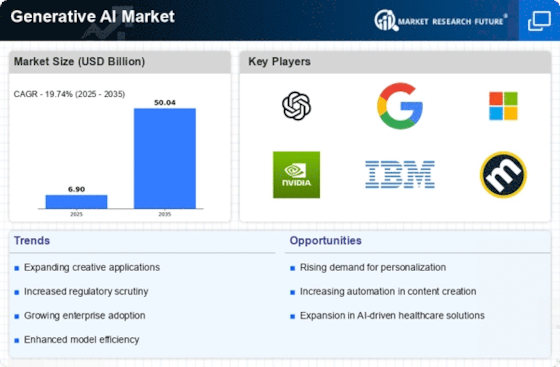
The global Generative AI market was valued at USD 6.897 Billion in 2024 and is projected to grow from USD 8.258 Billion in 2025 to USD 50.04 Billion by 2035, at a CAGR of 19.74% (2025–2035). Growth is driven by rising demand for AI-powered content creation, expansion of AI-driven applications across healthcare, finance and entertainment, integration of generative AI in business processes, and rapid advancements in large language models and machine learning algorithms. North America is the largest market (45% share); Asia-Pacific is the fastest-growing region (20% share).
 
Source: Market Research Future (MRFR)
 

USD 50.04 Billion by 2035 19.74% CAGR (2025–2035) North America - 45%
Projected Market Value GenAI Innovation-Led Growth Asia-Pacific - Fastest Growing
 
Published by: Market Research Future (MRFR)   |   Last Updated: March 2026   |   Forecast Period: 2025–2035   |   Base Year: 2024

Key Market Trends & Highlights

The Generative AI Market is experiencing robust growth driven by diverse applications and technological advancements.

  • The market is witnessing increased adoption in creative industries, particularly in North America, which remains the largest market. Enhanced personalization capabilities are becoming a focal point, especially in the Natural Language Processing segment, which is the largest. Collaboration between technology firms and academic institutions is fostering innovation, particularly in the Asia-Pacific region, recognized as the fastest-growing market. Rising demand for content creation and advancements in machine learning algorithms are key drivers propelling growth across various segments.

Market Size & Forecast

2024 Market Value $6.897B
2035 Projected Value $50.04B
CAGR 2025–2035 19.74%
Largest Regional Market Share in 2024 North America

Major Players

The generative AI market includes major innovators such as OpenAI, Google, Microsoft, NVIDIA, IBM, Meta, Amazon, Salesforce, Cohere, and Anthropic. These players are leading the development of advanced AI models and enterprise-grade generative solutions. The focus is on scalability, performance, and responsible AI deployment. Generative AI is rapidly becoming central to automation and content-driven workflows.

Market Trends

The Generative AI Market is currently experiencing a transformative phase, characterized by rapid advancements in technology and increasing adoption across various sectors. Organizations are increasingly recognizing the potential of generative AI to enhance creativity, streamline processes, and improve decision-making. This market encompasses a wide array of applications, including content generation, design automation, and personalized user experiences. The global AI market is expanding rapidly, with generative technologies emerging as a key growth driver across industries. The generative AI industry is witnessing rapid innovation driven by advancements in large language models and creative AI systems.

The generative AI landscape is characterized by the presence of major technology players and emerging startups driving innovation. The generative AI application landscape spans content creation, game development, product design, and advertising. This generative AI report provides comprehensive analysis of market size, trends, segmentation, and competitive dynamics through 2035.  As businesses strive to remain competitive, the integration of generative AI solutions appears to be a strategic priority, fostering innovation and efficiency.

Moreover, the Generative AI Market is witnessing a surge in investment and research initiatives aimed at refining algorithms and expanding capabilities. This trend is likely to lead to the emergence of more sophisticated tools that can generate high-quality outputs across diverse domains. The collaboration between technology firms and academic institutions seems to be a driving force behind these advancements, as they work together to explore new methodologies and applications. As the landscape evolves, it is essential for stakeholders to stay informed about emerging trends and potential challenges that may arise in this dynamic environment. Recent generative AI statistics indicate strong double-digit growth across enterprise and creative applications. The gen AI landscape continues to evolve with rapid advancements in foundation models and multimodal systems. Key gen AI trends include enterprise adoption, personalization, and integration across creative workflows. Generative AI in marketing enables personalized campaigns, automated content creation, and improved customer engagement.

Increased Adoption in Creative Industries

The Generative AI Market is seeing heightened interest from creative sectors such as advertising, entertainment, and design. Companies are leveraging generative AI to produce innovative content, enabling them to engage audiences more effectively. This trend suggests a shift towards automation in creative processes, allowing human creators to focus on higher-level strategic tasks.

Generative marketing is emerging as a key strategy, allowing brands to scale personalized content efficiently. Market research with generative AI is enhancing data analysis, survey design, and predictive insights for decision-makers. Companies that use artificial intelligence are increasingly adopting generative models to improve productivity and innovation. Conversational AI for enterprise applications is driving demand for advanced natural language processing solutions.

Enhanced Personalization Capabilities

Another notable trend within the Generative AI Market is the emphasis on personalization. Businesses are utilizing generative AI to tailor experiences and products to individual preferences. This capability not only improves customer satisfaction but also fosters brand loyalty, as consumers increasingly seek personalized interactions.

Collaboration Between Tech and Academia

The Generative AI Market is benefiting from collaborative efforts between technology companies and academic institutions. This partnership appears to be driving innovation, as researchers and developers work together to explore new applications and refine existing technologies. Such collaborations may lead to breakthroughs that enhance the overall effectiveness of generative AI solutions.

Generative AI Market Market Drivers

Rising Demand for Content Creation

The Generative AI Market experiences a notable surge in demand for content creation across various sectors. Businesses increasingly seek innovative solutions to generate high-quality text, images, and videos efficiently. This trend is driven by the need for personalized marketing strategies and engaging customer experiences. According to recent estimates, the content creation segment within the Generative AI Market is projected to grow at a compound annual growth rate of over 30% in the coming years. As organizations recognize the potential of AI-generated content to enhance brand visibility and customer engagement, investments in generative technologies are likely to escalate. This growing demand not only fuels the development of advanced algorithms but also encourages collaborations between tech companies and creative professionals, thereby shaping the future landscape of the Generative AI Market.

Expansion of AI-Driven Applications

The expansion of AI-driven applications is a crucial factor propelling the Generative AI Market forward. As various sectors, including healthcare, finance, and entertainment, increasingly adopt generative AI solutions, the market is witnessing a diversification of applications. For instance, in healthcare, generative AI is being utilized for drug discovery and personalized treatment plans, while in finance, it aids in risk assessment and fraud detection. This broadening of applications is expected to drive market growth, with projections indicating a potential increase in market size by over 40% in the next few years. The versatility of generative AI technologies not only enhances their appeal across industries but also encourages innovation, thereby shaping the future trajectory of the Generative AI Market.

Integration of AI in Business Processes

The integration of AI technologies into business processes is a pivotal driver for the Generative AI Market. Organizations are increasingly recognizing the value of automating tasks such as content generation, customer service, and data analysis through generative AI solutions. This integration streamlines operations, reduces costs, and enhances productivity. Recent surveys indicate that over 60% of businesses are actively exploring AI-driven solutions to improve their operational efficiency. As companies adopt generative AI tools, they are likely to experience significant improvements in decision-making and resource allocation. This trend not only propels the growth of the Generative AI Market but also encourages the development of tailored solutions that cater to specific industry needs, thereby expanding the market's reach and potential.

Growing Interest in Ethical AI Practices

The Generative AI Market is increasingly influenced by the growing interest in ethical AI practices. As concerns regarding data privacy, bias, and transparency rise, stakeholders are advocating for responsible AI development and deployment. This shift is prompting companies to adopt ethical guidelines and frameworks that govern the use of generative AI technologies. Research indicates that organizations prioritizing ethical considerations in their AI strategies are likely to gain a competitive edge, as consumers become more discerning about the technologies they engage with. The emphasis on ethical AI not only shapes the development of generative models but also fosters trust among users, which is essential for the long-term sustainability of the Generative AI Market.

Advancements in Machine Learning Algorithms

The Generative AI Market benefits significantly from continuous advancements in machine learning algorithms. These innovations enhance the capabilities of generative models, enabling them to produce more realistic and contextually relevant outputs. Recent developments in deep learning techniques, such as transformer models, have revolutionized the way AI systems understand and generate human-like text and images. As a result, the efficiency and accuracy of generative AI applications are improving, leading to broader adoption across industries. The market for machine learning in generative AI is expected to witness substantial growth, with estimates suggesting a potential increase of over 25% in the next few years. This progress not only attracts investments but also fosters a competitive environment, pushing companies to innovate and refine their offerings within the Generative AI Market.

Market Segment Insights

By Technology: Natural Language Processing (Largest) vs. Image Generation (Fastest-Growing)

The Generative AI Market is diversely segmented into various technologies, including <a href="https://www.marketresearchfuture.com/reports/natural-language-processing-market-1288">Natural Language Processing (NLP)</a>, Image Generation, Speech Synthesis, and Video Generation. Among these, NLP holds the largest market share, driven by its extensive applications in chatbots, virtual assistants, and content creation. Image Generation follows closely, showcasing significant contributions to creative industries and marketing campaigns. The increasing demand for AI-generated text and visuals highlights the importance of these segment values in shaping the future of AI technologies.

Technology: NLP (Dominant) vs. Image Generation (Emerging)

Natural Language Processing (NLP) stands as the dominant force in the Generative AI Market due to its robust applications across various sectors, including e-commerce, healthcare, and entertainment. It excels in enabling machines to understand and generate human language, leading to enhanced user experiences. On the other hand, Image Generation represents an emerging segment, rapidly gaining traction with advancements in deep learning and GANs (Generative Adversarial Networks). This technology enables the creation of realistic images for various applications, from art generation to product design. The competition between NLP and Image Generation reveals a dynamic landscape where both serve distinct yet complementary roles in driving innovation.

By Application: Content Creation (Largest) vs. Game Development (Fastest-Growing)

Among the application segments in the Generative AI Market, Content Creation emerges as the largest, capturing significant market share. It encompasses various domains, including text, video, and image generation, appealing to diverse industries such as media, entertainment, and education. In contrast, Game Development, while currently smaller in market share, showcases rapid adoption and innovation, with more developers leveraging AI to create immersive, dynamic gaming experiences. As we observe growth trends, the demand for enhanced creativity and efficiency in Content Creation is propelling its dominance in the market. Meanwhile, Game Development is gaining momentum due to the rise of virtual and augmented reality experiences, attracting tech-savvy audiences. The synergy between <a href="https://www.marketresearchfuture.com/reports/ai-in-games-market-22334">AI and gaming</a> is expected to drive further innovation and investment in this area, marking it as an emerging frontier in the application of generative technologies.

Content Creation (Dominant) vs. Advertising (Emerging)

Content Creation stands as a dominant force in the Generative AI Market, characterized by its vast applications ranging from automated journalism to art generation. It caters to industries seeking to enhance productivity and creativity, allowing businesses to generate high-quality content efficiently. This segment thrives on advancements in natural language processing and <a href="https://www.marketresearchfuture.com/reports/deep-learning-market-6058">deep learning</a>, enabling AI systems to produce content that resonates with human emotion and creativity. In contrast, Advertising is an emerging application, capitalizing on AI's ability to craft personalized marketing strategies. Through generative models, advertisers can create tailored campaigns that engage consumers more effectively. This segment is evolving rapidly, with innovations in targeted content generation and customer interaction technologies that enhance brand engagement and user experience.

By End Use: Healthcare (Largest) vs. Education (Fastest-Growing)

In the Generative AI Market, the healthcare sector captures the largest share, driven by increasing demand for AI solutions in diagnostics, patient management, and personalized medicine. Following closely, the education sector is emerging as a significant player, leveraging generative AI for personalized learning experiences, instructional design, and administrative efficiency. Other noteworthy segments include entertainment, which utilizes generative AI for content creation and gaming enhancements, and retail, where AI is transforming customer engagement through personalized shopping experiences and insightful analytics. The growth trends within these segments reflect shifts in technology adoption and consumer preferences. Healthcare's dominance is propelled by advancements in data analytics, while education benefits from <a href="https://www.marketresearchfuture.com/reports/digital-transformation-market-8685">digital transformation</a> and a focus on adaptive learning tools. Moreover, the entertainment sector is witnessing a surge in demand for immersive experiences, and retail is increasingly integrating AI to streamline operations and enhance customer interaction. These factors collectively indicate a robust and evolving landscape within the Generative AI Market.

Healthcare: (Dominant) vs. Education (Emerging)

The healthcare segment stands out as a dominant force in the Generative AI Market, characterized by its extensive application in clinical environments, research, and telemedicine. AI technologies enable <a href="https://www.marketresearchfuture.com/reports/predictive-analytics-market-6845">predictive analytics</a>, improve patient outcomes, and streamline operational workflows, making healthcare more efficient and effective. In contrast, the education segment is emerging rapidly, driven by the need for personalized learning paths and the integration of AI in curriculum development. Generative AI Market is reshaping educational methodologies, fostering engagement, and delivering customized content to cater to diverse learning styles. While healthcare is firmly established, education is stirring innovation and opening new avenues for growth, representing a dynamic shift in how both sectors utilize AI.

By Deployment Mode: Cloud (Largest) vs. On-Premises (Fastest-Growing)

In the Generative AI Market, the deployment mode segment is primarily divided into Cloud and On-Premises configurations. The Cloud deployment model holds the largest market share, favored by organizations for its scalability, accessibility, and reduced infrastructure costs. This model allows users to access generative AI tools and applications over the Internet, thus enhancing collaboration and flexibility for businesses of all sizes. Conversely, the On-Premises deployment mode is witnessing rapid growth and is often preferred by enterprises requiring stringent data security and compliance measures. As organizations increasingly recognize the benefits of retaining control over their data environments, the demand for On-Premises solutions is set to surge, making it the fastest-growing segment in deployment modes within the Generative AI Market.

Deployment Mode: Cloud (Dominant) vs. On-Premises (Emerging)

The Cloud deployment model in the Generative AI Market is recognized for its dominant position due to its ability to facilitate real-time collaboration and rapid deployment of AI solutions without the need for substantial upfront investment. Organizations utilizing the Cloud can easily scale their AI capabilities and benefit from continuous updates and innovation without extensive IT overhead. In contrast, On-Premises solutions, although currently emerging, cater to businesses that prioritize data sovereignty and compliance. These solutions provide enhanced control over sensitive information, thereby appealing to industries like finance and healthcare, where data privacy is paramount. The ongoing advancements in technology are likely to propel On-Premises deployments, making them a notable option for organizations looking to balance performance with security.

Get more detailed insights about Generative AI Market Research Report - Global Forecast till 2035

Regional Insights

North America : Innovation and Leadership Hub

North America is the largest market for Generative AI Market, holding approximately 45% of the global share. The region's growth is driven by significant investments in AI research and development, a robust technology infrastructure, and a favorable regulatory environment. The demand for AI solutions across various sectors, including healthcare, finance, and entertainment, is propelling market expansion. Additionally, government initiatives supporting AI innovation are further catalyzing growth. The United States is the leading country in this market, with major players like OpenAI, Google, and Microsoft headquartered here. Canada also plays a significant role, with companies like Cohere contributing to the competitive landscape. The presence of these key players fosters a vibrant ecosystem, encouraging collaboration and innovation. As the market evolves, North America is expected to maintain its leadership position, driven by continuous advancements in AI technology. North America accounts for the largest artificial intelligence market share due to strong technology infrastructure and early adoption.

Europe : Emerging Regulatory Frameworks

Europe is witnessing rapid growth in the Generative AI Market, holding approximately 30% of the global share. The region's expansion is fueled by increasing demand for AI-driven solutions across industries, coupled with stringent regulations aimed at ensuring ethical AI use. The European Union's initiatives to create a comprehensive regulatory framework for AI are pivotal in shaping market dynamics, fostering innovation while addressing ethical concerns. Leading countries in Europe include Germany, France, and the United Kingdom, each contributing significantly to the market. The competitive landscape features both established tech giants and innovative startups, creating a diverse ecosystem. Companies like SAP and DeepMind are at the forefront, driving advancements in AI technology. As Europe continues to refine its regulatory approach, the market is expected to grow, balancing innovation with responsible AI practices.

Asia-Pacific : Rapid Adoption and Growth

Asia-Pacific is rapidly emerging as a significant player in the Generative AI Market, accounting for approximately 20% of the global share. The region's growth is driven by increasing digital transformation initiatives, a burgeoning tech-savvy population, and substantial investments in AI research. Countries like China and India are leading this charge, with government support for AI innovation and a growing demand for AI applications across various sectors. China is at the forefront, with major companies like Baidu and Alibaba investing heavily in AI technologies. India is also making strides, with a vibrant startup ecosystem focused on AI solutions. The competitive landscape is characterized by a mix of established firms and innovative startups, fostering a dynamic environment for growth. As the region continues to embrace AI, its market share is expected to expand significantly in the coming years.

Middle East and Africa : Resource-Rich Frontier

The Middle East and Africa are gradually establishing themselves in the Generative AI Market, holding about 5% of the global share. The region's growth is driven by increasing investments in technology and digital infrastructure, alongside government initiatives aimed at fostering innovation. Countries like the UAE and South Africa are leading the way, with a focus on integrating AI into various sectors, including finance and healthcare. The competitive landscape is evolving, with both local startups and international players entering the market. The UAE, in particular, is making significant strides in AI adoption, supported by government policies promoting technology. As the region continues to develop its AI capabilities, it is poised for growth, leveraging its unique resources and strategic location to attract investment and talent.

Key Players and Competitive Insights

The Generative AI Market has witnessed significant growth and evolution, driven by advancements in machine learning and creative technologies. This market has captivated various sectors by allowing for the generation of text, images, music, and other media through artificial intelligence. The competitive landscape is characterized by a blend of established tech giants and emerging startups, each bringing unique capabilities and innovations to the forefront of generative AI. Companies in this space are vying for market share, investing heavily in research and development, and establishing strategic partnerships to enhance their offerings. As applications of generative AI proliferate, understanding the competitors' strengths and weaknesses is essential to navigating this dynamic environment.

Baidu holds a prominent position in the Generative AI Market, leveraging its extensive expertise in artificial intelligence research and development. The company has established a strong presence through its AI platforms, which encompass various applications, from natural language processing to content generation. Baidu's strengths lie in its significant investments in AI and machine learning, allowing it to harness vast amounts of data for training its models. This position not only enhances the accuracy and efficiency of its generative AI solutions but also provides a competitive edge in delivering tailored applications across industries. Baidu's commitment to innovation and continuous improvement solidifies its reputation as a leader in the generative AI segment on a global scale.OpenAI has emerged as a pivotal player in the Generative AI Market, renowned for its cutting-edge models and technologies that have redefined the capabilities of artificial intelligence. The company's flagship products, such as advanced language models, have garnered widespread attention for their ability to generate human-like text and engage in complex conversations. OpenAI's market presence is reinforced by its strategic partnerships and collaborations that facilitate access to diverse datasets and bolster its innovation efforts. Among its strengths are its commitment to ethical AI development and community engagement, fostering a responsible approach to generative technologies. The company has also involved itself in significant mergers and acquisitions, enhancing its research capabilities and expanding its product offerings. OpenAI continues to innovate, ensuring its relevance and leadership in the rapidly evolving global generative AI landscape.

Key Companies in the Generative AI Market include

Industry Developments

The Generative AI Market has experienced significant developments recently. NVIDIA continues to strengthen its position in the market by expanding its GPU offerings tailored for AI workloads, facilitating faster training for generative models. Adobe acquired Supernormal in June 2023, a startup that provides AI-powered meeting summaries, thereby improving its creative and productivity AI. Leading generative AI developers such as OpenAI, Google, and Anthropic continue to invest heavily in model innovation and deployment. Key players are expanding their generative AI offerings across text, image, speech, and video generation solutions.

In a Series C round in June 2023, Cohere raised $270 million, resulting in a valuation of approximately $2.2 billion. The company was valued at $5.5 billion after securing $500 million in July 2024. With tech giants like Google and Amazon leveraging generative AI to optimize their cloud services, competition is intensifying, leading to innovation and further investment in the sector over the last two years.

Future Outlook

Generative AI Market Future Outlook

The Generative AI Market is projected to grow at a 19.74% CAGR from 2025 to 2035, driven by advancements in machine learning, increased demand for automation, and enhanced data processing capabilities.

New opportunities lie in:

  • <p>Development of industry-specific generative AI solutions for healthcare and finance. Integration of generative AI in content creation platforms for personalized marketing. Establishment of AI-driven customer service chatbots to enhance user engagement.</p>

By 2035, the Generative AI Market is expected to be a cornerstone of technological innovation and business strategy.

Market Segmentation

Generative AI Market End Use Outlook

  • Healthcare
  • Entertainment
  • Retail
  • Education

Generative AI Market Technology Outlook

  • Natural Language Processing
  • Image Generation
  • Speech Synthesis
  • Video Generation

Generative AI Market Application Outlook

  • Content Creation
  • Game Development
  • Product Design
  • Advertising

Generative AI Market Deployment Mode Outlook

  • Cloud
  • On-Premises

Report Scope

MARKET SIZE 2024 6.897(USD Billion)
MARKET SIZE 2025 8.258(USD Billion)
MARKET SIZE 2035 50.04(USD Billion)
COMPOUND ANNUAL GROWTH RATE (CAGR) 19.74% (2025 - 2035)
REPORT COVERAGE Revenue Forecast, Competitive Landscape, Growth Factors, and Trends
BASE YEAR 2024
Market Forecast Period 2025 - 2035
Historical Data 2019 - 2024
Market Forecast Units USD Billion
Key Companies Profiled OpenAI (US), Google (US), Microsoft (US), NVIDIA (US), IBM (US), Meta (US), Amazon (US), Salesforce (US), Cohere (CA), Anthropic (US)
Segments Covered Technology, Application, End Use, Deployment Mode, Regional
Key Market Opportunities Integration of Generative AI in personalized content creation and automated design processes.
Key Market Dynamics Rising demand for personalized content drives innovation and competition in the Generative Artificial Intelligence Market.
Countries Covered North America, Europe, APAC, South America, MEA

FAQs

What is the current valuation of the Generative AI Market as of 2024?

<p>The Generative AI Market was valued at 6.897 USD Billion in 2024.</p>

What is the projected market size for the Generative AI Market by 2035?

<p>The market is projected to reach 50.04 USD Billion by 2035.</p>

What is the expected CAGR for the Generative AI Market during the forecast period 2025 - 2035?

<p>The expected CAGR for the Generative AI Market during 2025 - 2035 is 19.74%.</p>

Which technology segment is anticipated to dominate the Generative AI Market?

<p>Natural Language Processing is expected to dominate, growing from 2.5 USD Billion in 2024 to 18.5 USD Billion by 2035.</p>

How does the Image Generation segment perform in the Generative AI Market?

<p>The Image Generation segment is projected to grow from 1.5 USD Billion in 2024 to 12.0 USD Billion by 2035.</p>

What applications are driving growth in the Generative AI Market?

<p>Content Creation is a key application, expected to expand from 2.5 USD Billion in 2024 to 18.5 USD Billion by 2035.</p>

Which end-use sector shows the highest growth potential in the Generative AI Market?

<p>The Entertainment sector is likely to show substantial growth, increasing from 2.0 USD Billion in 2024 to 15.0 USD Billion by 2035.</p>

What deployment mode is forecasted to lead the Generative AI Market?

<p>The Cloud deployment mode is anticipated to lead, growing from 4.137 USD Billion in 2024 to 30.02 USD Billion by 2035.</p>

Who are the key players in the Generative AI Market?

<p>Key players include OpenAI, Google, Microsoft, NVIDIA, IBM, Meta, Amazon, Salesforce, Cohere, and Anthropic.</p>

What is the growth outlook for the Game Development application in the Generative AI Market?

<p>The Game Development application is projected to grow from 1.5 USD Billion in 2024 to 10.5 USD Billion by 2035.</p>

  1. SECTION I: EXECUTIVE SUMMARY AND KEY HIGHLIGHTS |
    1. EXECUTIVE SUMMARY | |
      1. Market Overview | |
      2. Key Findings | |
      3. Market Segmentation | |
      4. Competitive Landscape | |
      5. Challenges and Opportunities | |
      6. Future Outlook 2
  2. SECTION II: SCOPING, METHODOLOGY AND MARKET STRUCTURE |
    1. MARKET INTRODUCTION | |
      1. Definition | |
      2. Scope of the study | | |
    2. RESEARCH METHODOLOGY | |
      1. Overview | |
      2. Data Mining | |
      3. Secondary Research | |
      4. Primary Research | | |
      5. Forecasting Model | |
      6. Market Size Estimation | | |
      7. Data Triangulation | |
      8. Validation 3
  3. SECTION III: QUALITATIVE ANALYSIS |
    1. MARKET DYNAMICS | |
      1. Overview | |
      2. Drivers | |
      3. Restraints | |
      4. Opportunities |
    2. MARKET FACTOR ANALYSIS | |
      1. Value chain Analysis | |
      2. Porter's Five Forces Analysis | | |
      3. COVID-19 Impact Analysis | | |
  4. SECTION IV: QUANTITATIVE ANALYSIS |
    1. Information and Communications Technology, BY Technology (USD Billion) | |
      1. Natural Language Processing | |
      2. Image Generation | |
      3. Speech Synthesis | |
      4. Video Generation |
    2. Information and Communications Technology, BY Application (USD Billion) | |
      1. Content Creation | |
      2. Game Development | |
      3. Product Design | |
      4. Advertising |
    3. Information and Communications Technology, BY End Use (USD Billion) | |
      1. Healthcare | |
      2. Entertainment | |
      3. Retail | |
      4. Education |
    4. Information and Communications Technology, BY Deployment Mode (USD Billion) | |
      1. Cloud | |
      2. On-Premises |
    5. Information and Communications Technology, BY Region (USD Billion) | |
      1. North America | | |
      2. Europe | | |
      3. APAC | | |
      4. South America | | |
      5. MEA | | |
  5. SECTION V: COMPETITIVE ANALYSIS |
    1. Competitive Landscape | |
      1. Overview | |
      2. Competitive Analysis | |
      3. Market share Analysis | |
      4. Major Growth Strategy in the Information and Communications Technology | |
      5. Competitive Benchmarking | |
      6. Leading Players in Terms of Number of Developments in the Information and Communications Technology | |
      7. Key developments and growth strategies | | |
      8. Major Players Financial Matrix | | |
    2. Company Profiles | |
      1. OpenAI (US) | | |
      2. Google (US) | | |
      3. Microsoft (US) | | |
      4. NVIDIA (US) | | |
      5. IBM (US) | | |
      6. Meta (US) | | |
      7. Amazon (US) | | |
      8. Salesforce (US) | | |
      9. Cohere (CA) | | |
      10. Anthropic (US) | | |
    3. Appendix | |
      1. References | |
      2. Related Reports 6 LIST OF FIGURES |
    4. MARKET SYNOPSIS |
    5. NORTH AMERICA MARKET ANALYSIS |
    6. US MARKET ANALYSIS BY TECHNOLOGY |
    7. US MARKET ANALYSIS BY APPLICATION |
    8. US MARKET ANALYSIS BY END USE |
    9. US MARKET ANALYSIS BY DEPLOYMENT MODE |
    10. CANADA MARKET ANALYSIS BY TECHNOLOGY |
    11. CANADA MARKET ANALYSIS BY APPLICATION |
    12. CANADA MARKET ANALYSIS BY END USE |
    13. CANADA MARKET ANALYSIS BY DEPLOYMENT MODE |
    14. EUROPE MARKET ANALYSIS |
    15. GERMANY MARKET ANALYSIS BY TECHNOLOGY |
    16. GERMANY MARKET ANALYSIS BY APPLICATION |
    17. GERMANY MARKET ANALYSIS BY END USE |
    18. GERMANY MARKET ANALYSIS BY DEPLOYMENT MODE |
    19. UK MARKET ANALYSIS BY TECHNOLOGY |
    20. UK MARKET ANALYSIS BY APPLICATION |
    21. UK MARKET ANALYSIS BY END USE |
    22. UK MARKET ANALYSIS BY DEPLOYMENT MODE |
    23. FRANCE MARKET ANALYSIS BY TECHNOLOGY |
    24. FRANCE MARKET ANALYSIS BY APPLICATION |
    25. FRANCE MARKET ANALYSIS BY END USE |
    26. FRANCE MARKET ANALYSIS BY DEPLOYMENT MODE |
    27. RUSSIA MARKET ANALYSIS BY TECHNOLOGY |
    28. RUSSIA MARKET ANALYSIS BY APPLICATION |
    29. RUSSIA MARKET ANALYSIS BY END USE |
    30. RUSSIA MARKET ANALYSIS BY DEPLOYMENT MODE |
    31. ITALY MARKET ANALYSIS BY TECHNOLOGY |
    32. ITALY MARKET ANALYSIS BY APPLICATION |
    33. ITALY MARKET ANALYSIS BY END USE |
    34. ITALY MARKET ANALYSIS BY DEPLOYMENT MODE |
    35. SPAIN MARKET ANALYSIS BY TECHNOLOGY |
    36. SPAIN MARKET ANALYSIS BY APPLICATION |
    37. SPAIN MARKET ANALYSIS BY END USE |
    38. SPAIN MARKET ANALYSIS BY DEPLOYMENT MODE |
    39. REST OF EUROPE MARKET ANALYSIS BY TECHNOLOGY |
    40. REST OF EUROPE MARKET ANALYSIS BY APPLICATION |
    41. REST OF EUROPE MARKET ANALYSIS BY END USE |
    42. REST OF EUROPE MARKET ANALYSIS BY DEPLOYMENT MODE |
    43. APAC MARKET ANALYSIS |
    44. CHINA MARKET ANALYSIS BY TECHNOLOGY |
    45. CHINA MARKET ANALYSIS BY APPLICATION |
    46. CHINA MARKET ANALYSIS BY END USE |
    47. CHINA MARKET ANALYSIS BY DEPLOYMENT MODE |
    48. INDIA MARKET ANALYSIS BY TECHNOLOGY |
    49. INDIA MARKET ANALYSIS BY APPLICATION |
    50. INDIA MARKET ANALYSIS BY END USE |
    51. INDIA MARKET ANALYSIS BY DEPLOYMENT MODE |
    52. JAPAN MARKET ANALYSIS BY TECHNOLOGY |
    53. JAPAN MARKET ANALYSIS BY APPLICATION |
    54. JAPAN MARKET ANALYSIS BY END USE |
    55. JAPAN MARKET ANALYSIS BY DEPLOYMENT MODE |
    56. SOUTH KOREA MARKET ANALYSIS BY TECHNOLOGY |
    57. SOUTH KOREA MARKET ANALYSIS BY APPLICATION |
    58. SOUTH KOREA MARKET ANALYSIS BY END USE |
    59. SOUTH KOREA MARKET ANALYSIS BY DEPLOYMENT MODE |
    60. MALAYSIA MARKET ANALYSIS BY TECHNOLOGY |
    61. MALAYSIA MARKET ANALYSIS BY APPLICATION |
    62. MALAYSIA MARKET ANALYSIS BY END USE |
    63. MALAYSIA MARKET ANALYSIS BY DEPLOYMENT MODE |
    64. THAILAND MARKET ANALYSIS BY TECHNOLOGY |
    65. THAILAND MARKET ANALYSIS BY APPLICATION |
    66. THAILAND MARKET ANALYSIS BY END USE |
    67. THAILAND MARKET ANALYSIS BY DEPLOYMENT MODE |
    68. INDONESIA MARKET ANALYSIS BY TECHNOLOGY |
    69. INDONESIA MARKET ANALYSIS BY APPLICATION |
    70. INDONESIA MARKET ANALYSIS BY END USE |
    71. INDONESIA MARKET ANALYSIS BY DEPLOYMENT MODE |
    72. REST OF APAC MARKET ANALYSIS BY TECHNOLOGY |
    73. REST OF APAC MARKET ANALYSIS BY APPLICATION |
    74. REST OF APAC MARKET ANALYSIS BY END USE |
    75. REST OF APAC MARKET ANALYSIS BY DEPLOYMENT MODE |
    76. SOUTH AMERICA MARKET ANALYSIS |
    77. BRAZIL MARKET ANALYSIS BY TECHNOLOGY |
    78. BRAZIL MARKET ANALYSIS BY APPLICATION |
    79. BRAZIL MARKET ANALYSIS BY END USE |
    80. BRAZIL MARKET ANALYSIS BY DEPLOYMENT MODE |
    81. MEXICO MARKET ANALYSIS BY TECHNOLOGY |
    82. MEXICO MARKET ANALYSIS BY APPLICATION |
    83. MEXICO MARKET ANALYSIS BY END USE |
    84. MEXICO MARKET ANALYSIS BY DEPLOYMENT MODE |
    85. ARGENTINA MARKET ANALYSIS BY TECHNOLOGY |
    86. ARGENTINA MARKET ANALYSIS BY APPLICATION |
    87. ARGENTINA MARKET ANALYSIS BY END USE |
    88. ARGENTINA MARKET ANALYSIS BY DEPLOYMENT MODE |
    89. REST OF SOUTH AMERICA MARKET ANALYSIS BY TECHNOLOGY |
    90. REST OF SOUTH AMERICA MARKET ANALYSIS BY APPLICATION |
    91. REST OF SOUTH AMERICA MARKET ANALYSIS BY END USE |
    92. REST OF SOUTH AMERICA MARKET ANALYSIS BY DEPLOYMENT MODE |
    93. MEA MARKET ANALYSIS |
    94. GCC COUNTRIES MARKET ANALYSIS BY TECHNOLOGY |
    95. GCC COUNTRIES MARKET ANALYSIS BY APPLICATION |
    96. GCC COUNTRIES MARKET ANALYSIS BY END USE |
    97. GCC COUNTRIES MARKET ANALYSIS BY DEPLOYMENT MODE |
    98. SOUTH AFRICA MARKET ANALYSIS BY TECHNOLOGY |
    99. SOUTH AFRICA MARKET ANALYSIS BY APPLICATION |
    100. SOUTH AFRICA MARKET ANALYSIS BY END USE |
    101. SOUTH AFRICA MARKET ANALYSIS BY DEPLOYMENT MODE |
    102. REST OF MEA MARKET ANALYSIS BY TECHNOLOGY |
    103. REST OF MEA MARKET ANALYSIS BY APPLICATION |
    104. REST OF MEA MARKET ANALYSIS BY END USE |
    105. REST OF MEA MARKET ANALYSIS BY DEPLOYMENT MODE |
    106. KEY BUYING CRITERIA OF INFORMATION AND COMMUNICATIONS TECHNOLOGY |
    107. RESEARCH PROCESS OF MRFR |
    108. DRO ANALYSIS OF INFORMATION AND COMMUNICATIONS TECHNOLOGY |
    109. DRIVERS IMPACT ANALYSIS: INFORMATION AND COMMUNICATIONS TECHNOLOGY |
    110. RESTRAINTS IMPACT ANALYSIS: INFORMATION AND COMMUNICATIONS TECHNOLOGY |
    111. SUPPLY / VALUE CHAIN: INFORMATION AND COMMUNICATIONS TECHNOLOGY |
    112. INFORMATION AND COMMUNICATIONS TECHNOLOGY, BY TECHNOLOGY, 2024 (% SHARE) |
    113. INFORMATION AND COMMUNICATIONS TECHNOLOGY, BY TECHNOLOGY, 2024 TO 2035 (USD Billion) |
    114. INFORMATION AND COMMUNICATIONS TECHNOLOGY, BY APPLICATION, 2024 (% SHARE) |
    115. INFORMATION AND COMMUNICATIONS TECHNOLOGY, BY APPLICATION, 2024 TO 2035 (USD Billion) |
    116. INFORMATION AND COMMUNICATIONS TECHNOLOGY, BY END USE, 2024 (% SHARE) |
    117. INFORMATION AND COMMUNICATIONS TECHNOLOGY, BY END USE, 2024 TO 2035 (USD Billion) |
    118. INFORMATION AND COMMUNICATIONS TECHNOLOGY, BY DEPLOYMENT MODE, 2024 (% SHARE) |
    119. INFORMATION AND COMMUNICATIONS TECHNOLOGY, BY DEPLOYMENT MODE, 2024 TO 2035 (USD Billion) |
    120. BENCHMARKING OF MAJOR COMPETITORS 7 LIST OF TABLES |
    121. LIST OF ASSUMPTIONS | |
      1. |
    122. North America MARKET SIZE ESTIMATES; FORECAST | |
      1. BY TECHNOLOGY, 2025-2035 (USD Billion) | |
      2. BY APPLICATION, 2025-2035 (USD Billion) | |
      3. BY END USE, 2025-2035 (USD Billion) | |
      4. BY DEPLOYMENT MODE, 2025-2035 (USD Billion) |
    123. US MARKET SIZE ESTIMATES; FORECAST | |
      1. BY TECHNOLOGY, 2025-2035 (USD Billion) | |
      2. BY APPLICATION, 2025-2035 (USD Billion) | |
      3. BY END USE, 2025-2035 (USD Billion) | |
      4. BY DEPLOYMENT MODE, 2025-2035 (USD Billion) |
    124. Canada MARKET SIZE ESTIMATES; FORECAST | |
      1. BY TECHNOLOGY, 2025-2035 (USD Billion) | |
      2. BY APPLICATION, 2025-2035 (USD Billion) | |
      3. BY END USE, 2025-2035 (USD Billion) | |
      4. BY DEPLOYMENT MODE, 2025-2035 (USD Billion) |
    125. Europe MARKET SIZE ESTIMATES; FORECAST | |
      1. BY TECHNOLOGY, 2025-2035 (USD Billion) | |
      2. BY APPLICATION, 2025-2035 (USD Billion) | |
      3. BY END USE, 2025-2035 (USD Billion) | |
      4. BY DEPLOYMENT MODE, 2025-2035 (USD Billion) |
    126. Germany MARKET SIZE ESTIMATES; FORECAST | |
      1. BY TECHNOLOGY, 2025-2035 (USD Billion) | |
      2. BY APPLICATION, 2025-2035 (USD Billion) | |
      3. BY END USE, 2025-2035 (USD Billion) | |
      4. BY DEPLOYMENT MODE, 2025-2035 (USD Billion) |
    127. UK MARKET SIZE ESTIMATES; FORECAST | |
      1. BY TECHNOLOGY, 2025-2035 (USD Billion) | |
      2. BY APPLICATION, 2025-2035 (USD Billion) | |
      3. BY END USE, 2025-2035 (USD Billion) | |
      4. BY DEPLOYMENT MODE, 2025-2035 (USD Billion) |
    128. France MARKET SIZE ESTIMATES; FORECAST | |
      1. BY TECHNOLOGY, 2025-2035 (USD Billion) | |
      2. BY APPLICATION, 2025-2035 (USD Billion) | |
      3. BY END USE, 2025-2035 (USD Billion) | |
      4. BY DEPLOYMENT MODE, 2025-2035 (USD Billion) |
    129. Russia MARKET SIZE ESTIMATES; FORECAST | |
      1. BY TECHNOLOGY, 2025-2035 (USD Billion) | |
      2. BY APPLICATION, 2025-2035 (USD Billion) | |
      3. BY END USE, 2025-2035 (USD Billion) | |
      4. BY DEPLOYMENT MODE, 2025-2035 (USD Billion) |
    130. Italy MARKET SIZE ESTIMATES; FORECAST | |
      1. BY TECHNOLOGY, 2025-2035 (USD Billion) | |
      2. BY APPLICATION, 2025-2035 (USD Billion) | |
      3. BY END USE, 2025-2035 (USD Billion) | |
      4. BY DEPLOYMENT MODE, 2025-2035 (USD Billion) |
    131. Spain MARKET SIZE ESTIMATES; FORECAST | |
      1. BY TECHNOLOGY, 2025-2035 (USD Billion) | |
      2. BY APPLICATION, 2025-2035 (USD Billion) | |
      3. BY END USE, 2025-2035 (USD Billion) | |
      4. BY DEPLOYMENT MODE, 2025-2035 (USD Billion) |
    132. Rest of Europe MARKET SIZE ESTIMATES; FORECAST | |
      1. BY TECHNOLOGY, 2025-2035 (USD Billion) | |
      2. BY APPLICATION, 2025-2035 (USD Billion) | |
      3. BY END USE, 2025-2035 (USD Billion) | |
      4. BY DEPLOYMENT MODE, 2025-2035 (USD Billion) |
    133. APAC MARKET SIZE ESTIMATES; FORECAST | |
      1. BY TECHNOLOGY, 2025-2035 (USD Billion) | |
      2. BY APPLICATION, 2025-2035 (USD Billion) | |
      3. BY END USE, 2025-2035 (USD Billion) | |
      4. BY DEPLOYMENT MODE, 2025-2035 (USD Billion) |
    134. China MARKET SIZE ESTIMATES; FORECAST | |
      1. BY TECHNOLOGY, 2025-2035 (USD Billion) | |
      2. BY APPLICATION, 2025-2035 (USD Billion) | |
      3. BY END USE, 2025-2035 (USD Billion) | |
      4. BY DEPLOYMENT MODE, 2025-2035 (USD Billion) |
    135. India MARKET SIZE ESTIMATES; FORECAST | |
      1. BY TECHNOLOGY, 2025-2035 (USD Billion) | |
      2. BY APPLICATION, 2025-2035 (USD Billion) | |
      3. BY END USE, 2025-2035 (USD Billion) | |
      4. BY DEPLOYMENT MODE, 2025-2035 (USD Billion) |
    136. Japan MARKET SIZE ESTIMATES; FORECAST | |
      1. BY TECHNOLOGY, 2025-2035 (USD Billion) | |
      2. BY APPLICATION, 2025-2035 (USD Billion) | |
      3. BY END USE, 2025-2035 (USD Billion) | |
      4. BY DEPLOYMENT MODE, 2025-2035 (USD Billion) |
    137. South Korea MARKET SIZE ESTIMATES; FORECAST | |
      1. BY TECHNOLOGY, 2025-2035 (USD Billion) | |
      2. BY APPLICATION, 2025-2035 (USD Billion) | |
      3. BY END USE, 2025-2035 (USD Billion) | |
      4. BY DEPLOYMENT MODE, 2025-2035 (USD Billion) |
    138. Malaysia MARKET SIZE ESTIMATES; FORECAST | |
      1. BY TECHNOLOGY, 2025-2035 (USD Billion) | |
      2. BY APPLICATION, 2025-2035 (USD Billion) | |
      3. BY END USE, 2025-2035 (USD Billion) | |
      4. BY DEPLOYMENT MODE, 2025-2035 (USD Billion) |
    139. Thailand MARKET SIZE ESTIMATES; FORECAST | |
      1. BY TECHNOLOGY, 2025-2035 (USD Billion) | |
      2. BY APPLICATION, 2025-2035 (USD Billion) | |
      3. BY END USE, 2025-2035 (USD Billion) | |
      4. BY DEPLOYMENT MODE, 2025-2035 (USD Billion) |
    140. Indonesia MARKET SIZE ESTIMATES; FORECAST | |
      1. BY TECHNOLOGY, 2025-2035 (USD Billion) | |
      2. BY APPLICATION, 2025-2035 (USD Billion) | |
      3. BY END USE, 2025-2035 (USD Billion) | |
      4. BY DEPLOYMENT MODE, 2025-2035 (USD Billion) |
    141. Rest of APAC MARKET SIZE ESTIMATES; FORECAST | |
      1. BY TECHNOLOGY, 2025-2035 (USD Billion) | |
      2. BY APPLICATION, 2025-2035 (USD Billion) | |
      3. BY END USE, 2025-2035 (USD Billion) | |
      4. BY DEPLOYMENT MODE, 2025-2035 (USD Billion) |
    142. South America MARKET SIZE ESTIMATES; FORECAST | |
      1. BY TECHNOLOGY, 2025-2035 (USD Billion) | |
      2. BY APPLICATION, 2025-2035 (USD Billion) | |
      3. BY END USE, 2025-2035 (USD Billion) | |
      4. BY DEPLOYMENT MODE, 2025-2035 (USD Billion) |
    143. Brazil MARKET SIZE ESTIMATES; FORECAST | |
      1. BY TECHNOLOGY, 2025-2035 (USD Billion) | |
      2. BY APPLICATION, 2025-2035 (USD Billion) | |
      3. BY END USE, 2025-2035 (USD Billion) | |
      4. BY DEPLOYMENT MODE, 2025-2035 (USD Billion) |
    144. Mexico MARKET SIZE ESTIMATES; FORECAST | |
      1. BY TECHNOLOGY, 2025-2035 (USD Billion) | |
      2. BY APPLICATION, 2025-2035 (USD Billion) | |
      3. BY END USE, 2025-2035 (USD Billion) | |
      4. BY DEPLOYMENT MODE, 2025-2035 (USD Billion) |
    145. Argentina MARKET SIZE ESTIMATES; FORECAST | |
      1. BY TECHNOLOGY, 2025-2035 (USD Billion) | |
      2. BY APPLICATION, 2025-2035 (USD Billion) | |
      3. BY END USE, 2025-2035 (USD Billion) | |
      4. BY DEPLOYMENT MODE, 2025-2035 (USD Billion) |
    146. Rest of South America MARKET SIZE ESTIMATES; FORECAST | |
      1. BY TECHNOLOGY, 2025-2035 (USD Billion) | |
      2. BY APPLICATION, 2025-2035 (USD Billion) | |
      3. BY END USE, 2025-2035 (USD Billion) | |
      4. BY DEPLOYMENT MODE, 2025-2035 (USD Billion) |
    147. MEA MARKET SIZE ESTIMATES; FORECAST | |
      1. BY TECHNOLOGY, 2025-2035 (USD Billion) | |
      2. BY APPLICATION, 2025-2035 (USD Billion) | |
      3. BY END USE, 2025-2035 (USD Billion) | |
      4. BY DEPLOYMENT MODE, 2025-2035 (USD Billion) |
    148. GCC Countries MARKET SIZE ESTIMATES; FORECAST | |
      1. BY TECHNOLOGY, 2025-2035 (USD Billion) | |
      2. BY APPLICATION, 2025-2035 (USD Billion) | |
      3. BY END USE, 2025-2035 (USD Billion) | |
      4. BY DEPLOYMENT MODE, 2025-2035 (USD Billion) |
    149. South Africa MARKET SIZE ESTIMATES; FORECAST | |
      1. BY TECHNOLOGY, 2025-2035 (USD Billion) | |
      2. BY APPLICATION, 2025-2035 (USD Billion) | |
      3. BY END USE, 2025-2035 (USD Billion) | |
      4. BY DEPLOYMENT MODE, 2025-2035 (USD Billion) |
    150. Rest of MEA MARKET SIZE ESTIMATES; FORECAST | |
      1. BY TECHNOLOGY, 2025-2035 (USD Billion) | |
      2. BY APPLICATION, 2025-2035 (USD Billion) | |
      3. BY END USE, 2025-2035 (USD Billion) | |
      4. BY DEPLOYMENT MODE, 2025-2035 (USD Billion) |
    151. PRODUCT LAUNCH/PRODUCT DEVELOPMENT/APPROVAL | |
      1. |
    152. ACQUISITION/PARTNERSHIP | |

Information and Communications Technology Market Segmentation

Information and Communications Technology By Technology (USD Billion, 2025-2035)

  • Natural Language Processing
  • Image Generation
  • Speech Synthesis
  • Video Generation

Information and Communications Technology By Application (USD Billion, 2025-2035)

  • Content Creation
  • Game Development
  • Product Design
  • Advertising

Information and Communications Technology By End Use (USD Billion, 2025-2035)

  • Healthcare
  • Entertainment
  • Retail
  • Education

Information and Communications Technology By Deployment Mode (USD Billion, 2025-2035)

  • Cloud
  • On-Premises
Infographic

Free Sample Request

Kindly complete the form below to receive a free sample of this Report

Get Free Sample

Customer Strories

Compare Licence

×
Features License Type
Single User Multiuser License Enterprise User
Price $4,950 $5,950 $7,250
Maximum User Access Limit 1 User Upto 10 Users Unrestricted Access Throughout the Organization
Free Customization
Direct Access to Analyst
Deliverable Format
Platform Access
Discount on Next Purchase 10% 15% 15%
Printable Versions
%>