
×
Hero Background
English
Chinese
French
Japanese
Korean
German
Spanish

Garbage Collection Vehicle Market Trends

ID: MRFR/AT/6467-HCR
100 Pages
Sejal Akre
October 2025

Garbage Collection Vehicle Market Research Report Information By Loader Type (Front, Rear, Automated Side Loader, and Others), By Technology (Manual and Semi-Automatic), By Type (Light, Medium, and Heavy Duty), By Propulsion (ICE and Electric), And By Region (North America, Europe, Asia-Pacific, And Rest Of The World) –Market Forecast Till 2035

Share:
Download PDF ×

We do not share your information with anyone. However, we may send you emails based on your report interest from time to time. You may contact us at any time to opt-out.

Garbage Collection Vehicle Market Infographic
Purchase Options

Market Trends

Key Emerging Trends in the Garbage Collection Vehicle Market

In the dynamic landscape of the Garbage Collection Vehicle Market, companies employ various market share positioning strategies to gain a competitive edge and meet the evolving needs of municipalities and waste management entities. One prevalent approach involves differentiation through technological innovation. Companies invest heavily in research and development to introduce advanced features, such as automated sorting systems, route optimization algorithms, and eco-friendly propulsion systems. By offering cutting-edge solutions, these companies aim to carve a niche for themselves, attracting customers who prioritize efficiency, sustainability, and innovation.

Another key strategy revolves around cost leadership. Some players in the Garbage Collection Vehicle Market focus on achieving economies of scale, streamlining production processes, and optimizing the supply chain to deliver cost-effective solutions. This strategy aims to capture a significant portion of the market by providing affordable yet reliable garbage collection vehicles. Municipalities and waste management companies, often operating under budget constraints, are drawn to these cost-effective options, contributing to the company's increased market share.

Collaborative partnerships and strategic alliances constitute yet another crucial strategy in the Garbage Collection Vehicle Market. Companies engage in collaborations with technology providers, waste management consultants, or even local municipalities to enhance their product offerings and expand their market reach. These partnerships enable the development of tailored solutions that address specific regional needs or regulatory requirements. By aligning with influential stakeholders, companies position themselves strategically to access new markets and secure a larger share of the overall Garbage Collection Vehicle Market.

Customer-centric strategies are also gaining prominence in the market share positioning playbook. Understanding the unique demands of customers, companies tailor their products and services to meet specific requirements. This involves customization of vehicle features, offering flexible financing options, and providing comprehensive after-sales support. By prioritizing customer satisfaction, companies not only retain existing clients but also attract new ones through positive word-of-mouth and reputation building.

Additionally, sustainability and environmental consciousness have become key drivers in the Garbage Collection Vehicle Market. Companies adopting eco-friendly manufacturing processes, utilizing alternative fuels, and promoting recyclability aim to appeal to environmentally conscious customers. With an increasing emphasis on green initiatives and carbon footprint reduction, companies strategically position themselves as responsible and sustainable partners, attracting customers and gaining a competitive edge in the market.

Market penetration through geographic expansion is another strategy employed by companies in the Garbage Collection Vehicle Market. By identifying untapped regions and expanding their presence, companies can access new customer bases. This involves adapting products to suit local regulations, waste management practices, and infrastructure requirements. Successful penetration into emerging markets can significantly bolster a company's market share, as it establishes itself as a reliable and adaptable player in the global Garbage Collection Vehicle Market.

In conclusion, the Garbage Collection Vehicle Market is characterized by a variety of market share positioning strategies. From technological innovation and cost leadership to collaborative partnerships, customer-centric approaches, sustainability initiatives, and geographic expansion, companies navigate a complex landscape to secure their position. As the industry continues to evolve, flexibility and adaptability will be crucial for companies aiming not only to gain market share but also to sustain long-term success in the dynamic Garbage Collection Vehicle Market.


Author
Sejal Akre
Senior Research Analyst

She has over 5 years of rich experience, in market research and consulting providing valuable market insights to client. Hands on expertise in management consulting, and extensive knowledge in domain including ICT, Automotive & Transportation and Aerospace & Defense. She is skilled in Go-to market strategy, industry analysis, market sizing, in depth company profiling, competitive intelligence & benchmarking and value chain amongst others.

Leave a Comment

FAQs

How much is the Garbage Collection Vehicle market?

The Garbage Collection Vehicle Market size was valued at USD 15.09 Billion in 2024.

What is the growth rate of the Garbage Collection Vehicle market?

The global market is projected to grow at a CAGR of 5.66% during the forecast period, 2025-2034.

Which region held the largest market share in the Garbage Collection Vehicle market?

North America had the largest share of the global market

Who are the key players in the Garbage Collection Vehicle market?

The key players in the market are Heil Environmental (US), Geesink B.V. (Netherlands), and Pak-Mor. (US), Dennis Eagle Limited (UK), IVECO S.p.A. (Italy), Dulevo International S.p.A. (Italy), FAUN Umwelttechnik GmbH & Co. KG (Germany), CEEC TRUCKS INDUSTRY CO., LIMITED (China), Bridgeport Manufacturing (US), and Zoomlion Heavy Industry Science and Technology (China).

Which Loader Type led the Garbage Collection Vehicle market?

The Rear Loader category dominated the market in 2022.

Which Technology had the largest market share in the Garbage Collection Vehicle market?

The Manual had the largest share of the global market.

Market Summary

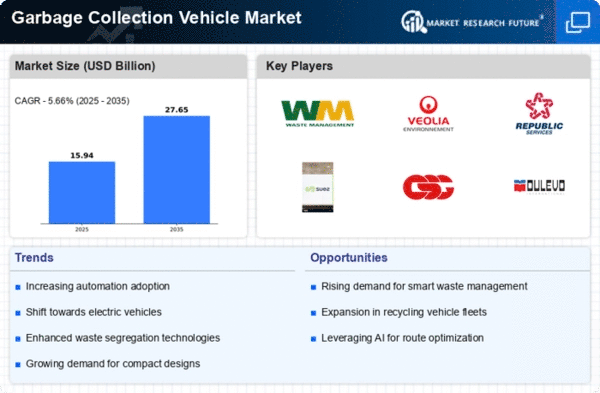
As per MRFR analysis, the Garbage Collection Vehicle Market Size was estimated at 15.09 USD Billion in 2024. The Garbage Collection Vehicle industry is projected to grow from 15.94 USD Billion in 2025 to 27.65 USD Billion by 2035, exhibiting a compound annual growth rate (CAGR) of 5.66 during the forecast period 2025 - 2035.

Key Market Trends & Highlights

The Garbage Collection Vehicle Market is experiencing a transformative shift towards sustainability and technological integration.

  • The market is witnessing a notable shift towards electrification, particularly in North America, which remains the largest market.
  • Integration of smart technologies is becoming increasingly prevalent, enhancing operational efficiency in both residential and commercial segments.
  • Regulatory support for sustainable practices is driving innovation, especially in the Asia-Pacific region, which is the fastest-growing market.
  • Increasing urbanization and rising awareness of waste management are key drivers propelling the demand for rear loader vehicles in the residential segment.

Market Size & Forecast

2024 Market Size 15.09 (USD Billion)
2035 Market Size 27.65 (USD Billion)
CAGR (2025 - 2035) 5.66%
Largest Regional Market Share in 2024 North America

Major Players

<p>Waste Management Inc (US), Veolia Environnement SA (FR), Republic Services Inc (US), SUEZ SA (FR), Cleansing Service Group (GB), Dulevo International S.p.A. (IT), Groupe Charles André (FR), Kässbohrer Geländefahrzeug AG (DE), Ecovia (PT)</p>

Market Trends

The Garbage Collection Vehicle Market is currently experiencing a transformative phase, driven by increasing urbanization and the growing emphasis on sustainable waste management practices. As cities expand, the demand for efficient and environmentally friendly waste collection solutions intensifies. This shift is prompting manufacturers to innovate, focusing on electric and hybrid vehicles that reduce emissions and operational costs. Furthermore, advancements in technology, such as smart waste management systems, are enhancing the efficiency of garbage collection processes, allowing for better route optimization and resource allocation. In addition to technological advancements, regulatory frameworks are evolving to support greener practices within the Garbage Collection Vehicle Market. Governments worldwide are implementing stricter environmental regulations, which compel municipalities to adopt cleaner vehicles. This trend not only aligns with global sustainability goals but also encourages investment in research and development. As a result, the market is poised for growth, with stakeholders increasingly recognizing the importance of integrating eco-friendly solutions into their operations. The future landscape of the Garbage Collection Vehicle Market appears promising, with a clear trajectory towards innovation and sustainability.
Shift Towards Electrification

The Garbage Collection Vehicle Market is witnessing a notable shift towards electrification, as stakeholders prioritize reducing carbon footprints. Electric and hybrid vehicles are becoming more prevalent, driven by advancements in battery technology and the need for sustainable waste management solutions. This trend suggests a long-term commitment to environmental responsibility.

Integration of Smart Technologies

The integration of smart technologies into garbage collection processes is gaining traction. Innovations such as IoT-enabled sensors and data analytics are enhancing operational efficiency. These technologies facilitate real-time monitoring and route optimization, potentially leading to reduced operational costs and improved service delivery.

Regulatory Support for Sustainable Practices

Regulatory frameworks are increasingly supporting sustainable practices within the Garbage Collection Vehicle Market. Governments are implementing stricter emissions standards and incentivizing the adoption of eco-friendly vehicles. This regulatory environment may drive further investment in cleaner technologies and promote a shift towards greener waste management solutions.
Garbage Collection Vehicle Market Market Drivers

Regulatory Compliance

Stringent environmental regulations are driving the Global Garbage Collection Vehicle Market Industry as governments worldwide enforce stricter waste management policies. Compliance with these regulations necessitates the use of advanced garbage collection vehicles that meet specific emission standards. For instance, the European Union has implemented regulations aimed at reducing carbon footprints, prompting municipalities to upgrade their fleets. This regulatory pressure is expected to propel market growth, as cities invest in cleaner and more efficient waste collection solutions. The anticipated market size of 27.7 USD Billion by 2035 underscores the importance of regulatory compliance in shaping the future of waste management.

Increasing Urbanization

The rapid pace of urbanization globally is a primary driver of the Global Garbage Collection Vehicle Market Industry. As more people migrate to urban areas, the demand for efficient waste management solutions intensifies. Urban centers require advanced garbage collection vehicles to handle the increasing volume of waste generated. For instance, cities like Tokyo and New York are investing heavily in modernizing their waste management fleets to accommodate growing populations. This trend is expected to contribute to the market's growth, with projections indicating a market size of 15.1 USD Billion in 2024, reflecting the urgent need for effective waste collection systems.

Rising Waste Generation

The continuous rise in waste generation is a fundamental driver of the Global Garbage Collection Vehicle Market Industry. As economies grow and consumption patterns evolve, the volume of waste produced increases, necessitating more efficient waste collection systems. For instance, developing countries are experiencing a surge in waste generation due to urbanization and changing lifestyles. This trend compels municipalities to enhance their garbage collection capabilities, leading to increased investments in modern vehicles. The market's growth trajectory is likely to reflect this reality, as cities strive to keep pace with rising waste volumes and improve their waste management infrastructure.

Market Growth Projections

The Global Garbage Collection Vehicle Market Industry is poised for substantial growth, with projections indicating a market size of 15.1 USD Billion in 2024 and an anticipated increase to 27.7 USD Billion by 2035. This growth trajectory suggests a robust demand for garbage collection vehicles, driven by factors such as urbanization, technological advancements, and regulatory compliance. The expected CAGR of 5.66% from 2025 to 2035 further emphasizes the industry's potential for expansion. As municipalities and waste management companies invest in modern fleets, the market is likely to witness significant transformations, aligning with global sustainability goals.

Technological Advancements

Technological innovations play a crucial role in shaping the Global Garbage Collection Vehicle Market Industry. The integration of smart technologies, such as GPS tracking, automated collection systems, and real-time monitoring, enhances operational efficiency and reduces costs. For example, cities are increasingly adopting electric garbage trucks, which not only lower emissions but also decrease fuel expenses. These advancements are likely to attract investments, as municipalities seek to modernize their fleets. The market is projected to grow at a CAGR of 5.66% from 2025 to 2035, indicating a strong inclination towards adopting cutting-edge technologies in waste management.

Growing Environmental Awareness

The increasing awareness of environmental issues among the global population is significantly influencing the Global Garbage Collection Vehicle Market Industry. Citizens are becoming more conscious of waste management practices and are advocating for sustainable solutions. This shift in public perception is prompting municipalities to invest in eco-friendly garbage collection vehicles, such as those powered by alternative fuels. For example, cities are exploring compressed natural gas and electric vehicles to minimize their environmental impact. As a result, the market is expected to expand, driven by the demand for greener waste management solutions that align with public expectations.

Market Segment Insights

By Application: Residential (Largest) vs. Commercial (Fastest-Growing)

<p>In the Garbage Collection Vehicle Market, the application segment is broadly categorized into Residential, Commercial, Industrial, and Municipal sectors. Currently, the Residential segment holds the largest share, driven by the consistent demand for reliable waste management solutions in urban areas. This segment caters to household consumers, ensuring efficient waste collection and disposal, while maintaining public hygiene and cleanliness. In contrast, the Commercial segment is rapidly gaining traction, benefiting from an increase in businesses recognizing the need for responsible waste management practices.</p>

<p>Commercial (Dominant) vs. Municipal (Emerging)</p>

<p>The Commercial application segment of the Garbage Collection Vehicle Market is characterized by its ability to cater to a diverse range of businesses, including retail, hospitality, and services, where effective waste removal is crucial. This segment has established itself as dominant due to growing environmental concerns and the implementation of stricter regulations on waste disposal. Conversely, the Municipal segment is emerging, driven by government initiatives and urbanization trends, focusing on upgrading city infrastructures to enhance waste management systems. While the Commercial sector remains foundational, Municipal applications are expanding in scope, presenting new opportunities for innovation and market growth.</p>

By Vehicle Type: Rear Loader (Largest) vs. Side Loader (Fastest-Growing)

<p>In the Garbage Collection Vehicle Market, the distribution of market share among different vehicle types reveals Rear Loaders as the largest segment, primarily due to their widespread adoption in urban settings. These vehicles are favored for their efficiency in collecting waste from residential areas, making them a staple in garbage collection operations. Meanwhile, Side Loaders are gaining traction and are recognized as the fastest-growing segment in the market. Their ability to operate in tighter spaces and collect waste without the need for curbside assistance appeals to municipalities looking for operational efficiency. Growth trends within this segment are driven by increasing urbanization and the rising demand for automated waste collection solutions. As cities grow, the need for compact and adaptable vehicles becomes paramount, which positions Side Loaders as a solution to challenges associated with densely populated areas. Additionally, advancements in technology are enhancing the appeal of these vehicles, making them more efficient and reducing the operational costs for waste management companies. This trend is likely to continue as municipalities prioritize sustainability and effective waste management strategies.</p>

<p>Rear Loader (Dominant) vs. Multi-Compartment (Emerging)</p>

<p>The Rear Loader segment holds a dominant position in the Garbage Collection Vehicle Market, characterized by its robust design and operational efficiency. These vehicles are highly versatile, typically employed for collecting solid waste from residential and commercial sources. Their compact nature allows for easy maneuverability in urban environments, ensuring effective waste management in crowded precincts. On the other hand, Multi-Compartment vehicles are emerging as an innovative solution, enabling the simultaneous collection of different types of waste, such as recyclables and organic materials, without cross-contamination. Their growing popularity is attributed to increasing environmental regulations and the push for sustainable waste management practices. As these vehicles continue to evolve with advanced features, their market position is set to strengthen, particularly among eco-conscious municipalities.</p>

By Fuel Type: Diesel (Largest) vs. Electric (Fastest-Growing)

<p>In the Garbage Collection Vehicle Market, Diesel remains the dominant fuel type, commanding the majority share due to its longstanding efficiency and availability. Natural Gas follows as a significant alternative, providing a cleaner-burning option that is gaining traction. Electric vehicles, while currently a smaller segment, are seeing rapid growth as technological advancements and environmental concerns drive innovation and adoption. Hybrid vehicles also hold a niche position, appealing to consumers seeking a balance between traditional and electric power sources.</p>

<p>Diesel (Dominant) vs. Electric (Emerging)</p>

<p>Diesel fuel has established itself as the dominant fuel type in the Garbage Collection Vehicle Market, favored for its powerful performance and established infrastructure. The reliability and extensive range of diesel engines make them the preferred choice for many municipalities. In contrast, electric garbage collection vehicles are emerging as a viable alternative, propelled by advances in battery technology and a societal push towards sustainability. While they currently represent a smaller market share, the rapid growth in electric vehicle adoption is attributed to increasing regulatory pressures, incentives for green technologies, and the potential for lower operational costs, making them an attractive option for future fleets.</p>

By Load Capacity: Heavy Duty (Largest) vs. Light Duty (Fastest-Growing)

<p>In the Garbage Collection Vehicle Market, the load capacity segment is prominently defined by heavy duty, medium duty, and light duty categories. Heavy-duty vehicles command significant market share due to their extensive applications in urban waste management and larger waste collection capacities. Medium-duty vehicles play an intermediary role, capturing a substantial niche between heavy and light duty. Meanwhile, light-duty vehicles, while having a smaller overall market share, have been on an upward trajectory, driven by urban expansion and increasing small business demands for waste management solutions.</p>

<p>Heavy Duty (Dominant) vs. Light Duty (Emerging)</p>

<p>Heavy duty garbage collection vehicles are considered the backbone of waste management operations in urban areas. These vehicles are designed to handle large volumes of waste, making them essential for municipalities and large corporations that require efficient waste disposal solutions. On the other hand, light duty vehicles are emerging players in this space, gaining traction in urbanized settings where maneuverability and fuel efficiency are prioritized. The increasing trend towards sustainability and eco-friendliness is creating opportunities for light duty vehicles that cater to customers seeking leaner and more cost-effective waste collection options.</p>

By Technology: Automated (Largest) vs. Semi-Automated (Fastest-Growing)

<p>In the Garbage Collection Vehicle Market, technology segment analysis reveals that the Automated category holds the largest market share, accounting for a significant proportion of the total vehicles used for waste collection. This segment is favored due to its efficiency and operational cost savings, enabling municipalities and private waste management companies to optimize routes and labor costs. Meanwhile, the Semi-Automated segment is quickly gaining traction, driven by advancements in technology and rising demand for more flexible waste collection solutions. Growth trends in the Garbage Collection Vehicle Market indicate an increasing shift towards innovative waste management practices, with the Semi-Automated vehicles being recognized for their adaptability and lower upfront costs compared to fully automated systems. Additionally, with growing environmental concerns and regulatory pressure, cities are investing more in technology that not only streamlines garbage collection but also minimizes environmental impact, thereby enhancing the overall urban waste management process.</p>

<p>Technology: Automated (Dominant) vs. Semi-Automated (Emerging)</p>

<p>The Automated segment leads in the Garbage Collection Vehicle Market due to its superior efficiency and effectiveness. These vehicles are equipped with advanced robotic systems, enabling them to operate without human intervention, which significantly reduces labor costs and increases collection volume per route. This makes them a preferred choice for large-scale waste management operations. On the other hand, the Semi-Automated segment is emerging as a strong competitor, appreciated for its balance of human operation and mechanical assistance. These vehicles offer flexibility and operational simplicity, making them suitable for varied urban environments where full automation may not be feasible. Together, these segments reflect a shift toward technology-enhanced waste management solutions, catering to different operational needs.</p>

Get more detailed insights about Garbage Collection Vehicle Market Research Report - Global Forecast till 2035

Regional Insights

By region, the study provides market insights into North America, Europe, Asia-Pacific, and the Rest of the World. The North American Garbage Collection Vehicle Market will dominate this market due to well-established markets and the availability of advanced Technology. In addition, the stable economy and dominance of key manufacturers globally will boost the market growth in this region.

Further, the major countries studied in the market report are the US, Canada, German, France, the UK, Italy, Spain, China, Japan, India, Australia, South Korea, and Brazil.

Figure 2: Garbage Collection Vehicle Market Share by Region 2022 (USD Billion)

Europe region’s  Garbage Collection Vehicle Market accounts for the second-highest market share due to growing industrialization and production capacity, leading to market growth. Further, the German Garbage Collection Vehicle Market holds the highest market share, and the UK Garbage Collection Vehicle Market is anticipated to grow steadily in the European region.

The Asia-Pacific Garbage Collection Vehicle Market is anticipated to grow significantly during the projected timeframe. This is due to spreading awareness regarding the benefits of garbage collection and rising per capita disposable income. Moreover, China’s Garbage Collection Vehicle Market dominates the market share, and the Indian Garbage Collection Vehicle Market is anticipated to grow and expand rapidly in the Asia-Pacific region during the projected timeframe.

Key Players and Competitive Insights

The Garbage Collection Vehicle Market is currently characterized by a dynamic competitive landscape, driven by increasing urbanization, stringent environmental regulations, and a growing emphasis on sustainability. Major players such as Waste Management Inc (US), Veolia Environnement SA (FR), and Republic Services Inc (US) are strategically positioning themselves through innovation and technological advancements. Waste Management Inc (US) has focused on enhancing its fleet with electric vehicles, aiming to reduce carbon emissions and improve operational efficiency. Meanwhile, Veolia Environnement SA (FR) has been investing in smart waste management solutions, integrating IoT technologies to optimize collection routes and reduce operational costs. These strategies collectively shape a competitive environment that is increasingly focused on sustainability and efficiency.

In terms of business tactics, companies are localizing manufacturing and optimizing supply chains to enhance responsiveness to market demands. The market structure appears moderately fragmented, with several key players holding substantial market shares while numerous smaller firms operate in niche segments. This fragmentation allows for diverse offerings and competitive pricing, although the influence of major players remains significant in setting industry standards and driving innovation.

In November 2025, Republic Services Inc (US) announced a partnership with a leading technology firm to develop AI-driven waste sorting systems. This strategic move is expected to enhance recycling rates and reduce contamination in waste streams, aligning with the company's sustainability goals. The integration of AI technology not only positions Republic Services as a leader in waste management innovation but also reflects a broader trend towards automation in the industry.

In October 2025, Veolia Environnement SA (FR) launched a new line of electric garbage collection vehicles designed for urban environments. This initiative underscores the company's commitment to reducing its carbon footprint and responding to the growing demand for eco-friendly solutions. The introduction of these vehicles is likely to enhance Veolia's competitive edge, particularly in regions with stringent emissions regulations.

In December 2025, Waste Management Inc (US) revealed plans to expand its fleet with advanced hybrid vehicles, which combine traditional fuel with electric power. This strategic decision is indicative of the company's proactive approach to meeting evolving regulatory requirements and consumer preferences for greener alternatives. The hybrid vehicles are expected to improve fuel efficiency and reduce operational costs, further solidifying Waste Management's market position.

As of December 2025, current competitive trends in the Garbage Collection Vehicle Market are heavily influenced by digitalization, sustainability, and the integration of AI technologies. Strategic alliances among key players are shaping the landscape, fostering innovation and enhancing service delivery. The shift from price-based competition to a focus on technological advancement and supply chain reliability is evident, suggesting that future competitive differentiation will hinge on the ability to innovate and adapt to changing market dynamics.

Key Companies in the Garbage Collection Vehicle Market market include

Industry Developments

  • Q2 2024: BYD launches new electric garbage truck model for European market BYD announced the launch of its latest electric garbage collection vehicle, designed specifically for European cities, featuring advanced battery technology and improved payload capacity.
  • Q2 2024: Volvo Trucks delivers first batch of electric refuse trucks to Paris municipality Volvo Trucks completed delivery of its first fleet of electric garbage collection vehicles to the city of Paris, marking a significant step in the city's transition to sustainable urban waste management.
  • Q3 2024: Waste Management Inc. announces $200 million investment in automated garbage truck fleet Waste Management Inc. revealed a major investment to upgrade its fleet with automated garbage collection vehicles, aiming to improve efficiency and reduce labor costs.
  • Q3 2024: China’s Zoomlion partners with Siemens for smart garbage truck technology Zoomlion signed a partnership agreement with Siemens to integrate IoT and telematics solutions into its next generation of garbage collection vehicles.
  • Q4 2024: Heil Environmental opens new manufacturing facility for electric garbage trucks in Texas Heil Environmental inaugurated a new plant in Texas dedicated to producing electric garbage collection vehicles, expanding its manufacturing footprint in North America.
  • Q4 2024: Faun Group acquires UK-based refuse vehicle manufacturer Dennis Eagle Faun Group completed the acquisition of Dennis Eagle, strengthening its position in the European garbage collection vehicle market.
  • Q1 2025: New Way Trucks secures multi-year contract with City of Los Angeles for hybrid garbage vehicles New Way Trucks announced a multi-year contract to supply hybrid garbage collection vehicles to the City of Los Angeles, supporting the city's sustainability goals.
  • Q1 2025: Startup Refuse Robotics raises $30 million Series B to develop autonomous garbage trucks Refuse Robotics closed a $30 million Series B funding round to accelerate development of its autonomous garbage collection vehicle technology.
  • Q2 2025: Mack Trucks unveils next-generation LR Electric garbage truck Mack Trucks introduced its new LR Electric garbage collection vehicle, featuring enhanced range and faster charging capabilities.
  • Q2 2025: Veolia signs partnership with Renault Trucks for zero-emission refuse vehicles Veolia and Renault Trucks entered a partnership to deploy zero-emission garbage collection vehicles across several European cities.
  • Q3 2025: Oshkosh Corporation wins contract to supply electric garbage trucks to Toronto Oshkosh Corporation secured a contract to deliver electric garbage collection vehicles to the City of Toronto, supporting its green fleet initiative.
  • Q3 2025: Suez Group appoints new CEO to lead waste vehicle electrification strategy Suez Group named a new CEO tasked with accelerating the company's transition to electric garbage collection vehicles and expanding its sustainable waste management operations.

Future Outlook

Garbage Collection Vehicle Market Future Outlook

<p>The Garbage Collection Vehicle Market is projected to grow at a 5.66% CAGR from 2024 to 2035, driven by urbanization, technological advancements, and sustainability initiatives.</p>

New opportunities lie in:

  • <p>Integration of IoT for real-time fleet management solutions.</p>
  • <p>Development of electric and hybrid garbage collection vehicles.</p>
  • <p>Expansion of automated waste sorting technologies in collection vehicles.</p>

<p>By 2035, the market is expected to be robust, driven by innovation and sustainability.</p>

Market Segmentation

Garbage Collection Vehicle Market Fuel Type Outlook

  • Diesel
  • Natural Gas
  • Electric
  • Hybrid

Garbage Collection Vehicle Market Technology Outlook

  • Automated
  • Semi-Automated
  • Manual

Garbage Collection Vehicle Market Application Outlook

  • Residential
  • Commercial
  • Industrial
  • Municipal

Garbage Collection Vehicle Market Vehicle Type Outlook

  • Rear Loader
  • Front Loader
  • Side Loader
  • Multi-Compartment

Garbage Collection Vehicle Market Load Capacity Outlook

  • Light Duty
  • Medium Duty
  • Heavy Duty

Report Scope

MARKET SIZE 202415.09(USD Billion)
MARKET SIZE 202515.94(USD Billion)
MARKET SIZE 203527.65(USD Billion)
COMPOUND ANNUAL GROWTH RATE (CAGR)5.66% (2024 - 2035)
REPORT COVERAGERevenue Forecast, Competitive Landscape, Growth Factors, and Trends
BASE YEAR2024
Market Forecast Period2025 - 2035
Historical Data2019 - 2024
Market Forecast UnitsUSD Billion
Key Companies ProfiledWaste Management Inc (US), Veolia Environnement SA (FR), Republic Services Inc (US), SUEZ SA (FR), Cleansing Service Group (GB), Dulevo International S.p.A. (IT), Groupe Charles André (FR), Kässbohrer Geländefahrzeug AG (DE), Ecovia (PT)
Segments CoveredApplication, Vehicle Type, Fuel Type, Load Capacity, Technology
Key Market OpportunitiesIntegration of electric and autonomous technologies in the Garbage Collection Vehicle Market presents substantial growth opportunities.
Key Market DynamicsRising demand for eco-friendly vehicles drives innovation in garbage collection technology and regulatory compliance.
Countries CoveredNorth America, Europe, APAC, South America, MEA

FAQs

How much is the Garbage Collection Vehicle market?

The Garbage Collection Vehicle Market size was valued at USD 15.09 Billion in 2024.

What is the growth rate of the Garbage Collection Vehicle market?

The global market is projected to grow at a CAGR of 5.66% during the forecast period, 2025-2034.

Which region held the largest market share in the Garbage Collection Vehicle market?

North America had the largest share of the global market

Who are the key players in the Garbage Collection Vehicle market?

The key players in the market are Heil Environmental (US), Geesink B.V. (Netherlands), and Pak-Mor. (US), Dennis Eagle Limited (UK), IVECO S.p.A. (Italy), Dulevo International S.p.A. (Italy), FAUN Umwelttechnik GmbH &amp; Co. KG (Germany), CEEC TRUCKS INDUSTRY CO., LIMITED (China), Bridgeport Manufacturing (US), and Zoomlion Heavy Industry Science and Technology (China).

Which Loader Type led the Garbage Collection Vehicle market?

The Rear Loader category dominated the market in 2022.

Which Technology had the largest market share in the Garbage Collection Vehicle market?

The Manual had the largest share of the global market.

  1. Executive Summary
  2. Scope of the Report
    1. Market Definition
    2. Scope of the Study
      1. Definition
      2. Research Objective
      3. Assumptions
      4. Limitations
    3. Research Process
      1. Primary Research
      2. Secondary Research
    4. Market Size Estimation
    5. Forecast Model
  3. Market Landscape
    1. Porter’s Five Forces Analysis
      1. Threat of New Entrants
      2. Bargaining Power of Buyers
      3. Threat of Substitutes
      4. Segment Rivalry
      5. Bargaining Power of Buyers
    2. Value Chain/Supply Chain Analysis
  4. Market Dynamics
    1. Introduction
    2. Market Drivers
    3. Market Restraints
    4. Market Opportunities
    5. Market Trends
  5. Global Garbage Collection Vehicle Market, by Loader Type
    1. Introduction
    2. Front Loader
      1. Market Estimates & Forecast, 2023-2032
      2. Market Estimates & Forecast, by Region, 2023-2032
    3. Rear Loader
      1. Market Estimates & Forecast, 2023-2032
      2. Market Estimates & Forecast, by Region, 2023-2032
    4. Automated Side Loader (ASL)
      1. Market Estimates & Forecast, 2023-2032
      2. Market Estimates & Forecast, by Region, 2023-2032
    5. Others
      1. Market Estimates & Forecast, 2023-2032
      2. Market Estimates & Forecast, by Region, 2023-2032
  6. Global Garbage Collection Vehicle Market, by Technology
    1. Manual
      1. Market Estimates & Forecast, 2023-2032
      2. Market Estimates & Forecast, by Region, 2023-2032
    2. Semi-Automatic
      1. Market Estimates & Forecast, 2023-2032
      2. Market Estimates & Forecast, by Region, 2023-2032
  7. Global Garbage Collection Vehicle Market, by Vehicle Type
    1. Introduction
    2. Light Duty Vehicle
      1. Market Estimates & Forecast, 2023-2032
      2. Market Estimates & Forecast, by Region, 2023-2032
    3. Heavy Duty Vehicle
      1. Market Estimates & Forecast, 2023-2032
      2. Market Estimates & Forecast, by Region, 2023-2032
  8. Global Garbage Collection Vehicle Market, by Propulsion
    1. Introduction
    2. ICE
      1. Market Estimates & Forecast, 2023-2032
      2. Market Estimates & Forecast, by Region, 2023-2032
    3. Electric Vehicle
      1. Market Estimates & Forecast, 2023-2032
      2. Market Estimates & Forecast, by Region, 2023-2032
      3. Battery Electric Vehicle (BEV)
      4. Plug-in Hybrid Electric Vehicle (PHEV)
      5. Hybrid Electric Vehicle (HEV)
  9. Global Garbage Collection Vehicle Market, by Application
    1. Introduction
    2. Residential
      1. Market Estimates & Forecast, 2023-2032
      2. Market Estimates & Forecast, by Region, 2023-2032
    3. Non-Residential
      1. Market Estimates & Forecast, 2023-2032
      2. Market Estimates & Forecast, by Region, 2023-2032
  10. Global Garbage Collection Vehicle Market, by Region
    1. Introduction
    2. North America
      1. Market Estimates & Forecast, by Country, 2023-2032
      2. Market Estimates & Forecast, by Loader Type, 2023-2032
      3. Market Estimates & Forecast, by Technology, 2023-2032
      4. Market Estimates & Forecast, by Vehicle Type, 2023-2032
      5. Market Estimates & Forecast, by Propulsion, 2023-2032
      6. Market Estimates & Forecast, by Application, 2023-2032
      7. US
      8. Canada
    3. Europe
      1. Market Estimates & Forecast, by Country, 2023-2032
      2. Market Estimates & Forecast, by Loader Type, 2023-2032
      3. Market Estimates & Forecast, by Technology, 2023-2032
      4. Market Estimates & Forecast, by Vehicle Type, 2023-2032
      5. Market Estimates & Forecast, by Propulsion, 2023-2032
      6. Market Estimates & Forecast, by Application, 2023-2032
      7. UK
      8. Germany
      9. France
      10. Italy
      11. Rest of Europe
    4. Asia-Pacific
      1. Market Estimates & Forecast, by Country, 2023-2032
      2. Market Estimates & Forecast, by Loader Type, 2023-2032
      3. Market Estimates & Forecast, by Technology, 2023-2032
      4. Market Estimates & Forecast, by Vehicle Type, 2023-2032
      5. Market Estimates & Forecast, by Propulsion, 2023-2032
      6. Market Estimates & Forecast, by Application, 2023-2032
      7. China
      8. Japan
      9. India
      10. Rest of Asia-Pacific
    5. Rest of The World
      1. Market Estimates & Forecast, by Region, 2023-2032
      2. Market Estimates & Forecast, by Loader Type, 2023-2032
      3. Market Estimates & Forecast, by Technology, 2023-2032
      4. Market Estimates & Forecast, by Vehicle Type, 2023-2032
      5. Market Estimates & Forecast, by Propulsion, 2023-2032
      6. Market Estimates & Forecast, by Application, 2023-2032
      7. Middle East & Africa
      8. Latin America
  11. Competitive Landscape
  12. Company Profile
    1. Heil Environmental
      1. Company Overview
      2. Products/Services Offered
      3. Financial Overview
      4. Key Developments
      5. Key Strategies
      6. SWOT Analysis
    2. Geesink B.V.
      1. Company Overview
      2. Products/Services Offered
      3. Financial Overview
      4. Key Developments
      5. Key Strategies
      6. SWOT Analysis
    3. FAUN Umwelttechnik GmbH & Co. KG
      1. Company Overview
      2. Products/Services Offered
      3. Financial Overview
      4. Key Developments
      5. Key Strategies
      6. SWOT Analysis
    4. CEEC TRUCKS INDUSTRY CO., LIMITED
      1. Company Overview
      2. Products/Services Offered
      3. Financial Overview
      4. Key Developments
      5. Key Strategies
      6. SWOT Analysis
    5. Bridgeport Manufacturing
      1. Company Overview
      2. Products/Services Offered
      3. Financial Overview
      4. Key Developments
      5. Key Strategies
      6. SWOT Analysis
    6. Zoomlion Heavy Industry Science and Technology Co., Ltd
      1. Company Overview
      2. Products/Services Offered
      3. Financial Overview
      4. Key Developments
      5. Key Strategies
      6. SWOT Analysis
    7. Pak-Mor.
      1. Company Overview
      2. Products/Services Offered
      3. Financial Overview
      4. Key Developments
      5. Key Strategies
      6. SWOT Analysis
    8. Dennis Eagle Limited
      1. Company Overview
      2. Products/Services Offered
      3. Financial Overview
      4. Key Developments
      5. Key Strategies
      6. SWOT Analysis
    9. IVECO S.p.A.,
      1. Company Overview
      2. Products/Services Offered
      3. Financial Overview
      4. Key Developments
      5. Key Strategies
      6. SWOT Analysis
    10. Dulevo International S.p.A
      1. Company Overview
      2. Products/Services Offered
      3. Financial Overview
      4. Key Developments
      5. Key Strategies
      6. SWOT Analysis
    11. List of Tables
  13. Global Garbage Collection Vehicle Market, by Region, 2023-2032
  14. North America: Garbage Collection Vehicle Market, by Country, 2023-2032
  15. Europe: Garbage Collection Vehicle Market, by Country, 2023-2032
  16. Asia-Pacific: Garbage Collection Vehicle Market, by Country, 2023-2032
  17. Row: Garbage Collection Vehicle Market, by Region, 2023-2032
  18. Global Garbage Collection Vehicle Market, by Loader Type, by Regions, 2023-2032
  19. North America: Garbage Collection Vehicle Market, by Loader Type, by Country, 2023-2032
  20. Europe: Garbage Collection Vehicle Market, by Loader Type, by Country, 2023-2032
  21. Asia-Pacific: Garbage Collection Vehicle Market, by Loader Type, by Country, 2023-2032
  22. Row: Garbage Collection Vehicle Market, by Loader Type, by Country, 2023-2032
  23. Global Garbage Collection Vehicle Market, by Technology, by Regions, 2023-2032
  24. North America: Garbage Collection Vehicle Market, by Technology, by Country, 2023-2032
  25. Europe: Garbage Collection Vehicle Market, by Technology, by Country, 2023-2032
  26. Asia-Pacific: Garbage Collection Vehicle Market, by Technology, by Country, 2023-2032
  27. Row: Garbage Collection Vehicle Market, by Technology, by Country, 2023-2032
  28. Global Garbage Collection Vehicle Market, by Vehicle Type, by Regions, 2023-2032
  29. North America: Garbage Collection Vehicle Market, by Vehicle Type, by Country, 2023-2032
  30. Europe: Garbage Collection Vehicle Market, by Vehicle Type, by Country, 2023-2032
  31. Asia-Pacific: Garbage Collection Vehicle Market, by Vehicle Type, by Country, 2023-2032
  32. Row: Garbage Collection Vehicle Market, by Vehicle Type, by Country, 2023-2032
  33. Global Garbage Collection Vehicle Market, by Application, by Regions, 2023-2032
  34. North America: Garbage Collection Vehicle Market, by Application, by Country, 2023-2032
  35. Europe: Garbage Collection Vehicle Market, by Application, by Country, 2023-2032
  36. Asia-Pacific: Garbage Collection Vehicle Market, by Application, by Country, 2023-2032
  37. Row: Garbage Collection Vehicle Market, by Application, by Country, 2023-2032
  38. Global Garbage Collection Vehicle, by Propulsion Market, by Regions, 2023-2032
  39. North America: Garbage Collection Vehicle Market, by Propulsion, by Country, 2023-2032
  40. Europe: Garbage Collection Vehicle Market, by Propulsion, by Country, 2023-2032
  41. Asia-Pacific: Garbage Collection Vehicle Market, by Propulsion, by Country, 2023-2032
  42. Row: Garbage Collection Vehicle Market, by Propulsion, by Country, 2023-2032
  43. Global Garbage Collection Vehicle Market, by Region, 2023-2032
  44. Global Garbage Collection Vehicle Market, by Loader Type, 2023-2032
  45. Global Garbage Collection Vehicle Market, by Technology, 2023-2032
  46. Global Garbage Collection Vehicle Market, by Vehicle Type, 2023-2032
  47. Global Garbage Collection Vehicle Market, by Application, 2023-2032
  48. Global Garbage Collection Vehicle Market, by Propulsion, 2023-2032
    1. List of Figures
  49. Research Process of MRFR
  50. Top-Down and Bottom-Up Approach
  51. Market Dynamics
  52. Impact Analysis: Market Drivers
  53. Impact Analysis: Market Restraints
  54. Porter''s Five Forces Analysis
  55. Value Chain Analysis
  56. Global Garbage Collection Vehicle Market Share, by Loader Type, 2023 (%)
  57. Global Garbage Collection Vehicle Market, by Loader Type, 2023-2032 (USD Million)
  58. Global Garbage Collection Vehicle Market Share, by Technology, 2023 (%)
  59. Global Garbage Collection Vehicle Market, by Technology, 2023-2032 (USD Million)
  60. Global Garbage Collection Vehicle Market Share, by Vehicle Type, 2023 (%)
  61. Global Garbage Collection Vehicle Market, by Vehicle Type, 2023-2032 (USD Million)
  62. Global Garbage Collection Vehicle Market Share, by Application, 2023 (%)
  63. Global Garbage Collection Vehicle Market, by Application, 2023-2032 (USD Million)
  64. Global Garbage Collection Vehicle Market Share, by Propulsion, 2023 (%)
  65. Global Garbage Collection Vehicle Market, by Propulsion, 2023-2032 (USD Million)
  66. Global Garbage Collection Vehicle Market Share (%), by Region, 2023 (%)
  67. Global Garbage Collection Vehicle Market, by Region, 2023-2032 (USD Million)
  68. North America: Garbage Collection Vehicle Market Share (%), 2023 (%)
  69. North America: Garbage Collection Vehicle Market, by Country, 2023-2032 (USD Million)
  70. Europe: Garbage Collection Vehicle Market Share (%), 2023 (%)
  71. Europe: Garbage Collection Vehicle Market, by Country, 2023-2032 (USD Million)
  72. Asia-Pacific: Garbage Collection Vehicle Market Share (%), 2023 (%)
  73. Asia-Pacific: Garbage Collection Vehicle Market, by Country, 2023-2032 (USD Million)
  74. Rest of The World Garbage Collection Vehicle Market Share (%), 2023 (%)
  75. Rest of The World Garbage Collection Vehicle Market, by Country, 2023-2032 (USD Million)

Garbage Collection Vehicle Market Segmentation

Garbage Collection Vehicle Loader Type Outlook (USD Billion, 2018-2032)

  • Front
  • Rear
  • Automated Side Loader
  • Others

Garbage Collection Vehicle Technology Outlook (USD Billion, 2018-2032)

  • Manual
  • Semi-Automatic

Garbage Collection Vehicle Type Outlook (USD Billion, 2018-2032)

  • Light
  • Medium
  • Heavy Duty

Garbage Collection Vehicle Propulsion Outlook (USD Billion, 2018-2032)

  • ICE
  • Electric

Garbage Collection Vehicle Regional Outlook (USD Billion, 2018-2032)

  • North America Outlook (USD Billion, 2018-2032)

    • North America Garbage Collection Vehicle by Loader Type
      • Front
      • Rear
      • Automated Side Loader
      • Others
    • North America Garbage Collection Vehicle by Technology
      • Manual
      • Semi-Automatic
    • North America Garbage Collection Vehicle by Type
      • Light
      • Medium
      • Heavy Duty
    • North America Garbage Collection Vehicle by Propulsion

      • ICE
      • Electric
    • US Outlook (USD Billion, 2018-2032)

    • US Garbage Collection Vehicle by Loader Type
      • Front
      • Rear
      • Automated Side Loader
      • Others
    • US Garbage Collection Vehicle by Technology
      • Manual
      • Semi-Automatic
    • US Garbage Collection Vehicle by Type
      • Light
      • Medium
      • Heavy Duty
    • US Garbage Collection Vehicle by Propulsion

      • ICE
      • Electric
    • Canada Outlook (USD Billion, 2018-2032)

    • Canada Garbage Collection Vehicle by Loader Type
      • Front
      • Rear
      • Automated Side Loader
      • Others
    • Canada Garbage Collection Vehicle by Technology
      • Manual
      • Semi-Automatic
    • Canada Garbage Collection Vehicle by Type

      • Light
      • Medium
      • Heavy Duty
    • Canada Garbage Collection Vehicle by Propulsion

      • ICE
      • Electric
  • Europe Outlook (USD Billion, 2018-2032)

    • Europe Garbage Collection Vehicle by Loader Type
      • Front
      • Rear
      • Automated Side Loader
      • Others
    • Europe Garbage Collection Vehicle by Technology
      • Manual
      • Semi-Automatic
    • Europe Garbage Collection Vehicle by Type
      • Light
      • Medium
      • Heavy Duty
    • Europe Garbage Collection Vehicle by Propulsion

      • ICE
      • Electric
    • Germany Outlook (USD Billion, 2018-2032)

    • Germany Garbage Collection Vehicle by Loader Type
      • Front
      • Rear
      • Automated Side Loader
      • Others
    • Germany Garbage Collection Vehicle by Technology
      • Manual
      • Semi-Automatic
    • Germany Garbage Collection Vehicle by Type
      • Light
      • Medium
      • Heavy Duty
    • Germany Garbage Collection Vehicle by Propulsion

      • ICE
      • Electric
    • France Outlook (USD Billion, 2018-2032)

    • France Garbage Collection Vehicle by Loader Type
      • Front
      • Rear
      • Automated Side Loader
      • Others
    • France Garbage Collection Vehicle by Technology
      • Manual
      • Semi-Automatic
    • France Garbage Collection Vehicle by Type
      • Light
      • Medium
      • Heavy Duty
    • France Garbage Collection Vehicle by Propulsion

      • ICE
      • Electric
    • UK Outlook (USD Billion, 2018-2032)

    • UK Garbage Collection Vehicle by Loader Type
      • Front
      • Rear
      • Automated Side Loader
      • Others
    • UK Garbage Collection Vehicle by Technology
      • Manual
      • Semi-Automatic
    • UK Garbage Collection Vehicle by Type
      • Light
      • Medium
      • Heavy Duty
    • UK Garbage Collection Vehicle by Propulsion

      • ICE
      • Electric
    • Italy Outlook (USD Billion, 2018-2032)

    • Italy Garbage Collection Vehicle by Loader Type
      • Front
      • Rear
      • Automated Side Loader
      • Others
    • Italy Garbage Collection Vehicle by Technology
      • Manual
      • Semi-Automatic
    • Italy Garbage Collection Vehicle by Type
      • Light
      • Medium
      • Heavy Duty
    • Italy Garbage Collection Vehicle by Propulsion

      • ICE
      • Electric
    • Spain Outlook (USD Billion, 2018-2032)

    • Spain Garbage Collection Vehicle by Loader Type
      • Front
      • Rear
      • Automated Side Loader
      • Others
    • Spain Garbage Collection Vehicle by Technology
      • Manual
      • Semi-Automatic
    • Spain Garbage Collection Vehicle by Type
      • Light
      • Medium
      • Heavy Duty
    • Spain Garbage Collection Vehicle by Propulsion

      • ICE
      • Electric
    • Rest Of Europe Outlook (USD Billion, 2018-2032)

    • Rest Of Europe Garbage Collection Vehicle by Loader Type
      • Front
      • Rear
      • Automated Side Loader
      • Others
    • Rest Of Europe Garbage Collection Vehicle by Technology
      • Manual
      • Semi-Automatic
    • Rest Of Europe Garbage Collection Vehicle by Type
      • Light
      • Medium
      • Heavy Duty
    • Rest Of Europe Garbage Collection Vehicle by Propulsion

      • ICE
      • Electric
  • Asia-Pacific Outlook (USD Billion, 2018-2032)

    • Asia-Pacific Garbage Collection Vehicle by Loader Type
      • Front
      • Rear
      • Automated Side Loader
      • Others
    • Asia-Pacific Garbage Collection Vehicle by Technology
      • Manual
      • Semi-Automatic
    • Asia-Pacific Garbage Collection Vehicle by Type
      • Light
      • Medium
      • Heavy Duty
    • Asia-Pacific Garbage Collection Vehicle by Propulsion

      • ICE
      • Electric
    • China Outlook (USD Billion, 2018-2032)

    • China Garbage Collection Vehicle by Loader Type
      • Front
      • Rear
      • Automated Side Loader
      • Others
    • China Garbage Collection Vehicle by Technology
      • Manual
      • Semi-Automatic
    • China Garbage Collection Vehicle by Type
      • Light
      • Medium
      • Heavy Duty
    • China Garbage Collection Vehicle by Propulsion

      • ICE
      • Electric
    • Japan Outlook (USD Billion, 2018-2032)

    • Japan Garbage Collection Vehicle by Loader Type
      • Front
      • Rear
      • Automated Side Loader
      • Others
    • Japan Garbage Collection Vehicle by Technology
      • Manual
      • Semi-Automatic
    • Japan Garbage Collection Vehicle by Type
      • Light
      • Medium
      • Heavy Duty
    • Japan Garbage Collection Vehicle by Propulsion

      • ICE
      • Electric
    • India Outlook (USD Billion, 2018-2032)

    • India Garbage Collection Vehicle by Loader Type
      • Front
      • Rear
      • Automated Side Loader
      • Others
    • India Garbage Collection Vehicle by Technology
      • Manual
      • Semi-Automatic
    • India Garbage Collection Vehicle by Type
      • Light
      • Medium
      • Heavy Duty
    • India Garbage Collection Vehicle by Propulsion

      • ICE
      • Electric
    • Australia Outlook (USD Billion, 2018-2032)

    • Australia Garbage Collection Vehicle by Loader Type
      • Front
      • Rear
      • Automated Side Loader
      • Others
    • Australia Garbage Collection Vehicle by Technology
      • Manual
      • Semi-Automatic
    • Australia Garbage Collection Vehicle by Type
      • Light
      • Medium
      • Heavy Duty
    • Australia Garbage Collection Vehicle by Propulsion

      • ICE
      • Electric
    • Rest of Asia-Pacific Outlook (USD Billion, 2018-2032)

    • Rest of Asia-Pacific Garbage Collection Vehicle by Loader Type
      • Front
      • Rear
      • Automated Side Loader
      • Others
    • Rest of Asia-Pacific Garbage Collection Vehicle by Technology
      • Manual
      • Semi-Automatic
    • Rest of Asia-Pacific Garbage Collection Vehicle by Type
      • Light
      • Medium
      • Heavy Duty
    • Rest of Asia-Pacific Garbage Collection Vehicle by Propulsion

      • ICE
      • Electric
  • Rest of the World Outlook (USD Billion, 2018-2032)

    • Rest of the World Garbage Collection Vehicle by Loader Type
      • Front
      • Rear
      • Automated Side Loader
      • Others
    • Rest of the World Garbage Collection Vehicle by Technology
      • Manual
      • Semi-Automatic
    • Rest of the World Garbage Collection Vehicle by Type
      • Light
      • Medium
      • Heavy Duty
    • Rest of the World Garbage Collection Vehicle by Propulsion

      • ICE
      • Electric
    • Middle East Outlook (USD Billion, 2018-2032)

    • Middle East Garbage Collection Vehicle by Loader Type
      • Front
      • Rear
      • Automated Side Loader
      • Others
    • Middle East Garbage Collection Vehicle by Technology
      • Manual
      • Semi-Automatic
    • Middle East Garbage Collection Vehicle by Type
      • Light
      • Medium
      • Heavy Duty
    • Middle East Garbage Collection Vehicle by Propulsion

      • ICE
      • Electric
    • Africa Outlook (USD Billion, 2018-2032)

    • Africa Garbage Collection Vehicle by Loader Type
      • Front
      • Rear
      • Automated Side Loader
      • Others
    • Africa Garbage Collection Vehicle by Technology
      • Manual
      • Semi-Automatic
    • Africa Garbage Collection Vehicle by Type

      • Light
      • Medium
      • Heavy Duty
    • Africa Garbage Collection Vehicle by Propulsion

      • ICE
      • Electric
    • Latin America Outlook (USD Billion, 2018-2032)

    • Latin America Garbage Collection Vehicle by Loader Type
      • Front
      • Rear
      • Automated Side Loader
      • Others
    • Latin America Garbage Collection Vehicle by Technology
      • Manual
      • Semi-Automatic
    • Latin America Garbage Collection Vehicle by Type
      • Light
      • Medium
      • Heavy Duty
    • Latin America Garbage Collection Vehicle by Propulsion

      • ICE
      • Electric
Infographic

Free Sample Request

Kindly complete the form below to receive a free sample of this Report

Get Free Sample

Customer Strories

Compare Licence

×
Features License Type
Single User Multiuser License Enterprise User
Price $4,950 $5,950 $7,250
Maximum User Access Limit 1 User Upto 10 Users Unrestricted Access Throughout the Organization
Free Customization
Direct Access to Analyst
Deliverable Format
Platform Access
Discount on Next Purchase 10% 15% 15%
Printable Versions