×
Request Free Sample ×

Kindly complete the form below to receive a free sample of this Report

* Please use a valid business email

Leading companies partner with us for data-driven Insights

clients tt-cursor
Hero Background
English
Chinese
French
Japanese
Korean
German
Spanish

Garbage Collection Vehicle Market Share

ID: MRFR/AT/6467-HCR
100 Pages
Sejal Akre
October 2025

Garbage Collection Vehicle Market Research Report Information By Loader Type (Front, Rear, Automated Side Loader, and Others), By Technology (Manual and Semi-Automatic), By Type (Light, Medium, and Heavy Duty), By Propulsion (ICE and Electric), And By Region (North America, Europe, Asia-Pacific, And Rest Of The World) –Market Forecast Till 2035

Share:
Download PDF ×

We do not share your information with anyone. However, we may send you emails based on your report interest from time to time. You may contact us at any time to opt-out.

Garbage Collection Vehicle Market Infographic
×
Garbage Collection Vehicle Market Infographic Full View
Purchase Options

Market Share

Garbage Collection Vehicle Market Share Analysis

The garbage collection vehicle market has been undergoing significant trends and transformations in recent years, reflecting the evolving landscape of waste management and environmental sustainability. One prominent trend in this market is the growing emphasis on technological advancements and innovation. Garbage collection vehicles are increasingly incorporating smart technologies, such as GPS tracking systems, route optimization algorithms, and real-time monitoring sensors. These features not only enhance operational efficiency but also contribute to reducing fuel consumption and minimizing the environmental impact of waste collection processes.

Environmental consciousness is another key factor driving market trends in garbage collection vehicles. Governments and municipalities worldwide are increasingly adopting stringent regulations and sustainability targets, pushing the market towards eco-friendly solutions. Electric garbage collection vehicles are gaining traction as they offer a cleaner and quieter alternative to traditional diesel-powered counterparts. The demand for electric garbage trucks is expected to rise as cities aim to reduce their carbon footprint and promote cleaner air quality.

Furthermore, there is a noticeable shift towards automation in the garbage collection vehicle market. Automated waste collection systems, including robotic arms and self-driving capabilities, are becoming more prevalent. These technologies enhance the safety and efficiency of waste collection operations, while also addressing labor shortages in the industry. Automated garbage collection vehicles not only streamline the collection process but also contribute to reducing operational costs for waste management companies.

Collaboration and partnerships between vehicle manufacturers and waste management service providers are also shaping market trends. Companies are increasingly forming strategic alliances to develop customized solutions that meet the unique needs of different regions and municipalities. This collaborative approach fosters innovation and allows for the creation of specialized garbage collection vehicles tailored to specific waste management challenges.

Global economic factors also play a crucial role in influencing market trends in the garbage collection vehicle industry. The increasing urbanization and population growth in many parts of the world contribute to a higher volume of waste generation, thereby driving the demand for efficient waste collection solutions. Emerging economies, in particular, are witnessing a surge in the adoption of modern waste management practices, leading to a growing market for garbage collection vehicles.

In conclusion, the garbage collection vehicle market is experiencing dynamic shifts driven by technological advancements, environmental concerns, automation, collaborations, and global economic factors. As the world grapples with the challenges of waste management and sustainability, the demand for innovative and eco-friendly solutions in garbage collection vehicles is likely to continue on an upward trajectory. Companies operating in this market must stay abreast of these trends to remain competitive and contribute to the development of more efficient and sustainable waste management practices globally.


Author
Sejal Akre
Senior Research Analyst

She has over 5 years of rich experience, in market research and consulting providing valuable market insights to client. Hands on expertise in management consulting, and extensive knowledge in domain including ICT, Automotive & Transportation and Aerospace & Defense. She is skilled in Go-to market strategy, industry analysis, market sizing, in depth company profiling, competitive intelligence & benchmarking and value chain amongst others.

Leave a Comment

FAQs

How much is the Garbage Collection Vehicle market?

The Garbage Collection Vehicle Market size was valued at USD 15.09 Billion in 2024.

What is the growth rate of the Garbage Collection Vehicle market?

The global market is projected to grow at a CAGR of 5.66% during the forecast period, 2025-2034.

Which region held the largest market share in the Garbage Collection Vehicle market?

North America had the largest share of the global market

Who are the key players in the Garbage Collection Vehicle market?

The key players in the market are Heil Environmental (US), Geesink B.V. (Netherlands), and Pak-Mor. (US), Dennis Eagle Limited (UK), IVECO S.p.A. (Italy), Dulevo International S.p.A. (Italy), FAUN Umwelttechnik GmbH & Co. KG (Germany), CEEC TRUCKS INDUSTRY CO., LIMITED (China), Bridgeport Manufacturing (US), and Zoomlion Heavy Industry Science and Technology (China).

Which Loader Type led the Garbage Collection Vehicle market?

The Rear Loader category dominated the market in 2022.

Which Technology had the largest market share in the Garbage Collection Vehicle market?

The Manual had the largest share of the global market.

Market Summary

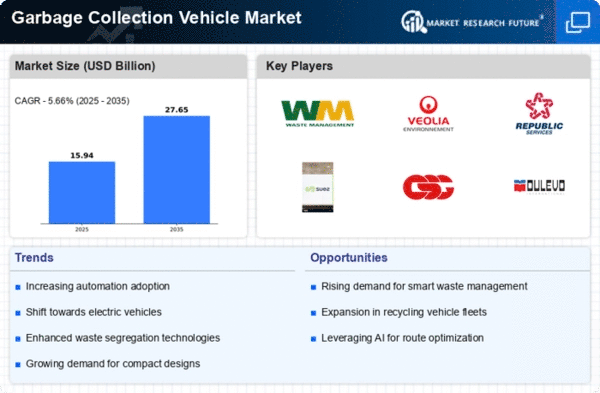
As per MRFR analysis, the Garbage Collection Vehicle Market Size was estimated at 15.09 USD Billion in 2024. The Garbage Collection Vehicle industry is projected to grow from 15.94 USD Billion in 2025 to 27.65 USD Billion by 2035, exhibiting a compound annual growth rate (CAGR) of 5.66 during the forecast period 2025 - 2035.

Key Market Trends & Highlights

The Garbage Collection Vehicle Market is experiencing a transformative shift towards sustainability and technological integration.

  • The market is witnessing a notable shift towards electrification, particularly in North America, which remains the largest market.
  • Integration of smart technologies is becoming increasingly prevalent, enhancing operational efficiency in both residential and commercial segments.
  • Regulatory support for sustainable practices is driving innovation, especially in the Asia-Pacific region, which is the fastest-growing market.
  • Increasing urbanization and rising environmental awareness are key drivers propelling the demand for rear loader vehicles in residential applications.

Market Size & Forecast

2024 Market Size 15.09 (USD Billion)
2035 Market Size 27.65 (USD Billion)
CAGR (2025 - 2035) 5.66%
Largest Regional Market Share in 2024 North America

Major Players

<p>Waste Management Inc (US), Veolia Environnement SA (FR), Republic Services Inc (US), SUEZ SA (FR), Cleansing Service Group (GB), Dulevo International S.p.A. (IT), Groupe Charles André (FR), Kässbohrer Geländefahrzeug AG (DE), Ecovia (PT)</p>

Market Trends

The Garbage Collection Vehicle Market is currently experiencing a transformative phase, driven by increasing urbanization and the growing emphasis on sustainable waste management practices. As cities expand, the demand for efficient and environmentally friendly waste collection solutions intensifies. This shift is prompting manufacturers to innovate, focusing on electric and hybrid vehicles that reduce emissions and operational costs. Furthermore, advancements in technology, such as smart waste management systems, are enhancing the efficiency of garbage collection processes, allowing for real-time monitoring and optimization of routes. In addition to technological advancements, regulatory frameworks are evolving to support greener practices within the Garbage Collection Vehicle Market. Governments are implementing stricter emissions standards and encouraging the adoption of alternative fuel sources. This regulatory push is likely to accelerate the transition towards cleaner vehicles, fostering a competitive landscape where companies that prioritize sustainability may gain a significant advantage. As the market continues to evolve, stakeholders must remain vigilant to emerging trends and adapt their strategies accordingly to thrive in this dynamic environment.

Shift Towards Electrification

The Garbage Collection Vehicle Market is witnessing a notable shift towards electrification, as municipalities seek to reduce their carbon footprints. Electric vehicles are becoming increasingly popular due to their lower operational costs and reduced environmental impact. This trend suggests a growing preference for sustainable solutions in waste management.

Integration of Smart Technologies

The integration of smart technologies into garbage collection processes is gaining traction. Advanced systems that utilize data analytics and IoT are enhancing operational efficiency. These technologies enable real-time tracking of vehicles and waste levels, potentially leading to optimized routes and reduced fuel consumption.

Regulatory Support for Sustainable Practices

Regulatory frameworks are evolving to support sustainable practices within the Garbage Collection Vehicle Market. Governments are implementing policies that encourage the use of alternative fuels and stricter emissions standards. This regulatory support may drive innovation and investment in cleaner technologies.

Garbage Collection Vehicle Market Market Drivers

Regulatory Compliance

Stringent environmental regulations are driving the Global Garbage Collection Vehicle Market Industry as governments worldwide enforce stricter waste management policies. Compliance with these regulations necessitates the use of advanced garbage collection vehicles that meet specific emission standards. For instance, the European Union has implemented regulations aimed at reducing carbon footprints, prompting municipalities to upgrade their fleets. This regulatory pressure is expected to propel market growth, as cities invest in cleaner and more efficient waste collection solutions. The anticipated market size of 27.7 USD Billion by 2035 underscores the importance of regulatory compliance in shaping the future of waste management.

Increasing Urbanization

The rapid pace of urbanization globally is a primary driver of the Global Garbage Collection Vehicle Market Industry. As more people migrate to urban areas, the demand for efficient waste management solutions intensifies. Urban centers require advanced garbage collection vehicles to handle the increasing volume of waste generated. For instance, cities like Tokyo and New York are investing heavily in modernizing their waste management fleets to accommodate growing populations. This trend is expected to contribute to the market's growth, with projections indicating a market size of 15.1 USD Billion in 2024, reflecting the urgent need for effective waste collection systems.

Rising Waste Generation

The continuous rise in waste generation is a fundamental driver of the Global Garbage Collection Vehicle Market Industry. As economies grow and consumption patterns evolve, the volume of waste produced increases, necessitating more efficient waste collection systems. For instance, developing countries are experiencing a surge in waste generation due to urbanization and changing lifestyles. This trend compels municipalities to enhance their garbage collection capabilities, leading to increased investments in modern vehicles. The market's growth trajectory is likely to reflect this reality, as cities strive to keep pace with rising waste volumes and improve their waste management infrastructure.

Market Growth Projections

The Global Garbage Collection Vehicle Market Industry is poised for substantial growth, with projections indicating a market size of 15.1 USD Billion in 2024 and an anticipated increase to 27.7 USD Billion by 2035. This growth trajectory suggests a robust demand for garbage collection vehicles, driven by factors such as urbanization, technological advancements, and regulatory compliance. The expected CAGR of 5.66% from 2025 to 2035 further emphasizes the industry's potential for expansion. As municipalities and waste management companies invest in modern fleets, the market is likely to witness significant transformations, aligning with global sustainability goals.

Technological Advancements

Technological innovations play a crucial role in shaping the Global Garbage Collection Vehicle Market Industry. The integration of smart technologies, such as GPS tracking, automated collection systems, and real-time monitoring, enhances operational efficiency and reduces costs. For example, cities are increasingly adopting electric garbage trucks, which not only lower emissions but also decrease fuel expenses. These advancements are likely to attract investments, as municipalities seek to modernize their fleets. The market is projected to grow at a CAGR of 5.66% from 2025 to 2035, indicating a strong inclination towards adopting cutting-edge technologies in waste management.

Growing Environmental Awareness

The increasing awareness of environmental issues among the global population is significantly influencing the Global Garbage Collection Vehicle Market Industry. Citizens are becoming more conscious of waste management practices and are advocating for sustainable solutions. This shift in public perception is prompting municipalities to invest in eco-friendly garbage collection vehicles, such as those powered by alternative fuels. For example, cities are exploring compressed natural gas and electric vehicles to minimize their environmental impact. As a result, the market is expected to expand, driven by the demand for greener waste management solutions that align with public expectations.

Market Segment Insights

By Application: Residential (Largest) vs. Commercial (Fastest-Growing)

<p>In the Garbage Collection Vehicle Market, the application segment is segmented into Residential, Commercial, Industrial, and Municipal. Currently, the Residential application holds the largest market share, driven by the consistent demand for waste management in urban and suburban areas. Meanwhile, the Commercial segment is gaining traction as businesses increasingly prioritize efficient waste disposal and sustainability, leading to a rapid growth trend in this area.</p>

<p>Application: Residential (Dominant) vs. Commercial (Emerging)</p>

<p>The Residential application of garbage collection vehicles remains dominant due to the steady and essential demand for waste collection services in households. With urbanization expanding, this segment shows resilience and growth potential, catering to the needs of families and small communities. On the other hand, the Commercial segment is emerging rapidly, spurred by an increase in business establishments and consumer laundry facilities that demand robust waste management solutions. The Commercial segment focuses on efficiency and environmental sustainability, making significant investments in innovative technologies to enhance overall waste handling systems.</p>

By Vehicle Type: Rear Loader (Largest) vs. Side Loader (Fastest-Growing)

<p>The Garbage Collection Vehicle Market showcases a diverse array of vehicle types, with Rear Loaders leading the segment due to their widespread adoption in urban environments. These vehicles account for a significant portion of the market share, attributed to their efficiency and adaptability for residential waste collection. Following closely are Side Loaders, which are gaining traction due to their operational capabilities in tight spaces and their innovative design that enhances productivity. Meanwhile, Front Loaders and Multi-Compartment vehicles hold considerable market positions, yet their share pales in comparison to the Rear Loaders. However, Side Loaders are rapidly emerging as the fastest-growing segment driven by increased urbanization and waste management needs, suggesting a potential shift in preferences within the market.</p>

<p>Rear Loader (Dominant) vs. Side Loader (Emerging)</p>

<p>The Rear Loader garbage collection vehicles are characterized by their robust design and ease of use, making them ideal for residential and commercial waste collection. Their dominance in the market stems from their reliable performance and compatibility with various waste types, enabling efficient operations across diverse environments. In contrast, Side Loaders are becoming an emerging favorite among waste management companies, praised for their maneuverability and ability to operate in confined spaces. This segment is particularly favored for its ergonomic design, which reduces the risk of worker injury and increases operational efficiency. As cities become denser, Side Loaders increasingly appeal to waste managers seeking modern solutions for evolving challenges.</p>

By Fuel Type: Internal Combustion Engine (Largest) vs. Electric (Fastest-Growing)

<p>In the Garbage Collection Vehicle Market, Internal Combustion Engine vehicles currently hold the largest market share due to their established infrastructure and widespread availability. They are preferred by many municipal services because of their durability and performance in various operational conditions. Electric vehicles, while having a smaller share, are rapidly gaining traction as cities look to reduce emissions and comply with stricter environmental regulations. The demand for cleaner alternatives is gradually reshaping market preferences, underscoring the shift towards electrification in this sector.</p>

<p>Fuel Type: Internal Combustion Engine (Dominant) vs. Electric (Emerging)</p>

<p>Internal Combustion Engine garbage collection vehicles remain dominant in the market, benefiting from proven reliability and performance in diverse terrains. Their ease of refueling and lower initial costs make them attractive for municipal fleets. Conversely, Electric vehicles are emerging as a key player, driven by increasing environmental concerns and advances in battery technology. They provide significant operational cost savings in fuel and maintenance while offering a quieter, more eco-friendly alternative to traditional engines. As charging infrastructure develops, the adoption of Electric garbage trucks is expected to accelerate, highlighting a pivotal shift towards sustainable waste management.</p>

By Load Capacity: Heavy Duty (Largest) vs. Light Duty (Fastest-Growing)

<p>In the Garbage Collection Vehicle Market, the load capacity segment is primarily divided into three categories: Light Duty, Medium Duty, and Heavy Duty. Heavy Duty vehicles hold the largest market share due to their capacity to manage larger waste volumes, making them crucial for urban municipalities and industrial applications. Light Duty vehicles, on the other hand, cater to residential areas and small businesses, thus tapping into a growing demand for agile waste collection solutions among municipal services. The growth trends in the load capacity segment are notably influenced by rising urbanization and increasing waste generation globally. The Light Duty segment is identified as the fastest-growing category, capitalizing on the surge in residential and commercial waste collection needs. Additionally, environmental regulations and sustainability motivations drive innovation within this segment, leading to the adoption of lighter, more efficient vehicles designed for effective waste management.</p>

<p>Heavy Duty (Dominant) vs. Light Duty (Emerging)</p>

<p>Heavy Duty garbage collection vehicles are designed for expansive capacities, typically utilized in large-scale operations like city waste management and industrial sectors. Their robust build and powerful engines enable them to efficiently transport significant loads, ensuring reliability in municipal waste collection. In contrast, Light Duty vehicles are emerging as a vital part of the market, particularly suited for urban environments where maneuverability and flexibility are essential. These vehicles are lighter, consume less fuel, and are increasingly equipped with advanced technologies to enhance efficiency and reduce environmental footprint. Their rapid growth is indicative of changing residential waste management patterns, where smaller vehicles are preferred for their agility in tight spaces.</p>

By Technology: Automated (Largest) vs. Semi-Automated (Fastest-Growing)

<p>The Garbage Collection Vehicle Market is primarily composed of three key technological segments: Automated, Semi-Automated, and Manual vehicles. Currently, the Automated segment holds the largest share, driven by advancements in automation technology and increasing urbanization demands. Its efficiency and lower operational costs make it highly sought after within municipal and private waste management sectors. In contrast, the Semi-Automated segment is rapidly gaining traction, appealing to operators looking to balance cost-effective technology with human oversight. This segment's growth reflects a larger trend toward improving operational efficiency in waste collection processes while still incorporating elements of human labor.</p>

<p>Technology: Automated (Dominant) vs. Semi-Automated (Emerging)</p>

<p>The Automated segment of garbage collection vehicles stands out as the dominant technology, characterized by fully mechanized collection processes that minimize the need for manual labor. These vehicles utilize advanced sensors, robotics, and smart systems to streamline garbage collection operations, which significantly enhances efficiency and reduces costs. On the other hand, the Semi-Automated segment represents an emerging market trend, blending automation with human interaction. These vehicles often feature mechanized arms for retrieving waste bins, yet still require operators to manage certain task aspects. This approach aligns with the growing demand for flexible solutions that maintain human oversight while enhancing operational efficiency, making Semi-Automated vehicles increasingly popular among urban waste management services.</p>

Get more detailed insights about Garbage Collection Vehicle Market Research Report - Global Forecast till 2035

Regional Insights

North America : Market Leader in Innovation

North America is poised to maintain its leadership in the garbage collection vehicle market, holding a significant market share of 6.5 in 2024. The region's growth is driven by increasing urbanization, stringent waste management regulations, and a rising emphasis on sustainability. Government initiatives aimed at enhancing waste collection efficiency and reducing environmental impact are further propelling demand for advanced garbage collection vehicles. The competitive landscape in North America is characterized by major players such as Waste Management Inc and Republic Services Inc, which are investing heavily in innovative technologies. The presence of established companies fosters a robust market environment, with a focus on electric and hybrid vehicles to meet regulatory standards. This trend is expected to continue, ensuring that North America remains at the forefront of the garbage collection vehicle market.

Europe : Sustainability and Innovation Focus

Europe's garbage collection vehicle market is projected to grow significantly, with a market size of 4.0 by 2025. The region is driven by stringent environmental regulations and a strong commitment to sustainability. Initiatives from the European Union aimed at reducing carbon emissions and promoting recycling are key catalysts for the adoption of advanced garbage collection technologies, including electric vehicles and automated systems. Leading countries such as Germany, France, and the UK are at the forefront of this transformation, with companies like Veolia Environnement SA and SUEZ SA leading the charge. The competitive landscape is marked by innovation, with a focus on developing vehicles that meet both regulatory requirements and consumer expectations for eco-friendliness. This trend is expected to solidify Europe's position as a leader in sustainable waste management solutions.

Asia-Pacific : Emerging Market with High Potential

The Asia-Pacific garbage collection vehicle market is on a growth trajectory, with a market size of 3.5 anticipated by 2025. Rapid urbanization, increasing population density, and rising waste generation are key drivers of this growth. Governments in the region are implementing policies to improve waste management infrastructure, which is expected to boost demand for modern garbage collection vehicles that can handle diverse waste types efficiently. Countries like China, India, and Japan are leading the charge, with significant investments in waste management technologies. The competitive landscape features key players such as Dulevo International S.p.A. and Kässbohrer Geländefahrzeug AG, who are focusing on innovation and sustainability. As the region continues to develop, the demand for advanced garbage collection vehicles is set to rise, creating opportunities for both local and international companies.

Middle East and Africa : Developing Market with Challenges

The Middle East and Africa garbage collection vehicle market is gradually evolving, with a market size of 1.09 projected for 2025. The region faces unique challenges, including inadequate waste management infrastructure and varying regulatory frameworks. However, increasing urbanization and a growing awareness of environmental issues are driving demand for improved waste collection solutions. Governments are beginning to recognize the importance of efficient waste management, which is expected to catalyze market growth. Countries like South Africa and the UAE are taking steps to enhance their waste management systems, with investments in modern garbage collection vehicles. The competitive landscape is still developing, with local and international players vying for market share. Companies such as Cleansing Service Group and Ecovia are focusing on innovative solutions to meet the region's specific needs, paving the way for future growth in the garbage collection vehicle market.

Key Players and Competitive Insights

The Garbage Collection Vehicle Market is characterized by a competitive landscape that is increasingly shaped by innovation, sustainability, and digital transformation. Key players such as Waste Management Inc (US), Veolia Environnement SA (FR), and Republic Services Inc (US) are actively pursuing strategies that emphasize technological advancements and operational efficiencies. Waste Management Inc (US) has focused on integrating smart technologies into its fleet, enhancing route optimization and fuel efficiency. Meanwhile, Veolia Environnement SA (FR) has been investing in electric and hybrid vehicles, aligning its operations with global sustainability goals. Republic Services Inc (US) appears to be concentrating on expanding its service offerings through strategic partnerships, thereby enhancing its market presence and customer engagement.

The market structure is moderately fragmented, with a mix of large multinational corporations and regional players. Key tactics employed by these companies include localizing manufacturing to reduce costs and optimize supply chains. This approach not only enhances operational efficiency but also allows for quicker responses to regional market demands. The collective influence of these major players is significant, as they drive innovation and set industry standards that smaller competitors often follow.

In November 2025, Waste Management Inc (US) announced a partnership with a leading technology firm to develop AI-driven waste sorting systems. This strategic move is expected to enhance recycling rates and reduce operational costs, positioning the company as a leader in sustainable waste management solutions. The integration of AI technology into their operations may also provide a competitive edge in terms of efficiency and customer satisfaction.

In October 2025, Veolia Environnement SA (FR) launched a new line of electric garbage collection vehicles aimed at urban areas. This initiative not only reflects the company's commitment to reducing carbon emissions but also addresses the growing demand for environmentally friendly solutions in waste management. The introduction of these vehicles could potentially reshape urban waste collection practices, making them more sustainable and efficient.

In September 2025, Republic Services Inc (US) expanded its service portfolio by acquiring a regional waste management company. This acquisition is likely to enhance its operational capabilities and market reach, allowing for a more comprehensive service offering. Such strategic expansions are indicative of a trend where companies seek to consolidate their positions in the market through mergers and acquisitions, thereby increasing their competitive advantage.

As of December 2025, the competitive trends in the Garbage Collection Vehicle Market are increasingly defined by digitalization, sustainability, and the integration of advanced technologies such as AI. Strategic alliances are becoming more prevalent, as companies recognize the need to collaborate in order to innovate and meet evolving customer demands. The shift from price-based competition to a focus on technological innovation and supply chain reliability is evident, suggesting that future competitive differentiation will hinge on the ability to adapt and innovate in response to market dynamics.

Key Companies in the Garbage Collection Vehicle Market include

Industry Developments

  • Q2 2024: BYD launches new electric garbage truck model for European market BYD announced the launch of its latest electric garbage collection vehicle, designed specifically for European cities, featuring advanced battery technology and improved payload capacity.
  • Q2 2024: Volvo Trucks delivers first batch of electric refuse trucks to Paris municipality Volvo Trucks completed delivery of its first fleet of electric garbage collection vehicles to the city of Paris, marking a significant step in the city's transition to sustainable urban waste management.
  • Q3 2024: Waste Management Inc. announces $200 million investment in automated garbage truck fleet Waste Management Inc. revealed a major investment to upgrade its fleet with automated garbage collection vehicles, aiming to improve efficiency and reduce labor costs.
  • Q3 2024: China’s Zoomlion partners with Siemens for smart garbage truck technology Zoomlion signed a partnership agreement with Siemens to integrate IoT and telematics solutions into its next generation of garbage collection vehicles.
  • Q4 2024: Heil Environmental opens new manufacturing facility for electric garbage trucks in Texas Heil Environmental inaugurated a new plant in Texas dedicated to producing electric garbage collection vehicles, expanding its manufacturing footprint in North America.
  • Q4 2024: Faun Group acquires UK-based refuse vehicle manufacturer Dennis Eagle Faun Group completed the acquisition of Dennis Eagle, strengthening its position in the European garbage collection vehicle market.
  • Q1 2025: New Way Trucks secures multi-year contract with City of Los Angeles for hybrid garbage vehicles New Way Trucks announced a multi-year contract to supply hybrid garbage collection vehicles to the City of Los Angeles, supporting the city's sustainability goals.
  • Q1 2025: Startup Refuse Robotics raises $30 million Series B to develop autonomous garbage trucks Refuse Robotics closed a $30 million Series B funding round to accelerate development of its autonomous garbage collection vehicle technology.
  • Q2 2025: Mack Trucks unveils next-generation LR Electric garbage truck Mack Trucks introduced its new LR Electric garbage collection vehicle, featuring enhanced range and faster charging capabilities.
  • Q2 2025: Veolia signs partnership with Renault Trucks for zero-emission refuse vehicles Veolia and Renault Trucks entered a partnership to deploy zero-emission garbage collection vehicles across several European cities.
  • Q3 2025: Oshkosh Corporation wins contract to supply electric garbage trucks to Toronto Oshkosh Corporation secured a contract to deliver electric garbage collection vehicles to the City of Toronto, supporting its green fleet initiative.
  • Q3 2025: Suez Group appoints new CEO to lead waste vehicle electrification strategy Suez Group named a new CEO tasked with accelerating the company's transition to electric garbage collection vehicles and expanding its sustainable waste management operations.

Future Outlook

Garbage Collection Vehicle Market Future Outlook

<p>The Garbage Collection Vehicle Market is projected to grow at a 5.66% CAGR from 2024 to 2035, driven by urbanization, technological advancements, and sustainability initiatives.</p>

New opportunities lie in:

  • <p>Integration of IoT for real-time fleet management solutions.</p>
  • <p>Development of electric and hybrid garbage collection vehicles.</p>
  • <p>Expansion of automated waste sorting technologies in collection vehicles.</p>

<p>By 2035, the market is expected to be robust, driven by innovation and sustainability.</p>

Market Segmentation

Garbage Collection Vehicle Market Fuel Type Outlook

  • Internal Combustion Engine
  • Electric
  • Hybrid
  • Compressed Natural Gas

Garbage Collection Vehicle Market Technology Outlook

  • Automated
  • Semi-Automated
  • Manual

Garbage Collection Vehicle Market Application Outlook

  • Residential
  • Commercial
  • Industrial
  • Municipal

Garbage Collection Vehicle Market Vehicle Type Outlook

  • Rear Loader
  • Front Loader
  • Side Loader
  • Multi-Compartment

Garbage Collection Vehicle Market Load Capacity Outlook

  • Light Duty
  • Medium Duty
  • Heavy Duty

Report Scope

MARKET SIZE 202415.09(USD Billion)
MARKET SIZE 202515.94(USD Billion)
MARKET SIZE 203527.65(USD Billion)
COMPOUND ANNUAL GROWTH RATE (CAGR)5.66% (2024 - 2035)
REPORT COVERAGERevenue Forecast, Competitive Landscape, Growth Factors, and Trends
BASE YEAR2024
Market Forecast Period2025 - 2035
Historical Data2019 - 2024
Market Forecast UnitsUSD Billion
Key Companies ProfiledWaste Management Inc (US), Veolia Environnement SA (FR), Republic Services Inc (US), SUEZ SA (FR), Cleansing Service Group (GB), Dulevo International S.p.A. (IT), Groupe Charles André (FR), Kässbohrer Geländefahrzeug AG (DE), Ecovia (PT)
Segments CoveredApplication, Vehicle Type, Fuel Type, Load Capacity, Technology
Key Market OpportunitiesIntegration of electric and autonomous technologies in the Garbage Collection Vehicle Market presents substantial growth opportunities.
Key Market DynamicsRising demand for eco-friendly vehicles drives innovation in garbage collection technology and regulatory compliance.
Countries CoveredNorth America, Europe, APAC, South America, MEA

FAQs

How much is the Garbage Collection Vehicle market?

The Garbage Collection Vehicle Market size was valued at USD 15.09 Billion in 2024.

What is the growth rate of the Garbage Collection Vehicle market?

The global market is projected to grow at a CAGR of 5.66% during the forecast period, 2025-2034.

Which region held the largest market share in the Garbage Collection Vehicle market?

North America had the largest share of the global market

Who are the key players in the Garbage Collection Vehicle market?

The key players in the market are Heil Environmental (US), Geesink B.V. (Netherlands), and Pak-Mor. (US), Dennis Eagle Limited (UK), IVECO S.p.A. (Italy), Dulevo International S.p.A. (Italy), FAUN Umwelttechnik GmbH &amp; Co. KG (Germany), CEEC TRUCKS INDUSTRY CO., LIMITED (China), Bridgeport Manufacturing (US), and Zoomlion Heavy Industry Science and Technology (China).

Which Loader Type led the Garbage Collection Vehicle market?

The Rear Loader category dominated the market in 2022.

Which Technology had the largest market share in the Garbage Collection Vehicle market?

The Manual had the largest share of the global market.

  1. SECTION I: EXECUTIVE SUMMARY AND KEY HIGHLIGHTS
    1. | 1.1 EXECUTIVE SUMMARY
  2. SECTION II: SCOPING, METHODOLOGY AND MARKET STRUCTURE
    1. | 2.1 MARKET INTRODUCTION
    2. | 2.2 RESEARCH METHODOLOGY
  3. SECTION III: QUALITATIVE ANALYSIS
    1. | 3.1 MARKET DYNAMICS
    2. | 3.2 MARKET FACTOR ANALYSIS
  4. SECTION IV: QUANTITATIVE ANALYSIS
    1. | 4.1 Automobile, BY Application (USD Billion)
    2. | 4.2 Automobile, BY Vehicle Type (USD Billion)
    3. | 4.3 Automobile, BY Fuel Type (USD Billion)
    4. | 4.4 Automobile, BY Load Capacity (USD Billion)
    5. | 4.5 Automobile, BY Technology (USD Billion)
    6. | 4.6 Automobile, BY Region (USD Billion)
  5. SECTION V: COMPETITIVE ANALYSIS
    1. | 5.1 Competitive Landscape
    2. | 5.2 Company Profiles
    3. | 5.3 Appendix

Garbage Collection Vehicle Market Segmentation

Market Segmentation Overview

  • Detailed segmentation data will be available in the full report
  • Comprehensive analysis by multiple parameters
  • Regional and country-level breakdowns
  • Market size forecasts by segment
Infographic

Free Sample Request

Kindly complete the form below to receive a free sample of this Report

Get Free Sample

Customer Strories

Compare Licence

×
Features License Type
Single User Multiuser License Enterprise User
Price $4,950 $5,950 $7,250
Maximum User Access Limit 1 User Upto 10 Users Unrestricted Access Throughout the Organization
Free Customization
Direct Access to Analyst
Deliverable Format
Platform Access
Discount on Next Purchase 10% 15% 15%
Printable Versions