Request Free Sample ×

Kindly complete the form below to receive a free sample of this Report

* Please use a valid business email

Leading companies partner with us for data-driven Insights

clients tt-cursor
Hero Background
English
Chinese
French
Japanese
Korean
German
Spanish

Fuel Dispenser Market Size

ID: MRFR/Equip/5553-CR
162 Pages
Tejas Chaudhary
July 2019

Fuel Dispenser Market Size, Share & Growth Analysis Report by Product (General Fuel Dispenser and Self-Service Fuel Dispenser), by Type (Submersible and Suction), by Application (Petrol, Diesel, Biofuel, and Others), and by Region (North America, Europe, Asia-Pacific, and Rest of The World) – Trends & Industry Forecast to 2035

Share:
Download PDF ×

We do not share your information with anyone. However, we may send you emails based on your report interest from time to time. You may contact us at any time to opt-out.

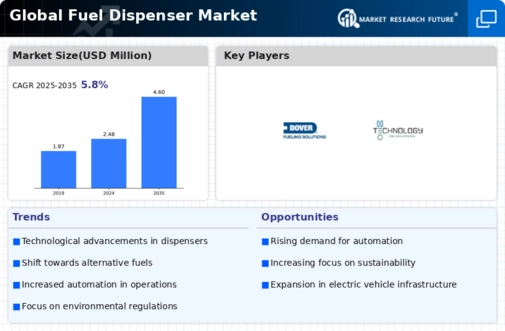
Fuel Dispenser Market Infographic
Purchase Options

Fuel Dispenser Size

Fuel Dispenser Market Growth Projections and Opportunities

Fuel dispensing equipment is what lets out and keeps track of liquid or gas fuel. These machines are used to pump liquids like gasoline, diesel, oil, or kerosene into things like vehicles, storage tanks, or portable containers. If it's a gaseous fuel dispenser, it might be used to refuel vehicles or machinery powered by things like hydrogen or syngas. Or it could just be used to move gases from one place to another. In addition to their basic function of pumping and monitoring fuel, fuel dispensing equipment comes in various types to cater to different needs. One common type is the fuel dispenser found at gas stations. These dispensers typically have multiple nozzles to serve various types of fuels like gasoline and diesel. They often have electronic displays that show the amount of fuel dispensed and the total cost.

Another type is the bulk fuel dispenser, commonly used in industrial settings or for large vehicles like trucks and buses. These dispensers have a higher capacity and are designed to handle larger quantities of fuel efficiently. They play a crucial role in keeping fleets of vehicles fueled and operational.

Furthermore, there are specialized dispensers for gaseous fuels, such as those used for hydrogen or compressed natural gas (CNG). These dispensers ensure the safe and controlled transfer of gas into vehicles specifically designed to run on these alternative fuels. The growing interest in environmentally friendly transportation has increased the demand for these types of dispensers.

One of the critical aspects of fuel dispensing equipment is the inclusion of safety features. This is especially important when dealing with flammable liquids or gases. Many fuel dispensers are equipped with safety mechanisms, such as automatic shut-off systems, to prevent spills and accidents. Additionally, some dispensers have advanced technologies like electronic monitoring and authentication systems to control access and usage, ensuring that only authorized personnel can operate them.

As technology advances, there is a trend toward smart fuel dispensing systems. These systems incorporate digital technologies to provide real-time monitoring, data analytics, and remote control capabilities. Smart dispensers can offer enhanced security, efficiency, and environmental sustainability by optimizing fuel consumption and minimizing waste.

In conclusion, fuel dispensing equipment is a crucial component in the transportation and industrial sectors, facilitating the safe and efficient transfer of liquid and gaseous fuels. With various types available, these dispensers play a vital role in keeping vehicles and machinery fueled, contributing to the smooth operation of various industries.
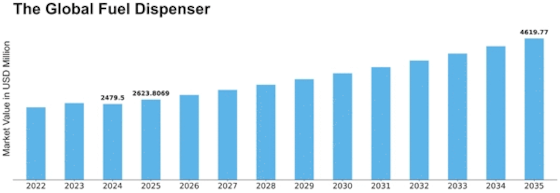
Fuel Dispenser Market Size Graph
Author
Author Profile
Tejas Chaudhary
Research Analyst Level II

I have a degree in Engineering (Civil), with masters in Business Administration (Marketing). With more than 4 years of experience in market research and consulting, I am involved in end-to-end process of market research, proposals, project kickoffs and delivery. I have research knowledge and expertise in consumer goods/packaging domain. Also I have worked for various other domains like construction & equipment. Effectively managed and delivered more than 60 report studies for regional as well as global clientele.

Leave a Comment

FAQs

What is the projected market valuation of The Global Fuel Dispenser by 2035?

<p>The projected market valuation of The Global Fuel Dispenser is 4619.77 USD Million by 2035.</p>

What was the overall market valuation of The Global Fuel Dispenser in 2024?

<p>The overall market valuation of The Global Fuel Dispenser was 2479.5 USD Million in 2024.</p>

What is the expected CAGR for The Global Fuel Dispenser during the forecast period 2025 - 2035?

<p>The expected CAGR for The Global Fuel Dispenser during the forecast period 2025 - 2035 is 5.82%.</p>

Which companies are considered key players in The Global Fuel Dispenser?

<p>Key players in The Global Fuel Dispenser include Gilbarco Veeder-Root, Dover Corporation, Tokheim, Wayne Fueling Systems, and Bennett Pump Company.</p>

What are the main types of fuel dispensers in the market?

<p>The main types of fuel dispensers in the market are Submersible and Suction dispensers, each valued at approximately 1239.75 USD Million in 2024.</p>

How does the market valuation for petrol dispensers compare to diesel dispensers?

<p>In 2024, petrol dispensers were valued at 1000.0 USD Million, while diesel dispensers were valued at 800.0 USD Million.</p>

What is the valuation range for biofuel dispensers in The Global Fuel Dispenser?

The valuation range for biofuel dispensers in The Global Fuel Dispenser is between 400.0 USD Million and 800.0 USD Million.

What segment of The Global Fuel Dispenser had the highest valuation in 2024?

In 2024, the petrol segment had the highest valuation at 1000.0 USD Million.

What is the projected growth trend for The Global Fuel Dispenser from 2025 to 2035?

The Global Fuel Dispenser is expected to grow steadily, reaching a valuation of 4619.77 USD Million by 2035.

What is the valuation of the 'Others' application segment in The Global Fuel Dispenser?

The valuation of the 'Others' application segment in The Global Fuel Dispenser was 279.5 USD Million in 2024.

Market Summary

As per Market Research Future analysis, The Global Fuel Dispenser Market Size was estimated at 2479.5 USD Million in 2024. The fuel dispenser industry is projected to grow from 2623.81 USD Million in 2025 to 4619.77 USD Million by 2035, exhibiting a compound annual growth rate (CAGR) of 5.8% during the forecast period 2025 - 2035

Key Market Trends & Highlights

The Global Fuel Dispenser Market is poised for growth driven by technological advancements and evolving consumer preferences.

  • North America remains the largest market for fuel dispensers, reflecting a robust infrastructure and high fuel demand. Asia-Pacific is emerging as the fastest-growing region, propelled by increasing urbanization and rising fuel consumption. The submersible segment dominates the market, while the suction segment is experiencing rapid growth due to its efficiency and convenience. Technological advancements and environmental regulations are key drivers, influencing the market dynamics and shaping consumer preferences.

Market Size & Forecast

2024 Market Size 2479.5 (USD Million)
2035 Market Size 4619.77 (USD Million)
CAGR (2025 - 2035) 5.82%
Largest Regional Market Share in 2024 Asia Pacific

Major Players

Gilbarco Veeder-Root (US), <a href="https://www.doverfuelingsolutions.com/apac/en/products-and-solutions/fuel-dispensers.html">Dover </a>Corporation (US), Tokheim (FR), Wayne Fueling Systems (US), Bennett Pump Company (US), Neotec (DE), Scheidt &amp; Bachmann (DE), <a href="https://www.krohne.com/en/applications/flow-measurement-lpg-dispensers">KROHNE </a>(DE), Aplab (IN)

Market Trends

The Global Fuel Dispenser Market is currently experiencing a transformative phase, driven by advancements in technology and evolving consumer preferences. The integration of digital solutions, such as contactless payment systems and real-time monitoring, appears to enhance user experience and operational efficiency. 

Furthermore, strategic innovations by leading fuel dispenser manufacturers are significantly expanding the global fuel dispenser market as they integrate IoT capabilities and multi-fuel compatibility to meet evolving energy demands.

The increasing emphasis on sustainability is prompting manufacturers to innovate fuel dispensers that accommodate alternative fuels, thereby aligning global environmental goals. This shift not only caters to a growing segment of eco-conscious consumers but also positions companies favorably in a competitive landscape. In addition, the market seems to be influenced by regulatory changes aimed at improving safety and efficiency standards. These regulations may compel fuel dispenser manufacturers to adopt more sophisticated designs and features, ensuring compliance while enhancing performance. As the industry adapts to these dynamics, it is likely that collaboration between technology providers and fuel dispenser manufacturers will intensify, fostering innovation and expanding market reach. Overall, The Global Fuel Dispenser Market is poised for growth, characterized by a blend of technological advancements and a commitment to sustainability.

Technological Integration

The incorporation of advanced technologies in fuel dispensers is reshaping the market landscape. Features such as digital payment options, automated monitoring systems, and user-friendly interfaces are becoming increasingly prevalent. This trend not only enhances customer convenience but also streamlines operational processes for fuel retailers.

Sustainability Focus

There is a noticeable shift towards sustainability within The Global Fuel Dispenser Market. Manufacturers are exploring designs that support alternative fuels, such as biofuels and electric charging stations. This trend reflects a broader commitment to environmental responsibility and caters to a growing demographic of eco-aware consumers.

Regulatory Compliance

The evolving regulatory environment is influencing the design and functionality of fuel dispensers. Stricter safety and efficiency standards are prompting manufacturers to innovate and enhance their products. This trend underscores the importance of compliance in maintaining market competitiveness and ensuring consumer safety.

Fuel Dispenser Market Market Drivers

Rising Fuel Demand

The persistent rise in fuel demand, particularly in developing regions, is a crucial driver for the fuel dispenser market. As urbanization accelerates and vehicle ownership increases, the need for efficient fuel dispensing solutions is becoming more pronounced. According to recent data, fuel consumption in emerging markets is expected to grow at a compound annual growth rate of over 4% in the coming years. This surge in demand necessitates the expansion of fuel dispensing infrastructure, thereby creating opportunities for manufacturers. Companies that can provide reliable and efficient dispensers are likely to benefit from this trend, positioning themselves favorably in the competitive landscape.

Environmental Regulations

The increasing stringency of environmental regulations is influencing the fuel dispenser market significantly. Governments worldwide are implementing policies aimed at reducing carbon emissions and promoting cleaner fuel alternatives. This regulatory landscape is compelling fuel dispenser manufacturers to innovate and adapt their products to meet these standards. For instance, the introduction of dispensers that support biofuels and alternative energy sources is becoming more prevalent. As a result, companies that align their offerings with these regulations may gain a competitive edge, potentially leading to increased market share. The market is projected to grow as compliance with these regulations becomes a necessity rather than an option.

Technological Advancements

The integration of advanced technologies in the fuel dispenser market appears to be a pivotal driver for growth. Innovations such as contactless payment systems, digital displays, and automated fuel dispensing mechanisms are enhancing user experience and operational efficiency. The market is witnessing a shift towards smart dispensers that can communicate with mobile applications, providing real-time data on fuel prices and availability. This technological evolution is likely to attract more consumers, thereby increasing sales in the fuel dispenser market. Furthermore, the adoption of IoT-enabled devices is expected to streamline operations, reduce downtime, and improve maintenance schedules, which could lead to a more robust market presence.

Expansion of Retail Fuel Outlets

The expansion of retail fuel outlets is emerging as a significant driver for the fuel dispenser market. As competition intensifies, fuel retailers are increasingly establishing new locations to capture market share. This trend is particularly evident in urban areas where the demand for fuel is high. The proliferation of convenience stores and gas stations is leading to a greater need for efficient and reliable fuel dispensers. Furthermore, the integration of additional services, such as car washes and food services, at these outlets is likely to enhance customer footfall, thereby increasing the demand for advanced dispensing solutions. This expansion strategy is expected to bolster the market, providing ample opportunities for growth.

Consumer Preferences for Convenience

Shifting consumer preferences towards convenience and speed are shaping the fuel dispenser market. Modern consumers increasingly favor quick and efficient refueling experiences, prompting fuel station operators to invest in advanced dispensing technologies. Features such as multi-product dispensers and user-friendly interfaces are becoming essential to meet these expectations. Additionally, the rise of loyalty programs and mobile payment options is enhancing customer satisfaction and retention. As fuel stations adapt to these changing preferences, the demand for innovative dispensers that facilitate a seamless experience is likely to rise, driving market growth. This trend underscores the importance of aligning product offerings with consumer needs.

Market Segment Insights

By Type: Submersible (Largest) vs. Suction (Fastest-Growing)

In The Global Fuel Dispenser Market, the Type segment's distribution reveals a significant preference for submersible fuel dispensers. These dispensers hold the largest market share due to their efficiency and reliability in various applications, making them a preferred choice for fuel retailers. Suction fuel dispensers, however, are emerging as a strong competitor, gaining traction due to their lower installation costs and suitability for specific retail environments.

Fuel Dispenser Market Type: Submersible (Dominant) vs. Suction (Emerging)

Submersible fuel dispensers are positioned as the dominant segment within the market due to their proven technology that offers significant advantages in efficiency and performance. They are designed for underground installations, allowing retailers to maximize space and maintain aesthetic appeal while ensuring safety. On the other hand, suction dispensers, while currently classified as emerging, are rapidly gaining popularity due to their straightforward installation process and adaptability for smaller fueling operations. Their cost-effective nature makes suction dispensers particularly appealing in regions with lower fuel demand, leading to considerable growth potential within this segment.

By Application: Petrol (Largest) vs. Diesel (Fastest-Growing)

The Global Fuel Dispenser Market is characterized by a prominent share held by the petrol application segment, which operates as the largest segment due to its widespread usage in personal and commercial <a href="https://www.marketresearchfuture.com/reports/electric-vehicles-market-1793">electric vehicles</a>. Diesel fuel dispensers follow, serving a significant market share driven primarily by heavy-duty vehicles and industrial applications. While petrol dominates the overall sector, the presence of diesel dispensers is on the rise, fueled by growing concerns over fuel efficiency and emissions regulation compliance in various regions.

Petrol (Dominant) vs. Diesel (Emerging)

Petrol dispensers are entrenched in the market as the dominant force, representing a substantial proportion of fuel dispensing worldwide, primarily due to the convenience and accessibility of petrol engines in the consumer vehicle sector. Conversely, diesel dispensers, recognized as an emerging segment, are experiencing rapid growth attributed to the increasing adoption of diesel <a href="https://www.marketresearchfuture.com/reports/small-engine-market-27561">small engine</a> in transportation and logistics, where fuel efficiency and torque are critical. As regulatory frameworks evolve, emphasizing lower emissions, diesel will likely carve out a more significant presence, catering to higher demand in commercial transportation.

Get more detailed insights about Fuel Dispenser Market Research Report - Global Forecast till 2035

Regional Insights

By region, the study provides market insights into North America, Europe, Asia-Pacific and the Rest of the World. The Asia-Pacific fuel dispenser market accounted for USD xx billion in 2021 and is expected to exhibit a significant CAGR growth during the study period. The government of China, India, and other developing economies are focused on reducing the harmful effects of vehicle emissions on the environment and increasing the price of gasoline, which will help to increase the demand for natural gas vehicles.

By 2025, Volkswagen aims to sell 1 million CNG vehicles and expand the number of CNG filling stations from 900 to 2,000 in Europe, for example. Volkswagen has committed to fueling CNG vehicles with CNG by 2025.

Further, the major countries studied in the market report are The U.S., Canada, Germany, France, the UK, Italy, Spain, China, Japan, India, Australia, South Korea, and Brazil.

Figure 3: FUEL DISPENSER MARKET SHARE BY REGION 2021 (%)

Source Secondary Research, Primary Research, Market Research Future Database and Analyst Review

North America's fuel dispenser market accounts for the second-largest market share. The market growth is attributed to the increase in new vehicle sales, forecasted to reach 16.7 million to 17.1 million vehicles in the United States by 2025, with the growth of CNG stations contributing as well. The CNG dispenser station near the Port of Savannah in Georgia will be constructed and maintained by 2021 under a joint venture agreement between Chesapeake Utilities Corporation and Atlanta Gas Light (AGL).

Further, the U.S. fuel dispenser market held the largest market share, and the Canadian fuel dispenser market was the fastest-growing market in the North American region

The Europe fuel dispenser market is expected to grow at the fastest CAGR from 2022 to 2030. Natural gas is considered the cleanest fuel in Europe, so many vehicles use it. There are 868 CNG stations in Germany, Italy, the Netherlands, Russia, and Ukraine, with 176, 235, and 207 CNG stations, respectively. By 2030, the European Union plans to reduce carbon emissions by 30% using Automotive Natural Gas Vehicle. Therefore, USD 179.17 million is being invested in developing CNG stations.

Moreover, the German fuel dispenser market held the largest market share, and the UK fuel dispenser market was the fastest-growing market in the Asia-Pacific region

Key Players and Competitive Insights

Major market players are spending a lot of money on R&D to increase their product lines, which will help the fuel dispenser market grow even more. Market participants are also taking various strategic initiatives to grow their worldwide footprint, with key fuel dispenser market developments such as new product launches, contractual agreements, mergers and acquisitions, increased investments, and collaboration with other organizations. Competitors in the fuel dispenser industry must offer cost-effective items to expand and survive in an increasingly competitive and rising market environment.
One of the primary business strategies manufacturers adopt in the fuel dispenser industry to benefit clients and expand the market sector is manufacturing locally to reduce operating costs. The fuel dispenser industry has provided medicine with some of the most significant benefits in recent years. The fuel dispenser market major player such as Gilbarco Inc. (US), Dover Fueling Solutions (US), Tatsuno Corporation (Japan), and others are working on expanding the fuel dispenser market demand by investing in research and development activities.
The Gilbarco Inc. company designs and manufactures petroleum retail management systems. Among the products offered by the company are fuel dispensers, point-of-sale systems, tank gauges, payment systems, digital merchandising products, food service equipment ordering and monitoring systems, intelligent device management systems and software, and fleet management systems.
In June an agreement was signed between Gilbarco Veeder-Root and Midco Limited. Midco Limited designs and manufactures fuel dispensers and other equipment related to fuel stations.
Also, a subsidiary of Dover Corporation, As well as ClearView, Fairbanks, OPW Fuel Management Systems, ProGauge, Tokheim, and Wayne Fueling Systems, Dover Fueling Solutions ("DFS") offers advanced fuel dispensing equipment, electronic payment systems, automatic tank gauges, and wet stock management systems to customers throughout the world. In addition to its headquarters in Austin, Texas, DFS has facilities in Brazil, China, India, Italy, Poland, the UK, and the US, where it manufactures and develops technology.
In April for the provision of Shell's site automation with Tokheim Fuel POS, Dover Fuelling Solution (DFS) won a contract.
It involves demonstrating the Tokheim Fuel POS point-of-sale system with an easy touchscreen interface that can communicate with dispensers, payments, CCTV, electric vehicle charging, and others.

Key Companies in the Fuel Dispenser Market include

Industry Developments

February 2021 With Pyramid Computer GmBH, Scheidt & Bachmann GmBH offers self-checkout solutions at retail fuel sites. This includes the installation of modern kiosks and the improvement of the customer experience by reducing waiting times.

November 2020 The Bennett Pacific dispensers are equipped with EMV-compatible chip cards and NFC technology, which allows Harmons to develop a custom solution for transferring sales information.

Future Outlook

Fuel Dispenser Market Future Outlook

The Global Fuel Dispenser Market size is projected to grow at a 5.82% CAGR from 2024 to 2035, driven by technological advancements, increasing fuel demand, and environmental regulations. Detailed Fuel Dispenser Market Analysis indicates that while the laser cutting machine market size influences manufacturing efficiency, the specific growth in fuel dispenser market share and fuel dispenser market size is increasingly driven by the modernization of retail fueling infrastructure and the rise of alternative energy vehicles.

New opportunities lie in:

  • <p>Integration of smart technology for real-time monitoring and analytics. Expansion into alternative fuel dispensers, such as electric and hydrogen. Development of mobile payment solutions for enhanced customer convenience.</p>

By 2035, the market is expected to be robust, driven by innovation and diverse fuel options.

Market Segmentation

Fuel Dispenser Market Type Outlook

  • Submersible
  • Suction

Fuel Dispenser Market Application Outlook

  • Petrol
  • Diesel
  • Biofuel
  • Others

Report Scope

MARKET SIZE 2024 2479.5(USD Million)
MARKET SIZE 2025 2623.81(USD Million)
MARKET SIZE 2035 4619.77(USD Million)
COMPOUND ANNUAL GROWTH RATE (CAGR) 5.82% (2025 - 2035)
REPORT COVERAGE Revenue Forecast, Competitive Landscape, Growth Factors, and Trends
BASE YEAR 2024
Market Forecast Period 2025 - 2035
Historical Data 2019 - 2024
Market Forecast Units USD Million
Key Companies Profiled Gilbarco Veeder-Root (US), Dover Corporation (US), Tokheim (FR), Wayne Fueling Systems (US), Bennett Pump Company (US), Neotec (DE), Scheidt & Bachmann (DE), KROHNE (DE), Aplab (IN)
Segments Covered Product, Type, Application, Region
Key Market Opportunities Integration of smart technology and automation in The Global Fuel Dispenser enhances operational efficiency and customer experience.
Key Market Dynamics Technological advancements in fuel dispensers drive efficiency and enhance user experience amid evolving regulatory standards.
Countries Covered North America, Europe, APAC, South America, MEA

FAQs

What is the projected market valuation of The Global Fuel Dispenser by 2035?

<p>The projected market valuation of The Global Fuel Dispenser is 4619.77 USD Million by 2035.</p>

What was the overall market valuation of The Global Fuel Dispenser in 2024?

<p>The overall market valuation of The Global Fuel Dispenser was 2479.5 USD Million in 2024.</p>

What is the expected CAGR for The Global Fuel Dispenser during the forecast period 2025 - 2035?

<p>The expected CAGR for The Global Fuel Dispenser during the forecast period 2025 - 2035 is 5.82%.</p>

Which companies are considered key players in The Global Fuel Dispenser?

<p>Key players in The Global Fuel Dispenser include Gilbarco Veeder-Root, Dover Corporation, Tokheim, Wayne Fueling Systems, and Bennett Pump Company.</p>

What are the main types of fuel dispensers in the market?

<p>The main types of fuel dispensers in the market are Submersible and Suction dispensers, each valued at approximately 1239.75 USD Million in 2024.</p>

How does the market valuation for petrol dispensers compare to diesel dispensers?

<p>In 2024, petrol dispensers were valued at 1000.0 USD Million, while diesel dispensers were valued at 800.0 USD Million.</p>

What is the valuation range for biofuel dispensers in The Global Fuel Dispenser?

The valuation range for biofuel dispensers in The Global Fuel Dispenser is between 400.0 USD Million and 800.0 USD Million.

What segment of The Global Fuel Dispenser had the highest valuation in 2024?

In 2024, the petrol segment had the highest valuation at 1000.0 USD Million.

What is the projected growth trend for The Global Fuel Dispenser from 2025 to 2035?

The Global Fuel Dispenser is expected to grow steadily, reaching a valuation of 4619.77 USD Million by 2035.

What is the valuation of the 'Others' application segment in The Global Fuel Dispenser?

The valuation of the 'Others' application segment in The Global Fuel Dispenser was 279.5 USD Million in 2024.

  1. SECTION I: EXECUTIVE SUMMARY AND KEY HIGHLIGHTS
    1. | 1.1 EXECUTIVE SUMMARY
    2. | | 1.1.1 Market Overview
    3. | | 1.1.2 Key Findings
    4. | | 1.1.3 Market Segmentation
    5. | | 1.1.4 Competitive Landscape
    6. | | 1.1.5 Challenges and Opportunities
    7. | | 1.1.6 Future Outlook
  2. SECTION II: SCOPING, METHODOLOGY AND MARKET STRUCTURE
    1. | 2.1 MARKET INTRODUCTION
    2. | | 2.1.1 Definition
    3. | | 2.1.2 Scope of the study
    4. | | | 2.1.2.1 Research Objective
    5. | | | 2.1.2.2 Assumption
    6. | | | 2.1.2.3 Limitations
    7. | 2.2 RESEARCH METHODOLOGY
    8. | | 2.2.1 Overview
    9. | | 2.2.2 Data Mining
    10. | | 2.2.3 Secondary Research
    11. | | 2.2.4 Primary Research
    12. | | | 2.2.4.1 Primary Interviews and Information Gathering Process
    13. | | | 2.2.4.2 Breakdown of Primary Respondents
    14. | | 2.2.5 Forecasting Model
    15. | | 2.2.6 Market Size Estimation
    16. | | | 2.2.6.1 Bottom-Up Approach
    17. | | | 2.2.6.2 Top-Down Approach
    18. | | 2.2.7 Data Triangulation
    19. | | 2.2.8 Validation
  3. SECTION III: QUALITATIVE ANALYSIS
    1. | 3.1 MARKET DYNAMICS
    2. | | 3.1.1 Overview
    3. | | 3.1.2 Drivers
    4. | | 3.1.3 Restraints
    5. | | 3.1.4 Opportunities
    6. | 3.2 MARKET FACTOR ANALYSIS
    7. | | 3.2.1 Value chain Analysis
    8. | | 3.2.2 Porter's Five Forces Analysis
    9. | | | 3.2.2.1 Bargaining Power of Suppliers
    10. | | | 3.2.2.2 Bargaining Power of Buyers
    11. | | | 3.2.2.3 Threat of New Entrants
    12. | | | 3.2.2.4 Threat of Substitutes
    13. | | | 3.2.2.5 Intensity of Rivalry
    14. | | 3.2.3 COVID-19 Impact Analysis
    15. | | | 3.2.3.1 Market Impact Analysis
    16. | | | 3.2.3.2 Regional Impact
    17. | | | 3.2.3.3 Opportunity and Threat Analysis
  4. SECTION IV: QUANTITATIVE ANALYSIS
    1. | 4.1 Healthcare, BY Type (USD Million)
    2. | | 4.1.1 Submersible
    3. | | 4.1.2 Suction
    4. | 4.2 Healthcare, BY Application (USD Million)
    5. | | 4.2.1 Petrol
    6. | | 4.2.2 Diesel
    7. | | 4.2.3 Biofuel
    8. | | 4.2.4 Others
    9. | 4.3 Healthcare, BY Region (USD Million)
    10. | | 4.3.1 North America
    11. | | | 4.3.1.1 US
    12. | | | 4.3.1.2 Canada
    13. | | 4.3.2 Europe
    14. | | | 4.3.2.1 Germany
    15. | | | 4.3.2.2 UK
    16. | | | 4.3.2.3 France
    17. | | | 4.3.2.4 Russia
    18. | | | 4.3.2.5 Italy
    19. | | | 4.3.2.6 Spain
    20. | | | 4.3.2.7 Rest of Europe
    21. | | 4.3.3 APAC
    22. | | | 4.3.3.1 China
    23. | | | 4.3.3.2 India
    24. | | | 4.3.3.3 Japan
    25. | | | 4.3.3.4 South Korea
    26. | | | 4.3.3.5 Malaysia
    27. | | | 4.3.3.6 Thailand
    28. | | | 4.3.3.7 Indonesia
    29. | | | 4.3.3.8 Rest of APAC
    30. | | 4.3.4 South America
    31. | | | 4.3.4.1 Brazil
    32. | | | 4.3.4.2 Mexico
    33. | | | 4.3.4.3 Argentina
    34. | | | 4.3.4.4 Rest of South America
    35. | | 4.3.5 MEA
    36. | | | 4.3.5.1 GCC Countries
    37. | | | 4.3.5.2 South Africa
    38. | | | 4.3.5.3 Rest of MEA
  5. SECTION V: COMPETITIVE ANALYSIS
    1. | 5.1 Competitive Landscape
    2. | | 5.1.1 Overview
    3. | | 5.1.2 Competitive Analysis
    4. | | 5.1.3 Market share Analysis
    5. | | 5.1.4 Major Growth Strategy in the Healthcare
    6. | | 5.1.5 Competitive Benchmarking
    7. | | 5.1.6 Leading Players in Terms of Number of Developments in the Healthcare
    8. | | 5.1.7 Key developments and growth strategies
    9. | | | 5.1.7.1 New Product Launch/Service Deployment
    10. | | | 5.1.7.2 Merger & Acquisitions
    11. | | | 5.1.7.3 Joint Ventures
    12. | | 5.1.8 Major Players Financial Matrix
    13. | | | 5.1.8.1 Sales and Operating Income
    14. | | | 5.1.8.2 Major Players R&D Expenditure. 2023
    15. | 5.2 Company Profiles
    16. | | 5.2.1 Gilbarco Veeder-Root (US)
    17. | | | 5.2.1.1 Financial Overview
    18. | | | 5.2.1.2 Products Offered
    19. | | | 5.2.1.3 Key Developments
    20. | | | 5.2.1.4 SWOT Analysis
    21. | | | 5.2.1.5 Key Strategies
    22. | | 5.2.2 Dover Corporation (US)
    23. | | | 5.2.2.1 Financial Overview
    24. | | | 5.2.2.2 Products Offered
    25. | | | 5.2.2.3 Key Developments
    26. | | | 5.2.2.4 SWOT Analysis
    27. | | | 5.2.2.5 Key Strategies
    28. | | 5.2.3 Tokheim (FR)
    29. | | | 5.2.3.1 Financial Overview
    30. | | | 5.2.3.2 Products Offered
    31. | | | 5.2.3.3 Key Developments
    32. | | | 5.2.3.4 SWOT Analysis
    33. | | | 5.2.3.5 Key Strategies
    34. | | 5.2.4 Wayne Fueling Systems (US)
    35. | | | 5.2.4.1 Financial Overview
    36. | | | 5.2.4.2 Products Offered
    37. | | | 5.2.4.3 Key Developments
    38. | | | 5.2.4.4 SWOT Analysis
    39. | | | 5.2.4.5 Key Strategies
    40. | | 5.2.5 Bennett Pump Company (US)
    41. | | | 5.2.5.1 Financial Overview
    42. | | | 5.2.5.2 Products Offered
    43. | | | 5.2.5.3 Key Developments
    44. | | | 5.2.5.4 SWOT Analysis
    45. | | | 5.2.5.5 Key Strategies
    46. | | 5.2.6 Neotec (DE)
    47. | | | 5.2.6.1 Financial Overview
    48. | | | 5.2.6.2 Products Offered
    49. | | | 5.2.6.3 Key Developments
    50. | | | 5.2.6.4 SWOT Analysis
    51. | | | 5.2.6.5 Key Strategies
    52. | | 5.2.7 Scheidt & Bachmann (DE)
    53. | | | 5.2.7.1 Financial Overview
    54. | | | 5.2.7.2 Products Offered
    55. | | | 5.2.7.3 Key Developments
    56. | | | 5.2.7.4 SWOT Analysis
    57. | | | 5.2.7.5 Key Strategies
    58. | | 5.2.8 KROHNE (DE)
    59. | | | 5.2.8.1 Financial Overview
    60. | | | 5.2.8.2 Products Offered
    61. | | | 5.2.8.3 Key Developments
    62. | | | 5.2.8.4 SWOT Analysis
    63. | | | 5.2.8.5 Key Strategies
    64. | | 5.2.9 Aplab (IN)
    65. | | | 5.2.9.1 Financial Overview
    66. | | | 5.2.9.2 Products Offered
    67. | | | 5.2.9.3 Key Developments
    68. | | | 5.2.9.4 SWOT Analysis
    69. | | | 5.2.9.5 Key Strategies
    70. | 5.3 Appendix
    71. | | 5.3.1 References
    72. | | 5.3.2 Related Reports
  6. LIST OF FIGURES
    1. | 6.1 MARKET SYNOPSIS
    2. | 6.2 NORTH AMERICA MARKET ANALYSIS
    3. | 6.3 US MARKET ANALYSIS BY TYPE
    4. | 6.4 US MARKET ANALYSIS BY APPLICATION
    5. | 6.5 CANADA MARKET ANALYSIS BY TYPE
    6. | 6.6 CANADA MARKET ANALYSIS BY APPLICATION
    7. | 6.7 EUROPE MARKET ANALYSIS
    8. | 6.8 GERMANY MARKET ANALYSIS BY TYPE
    9. | 6.9 GERMANY MARKET ANALYSIS BY APPLICATION
    10. | 6.10 UK MARKET ANALYSIS BY TYPE
    11. | 6.11 UK MARKET ANALYSIS BY APPLICATION
    12. | 6.12 FRANCE MARKET ANALYSIS BY TYPE
    13. | 6.13 FRANCE MARKET ANALYSIS BY APPLICATION
    14. | 6.14 RUSSIA MARKET ANALYSIS BY TYPE
    15. | 6.15 RUSSIA MARKET ANALYSIS BY APPLICATION
    16. | 6.16 ITALY MARKET ANALYSIS BY TYPE
    17. | 6.17 ITALY MARKET ANALYSIS BY APPLICATION
    18. | 6.18 SPAIN MARKET ANALYSIS BY TYPE
    19. | 6.19 SPAIN MARKET ANALYSIS BY APPLICATION
    20. | 6.20 REST OF EUROPE MARKET ANALYSIS BY TYPE
    21. | 6.21 REST OF EUROPE MARKET ANALYSIS BY APPLICATION
    22. | 6.22 APAC MARKET ANALYSIS
    23. | 6.23 CHINA MARKET ANALYSIS BY TYPE
    24. | 6.24 CHINA MARKET ANALYSIS BY APPLICATION
    25. | 6.25 INDIA MARKET ANALYSIS BY TYPE
    26. | 6.26 INDIA MARKET ANALYSIS BY APPLICATION
    27. | 6.27 JAPAN MARKET ANALYSIS BY TYPE
    28. | 6.28 JAPAN MARKET ANALYSIS BY APPLICATION
    29. | 6.29 SOUTH KOREA MARKET ANALYSIS BY TYPE
    30. | 6.30 SOUTH KOREA MARKET ANALYSIS BY APPLICATION
    31. | 6.31 MALAYSIA MARKET ANALYSIS BY TYPE
    32. | 6.32 MALAYSIA MARKET ANALYSIS BY APPLICATION
    33. | 6.33 THAILAND MARKET ANALYSIS BY TYPE
    34. | 6.34 THAILAND MARKET ANALYSIS BY APPLICATION
    35. | 6.35 INDONESIA MARKET ANALYSIS BY TYPE
    36. | 6.36 INDONESIA MARKET ANALYSIS BY APPLICATION
    37. | 6.37 REST OF APAC MARKET ANALYSIS BY TYPE
    38. | 6.38 REST OF APAC MARKET ANALYSIS BY APPLICATION
    39. | 6.39 SOUTH AMERICA MARKET ANALYSIS
    40. | 6.40 BRAZIL MARKET ANALYSIS BY TYPE
    41. | 6.41 BRAZIL MARKET ANALYSIS BY APPLICATION
    42. | 6.42 MEXICO MARKET ANALYSIS BY TYPE
    43. | 6.43 MEXICO MARKET ANALYSIS BY APPLICATION
    44. | 6.44 ARGENTINA MARKET ANALYSIS BY TYPE
    45. | 6.45 ARGENTINA MARKET ANALYSIS BY APPLICATION
    46. | 6.46 REST OF SOUTH AMERICA MARKET ANALYSIS BY TYPE
    47. | 6.47 REST OF SOUTH AMERICA MARKET ANALYSIS BY APPLICATION
    48. | 6.48 MEA MARKET ANALYSIS
    49. | 6.49 GCC COUNTRIES MARKET ANALYSIS BY TYPE
    50. | 6.50 GCC COUNTRIES MARKET ANALYSIS BY APPLICATION
    51. | 6.51 SOUTH AFRICA MARKET ANALYSIS BY TYPE
    52. | 6.52 SOUTH AFRICA MARKET ANALYSIS BY APPLICATION
    53. | 6.53 REST OF MEA MARKET ANALYSIS BY TYPE
    54. | 6.54 REST OF MEA MARKET ANALYSIS BY APPLICATION
    55. | 6.55 KEY BUYING CRITERIA OF HEALTHCARE
    56. | 6.56 RESEARCH PROCESS OF MRFR
    57. | 6.57 DRO ANALYSIS OF HEALTHCARE
    58. | 6.58 DRIVERS IMPACT ANALYSIS: HEALTHCARE
    59. | 6.59 RESTRAINTS IMPACT ANALYSIS: HEALTHCARE
    60. | 6.60 SUPPLY / VALUE CHAIN: HEALTHCARE
    61. | 6.61 HEALTHCARE, BY TYPE, 2024 (% SHARE)
    62. | 6.62 HEALTHCARE, BY TYPE, 2024 TO 2035 (USD Million)
    63. | 6.63 HEALTHCARE, BY APPLICATION, 2024 (% SHARE)
    64. | 6.64 HEALTHCARE, BY APPLICATION, 2024 TO 2035 (USD Million)
    65. | 6.65 BENCHMARKING OF MAJOR COMPETITORS
  7. LIST OF TABLES
    1. | 7.1 LIST OF ASSUMPTIONS
    2. | | 7.1.1
    3. | 7.2 North America MARKET SIZE ESTIMATES; FORECAST
    4. | | 7.2.1 BY TYPE, 2025-2035 (USD Million)
    5. | | 7.2.2 BY APPLICATION, 2025-2035 (USD Million)
    6. | 7.3 US MARKET SIZE ESTIMATES; FORECAST
    7. | | 7.3.1 BY TYPE, 2025-2035 (USD Million)
    8. | | 7.3.2 BY APPLICATION, 2025-2035 (USD Million)
    9. | 7.4 Canada MARKET SIZE ESTIMATES; FORECAST
    10. | | 7.4.1 BY TYPE, 2025-2035 (USD Million)
    11. | | 7.4.2 BY APPLICATION, 2025-2035 (USD Million)
    12. | 7.5 Europe MARKET SIZE ESTIMATES; FORECAST
    13. | | 7.5.1 BY TYPE, 2025-2035 (USD Million)
    14. | | 7.5.2 BY APPLICATION, 2025-2035 (USD Million)
    15. | 7.6 Germany MARKET SIZE ESTIMATES; FORECAST
    16. | | 7.6.1 BY TYPE, 2025-2035 (USD Million)
    17. | | 7.6.2 BY APPLICATION, 2025-2035 (USD Million)
    18. | 7.7 UK MARKET SIZE ESTIMATES; FORECAST
    19. | | 7.7.1 BY TYPE, 2025-2035 (USD Million)
    20. | | 7.7.2 BY APPLICATION, 2025-2035 (USD Million)
    21. | 7.8 France MARKET SIZE ESTIMATES; FORECAST
    22. | | 7.8.1 BY TYPE, 2025-2035 (USD Million)
    23. | | 7.8.2 BY APPLICATION, 2025-2035 (USD Million)
    24. | 7.9 Russia MARKET SIZE ESTIMATES; FORECAST
    25. | | 7.9.1 BY TYPE, 2025-2035 (USD Million)
    26. | | 7.9.2 BY APPLICATION, 2025-2035 (USD Million)
    27. | 7.10 Italy MARKET SIZE ESTIMATES; FORECAST
    28. | | 7.10.1 BY TYPE, 2025-2035 (USD Million)
    29. | | 7.10.2 BY APPLICATION, 2025-2035 (USD Million)
    30. | 7.11 Spain MARKET SIZE ESTIMATES; FORECAST
    31. | | 7.11.1 BY TYPE, 2025-2035 (USD Million)
    32. | | 7.11.2 BY APPLICATION, 2025-2035 (USD Million)
    33. | 7.12 Rest of Europe MARKET SIZE ESTIMATES; FORECAST
    34. | | 7.12.1 BY TYPE, 2025-2035 (USD Million)
    35. | | 7.12.2 BY APPLICATION, 2025-2035 (USD Million)
    36. | 7.13 APAC MARKET SIZE ESTIMATES; FORECAST
    37. | | 7.13.1 BY TYPE, 2025-2035 (USD Million)
    38. | | 7.13.2 BY APPLICATION, 2025-2035 (USD Million)
    39. | 7.14 China MARKET SIZE ESTIMATES; FORECAST
    40. | | 7.14.1 BY TYPE, 2025-2035 (USD Million)
    41. | | 7.14.2 BY APPLICATION, 2025-2035 (USD Million)
    42. | 7.15 India MARKET SIZE ESTIMATES; FORECAST
    43. | | 7.15.1 BY TYPE, 2025-2035 (USD Million)
    44. | | 7.15.2 BY APPLICATION, 2025-2035 (USD Million)
    45. | 7.16 Japan MARKET SIZE ESTIMATES; FORECAST
    46. | | 7.16.1 BY TYPE, 2025-2035 (USD Million)
    47. | | 7.16.2 BY APPLICATION, 2025-2035 (USD Million)
    48. | 7.17 South Korea MARKET SIZE ESTIMATES; FORECAST
    49. | | 7.17.1 BY TYPE, 2025-2035 (USD Million)
    50. | | 7.17.2 BY APPLICATION, 2025-2035 (USD Million)
    51. | 7.18 Malaysia MARKET SIZE ESTIMATES; FORECAST
    52. | | 7.18.1 BY TYPE, 2025-2035 (USD Million)
    53. | | 7.18.2 BY APPLICATION, 2025-2035 (USD Million)
    54. | 7.19 Thailand MARKET SIZE ESTIMATES; FORECAST
    55. | | 7.19.1 BY TYPE, 2025-2035 (USD Million)
    56. | | 7.19.2 BY APPLICATION, 2025-2035 (USD Million)
    57. | 7.20 Indonesia MARKET SIZE ESTIMATES; FORECAST
    58. | | 7.20.1 BY TYPE, 2025-2035 (USD Million)
    59. | | 7.20.2 BY APPLICATION, 2025-2035 (USD Million)
    60. | 7.21 Rest of APAC MARKET SIZE ESTIMATES; FORECAST
    61. | | 7.21.1 BY TYPE, 2025-2035 (USD Million)
    62. | | 7.21.2 BY APPLICATION, 2025-2035 (USD Million)
    63. | 7.22 South America MARKET SIZE ESTIMATES; FORECAST
    64. | | 7.22.1 BY TYPE, 2025-2035 (USD Million)
    65. | | 7.22.2 BY APPLICATION, 2025-2035 (USD Million)
    66. | 7.23 Brazil MARKET SIZE ESTIMATES; FORECAST
    67. | | 7.23.1 BY TYPE, 2025-2035 (USD Million)
    68. | | 7.23.2 BY APPLICATION, 2025-2035 (USD Million)
    69. | 7.24 Mexico MARKET SIZE ESTIMATES; FORECAST
    70. | | 7.24.1 BY TYPE, 2025-2035 (USD Million)
    71. | | 7.24.2 BY APPLICATION, 2025-2035 (USD Million)
    72. | 7.25 Argentina MARKET SIZE ESTIMATES; FORECAST
    73. | | 7.25.1 BY TYPE, 2025-2035 (USD Million)
    74. | | 7.25.2 BY APPLICATION, 2025-2035 (USD Million)
    75. | 7.26 Rest of South America MARKET SIZE ESTIMATES; FORECAST
    76. | | 7.26.1 BY TYPE, 2025-2035 (USD Million)
    77. | | 7.26.2 BY APPLICATION, 2025-2035 (USD Million)
    78. | 7.27 MEA MARKET SIZE ESTIMATES; FORECAST
    79. | | 7.27.1 BY TYPE, 2025-2035 (USD Million)
    80. | | 7.27.2 BY APPLICATION, 2025-2035 (USD Million)
    81. | 7.28 GCC Countries MARKET SIZE ESTIMATES; FORECAST
    82. | | 7.28.1 BY TYPE, 2025-2035 (USD Million)
    83. | | 7.28.2 BY APPLICATION, 2025-2035 (USD Million)
    84. | 7.29 South Africa MARKET SIZE ESTIMATES; FORECAST
    85. | | 7.29.1 BY TYPE, 2025-2035 (USD Million)
    86. | | 7.29.2 BY APPLICATION, 2025-2035 (USD Million)
    87. | 7.30 Rest of MEA MARKET SIZE ESTIMATES; FORECAST
    88. | | 7.30.1 BY TYPE, 2025-2035 (USD Million)
    89. | | 7.30.2 BY APPLICATION, 2025-2035 (USD Million)
    90. | 7.31 PRODUCT LAUNCH/PRODUCT DEVELOPMENT/APPROVAL
    91. | | 7.31.1
    92. | 7.32 ACQUISITION/PARTNERSHIP
    93. | | 7.32.1

Healthcare Market Segmentation

Healthcare By Type (USD Million, 2025-2035)

  • Submersible
  • Suction

Healthcare By Application (USD Million, 2025-2035)

  • Petrol
  • Diesel
  • Biofuel
  • Others
Infographic

Free Sample Request

Kindly complete the form below to receive a free sample of this Report

Get Free Sample

Customer Strories

Compare Licence

×
Features License Type
Single User Multiuser License Enterprise User
Price $4,950 $5,950 $7,250
Maximum User Access Limit 1 User Upto 10 Users Unrestricted Access Throughout the Organization
Free Customization
Direct Access to Analyst
Deliverable Format
Platform Access
Discount on Next Purchase 10% 15% 15%
Printable Versions