Request Free Sample ×

Kindly complete the form below to receive a free sample of this Report

* Please use a valid business email

Leading companies partner with us for data-driven Insights

clients tt-cursor
Hero Background
English
Chinese
French
Japanese
Korean
German
Spanish

Fruit Beer Market Trends

ID: MRFR/FnB/4854-HCR
100 Pages
Pradeep Nandi
March 2026

Fruit Beers Market Size, Share, Industry Trend & Analysis Research Report Information By Flavors (Peach, Raspberry, Cherry, Apricot, Apple), By Distribution Channel (Store-Based And Non-Store Based) And By Region (North America, Europe, Asia-Pacific, And Rest Of The World) – Forecast Till 2035

Share:
Download PDF ×

We do not share your information with anyone. However, we may send you emails based on your report interest from time to time. You may contact us at any time to opt-out.

Fruit Beer Market Infographic
Purchase Options

Market Trends

Key Emerging Trends in the Fruit Beer Market

The fruit beer market has changed a lot in recent times. This is because people's taste for these drinks have also shifted and the beverage business keeps moving forward. One important change that has become more popular is the growing love for art and handmade fruit beers. People want new and tasty drinks, so there is a big growth in making craft beers with many types of fruits. This habit matches with the bigger change towards getting fancy drinks and wanting unique, good quality beverages. Another important thing in the fruit beer market is that more and more people want healthier drinks made from real ingredients. As people take better care of their health, they are starting to like fruit beers more. These drinks have natural extracts from real fruits and less sugar. Makers are answering by bringing out things that match these likes. They focus on realness and the use of nature-made stuff when making their drinks. The market for fruit beers is also growing when it comes to flavors. Even though cherry and raspberry fruit beers are still liked, there's a new discovering of strange and non-traditional tastes. Small beer makers are mixing different fruits like tropical ones, berries and citrus to make special tastes that stand out. These include pineapple, strawberry or lemon flavors in their beers. This pattern helps to make the market more varied and gives customers a wider range of flavors. In the world of buying and selling things, it can be seen that more stores are starting to sell different types of fruit-flavored beer. This is happening through many ways like shops or online platforms. Supermarkets, special stores for drinks and online places are important in making fruit beers easy to get for many more people. Buying these drinks from many shops makes them more popular and found in lots of places. The fruit beer market is also changed by growing likes of young people, especially millennials and Gen Z. These groups of people love trying new things, different tastes and they prefer drinks that fit a fun social life. Fruit beers, with their fun and different tastes, are often liked by younger people as they fit well into the change in culture.


Author
Author Profile
Pradeep Nandi
Senior Research Analyst

I have a bachelor's degree in mechanical engineering and an MBA. I have more than two years of expertise in the retail, food, and beverage, chemical, and material industries, and hence have developed a sound cross-domain expertise. A firm believer in lifelong learning and sharing of knowledge. Having a proclivity for hatching ideas and trying to absorb as much information as possible in a short amount of time. Introducing corporates to the data and insight, which enables them to move from probability to possibility, has been my key areas of interest. 

Leave a Comment

FAQs

What is the current valuation of the Fruit Beers Market?

<p>The overall market valuation was 317.8 USD Billion in 2024.</p>

What is the projected market size for the Fruit Beers Market by 2035?

<p>The projected valuation for the Fruit Beers Market is 489.34 USD Billion by 2035.</p>

What is the expected CAGR for the Fruit Beers Market during the forecast period?

<p>The expected CAGR for the Fruit Beers Market from 2025 to 2035 is 4.0%.</p>

Which companies are the key players in the Fruit Beers Market?

<p>Key players include Anheuser-Busch InBev, Heineken N.V., Molson Coors Beverage Company, and others.</p>

What are the leading flavors in the Fruit Beers Market?

<p>Leading flavors include peach, raspberry, cherry, apricot, and apple, with peach valued at 31.78 USD Billion in 2024.</p>

How does the distribution channel impact the Fruit Beers Market?

<p>The distribution channels are segmented into store-based, valued at 200.0 USD Billion, and non-store-based, valued at 117.8 USD Billion in 2024.</p>

What applications are driving the Fruit Beers Market?

Applications include food &amp; beverage, valued at 200.0 USD Billion, and dietary supplements, valued at 30.0 USD Billion in 2024.

How does the market for raspberry-flavored beers compare to others?

Raspberry-flavored beers were valued at 25.42 USD Billion in 2024, indicating strong consumer interest.

What is the significance of the projected growth in the Fruit Beers Market?

The projected growth suggests a robust demand for fruit beers, potentially reaching 489.34 USD Billion by 2035.

How do the valuations of different fruit flavors compare?

In 2024, peach leads with 31.78 USD Billion, followed by raspberry at 25.42 USD Billion and cherry at 22.36 USD Billion.

Market Summary

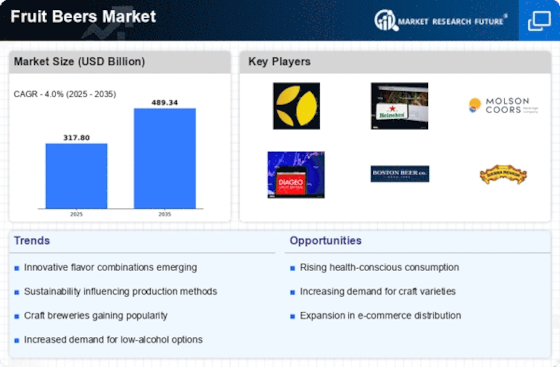
As per Market Research Future analysis, the Fruit Beers Market Size was estimated at 317.8 USD Billion in 2024, reflecting steady expansion in overall fruit beer market share across key regions. The Fruit Beers industry is projected to grow from 330.52 USD Billion in 2025 to 489.34 USD Billion by 2035, exhibiting a compound annual growth rate (CAGR) of 4.0% during the forecast period 2025 - 2035.

Key Market Trends & Highlights

The Fruit Beers Market is experiencing dynamic growth driven by innovative flavors and health-conscious consumer preferences.

  • North America remains the largest market for fruit beers, showcasing a diverse range of flavors. The Asia-Pacific region is the fastest-growing market, reflecting a rising interest in unique fruit beer offerings. Peach-flavored beers dominate the market, while raspberry-flavored options are rapidly gaining popularity. Key drivers include the craft beer movement and health and wellness trends, which are shaping consumer choices.

Market Size & Forecast

2024 Market Size 317.8 (USD Billion)
2035 Market Size 489.34 (USD Billion)
CAGR (2025 - 2035) 4.0%
Largest Regional Market Share in 2024 North America

Major Players

Anheuser-Busch InBev (BE), <a href="https://www.heineken.com/global/en/our-products/heineken-0-0">Heineken N.V. (NL)</a>, Molson Coors Beverage Company (US), Diageo plc (GB), Boston Beer Company (US), Sierra Nevada Brewing Co. (US), New Belgium Brewing Company (US), Cider Brothers (US)

Market Trends

The Fruit Beers Market is currently experiencing a notable evolution, characterized by a growing consumer preference for innovative flavors and unique brewing techniques, highlighting evolving fruit beer market trends driven by craft beer innovation and flavor diversification. This shift appears to be driven by an increasing interest in craft beverages, where artisanal production methods and local ingredients are highly valued. As consumers seek out distinctive taste experiences, breweries are responding by experimenting with various fruits, herbs, and spices, thereby expanding their product offerings. This trend not only enhances the diversity of available options but also fosters a deeper connection between consumers and the brewing process, as many are drawn to the stories behind each unique brew.

Moreover, the Fruit Beers Market is witnessing a rise in health-conscious choices among consumers, reinforcing positive fruit beer market trends focused on lighter, refreshing, and fruit-infused beverage options. Many individuals are gravitating towards beverages perceived as lighter and more refreshing, often opting for fruit-infused options that align with their lifestyle preferences. This inclination towards healthier alternatives suggests that breweries may need to adapt their marketing strategies to highlight the natural ingredients and lower calorie counts of their products. As the market continues to evolve, it is likely that the intersection of flavor innovation and health awareness will shape the future landscape of fruit beers, creating opportunities for growth and differentiation within this dynamic sector.

Flavor Innovation

The Fruit Beers Market is marked by a surge in flavor experimentation, with breweries increasingly incorporating a variety of fruits and botanicals. This trend reflects a consumer desire for unique and adventurous taste experiences, prompting producers to push the boundaries of traditional brewing.

Health-Conscious Choices

A growing segment of consumers is prioritizing health and wellness, leading to a preference for lighter, fruit-infused beverages. This shift indicates that breweries may need to emphasize the use of natural ingredients and lower calorie options to attract health-oriented customers.

Sustainability Practices

Sustainability is becoming a focal point within the Fruit Beers Market, as consumers show a preference for brands that adopt eco-friendly practices, shaping long-term fruit beer market trends related to sourcing and production. This trend suggests that breweries may increasingly invest in sustainable sourcing and production methods to appeal to environmentally conscious consumers.

Fruit Beer Market Market Drivers

Flavor Diversity

The Fruit Beers Market is experiencing a notable surge in flavor diversity, driven by consumer preferences for unique and innovative taste experiences. Breweries are increasingly experimenting with various fruits, herbs, and spices to create distinctive flavor profiles. This trend is reflected in the growing number of craft breweries that focus on fruit-infused beers, which accounted for approximately 25% of the craft beer market in recent years. As consumers seek out new and exciting flavors, the demand for fruit beers is likely to continue rising, encouraging producers to innovate further. This dynamic not only enhances consumer engagement but also fosters competition among breweries, ultimately benefiting the Fruit Beers Market as a whole.

Craft Beer Movement

The ongoing craft beer movement is a pivotal driver for the Fruit Beers Market. As consumers increasingly gravitate towards artisanal and locally produced beverages, craft breweries are capitalizing on this trend by offering a wide array of fruit beers. This movement has led to a proliferation of small-scale breweries that focus on quality and creativity, often incorporating locally sourced fruits into their brews. Data suggests that craft beer sales have consistently outpaced those of mass-produced beers, indicating a robust market for innovative fruit beers. The craft beer movement not only fosters creativity but also encourages community engagement, further solidifying the Fruit Beers Market's position in the beverage landscape.

Changing Demographics

Changing demographics are reshaping the Fruit Beers Market, as younger consumers, particularly millennials and Generation Z, exhibit distinct preferences for fruit-flavored beverages. These demographics are more adventurous in their drinking habits, often seeking out unique and flavorful options that differ from traditional beer offerings. Recent studies indicate that younger consumers are more likely to experiment with fruit beers, driving demand for innovative flavors and styles. This shift in consumer behavior suggests that the Fruit Beers Market must adapt to meet the evolving tastes and preferences of these younger generations. As a result, breweries that cater to these changing demographics are likely to thrive in an increasingly competitive market.

Health and Wellness Trends

The Fruit Beers Market is witnessing a shift towards health-conscious choices among consumers. As individuals become more aware of their dietary habits, there is an increasing demand for beverages that offer perceived health benefits. Fruit beers, often perceived as lighter and more refreshing alternatives to traditional beers, are gaining traction. Many consumers associate fruit beers with lower calorie counts and natural ingredients, which aligns with the growing trend of health and wellness. Recent data indicates that the market for low-calorie and low-alcohol beverages is expanding, with fruit beers positioned to capture a significant share of this segment. This trend suggests that the Fruit Beers Market may continue to thrive as health-conscious consumers seek out flavorful yet healthier options.

Sustainability and Ethical Sourcing

Sustainability practices are becoming increasingly important within the Fruit Beers Market. Consumers are more inclined to support brands that prioritize environmentally friendly production methods and ethical sourcing of ingredients. Breweries that adopt sustainable practices, such as using organic fruits or implementing eco-friendly packaging, are likely to resonate with a growing demographic of environmentally conscious consumers. Recent surveys indicate that a significant percentage of consumers are willing to pay a premium for products that align with their values regarding sustainability. This shift not only enhances brand loyalty but also positions the Fruit Beers Market favorably in a competitive landscape, as sustainability becomes a key differentiator.

Market Segment Insights

By Flavors: Peach (Largest) vs. Raspberry (Fastest-Growing)

In the Fruit Beers Market, the flavors segment showcases a diverse array of preferences among consumers. Peach stands out as the largest flavor, capturing significant market attention with its sweet and refreshing profile. Raspberry, on the other hand, is emerging rapidly, due to an increased consumer appetite for bold and tangy flavors. Other flavors such as cherry, <a href="https://www.marketresearchfuture.com/reports/apricot-market-23066" target="_blank" rel="noopener">apricot</a>, and apple also hold their ground, contributing to the overall diversification of the fruit beer offerings, but they command a smaller segment share compared to peach and raspberry.<br>As consumers increasingly seek unique and innovative taste experiences, the growth of these flavors follows suit, strengthening overall fruit beer market analysis across peach, raspberry, cherry, apricot, and apple segments. The rising trend towards naturally flavored beverages enhances the appeal of fruit beers, driving demand for flavors like raspberry that offer a vibrant taste. Additionally, the health-conscious consumer's preference for lower-calorie and fruit-infused beers has become a major driver, propelling the raspberry segment's growth as it aligns with these tendencies, further highlighting the dynamic evolution of the Fruit Beers Market.

Peach (Dominant) vs. Cherry (Emerging)

Peach flavor dominates the Fruit Beers Market due to its universally appealing taste and versatility, making it a staple in many craft breweries. The sweetness and fragrant aroma of peach resonate well with consumers, leading to its high popularity. In contrast, cherry flavor is emerging as a captivating choice for adventurous drinkers. It brings a unique tartness that attracts those seeking distinctive beverages. Cherry's positioning as an emerging flavor is bolstered by creative brewers experimenting with local and seasonal varieties, enhancing its market presence. Both these flavors reflect the ongoing trend of innovation in the fruit beer category, appealing to traditonal tastes while enticing new consumers.

By Distribution Channel: Store-based (Largest) vs. Non-store-based (Fastest-Growing)

In the Fruit Beers Market, store-based distribution remains the largest segment, capturing the majority of market share. This channel includes supermarkets, liquor stores, and specialty stores that provide consumers with a variety of fruit beer options. These outlets not only enhance visibility but also facilitate sampling and promotional activities that attract a diverse consumer base. Conversely, non-store-based distribution, including online platforms, is gaining traction as consumers increasingly turn to e-commerce for convenience and accessibility to unique fruit beer variations, including growing interest in the canned fruit beer market.

Distribution Channel: Store-based (Dominant) vs. Non-store-based (Emerging)

Store-based distribution channels dominate the Fruit Beers Market due to their established retail presence and the ability to provide immediate access to products. These channels offer consumers a tactile experience, allowing them to see, touch, and often taste the beers before purchase. In contrast, non-store-based channels are emerging as a significant force, driven by the rise in online shopping trends and the ability to reach niche markets. E-commerce platforms enable consumers to explore an extensive range of fruit beers, often accompanied by promotions and home delivery options, supporting growth in emerging segments such as the canned fruit beer market. The growth in this segment reflects changing consumer preferences and the convenience that modern shopping behaviors demand, making both distribution forms vital in a competitive landscape.

By Application: Food & Beverage (Largest) vs. Dietary Supplements (Fastest-Growing)

In the Fruit Beers Market, the application segment shows a diverse distribution among various categories. The Food &amp; Beverage sector dominates, driven by the increasing consumer demand for innovative and flavorful <a href="https://www.marketresearchfuture.com/reports/alcoholic-beverages-market-3190" target="_blank" rel="noopener">alcoholic beverages</a>. This segment's popularity is augmented by the ongoing trend towards fruit-infused beers, appealing to a wider audience including casual drinkers and craft beer enthusiasts. In contrast, the Dietary Supplements application is emerging as a significant player, gaining traction due to the growing consumer focus on health benefits and functional beverages. This shift enables the sector to tap into a niche market looking for wellness-oriented options in their beverage choices.

Food &amp; Beverage (Dominant) vs. Dietary Supplements (Emerging)

The Food &amp; Beverage application segment in the Fruit Beers Market remains dominant, characterized by a rich variety of flavors and innovative brewing techniques that enhance consumer experience. Craft breweries are prominent players in this space, creating unique products tailored to consumer preferences. Conversely, the Dietary Supplements segment is rapidly emerging, responding to health-conscious consumers seeking beverages that combine pleasure and wellness. This trend is supported by increasing health awareness, leading to fruit beers being marketed as refreshing alternatives with nutritional benefits. As both segments vie for consumer attention, the interplay between indulgence and health positions them uniquely in the competitive landscape.

Get more detailed insights about Fruit Beer Market Research Report – Forecast to 2035

Regional Insights

By region, the report provides market insights into North America, Asia-Pacific, Europe and the Rest of the World. The North American Fruit Beers market will dominate this market due to the region's growing consumer preference for flavored and innovative beer offerings, coupled with a diverse range of craft breweries and established beer manufacturers. Additionally, changing taste preferences and the rising popularity of fruit-infused beverages contributed to North America's dominance in the market.

Further, the major countries studied in the market report are The US, Canada, Germany, Italy, Spain, France, the UK, China, Japan, India, Australia, South Korea, and Brazil.

Figure 2: FRUIT BEERS MARKET SHARE BY REGION 2022 (USD Billion)

Europe's Fruit Beers market accounts for the second-largest market share, reinforcing its contribution to the global fruit beer market share supported by strong beer culture and established fruit-infused brewing traditions. Further, the German Fruit Beers market held the largest market share, and the UK Fruit Beers market was growing at the highest CAGR in the European region.

The Asia-Pacific Fruit Beers Market is anticipated to grow at the highest CAGR from 2023 to 2032. Asia-Pacific was the fastest-growing region in the Fruit Beers market due to increasing urbanization, rising disposable incomes, changing consumer preferences towards flavored alcoholic beverages, and expanding international beer brands, introducing new fruit beer offerings to cater to the growing demand. Moreover, China’s Fruit Beers market held the largest market share, and the Indian Fruit Beers market was the fastest-growing market in the Asia-Pacific region.

Key Players and Competitive Insights

Leading market players are investing heavily in R&D to expand their product lines, which will help the Fruit Beers market grow further, strengthening competitive positioning and reinforcing insights derived from fruit beer market analysis. Market players are also taking various strategic activities to enhance their footprint, with vital market developments including new product launches, M&A, higher investments, and collaboration with other organizations. The Fruit Beers industry must offer less costly items to expand in a more competitive market climate.
Manufacturing in-house to reduce operational costs is one of the key business strategy manufacturers use in the Fruit Beers industry to benefit clients and increase the market sector. In recent years, the Fruit Beers industry has offered some of the most significant advantages to the food industry.
Major players in the Fruit Beers market, including New Belgium Brewing Company (US), Magic Hat Brewing Company (US), Shipyard Brewing Company (US), Joseph James Brewing Company, All Saints Brewing Company (US), brewery Ommegang (US), Lindemass Brewery (Belgium), Lost Coast Brewery (US) and Others are attempting to increase market demand by investing in research and development operations.
New Belgium Brewing Company, headquartered in the United States, is a renowned craft brewery known for its exceptional fruit beers. Established in 1991 in Fort Collins, Colorado, the company has gained prominence for its commitment to sustainability and innovation in brewing. New Belgium Brewing takes pride in crafting diverse fruit-infused beers that cater to a wide range of palates, combining traditional brewing techniques with creative and refreshing fruit additions. With a strong emphasis on quality and craftsmanship, New Belgium Brewing Company sources premium fruits to create unique and flavorful fruit beers. Their offerings include popular fruit beer varieties such as Fat Tire Belgian White, which combines wheat and oats with Seville oranges, providing a smooth and citrusy taste. The Voodoo Ranger Juicy Haze IPA boasts tropical notes from the infusion of pineapple, mango, and citrus, offering a delightfully juicy drinking experience. Committed to environmental stewardship, the company utilizes sustainable brewing practices and advocates for eco-conscious initiatives, making it a popular choice among environmentally-conscious consumers. With its distinctive fruit beer selection and sustainable values, New Belgium Brewing continues to significantly impact the craft beer industry nationally and internationally. Based in the United States, Shipyard Brewing Company is a prominent craft brewery renowned for its exceptional fruit beers. It was founded in 1994 in Maine, the company has garnered recognition for its commitment to crafting innovative and diverse fruit-infused brews that appeal to a wide range of beer enthusiasts. Shipyard Brewing takes pride in sourcing high-quality fruits to create a variety of delicious fruit beers.
Their offerings include popular fruit beer options such as the Shipyard Summer Ale, infused with lemon peel and provide a refreshing and citrusy taste perfect for warmer months. The company's Pumpkinhead Ale, featuring pumpkin and seasonal spices, has become a seasonal favorite, offering a unique twist on traditional fruit beers. With a dedication to maintaining traditional brewing methods and exploring creative flavor combinations, Shipyard Brewing Company continues to leave a lasting impression on the craft beer industry, showcasing its commitment to craftsmanship and innovation with each fruit-infused brew they produce.

Key Companies in the Fruit Beer Market include

Industry Developments

September 2022: Sonnen Hill Brewing recently unveiled an exclusive fruit beer that features a combination of Blackberry and Raspberry flavors, grains, and locally sourced Ontario fruit. The brewing process involved more than eighteen months of fermentation in stainless steel tanks, resulting in a well-balanced blend of fruitiness, funky notes, and acidity.

October 2020: Abita Brewing Company (Abita) recently introduced their new product, Spring Loaded, a refreshing beverage made with artesian spring water and all-natural ingredients. The base beer is crafted using Louisiana sugar, which undergoes fermentation, leaving just two grams of sugar behind. The outcome is crisp, spiked water infused with delightful natural fruit flavors.

Future Outlook

Fruit Beer Market Future Outlook

The Fruit Beers Market is projected to grow at a 4.0% CAGR from 2025 to 2035, driven by increasing consumer demand for innovative flavors and health-conscious options.

New opportunities lie in:

  • <p>Expansion into non-alcoholic fruit <a href="https://www.marketresearchfuture.com/reports/beer-market-1647" target="_blank" rel="noopener">beer</a> segments Development of premium craft fruit beer lines Strategic partnerships with local fruit growers for unique ingredients</p>

By 2035, the Fruit Beers Market is expected to achieve substantial growth and diversification.

Market Segmentation

Fruit Beer Market Flavors Outlook

  • peach
  • raspberry
  • cherry
  • apricot
  • apple

Fruit Beer Market Application Outlook

  • Dietary Supplements
  • Personal Care
  • Food & Beverage
  • Industrial
  • Others

Fruit Beer Market Distribution Channel Outlook

  • store-based
  • non-store-based

Report Scope

MARKET SIZE 2024 317.8(USD Billion)
MARKET SIZE 2025 330.52(USD Billion)
MARKET SIZE 2035 489.34(USD Billion)
COMPOUND ANNUAL GROWTH RATE (CAGR) 4.0% (2025 - 2035)
REPORT COVERAGE Revenue Forecast, Competitive Landscape, Growth Factors, and Trends
BASE YEAR 2024
Market Forecast Period 2025 - 2035
Historical Data 2019 - 2024
Market Forecast Units USD Billion
Key Companies Profiled Anheuser-Busch InBev (BE), Heineken N.V. (NL), Molson Coors Beverage Company (US), Diageo plc (GB), Boston Beer Company (US), Sierra Nevada Brewing Co. (US), New Belgium Brewing Company (US), Cider Brothers (US)
Segments Covered Flavors, Distribution Channel, Region
Key Market Opportunities Growing consumer preference for innovative flavors and natural ingredients in the Fruit Beers Market.
Key Market Dynamics Rising consumer preference for unique flavors drives innovation and competition in the fruit beers market.
Countries Covered North America, Europe, APAC, South America, MEA

FAQs

What is the current valuation of the Fruit Beers Market?

<p>The overall market valuation was 317.8 USD Billion in 2024.</p>

What is the projected market size for the Fruit Beers Market by 2035?

<p>The projected valuation for the Fruit Beers Market is 489.34 USD Billion by 2035.</p>

What is the expected CAGR for the Fruit Beers Market during the forecast period?

<p>The expected CAGR for the Fruit Beers Market from 2025 to 2035 is 4.0%.</p>

Which companies are the key players in the Fruit Beers Market?

<p>Key players include Anheuser-Busch InBev, Heineken N.V., Molson Coors Beverage Company, and others.</p>

What are the leading flavors in the Fruit Beers Market?

<p>Leading flavors include peach, raspberry, cherry, apricot, and apple, with peach valued at 31.78 USD Billion in 2024.</p>

How does the distribution channel impact the Fruit Beers Market?

<p>The distribution channels are segmented into store-based, valued at 200.0 USD Billion, and non-store-based, valued at 117.8 USD Billion in 2024.</p>

What applications are driving the Fruit Beers Market?

Applications include food &amp; beverage, valued at 200.0 USD Billion, and dietary supplements, valued at 30.0 USD Billion in 2024.

How does the market for raspberry-flavored beers compare to others?

Raspberry-flavored beers were valued at 25.42 USD Billion in 2024, indicating strong consumer interest.

What is the significance of the projected growth in the Fruit Beers Market?

The projected growth suggests a robust demand for fruit beers, potentially reaching 489.34 USD Billion by 2035.

How do the valuations of different fruit flavors compare?

In 2024, peach leads with 31.78 USD Billion, followed by raspberry at 25.42 USD Billion and cherry at 22.36 USD Billion.

  1. SECTION I: EXECUTIVE SUMMARY AND KEY HIGHLIGHTS
    1. | 1.1 EXECUTIVE SUMMARY
    2. | | 1.1.1 Market Overview
    3. | | 1.1.2 Key Findings
    4. | | 1.1.3 Market Segmentation
    5. | | 1.1.4 Competitive Landscape
    6. | | 1.1.5 Challenges and Opportunities
    7. | | 1.1.6 Future Outlook
  2. SECTION II: SCOPING, METHODOLOGY AND MARKET STRUCTURE
    1. | 2.1 MARKET INTRODUCTION
    2. | | 2.1.1 Definition
    3. | | 2.1.2 Scope of the study
    4. | | | 2.1.2.1 Research Objective
    5. | | | 2.1.2.2 Assumption
    6. | | | 2.1.2.3 Limitations
    7. | 2.2 RESEARCH METHODOLOGY
    8. | | 2.2.1 Overview
    9. | | 2.2.2 Data Mining
    10. | | 2.2.3 Secondary Research
    11. | | 2.2.4 Primary Research
    12. | | | 2.2.4.1 Primary Interviews and Information Gathering Process
    13. | | | 2.2.4.2 Breakdown of Primary Respondents
    14. | | 2.2.5 Forecasting Model
    15. | | 2.2.6 Market Size Estimation
    16. | | | 2.2.6.1 Bottom-Up Approach
    17. | | | 2.2.6.2 Top-Down Approach
    18. | | 2.2.7 Data Triangulation
    19. | | 2.2.8 Validation
  3. SECTION III: QUALITATIVE ANALYSIS
    1. | 3.1 MARKET DYNAMICS
    2. | | 3.1.1 Overview
    3. | | 3.1.2 Drivers
    4. | | 3.1.3 Restraints
    5. | | 3.1.4 Opportunities
    6. | 3.2 MARKET FACTOR ANALYSIS
    7. | | 3.2.1 Value chain Analysis
    8. | | 3.2.2 Porter's Five Forces Analysis
    9. | | | 3.2.2.1 Bargaining Power of Suppliers
    10. | | | 3.2.2.2 Bargaining Power of Buyers
    11. | | | 3.2.2.3 Threat of New Entrants
    12. | | | 3.2.2.4 Threat of Substitutes
    13. | | | 3.2.2.5 Intensity of Rivalry
    14. | | 3.2.3 COVID-19 Impact Analysis
    15. | | | 3.2.3.1 Market Impact Analysis
    16. | | | 3.2.3.2 Regional Impact
    17. | | | 3.2.3.3 Opportunity and Threat Analysis
  4. SECTION IV: QUANTITATIVE ANALYSIS
    1. | 4.1 Food, Beverages & Nutrition, BY Flavors (USD Billion)
    2. | | 4.1.1 peach
    3. | | 4.1.2 raspberry
    4. | | 4.1.3 cherry
    5. | | 4.1.4 apricot
    6. | | 4.1.5 apple
    7. | 4.2 Food, Beverages & Nutrition, BY Distribution Channel (USD Billion)
    8. | | 4.2.1 store-based
    9. | | 4.2.2 non-store-based
    10. | 4.3 Food, Beverages & Nutrition, BY Application (USD Billion)
    11. | | 4.3.1 Dietary Supplements
    12. | | 4.3.2 Personal Care
    13. | | 4.3.3 Food & Beverage
    14. | | 4.3.4 Industrial
    15. | | 4.3.5 Others
    16. | 4.4 Food, Beverages & Nutrition, BY Region (USD Billion)
    17. | | 4.4.1 North America
    18. | | | 4.4.1.1 US
    19. | | | 4.4.1.2 Canada
    20. | | 4.4.2 Europe
    21. | | | 4.4.2.1 Germany
    22. | | | 4.4.2.2 UK
    23. | | | 4.4.2.3 France
    24. | | | 4.4.2.4 Russia
    25. | | | 4.4.2.5 Italy
    26. | | | 4.4.2.6 Spain
    27. | | | 4.4.2.7 Rest of Europe
    28. | | 4.4.3 APAC
    29. | | | 4.4.3.1 China
    30. | | | 4.4.3.2 India
    31. | | | 4.4.3.3 Japan
    32. | | | 4.4.3.4 South Korea
    33. | | | 4.4.3.5 Malaysia
    34. | | | 4.4.3.6 Thailand
    35. | | | 4.4.3.7 Indonesia
    36. | | | 4.4.3.8 Rest of APAC
    37. | | 4.4.4 South America
    38. | | | 4.4.4.1 Brazil
    39. | | | 4.4.4.2 Mexico
    40. | | | 4.4.4.3 Argentina
    41. | | | 4.4.4.4 Rest of South America
    42. | | 4.4.5 MEA
    43. | | | 4.4.5.1 GCC Countries
    44. | | | 4.4.5.2 South Africa
    45. | | | 4.4.5.3 Rest of MEA
  5. SECTION V: COMPETITIVE ANALYSIS
    1. | 5.1 Competitive Landscape
    2. | | 5.1.1 Overview
    3. | | 5.1.2 Competitive Analysis
    4. | | 5.1.3 Market share Analysis
    5. | | 5.1.4 Major Growth Strategy in the Food, Beverages & Nutrition
    6. | | 5.1.5 Competitive Benchmarking
    7. | | 5.1.6 Leading Players in Terms of Number of Developments in the Food, Beverages & Nutrition
    8. | | 5.1.7 Key developments and growth strategies
    9. | | | 5.1.7.1 New Product Launch/Service Deployment
    10. | | | 5.1.7.2 Merger & Acquisitions
    11. | | | 5.1.7.3 Joint Ventures
    12. | | 5.1.8 Major Players Financial Matrix
    13. | | | 5.1.8.1 Sales and Operating Income
    14. | | | 5.1.8.2 Major Players R&D Expenditure. 2023
    15. | 5.2 Company Profiles
    16. | | 5.2.1 Anheuser-Busch InBev (BE)
    17. | | | 5.2.1.1 Financial Overview
    18. | | | 5.2.1.2 Products Offered
    19. | | | 5.2.1.3 Key Developments
    20. | | | 5.2.1.4 SWOT Analysis
    21. | | | 5.2.1.5 Key Strategies
    22. | | 5.2.2 Heineken N.V. (NL)
    23. | | | 5.2.2.1 Financial Overview
    24. | | | 5.2.2.2 Products Offered
    25. | | | 5.2.2.3 Key Developments
    26. | | | 5.2.2.4 SWOT Analysis
    27. | | | 5.2.2.5 Key Strategies
    28. | | 5.2.3 Molson Coors Beverage Company (US)
    29. | | | 5.2.3.1 Financial Overview
    30. | | | 5.2.3.2 Products Offered
    31. | | | 5.2.3.3 Key Developments
    32. | | | 5.2.3.4 SWOT Analysis
    33. | | | 5.2.3.5 Key Strategies
    34. | | 5.2.4 Diageo plc (GB)
    35. | | | 5.2.4.1 Financial Overview
    36. | | | 5.2.4.2 Products Offered
    37. | | | 5.2.4.3 Key Developments
    38. | | | 5.2.4.4 SWOT Analysis
    39. | | | 5.2.4.5 Key Strategies
    40. | | 5.2.5 Boston Beer Company (US)
    41. | | | 5.2.5.1 Financial Overview
    42. | | | 5.2.5.2 Products Offered
    43. | | | 5.2.5.3 Key Developments
    44. | | | 5.2.5.4 SWOT Analysis
    45. | | | 5.2.5.5 Key Strategies
    46. | | 5.2.6 Sierra Nevada Brewing Co. (US)
    47. | | | 5.2.6.1 Financial Overview
    48. | | | 5.2.6.2 Products Offered
    49. | | | 5.2.6.3 Key Developments
    50. | | | 5.2.6.4 SWOT Analysis
    51. | | | 5.2.6.5 Key Strategies
    52. | | 5.2.7 New Belgium Brewing Company (US)
    53. | | | 5.2.7.1 Financial Overview
    54. | | | 5.2.7.2 Products Offered
    55. | | | 5.2.7.3 Key Developments
    56. | | | 5.2.7.4 SWOT Analysis
    57. | | | 5.2.7.5 Key Strategies
    58. | | 5.2.8 Cider Brothers (US)
    59. | | | 5.2.8.1 Financial Overview
    60. | | | 5.2.8.2 Products Offered
    61. | | | 5.2.8.3 Key Developments
    62. | | | 5.2.8.4 SWOT Analysis
    63. | | | 5.2.8.5 Key Strategies
    64. | 5.3 Appendix
    65. | | 5.3.1 References
    66. | | 5.3.2 Related Reports
  6. LIST OF FIGURES
    1. | 6.1 MARKET SYNOPSIS
    2. | 6.2 NORTH AMERICA MARKET ANALYSIS
    3. | 6.3 US MARKET ANALYSIS BY FLAVORS
    4. | 6.4 US MARKET ANALYSIS BY DISTRIBUTION CHANNEL
    5. | 6.5 US MARKET ANALYSIS BY APPLICATION
    6. | 6.6 CANADA MARKET ANALYSIS BY FLAVORS
    7. | 6.7 CANADA MARKET ANALYSIS BY DISTRIBUTION CHANNEL
    8. | 6.8 CANADA MARKET ANALYSIS BY APPLICATION
    9. | 6.9 EUROPE MARKET ANALYSIS
    10. | 6.10 GERMANY MARKET ANALYSIS BY FLAVORS
    11. | 6.11 GERMANY MARKET ANALYSIS BY DISTRIBUTION CHANNEL
    12. | 6.12 GERMANY MARKET ANALYSIS BY APPLICATION
    13. | 6.13 UK MARKET ANALYSIS BY FLAVORS
    14. | 6.14 UK MARKET ANALYSIS BY DISTRIBUTION CHANNEL
    15. | 6.15 UK MARKET ANALYSIS BY APPLICATION
    16. | 6.16 FRANCE MARKET ANALYSIS BY FLAVORS
    17. | 6.17 FRANCE MARKET ANALYSIS BY DISTRIBUTION CHANNEL
    18. | 6.18 FRANCE MARKET ANALYSIS BY APPLICATION
    19. | 6.19 RUSSIA MARKET ANALYSIS BY FLAVORS
    20. | 6.20 RUSSIA MARKET ANALYSIS BY DISTRIBUTION CHANNEL
    21. | 6.21 RUSSIA MARKET ANALYSIS BY APPLICATION
    22. | 6.22 ITALY MARKET ANALYSIS BY FLAVORS
    23. | 6.23 ITALY MARKET ANALYSIS BY DISTRIBUTION CHANNEL
    24. | 6.24 ITALY MARKET ANALYSIS BY APPLICATION
    25. | 6.25 SPAIN MARKET ANALYSIS BY FLAVORS
    26. | 6.26 SPAIN MARKET ANALYSIS BY DISTRIBUTION CHANNEL
    27. | 6.27 SPAIN MARKET ANALYSIS BY APPLICATION
    28. | 6.28 REST OF EUROPE MARKET ANALYSIS BY FLAVORS
    29. | 6.29 REST OF EUROPE MARKET ANALYSIS BY DISTRIBUTION CHANNEL
    30. | 6.30 REST OF EUROPE MARKET ANALYSIS BY APPLICATION
    31. | 6.31 APAC MARKET ANALYSIS
    32. | 6.32 CHINA MARKET ANALYSIS BY FLAVORS
    33. | 6.33 CHINA MARKET ANALYSIS BY DISTRIBUTION CHANNEL
    34. | 6.34 CHINA MARKET ANALYSIS BY APPLICATION
    35. | 6.35 INDIA MARKET ANALYSIS BY FLAVORS
    36. | 6.36 INDIA MARKET ANALYSIS BY DISTRIBUTION CHANNEL
    37. | 6.37 INDIA MARKET ANALYSIS BY APPLICATION
    38. | 6.38 JAPAN MARKET ANALYSIS BY FLAVORS
    39. | 6.39 JAPAN MARKET ANALYSIS BY DISTRIBUTION CHANNEL
    40. | 6.40 JAPAN MARKET ANALYSIS BY APPLICATION
    41. | 6.41 SOUTH KOREA MARKET ANALYSIS BY FLAVORS
    42. | 6.42 SOUTH KOREA MARKET ANALYSIS BY DISTRIBUTION CHANNEL
    43. | 6.43 SOUTH KOREA MARKET ANALYSIS BY APPLICATION
    44. | 6.44 MALAYSIA MARKET ANALYSIS BY FLAVORS
    45. | 6.45 MALAYSIA MARKET ANALYSIS BY DISTRIBUTION CHANNEL
    46. | 6.46 MALAYSIA MARKET ANALYSIS BY APPLICATION
    47. | 6.47 THAILAND MARKET ANALYSIS BY FLAVORS
    48. | 6.48 THAILAND MARKET ANALYSIS BY DISTRIBUTION CHANNEL
    49. | 6.49 THAILAND MARKET ANALYSIS BY APPLICATION
    50. | 6.50 INDONESIA MARKET ANALYSIS BY FLAVORS
    51. | 6.51 INDONESIA MARKET ANALYSIS BY DISTRIBUTION CHANNEL
    52. | 6.52 INDONESIA MARKET ANALYSIS BY APPLICATION
    53. | 6.53 REST OF APAC MARKET ANALYSIS BY FLAVORS
    54. | 6.54 REST OF APAC MARKET ANALYSIS BY DISTRIBUTION CHANNEL
    55. | 6.55 REST OF APAC MARKET ANALYSIS BY APPLICATION
    56. | 6.56 SOUTH AMERICA MARKET ANALYSIS
    57. | 6.57 BRAZIL MARKET ANALYSIS BY FLAVORS
    58. | 6.58 BRAZIL MARKET ANALYSIS BY DISTRIBUTION CHANNEL
    59. | 6.59 BRAZIL MARKET ANALYSIS BY APPLICATION
    60. | 6.60 MEXICO MARKET ANALYSIS BY FLAVORS
    61. | 6.61 MEXICO MARKET ANALYSIS BY DISTRIBUTION CHANNEL
    62. | 6.62 MEXICO MARKET ANALYSIS BY APPLICATION
    63. | 6.63 ARGENTINA MARKET ANALYSIS BY FLAVORS
    64. | 6.64 ARGENTINA MARKET ANALYSIS BY DISTRIBUTION CHANNEL
    65. | 6.65 ARGENTINA MARKET ANALYSIS BY APPLICATION
    66. | 6.66 REST OF SOUTH AMERICA MARKET ANALYSIS BY FLAVORS
    67. | 6.67 REST OF SOUTH AMERICA MARKET ANALYSIS BY DISTRIBUTION CHANNEL
    68. | 6.68 REST OF SOUTH AMERICA MARKET ANALYSIS BY APPLICATION
    69. | 6.69 MEA MARKET ANALYSIS
    70. | 6.70 GCC COUNTRIES MARKET ANALYSIS BY FLAVORS
    71. | 6.71 GCC COUNTRIES MARKET ANALYSIS BY DISTRIBUTION CHANNEL
    72. | 6.72 GCC COUNTRIES MARKET ANALYSIS BY APPLICATION
    73. | 6.73 SOUTH AFRICA MARKET ANALYSIS BY FLAVORS
    74. | 6.74 SOUTH AFRICA MARKET ANALYSIS BY DISTRIBUTION CHANNEL
    75. | 6.75 SOUTH AFRICA MARKET ANALYSIS BY APPLICATION
    76. | 6.76 REST OF MEA MARKET ANALYSIS BY FLAVORS
    77. | 6.77 REST OF MEA MARKET ANALYSIS BY DISTRIBUTION CHANNEL
    78. | 6.78 REST OF MEA MARKET ANALYSIS BY APPLICATION
    79. | 6.79 KEY BUYING CRITERIA OF FOOD, BEVERAGES & NUTRITION
    80. | 6.80 RESEARCH PROCESS OF MRFR
    81. | 6.81 DRO ANALYSIS OF FOOD, BEVERAGES & NUTRITION
    82. | 6.82 DRIVERS IMPACT ANALYSIS: FOOD, BEVERAGES & NUTRITION
    83. | 6.83 RESTRAINTS IMPACT ANALYSIS: FOOD, BEVERAGES & NUTRITION
    84. | 6.84 SUPPLY / VALUE CHAIN: FOOD, BEVERAGES & NUTRITION
    85. | 6.85 FOOD, BEVERAGES & NUTRITION, BY FLAVORS, 2024 (% SHARE)
    86. | 6.86 FOOD, BEVERAGES & NUTRITION, BY FLAVORS, 2024 TO 2035 (USD Billion)
    87. | 6.87 FOOD, BEVERAGES & NUTRITION, BY DISTRIBUTION CHANNEL, 2024 (% SHARE)
    88. | 6.88 FOOD, BEVERAGES & NUTRITION, BY DISTRIBUTION CHANNEL, 2024 TO 2035 (USD Billion)
    89. | 6.89 FOOD, BEVERAGES & NUTRITION, BY APPLICATION, 2024 (% SHARE)
    90. | 6.90 FOOD, BEVERAGES & NUTRITION, BY APPLICATION, 2024 TO 2035 (USD Billion)
    91. | 6.91 BENCHMARKING OF MAJOR COMPETITORS
  7. LIST OF TABLES
    1. | 7.1 LIST OF ASSUMPTIONS
    2. | | 7.1.1
    3. | 7.2 North America MARKET SIZE ESTIMATES; FORECAST
    4. | | 7.2.1 BY FLAVORS, 2025-2035 (USD Billion)
    5. | | 7.2.2 BY DISTRIBUTION CHANNEL, 2025-2035 (USD Billion)
    6. | | 7.2.3 BY APPLICATION, 2025-2035 (USD Billion)
    7. | 7.3 US MARKET SIZE ESTIMATES; FORECAST
    8. | | 7.3.1 BY FLAVORS, 2025-2035 (USD Billion)
    9. | | 7.3.2 BY DISTRIBUTION CHANNEL, 2025-2035 (USD Billion)
    10. | | 7.3.3 BY APPLICATION, 2025-2035 (USD Billion)
    11. | 7.4 Canada MARKET SIZE ESTIMATES; FORECAST
    12. | | 7.4.1 BY FLAVORS, 2025-2035 (USD Billion)
    13. | | 7.4.2 BY DISTRIBUTION CHANNEL, 2025-2035 (USD Billion)
    14. | | 7.4.3 BY APPLICATION, 2025-2035 (USD Billion)
    15. | 7.5 Europe MARKET SIZE ESTIMATES; FORECAST
    16. | | 7.5.1 BY FLAVORS, 2025-2035 (USD Billion)
    17. | | 7.5.2 BY DISTRIBUTION CHANNEL, 2025-2035 (USD Billion)
    18. | | 7.5.3 BY APPLICATION, 2025-2035 (USD Billion)
    19. | 7.6 Germany MARKET SIZE ESTIMATES; FORECAST
    20. | | 7.6.1 BY FLAVORS, 2025-2035 (USD Billion)
    21. | | 7.6.2 BY DISTRIBUTION CHANNEL, 2025-2035 (USD Billion)
    22. | | 7.6.3 BY APPLICATION, 2025-2035 (USD Billion)
    23. | 7.7 UK MARKET SIZE ESTIMATES; FORECAST
    24. | | 7.7.1 BY FLAVORS, 2025-2035 (USD Billion)
    25. | | 7.7.2 BY DISTRIBUTION CHANNEL, 2025-2035 (USD Billion)
    26. | | 7.7.3 BY APPLICATION, 2025-2035 (USD Billion)
    27. | 7.8 France MARKET SIZE ESTIMATES; FORECAST
    28. | | 7.8.1 BY FLAVORS, 2025-2035 (USD Billion)
    29. | | 7.8.2 BY DISTRIBUTION CHANNEL, 2025-2035 (USD Billion)
    30. | | 7.8.3 BY APPLICATION, 2025-2035 (USD Billion)
    31. | 7.9 Russia MARKET SIZE ESTIMATES; FORECAST
    32. | | 7.9.1 BY FLAVORS, 2025-2035 (USD Billion)
    33. | | 7.9.2 BY DISTRIBUTION CHANNEL, 2025-2035 (USD Billion)
    34. | | 7.9.3 BY APPLICATION, 2025-2035 (USD Billion)
    35. | 7.10 Italy MARKET SIZE ESTIMATES; FORECAST
    36. | | 7.10.1 BY FLAVORS, 2025-2035 (USD Billion)
    37. | | 7.10.2 BY DISTRIBUTION CHANNEL, 2025-2035 (USD Billion)
    38. | | 7.10.3 BY APPLICATION, 2025-2035 (USD Billion)
    39. | 7.11 Spain MARKET SIZE ESTIMATES; FORECAST
    40. | | 7.11.1 BY FLAVORS, 2025-2035 (USD Billion)
    41. | | 7.11.2 BY DISTRIBUTION CHANNEL, 2025-2035 (USD Billion)
    42. | | 7.11.3 BY APPLICATION, 2025-2035 (USD Billion)
    43. | 7.12 Rest of Europe MARKET SIZE ESTIMATES; FORECAST
    44. | | 7.12.1 BY FLAVORS, 2025-2035 (USD Billion)
    45. | | 7.12.2 BY DISTRIBUTION CHANNEL, 2025-2035 (USD Billion)
    46. | | 7.12.3 BY APPLICATION, 2025-2035 (USD Billion)
    47. | 7.13 APAC MARKET SIZE ESTIMATES; FORECAST
    48. | | 7.13.1 BY FLAVORS, 2025-2035 (USD Billion)
    49. | | 7.13.2 BY DISTRIBUTION CHANNEL, 2025-2035 (USD Billion)
    50. | | 7.13.3 BY APPLICATION, 2025-2035 (USD Billion)
    51. | 7.14 China MARKET SIZE ESTIMATES; FORECAST
    52. | | 7.14.1 BY FLAVORS, 2025-2035 (USD Billion)
    53. | | 7.14.2 BY DISTRIBUTION CHANNEL, 2025-2035 (USD Billion)
    54. | | 7.14.3 BY APPLICATION, 2025-2035 (USD Billion)
    55. | 7.15 India MARKET SIZE ESTIMATES; FORECAST
    56. | | 7.15.1 BY FLAVORS, 2025-2035 (USD Billion)
    57. | | 7.15.2 BY DISTRIBUTION CHANNEL, 2025-2035 (USD Billion)
    58. | | 7.15.3 BY APPLICATION, 2025-2035 (USD Billion)
    59. | 7.16 Japan MARKET SIZE ESTIMATES; FORECAST
    60. | | 7.16.1 BY FLAVORS, 2025-2035 (USD Billion)
    61. | | 7.16.2 BY DISTRIBUTION CHANNEL, 2025-2035 (USD Billion)
    62. | | 7.16.3 BY APPLICATION, 2025-2035 (USD Billion)
    63. | 7.17 South Korea MARKET SIZE ESTIMATES; FORECAST
    64. | | 7.17.1 BY FLAVORS, 2025-2035 (USD Billion)
    65. | | 7.17.2 BY DISTRIBUTION CHANNEL, 2025-2035 (USD Billion)
    66. | | 7.17.3 BY APPLICATION, 2025-2035 (USD Billion)
    67. | 7.18 Malaysia MARKET SIZE ESTIMATES; FORECAST
    68. | | 7.18.1 BY FLAVORS, 2025-2035 (USD Billion)
    69. | | 7.18.2 BY DISTRIBUTION CHANNEL, 2025-2035 (USD Billion)
    70. | | 7.18.3 BY APPLICATION, 2025-2035 (USD Billion)
    71. | 7.19 Thailand MARKET SIZE ESTIMATES; FORECAST
    72. | | 7.19.1 BY FLAVORS, 2025-2035 (USD Billion)
    73. | | 7.19.2 BY DISTRIBUTION CHANNEL, 2025-2035 (USD Billion)
    74. | | 7.19.3 BY APPLICATION, 2025-2035 (USD Billion)
    75. | 7.20 Indonesia MARKET SIZE ESTIMATES; FORECAST
    76. | | 7.20.1 BY FLAVORS, 2025-2035 (USD Billion)
    77. | | 7.20.2 BY DISTRIBUTION CHANNEL, 2025-2035 (USD Billion)
    78. | | 7.20.3 BY APPLICATION, 2025-2035 (USD Billion)
    79. | 7.21 Rest of APAC MARKET SIZE ESTIMATES; FORECAST
    80. | | 7.21.1 BY FLAVORS, 2025-2035 (USD Billion)
    81. | | 7.21.2 BY DISTRIBUTION CHANNEL, 2025-2035 (USD Billion)
    82. | | 7.21.3 BY APPLICATION, 2025-2035 (USD Billion)
    83. | 7.22 South America MARKET SIZE ESTIMATES; FORECAST
    84. | | 7.22.1 BY FLAVORS, 2025-2035 (USD Billion)
    85. | | 7.22.2 BY DISTRIBUTION CHANNEL, 2025-2035 (USD Billion)
    86. | | 7.22.3 BY APPLICATION, 2025-2035 (USD Billion)
    87. | 7.23 Brazil MARKET SIZE ESTIMATES; FORECAST
    88. | | 7.23.1 BY FLAVORS, 2025-2035 (USD Billion)
    89. | | 7.23.2 BY DISTRIBUTION CHANNEL, 2025-2035 (USD Billion)
    90. | | 7.23.3 BY APPLICATION, 2025-2035 (USD Billion)
    91. | 7.24 Mexico MARKET SIZE ESTIMATES; FORECAST
    92. | | 7.24.1 BY FLAVORS, 2025-2035 (USD Billion)
    93. | | 7.24.2 BY DISTRIBUTION CHANNEL, 2025-2035 (USD Billion)
    94. | | 7.24.3 BY APPLICATION, 2025-2035 (USD Billion)
    95. | 7.25 Argentina MARKET SIZE ESTIMATES; FORECAST
    96. | | 7.25.1 BY FLAVORS, 2025-2035 (USD Billion)
    97. | | 7.25.2 BY DISTRIBUTION CHANNEL, 2025-2035 (USD Billion)
    98. | | 7.25.3 BY APPLICATION, 2025-2035 (USD Billion)
    99. | 7.26 Rest of South America MARKET SIZE ESTIMATES; FORECAST
    100. | | 7.26.1 BY FLAVORS, 2025-2035 (USD Billion)
    101. | | 7.26.2 BY DISTRIBUTION CHANNEL, 2025-2035 (USD Billion)
    102. | | 7.26.3 BY APPLICATION, 2025-2035 (USD Billion)
    103. | 7.27 MEA MARKET SIZE ESTIMATES; FORECAST
    104. | | 7.27.1 BY FLAVORS, 2025-2035 (USD Billion)
    105. | | 7.27.2 BY DISTRIBUTION CHANNEL, 2025-2035 (USD Billion)
    106. | | 7.27.3 BY APPLICATION, 2025-2035 (USD Billion)
    107. | 7.28 GCC Countries MARKET SIZE ESTIMATES; FORECAST
    108. | | 7.28.1 BY FLAVORS, 2025-2035 (USD Billion)
    109. | | 7.28.2 BY DISTRIBUTION CHANNEL, 2025-2035 (USD Billion)
    110. | | 7.28.3 BY APPLICATION, 2025-2035 (USD Billion)
    111. | 7.29 South Africa MARKET SIZE ESTIMATES; FORECAST
    112. | | 7.29.1 BY FLAVORS, 2025-2035 (USD Billion)
    113. | | 7.29.2 BY DISTRIBUTION CHANNEL, 2025-2035 (USD Billion)
    114. | | 7.29.3 BY APPLICATION, 2025-2035 (USD Billion)
    115. | 7.30 Rest of MEA MARKET SIZE ESTIMATES; FORECAST
    116. | | 7.30.1 BY FLAVORS, 2025-2035 (USD Billion)
    117. | | 7.30.2 BY DISTRIBUTION CHANNEL, 2025-2035 (USD Billion)
    118. | | 7.30.3 BY APPLICATION, 2025-2035 (USD Billion)
    119. | 7.31 PRODUCT LAUNCH/PRODUCT DEVELOPMENT/APPROVAL
    120. | | 7.31.1
    121. | 7.32 ACQUISITION/PARTNERSHIP
    122. | | 7.32.1

Food, Beverages & Nutrition Market Segmentation

Food, Beverages & Nutrition By Flavors (USD Billion, 2025-2035)

  • peach
  • raspberry
  • cherry
  • apricot
  • apple

Food, Beverages & Nutrition By Distribution Channel (USD Billion, 2025-2035)

  • store-based
  • non-store-based

Food, Beverages & Nutrition By Application (USD Billion, 2025-2035)

  • Dietary Supplements
  • Personal Care
  • Food & Beverage
  • Industrial
  • Others
Infographic

Free Sample Request

Kindly complete the form below to receive a free sample of this Report

Get Free Sample

Customer Strories

Compare Licence

×
Features License Type
Single User Multiuser License Enterprise User
Price $4,950 $5,950 $7,250
Maximum User Access Limit 1 User Upto 10 Users Unrestricted Access Throughout the Organization
Free Customization
Direct Access to Analyst
Deliverable Format
Platform Access
Discount on Next Purchase 10% 15% 15%
Printable Versions