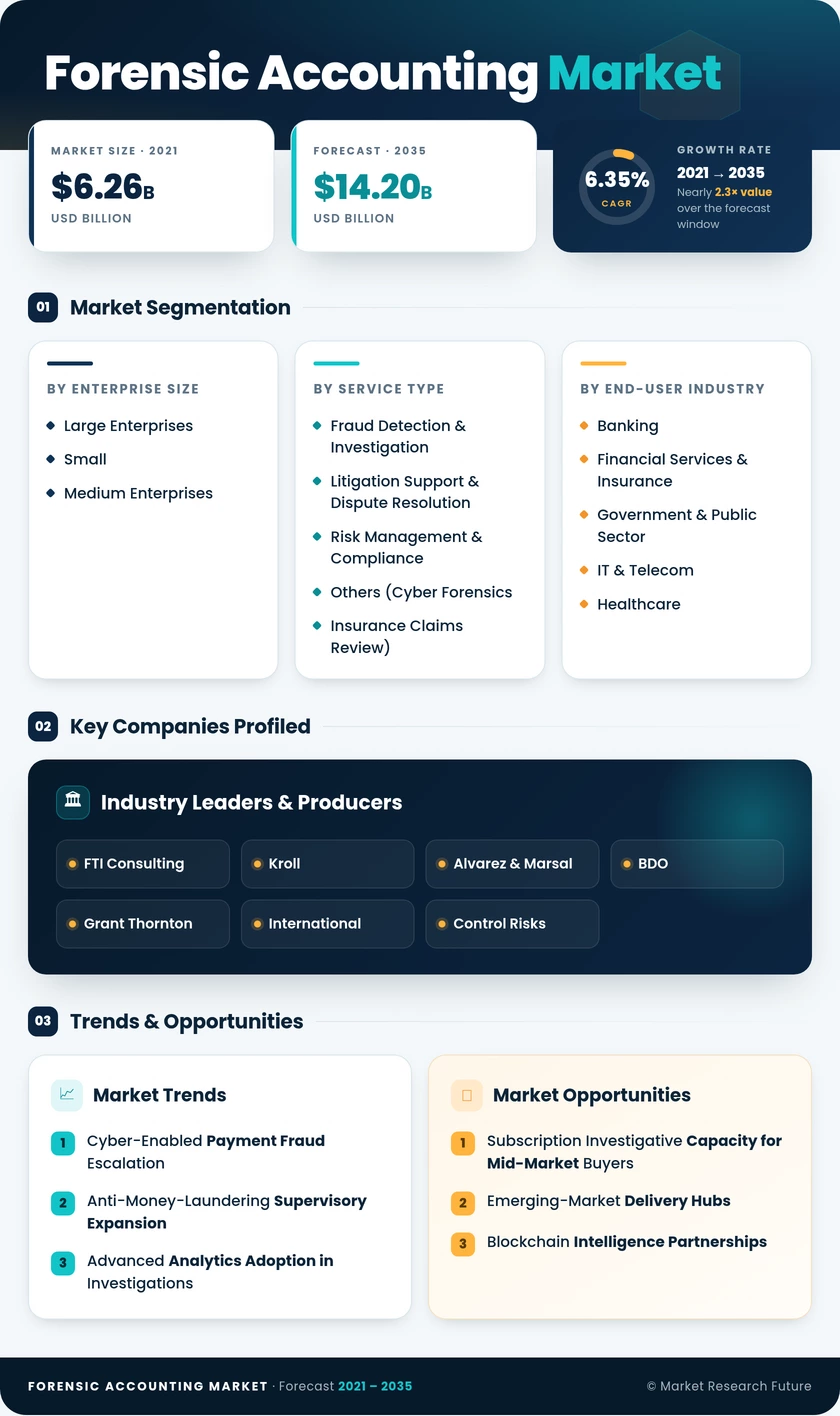
Market Segmentation Analysis
By Enterprise Size
9.1.1 Large Enterprises
9.1.2 Small and Medium Enterprises
By Service Type
9.2.1 Fraud Detection & Investigation
9.2.2 Litigation Support & Dispute Resolution
9.2.3 Risk Management & Compliance
9.2.4 Others (Cyber Forensics, Insurance Claims Review)
By End-User Industry
9.3.1 Banking, Financial Services & Insurance
9.3.2 Government & Public Sector
9.3.3 IT & Telecom
9.3.4 Healthcare
9.3.5 Manufacturing
9.3.6 Retail & E-commerce
9.3.7 Energy & Utilities
9.3.8 Others
| Dimension | Sub-Segments | Dominant Segment | Fastest Growing Segment |
| By Enterprise Size | Large Enterprises; Small and Medium Enterprises | Large Enterprises (58.6% share, 2025) | Small and Medium Enterprises (10.02% CAGR) |
| By Service Type | Fraud Detection & Investigation; Litigation Support & Dispute Resolution; Risk Management & Compliance; Others (Cyber Forensics, Insurance Claims Review) | Fraud Detection & Investigation (35.4% share, 2025) | Risk Management & Compliance (9.63% CAGR) |
| By End-User Industry | Banking, Financial Services & Insurance; Government & Public Sector; IT & Telecom; Healthcare; Manufacturing; Retail & E-commerce; Energy & Utilities; Others | Banking, Financial Services & Insurance (38.2% share, 2025) | Government & Public Sector (9.12% CAGR) |
Market Segmentation Overview
By Enterprise Size
| Sub-Segment | Key Trend |
| Large Enterprises | Multi-jurisdictional matters requiring coordinated privilege management across legal regimes |
| Small and Medium Enterprises | Modular, subscription-priced investigative capacity replacing episodic emergency engagements |
Large Enterprises hold the leading position because supervisors target systemically significant institutions first, and only global networks can staff simultaneous reviews across several legal regimes without breaching privilege. Small and Medium Enterprises grow fastest as authorities withdraw proportionality carve-outs from anti-money-laundering and data-protection rules, forcing smaller entities to buy external expertise they cannot build. Cloud-hosted review environments and per-gigabyte pricing have removed the six-figure minimum that previously excluded this cohort, consistent with the share and growth positions set out in Section 9.1.
By Service Type
| Sub-Segment | Key Trend |
| Fraud Detection & Investigation | Real-time payment rails compress response windows from weeks to hours |
| Litigation Support & Dispute Resolution | Post-completion earn-out and warranty claims sustain arbitration-linked demand. |
| Risk Management & Compliance | Supervisory expectation of continual controls testing replaces annual attestation. |
| Others (Cyber Forensics, Insurance Claims Review) | Ransomware response converges with digital-asset tracing methodology |
Fraud Detection & Investigation remains the largest service line because incident volume is non-discretionary and rising, particularly across instant-payment corridors where recovery windows are measured in hours. Risk Management & Compliance grows fastest as boards reallocate budget from post-event inquiry toward preventative control testing that supervisors now expect to see evidenced continuously. Litigation Support & Dispute Resolution holds a substantial revenue base through arbitration quantum work. In contrast, cyber forensics inside the Others grouping expands on ransomware and token-tracing convergence — the same hierarchy described in Section 9.2.
By End-User Industry
| Sub-Segment | Key Trend |
| Banking, Financial Services & Insurance | Look-back reviews ahead of harmonised European supervision |
| Government & Public Sector | Grant-recovery and procurement-integrity audits with measurable return |
| IT & Telecom | Revenue-assurance disputes and channel-partner integrity testing |
| Healthcare | Risk-adjustment coding audits and False Claims Act exposure quantification |
| Manufacturing | Supply-chain integrity and inventory misstatement reviews |
| Retail & E-commerce | Synthetic identity and loyalty-programme abuse detection |
| Energy & Utilities | Carbon-credit provenance verification and joint-venture cost audits |
| Others | Education, non-profit, and professional-services engagements |
Banking, Financial Services & Insurance leads because sanctions screening, transaction monitoring, and remediation obligations continue regardless of the credit cycle, giving providers unusually predictable volume. Government & Public Sector expands quickest as legislatures fund recovery audits that demonstrate direct fiscal payback and as transparency statutes widen disclosure obligations. Healthcare represents the highest-margin incremental pool because coding-audit work demands clinical fluency that few competitors possess. At the same time, Retail & E-commerce buyers turn outward for digital fraud techniques unavailable in-house — matching the segment positions established in Section 9.3.


 Noah Malgeri
Co-Founder

 Peter Groot koerkamp
Account and Business Manager

 Younghwan Choi
Senior Retail Manager

 Mark Irwin
Management Consultant

 Akif Moroglu
Strategy & Business Development Director

 Guilherme Gomes Martins
Product Management Director

 Joseph Aguayo
Sales Operations & Pricing Manager

 La Terria Dodd
Program Support Specialist

 Rob Kooiker
Group Product Manager HVAC & Fire Protection GMA