Request Free Sample ×

Kindly complete the form below to receive a free sample of this Report

* Please use a valid business email

Leading companies partner with us for data-driven Insights

clients tt-cursor
Hero Background
English
Chinese
French
Japanese
Korean
German
Spanish

Food bar Market Trends

ID: MRFR/FnB/3214-HCR
110 Pages
Varsha More
March 2026

Food Bar Market Size, Share, Industry Trend & Analysis Research Report: Information By Type (Candy Bars, Energy Bars, Protein Bars, Oats Bars, and Others), By Flavor (Chocolates, Fruits, Peanut Butter, Savoury, Spices, and Others), By Distribution Channel (Store-Based And Non-Store-Based) And By Region (North America, Europe, Asia-Pacific, And Rest Of The World) – Forecast Till 2035

Share:
Download PDF ×

We do not share your information with anyone. However, we may send you emails based on your report interest from time to time. You may contact us at any time to opt-out.

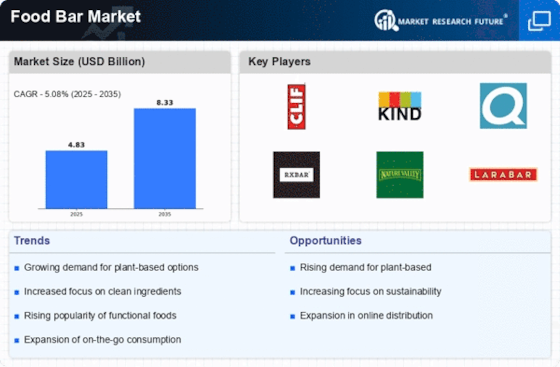
Food bar Market Infographic
Purchase Options

Market Trends

Key Emerging Trends in the Food bar Market

The food bar market is undergoing transformative trends fueled by shifting consumer preferences, health-conscious lifestyles, and the demand for convenient, on-the-go nutrition. One significant trend is the increasing popularity of functional and protein-packed food bars. As consumers prioritize health and wellness, food bars that offer a balance of macronutrients, vitamins, and minerals are gaining traction. Protein-rich bars, in particular, are sought after by fitness enthusiasts and individuals looking for convenient post-workout or snack options, driving innovation in flavor profiles and ingredient formulations within the food bar market. Furthermore, the market is experiencing a surge in demand for clean-label and natural ingredient options. Consumers are becoming more discerning, seeking food bars with minimal processing, fewer additives, and recognizable, wholesome ingredients. This trend reflects a broader shift towards clean eating, where transparency in labeling and an emphasis on natural, nutrient-dense components are essential factors influencing purchasing decisions within the food bar market. The rise of plant-based diets is also impacting the food bar market, with an increasing number of consumers opting for vegetarian and vegan options. Plant-based food bars, often featuring ingredients like nuts, seeds, and plant-derived proteins, cater to the growing demand for sustainable and cruelty-free food choices. This trend aligns with environmental consciousness, and manufacturers are responding by expanding their plant-based food bar offerings to meet diverse dietary preferences. Moreover, the food bar market is witnessing the convergence of flavors and functional ingredients. Consumers are seeking not only nutritional benefits but also unique and exciting taste experiences. Manufacturers are incorporating exotic flavors, superfoods, and adaptogens into their food bar formulations to create innovative and appealing products. The intersection of flavor and functionality allows food bars to cater to a broader consumer base, including those looking for both health benefits and sensory enjoyment. The online retail boom has significantly influenced the distribution and accessibility of food bars. E-commerce platforms offer consumers a convenient way to explore and purchase a wide variety of food bars, providing access to niche and specialty products that may not be readily available in traditional brick-and-mortar stores. This digital shift has opened up new avenues for both established and emerging brands in the food bar market to reach a broader audience. However, challenges such as competition, shelf stability, and taste consistency remain for manufacturers in the food bar market. With a plethora of options available, standing out in a competitive landscape requires a focus on unique selling propositions, innovative formulations, and effective marketing strategies. Additionally, addressing challenges related to shelf stability, especially for bars without preservatives, is crucial to ensure product quality and safety.

Author
Author Profile
Varsha More
Senior Research Analyst

Experienced business professional with a demonstrated history of working in the CFnB industry. Skilled in market research, and market estimation. Strong professional with a Masters focused in marketing management.

Leave a Comment

FAQs

What is the current valuation of the Food Bar Market as of 2024?

<p>The Food Bar Market was valued at 4.83 USD Billion in 2024.</p>

What is the projected market size for the Food Bar Market in 2035?

<p>The Food Bar Market is projected to reach 8.332 USD Billion by 2035.</p>

What is the expected CAGR for the Food Bar Market during the forecast period 2025 - 2035?

<p>The expected CAGR for the Food Bar Market during 2025 - 2035 is 5.08%.</p>

Which segment of the Food Bar Market had the highest valuation in 2024?

<p>In 2024, the Energy Bars segment had the highest valuation at 1.5 USD Billion.</p>

What are the key players in the Food Bar Market?

<p>Key players in the Food Bar Market include Clif Bar & Company, KIND Snacks, Quest Nutrition, and RXBAR.</p>

How does the valuation of Protein Bars compare to Candy Bars in 2024?

<p>In 2024, Protein Bars were valued at 1.3 USD Billion, while Candy Bars were valued at 1.2 USD Billion.</p>

What is the projected growth for the Oats Bars segment by 2035?

<p>The Oats Bars segment is projected to grow from 0.5 USD Billion in 2024 to 0.9 USD Billion by 2035.</p>

Which distribution channel is expected to dominate the Food Bar Market?

The Store-Based distribution channel is expected to dominate, with a valuation of 2.9 USD Billion in 2024.

What flavor segment is anticipated to see the most growth by 2035?

The Chocolates flavor segment is anticipated to grow from 1.5 USD Billion in 2024 to 2.5 USD Billion by 2035.

What is the valuation of the Non-Store-Based distribution channel in 2024?

The Non-Store-Based distribution channel was valued at 1.93 USD Billion in 2024.

Market Summary

As per Market Research Future analysis, the Food Bar Market Size was estimated at 4.83 USD Billion in 2024. The Food Bar industry is projected to grow from 5.075 USD Billion in 2025 to 8.332 USD Billion by 2035, exhibiting a compound annual growth rate (CAGR) of 5.08% during the forecast period 2025 - 2035

Key Market Trends & Highlights

The Food Bar Market is experiencing a dynamic shift towards health-conscious and convenient options.

  • The North American market remains the largest, driven by a strong health and wellness focus among consumers. Asia-Pacific is emerging as the fastest-growing region, reflecting a rising demand for on-the-go food solutions. Candy Bars continue to dominate the market, while Protein Bars are rapidly gaining traction due to their perceived health benefits. Key market drivers include health-conscious consumer trends and the increasing popularity of sustainable and eco-friendly practices.

Market Size & Forecast

2024 Market Size 4.83 (USD Billion)
2035 Market Size 8.332 (USD Billion)
CAGR (2025 - 2035) 5.08%
Largest Regional Market Share in 2024 North America

Major Players

<p>Clif Bar &amp; Company (US), KIND Snacks (US), <a href="https://www.questnutrition.com/">Quest Nutrition (US)</a>, RXBAR (US), Nature Valley (US), LÄRABAR (US), GoMacro (US), Orgain (US), PowerBar (DE), Grenade (GB)</p>

Market Trends

The Food Bar Market is currently experiencing a dynamic evolution, driven by changing consumer preferences and an increasing focus on health and wellness. As individuals become more health-conscious, there is a noticeable shift towards nutritious options that cater to various dietary needs. This trend is reflected in the growing demand for protein-rich, low-sugar, and plant-based food bars. Additionally, the convenience factor plays a crucial role, as busy lifestyles prompt consumers to seek portable and easy-to-consume snacks that fit seamlessly into their daily routines. The market appears to be adapting to these demands by introducing innovative flavors and formulations that appeal to a diverse audience. Moreover, sustainability is emerging as a pivotal consideration within the Food Bar Market. Consumers are increasingly aware of the environmental impact of their choices, leading to a preference for products that utilize eco-friendly packaging and ethically sourced ingredients. This shift suggests that brands may need to align their practices with sustainable principles to remain competitive. As the market continues to evolve, it is likely that the intersection of health, convenience, and sustainability will shape the future landscape of food bars, presenting both challenges and opportunities for manufacturers and retailers alike.

Health and Wellness and Flavor-based Focus

The Food Bar Market is witnessing a pronounced emphasis on health and wellness. Consumers are gravitating towards options that offer nutritional benefits, such as high protein content and low sugar levels. This trend indicates a broader societal shift towards healthier eating habits. One of the most influential food bar market trends this year is "functional indulgence," which pairs high-protein content with gourmet flavors like salted caramel and dark chocolate sea salt.

Innovation, Convenience and Portability

As lifestyles become increasingly hectic, the demand for convenient and portable food options is rising. Food bars that are easy to carry and consume on-the-go are gaining popularity, reflecting the need for quick yet nutritious snacks. . The innovation seen in the food market bar sector is leading to "3D-printed" options that allow consumers to customize their nutrient ratios at automated kiosks.

Sustainability and Ethical Sourcing

Sustainability is becoming a critical factor in consumer decision-making. The Food Bar Market is likely to see a growing preference for products that feature eco-friendly packaging and ingredients sourced through ethical practices, aligning with consumers' environmental values. Strategic expansion into plant-based and "clean-label" formulations is a primary driver of food bar market growth across emerging economies in the Asia-Pacific region.

Food bar Market Market Drivers

On-the-Go Lifestyle

The fast-paced lifestyle of modern consumers significantly influences the Food Bar Market. As individuals seek convenient meal options that fit into their busy schedules, food bars have emerged as a preferred choice. The increasing prevalence of snacking, particularly among younger demographics, has led to a surge in demand for portable and easy-to-consume food products. Market analysis suggests that the convenience factor is a primary driver, with a substantial percentage of consumers indicating that they prefer snacks that can be consumed without preparation. This trend is likely to continue, as more individuals prioritize convenience in their dietary choices. Consequently, brands are focusing on packaging innovations and product formulations that cater to this need, thereby solidifying their position in the competitive landscape of the Food Bar Market.

Health Conscious Consumer Trends

The Food Bar Market is experiencing a notable shift towards health-conscious consumer behavior. As individuals increasingly prioritize nutrition, the demand for food bars that offer functional benefits, such as protein, fiber, and vitamins, is on the rise. According to recent data, the market for protein bars alone is projected to reach approximately 1.5 billion USD by 2026, indicating a robust growth trajectory. This trend is further fueled by the growing awareness of dietary choices and their impact on overall health. Consumers are gravitating towards food bars that are low in sugar and free from artificial ingredients, reflecting a broader movement towards clean eating. Consequently, manufacturers are innovating to create products that align with these preferences, thereby enhancing their market presence within the Food Bar Market.

Technological Advancements in Production

Technological advancements are playing a pivotal role in shaping the Food Bar Market. Innovations in food processing and manufacturing techniques are enabling brands to enhance product quality and efficiency. For instance, advancements in ingredient sourcing and formulation allow for the creation of food bars that are not only nutritious but also appealing in taste and texture. Additionally, technology facilitates better tracking of supply chains, ensuring transparency and quality control. Industry expert's suggest that companies leveraging technology to improve their production processes are likely to gain a competitive edge. Furthermore, the integration of e-commerce platforms is transforming how consumers access food bars, making it easier for them to explore a wider range of products. As technology continues to advance, it is anticipated that the Food Bar Market will experience further growth and innovation.

Diverse Flavor Profiles and Customization

The Food Bar Market is witnessing a growing trend towards diverse flavor profiles and customization options. Consumers are increasingly seeking unique and exciting flavors that cater to their taste preferences, moving beyond traditional offerings. This demand for variety is prompting manufacturers to experiment with innovative ingredients and flavor combinations, thereby enhancing product appeal. Additionally, the rise of personalization in food products allows consumers to tailor their food bar choices to meet specific dietary needs or preferences. Market data indicates that brands offering customizable options are likely to capture a larger share of the market, as consumers appreciate the ability to select ingredients that align with their health goals. This trend not only fosters brand loyalty but also encourages repeat purchases, contributing to the overall growth of the Food Bar Market.

Sustainability and Eco-Friendly Practices

Sustainability is becoming an increasingly critical factor within the Food Bar Market. As consumers become more environmentally conscious, there is a growing demand for food bars that are produced using sustainable practices and eco-friendly packaging. Brands that prioritize ethical sourcing of ingredients and minimize their environmental footprint are likely to resonate with a significant segment of the market. Recent surveys indicate that a considerable percentage of consumers are willing to pay a premium for products that align with their sustainability values. This shift is prompting manufacturers to adopt greener practices, such as using recyclable materials and reducing waste in production processes. As sustainability continues to shape consumer preferences, it is expected that the Food Bar Market will evolve to meet these expectations, thereby fostering a more responsible approach to food production.

Market Segment Insights

By Type: Candy Bars (Largest) vs. Protein Bars (Fastest-Growing)

<p>The Food Bar Market showcases a diverse range of segments, with Candy Bars leading in market share. Their appeal lies in their variety of flavors and indulgent characteristics, making them a popular choice among consumers. Following closely are Protein Bars and Energy Bars, which cater to health-conscious individuals seeking nutritious snack options. Oats Bars and Others contribute to a smaller, yet notable part of the market, appealing to niche demands and dietary preferences. In recent years, the Protein Bars segment has emerged as the fastest-growing category within the Food Bar Market. This growth is driven by increasing consumer awareness of health and fitness, alongside the rising demand for convenient, on-the-go nutrition. Energy Bars also exhibit promising growth, fueled by the booming sports nutrition industry as more individuals engage in active lifestyles and seek quick sources of energy.</p>

<p>Candy Bars: Dominant vs. Protein Bars: Emerging</p>

<p>Candy Bars maintain a dominant position in the Food Bar Market, primarily due to their broad appeal and established presence. This segment benefits from ongoing product innovations, including the introduction of healthier alternatives that align with changing consumer preferences. On the other hand, Protein Bars are positioned as an emerging force, capturing the interest of fitness enthusiasts and health-conscious consumers. These bars are often formulated with high protein content and minimal sugar, appealing to those looking for nutritious snack options. As brands focus on expanding flavor varieties and enhancing nutritional profiles, Protein Bars are likely to see sustained growth, particularly among younger demographics prioritizing health and convenience.</p>

By Flavor: Chocolates (Largest) vs. Fruits (Fastest-Growing)

<p>The flavor segment in the Food Bar Market showcases a diverse range of options, with chocolates taking the lead as the largest segment. Consumers favor the rich, indulgent taste of chocolate, which is often combined with nuts and fruits for added texture and flavor. Fruits, on the other hand, are rapidly gaining popularity due to the increasing demand for healthier snack alternatives. This shift reflects a broader trend towards wholesome, nutrient-dense foods that cater to health-conscious individuals and families.</p>

<p>Chocolates (Dominant) vs. Fruits (Emerging)</p>

<p>Chocolates hold a dominant position in the Food Bar Market, appealing to a wide range of consumers with their rich flavors and versatile pairings. They are often perceived as indulgent treats, making them a preferred choice for many snackers. On the other hand, fruits represent an emerging segment that is on the rise, driven by growing health awareness among consumers. Fruit-flavored bars offer a refreshing, natural sweetness and are often marketed as convenient on-the-go snacks. As more consumers opt for healthier snack options, the fruit segment is expected to gain significant traction, particularly among younger demographics seeking nutritious yet tasty alternatives.</p>

By Distribution Channel: Store-Based (Largest) vs. Non-Store-Based (Fastest-Growing)

<p>In the Food Bar Market, the distribution channel segment is characterized by a clear distinction in market share between store-based and non-store-based channels. Store-based distribution remains the largest segment, capturing significant consumer traffic through traditional retail formats such as supermarkets and convenience stores. In contrast, non-store-based distribution channels, including online sales and direct-to-consumer models, are gaining popularity, particularly among younger consumers who value convenience and direct access to products.</p>

<p>Store-Based (Dominant) vs. Non-Store-Based (Emerging)</p>

<p>Store-based distribution channels are considered the dominant force in the Food Bar Market, heavily relying on physical retail outlets for consumer engagement. These channels enhance brand visibility and allow customers to experience products firsthand before purchase. On the other hand, non-store-based channels are emerging rapidly, driven by the rise of e-commerce and consumer preference for home delivery. These channels cater to tech-savvy shoppers who appreciate seamless online transactions and the flexibility of having food bars delivered directly to their homes. Together, these distribution channels are transforming the way consumers access food bar products, shaping a multifaceted market landscape.</p>

Get more detailed insights about Food bar Market Research Report- Forecast till 2035

Regional Insights

North America : Market Leader in Food Bars

North America is the largest market for food bars, accounting for approximately 45% of the global market share. The region's growth is driven by increasing health consciousness, demand for convenient snacks, and a rise in fitness trends. Regulatory support for health and wellness products further catalyzes market expansion, with initiatives promoting nutritional labeling and transparency. Major snack conglomerates are actively acquiring niche startups to bolster their food bar market share within the specialized keto and gut-health segments. The United States leads the North American market, with key players like Clif Bar & Company, KIND Snacks, and Quest Nutrition dominating the landscape. The competitive environment is characterized by innovation in flavors and formulations, catering to diverse dietary preferences. Canada also contributes significantly, focusing on organic and natural ingredients, enhancing the overall market dynamics.

Europe : Emerging Market with Potential

Europe is witnessing a growing demand for food bars, holding approximately 30% of the global market share. The region's growth is fueled by increasing consumer awareness regarding health and nutrition, alongside a shift towards on-the-go snacking. Regulatory frameworks, such as the EU's Food Information to Consumers Regulation, promote transparency and quality, further driving market growth. Leading countries in Europe include Germany, the UK, and France, where brands like PowerBar and Grenade are making significant impacts. The competitive landscape is marked by a focus on sustainability and clean-label products, with many companies innovating to meet consumer preferences for natural ingredients. The presence of established brands alongside emerging startups creates a dynamic market environment.

Asia-Pacific : Rapid Growth and Innovation

The Asia-Pacific region is rapidly emerging in the food bar market, currently holding about 20% of the global share. This growth is driven by urbanization, increasing disposable incomes, and a rising trend towards health and wellness. Regulatory initiatives promoting food safety and quality standards are also contributing to market expansion, encouraging local manufacturers to innovate and meet consumer demands. Countries like China, Japan, and Australia are leading the charge, with a growing number of local and international brands entering the market. The competitive landscape is characterized by a mix of traditional snacks and modern health bars, with companies focusing on unique flavors and nutritional benefits. The region's diverse consumer base presents both challenges and opportunities for market players.

Middle East and Africa : Untapped Market Opportunities

The Middle East and Africa region is gradually emerging in the food bar market, accounting for approximately 5% of the global share. The growth is driven by increasing health awareness, urbanization, and a shift towards convenient snacking options. Regulatory bodies are beginning to implement food safety standards, which will further enhance market growth and consumer trust in food products. Leading countries in this region include South Africa and the UAE, where there is a growing interest in health-oriented products. The competitive landscape is still developing, with both local and international brands vying for market share. Companies are focusing on innovative flavors and nutritional profiles to cater to the diverse preferences of consumers in this region.

Key Players and Competitive Insights

The Food Bar Market is currently characterized by a dynamic competitive landscape, driven by evolving consumer preferences towards health and wellness. Key players such as Clif Bar & Company (US), KIND Snacks (US), and Quest Nutrition (US) are at the forefront, each adopting distinct strategies to enhance their market positioning. Clif Bar & Company (US) emphasizes sustainability and organic ingredients, appealing to environmentally conscious consumers. Meanwhile, KIND Snacks (US) focuses on transparency and clean label products, which resonates with health-oriented buyers. Quest Nutrition (US) leverages innovation in high-protein offerings, catering to fitness enthusiasts. Collectively, these strategies not only enhance brand loyalty but also intensify competition as companies vie for market share in a rapidly growing sector. In terms of business tactics, companies are increasingly localizing manufacturing to reduce supply chain vulnerabilities and enhance responsiveness to regional demands. The Food Bar Market appears moderately fragmented, with a mix of established brands and emerging players. This fragmentation allows for diverse product offerings, yet the influence of key players remains substantial, as they set trends and standards that smaller companies often follow.

In September KIND Snacks (US) announced a partnership with a leading health food retailer to launch a new line of plant-based protein bars. This strategic move is likely to bolster KIND's presence in the growing plant-based segment, aligning with consumer trends favoring vegan and vegetarian options. The collaboration not only enhances product visibility but also taps into the retailer's established customer base, potentially driving significant sales growth.

In August Quest Nutrition (US) unveiled a new flavor of its popular protein bar, developed in response to consumer feedback gathered through social media channels. This initiative underscores Quest's commitment to consumer engagement and innovation, suggesting that the company is keen on maintaining its competitive edge by adapting to market demands swiftly. The introduction of new flavors may also attract new customers while retaining existing ones, thereby reinforcing brand loyalty.

In July Clif Bar & Company (US) launched a sustainability initiative aimed at reducing its carbon footprint by 50% by 2030. This ambitious goal reflects a growing trend among consumers who prioritize environmentally friendly products. By positioning itself as a leader in sustainability, Clif Bar & Company (US) not only differentiates its brand but also appeals to a demographic increasingly concerned with climate change and ethical consumption.

As of October the Food Bar Market is witnessing significant trends such as digitalization, sustainability, and the integration of artificial intelligence in product development and marketing strategies. Strategic alliances are becoming increasingly prevalent, as companies recognize the value of collaboration in enhancing innovation and market reach. Looking ahead, competitive differentiation is likely to evolve from traditional price-based competition towards a focus on innovation, technological advancements, and supply chain reliability, as companies strive to meet the sophisticated demands of modern consumers.

Key Companies in the Food bar Market include

Industry Developments

February 2022: The Yoga Bar brand expanded its product category into kids' nutrition by launching new mixes, 'Yo Chos' and 'Yo Fills.'

June 2021: RXBAR, a Kellogg subsidiary, announced its major plant-based product. It contains 10 grams of protein and substitutes pea and almond protein for the brand's distinctive egg white protein.

Future Outlook

Food bar Market Future Outlook

<p>The Food Bar Market analysis reveals a growth of 5.08% CAGR from 2025 to 2035, driven by health trends, convenience, and innovation in flavors.</p>

New opportunities lie in:

  • <p>Expansion into plant-based protein bars Development of <a href="https://www.marketresearchfuture.com/reports/personalized-nutrition-market-25685#:~:text=As%20per%20MRFR%20analysis%2C%20the,the%20forecast%20period%202025%20%2D%202035.">personalized nutrition</a> bars Integration of smart packaging technologies</p>

<p>By 2035, the Food Bar Market is expected to be robust, reflecting evolving consumer preferences and innovative product offerings.</p>

Market Segmentation

Food bar Market Type Outlook

  • Candy Bars
  • Energy Bars
  • Protein Bars
  • Oats Bars
  • Others

Food bar Market Flavor Outlook

  • Chocolates
  • Fruits
  • Peanut Butter
  • Savory
  • Spices
  • Others

Food bar Market Distribution Channel Outlook

  • Store-Based
  • Non-Store-Based

Report Scope

MARKET SIZE 2024 4.83(USD Billion)
MARKET SIZE 2025 5.075(USD Billion)
MARKET SIZE 2035 8.332(USD Billion)
COMPOUND ANNUAL GROWTH RATE (CAGR) 5.08% (2025 - 2035)
REPORT COVERAGE Revenue Forecast, Competitive Landscape, Growth Factors, and Trends
BASE YEAR 2024
Market Forecast Period 2025 - 2035
Historical Data 2019 - 2024
Market Forecast Units USD Billion
Key Companies Profiled Clif Bar & Company (US), KIND Snacks (US), Quest Nutrition (US), RXBAR (US), Nature Valley (US), LÄRABAR (US), GoMacro (US), Orgain (US), PowerBar (DE), Grenade (GB)
Segments Covered Type, Flavor, Distribution Channel, Region
Key Market Opportunities Growing demand for plant-based and functional ingredients in the Food Bar Market presents significant innovation opportunities.
Key Market Dynamics Rising consumer demand for health-oriented snacks drives innovation and competition in the Food Bar Market.
Countries Covered North America, Europe, APAC, South America, MEA

FAQs

What is the current valuation of the Food Bar Market as of 2024?

<p>The Food Bar Market was valued at 4.83 USD Billion in 2024.</p>

What is the projected market size for the Food Bar Market in 2035?

<p>The Food Bar Market is projected to reach 8.332 USD Billion by 2035.</p>

What is the expected CAGR for the Food Bar Market during the forecast period 2025 - 2035?

<p>The expected CAGR for the Food Bar Market during 2025 - 2035 is 5.08%.</p>

Which segment of the Food Bar Market had the highest valuation in 2024?

<p>In 2024, the Energy Bars segment had the highest valuation at 1.5 USD Billion.</p>

What are the key players in the Food Bar Market?

<p>Key players in the Food Bar Market include Clif Bar & Company, KIND Snacks, Quest Nutrition, and RXBAR.</p>

How does the valuation of Protein Bars compare to Candy Bars in 2024?

<p>In 2024, Protein Bars were valued at 1.3 USD Billion, while Candy Bars were valued at 1.2 USD Billion.</p>

What is the projected growth for the Oats Bars segment by 2035?

<p>The Oats Bars segment is projected to grow from 0.5 USD Billion in 2024 to 0.9 USD Billion by 2035.</p>

Which distribution channel is expected to dominate the Food Bar Market?

The Store-Based distribution channel is expected to dominate, with a valuation of 2.9 USD Billion in 2024.

What flavor segment is anticipated to see the most growth by 2035?

The Chocolates flavor segment is anticipated to grow from 1.5 USD Billion in 2024 to 2.5 USD Billion by 2035.

What is the valuation of the Non-Store-Based distribution channel in 2024?

The Non-Store-Based distribution channel was valued at 1.93 USD Billion in 2024.

  1. SECTION I: EXECUTIVE SUMMARY AND KEY HIGHLIGHTS
    1. | 1.1 EXECUTIVE SUMMARY
    2. | | 1.1.1 Market Overview
    3. | | 1.1.2 Key Findings
    4. | | 1.1.3 Market Segmentation
    5. | | 1.1.4 Competitive Landscape
    6. | | 1.1.5 Challenges and Opportunities
    7. | | 1.1.6 Future Outlook
  2. SECTION II: SCOPING, METHODOLOGY AND MARKET STRUCTURE
    1. | 2.1 MARKET INTRODUCTION
    2. | | 2.1.1 Definition
    3. | | 2.1.2 Scope of the study
    4. | | | 2.1.2.1 Research Objective
    5. | | | 2.1.2.2 Assumption
    6. | | | 2.1.2.3 Limitations
    7. | 2.2 RESEARCH METHODOLOGY
    8. | | 2.2.1 Overview
    9. | | 2.2.2 Data Mining
    10. | | 2.2.3 Secondary Research
    11. | | 2.2.4 Primary Research
    12. | | | 2.2.4.1 Primary Interviews and Information Gathering Process
    13. | | | 2.2.4.2 Breakdown of Primary Respondents
    14. | | 2.2.5 Forecasting Model
    15. | | 2.2.6 Market Size Estimation
    16. | | | 2.2.6.1 Bottom-Up Approach
    17. | | | 2.2.6.2 Top-Down Approach
    18. | | 2.2.7 Data Triangulation
    19. | | 2.2.8 Validation
  3. SECTION III: QUALITATIVE ANALYSIS
    1. | 3.1 MARKET DYNAMICS
    2. | | 3.1.1 Overview
    3. | | 3.1.2 Drivers
    4. | | 3.1.3 Restraints
    5. | | 3.1.4 Opportunities
    6. | 3.2 MARKET FACTOR ANALYSIS
    7. | | 3.2.1 Value chain Analysis
    8. | | 3.2.2 Porter's Five Forces Analysis
    9. | | | 3.2.2.1 Bargaining Power of Suppliers
    10. | | | 3.2.2.2 Bargaining Power of Buyers
    11. | | | 3.2.2.3 Threat of New Entrants
    12. | | | 3.2.2.4 Threat of Substitutes
    13. | | | 3.2.2.5 Intensity of Rivalry
    14. | | 3.2.3 COVID-19 Impact Analysis
    15. | | | 3.2.3.1 Market Impact Analysis
    16. | | | 3.2.3.2 Regional Impact
    17. | | | 3.2.3.3 Opportunity and Threat Analysis
  4. SECTION IV: QUANTITATIVE ANALYSIS
    1. | 4.1 Food, Beverages & Nutrition, BY Type (USD Billion)
    2. | | 4.1.1 Candy Bars
    3. | | 4.1.2 Energy Bars
    4. | | 4.1.3 Protein Bars
    5. | | 4.1.4 Oats Bars
    6. | | 4.1.5 Others
    7. | 4.2 Food, Beverages & Nutrition, BY Flavor (USD Billion)
    8. | | 4.2.1 Chocolates
    9. | | 4.2.2 Fruits
    10. | | 4.2.3 Peanut Butter
    11. | | 4.2.4 Savory
    12. | | 4.2.5 Spices
    13. | | 4.2.6 Others
    14. | 4.3 Food, Beverages & Nutrition, BY Distribution Channel (USD Billion)
    15. | | 4.3.1 Store-Based
    16. | | 4.3.2 Non-Store-Based
    17. | 4.4 Food, Beverages & Nutrition, BY Region (USD Billion)
    18. | | 4.4.1 North America
    19. | | | 4.4.1.1 US
    20. | | | 4.4.1.2 Canada
    21. | | 4.4.2 Europe
    22. | | | 4.4.2.1 Germany
    23. | | | 4.4.2.2 UK
    24. | | | 4.4.2.3 France
    25. | | | 4.4.2.4 Russia
    26. | | | 4.4.2.5 Italy
    27. | | | 4.4.2.6 Spain
    28. | | | 4.4.2.7 Rest of Europe
    29. | | 4.4.3 APAC
    30. | | | 4.4.3.1 China
    31. | | | 4.4.3.2 India
    32. | | | 4.4.3.3 Japan
    33. | | | 4.4.3.4 South Korea
    34. | | | 4.4.3.5 Malaysia
    35. | | | 4.4.3.6 Thailand
    36. | | | 4.4.3.7 Indonesia
    37. | | | 4.4.3.8 Rest of APAC
    38. | | 4.4.4 South America
    39. | | | 4.4.4.1 Brazil
    40. | | | 4.4.4.2 Mexico
    41. | | | 4.4.4.3 Argentina
    42. | | | 4.4.4.4 Rest of South America
    43. | | 4.4.5 MEA
    44. | | | 4.4.5.1 GCC Countries
    45. | | | 4.4.5.2 South Africa
    46. | | | 4.4.5.3 Rest of MEA
  5. SECTION V: COMPETITIVE ANALYSIS
    1. | 5.1 Competitive Landscape
    2. | | 5.1.1 Overview
    3. | | 5.1.2 Competitive Analysis
    4. | | 5.1.3 Market share Analysis
    5. | | 5.1.4 Major Growth Strategy in the Food, Beverages & Nutrition
    6. | | 5.1.5 Competitive Benchmarking
    7. | | 5.1.6 Leading Players in Terms of Number of Developments in the Food, Beverages & Nutrition
    8. | | 5.1.7 Key developments and growth strategies
    9. | | | 5.1.7.1 New Product Launch/Service Deployment
    10. | | | 5.1.7.2 Merger & Acquisitions
    11. | | | 5.1.7.3 Joint Ventures
    12. | | 5.1.8 Major Players Financial Matrix
    13. | | | 5.1.8.1 Sales and Operating Income
    14. | | | 5.1.8.2 Major Players R&D Expenditure. 2023
    15. | 5.2 Company Profiles
    16. | | 5.2.1 Clif Bar & Company (US)
    17. | | | 5.2.1.1 Financial Overview
    18. | | | 5.2.1.2 Products Offered
    19. | | | 5.2.1.3 Key Developments
    20. | | | 5.2.1.4 SWOT Analysis
    21. | | | 5.2.1.5 Key Strategies
    22. | | 5.2.2 KIND Snacks (US)
    23. | | | 5.2.2.1 Financial Overview
    24. | | | 5.2.2.2 Products Offered
    25. | | | 5.2.2.3 Key Developments
    26. | | | 5.2.2.4 SWOT Analysis
    27. | | | 5.2.2.5 Key Strategies
    28. | | 5.2.3 Quest Nutrition (US)
    29. | | | 5.2.3.1 Financial Overview
    30. | | | 5.2.3.2 Products Offered
    31. | | | 5.2.3.3 Key Developments
    32. | | | 5.2.3.4 SWOT Analysis
    33. | | | 5.2.3.5 Key Strategies
    34. | | 5.2.4 RXBAR (US)
    35. | | | 5.2.4.1 Financial Overview
    36. | | | 5.2.4.2 Products Offered
    37. | | | 5.2.4.3 Key Developments
    38. | | | 5.2.4.4 SWOT Analysis
    39. | | | 5.2.4.5 Key Strategies
    40. | | 5.2.5 Nature Valley (US)
    41. | | | 5.2.5.1 Financial Overview
    42. | | | 5.2.5.2 Products Offered
    43. | | | 5.2.5.3 Key Developments
    44. | | | 5.2.5.4 SWOT Analysis
    45. | | | 5.2.5.5 Key Strategies
    46. | | 5.2.6 LÄRABAR (US)
    47. | | | 5.2.6.1 Financial Overview
    48. | | | 5.2.6.2 Products Offered
    49. | | | 5.2.6.3 Key Developments
    50. | | | 5.2.6.4 SWOT Analysis
    51. | | | 5.2.6.5 Key Strategies
    52. | | 5.2.7 GoMacro (US)
    53. | | | 5.2.7.1 Financial Overview
    54. | | | 5.2.7.2 Products Offered
    55. | | | 5.2.7.3 Key Developments
    56. | | | 5.2.7.4 SWOT Analysis
    57. | | | 5.2.7.5 Key Strategies
    58. | | 5.2.8 Orgain (US)
    59. | | | 5.2.8.1 Financial Overview
    60. | | | 5.2.8.2 Products Offered
    61. | | | 5.2.8.3 Key Developments
    62. | | | 5.2.8.4 SWOT Analysis
    63. | | | 5.2.8.5 Key Strategies
    64. | | 5.2.9 PowerBar (DE)
    65. | | | 5.2.9.1 Financial Overview
    66. | | | 5.2.9.2 Products Offered
    67. | | | 5.2.9.3 Key Developments
    68. | | | 5.2.9.4 SWOT Analysis
    69. | | | 5.2.9.5 Key Strategies
    70. | | 5.2.10 Grenade (GB)
    71. | | | 5.2.10.1 Financial Overview
    72. | | | 5.2.10.2 Products Offered
    73. | | | 5.2.10.3 Key Developments
    74. | | | 5.2.10.4 SWOT Analysis
    75. | | | 5.2.10.5 Key Strategies
    76. | 5.3 Appendix
    77. | | 5.3.1 References
    78. | | 5.3.2 Related Reports
  6. LIST OF FIGURES
    1. | 6.1 MARKET SYNOPSIS
    2. | 6.2 NORTH AMERICA MARKET ANALYSIS
    3. | 6.3 US MARKET ANALYSIS BY TYPE
    4. | 6.4 US MARKET ANALYSIS BY FLAVOR
    5. | 6.5 US MARKET ANALYSIS BY DISTRIBUTION CHANNEL
    6. | 6.6 CANADA MARKET ANALYSIS BY TYPE
    7. | 6.7 CANADA MARKET ANALYSIS BY FLAVOR
    8. | 6.8 CANADA MARKET ANALYSIS BY DISTRIBUTION CHANNEL
    9. | 6.9 EUROPE MARKET ANALYSIS
    10. | 6.10 GERMANY MARKET ANALYSIS BY TYPE
    11. | 6.11 GERMANY MARKET ANALYSIS BY FLAVOR
    12. | 6.12 GERMANY MARKET ANALYSIS BY DISTRIBUTION CHANNEL
    13. | 6.13 UK MARKET ANALYSIS BY TYPE
    14. | 6.14 UK MARKET ANALYSIS BY FLAVOR
    15. | 6.15 UK MARKET ANALYSIS BY DISTRIBUTION CHANNEL
    16. | 6.16 FRANCE MARKET ANALYSIS BY TYPE
    17. | 6.17 FRANCE MARKET ANALYSIS BY FLAVOR
    18. | 6.18 FRANCE MARKET ANALYSIS BY DISTRIBUTION CHANNEL
    19. | 6.19 RUSSIA MARKET ANALYSIS BY TYPE
    20. | 6.20 RUSSIA MARKET ANALYSIS BY FLAVOR
    21. | 6.21 RUSSIA MARKET ANALYSIS BY DISTRIBUTION CHANNEL
    22. | 6.22 ITALY MARKET ANALYSIS BY TYPE
    23. | 6.23 ITALY MARKET ANALYSIS BY FLAVOR
    24. | 6.24 ITALY MARKET ANALYSIS BY DISTRIBUTION CHANNEL
    25. | 6.25 SPAIN MARKET ANALYSIS BY TYPE
    26. | 6.26 SPAIN MARKET ANALYSIS BY FLAVOR
    27. | 6.27 SPAIN MARKET ANALYSIS BY DISTRIBUTION CHANNEL
    28. | 6.28 REST OF EUROPE MARKET ANALYSIS BY TYPE
    29. | 6.29 REST OF EUROPE MARKET ANALYSIS BY FLAVOR
    30. | 6.30 REST OF EUROPE MARKET ANALYSIS BY DISTRIBUTION CHANNEL
    31. | 6.31 APAC MARKET ANALYSIS
    32. | 6.32 CHINA MARKET ANALYSIS BY TYPE
    33. | 6.33 CHINA MARKET ANALYSIS BY FLAVOR
    34. | 6.34 CHINA MARKET ANALYSIS BY DISTRIBUTION CHANNEL
    35. | 6.35 INDIA MARKET ANALYSIS BY TYPE
    36. | 6.36 INDIA MARKET ANALYSIS BY FLAVOR
    37. | 6.37 INDIA MARKET ANALYSIS BY DISTRIBUTION CHANNEL
    38. | 6.38 JAPAN MARKET ANALYSIS BY TYPE
    39. | 6.39 JAPAN MARKET ANALYSIS BY FLAVOR
    40. | 6.40 JAPAN MARKET ANALYSIS BY DISTRIBUTION CHANNEL
    41. | 6.41 SOUTH KOREA MARKET ANALYSIS BY TYPE
    42. | 6.42 SOUTH KOREA MARKET ANALYSIS BY FLAVOR
    43. | 6.43 SOUTH KOREA MARKET ANALYSIS BY DISTRIBUTION CHANNEL
    44. | 6.44 MALAYSIA MARKET ANALYSIS BY TYPE
    45. | 6.45 MALAYSIA MARKET ANALYSIS BY FLAVOR
    46. | 6.46 MALAYSIA MARKET ANALYSIS BY DISTRIBUTION CHANNEL
    47. | 6.47 THAILAND MARKET ANALYSIS BY TYPE
    48. | 6.48 THAILAND MARKET ANALYSIS BY FLAVOR
    49. | 6.49 THAILAND MARKET ANALYSIS BY DISTRIBUTION CHANNEL
    50. | 6.50 INDONESIA MARKET ANALYSIS BY TYPE
    51. | 6.51 INDONESIA MARKET ANALYSIS BY FLAVOR
    52. | 6.52 INDONESIA MARKET ANALYSIS BY DISTRIBUTION CHANNEL
    53. | 6.53 REST OF APAC MARKET ANALYSIS BY TYPE
    54. | 6.54 REST OF APAC MARKET ANALYSIS BY FLAVOR
    55. | 6.55 REST OF APAC MARKET ANALYSIS BY DISTRIBUTION CHANNEL
    56. | 6.56 SOUTH AMERICA MARKET ANALYSIS
    57. | 6.57 BRAZIL MARKET ANALYSIS BY TYPE
    58. | 6.58 BRAZIL MARKET ANALYSIS BY FLAVOR
    59. | 6.59 BRAZIL MARKET ANALYSIS BY DISTRIBUTION CHANNEL
    60. | 6.60 MEXICO MARKET ANALYSIS BY TYPE
    61. | 6.61 MEXICO MARKET ANALYSIS BY FLAVOR
    62. | 6.62 MEXICO MARKET ANALYSIS BY DISTRIBUTION CHANNEL
    63. | 6.63 ARGENTINA MARKET ANALYSIS BY TYPE
    64. | 6.64 ARGENTINA MARKET ANALYSIS BY FLAVOR
    65. | 6.65 ARGENTINA MARKET ANALYSIS BY DISTRIBUTION CHANNEL
    66. | 6.66 REST OF SOUTH AMERICA MARKET ANALYSIS BY TYPE
    67. | 6.67 REST OF SOUTH AMERICA MARKET ANALYSIS BY FLAVOR
    68. | 6.68 REST OF SOUTH AMERICA MARKET ANALYSIS BY DISTRIBUTION CHANNEL
    69. | 6.69 MEA MARKET ANALYSIS
    70. | 6.70 GCC COUNTRIES MARKET ANALYSIS BY TYPE
    71. | 6.71 GCC COUNTRIES MARKET ANALYSIS BY FLAVOR
    72. | 6.72 GCC COUNTRIES MARKET ANALYSIS BY DISTRIBUTION CHANNEL
    73. | 6.73 SOUTH AFRICA MARKET ANALYSIS BY TYPE
    74. | 6.74 SOUTH AFRICA MARKET ANALYSIS BY FLAVOR
    75. | 6.75 SOUTH AFRICA MARKET ANALYSIS BY DISTRIBUTION CHANNEL
    76. | 6.76 REST OF MEA MARKET ANALYSIS BY TYPE
    77. | 6.77 REST OF MEA MARKET ANALYSIS BY FLAVOR
    78. | 6.78 REST OF MEA MARKET ANALYSIS BY DISTRIBUTION CHANNEL
    79. | 6.79 KEY BUYING CRITERIA OF FOOD, BEVERAGES & NUTRITION
    80. | 6.80 RESEARCH PROCESS OF MRFR
    81. | 6.81 DRO ANALYSIS OF FOOD, BEVERAGES & NUTRITION
    82. | 6.82 DRIVERS IMPACT ANALYSIS: FOOD, BEVERAGES & NUTRITION
    83. | 6.83 RESTRAINTS IMPACT ANALYSIS: FOOD, BEVERAGES & NUTRITION
    84. | 6.84 SUPPLY / VALUE CHAIN: FOOD, BEVERAGES & NUTRITION
    85. | 6.85 FOOD, BEVERAGES & NUTRITION, BY TYPE, 2024 (% SHARE)
    86. | 6.86 FOOD, BEVERAGES & NUTRITION, BY TYPE, 2024 TO 2035 (USD Billion)
    87. | 6.87 FOOD, BEVERAGES & NUTRITION, BY FLAVOR, 2024 (% SHARE)
    88. | 6.88 FOOD, BEVERAGES & NUTRITION, BY FLAVOR, 2024 TO 2035 (USD Billion)
    89. | 6.89 FOOD, BEVERAGES & NUTRITION, BY DISTRIBUTION CHANNEL, 2024 (% SHARE)
    90. | 6.90 FOOD, BEVERAGES & NUTRITION, BY DISTRIBUTION CHANNEL, 2024 TO 2035 (USD Billion)
    91. | 6.91 BENCHMARKING OF MAJOR COMPETITORS
  7. LIST OF TABLES
    1. | 7.1 LIST OF ASSUMPTIONS
    2. | | 7.1.1
    3. | 7.2 North America MARKET SIZE ESTIMATES; FORECAST
    4. | | 7.2.1 BY TYPE, 2025-2035 (USD Billion)
    5. | | 7.2.2 BY FLAVOR, 2025-2035 (USD Billion)
    6. | | 7.2.3 BY DISTRIBUTION CHANNEL, 2025-2035 (USD Billion)
    7. | 7.3 US MARKET SIZE ESTIMATES; FORECAST
    8. | | 7.3.1 BY TYPE, 2025-2035 (USD Billion)
    9. | | 7.3.2 BY FLAVOR, 2025-2035 (USD Billion)
    10. | | 7.3.3 BY DISTRIBUTION CHANNEL, 2025-2035 (USD Billion)
    11. | 7.4 Canada MARKET SIZE ESTIMATES; FORECAST
    12. | | 7.4.1 BY TYPE, 2025-2035 (USD Billion)
    13. | | 7.4.2 BY FLAVOR, 2025-2035 (USD Billion)
    14. | | 7.4.3 BY DISTRIBUTION CHANNEL, 2025-2035 (USD Billion)
    15. | 7.5 Europe MARKET SIZE ESTIMATES; FORECAST
    16. | | 7.5.1 BY TYPE, 2025-2035 (USD Billion)
    17. | | 7.5.2 BY FLAVOR, 2025-2035 (USD Billion)
    18. | | 7.5.3 BY DISTRIBUTION CHANNEL, 2025-2035 (USD Billion)
    19. | 7.6 Germany MARKET SIZE ESTIMATES; FORECAST
    20. | | 7.6.1 BY TYPE, 2025-2035 (USD Billion)
    21. | | 7.6.2 BY FLAVOR, 2025-2035 (USD Billion)
    22. | | 7.6.3 BY DISTRIBUTION CHANNEL, 2025-2035 (USD Billion)
    23. | 7.7 UK MARKET SIZE ESTIMATES; FORECAST
    24. | | 7.7.1 BY TYPE, 2025-2035 (USD Billion)
    25. | | 7.7.2 BY FLAVOR, 2025-2035 (USD Billion)
    26. | | 7.7.3 BY DISTRIBUTION CHANNEL, 2025-2035 (USD Billion)
    27. | 7.8 France MARKET SIZE ESTIMATES; FORECAST
    28. | | 7.8.1 BY TYPE, 2025-2035 (USD Billion)
    29. | | 7.8.2 BY FLAVOR, 2025-2035 (USD Billion)
    30. | | 7.8.3 BY DISTRIBUTION CHANNEL, 2025-2035 (USD Billion)
    31. | 7.9 Russia MARKET SIZE ESTIMATES; FORECAST
    32. | | 7.9.1 BY TYPE, 2025-2035 (USD Billion)
    33. | | 7.9.2 BY FLAVOR, 2025-2035 (USD Billion)
    34. | | 7.9.3 BY DISTRIBUTION CHANNEL, 2025-2035 (USD Billion)
    35. | 7.10 Italy MARKET SIZE ESTIMATES; FORECAST
    36. | | 7.10.1 BY TYPE, 2025-2035 (USD Billion)
    37. | | 7.10.2 BY FLAVOR, 2025-2035 (USD Billion)
    38. | | 7.10.3 BY DISTRIBUTION CHANNEL, 2025-2035 (USD Billion)
    39. | 7.11 Spain MARKET SIZE ESTIMATES; FORECAST
    40. | | 7.11.1 BY TYPE, 2025-2035 (USD Billion)
    41. | | 7.11.2 BY FLAVOR, 2025-2035 (USD Billion)
    42. | | 7.11.3 BY DISTRIBUTION CHANNEL, 2025-2035 (USD Billion)
    43. | 7.12 Rest of Europe MARKET SIZE ESTIMATES; FORECAST
    44. | | 7.12.1 BY TYPE, 2025-2035 (USD Billion)
    45. | | 7.12.2 BY FLAVOR, 2025-2035 (USD Billion)
    46. | | 7.12.3 BY DISTRIBUTION CHANNEL, 2025-2035 (USD Billion)
    47. | 7.13 APAC MARKET SIZE ESTIMATES; FORECAST
    48. | | 7.13.1 BY TYPE, 2025-2035 (USD Billion)
    49. | | 7.13.2 BY FLAVOR, 2025-2035 (USD Billion)
    50. | | 7.13.3 BY DISTRIBUTION CHANNEL, 2025-2035 (USD Billion)
    51. | 7.14 China MARKET SIZE ESTIMATES; FORECAST
    52. | | 7.14.1 BY TYPE, 2025-2035 (USD Billion)
    53. | | 7.14.2 BY FLAVOR, 2025-2035 (USD Billion)
    54. | | 7.14.3 BY DISTRIBUTION CHANNEL, 2025-2035 (USD Billion)
    55. | 7.15 India MARKET SIZE ESTIMATES; FORECAST
    56. | | 7.15.1 BY TYPE, 2025-2035 (USD Billion)
    57. | | 7.15.2 BY FLAVOR, 2025-2035 (USD Billion)
    58. | | 7.15.3 BY DISTRIBUTION CHANNEL, 2025-2035 (USD Billion)
    59. | 7.16 Japan MARKET SIZE ESTIMATES; FORECAST
    60. | | 7.16.1 BY TYPE, 2025-2035 (USD Billion)
    61. | | 7.16.2 BY FLAVOR, 2025-2035 (USD Billion)
    62. | | 7.16.3 BY DISTRIBUTION CHANNEL, 2025-2035 (USD Billion)
    63. | 7.17 South Korea MARKET SIZE ESTIMATES; FORECAST
    64. | | 7.17.1 BY TYPE, 2025-2035 (USD Billion)
    65. | | 7.17.2 BY FLAVOR, 2025-2035 (USD Billion)
    66. | | 7.17.3 BY DISTRIBUTION CHANNEL, 2025-2035 (USD Billion)
    67. | 7.18 Malaysia MARKET SIZE ESTIMATES; FORECAST
    68. | | 7.18.1 BY TYPE, 2025-2035 (USD Billion)
    69. | | 7.18.2 BY FLAVOR, 2025-2035 (USD Billion)
    70. | | 7.18.3 BY DISTRIBUTION CHANNEL, 2025-2035 (USD Billion)
    71. | 7.19 Thailand MARKET SIZE ESTIMATES; FORECAST
    72. | | 7.19.1 BY TYPE, 2025-2035 (USD Billion)
    73. | | 7.19.2 BY FLAVOR, 2025-2035 (USD Billion)
    74. | | 7.19.3 BY DISTRIBUTION CHANNEL, 2025-2035 (USD Billion)
    75. | 7.20 Indonesia MARKET SIZE ESTIMATES; FORECAST
    76. | | 7.20.1 BY TYPE, 2025-2035 (USD Billion)
    77. | | 7.20.2 BY FLAVOR, 2025-2035 (USD Billion)
    78. | | 7.20.3 BY DISTRIBUTION CHANNEL, 2025-2035 (USD Billion)
    79. | 7.21 Rest of APAC MARKET SIZE ESTIMATES; FORECAST
    80. | | 7.21.1 BY TYPE, 2025-2035 (USD Billion)
    81. | | 7.21.2 BY FLAVOR, 2025-2035 (USD Billion)
    82. | | 7.21.3 BY DISTRIBUTION CHANNEL, 2025-2035 (USD Billion)
    83. | 7.22 South America MARKET SIZE ESTIMATES; FORECAST
    84. | | 7.22.1 BY TYPE, 2025-2035 (USD Billion)
    85. | | 7.22.2 BY FLAVOR, 2025-2035 (USD Billion)
    86. | | 7.22.3 BY DISTRIBUTION CHANNEL, 2025-2035 (USD Billion)
    87. | 7.23 Brazil MARKET SIZE ESTIMATES; FORECAST
    88. | | 7.23.1 BY TYPE, 2025-2035 (USD Billion)
    89. | | 7.23.2 BY FLAVOR, 2025-2035 (USD Billion)
    90. | | 7.23.3 BY DISTRIBUTION CHANNEL, 2025-2035 (USD Billion)
    91. | 7.24 Mexico MARKET SIZE ESTIMATES; FORECAST
    92. | | 7.24.1 BY TYPE, 2025-2035 (USD Billion)
    93. | | 7.24.2 BY FLAVOR, 2025-2035 (USD Billion)
    94. | | 7.24.3 BY DISTRIBUTION CHANNEL, 2025-2035 (USD Billion)
    95. | 7.25 Argentina MARKET SIZE ESTIMATES; FORECAST
    96. | | 7.25.1 BY TYPE, 2025-2035 (USD Billion)
    97. | | 7.25.2 BY FLAVOR, 2025-2035 (USD Billion)
    98. | | 7.25.3 BY DISTRIBUTION CHANNEL, 2025-2035 (USD Billion)
    99. | 7.26 Rest of South America MARKET SIZE ESTIMATES; FORECAST
    100. | | 7.26.1 BY TYPE, 2025-2035 (USD Billion)
    101. | | 7.26.2 BY FLAVOR, 2025-2035 (USD Billion)
    102. | | 7.26.3 BY DISTRIBUTION CHANNEL, 2025-2035 (USD Billion)
    103. | 7.27 MEA MARKET SIZE ESTIMATES; FORECAST
    104. | | 7.27.1 BY TYPE, 2025-2035 (USD Billion)
    105. | | 7.27.2 BY FLAVOR, 2025-2035 (USD Billion)
    106. | | 7.27.3 BY DISTRIBUTION CHANNEL, 2025-2035 (USD Billion)
    107. | 7.28 GCC Countries MARKET SIZE ESTIMATES; FORECAST
    108. | | 7.28.1 BY TYPE, 2025-2035 (USD Billion)
    109. | | 7.28.2 BY FLAVOR, 2025-2035 (USD Billion)
    110. | | 7.28.3 BY DISTRIBUTION CHANNEL, 2025-2035 (USD Billion)
    111. | 7.29 South Africa MARKET SIZE ESTIMATES; FORECAST
    112. | | 7.29.1 BY TYPE, 2025-2035 (USD Billion)
    113. | | 7.29.2 BY FLAVOR, 2025-2035 (USD Billion)
    114. | | 7.29.3 BY DISTRIBUTION CHANNEL, 2025-2035 (USD Billion)
    115. | 7.30 Rest of MEA MARKET SIZE ESTIMATES; FORECAST
    116. | | 7.30.1 BY TYPE, 2025-2035 (USD Billion)
    117. | | 7.30.2 BY FLAVOR, 2025-2035 (USD Billion)
    118. | | 7.30.3 BY DISTRIBUTION CHANNEL, 2025-2035 (USD Billion)
    119. | 7.31 PRODUCT LAUNCH/PRODUCT DEVELOPMENT/APPROVAL
    120. | | 7.31.1
    121. | 7.32 ACQUISITION/PARTNERSHIP
    122. | | 7.32.1

Food, Beverages & Nutrition Market Segmentation

Food, Beverages & Nutrition By Type (USD Billion, 2025-2035)

  • Candy Bars
  • Energy Bars
  • Protein Bars
  • Oats Bars
  • Others

Food, Beverages & Nutrition By Flavor (USD Billion, 2025-2035)

  • Chocolates
  • Fruits
  • Peanut Butter
  • Savory
  • Spices
  • Others

Food, Beverages & Nutrition By Distribution Channel (USD Billion, 2025-2035)

  • Store-Based
  • Non-Store-Based
Infographic

Free Sample Request

Kindly complete the form below to receive a free sample of this Report

Get Free Sample

Customer Strories

Compare Licence

×
Features License Type
Single User Multiuser License Enterprise User
Price $4,950 $5,950 $7,250
Maximum User Access Limit 1 User Upto 10 Users Unrestricted Access Throughout the Organization
Free Customization
Direct Access to Analyst
Deliverable Format
Platform Access
Discount on Next Purchase 10% 15% 15%
Printable Versions