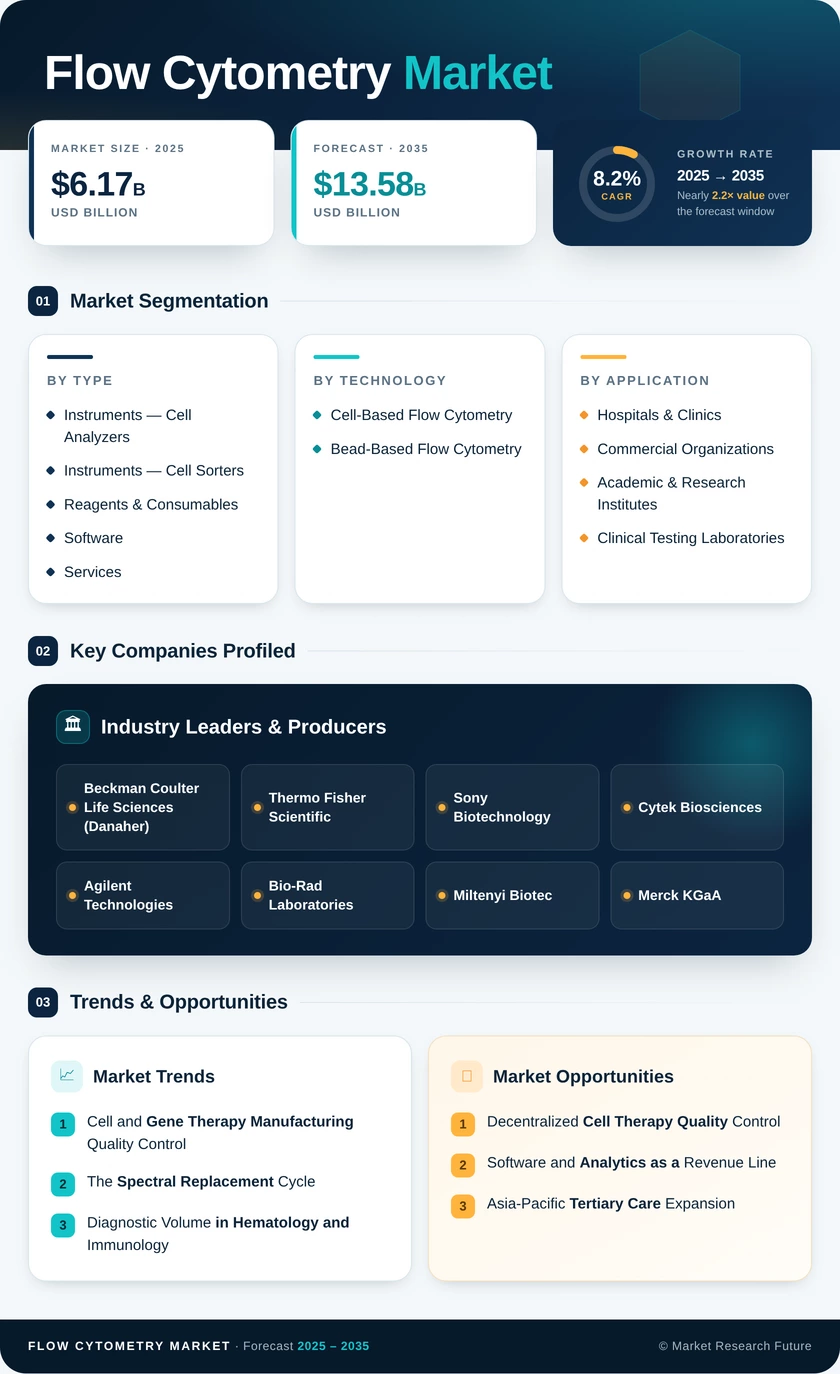
Flow Cytometry Market (2026 - 2035)

Flow Cytometry Market Research Report By Application (Cell Biology, Immunology, Cancer Research, Pharmaceutical Development, Diagnostics), By Type (Instruments, Reagents, Software, Accessories, Services), By End Use (Academic Research, Clinical Laboratories, Pharmaceutical Companies, Biotechnology Companies, Contract Research Organizations), By Technology (Cell Sorting, Cell Analyzers, High-Throughput Screening, Multicolor Analysis) and By Regional (North America, Europe, South America, Asia Pacific, Middle East and Africa) - Growth & Industry Forecast 2025 To 2035

Forecast Period
2026-2035
CAGR
8.2%
2025 Market Size
USD 6.17 Billion
2035 Market Size
USD 13.58 Billion
Medical Device ● Updated August 24, 2026 Report ID: MRFR/MED/4972-CR | Pages: 208 | Author: Rahul Gotadki, Kinjoll Dey
  1. 1 Market Overview |
    1. 1.1 Study Assumptions & Market Definition |
    2. 1.2 Scope of the Study |
    3. 1.3 Research Methodology
  2. 2 Market Summary & Key Report Takeaways |
    1. 2.1 Key Takeaways by Product and Services |
    2. 2.2 Key Takeaways by Application and End User |
    3. 2.3 Key Takeaways by Geography
  3. 3 Global Market Size & Forecast (2021–2035) |
    1. 3.1 Historical Market Size (2021–2024) |
    2. 3.2 Base Year Assessment (2025) |
    3. 3.3 Forecast Market Size (2026–2035) |
    4. 3.4 Year-over-Year Growth Analysis
  4. 4 Market Dynamics — Drivers |
    1. 4.1 Cell and Gene Therapy Manufacturing Quality Control |
    2. 4.2 Spectral Instrument Replacement Cycle |
    3. 4.3 Hematologic and Immunologic Diagnostic Volume |
    4. 4.4 Asia-Pacific Tertiary Hospital Buildout |
    5. 4.5 Automated Analysis and Cloud Software Adoption
  5. 5 Market Dynamics — Restraints |
    1. 5.1 Instrument Capital Intensity in Emerging Economies |
    2. 5.2 Shortage of Trained Operators |
    3. 5.3 IVDR Compliance Burden |
    4. 5.4 Data Standardization and Reproducibility Gaps |
    5. 5.5 Competitive Pressure from Single-Cell Sequencing
  6. 6 Market Opportunity Analysis |
    1. 6.1 Decentralized Cell Therapy Quality Control |
    2. 6.2 Software and Analytics as a Revenue Line |
    3. 6.3 Asia-Pacific Tertiary Care Expansion |
    4. 6.4 Reagent Rental and Outcome-Linked Contracting |
    5. 6.5 Microbiology and Industrial Quality Testing |
    6. 6.6 Industry Value Chain Analysis |
    7. 6.7 Porter's Five Forces Analysis
  7. 7 Regional Market Share & Country-Level Analysis |
    1. 7.1 North America | |
      1. 7.1.1 US | |
      2. 7.1.2 Canada | |
      3. 7.1.3 Mexico |
    2. 7.2 Europe | |
      1. 7.2.1 Germany | |
      2. 7.2.2 UK | |
      3. 7.2.3 France | |
      4. 7.2.4 Italy | |
      5. 7.2.5 Spain | |
      6. 7.2.6 Nordic Countries | |
      7. 7.2.7 Russia | |
      8. 7.2.8 Rest of Europe |
    3. 7.3 Asia-Pacific | |
      1. 7.3.1 China | |
      2. 7.3.2 India | |
      3. 7.3.3 Japan | |
      4. 7.3.4 South Korea | |
      5. 7.3.5 ASEAN | |
      6. 7.3.6 Rest of Asia-Pacific |
    4. 7.4 South America | |
      1. 7.4.1 Brazil | |
      2. 7.4.2 Argentina | |
      3. 7.4.3 Rest of South America |
    5. 7.5 Middle East & Africa | |
      1. 7.5.1 Saudi Arabia | |
      2. 7.5.2 UAE | |
      3. 7.5.3 South Africa | |
      4. 7.5.4 Egypt | |
      5. 7.5.5 Rest of Middle East & Africa
  8. 8 Future Outlook (2026–2035) |
    1. 8.1 Machine Learning and Automated Population Identification |
    2. 8.2 Platform Economics and Recurring Revenue |
    3. 8.3 Convergence with Single-Cell Multi-Omics |
    4. 8.4 Sustainability and Consumable Waste Reduction
  9. 9 Market Segmentation Analysis |
    1. 9.1 By Product and Services | |
      1. 9.1.1 Instruments — Cell Analyzers | |
      2. 9.1.2 Instruments — Cell Sorters | |
      3. 9.1.3 Reagents & Consumables | |
      4. 9.1.4 Software | |
      5. 9.1.5 Services |
    2. 9.2 By Technology | |
      1. 9.2.1 Cell-Based Flow Cytometry | |
      2. 9.2.2 Bead-Based Flow Cytometry |
    3. 9.3 By Application | |
      1. 9.3.1 Clinical Diagnostics | |
      2. 9.3.2 Drug Discovery & Development | |
      3. 9.3.3 Research Applications | |
      4. 9.3.4 Industrial Applications |
    4. 9.4 By End User | |
      1. 9.4.1 Hospitals & Clinics | |
      2. 9.4.2 Commercial Organizations | |
      3. 9.4.3 Academic & Research Institutes | |
      4. 9.4.4 Clinical Testing Laboratories
  10. 10 Competitive Landscape |
    1. 10.1 Market Concentration Analysis (2026) |
    2. 10.2 Competitive Benchmarking Matrix |
    3. 10.3 Company Profiles | |
      1. 10.3.1 BD (Becton, Dickinson and Company) | |
      2. 10.3.2 Beckman Coulter Life Sciences (Danaher) | |
      3. 10.3.3 Thermo Fisher Scientific | |
      4. 10.3.4 Sony Biotechnology | |
      5. 10.3.5 Cytek Biosciences | |
      6. 10.3.6 Agilent Technologies | |
      7. 10.3.7 Bio-Rad Laboratories | |
      8. 10.3.8 Miltenyi Biotec | |
      9. 10.3.9 Merck KGaA | |
      10. 10.3.10 DiaSorin | |
      11. 10.3.11 Sysmex Corporation | |
      12. 10.3.12 Standard BioTools
  11. 11 Recent News & Developments (2023–2025)
  12. 12 Report Scope & Methodology |
    1. 12.1 Study Period & Base Year |
    2. 12.2 Valuation Currency & Assumptions |
    3. 12.3 Abbreviations
  13. 13 Detailed Sources & Citations
  14. 14 Frequently Asked Questions
  15. 15 LIST OF TABLES
  16. 16 LIST OF FIGURES

Segmentation Quick Reference

DimensionSub-SegmentsDominant SegmentFastest Growing Segment
By Product and ServicesInstruments (Cell Analyzers, Cell Sorters), Reagents & Consumables, Software, ServicesReagents & ConsumablesSoftware
By TechnologyCell-Based Flow Cytometry, Bead-Based Flow CytometryCell-Based Flow CytometryBead-Based Flow Cytometry
By ApplicationClinical Diagnostics, Drug Discovery & Development, Research Applications, Industrial ApplicationsClinical DiagnosticsIndustrial Applications
By End UserHospitals & Clinics, Commercial Organizations, Academic & Research Institutes, Clinical Testing LaboratoriesHospitals & ClinicsAcademic & Research Institutes
By GeographyNorth America, Europe, Asia-Pacific, South America, Middle East & AfricaNorth AmericaAsia-Pacific


Market Segmentation Overview

By Product and Services

Sub-SegmentKey Trend
Instruments — Cell AnalyzersConsolidation of multiple legacy analyzers into single high-parameter platforms
Instruments — Cell SortersMigration from research use into GMP manufacturing environments
Reagents & ConsumablesPre-configured dry panel formats replacing manual conjugate assembly
SoftwareShift from bundled utilities to subscription-licensed analytics.
ServicesMulti-year uptime contracts becoming standard in clinical accounts.


Product mix is the clearest signal of where value is migrating. Hardware sales set the installed base, but revenue durability sits with the consumables and service layers attached to each placement.

By Technology

Sub-SegmentKey Trend
Cell-Based Flow CytometryFull-spectrum detection displacing filter-based optical architectures
Bead-Based Flow CytometryMultiplexed soluble analyte panels replacing single-plex immunoassays


Technology choice increasingly follows panel complexity rather than budget tier. Laboratories running fewer than a dozen markers see limited return from spectral architectures, which keeps conventional systems commercially viable well into the forecast window.

By Application

Sub-SegmentKey Trend
Clinical DiagnosticsHarmonized panel protocols standardizing procurement specifications
Drug Discovery & DevelopmentRelease testing for cellular products becoming a defined workflow category.
Research ApplicationsGrant-cycle dependency creating uneven year-to-year capital demand
Industrial ApplicationsRapid microbial enumeration displacing multi-day culture methods


Application mix explains regional divergence. Diagnostics-heavy regions grow steadily with demographics, while therapy-development hubs show sharper, pipeline-linked swings in demand.

By End User

Sub-SegmentKey Trend
Hospitals & ClinicsProcurement weighted toward service response and validated assay availability.
Commercial OrganizationsPurchasing driven by parameter count and throughput requirements
Academic & Research InstitutesShared core facility models concentrating high-end instrument placements
Clinical Testing LaboratoriesSpecialty send-out volume supporting centralized high-throughput platforms


Buyer behaviour varies more than the technology does. Vendors that segment sales coverage by end-user type — rather than by product line alone — consistently achieve better reagent pull-through per installed instrument.




Download PDF ×

We do not share your information with anyone. However, we may send you emails based on your report interest from time to time. You may contact us at any time to opt-out.