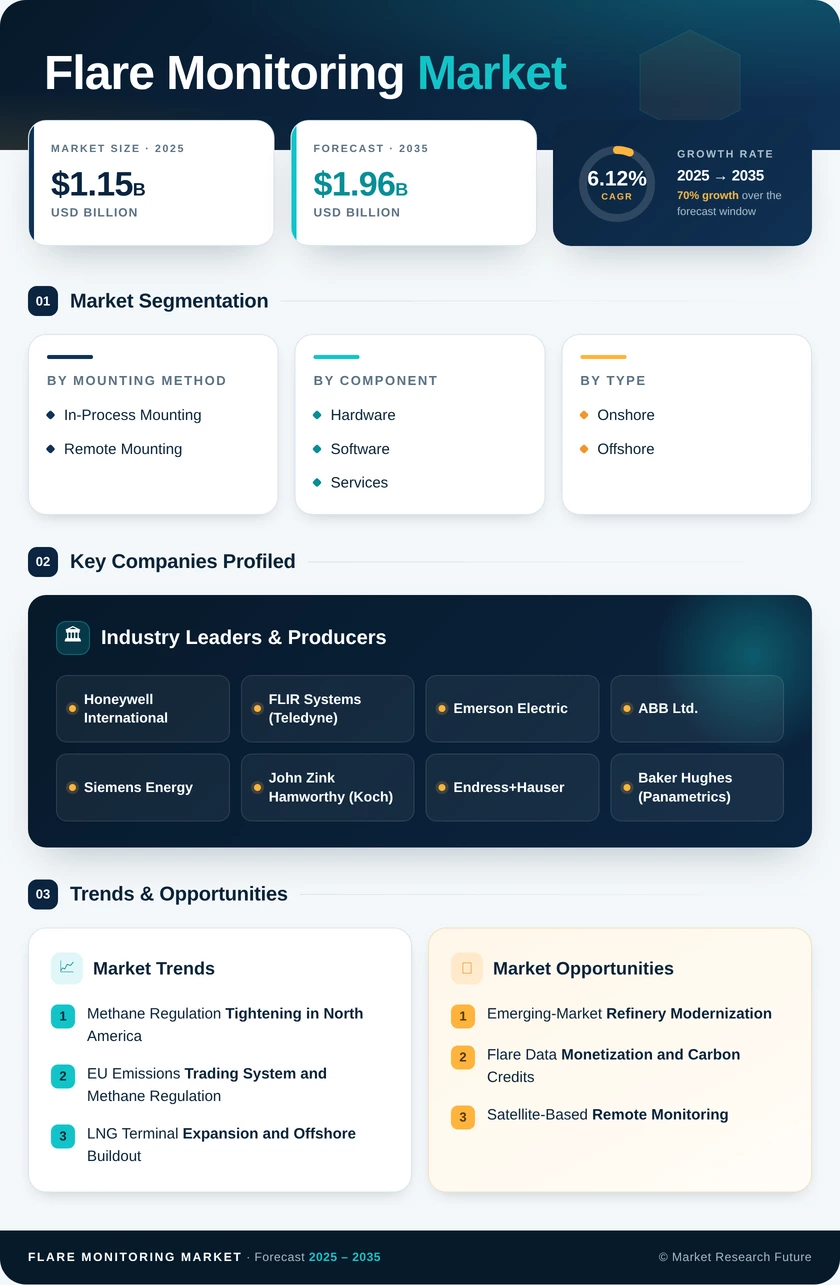
Flare Monitoring Market (2025 - 2035)

ID: MRFR/EnP/6192-HCR
112 Pages
Anshula Mandaokar
Last Updated: July 07, 2026
Flare Monitoring Market Research Report Information By Mounting Method (In-Process Mounting, Remote Mounting), By Component (Hardware, Software, Services), By Installation Type (Onshore, Offshore), By Measurement Parameter (Flame Detection & Imaging, Gas Composition Monitoring, Flow Rate Monitoring), By End-User (Oil Refineries, Petrochemical Plants, Upstream Offshore Operations) and By Regional (North America, Europe, South America, Asia Pacific, Middle East and Africa) - Industry Forecast to 2035
Flare Monitoring Market
Market Size
Forecast Period2025-2035
CAGR (2025-2035)6.12%
2025 Market SizeUSD 1.15 Billion
2035 Market SizeUSD 1.96 Billion
Key Players
Honeywell International
FLIR Systems
Emerson Electric
ABB Ltd.
Siemens Energy
John Zink Hamworthy
Opportunities
  • Emerging-Market Refinery Modernization
  • Flare Data Monetization and Carbon Credits
  • Satellite-Based Remote Monitoring
  1. 1 Market Overview |
    1. 1.1 Study Assumptions & Market Definition |
    2. 1.2 Scope of the Study |
    3. 1.3 Research Methodology
  2. 2 Market Summary & Key Takeaways
  3. 3 Market Dynamics |
    1. 3.1 Market Drivers Analysis | |
      1. 3.1.1 EPA OOOOb Methane Rules & State Equivalents | |
      2. 3.1.2 EU ETS Expansion & Methane Regulation | |
      3. 3.1.3 LNG Export Terminal Construction Wave | |
      4. 3.1.4 AI Video Analytics & Edge Computing | |
      5. 3.1.5 Offshore Digital Twin Integration | |
      6. 3.1.6 Carbon Credit Monetization Frameworks | |
      7. 3.1.7 Insurance & ESG Disclosure Mandates |
    2. 3.2 Market Restraints Analysis | |
      1. 3.2.1 High Upfront Capex for CEMS Retrofits | |
      2. 3.2.2 Fragmented Regulatory Standards Across Jurisdictions | |
      3. 3.2.3 Harsh Operating Environments Degrading Sensors | |
      4. 3.2.4 Shortage of Certified Calibration Technicians | |
      5. 3.2.5 Cybersecurity Risks in Connected Monitoring Networks |
    3. 3.3 Market Opportunity Analysis | |
      1. 3.3.1 Emerging-Market Refinery Modernization | |
      2. 3.3.2 Flare Data Monetization and Carbon Credits | |
      3. 3.3.3 Satellite-Based Remote Monitoring | |
      4. 3.3.4 Predictive Maintenance and Digital Twins | |
      5. 3.3.5 Drone-Integrated Inspection Services |
    4. 3.4 Industry Value Chain Analysis |
    5. 3.5 Porter's Five Forces Analysis
  4. 4 Global Flare Monitoring Market Size & Forecast (2021–2035) |
    1. 4.1 Historical Market Size (2021–2025) |
    2. 4.2 Current & Forecast Market Size (2026–2035) |
    3. 4.3 Market Size by Revenue (USD Billion) |
    4. 4.4 Year-over-Year Growth Analysis
  5. 5 Segmentation Analysis |
    1. 5.1 By Mounting Method | |
      1. 5.1.1 In-Process Mounting | |
      2. 5.1.2 Remote Mounting |
    2. 5.2 By Component | |
      1. 5.2.1 Hardware | |
      2. 5.2.2 Software | |
      3. 5.2.3 Services |
    3. 5.3 By Installation Type | |
      1. 5.3.1 Onshore | |
      2. 5.3.2 Offshore |
    4. 5.4 By Measurement Parameter | |
      1. 5.4.1 Flame Detection & Imaging | |
      2. 5.4.2 Gas Composition Monitoring | |
      3. 5.4.3 Flow Rate Monitoring |
    5. 5.5 By End-User | |
      1. 5.5.1 Oil Refineries | |
      2. 5.5.2 Petrochemical Plants | |
      3. 5.5.3 Upstream Offshore Operations
  6. 6 Regional Analysis |
    1. 6.1 North America | |
      1. 6.1.1 United States | |
      2. 6.1.2 Canada | |
      3. 6.1.3 Mexico |
    2. 6.2 Europe | |
      1. 6.2.1 Germany | |
      2. 6.2.2 United Kingdom | |
      3. 6.2.3 France | |
      4. 6.2.4 Italy | |
      5. 6.2.5 Spain | |
      6. 6.2.6 Nordic Countries | |
      7. 6.2.7 Russia | |
      8. 6.2.8 Rest of Europe |
    3. 6.3 Asia-Pacific | |
      1. 6.3.1 China | |
      2. 6.3.2 India | |
      3. 6.3.3 Japan | |
      4. 6.3.4 South Korea | |
      5. 6.3.5 ASEAN | |
      6. 6.3.6 Rest of Asia-Pacific |
    4. 6.4 South America | |
      1. 6.4.1 Brazil | |
      2. 6.4.2 Argentina | |
      3. 6.4.3 Rest of South America |
    5. 6.5 Middle East & Africa | |
      1. 6.5.1 Saudi Arabia | |
      2. 6.5.2 UAE | |
      3. 6.5.3 South Africa | |
      4. 6.5.4 Egypt | |
      5. 6.5.5 Rest of MEA
  7. 7 Competitive Landscape |
    1. 7.1 Market Share Analysis (2025) |
    2. 7.2 Competitive Benchmarking Matrix |
    3. 7.3 Company Profiles | |
      1. 7.3.1 Honeywell International | |
      2. 7.3.2 Teledyne FLIR | |
      3. 7.3.3 Emerson Electric | |
      4. 7.3.4 ABB Ltd. | |
      5. 7.3.5 Siemens Energy | |
      6. 7.3.6 John Zink Hamworthy (Koch Industries) | |
      7. 7.3.7 Endress+Hauser | |
      8. 7.3.8 Baker Hughes (Panametrics) | |
      9. 7.3.9 Providence Photonics | |
      10. 7.3.10 Williamson IR
  8. 8 Future Outlook & Strategic Recommendations (2026–2035) |
    1. 8.1 AI-Autonomous Flare Management |
    2. 8.2 Platform Economics and As-a-Service Models |
    3. 8.3 ESG Disclosure and Investor Pressure |
    4. 8.4 Electrification and Flare-to-Value Conversion
  9. 9 Recent Developments & News
  10. 10 Frequently Asked Questions (FAQs)
  11. 11 Report Scope & Methodology |
    1. 11.1 Study Period & Base Year |
    2. 11.2 Data Sources & Citations |
    3. 11.3 Abbreviations
  12. 12 LIST OF TABLES |
  13. TABLE 1 Global Flare Monitoring Market Size & Forecast, by Revenue (USD Billion), 2021–2035 |
  14. TABLE 2 Global Flare Monitoring Market – Year-over-Year Growth Analysis, 2021–2035 |
  15. TABLE 3 Global Flare Monitoring Market – Driver Impact Analysis, 2026–2035 |
  16. TABLE 4 Global Flare Monitoring Market – Restraints Impact Analysis, 2026–2035 |
  17. TABLE 5 Global Flare Monitoring Market Size, by Mounting Method, 2021–2035 (USD Billion) |
  18. TABLE 6 Global Flare Monitoring Market Size, by Component, 2021–2035 (USD Billion) |
  19. TABLE 7 Global Flare Monitoring Market Size, by Installation Type, 2021–2035 (USD Billion) |
  20. TABLE 8 Global Flare Monitoring Market Size, by Measurement Parameter, 2021–2035 (USD Billion) |
  21. TABLE 9 Global Flare Monitoring Market Size, by End-User, 2021–2035 (USD Billion) |
  22. TABLE 10 Global Flare Monitoring Market Size, by Region, 2021–2035 (USD Billion) |
  23. TABLE 11 North America Flare Monitoring Market Size, by Country, 2021–2035 (USD Billion) |
  24. TABLE 12 Europe Flare Monitoring Market Size, by Country, 2021–2035 (USD Billion) |
  25. TABLE 13 Asia-Pacific Flare Monitoring Market Size, by Country, 2021–2035 (USD Billion) |
  26. TABLE 14 South America Flare Monitoring Market Size, by Country, 2021–2035 (USD Billion) |
  27. TABLE 15 Middle East & Africa Flare Monitoring Market Size, by Country, 2021–2035 (USD Billion) |
  28. TABLE 16 Competitive Benchmarking Matrix – Global Flare Monitoring Market, 2025 |
  29. TABLE 17 Company Profiles – Key Players, Global Flare Monitoring Market |
  30. TABLE 18 Recent Developments & Strategic Announcements, 2024–2025 |
  31. TABLE 19 Report Scope & Methodology Summary |
  32. TABLE 20 Detailed Sources and Citations
  33. 13 LIST OF FIGURES |
  34. FIGURE 1 Global Flare Monitoring Market Dynamics – Drivers, Restraints, and Opportunities |
  35. FIGURE 2 Industry Value Chain Analysis – Flare Monitoring Market |
  36. FIGURE 3 Porter's Five Forces Analysis – Flare Monitoring Market |
  37. FIGURE 4 Global Flare Monitoring Market Size Trend (USD Billion), 2021–2035 |
  38. FIGURE 5 Global Flare Monitoring Market Share, by Mounting Method, 2025 |
  39. FIGURE 6 Global Flare Monitoring Market Share, by Component, 2025 |
  40. FIGURE 7 Global Flare Monitoring Market Share, by Installation Type, 2025 |
  41. FIGURE 8 Global Flare Monitoring Market Share, by Measurement Parameter, 2025 |
  42. FIGURE 9 Global Flare Monitoring Market Share, by End-User, 2025 |
  43. FIGURE 10 Global Flare Monitoring Market Share, by Region, 2025 |
  44. FIGURE 11 North America Flare Monitoring Market Share, by Country, 2025 |
  45. FIGURE 12 Europe Flare Monitoring Market Share, by Country, 2025 |
  46. FIGURE 13 Asia-Pacific Flare Monitoring Market Share, by Country, 2025 |
  47. FIGURE 14 South America Flare Monitoring Market Share, by Country, 2025 |
  48. FIGURE 15 Middle East & Africa Flare Monitoring Market Share, by Country, 2025 |
  49. FIGURE 16 Competitive Landscape – Market Share Analysis, 2025

Segmentation Quick Reference

DimensionSub-SegmentsDominant SegmentFastest Growing Segment
Mounting MethodIn-Process Mounting, Remote MountingIn-Process MountingRemote Mounting
ComponentHardware, Flare Monitoring Market, ServicesHardwareServices
Installation TypeOnshore, OffshoreOnshoreOffshore
Measurement ParameterFlame Detection & Imaging, Gas Composition Monitoring, Flow Rate MonitoringFlame Detection & ImagingGas Composition Monitoring
End-UserOil Refineries, Petrochemical Plants, Upstream Offshore OperationsOil RefineriesUpstream Offshore Operations
GeographyNorth America, Europe, Asia-Pacific, South America, Middle East & AfricaNorth AmericaAsia-Pacific


Market Segmentation Overview

By Mounting Method

Sub-SegmentKey Trend
In-Process MountingContinued dominance driven by regulatory accuracy requirements for direct-contact sensor installations at refinery flare stacks
Remote MountingRapid adoption fueled by satellite-based and drone-mounted monitoring platforms, reducing personnel exposure in hazardous zones


In-process mounting remains the preferred approach for facilities subject to stringent CEMS accuracy thresholds, while remote mounting gains traction as satellite constellations and UAV payloads deliver cost-effective alternatives for geographically dispersed or offshore assets.

By Component

Sub-SegmentKey Trend
HardwareInfrared cameras, gas analyzers, and flow meters form the capital-intensive foundation of monitoring installations
Flare Monitoring MarketCloud-based analytics platforms and compliance-reporting dashboards accelerate digital transformation
ServicesManaged monitoring contracts, calibration services, and AI-driven predictive maintenance subscriptions grow fastest


Hardware spending drives initial project capex, but recurring software and services revenue is shifting the industry toward subscription-based business models that lower adoption barriers for mid-tier operators.

By Installation Type

Sub-SegmentKey Trend
OnshoreRefinery and gas-processing plant compliance spending sustains the largest installed base
OffshoreFPSO deployments and deepwater platform construction programs create the fastest growth corridor


Onshore installations benefit from established regulatory frameworks and easier equipment access, while offshore installations demand ruggedized, remotely operated systems integrated with digital-twin platforms.

By Measurement Parameter

Sub-SegmentKey Trend
Flame Detection & ImagingMulti-spectral infrared and thermal cameras dominate for real-time combustion visualization
Gas Composition MonitoringSpeciated VOC and methane analysis requirements drive fastest adoption growth
Flow Rate MonitoringUltrasonic and differential-pressure meters support custody-transfer and mass-balance calculations


Flame detection and imaging serve as the primary compliance tool, but gas composition monitoring is the key growth frontier as regulators shift from aggregate emission estimates to component-level reporting.

By End-User

Sub-SegmentKey Trend
Oil RefineriesDense flare-stack configurations and mature regulatory mandates sustain the largest market share
Petrochemical PlantsProcess-safety instrumented system upgrades integrate flare monitoring into broader plant automation
Upstream Offshore OperationsDeepwater FPSO fleet expansion and zero-routine-flaring commitments drive the highest growth rates


Oil refineries will continue to anchor demand, but upstream offshore operations are poised to narrow the gap as new production assets in pre-salt basins, East Africa, and the Eastern Mediterranean come online with integrated monitoring from day one.


Download PDF ×

We do not share your information with anyone. However, we may send you emails based on your report interest from time to time. You may contact us at any time to opt-out.