
×
Hero Background
English
Chinese
French
Japanese
Korean
German
Spanish

Financial Analytics Market Trends

ID: MRFR/BS/6211-HCR
200 Pages
Aarti Dhapte
October 2025

Financial Analytics Market Research Report Information By Component, Deployment, Organization Size, Application (GRC & Wealth Management, Financial Forecasting & Budgeting, Transaction Monitoring, Fraud Detection & Prevention), Vertical - Industry Size, Share and Forecast till 2035

Share:
Download PDF ×

We do not share your information with anyone. However, we may send you emails based on your report interest from time to time. You may contact us at any time to opt-out.

Financial Analytics Market Infographic
Purchase Options

Market Trends

Key Emerging Trends in the Financial Analytics Market

The Financial Analytics market is currently undergoing significant shifts, driven by technological advancements, changing regulatory landscapes, and evolving customer expectations. One of the prominent trends shaping the market is the increasing adoption of artificial intelligence (AI) and machine learning (ML) in financial analytics. These technologies enable financial institutions to process vast amounts of data at unprecedented speeds, extracting valuable insights and improving decision-making processes. By leveraging predictive analytics, financial institutions can anticipate market trends, assess risks, and optimize investment strategies.

Another noteworthy trend is the growing importance of real-time analytics in the financial sector. As markets become more dynamic and volatile, the ability to access and analyze data in real-time is becoming crucial. Financial analytics solutions that offer real-time insights empower organizations to respond swiftly to market changes, identify emerging opportunities, and mitigate risks promptly. This shift towards real-time analytics is not only enhancing operational efficiency but also enabling financial institutions to stay competitive in an ever-evolving landscape.

Furthermore, the emphasis on data security and privacy is influencing the Financial Analytics market. With an increasing volume of sensitive financial data being processed and analyzed, the need for robust security measures has become paramount. Market participants are investing in advanced cybersecurity solutions to safeguard financial information and maintain the trust of clients and regulatory bodies. Compliance with data protection regulations is also a key consideration, as financial institutions strive to balance innovation with regulatory requirements.

Integration of cloud computing in financial analytics is another prevalent trend. Cloud-based solutions offer scalability, flexibility, and cost-effectiveness, making them attractive to financial organizations seeking to optimize their infrastructure. Cloud-based financial analytics enable seamless collaboration, data accessibility from various locations, and efficient resource utilization. As a result, many financial institutions are transitioning from traditional on-premises solutions to cloud-based platforms, thereby contributing to the overall growth of the Financial Analytics market.

The democratization of financial analytics tools is an emerging trend that is transforming the accessibility of sophisticated analytics capabilities. Previously confined to large financial institutions, advanced analytics tools are now becoming more accessible to smaller players in the market. This democratization allows a broader range of financial professionals to harness the power of analytics, democratizing decision-making processes and fostering innovation across the industry.

In conclusion, the Financial Analytics market is witnessing dynamic shifts driven by technological advancements, changing customer expectations, and regulatory considerations. The adoption of artificial intelligence and machine learning, the emphasis on real-time analytics, data security and privacy concerns, integration of cloud computing, and the democratization of analytics tools are key trends shaping the landscape. As financial institutions navigate these trends, they are better positioned to enhance their analytical capabilities, improve decision-making processes, and adapt to the evolving financial ecosystem. The continual evolution of market trends in financial analytics reflects the industry's commitment to staying agile and resilient in an ever-changing environment.


Author
Aarti Dhapte
Team Lead - Research

She holds an experience of about 6+ years in Market Research and Business Consulting, working under the spectrum of Information Communication Technology, Telecommunications and Semiconductor domains. Aarti conceptualizes and implements a scalable business strategy and provides strategic leadership to the clients. Her expertise lies in market estimation, competitive intelligence, pipeline analysis, customer assessment, etc.

Leave a Comment

FAQs

What will be the market value of Financial Analytics Market in 2030?

Financial Analytics Market profit is expected to generate 17.64 billion by the end of the year 2030.

What impact can the CAGR of the market have on the Financial Analytics Market revenue growth?

A 11.40% CAGR level is estimated to enhance the market in the future.

Who are the key market leaders in the financial analytics market?

Zoho Corporation (India), IBM Corporation (US), Oracle Corporation (US), TIBCO Software Inc. (US), Google (US), are the key market leaders.

Which region is expected to prosper the market of global financial analytics?

North America will be prospering the market of global financial analytics.

Which regions are grossing more market valuation as per the study?

North America, Europe, Asia-Pacific, and the rest of the world are the regions grossing the most as per the study.

How is data analytics used in finance?

Financial Analytics Market the businesses, projects, budgets, and other finance-related entities of an enterprise are evaluated to determine the performance and suitability.

What are the Factors Driving the Market Growth of Financial Analytics?

The increase in the adoption of computing devices everywhere, the increase in advanced security capabilities and the proliferation of new analytics tools are providing new opportunities for market players which, in turn, are driving the growth of the financial analytics market.

How can the global financial analytics market expect steady growth in the future?

Advancements in business intelligence (BI) and business analytics tools can assist the market with steady growth in the future.

What are the significant factors influencing the market to grow for the future?

The growing need for data-driven financial decisions among end users is a significant factor persuading the market to grow.

Market Summary

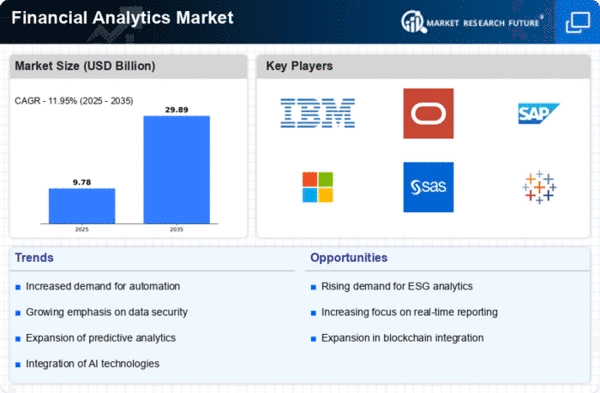
The Global Financial Analytics Market is poised for substantial growth, expanding from 8.74 USD Billion in 2024 to 30.3 USD Billion by 2035.

Key Market Trends & Highlights

Financial Analytics Market Key Trends and Highlights

  • The market is expected to grow at a compound annual growth rate (CAGR) of 11.95% from 2025 to 2035. By 2035, the market valuation is projected to reach 30.3 USD Billion, indicating robust demand for financial analytics solutions. In 2024, the market is valued at 8.74 USD Billion, reflecting a strong foundation for future growth. Growing adoption of advanced analytics technologies due to increasing demand for data-driven decision making is a major market driver.

Market Size & Forecast

2024 Market Size 8.74 (USD Billion)
2035 Market Size 30.3 (USD Billion)
CAGR (2025-2035) 11.95%
Largest Regional Market Share in 2024 latin_america)

Major Players

<p>Domo, Oracle, Zoho Corporation, Teradata, Information Builder, TIBCO Software, Qlik, Google, SAP, Birst, SAS Institute, FICO, Alteryx, IBM Corporation</p>

Market Trends

Financial Analytics Market Market Drivers

Rising Demand for Data-Driven Decision Making

The Global Financial Analytics Market Industry experiences a surge in demand for data-driven decision making among organizations. Companies increasingly rely on financial analytics to derive insights from vast amounts of data, enabling them to make informed strategic decisions. This trend is particularly evident in sectors such as banking and insurance, where real-time analytics can significantly enhance operational efficiency. As organizations recognize the value of data in optimizing financial performance, the market is projected to grow from 8.74 USD Billion in 2024 to an estimated 30.3 USD Billion by 2035, reflecting a robust CAGR of 11.95% from 2025 to 2035.

Market Segment Insights

Regional Insights

Key Companies in the Financial Analytics Market market include

Industry Developments

In June 2023, a business intelligence software firm MICROSTRATEGY INCORPORATED seems to have entered into an amended agreement with the multinational sophisticate Microsoft Corporation. The agreement will include MicroStrategy's cutting-edge analytics solutions together with Microsoft's Azure Open AI Service to allow businesses to make the most of their data.

In May 2023, business intelligence software firm QlikTech International AB completed a majority stake acquisition in data integration and management software developer Talend Inc. This purchase is projected to enhance the competencies of QlikTech International AB in such different areas as data quality, data transformation, application connectivity and API services.

In February 2023, Alteryx introduced management and self-service options for analytics cloud platforms and Enterprise customers, which should allow its clients to make business decisions faster. The upgraded platform improves the user experience by providing a new user interface style while maintaining acceptable standards in data management.

In November 2022, IBM Corporation, a firm involved with computers, technology and IT consulting with all its resources, opened the latest software to help enterprises quench their thirst for skimming enterprises' data and data analytics and make decisions faster than before.

In October 2022, Oracle, a company dealing with cloud applications and platform services, provided further innovations through several remuneration instruments with the aim of assisting customers in not just improving their skills but also incorporating new ideas into their businesses. The clients of Oracle are now able to use the already prepared packages of 2000 reports, dashboards, and metrics.

In September 2022, a multinational corporation, S&P, announced a cooperative deal with Novata Inc., a private companies’ ESG-based databases provider. As a result, it is possible to link Novata’s platform with S&P Global market intelligence customers’ databases. It will, in turn, enable making data-based decisions regarding the influence financial outcomes of ESG concepts.


Future Outlook

Financial Analytics Market Future Outlook

<p>The Financial Analytics Market is poised for growth at 11.95% CAGR from 2024 to 2035, driven by advancements in AI, regulatory changes, and increasing data complexity.</p>

New opportunities lie in:

  • <p>Leverage AI-driven predictive analytics to enhance investment strategies.&nbsp;</p><p>Develop cloud-based financial analytics solutions for SMEs.&nbsp;</p><p>Implement <a href="https://www.marketresearchfuture.com/reports/real-time-operating-system-market-34731">real-time</a> data visualization tools to improve decision-making processes.</p>

<p>By 2035, the Financial Analytics Market is expected to achieve substantial growth, reflecting evolving industry demands.</p>

Market Segmentation

Financial Analytics End-user Outlook:

  • Transportation and logistics 
  • Banking
  • insurance and financial services 
  • Retail and eCommerce 
  • Government 
  • Utilities 
  • Media and entertainment 
  • Manufacturing and automotive 
  • Latin America 
  • Europe 
  • Asia pacific 
  • North America 
  • Domo
  • Oracle
  • Zoho Corporation
  • Teradata
  • Information Builder
  • TIBCO Software 
  • QlikGoogle
  • Google
  • SAP
  • Birst 
  • SAS Institute
  • FICO
  • Alteryx
  • IBM Corporation
  • Market overview highlights 
  • Analysis based upon COVID 19
  • Explanation upon the Market Dynamics
  • Value chain analysis
  • Market segmentation overview
  • The regional analysis
  • Competitive landscape analysis
  • Recent Developments

Financial Analytics Services Outlook:

  • Professional services 
  • Managed services 

Financial Analytics Applications Outlook:

  • Stock management 
  • Wealth management 
  • Fraud prevention and detection 
  • Risk
  • governance and compliance management 
  • Claim management 
  • Customer management 
  • Track management 

Financial Analytics Components Outlook: 

  • Financial market analytics 
  • Financial function analytics 

Financial Analytics Organization Outlook:

  • Small and medium-sized enterprise 
  • Large scale enterprise 

Financial Analytics Deployment Modes Outlook:

  • Cloud technology 
  • On-premise technology

Report Scope

Report Attribute/MetricDetails
Market Size 2030USD 17.64 Billion
Compound Annual Growth Rate (CAGR)11.40% (2022-2030)
Base Year2021
Market Forecast Period2022-2030
Historical Data2020
Market Forecast UnitsValue (USD Billion)
Report CoverageRevenue Forecast, Competitive Landscape, Growth Factors, and Trends
Segments CoveredComponent, Application and Region
Geographies CoveredNorth America, Europe, Asia-Pacific, and Rest of the World (RoW)
Key VendorsFair Isaac Corporation (US), Oracle Corporation (US), TIBCO Software Inc. (US), IBM Corporation (US), Zoho Corporation (India), Google (US), SAP (Germany), MicroStrategy Incorporated (US), TABLEAU SOFTWARE (US), Teradata (US), SAS Institute Inc. (US), Rosslyn Data Technologies (UK), Deloitte Touche Tohmatsu Limited (US), QlikTech International AB (US) and ALTERYX, INC. (US).
Key Market OpportunitiesAdvancements in technologies such as artificial intelligence (AI) and machine learning (ML), and the growing adoption of predictive analytics offer lucrative opportunities to the key providers of financial analytics solutions and services in the global market.
Key Market DriversThe major factor contributing to market growth is the growing need for data-driven financial decisions among the end users.

FAQs

What will be the market value of Financial Analytics Market in 2030?

Financial Analytics Market profit is expected to generate 17.64 billion by the end of the year 2030.

What impact can the CAGR of the market have on the Financial Analytics Market revenue growth?

A 11.40% CAGR level is estimated to enhance the market in the future.

Who are the key market leaders in the financial analytics market?

Zoho Corporation (India), IBM Corporation (US), Oracle Corporation (US), TIBCO Software Inc. (US), Google (US), are the key market leaders.

Which region is expected to prosper the market of global financial analytics?

North America will be prospering the market of global financial analytics.

Which regions are grossing more market valuation as per the study?

North America, Europe, Asia-Pacific, and the rest of the world are the regions grossing the most as per the study.

How is data analytics used in finance?

Financial Analytics Market the businesses, projects, budgets, and other finance-related entities of an enterprise are evaluated to determine the performance and suitability.

What are the Factors Driving the Market Growth of Financial Analytics?

The increase in the adoption of computing devices everywhere, the increase in advanced security capabilities and the proliferation of new analytics tools are providing new opportunities for market players which, in turn, are driving the growth of the financial analytics market.

How can the global financial analytics market expect steady growth in the future?

Advancements in business intelligence (BI) and business analytics tools can assist the market with steady growth in the future.

What are the significant factors influencing the market to grow for the future?

The growing need for data-driven financial decisions among end users is a significant factor persuading the market to grow.

  1. Executive Summary
    1. Market Attractiveness Analysis
      1. Global Financial Analytics Market, by Component
      2. Global Financial Analytics Market, by Deployment
      3. Global Financial Analytics Market, by Organization Size
      4. Global Financial Analytics Market, by Application
      5. Global Financial Analytics Market, by Vertical
      6. Financial Analytics Market, by Region
  2. Scope of the Report
    1. Market Definition
    2. Scope of the Study
    3. Market Structure
    4. Key Buying Criteria
    5. Macro Factor Indicator Analysis
  3. Market Research Methodology
    1. Research Process
    2. Primary Research
    3. Secondary Research
    4. Market Size Estimation
    5. Forecast Model
    6. List of Assumptions
  4. Market Insights
  5. Industry Overview of the Global Financial Analytics Market
    1. Introduction
    2. Drivers
      1. Growing need on data driven financial decisions in end-users
      2. Advancement in Business Intelligence (BI) and business analytics tools
      3. Growing adoption of predictive analytics
      4. Drivers Impact Analysis
    3. Restraints
      1. Regulations and standards
      2. Security and privacy concerns
      3. Restraints Impact Analysis
    4. Opportunities
      1. Technological advancements such as AI and machine learning
      2. Growing adoption of predictive analytics
    5. Challenges
      1. Integration of data from data silos
  6. Market Factor Analysis
    1. Porter’s Five Forces Analysis
      1. Threat of New Entrants
      2. Bargaining Power of Suppliers
      3. Bargaining Power of Buyers
      4. Threat of Substitutes
      5. Intensity of Rivalry
    2. Value Chain/Supply Chain of the Global Financial Analytics Market
  7. Global Financial Analytics Market, by Component
    1. Introduction
    2. Software
      1. Market Estimates & Forecast, 2020–2027
      2. Market Estimates & Forecast, by Region, 2020–2027
    3. Services
      1. Market Estimates & Forecast, 2020–2027
      2. Market Estimates & Forecast, by Region, 2020–2027
  8. Global Financial Analytics Market, by Deployment Type
    1. Introduction
    2. On-Premise
      1. Market Estimates & Forecast, 2020–2027
      2. Market Estimates & Forecast, by Region, 2020–2027
    3. Cloud
      1. Market Estimates & Forecast, 2020–2027
      2. Market Estimates & Forecast, by Region, 2020–2027
  9. Global Financial Analytics Market, by Organization Size
    1. Introduction
    2. Large Enterprises
      1. Market Estimates & Forecast, 2020–2027
      2. Market Estimates & Forecast, by Region, 2020–2027
    3. Small and Medium-Sized Enterprises
      1. Market Estimates & Forecast, 2020–2027
      2. Market Estimates & Forecast, by Region, 2020–2027
  10. Global Financial Analytics Market, by Application
    1. Introduction
    2. Governance, Risk, and Compliance Management
      1. Market Estimates & Forecast, 2020–2027
      2. Market Estimates & Forecast, by Region, 2020–2027
    3. Customer Management
      1. Market Estimates & Forecast, 2020–2027
      2. Market Estimates & Forecast, by Region, 2020–2027
    4. Wealth Management
      1. Market Estimates & Forecast, 2020–2027
      2. Market Estimates & Forecast, by Region, 2020–2027
    5. Financial Forecasting and Budgeting
      1. Market Estimates & Forecast, 2020–2027
      2. Market Estimates & Forecast, by Region, 2020–2027
    6. Transaction Monitoring
      1. Market Estimates & Forecast, 2020–2027
      2. Market Estimates & Forecast, by Region, 2020–2027
    7. Stock Management
      1. Market Estimates & Forecast, 2020–2027
      2. Market Estimates & Forecast, by Region, 2020–2027
    8. Fraud Detection and Prevention
      1. Market Estimates & Forecast, 2020–2027
      2. Market Estimates & Forecast, by Region, 2020–2027
    9. Others
      1. Market Estimates & Forecast, 2020–2027
      2. Market Estimates & Forecast, by Region, 2020–2027
  11. Global Financial Analytics Market, by Vertical
    1. Introduction
    2. BFSI
      1. Market Estimates & Forecast, 2020–2027
      2. Market Estimates & Forecast, by Region, 2020–2027
    3. Retail & Ecommerce
      1. Market Estimates & Forecast, 2020–2027
      2. Market Estimates & Forecast, by Region, 2020–2027
    4. Government and Defense
      1. Market Estimates & Forecast, 2020–2027
      2. Market Estimates & Forecast, by Region, 2020–2027
    5. Healthcare and Life Sciences
      1. Market Estimates & Forecast, 2020–2027
      2. Market Estimates & Forecast, by Region, 2020–2027
    6. Energy and Utilities
      1. Market Estimates & Forecast, 2020–2027
      2. Market Estimates & Forecast, by Region, 2020–2027
    7. Manufacturing and Automotive
      1. Market Estimates & Forecast, 2020–2027
      2. Market Estimates & Forecast, by Region, 2020–2027
    8. Telecommunication and IT
      1. Market Estimates & Forecast, 2020–2027
      2. Market Estimates & Forecast, by Region, 2020–2027
    9. Transportation and Logistics
      1. Market Estimates & Forecast, 2020–2027
      2. Market Estimates & Forecast, by Region, 2020–2027
    10. Others
      1. Market Estimates & Forecast, 2020–2027
      2. Market Estimates & Forecast, by Region, 2020–2027
  12. Global Financial Analytics Market, by Region
    1. Introduction
    2. North America
      1. Market Estimates & Forecast, 2020–2027
      2. Market Estimates & Forecast, by Component, 2020–2027
      3. Market Estimates & Forecast, by Deployment Mode, 2020–2027
      4. Market Estimates & Forecast, by Organization Size, 2020–2027
      5. Market Estimates & Forecast, by Application, 2020–2027
      6. Market Estimates & Forecast, by Vertical, 2020–2027
      7. US
      8. Canada
      9. Mexico
    3. Europe
      1. Market Estimates & Forecast, 2020–2027
      2. Market Estimates & Forecast, by Component, 2020–2027
      3. Market Estimates & Forecast, by Deployment Mode, 2020–2027
      4. Market Estimates & Forecast, by Organization Size, 2020–2027
      5. Market Estimates & Forecast, by Application, 2020–2027
      6. Market Estimates & Forecast, by Vertical, 2020–2027
      7. Germany
      8. France
      9. UK
      10. Rest of Europe
    4. Asia-Pacific
      1. Market Estimates & Forecast, 2020–2027
      2. Market Estimates & Forecast, by Component, 2020–2027
      3. Market Estimates & Forecast, by Deployment Mode, 2020–2027
      4. Market Estimates & Forecast, by Organization Size, 2020–2027
      5. Market Estimates & Forecast, by Application, 2020–2027
      6. Market Estimates & Forecast, by Vertical, 2020–2027
      7. China
      8. India
      9. Japan
      10. Rest of Asia-Pacific
    5. Rest of the World
      1. Market Estimates & Forecast, 2020–2027
      2. Market Estimates & Forecast, by Component, 2020–2027
      3. Market Estimates & Forecast, by Deployment Mode, 2020–2027
      4. Market Estimates & Forecast, by Organization Size, 2020–2027
      5. Market Estimates & Forecast, by Application, 2020–2027
      6. Market Estimates & Forecast, by Vertical, 2020–2027
      7. Middle East & Africa
      8. South America
  13. Company Landscape
    1. Competitive Overview
    2. Competitor Dashboard
    3. Major Growth Strategies in the Global Financial Analytics Market
    4. Competitive Benchmarking
    5. Market Share Analysis
    6. XXXX: The leading player in terms of number of developments in the Global Financial Analytics Market
    7. Key Developments & Growth Strategies
      1. Product Launches/Service Deployment
      2. Mergers & Acquisitions
      3. Joint Ventures
      4. Business Expansion
  14. Company Profiles
    1. Fair Isaac Corporation
      1. Company Overview
      2. Product/Business Segment Overview
      3. Financial Updates
      4. Key Developments
    2. Oracle Corporation
      1. Company Overview
      2. Product/Business Segment Overview
      3. Financial Updates
      4. Key Developments
    3. TIBCO Software Inc.
      1. Company Overview
      2. Product/Business Segment Overview
      3. Financial Updates
      4. Key Developments
    4. IBM Corporation
      1. Company Overview
      2. Product/Business Segment Overview
      3. Financial Updates
      4. Key Developments
    5. Zoho Corporation
      1. Company Overview
      2. Product/Business Segment Overview
      3. Financial Updates
      4. Key Developments
    6. Google
      1. Company Overview
      2. Product/Business Segment Overview
      3. Financial Updates
      4. Key Developments
    7. SAP
      1. Company Overview
      2. Product/Business Segment Overview
      3. Financial Updates
      4. Key Developments
    8. MicroStrategy Incorporated
      1. Company Overview
      2. Product/Business Segment Overview
      3. Financial Updates
      4. Key Developments
    9. TABLEAU SOFTWARE
      1. Company Overview
      2. Product/Business Segment Overview
      3. Financial Updates
      4. Key Developments
    10. Teradata
      1. Company Overview
      2. Product/Business Segment Overview
      3. Financial Updates
      4. Key Developments
    11. SAS Institute Inc.
      1. Company Overview
      2. Product/Business Segment Overview
      3. Financial Updates
      4. Key Developments
    12. Rosslyn Data Technologies
      1. Company Overview
      2. Product/Business Segment Overview
      3. Financial Updates
      4. Key Developments
    13. Deloitte Touche Tohmatsu Limited
      1. Company Overview
      2. Product/Business Segment Overview
      3. Financial Updates
      4. Key Developments
    14. QlikTech International AB
      1. Company Overview
      2. Product/Business Segment Overview
      3. Financial Updates
      4. Key Developments
    15. ALTERYX, INC.
      1. Company Overview
      2. Product/Business Segment Overview
      3. Financial Updates
      4. Key Developments
  15. Conclusion
  16. LIST OF TABLES
  17. Global Financial Analytics Market, by Region, 2020–2027
  18. North America: Financial Analytics Market, by Country, 2020–2027
  19. Europe: Financial Analytics Market, by Country, 2020–2027
  20. Asia-Pacific: Financial Analytics Market, by Country, 2020–2027
  21. Middle East & Africa: Financial Analytics Market, by Country, 2020–2027
  22. South America: Financial Analytics Market, by Country, 2020–2027
  23. Global Financial Analytics Component Market, by Region, 2020–2027
  24. North America: Financial Analytics Component Market, by Country, 2020–2027
  25. Europe: Financial Analytics Component Market, by Country, 2020–2027
  26. Table10 Asia-Pacific: Financial Analytics Component Market, by Country, 2020–2027
  27. Table11 Middle East & Africa: Financial Analytics Component Market, by Country, 2020–2027
  28. Table12 South America: Financial Analytics Component Market, by Country, 2020–2027
  29. Table13 Global Financial Analytics Deployment Mode Market, by Region, 2020–2027
  30. Table14 North America: Financial Analytics Deployment Mode Market, by Country, 2020–2027
  31. Table15 Europe: Financial Analytics Deployment Mode Market, by Country, 2020–2027
  32. Table16 Asia-Pacific: Financial Analytics Deployment Mode Market, by Country, 2020–2027
  33. Table17 Middle East & Africa: Financial Analytics Deployment Mode Market, by Country, 2020–2027
  34. Table18 South America: Financial Analytics Deployment Mode Market, by Country, 2020–2027
  35. Table19 Global Financial Analytics Vertical Market, by Region, 2020–2027
  36. Table20 North America: Financial Analytics Vertical Market, by Country, 2020–2027
  37. Table21 Europe: Financial Analytics Vertical Market, by Country, 2020–2027
  38. Table22 Asia-Pacific: Financial Analytics Vertical Market, by Country, 2020–2027
  39. Table23 Middle East & Africa: Financial Analytics Vertical Market, by Country, 2020–2027
  40. Table24 South America: Financial Analytics Vertical Market, by Country, 2020–2027
  41. Table25 Global Financial Analytics Component Market, by Region, 2020–2027
  42. Table26 Global Financial Analytics Deployment Type Market, by Region, 2020–2027
  43. Table27 Global Financial Analytics Vertical Market, by Region, 2020–2027
  44. Table28 North America: Financial Analytics Market, by Country
  45. Table29 North America: Financial Analytics Market, by Component
  46. Table30 North America: Financial Analytics Market, by Deployment Type
  47. Table31 North America: Financial Analytics Market, by Vertical
  48. Table32 Europe: Financial Analytics Market, by Country
  49. Table33 Europe: Financial Analytics Market, by Component
  50. Table34 Europe: Financial Analytics Market, by Deployment Type
  51. Europe: Financial Analytics Market, by Vertical
  52. Table36 Asia-Pacific: Financial Analytics Market, by Country
  53. Table37 Asia-Pacific: Financial Analytics Market, by Component
  54. Table38 Asia-Pacific: Financial Analytics Market, by Deployment Type
  55. Asia-Pacific: Financial Analytics Market, by Vertical
  56. Table40 Middle East & Africa: Financial Analytics Market, by Country
  57. Table41 Middle East & Africa: Financial Analytics Market, by Component
  58. Table42 Middle East & Africa: Financial Analytics Market, by Deployment Type
  59. Table43 Middle East & Africa: Financial Analytics Market, by Vertical
  60. Table44 South America: Financial Analytics Market, by Country
  61. Table45 South America: Financial Analytics Market, by Component
  62. Table46 South America: Financial Analytics Market, by Deployment Type
  63. Table47 South America: Financial Analytics Market, by Vertical
  64. LIST OF FIGURES
  65. Global Financial Analytics Market Segmentation
  66. Forecast Methodology
  67. Porter’s Five Forces Analysis of the Global Financial Analytics Market
  68. Value Chain of the Global Financial Analytics Market
  69. Share of the Global Financial Analytics Market, by Country, 2020 (in %)
  70. Global Financial Analytics Market, 2020–2027
  71. Sub-Segments of Component
  72. Global Financial Analytics Market Size, by Component, 2020
  73. Share of the Global Financial Analytics Market, by Component, 2020–2027
  74. Global Financial Analytics Market Size, by Deployment Type, 2020
  75. Share of the Global Financial Analytics Market, by Deployment Type, 2020–2027
  76. Global Financial Analytics Market Size, by Vertical, 2020–2027
  77. Share of Global Financial Analytics Market, by Vertical, 2020–2027

Financial Analytics Market Segmentation

Market Segmentation Overview

  • Detailed segmentation data will be available in the full report
  • Comprehensive analysis by multiple parameters
  • Regional and country-level breakdowns
  • Market size forecasts by segment
Infographic

Free Sample Request

Kindly complete the form below to receive a free sample of this Report

Get Free Sample

Customer Strories

Compare Licence

×
Features License Type
Single User Multiuser License Enterprise User
Price $4,950 $5,950 $7,250
Maximum User Access Limit 1 User Upto 10 Users Unrestricted Access Throughout the Organization
Free Customization
Direct Access to Analyst
Deliverable Format
Platform Access
Discount on Next Purchase 10% 15% 15%
Printable Versions