
×
Request Free Sample ×

Kindly complete the form below to receive a free sample of this Report

* Please use a valid business email

Leading companies partner with us for data-driven Insights

clients tt-cursor
Hero Background
English
Chinese
French
Japanese
Korean
German
Spanish

Financial Analytics Market Size

ID: MRFR/BS/6211-HCR
200 Pages
Aarti Dhapte
October 2025

Financial Analytics Market Size, Share and Research Report By Component, Deployment, Organization Size, Application (GRC & Wealth Management, Financial Forecasting & Budgeting, Transaction Monitoring, Fraud Detection & Prevention), Vertical - Industry Forecast Till 2035

Share:
Download PDF ×

We do not share your information with anyone. However, we may send you emails based on your report interest from time to time. You may contact us at any time to opt-out.

Financial Analytics Market Infographic
×
Financial Analytics Market Infographic Full View
Purchase Options

Financial Analytics Size

Financial Analytics Market Growth Projections and Opportunities

In the dynamic landscape of the Financial Analytics Market, companies employ various market share positioning strategies to gain a competitive edge and maximize their presence. One common approach is differentiation, where companies distinguish their financial analytics solutions from competitors through unique features or specialized services. By offering innovative functionalities or catering to specific niche needs, companies can carve out a distinct market space.

Another pivotal strategy is cost leadership, wherein organizations aim to provide financial analytics solutions at a lower cost than their competitors. This can involve streamlining processes, leveraging economies of scale, or adopting cost-efficient technologies. Cost leadership not only attracts price-sensitive customers but also allows companies to achieve higher profit margins through operational efficiency.

Furthermore, a focus on customer segmentation plays a crucial role in market share positioning. Tailoring financial analytics solutions to meet the unique requirements of different customer segments allows companies to address specific market needs effectively. Whether targeting small businesses, large enterprises, or specific industries, a segmented approach enables companies to deliver more personalized and relevant solutions.

Strategic partnerships and collaborations also feature prominently in market share positioning. By forming alliances with other businesses, companies can expand their reach, access new markets, and enhance their overall capabilities. This approach fosters synergies, combining strengths from different entities to create a more comprehensive and competitive offering in the financial analytics space.

Moreover, geographical expansion is a strategic move employed by companies to increase market share. By entering new regions or countries, organizations can tap into untapped markets and diversify their customer base. This may involve adapting solutions to local regulations and preferences, ensuring a seamless integration into the new market while staying competitive.

Innovation is a cornerstone of successful market share positioning in the Financial Analytics Market. Companies that invest in research and development to continually enhance their solutions and stay ahead of technological trends are better positioned to capture market share. Whether through advancements in artificial intelligence, machine learning, or data visualization, staying at the forefront of innovation enables companies to meet evolving customer demands and preferences.

Furthermore, customer-centric strategies contribute significantly to market share growth. Establishing strong customer relationships, providing excellent support, and actively seeking customer feedback allow companies to refine their offerings based on actual user experiences. This approach not only fosters loyalty but also positions a company as a trusted partner in the financial analytics realm.

Lastly, effective marketing and brand positioning are essential components of market share strategies. Building a strong brand presence, communicating value propositions clearly, and creating compelling marketing campaigns contribute to attracting and retaining customers. A well-defined brand identity helps establish trust and recognition, influencing customers' choices in a crowded market.

In conclusion, the Financial Analytics Market is highly competitive, and companies employ diverse strategies to position themselves favorably and capture market share. Whether through differentiation, cost leadership, customer segmentation, strategic partnerships, geographical expansion, innovation, customer-centric approaches, or effective branding, each strategy plays a vital role in shaping a company's standing in the dynamic landscape of financial analytics. Successful market share positioning requires a thoughtful combination of these strategies, adapted to the specific challenges and opportunities presented by the ever-evolving market.
Financial Analytics Market Size Graph
Author
Aarti Dhapte
Team Lead - Research

She holds an experience of about 6+ years in Market Research and Business Consulting, working under the spectrum of Information Communication Technology, Telecommunications and Semiconductor domains. Aarti conceptualizes and implements a scalable business strategy and provides strategic leadership to the clients. Her expertise lies in market estimation, competitive intelligence, pipeline analysis, customer assessment, etc.

Leave a Comment

FAQs

What will be the market value of Financial Analytics Market in 2030?

Financial Analytics Market profit is expected to generate 17.64 billion by the end of the year 2030.

What impact can the CAGR of the market have on the Financial Analytics Market revenue growth?

A 11.40% CAGR level is estimated to enhance the market in the future.

Who are the key market leaders in the financial analytics market?

Zoho Corporation (India), IBM Corporation (US), Oracle Corporation (US), TIBCO Software Inc. (US), Google (US), are the key market leaders.

Which region is expected to prosper the market of global financial analytics?

North America will be prospering the market of global financial analytics.

Which regions are grossing more market valuation as per the study?

North America, Europe, Asia-Pacific, and the rest of the world are the regions grossing the most as per the study.

How is data analytics used in finance?

Financial Analytics Market the businesses, projects, budgets, and other finance-related entities of an enterprise are evaluated to determine the performance and suitability.

What are the Factors Driving the Market Growth of Financial Analytics?

The increase in the adoption of computing devices everywhere, the increase in advanced security capabilities and the proliferation of new analytics tools are providing new opportunities for market players which, in turn, are driving the growth of the financial analytics market.

How can the global financial analytics market expect steady growth in the future?

Advancements in business intelligence (BI) and business analytics tools can assist the market with steady growth in the future.

What are the significant factors influencing the market to grow for the future?

The growing need for data-driven financial decisions among end users is a significant factor persuading the market to grow.

Market Summary

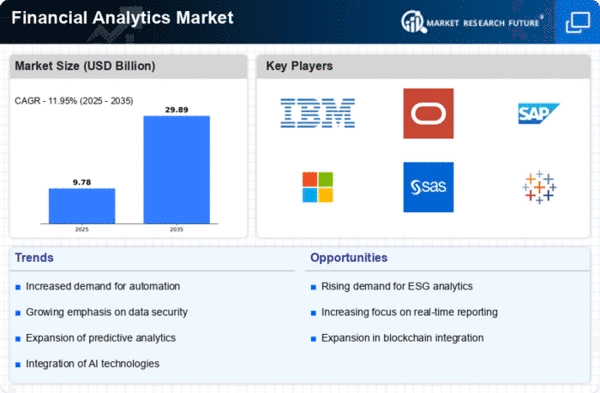
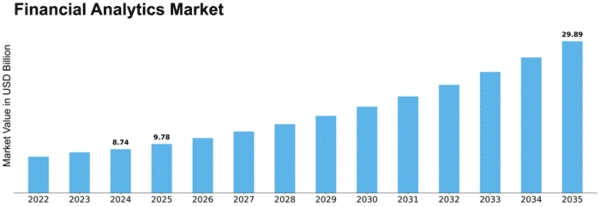
As per MRFR analysis, the Financial Analytics Market was estimated at 8.74 USD Billion in 2024. The Financial Analytics industry is projected to grow from 9.66 USD Billion in 2025 to 29.89 USD Billion by 2035, exhibiting a compound annual growth rate (CAGR) of 11.95% during the forecast period 2025 - 2035.

Key Market Trends & Highlights

The Financial Analytics Market is experiencing robust growth driven by technological advancements and evolving regulatory landscapes.

  • The integration of Artificial Intelligence is transforming financial analytics, enhancing predictive capabilities and decision-making processes. North America remains the largest market, while Asia-Pacific is emerging as the fastest-growing region, reflecting diverse economic dynamics. Risk Management continues to dominate the market, whereas Financial Reporting is witnessing the fastest growth due to increasing transparency demands. Rising demand for data-driven decision making and increased regulatory requirements are key drivers propelling the adoption of cloud-based financial solutions.

Market Size & Forecast

2024 Market Size 8.74 (USD Billion)
2035 Market Size 29.89 (USD Billion)
CAGR (2025 - 2035) 11.95%
Largest Regional Market Share in 2024 North America

Major Players

<p>IBM (US), Oracle (US), SAP (DE), Microsoft (US), SAS (US), Tableau (US), Qlik (US), TIBCO (US), MicroStrategy (US)</p>

Market Trends

The Financial Analytics Market is currently experiencing a transformative phase, driven by the increasing demand for data-driven decision-making across various sectors. Organizations are recognizing the value of financial analytics in enhancing operational efficiency, optimizing resource allocation, and improving overall financial performance. As businesses strive to remain competitive, the integration of advanced analytics tools and technologies is becoming essential. This shift is not merely a trend but a fundamental change in how financial data is utilized, leading to more informed strategic planning and risk management. Furthermore, the rise of cloud computing and artificial intelligence is reshaping the landscape, enabling real-time data processing and predictive analytics, which are crucial for timely decision-making. In addition, the Financial Analytics Market is witnessing a growing emphasis on regulatory compliance and risk assessment. Companies are increasingly investing in analytics solutions that provide insights into financial health and compliance with evolving regulations. This focus on governance and accountability is likely to drive further innovation in analytics tools, as organizations seek to mitigate risks and enhance transparency. Overall, the Financial Analytics Market appears poised for continued growth, with advancements in technology and a heightened awareness of the importance of data analytics in financial management.

Integration of Artificial Intelligence

The incorporation of artificial intelligence into financial analytics tools is becoming more prevalent. This trend enhances predictive capabilities, allowing organizations to forecast financial outcomes with greater accuracy. AI-driven analytics can identify patterns and trends that may not be immediately apparent, thus providing deeper insights into financial data.

Cloud-Based Solutions

The shift towards cloud-based financial analytics solutions is gaining momentum. These platforms offer flexibility, scalability, and cost-effectiveness, enabling businesses to access analytics tools without significant upfront investments. Cloud solutions facilitate collaboration and data sharing, which are essential for modern financial operations.

Focus on Regulatory Compliance

There is an increasing emphasis on regulatory compliance within the Financial Analytics Market. Organizations are prioritizing analytics solutions that help them navigate complex regulatory environments. This trend reflects a broader commitment to transparency and accountability in financial reporting and risk management.

Financial Analytics Market Market Drivers

Rising Demand for Data-Driven Decision Making

The Global Financial Analytics Market Industry experiences a surge in demand for data-driven decision making among organizations. Companies increasingly rely on financial analytics to derive insights from vast amounts of data, enabling them to make informed strategic decisions. This trend is particularly evident in sectors such as banking and insurance, where real-time analytics can significantly enhance operational efficiency. As organizations recognize the value of data in optimizing financial performance, the market is projected to grow from 8.74 USD Billion in 2024 to an estimated 30.3 USD Billion by 2035, reflecting a robust CAGR of 11.95% from 2025 to 2035.

Market Segment Insights

By Application: Risk Management (Largest) vs. Financial Reporting (Fastest-Growing)

<p>In the Financial Analytics Market, the application segment is significantly influenced by various types of analytics. Risk Management has emerged as the largest segment, ensuring organizations can navigate financial uncertainties effectively. Meanwhile, Financial Reporting is gaining traction rapidly, driven by the increasing need for accuracy and transparency in financial data reporting. This duality in market presence emphasizes a diverse range of applications catering to varying organizational needs, with Risk Management leading in adoption and Financial Reporting carving a niche for itself through technological advancements. The growth drivers for these segments are primarily rooted in regulatory changes, competitive pressure, and technological innovations. Organizations are increasingly investing in risk management tools to mitigate potential losses and ensure compliance with ever-evolving regulatory standards. Financial Reporting, characterized by its fast-paced growth, benefits from advancements in cloud technology and BI tools that facilitate timely and accurate reporting. As businesses adapt to both the challenges of risk and the demands of transparent reporting, these applications are vital to maintaining financial health and strategic alignment.</p>

<p>Risk Management (Dominant) vs. Budgeting and Forecasting (Emerging)</p>

<p>Risk Management stands as the dominant force in the Financial Analytics Market due to its critical role in safeguarding businesses against financial uncertainties. This segment encompasses a range of strategies and tools aimed at identifying, assessing, and mitigating risks effectively. Organizations prioritize risk management solutions to enhance decision-making processes and drive sustainable growth. On the other hand, Budgeting and Forecasting is an emerging segment that is gaining momentum as businesses seek to optimize their financial planning processes. Through predictive analytics and real-time data integration, organizations can create more accurate budgets and forecasts, allowing for better resource allocation and strategic direction. As these two segments evolve, the focus will increasingly be on integrating risk management frameworks within the budgeting processes to foster a more resilient financial environment.</p>

By Deployment Type: Cloud-Based (Largest) vs. On-Premises (Fastest-Growing)

<p>In the Financial Analytics Market, the deployment types are classified into on-premises, cloud-based, and hybrid models. Currently, the cloud-based segment holds the largest share, driven by the increasing preference for scalable and accessible solutions. Organizations are increasingly adopting cloud-based analytics due to their flexibility and ease of integration with existing systems. On-premises solutions, while still significant, are seeing a declining market share as companies shift towards more agile deployment methods. Growth trends within this segment show that hybrid models are becoming increasingly popular, combining the benefits of both on-premises and cloud solutions. Factors such as data security, compliance requirements, and the need for real-time analytics are propelling the growth of these hybrid solutions. Moreover, businesses are recognizing the advantages of cloud technology to enhance their operational efficiency and support remote work environments, contributing to the accelerated adoption of cloud-based analytics.</p>

<p>Cloud-Based (Dominant) vs. Hybrid (Emerging)</p>

<p>Cloud-based deployment solutions have established themselves as the dominant choice within the Financial Analytics Market, offering superior scalability, collaborative capabilities, and reduced upfront costs. These solutions enable organizations to harness real-time data analytics with ease, empowering finance professionals to make informed decisions rapidly. Conversely, the hybrid deployment model is emerging as a viable alternative, catering to organizations seeking a balanced approach. This model allows companies to maintain sensitive data on-premises while leveraging the cloud for enhanced analytics capabilities. Businesses are increasingly drawn to hybrid solutions due to their adaptability, allowing for tailored configurations that address specific regulatory and compliance needs. As such, the hybrid approach is gaining traction as organizations seek to blend the benefits of both deployment types.</p>

By End User: Banking (Largest) vs. Insurance (Fastest-Growing)

<p>The Financial Analytics Market is primarily driven by significant demand across various end-user segments. Banking holds the largest share, reflecting its central role in financial transactions and management. Insurance follows closely, leveraging advancements in data analytics to enhance risk assessment and customer service. Investment firms and corporate finance also contribute to the market, albeit at a smaller scale. Their focus on leveraging analytics for decision-making and performance tracking is becoming increasingly essential.</p>

<p>Banking (Dominant) vs. Insurance (Emerging)</p>

<p>Banking is a dominant player in the Financial Analytics Market due to its extensive need for risk management, regulatory compliance, and customer analytics. Banks utilize financial analytics to optimize operations, enhance customer relationships, and manage risks effectively. On the other hand, the insurance sector is emerging rapidly as a crucial player, driven by technological advancements in big data and predictive analytics. Insurers are adopting these tools to refine underwriting processes, improve claim management, and personalize services. This growing reliance on analytics positions insurance as a key player in the evolving financial landscape, thus enhancing its growth prospects.</p>

By Component: Software (Largest) vs. Services (Fastest-Growing)

<p>In the Financial Analytics Market, the component segment reveals a diverse distribution among its primary values: Software, Services, and Consulting. Software holds the largest market share, being the backbone of financial analytics solutions, providing functionalities that drive critical business insights. In contrast, Services, while possessing a smaller overall share, are rapidly gaining traction as organizations prioritize specialized support to enhance their software usage and training, leading this space in growth.</p>

<p>Software: Dominant vs. Services: Emerging</p>

<p>Software is the dominant component in the Financial Analytics Market, characterized by its comprehensive ability to analyze vast amounts of financial data, generate reports, and deliver predictive analytics. It enables organizations to make informed decisions, contributing to strategic financial management. On the other hand, Services represent an emerging segment fueled by the increasing demand for expert guidance, implementation support, and customized solutions. As businesses seek to transition from traditional to advanced analytics frameworks, the services aspect is evolving rapidly, providing essential support to harness the full potential of financial analytics software.</p>

By Analytics Type: Descriptive Analytics (Largest) vs. Predictive Analytics (Fastest-Growing)

<p>In the Financial Analytics Market, Descriptive Analytics holds the largest share, providing insights through historical data analysis and reporting. This segment serves as the backbone of financial decision-making, offering clarity and context to past performance, while predictive analytics is recognized as the fastest-growing component. It leverages statistical algorithms and machine learning techniques to forecast future trends, thus gaining traction among businesses striving for proactive decision-making.</p>

<p>Descriptive Analytics (Dominant) vs. Predictive Analytics (Emerging)</p>

<p>Descriptive Analytics has established itself as the dominant segment in financial analytics by enabling organizations to comprehend their past financial performance comprehensively. It integrates data visualization, reporting tools, and performance management to enhance understanding. On the other hand, Predictive Analytics is rapidly emerging, focused on forecasting outcomes based on data patterns. It enables companies to anticipate market changes and consumer behavior, facilitating more informed decisions. This segment is particularly appealing as organizations seek to utilize advanced analytical techniques to maintain a competitive edge.</p>

Get more detailed insights about Financial Analytics Market Research Report—Forecast till 2035

Regional Insights

North America : Market Leader in Financial Analytics

North America continues to lead the Financial Analytics Market, holding a significant share of 4.5 billion in 2024. The region's growth is driven by increasing demand for data-driven decision-making, regulatory compliance, and advanced analytics solutions. The presence of major tech companies and a robust financial sector further catalyze market expansion, supported by favorable government policies promoting innovation and technology adoption. The United States stands out as the primary market, with key players like IBM, Oracle, and Microsoft leading the charge. The competitive landscape is characterized by continuous innovation and strategic partnerships among these firms. As organizations increasingly prioritize financial analytics for operational efficiency, North America is poised to maintain its dominance in the coming years.

Europe : Emerging Financial Analytics Hub

Europe's Financial Analytics Market is projected to grow significantly, with a market size of 2.5 billion in 2024. The region benefits from stringent regulatory frameworks that encourage transparency and accountability in financial reporting. Additionally, the increasing adoption of cloud-based solutions and AI technologies is driving demand for advanced analytics tools, making Europe a key player in the global market. Leading countries such as Germany, the UK, and France are at the forefront of this growth, with major companies like SAP and Tableau establishing a strong presence. The competitive landscape is marked by a mix of established firms and innovative startups, all vying for market share. As European businesses continue to invest in financial analytics, the region is set to become a pivotal player in the global landscape.

Asia-Pacific : Rapidly Growing Analytics Market

The Asia-Pacific region is experiencing rapid growth in the Financial Analytics Market, with a market size of 1.8 billion in 2024. This growth is fueled by increasing digital transformation initiatives, a burgeoning middle class, and rising investments in technology. Governments in the region are also promoting data analytics as a means to enhance economic performance and competitiveness, creating a favorable environment for market expansion. Countries like China, India, and Japan are leading the charge, with a mix of local and international players competing for market share. Companies such as SAS and Qlik are making significant inroads, leveraging innovative solutions tailored to regional needs. As the demand for financial analytics continues to rise, Asia-Pacific is poised to become a major player in the global market.

Middle East and Africa : Emerging Analytics Frontier

The Middle East and Africa (MEA) region is gradually emerging in the Financial Analytics Market, with a market size of 0.94 billion in 2024. The growth is driven by increasing investments in technology and a shift towards data-driven decision-making among businesses. Governments are also recognizing the importance of financial analytics in enhancing economic stability and transparency, leading to supportive regulatory frameworks. Countries like South Africa and the UAE are at the forefront of this growth, with a mix of local and international firms entering the market. The competitive landscape is evolving, with companies seeking to provide tailored solutions that meet regional demands. As the MEA region continues to develop its analytics capabilities, it holds significant potential for future growth.

Key Players and Competitive Insights

The Financial Analytics Market is currently characterized by a dynamic competitive landscape, driven by the increasing demand for data-driven decision-making and the integration of advanced technologies. Key players such as IBM (US), Oracle (US), and SAP (DE) are at the forefront, each adopting distinct strategies to enhance their market positioning. IBM (US) emphasizes innovation through its AI-driven analytics solutions, while Oracle (US) focuses on expanding its cloud-based offerings to cater to a broader clientele. SAP (DE) is leveraging its strong enterprise resource planning (ERP) capabilities to integrate financial analytics seamlessly into business processes, thereby enhancing operational efficiency. Collectively, these strategies contribute to a competitive environment that is increasingly focused on technological advancement and customer-centric solutions.

In terms of business tactics, companies are increasingly localizing their operations and optimizing supply chains to respond swiftly to market demands. The Financial Analytics Market appears moderately fragmented, with a mix of established players and emerging startups. The collective influence of these key players shapes the market structure, as they engage in strategic partnerships and collaborations to enhance their service offerings and expand their geographical reach.

In November 2025, IBM (US) announced a strategic partnership with a leading fintech firm to develop integrated financial analytics solutions aimed at small and medium-sized enterprises (SMEs). This collaboration is significant as it not only broadens IBM's market reach but also addresses the growing need for accessible financial analytics tools among SMEs, which have historically been underserved in this domain. The partnership is likely to enhance IBM's competitive edge by providing tailored solutions that meet the specific needs of this segment.

In October 2025, Oracle (US) launched a new suite of financial analytics tools designed to enhance real-time data processing capabilities. This move is particularly noteworthy as it aligns with the increasing demand for instantaneous insights in financial decision-making. By focusing on real-time analytics, Oracle positions itself as a leader in providing timely and actionable financial data, which is crucial for businesses navigating a rapidly changing economic landscape.

In September 2025, SAP (DE) unveiled an innovative financial analytics platform that integrates machine learning algorithms to predict financial trends. This development is indicative of SAP's commitment to leveraging cutting-edge technology to enhance its analytics capabilities. By incorporating predictive analytics, SAP not only improves its service offerings but also empowers clients to make proactive financial decisions, thereby solidifying its position in the market.

As of December 2025, the Financial Analytics Market is witnessing trends such as digitalization, sustainability, and the integration of AI technologies. Strategic alliances among key players are shaping the competitive landscape, fostering innovation and collaboration. The shift from price-based competition to a focus on technological differentiation and supply chain reliability is evident. Moving forward, companies that prioritize innovation and adaptability are likely to thrive, as the market continues to evolve in response to emerging trends and customer expectations.

Key Companies in the Financial Analytics Market include

Industry Developments

In June 2023, a business intelligence software firm MICROSTRATEGY INCORPORATED seems to have entered into an amended agreement with the multinational sophisticate Microsoft Corporation. The agreement will include MicroStrategy's cutting-edge analytics solutions together with Microsoft's Azure Open AI Service to allow businesses to make the most of their data.

In May 2023, business intelligence software firm QlikTech International AB completed a majority stake acquisition in data integration and management software developer Talend Inc. This purchase is projected to enhance the competencies of QlikTech International AB in such different areas as data quality, data transformation, application connectivity and API services.

In February 2023, Alteryx introduced management and self-service options for analytics cloud platforms and Enterprise customers, which should allow its clients to make business decisions faster. The upgraded platform improves the user experience by providing a new user interface style while maintaining acceptable standards in data management.

In November 2022, IBM Corporation, a firm involved with computers, technology and IT consulting with all its resources, opened the latest software to help enterprises quench their thirst for skimming enterprises' data and data analytics and make decisions faster than before.

In October 2022, Oracle, a company dealing with cloud applications and platform services, provided further innovations through several remuneration instruments with the aim of assisting customers in not just improving their skills but also incorporating new ideas into their businesses. The clients of Oracle are now able to use the already prepared packages of 2000 reports, dashboards, and metrics.

In September 2022, a multinational corporation, S&P, announced a cooperative deal with Novata Inc., a private companies’ ESG-based databases provider. As a result, it is possible to link Novata’s platform with S&P Global market intelligence customers’ databases. It will, in turn, enable making data-based decisions regarding the influence financial outcomes of ESG concepts.


Future Outlook

Financial Analytics Market Future Outlook

<p>The Financial Analytics Market is projected to grow at 11.95% CAGR from 2024 to 2035, driven by advancements in AI, big data analytics, and regulatory compliance demands.</p>

New opportunities lie in:

  • <p>Integration of AI-driven predictive analytics tools for enhanced decision-making.</p>
  • <p>Development of cloud-based financial analytics platforms for scalability.</p>
  • <p>Expansion into emerging markets with tailored financial solutions.</p>

<p>By 2035, the Financial Analytics Market is expected to be robust, driven by innovation and strategic expansion.</p>

Market Segmentation

Financial Analytics Market End User Outlook

  • Banking
  • Insurance
  • Investment Firms
  • Corporate Finance

Financial Analytics Market Component Outlook

  • Software
  • Services
  • Consulting

Financial Analytics Market Application Outlook

  • Risk Management
  • Financial Reporting
  • Budgeting and Forecasting
  • Performance Management
  • Regulatory Compliance

Financial Analytics Market Analytics Type Outlook

  • Descriptive Analytics
  • Predictive Analytics
  • Prescriptive Analytics
  • Diagnostic Analytics

Financial Analytics Market Deployment Type Outlook

  • On-Premises
  • Cloud-Based
  • Hybrid

Report Scope

MARKET SIZE 2024 8.74(USD Billion)
MARKET SIZE 2025 9.66(USD Billion)
MARKET SIZE 2035 29.89(USD Billion)
COMPOUND ANNUAL GROWTH RATE (CAGR) 11.95% (2024 - 2035)
REPORT COVERAGE Revenue Forecast, Competitive Landscape, Growth Factors, and Trends
BASE YEAR 2024
Market Forecast Period 2025 - 2035
Historical Data 2019 - 2024
Market Forecast Units USD Billion
Key Companies Profiled IBM (US), Oracle (US), SAP (DE), Microsoft (US), SAS (US), Tableau (US), Qlik (US), TIBCO (US), MicroStrategy (US)
Segments Covered Application, Deployment Type, End User, Component, Analytics Type
Key Market Opportunities Integration of artificial intelligence and machine learning in Financial Analytics Market enhances predictive capabilities and decision-making.
Key Market Dynamics Rising demand for advanced analytics tools drives competition and innovation in the Financial Analytics Market.
Countries Covered North America, Europe, APAC, South America, MEA

FAQs

What will be the market value of Financial Analytics Market in 2030?

Financial Analytics Market profit is expected to generate 17.64 billion by the end of the year 2030.

What impact can the CAGR of the market have on the Financial Analytics Market revenue growth?

A 11.40% CAGR level is estimated to enhance the market in the future.

Who are the key market leaders in the financial analytics market?

Zoho Corporation (India), IBM Corporation (US), Oracle Corporation (US), TIBCO Software Inc. (US), Google (US), are the key market leaders.

Which region is expected to prosper the market of global financial analytics?

North America will be prospering the market of global financial analytics.

Which regions are grossing more market valuation as per the study?

North America, Europe, Asia-Pacific, and the rest of the world are the regions grossing the most as per the study.

How is data analytics used in finance?

Financial Analytics Market the businesses, projects, budgets, and other finance-related entities of an enterprise are evaluated to determine the performance and suitability.

What are the Factors Driving the Market Growth of Financial Analytics?

The increase in the adoption of computing devices everywhere, the increase in advanced security capabilities and the proliferation of new analytics tools are providing new opportunities for market players which, in turn, are driving the growth of the financial analytics market.

How can the global financial analytics market expect steady growth in the future?

Advancements in business intelligence (BI) and business analytics tools can assist the market with steady growth in the future.

What are the significant factors influencing the market to grow for the future?

The growing need for data-driven financial decisions among end users is a significant factor persuading the market to grow.

  1. SECTION I: EXECUTIVE SUMMARY AND KEY HIGHLIGHTS |
    1. EXECUTIVE SUMMARY 2
  2. SECTION II: SCOPING, METHODOLOGY AND MARKET STRUCTURE |
    1. MARKET INTRODUCTION |
    2. RESEARCH METHODOLOGY 3
  3. SECTION III: QUALITATIVE ANALYSIS |
    1. MARKET DYNAMICS |
    2. MARKET FACTOR ANALYSIS 4
  4. SECTION IV: QUANTITATIVE ANALYSIS |
    1. BFSI, BY Application (USD Billion) |
    2. BFSI, BY Deployment Type (USD Billion) |
    3. BFSI, BY End User (USD Billion) |
    4. BFSI, BY Component (USD Billion) |
    5. BFSI, BY Analytics Type (USD Billion) |
    6. BFSI, BY Region (USD Billion) 5
  5. SECTION V: COMPETITIVE ANALYSIS |
    1. Competitive Landscape |
    2. Company Profiles |
    3. Appendix

Financial Analytics Market Segmentation

Market Segmentation Overview

  • Detailed segmentation data will be available in the full report
  • Comprehensive analysis by multiple parameters
  • Regional and country-level breakdowns
  • Market size forecasts by segment
Infographic

Free Sample Request

Kindly complete the form below to receive a free sample of this Report

Get Free Sample

Customer Strories

Compare Licence

×
Features License Type
Single User Multiuser License Enterprise User
Price $4,950 $5,950 $7,250
Maximum User Access Limit 1 User Upto 10 Users Unrestricted Access Throughout the Organization
Free Customization
Direct Access to Analyst
Deliverable Format
Platform Access
Discount on Next Purchase 10% 15% 15%
Printable Versions