
Request Free Sample ×

Kindly complete the form below to receive a free sample of this Report

* Please use a valid business email

Leading companies partner with us for data-driven Insights

clients tt-cursor
Hero Background
English
Chinese
French
Japanese
Korean
German
Spanish

Feed Flavors Sweeteners Market Analysis

ID: MRFR/Agri/3959-HCR
90 Pages
Snehal Singh
Last Updated: April 06, 2026

Feed Flavors and Sweeteners Market Size, Share, Industry Trend & Analysis Research Report Information By Source (Natural and Synthetic), By Form (Dry and Liquid), By Livestock (Ruminants, Swine, Pets, and Others), And By Region (North America, Europe, Asia-Pacific, And Rest Of The World) – Forecast Till 2035

Share:
Download PDF ×

We do not share your information with anyone. However, we may send you emails based on your report interest from time to time. You may contact us at any time to opt-out.

Feed Flavors Sweeteners Market Infographic
Purchase Options

Market Analysis

In-depth Analysis of Feed Flavors Sweeteners Market Industry Landscape

One of the main drivers behind this trend is increasing awareness by breeders on enhancing taste appeal characteristics such as flavoring and sweetening agents used in formulating animal feeds. As buyers focus more on quality aspects like flavor, milk fat content etc., farmers want them to find their produce tasteful hence adding flavors or inclusion of sugar based substances into feeds are perceived as important techniques to improve acceptability. This increasing desire for better feeds quality forms part of the growth engine for Feed Flavors and Sweeteners market.

Also, another major driver is the growing world population resulting in increased demand for animal-based inputs. Population explosion means more persons must depend on livestock sector for their sustenance. Feed flavors and sweeteners have a very crucial role in ensuring animals receive balanced feeds that are also nutritious, thereby enhancing general health and productivity. This growing demand from the livestock sector has led to an overall increase in the market.

Additionally, as consumers increasingly prefer foods produced naturally and organically, the feed industry is shifting towards these types of products. Livestock farmers are influenced by this consumer preference when choosing feed ingredients. Consequently, natural feed flavors and sweeteners have seen considerable growth impacting the entire market size. To keep up with this trend however, manufactures are offering various natural and organic feed additives which can be desirable by both farmers as well as consumers changing taste patterns.

The feed flavors and sweeteners market size hit USD 2 Billion in 2022. The sector is projected to expand through injecting an increase from USD 2.08 Billion in 2023 to about USD 2.87 Billion by 2032. This represents a compound annual growth rate (CAGR) of 4.1% between the forecasted years of 2023 – 2032. Key factors that have steered this growth include, increasing demand for premium animal products, animal welfare and nutrition focus, the flourishing aquaculture and poultry industries, need for customized feed formulations as well as growing preference for natural and clean-label feed additives. These aspects work together to raise the overall market share of feed flavors and sweeteners.


Author
Author Profile
Snehal Singh
Manager - Research

High acumen in analyzing complex macro & micro markets with more than 6 years of work experience in the field of market research. By implementing her analytical skills in forecasting and estimation into market research reports, she has expertise in Packaging, Construction, and Equipment domains. She handles a team size of 20-25 resources and ensures smooth running of the projects, associated marketing activities, and client servicing.

Leave a Comment

FAQs

What is the current valuation of the Feed Flavors and Sweeteners Market?

<p>The Feed Flavors and Sweeteners Market was valued at 2.16 USD Billion in 2024.</p>

What is the projected market size for the Feed Flavors and Sweeteners Market by 2035?

<p>The market is projected to reach 3.181 USD Billion by 2035.</p>

What is the expected CAGR for the Feed Flavors and Sweeteners Market during the forecast period?

<p>The expected CAGR for the market from 2025 to 2035 is 3.58%.</p>

Which companies are considered key players in the Feed Flavors and Sweeteners Market?

<p>Key players include Cargill, Archer Daniels Midland, BASF, DuPont, Kerry Group, Givaudan, Symrise, Tate & Lyle, and Sensient Technologies.</p>

How did the market segments perform in terms of source in 2024?

<p>In 2024, the natural segment was valued at 1.08 USD Billion, while the synthetic segment reached 1.08 USD Billion.</p>

What are the projected values for the liquid and dry forms of feed flavors and sweeteners by 2035?

<p>By 2035, the liquid form is expected to be valued at 1.63 USD Billion, while the dry form is projected to reach 1.54 USD Billion.</p>

What is the market valuation for ruminants in the Feed Flavors and Sweeteners Market?

In 2024, the ruminants segment was valued at 0.864 USD Billion.

How do the valuations for swine and pets compare in the market?

Both the swine and pets segments were valued at 0.432 USD Billion in 2024.

What is the expected growth trend for the 'Others' livestock segment by 2035?

The 'Others' livestock segment is projected to grow to 0.62 USD Billion by 2035.

What factors might influence the growth of the Feed Flavors and Sweeteners Market in the coming years?

Factors such as increasing demand for natural ingredients and advancements in flavor technology may influence market growth.

Market Summary

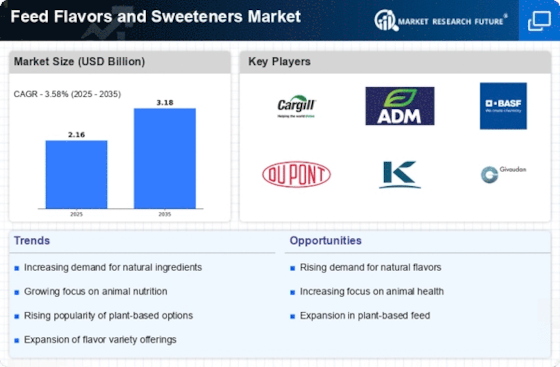
As per Market Research Future analysis, the Feed Flavors and Sweeteners Market was estimated at 2.16 USD Billion in 2024. The Feed Flavors and Sweeteners industry is projected to grow from 2.237 USD Billion in 2025 to 3.181 USD Billion by 2035, exhibiting a compound annual growth rate (CAGR) of 3.58% during the forecast period 2025 - 2035

Key Market Trends & Highlights

The Feed Flavors and Sweeteners Market is experiencing a notable shift towards natural ingredients and technological advancements.

  • The North American market remains the largest, driven by a strong demand for palatability enhancers.
  • Asia-Pacific is emerging as the fastest-growing region, reflecting a rising interest in sustainable practices.
  • Natural flavors dominate the market, while synthetic flavors are witnessing rapid growth due to innovation.
  • Key drivers include the expansion of livestock production and a growing awareness of animal welfare, influencing market dynamics.

Market Size & Forecast

2024 Market Size 2.16 (USD Billion)
2035 Market Size 3.181 (USD Billion)
CAGR (2025 - 2035) 3.58%
Largest Regional Market Share in 2024 North America

Major Players

Cargill (US), Archer Daniels Midland (US), BASF (DE), DuPont (US), Kerry Group (IE), Givaudan (CH), Symrise (DE), Tate & Lyle (GB), Sensient Technologies (US)

Market Trends

The Feed Flavors and Sweeteners Market is currently experiencing a dynamic evolution, driven by the increasing demand for enhanced palatability in animal feed. This market appears to be influenced by a growing awareness of the importance of nutrition in livestock production, as well as the rising need for sustainable and efficient feeding practices. Manufacturers are focusing on developing innovative flavoring agents and sweeteners that not only improve feed acceptance but also contribute to overall animal health and performance. As a result, the market landscape is becoming increasingly competitive, with various players striving to differentiate their offerings through unique formulations and natural ingredients. Moreover, the Feed Flavors and Sweeteners Market seems to be witnessing a shift towards natural and organic products, reflecting broader consumer trends in food and beverage sectors. This inclination towards clean label products may indicate a potential for growth in the segment of feed additives that are derived from natural sources. Additionally, regulatory frameworks are evolving, which could impact the types of ingredients used in feed formulations. Overall, the market is poised for continued growth, with opportunities emerging from both innovation and changing consumer preferences.

Shift Towards Natural Ingredients

There is a noticeable trend in the Feed Flavors and Sweeteners Market towards the use of natural ingredients. This shift is likely driven by consumer demand for cleaner labels and healthier options for livestock. Manufacturers are increasingly exploring plant-based and organic flavoring agents, which may enhance the appeal of animal feed while aligning with sustainability goals.

Technological Advancements in Flavoring

Technological innovations are playing a crucial role in the development of new flavoring solutions within the Feed Flavors and Sweeteners Market. Enhanced extraction methods and flavor encapsulation techniques are emerging, potentially allowing for more effective delivery of flavors and sweeteners. This could lead to improved feed efficiency and better animal performance.

Focus on Animal Health and Performance

The emphasis on animal health and performance is becoming more pronounced in the Feed Flavors and Sweeteners Market. Stakeholders are increasingly recognizing the link between palatability and overall animal well-being. This trend may drive the development of flavoring solutions that not only enhance taste but also support digestive health and nutrient absorption.

Feed Flavors Sweeteners Market Market Drivers

Expansion of Livestock Production

The Feed Flavors and Sweeteners Market is significantly influenced by the expansion of livestock production across various regions. As the global population continues to grow, the demand for meat, dairy, and other animal products is expected to rise correspondingly. This surge in livestock production necessitates the use of high-quality feed that is both nutritious and appealing to animals. Consequently, the incorporation of flavors and sweeteners becomes increasingly important to ensure optimal feed consumption. Market analyses suggest that the livestock sector is projected to grow at a rate of 4% annually, further driving the need for innovative feed solutions. This expansion presents opportunities for flavor and sweetener manufacturers to develop tailored products that meet the specific needs of different animal species, thereby enhancing their market presence.

Growing Awareness of Animal Welfare

The Feed Flavors and Sweeteners Market is increasingly influenced by the growing awareness of animal welfare among consumers and producers alike. As public concern for the ethical treatment of animals rises, there is a corresponding demand for feed products that promote animal well-being. Flavors and sweeteners play a vital role in ensuring that animals receive adequate nutrition, which is essential for their health and productivity. This awareness has led to a shift in purchasing decisions, with consumers favoring products that are perceived as beneficial for animal welfare. Consequently, manufacturers are focusing on developing feed solutions that not only enhance palatability but also contribute to the overall health of livestock. This trend is likely to drive innovation and growth within the Feed Flavors and Sweeteners Market.

Rising Demand for Palatability Enhancers

The Feed Flavors and Sweeteners Market experiences a notable increase in demand for palatability enhancers, driven by the need to improve feed intake among livestock. As animal nutritionists emphasize the importance of feed acceptance, the incorporation of flavors and sweeteners becomes essential. Reports indicate that the market for feed flavors is projected to grow at a compound annual growth rate of approximately 5.5% over the next few years. This growth is attributed to the rising awareness of the benefits of enhanced feed palatability, which can lead to improved animal performance and overall health. Consequently, manufacturers are investing in research and development to create innovative flavoring solutions that cater to diverse animal species, thereby expanding their market reach.

Increasing Focus on Sustainable Practices

Sustainability has emerged as a pivotal driver in the Feed Flavors and Sweeteners Market, as stakeholders seek to minimize environmental impact. The demand for sustainable feed ingredients is on the rise, with consumers increasingly favoring products that align with eco-friendly practices. This trend is reflected in the growing preference for natural flavors and sweeteners derived from renewable sources. Furthermore, regulatory bodies are implementing stricter guidelines regarding the use of synthetic additives, prompting manufacturers to adapt their formulations. The market is witnessing a shift towards organic and non-GMO ingredients, which not only cater to consumer preferences but also enhance the overall sustainability of animal farming operations. As a result, companies that prioritize sustainable practices are likely to gain a competitive edge in the Feed Flavors and Sweeteners Market.

Technological Innovations in Flavor Development

Technological advancements play a crucial role in shaping the Feed Flavors and Sweeteners Market. Innovations in flavor development techniques enable manufacturers to create more effective and appealing flavor profiles that cater to the diverse preferences of livestock. The use of encapsulation technology, for instance, allows for the controlled release of flavors, enhancing their effectiveness and longevity in feed formulations. Additionally, advancements in sensory analysis techniques provide valuable insights into animal preferences, guiding the development of flavors that maximize feed intake. As a result, companies that leverage these technological innovations are likely to enhance their product offerings and improve their competitive positioning in the market. The ongoing research in flavor technology suggests a promising future for the Feed Flavors and Sweeteners Market.

Market Segment Insights

By Source: Natural (Largest) vs. Synthetic (Fastest-Growing)

In the Feed Flavors and Sweeteners Market, the natural source segment holds the largest market share, preferred for its clean label appeal and health benefits. This segment’s prevalence is driven by increasing consumer demand for organic and natural products, aligning with broader trends towards cleaner and more sustainable food sources. The synthetic segment, though smaller, demonstrates rapid growth due to its cost-effectiveness and ability to deliver consistent flavor profiles, appealing to manufacturers seeking to optimize production costs while maintaining product quality.

Source: Natural (Dominant) vs. Synthetic (Emerging)

The natural source segment is characterized by its emphasis on minimally processed ingredients, attracting health-conscious consumers and brands prioritizing sustainability. Products derived from natural sources often emphasize transparency and purity, securing their position as the dominant choice in the feed flavors and sweeteners market. On the other hand, the synthetic segment is emerging strongly, rapidly evolving with advancements in food technology that improve the quality and safety of synthetic flavors. With its ability to provide a consistent product at lower costs, the synthetic segment is expected to grow significantly, capturing market interest and shifting trends in flavoring options.

By Form: Dry (Largest) vs. Liquid (Fastest-Growing)

In the Feed Flavors and Sweeteners Market, the dry segment holds the largest share, demonstrating a strong preference among manufacturers due to its stability, ease of storage, and prolonged shelf life. Dry flavors and sweeteners are widely adopted in feed formulations, providing a consistent sensory profile that aids in palatability and acceptability. Conversely, the liquid segment, while smaller in market share, is rapidly gaining traction as feed producers increasingly seek to enhance flavor distribution and mixability in animal feed formulations.

Form: Dry (Dominant) vs. Liquid (Emerging)

The dry form of feed flavors and sweeteners is characterized by its ability to be easily integrated into various feed types, offering excellent compatibility and ensuring uniform flavor distribution. This segment appeals primarily due to cost-effectiveness and ease of handling, making it a staple in the industry. On the other hand, the liquid form is becoming an emerging player, driven by innovations in formulation that allow for superior mixing capabilities and quicker assimilation in animal diets. Liquid sweeteners and flavors are particularly favored in specialty feeds where enhanced nutrient absorption is required, marking a significant shift in preference as manufacturers adapt to changing animal husbandry practices.

By Livestock: Ruminants (Largest) vs. Swine (Fastest-Growing)

The Livestock segment in the Feed Flavors and Sweeteners Market is notably dominated by Ruminants, capturing the largest share in terms of market presence. This segment benefits from a robust demand for feed that enhances taste and palatability, leading to better feed intake and improved overall livestock health. In contrast, the Swine segment has emerged as a key player with the fastest growth rate, driven by increasing meat consumption and a rising focus on optimizing feed efficiency.

Ruminants (Dominant) vs. Swine (Emerging)

The Ruminants segment represents the dominant force within the Livestock category, as cattle and sheep benefit from tailored feed flavors that encourage consumption and promote healthy growth. This segment is characterized by established feeding practices and a strong emphasis on nutritional performance. Conversely, the Swine segment is rapidly emerging due to the increasing global demand for pork products and advancements in swine nutrition. The shift towards using feed flavors and sweeteners is helping swine producers enhance feed efficiency and improve the quality of pork, positioning it as a dynamic segment in the market.

Get more detailed insights about Feed Flavors and Sweeteners Market Research Report - Global Forecast till 2035

Regional Insights

By region, the study provides market insights into North America, Europe, Asia-Pacific, and the Rest of the World. The North American feed flavors and sweeteners market accounted for USD 0.92 billion in 2022 and will likely exhibit a significant CAGR growth in the study period. Consumers in the region are becoming more conscious of the nutritional content and taste of animal-derived products, leading to a heightened interest in enhancing animal feed palatability with flavors and sweeteners. As a result, feed manufacturers are adopting these additives to improve feed intake and overall animal performance, meeting consumer preferences for superior-quality animal products.

Further, the major countries studied in the market report are The US, German, Canada, the UK, Italy, Spain, France, Japan, China, Australia, South Korea, India, and Brazil.

Figure 2: Feed Flavors And Sweeteners Market Share By Region 2022 (USD Billion)

Europe feed flavors and sweeteners market accounts for the second-largest market share. The European Union has stringent guidelines on using additives in animal feed, fostering the demand for natural and safe feed flavors and sweeteners. Feed manufacturers in Europe are increasingly focusing on eco-friendly and sustainable solutions to align with consumer demands for transparency and ethical production practices. As a result, the adoption of natural feed flavors and sweeteners sourced from plant extracts, essential oils, and other renewable materials is rising.

Further, the German feed flavors and sweeteners market held the largest market share, and the UK feed flavors and sweeteners market was the fastest-growing market in the European region.

The Asia-Pacific Feed Flavors and Sweeteners Market is expected to grow at the fastest CAGR from 2023 to 2032. As the demand for animal-derived products, especially meat and dairy, surges with the regional population growth and rising disposable income, feed manufacturers seek effective ways to optimize animal nutrition and performance. Feed flavors and sweeteners are vital in promoting livestock feed intake, digestibility, and nutrient utilization, supporting healthy growth and productivity. Additionally, the increasing adoption of advanced animal husbandries practices, such as precision nutrition and targeted feeding, necessitates using flavors and sweeteners to formulate customized and palatable diets.

Moreover, China’s feed flavors and sweeteners market held the largest market share, and the Indian feed flavors and sweeteners market was the fastest-growing market in the Asia-Pacific region.

Key Players and Competitive Insights

Leading market players are actively investing in R&D to broaden their product portfolios and meet the evolving demands of the animal nutrition sector. These investments in the feed flavors and sweeteners industry aim to develop innovative and customized flavors and sweeteners that cater to different animal species and production systems, addressing specific taste preferences and nutritional needs. Key market developments include new product launches introducing novel flavor blends and sweetener formulations to enhance feed palatability and encourage higher feed intake.Mergers and acquisitions are prevalent in the feed flavors and sweeteners industry as major players seek to enhance their market share and strengthen their position. These strategic moves facilitate access to new technologies, market insights, and expertise, accelerating product development and expanding market presence. In recent years, the feed flavors and sweeteners industry has offered some of the most significant advantages that address specific nutritional requirements and improve animal health and performance.Major players in the feed flavors and sweeteners market, including Solvay (Belgium), Grupo Ferrer Internacional S.A. (Spain), Pancosma (Switzerland), Nutriad (Belgium), FeedStimulants (Netherlands), Alltech (US), DuPont (US), BIOMIN Holding (Austria), Prinova Group LLC (US), Norel (Spain), are actively investing in research & development operations to bring cutting-edge solutions to the market.FeedStimulants is a leading company specializing in developing and manufacturing feed additives that enhance animal nutrition and performance. The company's core focus is providing innovative feed stimulants, including flavors and sweeteners, to improve feed palatability and encourage higher feed intake in various animal species. FeedStimulants offers a wide range of feed flavors and sweeteners tailored to the specific needs of different livestock and poultry industries. Their products are designed to enhance the taste and aroma of animal feed, promoting consistent feed consumption and optimal nutrient utilization.In 2018, FeedStimulants introduced an advanced line of liquid feed flavors that garnered significant attention in the animal nutrition sector. This innovative range of flavors is formulated using natural extracts and plant-based ingredients, aligning with the increasing demand for clean labels and natural feed additives.Solvay is a chemical company headquartered in Brussels, Belgium. With a rich history dating back to 1863, the company has grown into a leading player in various sectors, including chemicals, advanced materials, and specialty chemicals. Solvay operates through multiple business segments, which include Advanced Formulations, Advanced Materials, Performance Chemicals, and Corporate and Business Services. The company serves diverse industries such as automotive, aerospace, agriculture, consumer goods, and healthcare. Solvay offers various products and solutions, including specialty chemicals, high-performance polymers, advanced materials, and formulations for various industrial, consumer, and healthcare applications.

Key Companies in the Feed Flavors Sweeteners Market include

Industry Developments

June 2021: Phytobiotics formed its firm, Phytobiotics Iberica, with headquarters in Malaga, to service the rapidly developing market for premixed animal feed and plant production requirements in Spain and Portugal.

May 2021: Phytobiotics launched Miracol, an animal feed flavoring solution that addresses issues with animal feed consumption.

March 2018: Nutriad has announced opening a new palatability facility in China. This new manufacturing operation would produce feed flavors and sweeteners.

Future Outlook

Feed Flavors Sweeteners Market Future Outlook

The Feed Flavors and Sweeteners Market is projected to grow at a 3.58% CAGR from 2025 to 2035, driven by increasing demand for palatability and nutritional enhancement in animal feed.

New opportunities lie in:

  • Development of customized flavor profiles for specific livestock species.
  • Expansion into emerging markets with tailored sweetener solutions.
  • Integration of natural and organic flavoring agents to meet consumer preferences.

By 2035, the market is expected to achieve robust growth, reflecting evolving consumer demands and innovative product offerings.

Market Segmentation

Feed Flavors Sweeteners Market Form Outlook

  • Dry
  • Liquid

Feed Flavors Sweeteners Market Source Outlook

  • Natural
  • Synthetic

Feed Flavors Sweeteners Market Livestock Outlook

  • Ruminants
  • Swine
  • Pets
  • Others

Report Scope

MARKET SIZE 2024 2.16(USD Billion)
MARKET SIZE 2025 2.237(USD Billion)
MARKET SIZE 2035 3.181(USD Billion)
COMPOUND ANNUAL GROWTH RATE (CAGR) 3.58% (2025 - 2035)
REPORT COVERAGE Revenue Forecast, Competitive Landscape, Growth Factors, and Trends
BASE YEAR 2024
Market Forecast Period 2025 - 2035
Historical Data 2019 - 2024
Market Forecast Units USD Billion
Key Companies Profiled Cargill (US), Archer Daniels Midland (US), BASF (DE), DuPont (US), Kerry Group (IE), Givaudan (CH), Symrise (DE), Tate & Lyle (GB), Sensient Technologies (US)
Segments Covered Source, Form, Livestock, Region
Key Market Opportunities Growing demand for natural ingredients drives innovation in the Feed Flavors and Sweeteners Market.
Key Market Dynamics Rising demand for natural feed flavors and sweeteners drives innovation and competition among manufacturers.
Countries Covered North America, Europe, APAC, South America, MEA

FAQs

What is the current valuation of the Feed Flavors and Sweeteners Market?

<p>The Feed Flavors and Sweeteners Market was valued at 2.16 USD Billion in 2024.</p>

What is the projected market size for the Feed Flavors and Sweeteners Market by 2035?

<p>The market is projected to reach 3.181 USD Billion by 2035.</p>

What is the expected CAGR for the Feed Flavors and Sweeteners Market during the forecast period?

<p>The expected CAGR for the market from 2025 to 2035 is 3.58%.</p>

Which companies are considered key players in the Feed Flavors and Sweeteners Market?

<p>Key players include Cargill, Archer Daniels Midland, BASF, DuPont, Kerry Group, Givaudan, Symrise, Tate & Lyle, and Sensient Technologies.</p>

How did the market segments perform in terms of source in 2024?

<p>In 2024, the natural segment was valued at 1.08 USD Billion, while the synthetic segment reached 1.08 USD Billion.</p>

What are the projected values for the liquid and dry forms of feed flavors and sweeteners by 2035?

<p>By 2035, the liquid form is expected to be valued at 1.63 USD Billion, while the dry form is projected to reach 1.54 USD Billion.</p>

What is the market valuation for ruminants in the Feed Flavors and Sweeteners Market?

In 2024, the ruminants segment was valued at 0.864 USD Billion.

How do the valuations for swine and pets compare in the market?

Both the swine and pets segments were valued at 0.432 USD Billion in 2024.

What is the expected growth trend for the 'Others' livestock segment by 2035?

The 'Others' livestock segment is projected to grow to 0.62 USD Billion by 2035.

What factors might influence the growth of the Feed Flavors and Sweeteners Market in the coming years?

Factors such as increasing demand for natural ingredients and advancements in flavor technology may influence market growth.

  1. SECTION I: EXECUTIVE SUMMARY AND KEY HIGHLIGHTS
    1. | 1.1 EXECUTIVE SUMMARY
    2. | | 1.1.1 Market Overview
    3. | | 1.1.2 Key Findings
    4. | | 1.1.3 Market Segmentation
    5. | | 1.1.4 Competitive Landscape
    6. | | 1.1.5 Challenges and Opportunities
    7. | | 1.1.6 Future Outlook
  2. SECTION II: SCOPING, METHODOLOGY AND MARKET STRUCTURE
    1. | 2.1 MARKET INTRODUCTION
    2. | | 2.1.1 Definition
    3. | | 2.1.2 Scope of the study
    4. | | | 2.1.2.1 Research Objective
    5. | | | 2.1.2.2 Assumption
    6. | | | 2.1.2.3 Limitations
    7. | 2.2 RESEARCH METHODOLOGY
    8. | | 2.2.1 Overview
    9. | | 2.2.2 Data Mining
    10. | | 2.2.3 Secondary Research
    11. | | 2.2.4 Primary Research
    12. | | | 2.2.4.1 Primary Interviews and Information Gathering Process
    13. | | | 2.2.4.2 Breakdown of Primary Respondents
    14. | | 2.2.5 Forecasting Model
    15. | | 2.2.6 Market Size Estimation
    16. | | | 2.2.6.1 Bottom-Up Approach
    17. | | | 2.2.6.2 Top-Down Approach
    18. | | 2.2.7 Data Triangulation
    19. | | 2.2.8 Validation
  3. SECTION III: QUALITATIVE ANALYSIS
    1. | 3.1 MARKET DYNAMICS
    2. | | 3.1.1 Overview
    3. | | 3.1.2 Drivers
    4. | | 3.1.3 Restraints
    5. | | 3.1.4 Opportunities
    6. | 3.2 MARKET FACTOR ANALYSIS
    7. | | 3.2.1 Value chain Analysis
    8. | | 3.2.2 Porter's Five Forces Analysis
    9. | | | 3.2.2.1 Bargaining Power of Suppliers
    10. | | | 3.2.2.2 Bargaining Power of Buyers
    11. | | | 3.2.2.3 Threat of New Entrants
    12. | | | 3.2.2.4 Threat of Substitutes
    13. | | | 3.2.2.5 Intensity of Rivalry
    14. | | 3.2.3 COVID-19 Impact Analysis
    15. | | | 3.2.3.1 Market Impact Analysis
    16. | | | 3.2.3.2 Regional Impact
    17. | | | 3.2.3.3 Opportunity and Threat Analysis
  4. SECTION IV: QUANTITATIVE ANALYSIS
    1. | 4.1 Healthcare, BY Source (USD Billion)
    2. | | 4.1.1 Natural
    3. | | 4.1.2 Synthetic
    4. | 4.2 Healthcare, BY Form (USD Billion)
    5. | | 4.2.1 Dry
    6. | | 4.2.2 Liquid
    7. | 4.3 Healthcare, BY Livestock (USD Billion)
    8. | | 4.3.1 Ruminants
    9. | | 4.3.2 Swine
    10. | | 4.3.3 Pets
    11. | | 4.3.4 Others
    12. | 4.4 Healthcare, BY Region (USD Billion)
    13. | | 4.4.1 North America
    14. | | | 4.4.1.1 US
    15. | | | 4.4.1.2 Canada
    16. | | 4.4.2 Europe
    17. | | | 4.4.2.1 Germany
    18. | | | 4.4.2.2 UK
    19. | | | 4.4.2.3 France
    20. | | | 4.4.2.4 Russia
    21. | | | 4.4.2.5 Italy
    22. | | | 4.4.2.6 Spain
    23. | | | 4.4.2.7 Rest of Europe
    24. | | 4.4.3 APAC
    25. | | | 4.4.3.1 China
    26. | | | 4.4.3.2 India
    27. | | | 4.4.3.3 Japan
    28. | | | 4.4.3.4 South Korea
    29. | | | 4.4.3.5 Malaysia
    30. | | | 4.4.3.6 Thailand
    31. | | | 4.4.3.7 Indonesia
    32. | | | 4.4.3.8 Rest of APAC
    33. | | 4.4.4 South America
    34. | | | 4.4.4.1 Brazil
    35. | | | 4.4.4.2 Mexico
    36. | | | 4.4.4.3 Argentina
    37. | | | 4.4.4.4 Rest of South America
    38. | | 4.4.5 MEA
    39. | | | 4.4.5.1 GCC Countries
    40. | | | 4.4.5.2 South Africa
    41. | | | 4.4.5.3 Rest of MEA
  5. SECTION V: COMPETITIVE ANALYSIS
    1. | 5.1 Competitive Landscape
    2. | | 5.1.1 Overview
    3. | | 5.1.2 Competitive Analysis
    4. | | 5.1.3 Market share Analysis
    5. | | 5.1.4 Major Growth Strategy in the Healthcare
    6. | | 5.1.5 Competitive Benchmarking
    7. | | 5.1.6 Leading Players in Terms of Number of Developments in the Healthcare
    8. | | 5.1.7 Key developments and growth strategies
    9. | | | 5.1.7.1 New Product Launch/Service Deployment
    10. | | | 5.1.7.2 Merger & Acquisitions
    11. | | | 5.1.7.3 Joint Ventures
    12. | | 5.1.8 Major Players Financial Matrix
    13. | | | 5.1.8.1 Sales and Operating Income
    14. | | | 5.1.8.2 Major Players R&D Expenditure. 2023
    15. | 5.2 Company Profiles
    16. | | 5.2.1 Cargill (US)
    17. | | | 5.2.1.1 Financial Overview
    18. | | | 5.2.1.2 Products Offered
    19. | | | 5.2.1.3 Key Developments
    20. | | | 5.2.1.4 SWOT Analysis
    21. | | | 5.2.1.5 Key Strategies
    22. | | 5.2.2 Archer Daniels Midland (US)
    23. | | | 5.2.2.1 Financial Overview
    24. | | | 5.2.2.2 Products Offered
    25. | | | 5.2.2.3 Key Developments
    26. | | | 5.2.2.4 SWOT Analysis
    27. | | | 5.2.2.5 Key Strategies
    28. | | 5.2.3 BASF (DE)
    29. | | | 5.2.3.1 Financial Overview
    30. | | | 5.2.3.2 Products Offered
    31. | | | 5.2.3.3 Key Developments
    32. | | | 5.2.3.4 SWOT Analysis
    33. | | | 5.2.3.5 Key Strategies
    34. | | 5.2.4 DuPont (US)
    35. | | | 5.2.4.1 Financial Overview
    36. | | | 5.2.4.2 Products Offered
    37. | | | 5.2.4.3 Key Developments
    38. | | | 5.2.4.4 SWOT Analysis
    39. | | | 5.2.4.5 Key Strategies
    40. | | 5.2.5 Kerry Group (IE)
    41. | | | 5.2.5.1 Financial Overview
    42. | | | 5.2.5.2 Products Offered
    43. | | | 5.2.5.3 Key Developments
    44. | | | 5.2.5.4 SWOT Analysis
    45. | | | 5.2.5.5 Key Strategies
    46. | | 5.2.6 Givaudan (CH)
    47. | | | 5.2.6.1 Financial Overview
    48. | | | 5.2.6.2 Products Offered
    49. | | | 5.2.6.3 Key Developments
    50. | | | 5.2.6.4 SWOT Analysis
    51. | | | 5.2.6.5 Key Strategies
    52. | | 5.2.7 Symrise (DE)
    53. | | | 5.2.7.1 Financial Overview
    54. | | | 5.2.7.2 Products Offered
    55. | | | 5.2.7.3 Key Developments
    56. | | | 5.2.7.4 SWOT Analysis
    57. | | | 5.2.7.5 Key Strategies
    58. | | 5.2.8 Tate & Lyle (GB)
    59. | | | 5.2.8.1 Financial Overview
    60. | | | 5.2.8.2 Products Offered
    61. | | | 5.2.8.3 Key Developments
    62. | | | 5.2.8.4 SWOT Analysis
    63. | | | 5.2.8.5 Key Strategies
    64. | | 5.2.9 Sensient Technologies (US)
    65. | | | 5.2.9.1 Financial Overview
    66. | | | 5.2.9.2 Products Offered
    67. | | | 5.2.9.3 Key Developments
    68. | | | 5.2.9.4 SWOT Analysis
    69. | | | 5.2.9.5 Key Strategies
    70. | 5.3 Appendix
    71. | | 5.3.1 References
    72. | | 5.3.2 Related Reports
  6. LIST OF FIGURES
    1. | 6.1 MARKET SYNOPSIS
    2. | 6.2 NORTH AMERICA MARKET ANALYSIS
    3. | 6.3 US MARKET ANALYSIS BY SOURCE
    4. | 6.4 US MARKET ANALYSIS BY FORM
    5. | 6.5 US MARKET ANALYSIS BY LIVESTOCK
    6. | 6.6 CANADA MARKET ANALYSIS BY SOURCE
    7. | 6.7 CANADA MARKET ANALYSIS BY FORM
    8. | 6.8 CANADA MARKET ANALYSIS BY LIVESTOCK
    9. | 6.9 EUROPE MARKET ANALYSIS
    10. | 6.10 GERMANY MARKET ANALYSIS BY SOURCE
    11. | 6.11 GERMANY MARKET ANALYSIS BY FORM
    12. | 6.12 GERMANY MARKET ANALYSIS BY LIVESTOCK
    13. | 6.13 UK MARKET ANALYSIS BY SOURCE
    14. | 6.14 UK MARKET ANALYSIS BY FORM
    15. | 6.15 UK MARKET ANALYSIS BY LIVESTOCK
    16. | 6.16 FRANCE MARKET ANALYSIS BY SOURCE
    17. | 6.17 FRANCE MARKET ANALYSIS BY FORM
    18. | 6.18 FRANCE MARKET ANALYSIS BY LIVESTOCK
    19. | 6.19 RUSSIA MARKET ANALYSIS BY SOURCE
    20. | 6.20 RUSSIA MARKET ANALYSIS BY FORM
    21. | 6.21 RUSSIA MARKET ANALYSIS BY LIVESTOCK
    22. | 6.22 ITALY MARKET ANALYSIS BY SOURCE
    23. | 6.23 ITALY MARKET ANALYSIS BY FORM
    24. | 6.24 ITALY MARKET ANALYSIS BY LIVESTOCK
    25. | 6.25 SPAIN MARKET ANALYSIS BY SOURCE
    26. | 6.26 SPAIN MARKET ANALYSIS BY FORM
    27. | 6.27 SPAIN MARKET ANALYSIS BY LIVESTOCK
    28. | 6.28 REST OF EUROPE MARKET ANALYSIS BY SOURCE
    29. | 6.29 REST OF EUROPE MARKET ANALYSIS BY FORM
    30. | 6.30 REST OF EUROPE MARKET ANALYSIS BY LIVESTOCK
    31. | 6.31 APAC MARKET ANALYSIS
    32. | 6.32 CHINA MARKET ANALYSIS BY SOURCE
    33. | 6.33 CHINA MARKET ANALYSIS BY FORM
    34. | 6.34 CHINA MARKET ANALYSIS BY LIVESTOCK
    35. | 6.35 INDIA MARKET ANALYSIS BY SOURCE
    36. | 6.36 INDIA MARKET ANALYSIS BY FORM
    37. | 6.37 INDIA MARKET ANALYSIS BY LIVESTOCK
    38. | 6.38 JAPAN MARKET ANALYSIS BY SOURCE
    39. | 6.39 JAPAN MARKET ANALYSIS BY FORM
    40. | 6.40 JAPAN MARKET ANALYSIS BY LIVESTOCK
    41. | 6.41 SOUTH KOREA MARKET ANALYSIS BY SOURCE
    42. | 6.42 SOUTH KOREA MARKET ANALYSIS BY FORM
    43. | 6.43 SOUTH KOREA MARKET ANALYSIS BY LIVESTOCK
    44. | 6.44 MALAYSIA MARKET ANALYSIS BY SOURCE
    45. | 6.45 MALAYSIA MARKET ANALYSIS BY FORM
    46. | 6.46 MALAYSIA MARKET ANALYSIS BY LIVESTOCK
    47. | 6.47 THAILAND MARKET ANALYSIS BY SOURCE
    48. | 6.48 THAILAND MARKET ANALYSIS BY FORM
    49. | 6.49 THAILAND MARKET ANALYSIS BY LIVESTOCK
    50. | 6.50 INDONESIA MARKET ANALYSIS BY SOURCE
    51. | 6.51 INDONESIA MARKET ANALYSIS BY FORM
    52. | 6.52 INDONESIA MARKET ANALYSIS BY LIVESTOCK
    53. | 6.53 REST OF APAC MARKET ANALYSIS BY SOURCE
    54. | 6.54 REST OF APAC MARKET ANALYSIS BY FORM
    55. | 6.55 REST OF APAC MARKET ANALYSIS BY LIVESTOCK
    56. | 6.56 SOUTH AMERICA MARKET ANALYSIS
    57. | 6.57 BRAZIL MARKET ANALYSIS BY SOURCE
    58. | 6.58 BRAZIL MARKET ANALYSIS BY FORM
    59. | 6.59 BRAZIL MARKET ANALYSIS BY LIVESTOCK
    60. | 6.60 MEXICO MARKET ANALYSIS BY SOURCE
    61. | 6.61 MEXICO MARKET ANALYSIS BY FORM
    62. | 6.62 MEXICO MARKET ANALYSIS BY LIVESTOCK
    63. | 6.63 ARGENTINA MARKET ANALYSIS BY SOURCE
    64. | 6.64 ARGENTINA MARKET ANALYSIS BY FORM
    65. | 6.65 ARGENTINA MARKET ANALYSIS BY LIVESTOCK
    66. | 6.66 REST OF SOUTH AMERICA MARKET ANALYSIS BY SOURCE
    67. | 6.67 REST OF SOUTH AMERICA MARKET ANALYSIS BY FORM
    68. | 6.68 REST OF SOUTH AMERICA MARKET ANALYSIS BY LIVESTOCK
    69. | 6.69 MEA MARKET ANALYSIS
    70. | 6.70 GCC COUNTRIES MARKET ANALYSIS BY SOURCE
    71. | 6.71 GCC COUNTRIES MARKET ANALYSIS BY FORM
    72. | 6.72 GCC COUNTRIES MARKET ANALYSIS BY LIVESTOCK
    73. | 6.73 SOUTH AFRICA MARKET ANALYSIS BY SOURCE
    74. | 6.74 SOUTH AFRICA MARKET ANALYSIS BY FORM
    75. | 6.75 SOUTH AFRICA MARKET ANALYSIS BY LIVESTOCK
    76. | 6.76 REST OF MEA MARKET ANALYSIS BY SOURCE
    77. | 6.77 REST OF MEA MARKET ANALYSIS BY FORM
    78. | 6.78 REST OF MEA MARKET ANALYSIS BY LIVESTOCK
    79. | 6.79 KEY BUYING CRITERIA OF HEALTHCARE
    80. | 6.80 RESEARCH PROCESS OF MRFR
    81. | 6.81 DRO ANALYSIS OF HEALTHCARE
    82. | 6.82 DRIVERS IMPACT ANALYSIS: HEALTHCARE
    83. | 6.83 RESTRAINTS IMPACT ANALYSIS: HEALTHCARE
    84. | 6.84 SUPPLY / VALUE CHAIN: HEALTHCARE
    85. | 6.85 HEALTHCARE, BY SOURCE, 2024 (% SHARE)
    86. | 6.86 HEALTHCARE, BY SOURCE, 2024 TO 2035 (USD Billion)
    87. | 6.87 HEALTHCARE, BY FORM, 2024 (% SHARE)
    88. | 6.88 HEALTHCARE, BY FORM, 2024 TO 2035 (USD Billion)
    89. | 6.89 HEALTHCARE, BY LIVESTOCK, 2024 (% SHARE)
    90. | 6.90 HEALTHCARE, BY LIVESTOCK, 2024 TO 2035 (USD Billion)
    91. | 6.91 BENCHMARKING OF MAJOR COMPETITORS
  7. LIST OF TABLES
    1. | 7.1 LIST OF ASSUMPTIONS
    2. | | 7.1.1
    3. | 7.2 North America MARKET SIZE ESTIMATES; FORECAST
    4. | | 7.2.1 BY SOURCE, 2025-2035 (USD Billion)
    5. | | 7.2.2 BY FORM, 2025-2035 (USD Billion)
    6. | | 7.2.3 BY LIVESTOCK, 2025-2035 (USD Billion)
    7. | 7.3 US MARKET SIZE ESTIMATES; FORECAST
    8. | | 7.3.1 BY SOURCE, 2025-2035 (USD Billion)
    9. | | 7.3.2 BY FORM, 2025-2035 (USD Billion)
    10. | | 7.3.3 BY LIVESTOCK, 2025-2035 (USD Billion)
    11. | 7.4 Canada MARKET SIZE ESTIMATES; FORECAST
    12. | | 7.4.1 BY SOURCE, 2025-2035 (USD Billion)
    13. | | 7.4.2 BY FORM, 2025-2035 (USD Billion)
    14. | | 7.4.3 BY LIVESTOCK, 2025-2035 (USD Billion)
    15. | 7.5 Europe MARKET SIZE ESTIMATES; FORECAST
    16. | | 7.5.1 BY SOURCE, 2025-2035 (USD Billion)
    17. | | 7.5.2 BY FORM, 2025-2035 (USD Billion)
    18. | | 7.5.3 BY LIVESTOCK, 2025-2035 (USD Billion)
    19. | 7.6 Germany MARKET SIZE ESTIMATES; FORECAST
    20. | | 7.6.1 BY SOURCE, 2025-2035 (USD Billion)
    21. | | 7.6.2 BY FORM, 2025-2035 (USD Billion)
    22. | | 7.6.3 BY LIVESTOCK, 2025-2035 (USD Billion)
    23. | 7.7 UK MARKET SIZE ESTIMATES; FORECAST
    24. | | 7.7.1 BY SOURCE, 2025-2035 (USD Billion)
    25. | | 7.7.2 BY FORM, 2025-2035 (USD Billion)
    26. | | 7.7.3 BY LIVESTOCK, 2025-2035 (USD Billion)
    27. | 7.8 France MARKET SIZE ESTIMATES; FORECAST
    28. | | 7.8.1 BY SOURCE, 2025-2035 (USD Billion)
    29. | | 7.8.2 BY FORM, 2025-2035 (USD Billion)
    30. | | 7.8.3 BY LIVESTOCK, 2025-2035 (USD Billion)
    31. | 7.9 Russia MARKET SIZE ESTIMATES; FORECAST
    32. | | 7.9.1 BY SOURCE, 2025-2035 (USD Billion)
    33. | | 7.9.2 BY FORM, 2025-2035 (USD Billion)
    34. | | 7.9.3 BY LIVESTOCK, 2025-2035 (USD Billion)
    35. | 7.10 Italy MARKET SIZE ESTIMATES; FORECAST
    36. | | 7.10.1 BY SOURCE, 2025-2035 (USD Billion)
    37. | | 7.10.2 BY FORM, 2025-2035 (USD Billion)
    38. | | 7.10.3 BY LIVESTOCK, 2025-2035 (USD Billion)
    39. | 7.11 Spain MARKET SIZE ESTIMATES; FORECAST
    40. | | 7.11.1 BY SOURCE, 2025-2035 (USD Billion)
    41. | | 7.11.2 BY FORM, 2025-2035 (USD Billion)
    42. | | 7.11.3 BY LIVESTOCK, 2025-2035 (USD Billion)
    43. | 7.12 Rest of Europe MARKET SIZE ESTIMATES; FORECAST
    44. | | 7.12.1 BY SOURCE, 2025-2035 (USD Billion)
    45. | | 7.12.2 BY FORM, 2025-2035 (USD Billion)
    46. | | 7.12.3 BY LIVESTOCK, 2025-2035 (USD Billion)
    47. | 7.13 APAC MARKET SIZE ESTIMATES; FORECAST
    48. | | 7.13.1 BY SOURCE, 2025-2035 (USD Billion)
    49. | | 7.13.2 BY FORM, 2025-2035 (USD Billion)
    50. | | 7.13.3 BY LIVESTOCK, 2025-2035 (USD Billion)
    51. | 7.14 China MARKET SIZE ESTIMATES; FORECAST
    52. | | 7.14.1 BY SOURCE, 2025-2035 (USD Billion)
    53. | | 7.14.2 BY FORM, 2025-2035 (USD Billion)
    54. | | 7.14.3 BY LIVESTOCK, 2025-2035 (USD Billion)
    55. | 7.15 India MARKET SIZE ESTIMATES; FORECAST
    56. | | 7.15.1 BY SOURCE, 2025-2035 (USD Billion)
    57. | | 7.15.2 BY FORM, 2025-2035 (USD Billion)
    58. | | 7.15.3 BY LIVESTOCK, 2025-2035 (USD Billion)
    59. | 7.16 Japan MARKET SIZE ESTIMATES; FORECAST
    60. | | 7.16.1 BY SOURCE, 2025-2035 (USD Billion)
    61. | | 7.16.2 BY FORM, 2025-2035 (USD Billion)
    62. | | 7.16.3 BY LIVESTOCK, 2025-2035 (USD Billion)
    63. | 7.17 South Korea MARKET SIZE ESTIMATES; FORECAST
    64. | | 7.17.1 BY SOURCE, 2025-2035 (USD Billion)
    65. | | 7.17.2 BY FORM, 2025-2035 (USD Billion)
    66. | | 7.17.3 BY LIVESTOCK, 2025-2035 (USD Billion)
    67. | 7.18 Malaysia MARKET SIZE ESTIMATES; FORECAST
    68. | | 7.18.1 BY SOURCE, 2025-2035 (USD Billion)
    69. | | 7.18.2 BY FORM, 2025-2035 (USD Billion)
    70. | | 7.18.3 BY LIVESTOCK, 2025-2035 (USD Billion)
    71. | 7.19 Thailand MARKET SIZE ESTIMATES; FORECAST
    72. | | 7.19.1 BY SOURCE, 2025-2035 (USD Billion)
    73. | | 7.19.2 BY FORM, 2025-2035 (USD Billion)
    74. | | 7.19.3 BY LIVESTOCK, 2025-2035 (USD Billion)
    75. | 7.20 Indonesia MARKET SIZE ESTIMATES; FORECAST
    76. | | 7.20.1 BY SOURCE, 2025-2035 (USD Billion)
    77. | | 7.20.2 BY FORM, 2025-2035 (USD Billion)
    78. | | 7.20.3 BY LIVESTOCK, 2025-2035 (USD Billion)
    79. | 7.21 Rest of APAC MARKET SIZE ESTIMATES; FORECAST
    80. | | 7.21.1 BY SOURCE, 2025-2035 (USD Billion)
    81. | | 7.21.2 BY FORM, 2025-2035 (USD Billion)
    82. | | 7.21.3 BY LIVESTOCK, 2025-2035 (USD Billion)
    83. | 7.22 South America MARKET SIZE ESTIMATES; FORECAST
    84. | | 7.22.1 BY SOURCE, 2025-2035 (USD Billion)
    85. | | 7.22.2 BY FORM, 2025-2035 (USD Billion)
    86. | | 7.22.3 BY LIVESTOCK, 2025-2035 (USD Billion)
    87. | 7.23 Brazil MARKET SIZE ESTIMATES; FORECAST
    88. | | 7.23.1 BY SOURCE, 2025-2035 (USD Billion)
    89. | | 7.23.2 BY FORM, 2025-2035 (USD Billion)
    90. | | 7.23.3 BY LIVESTOCK, 2025-2035 (USD Billion)
    91. | 7.24 Mexico MARKET SIZE ESTIMATES; FORECAST
    92. | | 7.24.1 BY SOURCE, 2025-2035 (USD Billion)
    93. | | 7.24.2 BY FORM, 2025-2035 (USD Billion)
    94. | | 7.24.3 BY LIVESTOCK, 2025-2035 (USD Billion)
    95. | 7.25 Argentina MARKET SIZE ESTIMATES; FORECAST
    96. | | 7.25.1 BY SOURCE, 2025-2035 (USD Billion)
    97. | | 7.25.2 BY FORM, 2025-2035 (USD Billion)
    98. | | 7.25.3 BY LIVESTOCK, 2025-2035 (USD Billion)
    99. | 7.26 Rest of South America MARKET SIZE ESTIMATES; FORECAST
    100. | | 7.26.1 BY SOURCE, 2025-2035 (USD Billion)
    101. | | 7.26.2 BY FORM, 2025-2035 (USD Billion)
    102. | | 7.26.3 BY LIVESTOCK, 2025-2035 (USD Billion)
    103. | 7.27 MEA MARKET SIZE ESTIMATES; FORECAST
    104. | | 7.27.1 BY SOURCE, 2025-2035 (USD Billion)
    105. | | 7.27.2 BY FORM, 2025-2035 (USD Billion)
    106. | | 7.27.3 BY LIVESTOCK, 2025-2035 (USD Billion)
    107. | 7.28 GCC Countries MARKET SIZE ESTIMATES; FORECAST
    108. | | 7.28.1 BY SOURCE, 2025-2035 (USD Billion)
    109. | | 7.28.2 BY FORM, 2025-2035 (USD Billion)
    110. | | 7.28.3 BY LIVESTOCK, 2025-2035 (USD Billion)
    111. | 7.29 South Africa MARKET SIZE ESTIMATES; FORECAST
    112. | | 7.29.1 BY SOURCE, 2025-2035 (USD Billion)
    113. | | 7.29.2 BY FORM, 2025-2035 (USD Billion)
    114. | | 7.29.3 BY LIVESTOCK, 2025-2035 (USD Billion)
    115. | 7.30 Rest of MEA MARKET SIZE ESTIMATES; FORECAST
    116. | | 7.30.1 BY SOURCE, 2025-2035 (USD Billion)
    117. | | 7.30.2 BY FORM, 2025-2035 (USD Billion)
    118. | | 7.30.3 BY LIVESTOCK, 2025-2035 (USD Billion)
    119. | 7.31 PRODUCT LAUNCH/PRODUCT DEVELOPMENT/APPROVAL
    120. | | 7.31.1
    121. | 7.32 ACQUISITION/PARTNERSHIP
    122. | | 7.32.1

Healthcare Market Segmentation

Healthcare By Source (USD Billion, 2025-2035)

  • Natural
  • Synthetic

Healthcare By Form (USD Billion, 2025-2035)

  • Dry
  • Liquid

Healthcare By Livestock (USD Billion, 2025-2035)

  • Ruminants
  • Swine
  • Pets
  • Others
Infographic

Free Sample Request

Kindly complete the form below to receive a free sample of this Report

Get Free Sample

Customer Strories

Compare Licence

×
Features License Type
Single User Multiuser License Enterprise User
Price $4,950 $5,950 $7,250
Maximum User Access Limit 1 User Upto 10 Users Unrestricted Access Throughout the Organization
Free Customization
Direct Access to Analyst
Deliverable Format
Platform Access
Discount on Next Purchase 10% 15% 15%
Printable Versions