Fatty Alcohol Market

ID: MRFR/CnM/6253-CR
111 Pages
Chitranshi Jaiswal
Last Updated: June 07, 2026
Fatty Alcohol Market Research Report Information By Type (Pure and Midcut, Long Chain, Short Chain), By Application (Detergents and Cleaners, Cosmetics and Personal Care, Lubricants, Plasticizer), And By Region (North America, Europe, Asia-Pacific, And Rest Of The World) – Market Forecast Till 2035.
Download PDF ×

We do not share your information with anyone. However, we may send you emails based on your report interest from time to time. You may contact us at any time to opt-out.

  1. 1 Market Overview |
    1. 1.1 Study Assumptions & Market Definition |
    2. 1.2 Scope of the Study |
    3. 1.3 Research Methodology
  2. 2 Market Summary & Key Takeaways
  3. 3 Market Dynamics |
    1. 3.1 Market Drivers Analysis | |
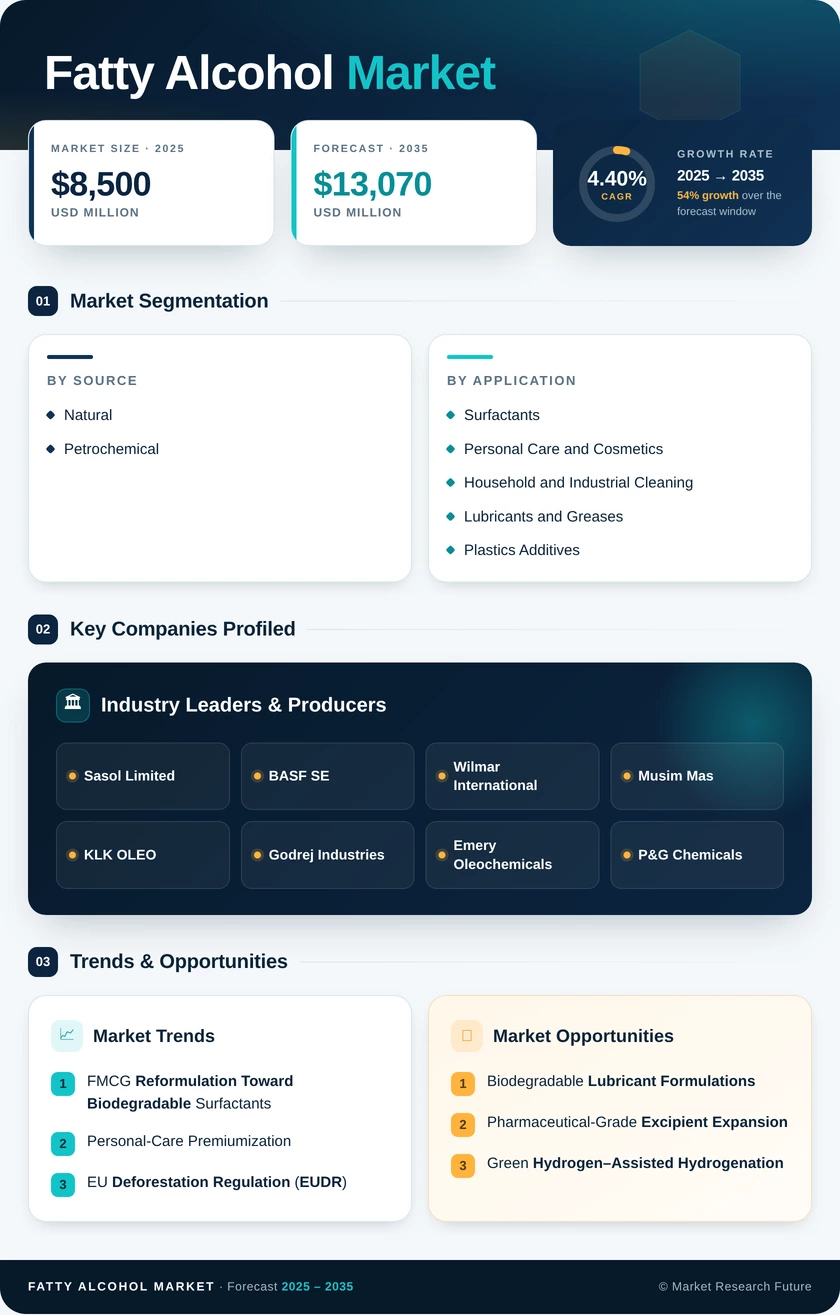
      1. 3.1.1 FMCG Reformulation Toward Biodegradable Surfactants | |
      2. 3.1.2 Personal-Care Premiumization and Cosmetic Raw Materials Demand | |
      3. 3.1.3 EU Deforestation Regulation (EUDR) Compliance Mandates | |
      4. 3.1.4 Indonesian Oleochemical Downstream Masterplan | |
      5. 3.1.5 Biodegradable Lubricant Mandates (EU Ecolabel) | |
      6. 3.1.6 Coal-to-Syngas Pathway Scale-Up in China | |
      7. 3.1.7 Pharmaceutical-Grade Excipient Standardization |
    2. 3.2 Market Restraints Analysis | |
      1. 3.2.1 Palm-Kernel-Oil Price Volatility and Feedstock Arbitrage | |
      2. 3.2.2 Overcapacity in Southeast Asian Oleochemicals | |
      3. 3.2.3 Regulatory Fragmentation on Deforestation Standards | |
      4. 3.2.4 Technical Hurdles in Next-Generation Catalytic Routes | |
      5. 3.2.5 Rising Ethylene Costs Impacting Petrochemical Routes |
    3. 3.3 Market Opportunity Analysis | |
      1. 3.3.1 Biodegradable Lubricant Formulations | |
      2. 3.3.2 Pharmaceutical-Grade Excipient Expansion | |
      3. 3.3.3 Green Hydrogen–Assisted Hydrogenation | |
      4. 3.3.4 African Palm-Kernel-Oil Frontier | |
      5. 3.3.5 Digital Supply-Chain Platforms for Detergent Alcohols |
    4. 3.4 Industry Value Chain Analysis |
    5. 3.5 Porter's Five Forces Analysis
  4. 4 Global Fatty Alcohol Market Size & Forecast (2021–2035) |
    1. 4.1 Historical Market Size (2021–2025) |
    2. 4.2 Current & Forecast Market Size (2026–2035) |
    3. 4.3 Market Size by Revenue (USD Million) |
    4. 4.4 Year-over-Year Growth Analysis
  5. 5 Segmentation Analysis |
    1. 5.1 By Source | |
      1. 5.1.1 Natural | |
      2. 5.1.2 Petrochemical |
    2. 5.2 By Application | |
      1. 5.2.1 Surfactants | |
      2. 5.2.2 Personal Care and Cosmetics | |
      3. 5.2.3 Household and Industrial Cleaning | |
      4. 5.2.4 Lubricants and Greases | |
      5. 5.2.5 Plastics Additives | |
      6. 5.2.6 Pharmaceutical Excipients | |
      7. 5.2.7 Others
  6. 6 Regional Analysis |
    1. 6.1 North America | |
      1. 6.1.1 United States | |
      2. 6.1.2 Canada | |
      3. 6.1.3 Mexico |
    2. 6.2 Europe | |
      1. 6.2.1 Germany | |
      2. 6.2.2 United Kingdom | |
      3. 6.2.3 France | |
      4. 6.2.4 Italy | |
      5. 6.2.5 Spain | |
      6. 6.2.6 Nordic Countries | |
      7. 6.2.7 Russia | |
      8. 6.2.8 Rest of Europe |
    3. 6.3 Asia-Pacific | |
      1. 6.3.1 China | |
      2. 6.3.2 India | |
      3. 6.3.3 Japan | |
      4. 6.3.4 South Korea | |
      5. 6.3.5 ASEAN | |
      6. 6.3.6 Rest of Asia-Pacific |
    4. 6.4 South America | |
      1. 6.4.1 Brazil | |
      2. 6.4.2 Argentina | |
      3. 6.4.3 Rest of South America |
    5. 6.5 Middle East & Africa | |
      1. 6.5.1 Saudi Arabia | |
      2. 6.5.2 UAE | |
      3. 6.5.3 South Africa | |
      4. 6.5.4 Egypt | |
      5. 6.5.5 Rest of MEA
  7. 7 Competitive Landscape |
    1. 7.1 Market Share Analysis (2025) |
    2. 7.2 Competitive Benchmarking Matrix |
    3. 7.3 Company Profiles | |
      1. 7.3.1 Sasol Limited | |
      2. 7.3.2 BASF SE | |
      3. 7.3.3 Wilmar International | |
      4. 7.3.4 Musim Mas | |
      5. 7.3.5 KLK OLEO | |
      6. 7.3.6 Godrej Industries | |
      7. 7.3.7 Emery Oleochemicals | |
      8. 7.3.8 P&G Chemicals | |
      9. 7.3.9 Thai Oleochemicals | |
      10. 7.3.10 Kao Corporation
  8. 8 Future Outlook & Strategic Recommendations (2026–2035) |
    1. 8.1 Feedstock Diversification and Bio-Based Alcohols Innovation |
    2. 8.2 Sustainability Reporting and ESG-Driven Procurement |
    3. 8.3 Process Electrification and Green Chemistry |
    4. 8.4 Platform Economics and Digital Marketplaces
  9. 9 Recent Developments & News
  10. 10 Frequently Asked Questions (FAQs)
  11. 11 Report Scope & Methodology |
    1. 11.1 Study Period & Base Year |
    2. 11.2 Data Sources & Citations |
    3. 11.3 Abbreviations
  12. 12 LIST OF TABLES |
  13. TABLE 1 Global Fatty Alcohol Market Size & Forecast, by Revenue (USD Million), 2021–2035 |
  14. TABLE 2 Global Fatty Alcohol Market — Year-over-Year Growth Analysis, 2021–2035 |
  15. TABLE 3 Global Fatty Alcohol Market — Driver Impact Analysis, 2026–2035 |
  16. TABLE 4 Global Fatty Alcohol Market — Restraint Impact Analysis, 2026–2035 |
  17. TABLE 5 Global Fatty Alcohol Market Size, by Source, 2021–2035 (USD Million) |
  18. TABLE 6 Global Fatty Alcohol Market Size, by Application, 2021–2035 (USD Million) |
  19. TABLE 7 Global Fatty Alcohol Market Size, by Region, 2021–2035 (USD Million) |
  20. TABLE 8 North America Fatty Alcohol Market Size, by Country, 2021–2035 (USD Million) |
  21. TABLE 9 Europe Fatty Alcohol Market Size, by Country, 2021–2035 (USD Million) |
  22. TABLE 10 Asia-Pacific Fatty Alcohol Market Size, by Country, 2021–2035 (USD Million) |
  23. TABLE 11 South America Fatty Alcohol Market Size, by Country, 2021–2035 (USD Million) |
  24. TABLE 12 Middle East & Africa Fatty Alcohol Market Size, by Country, 2021–2035 (USD Million) |
  25. TABLE 13 Competitive Benchmarking Matrix — Global Fatty Alcohol Market, 2025 |
  26. TABLE 14 Company Profiles — Key Players, Global Fatty Alcohol Market |
  27. TABLE 15 Recent Developments & Strategic Announcements, 2023–2025 |
  28. TABLE 16 North America Fatty Alcohol Market Size, by Source, 2021–2035 (USD Million) |
  29. TABLE 17 North America Fatty Alcohol Market Size, by Application, 2021–2035 (USD Million) |
  30. TABLE 18 Europe Fatty Alcohol Market Size, by Source, 2021–2035 (USD Million) |
  31. TABLE 19 Europe Fatty Alcohol Market Size, by Application, 2021–2035 (USD Million) |
  32. TABLE 20 Asia-Pacific Fatty Alcohol Market Size, by Source, 2021–2035 (USD Million) |
  33. TABLE 21 Asia-Pacific Fatty Alcohol Market Size, by Application, 2021–2035 (USD Million) |
  34. TABLE 22 South America Fatty Alcohol Market Size, by Source, 2021–2035 (USD Million) |
  35. TABLE 23 South America Fatty Alcohol Market Size, by Application, 2021–2035 (USD Million) |
  36. TABLE 24 Middle East & Africa Fatty Alcohol Market Size, by Source, 2021–2035 (USD Million) |
  37. TABLE 25 Middle East & Africa Fatty Alcohol Market Size, by Application, 2021–2035 (USD Million) |
  38. TABLE 26 Report Scope & Methodology Summary
  39. 13 LIST OF FIGURES |
  40. FIGURE 1 Fatty Alcohol Market Dynamics — Drivers, Restraints, and Opportunities |
  41. FIGURE 2 Fatty Alcohol Industry Value Chain Analysis |
  42. FIGURE 3 Porter's Five Forces Analysis — Fatty Alcohol Market |
  43. FIGURE 4 Global Fatty Alcohol Market Size Trend & Forecast (USD Million), 2021–2035 |
  44. FIGURE 5 Fatty Alcohol Market Share, by Source (%), 2025 |
  45. FIGURE 6 Fatty Alcohol Market Share, by Application (%), 2025 |
  46. FIGURE 7 Fatty Alcohol Market Share, by Region (%), 2025 |
  47. FIGURE 8 North America Fatty Alcohol Market Size Trend (USD Million), 2021–2035 |
  48. FIGURE 9 Europe Fatty Alcohol Market Size Trend (USD Million), 2021–2035 |
  49. FIGURE 10 Asia-Pacific Fatty Alcohol Market Size Trend (USD Million), 2021–2035 |
  50. FIGURE 11 South America Fatty Alcohol Market Size Trend (USD Million), 2021–2035 |
  51. FIGURE 12 Middle East & Africa Fatty Alcohol Market Size Trend (USD Million), 2021–2035 |
  52. FIGURE 13 Competitive Landscape — Fatty Alcohol Market Share by Company (%), 2025 |
  53. FIGURE 14 Competitive Positioning Map — Fatty Alcohol Market Key Players

Segmentation Quick Reference

DimensionSub-SegmentsDominant SegmentFastest Growing Segment
By SourceNatural, PetrochemicalNatural (72% share, 2025)Petrochemical (CAGR 4.75%)
By ApplicationSurfactants; Personal Care and Cosmetics; Household and Industrial Cleaning; Lubricants and Greases; Plastics Additives; Pharmaceutical Excipients; OthersSurfactants (52% share, 2025)Personal Care and Cosmetics (CAGR 5.10%)
By GeographyAsia-Pacific; North America; Europe; South America; Middle East & AfricaAsia-Pacific (48% share, 2025)Asia-Pacific (CAGR 5.50%)


Market Segmentation Overview

By Source

Sub-SegmentKey Trend
NaturalPalm-kernel and coconut oil–derived production dominates; RSPO/ISCC certification is increasingly required for European and North American supply chains.
PetrochemicalEthylene-based Ziegler and oxo-synthesis routes are gaining share in deforestation-sensitive markets; EUDR exemptions provide regulatory tailwind.


Natural fatty alcohols remain the foundation of global supply, leveraging Southeast Asia's integrated plantation-to-refinery model. Petrochemical routes offer an alternative pathway that bypasses tropical feedstock volatility and deforestation-compliance complexity, making them increasingly attractive for sustainability-conscious buyers.

By Application

Sub-SegmentKey Trend
SurfactantsLargest volume outlet; reformulation toward biodegradable alcohol ethoxylates and sulfates, accelerating
Personal Care and CosmeticsFastest growth; premiumization driving demand for high-purity cetyl and cetearyl alcohols
Household and Industrial CleaningEco-label mandates shifting formulations from petroleum-based to fatty-alcohol-derived systems.
Lubricants and GreasesEU Ecolabel bio-lubricant criteria opening new high-margin applications for C16–C18 grades
Plastics AdditivesSteady demand for fatty-alcohol-based slip agents and mold-release compounds
Pharmaceutical ExcipientsUSP/EP monograph harmonization expanding addressable market for tablet-coating and emulsion grades
OthersNiche applications in textile auxiliaries, agrochemical emulsions, and metal-processing fluids


Surfactants absorb over half of global fatty alcohol output, serving as the primary interface between oleochemical production and consumer-facing products. Personal care is the growth engine, propelled by rising Asian middle-class spending on premium skincare and haircare formulations that specify certified, traceable fatty alcohol ingredients.

By Geography

Sub-SegmentKey Trend
Asia-PacificProduction and consumption hub; Indonesia and China drive capacity additions and domestic demand growth
EuropeRegulatory-driven reformulation; EUDR reshaping supply-chain requirements for imported fatty alcohols
North AmericaSpecialty-grade demand; pharmaceutical excipients and premium personal-care applications anchor value
South AmericaEmerging processing capacity in Brazil; import-substitution dynamics in domestic FMCG supply
Middle East & AfricaPetrochemical-route production in Saudi Arabia; nascent palm-kernel processing in West Africa


Asia-Pacific's dominance reflects both its role as the world's primary oleochemical supply base and the rapid growth of regional end-use demand. Mature western markets increasingly differentiate on sustainability credentials and specialty-grade product portfolios rather than volume growth alone.