Request Free Sample ×

Kindly complete the form below to receive a free sample of this Report

* Please use a valid business email

Leading companies partner with us for data-driven Insights

clients tt-cursor
Hero Background
English
Chinese
French
Japanese
Korean
German
Spanish

Face-swiping Payment Market Trends

ID: MRFR/ICT/10280-HCR
128 Pages
Ankit Gupta
March 2026

Face-swiping Payment Market Research Report:Information By Type (Payment Equipment and Payment System), By Application (Retail, Restaurant, Travel, and Others), and By Region (North America, Europe, Asia-Pacific, and Rest Of The World) – Market Forecast Till 2035

Share:
Download PDF ×

We do not share your information with anyone. However, we may send you emails based on your report interest from time to time. You may contact us at any time to opt-out.

Face-swiping Payment Market Infographic
Purchase Options

Market Trends

Key Emerging Trends in the Face-swiping Payment Market

For one thing, competition has surged within financial technology’s pioneering sector which is the face swiping payment market, with companies scrambling for higher market stakes. In this fast-changing environment, successful players have put in place efficient market positioning measures to become industry leaders in emerging markets. An example of this is employing cutting-edge facial recognition technology.

Market share within the Face Swiping Payment is determined by strategic partnerships and collaborations. Companies form alliances with major financiers and technologists to integrate their face recognition payment systems with present banking infrastructure as well as some mobile applications.

The success of user adoption is central to any business operating in the Face Swiping Payment market hence customer-centricity remains paramount. Providers concentrate on developing intuitive interfaces, frictionless onboarding processes, and security or privacy of user data being a topmost priority. User experience counts a lot and those who perform better gain a competitive advantage here.

Meanwhile, pricing strategies are heavily involved in defining how much market share should be taken up by different players within the Face Swiping Payment sector. The key objective behind using flexible and clear pricing models is to cater to varying demands from businesses as well as individual clients. Some providers may offer subscription plans while others would rather go for transaction based rates instead.

To make e-branding efforts effective and to teach people the gains of swiping faces to pay, it is important to make use of good marketing and communication strategies. Providers invests in targeted marketing campaigns that emphasize on how convenient, safe and innovative their systems are. Educating consumers and businesses about the benefits of face recognition for payments is vital for adoption.

To maintain long-term success in the market for Face Swiping Payments, firms need to be flexible with changing industry trends as well as regulatory changes. In order not to be caught unawares by consumer behavior change, technological advancement or compliance requirements, providers must always be alert. Regular system updates that can meet emerging challenges and keep pace with evolving industry standards will ensure its relevance in the long term.


Author
Author Profile
Ankit Gupta
Team Lead - Research

Ankit Gupta is a seasoned market intelligence and strategic research professional with over six plus years of experience in the ICT and Semiconductor industries. With academic roots in Telecom, Marketing, and Electronics, he blends technical insight with business strategy. Ankit has led 200+ projects, including work for Fortune 500 clients like Microsoft and Rio Tinto, covering market sizing, tech forecasting, and go-to-market strategies. Known for bridging engineering and enterprise decision-making, his insights support growth, innovation, and investment planning across diverse technology markets.

Leave a Comment

FAQs

What is the current valuation of the Face-swiping Payment Market as of 2024?

<p>The Face-swiping Payment Market was valued at 6.972 USD Billion in 2024.</p>

What is the projected market valuation for the Face-swiping Payment Market in 2035?

<p>The market is projected to reach 52.77 USD Billion by 2035.</p>

What is the expected compound annual growth rate (CAGR) for the Face-swiping Payment Market from 2025 to 2035?

<p>The expected CAGR for the Face-swiping Payment Market during the forecast period 2025 - 2035 is 20.2%.</p>

Which companies are considered key players in the Face-swiping Payment Market?

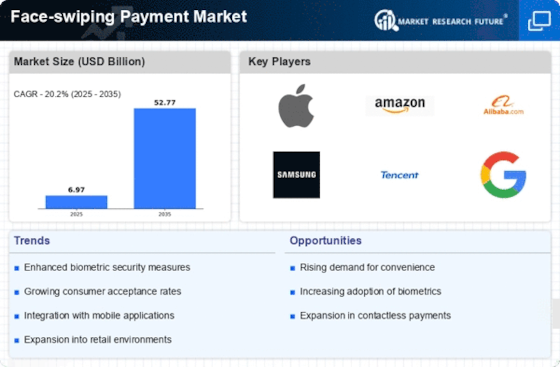
<p>Key players include Apple, Amazon, Alibaba, Samsung, Tencent, Google, Microsoft, Visa, and Mastercard.</p>

What are the main segments of the Face-swiping Payment Market?

<p>The main segments include Payment Equipment and Payment System, with valuations ranging from 2.5 to 33.27 USD Billion.</p>

How does the retail application segment perform in the Face-swiping Payment Market?

<p>The retail application segment was valued at 2.5 USD Billion in 2024 and is expected to grow significantly.</p>

What is the valuation of the restaurant application segment in the Face-swiping Payment Market?

The restaurant application segment was valued at 1.5 USD Billion in 2024.

What is the projected growth for the travel application segment in the Face-swiping Payment Market?

The travel application segment was valued at 1.0 USD Billion in 2024 and is anticipated to expand in the coming years.

What does the performance of the Payment Equipment segment indicate about the market?

The Payment Equipment segment shows a valuation range from 2.5 to 19.5 USD Billion, indicating robust growth potential.

How does the Face-swiping Payment Market's growth compare to other payment technologies?

The Face-swiping Payment Market's projected growth rate of 20.2% suggests it may outpace many traditional payment technologies.

Market Summary

As per Market Research Future analysis, the Face-swiping Payment Market Size was estimated at 6.972 USD Billion in 2024. The Face-swiping Payment industry is projected to grow from 8.38 USD Billion in 2025 to 52.77 USD Billion by 2035, exhibiting a compound annual growth rate (CAGR) of 20.2% during the forecast period 2025 - 2035

Key Market Trends & Highlights

The Face-swiping Payment Market is experiencing robust growth driven by technological advancements and consumer preferences for security.

  • The market is witnessing a notable rise in contactless payments, particularly in North America, which remains the largest market. Integration of biometric security features is becoming increasingly prevalent, enhancing user trust and transaction efficiency. The retail segment continues to dominate the market, while the restaurant segment is emerging as the fastest-growing area for face-swiping payments. Technological advancements in payment systems and consumer demand for enhanced security are key drivers propelling market expansion.

Market Size & Forecast

2024 Market Size 6.972 (USD Billion)
2035 Market Size 52.77 (USD Billion)
CAGR (2025 - 2035) 20.2%
Largest Regional Market Share in 2024 North America

Major Players

Apple (US), Amazon (US), Alibaba (CN), Samsung (KR), Tencent (CN), Google (US), Microsoft (US), Visa (US), Mastercard (US)

Market Trends

The Face-swiping Payment Market is currently experiencing a transformative phase, driven by advancements in technology and changing consumer preferences. As digital transactions become increasingly prevalent, the demand for seamless and secure payment methods has surged. This market appears to be characterized by a growing inclination towards contactless solutions, which offer convenience and efficiency. Furthermore, the integration of biometric authentication methods, such as facial recognition, is likely to enhance security measures, thereby fostering consumer trust in these systems. As a result, businesses are increasingly adopting face-swiping payment solutions to streamline their operations and improve customer experiences. In addition to technological advancements, the Face-swiping Payment Market is influenced by evolving regulatory frameworks and consumer awareness regarding data privacy. Companies are compelled to navigate complex legal landscapes while ensuring compliance with data protection regulations. This dynamic environment may lead to innovative approaches in payment processing, as organizations strive to balance user convenience with stringent security protocols. Overall, the Face-swiping Payment Market seems poised for substantial growth, as stakeholders adapt to the shifting landscape and capitalize on emerging opportunities.

Rise of Contactless Payments

The Face-swiping Payment Market is witnessing a notable shift towards contactless payment methods. This trend reflects consumer preferences for quick and efficient transactions, minimizing physical contact during payment processes. As technology evolves, businesses are increasingly adopting face-swiping solutions to enhance customer convenience.

Integration of Biometric Security

The incorporation of biometric security features, particularly facial recognition, is becoming a defining characteristic of the Face-swiping Payment Market. This trend suggests a growing emphasis on secure transactions, as consumers seek assurance that their personal information is protected. Enhanced security measures may lead to increased adoption rates.

Regulatory Compliance and Data Privacy

As the Face-swiping Payment Market expands, navigating regulatory compliance and data privacy concerns is crucial. Companies are likely to invest in solutions that align with evolving legal standards, ensuring consumer trust while fostering innovation. This trend indicates a proactive approach to addressing potential challenges in the market.

Face-swiping Payment Market Market Drivers

Shift Towards Cashless Transactions

The Face-swiping Payment Market is benefiting from a significant shift towards cashless transactions. As consumers increasingly favor digital payment methods, the demand for innovative solutions like face-swiping payments is on the rise. Recent data indicates that cash transactions have decreased by approximately 30% in various regions, highlighting a clear trend towards electronic payments. This transition is driven by the convenience and speed associated with cashless transactions, which are appealing to both consumers and merchants. As more businesses adopt face-swiping payment systems to cater to this demand, the industry is likely to witness substantial growth. This shift not only enhances transaction efficiency but also aligns with the evolving preferences of modern consumers.

Consumer Demand for Enhanced Security

In the Face-swiping Payment Market, there is a notable increase in consumer demand for enhanced security features. As digital transactions become more prevalent, consumers are increasingly concerned about the safety of their financial information. The integration of biometric authentication, such as facial recognition, is seen as a robust solution to mitigate fraud risks. Recent statistics suggest that 70% of consumers prefer payment methods that offer advanced security measures. This growing preference is likely to drive the adoption of face-swiping payment systems, as they provide a higher level of security compared to traditional payment methods. Consequently, businesses that prioritize security in their payment offerings may gain a competitive edge in the Face-swiping Payment Market.

Increased Investment in Fintech Solutions

Investment in fintech solutions is a key driver for the Face-swiping Payment Market. As financial technology continues to evolve, venture capital and private equity investments in fintech companies have surged, with estimates suggesting a growth of over 40% in funding over the past year. This influx of capital is enabling the development of innovative payment solutions, including face-swiping technologies. As startups and established companies alike seek to capitalize on this trend, the competition within the Face-swiping Payment Market is intensifying. This competitive landscape is likely to foster further innovation and improvements in payment systems, ultimately benefiting consumers and businesses through enhanced services and features.

Technological Advancements in Payment Systems

The Face-swiping Payment Market is experiencing a surge in technological advancements that enhance payment processing efficiency. Innovations such as artificial intelligence and machine learning are being integrated into payment systems, allowing for faster transaction times and improved user experiences. According to recent data, the adoption of advanced payment technologies is projected to increase by 25% over the next five years. This trend indicates a growing consumer preference for seamless and quick payment solutions, which is likely to drive the demand for face-swiping payment systems. As businesses seek to remain competitive, the incorporation of these technologies into their payment infrastructures becomes essential, thereby propelling the Face-swiping Payment Market forward.

Regulatory Support for Digital Payment Solutions

Regulatory support for digital payment solutions is emerging as a significant driver in the Face-swiping Payment Market. Governments and regulatory bodies are increasingly recognizing the importance of facilitating secure and efficient payment systems. Recent initiatives aimed at promoting digital payments have led to the establishment of favorable regulations that encourage the adoption of technologies like face-swiping payments. For instance, certain jurisdictions have implemented policies that streamline the approval process for new payment technologies, thereby accelerating their market entry. This regulatory environment is likely to foster innovation and growth within the Face-swiping Payment Market, as businesses are empowered to develop and deploy cutting-edge payment solutions that meet consumer needs.

Market Segment Insights

By Type: Payment Equipment (Largest) vs. Payment System (Fastest-Growing)

In the Face-swiping Payment Market, the segment is divided into two primary values: Payment Equipment and<a href="https://www.marketresearchfuture.com/reports/digital-payment-market-7572"> Payment System</a>. Payment Equipment currently holds the largest market share due to its essential role in facilitating transactions and ensuring security in face-swiping payment processes. This equipment is vital for retailers and service providers, leading to its widespread adoption. On the other hand, the Payment System, which encompasses the technological infrastructure behind these transactions, is experiencing rapid growth as businesses seek to innovate and improve customer experience.

Payment Equipment (Dominant) vs. Payment System (Emerging)

Payment Equipment represents the dominant force within the Face-swiping Payment Market, widely used across various sectors such as retail and hospitality. Its established technology ensures efficient and secure transactions, making it a preferred choice for merchants aiming to enhance payment security and customer convenience. On the other hand, Payment System is an emerging segment that focuses on software and network capabilities driving the face-swiping payment experience. As consumers demand more seamless and integrated payment solutions, this segment is witnessing accelerated growth, propelled by advancements in machine learning and biometric technology. Together, these segment values illustrate the balance between established infrastructure and innovative growth within the market.

By Application: Retail (Largest) vs. Restaurant (Fastest-Growing)

In the Face-swiping Payment Market, the application segment showcases a diverse distribution, with retail emerging as the largest contributor, greatly benefiting from the surge in contactless payment methods. This retail dominance is driven by an increasing number of stores adopting advanced payment technologies to enhance customer experiences. In contrast, the restaurant sector, while smaller in share, is noted for its rapid growth as dining establishments seek to streamline payment processes and reduce wait times, appealing to tech-savvy consumers.

Retail (Dominant) vs. Restaurant (Emerging)

The retail application segment in the Face-swiping Payment Market stands out as the dominant force, characterized by a widespread adoption of innovative technologies to improve transaction efficiency. Retailers leverage face-swiping payments for instant checkouts, enhancing the overall customer experience and integrating with loyalty programs. Meanwhile, the restaurant segment, marked as emerging, exhibits robust growth as eateries embrace these payment solutions to minimize friction during service. This shift caters to changing consumer expectations for swift and secure transactions, establishing technology as a core component of modern dining experiences.

Get more detailed insights about Face-swiping Payment Market Research Report - Global Forecast till 2035

Regional Insights

North America : Digital Payment Leader

North America is the largest market for face-swiping payments, holding approximately 45% of the global share. The region's growth is driven by high smartphone penetration, increasing consumer preference for contactless payments, and supportive regulatory frameworks. The U.S. leads this market, followed closely by Canada, which contributes around 15% to the overall market share. The regulatory environment is favorable, promoting innovation and security in digital transactions. The competitive landscape in North America is robust, featuring key players like Apple, Google, and Visa. These companies are at the forefront of technological advancements, integrating biometric authentication into payment systems. The presence of established financial institutions further enhances market growth, as they collaborate with tech giants to offer seamless payment solutions. This synergy between technology and finance is pivotal in shaping the future of face-swiping payments.

Europe : Emerging Market Dynamics

Europe is witnessing significant growth in the face-swiping payment market, accounting for approximately 30% of the global share. The region's expansion is fueled by increasing consumer acceptance of biometric payments and stringent regulations promoting secure transactions. Countries like Germany and the UK are leading this trend, with Germany holding about 12% of the market share, driven by its strong technological infrastructure and consumer trust in digital payments. The competitive landscape in Europe is characterized by a mix of established financial institutions and innovative tech startups. Key players such as Mastercard and Samsung are actively investing in biometric payment technologies. The European market is also seeing collaborations between banks and fintech companies, enhancing the overall payment ecosystem. This collaborative approach is essential for addressing consumer concerns regarding security and privacy in digital transactions.

Asia-Pacific : Rapid Adoption of Technology

Asia-Pacific is rapidly emerging as a powerhouse in the face-swiping payment market, holding around 20% of the global share. The region's growth is driven by a young, tech-savvy population and increasing smartphone usage. Countries like China and India are at the forefront, with China alone contributing approximately 15% to the market. The regulatory environment is evolving, with governments promoting digital payment solutions to boost economic growth and financial inclusion. The competitive landscape in Asia-Pacific is vibrant, featuring major players like Alibaba and Tencent, who are leading the charge in biometric payment innovations. The presence of numerous fintech startups is also reshaping the market, offering diverse solutions tailored to local consumer needs. This dynamic environment fosters innovation and competition, making Asia-Pacific a critical region for the future of face-swiping payments.

Middle East and Africa : Emerging Payment Solutions

The Middle East and Africa are gradually adopting face-swiping payment technologies, holding about 5% of the global market share. The growth is driven by increasing smartphone penetration and a young population eager for innovative payment solutions. Countries like South Africa and the UAE are leading this trend, with South Africa contributing around 3% to the market. Regulatory bodies are beginning to establish frameworks to support digital payments, enhancing consumer confidence in these technologies. The competitive landscape in this region is evolving, with both local and international players entering the market. Companies like Mastercard and Visa are expanding their presence, while local fintech startups are innovating to meet regional needs. The collaboration between traditional banks and tech companies is crucial for developing secure and efficient payment systems, paving the way for broader adoption of face-swiping payments.

Key Players and Competitive Insights

Leading market players are investing heavily in research and development in order to expand their product lines, which will help the Face-swiping Payment Market, grow even more. Market participants are also undertaking a variety of strategic activities to expand their global footprint, with important market developments including new product launches, contractual agreements, mergers and acquisitions, higher investments, and collaboration with other organizations. To expand and survive in a more competitive and rising market climate, Face-swiping Payment industry must offer cost-effective items. Manufacturing locally to minimize operational costs is one of the key business tactics used by manufacturers in the global Face-swiping Payment industry to benefit clients and increase the market sector. In recent years, the Face-swiping Payment industry has offered some of the most significant advantages to medicine. Major players in the Face-swiping Payment Market, including PopID, Inc., FacePay, PayByFace B.V., VisionLabs, Telepower Communication Co, Ltd. (Telpo), PAX Global Technology Limited, Alipay, NEC Corporation, SnapPay Inc., Mastercard, and CloudWalk Technology Co. Ltd., are attempting to increase market demand by investing in research and development operations. Technology and payment firm Mastercard Inc. (Mastercard) handles the clearing, authorization, and settlement of financial transactions. It provides a wide range of transaction services, including domestic and international transactions, digital payments, real-time account-based payments, and payment system security. It also offers payment solutions for credit, debit, prepaid, and commercial cards. Additionally, Mastercard offers advisory services like consultancy, analytics, and implementation services as well as value-added services like rewards and loyalty programmes. Individuals, businesses, governments, financial institutions, digital partners, merchants, and other organisations are all served by Mastercard. The Americas, the Middle East, Africa, Europe, and Asia-Pacific are all where it conducts business. The American city of Purchase serves as the headquarters of Mastercard. A financial services business called Mastercard launched a new facial recognition payment network in May 2022 that will let users make purchases with their faces or hand gestures. "Smile to pay" is the name of MasterCard's newest payment method. The cardless technology is intended to speed up transactions, reduce store lines, boost security, and enhance cleanliness. Asset management, business banking, and personal banking services are all offered by Qatar National Bank (QNB). Accounts, fixed deposits, loans, life and non-life insurance, as well as various ancillary services like merchant and e-acquisition, IPO subscription, and dividend distribution, are all part of personal banking. Wealth solutions, funds, portfolio management, and debt funds are all parts of asset management. Cards, brokerage, lending, overdraft options, trade finance, and international cash management are all part of business banking. The bank serves retail, high net worth, and corporate clients through a network of branch offices, ATMs, and online portals. It is operationally present throughout the continents of Africa, the Middle East, Asia, and Europe. The headquarters of QNB are in Doha, Qatar. Merchants in Qatar can now take biometric payments thanks to a new solution developed by commercial banking firm QNB Group in January 2023. As a result of this introduction, QNB Group helped businesses with stores in Qatar by enabling facial biometric payments for their consumers, which is safe and convenient.

Key Companies in the Face-swiping Payment Market include

Industry Developments

April 2022 A financial services company called Visa Inc. joined forces with PopID, a consumer authentication service. The goal of this collaboration was to introduce facial verification payment acceptance throughout the Middle East.

February 2022 Glory Ltd., a producer of a variety of money handling devices, and the Japanese city of Niigata trialled the hands-free shopping street project. The goal of this project was to make it possible for customers to use face recognition technology for online payments even when they are wearing masks.

Future Outlook

Face-swiping Payment Market Future Outlook

The Face-swiping Payment Market is projected to grow at a 20.2% CAGR from 2025 to 2035, driven by technological advancements, increasing consumer acceptance, and enhanced security features.

New opportunities lie in:

  • <p>Integration of AI-driven<a href="https://www.marketresearchfuture.com/reports/ai-in-fraud-management-market-34390"> fraud detection</a> systems Expansion into emerging markets with tailored solutionsCashless Transactions Development of mobile applications for seamless transactions</p>

By 2035, the market is expected to be robust, driven by innovation and widespread adoption.

Market Segmentation

Face-swiping Payment Market Type Outlook

  • Payment Equipment
  • Payment System

Face-swiping Payment Market Application Outlook

  • Retail
  • Restaurant
  • Travel
  • Others

Report Scope

MARKET SIZE 2024 6.972(USD Billion)
MARKET SIZE 2025 8.38(USD Billion)
MARKET SIZE 2035 52.77(USD Billion)
COMPOUND ANNUAL GROWTH RATE (CAGR) 20.2% (2025 - 2035)
REPORT COVERAGE Revenue Forecast, Competitive Landscape, Growth Factors, and Trends
BASE YEAR 2024
Market Forecast Period 2025 - 2035
Historical Data 2019 - 2024
Market Forecast Units USD Billion
Key Companies Profiled Apple (US), Amazon (US), Alibaba (CN), Samsung (KR), Tencent (CN), Google (US), Microsoft (US), Visa (US), Mastercard (US)
Segments Covered Type, Application, Region
Key Market Opportunities Integration of biometric security features enhances consumer trust in the Face-swiping Payment Market.
Key Market Dynamics Rising consumer demand for seamless transactions drives innovation in face-swiping payment technologies and competitive market dynamics.
Countries Covered North America, Europe, APAC, South America, MEA

FAQs

What is the current valuation of the Face-swiping Payment Market as of 2024?

<p>The Face-swiping Payment Market was valued at 6.972 USD Billion in 2024.</p>

What is the projected market valuation for the Face-swiping Payment Market in 2035?

<p>The market is projected to reach 52.77 USD Billion by 2035.</p>

What is the expected compound annual growth rate (CAGR) for the Face-swiping Payment Market from 2025 to 2035?

<p>The expected CAGR for the Face-swiping Payment Market during the forecast period 2025 - 2035 is 20.2%.</p>

Which companies are considered key players in the Face-swiping Payment Market?

<p>Key players include Apple, Amazon, Alibaba, Samsung, Tencent, Google, Microsoft, Visa, and Mastercard.</p>

What are the main segments of the Face-swiping Payment Market?

<p>The main segments include Payment Equipment and Payment System, with valuations ranging from 2.5 to 33.27 USD Billion.</p>

How does the retail application segment perform in the Face-swiping Payment Market?

<p>The retail application segment was valued at 2.5 USD Billion in 2024 and is expected to grow significantly.</p>

What is the valuation of the restaurant application segment in the Face-swiping Payment Market?

The restaurant application segment was valued at 1.5 USD Billion in 2024.

What is the projected growth for the travel application segment in the Face-swiping Payment Market?

The travel application segment was valued at 1.0 USD Billion in 2024 and is anticipated to expand in the coming years.

What does the performance of the Payment Equipment segment indicate about the market?

The Payment Equipment segment shows a valuation range from 2.5 to 19.5 USD Billion, indicating robust growth potential.

How does the Face-swiping Payment Market's growth compare to other payment technologies?

The Face-swiping Payment Market's projected growth rate of 20.2% suggests it may outpace many traditional payment technologies.

  1. SECTION I: EXECUTIVE SUMMARY AND KEY HIGHLIGHTS
    1. | 1.1 EXECUTIVE SUMMARY
    2. | | 1.1.1 Market Overview
    3. | | 1.1.2 Key Findings
    4. | | 1.1.3 Market Segmentation
    5. | | 1.1.4 Competitive Landscape
    6. | | 1.1.5 Challenges and Opportunities
    7. | | 1.1.6 Future Outlook
  2. SECTION II: SCOPING, METHODOLOGY AND MARKET STRUCTURE
    1. | 2.1 MARKET INTRODUCTION
    2. | | 2.1.1 Definition
    3. | | 2.1.2 Scope of the study
    4. | | | 2.1.2.1 Research Objective
    5. | | | 2.1.2.2 Assumption
    6. | | | 2.1.2.3 Limitations
    7. | 2.2 RESEARCH METHODOLOGY
    8. | | 2.2.1 Overview
    9. | | 2.2.2 Data Mining
    10. | | 2.2.3 Secondary Research
    11. | | 2.2.4 Primary Research
    12. | | | 2.2.4.1 Primary Interviews and Information Gathering Process
    13. | | | 2.2.4.2 Breakdown of Primary Respondents
    14. | | 2.2.5 Forecasting Model
    15. | | 2.2.6 Market Size Estimation
    16. | | | 2.2.6.1 Bottom-Up Approach
    17. | | | 2.2.6.2 Top-Down Approach
    18. | | 2.2.7 Data Triangulation
    19. | | 2.2.8 Validation
  3. SECTION III: QUALITATIVE ANALYSIS
    1. | 3.1 MARKET DYNAMICS
    2. | | 3.1.1 Overview
    3. | | 3.1.2 Drivers
    4. | | 3.1.3 Restraints
    5. | | 3.1.4 Opportunities
    6. | 3.2 MARKET FACTOR ANALYSIS
    7. | | 3.2.1 Value chain Analysis
    8. | | 3.2.2 Porter's Five Forces Analysis
    9. | | | 3.2.2.1 Bargaining Power of Suppliers
    10. | | | 3.2.2.2 Bargaining Power of Buyers
    11. | | | 3.2.2.3 Threat of New Entrants
    12. | | | 3.2.2.4 Threat of Substitutes
    13. | | | 3.2.2.5 Intensity of Rivalry
    14. | | 3.2.3 COVID-19 Impact Analysis
    15. | | | 3.2.3.1 Market Impact Analysis
    16. | | | 3.2.3.2 Regional Impact
    17. | | | 3.2.3.3 Opportunity and Threat Analysis
  4. SECTION IV: QUANTITATIVE ANALYSIS
    1. | 4.1 Information and Communications Technology, BY Type (USD Billion)
    2. | | 4.1.1 Payment Equipment
    3. | | 4.1.2 Payment System
    4. | 4.2 Information and Communications Technology, BY Application (USD Billion)
    5. | | 4.2.1 Retail
    6. | | 4.2.2 Restaurant
    7. | | 4.2.3 Travel
    8. | | 4.2.4 Others
    9. | 4.3 Information and Communications Technology, BY Region (USD Billion)
    10. | | 4.3.1 North America
    11. | | | 4.3.1.1 US
    12. | | | 4.3.1.2 Canada
    13. | | 4.3.2 Europe
    14. | | | 4.3.2.1 Germany
    15. | | | 4.3.2.2 UK
    16. | | | 4.3.2.3 France
    17. | | | 4.3.2.4 Russia
    18. | | | 4.3.2.5 Italy
    19. | | | 4.3.2.6 Spain
    20. | | | 4.3.2.7 Rest of Europe
    21. | | 4.3.3 APAC
    22. | | | 4.3.3.1 China
    23. | | | 4.3.3.2 India
    24. | | | 4.3.3.3 Japan
    25. | | | 4.3.3.4 South Korea
    26. | | | 4.3.3.5 Malaysia
    27. | | | 4.3.3.6 Thailand
    28. | | | 4.3.3.7 Indonesia
    29. | | | 4.3.3.8 Rest of APAC
    30. | | 4.3.4 South America
    31. | | | 4.3.4.1 Brazil
    32. | | | 4.3.4.2 Mexico
    33. | | | 4.3.4.3 Argentina
    34. | | | 4.3.4.4 Rest of South America
    35. | | 4.3.5 MEA
    36. | | | 4.3.5.1 GCC Countries
    37. | | | 4.3.5.2 South Africa
    38. | | | 4.3.5.3 Rest of MEA
  5. SECTION V: COMPETITIVE ANALYSIS
    1. | 5.1 Competitive Landscape
    2. | | 5.1.1 Overview
    3. | | 5.1.2 Competitive Analysis
    4. | | 5.1.3 Market share Analysis
    5. | | 5.1.4 Major Growth Strategy in the Information and Communications Technology
    6. | | 5.1.5 Competitive Benchmarking
    7. | | 5.1.6 Leading Players in Terms of Number of Developments in the Information and Communications Technology
    8. | | 5.1.7 Key developments and growth strategies
    9. | | | 5.1.7.1 New Product Launch/Service Deployment
    10. | | | 5.1.7.2 Merger & Acquisitions
    11. | | | 5.1.7.3 Joint Ventures
    12. | | 5.1.8 Major Players Financial Matrix
    13. | | | 5.1.8.1 Sales and Operating Income
    14. | | | 5.1.8.2 Major Players R&D Expenditure. 2023
    15. | 5.2 Company Profiles
    16. | | 5.2.1 Apple (US)
    17. | | | 5.2.1.1 Financial Overview
    18. | | | 5.2.1.2 Products Offered
    19. | | | 5.2.1.3 Key Developments
    20. | | | 5.2.1.4 SWOT Analysis
    21. | | | 5.2.1.5 Key Strategies
    22. | | 5.2.2 Amazon (US)
    23. | | | 5.2.2.1 Financial Overview
    24. | | | 5.2.2.2 Products Offered
    25. | | | 5.2.2.3 Key Developments
    26. | | | 5.2.2.4 SWOT Analysis
    27. | | | 5.2.2.5 Key Strategies
    28. | | 5.2.3 Alibaba (CN)
    29. | | | 5.2.3.1 Financial Overview
    30. | | | 5.2.3.2 Products Offered
    31. | | | 5.2.3.3 Key Developments
    32. | | | 5.2.3.4 SWOT Analysis
    33. | | | 5.2.3.5 Key Strategies
    34. | | 5.2.4 Samsung (KR)
    35. | | | 5.2.4.1 Financial Overview
    36. | | | 5.2.4.2 Products Offered
    37. | | | 5.2.4.3 Key Developments
    38. | | | 5.2.4.4 SWOT Analysis
    39. | | | 5.2.4.5 Key Strategies
    40. | | 5.2.5 Tencent (CN)
    41. | | | 5.2.5.1 Financial Overview
    42. | | | 5.2.5.2 Products Offered
    43. | | | 5.2.5.3 Key Developments
    44. | | | 5.2.5.4 SWOT Analysis
    45. | | | 5.2.5.5 Key Strategies
    46. | | 5.2.6 Google (US)
    47. | | | 5.2.6.1 Financial Overview
    48. | | | 5.2.6.2 Products Offered
    49. | | | 5.2.6.3 Key Developments
    50. | | | 5.2.6.4 SWOT Analysis
    51. | | | 5.2.6.5 Key Strategies
    52. | | 5.2.7 Microsoft (US)
    53. | | | 5.2.7.1 Financial Overview
    54. | | | 5.2.7.2 Products Offered
    55. | | | 5.2.7.3 Key Developments
    56. | | | 5.2.7.4 SWOT Analysis
    57. | | | 5.2.7.5 Key Strategies
    58. | | 5.2.8 Visa (US)
    59. | | | 5.2.8.1 Financial Overview
    60. | | | 5.2.8.2 Products Offered
    61. | | | 5.2.8.3 Key Developments
    62. | | | 5.2.8.4 SWOT Analysis
    63. | | | 5.2.8.5 Key Strategies
    64. | | 5.2.9 Mastercard (US)
    65. | | | 5.2.9.1 Financial Overview
    66. | | | 5.2.9.2 Products Offered
    67. | | | 5.2.9.3 Key Developments
    68. | | | 5.2.9.4 SWOT Analysis
    69. | | | 5.2.9.5 Key Strategies
    70. | 5.3 Appendix
    71. | | 5.3.1 References
    72. | | 5.3.2 Related Reports
  6. LIST OF FIGURES
    1. | 6.1 MARKET SYNOPSIS
    2. | 6.2 NORTH AMERICA MARKET ANALYSIS
    3. | 6.3 US MARKET ANALYSIS BY TYPE
    4. | 6.4 US MARKET ANALYSIS BY APPLICATION
    5. | 6.5 CANADA MARKET ANALYSIS BY TYPE
    6. | 6.6 CANADA MARKET ANALYSIS BY APPLICATION
    7. | 6.7 EUROPE MARKET ANALYSIS
    8. | 6.8 GERMANY MARKET ANALYSIS BY TYPE
    9. | 6.9 GERMANY MARKET ANALYSIS BY APPLICATION
    10. | 6.10 UK MARKET ANALYSIS BY TYPE
    11. | 6.11 UK MARKET ANALYSIS BY APPLICATION
    12. | 6.12 FRANCE MARKET ANALYSIS BY TYPE
    13. | 6.13 FRANCE MARKET ANALYSIS BY APPLICATION
    14. | 6.14 RUSSIA MARKET ANALYSIS BY TYPE
    15. | 6.15 RUSSIA MARKET ANALYSIS BY APPLICATION
    16. | 6.16 ITALY MARKET ANALYSIS BY TYPE
    17. | 6.17 ITALY MARKET ANALYSIS BY APPLICATION
    18. | 6.18 SPAIN MARKET ANALYSIS BY TYPE
    19. | 6.19 SPAIN MARKET ANALYSIS BY APPLICATION
    20. | 6.20 REST OF EUROPE MARKET ANALYSIS BY TYPE
    21. | 6.21 REST OF EUROPE MARKET ANALYSIS BY APPLICATION
    22. | 6.22 APAC MARKET ANALYSIS
    23. | 6.23 CHINA MARKET ANALYSIS BY TYPE
    24. | 6.24 CHINA MARKET ANALYSIS BY APPLICATION
    25. | 6.25 INDIA MARKET ANALYSIS BY TYPE
    26. | 6.26 INDIA MARKET ANALYSIS BY APPLICATION
    27. | 6.27 JAPAN MARKET ANALYSIS BY TYPE
    28. | 6.28 JAPAN MARKET ANALYSIS BY APPLICATION
    29. | 6.29 SOUTH KOREA MARKET ANALYSIS BY TYPE
    30. | 6.30 SOUTH KOREA MARKET ANALYSIS BY APPLICATION
    31. | 6.31 MALAYSIA MARKET ANALYSIS BY TYPE
    32. | 6.32 MALAYSIA MARKET ANALYSIS BY APPLICATION
    33. | 6.33 THAILAND MARKET ANALYSIS BY TYPE
    34. | 6.34 THAILAND MARKET ANALYSIS BY APPLICATION
    35. | 6.35 INDONESIA MARKET ANALYSIS BY TYPE
    36. | 6.36 INDONESIA MARKET ANALYSIS BY APPLICATION
    37. | 6.37 REST OF APAC MARKET ANALYSIS BY TYPE
    38. | 6.38 REST OF APAC MARKET ANALYSIS BY APPLICATION
    39. | 6.39 SOUTH AMERICA MARKET ANALYSIS
    40. | 6.40 BRAZIL MARKET ANALYSIS BY TYPE
    41. | 6.41 BRAZIL MARKET ANALYSIS BY APPLICATION
    42. | 6.42 MEXICO MARKET ANALYSIS BY TYPE
    43. | 6.43 MEXICO MARKET ANALYSIS BY APPLICATION
    44. | 6.44 ARGENTINA MARKET ANALYSIS BY TYPE
    45. | 6.45 ARGENTINA MARKET ANALYSIS BY APPLICATION
    46. | 6.46 REST OF SOUTH AMERICA MARKET ANALYSIS BY TYPE
    47. | 6.47 REST OF SOUTH AMERICA MARKET ANALYSIS BY APPLICATION
    48. | 6.48 MEA MARKET ANALYSIS
    49. | 6.49 GCC COUNTRIES MARKET ANALYSIS BY TYPE
    50. | 6.50 GCC COUNTRIES MARKET ANALYSIS BY APPLICATION
    51. | 6.51 SOUTH AFRICA MARKET ANALYSIS BY TYPE
    52. | 6.52 SOUTH AFRICA MARKET ANALYSIS BY APPLICATION
    53. | 6.53 REST OF MEA MARKET ANALYSIS BY TYPE
    54. | 6.54 REST OF MEA MARKET ANALYSIS BY APPLICATION
    55. | 6.55 KEY BUYING CRITERIA OF INFORMATION AND COMMUNICATIONS TECHNOLOGY
    56. | 6.56 RESEARCH PROCESS OF MRFR
    57. | 6.57 DRO ANALYSIS OF INFORMATION AND COMMUNICATIONS TECHNOLOGY
    58. | 6.58 DRIVERS IMPACT ANALYSIS: INFORMATION AND COMMUNICATIONS TECHNOLOGY
    59. | 6.59 RESTRAINTS IMPACT ANALYSIS: INFORMATION AND COMMUNICATIONS TECHNOLOGY
    60. | 6.60 SUPPLY / VALUE CHAIN: INFORMATION AND COMMUNICATIONS TECHNOLOGY
    61. | 6.61 INFORMATION AND COMMUNICATIONS TECHNOLOGY, BY TYPE, 2024 (% SHARE)
    62. | 6.62 INFORMATION AND COMMUNICATIONS TECHNOLOGY, BY TYPE, 2024 TO 2035 (USD Billion)
    63. | 6.63 INFORMATION AND COMMUNICATIONS TECHNOLOGY, BY APPLICATION, 2024 (% SHARE)
    64. | 6.64 INFORMATION AND COMMUNICATIONS TECHNOLOGY, BY APPLICATION, 2024 TO 2035 (USD Billion)
    65. | 6.65 BENCHMARKING OF MAJOR COMPETITORS
  7. LIST OF TABLES
    1. | 7.1 LIST OF ASSUMPTIONS
    2. | | 7.1.1
    3. | 7.2 North America MARKET SIZE ESTIMATES; FORECAST
    4. | | 7.2.1 BY TYPE, 2025-2035 (USD Billion)
    5. | | 7.2.2 BY APPLICATION, 2025-2035 (USD Billion)
    6. | 7.3 US MARKET SIZE ESTIMATES; FORECAST
    7. | | 7.3.1 BY TYPE, 2025-2035 (USD Billion)
    8. | | 7.3.2 BY APPLICATION, 2025-2035 (USD Billion)
    9. | 7.4 Canada MARKET SIZE ESTIMATES; FORECAST
    10. | | 7.4.1 BY TYPE, 2025-2035 (USD Billion)
    11. | | 7.4.2 BY APPLICATION, 2025-2035 (USD Billion)
    12. | 7.5 Europe MARKET SIZE ESTIMATES; FORECAST
    13. | | 7.5.1 BY TYPE, 2025-2035 (USD Billion)
    14. | | 7.5.2 BY APPLICATION, 2025-2035 (USD Billion)
    15. | 7.6 Germany MARKET SIZE ESTIMATES; FORECAST
    16. | | 7.6.1 BY TYPE, 2025-2035 (USD Billion)
    17. | | 7.6.2 BY APPLICATION, 2025-2035 (USD Billion)
    18. | 7.7 UK MARKET SIZE ESTIMATES; FORECAST
    19. | | 7.7.1 BY TYPE, 2025-2035 (USD Billion)
    20. | | 7.7.2 BY APPLICATION, 2025-2035 (USD Billion)
    21. | 7.8 France MARKET SIZE ESTIMATES; FORECAST
    22. | | 7.8.1 BY TYPE, 2025-2035 (USD Billion)
    23. | | 7.8.2 BY APPLICATION, 2025-2035 (USD Billion)
    24. | 7.9 Russia MARKET SIZE ESTIMATES; FORECAST
    25. | | 7.9.1 BY TYPE, 2025-2035 (USD Billion)
    26. | | 7.9.2 BY APPLICATION, 2025-2035 (USD Billion)
    27. | 7.10 Italy MARKET SIZE ESTIMATES; FORECAST
    28. | | 7.10.1 BY TYPE, 2025-2035 (USD Billion)
    29. | | 7.10.2 BY APPLICATION, 2025-2035 (USD Billion)
    30. | 7.11 Spain MARKET SIZE ESTIMATES; FORECAST
    31. | | 7.11.1 BY TYPE, 2025-2035 (USD Billion)
    32. | | 7.11.2 BY APPLICATION, 2025-2035 (USD Billion)
    33. | 7.12 Rest of Europe MARKET SIZE ESTIMATES; FORECAST
    34. | | 7.12.1 BY TYPE, 2025-2035 (USD Billion)
    35. | | 7.12.2 BY APPLICATION, 2025-2035 (USD Billion)
    36. | 7.13 APAC MARKET SIZE ESTIMATES; FORECAST
    37. | | 7.13.1 BY TYPE, 2025-2035 (USD Billion)
    38. | | 7.13.2 BY APPLICATION, 2025-2035 (USD Billion)
    39. | 7.14 China MARKET SIZE ESTIMATES; FORECAST
    40. | | 7.14.1 BY TYPE, 2025-2035 (USD Billion)
    41. | | 7.14.2 BY APPLICATION, 2025-2035 (USD Billion)
    42. | 7.15 India MARKET SIZE ESTIMATES; FORECAST
    43. | | 7.15.1 BY TYPE, 2025-2035 (USD Billion)
    44. | | 7.15.2 BY APPLICATION, 2025-2035 (USD Billion)
    45. | 7.16 Japan MARKET SIZE ESTIMATES; FORECAST
    46. | | 7.16.1 BY TYPE, 2025-2035 (USD Billion)
    47. | | 7.16.2 BY APPLICATION, 2025-2035 (USD Billion)
    48. | 7.17 South Korea MARKET SIZE ESTIMATES; FORECAST
    49. | | 7.17.1 BY TYPE, 2025-2035 (USD Billion)
    50. | | 7.17.2 BY APPLICATION, 2025-2035 (USD Billion)
    51. | 7.18 Malaysia MARKET SIZE ESTIMATES; FORECAST
    52. | | 7.18.1 BY TYPE, 2025-2035 (USD Billion)
    53. | | 7.18.2 BY APPLICATION, 2025-2035 (USD Billion)
    54. | 7.19 Thailand MARKET SIZE ESTIMATES; FORECAST
    55. | | 7.19.1 BY TYPE, 2025-2035 (USD Billion)
    56. | | 7.19.2 BY APPLICATION, 2025-2035 (USD Billion)
    57. | 7.20 Indonesia MARKET SIZE ESTIMATES; FORECAST
    58. | | 7.20.1 BY TYPE, 2025-2035 (USD Billion)
    59. | | 7.20.2 BY APPLICATION, 2025-2035 (USD Billion)
    60. | 7.21 Rest of APAC MARKET SIZE ESTIMATES; FORECAST
    61. | | 7.21.1 BY TYPE, 2025-2035 (USD Billion)
    62. | | 7.21.2 BY APPLICATION, 2025-2035 (USD Billion)
    63. | 7.22 South America MARKET SIZE ESTIMATES; FORECAST
    64. | | 7.22.1 BY TYPE, 2025-2035 (USD Billion)
    65. | | 7.22.2 BY APPLICATION, 2025-2035 (USD Billion)
    66. | 7.23 Brazil MARKET SIZE ESTIMATES; FORECAST
    67. | | 7.23.1 BY TYPE, 2025-2035 (USD Billion)
    68. | | 7.23.2 BY APPLICATION, 2025-2035 (USD Billion)
    69. | 7.24 Mexico MARKET SIZE ESTIMATES; FORECAST
    70. | | 7.24.1 BY TYPE, 2025-2035 (USD Billion)
    71. | | 7.24.2 BY APPLICATION, 2025-2035 (USD Billion)
    72. | 7.25 Argentina MARKET SIZE ESTIMATES; FORECAST
    73. | | 7.25.1 BY TYPE, 2025-2035 (USD Billion)
    74. | | 7.25.2 BY APPLICATION, 2025-2035 (USD Billion)
    75. | 7.26 Rest of South America MARKET SIZE ESTIMATES; FORECAST
    76. | | 7.26.1 BY TYPE, 2025-2035 (USD Billion)
    77. | | 7.26.2 BY APPLICATION, 2025-2035 (USD Billion)
    78. | 7.27 MEA MARKET SIZE ESTIMATES; FORECAST
    79. | | 7.27.1 BY TYPE, 2025-2035 (USD Billion)
    80. | | 7.27.2 BY APPLICATION, 2025-2035 (USD Billion)
    81. | 7.28 GCC Countries MARKET SIZE ESTIMATES; FORECAST
    82. | | 7.28.1 BY TYPE, 2025-2035 (USD Billion)
    83. | | 7.28.2 BY APPLICATION, 2025-2035 (USD Billion)
    84. | 7.29 South Africa MARKET SIZE ESTIMATES; FORECAST
    85. | | 7.29.1 BY TYPE, 2025-2035 (USD Billion)
    86. | | 7.29.2 BY APPLICATION, 2025-2035 (USD Billion)
    87. | 7.30 Rest of MEA MARKET SIZE ESTIMATES; FORECAST
    88. | | 7.30.1 BY TYPE, 2025-2035 (USD Billion)
    89. | | 7.30.2 BY APPLICATION, 2025-2035 (USD Billion)
    90. | 7.31 PRODUCT LAUNCH/PRODUCT DEVELOPMENT/APPROVAL
    91. | | 7.31.1
    92. | 7.32 ACQUISITION/PARTNERSHIP
    93. | | 7.32.1

Information and Communications Technology Market Segmentation

Information and Communications Technology By Type (USD Billion, 2025-2035)

  • Payment Equipment
  • Payment System

Information and Communications Technology By Application (USD Billion, 2025-2035)

  • Retail
  • Restaurant
  • Travel
  • Others
Infographic

Free Sample Request

Kindly complete the form below to receive a free sample of this Report

Get Free Sample

Customer Strories

Compare Licence

×
Features License Type
Single User Multiuser License Enterprise User
Price $4,950 $5,950 $7,250
Maximum User Access Limit 1 User Upto 10 Users Unrestricted Access Throughout the Organization
Free Customization
Direct Access to Analyst
Deliverable Format
Platform Access
Discount on Next Purchase 10% 15% 15%
Printable Versions