Request Free Sample ×

Kindly complete the form below to receive a free sample of this Report

* Please use a valid business email

Leading companies partner with us for data-driven Insights

clients tt-cursor
Hero Background
English
Chinese
French
Japanese
Korean
German
Spanish

Eyeliner Market Size

ID: MRFR/CG/6224-CR
184 Pages
Snehal Singh
Last Updated: January 13, 2026

Eyeliner Market Size, Share, Industry Trend & Analysis Research Report Information by Product Type (Liquid, Pen, Powder, Wax, Kohl, Gel, Others), By Application (Personal Application, Professional Application, Entertainment Industry), By Distribution Channel (Online, Offline) and By Region (North America, Europe, Asia-Pacific, and Rest of the World) – Forecast Till 2035.

Share:
Download PDF ×

We do not share your information with anyone. However, we may send you emails based on your report interest from time to time. You may contact us at any time to opt-out.

Eyeliner Market Infographic
Purchase Options

Eyeliner Size

Eyeliner Market Growth Projections and Opportunities

The Eyeliner Market operates at the intersection of beauty, self-expression, and fashion, shaped by a range of factors that cater to the diverse needs of consumers seeking eye-enhancing and trendsetting products. A primary driver in this market is the enduring desire for accentuated eyes and artistic eye makeup looks. While consumers tend to see eyeliner as a basic item in makeup area, the market is satisfied by a rich number of eyeliners: say, pencils or liquids or gels, to deliver an elaborate selection of the eye makeup to the consumers approaching this.

The consumer preferences, creativity and fashion trends have been playing a key part in shaping the eyeliner industry. Increasingly, the eye makeup trends become centered on eyeliner as a vehicle of expressing one’s individuality. Therefore, some customers look for eyeliners beyond the basics as they should be capable of creating essential shape and suit the customer’s goal of their beauty routine. Consumers are being served numerous formulations that include the most traditional black to trendy colors, which are representative of the ever-changing nature of beauty standards across the world today.

The economic situation greatly affects the eyeliner market along with many others. Being an essential part of women's beauty regimen, people are ready to spend money for eyeliners of good quality and performing the function stated if they want to achieve their goal of dramatic and lasting eyeliner look. The market's growth is stimulated by the economic viability for eyeliners that can satisfy the values and expectations from consumers who have the desire to get a makeup gel that has an affordable price yet offer premium quality features. The factor of economic fluctuations can trigger people to spend more depending on their budget, so we think that we should provide a variety of budget-friendly and premium eyeliners to address diversified budget limits in the market.

Cultural factors and beauty conception get the size of the makeup. Aligning with the cultural mindset that makeup is a way of celebrating and expressing identity, the industry will be adapting their eyeliner products and marketing strategy that are grasping the attitudinal change of consumers. The variety of the market includes eyeliners with various formulas and shades that can fit everybody's needs from a universally flattering classic one to dramatic innovative colors that meet the subtle taste and trends in the consumers' eye makeup application routine.

The demographic shift to triggers the modifications in the trends that prevail in the demand of the eyeliner market. An age spectrum, comprising distinct makeup style and to a greater extent personal choices determines which brands appeal to which audience segments and hence in response brands modify their eyeliner offerings in accordance with the priorities of distinct age groups. Consequently, the multinational character of the market allows commodities to be adapted under the local aesthetic and preference of different regions, cultural realities, and the makeup traditions.

The digital world has emerged as the front and center force of eyeliner marketing and availability. Online platforms, e-commerce, and social media serve as powerful tools for showcasing new eyeliner formulations, providing makeup tutorials, and facilitating direct communication between brands and consumers seeking the latest in eye makeup trends. E-commerce platforms offer consumers the convenience of exploring a wide range of eyeliners, accessing reviews, and making informed choices based on their preferences for precision, pigmentation, and application ease.

Eyeliner Market Size Graph
Author
Author Profile
Snehal Singh
Manager - Research

High acumen in analyzing complex macro & micro markets with more than 6 years of work experience in the field of market research. By implementing her analytical skills in forecasting and estimation into market research reports, she has expertise in Packaging, Construction, and Equipment domains. She handles a team size of 20-25 resources and ensures smooth running of the projects, associated marketing activities, and client servicing.

Leave a Comment

FAQs

What is the current valuation of the Eyeliner Market as of 2024?

<p>The Eyeliner Market was valued at 6.54 USD Billion in 2024.</p>

What is the projected market size for the Eyeliner Market in 2035?

<p>The Eyeliner Market is projected to reach 10.8 USD Billion by 2035.</p>

What is the expected CAGR for the Eyeliner Market during the forecast period 2025 - 2035?

<p>The expected CAGR for the Eyeliner Market during 2025 - 2035 is 4.66%.</p>

Which segment of the Eyeliner Market is expected to grow the most in terms of type?

<p>The Liquid eyeliner segment is anticipated to grow from 1.5 USD Billion in 2024 to 2.5 USD Billion by 2035.</p>

How does the distribution channel impact the Eyeliner Market's growth?

<p>The Offline distribution channel was valued at 3.92 USD Billion in 2024 and is expected to grow to 6.5 USD Billion by 2035.</p>

What are the key applications driving the Eyeliner Market?

<p>Personal application is projected to increase from 2.62 USD Billion in 2024 to 4.2 USD Billion by 2035.</p>

Which companies are leading the Eyeliner Market?

Key players in the Eyeliner Market include L'Oreal, Estée Lauder, Revlon, and Maybelline.

What is the growth outlook for the Gel eyeliner segment?

The Gel eyeliner segment is expected to grow from 1.0 USD Billion in 2024 to 1.5 USD Billion by 2035.

How does the professional application segment compare to personal application in the Eyeliner Market?

The professional application segment was valued at 2.08 USD Billion in 2024 and is projected to reach 3.3 USD Billion by 2035.

What is the market trend for Kohl eyeliners in the coming years?

The Kohl eyeliner segment is expected to grow from 0.6 USD Billion in 2024 to 1.0 USD Billion by 2035.

Market Summary

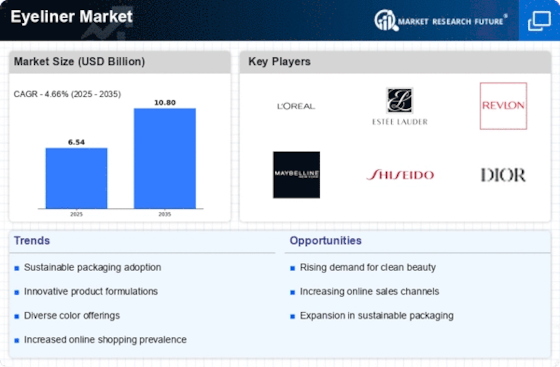
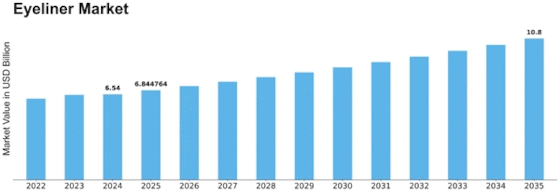
As per Market Research Future analysis, the Eyeliner Market Size was estimated at 6.54 USD Billion in 2024. The Eyeliner industry is projected to grow from 6.845 USD Billion in 2025 to 10.8 USD Billion by 2035, exhibiting a compound annual growth rate (CAGR) of 4.66% during the forecast period 2025 - 2035

Key Market Trends & Highlights

The Eyeliner Market is experiencing a dynamic shift towards sustainability and customization, driven by consumer preferences and technological advancements.

  • The rise of clean beauty products is reshaping consumer expectations in the eyeliner market.
  • Social media continues to play a pivotal role in influencing purchasing decisions, particularly among younger demographics.
  • In North America, liquid eyeliners dominate the market, while gel formulations are rapidly gaining traction in the Asia-Pacific region.
  • The increasing demand for long-lasting formulations and the expansion of e-commerce platforms are key drivers propelling market growth.

Market Size & Forecast

2024 Market Size 6.54 (USD Billion)
2035 Market Size 10.8 (USD Billion)
CAGR (2025 - 2035) 4.66%
Largest Regional Market Share in 2024 North America

Major Players

L'Oreal (FR), Estée Lauder (US), Revlon (US), Maybelline (US), Shiseido (JP), Dior (FR), Lancôme (FR), Urban Decay (US), NYX (US)

Market Trends

The Eyeliner Market is currently experiencing a dynamic evolution, characterized by shifting consumer preferences and innovative product offerings. As beauty standards continue to evolve, there is a noticeable inclination towards products that not only enhance aesthetics but also prioritize skin health. This trend is likely influenced by a growing awareness of ingredients and formulations, prompting brands to develop eyeliners that are both effective and gentle on the skin. Furthermore, the rise of social media platforms has significantly impacted consumer behavior, with influencers playing a pivotal role in shaping trends and driving demand for specific eyeliner styles and formulations. In addition to changing consumer preferences, the Eyeliner Market is witnessing a surge in demand for sustainable and eco-friendly products. Brands are increasingly adopting environmentally conscious practices, from packaging to ingredient sourcing, which resonates with a more environmentally aware consumer base. This shift towards sustainability may not only enhance brand loyalty but also attract new customers who prioritize ethical consumption. Overall, the Eyeliner Market appears poised for continued growth, driven by innovation, sustainability, and the influence of digital platforms.

Rise of Clean beauty products

There is a growing trend towards clean beauty within the Eyeliner Market, as consumers increasingly seek products free from harmful chemicals. This shift is prompting brands to reformulate their offerings, focusing on natural ingredients that are safer for the skin.

Influence of Social Media

Social media platforms are playing a crucial role in shaping consumer preferences in the Eyeliner Market. Influencers and beauty gurus are driving trends, showcasing various eyeliner styles and techniques, which significantly impacts purchasing decisions.

Sustainability and Eco-Friendly Practices

The Eyeliner Market is witnessing a notable shift towards sustainability, with brands adopting eco-friendly practices. This includes using recyclable packaging and ethically sourced ingredients, appealing to environmentally conscious consumers.

Eyeliner Market Market Drivers

Expansion of E-commerce Platforms

The Eyeliner Market is experiencing a significant transformation due to the expansion of e-commerce platforms. With the rise of online shopping, consumers are increasingly turning to digital channels for their beauty purchases. This shift has been accelerated by the convenience and accessibility that e-commerce provides, allowing consumers to explore a wider range of products from various brands. Data suggests that online sales of cosmetics, including eyeliners, have seen a remarkable increase, with many consumers preferring to shop from the comfort of their homes. As e-commerce continues to grow, brands in the Eyeliner Market are likely to invest more in digital marketing strategies and online presence, enhancing their reach and engagement with consumers.

Influence of Celebrity Endorsements

The Eyeliner Market is significantly influenced by celebrity endorsements, which play a crucial role in shaping consumer preferences. High-profile figures often collaborate with beauty brands to promote their products, creating a sense of aspiration among consumers. This trend is particularly evident in the rise of makeup tutorials and beauty influencers on social media platforms, where celebrities showcase their favorite eyeliners. Data indicates that products endorsed by celebrities tend to experience a spike in sales, as consumers are drawn to the perceived quality and effectiveness of these items. As the Eyeliner Market continues to evolve, the impact of celebrity endorsements is likely to remain a powerful driver, influencing purchasing decisions and brand loyalty.

Emphasis on Vegan and Cruelty-Free Products

The Eyeliner Market is experiencing a notable emphasis on vegan and cruelty-free products, driven by a growing consumer awareness regarding ethical beauty choices. Many consumers are now prioritizing products that align with their values, seeking out eyeliners that are free from animal-derived ingredients and not tested on animals. This shift is reflected in the increasing number of brands that are reformulating their products to meet these ethical standards. Market data indicates that the demand for vegan cosmetics is on the rise, with consumers actively seeking brands that promote sustainability and ethical practices. As the Eyeliner Market adapts to these changing consumer preferences, it is likely to see a continued expansion of vegan and cruelty-free product lines.

Increasing Demand for Long-Lasting Formulations

The Eyeliner Market is witnessing a notable shift towards long-lasting formulations. Consumers increasingly prefer products that offer durability and resistance to smudging, which aligns with their busy lifestyles. This trend is reflected in the growing sales of waterproof and gel eyeliners, which have gained popularity due to their ability to withstand various conditions. According to recent data, the long-wear segment is projected to account for a substantial share of the market, indicating a clear consumer preference. As brands innovate to meet this demand, the Eyeliner Market is likely to see a surge in product offerings that emphasize longevity and performance, catering to the needs of modern consumers who seek reliability in their makeup products.

Growing Interest in Customizable Beauty Products

The Eyeliner Market is witnessing a growing interest in customizable beauty products, reflecting a broader trend towards personalization in cosmetics. Consumers are increasingly seeking products that allow them to express their individuality and creativity. This trend is evident in the rise of brands offering customizable eyeliner shades and formulations, enabling consumers to create their unique looks. Market data suggests that the demand for personalized beauty solutions is on the rise, with many consumers willing to pay a premium for products that cater to their specific preferences. As this trend continues, the Eyeliner Market is likely to see an influx of innovative offerings that prioritize customization, appealing to a diverse range of consumers.

Market Segment Insights

By Type: Liquid (Largest) vs. Gel (Fastest-Growing)

<p>In the Eyeliner Market, the liquid segment holds the largest market share due to its popularity among consumers for its ease of application and long-lasting finish. Many brands have introduced a variety of liquid eyeliners in different shades and formulas to cater to diverse consumer preferences, solidifying liquid eyeliners as the dominant choice. On the other hand, the gel segment is rapidly gaining traction, attributed to its smooth consistency and versatility, providing users with both precision and blendability for various looks.</p>

<p>Liquid (Dominant) vs. Gel (Emerging)</p>

<p>The liquid eyeliner segment is characterized by its wide array of offerings, ranging from waterproof to smudge-proof formulations. This type is particularly favored for its sharp application and vibrant color payoff, making it a staple in many makeup routines. Conversely, gel eyeliners are emerging as a favorite among makeup enthusiasts for their creamy texture and ability to create both bold and subtle lines. Gel eyeliners often combine the benefits of liquid and pencil formulations, appealing to consumers looking for longevity without compromising ease of use. As makeup trends evolve towards more versatile products, gel eyeliners are poised to capture a larger market share.</p>

By Application: Personal Application (Largest) vs. Professional Application (Fastest-Growing)

<p>The Eyeliner Market is segmented into three distinct applications: personal application, professional application, and the entertainment industry. Among these, personal application holds the largest market share, as everyday consumers increasingly seek cosmetic products for daily use. Professional application follows closely, driven by the demand from makeup artists and beauty professionals who utilize top-tier products for their clients, ensuring stellar results at events and photoshoots. The entertainment industry, while smaller, also contributes a significant amount to the market, fueled by the needs of film and television production.</p>

<p>Application Types: Personal Application (Dominant) vs. Entertainment Industry (Emerging)</p>

<p>In the Eyeliner Market, personal application stands out as the dominant category. This segment is characterized by a broad range of products catering to diverse consumer preferences, from liquid eyeliners to pencil formulations, appealing to everyday users. The rising trend of beauty influencers and tutorials has boosted personal application purchases, making it a staple in many consumers' beauty routines. On the other hand, the entertainment industry serves as an emerging segment, gaining traction as film and television producers opt for high-quality eyeliners to achieve specific artistic effects. This segment is growing rapidly due to the increasing number of productions and events that demand intricate makeup artistry, reflecting a shift towards specialized products for professional use.</p>

By Distribution Channel: Online (Largest) vs. Offline (Fastest-Growing)

<p>In the Eyeliner Market, online distribution channels have emerged as the dominant force, capturing the largest share of market sales. With consumers increasingly turning to e-commerce platforms for convenience and a wider product selection, online sales of eyeliners outpace offline channels. The accessibility provided by online shopping has revolutionized how consumers purchase beauty products, contributing significantly to the overall growth of this segment.</p>

<p>Distribution Channels: Online (Dominant) vs. Offline (Emerging)</p>

<p>The online distribution channel represents a transformative shift in consumer purchasing behavior, where beauty enthusiasts favor the ease of browsing and buying eyeliners from their homes. This channel benefits from digital marketing strategies, social media influence, and extensive product availability that traditional retail does not match. Conversely, the offline segment, while currently smaller, is witnessing rapid growth as stores adapt with experiential shopping opportunities and personalized customer services, making it an emerging player in the market. As brands invest in these diversification strategies, offline sales are projected to gain momentum, appealing to consumers seeking immediate product gratification.</p>

Get more detailed insights about Eyeliner Market Research Report - Global Forecast till 2035

Regional Insights

North America : Cosmetic Powerhouse

The North American eyeliner market is driven by increasing consumer demand for innovative and high-quality cosmetic products. The region holds the largest market share at approximately 40%, with the U.S. being the primary contributor. Regulatory support for cosmetic safety and quality standards further enhances market growth. The trend towards cruelty-free and vegan products is also gaining traction, influencing purchasing decisions. Leading the market are major players like L'Oreal, Estée Lauder, and Revlon, which dominate with their extensive product lines and strong brand loyalty. The competitive landscape is characterized by continuous innovation, with brands focusing on sustainable packaging and formulations. The U.S. market is particularly vibrant, with a growing preference for online shopping, allowing brands to reach a wider audience effectively.

Europe : Diverse and Dynamic Market

Europe's eyeliner market is characterized by a diverse consumer base and a strong inclination towards premium products. The region holds the second-largest market share at around 30%. Factors such as increasing disposable income and a growing interest in beauty trends are driving demand. Regulatory frameworks, including the EU Cosmetics Regulation, ensure product safety and efficacy, fostering consumer trust and market growth. Key players in Europe include L'Oreal, Dior, and Lancôme, which leverage their heritage and innovation to capture market share. The competitive landscape is marked by a mix of established brands and emerging players focusing on niche markets. Countries like France and Germany lead in sales, with consumers increasingly favoring eco-friendly and sustainable products, reflecting a broader trend towards responsible consumption.

Asia-Pacific : Emerging Market Potential

The Asia-Pacific eyeliner market is witnessing rapid growth, driven by rising urbanization and increasing beauty consciousness among consumers. The region is projected to hold a market share of approximately 25%. Countries like China and India are leading this growth, fueled by a young population and a surge in online retail. Regulatory initiatives aimed at enhancing product safety and quality are also contributing to market expansion. China stands out as a significant player, with brands like Shiseido and local companies gaining traction. The competitive landscape is evolving, with a mix of international and domestic brands vying for market share. The increasing influence of social media and beauty influencers is shaping consumer preferences, leading to a demand for innovative and trendy eyeliner products that cater to diverse beauty standards.

Middle East and Africa : Untapped Market Opportunities

The Middle East and Africa eyeliner market is emerging as a significant player, driven by a growing middle class and increasing interest in beauty products. The region holds a market share of about 5%. Factors such as rising disposable incomes and a shift towards Western beauty standards are propelling demand. Regulatory bodies are also focusing on enhancing product safety, which is crucial for consumer confidence and market growth. Countries like the UAE and South Africa are leading the market, with a mix of local and international brands competing for consumer attention. The presence of key players such as L'Oreal and Maybelline is notable, as they adapt their offerings to cater to regional preferences. The competitive landscape is characterized by a growing trend towards online shopping, making beauty products more accessible to consumers across the region.

Key Players and Competitive Insights

Leading market players are investing heavily in research and development in order to expand their product lines, which will help the Eyeliner Market grow even more. Market participants are also undertaking a variety of strategic activities to expand their footprint, with important market developments including new product launches, contractual agreements, mergers and acquisitions, higher investments, and collaboration with other organizations. To expand and survive in a more competitive and rising market climate, the Eyeliner industry must offer cost-effective items.
Manufacturing locally to minimize operational costs is one of the key business tactics used by manufacturers in the Eyeliner industry to benefit clients and increase the market sector. In recent years, the Eyeliner industry has offered some of the most significant advantages to medicine. Major players in the Eyeliner Market, including Kao Corporation (Japan), Christian Dior SE (France), Mary Kay Inc. (US), Shiseido Co.
Ltd (Japan), L’Oréal S.A (France), The Estée Lauder Companies Inc. (US), Amore Pacific Corporation (South Korea), Chanel S.A. (France), Sisley Paris (France), Jordana Cosmetics Corporation (US), Iredale Mineral Cosmetics Ltd. (US), Markwins International Corp. (US), LG Household & Health Care Ltd. (South Korea), Marie Dalgar (China), Kazi Lan Carslan (China), Flamingo Beauty Supply (US), are attempting to increase market demand by investing in research and development operations.
Personal care products are offered by L'Oreal SA (L'Oreal). The business produces and sells cosmetics, fragrances, hair care, skincare, sunscreen, and coloring products. Lancome Giorgio Armani, Yves Saint Laurent, Biotherm, Kiehl's, Ralph Lauren, Shu Uemura, Cacharel, Helena Rubinstein, Clarisonic, Diesel, Viktor&Rolf, Yue Sai, Essie, Maybelline New York, Redken, Kerastase, and Matrix are just a few of the names that L'Oreal sells products under. Hair salons, mass-market retailers, perfumery stores, department stores, pharmacies, drugstores, medispas, branded retailers, and travel retailers make up the company's distribution network for its goods.
In addition to having physical locations, the company also uses e-commerce platforms to sell its goods online. North America, Latin America, Europe, Asia-Pacific, Africa, and the Middle East are all regions where the company conducts business. The headquarters of L'Oreal are in Clichy, Ile De France, and France.
The company Mary Kay Inc. (Mary Kay) sells color cosmetics and skin care items. The company's product line includes a wide variety of cosmetics, skin care, body care, fragrance, and acne treatment items. Additionally, it offers consumers gift baskets, electronic catalogues, mobile apps, and online virtual makeovers. Time Wise, Clear Proof, Mary Kay MK, Men Indulge, Beauty Blotters, Satin Lips, Satin Hands, Belara, MK High Intensity, Domain, Tribute, True Dimensions, NouriShine Plus, and Lash Love are just a few of the brands that Mary Kay sells goods under.
China, Mexico, Russia, the US, South Korea, the UK, Taiwan, Poland, and Germany are among the countries where the corporation conducts business. Dallas, Texas, in the US, serves as the home base for Mary Kay.

Key Companies in the Eyeliner Market include

Industry Developments

For Instance, July 2022 R.E.M. Beauty owner Ariana Grande announced the release of the company's signature eye set, which includes three of its best-selling items. It has a Borderline Eyeliner Market Marker that is simple to use and gives the eye a dramatic appearance.

For Instance, February 2022 Gwen Stefani announced the introduction of her new makeup brand, GXVE, which includes a variety of lipstick formulas in satin, matte, liquid, black, and blue eyeliners with quads of eye shadow, brow pencils, face oils, and other products.

Future Outlook

Eyeliner Market Future Outlook

The Eyeliner Market is projected to grow at a 4.66% CAGR from 2025 to 2035, driven by increasing consumer demand for innovative products and sustainable packaging solutions.

New opportunities lie in:

  • Expansion of vegan and cruelty-free eyeliner lines
  • Development of smart eyeliner applicators with integrated technology
  • Partnerships with beauty influencers for targeted marketing campaigns

By 2035, the Eyeliner Market is expected to achieve robust growth, reflecting evolving consumer preferences and innovative product offerings.

Market Segmentation

Eyeliner Market Type Outlook

  • Liquid
  • Pen
  • Powder
  • Wax
  • Kohl
  • Gel
  • Others

Eyeliner Market Application Outlook

  • Personal application
  • Professional application
  • Entertainment industry

Eyeliner Market Distribution Channel Outlook

  • Online
  • Offline

Report Scope

MARKET SIZE 2024 6.54(USD Billion)
MARKET SIZE 2025 6.845(USD Billion)
MARKET SIZE 2035 10.8(USD Billion)
COMPOUND ANNUAL GROWTH RATE (CAGR) 4.66% (2025 - 2035)
REPORT COVERAGE Revenue Forecast, Competitive Landscape, Growth Factors, and Trends
BASE YEAR 2024
Market Forecast Period 2025 - 2035
Historical Data 2019 - 2024
Market Forecast Units USD Billion
Key Companies Profiled L'Oreal (FR), Estée Lauder (US), Revlon (US), Maybelline (US), Shiseido (JP), Dior (FR), Lancôme (FR), Urban Decay (US), NYX (US)
Segments Covered Product Type, Application, Distribution Channel, Region
Key Market Opportunities Growing demand for clean beauty products presents opportunities in the Eyeliner Market.
Key Market Dynamics Rising consumer preference for long-lasting and waterproof formulations drives innovation in the eyeliner market.
Countries Covered North America, Europe, APAC, South America, MEA

FAQs

What is the current valuation of the Eyeliner Market as of 2024?

<p>The Eyeliner Market was valued at 6.54 USD Billion in 2024.</p>

What is the projected market size for the Eyeliner Market in 2035?

<p>The Eyeliner Market is projected to reach 10.8 USD Billion by 2035.</p>

What is the expected CAGR for the Eyeliner Market during the forecast period 2025 - 2035?

<p>The expected CAGR for the Eyeliner Market during 2025 - 2035 is 4.66%.</p>

Which segment of the Eyeliner Market is expected to grow the most in terms of type?

<p>The Liquid eyeliner segment is anticipated to grow from 1.5 USD Billion in 2024 to 2.5 USD Billion by 2035.</p>

How does the distribution channel impact the Eyeliner Market's growth?

<p>The Offline distribution channel was valued at 3.92 USD Billion in 2024 and is expected to grow to 6.5 USD Billion by 2035.</p>

What are the key applications driving the Eyeliner Market?

<p>Personal application is projected to increase from 2.62 USD Billion in 2024 to 4.2 USD Billion by 2035.</p>

Which companies are leading the Eyeliner Market?

Key players in the Eyeliner Market include L'Oreal, Estée Lauder, Revlon, and Maybelline.

What is the growth outlook for the Gel eyeliner segment?

The Gel eyeliner segment is expected to grow from 1.0 USD Billion in 2024 to 1.5 USD Billion by 2035.

How does the professional application segment compare to personal application in the Eyeliner Market?

The professional application segment was valued at 2.08 USD Billion in 2024 and is projected to reach 3.3 USD Billion by 2035.

What is the market trend for Kohl eyeliners in the coming years?

The Kohl eyeliner segment is expected to grow from 0.6 USD Billion in 2024 to 1.0 USD Billion by 2035.

  1. SECTION I: EXECUTIVE SUMMARY AND KEY HIGHLIGHTS
    1. | 1.1 EXECUTIVE SUMMARY
    2. | | 1.1.1 Market Overview
    3. | | 1.1.2 Key Findings
    4. | | 1.1.3 Market Segmentation
    5. | | 1.1.4 Competitive Landscape
    6. | | 1.1.5 Challenges and Opportunities
    7. | | 1.1.6 Future Outlook
  2. SECTION II: SCOPING, METHODOLOGY AND MARKET STRUCTURE
    1. | 2.1 MARKET INTRODUCTION
    2. | | 2.1.1 Definition
    3. | | 2.1.2 Scope of the study
    4. | | | 2.1.2.1 Research Objective
    5. | | | 2.1.2.2 Assumption
    6. | | | 2.1.2.3 Limitations
    7. | 2.2 RESEARCH METHODOLOGY
    8. | | 2.2.1 Overview
    9. | | 2.2.2 Data Mining
    10. | | 2.2.3 Secondary Research
    11. | | 2.2.4 Primary Research
    12. | | | 2.2.4.1 Primary Interviews and Information Gathering Process
    13. | | | 2.2.4.2 Breakdown of Primary Respondents
    14. | | 2.2.5 Forecasting Model
    15. | | 2.2.6 Market Size Estimation
    16. | | | 2.2.6.1 Bottom-Up Approach
    17. | | | 2.2.6.2 Top-Down Approach
    18. | | 2.2.7 Data Triangulation
    19. | | 2.2.8 Validation
  3. SECTION III: QUALITATIVE ANALYSIS
    1. | 3.1 MARKET DYNAMICS
    2. | | 3.1.1 Overview
    3. | | 3.1.2 Drivers
    4. | | 3.1.3 Restraints
    5. | | 3.1.4 Opportunities
    6. | 3.2 MARKET FACTOR ANALYSIS
    7. | | 3.2.1 Value chain Analysis
    8. | | 3.2.2 Porter's Five Forces Analysis
    9. | | | 3.2.2.1 Bargaining Power of Suppliers
    10. | | | 3.2.2.2 Bargaining Power of Buyers
    11. | | | 3.2.2.3 Threat of New Entrants
    12. | | | 3.2.2.4 Threat of Substitutes
    13. | | | 3.2.2.5 Intensity of Rivalry
    14. | | 3.2.3 COVID-19 Impact Analysis
    15. | | | 3.2.3.1 Market Impact Analysis
    16. | | | 3.2.3.2 Regional Impact
    17. | | | 3.2.3.3 Opportunity and Threat Analysis
  4. SECTION IV: QUANTITATIVE ANALYSIS
    1. | 4.1 Consumer and Retail, BY Type (USD Billion)
    2. | | 4.1.1 Liquid
    3. | | 4.1.2 Pen
    4. | | 4.1.3 Powder
    5. | | 4.1.4 Wax
    6. | | 4.1.5 Kohl
    7. | | 4.1.6 Gel
    8. | | 4.1.7 Others
    9. | 4.2 Consumer and Retail, BY Application (USD Billion)
    10. | | 4.2.1 Personal application
    11. | | 4.2.2 Professional application
    12. | | 4.2.3 Entertainment industry
    13. | 4.3 Consumer and Retail, BY Distribution Channel (USD Billion)
    14. | | 4.3.1 Online
    15. | | 4.3.2 Offline
    16. | 4.4 Consumer and Retail, BY Region (USD Billion)
    17. | | 4.4.1 North America
    18. | | | 4.4.1.1 US
    19. | | | 4.4.1.2 Canada
    20. | | 4.4.2 Europe
    21. | | | 4.4.2.1 Germany
    22. | | | 4.4.2.2 UK
    23. | | | 4.4.2.3 France
    24. | | | 4.4.2.4 Russia
    25. | | | 4.4.2.5 Italy
    26. | | | 4.4.2.6 Spain
    27. | | | 4.4.2.7 Rest of Europe
    28. | | 4.4.3 APAC
    29. | | | 4.4.3.1 China
    30. | | | 4.4.3.2 India
    31. | | | 4.4.3.3 Japan
    32. | | | 4.4.3.4 South Korea
    33. | | | 4.4.3.5 Malaysia
    34. | | | 4.4.3.6 Thailand
    35. | | | 4.4.3.7 Indonesia
    36. | | | 4.4.3.8 Rest of APAC
    37. | | 4.4.4 South America
    38. | | | 4.4.4.1 Brazil
    39. | | | 4.4.4.2 Mexico
    40. | | | 4.4.4.3 Argentina
    41. | | | 4.4.4.4 Rest of South America
    42. | | 4.4.5 MEA
    43. | | | 4.4.5.1 GCC Countries
    44. | | | 4.4.5.2 South Africa
    45. | | | 4.4.5.3 Rest of MEA
  5. SECTION V: COMPETITIVE ANALYSIS
    1. | 5.1 Competitive Landscape
    2. | | 5.1.1 Overview
    3. | | 5.1.2 Competitive Analysis
    4. | | 5.1.3 Market share Analysis
    5. | | 5.1.4 Major Growth Strategy in the Consumer and Retail
    6. | | 5.1.5 Competitive Benchmarking
    7. | | 5.1.6 Leading Players in Terms of Number of Developments in the Consumer and Retail
    8. | | 5.1.7 Key developments and growth strategies
    9. | | | 5.1.7.1 New Product Launch/Service Deployment
    10. | | | 5.1.7.2 Merger & Acquisitions
    11. | | | 5.1.7.3 Joint Ventures
    12. | | 5.1.8 Major Players Financial Matrix
    13. | | | 5.1.8.1 Sales and Operating Income
    14. | | | 5.1.8.2 Major Players R&D Expenditure. 2023
    15. | 5.2 Company Profiles
    16. | | 5.2.1 L'Oreal (FR)
    17. | | | 5.2.1.1 Financial Overview
    18. | | | 5.2.1.2 Products Offered
    19. | | | 5.2.1.3 Key Developments
    20. | | | 5.2.1.4 SWOT Analysis
    21. | | | 5.2.1.5 Key Strategies
    22. | | 5.2.2 Estée Lauder (US)
    23. | | | 5.2.2.1 Financial Overview
    24. | | | 5.2.2.2 Products Offered
    25. | | | 5.2.2.3 Key Developments
    26. | | | 5.2.2.4 SWOT Analysis
    27. | | | 5.2.2.5 Key Strategies
    28. | | 5.2.3 Revlon (US)
    29. | | | 5.2.3.1 Financial Overview
    30. | | | 5.2.3.2 Products Offered
    31. | | | 5.2.3.3 Key Developments
    32. | | | 5.2.3.4 SWOT Analysis
    33. | | | 5.2.3.5 Key Strategies
    34. | | 5.2.4 Maybelline (US)
    35. | | | 5.2.4.1 Financial Overview
    36. | | | 5.2.4.2 Products Offered
    37. | | | 5.2.4.3 Key Developments
    38. | | | 5.2.4.4 SWOT Analysis
    39. | | | 5.2.4.5 Key Strategies
    40. | | 5.2.5 Shiseido (JP)
    41. | | | 5.2.5.1 Financial Overview
    42. | | | 5.2.5.2 Products Offered
    43. | | | 5.2.5.3 Key Developments
    44. | | | 5.2.5.4 SWOT Analysis
    45. | | | 5.2.5.5 Key Strategies
    46. | | 5.2.6 Dior (FR)
    47. | | | 5.2.6.1 Financial Overview
    48. | | | 5.2.6.2 Products Offered
    49. | | | 5.2.6.3 Key Developments
    50. | | | 5.2.6.4 SWOT Analysis
    51. | | | 5.2.6.5 Key Strategies
    52. | | 5.2.7 Lancôme (FR)
    53. | | | 5.2.7.1 Financial Overview
    54. | | | 5.2.7.2 Products Offered
    55. | | | 5.2.7.3 Key Developments
    56. | | | 5.2.7.4 SWOT Analysis
    57. | | | 5.2.7.5 Key Strategies
    58. | | 5.2.8 Urban Decay (US)
    59. | | | 5.2.8.1 Financial Overview
    60. | | | 5.2.8.2 Products Offered
    61. | | | 5.2.8.3 Key Developments
    62. | | | 5.2.8.4 SWOT Analysis
    63. | | | 5.2.8.5 Key Strategies
    64. | | 5.2.9 NYX (US)
    65. | | | 5.2.9.1 Financial Overview
    66. | | | 5.2.9.2 Products Offered
    67. | | | 5.2.9.3 Key Developments
    68. | | | 5.2.9.4 SWOT Analysis
    69. | | | 5.2.9.5 Key Strategies
    70. | 5.3 Appendix
    71. | | 5.3.1 References
    72. | | 5.3.2 Related Reports
  6. LIST OF FIGURES
    1. | 6.1 MARKET SYNOPSIS
    2. | 6.2 NORTH AMERICA MARKET ANALYSIS
    3. | 6.3 US MARKET ANALYSIS BY TYPE
    4. | 6.4 US MARKET ANALYSIS BY APPLICATION
    5. | 6.5 US MARKET ANALYSIS BY DISTRIBUTION CHANNEL
    6. | 6.6 CANADA MARKET ANALYSIS BY TYPE
    7. | 6.7 CANADA MARKET ANALYSIS BY APPLICATION
    8. | 6.8 CANADA MARKET ANALYSIS BY DISTRIBUTION CHANNEL
    9. | 6.9 EUROPE MARKET ANALYSIS
    10. | 6.10 GERMANY MARKET ANALYSIS BY TYPE
    11. | 6.11 GERMANY MARKET ANALYSIS BY APPLICATION
    12. | 6.12 GERMANY MARKET ANALYSIS BY DISTRIBUTION CHANNEL
    13. | 6.13 UK MARKET ANALYSIS BY TYPE
    14. | 6.14 UK MARKET ANALYSIS BY APPLICATION
    15. | 6.15 UK MARKET ANALYSIS BY DISTRIBUTION CHANNEL
    16. | 6.16 FRANCE MARKET ANALYSIS BY TYPE
    17. | 6.17 FRANCE MARKET ANALYSIS BY APPLICATION
    18. | 6.18 FRANCE MARKET ANALYSIS BY DISTRIBUTION CHANNEL
    19. | 6.19 RUSSIA MARKET ANALYSIS BY TYPE
    20. | 6.20 RUSSIA MARKET ANALYSIS BY APPLICATION
    21. | 6.21 RUSSIA MARKET ANALYSIS BY DISTRIBUTION CHANNEL
    22. | 6.22 ITALY MARKET ANALYSIS BY TYPE
    23. | 6.23 ITALY MARKET ANALYSIS BY APPLICATION
    24. | 6.24 ITALY MARKET ANALYSIS BY DISTRIBUTION CHANNEL
    25. | 6.25 SPAIN MARKET ANALYSIS BY TYPE
    26. | 6.26 SPAIN MARKET ANALYSIS BY APPLICATION
    27. | 6.27 SPAIN MARKET ANALYSIS BY DISTRIBUTION CHANNEL
    28. | 6.28 REST OF EUROPE MARKET ANALYSIS BY TYPE
    29. | 6.29 REST OF EUROPE MARKET ANALYSIS BY APPLICATION
    30. | 6.30 REST OF EUROPE MARKET ANALYSIS BY DISTRIBUTION CHANNEL
    31. | 6.31 APAC MARKET ANALYSIS
    32. | 6.32 CHINA MARKET ANALYSIS BY TYPE
    33. | 6.33 CHINA MARKET ANALYSIS BY APPLICATION
    34. | 6.34 CHINA MARKET ANALYSIS BY DISTRIBUTION CHANNEL
    35. | 6.35 INDIA MARKET ANALYSIS BY TYPE
    36. | 6.36 INDIA MARKET ANALYSIS BY APPLICATION
    37. | 6.37 INDIA MARKET ANALYSIS BY DISTRIBUTION CHANNEL
    38. | 6.38 JAPAN MARKET ANALYSIS BY TYPE
    39. | 6.39 JAPAN MARKET ANALYSIS BY APPLICATION
    40. | 6.40 JAPAN MARKET ANALYSIS BY DISTRIBUTION CHANNEL
    41. | 6.41 SOUTH KOREA MARKET ANALYSIS BY TYPE
    42. | 6.42 SOUTH KOREA MARKET ANALYSIS BY APPLICATION
    43. | 6.43 SOUTH KOREA MARKET ANALYSIS BY DISTRIBUTION CHANNEL
    44. | 6.44 MALAYSIA MARKET ANALYSIS BY TYPE
    45. | 6.45 MALAYSIA MARKET ANALYSIS BY APPLICATION
    46. | 6.46 MALAYSIA MARKET ANALYSIS BY DISTRIBUTION CHANNEL
    47. | 6.47 THAILAND MARKET ANALYSIS BY TYPE
    48. | 6.48 THAILAND MARKET ANALYSIS BY APPLICATION
    49. | 6.49 THAILAND MARKET ANALYSIS BY DISTRIBUTION CHANNEL
    50. | 6.50 INDONESIA MARKET ANALYSIS BY TYPE
    51. | 6.51 INDONESIA MARKET ANALYSIS BY APPLICATION
    52. | 6.52 INDONESIA MARKET ANALYSIS BY DISTRIBUTION CHANNEL
    53. | 6.53 REST OF APAC MARKET ANALYSIS BY TYPE
    54. | 6.54 REST OF APAC MARKET ANALYSIS BY APPLICATION
    55. | 6.55 REST OF APAC MARKET ANALYSIS BY DISTRIBUTION CHANNEL
    56. | 6.56 SOUTH AMERICA MARKET ANALYSIS
    57. | 6.57 BRAZIL MARKET ANALYSIS BY TYPE
    58. | 6.58 BRAZIL MARKET ANALYSIS BY APPLICATION
    59. | 6.59 BRAZIL MARKET ANALYSIS BY DISTRIBUTION CHANNEL
    60. | 6.60 MEXICO MARKET ANALYSIS BY TYPE
    61. | 6.61 MEXICO MARKET ANALYSIS BY APPLICATION
    62. | 6.62 MEXICO MARKET ANALYSIS BY DISTRIBUTION CHANNEL
    63. | 6.63 ARGENTINA MARKET ANALYSIS BY TYPE
    64. | 6.64 ARGENTINA MARKET ANALYSIS BY APPLICATION
    65. | 6.65 ARGENTINA MARKET ANALYSIS BY DISTRIBUTION CHANNEL
    66. | 6.66 REST OF SOUTH AMERICA MARKET ANALYSIS BY TYPE
    67. | 6.67 REST OF SOUTH AMERICA MARKET ANALYSIS BY APPLICATION
    68. | 6.68 REST OF SOUTH AMERICA MARKET ANALYSIS BY DISTRIBUTION CHANNEL
    69. | 6.69 MEA MARKET ANALYSIS
    70. | 6.70 GCC COUNTRIES MARKET ANALYSIS BY TYPE
    71. | 6.71 GCC COUNTRIES MARKET ANALYSIS BY APPLICATION
    72. | 6.72 GCC COUNTRIES MARKET ANALYSIS BY DISTRIBUTION CHANNEL
    73. | 6.73 SOUTH AFRICA MARKET ANALYSIS BY TYPE
    74. | 6.74 SOUTH AFRICA MARKET ANALYSIS BY APPLICATION
    75. | 6.75 SOUTH AFRICA MARKET ANALYSIS BY DISTRIBUTION CHANNEL
    76. | 6.76 REST OF MEA MARKET ANALYSIS BY TYPE
    77. | 6.77 REST OF MEA MARKET ANALYSIS BY APPLICATION
    78. | 6.78 REST OF MEA MARKET ANALYSIS BY DISTRIBUTION CHANNEL
    79. | 6.79 KEY BUYING CRITERIA OF CONSUMER AND RETAIL
    80. | 6.80 RESEARCH PROCESS OF MRFR
    81. | 6.81 DRO ANALYSIS OF CONSUMER AND RETAIL
    82. | 6.82 DRIVERS IMPACT ANALYSIS: CONSUMER AND RETAIL
    83. | 6.83 RESTRAINTS IMPACT ANALYSIS: CONSUMER AND RETAIL
    84. | 6.84 SUPPLY / VALUE CHAIN: CONSUMER AND RETAIL
    85. | 6.85 CONSUMER AND RETAIL, BY TYPE, 2024 (% SHARE)
    86. | 6.86 CONSUMER AND RETAIL, BY TYPE, 2024 TO 2035 (USD Billion)
    87. | 6.87 CONSUMER AND RETAIL, BY APPLICATION, 2024 (% SHARE)
    88. | 6.88 CONSUMER AND RETAIL, BY APPLICATION, 2024 TO 2035 (USD Billion)
    89. | 6.89 CONSUMER AND RETAIL, BY DISTRIBUTION CHANNEL, 2024 (% SHARE)
    90. | 6.90 CONSUMER AND RETAIL, BY DISTRIBUTION CHANNEL, 2024 TO 2035 (USD Billion)
    91. | 6.91 BENCHMARKING OF MAJOR COMPETITORS
  7. LIST OF TABLES
    1. | 7.1 LIST OF ASSUMPTIONS
    2. | | 7.1.1
    3. | 7.2 North America MARKET SIZE ESTIMATES; FORECAST
    4. | | 7.2.1 BY TYPE, 2025-2035 (USD Billion)
    5. | | 7.2.2 BY APPLICATION, 2025-2035 (USD Billion)
    6. | | 7.2.3 BY DISTRIBUTION CHANNEL, 2025-2035 (USD Billion)
    7. | 7.3 US MARKET SIZE ESTIMATES; FORECAST
    8. | | 7.3.1 BY TYPE, 2025-2035 (USD Billion)
    9. | | 7.3.2 BY APPLICATION, 2025-2035 (USD Billion)
    10. | | 7.3.3 BY DISTRIBUTION CHANNEL, 2025-2035 (USD Billion)
    11. | 7.4 Canada MARKET SIZE ESTIMATES; FORECAST
    12. | | 7.4.1 BY TYPE, 2025-2035 (USD Billion)
    13. | | 7.4.2 BY APPLICATION, 2025-2035 (USD Billion)
    14. | | 7.4.3 BY DISTRIBUTION CHANNEL, 2025-2035 (USD Billion)
    15. | 7.5 Europe MARKET SIZE ESTIMATES; FORECAST
    16. | | 7.5.1 BY TYPE, 2025-2035 (USD Billion)
    17. | | 7.5.2 BY APPLICATION, 2025-2035 (USD Billion)
    18. | | 7.5.3 BY DISTRIBUTION CHANNEL, 2025-2035 (USD Billion)
    19. | 7.6 Germany MARKET SIZE ESTIMATES; FORECAST
    20. | | 7.6.1 BY TYPE, 2025-2035 (USD Billion)
    21. | | 7.6.2 BY APPLICATION, 2025-2035 (USD Billion)
    22. | | 7.6.3 BY DISTRIBUTION CHANNEL, 2025-2035 (USD Billion)
    23. | 7.7 UK MARKET SIZE ESTIMATES; FORECAST
    24. | | 7.7.1 BY TYPE, 2025-2035 (USD Billion)
    25. | | 7.7.2 BY APPLICATION, 2025-2035 (USD Billion)
    26. | | 7.7.3 BY DISTRIBUTION CHANNEL, 2025-2035 (USD Billion)
    27. | 7.8 France MARKET SIZE ESTIMATES; FORECAST
    28. | | 7.8.1 BY TYPE, 2025-2035 (USD Billion)
    29. | | 7.8.2 BY APPLICATION, 2025-2035 (USD Billion)
    30. | | 7.8.3 BY DISTRIBUTION CHANNEL, 2025-2035 (USD Billion)
    31. | 7.9 Russia MARKET SIZE ESTIMATES; FORECAST
    32. | | 7.9.1 BY TYPE, 2025-2035 (USD Billion)
    33. | | 7.9.2 BY APPLICATION, 2025-2035 (USD Billion)
    34. | | 7.9.3 BY DISTRIBUTION CHANNEL, 2025-2035 (USD Billion)
    35. | 7.10 Italy MARKET SIZE ESTIMATES; FORECAST
    36. | | 7.10.1 BY TYPE, 2025-2035 (USD Billion)
    37. | | 7.10.2 BY APPLICATION, 2025-2035 (USD Billion)
    38. | | 7.10.3 BY DISTRIBUTION CHANNEL, 2025-2035 (USD Billion)
    39. | 7.11 Spain MARKET SIZE ESTIMATES; FORECAST
    40. | | 7.11.1 BY TYPE, 2025-2035 (USD Billion)
    41. | | 7.11.2 BY APPLICATION, 2025-2035 (USD Billion)
    42. | | 7.11.3 BY DISTRIBUTION CHANNEL, 2025-2035 (USD Billion)
    43. | 7.12 Rest of Europe MARKET SIZE ESTIMATES; FORECAST
    44. | | 7.12.1 BY TYPE, 2025-2035 (USD Billion)
    45. | | 7.12.2 BY APPLICATION, 2025-2035 (USD Billion)
    46. | | 7.12.3 BY DISTRIBUTION CHANNEL, 2025-2035 (USD Billion)
    47. | 7.13 APAC MARKET SIZE ESTIMATES; FORECAST
    48. | | 7.13.1 BY TYPE, 2025-2035 (USD Billion)
    49. | | 7.13.2 BY APPLICATION, 2025-2035 (USD Billion)
    50. | | 7.13.3 BY DISTRIBUTION CHANNEL, 2025-2035 (USD Billion)
    51. | 7.14 China MARKET SIZE ESTIMATES; FORECAST
    52. | | 7.14.1 BY TYPE, 2025-2035 (USD Billion)
    53. | | 7.14.2 BY APPLICATION, 2025-2035 (USD Billion)
    54. | | 7.14.3 BY DISTRIBUTION CHANNEL, 2025-2035 (USD Billion)
    55. | 7.15 India MARKET SIZE ESTIMATES; FORECAST
    56. | | 7.15.1 BY TYPE, 2025-2035 (USD Billion)
    57. | | 7.15.2 BY APPLICATION, 2025-2035 (USD Billion)
    58. | | 7.15.3 BY DISTRIBUTION CHANNEL, 2025-2035 (USD Billion)
    59. | 7.16 Japan MARKET SIZE ESTIMATES; FORECAST
    60. | | 7.16.1 BY TYPE, 2025-2035 (USD Billion)
    61. | | 7.16.2 BY APPLICATION, 2025-2035 (USD Billion)
    62. | | 7.16.3 BY DISTRIBUTION CHANNEL, 2025-2035 (USD Billion)
    63. | 7.17 South Korea MARKET SIZE ESTIMATES; FORECAST
    64. | | 7.17.1 BY TYPE, 2025-2035 (USD Billion)
    65. | | 7.17.2 BY APPLICATION, 2025-2035 (USD Billion)
    66. | | 7.17.3 BY DISTRIBUTION CHANNEL, 2025-2035 (USD Billion)
    67. | 7.18 Malaysia MARKET SIZE ESTIMATES; FORECAST
    68. | | 7.18.1 BY TYPE, 2025-2035 (USD Billion)
    69. | | 7.18.2 BY APPLICATION, 2025-2035 (USD Billion)
    70. | | 7.18.3 BY DISTRIBUTION CHANNEL, 2025-2035 (USD Billion)
    71. | 7.19 Thailand MARKET SIZE ESTIMATES; FORECAST
    72. | | 7.19.1 BY TYPE, 2025-2035 (USD Billion)
    73. | | 7.19.2 BY APPLICATION, 2025-2035 (USD Billion)
    74. | | 7.19.3 BY DISTRIBUTION CHANNEL, 2025-2035 (USD Billion)
    75. | 7.20 Indonesia MARKET SIZE ESTIMATES; FORECAST
    76. | | 7.20.1 BY TYPE, 2025-2035 (USD Billion)
    77. | | 7.20.2 BY APPLICATION, 2025-2035 (USD Billion)
    78. | | 7.20.3 BY DISTRIBUTION CHANNEL, 2025-2035 (USD Billion)
    79. | 7.21 Rest of APAC MARKET SIZE ESTIMATES; FORECAST
    80. | | 7.21.1 BY TYPE, 2025-2035 (USD Billion)
    81. | | 7.21.2 BY APPLICATION, 2025-2035 (USD Billion)
    82. | | 7.21.3 BY DISTRIBUTION CHANNEL, 2025-2035 (USD Billion)
    83. | 7.22 South America MARKET SIZE ESTIMATES; FORECAST
    84. | | 7.22.1 BY TYPE, 2025-2035 (USD Billion)
    85. | | 7.22.2 BY APPLICATION, 2025-2035 (USD Billion)
    86. | | 7.22.3 BY DISTRIBUTION CHANNEL, 2025-2035 (USD Billion)
    87. | 7.23 Brazil MARKET SIZE ESTIMATES; FORECAST
    88. | | 7.23.1 BY TYPE, 2025-2035 (USD Billion)
    89. | | 7.23.2 BY APPLICATION, 2025-2035 (USD Billion)
    90. | | 7.23.3 BY DISTRIBUTION CHANNEL, 2025-2035 (USD Billion)
    91. | 7.24 Mexico MARKET SIZE ESTIMATES; FORECAST
    92. | | 7.24.1 BY TYPE, 2025-2035 (USD Billion)
    93. | | 7.24.2 BY APPLICATION, 2025-2035 (USD Billion)
    94. | | 7.24.3 BY DISTRIBUTION CHANNEL, 2025-2035 (USD Billion)
    95. | 7.25 Argentina MARKET SIZE ESTIMATES; FORECAST
    96. | | 7.25.1 BY TYPE, 2025-2035 (USD Billion)
    97. | | 7.25.2 BY APPLICATION, 2025-2035 (USD Billion)
    98. | | 7.25.3 BY DISTRIBUTION CHANNEL, 2025-2035 (USD Billion)
    99. | 7.26 Rest of South America MARKET SIZE ESTIMATES; FORECAST
    100. | | 7.26.1 BY TYPE, 2025-2035 (USD Billion)
    101. | | 7.26.2 BY APPLICATION, 2025-2035 (USD Billion)
    102. | | 7.26.3 BY DISTRIBUTION CHANNEL, 2025-2035 (USD Billion)
    103. | 7.27 MEA MARKET SIZE ESTIMATES; FORECAST
    104. | | 7.27.1 BY TYPE, 2025-2035 (USD Billion)
    105. | | 7.27.2 BY APPLICATION, 2025-2035 (USD Billion)
    106. | | 7.27.3 BY DISTRIBUTION CHANNEL, 2025-2035 (USD Billion)
    107. | 7.28 GCC Countries MARKET SIZE ESTIMATES; FORECAST
    108. | | 7.28.1 BY TYPE, 2025-2035 (USD Billion)
    109. | | 7.28.2 BY APPLICATION, 2025-2035 (USD Billion)
    110. | | 7.28.3 BY DISTRIBUTION CHANNEL, 2025-2035 (USD Billion)
    111. | 7.29 South Africa MARKET SIZE ESTIMATES; FORECAST
    112. | | 7.29.1 BY TYPE, 2025-2035 (USD Billion)
    113. | | 7.29.2 BY APPLICATION, 2025-2035 (USD Billion)
    114. | | 7.29.3 BY DISTRIBUTION CHANNEL, 2025-2035 (USD Billion)
    115. | 7.30 Rest of MEA MARKET SIZE ESTIMATES; FORECAST
    116. | | 7.30.1 BY TYPE, 2025-2035 (USD Billion)
    117. | | 7.30.2 BY APPLICATION, 2025-2035 (USD Billion)
    118. | | 7.30.3 BY DISTRIBUTION CHANNEL, 2025-2035 (USD Billion)
    119. | 7.31 PRODUCT LAUNCH/PRODUCT DEVELOPMENT/APPROVAL
    120. | | 7.31.1
    121. | 7.32 ACQUISITION/PARTNERSHIP
    122. | | 7.32.1

Consumer and Retail Market Segmentation

Consumer and Retail By Type (USD Billion, 2025-2035)

  • Liquid
  • Pen
  • Powder
  • Wax
  • Kohl
  • Gel
  • Others

Consumer and Retail By Application (USD Billion, 2025-2035)

  • Personal application
  • Professional application
  • Entertainment industry

Consumer and Retail By Distribution Channel (USD Billion, 2025-2035)

  • Online
  • Offline
Infographic

Free Sample Request

Kindly complete the form below to receive a free sample of this Report

Get Free Sample

Customer Strories

Compare Licence

×
Features License Type
Single User Multiuser License Enterprise User
Price $4,950 $5,950 $7,250
Maximum User Access Limit 1 User Upto 10 Users Unrestricted Access Throughout the Organization
Free Customization
Direct Access to Analyst
Deliverable Format
Platform Access
Discount on Next Purchase 10% 15% 15%
Printable Versions