Request Free Sample ×

Kindly complete the form below to receive a free sample of this Report

* Please use a valid business email

Leading companies partner with us for data-driven Insights

clients tt-cursor
Hero Background
English
Chinese
French
Japanese
Korean
German
Spanish

Europe LNG Bunkering Market Analysis

ID: MRFR/EnP/11165-HCR
128 Pages
Swapnil Palwe
April 2026

Europe LNG Bunkering Market Research Report Information By Product Type (Truck-to-Ship, Port-to-Ship, Ship-to-Ship, and Portable Tanks), By Application (Container Fleet, Tanker Fleet, Cargo Fleet, Ferries, Inland Vessels, and Others) – and Europe Market Forecast Till 2035

Share:
Download PDF ×

We do not share your information with anyone. However, we may send you emails based on your report interest from time to time. You may contact us at any time to opt-out.

Europe LNG Bunkering Market Infographic
Purchase Options

Market Analysis

In-depth Analysis of Europe LNG Bunkering Market Industry Landscape

The LNG bunkering business is set for significant growth in emerging nations due to a variety of factors. One key driver is the rapid expansion of shipping and port infrastructure in these regions. As these nations experience economic growth and increased commerce, there is a rising demand for cleaner fuels. This demand is further fueled by the mounting regulatory pressure to reduce emissions from the maritime sector.

LNG bunkering, which involves supplying ships with liquefied natural gas, is emerging as an attractive alternative to traditional fossil fuels. One of its primary advantages is that it burns cleaner, emitting fewer greenhouse gases and air pollutants. This environmentally friendly aspect is gaining importance as more countries focus on sustainability and environmental conservation.

The business prospects for LNG bunkering are particularly promising in emerging markets, and this is attributed to several factors. Firstly, these nations are witnessing booming economies, leading to increased economic activities such as trade and commerce. The expansion of populations in these regions also contributes to a higher demand for goods and services, including the transportation of goods via ships.

Governments in many developing nations are taking proactive measures to address environmental concerns related to the maritime sector. New laws and regulations are being enacted to limit emissions from ships and encourage the use of cleaner-burning fuels like LNG. This regulatory push aligns with the global trend towards sustainability and the reduction of carbon footprints.

The growth in shipping and port infrastructure is a crucial factor contributing to the appeal of LNG bunkering in emerging nations. With increased economic activity, there is a higher volume of goods being transported, necessitating efficient and environmentally friendly fuel options for ships. As a result, the LNG bunkering business stands to benefit significantly from this trend.

The LNG bunkering business in emerging nations is poised for substantial growth due to the expansion of shipping and port infrastructure, the increasing demand for cleaner fuels, and the regulatory push to reduce emissions. The attractiveness of LNG bunkering is further enhanced by its environmentally friendly characteristics, making it a viable and appealing option for the shipping industry in these regions. As the world continues to prioritize sustainability, the LNG bunkering market is likely to play a pivotal role in meeting the evolving energy needs of the maritime sector in emerging nations.

Author
Author Profile
Swapnil Palwe
Team Lead - Research

With a technical background as Bachelor's in Mechanical Engineering, with MBA in Operations Management , Swapnil has 6+ years of experience in market research, consulting and analytics with the tasks of data mining, analysis, and project execution. He is the POC for our clients, for their consulting projects running under the Automotive/A&D domain. Swapnil has worked on major projects in verticals such as Aerospace & Defense, Automotive and many other domain projects. He has worked on projects for fortune 500 companies' syndicate and consulting projects along with several government projects.

Leave a Comment

FAQs

What is the current valuation of the Europe LNG bunkering market?

<p>As of 2024, the Europe LNG bunkering market was valued at 304.0 USD Million.</p>

What is the projected market valuation for the Europe LNG bunkering market in 2035?

<p>The market is projected to reach a valuation of 19,356.5 USD Million by 2035.</p>

What is the expected CAGR for the Europe LNG bunkering market during the forecast period?

<p>The expected CAGR for the Europe LNG bunkering market from 2025 to 2035 is 45.88%.</p>

Who are the key players in the Europe LNG bunkering market?

<p>Key players include Shell, TotalEnergies, Engie, Gasum, Svitzer, Bunker Holding, Höegh LNG, K Line, and Maritime LNG.</p>

Which application segment has the highest valuation in the Europe LNG bunkering market?

<p>The Commercial Shipping segment had the highest valuation at 6,000.0 USD Million.</p>

What is the valuation of the Truck-to-Ship bunkering method?

<p>The Truck-to-Ship bunkering method is valued at 10,356.5 USD Million.</p>

How does the valuation of Bio-LNG compare to that of Liquefied Natural Gas?

<p>Bio-LNG is valued at 3,000.0 USD Million, significantly lower than Liquefied Natural Gas at 12,000.0 USD Million.</p>

What is the valuation of the Offshore Support Vessels end-use segment?

<p>The Offshore Support Vessels end-use segment is valued at 2,500.0 USD Million.</p>

Which bunkering method has the lowest valuation?

<p>The Barge-to-Ship bunkering method has the lowest valuation at 1,000.0 USD Million.</p>

What is the projected growth trend for the Europe LNG bunkering market?

<p>The market appears to be on a robust growth trajectory, with projections indicating substantial increases in valuation by 2035.</p>

Market Summary

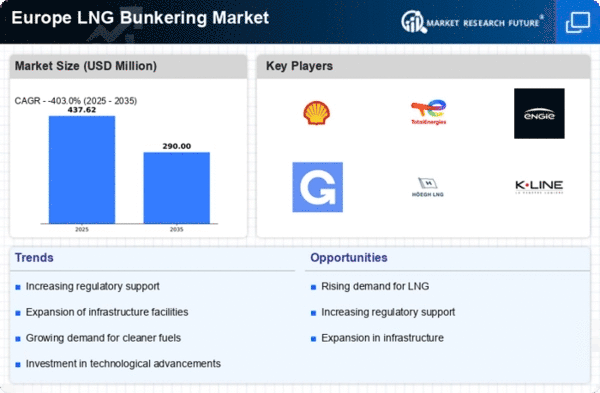
As per Market Research Future analysis, the LNG Bunkering Market Size was estimated at 456.0 USD Million in 2024. The Lng Bunkering market is projected to grow from 437.62 USD Million in 2025 to 290.0 USD Million by 2035, exhibiting a compound annual growth rate (CAGR) of 4.03% during the forecast period 2025 - 2035

Key Market Trends & Highlights

The Europe LNG bunkering market is experiencing robust growth driven by regulatory support and infrastructure expansion.

  • Germany remains the largest market for LNG bunkering, reflecting a strong commitment to cleaner marine fuels. The UK is emerging as the fastest-growing region, with increasing investments in LNG bunkering infrastructure. Shipping companies are increasingly adopting LNG as a viable alternative to traditional marine fuels, driven by economic considerations. Key market drivers include stringent environmental regulations and the economic viability of LNG as a sustainable shipping solution.

Market Size & Forecast

2024 Market Size 456.0 (USD Million)
2035 Market Size 290.0 (USD Million)
CAGR (2025 - 2035) -4.03%

Major Players

Shell (GB), <a href="https://marinefuels.totalenergies.com/products-and-services/liquefied-natural-gas">TotalEnergies </a>(FR), Engie (FR), Gasum (FI), Höegh LNG (NO), K Line (JP), MOL (JP), Sempra Infrastructure (US), <a href="https://www.wartsila.com/marine/products/simulation-and-training/technological-simulators/lng-bunkering-and-fuel-gas-supply-system-simulator">Wärtsilä </a>(FI)

Market Trends

The lng bunkering market is currently experiencing a transformative phase, driven by the increasing emphasis on environmental sustainability and regulatory frameworks aimed at reducing emissions. As nations within Europe implement stricter regulations on sulfur emissions, the demand for cleaner fuel alternatives, such as liquefied natural gas (LNG), is on the rise. This shift is not merely a response to regulatory pressures; it also reflects a broader commitment to achieving climate goals.

Consequently, ports are investing in infrastructure to support LNG bunkering operations, which is likely to enhance the overall efficiency and accessibility of this fuel option. Moreover, the lng bunkering market is witnessing a surge in interest from shipping companies seeking to modernize their fleets. The transition to LNG is perceived as a strategic move to comply with evolving environmental standards while potentially reducing operational costs.

The development of LNG bunkering facilities is becoming increasingly prevalent, with several ports across Europe expanding their capabilities. This trend indicates a robust future for LNG as a marine fuel, aligning with the maritime industry's shift towards sustainability and innovation. As the market evolves, collaboration among stakeholders, including governments, port authorities, and shipping companies, will be crucial in shaping the future landscape of LNG bunkering.

Regulatory Support for Cleaner Fuels

The lng bunkering market benefits from robust regulatory frameworks that promote the use of cleaner fuels. European regulations aimed at reducing greenhouse gas emissions and sulfur content in marine fuels are driving the adoption of LNG. This regulatory support is likely to encourage investment in LNG infrastructure and technology.

Expansion of Bunkering Infrastructure

There is a notable trend towards the expansion of LNG bunkering infrastructure across various ports. This development is essential for accommodating the growing demand for LNG as a marine fuel. Enhanced facilities are expected to improve the efficiency and reliability of bunkering operations.

Increased Adoption by Shipping Companies

Shipping companies are increasingly adopting LNG as a fuel source due to its environmental benefits and potential cost savings. This trend reflects a broader commitment to sustainability within the maritime sector, as companies seek to modernize their fleets and comply with stringent environmental regulations.

Europe LNG Bunkering Market Market Drivers

Environmental Regulations and Compliance

The stringent environmental regulations in Europe are driving the lng bunkering market. The European Union has implemented various directives aimed at reducing greenhouse gas emissions and promoting cleaner fuels. As a result, shipping companies are increasingly compelled to adopt liquefied natural gas (LNG) as a marine fuel.
The European Commission's commitment to achieving a 55% reduction in emissions by 2030 further emphasizes the need for cleaner alternatives. This regulatory landscape not only encourages investment in LNG bunkering infrastructure but also enhances the market's attractiveness. The lng bunkering market is likely to see a surge in demand as compliance with these regulations becomes essential for operational viability.

Economic Viability of LNG as a Marine Fuel

The economic viability of LNG as a marine fuel is a significant driver for the lng bunkering market in Europe. With fluctuating oil prices, LNG has emerged as a cost-effective alternative for shipping companies. The price of LNG is often more stable compared to traditional marine fuels, which can lead to substantial savings in operational costs.
Additionally, the lower sulfur content of LNG results in reduced fuel taxes and compliance costs associated with emissions regulations. As shipping companies seek to optimize their fuel expenditures, the attractiveness of LNG is likely to increase. This economic rationale is expected to propel the lng bunkering market forward, as more operators recognize the financial benefits of transitioning to LNG.

Investment in LNG Bunkering Infrastructure

Investment in LNG bunkering infrastructure is a crucial driver for the lng bunkering market in Europe. The establishment of new bunkering facilities and the expansion of existing ones are essential to meet the growing demand for LNG as a marine fuel. According to recent data, the European lng bunkering market is projected to grow at a CAGR of approximately 10% from 2025 to 2030.
Major ports across Europe are increasingly investing in LNG bunkering capabilities, which not only facilitates the refueling of LNG-powered vessels but also enhances the overall efficiency of maritime operations. This investment trend is likely to bolster the lng bunkering market, making it a pivotal component of the maritime sector.

Technological Advancements in LNG Bunkering

Technological advancements in LNG bunkering are significantly influencing the lng bunkering market. Innovations in LNG storage, transfer systems, and safety protocols are enhancing the efficiency and safety of bunkering operations. For instance, the development of ship-to-ship bunkering technology is streamlining the refueling process, reducing turnaround times for vessels.
Furthermore, advancements in monitoring and control systems are improving operational efficiency and safety standards. As these technologies become more widely adopted, they are likely to attract more shipping companies to consider LNG as a viable fuel option. This trend indicates a positive outlook for the lng bunkering market, as enhanced technology could lead to increased adoption rates.

Growing Demand for Sustainable Shipping Solutions

The growing demand for sustainable shipping solutions is a pivotal driver for the lng bunkering market. As environmental awareness increases among consumers and stakeholders, shipping companies are under pressure to adopt greener practices. The transition to LNG as a marine fuel aligns with this demand, as it significantly reduces emissions compared to conventional fuels.
The European shipping sector is increasingly focusing on sustainability, with many companies committing to carbon neutrality by 2050. This shift is likely to drive the adoption of LNG, as it is viewed as a bridge fuel towards more sustainable alternatives. Consequently, the lng bunkering market is expected to benefit from this trend, as more vessels are converted to LNG propulsion.

Market Segment Insights

By Application: Commercial Shipping (Largest) vs. Ferries (Fastest-Growing)

<p>In the Europe LNG bunkering market, the application segment is primarily dominated by commercial shipping, which represents the largest proportion due to its extensive use of liquefied natural gas as a cleaner fuel option. This segment, which includes cargo vessels that transport goods across Europe, significantly contributes to the overall market share. In contrast, the ferry segment is the fastest-growing application, driven by the increasing demand for environmentally friendly transportation options and the regulatory push for lower emissions in maritime operations. The growth trends within this segment are heavily influenced by advances in LNG infrastructure, government incentives for cleaner fuels, and the maritime industry's shift towards sustainability. As the European Union implements stricter emissions regulations, vessel operators are increasingly adopting LNG to comply with environmental standards. The ongoing investment in LNG bunkering facilities is also expected to boost the uptake of LNG amongst various application segments, particularly ferries, which are adapting to fuel-efficient technologies to attract environmentally conscious customers.</p>

<p>Commercial Shipping (Dominant) vs. Fishing Vessels (Emerging)</p>

<p>The dominant commercial shipping sector showcases significant advantages in the LNG bunkering market, leveraging its established supply chains and extensive global reach. This segment prioritizes operational efficiency and compliance with stringent emission regulations, leading to a transition to LNG as a viable alternative to traditional marine fuels. On the other hand, the fishing vessels segment is emerging as a noteworthy contender in the market. While it currently represents a smaller share of the LNG application landscape, increasing awareness regarding sustainability and the necessity to reduce carbon footprints is driving innovations in fuel options. Fishing vessels are slowly integrating LNG technology, propelled by the need for compliance with environmental standards and the appeal of reduced fuel costs over time. Overall, the balance between these two segments illustrates the shifting priorities within the maritime industry towards greener alternatives.</p>

By End Use: Marine Transportation (Largest) vs. Offshore Support Vessels (Fastest-Growing)

<p>In the Europe LNG bunkering market, the segment values are distributed primarily between Marine Transportation, Offshore Support Vessels, Port Operations, Shipbuilding, and Maintenance Services. Marine Transportation holds the largest share, driven by the rising demand for cleaner shipping fuels and stringent emissions regulations across Europe. Meanwhile, Offshore Support Vessels are emerging as a significant contributor, reflecting the increasing investment in offshore energy projects, particularly in renewable energies.</p>

<p>Marine Transportation: Dominant vs. Offshore Support Vessels: Emerging</p>

<p>Marine Transportation is the dominant segment in the Europe LNG bunkering market due to its vital role in ensuring compliance with environmental regulations, which favour LNG as a cleaner alternative to traditional marine fuels. It encompasses various cargo ships and ferries, which are increasingly adopting LNG to enhance their operational efficiency and reduce emissions. On the other hand, Offshore Support Vessels are an emerging segment that is rapidly gaining traction, fueled by the growth of offshore wind and oil operations. These vessels are often at the forefront of new technology adoption, making them adaptable to evolving energy demands, thereby capturing the interest of operators looking to leverage LNG for better performance.</p>

By Fuel Type: Liquefied Natural Gas (Largest) vs. Bio-LNG (Fastest-Growing)

<p>In the Europe LNG bunkering market, Liquefied Natural Gas (LNG) continues to hold a significant share as the dominant fuel type. Its widespread adoption among shipping companies highlights its role in transitioning towards cleaner energy solutions. Conversely, Bio-LNG is emerging rapidly as a viable alternative, driven by increasing regulatory support and environmental awareness. Its share is expected to rise as more operators adopt sustainable practices, making it a key player in the future of bunkering fuels. The growth trends in this segment are primarily influenced by the stringent emissions regulations set by the International Maritime Organization (IMO). LNG's established infrastructure and supply chain position it favorably among shipping operators. However, Bio-LNG is witnessing unparalleled growth, propelled by advancements in biomass technology and heightened focus on decarbonization in shipping. As these trends accelerate, the competitive landscape for fuel types in LNG bunkering will continue to evolve, fostering innovation and investment in cleaner energy sources.</p>

<p>Fuel Type: LNG (Dominant) vs. Bio-LNG (Emerging)</p>

<p>Liquefied Natural Gas (LNG) remains the dominant player in the Europe LNG bunkering market due to its cost-effectiveness, established infrastructure, and commitment to reducing greenhouse gas emissions. Shipping operators favor LNG for its clean-burning properties, which assist in meeting regulatory compliance. In contrast, Bio-LNG is emerging as a promising fuel alternative, gaining traction due to its renewable nature and lower carbon footprint. The growing emphasis on sustainability within the maritime sector positions Bio-LNG as a critical component in future energy strategies. Its benefits include waste reduction and the potential for circular economy integration, making it an attractive option for environmentally-conscious shipping companies seeking to align with global decarbonization goals.</p>

By Bunkering Method: Port-to-Ship (Largest) vs. Ship-to-Ship (Fastest-Growing)

<p>In the Europe LNG bunkering market, 'Port-to-Ship' represents the dominant bunkering method due to its strategic advantages, allowing vessels to refuel directly at port facilities. This segment has garnered significant market share owing to established infrastructure, efficient logistical processes, and operator preferences for streamlined refueling at designated port locations. Meanwhile, 'Ship-to-Ship' operations have been gaining traction, marking a shift towards more flexible bunkering solutions, particularly in congested waterways and offshore locations.</p>

<p>Port-to-Ship (Dominant) vs. Ship-to-Ship (Emerging)</p>

<p>'Port-to-Ship' is characterized by its reliability and efficiency, as it relies on existing port infrastructures equipped with LNG bunkering facilities. This method appeals to larger vessels that frequently dock at major ports, ensuring a steady supply of LNG. Conversely, 'Ship-to-Ship' offers increased flexibility, making it suitable for operations in regions where port infrastructure may be lacking. The versatility of 'Ship-to-Ship' is driving its growth, as it can cater to varying vessel sizes and operational demands, making it a promising emerging segment in the European market.</p>

Get more detailed insights about Europe LNG Bunkering Market Research Report—Forecast till 2035

Regional Insights

Germany : Strong Infrastructure and Demand Growth

Germany holds a commanding market share of 120.0, representing a significant portion of Europe's LNG bunkering landscape. Key growth drivers include stringent environmental regulations promoting cleaner fuels, alongside government initiatives aimed at enhancing LNG infrastructure. The demand for LNG is bolstered by the shipping industry's shift towards sustainable practices, with major ports like Hamburg and Bremen investing in bunkering facilities to accommodate this transition. Furthermore, Germany's commitment to renewable energy integration supports LNG as a transitional fuel, fostering consumption patterns that favor cleaner alternatives.

UK : Strategic Ports and Regulatory Support

The UK boasts a market share of 90.0, driven by strategic port locations such as London and Southampton, which are enhancing their LNG bunkering capabilities. The UK government has implemented favorable regulatory frameworks to support LNG adoption, including incentives for cleaner shipping technologies. Demand trends indicate a rising interest in LNG among shipping companies, driven by the need to comply with the International Maritime Organization's emissions regulations. The competitive landscape features major players like Shell and TotalEnergies, who are investing in infrastructure to capture this growing market.

France : Innovative Solutions and Infrastructure Growth

France holds a market share of 70.0, with significant investments in LNG infrastructure, particularly in ports like Marseille and Dunkirk. The growth is fueled by government policies promoting LNG as a cleaner alternative to traditional marine fuels, aligning with EU emissions targets. Demand is increasing as shipping companies seek to reduce their carbon footprint, supported by initiatives from TotalEnergies and Engie, who are leading the charge in developing innovative bunkering solutions. The competitive landscape is characterized by collaboration between public and private sectors to enhance LNG availability.

Russia : Emerging Market with Unique Challenges

With a market share of 60.0, Russia is positioning itself as a key player in the LNG bunkering market, particularly in the Arctic region. The growth is driven by the country's vast natural gas reserves and government initiatives aimed at developing LNG infrastructure in ports like Murmansk and Vladivostok. However, regulatory challenges and geopolitical factors may hinder rapid expansion. The competitive landscape includes local players and international firms like Höegh LNG, who are exploring partnerships to enhance service offerings. The demand is primarily driven by shipping routes in the Northern Sea, emphasizing the need for reliable bunkering solutions.

Italy : Strategic Location and Growing Demand

Italy's market share stands at 50.0, benefiting from its strategic Mediterranean location, which is crucial for LNG bunkering. Key growth drivers include government support for cleaner fuels and investments in infrastructure at ports like Genoa and Trieste. The demand for LNG is rising as shipping companies seek to comply with EU regulations on emissions. The competitive landscape features major players like Wärtsilä and local firms, focusing on enhancing bunkering services. The business environment is favorable, with increasing collaboration between public and private sectors to promote LNG adoption in maritime transport.

Spain : Emerging Market with Strong Potential

Spain holds a market share of 40.0, with significant potential for growth in the LNG bunkering sector. The government is actively promoting LNG as a cleaner alternative, supported by initiatives in ports like Barcelona and Algeciras. Demand trends indicate a shift towards LNG among shipping companies, driven by regulatory pressures to reduce emissions. The competitive landscape includes key players like Gasum and local firms, who are investing in infrastructure to meet growing demand. The business environment is evolving, with increasing interest from international players looking to enter the Spanish market.

Rest of Europe : Varied Markets with Unique Opportunities

The Rest of Europe accounts for a market share of 26.0, showcasing a diverse LNG bunkering landscape across various countries. Growth drivers include regional regulations promoting cleaner fuels and investments in infrastructure. Demand patterns vary significantly, with some countries prioritizing LNG adoption more aggressively than others. The competitive landscape features a mix of local and international players, each adapting to unique market conditions. Key applications include shipping and industrial uses, with opportunities for growth in emerging markets as awareness of LNG benefits increases.

Key Players and Competitive Insights

The competitive dynamics within the lng bunkering market are characterized by a blend of innovation, strategic partnerships, and regional expansion. Key players such as Shell (GB), TotalEnergies (FR), and Engie (FR) are actively shaping the landscape through their distinct operational focuses. Shell (GB) emphasizes sustainability and digital transformation, aiming to enhance its service offerings and operational efficiency. TotalEnergies (FR) is pursuing aggressive regional expansion, particularly in Northern Europe, to capitalize on the growing demand for cleaner marine fuels. Engie (FR) is leveraging its expertise in renewable energy to integrate lng solutions with sustainable practices, thereby positioning itself as a leader in the transition to greener energy sources. Collectively, these strategies foster a competitive environment that prioritizes innovation and sustainability, driving the market forward.In terms of business tactics, companies are increasingly localizing their operations and optimizing supply chains to enhance efficiency and reduce costs. The market appears moderately fragmented, with several key players exerting influence over regional markets. This structure allows for a diverse range of offerings, catering to varying customer needs while fostering healthy competition among established and emerging players.
In October Shell (GB) announced a partnership with a leading technology firm to develop advanced digital solutions for lng bunkering operations. This strategic move is likely to enhance operational efficiency and customer engagement, reflecting Shell's commitment to integrating technology into its service delivery. The partnership may also facilitate the development of predictive maintenance systems, thereby reducing downtime and operational costs.
In September TotalEnergies (FR) launched a new lng bunkering terminal in the Port of Rotterdam, significantly expanding its infrastructure capabilities in Europe. This terminal is expected to enhance supply reliability and accessibility for shipping companies, aligning with TotalEnergies' strategy to strengthen its market presence in key maritime hubs. The establishment of this terminal underscores the company's focus on meeting the increasing demand for lng as a cleaner alternative to traditional marine fuels.
In August Engie (FR) entered into a joint venture with a local firm to develop lng bunkering solutions in the Mediterranean region. This collaboration is anticipated to leverage local expertise and resources, facilitating the rapid deployment of lng infrastructure. Engie's strategic focus on regional partnerships indicates a proactive approach to capturing market share in emerging markets, particularly as the demand for sustainable energy solutions continues to rise.
As of November the lng bunkering market is witnessing trends that emphasize digitalization, sustainability, and the integration of artificial intelligence. Strategic alliances are increasingly shaping the competitive landscape, enabling companies to pool resources and expertise to address market challenges. The shift from price-based competition to a focus on innovation, technology, and supply chain reliability is becoming evident. Moving forward, competitive differentiation will likely hinge on the ability to adapt to these trends, with companies that prioritize technological advancements and sustainable practices poised to lead the market.

Key Companies in the Europe LNG Bunkering Market include

Industry Developments

Future Outlook

Europe LNG Bunkering Market Future Outlook

The LNG bunkering market is projected to experience a decline of -4.03% CAGR from 2025 to 2035, driven by regulatory changes and evolving fuel preferences.

New opportunities lie in:

  • <p>Development of LNG bunkering infrastructure in strategic ports Investment in dual-fuel engine technology for vessels Partnerships with shipping companies for integrated fuel solutions</p>

By 2035, the market is expected to stabilize, adapting to new energy trends.

Market Segmentation

Europe LNG Bunkering Market Application Outlook

  • Container Fleet
  • Tanker Fleet
  • Cargo Fleet
  • Ferries
  • Inland Vessels
  • Others

Europe LNG Bunkering Market Product Type Outlook

  • Truck-to-Ship
  • Port-to-Ship
  • Ship-to-Ship
  • Portable Tanks

Report Scope

MARKET SIZE 2024 456.0(USD Million)
MARKET SIZE 2025 437.62(USD Million)
MARKET SIZE 2035 290.0(USD Million)
COMPOUND ANNUAL GROWTH RATE (CAGR) -4.03% (2025 - 2035)
REPORT COVERAGE Revenue Forecast, Competitive Landscape, Growth Factors, and Trends
BASE YEAR 2024
Market Forecast Period 2025 - 2035
Historical Data 2019 - 2024
Market Forecast Units USD Million
Key Companies Profiled Shell (GB), TotalEnergies (FR), Engie (FR), Gasum (FI), Höegh LNG (NO), K Line (JP), MOL (JP), Sempra Infrastructure (US), Wärtsilä (FI)
Segments Covered Product Type, Application
Key Market Opportunities Adoption of innovative LNG bunkering infrastructure to meet evolving regulatory standards and environmental goals.
Key Market Dynamics Regulatory shifts and technological advancements drive growth in the liquefied natural gas bunkering market.
Countries Covered Germany, UK, France, Russia, Italy, Spain, Rest of Europe

FAQs

What is the current valuation of the Europe LNG bunkering market?

<p>As of 2024, the Europe LNG bunkering market was valued at 304.0 USD Million.</p>

What is the projected market valuation for the Europe LNG bunkering market in 2035?

<p>The market is projected to reach a valuation of 19,356.5 USD Million by 2035.</p>

What is the expected CAGR for the Europe LNG bunkering market during the forecast period?

<p>The expected CAGR for the Europe LNG bunkering market from 2025 to 2035 is 45.88%.</p>

Who are the key players in the Europe LNG bunkering market?

<p>Key players include Shell, TotalEnergies, Engie, Gasum, Svitzer, Bunker Holding, Höegh LNG, K Line, and Maritime LNG.</p>

Which application segment has the highest valuation in the Europe LNG bunkering market?

<p>The Commercial Shipping segment had the highest valuation at 6,000.0 USD Million.</p>

What is the valuation of the Truck-to-Ship bunkering method?

<p>The Truck-to-Ship bunkering method is valued at 10,356.5 USD Million.</p>

How does the valuation of Bio-LNG compare to that of Liquefied Natural Gas?

<p>Bio-LNG is valued at 3,000.0 USD Million, significantly lower than Liquefied Natural Gas at 12,000.0 USD Million.</p>

What is the valuation of the Offshore Support Vessels end-use segment?

<p>The Offshore Support Vessels end-use segment is valued at 2,500.0 USD Million.</p>

Which bunkering method has the lowest valuation?

<p>The Barge-to-Ship bunkering method has the lowest valuation at 1,000.0 USD Million.</p>

What is the projected growth trend for the Europe LNG bunkering market?

<p>The market appears to be on a robust growth trajectory, with projections indicating substantial increases in valuation by 2035.</p>

  1. SECTION I: EXECUTIVE SUMMARY AND KEY HIGHLIGHTS
    1. | 1.1 EXECUTIVE SUMMARY
    2. | | 1.1.1 Market Overview
    3. | | 1.1.2 Key Findings
    4. | | 1.1.3 Market Segmentation
    5. | | 1.1.4 Competitive Landscape
    6. | | 1.1.5 Challenges and Opportunities
    7. | | 1.1.6 Future Outlook
  2. SECTION II: SCOPING, METHODOLOGY AND MARKET STRUCTURE
    1. | 2.1 MARKET INTRODUCTION
    2. | | 2.1.1 Definition
    3. | | 2.1.2 Scope of the study
    4. | | | 2.1.2.1 Research Objective
    5. | | | 2.1.2.2 Assumption
    6. | | | 2.1.2.3 Limitations
    7. | 2.2 RESEARCH METHODOLOGY
    8. | | 2.2.1 Overview
    9. | | 2.2.2 Data Mining
    10. | | 2.2.3 Secondary Research
    11. | | 2.2.4 Primary Research
    12. | | | 2.2.4.1 Primary Interviews and Information Gathering Process
    13. | | | 2.2.4.2 Breakdown of Primary Respondents
    14. | | 2.2.5 Forecasting Model
    15. | | 2.2.6 Market Size Estimation
    16. | | | 2.2.6.1 Bottom-Up Approach
    17. | | | 2.2.6.2 Top-Down Approach
    18. | | 2.2.7 Data Triangulation
    19. | | 2.2.8 Validation
  3. SECTION III: QUALITATIVE ANALYSIS
    1. | 3.1 MARKET DYNAMICS
    2. | | 3.1.1 Overview
    3. | | 3.1.2 Drivers
    4. | | 3.1.3 Restraints
    5. | | 3.1.4 Opportunities
    6. | 3.2 MARKET FACTOR ANALYSIS
    7. | | 3.2.1 Value chain Analysis
    8. | | 3.2.2 Porter's Five Forces Analysis
    9. | | | 3.2.2.1 Bargaining Power of Suppliers
    10. | | | 3.2.2.2 Bargaining Power of Buyers
    11. | | | 3.2.2.3 Threat of New Entrants
    12. | | | 3.2.2.4 Threat of Substitutes
    13. | | | 3.2.2.5 Intensity of Rivalry
    14. | | 3.2.3 COVID-19 Impact Analysis
    15. | | | 3.2.3.1 Market Impact Analysis
    16. | | | 3.2.3.2 Regional Impact
    17. | | | 3.2.3.3 Opportunity and Threat Analysis
  4. SECTION IV: QUANTITATIVE ANALYSIS
    1. | 4.1 Energy & Power, BY Application (USD Million)
    2. | | 4.1.1 Commercial Shipping
    3. | | 4.1.2 Ferries
    4. | | 4.1.3 Fishing Vessels
    5. | | 4.1.4 Cruise Ships
    6. | | 4.1.5 Naval Vessels
    7. | 4.2 Energy & Power, BY End Use (USD Million)
    8. | | 4.2.1 Marine Transportation
    9. | | 4.2.2 Offshore Support Vessels
    10. | | 4.2.3 Port Operations
    11. | | 4.2.4 Shipbuilding
    12. | | 4.2.5 Maintenance Services
    13. | 4.3 Energy & Power, BY Fuel Type (USD Million)
    14. | | 4.3.1 Liquefied Natural Gas
    15. | | 4.3.2 Bio-LNG
    16. | | 4.3.3 Synthetic Natural Gas
    17. | | 4.3.4 Compressed Natural Gas
    18. | | 4.3.5 Renewable Natural Gas
    19. | 4.4 Energy & Power, BY Bunkering Method (USD Million)
    20. | | 4.4.1 Ship-to-Ship
    21. | | 4.4.2 Port-to-Ship
    22. | | 4.4.3 Terminal-to-Ship
    23. | | 4.4.4 Barge-to-Ship
    24. | | 4.4.5 Truck-to-Ship
  5. SECTION V: COMPETITIVE ANALYSIS
    1. | 5.1 Competitive Landscape
    2. | | 5.1.1 Overview
    3. | | 5.1.2 Competitive Analysis
    4. | | 5.1.3 Market share Analysis
    5. | | 5.1.4 Major Growth Strategy in the Energy & Power
    6. | | 5.1.5 Competitive Benchmarking
    7. | | 5.1.6 Leading Players in Terms of Number of Developments in the Energy & Power
    8. | | 5.1.7 Key developments and growth strategies
    9. | | | 5.1.7.1 New Product Launch/Service Deployment
    10. | | | 5.1.7.2 Merger & Acquisitions
    11. | | | 5.1.7.3 Joint Ventures
    12. | | 5.1.8 Major Players Financial Matrix
    13. | | | 5.1.8.1 Sales and Operating Income
    14. | | | 5.1.8.2 Major Players R&D Expenditure. 2023
    15. | 5.2 Company Profiles
    16. | | 5.2.1 Shell (GB)
    17. | | | 5.2.1.1 Financial Overview
    18. | | | 5.2.1.2 Products Offered
    19. | | | 5.2.1.3 Key Developments
    20. | | | 5.2.1.4 SWOT Analysis
    21. | | | 5.2.1.5 Key Strategies
    22. | | 5.2.2 TotalEnergies (FR)
    23. | | | 5.2.2.1 Financial Overview
    24. | | | 5.2.2.2 Products Offered
    25. | | | 5.2.2.3 Key Developments
    26. | | | 5.2.2.4 SWOT Analysis
    27. | | | 5.2.2.5 Key Strategies
    28. | | 5.2.3 Engie (FR)
    29. | | | 5.2.3.1 Financial Overview
    30. | | | 5.2.3.2 Products Offered
    31. | | | 5.2.3.3 Key Developments
    32. | | | 5.2.3.4 SWOT Analysis
    33. | | | 5.2.3.5 Key Strategies
    34. | | 5.2.4 Gasum (FI)
    35. | | | 5.2.4.1 Financial Overview
    36. | | | 5.2.4.2 Products Offered
    37. | | | 5.2.4.3 Key Developments
    38. | | | 5.2.4.4 SWOT Analysis
    39. | | | 5.2.4.5 Key Strategies
    40. | | 5.2.5 Svitzer (DK)
    41. | | | 5.2.5.1 Financial Overview
    42. | | | 5.2.5.2 Products Offered
    43. | | | 5.2.5.3 Key Developments
    44. | | | 5.2.5.4 SWOT Analysis
    45. | | | 5.2.5.5 Key Strategies
    46. | | 5.2.6 Bunker Holding (DK)
    47. | | | 5.2.6.1 Financial Overview
    48. | | | 5.2.6.2 Products Offered
    49. | | | 5.2.6.3 Key Developments
    50. | | | 5.2.6.4 SWOT Analysis
    51. | | | 5.2.6.5 Key Strategies
    52. | | 5.2.7 Höegh LNG (NO)
    53. | | | 5.2.7.1 Financial Overview
    54. | | | 5.2.7.2 Products Offered
    55. | | | 5.2.7.3 Key Developments
    56. | | | 5.2.7.4 SWOT Analysis
    57. | | | 5.2.7.5 Key Strategies
    58. | | 5.2.8 K Line (JP)
    59. | | | 5.2.8.1 Financial Overview
    60. | | | 5.2.8.2 Products Offered
    61. | | | 5.2.8.3 Key Developments
    62. | | | 5.2.8.4 SWOT Analysis
    63. | | | 5.2.8.5 Key Strategies
    64. | | 5.2.9 Maritime LNG (DE)
    65. | | | 5.2.9.1 Financial Overview
    66. | | | 5.2.9.2 Products Offered
    67. | | | 5.2.9.3 Key Developments
    68. | | | 5.2.9.4 SWOT Analysis
    69. | | | 5.2.9.5 Key Strategies
    70. | 5.3 Appendix
    71. | | 5.3.1 References
    72. | | 5.3.2 Related Reports
  6. LIST OF FIGURES
    1. | 6.1 MARKET SYNOPSIS
    2. | 6.2 EUROPE MARKET ANALYSIS BY APPLICATION
    3. | 6.3 EUROPE MARKET ANALYSIS BY END USE
    4. | 6.4 EUROPE MARKET ANALYSIS BY FUEL TYPE
    5. | 6.5 EUROPE MARKET ANALYSIS BY BUNKERING METHOD
    6. | 6.6 KEY BUYING CRITERIA OF ENERGY & POWER
    7. | 6.7 RESEARCH PROCESS OF MRFR
    8. | 6.8 DRO ANALYSIS OF ENERGY & POWER
    9. | 6.9 DRIVERS IMPACT ANALYSIS: ENERGY & POWER
    10. | 6.10 RESTRAINTS IMPACT ANALYSIS: ENERGY & POWER
    11. | 6.11 SUPPLY / VALUE CHAIN: ENERGY & POWER
    12. | 6.12 ENERGY & POWER, BY APPLICATION, 2024 (% SHARE)
    13. | 6.13 ENERGY & POWER, BY APPLICATION, 2024 TO 2035 (USD Million)
    14. | 6.14 ENERGY & POWER, BY END USE, 2024 (% SHARE)
    15. | 6.15 ENERGY & POWER, BY END USE, 2024 TO 2035 (USD Million)
    16. | 6.16 ENERGY & POWER, BY FUEL TYPE, 2024 (% SHARE)
    17. | 6.17 ENERGY & POWER, BY FUEL TYPE, 2024 TO 2035 (USD Million)
    18. | 6.18 ENERGY & POWER, BY BUNKERING METHOD, 2024 (% SHARE)
    19. | 6.19 ENERGY & POWER, BY BUNKERING METHOD, 2024 TO 2035 (USD Million)
    20. | 6.20 BENCHMARKING OF MAJOR COMPETITORS
  7. LIST OF TABLES
    1. | 7.1 LIST OF ASSUMPTIONS
    2. | | 7.1.1
    3. | 7.2 Europe MARKET SIZE ESTIMATES; FORECAST
    4. | | 7.2.1 BY APPLICATION, 2026-2035 (USD Million)
    5. | | 7.2.2 BY END USE, 2026-2035 (USD Million)
    6. | | 7.2.3 BY FUEL TYPE, 2026-2035 (USD Million)
    7. | | 7.2.4 BY BUNKERING METHOD, 2026-2035 (USD Million)
    8. | 7.3 PRODUCT LAUNCH/PRODUCT DEVELOPMENT/APPROVAL
    9. | | 7.3.1
    10. | 7.4 ACQUISITION/PARTNERSHIP
    11. | | 7.4.1

Europe Energy & Power Market Segmentation

Energy & Power By Application (USD Million, 2022-2035)

  • Commercial Shipping
  • Ferries
  • Fishing Vessels
  • Cruise Ships
  • Naval Vessels

Energy & Power By End Use (USD Million, 2022-2035)

  • Marine Transportation
  • Offshore Support Vessels
  • Port Operations
  • Shipbuilding
  • Maintenance Services

Energy & Power By Fuel Type (USD Million, 2022-2035)

  • Liquefied Natural Gas
  • Bio-LNG
  • Synthetic Natural Gas
  • Compressed Natural Gas
  • Renewable Natural Gas

Energy & Power By Bunkering Method (USD Million, 2022-2035)

  • Ship-to-Ship
  • Port-to-Ship
  • Terminal-to-Ship
  • Barge-to-Ship
  • Truck-to-Ship
Infographic

Free Sample Request

Kindly complete the form below to receive a free sample of this Report

Get Free Sample

Customer Strories

Compare Licence

×
Features License Type
Single User Multiuser License Enterprise User
Price $4,950 $5,950 $7,250
Maximum User Access Limit 1 User Upto 10 Users Unrestricted Access Throughout the Organization
Free Customization
Direct Access to Analyst
Deliverable Format
Platform Access
Discount on Next Purchase 10% 15% 15%
Printable Versions
%>