×
Request Free Sample ×

Kindly complete the form below to receive a free sample of this Report

* Please use a valid business email

Leading companies partner with us for data-driven Insights

clients tt-cursor
Hero Background
English
Chinese
French
Japanese
Korean
German
Spanish

Europe Advanced Biofuel market Share

ID: MRFR/EnP/12415-HCR
128 Pages
Garvit Vyas
October 2025

Europe Advanced Biofuel Market Research Report Information By Raw Material (Jatropha, Lignocellulose, Algae and Other Raw Materials), By Biofuel Type (Cellulosic Ethanol, Biodiesel, Biogas, Biobutanol and Other Biofuel Types), By Technology (Biochemical and Thermochemical), By Region (Germany, France, UK, Italy, Spain, Sweden, Denmark, Luxembourg, Norway, Austria and Rest of Europe) –Market Forecast Till 2035

Share:
Download PDF ×

We do not share your information with anyone. However, we may send you emails based on your report interest from time to time. You may contact us at any time to opt-out.

Europe Advanced Biofuel market Infographic
Purchase Options

Market Share

Europe Advanced Biofuel market Share Analysis

In the competitive landscape of the Europe Advanced Biofuel Market, companies employ various strategies to position themselves effectively and capture market share. One prominent approach is differentiation, where companies distinguish their biofuels from competitors' offerings based on unique features or benefits. This could involve emphasizing superior environmental sustainability, higher energy efficiency, or lower production costs. By highlighting these advantages, companies aim to attract environmentally conscious consumers and gain a competitive edge in the market.

Another key strategy is segmentation, where companies target specific customer segments or niche markets within the biofuel industry. For example, some companies may focus on supplying biofuels for commercial aviation, while others target the marine transportation sector. By tailoring their products and marketing efforts to meet the unique needs of these segments, companies can establish a strong presence and capture a larger share of the market.

Furthermore, strategic partnerships and alliances play a crucial role in market share positioning within the Europe Advanced Biofuel Market. Collaborating with key stakeholders such as government agencies, research institutions, and industry associations can provide companies with access to resources, expertise, and market opportunities that may be otherwise inaccessible. By forming strategic partnerships, companies can enhance their competitiveness, expand their market reach, and strengthen their position in the industry.

Moreover, innovation and technological advancements are integral to maintaining a competitive edge in the Europe Advanced Biofuel Market. Companies that invest in research and development to improve production processes, enhance product quality, and develop new biofuel formulations are better positioned to meet evolving customer demands and stay ahead of the competition. By continuously innovating, companies can differentiate themselves in the market and attract customers seeking cutting-edge solutions.

Additionally, effective marketing and branding strategies are essential for building brand awareness, fostering customer loyalty, and increasing market share in the Europe Advanced Biofuel Market. Companies that invest in creating compelling brand identities, communicating their value proposition effectively, and engaging with customers through various channels such as social media, events, and advertising can strengthen their position in the market and drive growth.

Furthermore, regulatory compliance and sustainability credentials are increasingly important for companies operating in the Europe Advanced Biofuel Market. With growing awareness of environmental issues and stricter regulations governing carbon emissions, consumers and businesses alike are seeking biofuel suppliers that demonstrate a commitment to sustainability and environmental responsibility. Companies that adhere to rigorous environmental standards, obtain certifications, and transparently communicate their sustainability efforts can enhance their reputation, attract environmentally conscious customers, and gain a competitive advantage in the market.

Market share positioning strategies in the Europe Advanced Biofuel Market involve a combination of differentiation, segmentation, strategic partnerships, innovation, marketing, regulatory compliance, and sustainability. By employing these strategies effectively, companies can enhance their competitiveness, attract customers, and capture a larger share of the market. As the demand for renewable energy sources continues to grow, companies that adapt to changing market dynamics and focus on delivering value to customers will be well-positioned to succeed in the Europe Advanced Biofuel Market.


Author
Garvit Vyas
Analyst

Explore the profile of Garvit Vyas, one of our esteemed authors at Market Research Future, and access their expert research contributions in the field of market research and industry analysis

Leave a Comment

FAQs

What is the current valuation of the Europe Advanced Biofuels Market?

As of 2024, the Europe Advanced Biofuels Market was valued at 5.53 USD Billion.

What is the projected market size for the Europe Advanced Biofuels Market by 2035?

The market is projected to reach 12.45 USD Billion by 2035.

What is the expected CAGR for the Europe Advanced Biofuels Market during the forecast period?

The expected CAGR for the market from 2025 to 2035 is 7.65%.

Which companies are considered key players in the Europe Advanced Biofuels Market?

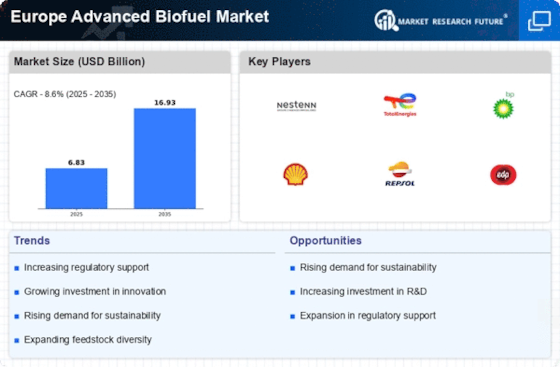
Key players include Neste, TotalEnergies, BP, Shell, Repsol, Clariant, Energias de Portugal, Abengoa, Green Plains, and Valero.

How does the Transportation segment perform in the Europe Advanced Biofuels Market?

The Transportation segment was valued at 2.2 USD Billion in 2024 and is expected to grow to 5.0 USD Billion by 2035.

What is the valuation of the Aviation segment in the Europe Advanced Biofuels Market?

The Aviation segment was valued at 1.0 USD Billion in 2024 and is projected to reach 2.5 USD Billion by 2035.

Market Summary

As per MRFR analysis, the (Europe) Advanced Biofuels Market is projected to grow from USD 6.0 Billion in 2025 to USD 12.45 Billion by 2035, exhibiting a compound annual growth rate (CAGR) of 7.65% during the forecast period (2025 - 2035).

Key Market Trends & Highlights

The Europe Advanced Biofuels Market is poised for growth driven by regulatory support and technological advancements.

  • Germany remains the largest market for advanced biofuels, showcasing robust regulatory frameworks that encourage sustainable energy production. The UK is emerging as the fastest-growing region, propelled by increasing consumer demand for eco-friendly transportation solutions. In the transportation segment, advanced biofuels derived from vegetable oil dominate, while waste cooking oil is rapidly gaining traction in the aviation sector. Key market drivers include strong regulatory support and significant investments in infrastructure development, fostering innovation and collaboration.

Market Size & Forecast

2024 Market Size 5.53 (USD Billion)
2035 Market Size 12.45 (USD Billion)
CAGR (2025 - 2035) 7.65%

Major Players

<a href="https://www.neste.com/news/neste-to-receive-eu-innovation-fund-support-for-developing-a-new-co-processing-technology">Neste</a> (FI), TotalEnergies (FR), BP (GB), Shell (GB), Repsol (ES), <a href="https://www.clariant.com/en/Corporate/News/2021/04/Clariant-collaborates-with-Indonesia39s-Pertamina-in-advanced-biofuels-assessment">Clariant</a> (CH), Energias de Portugal (PT), Abengoa (ES), Green Plains (US), Valero (US)

Market Trends

The Europe Advanced Biofuels Market is currently experiencing a notable transformation, driven by a combination of regulatory frameworks, technological advancements, and shifting consumer preferences. Governments across Europe are increasingly implementing policies aimed at reducing greenhouse gas emissions and promoting renewable energy sources. This regulatory push is fostering innovation in biofuel production processes, leading to the development of more efficient and sustainable methods.

Furthermore, the growing awareness of climate change and the need for energy security are prompting both consumers and industries to seek alternatives to fossil fuels, thereby enhancing the demand for advanced biofuels. In addition to regulatory influences, technological progress plays a crucial role in shaping the Europe Advanced Biofuels Market. Innovations in feedstock selection, conversion technologies, and production methods are enabling the creation of biofuels that are not only more sustainable but also more compatible with existing infrastructure.

The market appears poised for growth as stakeholders, including governments, businesses, and research institutions, collaborate to overcome challenges related to scalability and cost-effectiveness. As the landscape evolves, the emphasis on sustainability and environmental responsibility is likely to remain at the forefront of market developments, indicating a promising future for advanced biofuels in Europe.

Regulatory Support and Policy Frameworks

The Europe Advanced Biofuels Market benefits from robust regulatory support, with various governments establishing frameworks that encourage the adoption of renewable energy sources. Policies aimed at reducing carbon emissions and promoting sustainability are driving investments in advanced biofuels. This regulatory environment not only incentivizes production but also fosters research and development, leading to innovative solutions that enhance the market's growth potential.

Technological Innovations in Production

Technological advancements are significantly influencing the Europe Advanced Biofuels Market. Innovations in feedstock processing and conversion technologies are enabling the production of biofuels that are more efficient and environmentally friendly. These developments are crucial for improving the economic viability of advanced biofuels, making them a more attractive option for energy producers and consumers alike.

Consumer Demand for Sustainable Energy

There is a growing consumer demand for sustainable energy solutions within the Europe Advanced Biofuels Market. As awareness of environmental issues increases, consumers are actively seeking alternatives to traditional fossil fuels. This shift in consumer behavior is prompting businesses to explore advanced biofuels as a viable option, thereby driving market growth and encouraging further investment in renewable energy technologies.

Europe Advanced Biofuel market Market Drivers

Consumer Demand for Sustainable Energy

The growing consumer demand for sustainable energy solutions is a pivotal driver for the Europe Advanced Biofuels Market. As awareness of climate change and environmental issues rises, consumers are increasingly seeking greener alternatives to traditional fossil fuels. This shift in consumer behavior is reflected in the rising sales of biofuels, which are perceived as more environmentally friendly. According to recent surveys, a significant percentage of European consumers express a willingness to pay a premium for sustainable energy options. This trend is prompting fuel suppliers and automotive manufacturers to explore partnerships with biofuel producers, thereby expanding the market. The increasing availability of biofuels at retail outlets and the integration of biofuels into existing fuel supply chains are likely to further enhance consumer access and acceptance, driving growth in the Europe Advanced Biofuels Market.

Technological Innovations in Production

Technological advancements play a crucial role in shaping the Europe Advanced Biofuels Market. Innovations in production processes, such as the development of second and third-generation biofuels, are enhancing efficiency and reducing costs. For example, the use of waste materials and non-food crops for biofuel production is gaining traction, which not only addresses food security concerns but also promotes sustainability. The European Commission has reported that investments in research and development for biofuel technologies have increased, leading to breakthroughs in conversion technologies. These innovations are expected to improve the overall competitiveness of advanced biofuels compared to fossil fuels. As a result, the market is likely to witness a surge in production capacity and a diversification of feedstock sources, further solidifying the position of the Europe Advanced Biofuels Market.

Investment in Infrastructure Development

Investment in infrastructure development is a critical factor propelling the Europe Advanced Biofuels Market. The establishment of production facilities, distribution networks, and refueling stations is essential for the widespread adoption of advanced biofuels. Governments and private investors are recognizing the need for substantial capital investment to build the necessary infrastructure to support biofuel production and distribution. For instance, several European countries are investing in biorefineries that convert biomass into advanced biofuels, which are strategically located to optimize supply chains. Additionally, the development of blending facilities that allow for the seamless integration of biofuels into existing fuel systems is gaining momentum. This infrastructure investment is expected to enhance the availability and accessibility of advanced biofuels, thereby stimulating market growth in the Europe Advanced Biofuels Market.

Regulatory Support and Policy Frameworks

The Europe Advanced Biofuels Market is significantly influenced by robust regulatory support and policy frameworks established by the European Union. The EU has set ambitious targets for renewable energy, aiming for at least 32% of its energy to come from renewable sources by 2030. This regulatory environment encourages investment in advanced biofuels, as member states implement national policies to meet these targets. For instance, the Renewable Energy Directive II mandates that a certain percentage of transport fuels must come from renewable sources, which directly benefits the advanced biofuels sector. Furthermore, financial incentives and subsidies for biofuel production are becoming increasingly common, fostering growth in the industry. This supportive policy landscape is likely to drive innovation and expansion within the Europe Advanced Biofuels Market.

Collaboration and Partnerships in Research

Collaboration and partnerships in research and development are emerging as vital drivers for the Europe Advanced Biofuels Market. Academic institutions, research organizations, and industry stakeholders are increasingly joining forces to advance biofuel technologies and address challenges related to production and sustainability. These collaborative efforts often lead to innovative solutions that enhance the efficiency and viability of advanced biofuels. For example, partnerships between universities and biofuel companies have resulted in breakthroughs in feedstock optimization and conversion processes. Furthermore, European funding programs, such as Horizon Europe, are supporting collaborative research initiatives aimed at fostering innovation in the biofuels sector. This collaborative approach is likely to accelerate the development of advanced biofuels, positioning the Europe Advanced Biofuels Market for sustained growth in the coming years.

Market Segment Insights

By Application: Transportation (Largest) vs. Aviation (Fastest-Growing)

In the Europe Advanced Biofuels Market, the 'Transportation' segment commands a significant share, largely driven by the transition from fossil fuels to biofuels in road transportation. Cars, buses, and trucks increasingly adopt advanced biofuels due to stringent emission regulations and the push toward sustainability. Meanwhile, the 'Aviation' segment is emerging as the fastest-growing area, supported by initiatives aimed at decarbonizing air travel and increasing investment in <a href="https://www.marketresearchfuture.com/reports/sustainable-aviation-fuel-market-11965">sustainable aviation fuels</a>.

Transportation (Dominant) vs. Aviation (Emerging)

The Transportation segment stands as the dominant player in the advanced biofuels market, benefiting from widespread adoption and regulatory support for cleaner fuel alternatives. It encompasses a variety of vehicles, enhancing its market reach and applicability. Conversely, the Aviation segment is gaining momentum as an emerging sector, characterized by rapid technological advancements aimed at reducing carbon footprints. Airlines are increasingly investing in biofuels to meet sustainability targets, thus positioning this segment as a key growth driver for the future.

By Feedstock Type: Vegetable Oil (Largest) vs. Waste Cooking Oil (Fastest-Growing)

In the Europe Advanced Biofuels Market, 'Vegetable Oil' holds the largest market share within the feedstock type segment, largely attributed to its established supply chains and production processes. Meanwhile, 'Waste Cooking Oil' is rapidly gaining traction as sustainability concerns rise, enabling it to emerge as the fastest-growing feedstock option. This shift reflects a growing preference for renewable sources that minimize waste and support circular economy initiatives. Continuous investments in refining processes for these feedstocks are further streamlining their integration into biofuel production, enhancing their appeal in Europe’s energy landscape.

Feedstock Type: Vegetable Oil (Dominant) vs. Waste Cooking Oil (Emerging)

Vegetable Oil remains the dominant feedstock type in the Europe Advanced Biofuels Market due to its high yield, established market infrastructure, and consistency in quality. This feedstock is often sourced from rapeseed and sunflower, providing a reliable supply for biofuel production. In contrast, Waste Cooking Oil is perceived as an emerging feedstock, driven by increasing regulations aimed at reducing waste and promoting sustainability. Its utilization not only mitigates waste but also offers an economically viable alternative that helps reduce greenhouse gas emissions. As producers innovate in processing technologies, Waste Cooking Oil is expected to capture market interest rapidly, appealing to environmentally conscious consumers.

By Technology: Fermentation (Largest) vs. Transesterification (Fastest-Growing)

In the Europe Advanced Biofuels Market, the technology segment showcases a diverse landscape of methodologies. Fermentation is currently the largest segment, dominating the market due to its ability to efficiently convert biomass into biofuels, particularly ethanol. Meanwhile, Transesterification emerges as the fastest-growing segment, primarily driven by an increasing demand for biodiesel. This process converts fats and oils into biodiesel through a catalyst reaction, appealing to markets seeking more sustainable fuels.

Technology: Fermentation (Dominant) vs. Transesterification (Emerging)

Fermentation is characterized by its well-established processes that leverage microbial fermentation to produce ethanol from various feedstocks, ensuring a constant supply of biofuel. With significant investments in research and optimization, it is favored for its efficiency and sustainability. On the other hand, Transesterification represents an emerging opportunity in the biofuels landscape, attracting attention due to its versatility in using a wide range of feedstocks. It is increasingly seen as a reliable method to produce high-quality biodiesel, driven by shifting policies favoring cleaner fuel sources.

By End Use: Automotive (Largest) vs. Shipping (Fastest-Growing)

In the Europe Advanced Biofuels Market, the automotive sector stands out as the largest segment, representing a significant portion of the overall market share. The demand for sustainable transportation fuels is driving this dominance, as major <a href="https://www.marketresearchfuture.com/reports/car-manufacturing-market-16168">car manufacturers</a> shift towards biofuel-compatible engines and greener technologies. In contrast, the shipping sector is emerging rapidly, fueled by stricter emissions regulations and a global push towards decarbonizing marine transport. This shift is evident as shipping companies explore advanced biofuels to meet sustainability goals.

Aerospace (Dominant) vs. Heating (Emerging)

The aerospace sector holds a dominant position in the Europe Advanced Biofuels Market due to its stringent environmental regulations and the growing need for sustainable aviation fuels. Airlines are increasingly investing in advanced biofuels as part of their commitment to reduce carbon emissions and enhance environmental performance. On the other hand, the heating segment is emerging as a viable alternative, with rising energy costs and the increasing focus on renewable energy sources. While still smaller in comparison to aerospace, the heating segment is gaining attention as consumers and businesses seek cleaner, more sustainable heating options, reflecting a significant shift towards biofuels.

By Regulatory Framework: Renewable Energy Directive (Largest) vs. Carbon Pricing (Fastest-Growing)

In the Europe Advanced Biofuels Market, the Renewable Energy Directive (RED) stands out as the largest framework, significantly influencing the market dynamics by setting binding targets for renewable energy consumption and production. It plays a pivotal role in promoting biofuels, ensuring they meet strict sustainability criteria, and driving investment in renewable technologies. On the other hand, Carbon Pricing, while currently smaller in share compared to RED, is gaining rapid traction as countries aim to meet their climate goals. The establishment of price signals on carbon emissions influences biofuel production methods, thus reshaping market dynamics.

Sustainability Criteria: Dominant vs. Emission Reduction Targets: Emerging

Sustainability Criteria are currently dominant within the regulatory landscape of the Europe Advanced Biofuels Market, as they dictate the environmental parameters biofuels must achieve to qualify as sustainable. These criteria encompass aspects such as greenhouse gas emissions savings, biodiversity protection, and land use implications. In contrast, Emission Reduction Targets represent an emerging focus area, gaining importance as governments enhance their commitments to climate goals. They serve as ambitious benchmarks for reducing overall greenhouse gas emissions within specific timelines. The alignment of biofuel production with these targets is critical, as it drives innovation and adoption of cleaner technologies, ensuring that the sector evolves in a sustainable manner.

Get more detailed insights about Europe Advanced Biofuel Market Research Report – Forecast till 2035

Regional Insights

Germany : Strong Infrastructure and Innovation Hub

Germany holds a commanding 2.1% market share in the Advanced Biofuels sector, driven by robust government policies promoting renewable energy. Key growth drivers include the Energiewende initiative, which aims to transition to sustainable energy sources, and increasing demand for biofuels in transportation. The country has seen a rise in consumption patterns favoring biofuels, supported by incentives for sustainable practices and investments in infrastructure development, particularly in logistics and production facilities.

UK : Government Support Fuels Growth

The UK boasts a 1.0% market share in Advanced Biofuels, with significant growth driven by government mandates for renewable energy usage. The Renewable Transport Fuel Obligation (RTFO) encourages the adoption of biofuels, leading to increased demand in the transportation sector. The market is characterized by a growing interest in sustainable aviation fuels and bio-based chemicals, supported by investments in research and development.

France : Innovative Policies and Investments

France's Advanced Biofuels market holds a 0.8% share, bolstered by national policies aimed at reducing greenhouse gas emissions. The French government has implemented the Multiannual Energy Program, which promotes biofuels as a key component of the energy mix. Demand is rising in sectors like transportation and agriculture, with a focus on second-generation biofuels derived from waste materials, enhancing sustainability.

Russia : Potential in Vast Resources

With a 0.7% market share, Russia's Advanced Biofuels sector is gradually expanding, driven by the country's vast agricultural resources. Government initiatives are beginning to support biofuel production, particularly in rural areas, where biofuels can provide energy security. The market is still developing, with increasing interest from local and international players looking to tap into the potential of bio-based energy solutions.

Italy : Focus on Sustainable Agriculture

Italy's Advanced Biofuels market, with a 0.5% share, is gaining traction through a focus on sustainable agricultural practices. The Italian government supports biofuel production via incentives for farmers to grow energy crops. Demand is particularly strong in the transport sector, with cities like Milan and Rome leading the way in adopting biofuels. The competitive landscape includes local players and multinational companies investing in production facilities.

Spain : Renewable Energy Commitment

Spain's Advanced Biofuels market, holding a 0.3% share, is driven by a commitment to renewable energy and sustainability. The government has set ambitious targets for biofuel usage in transportation, supported by the National Renewable Energy Action Plan. Key markets include regions like Andalusia and Catalonia, where agricultural resources are abundant. Major players like Repsol are actively investing in biofuel production, enhancing the competitive landscape.

Rest of Europe : Varied Market Dynamics Across Regions

The Rest of Europe accounts for a modest 0.13% market share in Advanced Biofuels, with diverse dynamics across different countries. Regulatory frameworks vary significantly, influencing market growth. Countries like Sweden and Finland are leading in biofuel adoption, driven by strong government support and innovative technologies. The competitive landscape includes both local and international players, with a focus on niche applications in transportation and heating.

Key Players and Competitive Insights

The Advanced Biofuels Market in Europe is characterized by a dynamic competitive landscape, driven by increasing regulatory support for renewable energy and a growing emphasis on sustainability. Key players such as Neste (FI), TotalEnergies (FR), and BP (GB) are strategically positioning themselves through innovation and partnerships to enhance their market presence. Neste (FI) focuses on expanding its renewable product portfolio, while TotalEnergies (FR) emphasizes its commitment to carbon neutrality by 2050, indicating a strong alignment with environmental goals. BP (GB) is actively investing in digital transformation to optimize its operations, which collectively shapes a competitive environment that prioritizes sustainability and technological advancement.
The market structure appears moderately fragmented, with several players vying for market share. Companies are increasingly localizing manufacturing and optimizing supply chains to enhance efficiency and reduce costs. This competitive structure allows for a diverse range of offerings, although the influence of major players remains significant. The collective strategies of these companies indicate a trend towards collaboration and innovation, which is likely to redefine market dynamics.
In November 2025, Neste (FI) announced a partnership with a leading European airline to supply sustainable aviation fuel (SAF), marking a significant step in its strategy to penetrate the aviation sector. This collaboration not only enhances Neste's product offerings but also aligns with the airline's sustainability goals, potentially setting a precedent for future partnerships in the industry. The strategic importance of this move lies in its potential to drive demand for SAF, thereby expanding Neste's market reach.
In December 2025, TotalEnergies (FR) unveiled plans to invest €1 billion in a new biofuel production facility in France, aimed at increasing its production capacity by 30%. This investment underscores TotalEnergies' commitment to scaling up its biofuel operations and meeting the growing demand for renewable energy sources. The strategic significance of this facility lies in its potential to enhance local supply chains and reduce reliance on imported fuels, thereby strengthening TotalEnergies' competitive position in the market.
In January 2026, BP (GB) launched a new digital platform designed to streamline the supply chain for biofuels, enhancing transparency and efficiency. This initiative reflects BP's focus on integrating digital solutions into its operations, which could lead to improved decision-making and reduced operational costs. The strategic importance of this platform lies in its potential to set a new standard for supply chain management in the biofuels sector, fostering greater collaboration among stakeholders.
As of January 2026, current trends in the Advanced Biofuels Market indicate a strong shift towards digitalization, sustainability, and the integration of AI technologies. Strategic alliances are increasingly shaping the competitive landscape, as companies recognize the value of collaboration in achieving common sustainability goals. Looking ahead, competitive differentiation is likely to evolve from traditional price-based competition to a focus on innovation, technological advancements, and supply chain reliability. This shift suggests that companies that prioritize these aspects will be better positioned to thrive in an increasingly competitive environment.

Key Companies in the Europe Advanced Biofuel market include

Industry Developments

June 2022: Cargill completed its first advanced biodiesel plant in Ghent, Belgium, which diverts waste oils and residues into renewable fuel. The maritime and trucking sectors will utilize these produced at the facility, helping customers decrease the carbon footprint associated with their maritime and road transport activities.

In July 2022, DHL Global Forwarding, Germany's Deutsche Post DHL Group's air and ocean freight specialist, reached an agreement with Hapag-Lloyd, a compatriot liner shipping business, to employ advanced biofuels. As an initial step, Hapag-Lloyd will ship 18,000 TEU of DHL freight using advanced biofuels, resulting in a 14,000-ton decrease in Well-to-Wake CO2 emissions. The two companies share a strategy for decarbonizing container shipping and logistics.

In June 2022, Cargill completed its first cutting-edge advanced biodiesel facility in Ghent, Belgium, which turns waste oils and wastes into renewable fuels. The advanced biodiesel generated at the facility will be used by the marine and trucking industries, allowing clients to reduce their carbon footprint connected with maritime and road transport activities.

TotalEnergies, a worldwide energy firm, has taken considerable steps toward sustainability by turning several of its traditional refineries into biofuel producing facilities. One of its most noteworthy initiatives is to convert the La Mède refinery in southeastern France into a biorefinery. This facility has become a key component of the company's strategy to manufacture sustainable aviation fuel (SAF) and renewable diesel from environmentally friendly feedstocks.

Shell's Rotterdam biofuel factory is a significant step forward in Europe's energy transition, reflecting the growing reliance on renewable energy sources. The project, which was planned to open in 2024, would manufacture sustainable fuel and Sustainable Aviation Fuel (SAF) from waste resources such as leftover cooking oil, animal fats, and other residual biomass.

The European Union has aggressive climate goals, including lowering GHG emissions by 55% by 2030 and becoming net-zero by 2050. Facilities like Shell's in Rotterdam are critical to accomplishing these goals.

With its second-generation bioethanol generating technology, Clariant has accomplished a major step in sustainable energy. Their flagship Sunliquid® plant in Podari, Romania, just opened and features this creative method. By proving Clariant's dedication to using non-food biomass for generation of renewable fuels, the company positions itself as a major participant in the change to a low-carbon economy.

Future Outlook

Europe Advanced Biofuel market Future Outlook

The Europe Advanced Biofuels Market is projected to grow at a 7.65% CAGR from 2025 to 2035, driven by regulatory support, technological advancements, and increasing demand for sustainable energy solutions.

New opportunities lie in:

  • <p>Investment in biogas production facilities to enhance energy diversification. Development of advanced feedstock supply chains for improved efficiency. Partnerships with automotive manufacturers for biofuel integration in new vehicles.</p>

By 2035, the market is expected to solidify its position as a leader in sustainable energy solutions.

Market Segmentation

Europe Advanced Biofuel market End Use Outlook

  • Automotive
  • Aerospace
  • Shipping
  • Electricity Generation
  • Heating

Europe Advanced Biofuel market Technology Outlook

  • Fermentation
  • Transesterification
  • Gasification
  • Hydrothermal Liquefaction
  • Anaerobic Digestion

Europe Advanced Biofuel market Application Outlook

  • Transportation
  • Aviation
  • Marine
  • Power Generation
  • Industrial

Europe Advanced Biofuel market Feedstock Type Outlook

  • Vegetable Oil
  • Animal Fat
  • Waste Cooking Oil
  • Cellulosic Biomass
  • Algae

Europe Advanced Biofuel market Regulatory Framework Outlook

  • Renewable Energy Directive
  • Sustainability Criteria
  • Emission Reduction Targets
  • Incentives and Subsidies
  • Carbon Pricing

Report Scope

MARKET SIZE 2024 5.53(USD Billion)
MARKET SIZE 2025 6.0(USD Billion)
MARKET SIZE 2035 12.45(USD Billion)
COMPOUND ANNUAL GROWTH RATE (CAGR) 7.65% (2024 - 2035)
REPORT COVERAGE Revenue Forecast, Competitive Landscape, Growth Factors, and Trends
BASE YEAR 2024
Market Forecast Period 2025 - 2035
Historical Data 2019 - 2024
Market Forecast Units USD Billion
Key Companies Profiled Neste (FI), TotalEnergies (FR), BP (GB), Shell (GB), Repsol (ES), Clariant (CH), Energias de Portugal (PT), Abengoa (ES), Green Plains (US), Valero (US)
Segments Covered Application, Feedstock Type, Technology, End Use, Regulatory Framework
Key Market Opportunities Growing demand for sustainable energy solutions drives innovation in the Europe Advanced Biofuels Market.
Key Market Dynamics Regulatory support and technological advancements drive growth in Europe's Advanced Biofuels Market amid sustainability goals.
Countries Covered Germany, UK, France, Russia, Italy, Spain, Rest of Europe

FAQs

What is the current valuation of the Europe Advanced Biofuels Market?

As of 2024, the Europe Advanced Biofuels Market was valued at 5.53 USD Billion.

What is the projected market size for the Europe Advanced Biofuels Market by 2035?

The market is projected to reach 12.45 USD Billion by 2035.

What is the expected CAGR for the Europe Advanced Biofuels Market during the forecast period?

The expected CAGR for the market from 2025 to 2035 is 7.65%.

Which companies are considered key players in the Europe Advanced Biofuels Market?

Key players include Neste, TotalEnergies, BP, Shell, Repsol, Clariant, Energias de Portugal, Abengoa, Green Plains, and Valero.

How does the Transportation segment perform in the Europe Advanced Biofuels Market?

The Transportation segment was valued at 2.2 USD Billion in 2024 and is expected to grow to 5.0 USD Billion by 2035.

What is the valuation of the Aviation segment in the Europe Advanced Biofuels Market?

The Aviation segment was valued at 1.0 USD Billion in 2024 and is projected to reach 2.5 USD Billion by 2035.

  1. SECTION I: EXECUTIVE SUMMARY AND KEY HIGHLIGHTS
    1. EXECUTIVE SUMMARY
      1. Market Overview
      2. Key Findings
      3. Market Segmentation
      4. Competitive Landscape
      5. Challenges and Opportunities
      6. Future Outlook 2
  2. SECTION II: SCOPING, METHODOLOGY AND MARKET STRUCTURE
    1. MARKET INTRODUCTION
      1. Definition
      2. Scope of the study
    2. RESEARCH METHODOLOGY
      1. Overview
      2. Data Mining
      3. Secondary Research
      4. Primary Research
      5. Forecasting Model
      6. Market Size Estimation
      7. Data Triangulation
      8. Validation 3
  3. SECTION III: QUALITATIVE ANALYSIS
    1. MARKET DYNAMICS
      1. Overview
      2. Drivers
      3. Restraints
      4. Opportunities
    2. MARKET FACTOR ANALYSIS
      1. Value chain Analysis
      2. Porter's Five Forces Analysis
      3. COVID-19 Impact Analysis
  4. SECTION IV: QUANTITATIVE ANALYSIS
    1. Energy & Power, BY Raw Material (USD Billion)
      1. Jatropha
      2. Lignocellulose
      3. Algae
      4. Other Raw Materials
    2. Energy & Power, BY Biofuel Type (USD Billion)
      1. Cellulosic Ethanol
      2. Biodiesel
      3. Biogas
      4. Biobutanol
      5. Other Biofuel Types
    3. Energy & Power, BY Technology (USD Billion)
      1. Biochemical
      2. Thermochemical
    4. Energy & Power, BY Region (USD Billion)
      1. North America
      2. Europe
      3. APAC
      4. South America
      5. MEA
  5. SECTION V: COMPETITIVE ANALYSIS
    1. Competitive Landscape
      1. Overview
      2. Competitive Analysis
      3. Market share Analysis
      4. Major Growth Strategy in the Energy & Power
      5. Competitive Benchmarking
      6. Leading Players in Terms of Number of Developments in the Energy & Power
      7. Key developments and growth strategies
      8. Major Players Financial Matrix
    2. Company Profiles
      1. Neste (FI)
      2. TotalEnergies (FR)
      3. BP (GB)
      4. Shell (GB)
      5. Repsol (ES)
      6. Energias de Portugal (PT)
      7. Clariant (CH)
      8. Biomass Technology Group (NL)
      9. Greenfield Global (CA)
    3. Appendix
      1. References
      2. Related Reports 6 LIST OF FIGURES
    4. MARKET SYNOPSIS
    5. NORTH AMERICA MARKET ANALYSIS
    6. US MARKET ANALYSIS BY RAW MATERIAL
    7. US MARKET ANALYSIS BY BIOFUEL TYPE
    8. US MARKET ANALYSIS BY TECHNOLOGY
    9. CANADA MARKET ANALYSIS BY RAW MATERIAL
    10. CANADA MARKET ANALYSIS BY BIOFUEL TYPE
    11. CANADA MARKET ANALYSIS BY TECHNOLOGY
    12. EUROPE MARKET ANALYSIS
    13. GERMANY MARKET ANALYSIS BY RAW MATERIAL
    14. GERMANY MARKET ANALYSIS BY BIOFUEL TYPE
    15. GERMANY MARKET ANALYSIS BY TECHNOLOGY
    16. UK MARKET ANALYSIS BY RAW MATERIAL
    17. UK MARKET ANALYSIS BY BIOFUEL TYPE
    18. UK MARKET ANALYSIS BY TECHNOLOGY
    19. FRANCE MARKET ANALYSIS BY RAW MATERIAL
    20. FRANCE MARKET ANALYSIS BY BIOFUEL TYPE
    21. FRANCE MARKET ANALYSIS BY TECHNOLOGY
    22. RUSSIA MARKET ANALYSIS BY RAW MATERIAL
    23. RUSSIA MARKET ANALYSIS BY BIOFUEL TYPE
    24. RUSSIA MARKET ANALYSIS BY TECHNOLOGY
    25. ITALY MARKET ANALYSIS BY RAW MATERIAL
    26. ITALY MARKET ANALYSIS BY BIOFUEL TYPE
    27. ITALY MARKET ANALYSIS BY TECHNOLOGY
    28. SPAIN MARKET ANALYSIS BY RAW MATERIAL
    29. SPAIN MARKET ANALYSIS BY BIOFUEL TYPE
    30. SPAIN MARKET ANALYSIS BY TECHNOLOGY
    31. REST OF EUROPE MARKET ANALYSIS BY RAW MATERIAL
    32. REST OF EUROPE MARKET ANALYSIS BY BIOFUEL TYPE
    33. REST OF EUROPE MARKET ANALYSIS BY TECHNOLOGY
    34. APAC MARKET ANALYSIS
    35. CHINA MARKET ANALYSIS BY RAW MATERIAL
    36. CHINA MARKET ANALYSIS BY BIOFUEL TYPE
    37. CHINA MARKET ANALYSIS BY TECHNOLOGY
    38. INDIA MARKET ANALYSIS BY RAW MATERIAL
    39. INDIA MARKET ANALYSIS BY BIOFUEL TYPE
    40. INDIA MARKET ANALYSIS BY TECHNOLOGY
    41. JAPAN MARKET ANALYSIS BY RAW MATERIAL
    42. JAPAN MARKET ANALYSIS BY BIOFUEL TYPE
    43. JAPAN MARKET ANALYSIS BY TECHNOLOGY
    44. SOUTH KOREA MARKET ANALYSIS BY RAW MATERIAL
    45. SOUTH KOREA MARKET ANALYSIS BY BIOFUEL TYPE
    46. SOUTH KOREA MARKET ANALYSIS BY TECHNOLOGY
    47. MALAYSIA MARKET ANALYSIS BY RAW MATERIAL
    48. MALAYSIA MARKET ANALYSIS BY BIOFUEL TYPE
    49. MALAYSIA MARKET ANALYSIS BY TECHNOLOGY
    50. THAILAND MARKET ANALYSIS BY RAW MATERIAL
    51. THAILAND MARKET ANALYSIS BY BIOFUEL TYPE
    52. THAILAND MARKET ANALYSIS BY TECHNOLOGY
    53. INDONESIA MARKET ANALYSIS BY RAW MATERIAL
    54. INDONESIA MARKET ANALYSIS BY BIOFUEL TYPE
    55. INDONESIA MARKET ANALYSIS BY TECHNOLOGY
    56. REST OF APAC MARKET ANALYSIS BY RAW MATERIAL
    57. REST OF APAC MARKET ANALYSIS BY BIOFUEL TYPE
    58. REST OF APAC MARKET ANALYSIS BY TECHNOLOGY
    59. SOUTH AMERICA MARKET ANALYSIS
    60. BRAZIL MARKET ANALYSIS BY RAW MATERIAL
    61. BRAZIL MARKET ANALYSIS BY BIOFUEL TYPE
    62. BRAZIL MARKET ANALYSIS BY TECHNOLOGY
    63. MEXICO MARKET ANALYSIS BY RAW MATERIAL
    64. MEXICO MARKET ANALYSIS BY BIOFUEL TYPE
    65. MEXICO MARKET ANALYSIS BY TECHNOLOGY
    66. ARGENTINA MARKET ANALYSIS BY RAW MATERIAL
    67. ARGENTINA MARKET ANALYSIS BY BIOFUEL TYPE
    68. ARGENTINA MARKET ANALYSIS BY TECHNOLOGY
    69. REST OF SOUTH AMERICA MARKET ANALYSIS BY RAW MATERIAL
    70. REST OF SOUTH AMERICA MARKET ANALYSIS BY BIOFUEL TYPE
    71. REST OF SOUTH AMERICA MARKET ANALYSIS BY TECHNOLOGY
    72. MEA MARKET ANALYSIS
    73. GCC COUNTRIES MARKET ANALYSIS BY RAW MATERIAL
    74. GCC COUNTRIES MARKET ANALYSIS BY BIOFUEL TYPE
    75. GCC COUNTRIES MARKET ANALYSIS BY TECHNOLOGY
    76. SOUTH AFRICA MARKET ANALYSIS BY RAW MATERIAL
    77. SOUTH AFRICA MARKET ANALYSIS BY BIOFUEL TYPE
    78. SOUTH AFRICA MARKET ANALYSIS BY TECHNOLOGY
    79. REST OF MEA MARKET ANALYSIS BY RAW MATERIAL
    80. REST OF MEA MARKET ANALYSIS BY BIOFUEL TYPE
    81. REST OF MEA MARKET ANALYSIS BY TECHNOLOGY
    82. KEY BUYING CRITERIA OF ENERGY & POWER
    83. RESEARCH PROCESS OF MRFR
    84. DRO ANALYSIS OF ENERGY & POWER
    85. DRIVERS IMPACT ANALYSIS: ENERGY & POWER
    86. RESTRAINTS IMPACT ANALYSIS: ENERGY & POWER
    87. SUPPLY / VALUE CHAIN: ENERGY & POWER
    88. ENERGY & POWER, BY RAW MATERIAL, 2024 (% SHARE)
    89. ENERGY & POWER, BY RAW MATERIAL, 2024 TO 2035 (USD Billion)
    90. ENERGY & POWER, BY BIOFUEL TYPE, 2024 (% SHARE)
    91. ENERGY & POWER, BY BIOFUEL TYPE, 2024 TO 2035 (USD Billion)
    92. ENERGY & POWER, BY TECHNOLOGY, 2024 (% SHARE)
    93. ENERGY & POWER, BY TECHNOLOGY, 2024 TO 2035 (USD Billion)
    94. BENCHMARKING OF MAJOR COMPETITORS 7 LIST OF TABLES
    95. LIST OF ASSUMPTIONS
    96. North America MARKET SIZE ESTIMATES; FORECAST
      1. BY RAW MATERIAL, 2025-2035 (USD Billion)
      2. BY BIOFUEL TYPE, 2025-2035 (USD Billion)
      3. BY TECHNOLOGY, 2025-2035 (USD Billion)
    97. US MARKET SIZE ESTIMATES; FORECAST
      1. BY RAW MATERIAL, 2025-2035 (USD Billion)
      2. BY BIOFUEL TYPE, 2025-2035 (USD Billion)
      3. BY TECHNOLOGY, 2025-2035 (USD Billion)
    98. Canada MARKET SIZE ESTIMATES; FORECAST
      1. BY RAW MATERIAL, 2025-2035 (USD Billion)
      2. BY BIOFUEL TYPE, 2025-2035 (USD Billion)
      3. BY TECHNOLOGY, 2025-2035 (USD Billion)
    99. Europe MARKET SIZE ESTIMATES; FORECAST
      1. BY RAW MATERIAL, 2025-2035 (USD Billion)
      2. BY BIOFUEL TYPE, 2025-2035 (USD Billion)
      3. BY TECHNOLOGY, 2025-2035 (USD Billion)
    100. Germany MARKET SIZE ESTIMATES; FORECAST
      1. BY RAW MATERIAL, 2025-2035 (USD Billion)
      2. BY BIOFUEL TYPE, 2025-2035 (USD Billion)
      3. BY TECHNOLOGY, 2025-2035 (USD Billion)
    101. UK MARKET SIZE ESTIMATES; FORECAST
      1. BY RAW MATERIAL, 2025-2035 (USD Billion)
      2. BY BIOFUEL TYPE, 2025-2035 (USD Billion)
      3. BY TECHNOLOGY, 2025-2035 (USD Billion)
    102. France MARKET SIZE ESTIMATES; FORECAST
      1. BY RAW MATERIAL, 2025-2035 (USD Billion)
      2. BY BIOFUEL TYPE, 2025-2035 (USD Billion)
      3. BY TECHNOLOGY, 2025-2035 (USD Billion)
    103. Russia MARKET SIZE ESTIMATES; FORECAST
      1. BY RAW MATERIAL, 2025-2035 (USD Billion)
      2. BY BIOFUEL TYPE, 2025-2035 (USD Billion)
      3. BY TECHNOLOGY, 2025-2035 (USD Billion)
    104. Italy MARKET SIZE ESTIMATES; FORECAST
      1. BY RAW MATERIAL, 2025-2035 (USD Billion)
      2. BY BIOFUEL TYPE, 2025-2035 (USD Billion)
      3. BY TECHNOLOGY, 2025-2035 (USD Billion)
    105. Spain MARKET SIZE ESTIMATES; FORECAST
      1. BY RAW MATERIAL, 2025-2035 (USD Billion)
      2. BY BIOFUEL TYPE, 2025-2035 (USD Billion)
      3. BY TECHNOLOGY, 2025-2035 (USD Billion)
    106. Rest of Europe MARKET SIZE ESTIMATES; FORECAST
      1. BY RAW MATERIAL, 2025-2035 (USD Billion)
      2. BY BIOFUEL TYPE, 2025-2035 (USD Billion)
      3. BY TECHNOLOGY, 2025-2035 (USD Billion)
    107. APAC MARKET SIZE ESTIMATES; FORECAST
      1. BY RAW MATERIAL, 2025-2035 (USD Billion)
      2. BY BIOFUEL TYPE, 2025-2035 (USD Billion)
      3. BY TECHNOLOGY, 2025-2035 (USD Billion)
    108. China MARKET SIZE ESTIMATES; FORECAST
      1. BY RAW MATERIAL, 2025-2035 (USD Billion)
      2. BY BIOFUEL TYPE, 2025-2035 (USD Billion)
      3. BY TECHNOLOGY, 2025-2035 (USD Billion)
    109. India MARKET SIZE ESTIMATES; FORECAST
      1. BY RAW MATERIAL, 2025-2035 (USD Billion)
      2. BY BIOFUEL TYPE, 2025-2035 (USD Billion)
      3. BY TECHNOLOGY, 2025-2035 (USD Billion)
    110. Japan MARKET SIZE ESTIMATES; FORECAST
      1. BY RAW MATERIAL, 2025-2035 (USD Billion)
      2. BY BIOFUEL TYPE, 2025-2035 (USD Billion)
      3. BY TECHNOLOGY, 2025-2035 (USD Billion)
    111. South Korea MARKET SIZE ESTIMATES; FORECAST
      1. BY RAW MATERIAL, 2025-2035 (USD Billion)
      2. BY BIOFUEL TYPE, 2025-2035 (USD Billion)
      3. BY TECHNOLOGY, 2025-2035 (USD Billion)
    112. Malaysia MARKET SIZE ESTIMATES; FORECAST
      1. BY RAW MATERIAL, 2025-2035 (USD Billion)
      2. BY BIOFUEL TYPE, 2025-2035 (USD Billion)
      3. BY TECHNOLOGY, 2025-2035 (USD Billion)
    113. Thailand MARKET SIZE ESTIMATES; FORECAST
      1. BY RAW MATERIAL, 2025-2035 (USD Billion)
      2. BY BIOFUEL TYPE, 2025-2035 (USD Billion)
      3. BY TECHNOLOGY, 2025-2035 (USD Billion)
    114. Indonesia MARKET SIZE ESTIMATES; FORECAST
      1. BY RAW MATERIAL, 2025-2035 (USD Billion)
      2. BY BIOFUEL TYPE, 2025-2035 (USD Billion)
      3. BY TECHNOLOGY, 2025-2035 (USD Billion)
    115. Rest of APAC MARKET SIZE ESTIMATES; FORECAST
      1. BY RAW MATERIAL, 2025-2035 (USD Billion)
      2. BY BIOFUEL TYPE, 2025-2035 (USD Billion)
      3. BY TECHNOLOGY, 2025-2035 (USD Billion)
    116. South America MARKET SIZE ESTIMATES; FORECAST
      1. BY RAW MATERIAL, 2025-2035 (USD Billion)
      2. BY BIOFUEL TYPE, 2025-2035 (USD Billion)
      3. BY TECHNOLOGY, 2025-2035 (USD Billion)
    117. Brazil MARKET SIZE ESTIMATES; FORECAST
      1. BY RAW MATERIAL, 2025-2035 (USD Billion)
      2. BY BIOFUEL TYPE, 2025-2035 (USD Billion)
      3. BY TECHNOLOGY, 2025-2035 (USD Billion)
    118. Mexico MARKET SIZE ESTIMATES; FORECAST
      1. BY RAW MATERIAL, 2025-2035 (USD Billion)
      2. BY BIOFUEL TYPE, 2025-2035 (USD Billion)
      3. BY TECHNOLOGY, 2025-2035 (USD Billion)
    119. Argentina MARKET SIZE ESTIMATES; FORECAST
      1. BY RAW MATERIAL, 2025-2035 (USD Billion)
      2. BY BIOFUEL TYPE, 2025-2035 (USD Billion)
      3. BY TECHNOLOGY, 2025-2035 (USD Billion)
    120. Rest of South America MARKET SIZE ESTIMATES; FORECAST
      1. BY RAW MATERIAL, 2025-2035 (USD Billion)
      2. BY BIOFUEL TYPE, 2025-2035 (USD Billion)
      3. BY TECHNOLOGY, 2025-2035 (USD Billion)
    121. MEA MARKET SIZE ESTIMATES; FORECAST
      1. BY RAW MATERIAL, 2025-2035 (USD Billion)
      2. BY BIOFUEL TYPE, 2025-2035 (USD Billion)
      3. BY TECHNOLOGY, 2025-2035 (USD Billion)
    122. GCC Countries MARKET SIZE ESTIMATES; FORECAST
      1. BY RAW MATERIAL, 2025-2035 (USD Billion)
      2. BY BIOFUEL TYPE, 2025-2035 (USD Billion)
      3. BY TECHNOLOGY, 2025-2035 (USD Billion)
    123. South Africa MARKET SIZE ESTIMATES; FORECAST
      1. BY RAW MATERIAL, 2025-2035 (USD Billion)
      2. BY BIOFUEL TYPE, 2025-2035 (USD Billion)
      3. BY TECHNOLOGY, 2025-2035 (USD Billion)
    124. Rest of MEA MARKET SIZE ESTIMATES; FORECAST
      1. BY RAW MATERIAL, 2025-2035 (USD Billion)
      2. BY BIOFUEL TYPE, 2025-2035 (USD Billion)
      3. BY TECHNOLOGY, 2025-2035 (USD Billion)
    125. PRODUCT LAUNCH/PRODUCT DEVELOPMENT/APPROVAL
    126. ACQUISITION/PARTNERSHIP

Europe Advanced Biofuel Market Segmentation

Market Segmentation Overview

  • Detailed segmentation data will be available in the full report
  • Comprehensive analysis by multiple parameters
  • Regional and country-level breakdowns
  • Market size forecasts by segment
Infographic

Free Sample Request

Kindly complete the form below to receive a free sample of this Report

Get Free Sample

Customer Strories

Compare Licence

×
Features License Type
Single User Multiuser License Enterprise User
Price $4,950 $5,950 $7,250
Maximum User Access Limit 1 User Upto 10 Users Unrestricted Access Throughout the Organization
Free Customization
Direct Access to Analyst
Deliverable Format
Platform Access
Discount on Next Purchase 10% 15% 15%
Printable Versions