Ethylene Market (2026 - 2035)

ID: MRFR/CnM/0426-CR 128 Pages Chitranshi Jaiswal Last Updated: November 12, 2026
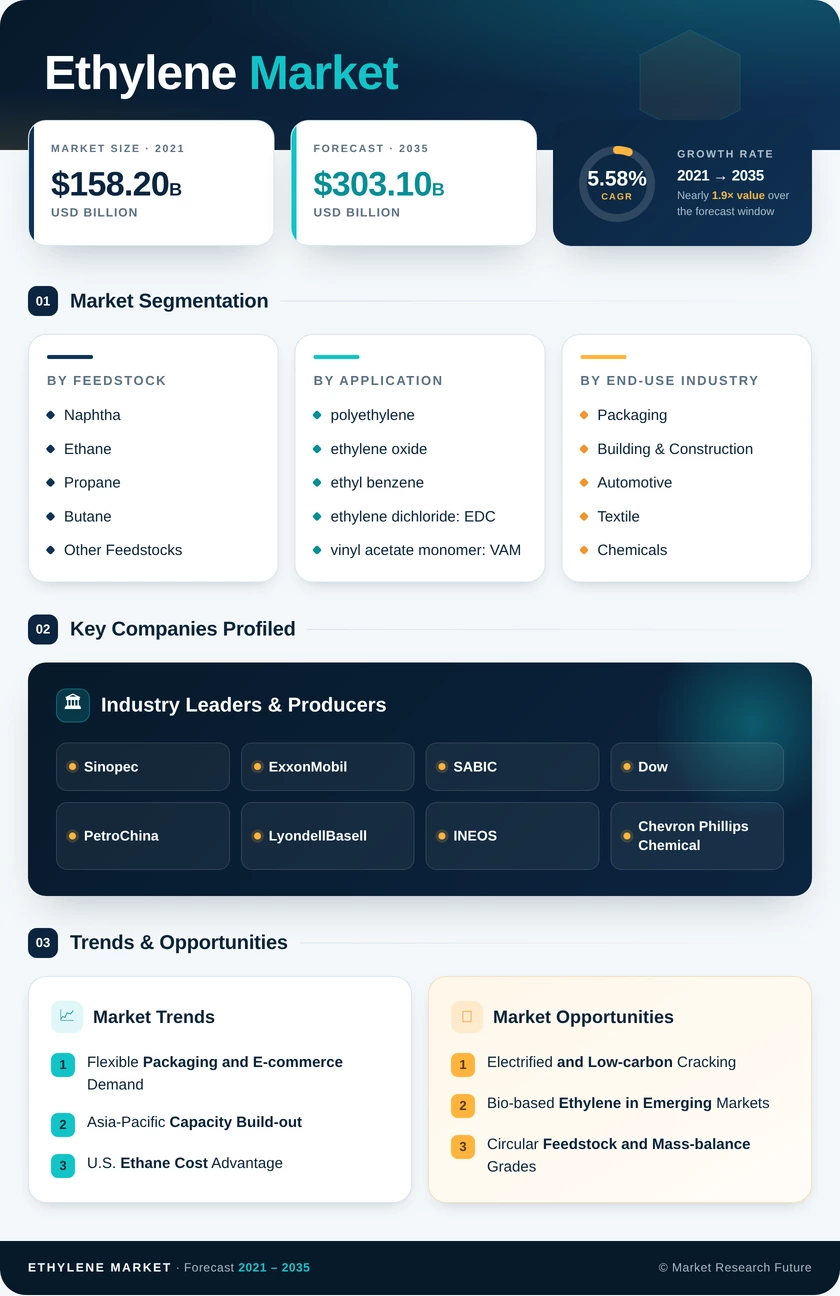
Ethylene Market Research Report Information By Feedstock (Naphtha, Ethane, Propane, Butane, and Other Feedstocks), By Application (Polyethylene, Ethylene Oxide, Ethylbenzene, Ethylene Dichloride (EDC), Vinyl Acetate Monomer (VAM), and Other Applications), By End-Use Industry (Packaging, Building & Construction, Automotive, Textile, Chemicals, Agriculture, Healthcare & Pharmaceuticals, Consumer Goods, and Other End-Use Industries), And By Region (North America, Europe, Asia-Pacific, and Rest of the World) – Market Forecast Till 2035.
Ethylene Market
Market Size
Forecast Period2026-2035
CAGR (2026-2035)5.58%
2025 Market SizeUSD 176.1 Billion
2035 Market SizeUSD 303.1 Billion
Key Players
Sinopec
ExxonMobil
SABIC
Dow
PetroChina
LyondellBasell
Opportunities
  • Electrified and Low-carbon Cracking
  • Bio-based Ethylene in Emerging Markets
  • Circular Feedstock and Mass-balance Grades
  1. 1 Market Summary | |
  2. 2 Key Report Takeaways | |
    1. 2.1 By Feedstock | |
    2. 2.2 By Application | |
    3. 2.3 By End-use Industry | |
    4. 2.4 By Region | |
  3. 3 Market Size and Forecast (2021–2035) | |
    1. 3.1 Historical Market Size (2021–2025) | |
    2. 3.2 Forecast Market Size (2026–2035) | |
    3. 3.3 Year-over-Year Growth Analysis | |
  4. 4 Driver Impact Analysis | |
    1. 4.1 Flexible Packaging and E-commerce Demand | |
    2. 4.2 Asia-Pacific Capacity Build-out | |
    3. 4.3 U.S. Ethane Cost Advantage | |
    4. 4.4 Gulf Integrated Crude-to-Chemicals Projects | |
    5. 4.5 Infrastructure-led HDPE Pipe Demand | |
    6. 4.6 Glycol Demand from EV and Data-Center Cooling | |
  5. 5 Restraints Impact Analysis | |
    1. 5.1 Global Overcapacity and Margin Compression | |
    2. 5.2 Feedstock Price Volatility | |
    3. 5.3 Carbon Pricing and Emissions Rules | |
    4. 5.4 Plastic Waste and Single-use Regulations | |
    5. 5.5 High Energy Costs and European Cracker Closures | |
  6. 6 Opportunities | |
    1. 6.1 Electrified and Low-carbon Cracking | |
    2. 6.2 Bio-based Ethylene in Emerging Markets | |
    3. 6.3 Circular Feedstock and Mass-balance Grades | |
    4. 6.4 Carbon-intensity Data and Product Passports | |
    5. 6.5 Underserved African and South Asian Demand | |
  7. 7 Regional Market Share and Country-Level Analysis | |
    1. 7.1 North America | | |
      1. 7.1.1 US | | |
      2. 7.1.2 Canada | | |
      3. 7.1.3 Mexico | |
    2. 7.2 Europe | | |
      1. 7.2.1 Germany | | |
      2. 7.2.2 UK | | |
      3. 7.2.3 France | | |
      4. 7.2.4 Italy | | |
      5. 7.2.5 Spain | | |
      6. 7.2.6 Nordic Countries | | |
      7. 7.2.7 Russia | | |
      8. 7.2.8 Rest of Europe | |
    3. 7.3 Asia-Pacific | | |
      1. 7.3.1 China | | |
      2. 7.3.2 India | | |
      3. 7.3.3 Japan | | |
      4. 7.3.4 South Korea | | |
      5. 7.3.5 ASEAN | | |
      6. 7.3.6 Rest of Asia-Pacific | |
    4. 7.4 South America | | |
      1. 7.4.1 Brazil | | |
      2. 7.4.2 Argentina | | |
      3. 7.4.3 Rest of South America | |
    5. 7.5 Middle East & Africa | | |
      1. 7.5.1 Saudi Arabia | | |
      2. 7.5.2 UAE | | |
      3. 7.5.3 South Africa | | |
      4. 7.5.4 Egypt | | |
      5. 7.5.5 Rest of MEA | |
  8. 8 Future Outlook (2026–2035) | |
    1. 8.1 Electrification and Decarbonized Cracking | |
    2. 8.2 AI-driven Cracker Optimization | |
    3. 8.3 Capacity Rationalization and Trade Realignment | |
    4. 8.4 Circularity and ESG Reporting | |
  9. 9 Segmentation Analysis | |
    1. 9.1 By Feedstock | | |
      1. 9.1.1 Naphtha | | |
      2. 9.1.2 Ethane | | |
      3. 9.1.3 Propane | | |
      4. 9.1.4 Butane | | |
      5. 9.1.5 Other Feedstocks | |
    2. 9.2 By Application | | |
      1. 9.2.1 polyethylene | | |
      2. 9.2.2 ethylene oxide | | |
      3. 9.2.3 ethyl benzene | | |
      4. 9.2.4 ethylene dichloride: EDC | | |
      5. 9.2.5 vinyl acetate monomer: VAM | | |
      6. 9.2.6 Other applications | |
    3. 9.3 By End-use Industry | | |
      1. 9.3.1 Packaging | | |
      2. 9.3.2 Building & Construction | | |
      3. 9.3.3 Automotive | | |
      4. 9.3.4 Textile | | |
      5. 9.3.5 Chemicals | | |
      6. 9.3.6 Agriculture | | |
      7. 9.3.7 Healthcare & Pharmaceuticals | | |
      8. 9.3.8 Consumer Goods | | |
      9. 9.3.9 Other End-Use Industries | |
  10. 10 Competitive Landscape | |
    1. 10.1 Market Concentration Analysis | |
    2. 10.2 Competitive Benchmarking Matrix | |
    3. 10.3 Company Profiles | | |
      1. 10.3.1 Sinopec | | |
      2. 10.3.2 ExxonMobil | | |
      3. 10.3.3 SABIC | | |
      4. 10.3.4 Dow | | |
      5. 10.3.5 PetroChina | | |
      6. 10.3.6 LyondellBasell | | |
      7. 10.3.7 INEOS | | |
      8. 10.3.8 Chevron Phillips Chemical | | |
      9. 10.3.9 Shell | | |
      10. 10.3.10 Formosa Plastics | | |
      11. 10.3.11 LG Chem | | |
      12. 10.3.12 BASF | |
  11. 11 Recent News & Developments | |
  12. 12 Report Scope and Methodology | |
  13. 13 Detailed Sources and Citations | |
  14. 14 Frequently Asked Questions (FAQs) | | LIST OF TABLES | |
  15. TABLE 1 Global Ethylene Market Summary Metrics, 2025–2035 | |
  16. TABLE 2 Global Ethylene Market Size & Forecast, by Revenue (USD Billion), 2021–2035 | |
  17. TABLE 3 Driver Impact Analysis, 2026–2035 | |
  18. TABLE 4 Restraints Impact Analysis, 2026–2035 | |
  19. TABLE 5 Global Ethylene Market, by Region, 2025 | |
  20. TABLE 6 North America Ethylene Market, by Country, 2025 | |
  21. TABLE 7 Europe Ethylene Market, by Country, 2025 | |
  22. TABLE 8 Asia-Pacific Ethylene Market, by Country, 2025 | |
  23. TABLE 9 South America Ethylene Market, by Country, 2025 | |
  24. TABLE 10 Middle East & Africa Ethylene Market, by Country, 2025 | |
  25. TABLE 11 Global Ethylene Market, by Feedstock, 2025 | |
  26. TABLE 12 Global Ethylene Market, by Application, 2025 | |
  27. TABLE 13 Global Ethylene Market, by End-use Industry, 2025 | |
  28. TABLE 14 Competitive Benchmarking Matrix, 2025 | |
  29. TABLE 15 Report Scope and Methodology | |
  30. TABLE 16 Detailed Sources and Citations | | LIST OF FIGURES | |
  31. FIGURE 1 Market Dynamics Overview (Drivers, Restraints, Opportunities) | |
  32. FIGURE 2 Ethylene Value Chain Analysis | |
  33. FIGURE 3 Porter's Five Forces Analysis | |
  34. FIGURE 4 Global Ethylene Market Size Trend, 2021–2035 (USD Billion) | |
  35. FIGURE 5 Market Share by Feedstock, 2025 | |
  36. FIGURE 6 Market Share by Application, 2025 | |
  37. FIGURE 7 Market Share by End-use Industry, 2025 | |
  38. FIGURE 8 Regional Market Share, 2025 | |
  39. FIGURE 9 Country-Level Market Share by Region, 2025 | |
  40. FIGURE 10 Competitive Landscape Positioning Matrix, 2025

Segmentation Quick Reference

DimensionSub-SegmentsDominant SegmentFastest Growing Segment
By FeedstockNaphtha, Ethane, Propane, Butane, Other FeedstocksNaphtha (39.6% share)Ethane (6.38% CAGR)
By Applicationpolyethylene, ethylene oxide, ethylbenzene, ethylene dichloride: EDC, vinyl acetate monomer: VAM, other applicationspolyethylene (49.3% share)ethylene oxide (6.27% CAGR)
By End-use IndustryPackaging, Building & Construction, Automotive, Textile, Chemicals, Agriculture, Healthcare & Pharmaceuticals, Consumer Goods, Other End-Use IndustriesPackaging (largest end use)Packaging (6.32% CAGR)
By RegionNorth America, Europe, Asia-Pacific, South America, Middle East & AfricaAsia-Pacific (47.2% share)Asia-Pacific (47.2% share; fastest-growing region)

Market Segmentation Overview

By Feedstock

Sub-SegmentKey Trend
NaphthaRefinery-integrated base under margin pressure in Europe and Northeast Asia
EthaneShale-driven cost advantage and growing seaborne ethane trade
PropaneFlexible-feed crackers switching on price spreads
ButaneGulf producers using associated gas liquids
Other FeedstocksBio-ethanol and pyrolysis oil for low-carbon grades

Naphtha leads this dimension because Europe's and Asia's refinery-linked crackers were designed around oil-derived streams and remain costly to convert. Ethane grows fastest, as U.S. shale supply and new export terminals allow Asian and European buyers to secure cheaper, lower-emission feed. Propane and Butane add switching flexibility, while Other Feedstocks open a route to certified circular and bio-based output.

By Application

Sub-SegmentKey Trend
polyethyleneRecyclable mono-material films and HDPE pipe growth
ethylene oxideGlycol demand from polyester, coolants and surfactants
ethyl benzeneChinese styrene surplus limits growth
ethylene dichloride: EDCPVC demand tied to construction cycles
vinyl acetate monomer: VAMEVA solar encapsulants and adhesives
other applicationsAlpha-olefins and specialty derivatives

Polyethylene leads application demand because its HDPE, LDPE and LLDPE grades serve packaging, pipe and consumer goods simultaneously. Ethylene oxide grows fastest as monoethylene glycol demand rises in polyester textiles and battery and server cooling fluids. Ethylbenzene lags due to styrene oversupply in China, while ethylene dichloride (EDC follows construction-driven PVC cycles.

By End-use Industry

Sub-SegmentKey Trend
PackagingE-commerce films and recyclable mono-material formats
Building & ConstructionHDPE pipe and geomembrane demand in infrastructure
AutomotiveGlycol coolants for EV thermal management
TextileRecycled and virgin polyester via ethylene glycol
ChemicalsIntermediates and solvent demand
AgricultureMulch films, greenhouse covers and irrigation pipe
Healthcare & PharmaceuticalsEthylene oxide sterilization and medical packaging
Consumer GoodsHousehold and personal care products
Other End-Use IndustriesElectrical and industrial uses

Packaging leads this dimension on both scale and growth, as e-commerce shipping and food-safety rules lift demand for stretch films and protective wraps, and Europe's packaging regulation favors all-polyethylene structures. Building & Construction ranks second through pipe and PVC use in water and gas networks. Automotive and Healthcare & Pharmaceuticals add specialized demand through glycol coolants and sterilization needs.


Download PDF ×

We do not share your information with anyone. However, we may send you emails based on your report interest from time to time. You may contact us at any time to opt-out.