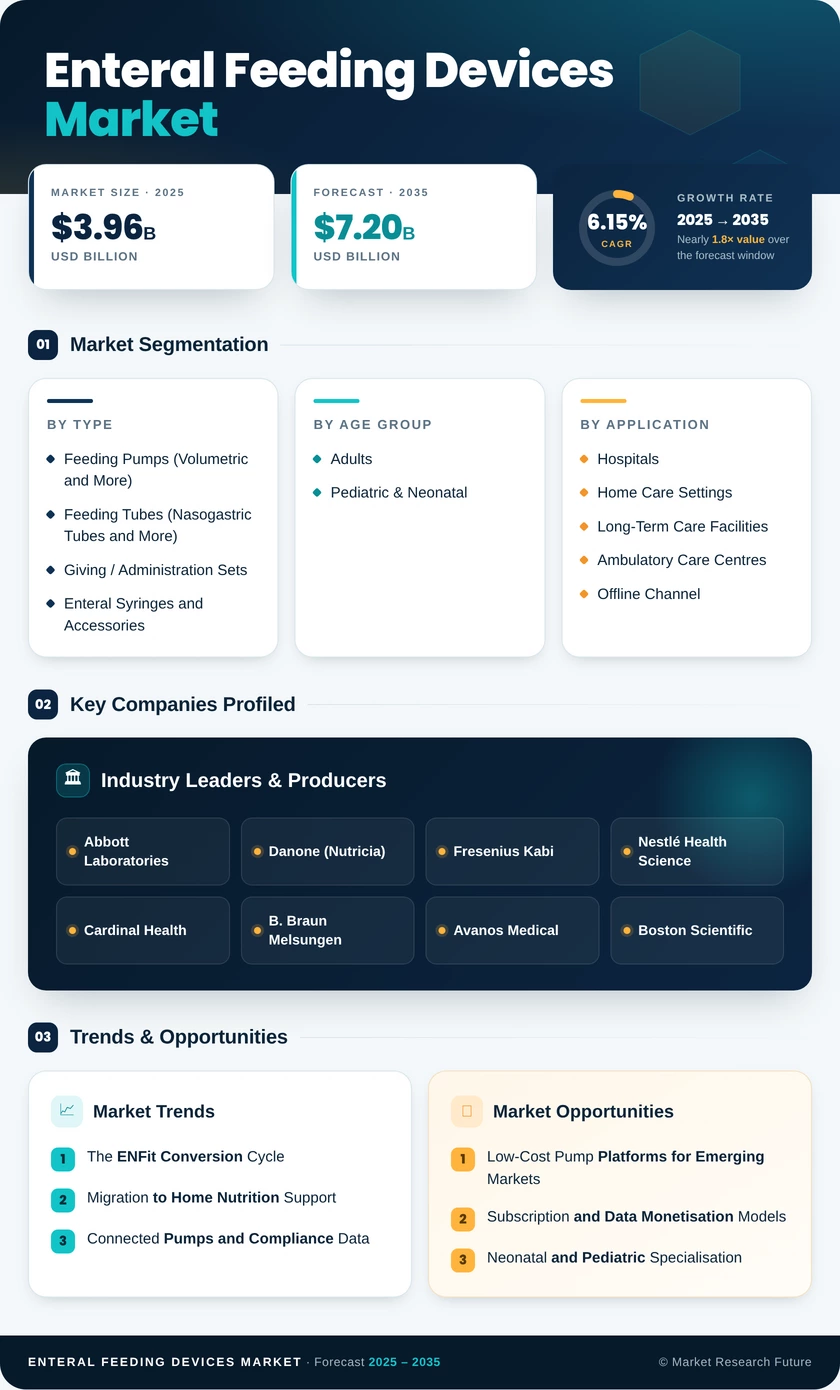
Segmentation Quick Reference
| Dimension | Sub-Segments | Dominant Segment | Fastest Growing Segment |
| By Product Type | Feeding Pumps (Volumetric Pumps and More); Feeding Tubes (Nasogastric Tubes and More); Giving / Administration Sets; Enteral Syringes and Accessories | Feeding Pumps | Feeding Tubes |
| By Age Group | Adults; Pediatric & Neonatal | Adults | Pediatric & Neonatal |
| By Distribution Channel | Offline; Online | Offline | Online |
| By Application | Oncology; Gastroenterology; Neurology; Critical Care & Trauma; Diabetes; Others | Oncology | Critical Care & Trauma |
| By End-User | Hospitals; Home Care Settings; Long-Term Care Facilities; Ambulatory Care Centres | Hospitals | Home Care Settings |
| By Geography | North America; Europe; Asia-Pacific; South America; Middle East & Africa | North America | Asia-Pacific |
Market Segmentation Overview
By Product Type
| Sub-Segment | Key Trend |
| Feeding Pumps (Volumetric Pumps and More) | Migration to ambulatory, battery-powered units with dose-error reduction software |
| Feeding Tubes (Nasogastric Tubes and More) | Polyurethane formulations extending dwell time and reducing replacement frequency |
| Giving / Administration Sets | Full ENFit conversion completed across most acute-care portfolios |
| Enteral Syringes and Accessories | Purple-hub standardisation and low-dose accuracy for neonatal use |
Product mix is bifurcating. Pumps hold the value and the software roadmap, while tubes and sets carry recurring volume that stabilises revenue between capital cycles.
By Age Group
| Sub-Segment | Key Trend |
| Adults | Stroke, oncology and neurodegenerative caseloads sustaining baseline demand |
| Pediatric & Neonatal | NICU capacity expansion and human-milk-compatible material requirements |
Adult volume funds the business; pediatric specialisation defends margin. Few manufacturers hold clearances across both accuracy classes, which limits competitive crossover.
By Distribution Channel
| Sub-Segment | Key Trend |
| Offline | Consolidated hospital tenders and distributor networks controlling acute-care access |
| Online | Pharmacy-led subscription refills reducing patient supply interruption |
Offline remains dominant through institutional procurement, yet online refill models are reshaping the home-care resupply relationship and the customer data that comes with it.
By Application
| Sub-Segment | Key Trend |
| Oncology | Head, neck and gastrointestinal treatment protocols driving early nutrition initiation |
| Gastroenterology | Malabsorption and inflammatory bowel disease management |
| Neurology | Post-stroke dysphagia pathways formalised in national guidelines |
| Critical Care & Trauma | 48-hour early feeding protocols lifting ICU pump utilisation |
| Diabetes | Specialised low-glycaemic formula delivery requirements |
| Others | Burns, major surgery and recovery nutrition |
Oncology anchors demand because treatment-related malnutrition is predictable and protocol-driven, while critical care grows fastest on the back of early-initiation guideline changes.
By End-User
| Sub-Segment | Key Trend |
| Hospitals | Clinical gateway for tube placement and therapy initiation |
| Home Care Settings | Payer-driven cost-shifting and remote monitoring adoption |
| Long-Term Care Facilities | Price-led purchasing with limited clinical differentiation |
| Ambulatory Care Centres | Outpatient percutaneous placement volumes rising |
Hospitals decide the therapy; home care increasingly captures the revenue. Suppliers that control both the placement moment and the resupply chain will hold the strongest position through 2035.
By Geography
| Sub-Segment | Key Trend |
| North America | ENFit enforcement and mature home-infusion reimbursement |
| Europe | Consolidated tenders with sustainability scoring criteria |
| Asia-Pacific | Public insurance expansion and domestic manufacturer price competition |
| South America | Regulatory harmonisation opening multinational registration pathways |
| Middle East & Africa | Hospital megaprojects in the Gulf; donor-funded neonatal units elsewhere |
Mature regions are replacing installed bases under regulatory pressure; emerging regions are building first-time capacity. Those two dynamics require different product architectures and different price points.


 Noah Malgeri
Co-Founder
Noah Malgeri
Co-Founder

 Peter Groot koerkamp
Account and Business Manager
Peter Groot koerkamp
Account and Business Manager

 Younghwan Choi
Senior Retail Manager
Younghwan Choi
Senior Retail Manager

 Mark Irwin
Management Consultant
Mark Irwin
Management Consultant

 Akif Moroglu
Strategy & Business Development Director
Akif Moroglu
Strategy & Business Development Director

 Guilherme Gomes Martins
Product Management Director
Guilherme Gomes Martins
Product Management Director

 Joseph Aguayo
Sales Operations & Pricing Manager
Joseph Aguayo
Sales Operations & Pricing Manager

 La Terria Dodd
Program Support Specialist
La Terria Dodd
Program Support Specialist

 Rob Kooiker
Group Product Manager HVAC & Fire Protection GMA
Rob Kooiker
Group Product Manager HVAC & Fire Protection GMA