×
Request Free Sample ×

Kindly complete the form below to receive a free sample of this Report

* Please use a valid business email

Leading companies partner with us for data-driven Insights

clients tt-cursor
Hero Background

End User Experience Monitoring Market

ID: MRFR/ICT/5777-HCR
100 Pages
Aarti Dhapte
October 2025

End User Experience Monitoring Market Research Report By Deployment Type (On-Premises, Cloud-Based, Hybrid), By End User (IT Enterprises, BFSI, Healthcare, Retail, Telecommunications), By Component (Software, Services, Support), By Methodology (Synthetic Monitoring, Real User Monitoring, Digital Experience Monitoring) and By Regional (North America, Europe, South America, Asia Pacific, Middle East and Africa) - Forecast to 2035

Share:
Download PDF ×

We do not share your information with anyone. However, we may send you emails based on your report interest from time to time. You may contact us at any time to opt-out.

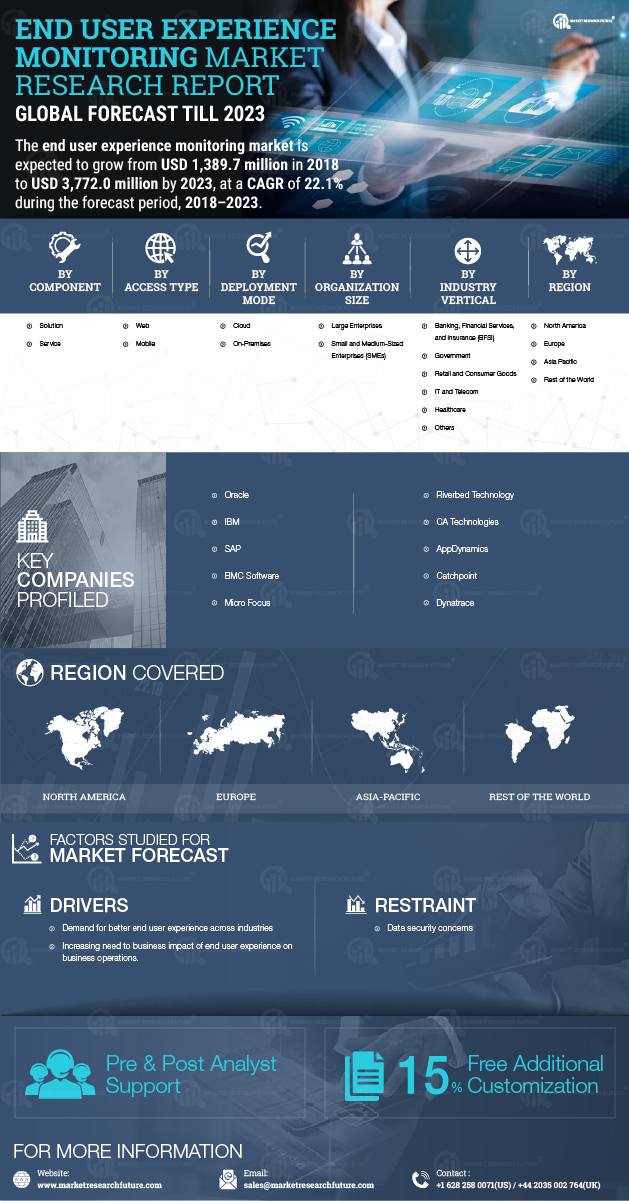
End User Experience Monitoring Market Infographic
Purchase Options

End User Experience Monitoring Market Summary

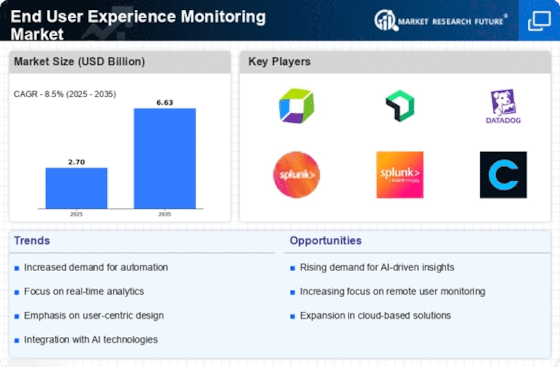
As per MRFR analysis, the End User Experience Monitoring Market Size was estimated at 2.702 USD Billion in 2024. The End User Experience Monitoring industry is projected to grow from 2.931 in 2025 to 6.628 by 2035, exhibiting a compound annual growth rate (CAGR) of 8.5 during the forecast period 2025 - 2035.

Key Market Trends & Highlights

The End User Experience Monitoring Market is poised for substantial growth driven by technological advancements and evolving user expectations.

  • The integration of AI technologies is transforming the End User Experience Monitoring Market landscape, enhancing data analysis and insights.
  • Real-time feedback mechanisms are becoming increasingly vital, allowing organizations to respond swiftly to user needs and preferences.
  • Multi-channel monitoring is gaining traction, reflecting the necessity for businesses to engage users across various platforms effectively.
  • The rising demand for enhanced user experience and the adoption of cloud-based solutions are key drivers propelling market expansion, particularly in North America and Asia-Pacific, with IT enterprises leading the market and BFSI segments experiencing rapid growth.

Market Size & Forecast

2024 Market Size 2.702 (USD Billion)
2035 Market Size 6.628 (USD Billion)
CAGR (2025 - 2035) 8.5%

Major Players

Dynatrace (AT), New Relic (US), Datadog (US), AppDynamics (US), Splunk (US), Catchpoint (US), Aternity (US), SmartBear (US), ObserveIT (US), UserZoom (US)

End User Experience Monitoring Market Trends

The End User Experience Monitoring Market is currently experiencing a notable evolution, driven by the increasing demand for enhanced digital interactions. Organizations are increasingly recognizing the necessity of understanding user behavior and satisfaction to optimize their services. This market encompasses a variety of tools and solutions designed to monitor and analyze user experiences across different platforms, including web and mobile applications. As businesses strive to deliver seamless experiences, the focus on real-time feedback and performance metrics has intensified. This shift suggests a growing awareness of the importance of user-centric approaches in technology deployment. Moreover, the End User Experience Monitoring Market appears to be influenced by advancements in artificial intelligence and machine learning. These technologies enable more sophisticated data analysis, allowing organizations to gain deeper insights into user interactions. The integration of AI-driven analytics tools is likely to enhance the ability to predict user needs and preferences, thereby fostering a more personalized experience. As companies continue to invest in these innovative solutions, the market is poised for further growth, reflecting a broader trend towards data-driven decision-making in enhancing user satisfaction.

Integration of AI Technologies

The incorporation of artificial intelligence in monitoring tools is transforming the End User Experience Monitoring Market. AI technologies facilitate advanced data analysis, enabling organizations to derive actionable insights from user interactions. This trend suggests a shift towards more personalized user experiences, as businesses leverage AI to anticipate user needs.

Emphasis on Real-Time Feedback

There is a growing emphasis on obtaining real-time feedback from users within the End User Experience Monitoring Market. Organizations are increasingly prioritizing immediate insights to address user concerns promptly. This trend indicates a proactive approach to enhancing user satisfaction and optimizing service delivery.

Focus on Multi-Channel Monitoring

The End User Experience Monitoring Market is witnessing a heightened focus on multi-channel monitoring solutions. Businesses are recognizing the necessity of tracking user experiences across various platforms, including web, mobile, and social media. This trend highlights the importance of a holistic view of user interactions to ensure consistent and satisfactory experiences.

End User Experience Monitoring Market Drivers

Adoption of Cloud-Based Solutions

The shift towards cloud-based solutions is significantly influencing the End User Experience Monitoring Market. Organizations are increasingly adopting cloud technologies to enhance scalability, flexibility, and cost-effectiveness in their monitoring efforts. Cloud-based monitoring tools allow businesses to gather and analyze user experience data in real-time, facilitating quicker decision-making processes. Recent statistics indicate that the cloud segment within the user experience monitoring market is expected to account for over 60% of the total market share by 2026. This trend suggests that as more companies migrate to cloud environments, the demand for effective monitoring solutions will continue to rise, further propelling the growth of the End User Experience Monitoring Market.

Integration of Advanced Analytics and AI

The integration of advanced analytics and artificial intelligence is transforming the End User Experience Monitoring Market. Organizations are leveraging AI-driven tools to gain deeper insights into user behavior and preferences. These technologies enable predictive analytics, allowing businesses to anticipate user needs and enhance their overall experience. The market for AI-powered user experience monitoring solutions is expected to witness substantial growth, with estimates suggesting a potential increase of over 30% in adoption rates by 2027. This trend indicates that as companies seek to differentiate themselves in a competitive landscape, the incorporation of advanced analytics will become a key driver in the End User Experience Monitoring Market.

Rising Demand for Enhanced User Experience

The End User Experience Monitoring Market is witnessing a notable surge in demand for improved user experiences across various digital platforms. Organizations are increasingly recognizing that a seamless user experience is pivotal for customer retention and satisfaction. As a result, investments in monitoring tools that provide insights into user interactions are on the rise. According to recent data, the market for user experience monitoring solutions is projected to grow at a compound annual growth rate of approximately 20% over the next five years. This growth is driven by the need for businesses to understand user behavior and preferences, enabling them to tailor their services accordingly. Consequently, the End User Experience Monitoring Market is becoming a critical component of digital transformation strategies.

Increased Focus on Data Privacy and Security

As data privacy regulations become more stringent, the End User Experience Monitoring Market is experiencing a heightened focus on data security and compliance. Organizations are compelled to ensure that their monitoring practices align with regulations such as GDPR and CCPA. This necessity drives the demand for monitoring solutions that not only provide insights into user experiences but also prioritize data protection. Companies are investing in technologies that offer secure data handling and storage, which is likely to enhance consumer trust. The market for privacy-compliant user experience monitoring tools is projected to grow, indicating that businesses are increasingly aware of the importance of safeguarding user data while optimizing their services through the End User Experience Monitoring Market.

Growing Importance of Multi-Channel Engagement

The increasing importance of multi-channel engagement is reshaping the End User Experience Monitoring Market. As consumers interact with brands across various platforms, businesses are recognizing the need for comprehensive monitoring solutions that provide a unified view of user experiences. This trend is prompting organizations to invest in tools that can track and analyze user interactions across multiple channels, including websites, mobile applications, and social media. Recent data suggests that companies focusing on multi-channel strategies are likely to see a 25% increase in customer satisfaction rates. Consequently, the demand for multi-channel monitoring solutions is expected to rise, further driving the growth of the End User Experience Monitoring Market.

Market Segment Insights

By Deployment Type: Cloud-Based (Largest) vs. Hybrid (Fastest-Growing)

In the End User Experience Monitoring Market, the deployment type segment showcases a diverse landscape with distinct preferences among enterprises. The Cloud-Based deployment method holds the largest market share, driven by its flexibility and scalability to meet the evolving needs of organizations. This segment's popularity stems from its cost-effectiveness and ease of integration with existing IT frameworks, making it the preferred choice for many companies seeking to enhance their end-user experience. On the other hand, the Hybrid deployment model is emerging as the fastest-growing segment within this market. This growth can be attributed to an increasing demand for adaptable solutions that combine the benefits of both on-premises and cloud environments. As businesses seek more targeted approaches to monitoring user experiences across various platforms, the Hybrid model is poised to gain significant traction as it allows organizations to maintain control while leveraging cloud innovations.

Cloud-Based (Dominant) vs. Hybrid (Emerging)

The Cloud-Based deployment type is characterized by its widespread adoption due to the numerous advantages it brings to businesses in monitoring end-user experiences. This model enables seamless updates, reduced maintenance efforts, and improved data accessibility, allowing organizations to analyze user interactions in real-time. As digital transformation accelerates, organizations see Cloud-Based solutions as essential for fostering innovation and agility. In contrast, the Hybrid deployment approach is gaining traction as an emerging trend, appealing to businesses that require a balance between on-premises control and cloud agility. This model offers the flexibility to adapt to varying workloads and compliance needs, enabling organizations to optimize their monitoring strategies while managing sensitive data more effectively.

By End User: IT Enterprises (Largest) vs. BFSI (Fastest-Growing)

The End User Experience Monitoring Market is predominantly driven by IT Enterprises, which hold the largest market share due to their critical need for maintaining effective and efficient IT systems. In contrast, the BFSI sector, with its rapidly digitizing landscape, is emerging as the fastest-growing segment. As enterprises focus on enhancing customer experiences and operational efficiencies, the demand for solutions tailored to these two segments is on the rise.

IT Enterprises: Dominant vs. BFSI: Emerging

IT Enterprises are recognized as the dominant players in the End User Experience Monitoring Market, driven by their extensive infrastructure and need for robust monitoring solutions to ensure seamless service delivery. Their focus on digital transformation and customer satisfaction leads to substantial investments in monitoring technologies. Conversely, the BFSI sector, characterized by its stringent regulatory requirements and increasing demand for secure and user-friendly financial services, is becoming an emerging segment. The rapid adoption of advanced technologies in banking and finance is propelling growth, making BFSI a key area for innovative monitoring solutions.

By Component: Software (Largest) vs. Services (Fastest-Growing)

In the End User Experience Monitoring Market, the component segment comprises three crucial values: Software, Services, and Support. Among these, Software holds the largest market share, primarily due to its comprehensive offerings that enhance user experience through data analysis and performance monitoring. Services, though not the largest, have emerged as a significant contributor, witnessing rapid growth as organizations seek specialized assistance to implement and maintain monitoring solutions effectively. The growth trends in this segment are driven by increasing demand for improved customer experiences and the necessity for businesses to adopt digital transformation initiatives. Companies are recognizing the value of real-time user feedback and performance metrics, which has sparked investments in Software and Services. The rising complexity of IT infrastructures also fuels the need for robust support mechanisms, thereby enhancing the relevance of each component in the market.

Software (Dominant) vs. Services (Emerging)

Software is the dominant player in the End User Experience Monitoring Market, delivering powerful solutions for tracking, analyzing, and optimizing user experiences across various digital platforms. This segment is characterized by its extensive range of tools and applications that facilitate data collection, visualization, and actionable insights, making it indispensable for organizations aiming to enhance user satisfaction. In contrast, Services represent the emerging segment that is rapidly gaining traction as more businesses outsource their monitoring needs to third-party providers. This growth is driven by the need for specialized expertise that can manage complex implementations and ensure seamless integration of monitoring tools into existing workflows. Both Software and Services are vital to fostering an agile, responsive user experience strategy.

By Methodology: Synthetic Monitoring (Largest) vs. Real User Monitoring (Fastest-Growing)

In the End User Experience Monitoring Market, the methodology segment is comprised of three primary approaches: Synthetic Monitoring, Real User Monitoring, and Digital Experience Monitoring. Among these, Synthetic Monitoring holds the largest share due to its comprehensive capabilities in simulating user experience and proactively identifying potential issues before they affect real users. Real User Monitoring, while currently smaller in share, is rapidly gaining traction, driven by the increasing demand for genuine user insights and experience enhancements.

Synthetic Monitoring (Dominant) vs. Real User Monitoring (Emerging)

Synthetic Monitoring is recognized for its ability to provide a proactive approach by simulating user actions and monitoring performance preemptively. It allows organizations to ensure their applications perform optimally. On the other hand, Real User Monitoring is emerging as a crucial methodology by capturing actual user interactions and performance metrics in real-time. This methodology can reveal genuine user experiences and insights, which are essential for data-driven decision-making. As companies prioritize customer experience and aim to optimize user satisfaction, the shift towards these emerging methodologies like Real User Monitoring is likely to continue, complementing the established practices of Synthetic Monitoring.

Get more detailed insights about End User Experience Monitoring Market

Regional Insights

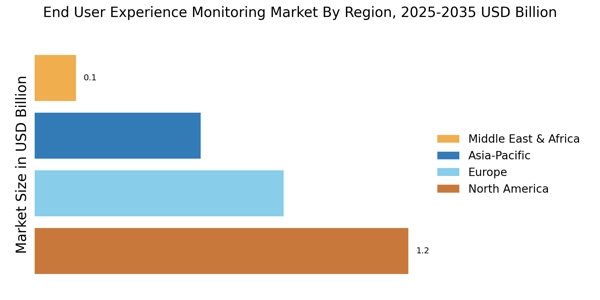
The End User Experience Monitoring Market is projected to witness noteworthy growth across various regions. North America is leading as a dominant player at 0.756 USD Billion, capturing a significant share driven by advanced technological adoption and a vast customer base. Europe follows closely with a valuation of 0.606 USD Billion, benefiting from its strong regulatory environment and emphasis on data privacy, making it an attractive market for end-user experience solutions. The APAC region, valued at 0.428 USD Billion, presents substantial growth potential due to increasing investments in digital transformation and a burgeoning population increasingly relying on digital services.

End User Experience Monitoring Market Regional Image

Key Players and Competitive Insights

The competitive landscape of the End User Experience Monitoring Market has been evolving rapidly as companies increasingly prioritize understanding the customer journey and user interactions within digital environments. This market encompasses tools and solutions designed to monitor, analyze, and enhance the overall user experience, providing organizations with critical insights into application performance, user satisfaction, and engagement levels. A surge in digital transformation initiatives across various sectors has significantly fueled demand for these monitoring solutions, making it essential for market players to devise innovative strategies and offer tailored products that align with consumer expectations.

As customer experience takes center stage, the quest for optimal performance and seamless digital interactions drives investment and competition among key stakeholders in this market.

Datadog stands out in the End User Experience Monitoring Market, leveraging its comprehensive cloud-based monitoring and analytics platform to enhance user experience. With its robust capabilities in observability, Datadog provides real-time visibility into application performance and user interactions, empowering organizations to make data-driven decisions. Its strength in integrating various data sources enables businesses to holistically analyze the end-user experience. Moreover, Datadog's dynamic and scalable infrastructure supports rapid deployment and provides insights on demand, helping organizations swiftly adapt to changing user needs.

The company's commitment to innovation is evident in its continuous enhancement of monitoring tools and user-centric features that simplify operational complexities and elevate overall user satisfaction across diverse digital platforms.

AppDynamics brings a distinct advantage to the End User Experience Monitoring Market, particularly with its focus on application performance management and deep-dive analytics. The company's ability to correlate application performance metrics with user experience directly positions it as a key player in this competitive landscape. AppDynamics provides actionable insights by monitoring user journeys in real-time, allowing organizations to quickly identify and resolve issues that impact user satisfaction. The platform's strength lies in its sophisticated machine learning capabilities that automate performance baselining and anomaly detection, empowering users to proactively manage their applications.

AppDynamics is acclaimed for fostering collaboration between IT and business units, ensuring that technical functionalities align closely with strategic business objectives that enhance user engagement. As digital experiences become increasingly critical to business success, AppDynamics continues to strengthen its offerings, catering to the needs of organizations committed to delivering exceptional end-user experiences.

Key Companies in the End User Experience Monitoring Market market include

Industry Developments

Recent developments in the End User Experience Monitoring Market highlight a significant increase in demand for advanced monitoring solutions driven by the growing emphasis on digital transformation and customer satisfaction. Companies like Datadog, Dynatrace, and New Relic are expanding their product offerings, integrating artificial intelligence to enhance anomaly detection and automated response capabilities. In particular, the rise of remote work has necessitated robust monitoring tools to ensure seamless user experiences across various platforms.

Additionally, there have been notable mergers and acquisitions, specifically with AppDynamics acquiring a smaller firm to enhance their analytics capabilities, while Fortinet recently expanded its portfolio by integrating solutions from a previous acquisition, solidifying its position in the market. The market valuation of these companies showcases strong growth, reflecting their successful adaptation to changing technology requirements and consumer preferences. As organizations increasingly recognize the critical importance of user experience, the investments in monitoring tools by Riverbed Technology, Sentry, and others are likely to further drive market expansion and innovation.

Overall, the landscape remains dynamic and highly competitive, with significant implications for service delivery across sectors.

Future Outlook

End User Experience Monitoring Market Future Outlook

The End User Experience Monitoring Market is projected to grow at an 8.5% CAGR from 2024 to 2035, driven by increasing digital transformation and demand for enhanced user insights.

New opportunities lie in:

  • Integration of AI-driven analytics for real-time user feedback
  • Development of cross-platform monitoring solutions for diverse environments
  • Expansion into emerging markets with tailored user experience tools

By 2035, the market is expected to be robust, reflecting substantial growth and innovation.

Market Segmentation

End User Experience Monitoring Market End User Outlook

  • IT Enterprises
  • BFSI
  • Healthcare
  • Retail
  • Telecommunications

End User Experience Monitoring Market Component Outlook

  • Software
  • Services
  • Support

End User Experience Monitoring Market Methodology Outlook

  • Synthetic Monitoring
  • Real User Monitoring
  • Digital Experience Monitoring

End User Experience Monitoring Market Deployment Type Outlook

  • On-Premises
  • Cloud-Based
  • Hybrid

Report Scope

MARKET SIZE 20242.702(USD Billion)
MARKET SIZE 20252.931(USD Billion)
MARKET SIZE 20356.628(USD Billion)
COMPOUND ANNUAL GROWTH RATE (CAGR)8.5% (2024 - 2035)
REPORT COVERAGERevenue Forecast, Competitive Landscape, Growth Factors, and Trends
BASE YEAR2024
Market Forecast Period2025 - 2035
Historical Data2019 - 2024
Market Forecast UnitsUSD Billion
Key Companies ProfiledMarket analysis in progress
Segments CoveredMarket segmentation analysis in progress
Key Market OpportunitiesIntegration of artificial intelligence to enhance real-time user experience insights in the End User Experience Monitoring Market.
Key Market DynamicsRising demand for real-time analytics drives innovation in End User Experience Monitoring solutions across various industries.
Countries CoveredNorth America, Europe, APAC, South America, MEA

Market Highlights

Author
Aarti Dhapte
Team Lead - Research

She holds an experience of about 6+ years in Market Research and Business Consulting, working under the spectrum of Information Communication Technology, Telecommunications and Semiconductor domains. Aarti conceptualizes and implements a scalable business strategy and provides strategic leadership to the clients. Her expertise lies in market estimation, competitive intelligence, pipeline analysis, customer assessment, etc.

Leave a Comment

FAQs

What is the projected market valuation for the End User Experience Monitoring Market in 2035?

The projected market valuation for the End User Experience Monitoring Market in 2035 is 6.628 USD Billion.

What was the market valuation for the End User Experience Monitoring Market in 2024?

The market valuation for the End User Experience Monitoring Market in 2024 was 2.702 USD Billion.

What is the expected CAGR for the End User Experience Monitoring Market from 2025 to 2035?

The expected CAGR for the End User Experience Monitoring Market during the forecast period 2025 - 2035 is 8.5%.

Which deployment type segment is projected to grow the most by 2035?

The Cloud-Based deployment type segment is projected to grow from 1.08 USD Billion in 2024 to 3.2 USD Billion by 2035.

How does the Healthcare sector contribute to the End User Experience Monitoring Market?

The Healthcare sector is expected to grow from 0.45 USD Billion in 2024 to 1.1 USD Billion by 2035.

What are the key components of the End User Experience Monitoring Market?

The key components include Software, Services, and Support, with Software and Services both projected to reach 2.646 USD Billion by 2035.

Which methodology segment shows the highest growth potential in the market?

The Real User Monitoring methodology segment is anticipated to grow from 0.9 USD Billion in 2024 to 2.2 USD Billion by 2035.

Who are the leading players in the End User Experience Monitoring Market?

Key players in the market include Dynatrace, New Relic, Datadog, AppDynamics, and Splunk.

What is the projected growth for the Telecommunications sector in the End User Experience Monitoring Market?

The Telecommunications sector is expected to grow from 0.41 USD Billion in 2024 to 1.08 USD Billion by 2035.

How does the End User Experience Monitoring Market support IT Enterprises?

The IT Enterprises segment is projected to increase from 0.81 USD Billion in 2024 to 1.95 USD Billion by 2035.

Download Free Sample

Kindly complete the form below to receive a free sample of this Report

Compare Licence

×
Features License Type
Single User Multiuser License Enterprise User
Price $4,950 $5,950 $7,250
Maximum User Access Limit 1 User Upto 10 Users Unrestricted Access Throughout the Organization
Free Customization
Direct Access to Analyst
Deliverable Format
Platform Access
Discount on Next Purchase 10% 15% 15%
Printable Versions