Request Free Sample ×

Kindly complete the form below to receive a free sample of this Report

* Please use a valid business email

Leading companies partner with us for data-driven Insights

clients tt-cursor
Hero Background
English
Chinese
French
Japanese
Korean
German
Spanish

Electric two-wheeler Market Share

ID: MRFR/AT/4010-CR
128 Pages
Triveni Bhoyar
August 2023

Electric Two-Wheeler Market Research Report By Type (Scooters, Motorcycles, Mopeds, E-Bikes), By Battery Type (Lithium-Ion Batteries, Lead-Acid Batteries, Nickel-Metal Hydride Batteries), By Voltage Capacity (Below 48V, 48V to 72V, Above 72V), By End Use (Personal Transportation, Commercial Delivery, Shared Mobility) and By Regional (North America, Europe, South America, Asia Pacific, Middle East and Africa) - Industry Outlook & Forecast to 2035

Share:
Download PDF ×

We do not share your information with anyone. However, we may send you emails based on your report interest from time to time. You may contact us at any time to opt-out.

Electric two-wheeler Market Infographic
Purchase Options

Market Share

Electric two-wheeler Market Share Analysis

In the high-speed outlook of the Network Engineering Services Market, organizations convey different methodologies to get market share and lay out a clear situation in the business. A key mainstay of numerous organizations inside this area is mechanical development. Organizations ceaselessly endeavor to foster state of the art arrangements, including network plan, execution, and streamlining services, to satisfy the developing needs of clients. Remaining at the cutting edge of mechanical progresses, for example, the execution of 5G networks, cloud-based arrangements, and online protection measures, permits organizations to draw in organizations looking for the most recent in network engineering services and cement their market position. Geographic development is a vital system in the Network Engineering Services Market. Organizations decisively target explicit locales or worldwide markets to take advantage of developing potential options. This includes figuring out nearby guidelines, consistence norms, and adjusting services to suit territorial business needs. By growing in a calculated manner, organizations expect to get to new client bases, upgrade their market share, and lay out areas of strength for an in key markets. This procedure often requires a nuanced comprehension of different markets and the capacity to tailor services and marketing systems likewise. Building solid associations with clients encourages steadfastness as well as creates positive verbal, adding to a good market position. Figuring out the exceptional necessities of clients and giving customized network engineering arrangements upgrades an organization's upper hand.

Author
Author Profile
Triveni Bhoyar
Senior Research Analyst

Triveni Bhoyar has over 5 years of experience in the market research industry, specializing in the Automotive and Aerospace & Defense sectors. She has contributed to 200+ reports, including numerous custom projects for leading global companies, delivering solutions to complex business challenges. Renowned for her ability to generate valuable insights, Triveni excels in addressing unique market dynamics with precision and depth. Her expertise spans market sizing, competitive intelligence, and trend analysis, enabling clients to craft data-driven growth strategies. With strong analytical rigor and a client-centric approach, she plays a pivotal role in driving impactful, strategic decision-making.

Leave a Comment

FAQs

What is the current valuation of the Electric two-wheeler Market as of 2025?

<p>The Electric two-wheeler Market is valued at approximately 7260.13 USD Billion in 2024.</p>

What is the projected market valuation for the Electric two-wheeler Market by 2035?

<p>The market is expected to reach a valuation of around 87634.55 USD Billion by 2035.</p>

What is the expected CAGR for the Electric two-wheeler Market during the forecast period 2025 - 2035?

<p>The anticipated CAGR for the Electric two-wheeler Market during 2025 - 2035 is 25.41%.</p>

Which companies are considered key players in the Electric two-wheeler Market?

<p>Key players in the market include Hero Electric, Bajaj Auto, Ather Energy, TVS Motor Company, and Ola Electric.</p>

What are the primary applications of electric two-wheelers in the market?

<p>The primary applications include Personal Transportation, Commercial Use, Delivery Services, and Shared Mobility.</p>

How does the market segment by battery type for electric two-wheelers?

<p>The market segments by battery type include Lithium-ion, Lead-acid, Nickel Metal Hydride, and Solid State batteries.</p>

What vehicle types are included in the Electric two-wheeler Market?

<p>The market encompasses various vehicle types such as Scooters, Motorcycles, Mopeds, and Three-wheelers.</p>

What is the current state of charging infrastructure for electric two-wheelers?

<p>Charging infrastructure includes Home Charging, Public Charging Stations, Fast Charging Solutions, and Battery Swapping.</p>

Who are the primary consumers of electric two-wheelers?

<p>The primary consumers consist of Individual Consumers, Fleet Operators, Government Agencies, and Ride-sharing Services.</p>

What is the market size for electric two-wheelers used in delivery services?

<p>The market size for electric two-wheelers in Delivery Services is approximately 800.0 USD Billion.</p>

Market Summary

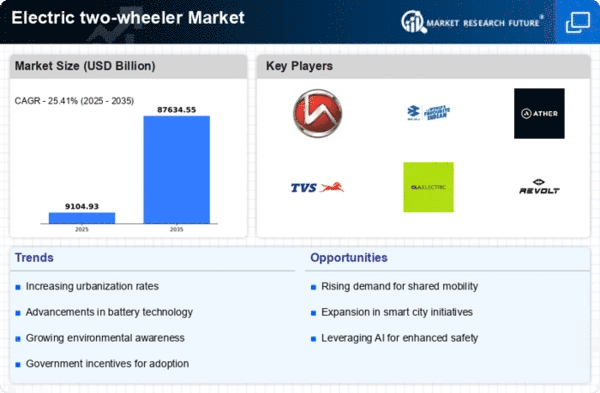
As per MRFR analysis, the Electric two-wheeler market size was estimated at 7260.13 USD Billion in 2024. The Electric two-wheeler industry is projected to grow from 9105.08 in 2025 to 87634.55 by 2035, exhibiting a compound annual growth rate (CAGR) of 25.41% during the forecast period 2025 - 2035.

Key Market Trends & Highlights

The electric two-wheeler market is poised for substantial growth driven by technological advancements and supportive government policies.

  • North America remains the largest market for electric two-wheelers, showcasing a robust demand for personal transportation. Asia-Pacific is recognized as the fastest-growing region, with increasing adoption in delivery services. The lithium-ion battery segment continues to dominate, while solid-state batteries are emerging as a rapidly growing alternative. Rising fuel prices and environmental concerns are significant drivers propelling the shift towards electric two-wheelers.

Market Size & Forecast

2024 Market Size 7260.13 (USD Billion)
2035 Market Size 87634.55 (USD Billion)
CAGR (2025 - 2035) 25.41%
Largest Regional Market Share in 2024 Asia-Pacific

Major Players

Hero Electric (IN), <a href="https://www.bajajauto.com/">Bajaj Auto</a> (IN), Ather Energy (IN), TVS Motor Company (IN), Ola Electric (IN), Revolt Motors (IN), Niu Technologies (CN), Gogoro (TW), <a href="https://www.yamaha-motor-india.com/ev-scooters.html">Yamaha Motor Co</a> (JP)

Market Trends

The Electric two-wheeler Market is currently experiencing a transformative phase characterized by rapid advancements in technology and increasing consumer awareness regarding environmental sustainability. As urban areas become more congested, the demand for efficient and eco-friendly transportation options within the electric two wheeler market is on the rise. This shift is further fueled by government initiatives promoting electric mobility, which aim to reduce carbon emissions and enhance air quality. Consequently, manufacturers are investing heavily in research and development to produce innovative models that cater to diverse consumer preferences, thereby expanding their market reach..  In addition to technological advancements, the Electric two-wheeler Market is witnessing a notable shift in consumer behavior. More individuals are opting for electric scooters and motorcycles as viable alternatives to traditional gasoline-powered vehicles. within the broader electric two wheeler market. This trend is likely influenced by the growing availability of charging infrastructure and the decreasing costs associated with electric vehicle ownership. Furthermore, the integration of smart technologies, such as connectivity features and advanced battery from the electric two wheeler lithium ion battery management system market,, appears to enhance the overall user experience, making electric two-wheelers increasingly appealing to a broader audience. As the market continues to evolve, it is poised for substantial growth in the coming years, driven by both innovation and changing consumer preferences.

Technological Advancements

The Electric two-wheeler Market is seeing significant technological innovations, particularly in battery technology and electric drivetrains. These advancements are enhancing the performance and efficiency of electric two-wheelers, making them more appealing to consumers.

Government Initiatives

Various governments are implementing policies and incentives to promote electric mobility. These initiatives include subsidies for electric vehicle purchases and investments in charging infrastructure, which are likely to stimulate market growth.

Diverse Product Offerings

The market is witnessing a broadening of product categories, with manufacturers introducing a range of electric scooters and motorcycles. This diversification caters to different consumer preferences and is expected to attract a wider audience.

Electric two-wheeler Market Market Drivers

Rising Fuel Prices

The volatility of fuel prices is a notable driver of the Global Electric Two-Wheeler Market Industry. As gasoline prices fluctuate, consumers are increasingly looking for cost-effective alternatives to traditional vehicles. Electric two-wheelers present a viable solution, offering lower operating costs and reduced dependence on fossil fuels. The long-term savings associated with electric vehicles, combined with the rising cost of gasoline, are likely to encourage more consumers to transition to electric two-wheelers. This shift is expected to contribute to the market's expansion, aligning with the broader trend towards sustainable transportation.

Market Growth Projections

The Global Electric Two-Wheeler Market Industry is poised for substantial growth, with projections indicating a market value of 30.1 USD Billion in 2024 and an anticipated increase to 100 USD Billion by 2035. The compound annual growth rate of 11.55% from 2025 to 2035 underscores the robust demand for electric two-wheelers. This growth trajectory reflects the convergence of various factors, including technological advancements, government support, and changing consumer preferences. As the market evolves, it is likely to attract new entrants and foster innovation, further enhancing the competitive landscape.

Technological Advancements

Technological innovations play a pivotal role in shaping the Global Electric Two-Wheeler Market Industry. Advances in battery technology, such as lithium-ion batteries, have significantly improved the range and efficiency of electric two-wheelers. Enhanced charging infrastructure, including fast-charging stations, is also emerging, making electric two-wheelers more convenient for consumers. Furthermore, the integration of smart technologies, such as connectivity features and advanced safety systems, is likely to attract a broader customer base. These developments not only enhance user experience but also contribute to the overall growth of the market, which is anticipated to reach 100 USD Billion by 2035.

Growing Environmental Concerns

The increasing awareness of environmental issues drives the Global Electric Two-Wheeler Market Industry. As urban areas grapple with pollution and climate change, consumers are more inclined to adopt electric two-wheelers as a sustainable alternative to traditional gasoline-powered vehicles. Governments worldwide are implementing stricter emissions regulations, which further incentivizes the shift towards electric mobility. For instance, many countries are setting ambitious targets for reducing carbon emissions, thereby creating a favorable environment for electric two-wheelers. This trend is expected to contribute to the market's growth, with projections indicating a market value of 30.1 USD Billion in 2024.

Government Incentives and Policies

Government incentives and supportive policies are crucial drivers of the Global Electric Two-Wheeler Market Industry. Many governments are offering subsidies, tax rebates, and grants to encourage the adoption of electric vehicles. These financial incentives reduce the initial purchase cost for consumers, making electric two-wheelers more accessible. Additionally, various countries are investing in charging infrastructure to alleviate range anxiety among potential buyers. As a result, the market is likely to witness a surge in demand, with a projected compound annual growth rate of 11.55% from 2025 to 2035, reflecting the positive impact of these initiatives.

Urbanization and Traffic Congestion

Rapid urbanization and increasing traffic congestion are significant factors influencing the Global Electric Two-Wheeler Market Industry. As cities expand and populations grow, the demand for efficient and sustainable transportation solutions rises. Electric two-wheelers offer a practical alternative for navigating congested urban environments, providing flexibility and ease of use. Their compact size allows for maneuverability in heavy traffic, making them an attractive option for commuters. This trend is expected to drive market growth, as more individuals seek eco-friendly transportation methods to address urban mobility challenges.


Market Segment Insights

By Application: Personal Transportation (Largest) vs. Delivery Services (Fastest-Growing)

In the Electric two-wheeler Market, the application segments show diverse utilization patterns. Personal transportation constitutes the largest share, reflecting the increasing consumer preference for eco-friendly and cost-effective commuting solutions. This segment is driven by urbanization and a growing emphasis on sustainable living, leading many individuals to transition from conventional vehicles to electric two-wheelers. Conversely, the delivery services segment is rapidly gaining traction, fueled by the rise of e-commerce and the demand for efficient last-mile delivery solutions. The growth trends indicate that personal transportation remains the dominant application, while delivery services are expanding quickly. Factors such as technological advancements, government incentives, and changing consumer behaviors contribute to this growth. Companies are increasingly focusing on the development of electric scooters and bicycles tailored for delivery services, recognizing its potential as a lucrative segment for future investments.

Personal Transportation (Dominant) vs. Delivery Services (Emerging)

Personal transportation in the Electric two-wheeler Market has established itself as the dominant segment, appealing to consumers who prioritize convenience, sustainability, and reduced commuting costs. This segment is characterized by a variety of electric scooters and bikes that cater to urban commuters and recreational users. On the other hand, the delivery services segment is emerging as a promising player, driven by the rapid growth of e-commerce and the need for efficient logistics solutions. Electric two-wheelers used for delivery are typically designed for enhanced durability and range, ensuring they can meet the demands of frequent short trips. As urban areas grapple with traffic congestion and pollution, both segments are set to play crucial roles in urban mobility solutions.

By Battery Type: Lithium-ion Battery (Largest) vs. Lead-acid Battery (Fastest-Growing)

<p>The electric two-wheeler market showcases a diverse range of battery types, with Lithium-ion batteries taking the lead in market share, attributable to their lightweight, high energy density, and longer lifecycle. They dominate the segment, powering a majority of electric scooters and bikes, while the Lead-acid batteries, traditionally used in many electric vehicles, maintain a significant presence due to their lower initial cost and ease of recycling. Nickel Metal Hydride and Solid State batteries are emerging, but their market share remains limited compared to the two lead contenders.</p>

<p>Lithium-ion Battery (Dominant) vs. Lead-acid Battery (Emerging)</p>

<p>Lithium-ion batteries are pivotal in the electric two-wheeler market, characterized by their lightweight design, high energy density, and superior performance. This battery type is favored for its longevity and reduced charging times, making it the preferred choice for electric two-wheelers. Conversely, Lead-acid batteries, while trailing in technological advancement, remain relevant due to their low cost and widespread availability. They are commonly found in entry-level electric bikes. As the market evolves, the transition to Lithium-ion technology is expected to continue, positioning it as the dominant player, while Lead-acid batteries may see slow growth as manufacturers aim for cost-effective electric mobility solutions.</p>

By Vehicle Type: Scooters (Largest) vs. Motorcycles (Fastest-Growing)

In the Electric two-wheeler Market, scooters currently dominate the market share, benefiting from their practicality and widespread adoption in urban areas. Motorcycles, while trailing in market share, are rapidly catching up due to rising interest among enthusiasts and commuters seeking electric alternatives with higher performance capabilities. Mopeds hold a modest position in the market, appealing primarily to budget-conscious consumers, while three-wheelers carve out a niche primarily in goods delivery, showing potential for future expansion.

Scooters (Dominant) vs. Motorcycles (Emerging)

Scooters represent the dominant force in the Electric two-wheeler Market, largely attributed to their convenience and efficiency for short-distance commutes. They are favored for their ease of use and affordability, making them accessible to a broader audience. On the other hand, electric motorcycles are emerging as an exciting choice for those looking for speed and style, appealing to a younger demographic and riders craving performance. With advancements in battery technology leading to enhanced range and efficiency, motorcycles are becoming more viable options, thereby stimulating growth in the segment.

By Charging Infrastructure: Home Charging (Largest) vs. Fast Charging Solutions (Fastest-Growing)

<p>In the Electric two-wheeler Market, the charging infrastructure segment is witnessing a diverse share among its values. Home Charging stands out as the largest segment, reflecting consumer preference for convenience and the growing trend of personal electric vehicle ownership. Public Charging Stations follow as essential enablers of the market, while Fast Charging Solutions and Battery Swapping are making significant strides, catering to the increasing demand for quick and efficient refueling options.</p>

<p>Home Charging (Dominant) vs. Fast Charging Solutions (Emerging)</p>

<p>Home Charging remains the dominant infrastructure solution in the electric two-wheeler market due to its ability to support daily usage patterns and provide users with flexibility at their residences. This approach not only minimizes downtime but also aligns with the growing trend of electric vehicle adoption among consumers who appreciate the comfort of charging at home. Conversely, Fast Charging Solutions are emerging as a vital component in enhancing the usability of electric two-wheelers, addressing range anxiety and facilitating longer journeys. As urbanization accelerates and consumer preferences shift towards more adaptable charging options, Fast Charging Solutions are expected to gain considerable ground, shaping the landscape of the electric mobility sector.</p>

By Consumer Segment: Individual Consumers (Largest) vs. Fleet Operators (Fastest-Growing)

<p>The electric two-wheeler market is witnessing a dynamic distribution among various consumer segments. Individual consumers hold the largest share, driven by the growing preference for sustainable transportation options and the increasing availability of affordable, high-performance electric scooters. Fleet operators are emerging rapidly, capitalizing on the demand for electrification in public transportation and delivery services, spurred by government policies favoring electric vehicles and the push for greener logistics. Growth trends indicate a robust future for both segments. Individual consumers are increasingly attracted to electric two-wheelers due to rising environmental awareness, advancements in technology, and the low cost of operation. Meanwhile, fleet operators are benefitting from economies of scale, partnerships with manufacturers, and incentives designed to accelerate electric vehicle adoption. These factors combined are set to propel both consumer segments to new heights in the market.</p>

<p>Individual Consumers (Dominant) vs. Fleet Operators (Emerging)</p>

<p>The individual consumer segment remains dominant in the electric two-wheeler market, with buyers increasingly favoring eco-friendly vehicles for personal use. This segment is characterized by a diverse consumer base ranging from environmentally conscious millennials to urban commuters seeking efficient transportation. They benefit from extensive model choices, appealing designs, and advancements in battery technology that enhance performance and convenience. In contrast, fleet operators are an emerging force, leveraging electric two-wheelers for cost-effective and sustainable business operations. These operators typically view electric vehicles as vital for fleet optimization, maintenance savings, and compliance with environmental regulations. As fleet electrification accelerates, partnerships with manufacturers and charging infrastructure development will become paramount to meet operational demands.</p>

Get more detailed insights about Electric Two-Wheeler Market Research Report - Global Forecast till 2035

Regional Insights

North America : Growing Market for E-Mobility

The North American electric two-wheeler market is poised for significant growth, driven by increasing environmental awareness and government incentives. With a market size of $1000.0 million, the region is witnessing a surge in demand for sustainable transportation solutions. Regulatory support, including tax credits and rebates, is further catalyzing this growth, making electric two-wheelers more accessible to consumers. Leading the charge in this market are the United States and Canada, where major players like Hero Electric and Bajaj Auto are expanding their presence. The competitive landscape is evolving, with new entrants and established manufacturers alike vying for market share. As consumer preferences shift towards eco-friendly options, the electric two-wheeler segment is expected to flourish, supported by advancements in battery technology and charging infrastructure.

Europe : Sustainable Mobility Leader

Europe is emerging as a leader in the electric two-wheeler market, with a market size of $1500.0 million. The region's commitment to sustainability and stringent emissions regulations are key drivers of this growth. Countries like Germany, France, and the Netherlands are at the forefront, implementing policies that encourage the adoption of electric vehicles, including two-wheelers. The European Union's Green Deal aims to reduce greenhouse gas emissions, further boosting demand for electric mobility solutions. The competitive landscape is robust, featuring key players such as Ather Energy and TVS Motor Company, alongside established brands like Yamaha. The presence of innovative startups is also notable, contributing to a dynamic market environment. As consumer awareness of environmental issues grows, the demand for electric two-wheelers is expected to rise, supported by government initiatives and a growing charging infrastructure.

Asia-Pacific : Dominating Electric Two-Wheeler Market

Asia-Pacific is the dominant player in the electric two-wheeler market, boasting a market size of $4500.0 million. The region's growth is driven by rapid urbanization, rising fuel prices, and government initiatives promoting electric mobility. Countries like China and India are leading the charge, with substantial investments in charging infrastructure and incentives for electric vehicle adoption significantly contributing to the electric two wheeler market share in India. The region accounted for the majority market share in 2024, reflecting its pivotal role in the global landscape. The competitive environment is robust, featuring key players such as Niu Technologies and Ola Electric. Local manufacturers are innovating rapidly to meet consumer demands, while international brands like Honda and Yamaha are also expanding their electric offerings. As the market evolves, the focus on sustainability and technological advancements will continue to shape the future of electric two-wheelers in this region.

Middle East and Africa : Emerging Market Potential

The Middle East and Africa region is witnessing emerging potential in the electric two-wheeler market, with a market size of $260.13 million. Factors such as increasing urbanization, rising fuel costs, and a growing focus on sustainable transportation are driving demand. Governments in several countries are beginning to recognize the importance of electric mobility, leading to the introduction of supportive policies and incentives aimed at boosting adoption. Countries like South Africa and Kenya are leading the charge, with local manufacturers and international players exploring opportunities in this nascent market. The competitive landscape is gradually evolving, with a mix of established brands and new entrants looking to capitalize on the growing interest in electric two-wheelers. As infrastructure develops and consumer awareness increases, the region is expected to see significant growth in this sector.

Key Players and Competitive Insights

The Electric two-wheeler Market is currently characterized by a dynamic competitive landscape, driven by technological advancements, increasing environmental awareness, and supportive government policies. Major players such as Hero Electric (India), Ather Energy (India), and Ola Electric (India) are strategically positioning themselves through innovation and regional expansion. Hero Electric (India) focuses on enhancing its product portfolio with advanced battery technologies, while Ather Energy (India) emphasizes smart connectivity features in its vehicles. Ola Electric (India) is aggressively expanding its manufacturing capabilities, which collectively shapes a competitive environment that is increasingly focused on sustainability and technological integration. Key business tactics within the market include localizing manufacturing and optimizing supply chains to enhance efficiency and reduce costs. The competitive structure appears moderately fragmented, with several players vying for market share. However, the collective influence of key players is significant, as they drive innovation and set industry standards, thereby shaping consumer expectations and market dynamics. In November 2025, Ather Energy (India) announced the launch of its new flagship model, which features a cutting-edge battery management system designed to extend range and improve charging efficiency. This strategic move is likely to enhance Ather's competitive edge by addressing consumer concerns regarding range anxiety, thereby attracting a broader customer base. The introduction of this model underscores Ather's commitment to innovation and positions it favorably against competitors. In October 2025, Ola Electric (India) unveiled its plans to establish a new manufacturing facility in Tamil Nadu, aimed at increasing production capacity by 50%. This expansion is strategically important as it not only meets the growing demand for electric two-wheelers but also reinforces Ola's commitment to local manufacturing, which may enhance its brand image and operational efficiency. Such initiatives are indicative of a broader trend towards localized production in the industry. In September 2025, Yamaha Motor Co (Japan) announced a partnership with a leading tech firm to integrate AI-driven features into its electric two-wheelers. This collaboration is expected to enhance user experience through advanced navigation and predictive maintenance features. The strategic importance of this partnership lies in Yamaha's effort to differentiate its offerings in a crowded market, potentially attracting tech-savvy consumers who prioritize connectivity and smart features. As of December 2025, current competitive trends in the Electric two-wheeler Market are heavily influenced by digitalization, sustainability, and the integration of AI technologies. Strategic alliances are increasingly shaping the landscape, allowing companies to leverage complementary strengths and enhance their market positions. Looking ahead, competitive differentiation is likely to evolve from traditional price-based competition to a focus on innovation, technological advancements, and supply chain reliability, as companies strive to meet the growing expectations of environmentally conscious consumers.

Key Companies in the Electric two-wheeler Market include

Industry Developments

  • Q1 2024: VinFast launches DrgnFly electric bike in the US at CES 2024 Vietnamese EV maker VinFast unveiled its DrgnFly electric bike at CES 2024, marking its official entry into the US electric two-wheeler market with a focus on urban mobility.

Future Outlook

Electric two-wheeler Market Future Outlook

The Electric two-wheeler Market is projected to grow at a 25.41% CAGR from 2025 to 2035, driven by technological advancements, environmental regulations, and increasing consumer demand.

New opportunities lie in:

  • <p>Expansion of battery swapping infrastructure in urban areas. Development of subscription-based electric two-wheeler services. Partnerships with renewable energy providers for charging solutions.</p>

By 2035, the market is expected to be robust, driven by innovation and sustainable practices.

Market Segmentation

Electric two-wheeler Market Application Outlook

  • Personal Transportation
  • Commercial Use
  • Delivery Services
  • Shared Mobility

Electric two-wheeler Market Battery Type Outlook

  • Lithium-ion Battery
  • Lead-acid Battery
  • Nickel Metal Hydride Battery
  • Solid State Battery

Electric two-wheeler Market Vehicle Type Outlook

  • Scooters
  • Motorcycles
  • Mopeds
  • Three-wheelers

Electric two-wheeler Market Charging Infrastructure Outlook

  • Home Charging Stations
  • Public Charging Stations
  • Fast Charging Networks
  • Battery Swapping Stations

Report Scope

MARKET SIZE 2024 7260.13(USD Billion)
MARKET SIZE 2025 9105.08(USD Billion)
MARKET SIZE 2035 87634.55(USD Billion)
COMPOUND ANNUAL GROWTH RATE (CAGR) 25.41% (2025 - 2035)
REPORT COVERAGE Revenue Forecast, Competitive Landscape, Growth Factors, and Trends
BASE YEAR 2024
Market Forecast Period 2025 - 2035
Historical Data 2019 - 2024
Market Forecast Units USD Billion
Key Companies Profiled Hero Electric (IN), Bajaj Auto (IN), Ather Energy (IN), TVS Motor Company (IN), Ola Electric (IN), Revolt Motors (IN), Niu Technologies (CN), Gogoro (TW), Yamaha Motor Co (JP)
Segments Covered Application, Battery Type, Vehicle Type, Charging Infrastructure
Key Market Opportunities Growing consumer demand for sustainable transportation fuels expansion in the Electric two-wheeler Market.
Key Market Dynamics Rising consumer demand for sustainable transportation drives innovation and competition in the electric two-wheeler market.
Countries Covered North America, Europe, APAC, South America, MEA

FAQs

What is the current valuation of the Electric two-wheeler Market as of 2025?

<p>The Electric two-wheeler Market is valued at approximately 7260.13 USD Billion in 2024.</p>

What is the projected market valuation for the Electric two-wheeler Market by 2035?

<p>The market is expected to reach a valuation of around 87634.55 USD Billion by 2035.</p>

What is the expected CAGR for the Electric two-wheeler Market during the forecast period 2025 - 2035?

<p>The anticipated CAGR for the Electric two-wheeler Market during 2025 - 2035 is 25.41%.</p>

Which companies are considered key players in the Electric two-wheeler Market?

<p>Key players in the market include Hero Electric, Bajaj Auto, Ather Energy, TVS Motor Company, and Ola Electric.</p>

What are the primary applications of electric two-wheelers in the market?

<p>The primary applications include Personal Transportation, Commercial Use, Delivery Services, and Shared Mobility.</p>

How does the market segment by battery type for electric two-wheelers?

<p>The market segments by battery type include Lithium-ion, Lead-acid, Nickel Metal Hydride, and Solid State batteries.</p>

What vehicle types are included in the Electric two-wheeler Market?

<p>The market encompasses various vehicle types such as Scooters, Motorcycles, Mopeds, and Three-wheelers.</p>

What is the current state of charging infrastructure for electric two-wheelers?

<p>Charging infrastructure includes Home Charging, Public Charging Stations, Fast Charging Solutions, and Battery Swapping.</p>

Who are the primary consumers of electric two-wheelers?

<p>The primary consumers consist of Individual Consumers, Fleet Operators, Government Agencies, and Ride-sharing Services.</p>

What is the market size for electric two-wheelers used in delivery services?

<p>The market size for electric two-wheelers in Delivery Services is approximately 800.0 USD Billion.</p>

  1. SECTION I: EXECUTIVE SUMMARY AND KEY HIGHLIGHTS
    1. | 1.1 EXECUTIVE SUMMARY
    2. | | 1.1.1 Market Overview
    3. | | 1.1.2 Key Findings
    4. | | 1.1.3 Market Segmentation
    5. | | 1.1.4 Competitive Landscape
    6. | | 1.1.5 Challenges and Opportunities
    7. | | 1.1.6 Future Outlook
  2. SECTION II: SCOPING, METHODOLOGY AND MARKET STRUCTURE
    1. | 2.1 MARKET INTRODUCTION
    2. | | 2.1.1 Definition
    3. | | 2.1.2 Scope of the study
    4. | | | 2.1.2.1 Research Objective
    5. | | | 2.1.2.2 Assumption
    6. | | | 2.1.2.3 Limitations
    7. | 2.2 RESEARCH METHODOLOGY
    8. | | 2.2.1 Overview
    9. | | 2.2.2 Data Mining
    10. | | 2.2.3 Secondary Research
    11. | | 2.2.4 Primary Research
    12. | | | 2.2.4.1 Primary Interviews and Information Gathering Process
    13. | | | 2.2.4.2 Breakdown of Primary Respondents
    14. | | 2.2.5 Forecasting Model
    15. | | 2.2.6 Market Size Estimation
    16. | | | 2.2.6.1 Bottom-Up Approach
    17. | | | 2.2.6.2 Top-Down Approach
    18. | | 2.2.7 Data Triangulation
    19. | | 2.2.8 Validation
  3. SECTION III: QUALITATIVE ANALYSIS
    1. | 3.1 MARKET DYNAMICS
    2. | | 3.1.1 Overview
    3. | | 3.1.2 Drivers
    4. | | 3.1.3 Restraints
    5. | | 3.1.4 Opportunities
    6. | 3.2 MARKET FACTOR ANALYSIS
    7. | | 3.2.1 Value chain Analysis
    8. | | 3.2.2 Porter's Five Forces Analysis
    9. | | | 3.2.2.1 Bargaining Power of Suppliers
    10. | | | 3.2.2.2 Bargaining Power of Buyers
    11. | | | 3.2.2.3 Threat of New Entrants
    12. | | | 3.2.2.4 Threat of Substitutes
    13. | | | 3.2.2.5 Intensity of Rivalry
    14. | | 3.2.3 COVID-19 Impact Analysis
    15. | | | 3.2.3.1 Market Impact Analysis
    16. | | | 3.2.3.2 Regional Impact
    17. | | | 3.2.3.3 Opportunity and Threat Analysis
  4. SECTION IV: QUANTITATIVE ANALYSIS
    1. | 4.1 Automobile, BY Application (USD Billion)
    2. | | 4.1.1 Personal Transportation
    3. | | 4.1.2 Commercial Use
    4. | | 4.1.3 Delivery Services
    5. | | 4.1.4 Shared Mobility
    6. | 4.2 Automobile, BY Battery Type (USD Billion)
    7. | | 4.2.1 Lithium-ion Battery
    8. | | 4.2.2 Lead-acid Battery
    9. | | 4.2.3 Nickel Metal Hydride Battery
    10. | | 4.2.4 Solid State Battery
    11. | 4.3 Automobile, BY Vehicle Type (USD Billion)
    12. | | 4.3.1 Scooters
    13. | | 4.3.2 Motorcycles
    14. | | 4.3.3 Mopeds
    15. | | 4.3.4 Three-wheelers
    16. | 4.4 Automobile, BY Charging Infrastructure (USD Billion)
    17. | | 4.4.1 Home Charging
    18. | | 4.4.2 Public Charging Stations
    19. | | 4.4.3 Fast Charging Solutions
    20. | | 4.4.4 Battery Swapping
    21. | 4.5 Automobile, BY Consumer Segment (USD Billion)
    22. | | 4.5.1 Individual Consumers
    23. | | 4.5.2 Fleet Operators
    24. | | 4.5.3 Government Agencies
    25. | | 4.5.4 Ride-sharing Services
    26. | 4.6 Automobile, BY Region (USD Billion)
    27. | | 4.6.1 North America
    28. | | | 4.6.1.1 US
    29. | | | 4.6.1.2 Canada
    30. | | 4.6.2 Europe
    31. | | | 4.6.2.1 Germany
    32. | | | 4.6.2.2 UK
    33. | | | 4.6.2.3 France
    34. | | | 4.6.2.4 Russia
    35. | | | 4.6.2.5 Italy
    36. | | | 4.6.2.6 Spain
    37. | | | 4.6.2.7 Rest of Europe
    38. | | 4.6.3 APAC
    39. | | | 4.6.3.1 China
    40. | | | 4.6.3.2 India
    41. | | | 4.6.3.3 Japan
    42. | | | 4.6.3.4 South Korea
    43. | | | 4.6.3.5 Malaysia
    44. | | | 4.6.3.6 Thailand
    45. | | | 4.6.3.7 Indonesia
    46. | | | 4.6.3.8 Rest of APAC
    47. | | 4.6.4 South America
    48. | | | 4.6.4.1 Brazil
    49. | | | 4.6.4.2 Mexico
    50. | | | 4.6.4.3 Argentina
    51. | | | 4.6.4.4 Rest of South America
    52. | | 4.6.5 MEA
    53. | | | 4.6.5.1 GCC Countries
    54. | | | 4.6.5.2 South Africa
    55. | | | 4.6.5.3 Rest of MEA
  5. SECTION V: COMPETITIVE ANALYSIS
    1. | 5.1 Competitive Landscape
    2. | | 5.1.1 Overview
    3. | | 5.1.2 Competitive Analysis
    4. | | 5.1.3 Market share Analysis
    5. | | 5.1.4 Major Growth Strategy in the Automobile
    6. | | 5.1.5 Competitive Benchmarking
    7. | | 5.1.6 Leading Players in Terms of Number of Developments in the Automobile
    8. | | 5.1.7 Key developments and growth strategies
    9. | | | 5.1.7.1 New Product Launch/Service Deployment
    10. | | | 5.1.7.2 Merger & Acquisitions
    11. | | | 5.1.7.3 Joint Ventures
    12. | | 5.1.8 Major Players Financial Matrix
    13. | | | 5.1.8.1 Sales and Operating Income
    14. | | | 5.1.8.2 Major Players R&D Expenditure. 2023
    15. | 5.2 Company Profiles
    16. | | 5.2.1 Hero Electric (IN)
    17. | | | 5.2.1.1 Financial Overview
    18. | | | 5.2.1.2 Products Offered
    19. | | | 5.2.1.3 Key Developments
    20. | | | 5.2.1.4 SWOT Analysis
    21. | | | 5.2.1.5 Key Strategies
    22. | | 5.2.2 Bajaj Auto (IN)
    23. | | | 5.2.2.1 Financial Overview
    24. | | | 5.2.2.2 Products Offered
    25. | | | 5.2.2.3 Key Developments
    26. | | | 5.2.2.4 SWOT Analysis
    27. | | | 5.2.2.5 Key Strategies
    28. | | 5.2.3 Ather Energy (IN)
    29. | | | 5.2.3.1 Financial Overview
    30. | | | 5.2.3.2 Products Offered
    31. | | | 5.2.3.3 Key Developments
    32. | | | 5.2.3.4 SWOT Analysis
    33. | | | 5.2.3.5 Key Strategies
    34. | | 5.2.4 TVS Motor Company (IN)
    35. | | | 5.2.4.1 Financial Overview
    36. | | | 5.2.4.2 Products Offered
    37. | | | 5.2.4.3 Key Developments
    38. | | | 5.2.4.4 SWOT Analysis
    39. | | | 5.2.4.5 Key Strategies
    40. | | 5.2.5 Ola Electric (IN)
    41. | | | 5.2.5.1 Financial Overview
    42. | | | 5.2.5.2 Products Offered
    43. | | | 5.2.5.3 Key Developments
    44. | | | 5.2.5.4 SWOT Analysis
    45. | | | 5.2.5.5 Key Strategies
    46. | | 5.2.6 Niu Technologies (CN)
    47. | | | 5.2.6.1 Financial Overview
    48. | | | 5.2.6.2 Products Offered
    49. | | | 5.2.6.3 Key Developments
    50. | | | 5.2.6.4 SWOT Analysis
    51. | | | 5.2.6.5 Key Strategies
    52. | | 5.2.7 Yamaha Motor (JP)
    53. | | | 5.2.7.1 Financial Overview
    54. | | | 5.2.7.2 Products Offered
    55. | | | 5.2.7.3 Key Developments
    56. | | | 5.2.7.4 SWOT Analysis
    57. | | | 5.2.7.5 Key Strategies
    58. | | 5.2.8 Honda Motor (JP)
    59. | | | 5.2.8.1 Financial Overview
    60. | | | 5.2.8.2 Products Offered
    61. | | | 5.2.8.3 Key Developments
    62. | | | 5.2.8.4 SWOT Analysis
    63. | | | 5.2.8.5 Key Strategies
    64. | | 5.2.9 Gogoro (TW)
    65. | | | 5.2.9.1 Financial Overview
    66. | | | 5.2.9.2 Products Offered
    67. | | | 5.2.9.3 Key Developments
    68. | | | 5.2.9.4 SWOT Analysis
    69. | | | 5.2.9.5 Key Strategies
    70. | 5.3 Appendix
    71. | | 5.3.1 References
    72. | | 5.3.2 Related Reports
  6. LIST OF FIGURES
    1. | 6.1 MARKET SYNOPSIS
    2. | 6.2 NORTH AMERICA MARKET ANALYSIS
    3. | 6.3 US MARKET ANALYSIS BY APPLICATION
    4. | 6.4 US MARKET ANALYSIS BY BATTERY TYPE
    5. | 6.5 US MARKET ANALYSIS BY VEHICLE TYPE
    6. | 6.6 US MARKET ANALYSIS BY CHARGING INFRASTRUCTURE
    7. | 6.7 US MARKET ANALYSIS BY CONSUMER SEGMENT
    8. | 6.8 CANADA MARKET ANALYSIS BY APPLICATION
    9. | 6.9 CANADA MARKET ANALYSIS BY BATTERY TYPE
    10. | 6.10 CANADA MARKET ANALYSIS BY VEHICLE TYPE
    11. | 6.11 CANADA MARKET ANALYSIS BY CHARGING INFRASTRUCTURE
    12. | 6.12 CANADA MARKET ANALYSIS BY CONSUMER SEGMENT
    13. | 6.13 EUROPE MARKET ANALYSIS
    14. | 6.14 GERMANY MARKET ANALYSIS BY APPLICATION
    15. | 6.15 GERMANY MARKET ANALYSIS BY BATTERY TYPE
    16. | 6.16 GERMANY MARKET ANALYSIS BY VEHICLE TYPE
    17. | 6.17 GERMANY MARKET ANALYSIS BY CHARGING INFRASTRUCTURE
    18. | 6.18 GERMANY MARKET ANALYSIS BY CONSUMER SEGMENT
    19. | 6.19 UK MARKET ANALYSIS BY APPLICATION
    20. | 6.20 UK MARKET ANALYSIS BY BATTERY TYPE
    21. | 6.21 UK MARKET ANALYSIS BY VEHICLE TYPE
    22. | 6.22 UK MARKET ANALYSIS BY CHARGING INFRASTRUCTURE
    23. | 6.23 UK MARKET ANALYSIS BY CONSUMER SEGMENT
    24. | 6.24 FRANCE MARKET ANALYSIS BY APPLICATION
    25. | 6.25 FRANCE MARKET ANALYSIS BY BATTERY TYPE
    26. | 6.26 FRANCE MARKET ANALYSIS BY VEHICLE TYPE
    27. | 6.27 FRANCE MARKET ANALYSIS BY CHARGING INFRASTRUCTURE
    28. | 6.28 FRANCE MARKET ANALYSIS BY CONSUMER SEGMENT
    29. | 6.29 RUSSIA MARKET ANALYSIS BY APPLICATION
    30. | 6.30 RUSSIA MARKET ANALYSIS BY BATTERY TYPE
    31. | 6.31 RUSSIA MARKET ANALYSIS BY VEHICLE TYPE
    32. | 6.32 RUSSIA MARKET ANALYSIS BY CHARGING INFRASTRUCTURE
    33. | 6.33 RUSSIA MARKET ANALYSIS BY CONSUMER SEGMENT
    34. | 6.34 ITALY MARKET ANALYSIS BY APPLICATION
    35. | 6.35 ITALY MARKET ANALYSIS BY BATTERY TYPE
    36. | 6.36 ITALY MARKET ANALYSIS BY VEHICLE TYPE
    37. | 6.37 ITALY MARKET ANALYSIS BY CHARGING INFRASTRUCTURE
    38. | 6.38 ITALY MARKET ANALYSIS BY CONSUMER SEGMENT
    39. | 6.39 SPAIN MARKET ANALYSIS BY APPLICATION
    40. | 6.40 SPAIN MARKET ANALYSIS BY BATTERY TYPE
    41. | 6.41 SPAIN MARKET ANALYSIS BY VEHICLE TYPE
    42. | 6.42 SPAIN MARKET ANALYSIS BY CHARGING INFRASTRUCTURE
    43. | 6.43 SPAIN MARKET ANALYSIS BY CONSUMER SEGMENT
    44. | 6.44 REST OF EUROPE MARKET ANALYSIS BY APPLICATION
    45. | 6.45 REST OF EUROPE MARKET ANALYSIS BY BATTERY TYPE
    46. | 6.46 REST OF EUROPE MARKET ANALYSIS BY VEHICLE TYPE
    47. | 6.47 REST OF EUROPE MARKET ANALYSIS BY CHARGING INFRASTRUCTURE
    48. | 6.48 REST OF EUROPE MARKET ANALYSIS BY CONSUMER SEGMENT
    49. | 6.49 APAC MARKET ANALYSIS
    50. | 6.50 CHINA MARKET ANALYSIS BY APPLICATION
    51. | 6.51 CHINA MARKET ANALYSIS BY BATTERY TYPE
    52. | 6.52 CHINA MARKET ANALYSIS BY VEHICLE TYPE
    53. | 6.53 CHINA MARKET ANALYSIS BY CHARGING INFRASTRUCTURE
    54. | 6.54 CHINA MARKET ANALYSIS BY CONSUMER SEGMENT
    55. | 6.55 INDIA MARKET ANALYSIS BY APPLICATION
    56. | 6.56 INDIA MARKET ANALYSIS BY BATTERY TYPE
    57. | 6.57 INDIA MARKET ANALYSIS BY VEHICLE TYPE
    58. | 6.58 INDIA MARKET ANALYSIS BY CHARGING INFRASTRUCTURE
    59. | 6.59 INDIA MARKET ANALYSIS BY CONSUMER SEGMENT
    60. | 6.60 JAPAN MARKET ANALYSIS BY APPLICATION
    61. | 6.61 JAPAN MARKET ANALYSIS BY BATTERY TYPE
    62. | 6.62 JAPAN MARKET ANALYSIS BY VEHICLE TYPE
    63. | 6.63 JAPAN MARKET ANALYSIS BY CHARGING INFRASTRUCTURE
    64. | 6.64 JAPAN MARKET ANALYSIS BY CONSUMER SEGMENT
    65. | 6.65 SOUTH KOREA MARKET ANALYSIS BY APPLICATION
    66. | 6.66 SOUTH KOREA MARKET ANALYSIS BY BATTERY TYPE
    67. | 6.67 SOUTH KOREA MARKET ANALYSIS BY VEHICLE TYPE
    68. | 6.68 SOUTH KOREA MARKET ANALYSIS BY CHARGING INFRASTRUCTURE
    69. | 6.69 SOUTH KOREA MARKET ANALYSIS BY CONSUMER SEGMENT
    70. | 6.70 MALAYSIA MARKET ANALYSIS BY APPLICATION
    71. | 6.71 MALAYSIA MARKET ANALYSIS BY BATTERY TYPE
    72. | 6.72 MALAYSIA MARKET ANALYSIS BY VEHICLE TYPE
    73. | 6.73 MALAYSIA MARKET ANALYSIS BY CHARGING INFRASTRUCTURE
    74. | 6.74 MALAYSIA MARKET ANALYSIS BY CONSUMER SEGMENT
    75. | 6.75 THAILAND MARKET ANALYSIS BY APPLICATION
    76. | 6.76 THAILAND MARKET ANALYSIS BY BATTERY TYPE
    77. | 6.77 THAILAND MARKET ANALYSIS BY VEHICLE TYPE
    78. | 6.78 THAILAND MARKET ANALYSIS BY CHARGING INFRASTRUCTURE
    79. | 6.79 THAILAND MARKET ANALYSIS BY CONSUMER SEGMENT
    80. | 6.80 INDONESIA MARKET ANALYSIS BY APPLICATION
    81. | 6.81 INDONESIA MARKET ANALYSIS BY BATTERY TYPE
    82. | 6.82 INDONESIA MARKET ANALYSIS BY VEHICLE TYPE
    83. | 6.83 INDONESIA MARKET ANALYSIS BY CHARGING INFRASTRUCTURE
    84. | 6.84 INDONESIA MARKET ANALYSIS BY CONSUMER SEGMENT
    85. | 6.85 REST OF APAC MARKET ANALYSIS BY APPLICATION
    86. | 6.86 REST OF APAC MARKET ANALYSIS BY BATTERY TYPE
    87. | 6.87 REST OF APAC MARKET ANALYSIS BY VEHICLE TYPE
    88. | 6.88 REST OF APAC MARKET ANALYSIS BY CHARGING INFRASTRUCTURE
    89. | 6.89 REST OF APAC MARKET ANALYSIS BY CONSUMER SEGMENT
    90. | 6.90 SOUTH AMERICA MARKET ANALYSIS
    91. | 6.91 BRAZIL MARKET ANALYSIS BY APPLICATION
    92. | 6.92 BRAZIL MARKET ANALYSIS BY BATTERY TYPE
    93. | 6.93 BRAZIL MARKET ANALYSIS BY VEHICLE TYPE
    94. | 6.94 BRAZIL MARKET ANALYSIS BY CHARGING INFRASTRUCTURE
    95. | 6.95 BRAZIL MARKET ANALYSIS BY CONSUMER SEGMENT
    96. | 6.96 MEXICO MARKET ANALYSIS BY APPLICATION
    97. | 6.97 MEXICO MARKET ANALYSIS BY BATTERY TYPE
    98. | 6.98 MEXICO MARKET ANALYSIS BY VEHICLE TYPE
    99. | 6.99 MEXICO MARKET ANALYSIS BY CHARGING INFRASTRUCTURE
    100. | 6.100 MEXICO MARKET ANALYSIS BY CONSUMER SEGMENT
    101. | 6.101 ARGENTINA MARKET ANALYSIS BY APPLICATION
    102. | 6.102 ARGENTINA MARKET ANALYSIS BY BATTERY TYPE
    103. | 6.103 ARGENTINA MARKET ANALYSIS BY VEHICLE TYPE
    104. | 6.104 ARGENTINA MARKET ANALYSIS BY CHARGING INFRASTRUCTURE
    105. | 6.105 ARGENTINA MARKET ANALYSIS BY CONSUMER SEGMENT
    106. | 6.106 REST OF SOUTH AMERICA MARKET ANALYSIS BY APPLICATION
    107. | 6.107 REST OF SOUTH AMERICA MARKET ANALYSIS BY BATTERY TYPE
    108. | 6.108 REST OF SOUTH AMERICA MARKET ANALYSIS BY VEHICLE TYPE
    109. | 6.109 REST OF SOUTH AMERICA MARKET ANALYSIS BY CHARGING INFRASTRUCTURE
    110. | 6.110 REST OF SOUTH AMERICA MARKET ANALYSIS BY CONSUMER SEGMENT
    111. | 6.111 MEA MARKET ANALYSIS
    112. | 6.112 GCC COUNTRIES MARKET ANALYSIS BY APPLICATION
    113. | 6.113 GCC COUNTRIES MARKET ANALYSIS BY BATTERY TYPE
    114. | 6.114 GCC COUNTRIES MARKET ANALYSIS BY VEHICLE TYPE
    115. | 6.115 GCC COUNTRIES MARKET ANALYSIS BY CHARGING INFRASTRUCTURE
    116. | 6.116 GCC COUNTRIES MARKET ANALYSIS BY CONSUMER SEGMENT
    117. | 6.117 SOUTH AFRICA MARKET ANALYSIS BY APPLICATION
    118. | 6.118 SOUTH AFRICA MARKET ANALYSIS BY BATTERY TYPE
    119. | 6.119 SOUTH AFRICA MARKET ANALYSIS BY VEHICLE TYPE
    120. | 6.120 SOUTH AFRICA MARKET ANALYSIS BY CHARGING INFRASTRUCTURE
    121. | 6.121 SOUTH AFRICA MARKET ANALYSIS BY CONSUMER SEGMENT
    122. | 6.122 REST OF MEA MARKET ANALYSIS BY APPLICATION
    123. | 6.123 REST OF MEA MARKET ANALYSIS BY BATTERY TYPE
    124. | 6.124 REST OF MEA MARKET ANALYSIS BY VEHICLE TYPE
    125. | 6.125 REST OF MEA MARKET ANALYSIS BY CHARGING INFRASTRUCTURE
    126. | 6.126 REST OF MEA MARKET ANALYSIS BY CONSUMER SEGMENT
    127. | 6.127 KEY BUYING CRITERIA OF AUTOMOBILE
    128. | 6.128 RESEARCH PROCESS OF MRFR
    129. | 6.129 DRO ANALYSIS OF AUTOMOBILE
    130. | 6.130 DRIVERS IMPACT ANALYSIS: AUTOMOBILE
    131. | 6.131 RESTRAINTS IMPACT ANALYSIS: AUTOMOBILE
    132. | 6.132 SUPPLY / VALUE CHAIN: AUTOMOBILE
    133. | 6.133 AUTOMOBILE, BY APPLICATION, 2024 (% SHARE)
    134. | 6.134 AUTOMOBILE, BY APPLICATION, 2024 TO 2035 (USD Billion)
    135. | 6.135 AUTOMOBILE, BY BATTERY TYPE, 2024 (% SHARE)
    136. | 6.136 AUTOMOBILE, BY BATTERY TYPE, 2024 TO 2035 (USD Billion)
    137. | 6.137 AUTOMOBILE, BY VEHICLE TYPE, 2024 (% SHARE)
    138. | 6.138 AUTOMOBILE, BY VEHICLE TYPE, 2024 TO 2035 (USD Billion)
    139. | 6.139 AUTOMOBILE, BY CHARGING INFRASTRUCTURE, 2024 (% SHARE)
    140. | 6.140 AUTOMOBILE, BY CHARGING INFRASTRUCTURE, 2024 TO 2035 (USD Billion)
    141. | 6.141 AUTOMOBILE, BY CONSUMER SEGMENT, 2024 (% SHARE)
    142. | 6.142 AUTOMOBILE, BY CONSUMER SEGMENT, 2024 TO 2035 (USD Billion)
    143. | 6.143 BENCHMARKING OF MAJOR COMPETITORS
  7. LIST OF TABLES
    1. | 7.1 LIST OF ASSUMPTIONS
    2. | | 7.1.1
    3. | 7.2 North America MARKET SIZE ESTIMATES; FORECAST
    4. | | 7.2.1 BY APPLICATION, 2025-2035 (USD Billion)
    5. | | 7.2.2 BY BATTERY TYPE, 2025-2035 (USD Billion)
    6. | | 7.2.3 BY VEHICLE TYPE, 2025-2035 (USD Billion)
    7. | | 7.2.4 BY CHARGING INFRASTRUCTURE, 2025-2035 (USD Billion)
    8. | | 7.2.5 BY CONSUMER SEGMENT, 2025-2035 (USD Billion)
    9. | 7.3 US MARKET SIZE ESTIMATES; FORECAST
    10. | | 7.3.1 BY APPLICATION, 2025-2035 (USD Billion)
    11. | | 7.3.2 BY BATTERY TYPE, 2025-2035 (USD Billion)
    12. | | 7.3.3 BY VEHICLE TYPE, 2025-2035 (USD Billion)
    13. | | 7.3.4 BY CHARGING INFRASTRUCTURE, 2025-2035 (USD Billion)
    14. | | 7.3.5 BY CONSUMER SEGMENT, 2025-2035 (USD Billion)
    15. | 7.4 Canada MARKET SIZE ESTIMATES; FORECAST
    16. | | 7.4.1 BY APPLICATION, 2025-2035 (USD Billion)
    17. | | 7.4.2 BY BATTERY TYPE, 2025-2035 (USD Billion)
    18. | | 7.4.3 BY VEHICLE TYPE, 2025-2035 (USD Billion)
    19. | | 7.4.4 BY CHARGING INFRASTRUCTURE, 2025-2035 (USD Billion)
    20. | | 7.4.5 BY CONSUMER SEGMENT, 2025-2035 (USD Billion)
    21. | 7.5 Europe MARKET SIZE ESTIMATES; FORECAST
    22. | | 7.5.1 BY APPLICATION, 2025-2035 (USD Billion)
    23. | | 7.5.2 BY BATTERY TYPE, 2025-2035 (USD Billion)
    24. | | 7.5.3 BY VEHICLE TYPE, 2025-2035 (USD Billion)
    25. | | 7.5.4 BY CHARGING INFRASTRUCTURE, 2025-2035 (USD Billion)
    26. | | 7.5.5 BY CONSUMER SEGMENT, 2025-2035 (USD Billion)
    27. | 7.6 Germany MARKET SIZE ESTIMATES; FORECAST
    28. | | 7.6.1 BY APPLICATION, 2025-2035 (USD Billion)
    29. | | 7.6.2 BY BATTERY TYPE, 2025-2035 (USD Billion)
    30. | | 7.6.3 BY VEHICLE TYPE, 2025-2035 (USD Billion)
    31. | | 7.6.4 BY CHARGING INFRASTRUCTURE, 2025-2035 (USD Billion)
    32. | | 7.6.5 BY CONSUMER SEGMENT, 2025-2035 (USD Billion)
    33. | 7.7 UK MARKET SIZE ESTIMATES; FORECAST
    34. | | 7.7.1 BY APPLICATION, 2025-2035 (USD Billion)
    35. | | 7.7.2 BY BATTERY TYPE, 2025-2035 (USD Billion)
    36. | | 7.7.3 BY VEHICLE TYPE, 2025-2035 (USD Billion)
    37. | | 7.7.4 BY CHARGING INFRASTRUCTURE, 2025-2035 (USD Billion)
    38. | | 7.7.5 BY CONSUMER SEGMENT, 2025-2035 (USD Billion)
    39. | 7.8 France MARKET SIZE ESTIMATES; FORECAST
    40. | | 7.8.1 BY APPLICATION, 2025-2035 (USD Billion)
    41. | | 7.8.2 BY BATTERY TYPE, 2025-2035 (USD Billion)
    42. | | 7.8.3 BY VEHICLE TYPE, 2025-2035 (USD Billion)
    43. | | 7.8.4 BY CHARGING INFRASTRUCTURE, 2025-2035 (USD Billion)
    44. | | 7.8.5 BY CONSUMER SEGMENT, 2025-2035 (USD Billion)
    45. | 7.9 Russia MARKET SIZE ESTIMATES; FORECAST
    46. | | 7.9.1 BY APPLICATION, 2025-2035 (USD Billion)
    47. | | 7.9.2 BY BATTERY TYPE, 2025-2035 (USD Billion)
    48. | | 7.9.3 BY VEHICLE TYPE, 2025-2035 (USD Billion)
    49. | | 7.9.4 BY CHARGING INFRASTRUCTURE, 2025-2035 (USD Billion)
    50. | | 7.9.5 BY CONSUMER SEGMENT, 2025-2035 (USD Billion)
    51. | 7.10 Italy MARKET SIZE ESTIMATES; FORECAST
    52. | | 7.10.1 BY APPLICATION, 2025-2035 (USD Billion)
    53. | | 7.10.2 BY BATTERY TYPE, 2025-2035 (USD Billion)
    54. | | 7.10.3 BY VEHICLE TYPE, 2025-2035 (USD Billion)
    55. | | 7.10.4 BY CHARGING INFRASTRUCTURE, 2025-2035 (USD Billion)
    56. | | 7.10.5 BY CONSUMER SEGMENT, 2025-2035 (USD Billion)
    57. | 7.11 Spain MARKET SIZE ESTIMATES; FORECAST
    58. | | 7.11.1 BY APPLICATION, 2025-2035 (USD Billion)
    59. | | 7.11.2 BY BATTERY TYPE, 2025-2035 (USD Billion)
    60. | | 7.11.3 BY VEHICLE TYPE, 2025-2035 (USD Billion)
    61. | | 7.11.4 BY CHARGING INFRASTRUCTURE, 2025-2035 (USD Billion)
    62. | | 7.11.5 BY CONSUMER SEGMENT, 2025-2035 (USD Billion)
    63. | 7.12 Rest of Europe MARKET SIZE ESTIMATES; FORECAST
    64. | | 7.12.1 BY APPLICATION, 2025-2035 (USD Billion)
    65. | | 7.12.2 BY BATTERY TYPE, 2025-2035 (USD Billion)
    66. | | 7.12.3 BY VEHICLE TYPE, 2025-2035 (USD Billion)
    67. | | 7.12.4 BY CHARGING INFRASTRUCTURE, 2025-2035 (USD Billion)
    68. | | 7.12.5 BY CONSUMER SEGMENT, 2025-2035 (USD Billion)
    69. | 7.13 APAC MARKET SIZE ESTIMATES; FORECAST
    70. | | 7.13.1 BY APPLICATION, 2025-2035 (USD Billion)
    71. | | 7.13.2 BY BATTERY TYPE, 2025-2035 (USD Billion)
    72. | | 7.13.3 BY VEHICLE TYPE, 2025-2035 (USD Billion)
    73. | | 7.13.4 BY CHARGING INFRASTRUCTURE, 2025-2035 (USD Billion)
    74. | | 7.13.5 BY CONSUMER SEGMENT, 2025-2035 (USD Billion)
    75. | 7.14 China MARKET SIZE ESTIMATES; FORECAST
    76. | | 7.14.1 BY APPLICATION, 2025-2035 (USD Billion)
    77. | | 7.14.2 BY BATTERY TYPE, 2025-2035 (USD Billion)
    78. | | 7.14.3 BY VEHICLE TYPE, 2025-2035 (USD Billion)
    79. | | 7.14.4 BY CHARGING INFRASTRUCTURE, 2025-2035 (USD Billion)
    80. | | 7.14.5 BY CONSUMER SEGMENT, 2025-2035 (USD Billion)
    81. | 7.15 India MARKET SIZE ESTIMATES; FORECAST
    82. | | 7.15.1 BY APPLICATION, 2025-2035 (USD Billion)
    83. | | 7.15.2 BY BATTERY TYPE, 2025-2035 (USD Billion)
    84. | | 7.15.3 BY VEHICLE TYPE, 2025-2035 (USD Billion)
    85. | | 7.15.4 BY CHARGING INFRASTRUCTURE, 2025-2035 (USD Billion)
    86. | | 7.15.5 BY CONSUMER SEGMENT, 2025-2035 (USD Billion)
    87. | 7.16 Japan MARKET SIZE ESTIMATES; FORECAST
    88. | | 7.16.1 BY APPLICATION, 2025-2035 (USD Billion)
    89. | | 7.16.2 BY BATTERY TYPE, 2025-2035 (USD Billion)
    90. | | 7.16.3 BY VEHICLE TYPE, 2025-2035 (USD Billion)
    91. | | 7.16.4 BY CHARGING INFRASTRUCTURE, 2025-2035 (USD Billion)
    92. | | 7.16.5 BY CONSUMER SEGMENT, 2025-2035 (USD Billion)
    93. | 7.17 South Korea MARKET SIZE ESTIMATES; FORECAST
    94. | | 7.17.1 BY APPLICATION, 2025-2035 (USD Billion)
    95. | | 7.17.2 BY BATTERY TYPE, 2025-2035 (USD Billion)
    96. | | 7.17.3 BY VEHICLE TYPE, 2025-2035 (USD Billion)
    97. | | 7.17.4 BY CHARGING INFRASTRUCTURE, 2025-2035 (USD Billion)
    98. | | 7.17.5 BY CONSUMER SEGMENT, 2025-2035 (USD Billion)
    99. | 7.18 Malaysia MARKET SIZE ESTIMATES; FORECAST
    100. | | 7.18.1 BY APPLICATION, 2025-2035 (USD Billion)
    101. | | 7.18.2 BY BATTERY TYPE, 2025-2035 (USD Billion)
    102. | | 7.18.3 BY VEHICLE TYPE, 2025-2035 (USD Billion)
    103. | | 7.18.4 BY CHARGING INFRASTRUCTURE, 2025-2035 (USD Billion)
    104. | | 7.18.5 BY CONSUMER SEGMENT, 2025-2035 (USD Billion)
    105. | 7.19 Thailand MARKET SIZE ESTIMATES; FORECAST
    106. | | 7.19.1 BY APPLICATION, 2025-2035 (USD Billion)
    107. | | 7.19.2 BY BATTERY TYPE, 2025-2035 (USD Billion)
    108. | | 7.19.3 BY VEHICLE TYPE, 2025-2035 (USD Billion)
    109. | | 7.19.4 BY CHARGING INFRASTRUCTURE, 2025-2035 (USD Billion)
    110. | | 7.19.5 BY CONSUMER SEGMENT, 2025-2035 (USD Billion)
    111. | 7.20 Indonesia MARKET SIZE ESTIMATES; FORECAST
    112. | | 7.20.1 BY APPLICATION, 2025-2035 (USD Billion)
    113. | | 7.20.2 BY BATTERY TYPE, 2025-2035 (USD Billion)
    114. | | 7.20.3 BY VEHICLE TYPE, 2025-2035 (USD Billion)
    115. | | 7.20.4 BY CHARGING INFRASTRUCTURE, 2025-2035 (USD Billion)
    116. | | 7.20.5 BY CONSUMER SEGMENT, 2025-2035 (USD Billion)
    117. | 7.21 Rest of APAC MARKET SIZE ESTIMATES; FORECAST
    118. | | 7.21.1 BY APPLICATION, 2025-2035 (USD Billion)
    119. | | 7.21.2 BY BATTERY TYPE, 2025-2035 (USD Billion)
    120. | | 7.21.3 BY VEHICLE TYPE, 2025-2035 (USD Billion)
    121. | | 7.21.4 BY CHARGING INFRASTRUCTURE, 2025-2035 (USD Billion)
    122. | | 7.21.5 BY CONSUMER SEGMENT, 2025-2035 (USD Billion)
    123. | 7.22 South America MARKET SIZE ESTIMATES; FORECAST
    124. | | 7.22.1 BY APPLICATION, 2025-2035 (USD Billion)
    125. | | 7.22.2 BY BATTERY TYPE, 2025-2035 (USD Billion)
    126. | | 7.22.3 BY VEHICLE TYPE, 2025-2035 (USD Billion)
    127. | | 7.22.4 BY CHARGING INFRASTRUCTURE, 2025-2035 (USD Billion)
    128. | | 7.22.5 BY CONSUMER SEGMENT, 2025-2035 (USD Billion)
    129. | 7.23 Brazil MARKET SIZE ESTIMATES; FORECAST
    130. | | 7.23.1 BY APPLICATION, 2025-2035 (USD Billion)
    131. | | 7.23.2 BY BATTERY TYPE, 2025-2035 (USD Billion)
    132. | | 7.23.3 BY VEHICLE TYPE, 2025-2035 (USD Billion)
    133. | | 7.23.4 BY CHARGING INFRASTRUCTURE, 2025-2035 (USD Billion)
    134. | | 7.23.5 BY CONSUMER SEGMENT, 2025-2035 (USD Billion)
    135. | 7.24 Mexico MARKET SIZE ESTIMATES; FORECAST
    136. | | 7.24.1 BY APPLICATION, 2025-2035 (USD Billion)
    137. | | 7.24.2 BY BATTERY TYPE, 2025-2035 (USD Billion)
    138. | | 7.24.3 BY VEHICLE TYPE, 2025-2035 (USD Billion)
    139. | | 7.24.4 BY CHARGING INFRASTRUCTURE, 2025-2035 (USD Billion)
    140. | | 7.24.5 BY CONSUMER SEGMENT, 2025-2035 (USD Billion)
    141. | 7.25 Argentina MARKET SIZE ESTIMATES; FORECAST
    142. | | 7.25.1 BY APPLICATION, 2025-2035 (USD Billion)
    143. | | 7.25.2 BY BATTERY TYPE, 2025-2035 (USD Billion)
    144. | | 7.25.3 BY VEHICLE TYPE, 2025-2035 (USD Billion)
    145. | | 7.25.4 BY CHARGING INFRASTRUCTURE, 2025-2035 (USD Billion)
    146. | | 7.25.5 BY CONSUMER SEGMENT, 2025-2035 (USD Billion)
    147. | 7.26 Rest of South America MARKET SIZE ESTIMATES; FORECAST
    148. | | 7.26.1 BY APPLICATION, 2025-2035 (USD Billion)
    149. | | 7.26.2 BY BATTERY TYPE, 2025-2035 (USD Billion)
    150. | | 7.26.3 BY VEHICLE TYPE, 2025-2035 (USD Billion)
    151. | | 7.26.4 BY CHARGING INFRASTRUCTURE, 2025-2035 (USD Billion)
    152. | | 7.26.5 BY CONSUMER SEGMENT, 2025-2035 (USD Billion)
    153. | 7.27 MEA MARKET SIZE ESTIMATES; FORECAST
    154. | | 7.27.1 BY APPLICATION, 2025-2035 (USD Billion)
    155. | | 7.27.2 BY BATTERY TYPE, 2025-2035 (USD Billion)
    156. | | 7.27.3 BY VEHICLE TYPE, 2025-2035 (USD Billion)
    157. | | 7.27.4 BY CHARGING INFRASTRUCTURE, 2025-2035 (USD Billion)
    158. | | 7.27.5 BY CONSUMER SEGMENT, 2025-2035 (USD Billion)
    159. | 7.28 GCC Countries MARKET SIZE ESTIMATES; FORECAST
    160. | | 7.28.1 BY APPLICATION, 2025-2035 (USD Billion)
    161. | | 7.28.2 BY BATTERY TYPE, 2025-2035 (USD Billion)
    162. | | 7.28.3 BY VEHICLE TYPE, 2025-2035 (USD Billion)
    163. | | 7.28.4 BY CHARGING INFRASTRUCTURE, 2025-2035 (USD Billion)
    164. | | 7.28.5 BY CONSUMER SEGMENT, 2025-2035 (USD Billion)
    165. | 7.29 South Africa MARKET SIZE ESTIMATES; FORECAST
    166. | | 7.29.1 BY APPLICATION, 2025-2035 (USD Billion)
    167. | | 7.29.2 BY BATTERY TYPE, 2025-2035 (USD Billion)
    168. | | 7.29.3 BY VEHICLE TYPE, 2025-2035 (USD Billion)
    169. | | 7.29.4 BY CHARGING INFRASTRUCTURE, 2025-2035 (USD Billion)
    170. | | 7.29.5 BY CONSUMER SEGMENT, 2025-2035 (USD Billion)
    171. | 7.30 Rest of MEA MARKET SIZE ESTIMATES; FORECAST
    172. | | 7.30.1 BY APPLICATION, 2025-2035 (USD Billion)
    173. | | 7.30.2 BY BATTERY TYPE, 2025-2035 (USD Billion)
    174. | | 7.30.3 BY VEHICLE TYPE, 2025-2035 (USD Billion)
    175. | | 7.30.4 BY CHARGING INFRASTRUCTURE, 2025-2035 (USD Billion)
    176. | | 7.30.5 BY CONSUMER SEGMENT, 2025-2035 (USD Billion)
    177. | 7.31 PRODUCT LAUNCH/PRODUCT DEVELOPMENT/APPROVAL
    178. | | 7.31.1
    179. | 7.32 ACQUISITION/PARTNERSHIP
    180. | | 7.32.1

Automobile Market Segmentation

Automobile By Application (USD Billion, 2025-2035)

  • Personal Transportation
  • Commercial Use
  • Delivery Services
  • Shared Mobility

Automobile By Battery Type (USD Billion, 2025-2035)

  • Lithium-ion Battery
  • Lead-acid Battery
  • Nickel Metal Hydride Battery
  • Solid State Battery

Automobile By Vehicle Type (USD Billion, 2025-2035)

  • Scooters
  • Motorcycles
  • Mopeds
  • Three-wheelers

Automobile By Charging Infrastructure (USD Billion, 2025-2035)

  • Home Charging
  • Public Charging Stations
  • Fast Charging Solutions
  • Battery Swapping

Automobile By Consumer Segment (USD Billion, 2025-2035)

  • Individual Consumers
  • Fleet Operators
  • Government Agencies
  • Ride-sharing Services
Infographic

Free Sample Request

Kindly complete the form below to receive a free sample of this Report

Get Free Sample

Customer Strories

Compare Licence

×
Features License Type
Single User Multiuser License Enterprise User
Price $4,950 $5,950 $7,250
Maximum User Access Limit 1 User Upto 10 Users Unrestricted Access Throughout the Organization
Free Customization
Direct Access to Analyst
Deliverable Format
Platform Access
Discount on Next Purchase 10% 15% 15%
Printable Versions
%>