×
Hero Background
English
Chinese
French
Japanese
Korean
German
Spanish

Elastomers Market Trends

ID: MRFR/CnM/6870-HCR
111 Pages
Chitranshi Jaiswal
October 2025

Elastomers Market Research Report By Type (Thermoset Elastomer (Synthetic Rubber, Styrene-butadiene Rubber, Isobutylene-isoprene, Nitrile rubber, Polybutadiene, Others), Natural Rubber, Thermoplastic Elastomer) and By End-Use (Automotive, Medical, Electronics, Textile, Others) – Forecast to 2035

Share:
Download PDF ×

We do not share your information with anyone. However, we may send you emails based on your report interest from time to time. You may contact us at any time to opt-out.

Elastomers Market Infographic
Purchase Options

Market Trends

Key Emerging Trends in the Elastomers Market

The Elastomers market shows different dynamics currently, which includes growing sectors and changing in demands between different spawning businesses. The elastomers group, namely natural rubber and synthetic rubbers, is among materials with the best flexibility and elasticity properties. Society will look at the growing needs of elastomers in the automotive sector as one of the key market trends. Because of the weighty attention placed on the car comfort, safety and fuel efficiency, elastomers are ultra-necessary for the manufacturing of tires, seals, gaskets and other components. This practice is rededicated by the continuously advancing technology in automobile design and the need for materials which can withstand various environmental forces without compromising the level of durability and reliability they offer.

Along with this, the last couple of years saw a rising demand from the construction industry for elastomers with the same trend. Shore compounds belong to the group of rubber-containing compositions that are used in the manufacture of sealants, roofing materials, and insulation products. Due to the situations that call for use of construction materials that are weather resistant, flexible and durable, the construction industry has ended up with a high tendency to include the production of elastomers. Make this wording coincide with actions being taken by the building and construction industry to create an environment friendly structure, where elastomeric materials help to improve insulation and air tightness.

One of the prime factors which affects elastomeric material market trends is the environmental sustainability. It is also noted that there is an increasing need of the market for the use of bio-based elastomers that are more environment friendly ones as alternatives to synthetic rubber. Companies operating in manufacturing sector are channeling resources into research and development to produce elastomer from renewable resources thereby minimizing the disadvantages of rubber. This will lean together with global initiatives to encourage environment-friendly ones in the rubber as well as elastomers manufacturing sector.

Furthermore, Medical and health industry is registering a significant growth for the elastic rubber market. Elastic material, because of its biocompatibility and flexibility, is used in the manufacture of medical instruments including gloves, seals, and other gaskets. Elastomer demand in medical field has surged while custom healthcare devices are upgraded constantly and stable, safe materials are naturally required for medical applications.

Cooperations and collaborations in elastomers industry go through its boom time. Companies in this field are collaborating to research and design new and improved elastomeric products and strategies. In these collaborations the goal is to meet industry specific challenges in, auto, build and health of patients in different fields of industries respectively. Therefore, these collaborations are instrumental in the development of elastomers having continuously enhanced performance and the address of varying needs across the different industries.

Author
Chitranshi Jaiswal
Research Analyst Level I

In her 3 years of experience in the market research field, she has handled critical cross-domain projects. She has an in-depth knowledge of market estimation & analysis, problem-solving, primary as well as secondary research, and team management.She holds an engineering degree and is an MBA professional from a well-known university, capable of evaluating the market and competitive conditions. An exceptional strategist with excellent communication skills and a passion for delivering cutting-edge & practical insights for the market. Proficient in multi-tasking, and can successfully deal with competing demands, while maintaining complete confidentiality. Generated business through active client and project development, networking, and high-quality responses. Her knowledge and skills have helped in making solid business decisions, securing funding from investors, and avoiding business failures.

Leave a Comment

FAQs

What is the CAGR for Elastomer market?

Elastomer market can expand at 7.15% CAGR by 2035.

What is the valuation of the Elastomer market?

By 2035, the Elastomer market value can exceed USD 107.1 Billion.

Who are key players of the Elastomer market?

BASF SE (Germany)—Elastollan, Arkema S.A. (France)—Pebax, and Evonik Industries AG (Germany)—VESTAMID are some reputed names in the Elastomer market.

What is the Elastomer market driver?

The surge in need for geotextile can promote the Elastomer market.

What is the Elastomer market restrain?

presence of alternative solutions can restrain the Elastomer market.

Market Summary

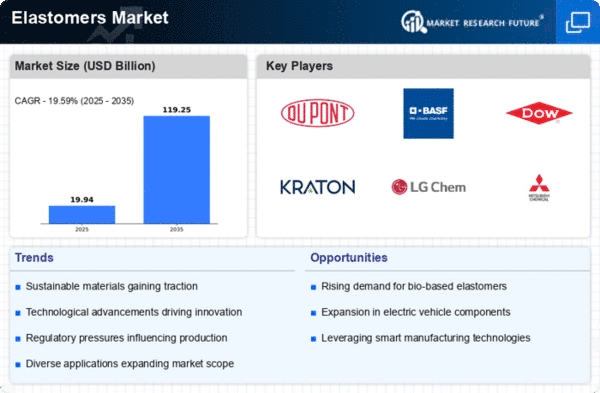
As per MRFR analysis, the Elastomers Market Size was estimated at 16.67 USD Billion in 2024. The Elastomers industry is projected to grow from 19.94 USD Billion in 2025 to 119.25 USD Billion by 2035, exhibiting a compound annual growth rate (CAGR) of 19.59 during the forecast period 2025 - 2035.

Key Market Trends & Highlights

The elastomers market is poised for robust growth driven by sustainability and technological advancements.

  • North America remains the largest market for elastomers, driven by strong demand in the automotive sector.
  • Asia-Pacific is the fastest-growing region, with increasing investments in construction and infrastructure.
  • The automotive segment continues to dominate, while the medical segment is experiencing rapid growth due to advancements in healthcare applications.
  • Key market drivers include rising demand in the automotive sector and a growing focus on renewable energy initiatives.

Market Size & Forecast

2024 Market Size 16.67 (USD Billion)
2035 Market Size 119.25 (USD Billion)
CAGR (2025 - 2035) 19.59%
Largest Regional Market Share in 2024 Asia-Pacific

Major Players

<p>DuPont (US), BASF (DE), Dow (US), Kraton Corporation (US), LG Chem (KR), Mitsubishi Chemical (JP), SABIC (SA), Solvay (BE), Wacker Chemie AG (DE)</p>

Market Trends

The Elastomers Market is currently experiencing a dynamic evolution, driven by various factors that influence demand and supply. The increasing application of elastomers in diverse industries, such as automotive, construction, and consumer goods, appears to be a primary catalyst for growth. Innovations in material science are leading to the development of advanced elastomer formulations that offer enhanced performance characteristics, such as improved durability and resistance to extreme temperatures. Furthermore, the rising emphasis on sustainability is prompting manufacturers to explore bio-based elastomers, which could potentially reshape the market landscape. In addition to these developments, the Elastomers Market is witnessing a shift towards automation and smart manufacturing processes. This trend may enhance production efficiency and reduce costs, thereby attracting more players to the sector. As industries continue to evolve, the demand for specialized elastomers tailored to specific applications is likely to increase. Overall, the current trajectory of the Elastomers Market suggests a robust future, characterized by innovation and adaptability to changing market needs.

Sustainability Initiatives

The growing focus on environmental sustainability is influencing the Elastomers Market. Manufacturers are increasingly investing in the development of eco-friendly elastomers, which are derived from renewable resources. This shift not only addresses consumer demand for greener products but also aligns with regulatory pressures aimed at reducing carbon footprints.

Technological Advancements

Recent technological innovations are reshaping the Elastomers Market landscape. Enhanced manufacturing techniques and the introduction of smart materials are enabling the production of elastomers with superior properties. These advancements may lead to increased efficiency and performance in various applications, particularly in automotive and industrial sectors.

Customization and Specialization

There is a noticeable trend towards customization within the Elastomers Market. As industries seek tailored solutions for specific applications, manufacturers are responding by developing specialized elastomers. This trend indicates a move away from generic products, allowing for enhanced performance and functionality in diverse environments.

Elastomers Market Market Drivers

Market Driver Chart

This section contains a chart illustrating the key market drivers influencing the Global Elastomers Market Industry. The chart visually represents the impact of rising demand from the automotive sector, technological advancements in material science, growing applications in healthcare, and sustainability initiatives. Each driver is quantified to reflect its potential contribution to market growth, providing a comprehensive overview of the factors shaping the industry landscape.

Growing Applications in Healthcare

The Global Elastomers Market Industry is witnessing an expansion in applications within the healthcare sector. Elastomers Market are increasingly utilized in medical devices, drug delivery systems, and biocompatible materials due to their flexibility, durability, and safety. For example, silicone elastomers are commonly used in implants and prosthetics, while thermoplastic elastomers are favored for their ease of processing and sterilization. As the global population ages and healthcare needs evolve, the demand for innovative medical solutions is expected to rise. This trend underscores the potential for growth in the elastomers market, aligning with the projected CAGR of 7.15% from 2025 to 2035.

Rising Demand from Automotive Sector

The Global Elastomers Market Industry is experiencing a surge in demand driven by the automotive sector. As manufacturers increasingly prioritize lightweight materials to enhance fuel efficiency and reduce emissions, elastomers are becoming essential in vehicle production. For instance, elastomers are utilized in tires, seals, and gaskets, contributing to improved performance and durability. The automotive industry's shift towards electric vehicles further amplifies this trend, as these vehicles require advanced materials for battery casings and insulation. This growing demand is projected to significantly impact the market, with the industry expected to reach 127.1 USD Billion by 2024.

Technological Advancements in Material Science

Technological advancements in material science are propelling the Global Elastomers Market Industry forward. Innovations in polymer chemistry and processing techniques are enabling the development of high-performance elastomers with enhanced properties such as heat resistance, flexibility, and chemical stability. These advancements allow for the creation of specialized elastomers tailored for various applications, including medical devices, consumer goods, and industrial components. As industries seek to improve product performance and sustainability, the demand for these advanced elastomers is likely to increase. This trend suggests a robust growth trajectory for the market, potentially reaching 271.8 USD Billion by 2035.

Sustainability Initiatives and Eco-Friendly Materials

Sustainability initiatives are increasingly influencing the Global Elastomers Market Industry. As consumers and manufacturers alike prioritize eco-friendly materials, the demand for bio-based and recyclable elastomers is on the rise. Companies are investing in research and development to create sustainable alternatives that minimize environmental impact while maintaining performance standards. For instance, bio-based elastomers derived from renewable resources are gaining traction in various applications, including packaging and automotive components. This shift towards sustainability is likely to reshape market dynamics, as businesses adapt to meet regulatory requirements and consumer preferences, further driving growth in the elastomers sector.

Market Segment Insights

By Application: Automotive (Largest) vs. Medical (Fastest-Growing)

<p>The Elastomers Market is significantly influenced by its application segments, with the automotive sector commanding the largest share due to its extensive use in vehicle manufacturing, components, and accessories. This segment benefits from the rising trend toward lightweight materials and improved performance metrics in fuel efficiency and durability. Following closely, the construction and consumer goods segments also contribute notably, driven by the demand for innovative and high-performance materials in infrastructure and everyday products. In contrast, the medical application segment is witnessing the fastest growth, fueled by advancements in healthcare technologies and the increasing demand for medical devices that require high-performance elastomer materials. As manufacturers seek to enhance the biocompatibility and functionality of products, the medical sector is expected to expand rapidly, overshadowing traditional applications and driving innovation in elastomer material development.</p>

<p>Automotive: Dominant vs. Medical: Emerging</p>

<p>In the Elastomers Market, the automotive application stands as the dominant force, characterized by its substantial utilization of elastomeric materials in tires, seals, and gaskets. This segment thrives on innovative automotive technology advancements, particularly in electric and hybrid vehicles, which require specialized elastomers for effective performance. Conversely, the medical application, while emerging, is rapidly gaining traction due to the booming healthcare industry. This segment leverages the advantages of elastomers in producing materials that meet stringent regulatory standards and performance requirements. Medical elastomers are utilized in devices ranging from surgical tools to prosthetics, indicating a shift toward higher quality and performance-driven solutions. The growth in this segment reflects the increasing investment in healthcare innovation, making it a crucial area for future elastomer applications.</p>

By Type: Thermoplastic Elastomers (Largest) vs. Silicone Elastomers (Fastest-Growing)

<p>The elastomers market is characterized by a diverse range of types, including Thermoplastic Elastomers (TPEs), Thermosetting Elastomers, Natural Rubber, Synthetic Rubber, and Silicone Elastomers. Among these, Thermoplastic Elastomers hold the largest market share, widely utilized in applications ranging from automotive to consumer goods due to their versatility and recyclability. In contrast, Silicone Elastomers are emerging rapidly, attributed to their exceptional thermal stability and resistance to environmental factors, which makes them highly sought after in sectors like healthcare and electronics.</p>

<p>Thermoplastic Elastomers (Dominant) vs. Silicone Elastomers (Emerging)</p>

<p>Thermoplastic Elastomers (TPEs) are known for their adaptability, combining the properties of rubber with the processing advantages of thermoplastics. This segment dominates the elastomers market due to its extensive use in various industries, driven by the increasing demand for lightweight and durable materials. On the other hand, Silicone Elastomers are gaining traction as an emerging segment due to their unique properties such as high-temperature resistance and biocompatibility. They are particularly favored in applications requiring sterilization and high performance, enabling them to carve out a significant niche in the elastomers market, especially in medical and innovative consumer products.</p>

By End Use: Automotive Components (Largest) vs. Footwear (Fastest-Growing)

<p>The elastomers market is significantly influenced by various end-use sectors, with automotive components leading the distribution in market share. This segment benefits from the need for high-performance materials that offer durability, flexibility, and resistance to environmental factors. Following closely, building materials and medical devices also hold substantial shares, while footwear is rapidly growing, driven by increasing consumer demand for comfort and performance in shoes. In terms of growth trends, the automotive components segment is sustained by the ongoing advancements in vehicle technology, emphasizing lightweight materials for efficiency. Footwear is witnessing rapid expansion as consumer preferences shift towards high-quality, high-performing materials. The medical devices and electrical insulation segments are also projected to grow, fueled by innovation and increasing healthcare requirements.</p>

<p>Automotive Components (Dominant) vs. Medical Devices (Emerging)</p>

<p>Automotive components remain the dominant end-use segment in the elastomers market, primarily due to their essential role in manufacturing vehicles with improved safety and performance characteristics. Elastomers in this segment are utilized for gaskets, seals, and vibration dampeners, providing crucial benefits such as resistance to heat and chemicals. Conversely, the medical devices segment is an emerging area, benefiting from the increased focus on healthcare innovation. Elastomers used in medical devices must meet stringent regulatory standards and are prized for their biocompatibility and flexibility, making them ideal for applications such as tubing, seals, and other components. The market for these segments is expected to evolve continually as technological advancements propel product development.</p>

Get more detailed insights about Elastomers Market Research Report - Forecast till 2035

Regional Insights

North America : Innovation and Demand Growth

The North American elastomers market is projected to reach $4.0 billion by 2025, driven by increasing demand in automotive, construction, and consumer goods sectors. Regulatory support for sustainable materials and innovations in polymer technology are key growth catalysts. The region's focus on eco-friendly elastomers aligns with global sustainability trends, enhancing market potential. Leading countries like the US and Canada dominate the market, with major players such as DuPont, Dow, and Kraton Corporation driving innovation. The competitive landscape is characterized by strategic partnerships and investments in R&D, ensuring a robust supply chain. The presence of established manufacturers and a growing emphasis on high-performance materials further solidify North America's position in the elastomers market.

Europe : Sustainability and Innovation Focus

Europe's elastomers market is expected to reach €4.5 billion by 2025, fueled by stringent regulations promoting sustainable practices and innovative applications in various industries. The region's commitment to reducing carbon footprints and enhancing product performance drives demand for advanced elastomer solutions. Regulatory frameworks are increasingly supportive of eco-friendly materials, creating a favorable environment for market growth. Germany, France, and the UK are leading countries in this sector, with key players like BASF and Wacker Chemie AG at the forefront. The competitive landscape is marked by a strong emphasis on R&D and collaboration among industry stakeholders. The presence of established manufacturers and a growing focus on high-performance elastomers position Europe as a significant player in the global market.

Asia-Pacific : Emerging Powerhouse in Elastomers

Asia-Pacific is the largest elastomers market, projected to reach $7.5 billion by 2025, driven by rapid industrialization and urbanization. The region's growing automotive and construction sectors significantly contribute to demand, supported by favorable government policies and investments in infrastructure. The increasing adoption of advanced elastomer technologies is also a key growth driver, enhancing product performance and sustainability. China, Japan, and South Korea are the leading countries in this market, with major players like LG Chem and Mitsubishi Chemical leading the charge. The competitive landscape is characterized by a mix of local and international companies, fostering innovation and collaboration. The presence of a robust manufacturing base and a focus on high-quality elastomers further strengthen Asia-Pacific's dominance in the global market.

Middle East and Africa : Emerging Market Opportunities

The Middle East and Africa elastomers market is projected to reach $1.67 billion by 2025, driven by increasing demand in construction and automotive sectors. The region's rich natural resources and growing industrial base provide a solid foundation for market expansion. Government initiatives aimed at diversifying economies and promoting manufacturing are key catalysts for growth in this sector. Countries like Saudi Arabia and South Africa are leading the market, with a growing presence of key players such as SABIC. The competitive landscape is evolving, with local manufacturers increasingly focusing on innovation and quality. The region's strategic location and access to emerging markets further enhance its attractiveness for elastomer production and distribution.

Key Players and Competitive Insights

The elastomers market is currently characterized by a dynamic competitive landscape, driven by innovation, sustainability, and strategic partnerships. Key players such as DuPont (US), BASF (DE), and Dow (US) are actively shaping the market through their distinct operational focuses. DuPont (US) emphasizes innovation in bio-based elastomers, aiming to meet the growing demand for sustainable materials. BASF (DE) is leveraging its extensive research capabilities to enhance product performance, while Dow (US) is focusing on expanding its global footprint through strategic collaborations and acquisitions. Collectively, these strategies foster a competitive environment that prioritizes technological advancement and sustainability.

In terms of business tactics, companies are increasingly localizing manufacturing to reduce lead times and optimize supply chains. The elastomers market appears moderately fragmented, with a mix of established players and emerging companies. The influence of key players is significant, as their strategic initiatives often set industry standards and drive market trends. This competitive structure encourages innovation and responsiveness to market demands, ultimately benefiting end-users.

In November 2025, DuPont (US) announced the launch of a new line of bio-based elastomers designed for automotive applications. This strategic move not only aligns with the growing trend towards sustainability but also positions DuPont (US) as a leader in eco-friendly materials. The introduction of these products is expected to enhance the company's market share and appeal to environmentally conscious consumers.

In October 2025, BASF (DE) expanded its production capacity for thermoplastic elastomers in Asia. This expansion is strategically important as it allows BASF (DE) to better serve the rapidly growing demand in the region, particularly in the automotive and consumer goods sectors. By increasing its local production capabilities, BASF (DE) aims to strengthen its competitive position and improve supply chain efficiency.

In September 2025, Dow (US) entered into a strategic partnership with a leading technology firm to integrate AI into its manufacturing processes. This collaboration is likely to enhance operational efficiency and product quality, reflecting a broader trend towards digital transformation in the elastomers market. By adopting advanced technologies, Dow (US) is positioning itself to respond more effectively to market fluctuations and customer needs.

As of December 2025, the elastomers market is witnessing trends such as digitalization, sustainability, and AI integration, which are redefining competitive dynamics. Strategic alliances are increasingly shaping the landscape, enabling companies to leverage complementary strengths and enhance innovation. Moving forward, competitive differentiation is expected to evolve from traditional price-based competition to a focus on innovation, technology, and supply chain reliability. This shift underscores the importance of adaptability and forward-thinking strategies in maintaining a competitive edge.

Key Companies in the Elastomers Market market include

Industry Developments

  • March 2022: The researchers at Johns Hopkins examined the energy-absorbing properties of liquid crystal elastomers. The research team was able to increase strength while decreasing weight by using high-energy-absorbing liquid crystal elastomers (LCEs), which are typically used in actuators and robotics.
  • February 2022: Celanese has agreed to acquire the majority of DuPont's Mobility and Materials unit for USD 11 billion, combining two of the world's leading engineering polymer businesses. Celanese will also acquire DuPont's long-chain and performance nylons, as well as polybutylene and polyethylene terephthalates. The deal also includes DuPont's polyester and ethylene acrylic elastomers, as well as its Mylar and Melinex polyester films.

Future Outlook

Elastomers Market Future Outlook

<p>The Elastomers is poised for robust growth at 19.59% CAGR from 2024 to 2035, driven by increasing demand in automotive, healthcare, and consumer goods sectors.</p>

New opportunities lie in:

  • <p>Development of bio-based elastomers for sustainable applications.</p>
  • <p>Expansion into emerging markets with tailored product offerings.</p>
  • <p>Investment in advanced manufacturing technologies to enhance production efficiency.</p>

<p>By 2035, the elastomers market is expected to achieve substantial growth, solidifying its position as a key industry.</p>

Market Segmentation

Elastomers Market Type Outlook

  • Thermoplastic Elastomers
  • Thermosetting Elastomers
  • Natural Rubber
  • Synthetic Rubber
  • Silicone Elastomers

Elastomers Market End Use Outlook

  • Automotive Components
  • Building Materials
  • Footwear
  • Medical Devices
  • Electrical Insulation

Elastomers Market Application Outlook

  • Automotive
  • Construction
  • Consumer Goods
  • Medical
  • Industrial

Report Scope

MARKET SIZE 202416.67(USD Billion)
MARKET SIZE 202519.94(USD Billion)
MARKET SIZE 2035119.25(USD Billion)
COMPOUND ANNUAL GROWTH RATE (CAGR)19.59% (2024 - 2035)
REPORT COVERAGERevenue Forecast, Competitive Landscape, Growth Factors, and Trends
BASE YEAR2024
Market Forecast Period2025 - 2035
Historical Data2019 - 2024
Market Forecast UnitsUSD Billion
Key Companies ProfiledDuPont (US), BASF (DE), Dow (US), Kraton Corporation (US), LG Chem (KR), Mitsubishi Chemical (JP), SABIC (SA), Solvay (BE), Wacker Chemie AG (DE)
Segments CoveredApplication, Type, End Use
Key Market OpportunitiesGrowing demand for sustainable elastomers driven by environmental regulations and consumer preferences.
Key Market DynamicsRising demand for sustainable materials drives innovation and competition in the elastomers market.
Countries CoveredNorth America, Europe, APAC, South America, MEA

FAQs

What is the CAGR for Elastomer market?

Elastomer market can expand at 7.15% CAGR by 2035.

What is the valuation of the Elastomer market?

By 2035, the Elastomer market value can exceed USD 107.1 Billion.

Who are key players of the Elastomer market?

BASF SE (Germany)—Elastollan, Arkema S.A. (France)—Pebax, and Evonik Industries AG (Germany)—VESTAMID are some reputed names in the Elastomer market.

What is the Elastomer market driver?

The surge in need for geotextile can promote the Elastomer market.

What is the Elastomer market restrain?

presence of alternative solutions can restrain the Elastomer market.

  1. Executive Summary
  2. Market Introduction
    1. Market Definition
    2. Scope of the Study
      1. Research Objectives
      2. Assumptions & Limitations
    3. Markets Structure
    4. Key Takeaways
  3. Market Research Methodology
    1. Research Process
    2. Primary Research
    3. Secondary Research
    4. Market Size Estimation
    5. Forecast Model
  4. Market Dynamics of Global Elastomers Market
    1. Introduction
    2. Drivers
    3. Restraints
    4. Opportunities
    5. Challenges
    6. Trends/Technology
  5. Market Factor Analysis of Global Elastomers Market
    1. Supply Chain Analysis
      1. Raw Material Suppliers
      2. Manufacturers/Producers
      3. Distributors/Retailers/Wholesalers/E-Commerce
      4. End User
    2. Porter’s Five Forces Analysis
      1. Threat of New Entrants
      2. Bargaining Power of Buyers
      3. Bargaining Power of Suppliers
      4. Threat of Substitutes
      5. Intensity of Competitive Rivalry
    3. Pricing Analysis
  6. Global Elastomers Market, by Type
    1. Introduction
    2. Thermoset Elastomer
      1. Market Estimates & Forecast, 2020−2027
      2. Market Estimates & Forecast, by Region, 2020−2027
    3. Thermoplastic Elastomer
      1. Market Estimates & Forecast, 2020−2027
      2. Market Estimates & Forecast, by Region, 2020−2027
  7. Global Elastomers Market, by End-Use Industry
    1. Introduction
    2. Automotive
      1. Market Estimates & Forecast, 2020−2027
      2. Market Estimates & Forecast, by Region, 2020−2027
    3. Medical
      1. Market Estimates & Forecast, 2020−2027
      2. Market Estimates & Forecast, by Region, 2020−2027
    4. Electronics
      1. Market Estimates & Forecast, 2020−2027
      2. Market Estimates & Forecast, by Region, 2020−2027
    5. Textile
      1. Market Estimates & Forecast, 2020−2027
      2. Market Estimates & Forecast, by Region, 2020−2027
    6. Others
      1. Market Estimates & Forecast, 2020−2027
      2. Market Estimates & Forecast, by Region, 2020−2027
  8. Global Elastomers Market, by Region
    1. Introduction
    2. North America
      1. Market Estimates & Forecast, 2020−2027
      2. Market Estimates & Forecast, by Type, 2020−2027
      3. Market Estimates & Forecast, by End-Use Industry, 2020−2027
      4. US
      5. Canada
    3. Europe
      1. Market Estimates & Forecast, 2020−2027
      2. Market Estimates & Forecast, by Type, 2020−2027
      3. Market Estimates & Forecast, by End-Use Industry, 2020−2027
      4. Germany
      5. France
      6. Italy
      7. Spain
      8. UK
      9. Russia
      10. Poland
      11. Rest of Europe
    4. Asia-Pacific
      1. Market Estimates & Forecast, 2020−2027
      2. Market Estimates & Forecast, by Type, 2020−2027
      3. Market Estimates & Forecast, by End-Use Industry, 2020−2027
      4. China
      5. India
      6. Japan
      7. Australia & New Zealand
      8. Rest of Asia-Pacific
    5. Middle East & Africa
      1. Market Estimates & Forecast, 2020−2027
      2. Market Estimates & Forecast, by Type, 2020−2027
      3. Market Estimates & Forecast, by End-Use Industry, 2020−2027
      4. GCC
      5. Israel
      6. North Africa
      7. Turkey
      8. Rest of Middle East & Africa
    6. Latin America
      1. Market Estimates & Forecast, 2020−2027
      2. Market Estimates & Forecast, by Type, 2020−2027
      3. Market Estimates & Forecast, by End-Use Industry, 2020−2027
      4. Brazil
      5. Argentina
      6. Mexico
      7. Rest of Latin America
  9. Company Landscape
    1. Introduction
    2. Market Strategy
    3. Key Development Analysis (Expansion/Merger & Acquisitions/Joint Venture/New Product Development/Agreement/Investment)
  10. Company Profiles
    1. BASF SE
      1. Company Overview
      2. Financial Updates
      3. Product/Business Segment Overview
      4. Strategy
      5. Key Developments
      6. SWOT Analysis
    2. Evonik Industries AG
      1. Company Overview
      2. Financial Updates
      3. Product/Business Segment Overview
      4. Strategy
      5. Key Developments
      6. SWOT Analysis
    3. Arkema S.A.
      1. Company Overview
      2. Financial Updates
      3. Product/Business Segment Overview
      4. Strategy
      5. Key Developments
      6. SWOT Analysis
    4. The Dow Chemical Company
      1. Company Overview
      2. Financial Updates
      3. Product/Business Segment Overview
      4. Strategy
      5. Key Developments
      6. SWOT Analysis
    5. Kuraray Co., Ltd.
      1. Company Overview
      2. Financial Updates
      3. Product/Business Segment Overview
      4. Strategy
      5. Key Developments
      6. SWOT Analysis
    6. Covestro AG
      1. Company Overview
      2. Financial Updates
      3. Product/Business Segment Overview
      4. Strategy
      5. Key Developments
      6. SWOT Analysis
    7. SABIC
      1. Company Overview
      2. Financial Updates
      3. Product/Business Segment Overview
      4. Strategy
      5. Key Developments
      6. SWOT Analysis
    8. ARLANXEO
      1. Company Overview
      2. Financial Updates
      3. Product/Business Segment Overview
      4. Strategy
      5. Key Developments
      6. SWOT Analysis
    9. Mitsui Chemicals, Inc
      1. Company Overview
      2. Financial Updates
      3. Product/Business Segment Overview
      4. Strategy
      5. Key Developments
      6. SWOT Analysis
    10. Exxon Mobil Corporation
      1. Company Overview
      2. Financial Updates
      3. Product/Business Segment Overview
      4. Strategy
      5. Key Developments
      6. SWOT Analysis
    11. DuPont de Nemours
      1. Company Overview
      2. Financial Updates
      3. Product/Business Segment Overview
      4. Strategy
      5. Key Developments
      6. SWOT Analysis
    12. West American Rubber Company,LLC
      1. Company Overview
      2. Financial Updates
      3. Product/Business Segment Overview
      4. Strategy
      5. Key Developments
      6. SWOT Analysis
    13. Solvay
      1. Company Overview
      2. Financial Updates
      3. Product/Business Segment Overview
      4. Strategy
      5. Key Developments
      6. SWOT Analysis
    14. TERVES INC.
      1. Company Overview
      2. Financial Updates
      3. Product/Business Segment Overview
      4. Strategy
      5. Key Developments
      6. SWOT Analysis
    15. Teknor Apex
      1. Company Overview
      2. Financial Updates
      3. Product/Business Segment Overview
      4. Strategy
      5. Key Developments
      6. SWOT Analysis
  11. Conclusion
  12. LIST OF TABLES
  13. Global Elastomers Market: by Region, 2020−2027
  14. North America: Elastomers Market, by Country, 2020−2027
  15. Europe: Elastomers Market, by Country, 2020−2027
  16. Asia-Pacific: Elastomers Market. by Country, 2020−2027
  17. Middle East & Africa: Elastomers Market, by Country, 2020−2027
  18. Latin America: Elastomers Market, by Country, 2020−2027
  19. Global Elastomers Type Market, by Regions, 2020−2027
  20. North America: Elastomers Type Market, by Country, 2020−2027
  21. Europe: Elastomers Type Market, by Country, 2020−2027
  22. Table10 Asia-Pacific: Elastomers Type Market, by Country, 2020−2027
  23. Table11 Middle East & Africa: Elastomers Type Market, by Country, 2020−2027
  24. Table12 Latin America: Elastomers Type Market, by Country, 2020−2027
  25. Table13 Global Elastomers End-Use Industry Market, by Regions, 2020−2027
  26. Table14 North America: Elastomers End-Use Industry Market, by Country, 2020−2027
  27. Table15 Europe: Elastomers End-Use Industry Market, by Country, 2020−2027
  28. Table16 Asia-Pacific: Elastomers End-Use Industry Market, by Country, 2020−2027
  29. Table17 Middle East & Africa: Elastomers End-Use Industry Market, by Country, 2020−2027
  30. Table18 Latin America: Elastomers by End-Use Industry Market, by Country, 2020-2027
  31. Table19 Global Type Market, by Region, 2020−2027
  32. Table20 Global End-Use Industry Market, by Region, 2020−2027
  33. Table21 North America: Elastomers Market, by Country, 2020−2027
  34. Table22 North America: Elastomers Market, by Type, 2020−2027
  35. Table23 North America: Elastomers Market, by End-Use Industry, 2020−2027
  36. Table24 Europe: Elastomers Market, by Country, 2020−2027
  37. Table25 Europe: Elastomers Market, by Type, 2020−2027
  38. Table26 Europe: Elastomers Market, by End-Use Industry, 2020−2027
  39. Table27 Asia-Pacific: Elastomers Market, by Country, 2020−2027
  40. Table28 Asia-Pacific: Elastomers Market, by Type, 2020−2027
  41. Table29 Asia-Pacific: Elastomers Market, by End-Use Industry, 2020−2027
  42. Table30 Middle East & Africa: Elastomers Market, by Country, 2020−2027
  43. Table31 Middle East & Africa: Elastomers Market, by Type, 2020−2027
  44. Table32 Middle East & Africa: Elastomers Market, by End-Use Industry, 2020−2027
  45. Table33 Latin America: Elastomers Market, by Country, 2020−2027
  46. Table34 Latin America: Elastomers Market, by Type, 2020−2027
  47. Table35 Latin America: Elastomers Market, by End-Use Industry, 2020−2027
  48. LIST OF FIGURES
  49. Global Elastomers Market Segmentation
  50. Forecast Research Methodology
  51. Five Forces Analysis of Global Elastomers Market
  52. Value Chain of Global Elastomers Market
  53. Global Elastomers Market, 2020−2027, by Country, 2020
  54. Share of Global Elastomers Market, by Type, 2020−2027
  55. Global Elastomers Market Size, by Type, 2020
  56. Share of Global Elastomers Market, by Type, 2020−2027
  57. Global Elastomers Market Size, by End-Use Industry, 2020
  58. FIGURE10 Share of Global Elastomers Market, by End-Use Industry, 2020−2027

Elastomers Market Segmentation

Market Segmentation Overview

  • Detailed segmentation data will be available in the full report
  • Comprehensive analysis by multiple parameters
  • Regional and country-level breakdowns
  • Market size forecasts by segment
Infographic

Free Sample Request

Kindly complete the form below to receive a free sample of this Report

Get Free Sample

Customer Strories

Compare Licence

×
Features License Type
Single User Multiuser License Enterprise User
Price $4,950 $5,950 $7,250
Maximum User Access Limit 1 User Upto 10 Users Unrestricted Access Throughout the Organization
Free Customization
Direct Access to Analyst
Deliverable Format
Platform Access
Discount on Next Purchase 10% 15% 15%
Printable Versions