×
Request Free Sample ×

Kindly complete the form below to receive a free sample of this Report

* Please use a valid business email

Leading companies partner with us for data-driven Insights

clients tt-cursor
Hero Background
English
Chinese
French
Japanese
Korean
German
Spanish

Egg Allergy Market Size

ID: MRFR/Pharma/3312-CR
85 Pages
Rahul Gotadki
June 2024

Egg Allergy Market Research Report Information by Age Group (Children and Adults), Diagnosis & Treatment (Diagnosis [Skin Test, Blood Test, Food Challenge and others] and Treatment [Medication and Oral Immunotherapy]), End User (Hospitals and Clinics, Diagnostic Centers, Research Institutes and others) - Forecast till 2035

Share:
Download PDF ×

We do not share your information with anyone. However, we may send you emails based on your report interest from time to time. You may contact us at any time to opt-out.

Egg Allergy Market Infographic
×
Egg Allergy Market Infographic Full View
Purchase Options

Egg Allergy Size

Egg Allergy Market Growth Projections and Opportunities

The egg allergy market is influenced by several key factors that shape its growth and dynamics. Firstly, the increasing prevalence of food allergies, including egg allergy, drives demand for diagnostic tests, treatments, and related healthcare services. Egg allergy is one of the most common food allergies, particularly in children, and its prevalence has been on the rise in recent years. Factors such as genetic predisposition, early exposure to eggs, and environmental factors contribute to the development of egg allergies, leading to a growing need for medical interventions and management strategies.

Moreover, advancements in diagnostic technologies and allergy testing protocols play a crucial role in driving market expansion. As healthcare providers adopt more sensitive and specific tests for detecting egg allergies, such as skin prick tests, blood tests for specific IgE antibodies, and oral food challenges, the accuracy and efficiency of allergy diagnosis improve. Early and accurate diagnosis enables timely intervention and appropriate treatment, improving patient outcomes and driving demand for diagnostic tests and allergy management strategies.

Furthermore, regulatory factors influence the egg allergy market landscape. Regulatory agencies such as the FDA (Food and Drug Administration) in the United States and the European Medicines Agency (EMA) in Europe impose regulations on the approval, manufacturing, and marketing of allergy testing kits, medications, and immunotherapy products for egg allergy. Compliance with regulatory standards is essential for manufacturers to obtain market approval and ensure consumer safety and product efficacy. Changes in regulations or the introduction of new standards may impact market dynamics by affecting product development timelines and market entry strategies.

Additionally, market competition drives innovation and influences pricing strategies within the egg allergy market. With numerous pharmaceutical companies and diagnostic test manufacturers competing in the market, there's a constant push for the development of novel allergy treatments, diagnostic tools, and management protocols. Manufacturers strive to differentiate their products through factors such as efficacy, safety profile, ease of administration, and affordability. Price competition also plays a significant role in market dynamics, with manufacturers balancing product quality and pricing to remain competitive while maximizing profitability.

Moreover, demographic trends such as increasing awareness of food allergies and changing dietary habits impact market demand for egg allergy treatments and services. As public awareness of food allergies, including egg allergy, continues to grow, there's a greater recognition of the importance of early detection and management of these conditions. Additionally, changing dietary habits, such as the growing trend towards veganism and plant-based diets, may influence consumer preferences for egg-free alternatives and drive demand for allergy-friendly food products and medications.

Furthermore, economic factors such as healthcare expenditure and insurance coverage influence market dynamics and consumer access to egg allergy treatments and services. Countries with higher healthcare spending and better insurance coverage tend to have higher adoption rates of allergy testing kits, medications, and immunotherapy treatments for egg allergy. Economic downturns or fluctuations in disposable income levels may impact consumer purchasing decisions, leading to shifts in demand for healthcare-related products and services, including treatments for egg allergy.

Additionally, technological advancements in allergy immunotherapy and food allergy management drive market growth and adoption. Innovations such as oral immunotherapy (OIT), sublingual immunotherapy (SLIT), and epicutaneous immunotherapy (EPIT) offer patients alternative treatment options for egg allergy, reducing the risk of allergic reactions and improving quality of life. Digital health platforms and smartphone apps also play a role in facilitating communication between patients and healthcare providers, enabling better management and monitoring of egg allergy symptoms and treatment outcomes.

Lastly, public health initiatives and government policies promoting food allergy awareness and allergen labeling contribute to market expansion. Governments and healthcare organizations worldwide are increasingly investing in food allergy education programs, allergen labeling regulations, and allergy-friendly dining initiatives to raise awareness about food allergies and improve safety for individuals with allergies. These initiatives create a supportive environment for individuals with egg allergy and drive demand for allergy testing, treatment, and management products and services.
Egg Allergy Market Size Graph
Author
Rahul Gotadki
Assistant Manager

He holds an experience of about 7+ years in Market Research and Business Consulting, working under the spectrum of Life Sciences and Healthcare domains. Rahul conceptualizes and implements a scalable business strategy and provides strategic leadership to the clients. His expertise lies in market estimation, competitive intelligence, pipeline analysis, customer assessment, etc. In addition to the above, his other responsibility includes strategic tracking of high growth markets & advising clients on the potential areas of focus they could direct their business initiatives

Leave a Comment

FAQs

At what CAGR is the global egg allergy market projected to grow in the forecast period (2024-2032)?

Egg allergy market projected to grow at approximately 6.90% CAGR during the assessment period (2022-2030).

How much is the global egg allergy market worth in the future?

The valuation of the global egg allergy market is estimated to increase to USD 2.016 Billion by the end of 2030

What are the major tailwinds pushing the growth of the global egg allergy market?

Increasing prevalence, improved allergy diagnosis, and rising healthcare expenses are major tailwinds pushing the growth of the global egg allergy market.

Which region holds the largest share in the global egg allergy market?

North America holds the largest share in the global egg allergy market, followed by Europe and the Asia Pacific, respectively.

Who are the top players in the global egg allergy market?

Genetech, Inc. (US), Mylan N.V. (US), Sanofi (France), Alletess Medical Laboratory (US), Creative Diagnostics (US), HYCOR Biomedical (US), Impax Laboratories, Inc. (US), Kaleo, Inc. (US), Kaleo, Inc. (US), Impax Laboratories (US), Quest Diagnostics (US), ImmuneTech (US), and Imutest Ltd. (UK), are some of the top players operating in the global egg allergy market.

Market Summary

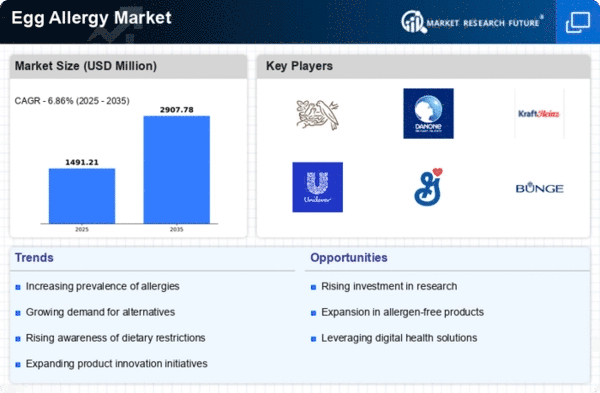
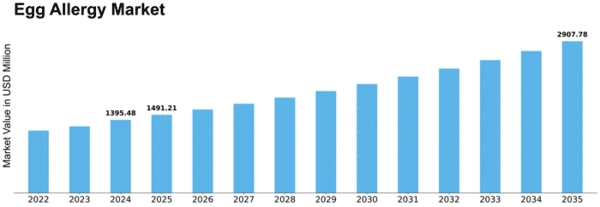
As per MRFR analysis, the Egg Allergy Market Size was estimated at 1395.48 USD Million in 2024. The Egg Allergy industry is projected to grow from 1507.2 USD Million in 2025 to 2907.78 USD Million by 2035, exhibiting a compound annual growth rate (CAGR) of 6.86 during the forecast period 2025 - 2035.

Key Market Trends & Highlights

The Egg Allergy Market is experiencing a notable shift towards allergen-free products and innovative food solutions.

  • The demand for allergen-free products is rising, particularly in North America, which remains the largest market for egg allergy solutions.
  • Innovation in food technology is driving new product development, especially within the food products segment, which is currently the largest.
  • The Asia-Pacific region is emerging as the fastest-growing market, reflecting a broader shift towards plant-based diets and dairy alternatives.
  • Increased awareness of food allergies and regulatory support for allergen labeling are key drivers propelling market growth.

Market Size & Forecast

2024 Market Size 1395.48 (USD Million)
2035 Market Size 2907.78 (USD Million)
CAGR (2025 - 2035) 6.86%
Largest Regional Market Share in 2024 North America

Major Players

<p>Nestle (CH), Danone (FR), Kraft Heinz (US), Unilever (GB), General Mills (US), Bunge Limited (US), Oatly (SE), Blue Diamond Growers (US)</p>

Market Trends

The Egg Allergy Market is currently experiencing notable shifts driven by increasing awareness of food allergies and the rising prevalence of egg allergies among children. This heightened awareness is prompting parents and caregivers to seek alternatives and solutions that cater to the dietary restrictions imposed by such allergies. Consequently, manufacturers are responding by innovating and diversifying their product offerings, which include egg-free substitutes and allergen-free food options. The market landscape is evolving as stakeholders strive to meet the demands of consumers who are increasingly vigilant about food safety and ingredient transparency. Moreover, the Egg Allergy Market is influenced by advancements in food technology and the growing trend of plant-based diets. As consumers become more health-conscious, there is a discernible shift towards products that not only avoid allergens but also promote overall well-being. This trend is likely to encourage the development of new formulations that appeal to a broader audience, including those without allergies. The market appears poised for growth as it adapts to these changing consumer preferences and the ongoing quest for safe, nutritious food alternatives.

Rising Demand for Allergen-Free Products

There is an increasing consumer demand for products that are free from common allergens, including eggs. This trend is driven by heightened awareness of food allergies and the need for safe dietary options.

Innovation in Food Technology

Advancements in food technology are facilitating the creation of egg substitutes and allergen-free alternatives. This innovation is crucial for meeting the needs of consumers with egg allergies.

Shift Towards Plant-Based Diets

The growing popularity of plant-based diets is influencing the Egg Allergy Market. Consumers are seeking healthier, egg-free options that align with their dietary preferences.

Egg Allergy Market Market Drivers

Rising Prevalence of Egg Allergy

The increasing incidence of egg allergy, particularly among children, is a primary driver of the Global Egg Allergy Market Industry. Studies indicate that egg allergy affects approximately 1.5 to 2.5% of children globally, with many outgrowing it by adolescence. However, the persistent cases contribute to a growing demand for allergen-free products. As awareness of food allergies rises, parents and caregivers are more vigilant, leading to increased consumption of egg-free alternatives. This trend is expected to propel the market, with projections estimating the market value to reach 1.48 USD Billion in 2024.

Market Segment Insights

By Application: Food Products (Largest) vs. Dairy Alternatives (Fastest-Growing)

<p>In the Egg Allergy Market, the application segment is diverse, with food products capturing the largest share of the market. Baked goods and confectionery are critical components as they often require egg substitutes due to their widespread consumption among individuals with egg allergies. Dairy alternatives also hold a significant market share, while nutritional supplements are gaining traction as consumers seek healthier food options without allergenic ingredients.</p>

<p>Food Products: Dominant vs. Dairy Alternatives: Emerging</p>

<p>The food products segment remains the dominant force in the Egg Allergy Market due to its extensive variety encompassing processed meals, snacks, and condiments that appeal to consumers seeking safe alternatives. Meanwhile, dairy alternatives, labeled as emerging, are seeing accelerated growth driven by the increasing awareness of lactose intolerance, veganism, and health-conscious lifestyles. Innovations in formulations and a growing range of dairy-free options are attracting customers, particularly among those with various dietary restrictions, making this segment increasingly relevant in today's market.</p>

By End Use: Household (Largest) vs. Food Service (Fastest-Growing)

<p>In the Egg Allergy Market, the distribution of market share among various end use segments reveals that the Household segment dominates significantly. This segment captures a substantial portion of consumers dealing with egg allergies, as families increasingly seek alternatives to traditional egg-based products, emphasizing safety and convenience. Other segments, such as Food Service and Healthcare Facilities, hold noteworthy shares, but the focus remains largely on households where egg substitutes are becoming vital for daily meal preparation. Meanwhile, food service is emerging as the fastest-growing segment, propelled by rising awareness about food allergies and increased demand for allergen-free dining options. Catering Services and Educational Institutions are also showing steady growth as schools and institutions increasingly adopt egg-free policies to safeguard the health of students. This shift signals a broader trend towards inclusive dining experiences across various end uses in the Egg Allergy Market.</p>

<p>Household (Dominant) vs. Healthcare Facilities (Emerging)</p>

<p>The Household segment represents the dominant force in the Egg Allergy Market, characterized by families seeking egg alternatives to accommodate allergy concerns. This segment thrives on the demand for versatile, safe products that align with health-conscious consumer behavior. In contrast, Healthcare Facilities emerge as a significant segment, focusing on the preparation of allergen-free food for patients. This segment influences market dynamics through institutional catering, thereby promoting safe eating practices within healthcare settings. While the Household segment highlights consumer-driven choices, Healthcare Facilities illustrate an institutional response to the increasing prevalence of food allergies, indicating a trend towards comprehensive allergy management in diverse environments.</p>

By Type of Egg Allergy: IgE-Mediated Allergy (Largest) vs. Non-IgE-Mediated Allergy (Fastest-Growing)

<p>In the Egg Allergy Market, the IgE-Mediated Allergy segment holds the largest share, serving as a primary focus for researchers and healthcare providers. This segment is characterized by immediate hypersensitivity reactions triggered by egg proteins, making it a significant concern for many individuals, particularly children. In contrast, the Non-IgE-Mediated Allergy segment, while smaller, is emerging rapidly due to increasing awareness and diagnosis of delayed allergic responses to eggs, making it a focal point of attention for stakeholders. The growth of the Non-IgE-Mediated Allergy segment is driven by evolving diagnostic techniques and greater understanding of allergic diseases. Parents and caregivers are becoming more informed about the symptoms and management of egg allergies, leading to increased demand for products catering to this specific allergy type. Meanwhile, efforts by healthcare providers to raise awareness and offer support are enhancing market dynamics, creating a more inclusive landscape for those affected by egg allergies.</p>

<p>IgE-Mediated Allergy (Dominant) vs. Non-IgE-Mediated Allergy (Emerging)</p>

<p>The IgE-Mediated Allergy segment remains dominant in the Egg Allergy Market, primarily due to its prevalence and the immediate health risks associated with exposure to egg protein. This segment is well understood, aiding in the development of effective management strategies and educational campaigns aimed at reducing incidents of anaphylaxis. Conversely, the Non-IgE-Mediated Allergy segment is emerging, gaining traction as more individuals are diagnosed with this form of allergy, which often involves gastrointestinal symptoms rather than immediate anaphylaxis. The distinction between these allergies has led to a diversification of product offerings aimed at those with Non-IgE-Mediated reactions, creating a dynamic market landscape where both segments are increasingly recognized and treated with tailored approaches.</p>

By Diagnosis Method: Skin Prick Test (Largest) vs. Oral Food Challenge (Fastest-Growing)

<p>In the Egg Allergy Market, the diagnosis methods include Skin Prick Test, Blood Test, Oral Food Challenge, and Elimination Diet. Among these, the Skin Prick Test holds the largest share, being widely accepted and employed for its quick and reliable results. The Blood Test comes second, offering a viable alternative for individuals who may have unfavorable reactions to skin testing. However, the Oral Food Challenge and Elimination Diet are gaining traction due to their definitive nature in confirming egg allergies, leading to a shift in market dynamics.</p>

<p>Skin Prick Test (Dominant) vs. Oral Food Challenge (Emerging)</p>

<p>The Skin Prick Test remains the dominant diagnostic method for egg allergies due to its effectiveness and speed, providing immediate results that assist in clinical decision-making. Conversely, the Oral Food Challenge is viewed as an emerging and definitive diagnostic tool, particularly important in cases where uncertainty exists following other testing methods. While the Skin Prick Test is efficient for initial screening, the Oral Food Challenge stands out by offering a practical evaluation of the individual’s tolerance to egg proteins, thus increasing its popularity. As consumers and healthcare providers seek more conclusive results, the trend is increasingly favoring more comprehensive approaches, signaling a pivotal shift in how egg allergies are diagnosed.</p>

Get more detailed insights about Egg Allergy Market by Share, Size, Growth and Overview – 2035

Regional Insights

North America : Market Leader in Egg Allergy

North America is poised to maintain its leadership in the egg allergy market, with a market size of $697.74M in 2025. The region's growth is driven by increasing awareness of food allergies, rising demand for allergen-free products, and stringent food safety regulations. The prevalence of egg allergies among children has prompted manufacturers to innovate and diversify their product offerings, catering to health-conscious consumers seeking safe alternatives. The competitive landscape in North America is robust, featuring key players such as Kraft Heinz, General Mills, and Unilever. These companies are investing in research and development to create egg-free products that meet consumer demands. The U.S. leads the market, supported by a strong distribution network and consumer preference for allergen-free options. The presence of established brands enhances market penetration, ensuring a steady growth trajectory for the egg allergy segment.

Europe : Emerging Market for Alternatives

Europe is witnessing significant growth in the egg allergy market, with a market size of €420.0M in 2025. The region's growth is fueled by increasing incidences of food allergies, heightened consumer awareness, and regulatory support for allergen labeling. European countries are implementing stringent regulations to ensure food safety, which is driving demand for egg-free alternatives in various food products, including baked goods and dairy substitutes. Leading countries in this market include Germany, France, and the UK, where consumer preferences are shifting towards healthier, allergen-free options. Key players like Danone and Nestle are actively expanding their product lines to cater to this demand. The competitive landscape is characterized by innovation and collaboration among manufacturers to develop new formulations that meet regulatory standards and consumer expectations. "The European food safety authority emphasizes the importance of clear allergen labeling to protect consumers."

Asia-Pacific : Growing Awareness and Demand

Asia-Pacific is emerging as a significant market for egg allergy solutions, with a market size of $227.74M in 2025. The growth in this region is driven by increasing awareness of food allergies, changing dietary habits, and a rise in the number of health-conscious consumers. Governments are also beginning to implement regulations that promote allergen awareness, which is expected to further boost market growth in the coming years. Countries like Australia, Japan, and China are leading the charge in adopting allergen-free products. The competitive landscape features both local and international players, including Oatly and Blue Diamond Growers, who are innovating to meet the specific needs of consumers. The market is characterized by a growing trend towards plant-based alternatives, which are gaining traction among consumers looking for healthier options. The presence of established brands is crucial for market penetration and consumer trust.

Middle East and Africa : Niche Market with Potential

The Middle East and Africa region is a niche market for egg allergy solutions, with a market size of $50.0M in 2025. The growth in this region is primarily driven by increasing awareness of food allergies and a gradual shift towards healthier eating habits. Although the market is still developing, there is a growing demand for allergen-free products, particularly among urban populations who are becoming more health-conscious and informed about food safety. Countries like South Africa and the UAE are beginning to see a rise in the availability of egg-free alternatives. The competitive landscape is still emerging, with local manufacturers and international brands exploring opportunities to introduce innovative products. As consumer awareness increases, the market is expected to grow, driven by the need for safe food options. "The health ministry emphasizes the importance of allergen awareness in food safety regulations."

Key Players and Competitive Insights

The Egg Allergy Market is currently characterized by a dynamic competitive landscape, driven by increasing consumer awareness regarding food allergies and the rising prevalence of egg allergies among children. Key players such as Nestle (CH), Danone (FR), and Kraft Heinz (US) are strategically positioning themselves through innovation and product diversification. Nestle (CH) has focused on developing allergen-free alternatives, while Danone (FR) emphasizes its commitment to sustainability and health-focused products. Kraft Heinz (US) is leveraging its extensive distribution network to enhance market penetration, thereby collectively shaping a competitive environment that prioritizes health-conscious offerings and consumer education.

In terms of business tactics, companies are increasingly localizing manufacturing to reduce supply chain vulnerabilities and enhance responsiveness to regional demands. The market structure appears moderately fragmented, with several players vying for market share. However, the collective influence of major companies is significant, as they drive trends in product development and consumer engagement, thereby shaping the overall market dynamics.

In November 2025, Nestle (CH) announced the launch of a new line of egg-free protein products aimed at children with allergies. This strategic move not only addresses a growing consumer need but also positions Nestle (CH) as a leader in allergen-free food innovation. The introduction of these products is likely to enhance brand loyalty among health-conscious parents, further solidifying Nestle's market presence.

In October 2025, Danone (FR) expanded its partnership with local farmers to source organic ingredients for its allergen-free product range. This initiative underscores Danone's commitment to sustainability and local sourcing, which resonates well with environmentally conscious consumers. By strengthening its supply chain, Danone (FR) is not only ensuring product quality but also enhancing its brand image in the competitive landscape.

In September 2025, Kraft Heinz (US) launched a digital marketing campaign aimed at educating consumers about egg allergies and promoting its allergen-free product line. This campaign reflects a broader trend towards digital engagement and consumer education, which is becoming increasingly vital in the food industry. By positioning itself as a knowledgeable resource, Kraft Heinz (US) is likely to foster trust and loyalty among consumers, thereby enhancing its competitive edge.

As of December 2025, current trends in the Egg Allergy Market indicate a strong emphasis on digitalization, sustainability, and the integration of AI technologies in product development and marketing strategies. Strategic alliances among key players are shaping the landscape, facilitating knowledge sharing and resource optimization. Looking ahead, competitive differentiation is expected to evolve, with a shift from price-based competition to a focus on innovation, technology, and supply chain reliability. Companies that can effectively leverage these trends will likely secure a more robust position in the market.

Key Companies in the Egg Allergy Market include

Industry Developments

Future Outlook

Egg Allergy Market Future Outlook

<p>The Egg Allergy Market is projected to grow at a 6.86% CAGR from 2024 to 2035, driven by increasing awareness, innovative product development, and rising prevalence of allergies.</p>

New opportunities lie in:

  • <p>Development of allergen-free egg substitutes for food manufacturers.</p>
  • <p>Expansion of educational programs for healthcare professionals on egg allergies.</p>
  • <p>Investment in digital platforms for personalized allergy management solutions.</p>

<p>By 2035, the Egg Allergy Market is expected to be robust, reflecting significant growth and innovation.</p>

Market Segmentation

Egg Allergy Market End Use Outlook

  • Household
  • Food Service
  • Healthcare Facilities
  • Educational Institutions
  • Catering Services

Egg Allergy Market Application Outlook

  • Food Products
  • Baked Goods
  • Confectionery
  • Dairy Alternatives
  • Nutritional Supplements

Egg Allergy Market Diagnosis Method Outlook

  • Skin Prick Test
  • Blood Test
  • Oral Food Challenge
  • Elimination Diet

Egg Allergy Market Type of Egg Allergy Outlook

  • IgE-Mediated Allergy
  • Non-IgE-Mediated Allergy
  • Mixed Allergy

Report Scope

MARKET SIZE 20241395.48(USD Million)
MARKET SIZE 20251507.2(USD Million)
MARKET SIZE 20352907.78(USD Million)
COMPOUND ANNUAL GROWTH RATE (CAGR)6.86% (2024 - 2035)
REPORT COVERAGERevenue Forecast, Competitive Landscape, Growth Factors, and Trends
BASE YEAR2024
Market Forecast Period2025 - 2035
Historical Data2019 - 2024
Market Forecast UnitsUSD Million
Key Companies ProfiledNestle (CH), Danone (FR), Kraft Heinz (US), Unilever (GB), General Mills (US), Bunge Limited (US), Oatly (SE), Blue Diamond Growers (US)
Segments CoveredApplication, End Use, Type of Egg Allergy, Diagnosis Method
Key Market OpportunitiesEmerging plant-based alternatives and innovative formulations drive growth in the Egg Allergy Market.
Key Market DynamicsRising consumer awareness drives demand for egg-free products, influencing market dynamics and competitive strategies.
Countries CoveredNorth America, Europe, APAC, South America, MEA

FAQs

At what CAGR is the global egg allergy market projected to grow in the forecast period (2024-2032)?

Egg allergy market projected to grow at approximately 6.90% CAGR during the assessment period (2022-2030).

How much is the global egg allergy market worth in the future?

The valuation of the global egg allergy market is estimated to increase to USD 2.016 Billion by the end of 2030

What are the major tailwinds pushing the growth of the global egg allergy market?

Increasing prevalence, improved allergy diagnosis, and rising healthcare expenses are major tailwinds pushing the growth of the global egg allergy market.

Which region holds the largest share in the global egg allergy market?

North America holds the largest share in the global egg allergy market, followed by Europe and the Asia Pacific, respectively.

Who are the top players in the global egg allergy market?

Genetech, Inc. (US), Mylan N.V. (US), Sanofi (France), Alletess Medical Laboratory (US), Creative Diagnostics (US), HYCOR Biomedical (US), Impax Laboratories, Inc. (US), Kaleo, Inc. (US), Kaleo, Inc. (US), Impax Laboratories (US), Quest Diagnostics (US), ImmuneTech (US), and Imutest Ltd. (UK), are some of the top players operating in the global egg allergy market.

  1. SECTION I: EXECUTIVE SUMMARY AND KEY HIGHLIGHTS
    1. | 1.1 EXECUTIVE SUMMARY
  2. SECTION II: SCOPING, METHODOLOGY AND MARKET STRUCTURE
    1. | 2.1 MARKET INTRODUCTION
    2. | 2.2 RESEARCH METHODOLOGY
  3. SECTION III: QUALITATIVE ANALYSIS
    1. | 3.1 MARKET DYNAMICS
    2. | 3.2 MARKET FACTOR ANALYSIS
  4. SECTION IV: QUANTITATIVE ANALYSIS
    1. | 4.1 Healthcare, BY Application (USD Million)
    2. | 4.2 Healthcare, BY End Use (USD Million)
    3. | 4.3 Healthcare, BY Type of Egg Allergy (USD Million)
    4. | 4.4 Healthcare, BY Diagnosis Method (USD Million)
    5. | 4.5 Healthcare, BY Region (USD Million)
  5. SECTION V: COMPETITIVE ANALYSIS
    1. | 5.1 Competitive Landscape
    2. | 5.2 Company Profiles
    3. | 5.3 Appendix

Egg Allergy Market Segmentation

Market Segmentation Overview

  • Detailed segmentation data will be available in the full report
  • Comprehensive analysis by multiple parameters
  • Regional and country-level breakdowns
  • Market size forecasts by segment
Infographic

Free Sample Request

Kindly complete the form below to receive a free sample of this Report

Get Free Sample

Customer Strories

Compare Licence

×
Features License Type
Single User Multiuser License Enterprise User
Price $4,950 $5,950 $7,250
Maximum User Access Limit 1 User Upto 10 Users Unrestricted Access Throughout the Organization
Free Customization
Direct Access to Analyst
Deliverable Format
Platform Access
Discount on Next Purchase 10% 15% 15%
Printable Versions