×
Hero Background
English
Chinese
French
Japanese
Korean
German
Spanish

Egg Allergy Market Trends

ID: MRFR/Pharma/3312-CR
85 Pages
Rahul Gotadki
June 2024

Egg Allergy Market Research Report Information by Age Group (Children and Adults), Diagnosis & Treatment (Diagnosis [Skin Test, Blood Test, Food Challenge and others] and Treatment [Medication and Oral Immunotherapy]), End User (Hospitals and Clinics, Diagnostic Centers, Research Institutes and others) - Forecast till 2035

Share:
Download PDF ×

We do not share your information with anyone. However, we may send you emails based on your report interest from time to time. You may contact us at any time to opt-out.

Egg Allergy Market Infographic
Purchase Options

Market Trends

Key Emerging Trends in the Egg Allergy Market

The egg allergy market is witnessing notable trends influenced by various factors such as increasing awareness, advancements in diagnostic technologies, and evolving treatment approaches. Egg allergy is one of the most common food allergies, particularly in children, characterized by adverse immune reactions to proteins found in eggs. One significant trend in this market is the growing recognition of egg allergy as a significant health concern, leading to heightened awareness among healthcare professionals, caregivers, and patients. As the prevalence of food allergies, including egg allergy, continues to rise, there is a growing demand for effective diagnostic tools and management strategies to improve outcomes and quality of life for individuals affected by this condition.

Technological advancements play a pivotal role in shaping market trends in the egg allergy market. Innovations in diagnostic testing methods, such as skin prick tests, blood tests, and oral food challenges, enable more accurate and reliable identification of egg allergy in patients. Moreover, the development of molecular diagnostic tests and allergen-specific immunoglobulin E (IgE) assays allows for precise identification of specific egg proteins responsible for allergic reactions, facilitating targeted diagnostic and treatment approaches. Additionally, advancements in allergen component testing help differentiate between sensitization and clinical allergy to specific egg proteins, guiding personalized management strategies for patients with egg allergy.

Furthermore, the increasing prevalence of egg allergy drives market growth for egg-free and allergen-reduced food products. With growing awareness of food allergies and dietary restrictions, there is a rising demand for safe and convenient food options for individuals with egg allergy. Food manufacturers are responding to this demand by developing a wide range of egg-free and allergen-friendly products, including baked goods, snacks, and convenience foods. Moreover, labeling regulations and certification programs for allergen-free products provide consumers with greater transparency and assurance regarding the safety and suitability of food products for individuals with egg allergy, further driving market expansion.

Moreover, demographic shifts and changing consumer preferences influence market trends in the egg allergy market. With increasing urbanization, globalization, and multiculturalism, there is greater diversity in dietary habits and food choices, leading to heightened awareness of food allergies and intolerances. Additionally, changing lifestyle factors such as increased consumption of processed foods, dining out, and food allergies, including egg allergy, emphasize the importance of accurate labeling, allergen awareness, and food safety in foodservice establishments and food manufacturing facilities. Furthermore, the COVID-19 pandemic has underscored the importance of food safety and allergen management in food supply chains, prompting greater vigilance and adherence to regulatory standards and guidelines.

Regulatory factors also play a significant role in shaping market trends in the egg allergy market. Regulatory agencies such as the FDA (Food and Drug Administration) and the European Food Safety Authority (EFSA) regulate the labeling, manufacturing, and marketing of food products, including allergen-free and hypoallergenic foods. Compliance with regulatory standards and guidelines, such as allergen labeling requirements and precautionary allergen labeling (PAL), is essential for market entry and consumer trust, ensuring product safety and transparency for individuals with food allergies, including egg allergy. Moreover, government initiatives and public health campaigns aimed at raising awareness of food allergies and promoting allergen management practices contribute to market growth and consumer education in the egg allergy market.

Author
Rahul Gotadki
Assistant Manager

He holds an experience of about 7+ years in Market Research and Business Consulting, working under the spectrum of Life Sciences and Healthcare domains. Rahul conceptualizes and implements a scalable business strategy and provides strategic leadership to the clients. His expertise lies in market estimation, competitive intelligence, pipeline analysis, customer assessment, etc. In addition to the above, his other responsibility includes strategic tracking of high growth markets & advising clients on the potential areas of focus they could direct their business initiatives

Leave a Comment

FAQs

At what CAGR is the global egg allergy market projected to grow in the forecast period (2024-2032)?

Egg allergy market projected to grow at approximately 6.90% CAGR during the assessment period (2022-2030).

How much is the global egg allergy market worth in the future?

The valuation of the global egg allergy market is estimated to increase to USD 2.016 Billion by the end of 2030

What are the major tailwinds pushing the growth of the global egg allergy market?

Increasing prevalence, improved allergy diagnosis, and rising healthcare expenses are major tailwinds pushing the growth of the global egg allergy market.

Which region holds the largest share in the global egg allergy market?

North America holds the largest share in the global egg allergy market, followed by Europe and the Asia Pacific, respectively.

Who are the top players in the global egg allergy market?

Genetech, Inc. (US), Mylan N.V. (US), Sanofi (France), Alletess Medical Laboratory (US), Creative Diagnostics (US), HYCOR Biomedical (US), Impax Laboratories, Inc. (US), Kaleo, Inc. (US), Kaleo, Inc. (US), Impax Laboratories (US), Quest Diagnostics (US), ImmuneTech (US), and Imutest Ltd. (UK), are some of the top players operating in the global egg allergy market.

Market Summary

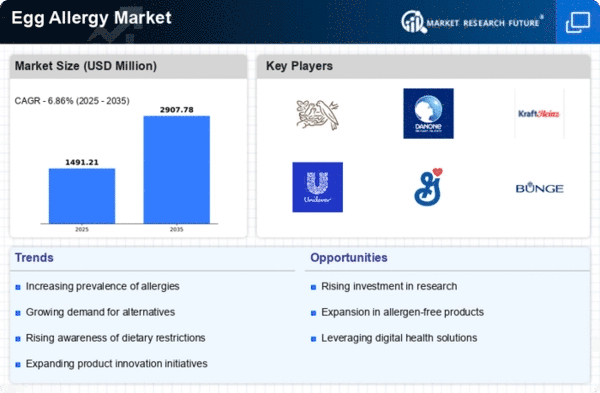
As per MRFR analysis, the Egg Allergy Market Size was estimated at 1395.48 USD Million in 2024. The Egg Allergy industry is projected to grow from 1507.2 USD Million in 2025 to 2907.78 USD Million by 2035, exhibiting a compound annual growth rate (CAGR) of 6.86 during the forecast period 2025 - 2035.

Key Market Trends & Highlights

The Egg Allergy Market is experiencing a notable shift towards innovative, egg-free alternatives driven by rising health consciousness and awareness.

  • The demand for egg-free alternatives is rising significantly, particularly in North America, which remains the largest market.
  • Increased awareness and education regarding egg allergies are fostering a more informed consumer base across the Asia-Pacific region.
  • Innovation in food technology is propelling the development of new products, especially in the baked goods segment, which is currently the largest.
  • The rising incidence of egg allergies and growing health consciousness are key drivers influencing market dynamics, particularly in the food service segment.

Market Size & Forecast

2024 Market Size 1395.48 (USD Million)
2035 Market Size 2907.78 (USD Million)
CAGR (2025 - 2035) 6.86%
Largest Regional Market Share in 2024 North America

Major Players

<p>Nestle (CH), Danone (FR), Kraft Heinz (US), Unilever (GB), General Mills (US), Bunge Limited (US), Oatly (SE), Blue Diamond Growers (US)</p>

Market Trends

The Egg Allergy Market is currently experiencing notable shifts driven by increasing awareness of food allergies and the growing prevalence of egg allergies among children. This heightened awareness is prompting parents and caregivers to seek alternatives, leading to a surge in demand for egg-free products. Additionally, the food industry is responding by innovating and reformulating existing products to cater to this demographic, which appears to be a strategic move to capture a larger share of the market. Furthermore, educational initiatives aimed at informing the public about egg allergies are gaining traction, potentially influencing consumer behavior and preferences. Moreover, the Egg Allergy Market is likely to benefit from advancements in food technology, which may facilitate the development of new substitutes that mimic the properties of eggs without triggering allergic reactions. This trend suggests a shift towards more inclusive food options, as manufacturers strive to meet the needs of consumers with dietary restrictions. As the market evolves, collaboration between food producers, healthcare professionals, and advocacy groups could play a crucial role in shaping the future landscape of egg allergy management and product offerings.

Rising Demand for Egg-Free Alternatives

The Egg Allergy Market is witnessing a growing demand for products that do not contain eggs. This trend is largely driven by consumers seeking safe options for individuals with egg allergies, particularly children. Manufacturers are increasingly focusing on creating egg-free versions of popular food items, which may enhance market growth.

Increased Awareness and Education

There is a noticeable increase in awareness regarding food allergies, particularly egg allergies. Educational campaigns and resources are becoming more prevalent, which could lead to better understanding and management of these allergies. This trend may encourage more consumers to seek out egg-free products.

Innovation in Food Technology

Advancements in food technology are likely to play a pivotal role in the Egg Allergy Market. New techniques and ingredients are being developed to create substitutes that replicate the functionality of eggs. This innovation may provide consumers with more options and improve the overall quality of egg-free products.

Egg Allergy Market Market Drivers

Rising Prevalence of Egg Allergy

The increasing incidence of egg allergy, particularly among children, is a primary driver of the Global Egg Allergy Market Industry. Studies indicate that egg allergy affects approximately 1.5 to 2.5% of children globally, with many outgrowing it by adolescence. However, the persistent cases contribute to a growing demand for allergen-free products. As awareness of food allergies rises, parents and caregivers are more vigilant, leading to increased consumption of egg-free alternatives. This trend is expected to propel the market, with projections estimating the market value to reach 1.48 USD Billion in 2024.

Market Segment Insights

By Application: Baked Goods (Largest) vs. Dairy Alternatives (Fastest-Growing)

<p>In the Egg Allergy Market, the application segment is predominantly influenced by food products, including baked goods, dairy alternatives, and nutritional supplements. Baked goods hold the largest share as consumers increasingly seek egg-free options in their diets. This is followed by dairy alternatives, which are gaining significant traction as more individuals adopt plant-based diets, further expanding their market presence within this segment.</p>

<p>Baked Goods (Dominant) vs. Dairy Alternatives (Emerging)</p>

<p>Baked goods, as the dominant application segment, encompass a wide range of products, including cakes, cookies, and breads that are formulated without eggs to cater to consumers with egg allergies. Their established presence in the market makes them a trusted choice among consumers. On the other hand, dairy alternatives represent the emerging segment, gaining momentum as innovative products like egg-free mayonnaise and plant-based egg substitutes enter the market. This segment is driven by the rising trend of veganism and lactose intolerance, leading to increased demand for versatile and allergen-free options.</p>

By End Use: Household (Largest) vs. Food Service (Fastest-Growing)

<p>The Egg Allergy Market showcases a diverse distribution across various end use segments. The household sector represents the largest share, driven by the increasing prevalence of egg allergies among consumers and the growing awareness about allergy-friendly diets. Following closely is the food service sector, which is rapidly expanding, propelled by an increasing demand for allergy-conscious meal options in restaurants and cafes, reflecting a significant shift towards more inclusive dining experiences. Moreover, healthcare facilities and educational institutions are emerging as vital segments contributing to the market. These sectors are witnessing a surge in demand for egg-free products, fueled by heightened vigilance regarding food allergies among patients and students. As educational programs and dietary initiatives advance, both sectors are expected to drive substantial growth, fostering a more cautious approach to egg consumption in public settings.</p>

<p>Household (Dominant) vs. Food Service (Emerging)</p>

<p>The household segment holds a dominant position in the Egg Allergy Market, characterized by consumers actively seeking out alternatives to traditional egg-containing products. Increasing health consciousness, along with a desire for allergy-safe recipes, fuels this segment’s growth. In contrast, the food service sector is emerging rapidly, marked by an expanding array of restaurants and cafes adept at providing allergy-friendly options. This segment is reshaping culinary practices to address dietary restrictions, integrating eggless offerings into their menus. The rise of allergen-free dining experiences is indicative of changing consumer preferences, with food service providers increasingly focusing on inclusivity and taste, catering effectively to those with dietary concerns.</p>

By Type of Allergy: IgE-Mediated Allergy (Largest) vs. Non-IgE-Mediated Allergy (Fastest-Growing)

<p>In the Egg Allergy Market, the distribution of market share among the type of allergies highlights IgE-Mediated Allergy as the largest segment, accounting for a significant proportion of the overall cases. This segment is well-defined and impacts many individuals, mainly children, leading to higher identification and diagnosis rates. Conversely, Non-IgE-Mediated Allergy is growing in prominence and represents an emerging area of focus with increasing awareness and detection of symptoms. This segment addresses the needs of patients who may experience delayed allergic reactions, marking a shift in how allergists are approaching egg allergy diagnoses.</p>

<p>IgE-Mediated Allergy (Dominant) vs. Non-IgE-Mediated Allergy (Emerging)</p>

<p>IgE-Mediated Allergy is characterized by immediate allergic reactions triggered by specific proteins in eggs, resulting in symptoms such as hives, swelling, and anaphylaxis. This segment is currently the dominant force in the egg allergy market, supported by a wealth of clinical data highlighting the urgency for diagnosis and treatment. In contrast, Non-IgE-Mediated Allergy, though emerging, is becoming more recognized as it encompasses conditions like food protein-induced enterocolitis syndrome (FPIES). This segment is crucial for understanding delayed type reactions and managing allergenic food intake, thereby driving the demand for tailored dietary solutions and increased research initiatives in the egg allergy sector.</p>

By Age Group: Children (Largest) vs. Infants (Fastest-Growing)

<p>The Egg Allergy Market exhibits a varied distribution of segments across different age groups. Among these, children represent the largest share, reflecting heightened awareness regarding food allergies in younger populations and ensuing dietary adjustments by parents and caregivers. Infants, on the other hand, are emerging as a focal point of concern given their developing immune systems and rising instances of allergy reports. This dynamic in age-specific market share underscores the necessity for tailored products and educational resources. As consumer awareness grows, growth trends indicate a shift towards preventive approaches, particularly in the case of infants. The rising prevalence of egg allergies in early childhood pushes manufacturers to innovate and introduce allergy-friendly alternatives. Furthermore, increased support from healthcare professionals, coupled with a rising number of awareness campaigns, contributes to the fast-paced growth of segment targeting infants, while the established routines for managing allergies in children solidify their dominant market position.</p>

<p>Children (Dominant) vs. Infants (Emerging)</p>

<p>In the Egg Allergy Market, children stand as the dominant segment, primarily due to established dietary practices that emphasize allergen avoidance, bolstered by widespread education on food allergies. Their familiarity with egg-free products reflects a market that has adapted over time, offering various alternatives ranging from egg substitutes to specialty foods. Simultaneously, the infant segment is emerging rapidly, marked by an increasing focus on early detection and management of food allergies. Products targeting infants are often characterized by mild formulations and are designed to meet the unique nutritional needs of developing children. With parents increasingly vigilant about allergens, the demand for specially formulated infant foods is likely to rise, setting the stage for further innovation and market expansion.</p>

Get more detailed insights about Egg Allergy Market by Share, Size, Growth and Overview – 2035

Regional Insights

North America : Market Leader in Egg Allergy

North America is poised to maintain its leadership in the egg allergy market, holding a significant market share of $697.74M as of 2024. The region's growth is driven by increasing awareness of food allergies, rising demand for allergen-free products, and stringent food safety regulations. The regulatory landscape is supportive, with initiatives aimed at improving labeling and consumer education, further propelling market expansion. The competitive landscape in North America is robust, featuring key players such as Kraft Heinz, Unilever, and General Mills. These companies are actively innovating to meet consumer demands for allergen-free alternatives. The U.S. leads the market, supported by a growing population of allergy sufferers and a trend towards healthier eating. This dynamic environment fosters continuous product development and strategic partnerships among leading brands.

Europe : Emerging Market for Alternatives

Europe is witnessing a notable increase in the egg allergy market, valued at $397.84M in 2024. The growth is fueled by rising consumer awareness regarding food allergies and a shift towards plant-based diets. Regulatory frameworks in the EU are becoming more stringent, promoting transparency in food labeling and safety standards, which is essential for allergen management and consumer trust. Leading countries in this region include Germany, France, and the UK, where companies like Danone and Nestle are investing in research and development of egg-free products. The competitive landscape is characterized by a mix of established brands and innovative startups focusing on allergen-free solutions. This dynamic is expected to enhance product offerings and cater to the growing demand for safe food alternatives.

Asia-Pacific : Growing Awareness and Demand

The Asia-Pacific region is emerging as a significant player in the egg allergy market, with a market size of $246.9M in 2024. The growth is driven by increasing awareness of food allergies and a rising number of diagnosed cases. Countries like Japan and Australia are leading the charge, supported by government initiatives aimed at improving food safety and allergen management, which are crucial for consumer protection and market growth. The competitive landscape is evolving, with local and international brands entering the market to meet the rising demand for allergen-free products. Key players such as Oatly and Blue Diamond Growers are expanding their presence, focusing on innovative solutions tailored to local tastes and preferences. This trend is expected to drive further growth and diversification in the market.

Middle East and Africa : Niche Market with Potential

The Middle East and Africa region represents a niche market for egg allergy solutions, valued at $53.0M in 2024. The growth potential is significant, driven by increasing awareness of food allergies and a gradual shift towards healthier eating habits. Regulatory bodies are beginning to recognize the importance of allergen management, which is essential for consumer safety and market development. Countries like South Africa and the UAE are at the forefront of this emerging market, with local companies exploring opportunities in allergen-free products. The competitive landscape is still developing, with a mix of local and international players looking to establish a foothold. As awareness grows, the market is expected to expand, offering new opportunities for innovation and product development.

Key Players and Competitive Insights

The Egg Allergy Market is currently characterized by a dynamic competitive landscape, driven by increasing consumer awareness regarding food allergies and the rising prevalence of egg allergies among children. Key players such as Nestle (CH), Danone (FR), and Kraft Heinz (US) are strategically positioning themselves through innovation and product diversification. Nestle (CH) has focused on developing allergen-free alternatives, while Danone (FR) emphasizes its commitment to sustainability and health-focused products. Kraft Heinz (US) is leveraging its extensive distribution network to enhance market penetration, thereby collectively shaping a competitive environment that prioritizes health-conscious offerings and consumer education.

In terms of business tactics, companies are increasingly localizing manufacturing to reduce supply chain vulnerabilities and enhance responsiveness to regional demands. The market appears moderately fragmented, with a mix of established players and emerging brands vying for market share. The collective influence of these key players is significant, as they not only drive innovation but also set industry standards for allergen management and labeling practices.

In November 2025, Nestle (CH) launched a new line of egg-free protein products aimed at children with allergies, which reflects a strategic pivot towards addressing specific consumer needs. This initiative is likely to enhance Nestle's market share by appealing to health-conscious parents seeking safe alternatives for their children. The introduction of these products may also position Nestle as a leader in allergen-free innovations, potentially influencing competitors to follow suit.

In October 2025, Danone (FR) announced a partnership with a leading food technology firm to develop plant-based egg substitutes. This collaboration underscores Danone's commitment to sustainability and innovation, as it seeks to expand its product portfolio in response to growing consumer demand for plant-based options. The strategic importance of this partnership lies in its potential to enhance Danone's competitive edge in the allergen-free segment, aligning with broader trends towards healthier eating.

In September 2025, Kraft Heinz (US) acquired a small startup specializing in allergen-free snacks, which indicates a strategic move to diversify its offerings and tap into the growing market for allergy-friendly foods. This acquisition not only broadens Kraft Heinz's product range but also enhances its capabilities in allergen management, positioning the company favorably in a market that is increasingly focused on safety and health.

As of December 2025, current competitive trends in the Egg Allergy Market are heavily influenced by digitalization, sustainability, and the integration of AI technologies. Strategic alliances are becoming more prevalent, as companies recognize the need to collaborate in order to innovate and meet consumer demands effectively. The competitive differentiation is likely to evolve from traditional price-based strategies to a focus on innovation, technology, and supply chain reliability, suggesting a transformative shift in how companies approach market challenges.

Key Companies in the Egg Allergy Market market include

Industry Developments

Future Outlook

Egg Allergy Market Future Outlook

<p>The Egg Allergy Market is projected to grow at a 6.86% CAGR from 2024 to 2035, driven by increasing awareness, innovative treatments, and rising prevalence of allergies.</p>

New opportunities lie in:

  • <p>Development of specialized egg-free food products for allergic consumers.</p>
  • <p>Investment in advanced diagnostic tools for early detection of egg allergies.</p>
  • <p>Expansion of telehealth services for allergy management and consultation.</p>

<p>By 2035, the Egg Allergy Market is expected to achieve substantial growth and innovation.</p>

Market Segmentation

Egg Allergy Market End Use Outlook

  • Household
  • Food Service
  • Healthcare Facilities
  • Educational Institutions

Egg Allergy Market Age Group Outlook

  • Infants
  • Children
  • Adults
  • Elderly

Egg Allergy Market Application Outlook

  • Food Products
  • Baked Goods
  • Dairy Alternatives
  • Nutritional Supplements

Egg Allergy Market Type of Allergy Outlook

  • IgE-Mediated Allergy
  • Non-IgE-Mediated Allergy
  • Mixed Allergy

Report Scope

MARKET SIZE 20241395.48(USD Million)
MARKET SIZE 20251507.2(USD Million)
MARKET SIZE 20352907.78(USD Million)
COMPOUND ANNUAL GROWTH RATE (CAGR)6.86% (2024 - 2035)
REPORT COVERAGERevenue Forecast, Competitive Landscape, Growth Factors, and Trends
BASE YEAR2024
Market Forecast Period2025 - 2035
Historical Data2019 - 2024
Market Forecast UnitsUSD Million
Key Companies ProfiledNestle (CH), Danone (FR), Kraft Heinz (US), Unilever (GB), General Mills (US), Bunge Limited (US), Oatly (SE), Blue Diamond Growers (US)
Segments CoveredApplication, End Use, Type of Allergy, Age Group
Key Market OpportunitiesEmerging plant-based alternatives cater to growing consumer demand in the Egg Allergy Market.
Key Market DynamicsRising consumer awareness drives demand for egg-free products, influencing market dynamics and competitive strategies.
Countries CoveredNorth America, Europe, APAC, South America, MEA

FAQs

At what CAGR is the global egg allergy market projected to grow in the forecast period (2024-2032)?

Egg allergy market projected to grow at approximately 6.90% CAGR during the assessment period (2022-2030).

How much is the global egg allergy market worth in the future?

The valuation of the global egg allergy market is estimated to increase to USD 2.016 Billion by the end of 2030

What are the major tailwinds pushing the growth of the global egg allergy market?

Increasing prevalence, improved allergy diagnosis, and rising healthcare expenses are major tailwinds pushing the growth of the global egg allergy market.

Which region holds the largest share in the global egg allergy market?

North America holds the largest share in the global egg allergy market, followed by Europe and the Asia Pacific, respectively.

Who are the top players in the global egg allergy market?

Genetech, Inc. (US), Mylan N.V. (US), Sanofi (France), Alletess Medical Laboratory (US), Creative Diagnostics (US), HYCOR Biomedical (US), Impax Laboratories, Inc. (US), Kaleo, Inc. (US), Kaleo, Inc. (US), Impax Laboratories (US), Quest Diagnostics (US), ImmuneTech (US), and Imutest Ltd. (UK), are some of the top players operating in the global egg allergy market.

  1. Definition
    1. Scope of the Study
      1. Research Objective
      2. Assumptions
      3. Limitations
    2. Introduction
    3. Primary Research
    4. Secondary research
    5. Market Size Estimation
    6. Drivers
    7. Restrains
    8. Opportunities
    9. Challenges
    10. Macroeconomic Indicators
    11. Technology Trends & Assessment
    12. Porter’s Five Forces Analysis
      1. Bargaining Power of Suppliers
      2. Bargaining Power of Buyers
      3. Threat of New Entrants
      4. Threat of Substitutes
      5. Intensity of Rivalry
    13. Value Chain Analysis
    14. Investment Feasibility Analysis
    15. Pricing Analysis
  2. Chapter 6. Global Encephalomyelitis Market, by Type
    1. Introduction
    2. Acute Disseminated Encephalomyelitis
    3. Market Estimates & Forecast, 2020 – 2027
    4. Encephalomyelitis Disseminata
    5. Market Estimates & Forecast, 2020 – 2027
    6. Deprivation & Occlusion Encephalomyelitis
    7. Market Estimates & Forecast, 2020 – 2027
    8. AntiMOG Associated Encephalomyelitis
    9. Market Estimates & Forecast, 2020 – 2027
    10. Equine Encephalomyelitis
    11. Market Estimates & Forecast, 2020 – 2027
    12. AIDS Related Encephalomyelitis
    13. Market Estimates & Forecast, 2020 – 2027
    14. Others
  3. Chapter 7. Global Encephalomyelitis Market, by Treatment
    1. Introduction
    2. Drug Treatment
      1. Antiviral Medications
      2. Antibiotics
      3. Steroids
      4. Sedatives
      5. NSAIDs
      6. Mood Stabilizers
      7. Others
    3. Market Estimates & Forecast, 2020 – 2027
    4. Plasmapheresis
    5. Market Estimates & Forecast, 2020 – 2027
    6. Surgery
    7. Market Estimates & Forecast, 2020 – 2027
    8. Others
  4. Chapter 8. Global Encephalomyelitis Market, by End User
    1. Introduction
    2. Hospitals
    3. Market Estimates & Forecast, 2020 – 2027
    4. Clinics
    5. Market Estimates & Forecast, 2020 – 2027
    6. Others
  5. Chapter 9. Global Encephalomyelitis Market, by Region
    1. Introduction
    2. America
      1. North America
      2. South America
    3. Europe
      1. Western Europe
      2. Eastern Europe
    4. Asia Pacific
      1. Japan
      2. China
      3. India
      4. Australia
      5. Republic of Korea
      6. Rest of Asia Pacific
    5. The Middle East & Africa
      1. United Arab Emirates
      2. Saudi Arabia
      3. Oman
      4. Kuwait
      5. Qatar
      6. Rest of the Middle East & Africa
    6. Chapter 10 Company Landscape
    7. Introduction
    8. Market Share Analysis
    9. Key Development & Strategies
      1. Key Developments
    10. Chapter 11 Company Profiles
    11. Bristol-Myers Squibb Company
      1. Company Overview
      2. Product Overview
      3. Financials
      4. SWOT Analysis
    12. Sanofi
      1. Company Overview
      2. Product Overview
      3. Financial Overview
      4. Key Developments
      5. SWOT Analysis
    13. GlaxoSmithKline Plc.
      1. Company Overview
      2. Product Overview
      3. Financial Overview
      4. Key Development
      5. SWOT Analysis
    14. Amgen, Inc
      1. Company Overview
      2. Product/Business Segment Overview
      3. Financial Overview
      4. Key Development
      5. SWOT Analysis
    15. Bayer AG
      1. Company Overview
      2. Product Overview
      3. Financial overview
      4. Key Developments
    16. Novartis AG
      1. Company Overview
      2. Product Overview
      3. Financial Overview
      4. Key Developments
    17. F. Hoffmann-La Roche Ltd
      1. Overview
      2. Product Overview
      3. Financials
      4. Key Developments
      5. SWOT Analysis
    18. Others
    19. Chapter 12 MRFR Conclusion
    20. Key Findings
      1. From CEO’s View Point
      2. Unmet Needs of the Market
    21. Key Companies to Watch
    22. Prediction of Pharmaceutical Industry
    23. Chapter 13 Appendix
  6. DATA TABLES
  7. Encephalomyelitis Industry Synopsis, 2020 – 2027
  8. Global Encephalomyelitis Market Estimates and Forecast, 2020 – 2027, (USD Million)
  9. Global Encephalomyelitis Market by Region, 2020 – 2027, (USD Million)
  10. Global Encephalomyelitis Market by Types, 2020 – 2027, (USD Million)
  11. Global Encephalomyelitis Market by Treatment, 2020 – 2027, (USD Million)
  12. Global Encephalomyelitis Market by End Users, 2020 – 2027, (USD Million)
  13. North America Encephalomyelitis Market by Types, 2020 – 2027, (USD Million)
  14. North America Encephalomyelitis Market by Treatment, 2020 – 2027, (USD Million)
  15. North America Encephalomyelitis Market by End Users, 2020 – 2027, (USD Million)
  16. US Market by Types, 2020 – 2027, (USD Million)
  17. US Encephalomyelitis Market by Treatment, 2020 – 2027, (USD Million)
  18. US Encephalomyelitis Market by End Users, 2020 – 2027, (USD Million)
  19. Canada Market by Types, 2020 – 2027, (USD Million)
  20. Canada Encephalomyelitis Market by Treatment, 2020 – 2027, (USD Million)
  21. Canada Encephalomyelitis Market by End Users, 2020 – 2027, (USD Million)
  22. South America Market by Types, 2020 – 2027, (USD Million)
  23. South America Encephalomyelitis Market by Treatment, 2020 – 2027, (USD Million)
  24. South America Encephalomyelitis Market by End Users, 2020 – 2027, (USD Million)
  25. Europe Market by Types, 2020 – 2027, (USD Million)
  26. Europe Encephalomyelitis Market by Treatment, 2020 – 2027, (USD Million)
  27. Europe Encephalomyelitis Market by End Users, 2020 – 2027, (USD Million)
  28. Western Europe Market by Types, 2020 – 2027, (USD Million)
  29. Western Europe Encephalomyelitis Market by Treatment, 2020 – 2027, (USD Million)
  30. Western Europe Encephalomyelitis Market by End Users, 2020 – 2027, (USD Million)
  31. Eastern Europe Market by Types, 2020 – 2027, (USD Million)
  32. Eastern Europe Encephalomyelitis Market by Treatment, 2020 – 2027, (USD Million)
  33. Eastern Europe Encephalomyelitis Market by End Users, 2020 – 2027, (USD Million)
  34. Asia Pacific Market by Types, 2020 – 2027, (USD Million)
  35. Asia Pacific Encephalomyelitis Market by Treatment, 2020 – 2027, (USD Million)
  36. Asia Pacific Encephalomyelitis Market by End Users, 2020 – 2027, (USD Million)
  37. Middle East & Africa Market by Types, 2020 – 2027, (USD Million)
  38. Middle East & Africa Encephalomyelitis Market by Treatment, 2020 – 2027, (USD Million)
  39. Middle East & Africa Encephalomyelitis Market by End Users, 2020 – 2027, (USD Million)
  40. LIST OF FIGURES
  41. Research Process
  42. Segmentation for Global Encephalomyelitis Market
  43. Segmentation Market Dynamics for Global Encephalomyelitis Market
  44. Global Encephalomyelitis market Share, by type 2020
  45. Global Encephalomyelitis market Share, by Treatment 2020
  46. Global Encephalomyelitis Market Share, by End Users, 2020
  47. Global Encephalomyelitis Market Share, by Region, 2020
  48. North America Encephalomyelitis Market Share, by Country, 2020
  49. Europe Encephalomyelitis Market Share, by Country, 2020
  50. Asia Pacific Encephalomyelitis Market Share, by Country, 2020
  51. Middle East & Africa Encephalomyelitis Market Share, by Country, 2020
  52. Global Encephalomyelitis Market: Company Share Analysis, 2020 (%)
  53. Bristol-Myers Squibb Company: Key Financials
  54. Bristol-Myers Squibb Company: Segmental Revenue
  55. Bristol-Myers Squibb Company: Geographical Revenue
  56. Sanofi: Key Financials
  57. Sanofi: Segmental Revenue
  58. Sanofi: Geographical Revenue
  59. GlaxoSmithKline Plc.: Key Financials
  60. GlaxoSmithKline Plc.: Segmental Revenue
  61. GlaxoSmithKline Plc.: Geographical Revenue
  62. Amgen, Inc: Key Financials
  63. Amgen, Inc: Segmental Revenue
  64. Amgen, Inc: Geographical Revenue
  65. Bayer AG: Key Financials
  66. Bayer AG: Segmental Revenue
  67. Bayer AG: Geographical Revenue
  68. Novartis AG : Key Financials
  69. Novartis AG : Segmental Revenue
  70. Novartis AG : Geographical Revenue
  71. F. Hoffmann-La Roche Ltd: Key Financials
  72. F. Hoffmann-La Roche Ltd: Segmental Revenue
  73. F. Hoffmann-La Roche Ltd: Geographical Revenue

Egg Allergy Market Segmentation

Market Segmentation Overview

  • Detailed segmentation data will be available in the full report
  • Comprehensive analysis by multiple parameters
  • Regional and country-level breakdowns
  • Market size forecasts by segment
Infographic

Free Sample Request

Kindly complete the form below to receive a free sample of this Report

Get Free Sample

Customer Strories

Compare Licence

×
Features License Type
Single User Multiuser License Enterprise User
Price $4,950 $5,950 $7,250
Maximum User Access Limit 1 User Upto 10 Users Unrestricted Access Throughout the Organization
Free Customization
Direct Access to Analyst
Deliverable Format
Platform Access
Discount on Next Purchase 10% 15% 15%
Printable Versions