Request Free Sample ×

Kindly complete the form below to receive a free sample of this Report

* Please use a valid business email

Leading companies partner with us for data-driven Insights

clients tt-cursor
Hero Background
English
Chinese
French
Japanese
Korean
German
Spanish

Edible Films Coatings Market Share

ID: MRFR/CnM/10322-HCR
128 Pages
Anshula Mandaokar
Last Updated: April 06, 2026

Edible Films and Coatings Market Research Report Information By Ingredient Type (Protein, Polysaccharides, Lipids, and Composites), By Application (Dairy Products, Bakery and Confectionery, Fruits and Vegetables, Meat, Poultry, Seafood, and Other), and By Region (North America, Europe, Asia-Pacific, and Rest Of The World) – Market Forecast Till 2035

Share:
Download PDF ×

We do not share your information with anyone. However, we may send you emails based on your report interest from time to time. You may contact us at any time to opt-out.

Edible Films Coatings Market Infographic
Purchase Options

Market Share

Edible Films Coatings Market Share Analysis

In the competitive landscape of the Edible Films and Coatings market, positioning strategies play a crucial role in determining a company's market share and overall success. One common approach is differentiation, where companies seek to distinguish their products from competitors' offerings. This could involve unique formulations, innovative packaging designs, or specialized applications tailored to specific customer needs. By highlighting these distinct features, companies can carve out a niche for themselves and attract customers who value the benefits they offer.

Another strategy is cost leadership, where companies aim to become the lowest-cost producer in the market. This could involve investing in efficient manufacturing processes, sourcing raw materials at lower prices, or optimizing distribution channels to minimize expenses. By offering competitive prices, companies can appeal to price-conscious consumers and gain market share through volume sales. However, it's important to balance cost-cutting measures with maintaining product quality and customer satisfaction to avoid compromising the brand's reputation.

Market segmentation is another key aspect of positioning strategy, where companies divide the market into distinct segments based on factors such as demographics, psychographics, or behavior. By targeting specific segments with tailored products and marketing messages, companies can better meet the needs and preferences of different customer groups. For example, a company may develop specialized edible films for organic food producers or coatings designed for use in the pharmaceutical industry. By focusing on these niche markets, companies can often achieve higher profit margins and lower competition compared to serving the broader market.

Collaboration and partnerships can also be effective positioning strategies in the Edible Films and Coatings market. By forming alliances with suppliers, distributors, or complementary businesses, companies can leverage their partners' resources and expertise to strengthen their market position. This could involve co-developing new products, sharing distribution networks, or cross-promoting each other's offerings to reach a wider audience. Collaboration can help companies access new markets, expand their product portfolio, and improve their competitive advantage in the industry.

Innovation is another critical factor in positioning strategies for the Edible Films and Coatings market. With rapidly evolving consumer preferences and technological advancements, companies must continually innovate to stay ahead of the competition. This could involve investing in research and development to create new formulations, incorporating sustainable materials, or developing advanced application techniques. By offering cutting-edge products that deliver superior performance or address emerging market trends, companies can differentiate themselves and attract customers looking for innovative solutions.

Finally, branding and marketing play a vital role in positioning strategies for the Edible Films and Coatings market. Building a strong brand identity and effectively communicating the value proposition to customers can help companies stand out in a crowded marketplace. This could involve investing in advertising campaigns, participating in industry events, or engaging with customers through social media and other digital channels. A compelling brand story, consistent messaging, and positive brand associations can help companies build customer loyalty and drive sales, ultimately leading to increased market share and sustainable growth in the long term.

Author
Author Profile
Anshula Mandaokar
Team Lead - Research

Anshula Mandaokar holds an academic degree in Chemical Engineering and has been contributing to the field for more than 5 years. She has expertise in Market Research and Business Consulting and serves as a Team Lead for a reputed Market Research firm under the Chemicals and Materials domain spectrum. She has worked on multiple projects, generating explicit results in a quick turnaround time. Her understanding of data interpretation justifies her role as a leader.

Leave a Comment

FAQs

What is the current valuation of the Edible Films and Coatings Market?

<p>The Edible Films and Coatings Market was valued at 2.496 USD Billion in 2024.</p>

What is the projected market size for the Edible Films and Coatings Market by 2035?

<p>The market is projected to reach 6.123 USD Billion by 2035.</p>

What is the expected CAGR for the Edible Films and Coatings Market during the forecast period?

<p>The expected CAGR for the Edible Films and Coatings Market from 2025 to 2035 is 8.5%.</p>

Which ingredient type segment is anticipated to show significant growth?

<p>The Polysaccharides segment, valued at 0.998 USD Billion in 2024, is expected to grow to 2.462 USD Billion by 2035.</p>

How do the valuations of Dairy products and Bakery and Confectionery compare in the market?

<p>Both Dairy products and Bakery and Confectionery segments were valued at 0.499 USD Billion in 2024, with Bakery projected to grow to 1.249 USD Billion by 2035.</p>

Who are the key players in the Edible Films and Coatings Market?

<p>Key players include Tate & Lyle, DuPont, Cargill, and BASF, among others.</p>

What is the projected growth for the Lipids segment in the Edible Films and Coatings Market?

The Lipids segment, valued at 0.498 USD Billion in 2024, is expected to grow to 1.225 USD Billion by 2035.

Which application segment is likely to experience the highest growth?

The Fruits and Vegetables application segment, valued at 0.499 USD Billion in 2024, is projected to reach 1.249 USD Billion by 2035.

What is the market outlook for the Composites ingredient type?

The Composites segment, which was valued at 0.252 USD Billion in 2024, is expected to grow to 0.591 USD Billion by 2035.

How does the growth of the Edible Films and Coatings Market reflect on consumer trends?

The anticipated growth indicates a rising consumer preference for sustainable and edible packaging solutions in the food industry.

Market Summary

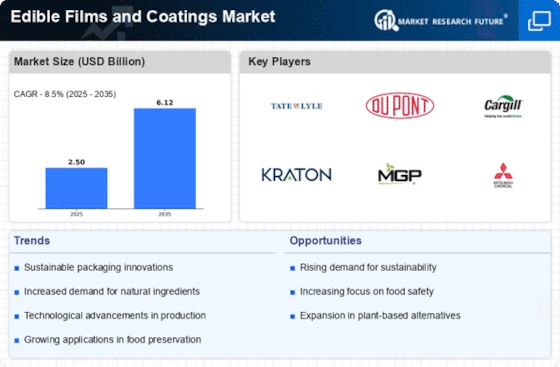
As per Market Research Future analysis, the Edible Films and Coatings Market was estimated at 2.496 USD Billion in 2024. The Edible Films and Coatings industry is projected to grow from 2.708 USD Billion in 2025 to 6.123 USD Billion by 2035, exhibiting a compound annual growth rate (CAGR) of 8.5% during the forecast period 2025 - 2035

Key Market Trends & Highlights

The Edible Films and Coatings Market is experiencing robust growth driven by sustainability and health trends.

  • North America remains the largest market for edible films and coatings, reflecting a strong consumer preference for sustainable packaging solutions.
  • The Asia-Pacific region is emerging as the fastest-growing market, propelled by increasing demand for innovative food preservation methods.
  • In the protein segment, edible films and coatings derived from proteins dominate the market, while polysaccharide-based solutions are rapidly gaining traction.
  • Key market drivers include the clean label movement and health and nutrition trends, which are influencing product development across various food categories.

Market Size & Forecast

2024 Market Size 2.496 (USD Billion)
2035 Market Size 6.123 (USD Billion)
CAGR (2025 - 2035) 8.5%
Largest Regional Market Share in 2024 North America

Major Players

Tate & Lyle (GB), DuPont (US), Cargill (US), Kraton Corporation (US), MGP Ingredients (US), Mitsubishi Chemical (JP), NatureWorks LLC (US), BASF (DE), FMC Corporation (US)

Market Trends

The Edible Films and Coatings Market is experiencing a notable evolution, driven by increasing consumer demand for sustainable packaging solutions and healthier food preservation methods. This market encompasses a variety of materials, including polysaccharides, proteins, and lipids, which are utilized to create films and coatings that enhance the shelf life of food products while maintaining their quality. As environmental concerns gain prominence, manufacturers are increasingly focusing on biodegradable and compostable options, aligning with the broader trend towards sustainability in the food industry. Furthermore, advancements in technology are facilitating the development of innovative edible films that not only serve functional purposes but also enhance the sensory attributes of food, such as flavor and texture. In addition to sustainability, the Edible Films and Coatings Market is influenced by the growing trend of clean label products. Consumers are becoming more conscious of the ingredients in their food, leading to a preference for natural and minimally processed options. This shift is prompting food manufacturers to explore edible coatings that are derived from natural sources, thereby appealing to health-conscious consumers. The market is also witnessing an increase in applications beyond traditional food preservation, such as in pharmaceuticals and cosmetics, where edible films can provide protective barriers and controlled release of active ingredients. Overall, the Edible Films and Coatings Market appears poised for continued growth as it adapts to evolving consumer preferences and technological advancements.

Sustainability Focus

The Edible Films and Coatings Market is increasingly oriented towards sustainable practices. Manufacturers are prioritizing biodegradable and compostable materials to address environmental concerns. This trend reflects a broader movement within the food industry, where eco-friendly packaging solutions are becoming essential.

Clean Label Movement

There is a growing inclination towards clean label products within the Edible Films and Coatings Market. Consumers are seeking transparency regarding food ingredients, leading to a demand for natural and minimally processed edible coatings. This trend aligns with health-conscious consumer behavior.

Diverse Applications

The Edible Films and Coatings Market is expanding its reach beyond food preservation. Applications in pharmaceuticals and cosmetics are emerging, where edible films can serve as protective barriers and facilitate controlled release of active ingredients, showcasing versatility in various sectors.

Edible Films Coatings Market Market Drivers

Clean Label Movement

The clean label movement is reshaping consumer preferences and is a crucial driver for the Edible Films and Coatings Market. Consumers are increasingly seeking products with minimal ingredients and transparency in sourcing. Edible films and coatings, which are often derived from natural and recognizable ingredients, cater to this demand. This trend is reflected in the market, where the edible films segment is expected to reach a valuation of over USD 1 billion by 2026. The clean label movement not only influences consumer choices but also compels manufacturers to reformulate their products, ensuring that they meet the expectations of health-conscious consumers. Consequently, the Edible Films and Coatings Market is positioned to benefit from this shift towards clean label products, as companies strive to enhance their offerings and align with consumer values.

Diverse Applications

The versatility of edible films and coatings is a significant driver for the Edible Films and Coatings Market. These materials find applications across various sectors, including food, pharmaceuticals, and cosmetics. In the food industry, edible coatings are utilized to enhance the shelf life of perishable products, while in pharmaceuticals, they serve as protective barriers for active ingredients. The market for edible coatings in food applications alone is projected to grow at a CAGR of 6% through 2028, highlighting the expanding scope of these materials. This diversity in applications not only broadens the market potential but also encourages innovation in product development. As industries continue to explore the benefits of edible films and coatings, the Edible Films and Coatings Market is likely to experience sustained growth driven by the demand for multifunctional materials.

Sustainability Focus

The increasing emphasis on sustainability is a pivotal driver for the Edible Films and Coatings Market. Consumers are becoming more environmentally conscious, leading to a demand for biodegradable and compostable packaging solutions. Edible films and coatings, made from natural sources such as proteins, polysaccharides, and lipids, align with this trend by reducing plastic waste. The market for edible films is projected to grow at a compound annual growth rate of approximately 5.5% from 2023 to 2030, indicating a robust shift towards sustainable alternatives. This focus on sustainability not only appeals to eco-conscious consumers but also encourages manufacturers to innovate and develop new products that meet these evolving demands. As a result, the Edible Films and Coatings Market is likely to witness significant growth driven by sustainability initiatives.

Technological Advancements

Technological advancements play a crucial role in shaping the Edible Films and Coatings Market. Innovations in material science and processing techniques have led to the development of more effective and versatile edible films. For instance, advancements in nanotechnology have enabled the creation of films with enhanced barrier properties and improved mechanical strength. These innovations not only improve the functionality of edible films but also expand their applications across various sectors. The market is witnessing a surge in research and development activities aimed at optimizing the properties of edible coatings, which is expected to drive growth. As technology continues to evolve, the Edible Films and Coatings Market is likely to benefit from enhanced product offerings and increased market penetration.

Health and Nutrition Trends

The rising awareness of health and nutrition is a notable driver for the Edible Films and Coatings Market. As consumers become more health-conscious, there is a growing demand for food products that offer added nutritional benefits. Edible films and coatings can be fortified with vitamins, minerals, and other bioactive compounds, making them appealing to health-oriented consumers. This trend is reflected in the increasing incorporation of functional ingredients in edible films, which enhances their value proposition. The market for functional edible films is expected to witness a growth rate of around 7% annually, indicating a strong alignment with health trends. As the Edible Films and Coatings Market adapts to these health and nutrition trends, it is likely to attract a broader consumer base seeking healthier food options.

Market Segment Insights

By Ingredient Type: Protein (Largest) vs. Polysaccharides (Fastest-Growing)

In the Edible Films and Coatings Market, the ingredient type segment shows a diverse share distribution among proteins, polysaccharides, lipids, and composites. Proteins currently hold the largest market share due to their unique functional properties, such as excellent film-forming capabilities and barriers against moisture and gases. Polysaccharides are also significant, showing notable traction in the market as they are natural, biodegradable, and conducive to various food applications.

Ingredient Comparison: Protein (Dominant) vs. Polysaccharides (Emerging)

Proteins serve as the dominant ingredient type in edible films and coatings, offering superior mechanical strength and barrier properties, making them ideal for perishable food items. Their ability to enhance the nutritional profile of food products through added protein content drives their demand in the market. In contrast, polysaccharides are emerging rapidly, appealing to health-conscious consumers due to their natural origins. They are gaining attention for their versatility and sustainability, providing an eco-friendly alternative while effectively preserving food freshness and quality.

By Application: Dairy products (Largest) vs. Bakery and Confectionery (Fastest-Growing)

The application segment of the Edible Films and Coatings Market showcases a dynamic distribution of market share among various categories. Dairy products emerge as the largest segment, significantly dominating the market due to their extensive use in preserving freshness and extending shelf life. The Bakery and Confectionery segment, however, is rapidly gaining traction as a preferred choice for manufacturers, thanks to the increasing demand for innovative packaging solutions that enhance product appeal and reduce waste.

Dairy products (Dominant) vs. Bakery and Confectionery (Emerging)

Dairy products continue to dominate the Edible Films and Coatings Market, driven by their essential role in enhancing product quality and longevity. These films provide moisture control and improved barrier properties, making them indispensable for products like cheese and yogurt. In contrast, the Bakery and Confectionery segment is emerging as a significant player, fueled by the trend towards cleaner labels and healthier options. Manufacturers are increasingly adopting edible coatings in baked goods and sweets for their ability to impart flavor and prevent spoilage, making them a sought-after option in contemporary food technology.

Get more detailed insights about Edible Films and Coatings Market Research Report—Global Forecast till 2035

Regional Insights

By region, the study provides the market insights into North America, Europe, Asia-Pacific and Rest of the World. The North America Edible Films and Coatings Market dominated this market in 2022 (45.80%). The existence of international competitors, the accessibility of edible films and coating materials, and consumers' willingness to pay for goods will all contribute to the market expansion of this area. Further, the U.S. Edible Films and Coatings market held the largest market share, and the Canada Edible Films and Coatings market was the fastest growing market in the North America region.

Further, the major countries studied in the market report are The US, Canada, German, France, the UK, Italy, Spain, China, Japan, India, Australia, South Korea, and Brazil.

Figure 2: EDIBLE FILMS AND COATINGS MARKET SHARE BY REGION 2022 (USD Billion)

Europe Edible Films and Coatings market accounted for the healthy market share in 2022. The region is highlighting a switch from the use of single-use plastics to edible options as a crucial method for reducing plastic waste. To reduce waste and give their customers nutritional benefits, local food and beverage producers, as well as foodservice establishments, are implementing edible packaging designs into their operations. Further, the German Edible Films and Coatings market held the largest market share, and the U.K Edible Films and Coatings market was the fastest growing market in the European region

The Asia Pacific Edible Films and Coatings market is expected to register significant growth from 2023 to 2032. The market for edible films and coatings in this region is primarily driven by China and Japan. Market expansion will be fueled by the presence of international competitors, the accessibility of products, and growing environmental concerns. Moreover, China’s Edible Films and Coatings market held the largest market share, and the Indian Edible Films and Coatings market was the fastest growing market in the Asia-Pacific region.

Key Players and Competitive Insights

Leading market players are investing heavily in research and development in order to expand their product lines, which will help the Edible Films and Coatings market, grow even more. Market participants are also undertaking a variety of strategic activities to expand their global footprint, with important market developments including new product launches, contractual agreements, mergers and acquisitions, higher investments, and collaboration with other organizations. To expand and survive in a more competitive and rising market climate, Edible Films and Coatings Industry must offer cost-effective items.
Manufacturing locally to minimize operational costs is one of the key business tactics used by manufacturers in the global Edible Films and Coatings Industry to benefit clients and increase the market sector. In recent years, the Edible Films and Coatings Industry has offered some of the most significant advantages to medicine. Major players in the Edible Films and Coatings market, including Bayer AG, H.C.
Starck GmbH, AGC SEIMI CHEMICAL CO., LTD., BASF SE, DuPont, Merck & Co., Inc., Evonik Industries AG, Sumitomo Chemical Co., Ltd., Heliatek GmbH, Novaled GmbH, AU Optronics Corp., Graphic Packaging International, LLC, WestRock Company, Smurfit Kappa, Krones AG, Amcor plc, Graham, Packaging Company, Sonoco Products Company, Parker Hannifin Corp, and Berry Global Inc, are attempting to increase market demand by investing in research and development operations.
A chemical corporation is BASF SE (BASF). Chemicals, polymers, crop protection products, and performance goods are produced, marketed, and sold by it. Solvents, adhesives, surfactants, fuel additives, electronic chemicals, pigments, paints, food additives, fungicides, and herbicides are among the company's product offerings. Construction, furniture and wood, agricultural, electronics and electrical, paints and coatings, automotive, home care, nutrition, chemicals, and other industries are among the many that the company serves. R&D is conducted by BASF in collaboration with international clients, partners, and scientists. A global network of production sites supports the company's operations.
It is present throughout North America, Europe, Asia Pacific, South America, Africa, and the Middle East. The headquarters of BASF are in Ludwigshafen, Germany.
Akorn Technology creates food technology that minimizes food loss and waste through natural means. In order to provide long-lasting, secure, tasty, and nutritious produce options for contemporary diets and lifestyles, the company offers coatings made from upcycled sustainable and abundant grain by-products. This enables clients and customers to get delicious and multifunctional edible coatings.

Key Companies in the Edible Films Coatings Market include

Industry Developments

November 2021 The edible coating was introduced by Sufresca, an Agri-Tech startup, and is a biodegradable, water-based emulsion comprised completely of natural food ingredients and designed with cutting-edge modified environment features.

Future Outlook

Edible Films Coatings Market Future Outlook

The Edible Films and Coatings Market is projected to grow at an 8.5% CAGR from 2025 to 2035, driven by increasing demand for sustainable packaging and food preservation technologies.

New opportunities lie in:

  • Development of biodegradable edible films for eco-conscious consumers.
  • Integration of smart packaging technologies to enhance food safety.
  • Expansion into emerging markets with tailored product offerings.

By 2035, the market is expected to achieve substantial growth, positioning itself as a leader in sustainable <a href="https://www.marketresearchfuture.com/reports/food-packaging-market-2086" target="_blank" title="food packaging">food packaging</a> solutions.

Market Segmentation

Edible Films Coatings Market Application Outlook

  • Dairy products
  • Bakery and Confectionery
  • Fruits and Vegetables
  • Meat
  • Poultry
  • Seafood
  • Other

Edible Films Coatings Market Ingredient Type Outlook

  • Protein
  • Polysaccharides
  • Lipids
  • Composites

Report Scope

MARKET SIZE 2024 2.496(USD Billion)
MARKET SIZE 2025 2.708(USD Billion)
MARKET SIZE 2035 6.123(USD Billion)
COMPOUND ANNUAL GROWTH RATE (CAGR) 8.5% (2025 - 2035)
REPORT COVERAGE Revenue Forecast, Competitive Landscape, Growth Factors, and Trends
BASE YEAR 2024
Market Forecast Period 2025 - 2035
Historical Data 2019 - 2024
Market Forecast Units USD Billion
Key Companies Profiled Tate & Lyle (GB), DuPont (US), Cargill (US), Kraton Corporation (US), MGP Ingredients (US), Mitsubishi Chemical (JP), NatureWorks LLC (US), BASF (DE), FMC Corporation (US)
Segments Covered Ingredient Type, Application, Region
Key Market Opportunities Growing demand for sustainable packaging solutions drives innovation in the Edible Films and Coatings Market.
Key Market Dynamics Rising consumer demand for sustainable packaging drives innovation in edible films and coatings technology.
Countries Covered North America, Europe, APAC, South America, MEA

FAQs

What is the current valuation of the Edible Films and Coatings Market?

<p>The Edible Films and Coatings Market was valued at 2.496 USD Billion in 2024.</p>

What is the projected market size for the Edible Films and Coatings Market by 2035?

<p>The market is projected to reach 6.123 USD Billion by 2035.</p>

What is the expected CAGR for the Edible Films and Coatings Market during the forecast period?

<p>The expected CAGR for the Edible Films and Coatings Market from 2025 to 2035 is 8.5%.</p>

Which ingredient type segment is anticipated to show significant growth?

<p>The Polysaccharides segment, valued at 0.998 USD Billion in 2024, is expected to grow to 2.462 USD Billion by 2035.</p>

How do the valuations of Dairy products and Bakery and Confectionery compare in the market?

<p>Both Dairy products and Bakery and Confectionery segments were valued at 0.499 USD Billion in 2024, with Bakery projected to grow to 1.249 USD Billion by 2035.</p>

Who are the key players in the Edible Films and Coatings Market?

<p>Key players include Tate & Lyle, DuPont, Cargill, and BASF, among others.</p>

What is the projected growth for the Lipids segment in the Edible Films and Coatings Market?

The Lipids segment, valued at 0.498 USD Billion in 2024, is expected to grow to 1.225 USD Billion by 2035.

Which application segment is likely to experience the highest growth?

The Fruits and Vegetables application segment, valued at 0.499 USD Billion in 2024, is projected to reach 1.249 USD Billion by 2035.

What is the market outlook for the Composites ingredient type?

The Composites segment, which was valued at 0.252 USD Billion in 2024, is expected to grow to 0.591 USD Billion by 2035.

How does the growth of the Edible Films and Coatings Market reflect on consumer trends?

The anticipated growth indicates a rising consumer preference for sustainable and edible packaging solutions in the food industry.

  1. SECTION I: EXECUTIVE SUMMARY AND KEY HIGHLIGHTS
    1. | 1.1 EXECUTIVE SUMMARY
    2. | | 1.1.1 Market Overview
    3. | | 1.1.2 Key Findings
    4. | | 1.1.3 Market Segmentation
    5. | | 1.1.4 Competitive Landscape
    6. | | 1.1.5 Challenges and Opportunities
    7. | | 1.1.6 Future Outlook
  2. SECTION II: SCOPING, METHODOLOGY AND MARKET STRUCTURE
    1. | 2.1 MARKET INTRODUCTION
    2. | | 2.1.1 Definition
    3. | | 2.1.2 Scope of the study
    4. | | | 2.1.2.1 Research Objective
    5. | | | 2.1.2.2 Assumption
    6. | | | 2.1.2.3 Limitations
    7. | 2.2 RESEARCH METHODOLOGY
    8. | | 2.2.1 Overview
    9. | | 2.2.2 Data Mining
    10. | | 2.2.3 Secondary Research
    11. | | 2.2.4 Primary Research
    12. | | | 2.2.4.1 Primary Interviews and Information Gathering Process
    13. | | | 2.2.4.2 Breakdown of Primary Respondents
    14. | | 2.2.5 Forecasting Model
    15. | | 2.2.6 Market Size Estimation
    16. | | | 2.2.6.1 Bottom-Up Approach
    17. | | | 2.2.6.2 Top-Down Approach
    18. | | 2.2.7 Data Triangulation
    19. | | 2.2.8 Validation
  3. SECTION III: QUALITATIVE ANALYSIS
    1. | 3.1 MARKET DYNAMICS
    2. | | 3.1.1 Overview
    3. | | 3.1.2 Drivers
    4. | | 3.1.3 Restraints
    5. | | 3.1.4 Opportunities
    6. | 3.2 MARKET FACTOR ANALYSIS
    7. | | 3.2.1 Value chain Analysis
    8. | | 3.2.2 Porter's Five Forces Analysis
    9. | | | 3.2.2.1 Bargaining Power of Suppliers
    10. | | | 3.2.2.2 Bargaining Power of Buyers
    11. | | | 3.2.2.3 Threat of New Entrants
    12. | | | 3.2.2.4 Threat of Substitutes
    13. | | | 3.2.2.5 Intensity of Rivalry
    14. | | 3.2.3 COVID-19 Impact Analysis
    15. | | | 3.2.3.1 Market Impact Analysis
    16. | | | 3.2.3.2 Regional Impact
    17. | | | 3.2.3.3 Opportunity and Threat Analysis
  4. SECTION IV: QUANTITATIVE ANALYSIS
    1. | 4.1 Chemicals and Materials, BY Ingredient Type (USD Billion)
    2. | | 4.1.1 Protein
    3. | | 4.1.2 Polysaccharides
    4. | | 4.1.3 Lipids
    5. | | 4.1.4 Composites
    6. | 4.2 Chemicals and Materials, BY Application (USD Billion)
    7. | | 4.2.1 Dairy products
    8. | | 4.2.2 Bakery and Confectionery
    9. | | 4.2.3 Fruits and Vegetables
    10. | | 4.2.4 Meat
    11. | | 4.2.5 Poultry
    12. | | 4.2.6 Seafood
    13. | | 4.2.7 Other
    14. | 4.3 Chemicals and Materials, BY Region (USD Billion)
    15. | | 4.3.1 North America
    16. | | | 4.3.1.1 US
    17. | | | 4.3.1.2 Canada
    18. | | 4.3.2 Europe
    19. | | | 4.3.2.1 Germany
    20. | | | 4.3.2.2 UK
    21. | | | 4.3.2.3 France
    22. | | | 4.3.2.4 Russia
    23. | | | 4.3.2.5 Italy
    24. | | | 4.3.2.6 Spain
    25. | | | 4.3.2.7 Rest of Europe
    26. | | 4.3.3 APAC
    27. | | | 4.3.3.1 China
    28. | | | 4.3.3.2 India
    29. | | | 4.3.3.3 Japan
    30. | | | 4.3.3.4 South Korea
    31. | | | 4.3.3.5 Malaysia
    32. | | | 4.3.3.6 Thailand
    33. | | | 4.3.3.7 Indonesia
    34. | | | 4.3.3.8 Rest of APAC
    35. | | 4.3.4 South America
    36. | | | 4.3.4.1 Brazil
    37. | | | 4.3.4.2 Mexico
    38. | | | 4.3.4.3 Argentina
    39. | | | 4.3.4.4 Rest of South America
    40. | | 4.3.5 MEA
    41. | | | 4.3.5.1 GCC Countries
    42. | | | 4.3.5.2 South Africa
    43. | | | 4.3.5.3 Rest of MEA
  5. SECTION V: COMPETITIVE ANALYSIS
    1. | 5.1 Competitive Landscape
    2. | | 5.1.1 Overview
    3. | | 5.1.2 Competitive Analysis
    4. | | 5.1.3 Market share Analysis
    5. | | 5.1.4 Major Growth Strategy in the Chemicals and Materials
    6. | | 5.1.5 Competitive Benchmarking
    7. | | 5.1.6 Leading Players in Terms of Number of Developments in the Chemicals and Materials
    8. | | 5.1.7 Key developments and growth strategies
    9. | | | 5.1.7.1 New Product Launch/Service Deployment
    10. | | | 5.1.7.2 Merger & Acquisitions
    11. | | | 5.1.7.3 Joint Ventures
    12. | | 5.1.8 Major Players Financial Matrix
    13. | | | 5.1.8.1 Sales and Operating Income
    14. | | | 5.1.8.2 Major Players R&D Expenditure. 2023
    15. | 5.2 Company Profiles
    16. | | 5.2.1 Tate & Lyle (GB)
    17. | | | 5.2.1.1 Financial Overview
    18. | | | 5.2.1.2 Products Offered
    19. | | | 5.2.1.3 Key Developments
    20. | | | 5.2.1.4 SWOT Analysis
    21. | | | 5.2.1.5 Key Strategies
    22. | | 5.2.2 DuPont (US)
    23. | | | 5.2.2.1 Financial Overview
    24. | | | 5.2.2.2 Products Offered
    25. | | | 5.2.2.3 Key Developments
    26. | | | 5.2.2.4 SWOT Analysis
    27. | | | 5.2.2.5 Key Strategies
    28. | | 5.2.3 Cargill (US)
    29. | | | 5.2.3.1 Financial Overview
    30. | | | 5.2.3.2 Products Offered
    31. | | | 5.2.3.3 Key Developments
    32. | | | 5.2.3.4 SWOT Analysis
    33. | | | 5.2.3.5 Key Strategies
    34. | | 5.2.4 Kraton Corporation (US)
    35. | | | 5.2.4.1 Financial Overview
    36. | | | 5.2.4.2 Products Offered
    37. | | | 5.2.4.3 Key Developments
    38. | | | 5.2.4.4 SWOT Analysis
    39. | | | 5.2.4.5 Key Strategies
    40. | | 5.2.5 MGP Ingredients (US)
    41. | | | 5.2.5.1 Financial Overview
    42. | | | 5.2.5.2 Products Offered
    43. | | | 5.2.5.3 Key Developments
    44. | | | 5.2.5.4 SWOT Analysis
    45. | | | 5.2.5.5 Key Strategies
    46. | | 5.2.6 Mitsubishi Chemical (JP)
    47. | | | 5.2.6.1 Financial Overview
    48. | | | 5.2.6.2 Products Offered
    49. | | | 5.2.6.3 Key Developments
    50. | | | 5.2.6.4 SWOT Analysis
    51. | | | 5.2.6.5 Key Strategies
    52. | | 5.2.7 NatureWorks LLC (US)
    53. | | | 5.2.7.1 Financial Overview
    54. | | | 5.2.7.2 Products Offered
    55. | | | 5.2.7.3 Key Developments
    56. | | | 5.2.7.4 SWOT Analysis
    57. | | | 5.2.7.5 Key Strategies
    58. | | 5.2.8 BASF (DE)
    59. | | | 5.2.8.1 Financial Overview
    60. | | | 5.2.8.2 Products Offered
    61. | | | 5.2.8.3 Key Developments
    62. | | | 5.2.8.4 SWOT Analysis
    63. | | | 5.2.8.5 Key Strategies
    64. | | 5.2.9 FMC Corporation (US)
    65. | | | 5.2.9.1 Financial Overview
    66. | | | 5.2.9.2 Products Offered
    67. | | | 5.2.9.3 Key Developments
    68. | | | 5.2.9.4 SWOT Analysis
    69. | | | 5.2.9.5 Key Strategies
    70. | 5.3 Appendix
    71. | | 5.3.1 References
    72. | | 5.3.2 Related Reports
  6. LIST OF FIGURES
    1. | 6.1 MARKET SYNOPSIS
    2. | 6.2 NORTH AMERICA MARKET ANALYSIS
    3. | 6.3 US MARKET ANALYSIS BY INGREDIENT TYPE
    4. | 6.4 US MARKET ANALYSIS BY APPLICATION
    5. | 6.5 CANADA MARKET ANALYSIS BY INGREDIENT TYPE
    6. | 6.6 CANADA MARKET ANALYSIS BY APPLICATION
    7. | 6.7 EUROPE MARKET ANALYSIS
    8. | 6.8 GERMANY MARKET ANALYSIS BY INGREDIENT TYPE
    9. | 6.9 GERMANY MARKET ANALYSIS BY APPLICATION
    10. | 6.10 UK MARKET ANALYSIS BY INGREDIENT TYPE
    11. | 6.11 UK MARKET ANALYSIS BY APPLICATION
    12. | 6.12 FRANCE MARKET ANALYSIS BY INGREDIENT TYPE
    13. | 6.13 FRANCE MARKET ANALYSIS BY APPLICATION
    14. | 6.14 RUSSIA MARKET ANALYSIS BY INGREDIENT TYPE
    15. | 6.15 RUSSIA MARKET ANALYSIS BY APPLICATION
    16. | 6.16 ITALY MARKET ANALYSIS BY INGREDIENT TYPE
    17. | 6.17 ITALY MARKET ANALYSIS BY APPLICATION
    18. | 6.18 SPAIN MARKET ANALYSIS BY INGREDIENT TYPE
    19. | 6.19 SPAIN MARKET ANALYSIS BY APPLICATION
    20. | 6.20 REST OF EUROPE MARKET ANALYSIS BY INGREDIENT TYPE
    21. | 6.21 REST OF EUROPE MARKET ANALYSIS BY APPLICATION
    22. | 6.22 APAC MARKET ANALYSIS
    23. | 6.23 CHINA MARKET ANALYSIS BY INGREDIENT TYPE
    24. | 6.24 CHINA MARKET ANALYSIS BY APPLICATION
    25. | 6.25 INDIA MARKET ANALYSIS BY INGREDIENT TYPE
    26. | 6.26 INDIA MARKET ANALYSIS BY APPLICATION
    27. | 6.27 JAPAN MARKET ANALYSIS BY INGREDIENT TYPE
    28. | 6.28 JAPAN MARKET ANALYSIS BY APPLICATION
    29. | 6.29 SOUTH KOREA MARKET ANALYSIS BY INGREDIENT TYPE
    30. | 6.30 SOUTH KOREA MARKET ANALYSIS BY APPLICATION
    31. | 6.31 MALAYSIA MARKET ANALYSIS BY INGREDIENT TYPE
    32. | 6.32 MALAYSIA MARKET ANALYSIS BY APPLICATION
    33. | 6.33 THAILAND MARKET ANALYSIS BY INGREDIENT TYPE
    34. | 6.34 THAILAND MARKET ANALYSIS BY APPLICATION
    35. | 6.35 INDONESIA MARKET ANALYSIS BY INGREDIENT TYPE
    36. | 6.36 INDONESIA MARKET ANALYSIS BY APPLICATION
    37. | 6.37 REST OF APAC MARKET ANALYSIS BY INGREDIENT TYPE
    38. | 6.38 REST OF APAC MARKET ANALYSIS BY APPLICATION
    39. | 6.39 SOUTH AMERICA MARKET ANALYSIS
    40. | 6.40 BRAZIL MARKET ANALYSIS BY INGREDIENT TYPE
    41. | 6.41 BRAZIL MARKET ANALYSIS BY APPLICATION
    42. | 6.42 MEXICO MARKET ANALYSIS BY INGREDIENT TYPE
    43. | 6.43 MEXICO MARKET ANALYSIS BY APPLICATION
    44. | 6.44 ARGENTINA MARKET ANALYSIS BY INGREDIENT TYPE
    45. | 6.45 ARGENTINA MARKET ANALYSIS BY APPLICATION
    46. | 6.46 REST OF SOUTH AMERICA MARKET ANALYSIS BY INGREDIENT TYPE
    47. | 6.47 REST OF SOUTH AMERICA MARKET ANALYSIS BY APPLICATION
    48. | 6.48 MEA MARKET ANALYSIS
    49. | 6.49 GCC COUNTRIES MARKET ANALYSIS BY INGREDIENT TYPE
    50. | 6.50 GCC COUNTRIES MARKET ANALYSIS BY APPLICATION
    51. | 6.51 SOUTH AFRICA MARKET ANALYSIS BY INGREDIENT TYPE
    52. | 6.52 SOUTH AFRICA MARKET ANALYSIS BY APPLICATION
    53. | 6.53 REST OF MEA MARKET ANALYSIS BY INGREDIENT TYPE
    54. | 6.54 REST OF MEA MARKET ANALYSIS BY APPLICATION
    55. | 6.55 KEY BUYING CRITERIA OF CHEMICALS AND MATERIALS
    56. | 6.56 RESEARCH PROCESS OF MRFR
    57. | 6.57 DRO ANALYSIS OF CHEMICALS AND MATERIALS
    58. | 6.58 DRIVERS IMPACT ANALYSIS: CHEMICALS AND MATERIALS
    59. | 6.59 RESTRAINTS IMPACT ANALYSIS: CHEMICALS AND MATERIALS
    60. | 6.60 SUPPLY / VALUE CHAIN: CHEMICALS AND MATERIALS
    61. | 6.61 CHEMICALS AND MATERIALS, BY INGREDIENT TYPE, 2024 (% SHARE)
    62. | 6.62 CHEMICALS AND MATERIALS, BY INGREDIENT TYPE, 2024 TO 2035 (USD Billion)
    63. | 6.63 CHEMICALS AND MATERIALS, BY APPLICATION, 2024 (% SHARE)
    64. | 6.64 CHEMICALS AND MATERIALS, BY APPLICATION, 2024 TO 2035 (USD Billion)
    65. | 6.65 BENCHMARKING OF MAJOR COMPETITORS
  7. LIST OF TABLES
    1. | 7.1 LIST OF ASSUMPTIONS
    2. | | 7.1.1
    3. | 7.2 North America MARKET SIZE ESTIMATES; FORECAST
    4. | | 7.2.1 BY INGREDIENT TYPE, 2025-2035 (USD Billion)
    5. | | 7.2.2 BY APPLICATION, 2025-2035 (USD Billion)
    6. | 7.3 US MARKET SIZE ESTIMATES; FORECAST
    7. | | 7.3.1 BY INGREDIENT TYPE, 2025-2035 (USD Billion)
    8. | | 7.3.2 BY APPLICATION, 2025-2035 (USD Billion)
    9. | 7.4 Canada MARKET SIZE ESTIMATES; FORECAST
    10. | | 7.4.1 BY INGREDIENT TYPE, 2025-2035 (USD Billion)
    11. | | 7.4.2 BY APPLICATION, 2025-2035 (USD Billion)
    12. | 7.5 Europe MARKET SIZE ESTIMATES; FORECAST
    13. | | 7.5.1 BY INGREDIENT TYPE, 2025-2035 (USD Billion)
    14. | | 7.5.2 BY APPLICATION, 2025-2035 (USD Billion)
    15. | 7.6 Germany MARKET SIZE ESTIMATES; FORECAST
    16. | | 7.6.1 BY INGREDIENT TYPE, 2025-2035 (USD Billion)
    17. | | 7.6.2 BY APPLICATION, 2025-2035 (USD Billion)
    18. | 7.7 UK MARKET SIZE ESTIMATES; FORECAST
    19. | | 7.7.1 BY INGREDIENT TYPE, 2025-2035 (USD Billion)
    20. | | 7.7.2 BY APPLICATION, 2025-2035 (USD Billion)
    21. | 7.8 France MARKET SIZE ESTIMATES; FORECAST
    22. | | 7.8.1 BY INGREDIENT TYPE, 2025-2035 (USD Billion)
    23. | | 7.8.2 BY APPLICATION, 2025-2035 (USD Billion)
    24. | 7.9 Russia MARKET SIZE ESTIMATES; FORECAST
    25. | | 7.9.1 BY INGREDIENT TYPE, 2025-2035 (USD Billion)
    26. | | 7.9.2 BY APPLICATION, 2025-2035 (USD Billion)
    27. | 7.10 Italy MARKET SIZE ESTIMATES; FORECAST
    28. | | 7.10.1 BY INGREDIENT TYPE, 2025-2035 (USD Billion)
    29. | | 7.10.2 BY APPLICATION, 2025-2035 (USD Billion)
    30. | 7.11 Spain MARKET SIZE ESTIMATES; FORECAST
    31. | | 7.11.1 BY INGREDIENT TYPE, 2025-2035 (USD Billion)
    32. | | 7.11.2 BY APPLICATION, 2025-2035 (USD Billion)
    33. | 7.12 Rest of Europe MARKET SIZE ESTIMATES; FORECAST
    34. | | 7.12.1 BY INGREDIENT TYPE, 2025-2035 (USD Billion)
    35. | | 7.12.2 BY APPLICATION, 2025-2035 (USD Billion)
    36. | 7.13 APAC MARKET SIZE ESTIMATES; FORECAST
    37. | | 7.13.1 BY INGREDIENT TYPE, 2025-2035 (USD Billion)
    38. | | 7.13.2 BY APPLICATION, 2025-2035 (USD Billion)
    39. | 7.14 China MARKET SIZE ESTIMATES; FORECAST
    40. | | 7.14.1 BY INGREDIENT TYPE, 2025-2035 (USD Billion)
    41. | | 7.14.2 BY APPLICATION, 2025-2035 (USD Billion)
    42. | 7.15 India MARKET SIZE ESTIMATES; FORECAST
    43. | | 7.15.1 BY INGREDIENT TYPE, 2025-2035 (USD Billion)
    44. | | 7.15.2 BY APPLICATION, 2025-2035 (USD Billion)
    45. | 7.16 Japan MARKET SIZE ESTIMATES; FORECAST
    46. | | 7.16.1 BY INGREDIENT TYPE, 2025-2035 (USD Billion)
    47. | | 7.16.2 BY APPLICATION, 2025-2035 (USD Billion)
    48. | 7.17 South Korea MARKET SIZE ESTIMATES; FORECAST
    49. | | 7.17.1 BY INGREDIENT TYPE, 2025-2035 (USD Billion)
    50. | | 7.17.2 BY APPLICATION, 2025-2035 (USD Billion)
    51. | 7.18 Malaysia MARKET SIZE ESTIMATES; FORECAST
    52. | | 7.18.1 BY INGREDIENT TYPE, 2025-2035 (USD Billion)
    53. | | 7.18.2 BY APPLICATION, 2025-2035 (USD Billion)
    54. | 7.19 Thailand MARKET SIZE ESTIMATES; FORECAST
    55. | | 7.19.1 BY INGREDIENT TYPE, 2025-2035 (USD Billion)
    56. | | 7.19.2 BY APPLICATION, 2025-2035 (USD Billion)
    57. | 7.20 Indonesia MARKET SIZE ESTIMATES; FORECAST
    58. | | 7.20.1 BY INGREDIENT TYPE, 2025-2035 (USD Billion)
    59. | | 7.20.2 BY APPLICATION, 2025-2035 (USD Billion)
    60. | 7.21 Rest of APAC MARKET SIZE ESTIMATES; FORECAST
    61. | | 7.21.1 BY INGREDIENT TYPE, 2025-2035 (USD Billion)
    62. | | 7.21.2 BY APPLICATION, 2025-2035 (USD Billion)
    63. | 7.22 South America MARKET SIZE ESTIMATES; FORECAST
    64. | | 7.22.1 BY INGREDIENT TYPE, 2025-2035 (USD Billion)
    65. | | 7.22.2 BY APPLICATION, 2025-2035 (USD Billion)
    66. | 7.23 Brazil MARKET SIZE ESTIMATES; FORECAST
    67. | | 7.23.1 BY INGREDIENT TYPE, 2025-2035 (USD Billion)
    68. | | 7.23.2 BY APPLICATION, 2025-2035 (USD Billion)
    69. | 7.24 Mexico MARKET SIZE ESTIMATES; FORECAST
    70. | | 7.24.1 BY INGREDIENT TYPE, 2025-2035 (USD Billion)
    71. | | 7.24.2 BY APPLICATION, 2025-2035 (USD Billion)
    72. | 7.25 Argentina MARKET SIZE ESTIMATES; FORECAST
    73. | | 7.25.1 BY INGREDIENT TYPE, 2025-2035 (USD Billion)
    74. | | 7.25.2 BY APPLICATION, 2025-2035 (USD Billion)
    75. | 7.26 Rest of South America MARKET SIZE ESTIMATES; FORECAST
    76. | | 7.26.1 BY INGREDIENT TYPE, 2025-2035 (USD Billion)
    77. | | 7.26.2 BY APPLICATION, 2025-2035 (USD Billion)
    78. | 7.27 MEA MARKET SIZE ESTIMATES; FORECAST
    79. | | 7.27.1 BY INGREDIENT TYPE, 2025-2035 (USD Billion)
    80. | | 7.27.2 BY APPLICATION, 2025-2035 (USD Billion)
    81. | 7.28 GCC Countries MARKET SIZE ESTIMATES; FORECAST
    82. | | 7.28.1 BY INGREDIENT TYPE, 2025-2035 (USD Billion)
    83. | | 7.28.2 BY APPLICATION, 2025-2035 (USD Billion)
    84. | 7.29 South Africa MARKET SIZE ESTIMATES; FORECAST
    85. | | 7.29.1 BY INGREDIENT TYPE, 2025-2035 (USD Billion)
    86. | | 7.29.2 BY APPLICATION, 2025-2035 (USD Billion)
    87. | 7.30 Rest of MEA MARKET SIZE ESTIMATES; FORECAST
    88. | | 7.30.1 BY INGREDIENT TYPE, 2025-2035 (USD Billion)
    89. | | 7.30.2 BY APPLICATION, 2025-2035 (USD Billion)
    90. | 7.31 PRODUCT LAUNCH/PRODUCT DEVELOPMENT/APPROVAL
    91. | | 7.31.1
    92. | 7.32 ACQUISITION/PARTNERSHIP
    93. | | 7.32.1

Chemicals and Materials Market Segmentation

Chemicals and Materials By Ingredient Type (USD Billion, 2025-2035)

  • Protein
  • Polysaccharides
  • Lipids
  • Composites

Chemicals and Materials By Application (USD Billion, 2025-2035)

  • Dairy products
  • Bakery and Confectionery
  • Fruits and Vegetables
  • Meat
  • Poultry
  • Seafood
  • Other
Infographic

Free Sample Request

Kindly complete the form below to receive a free sample of this Report

Get Free Sample

Customer Strories

Compare Licence

×
Features License Type
Single User Multiuser License Enterprise User
Price $4,950 $5,950 $7,250
Maximum User Access Limit 1 User Upto 10 Users Unrestricted Access Throughout the Organization
Free Customization
Direct Access to Analyst
Deliverable Format
Platform Access
Discount on Next Purchase 10% 15% 15%
Printable Versions