
Request Free Sample ×

Kindly complete the form below to receive a free sample of this Report

* Please use a valid business email

Leading companies partner with us for data-driven Insights

clients tt-cursor
Hero Background
English
Chinese
French
Japanese
Korean
German
Spanish

E-Visa Market Trends

ID: MRFR/ICT/7299-CR
128 Pages
Ankit Gupta
January 2024

E-Visa Market Research Report By Component (Software and Services), by Application (Travelling, Students/Educational Visa, Government/Foreign Affairs and Others), by Platform (Desktop, Smartphone and Tablets), and By Region (North America, Europe, Asia-Pacific, Middle East and Africa, South America) – Market Forecast Till 2035

Share:
Download PDF ×

We do not share your information with anyone. However, we may send you emails based on your report interest from time to time. You may contact us at any time to opt-out.

E Visa Market Infographic
Purchase Options

Market Trends

Key Emerging Trends in the E Visa Market

The market trends in the e-visa sector are witnessing significant growth and evolution, driven by advancements in technology, changing travel patterns, and increasing globalization. One prominent trend is the rising demand for e-visa services due to their convenience and efficiency compared to traditional visa application processes. Travelers are increasingly opting for e-visas as they offer streamlined application procedures, often allowing applicants to apply online and receive approvals electronically within a shorter timeframe. This trend is particularly pronounced in regions with high tourist traffic, where governments are increasingly embracing e-visa systems to attract visitors and boost tourism revenue.

Moreover, the e-visa market is experiencing a shift towards greater digitalization and automation, with governments and service providers investing in advanced online platforms and systems to enhance the visa application experience. Integration of biometric authentication and electronic document verification systems is becoming increasingly common, enhancing security measures while simplifying the application process for travelers. These technological advancements are not only improving the efficiency of e-visa systems but also reducing the likelihood of fraud and unauthorized entry, thereby bolstering confidence among travelers and governments alike.

Furthermore, the COVID-19 pandemic has had a profound impact on the e-visa market, prompting governments to introduce new health and safety measures in visa processing. Many countries have implemented e-visa systems as part of their broader efforts to manage border controls and mitigate the spread of the virus. This includes the adoption of health declaration forms, quarantine requirements, and vaccination certificates as additional criteria for visa approval. As travel restrictions continue to fluctuate in response to the pandemic, e-visa systems are expected to play a crucial role in facilitating safe and responsible travel in the post-pandemic era.

In addition to technological advancements and the impact of the pandemic, demographic shifts and changing consumer preferences are also influencing market trends in the e-visa sector. The growing millennial and Gen Z demographics, characterized by their digital literacy and preference for seamless online experiences, are driving demand for e-visa services. These younger generations are more inclined to travel independently and seek out destinations that offer hassle-free visa processes, making e-visas an increasingly attractive option.

Moreover, the rise of remote work and digital nomadism is fueling demand for long-term visas and residency permits that can be obtained online. Many countries are introducing specialized e-visa programs tailored to remote workers and entrepreneurs, allowing them to live and work in a foreign country for an extended period without the need for traditional visa applications. This trend is reshaping the concept of visa issuance, blurring the lines between tourism, business, and residency visas, and creating new opportunities for both travelers and destination countries.


Author
Author Profile
Ankit Gupta
Team Lead - Research

Ankit Gupta is a seasoned market intelligence and strategic research professional with over six plus years of experience in the ICT and Semiconductor industries. With academic roots in Telecom, Marketing, and Electronics, he blends technical insight with business strategy. Ankit has led 200+ projects, including work for Fortune 500 clients like Microsoft and Rio Tinto, covering market sizing, tech forecasting, and go-to-market strategies. Known for bridging engineering and enterprise decision-making, his insights support growth, innovation, and investment planning across diverse technology markets.

Leave a Comment

FAQs

What is the current valuation of the E-Visa Market as of 2024?

<p>The E-Visa Market was valued at 1030.5 USD Million in 2024.</p>

What is the projected market valuation for the E-Visa Market in 2035?

<p>The E-Visa Market is projected to reach a valuation of 3286.8 USD Million by 2035.</p>

What is the expected CAGR for the E-Visa Market during the forecast period 2025 - 2035?

<p>The expected CAGR for the E-Visa Market during the forecast period 2025 - 2035 is 11.12%.</p>

Which companies are considered key players in the E-Visa Market?

<p>Key players in the E-Visa Market include VFS Global, Cox & Kings Global Services, TLScontact, BLS International, VisaHQ, iVisa, CIBTvisas, and Travel Visa Pro.</p>

What are the main components of the E-Visa Market?

<p>The main components of the E-Visa Market include services, valued at 1900.0 USD Million, and software, valued at 1386.8 USD Million.</p>

How does the application segment of the E-Visa Market break down?

The application segment includes Travelling at 1200.0 USD Million, Students/Educational Visa at 800.0 USD Million, and Government/Foreign Affairs at 600.0 USD Million.

What platforms are utilized in the E-Visa Market?

The platforms in the E-Visa Market consist of Desktop at 900.0 USD Million, Smartphone at 1300.0 USD Million, and Tablets at 1086.8 USD Million.

What trends are influencing the growth of the E-Visa Market?

The growth of the E-Visa Market appears to be influenced by increasing digitalization and the rising demand for efficient visa processing solutions.

How does the E-Visa Market's growth compare across different platforms?

The Smartphone platform is projected to lead with a valuation of 1300.0 USD Million, indicating a strong preference for mobile access.

What factors could impact the future growth of the E-Visa Market?

Factors that could impact future growth include advancements in technology, regulatory changes, and shifts in consumer behavior towards online visa applications.

Market Summary

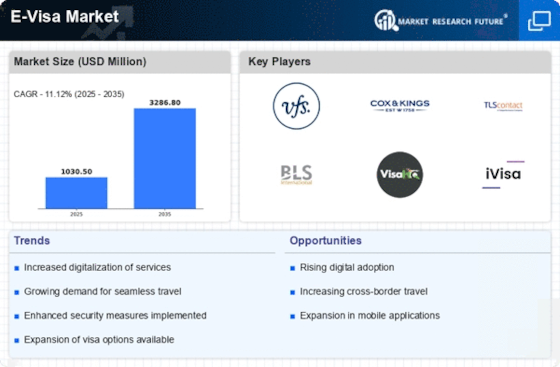
As per Market Research Future analysis, the E-Visa Market Size was estimated at 1030.5 USD Million in 2024. The E-Visa industry is projected to grow from 1145.09 USD Million in 2025 to 3286.8 USD Million by 2035, exhibiting a compound annual growth rate (CAGR) of 11.12% during the forecast period 2025 - 2035

Key Market Trends & Highlights

The E-Visa Market is experiencing robust growth driven by technological advancements and changing consumer preferences.

  • North America remains the largest market for e-visas, reflecting a strong governmental push towards digital solutions. The Asia-Pacific region is emerging as the fastest-growing market, fueled by increasing international travel demand. The services segment dominates the market, while the educational visa segment is witnessing the fastest growth due to rising student mobility. Enhanced security measures and a growing focus on tourism revenue are key drivers propelling the e-visa market forward.

Market Size & Forecast

2024 Market Size 1030.5 (USD Million)
2035 Market Size 3286.8 (USD Million)
CAGR (2025 - 2035) 11.12%
Largest Regional Market Share in 2024 Asia Pacific

Major Players

<a title="VFS Global" href="https://www.vfsglobal.com/en/governments/solutions-e-visa.html" target="_blank" rel="noopener">VFS Global</a> (IN), Cox &amp; Kings Global Services (IN), TLScontact (FR), <a title="BLS International" href="https://evisas.blsinternational.com/" target="_blank" rel="noopener">BLS International</a> (IN), VisaHQ (US), iVisa (US), CIBTvisas (US), Travel Visa Pro (US)

Market Trends

The E-Visa Market is currently experiencing a transformative phase, characterized by the increasing adoption of digital solutions in the travel and immigration sectors. Governments worldwide are recognizing the potential of electronic visas to streamline entry processes, enhance security, and improve the overall traveler experience. This shift towards digitalization appears to be driven by a combination of factors, including the need for efficient border management and the growing demand for seamless travel experiences. As a result, many nations are investing in advanced technologies to facilitate the issuance and management of e-visas, which may lead to a more interconnected global travel landscape. Moreover, the E-Visa Market seems to be influenced by changing consumer preferences, with travelers increasingly favoring online applications over traditional methods. This trend indicates a broader societal shift towards convenience and accessibility, as individuals seek to minimize the time and effort required for visa processing. Additionally, the rise of mobile technology is likely to play a crucial role in shaping the future of the E-Visa Market, as more users turn to smartphones and applications for their travel needs. Overall, the E-Visa Market is poised for growth, driven by technological advancements and evolving traveler expectations.

Increased Government Adoption

Governments are progressively embracing e-visa systems to modernize their immigration processes. This trend suggests a shift towards more efficient border control measures, as electronic visas can expedite entry and enhance security protocols.

Consumer Preference for Digital Solutions

Travelers are increasingly opting for online visa applications, reflecting a broader preference for digital solutions. This inclination indicates a demand for convenience and speed in the visa acquisition process, which e-visas can effectively provide.

Integration of Mobile Technology

The integration of mobile technology into the E-Visa Market is becoming more pronounced. As smartphones become ubiquitous, the potential for mobile applications to facilitate visa applications and management is likely to reshape user experiences.

E Visa Market Market Drivers

Enhanced Security Measures

The E-Visa Market is experiencing a notable shift towards enhanced security measures, driven by the increasing need for secure travel documentation. Governments are implementing advanced biometric technologies, such as facial recognition and fingerprint scanning, to bolster the integrity of the visa application process. This trend is underscored by the fact that countries are investing heavily in digital infrastructure to ensure that e-visas are not only convenient but also secure. For instance, the integration of blockchain technology is being explored to prevent fraud and unauthorized access. As a result, the E-Visa Market is likely to witness a surge in demand as travelers seek assurance that their personal information is protected. This focus on security may also lead to a more streamlined application process, further encouraging adoption among travelers.

Increased Focus on Tourism Revenue

The E-Visa Market is increasingly recognized as a vital component in boosting tourism revenue for many countries. Governments are acknowledging that simplifying the visa process can lead to higher tourist inflows, which in turn contributes to economic growth. For instance, countries that have adopted e-visa systems have reported significant increases in tourist arrivals, with some experiencing growth rates of over 20% in the first year of implementation. This realization is prompting more nations to consider e-visas as a strategic tool for enhancing their tourism sectors. By facilitating easier access for travelers, the E-Visa Market is likely to play a crucial role in shaping the future of international tourism, as countries strive to attract more visitors and maximize their economic potential.

Growing International Travel Demand

The E-Visa Market is poised for growth due to the increasing demand for international travel. As economies recover and travel restrictions ease, more individuals are seeking to explore new destinations. According to recent statistics, international tourist arrivals are projected to reach 1.8 billion by 2030, indicating a robust appetite for travel. This surge in travel demand is likely to drive the need for efficient visa processing solutions, making e-visas an attractive option for both travelers and governments. The convenience of applying for visas online, coupled with the ability to receive approvals quickly, positions the E-Visa Market favorably in meeting the needs of a growing traveler base. Consequently, this trend may lead to an expansion of e-visa offerings across various countries, enhancing accessibility for tourists.

Regulatory Changes and Policy Reforms

Regulatory changes and policy reforms are driving the evolution of the E-Visa Market. Many countries are revising their visa policies to adapt to the changing landscape of international travel. This includes simplifying application procedures and reducing fees associated with e-visas, making them more appealing to travelers. For example, several nations have recently introduced policies that allow for longer stays or multiple entries, which can enhance the attractiveness of their destinations. These reforms are often aimed at increasing competitiveness in The E-Visa. As countries continue to adapt their regulations, the E-Visa Market is likely to see a corresponding increase in adoption rates, as travelers seek more flexible and accessible visa options.

Technological Advancements in Application Processes

Technological advancements are significantly shaping the E-Visa Market, particularly in the realm of application processes. The introduction of artificial intelligence and machine learning is streamlining the visa application and approval processes, reducing processing times and enhancing user experience. For example, AI-driven chatbots are being utilized to assist applicants in real-time, providing guidance and answering queries, which improves overall satisfaction. Furthermore, the integration of data analytics allows governments to better assess risks and manage applications more effectively. As these technologies continue to evolve, they are likely to attract more travelers to utilize e-visas, thereby expanding the market. The E-Visa Market stands to benefit from these innovations, as they not only enhance efficiency but also foster a more user-friendly environment for applicants.

Market Segment Insights

By Component: Services (Largest) vs. Software (Fastest-Growing)

In the E-Visa Market, the Services segment commands the largest market share, driven by the growing demand for streamlined application processes and customer support. Services encompass various offerings such as application processing, customer assistance, and document verification, playing a pivotal role in enhancing user experience and efficiency. Meanwhile, Software, representing the fastest-growing segment, is gaining traction due to the increasing reliance on digital solutions, AI, and automation to facilitate e-visa applications and approvals.

Services (Dominant) vs. Software (Emerging)

The Services segment in the E-Visa Market is characterized by its robust position as the dominant offering, providing critical support throughout the application process. It includes services like consultation, application submission, and real-time tracking, ensuring applicants receive guidance and assistance at each stage. Conversely, the Software segment is emerging rapidly, leveraging technology to optimize visa workflows, improve data accuracy, and enhance user engagement. Software tools are increasingly integrated into service offerings, promoting efficiency and accessibility in the visa application process, ultimately transforming the traditional approach into a more seamless and user-friendly experience.

By Application: Travelling (Largest) vs. Students/Educational Visa (Fastest-Growing)

The E-Visa market showcases a distinct distribution of applications across various segment values. Travelling accounts for the largest proportion, as the convenience of electronic visas simplifies the travel experience for tourists, enabling seamless entry into different countries. On the contrary, the Students/Educational Visa sector, although smaller in market share, is rapidly gaining traction as education becomes increasingly globalized and digital platforms make it easier for students to apply for visas online. As the market evolves, several growth trends are emerging within the E-Visa application segments. The demand for Travelling visas remains robust, spurred by rising international tourism and the growing digitization of travel processes. Meanwhile, the Students/Educational Visa segment is bolstered by increasing number of international student enrollments across educational institutions, highlighting a shift towards a more interconnected world where acquiring education abroad is seen as a valuable investment. This trend is expected to continue as educational institutions adapt to meet the needs of international students, further stimulating this sector's growth.

Travelling (Dominant) vs. Students/Educational Visa (Emerging)

In the E-Visa market, the Travelling segment stands out as the dominant force, driven by the tourist influx facilitated by simplified visa processes. This segment appeals to a broad demographic, encompassing leisure travelers and business professionals alike, thus maintaining a strong competitive edge. In contrast, the Students/Educational Visa segment is emerging rapidly, characterized by its appeal to a niche market that values cultural exchange and educational opportunities abroad. As institutions proactively support international students through tailored visa solutions, this segment is poised for significant growth. While Travelling visas cater to immediate entry needs, the Students/Educational Visa offers a long-term vision, making both segments vital in the evolving landscape of global mobility.

By Platform: Smartphone (Largest) vs. Desktop (Fastest-Growing)

In the E-Visa Market, the distribution of platform usage reveals significant trends, with smartphones emerging as the leading platform for e-visa applications. The user-friendly interface and accessibility of smartphones have made them the go-to choice for travelers seeking quick visa approval. In contrast, desktop usage, although currently lower, is seeing a surge as businesses and frequent travelers prefer the comprehensive viewing offered by larger screens. Market dynamics indicate a notable shift towards mobile as the preferred platform, driven by advancements in mobile technology and the increasing penetration of smartphones globally. This trend is further supported by the growing awareness of the ease of use and efficiency of smartphone applications in managing travel documentation, leading to a rise in mobile transactions within the e-visa sector.

Platform Comparison: Smartphone (Dominant) vs. Desktop (Emerging)

Smartphones stand out as the dominant platform in the E-Visa Market, largely due to their convenience and portability, appealing to the on-the-go traveler. As mobile applications become increasingly sophisticated, they offer seamless functionality, enabling users to complete their visa applications quickly. The smartphone platform facilitates instant notifications and easy access to application updates, enhancing user experience. Conversely, while desktops are currently considered an emerging segment, they are gaining traction among particular demographics, especially business travelers. The larger screen size allows for better navigation through complex forms and document uploads, signaling a gradual and steady growth in desktop usage as user preferences evolve.

Get more detailed insights about E-Visa Market Research Report — Global Forecast till 2035

Regional Insights

North America : Digital Transformation Leader

The North American e-visa market is driven by increasing travel demand and digital transformation initiatives. The U.S. holds the largest market share at approximately 60%, followed by Canada at around 25%. Regulatory support, such as the Electronic System for Travel Authorization (ESTA), has catalyzed growth, making the visa application process more efficient and accessible. The region's focus on technology and innovation further enhances its market potential. Leading countries in this region include the United States and Canada, with a competitive landscape featuring key players like VisaHQ, iVisa, and CIBTvisas. These companies leverage advanced technology to streamline visa processing, catering to a diverse clientele. The presence of established players and a growing number of startups contribute to a dynamic market environment, ensuring that North America remains at the forefront of e-visa services. The Mexico e passport e visa market is emerging as a key segment in Latin America, supported by tourism growth and border digitization initiatives.

Europe : Regulatory Framework Strengthens Market

Europe's e-visa market is characterized by robust regulatory frameworks and increasing travel mobility. The largest market is Germany, holding approximately 30% of the share, followed closely by France at 25%. The European Union's initiatives to simplify visa processes and enhance security measures are significant growth drivers. The introduction of the European Travel Information and Authorization System (ETIAS) is expected to further boost the market by streamlining entry for travelers. Key players in Europe include TLScontact and BLS International, which provide comprehensive visa services across multiple countries. The competitive landscape is marked by partnerships with government agencies and a focus on customer experience. Countries like the UK and Italy are also emerging as significant players, contributing to a diverse and competitive market environment. The Europe e-passport e visa market is strengthening due to regulatory initiatives such as ETIAS and the expansion of digital identity frameworks.

Asia-Pacific : Emerging Market Potential

The Asia-Pacific e-visa market is rapidly expanding, driven by increasing international travel and government initiatives to promote tourism. The largest market is India, accounting for approximately 35% of the share, followed by Australia at around 20%. Regulatory support, such as the introduction of e-visa systems in various countries, has significantly boosted accessibility for travelers, making the region a focal point for e-visa services. Leading countries include India, Australia, and Japan, with key players like VFS Global and Cox & Kings Global Services dominating the landscape. The competitive environment is characterized by a mix of established companies and new entrants, all vying to capture the growing demand for e-visa services. The region's diverse travel patterns and increasing digital adoption further enhance its market potential.

The India e visa market continues to dominate the Asia-Pacific region, driven by strong government initiatives and rising inbound tourism. The Japan e visa market is expanding steadily as the country simplifies entry procedures for international travelers. The China e visa market is expected to witness gradual growth as digital immigration systems gain wider acceptance. Asia-Pacific accounted for the largest e visa market share in 2024, supported by high travel volumes and widespread government digitization programs.

Middle East and Africa : Tourism Growth Catalyst

The Middle East and Africa e-visa market is witnessing significant growth, driven by increasing tourism and government efforts to simplify visa processes. The largest market is the United Arab Emirates, holding approximately 40% of the share, followed by South Africa at around 20%. Initiatives like the UAE's e-visa system have made it easier for travelers, contributing to the region's attractiveness as a tourist destination. Key players in this region include BLS International and TLScontact, which provide essential visa services to travelers. The competitive landscape is evolving, with a focus on enhancing customer experience and leveraging technology to streamline processes. Countries like Kenya and Egypt are also emerging as important players, further diversifying the market and enhancing its growth prospects.

Key Players and Competitive Insights

The E-Visa Market is currently characterized by a dynamic competitive landscape, driven by increasing globalization and the need for streamlined travel processes. Key players such as VFS Global (IN), TLScontact (FR), and iVisa (US) are strategically positioned to leverage technological advancements and enhance customer experiences. VFS Global (IN) focuses on expanding its digital services, aiming to simplify the visa application process through innovative online platforms. Meanwhile, TLScontact (FR) emphasizes partnerships with governments to improve service delivery, thereby enhancing its operational footprint in Europe and beyond. iVisa (US) adopts a customer-centric approach, utilizing data analytics to tailor its offerings, which collectively shapes a competitive environment that prioritizes efficiency and user satisfaction. The E-Visa Market exhibits a moderately fragmented structure, with several players vying for market share. Key business tactics include localizing services to meet regional demands and optimizing supply chains to ensure timely processing. The collective influence of these major companies fosters a competitive atmosphere where agility and responsiveness to market needs are paramount. As companies adapt to evolving consumer expectations, the emphasis on digital transformation becomes increasingly evident. In August 2025, VFS Global (IN) announced a strategic partnership with a leading technology firm to enhance its e-visa processing capabilities. This collaboration aims to integrate artificial intelligence into its systems, potentially reducing processing times and improving accuracy. Such a move not only positions VFS Global as a frontrunner in technological adoption but also reflects a broader trend within the industry towards automation and efficiency. In September 2025, TLScontact (FR) launched a new mobile application designed to facilitate visa applications and provide real-time updates to users. This initiative underscores the company's commitment to enhancing user experience through digital solutions. By prioritizing mobile accessibility, TLScontact appears to be responding to the growing demand for convenience in travel-related services, thereby strengthening its market position. In July 2025, iVisa (US) expanded its service offerings by introducing a subscription model for frequent travelers. This innovative approach not only caters to a niche market but also fosters customer loyalty through personalized services. The strategic importance of this move lies in its potential to create a steady revenue stream while enhancing customer engagement, which is crucial in a competitive landscape. As of October 2025, the E-Visa Market is increasingly defined by trends such as digitalization, sustainability, and the integration of artificial intelligence. Strategic alliances among key players are shaping the landscape, fostering innovation and enhancing service delivery. Looking ahead, competitive differentiation is likely to evolve from traditional price-based competition to a focus on technological innovation, customer experience, and supply chain reliability. Companies that can effectively harness these trends will likely secure a competitive edge in the rapidly changing market.

Key Companies in the E Visa Market include

Industry Developments

  • In June 2023, BLS International Services Ltd. signed a contract with the Embassy of Italy in Kazakhstan to improve and simplify the process of visa application for individuals traveling to Italy from Kazakhstan. BLS International will open five visa application centers across Kazakhstan, handling 25,000 visa applications annually, and offering end-to-end visa processing solutions, including application submission, biometric data collection, and applicant support.
  • In October 2023, iVisa has partnered with travel partners to provide worldwide tourism visas for any travel agent. The aim of this partnership is to give travel agents the flexibility to set up built-in options allowing them to fully customize the system to their needs.

Future Outlook

E Visa Market Future Outlook

The E-Visa Market is projected to grow at 11.12% CAGR from 2025 to 2035, driven by digital transformation, increased travel demand, and government initiatives.

New opportunities lie in:

  • <p>Integration of AI-driven application processing systems Development of mobile e-visa applications for seamless user experience Partnerships with travel agencies for bundled visa services</p>

By 2035, the E-Visa Market is expected to be robust, reflecting substantial growth and innovation.

Market Segmentation

E Visa Market Platform Outlook

  • Desktop
  • Smartphone
  • Tablets

E Visa Market Component Outlook

  • Services
  • Software

E Visa Market Application Outlook

  • Travelling
  • Students/Educational Visa
  • Government/Foreign Affairs
  • Others

Report Scope

MARKET SIZE 2024 1030.5(USD Million)
MARKET SIZE 2025 1145.09(USD Million)
MARKET SIZE 2035 3286.8(USD Million)
COMPOUND ANNUAL GROWTH RATE (CAGR) 11.12% (2025 - 2035)
REPORT COVERAGE Revenue Forecast, Competitive Landscape, Growth Factors, and Trends
BASE YEAR 2024
Market Forecast Period 2025 - 2035
Historical Data 2019 - 2024
Market Forecast Units USD Million
Key Companies Profiled VFS Global (IN), Cox & Kings Global Services (IN), TLScontact (FR), BLS International (IN), VisaHQ (US), iVisa (US), CIBTvisas (US), Travel Visa Pro (US)
Segments Covered Component, Application, Platform, Region
Key Market Opportunities Integration of advanced biometric technologies enhances security and streamlines processes in the E-Visa Market.
Key Market Dynamics Rising demand for streamlined travel processes drives innovation and competition in the E-Visa market.
Countries Covered North America, Europe, APAC, South America, MEA

FAQs

What is the current valuation of the E-Visa Market as of 2024?

<p>The E-Visa Market was valued at 1030.5 USD Million in 2024.</p>

What is the projected market valuation for the E-Visa Market in 2035?

<p>The E-Visa Market is projected to reach a valuation of 3286.8 USD Million by 2035.</p>

What is the expected CAGR for the E-Visa Market during the forecast period 2025 - 2035?

<p>The expected CAGR for the E-Visa Market during the forecast period 2025 - 2035 is 11.12%.</p>

Which companies are considered key players in the E-Visa Market?

<p>Key players in the E-Visa Market include VFS Global, Cox & Kings Global Services, TLScontact, BLS International, VisaHQ, iVisa, CIBTvisas, and Travel Visa Pro.</p>

What are the main components of the E-Visa Market?

<p>The main components of the E-Visa Market include services, valued at 1900.0 USD Million, and software, valued at 1386.8 USD Million.</p>

How does the application segment of the E-Visa Market break down?

The application segment includes Travelling at 1200.0 USD Million, Students/Educational Visa at 800.0 USD Million, and Government/Foreign Affairs at 600.0 USD Million.

What platforms are utilized in the E-Visa Market?

The platforms in the E-Visa Market consist of Desktop at 900.0 USD Million, Smartphone at 1300.0 USD Million, and Tablets at 1086.8 USD Million.

What trends are influencing the growth of the E-Visa Market?

The growth of the E-Visa Market appears to be influenced by increasing digitalization and the rising demand for efficient visa processing solutions.

How does the E-Visa Market's growth compare across different platforms?

The Smartphone platform is projected to lead with a valuation of 1300.0 USD Million, indicating a strong preference for mobile access.

What factors could impact the future growth of the E-Visa Market?

Factors that could impact future growth include advancements in technology, regulatory changes, and shifts in consumer behavior towards online visa applications.

  1. SECTION I: EXECUTIVE SUMMARY AND KEY HIGHLIGHTS
    1. | 1.1 EXECUTIVE SUMMARY
    2. | | 1.1.1 Market Overview
    3. | | 1.1.2 Key Findings
    4. | | 1.1.3 Market Segmentation
    5. | | 1.1.4 Competitive Landscape
    6. | | 1.1.5 Challenges and Opportunities
    7. | | 1.1.6 Future Outlook
  2. SECTION II: SCOPING, METHODOLOGY AND MARKET STRUCTURE
    1. | 2.1 MARKET INTRODUCTION
    2. | | 2.1.1 Definition
    3. | | 2.1.2 Scope of the study
    4. | | | 2.1.2.1 Research Objective
    5. | | | 2.1.2.2 Assumption
    6. | | | 2.1.2.3 Limitations
    7. | 2.2 RESEARCH METHODOLOGY
    8. | | 2.2.1 Overview
    9. | | 2.2.2 Data Mining
    10. | | 2.2.3 Secondary Research
    11. | | 2.2.4 Primary Research
    12. | | | 2.2.4.1 Primary Interviews and Information Gathering Process
    13. | | | 2.2.4.2 Breakdown of Primary Respondents
    14. | | 2.2.5 Forecasting Model
    15. | | 2.2.6 Market Size Estimation
    16. | | | 2.2.6.1 Bottom-Up Approach
    17. | | | 2.2.6.2 Top-Down Approach
    18. | | 2.2.7 Data Triangulation
    19. | | 2.2.8 Validation
  3. SECTION III: QUALITATIVE ANALYSIS
    1. | 3.1 MARKET DYNAMICS
    2. | | 3.1.1 Overview
    3. | | 3.1.2 Drivers
    4. | | 3.1.3 Restraints
    5. | | 3.1.4 Opportunities
    6. | 3.2 MARKET FACTOR ANALYSIS
    7. | | 3.2.1 Value chain Analysis
    8. | | 3.2.2 Porter's Five Forces Analysis
    9. | | | 3.2.2.1 Bargaining Power of Suppliers
    10. | | | 3.2.2.2 Bargaining Power of Buyers
    11. | | | 3.2.2.3 Threat of New Entrants
    12. | | | 3.2.2.4 Threat of Substitutes
    13. | | | 3.2.2.5 Intensity of Rivalry
    14. | | 3.2.3 COVID-19 Impact Analysis
    15. | | | 3.2.3.1 Market Impact Analysis
    16. | | | 3.2.3.2 Regional Impact
    17. | | | 3.2.3.3 Opportunity and Threat Analysis
  4. SECTION IV: QUANTITATIVE ANALYSIS
    1. | 4.1 Information and Communications Technology, BY Component (USD Million)
    2. | | 4.1.1 Services
    3. | | 4.1.2 Software
    4. | 4.2 Information and Communications Technology, BY Application (USD Million)
    5. | | 4.2.1 Travelling
    6. | | 4.2.2 Students/Educational Visa
    7. | | 4.2.3 Government/Foreign Affairs
    8. | | 4.2.4 Others
    9. | 4.3 Information and Communications Technology, BY Platform (USD Million)
    10. | | 4.3.1 Desktop
    11. | | 4.3.2 Smartphone
    12. | | 4.3.3 Tablets
    13. | 4.4 Information and Communications Technology, BY Region (USD Million)
    14. | | 4.4.1 North America
    15. | | | 4.4.1.1 US
    16. | | | 4.4.1.2 Canada
    17. | | 4.4.2 Europe
    18. | | | 4.4.2.1 Germany
    19. | | | 4.4.2.2 UK
    20. | | | 4.4.2.3 France
    21. | | | 4.4.2.4 Russia
    22. | | | 4.4.2.5 Italy
    23. | | | 4.4.2.6 Spain
    24. | | | 4.4.2.7 Rest of Europe
    25. | | 4.4.3 APAC
    26. | | | 4.4.3.1 China
    27. | | | 4.4.3.2 India
    28. | | | 4.4.3.3 Japan
    29. | | | 4.4.3.4 South Korea
    30. | | | 4.4.3.5 Malaysia
    31. | | | 4.4.3.6 Thailand
    32. | | | 4.4.3.7 Indonesia
    33. | | | 4.4.3.8 Rest of APAC
    34. | | 4.4.4 South America
    35. | | | 4.4.4.1 Brazil
    36. | | | 4.4.4.2 Mexico
    37. | | | 4.4.4.3 Argentina
    38. | | | 4.4.4.4 Rest of South America
    39. | | 4.4.5 MEA
    40. | | | 4.4.5.1 GCC Countries
    41. | | | 4.4.5.2 South Africa
    42. | | | 4.4.5.3 Rest of MEA
  5. SECTION V: COMPETITIVE ANALYSIS
    1. | 5.1 Competitive Landscape
    2. | | 5.1.1 Overview
    3. | | 5.1.2 Competitive Analysis
    4. | | 5.1.3 Market share Analysis
    5. | | 5.1.4 Major Growth Strategy in the Information and Communications Technology
    6. | | 5.1.5 Competitive Benchmarking
    7. | | 5.1.6 Leading Players in Terms of Number of Developments in the Information and Communications Technology
    8. | | 5.1.7 Key developments and growth strategies
    9. | | | 5.1.7.1 New Product Launch/Service Deployment
    10. | | | 5.1.7.2 Merger & Acquisitions
    11. | | | 5.1.7.3 Joint Ventures
    12. | | 5.1.8 Major Players Financial Matrix
    13. | | | 5.1.8.1 Sales and Operating Income
    14. | | | 5.1.8.2 Major Players R&D Expenditure. 2023
    15. | 5.2 Company Profiles
    16. | | 5.2.1 VFS Global (IN)
    17. | | | 5.2.1.1 Financial Overview
    18. | | | 5.2.1.2 Products Offered
    19. | | | 5.2.1.3 Key Developments
    20. | | | 5.2.1.4 SWOT Analysis
    21. | | | 5.2.1.5 Key Strategies
    22. | | 5.2.2 Cox & Kings Global Services (IN)
    23. | | | 5.2.2.1 Financial Overview
    24. | | | 5.2.2.2 Products Offered
    25. | | | 5.2.2.3 Key Developments
    26. | | | 5.2.2.4 SWOT Analysis
    27. | | | 5.2.2.5 Key Strategies
    28. | | 5.2.3 TLScontact (FR)
    29. | | | 5.2.3.1 Financial Overview
    30. | | | 5.2.3.2 Products Offered
    31. | | | 5.2.3.3 Key Developments
    32. | | | 5.2.3.4 SWOT Analysis
    33. | | | 5.2.3.5 Key Strategies
    34. | | 5.2.4 BLS International (IN)
    35. | | | 5.2.4.1 Financial Overview
    36. | | | 5.2.4.2 Products Offered
    37. | | | 5.2.4.3 Key Developments
    38. | | | 5.2.4.4 SWOT Analysis
    39. | | | 5.2.4.5 Key Strategies
    40. | | 5.2.5 VisaHQ (US)
    41. | | | 5.2.5.1 Financial Overview
    42. | | | 5.2.5.2 Products Offered
    43. | | | 5.2.5.3 Key Developments
    44. | | | 5.2.5.4 SWOT Analysis
    45. | | | 5.2.5.5 Key Strategies
    46. | | 5.2.6 iVisa (US)
    47. | | | 5.2.6.1 Financial Overview
    48. | | | 5.2.6.2 Products Offered
    49. | | | 5.2.6.3 Key Developments
    50. | | | 5.2.6.4 SWOT Analysis
    51. | | | 5.2.6.5 Key Strategies
    52. | | 5.2.7 CIBTvisas (US)
    53. | | | 5.2.7.1 Financial Overview
    54. | | | 5.2.7.2 Products Offered
    55. | | | 5.2.7.3 Key Developments
    56. | | | 5.2.7.4 SWOT Analysis
    57. | | | 5.2.7.5 Key Strategies
    58. | | 5.2.8 Travel Visa Pro (US)
    59. | | | 5.2.8.1 Financial Overview
    60. | | | 5.2.8.2 Products Offered
    61. | | | 5.2.8.3 Key Developments
    62. | | | 5.2.8.4 SWOT Analysis
    63. | | | 5.2.8.5 Key Strategies
    64. | 5.3 Appendix
    65. | | 5.3.1 References
    66. | | 5.3.2 Related Reports
  6. LIST OF FIGURES
    1. | 6.1 MARKET SYNOPSIS
    2. | 6.2 NORTH AMERICA MARKET ANALYSIS
    3. | 6.3 US MARKET ANALYSIS BY COMPONENT
    4. | 6.4 US MARKET ANALYSIS BY APPLICATION
    5. | 6.5 US MARKET ANALYSIS BY PLATFORM
    6. | 6.6 CANADA MARKET ANALYSIS BY COMPONENT
    7. | 6.7 CANADA MARKET ANALYSIS BY APPLICATION
    8. | 6.8 CANADA MARKET ANALYSIS BY PLATFORM
    9. | 6.9 EUROPE MARKET ANALYSIS
    10. | 6.10 GERMANY MARKET ANALYSIS BY COMPONENT
    11. | 6.11 GERMANY MARKET ANALYSIS BY APPLICATION
    12. | 6.12 GERMANY MARKET ANALYSIS BY PLATFORM
    13. | 6.13 UK MARKET ANALYSIS BY COMPONENT
    14. | 6.14 UK MARKET ANALYSIS BY APPLICATION
    15. | 6.15 UK MARKET ANALYSIS BY PLATFORM
    16. | 6.16 FRANCE MARKET ANALYSIS BY COMPONENT
    17. | 6.17 FRANCE MARKET ANALYSIS BY APPLICATION
    18. | 6.18 FRANCE MARKET ANALYSIS BY PLATFORM
    19. | 6.19 RUSSIA MARKET ANALYSIS BY COMPONENT
    20. | 6.20 RUSSIA MARKET ANALYSIS BY APPLICATION
    21. | 6.21 RUSSIA MARKET ANALYSIS BY PLATFORM
    22. | 6.22 ITALY MARKET ANALYSIS BY COMPONENT
    23. | 6.23 ITALY MARKET ANALYSIS BY APPLICATION
    24. | 6.24 ITALY MARKET ANALYSIS BY PLATFORM
    25. | 6.25 SPAIN MARKET ANALYSIS BY COMPONENT
    26. | 6.26 SPAIN MARKET ANALYSIS BY APPLICATION
    27. | 6.27 SPAIN MARKET ANALYSIS BY PLATFORM
    28. | 6.28 REST OF EUROPE MARKET ANALYSIS BY COMPONENT
    29. | 6.29 REST OF EUROPE MARKET ANALYSIS BY APPLICATION
    30. | 6.30 REST OF EUROPE MARKET ANALYSIS BY PLATFORM
    31. | 6.31 APAC MARKET ANALYSIS
    32. | 6.32 CHINA MARKET ANALYSIS BY COMPONENT
    33. | 6.33 CHINA MARKET ANALYSIS BY APPLICATION
    34. | 6.34 CHINA MARKET ANALYSIS BY PLATFORM
    35. | 6.35 INDIA MARKET ANALYSIS BY COMPONENT
    36. | 6.36 INDIA MARKET ANALYSIS BY APPLICATION
    37. | 6.37 INDIA MARKET ANALYSIS BY PLATFORM
    38. | 6.38 JAPAN MARKET ANALYSIS BY COMPONENT
    39. | 6.39 JAPAN MARKET ANALYSIS BY APPLICATION
    40. | 6.40 JAPAN MARKET ANALYSIS BY PLATFORM
    41. | 6.41 SOUTH KOREA MARKET ANALYSIS BY COMPONENT
    42. | 6.42 SOUTH KOREA MARKET ANALYSIS BY APPLICATION
    43. | 6.43 SOUTH KOREA MARKET ANALYSIS BY PLATFORM
    44. | 6.44 MALAYSIA MARKET ANALYSIS BY COMPONENT
    45. | 6.45 MALAYSIA MARKET ANALYSIS BY APPLICATION
    46. | 6.46 MALAYSIA MARKET ANALYSIS BY PLATFORM
    47. | 6.47 THAILAND MARKET ANALYSIS BY COMPONENT
    48. | 6.48 THAILAND MARKET ANALYSIS BY APPLICATION
    49. | 6.49 THAILAND MARKET ANALYSIS BY PLATFORM
    50. | 6.50 INDONESIA MARKET ANALYSIS BY COMPONENT
    51. | 6.51 INDONESIA MARKET ANALYSIS BY APPLICATION
    52. | 6.52 INDONESIA MARKET ANALYSIS BY PLATFORM
    53. | 6.53 REST OF APAC MARKET ANALYSIS BY COMPONENT
    54. | 6.54 REST OF APAC MARKET ANALYSIS BY APPLICATION
    55. | 6.55 REST OF APAC MARKET ANALYSIS BY PLATFORM
    56. | 6.56 SOUTH AMERICA MARKET ANALYSIS
    57. | 6.57 BRAZIL MARKET ANALYSIS BY COMPONENT
    58. | 6.58 BRAZIL MARKET ANALYSIS BY APPLICATION
    59. | 6.59 BRAZIL MARKET ANALYSIS BY PLATFORM
    60. | 6.60 MEXICO MARKET ANALYSIS BY COMPONENT
    61. | 6.61 MEXICO MARKET ANALYSIS BY APPLICATION
    62. | 6.62 MEXICO MARKET ANALYSIS BY PLATFORM
    63. | 6.63 ARGENTINA MARKET ANALYSIS BY COMPONENT
    64. | 6.64 ARGENTINA MARKET ANALYSIS BY APPLICATION
    65. | 6.65 ARGENTINA MARKET ANALYSIS BY PLATFORM
    66. | 6.66 REST OF SOUTH AMERICA MARKET ANALYSIS BY COMPONENT
    67. | 6.67 REST OF SOUTH AMERICA MARKET ANALYSIS BY APPLICATION
    68. | 6.68 REST OF SOUTH AMERICA MARKET ANALYSIS BY PLATFORM
    69. | 6.69 MEA MARKET ANALYSIS
    70. | 6.70 GCC COUNTRIES MARKET ANALYSIS BY COMPONENT
    71. | 6.71 GCC COUNTRIES MARKET ANALYSIS BY APPLICATION
    72. | 6.72 GCC COUNTRIES MARKET ANALYSIS BY PLATFORM
    73. | 6.73 SOUTH AFRICA MARKET ANALYSIS BY COMPONENT
    74. | 6.74 SOUTH AFRICA MARKET ANALYSIS BY APPLICATION
    75. | 6.75 SOUTH AFRICA MARKET ANALYSIS BY PLATFORM
    76. | 6.76 REST OF MEA MARKET ANALYSIS BY COMPONENT
    77. | 6.77 REST OF MEA MARKET ANALYSIS BY APPLICATION
    78. | 6.78 REST OF MEA MARKET ANALYSIS BY PLATFORM
    79. | 6.79 KEY BUYING CRITERIA OF INFORMATION AND COMMUNICATIONS TECHNOLOGY
    80. | 6.80 RESEARCH PROCESS OF MRFR
    81. | 6.81 DRO ANALYSIS OF INFORMATION AND COMMUNICATIONS TECHNOLOGY
    82. | 6.82 DRIVERS IMPACT ANALYSIS: INFORMATION AND COMMUNICATIONS TECHNOLOGY
    83. | 6.83 RESTRAINTS IMPACT ANALYSIS: INFORMATION AND COMMUNICATIONS TECHNOLOGY
    84. | 6.84 SUPPLY / VALUE CHAIN: INFORMATION AND COMMUNICATIONS TECHNOLOGY
    85. | 6.85 INFORMATION AND COMMUNICATIONS TECHNOLOGY, BY COMPONENT, 2024 (% SHARE)
    86. | 6.86 INFORMATION AND COMMUNICATIONS TECHNOLOGY, BY COMPONENT, 2024 TO 2035 (USD Million)
    87. | 6.87 INFORMATION AND COMMUNICATIONS TECHNOLOGY, BY APPLICATION, 2024 (% SHARE)
    88. | 6.88 INFORMATION AND COMMUNICATIONS TECHNOLOGY, BY APPLICATION, 2024 TO 2035 (USD Million)
    89. | 6.89 INFORMATION AND COMMUNICATIONS TECHNOLOGY, BY PLATFORM, 2024 (% SHARE)
    90. | 6.90 INFORMATION AND COMMUNICATIONS TECHNOLOGY, BY PLATFORM, 2024 TO 2035 (USD Million)
    91. | 6.91 BENCHMARKING OF MAJOR COMPETITORS
  7. LIST OF TABLES
    1. | 7.1 LIST OF ASSUMPTIONS
    2. | | 7.1.1
    3. | 7.2 North America MARKET SIZE ESTIMATES; FORECAST
    4. | | 7.2.1 BY COMPONENT, 2025-2035 (USD Million)
    5. | | 7.2.2 BY APPLICATION, 2025-2035 (USD Million)
    6. | | 7.2.3 BY PLATFORM, 2025-2035 (USD Million)
    7. | 7.3 US MARKET SIZE ESTIMATES; FORECAST
    8. | | 7.3.1 BY COMPONENT, 2025-2035 (USD Million)
    9. | | 7.3.2 BY APPLICATION, 2025-2035 (USD Million)
    10. | | 7.3.3 BY PLATFORM, 2025-2035 (USD Million)
    11. | 7.4 Canada MARKET SIZE ESTIMATES; FORECAST
    12. | | 7.4.1 BY COMPONENT, 2025-2035 (USD Million)
    13. | | 7.4.2 BY APPLICATION, 2025-2035 (USD Million)
    14. | | 7.4.3 BY PLATFORM, 2025-2035 (USD Million)
    15. | 7.5 Europe MARKET SIZE ESTIMATES; FORECAST
    16. | | 7.5.1 BY COMPONENT, 2025-2035 (USD Million)
    17. | | 7.5.2 BY APPLICATION, 2025-2035 (USD Million)
    18. | | 7.5.3 BY PLATFORM, 2025-2035 (USD Million)
    19. | 7.6 Germany MARKET SIZE ESTIMATES; FORECAST
    20. | | 7.6.1 BY COMPONENT, 2025-2035 (USD Million)
    21. | | 7.6.2 BY APPLICATION, 2025-2035 (USD Million)
    22. | | 7.6.3 BY PLATFORM, 2025-2035 (USD Million)
    23. | 7.7 UK MARKET SIZE ESTIMATES; FORECAST
    24. | | 7.7.1 BY COMPONENT, 2025-2035 (USD Million)
    25. | | 7.7.2 BY APPLICATION, 2025-2035 (USD Million)
    26. | | 7.7.3 BY PLATFORM, 2025-2035 (USD Million)
    27. | 7.8 France MARKET SIZE ESTIMATES; FORECAST
    28. | | 7.8.1 BY COMPONENT, 2025-2035 (USD Million)
    29. | | 7.8.2 BY APPLICATION, 2025-2035 (USD Million)
    30. | | 7.8.3 BY PLATFORM, 2025-2035 (USD Million)
    31. | 7.9 Russia MARKET SIZE ESTIMATES; FORECAST
    32. | | 7.9.1 BY COMPONENT, 2025-2035 (USD Million)
    33. | | 7.9.2 BY APPLICATION, 2025-2035 (USD Million)
    34. | | 7.9.3 BY PLATFORM, 2025-2035 (USD Million)
    35. | 7.10 Italy MARKET SIZE ESTIMATES; FORECAST
    36. | | 7.10.1 BY COMPONENT, 2025-2035 (USD Million)
    37. | | 7.10.2 BY APPLICATION, 2025-2035 (USD Million)
    38. | | 7.10.3 BY PLATFORM, 2025-2035 (USD Million)
    39. | 7.11 Spain MARKET SIZE ESTIMATES; FORECAST
    40. | | 7.11.1 BY COMPONENT, 2025-2035 (USD Million)
    41. | | 7.11.2 BY APPLICATION, 2025-2035 (USD Million)
    42. | | 7.11.3 BY PLATFORM, 2025-2035 (USD Million)
    43. | 7.12 Rest of Europe MARKET SIZE ESTIMATES; FORECAST
    44. | | 7.12.1 BY COMPONENT, 2025-2035 (USD Million)
    45. | | 7.12.2 BY APPLICATION, 2025-2035 (USD Million)
    46. | | 7.12.3 BY PLATFORM, 2025-2035 (USD Million)
    47. | 7.13 APAC MARKET SIZE ESTIMATES; FORECAST
    48. | | 7.13.1 BY COMPONENT, 2025-2035 (USD Million)
    49. | | 7.13.2 BY APPLICATION, 2025-2035 (USD Million)
    50. | | 7.13.3 BY PLATFORM, 2025-2035 (USD Million)
    51. | 7.14 China MARKET SIZE ESTIMATES; FORECAST
    52. | | 7.14.1 BY COMPONENT, 2025-2035 (USD Million)
    53. | | 7.14.2 BY APPLICATION, 2025-2035 (USD Million)
    54. | | 7.14.3 BY PLATFORM, 2025-2035 (USD Million)
    55. | 7.15 India MARKET SIZE ESTIMATES; FORECAST
    56. | | 7.15.1 BY COMPONENT, 2025-2035 (USD Million)
    57. | | 7.15.2 BY APPLICATION, 2025-2035 (USD Million)
    58. | | 7.15.3 BY PLATFORM, 2025-2035 (USD Million)
    59. | 7.16 Japan MARKET SIZE ESTIMATES; FORECAST
    60. | | 7.16.1 BY COMPONENT, 2025-2035 (USD Million)
    61. | | 7.16.2 BY APPLICATION, 2025-2035 (USD Million)
    62. | | 7.16.3 BY PLATFORM, 2025-2035 (USD Million)
    63. | 7.17 South Korea MARKET SIZE ESTIMATES; FORECAST
    64. | | 7.17.1 BY COMPONENT, 2025-2035 (USD Million)
    65. | | 7.17.2 BY APPLICATION, 2025-2035 (USD Million)
    66. | | 7.17.3 BY PLATFORM, 2025-2035 (USD Million)
    67. | 7.18 Malaysia MARKET SIZE ESTIMATES; FORECAST
    68. | | 7.18.1 BY COMPONENT, 2025-2035 (USD Million)
    69. | | 7.18.2 BY APPLICATION, 2025-2035 (USD Million)
    70. | | 7.18.3 BY PLATFORM, 2025-2035 (USD Million)
    71. | 7.19 Thailand MARKET SIZE ESTIMATES; FORECAST
    72. | | 7.19.1 BY COMPONENT, 2025-2035 (USD Million)
    73. | | 7.19.2 BY APPLICATION, 2025-2035 (USD Million)
    74. | | 7.19.3 BY PLATFORM, 2025-2035 (USD Million)
    75. | 7.20 Indonesia MARKET SIZE ESTIMATES; FORECAST
    76. | | 7.20.1 BY COMPONENT, 2025-2035 (USD Million)
    77. | | 7.20.2 BY APPLICATION, 2025-2035 (USD Million)
    78. | | 7.20.3 BY PLATFORM, 2025-2035 (USD Million)
    79. | 7.21 Rest of APAC MARKET SIZE ESTIMATES; FORECAST
    80. | | 7.21.1 BY COMPONENT, 2025-2035 (USD Million)
    81. | | 7.21.2 BY APPLICATION, 2025-2035 (USD Million)
    82. | | 7.21.3 BY PLATFORM, 2025-2035 (USD Million)
    83. | 7.22 South America MARKET SIZE ESTIMATES; FORECAST
    84. | | 7.22.1 BY COMPONENT, 2025-2035 (USD Million)
    85. | | 7.22.2 BY APPLICATION, 2025-2035 (USD Million)
    86. | | 7.22.3 BY PLATFORM, 2025-2035 (USD Million)
    87. | 7.23 Brazil MARKET SIZE ESTIMATES; FORECAST
    88. | | 7.23.1 BY COMPONENT, 2025-2035 (USD Million)
    89. | | 7.23.2 BY APPLICATION, 2025-2035 (USD Million)
    90. | | 7.23.3 BY PLATFORM, 2025-2035 (USD Million)
    91. | 7.24 Mexico MARKET SIZE ESTIMATES; FORECAST
    92. | | 7.24.1 BY COMPONENT, 2025-2035 (USD Million)
    93. | | 7.24.2 BY APPLICATION, 2025-2035 (USD Million)
    94. | | 7.24.3 BY PLATFORM, 2025-2035 (USD Million)
    95. | 7.25 Argentina MARKET SIZE ESTIMATES; FORECAST
    96. | | 7.25.1 BY COMPONENT, 2025-2035 (USD Million)
    97. | | 7.25.2 BY APPLICATION, 2025-2035 (USD Million)
    98. | | 7.25.3 BY PLATFORM, 2025-2035 (USD Million)
    99. | 7.26 Rest of South America MARKET SIZE ESTIMATES; FORECAST
    100. | | 7.26.1 BY COMPONENT, 2025-2035 (USD Million)
    101. | | 7.26.2 BY APPLICATION, 2025-2035 (USD Million)
    102. | | 7.26.3 BY PLATFORM, 2025-2035 (USD Million)
    103. | 7.27 MEA MARKET SIZE ESTIMATES; FORECAST
    104. | | 7.27.1 BY COMPONENT, 2025-2035 (USD Million)
    105. | | 7.27.2 BY APPLICATION, 2025-2035 (USD Million)
    106. | | 7.27.3 BY PLATFORM, 2025-2035 (USD Million)
    107. | 7.28 GCC Countries MARKET SIZE ESTIMATES; FORECAST
    108. | | 7.28.1 BY COMPONENT, 2025-2035 (USD Million)
    109. | | 7.28.2 BY APPLICATION, 2025-2035 (USD Million)
    110. | | 7.28.3 BY PLATFORM, 2025-2035 (USD Million)
    111. | 7.29 South Africa MARKET SIZE ESTIMATES; FORECAST
    112. | | 7.29.1 BY COMPONENT, 2025-2035 (USD Million)
    113. | | 7.29.2 BY APPLICATION, 2025-2035 (USD Million)
    114. | | 7.29.3 BY PLATFORM, 2025-2035 (USD Million)
    115. | 7.30 Rest of MEA MARKET SIZE ESTIMATES; FORECAST
    116. | | 7.30.1 BY COMPONENT, 2025-2035 (USD Million)
    117. | | 7.30.2 BY APPLICATION, 2025-2035 (USD Million)
    118. | | 7.30.3 BY PLATFORM, 2025-2035 (USD Million)
    119. | 7.31 PRODUCT LAUNCH/PRODUCT DEVELOPMENT/APPROVAL
    120. | | 7.31.1
    121. | 7.32 ACQUISITION/PARTNERSHIP
    122. | | 7.32.1

Information and Communications Technology Market Segmentation

Information and Communications Technology By Component (USD Million, 2025-2035)

  • Services
  • Software

Information and Communications Technology By Application (USD Million, 2025-2035)

  • Travelling
  • Students/Educational Visa
  • Government/Foreign Affairs
  • Others

Information and Communications Technology By Platform (USD Million, 2025-2035)

  • Desktop
  • Smartphone
  • Tablets
Infographic

Free Sample Request

Kindly complete the form below to receive a free sample of this Report

Get Free Sample

Customer Strories

Compare Licence

×
Features License Type
Single User Multiuser License Enterprise User
Price $4,950 $5,950 $7,250
Maximum User Access Limit 1 User Upto 10 Users Unrestricted Access Throughout the Organization
Free Customization
Direct Access to Analyst
Deliverable Format
Platform Access
Discount on Next Purchase 10% 15% 15%
Printable Versions