Request Free Sample ×

Kindly complete the form below to receive a free sample of this Report

* Please use a valid business email

Leading companies partner with us for data-driven Insights

clients tt-cursor
Hero Background
English
Chinese
French
Japanese
Korean
German
Spanish

Diphenylamine Market Trends

ID: MRFR/CnM/3131-CR
449 Pages
Anshula Mandaokar
Last Updated: March 13, 2026

Diphenylamine Research Report Information By Application (Chemical Intermediates, Antioxidants, Fungicides And Others), By End-Use Industry (Personal Care, Automotive And Agriculture, Cosmetics, Rubber And Plastics Industry) And By Region (North America, Europe, Asia-Pacific, And Rest Of The World) –Market Forecast Till 2035

Share:
Download PDF ×

We do not share your information with anyone. However, we may send you emails based on your report interest from time to time. You may contact us at any time to opt-out.

Diphenylamine Market Infographic
Purchase Options

Market Trends

Key Emerging Trends in the Diphenylamine Market

The Diphenylamine (DPA) industry is undergoing significant trends mainly due to its wide range of applications across sectors such as rubber & tires, agriculture, and pharmaceuticals, among others. A major trend observed in the diphenylamine market is that there has been an increase in the rubber and tire industry's consumption rate of diphenylamine. Diphenylamine acts as a rubber antioxidant, which shields against oxidation degradation, hence increasing the life span of rubber-made items. Additionally, agriculture largely demands diphenylamine use. It functions as a plant growth regulator besides serving as a preservative during the post-harvest process in fruits like apples and pears, among others. This helps prevent scalding or decay on fruits under storage, hence increasing shelf life & quality. Another force behind the diphenylamine sector is the pharmaceuticals field. The synthesis of drugs, including dyes, could involve diphenylamine, which serves as one of the key intermediate compounds being used nowadays. It is useful in pharmaceutical research and manufacturing because it possesses versatile chemical properties, therefore fostering positive market dynamics within this segment. Technological advancements play a vital role when considering the market trends of diphenylamine. Ongoing research and development efforts focus on optimizing manufacturing processes, improving the efficiency of Diphenylamine synthesis, and exploring new applications. Technological innovations lead to high-quality products that meet changing industrial needs, thereby dictating the market dynamics of diphenylamine. Geographically, there have been differences across regions in the distribution of the Diphenylamine market. Growing economies with expanding manufacturing sectors, particularly in Asia and North America, are witnessing increased adoption of diphenylamine. For instance, players in this industry ensure they position themselves strategically within such regions, aiming at capitalizing on increasing opportunities while serving many industries within those localities. In addition, other plastic and polymer industries use enough diphenylamines to transmit their demand outside rubbers alone. It is applied in different types of plastics as a stabilizer or an antioxidant to deter degradation due to heat or light, for example. The trend towards sustainability and eco-friendly practices is impacting the Diphenylamine market. As firms try to find environmentally friendly solutions, producers of diphenylamine are now investigating cleaner techniques for greener production. Among others, focusing on the reduction of environmental impact goes along with both industry and regulatory objectives, thus leading to good sustainability-driven market dynamics for DiPhenylAmine.

Author
Author Profile
Anshula Mandaokar
Team Lead - Research

Anshula Mandaokar holds an academic degree in Chemical Engineering and has been contributing to the field for more than 5 years. She has expertise in Market Research and Business Consulting and serves as a Team Lead for a reputed Market Research firm under the Chemicals and Materials domain spectrum. She has worked on multiple projects, generating explicit results in a quick turnaround time. Her understanding of data interpretation justifies her role as a leader.

Leave a Comment

FAQs

What is the projected market valuation of the Diphenylamine (DPA) market by 2035?

<p>The projected market valuation of the Diphenylamine (DPA) market is expected to reach 0.607 USD Billion by 2035.</p>

What was the market valuation of the Diphenylamine (DPA) market in 2024?

<p>The market valuation of the Diphenylamine (DPA) market was 0.41 USD Billion in 2024.</p>

What is the expected CAGR for the Diphenylamine (DPA) market during the forecast period 2025 - 2035?

<p>The expected CAGR for the Diphenylamine (DPA) market during the forecast period 2025 - 2035 is 3.63%.</p>

Which companies are considered key players in the Diphenylamine (DPA) market?

<p>Key players in the Diphenylamine (DPA) market include BASF SE, Eastman Chemical Company, Huntsman Corporation, and others.</p>

What are the main application segments of the Diphenylamine (DPA) market?

<p>The main application segments of the Diphenylamine (DPA) market include Chemical Intermediates, Antioxidants, Fungicides, and Others.</p>

What was the valuation of the Chemical Intermediates segment in 2024?

<p>The valuation of the Chemical Intermediates segment in 2024 was 0.15 USD Billion.</p>

How does the Automotive and Agriculture end-use industry segment perform in the Diphenylamine (DPA) market?

The Automotive and Agriculture end-use industry segment was valued at 0.12 USD Billion in 2024 and is expected to grow.

What is the projected growth for the Antioxidants segment in the Diphenylamine (DPA) market by 2035?

The Antioxidants segment is projected to grow from 0.12 USD Billion in 2024 to 0.18 USD Billion by 2035.

What role does Lanxess AG play in the Diphenylamine (DPA) market?

Lanxess AG is one of the key players contributing to the development and growth of the Diphenylamine (DPA) market.

What is the expected valuation of the Rubber end-use industry segment by 2035?

The expected valuation of the Rubber end-use industry segment is projected to increase from 0.05 USD Billion in 2024 to 0.08 USD Billion by 2035.

Market Summary

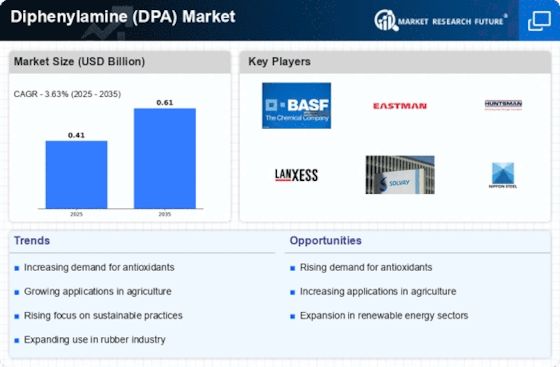
As per Market Research Future analysis, the Diphenylamine Market Size was estimated at 0.41 USD Billion in 2024. The Diphenylamine industry is projected to grow from USD 0.4249 Billion in 2025 to USD 0.607 Billion by 2035, exhibiting a compound annual growth rate (CAGR) of 3.63% during the forecast period 2025 - 2035

Key Market Trends & Highlights

The Diphenylamine Market is experiencing robust growth driven by diverse applications and technological advancements.

  • The North American region remains the largest market for Diphenylamine Market, reflecting strong demand across various sectors. Asia-Pacific is identified as the fastest-growing region, propelled by increasing industrial activities and agricultural applications. In the market segments, Chemical Intermediates dominate, while Antioxidants are emerging as the fastest-growing segment due to rising product quality awareness. Key market drivers include increasing demand in the automotive sector and sustainability trends influencing production practices.

Market Size & Forecast

2024 Market Size 0.41 (USD Billion)
2035 Market Size 0.607 (USD Billion)
CAGR (2025 - 2035) 3.63%
Largest Regional Market Share in 2024 North America

Major Players

BASF SE (DE), Eastman Chemical Company (US), Huntsman Corporation (US), Lanxess AG (DE), Solvay SA (BE), Nippon Steel Corporation (JP), Kraton Corporation (US), Shandong Yanggu Huatai Chemical Co., Ltd. (CN)

Market Trends

The Diphenylamine Market is currently experiencing notable shifts driven by various factors. The increasing demand for DPA in the agricultural sector, particularly as a pesticide and fungicide, appears to be a primary catalyst for market growth. Additionally, the rising awareness regarding the benefits of DPA in enhancing the stability and performance of rubber and plastics is influencing manufacturers to incorporate this compound into their formulations. Furthermore, the ongoing advancements in chemical processing technologies may lead to more efficient production methods, potentially reducing costs and increasing accessibility to end-users. Moreover, regulatory frameworks surrounding chemical usage are evolving, which could impact the Diphenylamine Market . Stricter environmental regulations may necessitate the development of more sustainable alternatives, prompting companies to innovate and adapt. This dynamic landscape suggests that while opportunities for growth exist, challenges related to compliance and sustainability will also shape the future of the market. As stakeholders navigate these complexities, the focus on research and development is likely to intensify, fostering a competitive environment that could redefine market strategies in the coming years.

Growing Agricultural Applications

The demand for Diphenylamine Market (DPA) in agriculture is on the rise, primarily due to its effectiveness as a pesticide and fungicide. This trend indicates a shift towards utilizing chemical compounds that enhance crop protection and yield.

Advancements in Chemical Processing

Innovations in chemical processing technologies are likely to improve the production efficiency of Diphenylamine Market (DPA). This trend may lead to reduced manufacturing costs and increased availability for various applications.

Regulatory Influences on Market Dynamics

Evolving regulatory frameworks concerning chemical usage could significantly impact the Diphenylamine Market . Stricter environmental regulations may drive the need for sustainable alternatives, influencing market strategies.

Diphenylamine Market Market Drivers

Increasing Demand in the Automotive Sector

The Diphenylamine Market is experiencing a notable surge in demand driven by the automotive sector. DPA is utilized as an antioxidant in lubricants and fuels, which are critical for enhancing the performance and longevity of automotive engines. As the automotive industry continues to evolve, with a focus on efficiency and sustainability, the need for high-quality lubricants is paramount. In 2023, the automotive lubricants segment accounted for approximately 30% of the total DPA consumption, indicating a robust market presence. This trend is likely to persist as manufacturers seek to meet stringent emission regulations and improve fuel efficiency, thereby propelling the DPA market further.

Expansion in the Rubber and Plastics Industry

The Diphenylamine Market is significantly influenced by the expansion of the rubber and plastics sector. DPA serves as a crucial antioxidant in the production of rubber, enhancing its durability and resistance to aging. The Diphenylamine Market (DPA) is projected to grow at a compound annual growth rate (CAGR) of around 4% from 2023 to 2028, which bodes well for DPA consumption. Additionally, the plastics industry, which increasingly incorporates DPA to improve product stability, is also on an upward trajectory. This dual demand from both rubber and plastics is likely to bolster the DPA market, as manufacturers strive to enhance product performance and longevity.

Sustainability Trends Driving Market Dynamics

Sustainability trends are increasingly shaping the Diphenylamine Market , as industries seek to reduce their environmental footprint. The push for eco-friendly products is prompting manufacturers to explore sustainable alternatives to traditional antioxidants. However, DPA, with its established efficacy and performance, remains a preferred choice in many applications. The market is witnessing a shift where companies are balancing sustainability with performance, leading to a potential increase in DPA usage in formulations that meet environmental standards. This dual focus on sustainability and performance may create a unique niche for DPA, ensuring its relevance in an evolving market landscape.

Rising Awareness of Product Quality and Safety

In the Diphenylamine Market , there is a growing awareness regarding product quality and safety among consumers and manufacturers alike. As industries become more cognizant of the implications of using subpar materials, the demand for high-quality antioxidants like DPA is expected to rise. This trend is particularly evident in sectors such as food packaging and pharmaceuticals, where the integrity of products is paramount. The increasing regulatory scrutiny surrounding product safety is likely to drive manufacturers to adopt DPA as a reliable solution, thereby enhancing its market presence. This shift towards quality assurance may lead to a more robust DPA market, as companies prioritize safety and compliance.

Technological Innovations in Chemical Manufacturing

The Diphenylamine Market is poised for growth due to ongoing technological innovations in chemical manufacturing processes. Advances in production techniques are enabling manufacturers to produce DPA more efficiently and at lower costs. This not only enhances the profitability of DPA production but also makes it more accessible to various industries. Furthermore, innovations in formulation technologies are allowing for the development of new applications for DPA, particularly in specialty chemicals. As these technologies continue to evolve, they are likely to create new opportunities for DPA, expanding its market reach and applications across diverse sectors.

Market Segment Insights

By Application: Chemical Intermediates (Largest) vs. Antioxidants (Fastest-Growing)

<p>In the Diphenylamine (DPA) market, the application segment is predominantly led by chemical intermediates. This category constitutes the largest share due to its extensive use in the production of dyes, rubber, and other essential chemicals. Following closely, antioxidants are experiencing a rapid upward trajectory as industries increasingly emphasize the importance of prolonging product life and enhancing performance by integrating antioxidants into their formulations. Fungicides and other applications hold smaller shares but contribute uniquely to niche markets within the sector.</p>

<p>Chemical Intermediates (Dominant) vs. Antioxidants (Emerging)</p>

<p>Chemical intermediates remain the dominant application for Diphenylamine, primarily due to their critical role in synthesizing various industrial chemicals. These intermediates serve as precursors in the manufacture of products across multiple sectors, including agrochemicals and pharmaceuticals. On the other hand, antioxidants are emerging as a significant player in the DPA market, driven by their growing application in food preservation, cosmetics, and plastics. The demand for antioxidants is further supported by a global trend towards sustainability, pushing for products that not only offer stability but also meet safety regulations. As consumers become more health-conscious, the emphasis on antioxidants in various industries is likely to keep growing.</p>

By End-Use Industry: Personal Care (Largest) vs. Automotive and Agriculture (Fastest-Growing)

<p>In the Diphenylamine (DPA) Market, the end-use industry segment displays a diverse distribution of applications, with Personal Care holding a significant share due to its widespread use in skincare products and sunscreens. This segment is notably driven by increasing consumer awareness about personal health and wellness, leading to greater investments in personal care formulations. Meanwhile, Automotive and Agriculture is emerging as the fastest-growing segment, driven by the need for advanced materials in automotive applications and the rising demand for crop protection solutions, where DPA is utilized as a chemical additive.</p>

<p>Personal Care (Dominant) vs. Automotive and Agriculture (Emerging)</p>

<p>The Personal Care segment is currently a dominant player within the DPA market, benefiting from a loyal consumer base that values the effectiveness of DPA in enhancing product stability and performance. This segment sees extensive use in anti-aging creams and moisturizers, where its antioxidant properties are crucial. Conversely, the Automotive and Agriculture segment is rapidly emerging, primarily fueled by advancements in automotive technology and the heightened global focus on sustainable agricultural practices. As manufacturers seek effective solutions for enhanced performance and reduced environmental impact, DPA's role in these industries is expected to expand, fostering innovation and attracting investment.</p>

Get more detailed insights about Diphenylamine Research Report - Global Forecast till 2035

Regional Insights

North America : Innovation and Demand Growth

North America is the largest market for Diphenylamine Market (DPA), holding approximately 40% of the global market share. The region's growth is driven by increasing demand in the agricultural sector, particularly in crop protection products. Regulatory support for sustainable agricultural practices further fuels this demand, alongside advancements in chemical manufacturing technologies. The U.S. leads the market, followed by Canada, which contributes significantly to the overall growth.

Europe : Regulatory Framework and Innovation

Europe is the second-largest market for Diphenylamine Market, accounting for around 30% of the global share. The region's growth is propelled by stringent regulations promoting the use of safer chemicals in agriculture and industrial applications. Countries like Germany and France are at the forefront, with robust agricultural sectors driving demand. The European market is characterized by a strong emphasis on sustainability and innovation, leading to increased investments in R&D.

Asia-Pacific : Emerging Market Potential

Asia-Pacific is witnessing rapid growth in the Diphenylamine Market, driven by increasing agricultural activities and industrial applications. The region holds about 25% of the global market share, with China and India being the leading countries. The demand for DPA in these countries is bolstered by the rising need for effective crop protection solutions. Additionally, favorable government policies and investments in agricultural technology are enhancing market prospects.

Middle East and Africa : Resource-Rich Opportunities

The Middle East and Africa region is gradually emerging in the Diphenylamine Market, holding approximately 5% of the global share. The growth is primarily driven by increasing agricultural practices and the need for effective pest control solutions. Countries like South Africa and the UAE are leading the market, supported by government initiatives to boost agricultural productivity. However, challenges such as regulatory hurdles and market access remain.

Key Players and Competitive Insights

Leading market players are investing heavily in R&D in order to expand their product lines, which will help the diphenylamine , grow even more. Market participants are also undertaking a variety of strategic activities to expand their footprint, with important market developments including new product launches, contractual agreements, mergers and acquisitions, higher investments, and collaboration with other organizations. To expand and survive in a more competitive and rising market climate, diphenylamine (DPA)industry must offer cost-effective items. Manufacturing locally to minimize operational costs is one of the key business tactics used by manufacturers in the diphenylamine (DPA) industry to benefit clients and increase the market sector. In recent years, the diphenylamine (DPA) industry has offered some of the most significant advantages to medicine. Major players in the diphenylamine , including Eastman Chemical Company (US), Duslo a.s. (Slovakia), SONGWON (South Korea), Nantong Xinbang Chemical Technology Chemical Co, Ltd (China) and others, are attempting to increase market demand by investing in R&D operations. Kumho Petrochemical Co., Ltd. is a South Korean multinational chemical corporation headquartered in Seoul. It was established in 1970 as a result of Kumho Group's inability to source raw materials for its bus and tire businesses. Kumho Petrochemical leads the market in the production of synthetic rubbers, with the world's highest production capacity based on SBR and BR according to IISRP 2012. As its core business, it concentrates on synthetic rubbers, synthetic resins, speciality chemicals, electronic chemicals, energy, construction materials, and advanced materials. Forbes rated Kumho Petrochemical 1806th among 'the 2000' in 2011. It became a component of the KOSPI 100 index, which monitors 100 significant businesses listed on the Korea Stock Exchange. in August 2021, Kumho Petrochemical has announced the usage of environmentally friendly basilica derived from rice bran in its high-performance synthetic rubbers, including S-SBR. Lanxess AG is a German specialty chemicals firm headquartered in Cologne, Germany. It was created in 2004 following the spin-off of Bayer AG's chemicals division and sections of its polymers business. The company's origins may be traced back to 1863, the year Bayer AG was founded. As part of a major restructuring, the Bayer Group chose to spin off big parts of its chemical activities and roughly one-third of its polymer business into an independent company in November 2003. Lanxess AG shares were listed in Germany's DAX from September 24, 2012 to September 21, 2015, and are now part of the MDAX, a midcap index. The Dow Jones Sustainability Index and the FTSE4Good Index both include the company. April 2019, LANXESS, a market player, has acquired Chemtura Corporation, a well-known company noted for its DPA production levels. LANXESS is also expanding its market dominance by entering the organometallics and additives industries.

Key Companies in the Diphenylamine Market include

Industry Developments

In August 2021, Kumho Petrochemical has announced the usage of environmentally friendly biosilica derived from rice bran in its high-performance synthetic rubbers, including S-SBR.

In October 2021, GRI, an Indian tyre manufacturer, has announced the release of the Ultimate Green XT, a solid material handling tyre that is environmentally friendly. The latest GRI tyre, constructed of pure natural rubber and silica, is designed to improve energy economy by having a 20.4% lower rolling resistance than currently available tyres.

In August 2020, SONGNOX L670 was introduced by notable player SONGWON. It is expected that SONGNOX L670 will be used in conjunction with SONGNOX L135 to stabilize autos, engines, gear oils, and greases.

Future Outlook

Diphenylamine Market Future Outlook

The Diphenylamine Market is projected to grow at 3.63% CAGR from 2025 to 2035, driven by increasing demand in agriculture and automotive sectors.

New opportunities lie in:

  • <p>Expansion into emerging markets with tailored DPA formulations. Development of eco-friendly DPA alternatives to meet regulatory demands. Strategic partnerships with agricultural firms for integrated pest management solutions.</p>

By 2035, the Diphenylamine Market is expected to solidify its position as a key player in specialty chemicals.

Market Segmentation

Diphenylamine Market Application Outlook

  • Chemical Intermediates
  • Antioxidants
  • Fungicides
  • Others

Diphenylamine Market End-Use Industry Outlook

  • Personal Care
  • Automotive and Agriculture
  • Cosmetics
  • Rubber
  • Plastics Industry

Report Scope

MARKET SIZE 2024 0.41(USD Billion)
MARKET SIZE 2025 0.4249(USD Billion)
MARKET SIZE 2035 0.607(USD Billion)
COMPOUND ANNUAL GROWTH RATE (CAGR) 3.63% (2025 - 2035)
REPORT COVERAGE Revenue Forecast, Competitive Landscape, Growth Factors, and Trends
BASE YEAR 2024
Market Forecast Period 2025 - 2035
Historical Data 2019 - 2024
Market Forecast Units USD Billion
Key Companies Profiled BASF SE (DE), Eastman Chemical Company (US), Huntsman Corporation (US), Lanxess AG (DE), Solvay SA (BE), Nippon Steel Corporation (JP), Kraton Corporation (US), Shandong Yanggu Huatai Chemical Co., Ltd. (CN)
Segments Covered Application, End-Use Industry, Region
Key Market Opportunities Growing demand for antioxidants in various industries enhances opportunities in the Diphenylamine (Market.
Key Market Dynamics Rising demand for antioxidants in various industries drives growth in the Diphenylamine market.
Countries Covered North America, Europe, APAC, South America, MEA

FAQs

What is the projected market valuation of the Diphenylamine (DPA) market by 2035?

<p>The projected market valuation of the Diphenylamine (DPA) market is expected to reach 0.607 USD Billion by 2035.</p>

What was the market valuation of the Diphenylamine (DPA) market in 2024?

<p>The market valuation of the Diphenylamine (DPA) market was 0.41 USD Billion in 2024.</p>

What is the expected CAGR for the Diphenylamine (DPA) market during the forecast period 2025 - 2035?

<p>The expected CAGR for the Diphenylamine (DPA) market during the forecast period 2025 - 2035 is 3.63%.</p>

Which companies are considered key players in the Diphenylamine (DPA) market?

<p>Key players in the Diphenylamine (DPA) market include BASF SE, Eastman Chemical Company, Huntsman Corporation, and others.</p>

What are the main application segments of the Diphenylamine (DPA) market?

<p>The main application segments of the Diphenylamine (DPA) market include Chemical Intermediates, Antioxidants, Fungicides, and Others.</p>

What was the valuation of the Chemical Intermediates segment in 2024?

<p>The valuation of the Chemical Intermediates segment in 2024 was 0.15 USD Billion.</p>

How does the Automotive and Agriculture end-use industry segment perform in the Diphenylamine (DPA) market?

The Automotive and Agriculture end-use industry segment was valued at 0.12 USD Billion in 2024 and is expected to grow.

What is the projected growth for the Antioxidants segment in the Diphenylamine (DPA) market by 2035?

The Antioxidants segment is projected to grow from 0.12 USD Billion in 2024 to 0.18 USD Billion by 2035.

What role does Lanxess AG play in the Diphenylamine (DPA) market?

Lanxess AG is one of the key players contributing to the development and growth of the Diphenylamine (DPA) market.

What is the expected valuation of the Rubber end-use industry segment by 2035?

The expected valuation of the Rubber end-use industry segment is projected to increase from 0.05 USD Billion in 2024 to 0.08 USD Billion by 2035.

  1. SECTION I: EXECUTIVE SUMMARY AND KEY HIGHLIGHTS
    1. | 1.1 EXECUTIVE SUMMARY
    2. | | 1.1.1 Market Overview
    3. | | 1.1.2 Key Findings
    4. | | 1.1.3 Market Segmentation
    5. | | 1.1.4 Competitive Landscape
    6. | | 1.1.5 Challenges and Opportunities
    7. | | 1.1.6 Future Outlook
  2. SECTION II: SCOPING, METHODOLOGY AND MARKET STRUCTURE
    1. | 2.1 MARKET INTRODUCTION
    2. | | 2.1.1 Definition
    3. | | 2.1.2 Scope of the study
    4. | | | 2.1.2.1 Research Objective
    5. | | | 2.1.2.2 Assumption
    6. | | | 2.1.2.3 Limitations
    7. | 2.2 RESEARCH METHODOLOGY
    8. | | 2.2.1 Overview
    9. | | 2.2.2 Data Mining
    10. | | 2.2.3 Secondary Research
    11. | | 2.2.4 Primary Research
    12. | | | 2.2.4.1 Primary Interviews and Information Gathering Process
    13. | | | 2.2.4.2 Breakdown of Primary Respondents
    14. | | 2.2.5 Forecasting Model
    15. | | 2.2.6 Market Size Estimation
    16. | | | 2.2.6.1 Bottom-Up Approach
    17. | | | 2.2.6.2 Top-Down Approach
    18. | | 2.2.7 Data Triangulation
    19. | | 2.2.8 Validation
  3. SECTION III: QUALITATIVE ANALYSIS
    1. | 3.1 MARKET DYNAMICS
    2. | | 3.1.1 Overview
    3. | | 3.1.2 Drivers
    4. | | 3.1.3 Restraints
    5. | | 3.1.4 Opportunities
    6. | 3.2 MARKET FACTOR ANALYSIS
    7. | | 3.2.1 Value chain Analysis
    8. | | 3.2.2 Porter's Five Forces Analysis
    9. | | | 3.2.2.1 Bargaining Power of Suppliers
    10. | | | 3.2.2.2 Bargaining Power of Buyers
    11. | | | 3.2.2.3 Threat of New Entrants
    12. | | | 3.2.2.4 Threat of Substitutes
    13. | | | 3.2.2.5 Intensity of Rivalry
    14. | | 3.2.3 COVID-19 Impact Analysis
    15. | | | 3.2.3.1 Market Impact Analysis
    16. | | | 3.2.3.2 Regional Impact
    17. | | | 3.2.3.3 Opportunity and Threat Analysis
  4. SECTION IV: QUANTITATIVE ANALYSIS
    1. | 4.1 Chemicals and Materials, BY Application (USD Billion)
    2. | | 4.1.1 Chemical Intermediates
    3. | | 4.1.2 Antioxidants
    4. | | 4.1.3 Fungicides
    5. | | 4.1.4 Others
    6. | 4.2 Chemicals and Materials, BY End-Use Industry (USD Billion)
    7. | | 4.2.1 Personal Care
    8. | | 4.2.2 Automotive and Agriculture
    9. | | 4.2.3 Cosmetics
    10. | | 4.2.4 Rubber
    11. | | 4.2.5 Plastics Industry
    12. | 4.3 Chemicals and Materials, BY Region (USD Billion)
    13. | | 4.3.1 North America
    14. | | | 4.3.1.1 US
    15. | | | 4.3.1.2 Canada
    16. | | 4.3.2 Europe
    17. | | | 4.3.2.1 Germany
    18. | | | 4.3.2.2 UK
    19. | | | 4.3.2.3 France
    20. | | | 4.3.2.4 Russia
    21. | | | 4.3.2.5 Italy
    22. | | | 4.3.2.6 Spain
    23. | | | 4.3.2.7 Rest of Europe
    24. | | 4.3.3 APAC
    25. | | | 4.3.3.1 China
    26. | | | 4.3.3.2 India
    27. | | | 4.3.3.3 Japan
    28. | | | 4.3.3.4 South Korea
    29. | | | 4.3.3.5 Malaysia
    30. | | | 4.3.3.6 Thailand
    31. | | | 4.3.3.7 Indonesia
    32. | | | 4.3.3.8 Rest of APAC
    33. | | 4.3.4 South America
    34. | | | 4.3.4.1 Brazil
    35. | | | 4.3.4.2 Mexico
    36. | | | 4.3.4.3 Argentina
    37. | | | 4.3.4.4 Rest of South America
    38. | | 4.3.5 MEA
    39. | | | 4.3.5.1 GCC Countries
    40. | | | 4.3.5.2 South Africa
    41. | | | 4.3.5.3 Rest of MEA
  5. SECTION V: COMPETITIVE ANALYSIS
    1. | 5.1 Competitive Landscape
    2. | | 5.1.1 Overview
    3. | | 5.1.2 Competitive Analysis
    4. | | 5.1.3 Market share Analysis
    5. | | 5.1.4 Major Growth Strategy in the Chemicals and Materials
    6. | | 5.1.5 Competitive Benchmarking
    7. | | 5.1.6 Leading Players in Terms of Number of Developments in the Chemicals and Materials
    8. | | 5.1.7 Key developments and growth strategies
    9. | | | 5.1.7.1 New Product Launch/Service Deployment
    10. | | | 5.1.7.2 Merger & Acquisitions
    11. | | | 5.1.7.3 Joint Ventures
    12. | | 5.1.8 Major Players Financial Matrix
    13. | | | 5.1.8.1 Sales and Operating Income
    14. | | | 5.1.8.2 Major Players R&D Expenditure. 2023
    15. | 5.2 Company Profiles
    16. | | 5.2.1 BASF SE (DE)
    17. | | | 5.2.1.1 Financial Overview
    18. | | | 5.2.1.2 Products Offered
    19. | | | 5.2.1.3 Key Developments
    20. | | | 5.2.1.4 SWOT Analysis
    21. | | | 5.2.1.5 Key Strategies
    22. | | 5.2.2 Eastman Chemical Company (US)
    23. | | | 5.2.2.1 Financial Overview
    24. | | | 5.2.2.2 Products Offered
    25. | | | 5.2.2.3 Key Developments
    26. | | | 5.2.2.4 SWOT Analysis
    27. | | | 5.2.2.5 Key Strategies
    28. | | 5.2.3 Huntsman Corporation (US)
    29. | | | 5.2.3.1 Financial Overview
    30. | | | 5.2.3.2 Products Offered
    31. | | | 5.2.3.3 Key Developments
    32. | | | 5.2.3.4 SWOT Analysis
    33. | | | 5.2.3.5 Key Strategies
    34. | | 5.2.4 Lanxess AG (DE)
    35. | | | 5.2.4.1 Financial Overview
    36. | | | 5.2.4.2 Products Offered
    37. | | | 5.2.4.3 Key Developments
    38. | | | 5.2.4.4 SWOT Analysis
    39. | | | 5.2.4.5 Key Strategies
    40. | | 5.2.5 Solvay SA (BE)
    41. | | | 5.2.5.1 Financial Overview
    42. | | | 5.2.5.2 Products Offered
    43. | | | 5.2.5.3 Key Developments
    44. | | | 5.2.5.4 SWOT Analysis
    45. | | | 5.2.5.5 Key Strategies
    46. | | 5.2.6 Nippon Steel Corporation (JP)
    47. | | | 5.2.6.1 Financial Overview
    48. | | | 5.2.6.2 Products Offered
    49. | | | 5.2.6.3 Key Developments
    50. | | | 5.2.6.4 SWOT Analysis
    51. | | | 5.2.6.5 Key Strategies
    52. | | 5.2.7 Kraton Corporation (US)
    53. | | | 5.2.7.1 Financial Overview
    54. | | | 5.2.7.2 Products Offered
    55. | | | 5.2.7.3 Key Developments
    56. | | | 5.2.7.4 SWOT Analysis
    57. | | | 5.2.7.5 Key Strategies
    58. | | 5.2.8 Shandong Yanggu Huatai Chemical Co., Ltd. (CN)
    59. | | | 5.2.8.1 Financial Overview
    60. | | | 5.2.8.2 Products Offered
    61. | | | 5.2.8.3 Key Developments
    62. | | | 5.2.8.4 SWOT Analysis
    63. | | | 5.2.8.5 Key Strategies
    64. | 5.3 Appendix
    65. | | 5.3.1 References
    66. | | 5.3.2 Related Reports
  6. LIST OF FIGURES
    1. | 6.1 MARKET SYNOPSIS
    2. | 6.2 NORTH AMERICA MARKET ANALYSIS
    3. | 6.3 US MARKET ANALYSIS BY APPLICATION
    4. | 6.4 US MARKET ANALYSIS BY END-USE INDUSTRY
    5. | 6.5 CANADA MARKET ANALYSIS BY APPLICATION
    6. | 6.6 CANADA MARKET ANALYSIS BY END-USE INDUSTRY
    7. | 6.7 EUROPE MARKET ANALYSIS
    8. | 6.8 GERMANY MARKET ANALYSIS BY APPLICATION
    9. | 6.9 GERMANY MARKET ANALYSIS BY END-USE INDUSTRY
    10. | 6.10 UK MARKET ANALYSIS BY APPLICATION
    11. | 6.11 UK MARKET ANALYSIS BY END-USE INDUSTRY
    12. | 6.12 FRANCE MARKET ANALYSIS BY APPLICATION
    13. | 6.13 FRANCE MARKET ANALYSIS BY END-USE INDUSTRY
    14. | 6.14 RUSSIA MARKET ANALYSIS BY APPLICATION
    15. | 6.15 RUSSIA MARKET ANALYSIS BY END-USE INDUSTRY
    16. | 6.16 ITALY MARKET ANALYSIS BY APPLICATION
    17. | 6.17 ITALY MARKET ANALYSIS BY END-USE INDUSTRY
    18. | 6.18 SPAIN MARKET ANALYSIS BY APPLICATION
    19. | 6.19 SPAIN MARKET ANALYSIS BY END-USE INDUSTRY
    20. | 6.20 REST OF EUROPE MARKET ANALYSIS BY APPLICATION
    21. | 6.21 REST OF EUROPE MARKET ANALYSIS BY END-USE INDUSTRY
    22. | 6.22 APAC MARKET ANALYSIS
    23. | 6.23 CHINA MARKET ANALYSIS BY APPLICATION
    24. | 6.24 CHINA MARKET ANALYSIS BY END-USE INDUSTRY
    25. | 6.25 INDIA MARKET ANALYSIS BY APPLICATION
    26. | 6.26 INDIA MARKET ANALYSIS BY END-USE INDUSTRY
    27. | 6.27 JAPAN MARKET ANALYSIS BY APPLICATION
    28. | 6.28 JAPAN MARKET ANALYSIS BY END-USE INDUSTRY
    29. | 6.29 SOUTH KOREA MARKET ANALYSIS BY APPLICATION
    30. | 6.30 SOUTH KOREA MARKET ANALYSIS BY END-USE INDUSTRY
    31. | 6.31 MALAYSIA MARKET ANALYSIS BY APPLICATION
    32. | 6.32 MALAYSIA MARKET ANALYSIS BY END-USE INDUSTRY
    33. | 6.33 THAILAND MARKET ANALYSIS BY APPLICATION
    34. | 6.34 THAILAND MARKET ANALYSIS BY END-USE INDUSTRY
    35. | 6.35 INDONESIA MARKET ANALYSIS BY APPLICATION
    36. | 6.36 INDONESIA MARKET ANALYSIS BY END-USE INDUSTRY
    37. | 6.37 REST OF APAC MARKET ANALYSIS BY APPLICATION
    38. | 6.38 REST OF APAC MARKET ANALYSIS BY END-USE INDUSTRY
    39. | 6.39 SOUTH AMERICA MARKET ANALYSIS
    40. | 6.40 BRAZIL MARKET ANALYSIS BY APPLICATION
    41. | 6.41 BRAZIL MARKET ANALYSIS BY END-USE INDUSTRY
    42. | 6.42 MEXICO MARKET ANALYSIS BY APPLICATION
    43. | 6.43 MEXICO MARKET ANALYSIS BY END-USE INDUSTRY
    44. | 6.44 ARGENTINA MARKET ANALYSIS BY APPLICATION
    45. | 6.45 ARGENTINA MARKET ANALYSIS BY END-USE INDUSTRY
    46. | 6.46 REST OF SOUTH AMERICA MARKET ANALYSIS BY APPLICATION
    47. | 6.47 REST OF SOUTH AMERICA MARKET ANALYSIS BY END-USE INDUSTRY
    48. | 6.48 MEA MARKET ANALYSIS
    49. | 6.49 GCC COUNTRIES MARKET ANALYSIS BY APPLICATION
    50. | 6.50 GCC COUNTRIES MARKET ANALYSIS BY END-USE INDUSTRY
    51. | 6.51 SOUTH AFRICA MARKET ANALYSIS BY APPLICATION
    52. | 6.52 SOUTH AFRICA MARKET ANALYSIS BY END-USE INDUSTRY
    53. | 6.53 REST OF MEA MARKET ANALYSIS BY APPLICATION
    54. | 6.54 REST OF MEA MARKET ANALYSIS BY END-USE INDUSTRY
    55. | 6.55 KEY BUYING CRITERIA OF CHEMICALS AND MATERIALS
    56. | 6.56 RESEARCH PROCESS OF MRFR
    57. | 6.57 DRO ANALYSIS OF CHEMICALS AND MATERIALS
    58. | 6.58 DRIVERS IMPACT ANALYSIS: CHEMICALS AND MATERIALS
    59. | 6.59 RESTRAINTS IMPACT ANALYSIS: CHEMICALS AND MATERIALS
    60. | 6.60 SUPPLY / VALUE CHAIN: CHEMICALS AND MATERIALS
    61. | 6.61 CHEMICALS AND MATERIALS, BY APPLICATION, 2024 (% SHARE)
    62. | 6.62 CHEMICALS AND MATERIALS, BY APPLICATION, 2024 TO 2035 (USD Billion)
    63. | 6.63 CHEMICALS AND MATERIALS, BY END-USE INDUSTRY, 2024 (% SHARE)
    64. | 6.64 CHEMICALS AND MATERIALS, BY END-USE INDUSTRY, 2024 TO 2035 (USD Billion)
    65. | 6.65 BENCHMARKING OF MAJOR COMPETITORS
  7. LIST OF TABLES
    1. | 7.1 LIST OF ASSUMPTIONS
    2. | | 7.1.1
    3. | 7.2 North America MARKET SIZE ESTIMATES; FORECAST
    4. | | 7.2.1 BY APPLICATION, 2025-2035 (USD Billion)
    5. | | 7.2.2 BY END-USE INDUSTRY, 2025-2035 (USD Billion)
    6. | 7.3 US MARKET SIZE ESTIMATES; FORECAST
    7. | | 7.3.1 BY APPLICATION, 2025-2035 (USD Billion)
    8. | | 7.3.2 BY END-USE INDUSTRY, 2025-2035 (USD Billion)
    9. | 7.4 Canada MARKET SIZE ESTIMATES; FORECAST
    10. | | 7.4.1 BY APPLICATION, 2025-2035 (USD Billion)
    11. | | 7.4.2 BY END-USE INDUSTRY, 2025-2035 (USD Billion)
    12. | 7.5 Europe MARKET SIZE ESTIMATES; FORECAST
    13. | | 7.5.1 BY APPLICATION, 2025-2035 (USD Billion)
    14. | | 7.5.2 BY END-USE INDUSTRY, 2025-2035 (USD Billion)
    15. | 7.6 Germany MARKET SIZE ESTIMATES; FORECAST
    16. | | 7.6.1 BY APPLICATION, 2025-2035 (USD Billion)
    17. | | 7.6.2 BY END-USE INDUSTRY, 2025-2035 (USD Billion)
    18. | 7.7 UK MARKET SIZE ESTIMATES; FORECAST
    19. | | 7.7.1 BY APPLICATION, 2025-2035 (USD Billion)
    20. | | 7.7.2 BY END-USE INDUSTRY, 2025-2035 (USD Billion)
    21. | 7.8 France MARKET SIZE ESTIMATES; FORECAST
    22. | | 7.8.1 BY APPLICATION, 2025-2035 (USD Billion)
    23. | | 7.8.2 BY END-USE INDUSTRY, 2025-2035 (USD Billion)
    24. | 7.9 Russia MARKET SIZE ESTIMATES; FORECAST
    25. | | 7.9.1 BY APPLICATION, 2025-2035 (USD Billion)
    26. | | 7.9.2 BY END-USE INDUSTRY, 2025-2035 (USD Billion)
    27. | 7.10 Italy MARKET SIZE ESTIMATES; FORECAST
    28. | | 7.10.1 BY APPLICATION, 2025-2035 (USD Billion)
    29. | | 7.10.2 BY END-USE INDUSTRY, 2025-2035 (USD Billion)
    30. | 7.11 Spain MARKET SIZE ESTIMATES; FORECAST
    31. | | 7.11.1 BY APPLICATION, 2025-2035 (USD Billion)
    32. | | 7.11.2 BY END-USE INDUSTRY, 2025-2035 (USD Billion)
    33. | 7.12 Rest of Europe MARKET SIZE ESTIMATES; FORECAST
    34. | | 7.12.1 BY APPLICATION, 2025-2035 (USD Billion)
    35. | | 7.12.2 BY END-USE INDUSTRY, 2025-2035 (USD Billion)
    36. | 7.13 APAC MARKET SIZE ESTIMATES; FORECAST
    37. | | 7.13.1 BY APPLICATION, 2025-2035 (USD Billion)
    38. | | 7.13.2 BY END-USE INDUSTRY, 2025-2035 (USD Billion)
    39. | 7.14 China MARKET SIZE ESTIMATES; FORECAST
    40. | | 7.14.1 BY APPLICATION, 2025-2035 (USD Billion)
    41. | | 7.14.2 BY END-USE INDUSTRY, 2025-2035 (USD Billion)
    42. | 7.15 India MARKET SIZE ESTIMATES; FORECAST
    43. | | 7.15.1 BY APPLICATION, 2025-2035 (USD Billion)
    44. | | 7.15.2 BY END-USE INDUSTRY, 2025-2035 (USD Billion)
    45. | 7.16 Japan MARKET SIZE ESTIMATES; FORECAST
    46. | | 7.16.1 BY APPLICATION, 2025-2035 (USD Billion)
    47. | | 7.16.2 BY END-USE INDUSTRY, 2025-2035 (USD Billion)
    48. | 7.17 South Korea MARKET SIZE ESTIMATES; FORECAST
    49. | | 7.17.1 BY APPLICATION, 2025-2035 (USD Billion)
    50. | | 7.17.2 BY END-USE INDUSTRY, 2025-2035 (USD Billion)
    51. | 7.18 Malaysia MARKET SIZE ESTIMATES; FORECAST
    52. | | 7.18.1 BY APPLICATION, 2025-2035 (USD Billion)
    53. | | 7.18.2 BY END-USE INDUSTRY, 2025-2035 (USD Billion)
    54. | 7.19 Thailand MARKET SIZE ESTIMATES; FORECAST
    55. | | 7.19.1 BY APPLICATION, 2025-2035 (USD Billion)
    56. | | 7.19.2 BY END-USE INDUSTRY, 2025-2035 (USD Billion)
    57. | 7.20 Indonesia MARKET SIZE ESTIMATES; FORECAST
    58. | | 7.20.1 BY APPLICATION, 2025-2035 (USD Billion)
    59. | | 7.20.2 BY END-USE INDUSTRY, 2025-2035 (USD Billion)
    60. | 7.21 Rest of APAC MARKET SIZE ESTIMATES; FORECAST
    61. | | 7.21.1 BY APPLICATION, 2025-2035 (USD Billion)
    62. | | 7.21.2 BY END-USE INDUSTRY, 2025-2035 (USD Billion)
    63. | 7.22 South America MARKET SIZE ESTIMATES; FORECAST
    64. | | 7.22.1 BY APPLICATION, 2025-2035 (USD Billion)
    65. | | 7.22.2 BY END-USE INDUSTRY, 2025-2035 (USD Billion)
    66. | 7.23 Brazil MARKET SIZE ESTIMATES; FORECAST
    67. | | 7.23.1 BY APPLICATION, 2025-2035 (USD Billion)
    68. | | 7.23.2 BY END-USE INDUSTRY, 2025-2035 (USD Billion)
    69. | 7.24 Mexico MARKET SIZE ESTIMATES; FORECAST
    70. | | 7.24.1 BY APPLICATION, 2025-2035 (USD Billion)
    71. | | 7.24.2 BY END-USE INDUSTRY, 2025-2035 (USD Billion)
    72. | 7.25 Argentina MARKET SIZE ESTIMATES; FORECAST
    73. | | 7.25.1 BY APPLICATION, 2025-2035 (USD Billion)
    74. | | 7.25.2 BY END-USE INDUSTRY, 2025-2035 (USD Billion)
    75. | 7.26 Rest of South America MARKET SIZE ESTIMATES; FORECAST
    76. | | 7.26.1 BY APPLICATION, 2025-2035 (USD Billion)
    77. | | 7.26.2 BY END-USE INDUSTRY, 2025-2035 (USD Billion)
    78. | 7.27 MEA MARKET SIZE ESTIMATES; FORECAST
    79. | | 7.27.1 BY APPLICATION, 2025-2035 (USD Billion)
    80. | | 7.27.2 BY END-USE INDUSTRY, 2025-2035 (USD Billion)
    81. | 7.28 GCC Countries MARKET SIZE ESTIMATES; FORECAST
    82. | | 7.28.1 BY APPLICATION, 2025-2035 (USD Billion)
    83. | | 7.28.2 BY END-USE INDUSTRY, 2025-2035 (USD Billion)
    84. | 7.29 South Africa MARKET SIZE ESTIMATES; FORECAST
    85. | | 7.29.1 BY APPLICATION, 2025-2035 (USD Billion)
    86. | | 7.29.2 BY END-USE INDUSTRY, 2025-2035 (USD Billion)
    87. | 7.30 Rest of MEA MARKET SIZE ESTIMATES; FORECAST
    88. | | 7.30.1 BY APPLICATION, 2025-2035 (USD Billion)
    89. | | 7.30.2 BY END-USE INDUSTRY, 2025-2035 (USD Billion)
    90. | 7.31 PRODUCT LAUNCH/PRODUCT DEVELOPMENT/APPROVAL
    91. | | 7.31.1
    92. | 7.32 ACQUISITION/PARTNERSHIP
    93. | | 7.32.1

Chemicals and Materials Market Segmentation

Chemicals and Materials By Application (USD Billion, 2025-2035)

  • Chemical Intermediates
  • Antioxidants
  • Fungicides
  • Others

Chemicals and Materials By End-Use Industry (USD Billion, 2025-2035)

  • Personal Care
  • Automotive and Agriculture
  • Cosmetics
  • Rubber
  • Plastics Industry
Infographic

Free Sample Request

Kindly complete the form below to receive a free sample of this Report

Get Free Sample

Customer Strories

Compare Licence

×
Features License Type
Single User Multiuser License Enterprise User
Price $4,950 $5,950 $7,250
Maximum User Access Limit 1 User Upto 10 Users Unrestricted Access Throughout the Organization
Free Customization
Direct Access to Analyst
Deliverable Format
Platform Access
Discount on Next Purchase 10% 15% 15%
Printable Versions