×
  • Cat-intel
  • MedIntelliX
  • Resources
  • About Us
  • Hero Background
    English
    Chinese
    French
    Japanese
    Korean
    German
    Spanish

    Dimethyl Ether Market Size

    ID: MRFR/CnM/0303-CR
    111 Pages
    Chitranshi Jaiswal
    February 2021

    Dimethyl Ether Market Research Report Information By Raw Materials (Natural Gas, Coal, Biomass, Others), By Application (Transportation Fuel, Aerosol Propellant, LPG Blending, Others), And By Region (North America, Europe, Asia-Pacific, And Rest Of The World) – Market Forecast Till 2035

    Share:
    Download PDF ×

    We do not share your information with anyone. However, we may send you emails based on your report interest from time to time. You may contact us at any time to opt-out.

    Dimethyl Ether Market Infographic
    Purchase Options

    Dimethyl Ether Size

    Dimethyl Ether Market Growth Projections and Opportunities

    The DME (Dimethyl ether) industry is experiencing substantial growth driven by a confluence of factors such as expanding applications, technological advancements, and escalating demand, particularly in energy-deficient countries. Across the Asia-Pacific region, excluding Japan, there is a significant emphasis on utilizing DME primarily for blending with LPG (Liquefied Petroleum Gas). DME finds widespread application in LPG blending, serving as an aerosol propellant, and functioning as a substitute for diesel. Notably, coal emerges as the primary feedstock for global DME production. Countries endowed with abundant natural gas resources are directing investments toward infrastructure development to position natural gas as an alternative fuel source. As of 2012, the global DME market was estimated at approximately 2,998.2 KT (kilotons). In Scenario I, this volume is anticipated to reach 6,500.6 KT by 2018 and further escalate to 11,390.8 KT by 2023. This growth is projected at a Compound Annual Growth Rate (CAGR) of 14.0% from 2013 to 2018 and 12.9% from 2013 to 2023. The surge in demand, especially for blending with LPG in countries like China, Korea, and Indonesia, is expected to propel the DME market forward. Indonesia, in particular, is anticipated to exhibit the highest CAGR of over 100.0% during the forecast period. The demand for DME as a diesel substitute is anticipated to witness significant growth in Japan and Sweden. Japan's growth is expected to accelerate post-2018, while Sweden is projected to experience notable growth before 2018.

    In Scenario II, efforts to develop the DME market are expected to intensify across various countries, accompanied by sustained high operating rates. Additionally, considerations include the capacity of India and expansion plans for the Egypt plant. With these optimistic assumptions, it is envisaged that DME consumption volume may reach 8,817.0 KT by 2018, growing at a CAGR of 21.1% from 2013 to 2018, and further escalate to 16,316.2 KT by 2023, growing at a CAGR of 17.1% from 2013 to 2023.

    The driving forces behind the industry's growth include an increasing dependence on LPG imports, the presence of rich coal deposits in the Asia-Pacific region, and a growing focus on environmental concerns. However, a significant constraint to market growth is the need for infrastructure alterations. Additionally, the industry faces challenges related to low capacity utilization. To address the demand generated, industry players are adopting strategic approaches such as capacity expansions and collaborations with key stakeholders within the value chain, particularly in key developing countries.
    Dimethyl Ether Market Size Graph
    Author
    Chitranshi Jaiswal
    Research Analyst Level I

    In her 3 years of experience in the market research field, she has handled critical cross-domain projects. She has an in-depth knowledge of market estimation & analysis, problem-solving, primary as well as secondary research, and team management.She holds an engineering degree and is an MBA professional from a well-known university, capable of evaluating the market and competitive conditions. An exceptional strategist with excellent communication skills and a passion for delivering cutting-edge & practical insights for the market. Proficient in multi-tasking, and can successfully deal with competing demands, while maintaining complete confidentiality. Generated business through active client and project development, networking, and high-quality responses. Her knowledge and skills have helped in making solid business decisions, securing funding from investors, and avoiding business failures.

    Leave a Comment

    FAQs

    How much is the Dimethyl Ether market?

    Dimethyl Ether Market size was valued at USD 6.37 Billion in 2024

    What is the growth rate of the Dimethyl Ether market?

    Dimethyl Ether Market is projected to grow at a CAGR of 12.35% during the forecast period, 2025-2035

    Which region held the largest market share in the Dimethyl Ether market?

    Asia Pacific had the largest share of the global Dimethyl Ether (DME) market.

    Who are the key players in the Dimethyl Ether (DME) market?

    The key players in the market are Zagros Petrochemical Company, Oberon Fuels, Jiutai Energy Group, Grillo Werke, Ferrostal, Mitsubishi Corporation, China Energy Limited, Royal Dutch Shell, Nouryon, Air Products, and Chemicals Inc.

    Which Raw Materials led the market of Dimethyl Ether?

    The Natural Gas category dominated the market in 2022.

    Which Application had the largest market share in the market?

    LPG Blending had the largest share in the global market for Dimethyl Ether.

    Market Summary

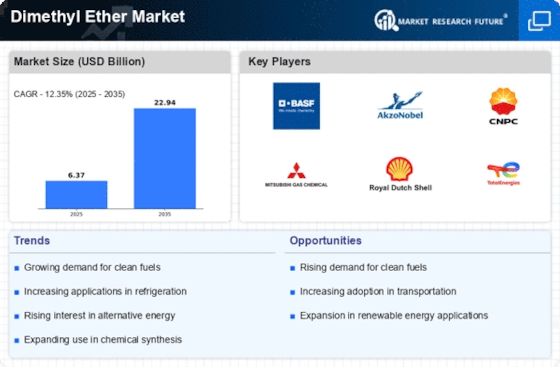
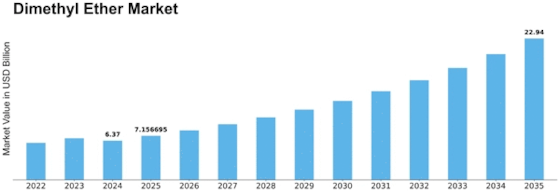
    As per MRFR analysis, the Dimethyl Ether Market Size was estimated at 6.37 USD Billion in 2024. The Dimethyl Ether industry is projected to grow from 7.157 USD Billion in 2025 to 22.94 USD Billion by 2035, exhibiting a compound annual growth rate (CAGR) of 12.35 during the forecast period 2025 - 2035.

    Key Market Trends & Highlights

    The Dimethyl Ether Market is poised for substantial growth driven by clean energy demands and technological advancements.

    • The market experiences rising demand for clean energy solutions, particularly in North America, which remains the largest market.
    • Technological advancements in production processes are enhancing efficiency and reducing costs, fostering market expansion.
    • Dimethyl ether is finding expanding applications across various industries, notably in transportation fuel and aerosol propellant segments.
    • Key market drivers include rising environmental concerns and government initiatives promoting alternative fuels, particularly in the Asia-Pacific region.

    Market Size & Forecast

    2024 Market Size 6.37 (USD Billion)
    2035 Market Size 22.94 (USD Billion)
    CAGR (2025 - 2035) 12.35%
    Largest Regional Market Share in 2024 Asia Pacific

    Major Players

    <p>BASF (DE), AkzoNobel (NL), China National Petroleum Corporation (CN), Mitsubishi Gas Chemical Company (JP), Royal Dutch Shell (NL), TotalEnergies (FR), Yara International (NO), SABIC (SA), Linde (DE)</p>

    Market Trends

    The Dimethyl Ether Market is currently experiencing a notable transformation, driven by a variety of factors that influence its growth trajectory. The increasing demand for cleaner fuels and the push for sustainable energy solutions appear to be at the forefront of this evolution. As industries seek alternatives to traditional fossil fuels, dimethyl ether emerges as a viable candidate due to its low emissions and versatility. Furthermore, advancements in production technologies and the establishment of regulatory frameworks supporting renewable energy sources seem to bolster the market's potential. This shift towards greener alternatives indicates a broader trend within the energy sector, where environmental considerations are becoming paramount. In addition to environmental factors, the Dimethyl Ether Market is also influenced by its applications across various sectors, including transportation, chemicals, and household energy. The versatility of dimethyl ether as a fuel and a feedstock for chemical production suggests that its adoption may continue to expand. Moreover, the growing interest in using dimethyl ether as a substitute for liquefied petroleum gas in domestic applications highlights its potential to penetrate new markets. As the global landscape evolves, the Dimethyl Ether Market appears poised for growth, driven by both regulatory support and increasing consumer awareness regarding sustainable energy solutions.

    Rising Demand for Clean Energy Solutions

    The shift towards cleaner energy sources is a prominent trend in the Dimethyl Ether Market. As governments and industries prioritize sustainability, the demand for dimethyl ether as a low-emission fuel alternative is likely to increase. This trend reflects a broader commitment to reducing carbon footprints and enhancing energy efficiency.

    Technological Advancements in Production

    Innovations in production technologies are shaping the Dimethyl Ether Market. Enhanced methods for synthesizing dimethyl ether from renewable resources may lead to more efficient and cost-effective processes. This trend suggests that the market could see a rise in production capacity and a decrease in overall costs.

    Expanding Applications Across Industries

    The versatility of dimethyl ether is driving its adoption across various sectors. From transportation to chemical manufacturing, its potential applications are broadening. This trend indicates that as industries seek alternatives to conventional fuels, dimethyl ether may find new opportunities for growth.

    Dimethyl Ether Market Market Drivers

    Rising Environmental Concerns

    The increasing awareness regarding environmental issues is driving the Dimethyl Ether Market. As nations strive to reduce greenhouse gas emissions, the demand for cleaner fuels has surged. Dimethyl ether, being a clean-burning alternative to traditional fossil fuels, is gaining traction. It produces fewer pollutants and can be used in various applications, including transportation and power generation. According to recent data, the market for dimethyl ether is projected to grow significantly, with estimates suggesting a compound annual growth rate of over 10% in the coming years. This trend indicates a shift towards sustainable energy solutions, positioning the Dimethyl Ether Market as a key player in the transition to greener alternatives.

    Diverse Applications Across Sectors

    The versatility of dimethyl ether is contributing to its growing presence in various sectors, thereby impacting the Dimethyl Ether Market positively. It is utilized in applications ranging from aerosol propellants to refrigerants and as a fuel for vehicles. The increasing adoption of dimethyl ether in the transportation sector, particularly in heavy-duty vehicles, is noteworthy. Market data indicates that the demand for dimethyl ether as a fuel is expected to rise significantly, with projections estimating a market share increase of over 15% in the next few years. This diversification of applications not only enhances the market's resilience but also opens new avenues for growth.

    Growing Demand for Alternative Fuels

    The shift towards alternative fuels is a major driver for the Dimethyl Ether Market. As consumers and industries seek sustainable energy solutions, dimethyl ether is emerging as a preferred choice due to its clean-burning properties. The transportation sector, in particular, is witnessing a surge in demand for alternative fuels, with dimethyl ether being recognized for its potential to reduce dependency on conventional fossil fuels. Market analysis suggests that the demand for dimethyl ether could increase by approximately 25% over the next five years, driven by both consumer preferences and regulatory pressures. This trend underscores the importance of the Dimethyl Ether Market in the broader context of energy transition.

    Government Initiatives and Regulations

    Government policies and regulations aimed at promoting cleaner energy sources are influencing the Dimethyl Ether Market. Many countries are implementing stringent emission standards and providing incentives for the adoption of alternative fuels. These initiatives encourage the use of dimethyl ether as a viable substitute for diesel and other fossil fuels. For instance, several nations have introduced tax benefits and subsidies for companies investing in dimethyl ether production. This regulatory support is expected to enhance market growth, with projections indicating that the industry could witness a substantial increase in production capacity over the next decade. Such measures not only foster innovation but also align with global sustainability goals.

    Technological Innovations in Production

    Technological advancements in the production of dimethyl ether are propelling the Dimethyl Ether Market forward. Innovations in catalytic processes and feedstock utilization have made the production of dimethyl ether more efficient and cost-effective. Recent developments suggest that new methods can reduce production costs by up to 20%, making dimethyl ether more competitive against traditional fuels. Furthermore, the integration of renewable energy sources in the production process is enhancing the sustainability of dimethyl ether. As these technologies continue to evolve, they are likely to attract investments and drive market expansion, positioning the Dimethyl Ether Market as a leader in the clean energy sector.

    Market Segment Insights

    Dimethyl Ether Raw Materials Insights

    The market segmentation, based on Raw Materials, includes Natural Gas, Coal, Biomass, and Others. The Natural Gas segment may dominate the market. Natural gas is an abundant and relatively low-cost feedstock for DME production, making it an attractive option for many producers. In addition, the use of natural gas as a feedstock for DME production can help to reduce greenhouse gas emissions, as DME is a cleaner-burning fuel compared to traditional fossil fuels.

    Dimethyl Ether Application Insights

    Based on Application, the global market segmentation includes Transportation Fuel, Aerosol Propellant, LPG Blending, and Others. The LPG Blending segment may dominate the market. LPG is a mixture of propane and butane, and it can be easily blended with DME to create a higher-quality, cleaner-burning fuel. LPG blending can also help to increase the overall energy density of the fuel, making it more efficient. In addition, blending DME with LPG can provide economic benefits for producers, as it can help to increase the overall value of the LPG and improve the profitability of the blending process.

    September 2023

    Rinnai, a global manufacturer and distributor of gas appliances, and Dimeta, a global joint venture whose mission is to accelerate the production and use of renewable and recycled carbon Dimethyl Ether (DME), have signed a Memorandum of Understanding (MoU) to investigate the possibility of decarbonizing the LPG market in Europe via the use of DME.

    According to the organizations, renewable and recycled carbon DME is a sustainable fuel that burns cleanly and is produced from a variety of feedstocks, including waste, biomass, and biogas. Compared to gasoline and diesel, it can reduce emissions by up to 85 percent.

    DME, which shares chemical similarities with bioLPG and Liquified Petroleum Gas (LPG), can be seamlessly integrated into existing LPG supply chains and incorporated with it up to 20%. This offers a viable solution to the annual emission reduction of more than 13 million tonnes of LPG used for energy in Europe.

    Get more detailed insights about Dimethyl Ether (DME) Market Research Report- Forecast to 2035

    Regional Insights

    North America : Innovation and Sustainability Focus

    North America is witnessing significant growth in the Dimethyl Ether (DME) market, driven by increasing demand for cleaner fuels and stringent environmental regulations. The region holds approximately 40% of the global market share, making it the largest market for DME. Key drivers include advancements in production technologies and government incentives for renewable energy sources, which are catalyzing the shift towards DME as a viable alternative to traditional fuels. The United States and Canada are the leading countries in this market, with major players like BASF and Linde establishing strong footholds. The competitive landscape is characterized by ongoing investments in research and development, aimed at enhancing production efficiency and reducing costs. The presence of established companies and a supportive regulatory framework further bolster the market's growth potential.

    Europe : Regulatory Support and Innovation

    Europe is emerging as a significant player in the Dimethyl Ether market, driven by robust regulatory support for sustainable energy solutions. The region accounts for approximately 30% of the global market share, making it the second-largest market. Key growth drivers include the European Union's commitment to reducing carbon emissions and promoting renewable energy sources, which are creating a favorable environment for DME adoption as a clean fuel alternative. Leading countries such as Germany, France, and the Netherlands are at the forefront of this market, with key players like AkzoNobel and TotalEnergies actively involved in DME production. The competitive landscape is marked by innovation in production technologies and strategic partnerships aimed at enhancing market penetration. The presence of strong regulatory frameworks further supports the growth of DME in Europe.

    Asia-Pacific : Emerging Markets and Demand Surge

    The Asia-Pacific region is experiencing a surge in demand for Dimethyl Ether, driven by rapid industrialization and urbanization. This region holds approximately 25% of the global market share, with countries like China and India leading the charge. The growth is fueled by increasing energy needs and a shift towards cleaner fuels, supported by government initiatives promoting DME as an alternative to liquefied petroleum gas (LPG) and diesel. China is the largest market in the region, with significant contributions from local players such as China National Petroleum Corporation. The competitive landscape is evolving, with both domestic and international companies vying for market share. Investments in production facilities and technology advancements are key strategies employed by leading firms to capitalize on the growing demand for DME in various applications, including transportation and power generation.

    Middle East and Africa : Resource-Rich and Growing Demand

    The Middle East and Africa region is poised for growth in the Dimethyl Ether market, driven by abundant natural resources and increasing energy demands. This region currently holds about 5% of the global market share, with potential for expansion as countries seek to diversify their energy portfolios. The growth is supported by government initiatives aimed at promoting cleaner energy solutions and reducing reliance on traditional fossil fuels. Countries like Saudi Arabia and South Africa are leading the way in DME production, with key players such as SABIC and Yara International making significant investments in this sector. The competitive landscape is characterized by a focus on leveraging local resources and technological advancements to enhance production capabilities. As the region continues to develop its energy infrastructure, the demand for DME is expected to rise significantly.

    Key Players and Competitive Insights

    The major market players are investing a lot of money in R&D to expand their product lines, which will spur further market growth. With significant market development like new product releases, contractual agreements, mergers and acquisitions, increased investments, and collaboration with other organizations, market participants are also undertaking various strategic activities to expand their global presence. To grow and thrive in a market climate that is becoming more competitive and growing, competitors in the Dimethyl Ether industry must offer affordable products.

    Manufacturing locally to cut operating costs is one of the main business tactics manufacturers use in the global Dimethyl Ether industry to benefit customers and expand the market sector. Major market players, including Jiutai Energy Group, Mitsubishi Corporation, Royal Dutch Shell, Nouryon, Air Products, and Chemicals Inc, and others, are attempting to increase market demand by funding R&D initiatives.

    Mitsubishi Corporation is a Japanese multinational corporation that operates across a wide range of industries, including energy, metals, machinery, chemicals, and living essentials. The company was founded in 1950 and is headquartered in Tokyo, Japan. Mitsubishi Corporation has a global network of over 200 offices and subsidiaries in more than 90 countries. The company's business operations are organized into three main groups: Global Environmental & Infrastructure Business Group, Industrial Finance, Logistics & Development Group, and Energy Business Group.

    Royal Dutch Shell, commonly known as Shell, is a British-Dutch multinational oil and gas company. The company is organized into four main business segments: Upstream, Downstream, Integrated Gas, and New Energies. The Upstream segment is involved in exploration and production activities, including conventional and unconventional oil and gas resources. The Downstream segment includes activities such as refining, marketing, and trading of oil and gas products, as well as the manufacture and marketing of chemicals. The Integrated Gas segment is involved in the production and marketing of liquefied natural gas (LNG) and other gas-related activities.

    The New Energies segment is focused on developing and investing in low-carbon energy sources, such as wind and solar power.

    Key Companies in the Dimethyl Ether Market market include

    Industry Developments

    January 2022: Air Products and Chemicals Inc with Indonesian coal miner Bukit Asam and energy company Pertamina, started constructing a new plant that converts coal into dimethyl ether (DME) with an investment of USD 2.3 billion.

    January 2021: Mitsubishi Corporation announced that Caribbean Gas Chemical Limited (CGCL), a joint venture between Mitsubishi group companies including Mitsubishi Gas Chemical Company (MGC), Mitsubishi Corporation (MC), and Mitsubishi Heavy Industries Engineering (MHIENG), and the National Gas Company of Trinidad, started commercial production of dimethyl ether (DME) from December 2020 with an annual production capacity of 20 kilotons of DME.

    Future Outlook

    Dimethyl Ether Market Future Outlook

    <p>The Dimethyl Ether Market is projected to grow at a 12.35% CAGR from 2024 to 2035, driven by increasing demand for clean energy and sustainable fuel alternatives.</p>

    New opportunities lie in:

    • <p>Expansion into emerging markets with tailored DME solutions.</p>
    • <p>Development of DME-based fuel cell technologies for transportation.</p>
    • <p>Investment in infrastructure for DME production and distribution networks.</p>

    <p>By 2035, the Dimethyl Ether Market is expected to achieve substantial growth, positioning itself as a key player in the energy sector.</p>

    Market Segmentation

    Dimethyl Ether Regional Outlook

    • {"North America"=>["US"
    • "Canada"]}
    • {"Europe"=>["Germany"
    • "France"
    • "UK"
    • "Italy"
    • "Spain"
    • "Rest of Europe"]}
    • {"Asia-Pacific"=>["China"
    • "Japan"
    • "India"
    • "Australia"
    • "South Korea"
    • "Rest of Asia-Pacific"]}
    • {"Rest of the World"=>["Middle East"
    • "Africa"
    • "Latin America"]}

    Dimethyl Ether Application Outlook

    • Transportation Fuel
    • Aerosol Propellant
    • LPG Blending
    • Others

    Dimethyl Ether Raw Materials Outlook

    • Natural Gas
    • Coal
    • Biomass
    • Others

    Report Scope

    MARKET SIZE 20246.37(USD Billion)
    MARKET SIZE 20257.157(USD Billion)
    MARKET SIZE 203522.94(USD Billion)
    COMPOUND ANNUAL GROWTH RATE (CAGR)12.35% (2024 - 2035)
    REPORT COVERAGERevenue Forecast, Competitive Landscape, Growth Factors, and Trends
    BASE YEAR2024
    Market Forecast Period2025 - 2035
    Historical Data2019 - 2024
    Market Forecast UnitsUSD Billion
    Key Companies ProfiledMarket analysis in progress
    Segments CoveredMarket segmentation analysis in progress
    Key Market OpportunitiesGrowing demand for clean energy solutions drives innovation in the Dimethyl Ether Market.
    Key Market DynamicsRising demand for cleaner fuels drives innovation and investment in Dimethyl Ether production technologies and applications.
    Countries CoveredNorth America, Europe, APAC, South America, MEA

    FAQs

    How much is the Dimethyl Ether market?

    Dimethyl Ether Market size was valued at USD 6.37 Billion in 2024

    What is the growth rate of the Dimethyl Ether market?

    Dimethyl Ether Market is projected to grow at a CAGR of 12.35% during the forecast period, 2025-2035

    Which region held the largest market share in the Dimethyl Ether market?

    Asia Pacific had the largest share of the global Dimethyl Ether (DME) market.

    Who are the key players in the Dimethyl Ether (DME) market?

    The key players in the market are Zagros Petrochemical Company, Oberon Fuels, Jiutai Energy Group, Grillo Werke, Ferrostal, Mitsubishi Corporation, China Energy Limited, Royal Dutch Shell, Nouryon, Air Products, and Chemicals Inc.

    Which Raw Materials led the market of Dimethyl Ether?

    The Natural Gas category dominated the market in 2022.

    Which Application had the largest market share in the market?

    LPG Blending had the largest share in the global market for Dimethyl Ether.

    1. SECTION I: EXECUTIVE SUMMARY AND KEY HIGHLIGHTS
      1. | 1.1 EXECUTIVE SUMMARY
      2. | | 1.1.1 Market Overview
      3. | | 1.1.2 Key Findings
      4. | | 1.1.3 Market Segmentation
      5. | | 1.1.4 Competitive Landscape
      6. | | 1.1.5 Challenges and Opportunities
      7. | | 1.1.6 Future Outlook
    2. SECTION II: SCOPING, METHODOLOGY AND MARKET STRUCTURE
      1. | 2.1 MARKET INTRODUCTION
      2. | | 2.1.1 Definition
      3. | | 2.1.2 Scope of the study
      4. | | | 2.1.2.1 Research Objective
      5. | | | 2.1.2.2 Assumption
      6. | | | 2.1.2.3 Limitations
      7. | 2.2 RESEARCH METHODOLOGY
      8. | | 2.2.1 Overview
      9. | | 2.2.2 Data Mining
      10. | | 2.2.3 Secondary Research
      11. | | 2.2.4 Primary Research
      12. | | | 2.2.4.1 Primary Interviews and Information Gathering Process
      13. | | | 2.2.4.2 Breakdown of Primary Respondents
      14. | | 2.2.5 Forecasting Model
      15. | | 2.2.6 Market Size Estimation
      16. | | | 2.2.6.1 Bottom-Up Approach
      17. | | | 2.2.6.2 Top-Down Approach
      18. | | 2.2.7 Data Triangulation
      19. | | 2.2.8 Validation
    3. SECTION III: QUALITATIVE ANALYSIS
      1. | 3.1 MARKET DYNAMICS
      2. | | 3.1.1 Overview
      3. | | 3.1.2 Drivers
      4. | | 3.1.3 Restraints
      5. | | 3.1.4 Opportunities
      6. | 3.2 MARKET FACTOR ANALYSIS
      7. | | 3.2.1 Value chain Analysis
      8. | | 3.2.2 Porter's Five Forces Analysis
      9. | | | 3.2.2.1 Bargaining Power of Suppliers
      10. | | | 3.2.2.2 Bargaining Power of Buyers
      11. | | | 3.2.2.3 Threat of New Entrants
      12. | | | 3.2.2.4 Threat of Substitutes
      13. | | | 3.2.2.5 Intensity of Rivalry
      14. | | 3.2.3 COVID-19 Impact Analysis
      15. | | | 3.2.3.1 Market Impact Analysis
      16. | | | 3.2.3.2 Regional Impact
      17. | | | 3.2.3.3 Opportunity and Threat Analysis
    4. SECTION IV: QUANTITATIVE ANALYSIS
      1. | 4.1 Chemicals and Materials, BY Raw Materials (USD Billion)
      2. | | 4.1.1 Natural Gas
      3. | | 4.1.2 Coal
      4. | | 4.1.3 Biomass
      5. | | 4.1.4 Others
      6. | 4.2 Chemicals and Materials, BY Application (USD Billion)
      7. | | 4.2.1 Transportation Fuel
      8. | | 4.2.2 Aerosol Propellant
      9. | | 4.2.3 LPG Blending
      10. | | 4.2.4 Others
      11. | 4.3 Chemicals and Materials, BY Region (USD Billion)
      12. | | 4.3.1 North America
      13. | | | 4.3.1.1 US
      14. | | | 4.3.1.2 Canada
      15. | | 4.3.2 Europe
      16. | | | 4.3.2.1 Germany
      17. | | | 4.3.2.2 UK
      18. | | | 4.3.2.3 France
      19. | | | 4.3.2.4 Russia
      20. | | | 4.3.2.5 Italy
      21. | | | 4.3.2.6 Spain
      22. | | | 4.3.2.7 Rest of Europe
      23. | | 4.3.3 APAC
      24. | | | 4.3.3.1 China
      25. | | | 4.3.3.2 India
      26. | | | 4.3.3.3 Japan
      27. | | | 4.3.3.4 South Korea
      28. | | | 4.3.3.5 Malaysia
      29. | | | 4.3.3.6 Thailand
      30. | | | 4.3.3.7 Indonesia
      31. | | | 4.3.3.8 Rest of APAC
      32. | | 4.3.4 South America
      33. | | | 4.3.4.1 Brazil
      34. | | | 4.3.4.2 Mexico
      35. | | | 4.3.4.3 Argentina
      36. | | | 4.3.4.4 Rest of South America
      37. | | 4.3.5 MEA
      38. | | | 4.3.5.1 GCC Countries
      39. | | | 4.3.5.2 South Africa
      40. | | | 4.3.5.3 Rest of MEA
    5. SECTION V: COMPETITIVE ANALYSIS
      1. | 5.1 Competitive Landscape
      2. | | 5.1.1 Overview
      3. | | 5.1.2 Competitive Analysis
      4. | | 5.1.3 Market share Analysis
      5. | | 5.1.4 Major Growth Strategy in the Chemicals and Materials
      6. | | 5.1.5 Competitive Benchmarking
      7. | | 5.1.6 Leading Players in Terms of Number of Developments in the Chemicals and Materials
      8. | | 5.1.7 Key developments and growth strategies
      9. | | | 5.1.7.1 New Product Launch/Service Deployment
      10. | | | 5.1.7.2 Merger & Acquisitions
      11. | | | 5.1.7.3 Joint Ventures
      12. | | 5.1.8 Major Players Financial Matrix
      13. | | | 5.1.8.1 Sales and Operating Income
      14. | | | 5.1.8.2 Major Players R&D Expenditure. 2023
      15. | 5.2 Company Profiles
      16. | | 5.2.1 BASF (DE)
      17. | | | 5.2.1.1 Financial Overview
      18. | | | 5.2.1.2 Products Offered
      19. | | | 5.2.1.3 Key Developments
      20. | | | 5.2.1.4 SWOT Analysis
      21. | | | 5.2.1.5 Key Strategies
      22. | | 5.2.2 AkzoNobel (NL)
      23. | | | 5.2.2.1 Financial Overview
      24. | | | 5.2.2.2 Products Offered
      25. | | | 5.2.2.3 Key Developments
      26. | | | 5.2.2.4 SWOT Analysis
      27. | | | 5.2.2.5 Key Strategies
      28. | | 5.2.3 China National Petroleum Corporation (CN)
      29. | | | 5.2.3.1 Financial Overview
      30. | | | 5.2.3.2 Products Offered
      31. | | | 5.2.3.3 Key Developments
      32. | | | 5.2.3.4 SWOT Analysis
      33. | | | 5.2.3.5 Key Strategies
      34. | | 5.2.4 Mitsubishi Gas Chemical Company (JP)
      35. | | | 5.2.4.1 Financial Overview
      36. | | | 5.2.4.2 Products Offered
      37. | | | 5.2.4.3 Key Developments
      38. | | | 5.2.4.4 SWOT Analysis
      39. | | | 5.2.4.5 Key Strategies
      40. | | 5.2.5 Royal Dutch Shell (NL)
      41. | | | 5.2.5.1 Financial Overview
      42. | | | 5.2.5.2 Products Offered
      43. | | | 5.2.5.3 Key Developments
      44. | | | 5.2.5.4 SWOT Analysis
      45. | | | 5.2.5.5 Key Strategies
      46. | | 5.2.6 TotalEnergies (FR)
      47. | | | 5.2.6.1 Financial Overview
      48. | | | 5.2.6.2 Products Offered
      49. | | | 5.2.6.3 Key Developments
      50. | | | 5.2.6.4 SWOT Analysis
      51. | | | 5.2.6.5 Key Strategies
      52. | | 5.2.7 Yara International (NO)
      53. | | | 5.2.7.1 Financial Overview
      54. | | | 5.2.7.2 Products Offered
      55. | | | 5.2.7.3 Key Developments
      56. | | | 5.2.7.4 SWOT Analysis
      57. | | | 5.2.7.5 Key Strategies
      58. | | 5.2.8 SABIC (SA)
      59. | | | 5.2.8.1 Financial Overview
      60. | | | 5.2.8.2 Products Offered
      61. | | | 5.2.8.3 Key Developments
      62. | | | 5.2.8.4 SWOT Analysis
      63. | | | 5.2.8.5 Key Strategies
      64. | | 5.2.9 Linde (DE)
      65. | | | 5.2.9.1 Financial Overview
      66. | | | 5.2.9.2 Products Offered
      67. | | | 5.2.9.3 Key Developments
      68. | | | 5.2.9.4 SWOT Analysis
      69. | | | 5.2.9.5 Key Strategies
      70. | 5.3 Appendix
      71. | | 5.3.1 References
      72. | | 5.3.2 Related Reports
    6. LIST OF FIGURES
      1. | 6.1 MARKET SYNOPSIS
      2. | 6.2 NORTH AMERICA MARKET ANALYSIS
      3. | 6.3 US MARKET ANALYSIS BY RAW MATERIALS
      4. | 6.4 US MARKET ANALYSIS BY APPLICATION
      5. | 6.5 CANADA MARKET ANALYSIS BY RAW MATERIALS
      6. | 6.6 CANADA MARKET ANALYSIS BY APPLICATION
      7. | 6.7 EUROPE MARKET ANALYSIS
      8. | 6.8 GERMANY MARKET ANALYSIS BY RAW MATERIALS
      9. | 6.9 GERMANY MARKET ANALYSIS BY APPLICATION
      10. | 6.10 UK MARKET ANALYSIS BY RAW MATERIALS
      11. | 6.11 UK MARKET ANALYSIS BY APPLICATION
      12. | 6.12 FRANCE MARKET ANALYSIS BY RAW MATERIALS
      13. | 6.13 FRANCE MARKET ANALYSIS BY APPLICATION
      14. | 6.14 RUSSIA MARKET ANALYSIS BY RAW MATERIALS
      15. | 6.15 RUSSIA MARKET ANALYSIS BY APPLICATION
      16. | 6.16 ITALY MARKET ANALYSIS BY RAW MATERIALS
      17. | 6.17 ITALY MARKET ANALYSIS BY APPLICATION
      18. | 6.18 SPAIN MARKET ANALYSIS BY RAW MATERIALS
      19. | 6.19 SPAIN MARKET ANALYSIS BY APPLICATION
      20. | 6.20 REST OF EUROPE MARKET ANALYSIS BY RAW MATERIALS
      21. | 6.21 REST OF EUROPE MARKET ANALYSIS BY APPLICATION
      22. | 6.22 APAC MARKET ANALYSIS
      23. | 6.23 CHINA MARKET ANALYSIS BY RAW MATERIALS
      24. | 6.24 CHINA MARKET ANALYSIS BY APPLICATION
      25. | 6.25 INDIA MARKET ANALYSIS BY RAW MATERIALS
      26. | 6.26 INDIA MARKET ANALYSIS BY APPLICATION
      27. | 6.27 JAPAN MARKET ANALYSIS BY RAW MATERIALS
      28. | 6.28 JAPAN MARKET ANALYSIS BY APPLICATION
      29. | 6.29 SOUTH KOREA MARKET ANALYSIS BY RAW MATERIALS
      30. | 6.30 SOUTH KOREA MARKET ANALYSIS BY APPLICATION
      31. | 6.31 MALAYSIA MARKET ANALYSIS BY RAW MATERIALS
      32. | 6.32 MALAYSIA MARKET ANALYSIS BY APPLICATION
      33. | 6.33 THAILAND MARKET ANALYSIS BY RAW MATERIALS
      34. | 6.34 THAILAND MARKET ANALYSIS BY APPLICATION
      35. | 6.35 INDONESIA MARKET ANALYSIS BY RAW MATERIALS
      36. | 6.36 INDONESIA MARKET ANALYSIS BY APPLICATION
      37. | 6.37 REST OF APAC MARKET ANALYSIS BY RAW MATERIALS
      38. | 6.38 REST OF APAC MARKET ANALYSIS BY APPLICATION
      39. | 6.39 SOUTH AMERICA MARKET ANALYSIS
      40. | 6.40 BRAZIL MARKET ANALYSIS BY RAW MATERIALS
      41. | 6.41 BRAZIL MARKET ANALYSIS BY APPLICATION
      42. | 6.42 MEXICO MARKET ANALYSIS BY RAW MATERIALS
      43. | 6.43 MEXICO MARKET ANALYSIS BY APPLICATION
      44. | 6.44 ARGENTINA MARKET ANALYSIS BY RAW MATERIALS
      45. | 6.45 ARGENTINA MARKET ANALYSIS BY APPLICATION
      46. | 6.46 REST OF SOUTH AMERICA MARKET ANALYSIS BY RAW MATERIALS
      47. | 6.47 REST OF SOUTH AMERICA MARKET ANALYSIS BY APPLICATION
      48. | 6.48 MEA MARKET ANALYSIS
      49. | 6.49 GCC COUNTRIES MARKET ANALYSIS BY RAW MATERIALS
      50. | 6.50 GCC COUNTRIES MARKET ANALYSIS BY APPLICATION
      51. | 6.51 SOUTH AFRICA MARKET ANALYSIS BY RAW MATERIALS
      52. | 6.52 SOUTH AFRICA MARKET ANALYSIS BY APPLICATION
      53. | 6.53 REST OF MEA MARKET ANALYSIS BY RAW MATERIALS
      54. | 6.54 REST OF MEA MARKET ANALYSIS BY APPLICATION
      55. | 6.55 KEY BUYING CRITERIA OF CHEMICALS AND MATERIALS
      56. | 6.56 RESEARCH PROCESS OF MRFR
      57. | 6.57 DRO ANALYSIS OF CHEMICALS AND MATERIALS
      58. | 6.58 DRIVERS IMPACT ANALYSIS: CHEMICALS AND MATERIALS
      59. | 6.59 RESTRAINTS IMPACT ANALYSIS: CHEMICALS AND MATERIALS
      60. | 6.60 SUPPLY / VALUE CHAIN: CHEMICALS AND MATERIALS
      61. | 6.61 CHEMICALS AND MATERIALS, BY RAW MATERIALS, 2024 (% SHARE)
      62. | 6.62 CHEMICALS AND MATERIALS, BY RAW MATERIALS, 2024 TO 2035 (USD Billion)
      63. | 6.63 CHEMICALS AND MATERIALS, BY APPLICATION, 2024 (% SHARE)
      64. | 6.64 CHEMICALS AND MATERIALS, BY APPLICATION, 2024 TO 2035 (USD Billion)
      65. | 6.65 BENCHMARKING OF MAJOR COMPETITORS
    7. LIST OF TABLES
      1. | 7.1 LIST OF ASSUMPTIONS
      2. | | 7.1.1
      3. | 7.2 North America MARKET SIZE ESTIMATES; FORECAST
      4. | | 7.2.1 BY RAW MATERIALS, 2025-2035 (USD Billion)
      5. | | 7.2.2 BY APPLICATION, 2025-2035 (USD Billion)
      6. | 7.3 US MARKET SIZE ESTIMATES; FORECAST
      7. | | 7.3.1 BY RAW MATERIALS, 2025-2035 (USD Billion)
      8. | | 7.3.2 BY APPLICATION, 2025-2035 (USD Billion)
      9. | 7.4 Canada MARKET SIZE ESTIMATES; FORECAST
      10. | | 7.4.1 BY RAW MATERIALS, 2025-2035 (USD Billion)
      11. | | 7.4.2 BY APPLICATION, 2025-2035 (USD Billion)
      12. | 7.5 Europe MARKET SIZE ESTIMATES; FORECAST
      13. | | 7.5.1 BY RAW MATERIALS, 2025-2035 (USD Billion)
      14. | | 7.5.2 BY APPLICATION, 2025-2035 (USD Billion)
      15. | 7.6 Germany MARKET SIZE ESTIMATES; FORECAST
      16. | | 7.6.1 BY RAW MATERIALS, 2025-2035 (USD Billion)
      17. | | 7.6.2 BY APPLICATION, 2025-2035 (USD Billion)
      18. | 7.7 UK MARKET SIZE ESTIMATES; FORECAST
      19. | | 7.7.1 BY RAW MATERIALS, 2025-2035 (USD Billion)
      20. | | 7.7.2 BY APPLICATION, 2025-2035 (USD Billion)
      21. | 7.8 France MARKET SIZE ESTIMATES; FORECAST
      22. | | 7.8.1 BY RAW MATERIALS, 2025-2035 (USD Billion)
      23. | | 7.8.2 BY APPLICATION, 2025-2035 (USD Billion)
      24. | 7.9 Russia MARKET SIZE ESTIMATES; FORECAST
      25. | | 7.9.1 BY RAW MATERIALS, 2025-2035 (USD Billion)
      26. | | 7.9.2 BY APPLICATION, 2025-2035 (USD Billion)
      27. | 7.10 Italy MARKET SIZE ESTIMATES; FORECAST
      28. | | 7.10.1 BY RAW MATERIALS, 2025-2035 (USD Billion)
      29. | | 7.10.2 BY APPLICATION, 2025-2035 (USD Billion)
      30. | 7.11 Spain MARKET SIZE ESTIMATES; FORECAST
      31. | | 7.11.1 BY RAW MATERIALS, 2025-2035 (USD Billion)
      32. | | 7.11.2 BY APPLICATION, 2025-2035 (USD Billion)
      33. | 7.12 Rest of Europe MARKET SIZE ESTIMATES; FORECAST
      34. | | 7.12.1 BY RAW MATERIALS, 2025-2035 (USD Billion)
      35. | | 7.12.2 BY APPLICATION, 2025-2035 (USD Billion)
      36. | 7.13 APAC MARKET SIZE ESTIMATES; FORECAST
      37. | | 7.13.1 BY RAW MATERIALS, 2025-2035 (USD Billion)
      38. | | 7.13.2 BY APPLICATION, 2025-2035 (USD Billion)
      39. | 7.14 China MARKET SIZE ESTIMATES; FORECAST
      40. | | 7.14.1 BY RAW MATERIALS, 2025-2035 (USD Billion)
      41. | | 7.14.2 BY APPLICATION, 2025-2035 (USD Billion)
      42. | 7.15 India MARKET SIZE ESTIMATES; FORECAST
      43. | | 7.15.1 BY RAW MATERIALS, 2025-2035 (USD Billion)
      44. | | 7.15.2 BY APPLICATION, 2025-2035 (USD Billion)
      45. | 7.16 Japan MARKET SIZE ESTIMATES; FORECAST
      46. | | 7.16.1 BY RAW MATERIALS, 2025-2035 (USD Billion)
      47. | | 7.16.2 BY APPLICATION, 2025-2035 (USD Billion)
      48. | 7.17 South Korea MARKET SIZE ESTIMATES; FORECAST
      49. | | 7.17.1 BY RAW MATERIALS, 2025-2035 (USD Billion)
      50. | | 7.17.2 BY APPLICATION, 2025-2035 (USD Billion)
      51. | 7.18 Malaysia MARKET SIZE ESTIMATES; FORECAST
      52. | | 7.18.1 BY RAW MATERIALS, 2025-2035 (USD Billion)
      53. | | 7.18.2 BY APPLICATION, 2025-2035 (USD Billion)
      54. | 7.19 Thailand MARKET SIZE ESTIMATES; FORECAST
      55. | | 7.19.1 BY RAW MATERIALS, 2025-2035 (USD Billion)
      56. | | 7.19.2 BY APPLICATION, 2025-2035 (USD Billion)
      57. | 7.20 Indonesia MARKET SIZE ESTIMATES; FORECAST
      58. | | 7.20.1 BY RAW MATERIALS, 2025-2035 (USD Billion)
      59. | | 7.20.2 BY APPLICATION, 2025-2035 (USD Billion)
      60. | 7.21 Rest of APAC MARKET SIZE ESTIMATES; FORECAST
      61. | | 7.21.1 BY RAW MATERIALS, 2025-2035 (USD Billion)
      62. | | 7.21.2 BY APPLICATION, 2025-2035 (USD Billion)
      63. | 7.22 South America MARKET SIZE ESTIMATES; FORECAST
      64. | | 7.22.1 BY RAW MATERIALS, 2025-2035 (USD Billion)
      65. | | 7.22.2 BY APPLICATION, 2025-2035 (USD Billion)
      66. | 7.23 Brazil MARKET SIZE ESTIMATES; FORECAST
      67. | | 7.23.1 BY RAW MATERIALS, 2025-2035 (USD Billion)
      68. | | 7.23.2 BY APPLICATION, 2025-2035 (USD Billion)
      69. | 7.24 Mexico MARKET SIZE ESTIMATES; FORECAST
      70. | | 7.24.1 BY RAW MATERIALS, 2025-2035 (USD Billion)
      71. | | 7.24.2 BY APPLICATION, 2025-2035 (USD Billion)
      72. | 7.25 Argentina MARKET SIZE ESTIMATES; FORECAST
      73. | | 7.25.1 BY RAW MATERIALS, 2025-2035 (USD Billion)
      74. | | 7.25.2 BY APPLICATION, 2025-2035 (USD Billion)
      75. | 7.26 Rest of South America MARKET SIZE ESTIMATES; FORECAST
      76. | | 7.26.1 BY RAW MATERIALS, 2025-2035 (USD Billion)
      77. | | 7.26.2 BY APPLICATION, 2025-2035 (USD Billion)
      78. | 7.27 MEA MARKET SIZE ESTIMATES; FORECAST
      79. | | 7.27.1 BY RAW MATERIALS, 2025-2035 (USD Billion)
      80. | | 7.27.2 BY APPLICATION, 2025-2035 (USD Billion)
      81. | 7.28 GCC Countries MARKET SIZE ESTIMATES; FORECAST
      82. | | 7.28.1 BY RAW MATERIALS, 2025-2035 (USD Billion)
      83. | | 7.28.2 BY APPLICATION, 2025-2035 (USD Billion)
      84. | 7.29 South Africa MARKET SIZE ESTIMATES; FORECAST
      85. | | 7.29.1 BY RAW MATERIALS, 2025-2035 (USD Billion)
      86. | | 7.29.2 BY APPLICATION, 2025-2035 (USD Billion)
      87. | 7.30 Rest of MEA MARKET SIZE ESTIMATES; FORECAST
      88. | | 7.30.1 BY RAW MATERIALS, 2025-2035 (USD Billion)
      89. | | 7.30.2 BY APPLICATION, 2025-2035 (USD Billion)
      90. | 7.31 PRODUCT LAUNCH/PRODUCT DEVELOPMENT/APPROVAL
      91. | | 7.31.1
      92. | 7.32 ACQUISITION/PARTNERSHIP
      93. | | 7.32.1

    Dimethyl Ether (DME) Market Segmentation

    Market Segmentation Overview

    • Detailed segmentation data will be available in the full report
    • Comprehensive analysis by multiple parameters
    • Regional and country-level breakdowns
    • Market size forecasts by segment
    Infographic

    Free Sample Request

    Kindly complete the form below to receive a free sample of this Report

    Get Free Sample

    Customer Strories

    “I am very pleased with how market segments have been defined in a relevant way for my purposes (such as "Portable Freezers & refrigerators" and "last-mile"). In general the report is well structured. Thanks very much for your efforts.”

    Victoria Milne

    Founder
    Case Study
    Chemicals and Materials

    Compare Licence

    ×
    Features License Type
    Single User Multiuser License Enterprise User
    Price $4,950 $5,950 $7,250
    Maximum User Access Limit 1 User Upto 10 Users Unrestricted Access Throughout the Organization
    Free Customization
    Direct Access to Analyst
    Deliverable Format
    Platform Access
    Discount on Next Purchase 10% 15% 15%
    Printable Versions