Request Free Sample ×

Kindly complete the form below to receive a free sample of this Report

* Please use a valid business email

Leading companies partner with us for data-driven Insights

clients tt-cursor
Hero Background
English
Chinese
French
Japanese
Korean
German
Spanish

Dimethyl Ether Market Analysis

ID: MRFR/CnM/0303-CR
111 Pages
Chitranshi Jaiswal
February 2021

Dimethyl Ether Market Research Report Information By Raw Materials (Natural Gas, Coal, Biomass, Others), By Application (Transportation Fuel, Aerosol Propellant, LPG Blending, Others), And By Region (North America, Europe, Asia-Pacific, And Rest Of The World) – Market Forecast Till 2035

Share:
Download PDF ×

We do not share your information with anyone. However, we may send you emails based on your report interest from time to time. You may contact us at any time to opt-out.

Dimethyl Ether Market Infographic
Purchase Options

Market Analysis

In-depth Analysis of Dimethyl Ether Market Industry Landscape

In any business sector, regions characterized by high demand potential and limited production capacities present optimal opportunities for market players. Currently, the primary application of Dimethyl ether (DME) in countries facing Liquefied Petroleum Gas (LPG) deficits is in LPG blending. However, with the exception of China, none of these nations possess sufficient capacities to meet their DME demand. While several projects have been announced in countries like Iran, Indonesia, and India, none of them have become operational to date. Even if these projects come to fruition in the near future, the capacity deficit is likely to persist. China stands out as the only nation with ample DME capacity to offset its LPG imports. Although the commencement of the planned plant in Indonesia could significantly reduce imports, it may not completely nullify them due to the demand cap on DME. All other countries are still far from meeting their current and future DME demand.

This scenario creates a substantial opportunity for market players to invest in these countries and establish DME production facilities. By doing so, companies can establish a robust DME presence in these nations, capitalizing on the vast demand potential and limited supply, leading to substantial profit margins.

Beyond its application in LPG blending, DME demonstrates significant potential as a substitute for diesel in conventional engines with a modified fuel injection system. The market potential for DME as a transport fuel is considerable, given the rapid growth in diesel consumption, particularly in the automotive segment. DME boasts a high cetane number and exhibits clean-burning properties with minimal emissions. Burning DME releases 44.0% fewer carbon emissions, achieves a 100.0% reduction in sulfur oxides (SOx), and complies with EURO IV standards without any modifications.

Furthermore, DME serves as an excellent fuel for gas turbines, demonstrating efficiency comparable to gas-fired power generation units with an efficiency range of 39.0% to 40.0% in turbines. Notably, the use of DME in power generation units results in lower CO2 emissions compared to both coal and oil.

The market dynamics for DME are shaped by the significant demand potential in countries facing LPG deficits, coupled with limited production capacities. While LPG blending is the current primary application, the versatility of DME extends to serving as a potential diesel substitute in engines and as a highly efficient gas turbine fuel. Investing in DME production facilities in these high-demand, low-supply regions presents a substantial opportunity for market players to capitalize on the burgeoning demand and realize significant profit margins.

Author
Author Profile
Chitranshi Jaiswal
Team Lead - Research

Chitranshi is a Team Leader in the Chemicals & Materials (CnM) and Energy & Power (EnP) domains, with 6+ years of experience in market research. She leads and mentors teams to deliver cross-domain projects that equip clients with actionable insights and growth strategies. She is skilled in market estimation, forecasting, competitive benchmarking, and both primary & secondary research, enabling her to turn complex data into decision-ready insights. An engineer and MBA professional, she combines technical expertise with strategic acumen to solve dynamic market challenges. Chitranshi has successfully managed projects that support market entry, investment planning, and competitive positioning, while building strong client relationships. Certified in Advanced Excel & Power BI she leverages data-driven approaches to ensure accuracy, clarity, and impactful outcomes.

Leave a Comment

FAQs

What is the current valuation of the Dimethyl Ether Market?

<p>As of 2024, the Dimethyl Ether Market was valued at 6.37 USD Billion.</p>

What is the projected market valuation for Dimethyl Ether by 2035?

<p>The market is projected to reach a valuation of 22.94 USD Billion by 2035.</p>

What is the expected CAGR for the Dimethyl Ether Market during the forecast period?

<p>The expected CAGR for the Dimethyl Ether Market from 2025 to 2035 is 12.35%.</p>

Which raw material segment holds the highest valuation in the Dimethyl Ether Market?

<p>The Natural Gas segment was valued at 9.45 USD Billion in 2024, indicating its leading position.</p>

What are the key applications of Dimethyl Ether?

<p>Key applications include Transportation Fuel, Aerosol Propellant, and LPG Blending, with Transportation Fuel valued at 9.45 USD Billion in 2024.</p>

Who are the major players in the Dimethyl Ether Market?

<p>Major players include BASF, AkzoNobel, and Royal Dutch Shell, among others.</p>

What is the valuation of the Biomass segment in the Dimethyl Ether Market?

<p>The Biomass segment was valued at 3.8 USD Billion in 2024.</p>

How does the Coal segment compare to other raw material segments?

<p>The Coal segment was valued at 5.6 USD Billion in 2024, making it a significant contributor alongside Natural Gas.</p>

What is the valuation of the Others segment in the application category?

<p>The Others segment in applications was valued at 3.59 USD Billion in 2024.</p>

What trends are expected in the Dimethyl Ether Market by 2035?

<p>The market is likely to experience substantial growth, driven by increasing demand across various applications and raw materials.</p>

Market Summary

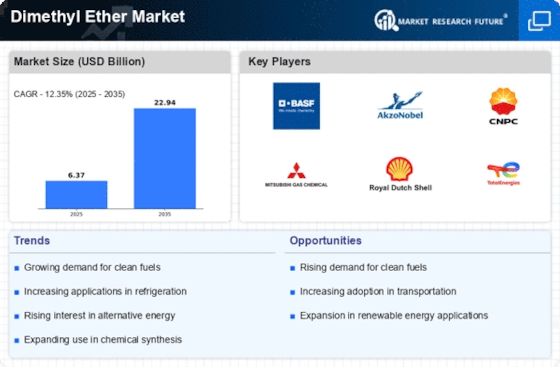
As per Market Research Future analysis, the Dimethyl Ether Market Size was estimated at 6.37 USD Billion in 2024. The Dimethyl Ether industry is projected to grow from 7.157 USD Billion in 2025 to 22.94 USD Billion by 2035, exhibiting a compound annual growth rate (CAGR) of 12.35% during the forecast period 2025 - 2035

Key Market Trends & Highlights

The Dimethyl Ether Market is poised for substantial growth driven by clean energy demands and technological advancements.

  • The market experiences rising demand for clean energy solutions, particularly in North America, which remains the largest market. Technological advancements in production processes are enhancing efficiency and reducing costs, fostering market expansion. Dimethyl ether is finding expanding applications across various industries, notably in transportation fuel and aerosol propellant segments. Key market drivers include rising environmental concerns and government initiatives promoting alternative fuels, particularly in the Asia-Pacific region.

Market Size & Forecast

2024 Market Size 6.37 (USD Billion)
2035 Market Size 22.94 (USD Billion)
CAGR (2025 - 2035) 12.35%
Largest Regional Market Share in 2024 Asia Pacific

Major Players

BASF (DE), AkzoNobel (NL), China National Petroleum Corporation (CN), Mitsubishi Gas Chemical Company (JP), Royal Dutch Shell (NL), TotalEnergies (FR), Yara International (NO), SABIC (SA), Linde (DE)

Market Trends

The Dimethyl Ether Market is currently experiencing a notable transformation, driven by a variety of factors that influence its growth trajectory. The increasing demand for cleaner fuels and the push for sustainable energy solutions appear to be at the forefront of this evolution. As industries seek alternatives to traditional fossil fuels, dimethyl ether emerges as a viable candidate due to its low emissions and versatility. Furthermore, advancements in production technologies and the establishment of regulatory frameworks supporting renewable energy sources seem to bolster the market's potential. This shift towards greener alternatives indicates a broader trend within the energy sector, where environmental considerations are becoming paramount. In addition to environmental factors, the Dimethyl Ether Market is also influenced by its applications across various sectors, including transportation, chemicals, and household energy. The versatility of dimethyl ether as a fuel and a feedstock for chemical production suggests that its adoption may continue to expand. Moreover, the growing interest in using dimethyl ether as a substitute for liquefied petroleum gas in domestic applications highlights its potential to penetrate new markets. As the global landscape evolves, the Dimethyl Ether Market appears poised for growth, driven by both regulatory support and increasing consumer awareness regarding sustainable energy solutions.

Rising Demand for Clean Energy Solutions

The shift towards cleaner energy sources is a prominent trend in the Dimethyl Ether Market. As governments and industries prioritize sustainability, the demand for dimethyl ether as a low-emission fuel alternative is likely to increase. This trend reflects a broader commitment to reducing carbon footprints and enhancing energy efficiency.

Technological Advancements in Production

Innovations in production technologies are shaping the Dimethyl Ether Market. Enhanced methods for synthesizing dimethyl ether from renewable resources may lead to more efficient and cost-effective processes. This trend suggests that the market could see a rise in production capacity and a decrease in overall costs.

Expanding Applications Across Industries

The versatility of dimethyl ether is driving its adoption across various sectors. From transportation to chemical manufacturing, its potential applications are broadening. This trend indicates that as industries seek alternatives to conventional fuels, dimethyl ether may find new opportunities for growth.

Dimethyl Ether Market Market Drivers

Rising Environmental Concerns

The increasing awareness regarding environmental issues is driving the Dimethyl Ether Market. As nations strive to reduce greenhouse gas emissions, the demand for cleaner fuels has surged. Dimethyl ether, being a clean-burning alternative to traditional fossil fuels, is gaining traction. It produces fewer pollutants and can be used in various applications, including transportation and power generation. According to recent data, the market for dimethyl ether is projected to grow significantly, with estimates suggesting a compound annual growth rate of over 10% in the coming years. This trend indicates a shift towards sustainable energy solutions, positioning the Dimethyl Ether Market as a key player in the transition to greener alternatives.

Diverse Applications Across Sectors

The versatility of dimethyl ether is contributing to its growing presence in various sectors, thereby impacting the Dimethyl Ether Market positively. It is utilized in applications ranging from aerosol propellants to refrigerants and as a fuel for vehicles. The increasing adoption of dimethyl ether in the transportation sector, particularly in heavy-duty vehicles, is noteworthy. Market data indicates that the demand for dimethyl ether as a fuel is expected to rise significantly, with projections estimating a market share increase of over 15% in the next few years. This diversification of applications not only enhances the market's resilience but also opens new avenues for growth.

Growing Demand for Alternative Fuels

The shift towards alternative fuels is a major driver for the Dimethyl Ether Market. As consumers and industries seek sustainable energy solutions, dimethyl ether is emerging as a preferred choice due to its clean-burning properties. The transportation sector, in particular, is witnessing a surge in demand for alternative fuels, with dimethyl ether being recognized for its potential to reduce dependency on conventional fossil fuels. Market analysis suggests that the demand for dimethyl ether could increase by approximately 25% over the next five years, driven by both consumer preferences and regulatory pressures. This trend underscores the importance of the Dimethyl Ether Market in the broader context of energy transition.

Government Initiatives and Regulations

Government policies and regulations aimed at promoting cleaner energy sources are influencing the Dimethyl Ether Market. Many countries are implementing stringent emission standards and providing incentives for the adoption of alternative fuels. These initiatives encourage the use of dimethyl ether as a viable substitute for diesel and other fossil fuels. For instance, several nations have introduced tax benefits and subsidies for companies investing in dimethyl ether production. This regulatory support is expected to enhance market growth, with projections indicating that the industry could witness a substantial increase in production capacity over the next decade. Such measures not only foster innovation but also align with global sustainability goals.

Technological Innovations in Production

Technological advancements in the production of dimethyl ether are propelling the Dimethyl Ether Market forward. Innovations in catalytic processes and feedstock utilization have made the production of dimethyl ether more efficient and cost-effective. Recent developments suggest that new methods can reduce production costs by up to 20%, making dimethyl ether more competitive against traditional fuels. Furthermore, the integration of renewable energy sources in the production process is enhancing the sustainability of dimethyl ether. As these technologies continue to evolve, they are likely to attract investments and drive market expansion, positioning the Dimethyl Ether Market as a leader in the clean energy sector.

Market Segment Insights

By Raw Materials: Natural Gas (Largest) vs. Coal (Fastest-Growing)

<p>In the Dimethyl Ether Market, the raw materials segment is primarily dominated by Natural Gas, which holds the largest share among the various sources used for production. Following behind, Coal is emerging rapidly as a significant contributor to the market, particularly in regions where it is abundant and cost-effective. Biomass and other alternative sources, while valuable, still represent a smaller fraction of the market compared to these two dominant players.</p>

<p>Natural Gas (Dominant) vs. Coal (Emerging)</p>

<p>Natural Gas plays a vital role in the Dimethyl Ether Market due to its wide availability and lower emissions compared to other raw materials. Its dominance stems from the established infrastructure for extraction and refinement, which facilitates easier and cost-effective production processes. Coal, on the other hand, is gaining traction as an emerging raw material especially in countries with rich coal reserves. It represents a critical alternative due to its lower production costs, but the environmental implications of coal usage present challenges that the industry must navigate. Biomass remains a viable option for those seeking sustainable methods of production, but its scalability is currently limited compared to Natural Gas and Coal.</p>

By Application: Transportation Fuel (Largest) vs. Aerosol Propellant (Fastest-Growing)

<p>Within the Dimethyl Ether Market, the application segment is diversified with notable shares attributable to Transportation Fuel, Aerosol Propellant, LPG Blending, and Others. Transportation Fuel remains the largest segment, being favored for its efficiency and environmental benefits compared to conventional fuels. Aerosol Propellant is on an impressive growth trajectory, driven by increasing demand in personal care and household product applications.</p>

<p>Transportation Fuel: Dominant vs. Aerosol Propellant: Emerging</p>

<p>Transportation Fuel is the dominant application in the Dimethyl Ether Market, widely utilized for its clean-burning characteristics that contribute to reduced emissions. It plays a crucial role in the transition towards sustainable energy solutions. On the other hand, Aerosol Propellant is emerging rapidly, as the shift towards eco-friendly propellants gains traction in industries like cosmetics and household cleaning. The versatility and efficiency of dimethyl ether in propellant applications offer a sustainable alternative to traditional propellants, indicating a significant shift in consumer preferences.</p>

Get more detailed insights about Dimethyl Ether (DME) Market Research Report- Forecast to 2035

Regional Insights

North America : Innovation and Sustainability Focus

North America is witnessing significant growth in the Dimethyl Ether (DME) market, driven by increasing demand for cleaner fuels and stringent environmental regulations. The region holds approximately 40% of the global market share, making it the largest market for DME. Key drivers include advancements in production technologies and government incentives for renewable energy sources, which are catalyzing the shift towards DME as a viable alternative to traditional fuels. The United States and Canada are the leading countries in this market, with major players like BASF and Linde establishing strong footholds. The competitive landscape is characterized by ongoing investments in research and development, aimed at enhancing production efficiency and reducing costs. The presence of established companies and a supportive regulatory framework further bolster the market's growth potential.

Europe : Regulatory Support and Innovation

Europe is emerging as a significant player in the Dimethyl Ether market, driven by robust regulatory support for sustainable energy solutions. The region accounts for approximately 30% of the global market share, making it the second-largest market. Key growth drivers include the European Union's commitment to reducing carbon emissions and promoting renewable energy sources, which are creating a favorable environment for DME adoption as a clean fuel alternative. Leading countries such as Germany, France, and the Netherlands are at the forefront of this market, with key players like AkzoNobel and TotalEnergies actively involved in DME production. The competitive landscape is marked by innovation in production technologies and strategic partnerships aimed at enhancing market penetration. The presence of strong regulatory frameworks further supports the growth of DME in Europe.

Asia-Pacific : Emerging Markets and Demand Surge

The Asia-Pacific region is experiencing a surge in demand for Dimethyl Ether, driven by rapid industrialization and urbanization. This region holds approximately 25% of the global market share, with countries like China and India leading the charge. The growth is fueled by increasing energy needs and a shift towards cleaner fuels, supported by government initiatives promoting DME as an alternative to liquefied petroleum gas (LPG) and diesel. China is the largest market in the region, with significant contributions from local players such as China National Petroleum Corporation. The competitive landscape is evolving, with both domestic and international companies vying for market share. Investments in production facilities and technology advancements are key strategies employed by leading firms to capitalize on the growing demand for DME in various applications, including transportation and power generation.

Middle East and Africa : Resource-Rich and Growing Demand

The Middle East and Africa region is poised for growth in the Dimethyl Ether market, driven by abundant natural resources and increasing energy demands. This region currently holds about 5% of the global market share, with potential for expansion as countries seek to diversify their energy portfolios. The growth is supported by government initiatives aimed at promoting cleaner energy solutions and reducing reliance on traditional fossil fuels. Countries like Saudi Arabia and South Africa are leading the way in DME production, with key players such as SABIC and Yara International making significant investments in this sector. The competitive landscape is characterized by a focus on leveraging local resources and technological advancements to enhance production capabilities. As the region continues to develop its energy infrastructure, the demand for DME is expected to rise significantly.

Key Players and Competitive Insights

The Dimethyl Ether Market is currently characterized by a dynamic competitive landscape, driven by increasing demand for cleaner fuels and the push for sustainable energy solutions. Key players such as BASF (Germany), AkzoNobel (Netherlands), and China National Petroleum Corporation (China) are strategically positioning themselves through innovation and regional expansion. BASF (Germany) focuses on enhancing its production capabilities while investing in research and development to improve the efficiency of dimethyl ether synthesis. Meanwhile, AkzoNobel (Netherlands) emphasizes partnerships with local firms to strengthen its market presence in Asia, reflecting a broader trend of localized manufacturing and supply chain optimization. These strategies collectively shape a moderately fragmented market, where the influence of major players is significant but not overwhelming, allowing for niche competitors to thrive.

In terms of business tactics, companies are increasingly localizing their manufacturing processes to reduce costs and enhance supply chain resilience. This approach is particularly evident in the Dimethyl Ether Market, where logistical efficiency is paramount. The competitive structure remains moderately fragmented, with several key players exerting influence over pricing and innovation. The collective actions of these companies indicate a shift towards more sustainable practices, as they seek to align with global environmental standards and consumer preferences.

In August 2025, BASF (Germany) announced the launch of a new production facility aimed at increasing its dimethyl ether output by 30%. This strategic move is significant as it not only enhances BASF's production capacity but also positions the company to meet the growing demand for cleaner energy solutions. The facility is expected to utilize advanced technologies that minimize emissions, aligning with global sustainability goals and reinforcing BASF's commitment to innovation in the sector.

In September 2025, AkzoNobel (Netherlands) entered into a strategic partnership with a leading renewable energy firm to develop a new line of bio-based dimethyl ether products. This collaboration is indicative of AkzoNobel's proactive approach to sustainability and innovation, as it seeks to diversify its product offerings and cater to the increasing demand for eco-friendly alternatives. The partnership is likely to enhance AkzoNobel's competitive edge in the market, allowing it to leverage renewable resources in its production processes.

In October 2025, China National Petroleum Corporation (China) unveiled plans to invest heavily in the development of a new dimethyl ether production facility in the Xinjiang region. This investment is poised to significantly boost the company's production capabilities and is strategically aligned with China's broader energy transition goals. By expanding its operational footprint, China National Petroleum Corporation aims to solidify its position as a leader in the dimethyl ether market, capitalizing on the growing demand for cleaner fuels in both domestic and international markets.

As of October 2025, the Dimethyl Ether Market is witnessing trends that emphasize digitalization, sustainability, and the integration of advanced technologies. Companies are increasingly forming strategic alliances to enhance their competitive positioning, reflecting a shift towards collaborative innovation. The competitive landscape is evolving, with a noticeable transition from price-based competition to a focus on technological advancements and supply chain reliability. This evolution suggests that future differentiation will hinge on the ability to innovate and adapt to changing market demands, rather than merely competing on cost.

Key Companies in the Dimethyl Ether Market include

Industry Developments

January 2022: Air Products and Chemicals Inc with Indonesian coal miner Bukit Asam and energy company Pertamina, started constructing a new plant that converts coal into dimethyl ether (DME) with an investment of USD 2.3 billion.

January 2021: Mitsubishi Corporation announced that Caribbean Gas Chemical Limited (CGCL), a joint venture between Mitsubishi group companies including Mitsubishi Gas Chemical Company (MGC), Mitsubishi Corporation (MC), and Mitsubishi Heavy Industries Engineering (MHIENG), and the National Gas Company of Trinidad, started commercial production of dimethyl ether (DME) from December 2020 with an annual production capacity of 20 kilotons of DME.

Future Outlook

Dimethyl Ether Market Future Outlook

The Dimethyl Ether Market is projected to grow at a 12.35% CAGR from 2024 to 2035, driven by increasing demand for clean energy and sustainable fuel alternatives.

New opportunities lie in:

  • Expansion into emerging markets with tailored DME solutions.
  • Development of DME-based fuel cell technologies for transportation.
  • Investment in infrastructure for DME production and distribution networks.

By 2035, the Dimethyl Ether Market is expected to achieve substantial growth, positioning itself as a key player in the energy sector.

Market Segmentation

Dimethyl Ether Market Application Outlook

  • Transportation Fuel
  • Aerosol Propellant
  • LPG Blending
  • Others

Dimethyl Ether Market Raw Materials Outlook

  • Natural Gas
  • Coal
  • Biomass
  • Others

Report Scope

MARKET SIZE 20246.37(USD Billion)
MARKET SIZE 20257.157(USD Billion)
MARKET SIZE 203522.94(USD Billion)
COMPOUND ANNUAL GROWTH RATE (CAGR)12.35% (2024 - 2035)
REPORT COVERAGERevenue Forecast, Competitive Landscape, Growth Factors, and Trends
BASE YEAR2024
Market Forecast Period2025 - 2035
Historical Data2019 - 2024
Market Forecast UnitsUSD Billion
Key Companies ProfiledMarket analysis in progress
Segments CoveredMarket segmentation analysis in progress
Key Market OpportunitiesGrowing demand for clean energy solutions drives innovation in the Dimethyl Ether Market.
Key Market DynamicsRising demand for cleaner fuels drives innovation and investment in Dimethyl Ether production technologies and applications.
Countries CoveredNorth America, Europe, APAC, South America, MEA

FAQs

What is the current valuation of the Dimethyl Ether Market?

<p>As of 2024, the Dimethyl Ether Market was valued at 6.37 USD Billion.</p>

What is the projected market valuation for Dimethyl Ether by 2035?

<p>The market is projected to reach a valuation of 22.94 USD Billion by 2035.</p>

What is the expected CAGR for the Dimethyl Ether Market during the forecast period?

<p>The expected CAGR for the Dimethyl Ether Market from 2025 to 2035 is 12.35%.</p>

Which raw material segment holds the highest valuation in the Dimethyl Ether Market?

<p>The Natural Gas segment was valued at 9.45 USD Billion in 2024, indicating its leading position.</p>

What are the key applications of Dimethyl Ether?

<p>Key applications include Transportation Fuel, Aerosol Propellant, and LPG Blending, with Transportation Fuel valued at 9.45 USD Billion in 2024.</p>

Who are the major players in the Dimethyl Ether Market?

<p>Major players include BASF, AkzoNobel, and Royal Dutch Shell, among others.</p>

What is the valuation of the Biomass segment in the Dimethyl Ether Market?

<p>The Biomass segment was valued at 3.8 USD Billion in 2024.</p>

How does the Coal segment compare to other raw material segments?

<p>The Coal segment was valued at 5.6 USD Billion in 2024, making it a significant contributor alongside Natural Gas.</p>

What is the valuation of the Others segment in the application category?

<p>The Others segment in applications was valued at 3.59 USD Billion in 2024.</p>

What trends are expected in the Dimethyl Ether Market by 2035?

<p>The market is likely to experience substantial growth, driven by increasing demand across various applications and raw materials.</p>

  1. SECTION I: EXECUTIVE SUMMARY AND KEY HIGHLIGHTS
    1. | 1.1 EXECUTIVE SUMMARY
    2. | | 1.1.1 Market Overview
    3. | | 1.1.2 Key Findings
    4. | | 1.1.3 Market Segmentation
    5. | | 1.1.4 Competitive Landscape
    6. | | 1.1.5 Challenges and Opportunities
    7. | | 1.1.6 Future Outlook
  2. SECTION II: SCOPING, METHODOLOGY AND MARKET STRUCTURE
    1. | 2.1 MARKET INTRODUCTION
    2. | | 2.1.1 Definition
    3. | | 2.1.2 Scope of the study
    4. | | | 2.1.2.1 Research Objective
    5. | | | 2.1.2.2 Assumption
    6. | | | 2.1.2.3 Limitations
    7. | 2.2 RESEARCH METHODOLOGY
    8. | | 2.2.1 Overview
    9. | | 2.2.2 Data Mining
    10. | | 2.2.3 Secondary Research
    11. | | 2.2.4 Primary Research
    12. | | | 2.2.4.1 Primary Interviews and Information Gathering Process
    13. | | | 2.2.4.2 Breakdown of Primary Respondents
    14. | | 2.2.5 Forecasting Model
    15. | | 2.2.6 Market Size Estimation
    16. | | | 2.2.6.1 Bottom-Up Approach
    17. | | | 2.2.6.2 Top-Down Approach
    18. | | 2.2.7 Data Triangulation
    19. | | 2.2.8 Validation
  3. SECTION III: QUALITATIVE ANALYSIS
    1. | 3.1 MARKET DYNAMICS
    2. | | 3.1.1 Overview
    3. | | 3.1.2 Drivers
    4. | | 3.1.3 Restraints
    5. | | 3.1.4 Opportunities
    6. | 3.2 MARKET FACTOR ANALYSIS
    7. | | 3.2.1 Value chain Analysis
    8. | | 3.2.2 Porter's Five Forces Analysis
    9. | | | 3.2.2.1 Bargaining Power of Suppliers
    10. | | | 3.2.2.2 Bargaining Power of Buyers
    11. | | | 3.2.2.3 Threat of New Entrants
    12. | | | 3.2.2.4 Threat of Substitutes
    13. | | | 3.2.2.5 Intensity of Rivalry
    14. | | 3.2.3 COVID-19 Impact Analysis
    15. | | | 3.2.3.1 Market Impact Analysis
    16. | | | 3.2.3.2 Regional Impact
    17. | | | 3.2.3.3 Opportunity and Threat Analysis
  4. SECTION IV: QUANTITATIVE ANALYSIS
    1. | 4.1 Chemicals and Materials, BY Raw Materials (USD Billion)
    2. | | 4.1.1 Natural Gas
    3. | | 4.1.2 Coal
    4. | | 4.1.3 Biomass
    5. | | 4.1.4 Others
    6. | 4.2 Chemicals and Materials, BY Application (USD Billion)
    7. | | 4.2.1 Transportation Fuel
    8. | | 4.2.2 Aerosol Propellant
    9. | | 4.2.3 LPG Blending
    10. | | 4.2.4 Others
    11. | 4.3 Chemicals and Materials, BY Region (USD Billion)
    12. | | 4.3.1 North America
    13. | | | 4.3.1.1 US
    14. | | | 4.3.1.2 Canada
    15. | | 4.3.2 Europe
    16. | | | 4.3.2.1 Germany
    17. | | | 4.3.2.2 UK
    18. | | | 4.3.2.3 France
    19. | | | 4.3.2.4 Russia
    20. | | | 4.3.2.5 Italy
    21. | | | 4.3.2.6 Spain
    22. | | | 4.3.2.7 Rest of Europe
    23. | | 4.3.3 APAC
    24. | | | 4.3.3.1 China
    25. | | | 4.3.3.2 India
    26. | | | 4.3.3.3 Japan
    27. | | | 4.3.3.4 South Korea
    28. | | | 4.3.3.5 Malaysia
    29. | | | 4.3.3.6 Thailand
    30. | | | 4.3.3.7 Indonesia
    31. | | | 4.3.3.8 Rest of APAC
    32. | | 4.3.4 South America
    33. | | | 4.3.4.1 Brazil
    34. | | | 4.3.4.2 Mexico
    35. | | | 4.3.4.3 Argentina
    36. | | | 4.3.4.4 Rest of South America
    37. | | 4.3.5 MEA
    38. | | | 4.3.5.1 GCC Countries
    39. | | | 4.3.5.2 South Africa
    40. | | | 4.3.5.3 Rest of MEA
  5. SECTION V: COMPETITIVE ANALYSIS
    1. | 5.1 Competitive Landscape
    2. | | 5.1.1 Overview
    3. | | 5.1.2 Competitive Analysis
    4. | | 5.1.3 Market share Analysis
    5. | | 5.1.4 Major Growth Strategy in the Chemicals and Materials
    6. | | 5.1.5 Competitive Benchmarking
    7. | | 5.1.6 Leading Players in Terms of Number of Developments in the Chemicals and Materials
    8. | | 5.1.7 Key developments and growth strategies
    9. | | | 5.1.7.1 New Product Launch/Service Deployment
    10. | | | 5.1.7.2 Merger & Acquisitions
    11. | | | 5.1.7.3 Joint Ventures
    12. | | 5.1.8 Major Players Financial Matrix
    13. | | | 5.1.8.1 Sales and Operating Income
    14. | | | 5.1.8.2 Major Players R&D Expenditure. 2023
    15. | 5.2 Company Profiles
    16. | | 5.2.1 BASF (DE)
    17. | | | 5.2.1.1 Financial Overview
    18. | | | 5.2.1.2 Products Offered
    19. | | | 5.2.1.3 Key Developments
    20. | | | 5.2.1.4 SWOT Analysis
    21. | | | 5.2.1.5 Key Strategies
    22. | | 5.2.2 AkzoNobel (NL)
    23. | | | 5.2.2.1 Financial Overview
    24. | | | 5.2.2.2 Products Offered
    25. | | | 5.2.2.3 Key Developments
    26. | | | 5.2.2.4 SWOT Analysis
    27. | | | 5.2.2.5 Key Strategies
    28. | | 5.2.3 China National Petroleum Corporation (CN)
    29. | | | 5.2.3.1 Financial Overview
    30. | | | 5.2.3.2 Products Offered
    31. | | | 5.2.3.3 Key Developments
    32. | | | 5.2.3.4 SWOT Analysis
    33. | | | 5.2.3.5 Key Strategies
    34. | | 5.2.4 Mitsubishi Gas Chemical Company (JP)
    35. | | | 5.2.4.1 Financial Overview
    36. | | | 5.2.4.2 Products Offered
    37. | | | 5.2.4.3 Key Developments
    38. | | | 5.2.4.4 SWOT Analysis
    39. | | | 5.2.4.5 Key Strategies
    40. | | 5.2.5 Royal Dutch Shell (NL)
    41. | | | 5.2.5.1 Financial Overview
    42. | | | 5.2.5.2 Products Offered
    43. | | | 5.2.5.3 Key Developments
    44. | | | 5.2.5.4 SWOT Analysis
    45. | | | 5.2.5.5 Key Strategies
    46. | | 5.2.6 TotalEnergies (FR)
    47. | | | 5.2.6.1 Financial Overview
    48. | | | 5.2.6.2 Products Offered
    49. | | | 5.2.6.3 Key Developments
    50. | | | 5.2.6.4 SWOT Analysis
    51. | | | 5.2.6.5 Key Strategies
    52. | | 5.2.7 Yara International (NO)
    53. | | | 5.2.7.1 Financial Overview
    54. | | | 5.2.7.2 Products Offered
    55. | | | 5.2.7.3 Key Developments
    56. | | | 5.2.7.4 SWOT Analysis
    57. | | | 5.2.7.5 Key Strategies
    58. | | 5.2.8 SABIC (SA)
    59. | | | 5.2.8.1 Financial Overview
    60. | | | 5.2.8.2 Products Offered
    61. | | | 5.2.8.3 Key Developments
    62. | | | 5.2.8.4 SWOT Analysis
    63. | | | 5.2.8.5 Key Strategies
    64. | | 5.2.9 Linde (DE)
    65. | | | 5.2.9.1 Financial Overview
    66. | | | 5.2.9.2 Products Offered
    67. | | | 5.2.9.3 Key Developments
    68. | | | 5.2.9.4 SWOT Analysis
    69. | | | 5.2.9.5 Key Strategies
    70. | 5.3 Appendix
    71. | | 5.3.1 References
    72. | | 5.3.2 Related Reports
  6. LIST OF FIGURES
    1. | 6.1 MARKET SYNOPSIS
    2. | 6.2 NORTH AMERICA MARKET ANALYSIS
    3. | 6.3 US MARKET ANALYSIS BY RAW MATERIALS
    4. | 6.4 US MARKET ANALYSIS BY APPLICATION
    5. | 6.5 CANADA MARKET ANALYSIS BY RAW MATERIALS
    6. | 6.6 CANADA MARKET ANALYSIS BY APPLICATION
    7. | 6.7 EUROPE MARKET ANALYSIS
    8. | 6.8 GERMANY MARKET ANALYSIS BY RAW MATERIALS
    9. | 6.9 GERMANY MARKET ANALYSIS BY APPLICATION
    10. | 6.10 UK MARKET ANALYSIS BY RAW MATERIALS
    11. | 6.11 UK MARKET ANALYSIS BY APPLICATION
    12. | 6.12 FRANCE MARKET ANALYSIS BY RAW MATERIALS
    13. | 6.13 FRANCE MARKET ANALYSIS BY APPLICATION
    14. | 6.14 RUSSIA MARKET ANALYSIS BY RAW MATERIALS
    15. | 6.15 RUSSIA MARKET ANALYSIS BY APPLICATION
    16. | 6.16 ITALY MARKET ANALYSIS BY RAW MATERIALS
    17. | 6.17 ITALY MARKET ANALYSIS BY APPLICATION
    18. | 6.18 SPAIN MARKET ANALYSIS BY RAW MATERIALS
    19. | 6.19 SPAIN MARKET ANALYSIS BY APPLICATION
    20. | 6.20 REST OF EUROPE MARKET ANALYSIS BY RAW MATERIALS
    21. | 6.21 REST OF EUROPE MARKET ANALYSIS BY APPLICATION
    22. | 6.22 APAC MARKET ANALYSIS
    23. | 6.23 CHINA MARKET ANALYSIS BY RAW MATERIALS
    24. | 6.24 CHINA MARKET ANALYSIS BY APPLICATION
    25. | 6.25 INDIA MARKET ANALYSIS BY RAW MATERIALS
    26. | 6.26 INDIA MARKET ANALYSIS BY APPLICATION
    27. | 6.27 JAPAN MARKET ANALYSIS BY RAW MATERIALS
    28. | 6.28 JAPAN MARKET ANALYSIS BY APPLICATION
    29. | 6.29 SOUTH KOREA MARKET ANALYSIS BY RAW MATERIALS
    30. | 6.30 SOUTH KOREA MARKET ANALYSIS BY APPLICATION
    31. | 6.31 MALAYSIA MARKET ANALYSIS BY RAW MATERIALS
    32. | 6.32 MALAYSIA MARKET ANALYSIS BY APPLICATION
    33. | 6.33 THAILAND MARKET ANALYSIS BY RAW MATERIALS
    34. | 6.34 THAILAND MARKET ANALYSIS BY APPLICATION
    35. | 6.35 INDONESIA MARKET ANALYSIS BY RAW MATERIALS
    36. | 6.36 INDONESIA MARKET ANALYSIS BY APPLICATION
    37. | 6.37 REST OF APAC MARKET ANALYSIS BY RAW MATERIALS
    38. | 6.38 REST OF APAC MARKET ANALYSIS BY APPLICATION
    39. | 6.39 SOUTH AMERICA MARKET ANALYSIS
    40. | 6.40 BRAZIL MARKET ANALYSIS BY RAW MATERIALS
    41. | 6.41 BRAZIL MARKET ANALYSIS BY APPLICATION
    42. | 6.42 MEXICO MARKET ANALYSIS BY RAW MATERIALS
    43. | 6.43 MEXICO MARKET ANALYSIS BY APPLICATION
    44. | 6.44 ARGENTINA MARKET ANALYSIS BY RAW MATERIALS
    45. | 6.45 ARGENTINA MARKET ANALYSIS BY APPLICATION
    46. | 6.46 REST OF SOUTH AMERICA MARKET ANALYSIS BY RAW MATERIALS
    47. | 6.47 REST OF SOUTH AMERICA MARKET ANALYSIS BY APPLICATION
    48. | 6.48 MEA MARKET ANALYSIS
    49. | 6.49 GCC COUNTRIES MARKET ANALYSIS BY RAW MATERIALS
    50. | 6.50 GCC COUNTRIES MARKET ANALYSIS BY APPLICATION
    51. | 6.51 SOUTH AFRICA MARKET ANALYSIS BY RAW MATERIALS
    52. | 6.52 SOUTH AFRICA MARKET ANALYSIS BY APPLICATION
    53. | 6.53 REST OF MEA MARKET ANALYSIS BY RAW MATERIALS
    54. | 6.54 REST OF MEA MARKET ANALYSIS BY APPLICATION
    55. | 6.55 KEY BUYING CRITERIA OF CHEMICALS AND MATERIALS
    56. | 6.56 RESEARCH PROCESS OF MRFR
    57. | 6.57 DRO ANALYSIS OF CHEMICALS AND MATERIALS
    58. | 6.58 DRIVERS IMPACT ANALYSIS: CHEMICALS AND MATERIALS
    59. | 6.59 RESTRAINTS IMPACT ANALYSIS: CHEMICALS AND MATERIALS
    60. | 6.60 SUPPLY / VALUE CHAIN: CHEMICALS AND MATERIALS
    61. | 6.61 CHEMICALS AND MATERIALS, BY RAW MATERIALS, 2024 (% SHARE)
    62. | 6.62 CHEMICALS AND MATERIALS, BY RAW MATERIALS, 2024 TO 2035 (USD Billion)
    63. | 6.63 CHEMICALS AND MATERIALS, BY APPLICATION, 2024 (% SHARE)
    64. | 6.64 CHEMICALS AND MATERIALS, BY APPLICATION, 2024 TO 2035 (USD Billion)
    65. | 6.65 BENCHMARKING OF MAJOR COMPETITORS
  7. LIST OF TABLES
    1. | 7.1 LIST OF ASSUMPTIONS
    2. | | 7.1.1
    3. | 7.2 North America MARKET SIZE ESTIMATES; FORECAST
    4. | | 7.2.1 BY RAW MATERIALS, 2025-2035 (USD Billion)
    5. | | 7.2.2 BY APPLICATION, 2025-2035 (USD Billion)
    6. | 7.3 US MARKET SIZE ESTIMATES; FORECAST
    7. | | 7.3.1 BY RAW MATERIALS, 2025-2035 (USD Billion)
    8. | | 7.3.2 BY APPLICATION, 2025-2035 (USD Billion)
    9. | 7.4 Canada MARKET SIZE ESTIMATES; FORECAST
    10. | | 7.4.1 BY RAW MATERIALS, 2025-2035 (USD Billion)
    11. | | 7.4.2 BY APPLICATION, 2025-2035 (USD Billion)
    12. | 7.5 Europe MARKET SIZE ESTIMATES; FORECAST
    13. | | 7.5.1 BY RAW MATERIALS, 2025-2035 (USD Billion)
    14. | | 7.5.2 BY APPLICATION, 2025-2035 (USD Billion)
    15. | 7.6 Germany MARKET SIZE ESTIMATES; FORECAST
    16. | | 7.6.1 BY RAW MATERIALS, 2025-2035 (USD Billion)
    17. | | 7.6.2 BY APPLICATION, 2025-2035 (USD Billion)
    18. | 7.7 UK MARKET SIZE ESTIMATES; FORECAST
    19. | | 7.7.1 BY RAW MATERIALS, 2025-2035 (USD Billion)
    20. | | 7.7.2 BY APPLICATION, 2025-2035 (USD Billion)
    21. | 7.8 France MARKET SIZE ESTIMATES; FORECAST
    22. | | 7.8.1 BY RAW MATERIALS, 2025-2035 (USD Billion)
    23. | | 7.8.2 BY APPLICATION, 2025-2035 (USD Billion)
    24. | 7.9 Russia MARKET SIZE ESTIMATES; FORECAST
    25. | | 7.9.1 BY RAW MATERIALS, 2025-2035 (USD Billion)
    26. | | 7.9.2 BY APPLICATION, 2025-2035 (USD Billion)
    27. | 7.10 Italy MARKET SIZE ESTIMATES; FORECAST
    28. | | 7.10.1 BY RAW MATERIALS, 2025-2035 (USD Billion)
    29. | | 7.10.2 BY APPLICATION, 2025-2035 (USD Billion)
    30. | 7.11 Spain MARKET SIZE ESTIMATES; FORECAST
    31. | | 7.11.1 BY RAW MATERIALS, 2025-2035 (USD Billion)
    32. | | 7.11.2 BY APPLICATION, 2025-2035 (USD Billion)
    33. | 7.12 Rest of Europe MARKET SIZE ESTIMATES; FORECAST
    34. | | 7.12.1 BY RAW MATERIALS, 2025-2035 (USD Billion)
    35. | | 7.12.2 BY APPLICATION, 2025-2035 (USD Billion)
    36. | 7.13 APAC MARKET SIZE ESTIMATES; FORECAST
    37. | | 7.13.1 BY RAW MATERIALS, 2025-2035 (USD Billion)
    38. | | 7.13.2 BY APPLICATION, 2025-2035 (USD Billion)
    39. | 7.14 China MARKET SIZE ESTIMATES; FORECAST
    40. | | 7.14.1 BY RAW MATERIALS, 2025-2035 (USD Billion)
    41. | | 7.14.2 BY APPLICATION, 2025-2035 (USD Billion)
    42. | 7.15 India MARKET SIZE ESTIMATES; FORECAST
    43. | | 7.15.1 BY RAW MATERIALS, 2025-2035 (USD Billion)
    44. | | 7.15.2 BY APPLICATION, 2025-2035 (USD Billion)
    45. | 7.16 Japan MARKET SIZE ESTIMATES; FORECAST
    46. | | 7.16.1 BY RAW MATERIALS, 2025-2035 (USD Billion)
    47. | | 7.16.2 BY APPLICATION, 2025-2035 (USD Billion)
    48. | 7.17 South Korea MARKET SIZE ESTIMATES; FORECAST
    49. | | 7.17.1 BY RAW MATERIALS, 2025-2035 (USD Billion)
    50. | | 7.17.2 BY APPLICATION, 2025-2035 (USD Billion)
    51. | 7.18 Malaysia MARKET SIZE ESTIMATES; FORECAST
    52. | | 7.18.1 BY RAW MATERIALS, 2025-2035 (USD Billion)
    53. | | 7.18.2 BY APPLICATION, 2025-2035 (USD Billion)
    54. | 7.19 Thailand MARKET SIZE ESTIMATES; FORECAST
    55. | | 7.19.1 BY RAW MATERIALS, 2025-2035 (USD Billion)
    56. | | 7.19.2 BY APPLICATION, 2025-2035 (USD Billion)
    57. | 7.20 Indonesia MARKET SIZE ESTIMATES; FORECAST
    58. | | 7.20.1 BY RAW MATERIALS, 2025-2035 (USD Billion)
    59. | | 7.20.2 BY APPLICATION, 2025-2035 (USD Billion)
    60. | 7.21 Rest of APAC MARKET SIZE ESTIMATES; FORECAST
    61. | | 7.21.1 BY RAW MATERIALS, 2025-2035 (USD Billion)
    62. | | 7.21.2 BY APPLICATION, 2025-2035 (USD Billion)
    63. | 7.22 South America MARKET SIZE ESTIMATES; FORECAST
    64. | | 7.22.1 BY RAW MATERIALS, 2025-2035 (USD Billion)
    65. | | 7.22.2 BY APPLICATION, 2025-2035 (USD Billion)
    66. | 7.23 Brazil MARKET SIZE ESTIMATES; FORECAST
    67. | | 7.23.1 BY RAW MATERIALS, 2025-2035 (USD Billion)
    68. | | 7.23.2 BY APPLICATION, 2025-2035 (USD Billion)
    69. | 7.24 Mexico MARKET SIZE ESTIMATES; FORECAST
    70. | | 7.24.1 BY RAW MATERIALS, 2025-2035 (USD Billion)
    71. | | 7.24.2 BY APPLICATION, 2025-2035 (USD Billion)
    72. | 7.25 Argentina MARKET SIZE ESTIMATES; FORECAST
    73. | | 7.25.1 BY RAW MATERIALS, 2025-2035 (USD Billion)
    74. | | 7.25.2 BY APPLICATION, 2025-2035 (USD Billion)
    75. | 7.26 Rest of South America MARKET SIZE ESTIMATES; FORECAST
    76. | | 7.26.1 BY RAW MATERIALS, 2025-2035 (USD Billion)
    77. | | 7.26.2 BY APPLICATION, 2025-2035 (USD Billion)
    78. | 7.27 MEA MARKET SIZE ESTIMATES; FORECAST
    79. | | 7.27.1 BY RAW MATERIALS, 2025-2035 (USD Billion)
    80. | | 7.27.2 BY APPLICATION, 2025-2035 (USD Billion)
    81. | 7.28 GCC Countries MARKET SIZE ESTIMATES; FORECAST
    82. | | 7.28.1 BY RAW MATERIALS, 2025-2035 (USD Billion)
    83. | | 7.28.2 BY APPLICATION, 2025-2035 (USD Billion)
    84. | 7.29 South Africa MARKET SIZE ESTIMATES; FORECAST
    85. | | 7.29.1 BY RAW MATERIALS, 2025-2035 (USD Billion)
    86. | | 7.29.2 BY APPLICATION, 2025-2035 (USD Billion)
    87. | 7.30 Rest of MEA MARKET SIZE ESTIMATES; FORECAST
    88. | | 7.30.1 BY RAW MATERIALS, 2025-2035 (USD Billion)
    89. | | 7.30.2 BY APPLICATION, 2025-2035 (USD Billion)
    90. | 7.31 PRODUCT LAUNCH/PRODUCT DEVELOPMENT/APPROVAL
    91. | | 7.31.1
    92. | 7.32 ACQUISITION/PARTNERSHIP
    93. | | 7.32.1

Chemicals and Materials Market Segmentation

Chemicals and Materials By Raw Materials (USD Billion, 2025-2035)

  • Natural Gas
  • Coal
  • Biomass
  • Others

Chemicals and Materials By Application (USD Billion, 2025-2035)

  • Transportation Fuel
  • Aerosol Propellant
  • LPG Blending
  • Others
Infographic

Free Sample Request

Kindly complete the form below to receive a free sample of this Report

Get Free Sample

Customer Strories

Compare Licence

×
Features License Type
Single User Multiuser License Enterprise User
Price $4,950 $5,950 $7,250
Maximum User Access Limit 1 User Upto 10 Users Unrestricted Access Throughout the Organization
Free Customization
Direct Access to Analyst
Deliverable Format
Platform Access
Discount on Next Purchase 10% 15% 15%
Printable Versions
%>