×
Request Free Sample ×

Kindly complete the form below to receive a free sample of this Report

* Please use a valid business email

Leading companies partner with us for data-driven Insights

clients tt-cursor
Hero Background
English
Chinese
French
Japanese
Korean
German
Spanish

Diabetic Ulcer Treatment Market Share

ID: MRFR/HC/6888-HCR
111 Pages
Rahul Gotadki
February 2026

Diabetic Ulcer Treatment Market Research Report: Size, Share, Trend Analysis By Treatment Type (Wound Care Dressings, Antimicrobial Therapy, Growth Factors, Skin Substitutes), By End Users (Hospitals, Clinics, Home Care Settings), By Cause of Diabetes (Type 1 Diabetes, Type 2 Diabetes, Gestational Diabetes), By Distribution Channel (Pharmacies, Online Stores, Hospitals) and By Regional (North America, Europe, South America, Asia Pacific, Middle East and Africa) - Growth Outlook & Industry Forecast 2025 To 2035

Share:
Download PDF ×

We do not share your information with anyone. However, we may send you emails based on your report interest from time to time. You may contact us at any time to opt-out.

Diabetic Ulcer Treatment Market Infographic
Purchase Options

Market Share

Diabetic Ulcer Treatment Market Share Analysis

To stay competitive and meet patient requirements in the Diabetic Ulcer Treatment Market, firms use several market share positioning methods. Companies use product differentiation to stand out from competition by creating new remedies. Companies engage in research and development to create cutting-edge medicines that solve diabetic ulcer issues and deliver improved efficacy. This technique appeals to individuals and healthcare professionals seeking more effective and efficient treatments.

Companies also use market penetration to grow their share in current marketplaces. To increase market share, extensive promotion, aggressive pricing, and effective distribution methods are needed. By expanding their audience and brand exposure, organizations may strengthen their position and perhaps overtake competitors in crucial locations. This strategy is vital in the Diabetic Ulcer Treatment Market, as diabetes incidence is increasing need for effective treatments.

Collaboration and partnerships are crucial to Diabetic Ulcer Treatment Market share positioning. Companies may partner with healthcare institutions, research groups, and other industry participants to share resources. Companies may speed up therapy development and commercialization by sharing expertise, benefiting both. These collaborations increase industry knowledge and create a collaborative ecosystem that boosts innovation and market growth.

Additionally, customer-centric initiatives can greatly effect Diabetic Ulcer Treatment Market market share positioning. Understanding healthcare professionals, patients, and caregivers' demands helps companies adjust their goods and services. Customer-centricity increases patient outcomes and brand loyalty and confidence. Companies may improve their products, gather customer insights, and establish long-term market success by actively engaging with customers.

Diabetic Ulcer Treatment Market firms also focus on geographic growth. This entails entering new markets or expanding in high-need medical areas. Companies may reach varied patient groups and increase market share by tailoring their goods and marketing techniques to regional needs. However, knowing local rules, cultural differences, and healthcare systems is essential for regional development.

Author
Rahul Gotadki
Research Manager

He holds an experience of about 9+ years in Market Research and Business Consulting, working under the spectrum of Life Sciences and Healthcare domains. Rahul conceptualizes and implements a scalable business strategy and provides strategic leadership to the clients. His expertise lies in market estimation, competitive intelligence, pipeline analysis, customer assessment, etc.

Leave a Comment

FAQs

What is the projected market valuation of the Diabetic Ulcer Treatment Market by 2035?

<p>The projected market valuation for the Diabetic Ulcer Treatment Market is expected to reach 11284.15 USD Million by 2035.</p>

What was the market valuation of the Diabetic Ulcer Treatment Market in 2024?

<p>The overall market valuation of the Diabetic Ulcer Treatment Market was 4590.41 USD Million in 2024.</p>

What is the expected CAGR for the Diabetic Ulcer Treatment Market during the forecast period 2025 - 2035?

<p>The expected CAGR for the Diabetic Ulcer Treatment Market during the forecast period 2025 - 2035 is 8.52%.</p>

Which treatment type segment had the highest valuation in 2024?

<p>In 2024, the Wound Dressings segment had the highest valuation at 1500.0 USD Million.</p>

What are the key players in the Diabetic Ulcer Treatment Market?

<p>Key players in the Diabetic Ulcer Treatment Market include MediWound, Smith & Nephew, Acelity, and 3M.</p>

Which end user segment is projected to grow the most by 2035?

<p>The Hospitals segment is projected to grow significantly, with a valuation expected to reach 4365.66 USD Million by 2035.</p>

What was the valuation of the Topical Agents segment in 2024?

<p>The Topical Agents segment was valued at 1200.0 USD Million in 2024.</p>

How does the market for Negative Pressure Wound Therapy compare to other treatment types?

<p>The Negative Pressure Wound Therapy segment was valued at 600.0 USD Million in 2024, indicating a smaller market compared to Wound Dressings and Topical Agents.</p>

What is the projected valuation for the Home Care Settings segment by 2035?

<p>The Home Care Settings segment is projected to reach a valuation of 3240.83 USD Million by 2035.</p>

Which distribution channel is expected to see the highest growth by 2035?

The Online Sales distribution channel is expected to see substantial growth, with a projected valuation of 2200.0 USD Million by 2035.

Market Summary

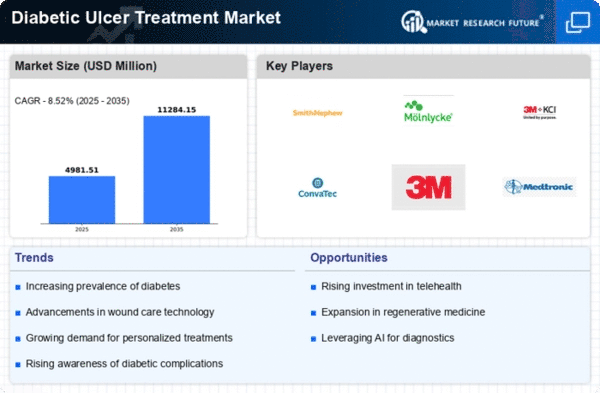
As per MRFR analysis, the Diabetic Ulcer Treatment Market Size was estimated at 4590.41 USD Million in 2024. The Diabetic Ulcer Treatment industry is projected to grow from 4981.52 in 2025 to 11284.15 by 2035, exhibiting a compound annual growth rate (CAGR) of 8.52% during the forecast period 2025 - 2035.

Key Market Trends & Highlights

The Diabetic Ulcer Treatment Market is experiencing robust growth driven by technological advancements and increasing healthcare awareness.

  • Technological advancements in wound care are enhancing treatment efficacy and patient outcomes.
  • There is a notable shift towards personalized treatment approaches, catering to individual patient needs.
  • Integration of digital health solutions is becoming prevalent, facilitating remote monitoring and management.
  • The rising prevalence of diabetes and advancements in wound care technologies are key drivers propelling market growth.

Market Size & Forecast

2024 Market Size 4590.41 (USD Million)
2035 Market Size 11284.15 (USD Million)
CAGR (2025 - 2035) 8.52%
Largest Regional Market Share in 2024 North America

Major Players

Smith & Nephew (GB), Mölnlycke Health Care (SE), Acelity (US), ConvaTec (GB), 3M (US), Medtronic (US), B. Braun Melsungen AG (DE), Hollister Incorporated (US), Derma Sciences (US), KCI Medical (US)

Market Trends

The Diabetic Ulcer Treatment Market is currently experiencing a notable evolution, driven by an increasing prevalence of diabetes worldwide. This condition often leads to complications such as diabetic ulcers, which necessitate effective treatment options. The market appears to be expanding as healthcare providers and patients seek advanced therapies that promote healing and prevent further complications. Innovations in wound care technologies, including advanced dressings and bioengineered tissues, are likely to play a crucial role in shaping treatment protocols. Furthermore, the growing awareness of diabetic foot care among patients and healthcare professionals suggests a shift towards proactive management strategies. In addition, the Diabetic Ulcer Treatment Market is influenced by the rising demand for personalized medicine. Tailored treatment plans that consider individual patient needs and conditions may enhance healing outcomes. The integration of telemedicine and digital health solutions is also emerging as a potential game-changer, allowing for remote monitoring and timely interventions. As the market continues to evolve, stakeholders must remain vigilant to emerging trends and adapt their strategies accordingly to meet the changing landscape of diabetic ulcer management.

Technological Advancements in Wound Care

The Diabetic Ulcer Treatment Market is witnessing a surge in technological innovations, particularly in wound care products. Advanced dressings, such as hydrocolloids and alginates, are gaining traction due to their ability to maintain a moist environment conducive to healing. Additionally, the development of bioengineered tissues and skin substitutes is likely to enhance treatment efficacy, offering new hope for patients with chronic ulcers.

Shift Towards Personalized Treatment Approaches

There is a discernible trend towards personalized treatment strategies within the Diabetic Ulcer Treatment Market. Healthcare providers are increasingly recognizing the importance of tailoring interventions to individual patient profiles. This approach may lead to improved healing rates and reduced recurrence of ulcers, as treatments are designed to address specific patient needs and underlying conditions.

Integration of Digital Health Solutions

The integration of digital health technologies is emerging as a transformative force in the Diabetic Ulcer Treatment Market. Telemedicine platforms and mobile health applications are facilitating remote patient monitoring and education. This trend not only enhances patient engagement but also allows for timely interventions, potentially reducing the incidence of severe complications associated with diabetic ulcers.

Diabetic Ulcer Treatment Market Market Drivers

Rising Prevalence of Diabetes

The increasing prevalence of diabetes globally is a primary driver for the Global Diabetic Ulcer Treatment Market Industry. As of 2024, approximately 537 million adults are living with diabetes, a figure projected to rise significantly in the coming years. This surge in diabetes cases correlates with a higher incidence of diabetic ulcers, necessitating effective treatment options. The Global Diabetic Ulcer Treatment Market Industry is expected to reach 6.57 USD Billion in 2024, reflecting the urgent need for innovative therapies and management strategies to address this growing health concern.

Market Segment Insights

By Treatment Type: Wound Dressings (Largest) vs. Topical Agents (Fastest-Growing)

<p>In the Diabetic Ulcer Treatment Market, wound dressings hold a substantial portion of the market share, serving as the primary choice for management and healing of diabetic ulcers. This segment is characterized by various types of dressings, which cater to differing wound conditions and patient needs, optimizing healing time and reducing infection risks Conversely, topical agents are rapidly gaining traction in this market, noted for their ability to promote healing through advanced bioactive components. This trend is supported by a growing preference for non-invasive treatments and the increasing incidence of diabetic ulcers globally, highlighting the importance of innovative solutions aimed at improving patient care outcomes.</p>

<p>Wound Dressings (Dominant) vs. Negative Pressure Wound Therapy (Emerging)</p>

<p>Wound dressings are the dominant segment in the diabetic ulcer treatment market, widely utilized due to their versatility and effectiveness in managing various types of wounds. They offer a range of options, including hydrocolloids, foams, and alginates, tailored for different stages of wound healing. In contrast, negative pressure wound therapy (NPWT) presents as an emerging option, gaining recognition for its ability to enhance healing through constant management of exudate and promotion of blood flow. NPWT is particularly suitable for complex wounds, providing clinical efficacy that is increasingly recognized, thereby making it a noteworthy consideration for clinicians dealing with challenging diabetic ulcers.</p>

By End User: Hospitals (Largest) vs. Home Care Settings (Fastest-Growing)

In the Diabetic Ulcer Treatment Market, hospitals are the largest end user segment, dominating the overall market share due to their comprehensive facilities and resources dedicated to advanced wound care. Specialty clinics, while significant, maintain a smaller market share in comparison to hospitals and home care settings. Long-term care facilities also contribute moderately to the market, catering primarily to elderly patients with chronic wounds.

Hospitals (Dominant) vs. Home Care Settings (Emerging)

Hospitals are a dominant force in the diabetic ulcer treatment market, providing large-scale treatment options that include specialized wound care services, surgical interventions, and access to multidisciplinary care teams. They offer advanced technologies and extensive patient monitoring, contributing to effectively managing diabetic ulcers. On the other hand, home care settings are emerging rapidly, driven by the growing preference for at-home care among patients. With an increasing number of patients being treated for diabetic ulcers at home, this segment benefits from the convenience, personalized care, and lower costs associated with home treatment options, making it an increasingly essential part of the care continuum.

By Wound Type: Neuropathic Ulcers (Largest) vs. Venous Ulcers (Fastest-Growing)

In the Diabetic Ulcer Treatment Market, Neuropathic Ulcers hold the largest market share due to their common occurrence among patients with diabetes, making them a focal point for treatment strategies. Venous Ulcers, while smaller in current market share, are gaining traction as a significant portion of diabetic ulcer cases, driven by shifts in clinical practices and patient management protocols. This balance between the two underscores the need for targeted therapeutic solutions in the management of diabetic wounds.

Neuropathic Ulcers (Dominant) vs. Ischemic Ulcers (Emerging)

Neuropathic Ulcers are recognized as the dominant segment in the diabetic ulcer treatment landscape, primarily due to their complex nature and association with diabetic neuropathy. They typically require comprehensive care strategies, including advanced dressings and adjunct therapies, which cater to the specific needs of patients. In contrast, Ischemic Ulcers represent an emerging category that is capturing attention due to their increasing recognition in diabetic care dynamics. As awareness grows about the impact of tissue perfusion on wound healing, treatment methods are evolving, incorporating vascular assessment and intervention, which positions Ischemic Ulcers as an important focus for future therapeutic advancements.

By Distribution Channel: Pharmacies (Largest) vs. Online Sales (Fastest-Growing)

<p>In the Diabetic Ulcer Treatment Market, the distribution channels exhibit a diverse range of market share dynamics. Pharmacies stand out as the largest distribution channel, leveraging established relationships with consumers for easy access to treatment products. In contrast, online sales have gained considerable traction, catering to an increasingly digital-savvy consumer base looking for convenience and privacy in their purchasing experience. This varied distribution reflects shifting patient preferences and the evolving landscape of healthcare accessibility. Growth trends reveal a robust expansion trajectory for online sales, driven by the rise in telemedicine and the increasing importance of e-commerce platforms in healthcare. Consumers are increasingly turning to online channels not just for medications but also for comprehensive treatment resources and advice. Meanwhile, pharmacies continue to hold their significant share, supported by strong customer loyalty and the trust associated with physical healthcare providers. As the market evolves, partnerships between traditional channels and digital platforms may further reshape the treatment landscape.</p>

<p>Pharmacies (Dominant) vs. Online Sales (Emerging)</p>

<p>Pharmacies remain the dominant force in the diabetic ulcer treatment distribution channel, offering patients immediate access to required medications and expert consultation from pharmacists. Their established networks and physical presence instill a sense of trust and reliability among consumers. Additionally, pharmacies provide educational resources and support to patients, enhancing their role as healthcare providers. On the other hand, online sales are rapidly emerging as a necessary channel, appealing to the younger demographic and those seeking discretion in their healthcare purchases. The flexibility and convenience of online shopping, combined with targeted marketing strategies, position online sales as a formidable player in the market. As such, both distribution channels are vital in delivering diabetic ulcer treatments to patients, albeit catering to different consumer preferences.</p>

Get more detailed insights about Diabetic Ulcer Treatment Market Research Report - Global Forecast till 2035

Regional Insights

North America : Market Leader in Treatment

North America is poised to maintain its leadership in the Diabetic Ulcer Treatment Market, holding a significant market size of $2290.2M. Key growth drivers include an increasing prevalence of diabetes, advancements in wound care technologies, and supportive healthcare policies. The region's robust healthcare infrastructure and rising awareness about diabetic complications further fuel demand for effective treatment solutions. The United States stands out as the leading country, with major players like Smith & Nephew, Acelity, and Medtronic driving innovation and market growth. The competitive landscape is characterized by strategic partnerships and product launches aimed at enhancing treatment efficacy. As the market evolves, the focus on patient-centric solutions and advanced wound care products will likely shape the future of diabetic ulcer management.

Europe : Emerging Market Dynamics

Europe's Diabetic Ulcer Treatment Market is projected to reach $1150.1M, driven by an aging population and increasing diabetes cases. Regulatory support for advanced wound care products and a growing emphasis on preventive healthcare are key factors propelling market growth. The region's healthcare systems are increasingly adopting innovative treatment modalities, enhancing patient outcomes and satisfaction. Leading countries such as Germany, France, and the UK are at the forefront of this market, with significant contributions from companies like Mölnlycke Health Care and ConvaTec. The competitive landscape is marked by a mix of established players and emerging startups, focusing on research and development to introduce novel therapies. As the market matures, collaboration between healthcare providers and manufacturers will be crucial for addressing the rising demand for effective diabetic ulcer treatments.

Asia-Pacific : Rapidly Growing Market

The Asia-Pacific Diabetic Ulcer Treatment Market is estimated at $830.0M, reflecting a growing awareness of diabetes management and wound care. Factors such as increasing healthcare expenditure, rising diabetes prevalence, and government initiatives to improve healthcare access are driving market growth. The region is witnessing a shift towards advanced treatment options, including bioengineered products and smart wound dressings. Countries like China, India, and Japan are leading the market, with significant investments from key players such as 3M and B. Braun Melsungen AG. The competitive landscape is evolving, with local manufacturers emerging alongside global giants, enhancing the availability of diverse treatment options. As the market develops, the focus on affordability and accessibility will be essential for meeting the needs of the growing diabetic population.

Middle East and Africa : Untapped Market Potential

The Middle East and Africa Diabetic Ulcer Treatment Market is valued at $320.11M, with significant growth potential driven by increasing diabetes rates and a rising awareness of wound care. The region faces challenges such as limited healthcare infrastructure and access to advanced treatment options, but ongoing investments in healthcare are expected to improve the situation. Government initiatives aimed at enhancing healthcare services are also contributing to market growth. Countries like South Africa and the UAE are leading the market, with a growing presence of international players like Hollister and KCI Medical. The competitive landscape is characterized by a mix of local and global companies, focusing on innovative solutions to address the unique challenges of diabetic ulcer treatment in the region. As healthcare systems evolve, the demand for effective and affordable treatment options will likely increase.

Key Players and Competitive Insights

The Diabetic Ulcer Treatment Market is characterized by a competitive landscape that is increasingly shaped by innovation, strategic partnerships, and a focus on patient-centric solutions. Key players such as Smith & Nephew (GB), Mölnlycke Health Care (SE), and Acelity (US) are actively pursuing strategies that emphasize technological advancements and enhanced product offerings. For instance, Smith & Nephew (GB) has been focusing on expanding its advanced wound care portfolio, which is indicative of a broader trend towards specialized treatment solutions that cater to the unique needs of diabetic ulcer patients. This strategic positioning not only enhances their market presence but also contributes to a more competitive environment where innovation is paramount.In terms of business tactics, companies are increasingly localizing manufacturing and optimizing supply chains to enhance efficiency and responsiveness to market demands. The competitive structure of the market appears moderately fragmented, with several key players exerting influence over various segments. This fragmentation allows for a diverse range of products and solutions, catering to different patient needs and preferences, while also fostering a competitive atmosphere that encourages continuous improvement and innovation.

In November Mölnlycke Health Care (SE) announced the launch of a new line of antimicrobial dressings specifically designed for diabetic ulcers. This strategic move is significant as it not only expands their product range but also addresses the growing demand for effective infection control in wound management. By leveraging advanced materials and technology, Mölnlycke aims to enhance patient outcomes and solidify its position as a leader in the wound care sector.

In October Acelity (US) entered into a strategic partnership with a leading telehealth provider to integrate digital health solutions into its wound care management offerings. This collaboration is noteworthy as it reflects a shift towards digital transformation in healthcare, enabling more personalized and efficient treatment plans for diabetic ulcer patients. The integration of telehealth services is likely to enhance patient engagement and adherence to treatment protocols, thereby improving overall outcomes.

In December 3M (US) unveiled a new AI-driven analytics platform aimed at optimizing wound care management. This initiative underscores the growing trend of AI integration within the healthcare sector, particularly in wound care. By utilizing data analytics, 3M seeks to provide healthcare professionals with actionable insights that can lead to better decision-making and improved patient care.

As of December the competitive trends in the Diabetic Ulcer Treatment Market are increasingly defined by digitalization, sustainability, and the integration of advanced technologies. Strategic alliances are playing a crucial role in shaping the current landscape, allowing companies to pool resources and expertise to drive innovation. Looking ahead, it is anticipated that competitive differentiation will evolve, with a notable shift from price-based competition towards a focus on innovation, technology, and supply chain reliability. This evolution suggests that companies that prioritize these aspects will likely gain a competitive edge in the market.

Key Companies in the Diabetic Ulcer Treatment Market include

Industry Developments

In recent months, the Diabetic Ulcer Treatment Market has seen significant advancements and developments. Companies such as Coloplast, Smith and Nephew, and Medtronic have continued to innovate their product offerings, contributing to an increased market valuation that highlights the growing demand for effective treatment solutions. For instance, in September 2023, Medtronic announced the launch of a new advanced wound care product that promises enhanced healing capabilities and faster recovery times. Additionally, in October 2023, Smith and Nephew expanded its product line by acquiring a cutting-edge technology focused on bioengineered wound dressings, further solidifying its market position. 

The overall market dynamics are influenced by a rising prevalence of diabetes globally, leading to a spike in diabetic ulcers, thereby warranting effective treatment methods. The total market size for diabetic ulcer treatment is expected to reach unprecedented levels in the coming years, driven by the increasing patient population and advancements in wound care technology. The last two to three years have reaffirmed the importance of innovation within this sector, creating a robust environment for both existing players and new entrants.

Future Outlook

Diabetic Ulcer Treatment Market Future Outlook

The Diabetic Ulcer Treatment Market is projected to grow at 8.52% CAGR from 2025 to 2035, driven by increasing diabetes prevalence, technological advancements, and enhanced healthcare access.

New opportunities lie in:

  • Development of advanced wound care dressings with antimicrobial properties.
  • Integration of telehealth solutions for remote patient monitoring and consultations.
  • Expansion of personalized treatment plans utilizing AI-driven analytics.

By 2035, the market is expected to achieve substantial growth, reflecting evolving treatment paradigms and increased patient demand.

Market Segmentation

Diabetic Ulcer Treatment Market End User Outlook

  • Hospitals
  • Home Care Settings
  • Specialty Clinics
  • Long-term Care Facilities

Diabetic Ulcer Treatment Market Wound Type Outlook

  • Neuropathic Ulcers
  • Ischemic Ulcers
  • Venous Ulcers
  • Mixed Ulcers

Diabetic Ulcer Treatment Market Stage of Ulcer Outlook

  • Stage I
  • Stage II
  • Stage III
  • Stage IV

Diabetic Ulcer Treatment Market Treatment Type Outlook

  • Wound Dressings
  • Topical Agents
  • Surgical Procedures
  • Negative Pressure Wound Therapy
  • Biologics

Report Scope

MARKET SIZE 2024 4590.41(USD Million)
MARKET SIZE 2025 4981.52(USD Million)
MARKET SIZE 2035 11284.15(USD Million)
COMPOUND ANNUAL GROWTH RATE (CAGR) 8.52% (2025 - 2035)
REPORT COVERAGE Revenue Forecast, Competitive Landscape, Growth Factors, and Trends
BASE YEAR 2024
Market Forecast Period 2025 - 2035
Historical Data 2019 - 2024
Market Forecast Units USD Million
Key Companies Profiled Smith & Nephew (GB), Mölnlycke Health Care (SE), Acelity (US), ConvaTec (GB), 3M (US), Medtronic (US), B. Braun Melsungen AG (DE), Hollister Incorporated (US), Derma Sciences (US), KCI Medical (US)
Segments Covered Treatment Type, End User, Wound Type, Stage of Ulcer
Key Market Opportunities Integration of advanced wound care technologies enhances treatment efficacy in the Diabetic Ulcer Treatment Market.
Key Market Dynamics Rising demand for advanced wound care products drives innovation and competition in the diabetic ulcer treatment market.
Countries Covered North America, Europe, APAC, South America, MEA

FAQs

What is the projected market valuation of the Diabetic Ulcer Treatment Market by 2035?

<p>The projected market valuation for the Diabetic Ulcer Treatment Market is expected to reach 11284.15 USD Million by 2035.</p>

What was the market valuation of the Diabetic Ulcer Treatment Market in 2024?

<p>The overall market valuation of the Diabetic Ulcer Treatment Market was 4590.41 USD Million in 2024.</p>

What is the expected CAGR for the Diabetic Ulcer Treatment Market during the forecast period 2025 - 2035?

<p>The expected CAGR for the Diabetic Ulcer Treatment Market during the forecast period 2025 - 2035 is 8.52%.</p>

Which treatment type segment had the highest valuation in 2024?

<p>In 2024, the Wound Dressings segment had the highest valuation at 1500.0 USD Million.</p>

What are the key players in the Diabetic Ulcer Treatment Market?

<p>Key players in the Diabetic Ulcer Treatment Market include MediWound, Smith & Nephew, Acelity, and 3M.</p>

Which end user segment is projected to grow the most by 2035?

<p>The Hospitals segment is projected to grow significantly, with a valuation expected to reach 4365.66 USD Million by 2035.</p>

What was the valuation of the Topical Agents segment in 2024?

<p>The Topical Agents segment was valued at 1200.0 USD Million in 2024.</p>

How does the market for Negative Pressure Wound Therapy compare to other treatment types?

<p>The Negative Pressure Wound Therapy segment was valued at 600.0 USD Million in 2024, indicating a smaller market compared to Wound Dressings and Topical Agents.</p>

What is the projected valuation for the Home Care Settings segment by 2035?

<p>The Home Care Settings segment is projected to reach a valuation of 3240.83 USD Million by 2035.</p>

Which distribution channel is expected to see the highest growth by 2035?

The Online Sales distribution channel is expected to see substantial growth, with a projected valuation of 2200.0 USD Million by 2035.

  1. SECTION I: EXECUTIVE SUMMARY AND KEY HIGHLIGHTS
    1. | 1.1 EXECUTIVE SUMMARY
    2. | | 1.1.1 Market Overview
    3. | | 1.1.2 Key Findings
    4. | | 1.1.3 Market Segmentation
    5. | | 1.1.4 Competitive Landscape
    6. | | 1.1.5 Challenges and Opportunities
    7. | | 1.1.6 Future Outlook
  2. SECTION II: SCOPING, METHODOLOGY AND MARKET STRUCTURE
    1. | 2.1 MARKET INTRODUCTION
    2. | | 2.1.1 Definition
    3. | | 2.1.2 Scope of the study
    4. | | | 2.1.2.1 Research Objective
    5. | | | 2.1.2.2 Assumption
    6. | | | 2.1.2.3 Limitations
    7. | 2.2 RESEARCH METHODOLOGY
    8. | | 2.2.1 Overview
    9. | | 2.2.2 Data Mining
    10. | | 2.2.3 Secondary Research
    11. | | 2.2.4 Primary Research
    12. | | | 2.2.4.1 Primary Interviews and Information Gathering Process
    13. | | | 2.2.4.2 Breakdown of Primary Respondents
    14. | | 2.2.5 Forecasting Model
    15. | | 2.2.6 Market Size Estimation
    16. | | | 2.2.6.1 Bottom-Up Approach
    17. | | | 2.2.6.2 Top-Down Approach
    18. | | 2.2.7 Data Triangulation
    19. | | 2.2.8 Validation
  3. SECTION III: QUALITATIVE ANALYSIS
    1. | 3.1 MARKET DYNAMICS
    2. | | 3.1.1 Overview
    3. | | 3.1.2 Drivers
    4. | | 3.1.3 Restraints
    5. | | 3.1.4 Opportunities
    6. | 3.2 MARKET FACTOR ANALYSIS
    7. | | 3.2.1 Value chain Analysis
    8. | | 3.2.2 Porter's Five Forces Analysis
    9. | | | 3.2.2.1 Bargaining Power of Suppliers
    10. | | | 3.2.2.2 Bargaining Power of Buyers
    11. | | | 3.2.2.3 Threat of New Entrants
    12. | | | 3.2.2.4 Threat of Substitutes
    13. | | | 3.2.2.5 Intensity of Rivalry
    14. | | 3.2.3 COVID-19 Impact Analysis
    15. | | | 3.2.3.1 Market Impact Analysis
    16. | | | 3.2.3.2 Regional Impact
    17. | | | 3.2.3.3 Opportunity and Threat Analysis
  4. SECTION IV: QUANTITATIVE ANALYSIS
    1. | 4.1 Healthcare, BY Treatment Type (USD Million)
    2. | | 4.1.1 Wound Dressings
    3. | | 4.1.2 Topical Agents
    4. | | 4.1.3 Surgical Procedures
    5. | | 4.1.4 Negative Pressure Wound Therapy
    6. | | 4.1.5 Biologics
    7. | 4.2 Healthcare, BY End User (USD Million)
    8. | | 4.2.1 Hospitals
    9. | | 4.2.2 Home Care Settings
    10. | | 4.2.3 Specialty Clinics
    11. | | 4.2.4 Long-term Care Facilities
    12. | 4.3 Healthcare, BY Wound Type (USD Million)
    13. | | 4.3.1 Neuropathic Ulcers
    14. | | 4.3.2 Ischemic Ulcers
    15. | | 4.3.3 Venous Ulcers
    16. | | 4.3.4 Mixed Ulcers
    17. | 4.4 Healthcare, BY Distribution Channel (USD Million)
    18. | | 4.4.1 Direct Sales
    19. | | 4.4.2 Online Sales
    20. | | 4.4.3 Pharmacies
    21. | | 4.4.4 Hospitals
    22. | 4.5 Healthcare, BY Region (USD Million)
    23. | | 4.5.1 North America
    24. | | | 4.5.1.1 US
    25. | | | 4.5.1.2 Canada
    26. | | 4.5.2 Europe
    27. | | | 4.5.2.1 Germany
    28. | | | 4.5.2.2 UK
    29. | | | 4.5.2.3 France
    30. | | | 4.5.2.4 Russia
    31. | | | 4.5.2.5 Italy
    32. | | | 4.5.2.6 Spain
    33. | | | 4.5.2.7 Rest of Europe
    34. | | 4.5.3 APAC
    35. | | | 4.5.3.1 China
    36. | | | 4.5.3.2 India
    37. | | | 4.5.3.3 Japan
    38. | | | 4.5.3.4 South Korea
    39. | | | 4.5.3.5 Malaysia
    40. | | | 4.5.3.6 Thailand
    41. | | | 4.5.3.7 Indonesia
    42. | | | 4.5.3.8 Rest of APAC
    43. | | 4.5.4 South America
    44. | | | 4.5.4.1 Brazil
    45. | | | 4.5.4.2 Mexico
    46. | | | 4.5.4.3 Argentina
    47. | | | 4.5.4.4 Rest of South America
    48. | | 4.5.5 MEA
    49. | | | 4.5.5.1 GCC Countries
    50. | | | 4.5.5.2 South Africa
    51. | | | 4.5.5.3 Rest of MEA
  5. SECTION V: COMPETITIVE ANALYSIS
    1. | 5.1 Competitive Landscape
    2. | | 5.1.1 Overview
    3. | | 5.1.2 Competitive Analysis
    4. | | 5.1.3 Market share Analysis
    5. | | 5.1.4 Major Growth Strategy in the Healthcare
    6. | | 5.1.5 Competitive Benchmarking
    7. | | 5.1.6 Leading Players in Terms of Number of Developments in the Healthcare
    8. | | 5.1.7 Key developments and growth strategies
    9. | | | 5.1.7.1 New Product Launch/Service Deployment
    10. | | | 5.1.7.2 Merger & Acquisitions
    11. | | | 5.1.7.3 Joint Ventures
    12. | | 5.1.8 Major Players Financial Matrix
    13. | | | 5.1.8.1 Sales and Operating Income
    14. | | | 5.1.8.2 Major Players R&D Expenditure. 2023
    15. | 5.2 Company Profiles
    16. | | 5.2.1 MediWound (IL)
    17. | | | 5.2.1.1 Financial Overview
    18. | | | 5.2.1.2 Products Offered
    19. | | | 5.2.1.3 Key Developments
    20. | | | 5.2.1.4 SWOT Analysis
    21. | | | 5.2.1.5 Key Strategies
    22. | | 5.2.2 Smith & Nephew (GB)
    23. | | | 5.2.2.1 Financial Overview
    24. | | | 5.2.2.2 Products Offered
    25. | | | 5.2.2.3 Key Developments
    26. | | | 5.2.2.4 SWOT Analysis
    27. | | | 5.2.2.5 Key Strategies
    28. | | 5.2.3 Acelity (US)
    29. | | | 5.2.3.1 Financial Overview
    30. | | | 5.2.3.2 Products Offered
    31. | | | 5.2.3.3 Key Developments
    32. | | | 5.2.3.4 SWOT Analysis
    33. | | | 5.2.3.5 Key Strategies
    34. | | 5.2.4 3M (US)
    35. | | | 5.2.4.1 Financial Overview
    36. | | | 5.2.4.2 Products Offered
    37. | | | 5.2.4.3 Key Developments
    38. | | | 5.2.4.4 SWOT Analysis
    39. | | | 5.2.4.5 Key Strategies
    40. | | 5.2.5 ConvaTec (GB)
    41. | | | 5.2.5.1 Financial Overview
    42. | | | 5.2.5.2 Products Offered
    43. | | | 5.2.5.3 Key Developments
    44. | | | 5.2.5.4 SWOT Analysis
    45. | | | 5.2.5.5 Key Strategies
    46. | | 5.2.6 B. Braun (DE)
    47. | | | 5.2.6.1 Financial Overview
    48. | | | 5.2.6.2 Products Offered
    49. | | | 5.2.6.3 Key Developments
    50. | | | 5.2.6.4 SWOT Analysis
    51. | | | 5.2.6.5 Key Strategies
    52. | | 5.2.7 Molnlycke Health Care (SE)
    53. | | | 5.2.7.1 Financial Overview
    54. | | | 5.2.7.2 Products Offered
    55. | | | 5.2.7.3 Key Developments
    56. | | | 5.2.7.4 SWOT Analysis
    57. | | | 5.2.7.5 Key Strategies
    58. | | 5.2.8 KCI Medical (US)
    59. | | | 5.2.8.1 Financial Overview
    60. | | | 5.2.8.2 Products Offered
    61. | | | 5.2.8.3 Key Developments
    62. | | | 5.2.8.4 SWOT Analysis
    63. | | | 5.2.8.5 Key Strategies
    64. | | 5.2.9 Hollister (US)
    65. | | | 5.2.9.1 Financial Overview
    66. | | | 5.2.9.2 Products Offered
    67. | | | 5.2.9.3 Key Developments
    68. | | | 5.2.9.4 SWOT Analysis
    69. | | | 5.2.9.5 Key Strategies
    70. | 5.3 Appendix
    71. | | 5.3.1 References
    72. | | 5.3.2 Related Reports
  6. LIST OF FIGURES
    1. | 6.1 MARKET SYNOPSIS
    2. | 6.2 NORTH AMERICA MARKET ANALYSIS
    3. | 6.3 US MARKET ANALYSIS BY TREATMENT TYPE
    4. | 6.4 US MARKET ANALYSIS BY END USER
    5. | 6.5 US MARKET ANALYSIS BY WOUND TYPE
    6. | 6.6 US MARKET ANALYSIS BY DISTRIBUTION CHANNEL
    7. | 6.7 CANADA MARKET ANALYSIS BY TREATMENT TYPE
    8. | 6.8 CANADA MARKET ANALYSIS BY END USER
    9. | 6.9 CANADA MARKET ANALYSIS BY WOUND TYPE
    10. | 6.10 CANADA MARKET ANALYSIS BY DISTRIBUTION CHANNEL
    11. | 6.11 EUROPE MARKET ANALYSIS
    12. | 6.12 GERMANY MARKET ANALYSIS BY TREATMENT TYPE
    13. | 6.13 GERMANY MARKET ANALYSIS BY END USER
    14. | 6.14 GERMANY MARKET ANALYSIS BY WOUND TYPE
    15. | 6.15 GERMANY MARKET ANALYSIS BY DISTRIBUTION CHANNEL
    16. | 6.16 UK MARKET ANALYSIS BY TREATMENT TYPE
    17. | 6.17 UK MARKET ANALYSIS BY END USER
    18. | 6.18 UK MARKET ANALYSIS BY WOUND TYPE
    19. | 6.19 UK MARKET ANALYSIS BY DISTRIBUTION CHANNEL
    20. | 6.20 FRANCE MARKET ANALYSIS BY TREATMENT TYPE
    21. | 6.21 FRANCE MARKET ANALYSIS BY END USER
    22. | 6.22 FRANCE MARKET ANALYSIS BY WOUND TYPE
    23. | 6.23 FRANCE MARKET ANALYSIS BY DISTRIBUTION CHANNEL
    24. | 6.24 RUSSIA MARKET ANALYSIS BY TREATMENT TYPE
    25. | 6.25 RUSSIA MARKET ANALYSIS BY END USER
    26. | 6.26 RUSSIA MARKET ANALYSIS BY WOUND TYPE
    27. | 6.27 RUSSIA MARKET ANALYSIS BY DISTRIBUTION CHANNEL
    28. | 6.28 ITALY MARKET ANALYSIS BY TREATMENT TYPE
    29. | 6.29 ITALY MARKET ANALYSIS BY END USER
    30. | 6.30 ITALY MARKET ANALYSIS BY WOUND TYPE
    31. | 6.31 ITALY MARKET ANALYSIS BY DISTRIBUTION CHANNEL
    32. | 6.32 SPAIN MARKET ANALYSIS BY TREATMENT TYPE
    33. | 6.33 SPAIN MARKET ANALYSIS BY END USER
    34. | 6.34 SPAIN MARKET ANALYSIS BY WOUND TYPE
    35. | 6.35 SPAIN MARKET ANALYSIS BY DISTRIBUTION CHANNEL
    36. | 6.36 REST OF EUROPE MARKET ANALYSIS BY TREATMENT TYPE
    37. | 6.37 REST OF EUROPE MARKET ANALYSIS BY END USER
    38. | 6.38 REST OF EUROPE MARKET ANALYSIS BY WOUND TYPE
    39. | 6.39 REST OF EUROPE MARKET ANALYSIS BY DISTRIBUTION CHANNEL
    40. | 6.40 APAC MARKET ANALYSIS
    41. | 6.41 CHINA MARKET ANALYSIS BY TREATMENT TYPE
    42. | 6.42 CHINA MARKET ANALYSIS BY END USER
    43. | 6.43 CHINA MARKET ANALYSIS BY WOUND TYPE
    44. | 6.44 CHINA MARKET ANALYSIS BY DISTRIBUTION CHANNEL
    45. | 6.45 INDIA MARKET ANALYSIS BY TREATMENT TYPE
    46. | 6.46 INDIA MARKET ANALYSIS BY END USER
    47. | 6.47 INDIA MARKET ANALYSIS BY WOUND TYPE
    48. | 6.48 INDIA MARKET ANALYSIS BY DISTRIBUTION CHANNEL
    49. | 6.49 JAPAN MARKET ANALYSIS BY TREATMENT TYPE
    50. | 6.50 JAPAN MARKET ANALYSIS BY END USER
    51. | 6.51 JAPAN MARKET ANALYSIS BY WOUND TYPE
    52. | 6.52 JAPAN MARKET ANALYSIS BY DISTRIBUTION CHANNEL
    53. | 6.53 SOUTH KOREA MARKET ANALYSIS BY TREATMENT TYPE
    54. | 6.54 SOUTH KOREA MARKET ANALYSIS BY END USER
    55. | 6.55 SOUTH KOREA MARKET ANALYSIS BY WOUND TYPE
    56. | 6.56 SOUTH KOREA MARKET ANALYSIS BY DISTRIBUTION CHANNEL
    57. | 6.57 MALAYSIA MARKET ANALYSIS BY TREATMENT TYPE
    58. | 6.58 MALAYSIA MARKET ANALYSIS BY END USER
    59. | 6.59 MALAYSIA MARKET ANALYSIS BY WOUND TYPE
    60. | 6.60 MALAYSIA MARKET ANALYSIS BY DISTRIBUTION CHANNEL
    61. | 6.61 THAILAND MARKET ANALYSIS BY TREATMENT TYPE
    62. | 6.62 THAILAND MARKET ANALYSIS BY END USER
    63. | 6.63 THAILAND MARKET ANALYSIS BY WOUND TYPE
    64. | 6.64 THAILAND MARKET ANALYSIS BY DISTRIBUTION CHANNEL
    65. | 6.65 INDONESIA MARKET ANALYSIS BY TREATMENT TYPE
    66. | 6.66 INDONESIA MARKET ANALYSIS BY END USER
    67. | 6.67 INDONESIA MARKET ANALYSIS BY WOUND TYPE
    68. | 6.68 INDONESIA MARKET ANALYSIS BY DISTRIBUTION CHANNEL
    69. | 6.69 REST OF APAC MARKET ANALYSIS BY TREATMENT TYPE
    70. | 6.70 REST OF APAC MARKET ANALYSIS BY END USER
    71. | 6.71 REST OF APAC MARKET ANALYSIS BY WOUND TYPE
    72. | 6.72 REST OF APAC MARKET ANALYSIS BY DISTRIBUTION CHANNEL
    73. | 6.73 SOUTH AMERICA MARKET ANALYSIS
    74. | 6.74 BRAZIL MARKET ANALYSIS BY TREATMENT TYPE
    75. | 6.75 BRAZIL MARKET ANALYSIS BY END USER
    76. | 6.76 BRAZIL MARKET ANALYSIS BY WOUND TYPE
    77. | 6.77 BRAZIL MARKET ANALYSIS BY DISTRIBUTION CHANNEL
    78. | 6.78 MEXICO MARKET ANALYSIS BY TREATMENT TYPE
    79. | 6.79 MEXICO MARKET ANALYSIS BY END USER
    80. | 6.80 MEXICO MARKET ANALYSIS BY WOUND TYPE
    81. | 6.81 MEXICO MARKET ANALYSIS BY DISTRIBUTION CHANNEL
    82. | 6.82 ARGENTINA MARKET ANALYSIS BY TREATMENT TYPE
    83. | 6.83 ARGENTINA MARKET ANALYSIS BY END USER
    84. | 6.84 ARGENTINA MARKET ANALYSIS BY WOUND TYPE
    85. | 6.85 ARGENTINA MARKET ANALYSIS BY DISTRIBUTION CHANNEL
    86. | 6.86 REST OF SOUTH AMERICA MARKET ANALYSIS BY TREATMENT TYPE
    87. | 6.87 REST OF SOUTH AMERICA MARKET ANALYSIS BY END USER
    88. | 6.88 REST OF SOUTH AMERICA MARKET ANALYSIS BY WOUND TYPE
    89. | 6.89 REST OF SOUTH AMERICA MARKET ANALYSIS BY DISTRIBUTION CHANNEL
    90. | 6.90 MEA MARKET ANALYSIS
    91. | 6.91 GCC COUNTRIES MARKET ANALYSIS BY TREATMENT TYPE
    92. | 6.92 GCC COUNTRIES MARKET ANALYSIS BY END USER
    93. | 6.93 GCC COUNTRIES MARKET ANALYSIS BY WOUND TYPE
    94. | 6.94 GCC COUNTRIES MARKET ANALYSIS BY DISTRIBUTION CHANNEL
    95. | 6.95 SOUTH AFRICA MARKET ANALYSIS BY TREATMENT TYPE
    96. | 6.96 SOUTH AFRICA MARKET ANALYSIS BY END USER
    97. | 6.97 SOUTH AFRICA MARKET ANALYSIS BY WOUND TYPE
    98. | 6.98 SOUTH AFRICA MARKET ANALYSIS BY DISTRIBUTION CHANNEL
    99. | 6.99 REST OF MEA MARKET ANALYSIS BY TREATMENT TYPE
    100. | 6.100 REST OF MEA MARKET ANALYSIS BY END USER
    101. | 6.101 REST OF MEA MARKET ANALYSIS BY WOUND TYPE
    102. | 6.102 REST OF MEA MARKET ANALYSIS BY DISTRIBUTION CHANNEL
    103. | 6.103 KEY BUYING CRITERIA OF HEALTHCARE
    104. | 6.104 RESEARCH PROCESS OF MRFR
    105. | 6.105 DRO ANALYSIS OF HEALTHCARE
    106. | 6.106 DRIVERS IMPACT ANALYSIS: HEALTHCARE
    107. | 6.107 RESTRAINTS IMPACT ANALYSIS: HEALTHCARE
    108. | 6.108 SUPPLY / VALUE CHAIN: HEALTHCARE
    109. | 6.109 HEALTHCARE, BY TREATMENT TYPE, 2024 (% SHARE)
    110. | 6.110 HEALTHCARE, BY TREATMENT TYPE, 2024 TO 2035 (USD Million)
    111. | 6.111 HEALTHCARE, BY END USER, 2024 (% SHARE)
    112. | 6.112 HEALTHCARE, BY END USER, 2024 TO 2035 (USD Million)
    113. | 6.113 HEALTHCARE, BY WOUND TYPE, 2024 (% SHARE)
    114. | 6.114 HEALTHCARE, BY WOUND TYPE, 2024 TO 2035 (USD Million)
    115. | 6.115 HEALTHCARE, BY DISTRIBUTION CHANNEL, 2024 (% SHARE)
    116. | 6.116 HEALTHCARE, BY DISTRIBUTION CHANNEL, 2024 TO 2035 (USD Million)
    117. | 6.117 BENCHMARKING OF MAJOR COMPETITORS
  7. LIST OF TABLES
    1. | 7.1 LIST OF ASSUMPTIONS
    2. | | 7.1.1
    3. | 7.2 North America MARKET SIZE ESTIMATES; FORECAST
    4. | | 7.2.1 BY TREATMENT TYPE, 2025-2035 (USD Million)
    5. | | 7.2.2 BY END USER, 2025-2035 (USD Million)
    6. | | 7.2.3 BY WOUND TYPE, 2025-2035 (USD Million)
    7. | | 7.2.4 BY DISTRIBUTION CHANNEL, 2025-2035 (USD Million)
    8. | 7.3 US MARKET SIZE ESTIMATES; FORECAST
    9. | | 7.3.1 BY TREATMENT TYPE, 2025-2035 (USD Million)
    10. | | 7.3.2 BY END USER, 2025-2035 (USD Million)
    11. | | 7.3.3 BY WOUND TYPE, 2025-2035 (USD Million)
    12. | | 7.3.4 BY DISTRIBUTION CHANNEL, 2025-2035 (USD Million)
    13. | 7.4 Canada MARKET SIZE ESTIMATES; FORECAST
    14. | | 7.4.1 BY TREATMENT TYPE, 2025-2035 (USD Million)
    15. | | 7.4.2 BY END USER, 2025-2035 (USD Million)
    16. | | 7.4.3 BY WOUND TYPE, 2025-2035 (USD Million)
    17. | | 7.4.4 BY DISTRIBUTION CHANNEL, 2025-2035 (USD Million)
    18. | 7.5 Europe MARKET SIZE ESTIMATES; FORECAST
    19. | | 7.5.1 BY TREATMENT TYPE, 2025-2035 (USD Million)
    20. | | 7.5.2 BY END USER, 2025-2035 (USD Million)
    21. | | 7.5.3 BY WOUND TYPE, 2025-2035 (USD Million)
    22. | | 7.5.4 BY DISTRIBUTION CHANNEL, 2025-2035 (USD Million)
    23. | 7.6 Germany MARKET SIZE ESTIMATES; FORECAST
    24. | | 7.6.1 BY TREATMENT TYPE, 2025-2035 (USD Million)
    25. | | 7.6.2 BY END USER, 2025-2035 (USD Million)
    26. | | 7.6.3 BY WOUND TYPE, 2025-2035 (USD Million)
    27. | | 7.6.4 BY DISTRIBUTION CHANNEL, 2025-2035 (USD Million)
    28. | 7.7 UK MARKET SIZE ESTIMATES; FORECAST
    29. | | 7.7.1 BY TREATMENT TYPE, 2025-2035 (USD Million)
    30. | | 7.7.2 BY END USER, 2025-2035 (USD Million)
    31. | | 7.7.3 BY WOUND TYPE, 2025-2035 (USD Million)
    32. | | 7.7.4 BY DISTRIBUTION CHANNEL, 2025-2035 (USD Million)
    33. | 7.8 France MARKET SIZE ESTIMATES; FORECAST
    34. | | 7.8.1 BY TREATMENT TYPE, 2025-2035 (USD Million)
    35. | | 7.8.2 BY END USER, 2025-2035 (USD Million)
    36. | | 7.8.3 BY WOUND TYPE, 2025-2035 (USD Million)
    37. | | 7.8.4 BY DISTRIBUTION CHANNEL, 2025-2035 (USD Million)
    38. | 7.9 Russia MARKET SIZE ESTIMATES; FORECAST
    39. | | 7.9.1 BY TREATMENT TYPE, 2025-2035 (USD Million)
    40. | | 7.9.2 BY END USER, 2025-2035 (USD Million)
    41. | | 7.9.3 BY WOUND TYPE, 2025-2035 (USD Million)
    42. | | 7.9.4 BY DISTRIBUTION CHANNEL, 2025-2035 (USD Million)
    43. | 7.10 Italy MARKET SIZE ESTIMATES; FORECAST
    44. | | 7.10.1 BY TREATMENT TYPE, 2025-2035 (USD Million)
    45. | | 7.10.2 BY END USER, 2025-2035 (USD Million)
    46. | | 7.10.3 BY WOUND TYPE, 2025-2035 (USD Million)
    47. | | 7.10.4 BY DISTRIBUTION CHANNEL, 2025-2035 (USD Million)
    48. | 7.11 Spain MARKET SIZE ESTIMATES; FORECAST
    49. | | 7.11.1 BY TREATMENT TYPE, 2025-2035 (USD Million)
    50. | | 7.11.2 BY END USER, 2025-2035 (USD Million)
    51. | | 7.11.3 BY WOUND TYPE, 2025-2035 (USD Million)
    52. | | 7.11.4 BY DISTRIBUTION CHANNEL, 2025-2035 (USD Million)
    53. | 7.12 Rest of Europe MARKET SIZE ESTIMATES; FORECAST
    54. | | 7.12.1 BY TREATMENT TYPE, 2025-2035 (USD Million)
    55. | | 7.12.2 BY END USER, 2025-2035 (USD Million)
    56. | | 7.12.3 BY WOUND TYPE, 2025-2035 (USD Million)
    57. | | 7.12.4 BY DISTRIBUTION CHANNEL, 2025-2035 (USD Million)
    58. | 7.13 APAC MARKET SIZE ESTIMATES; FORECAST
    59. | | 7.13.1 BY TREATMENT TYPE, 2025-2035 (USD Million)
    60. | | 7.13.2 BY END USER, 2025-2035 (USD Million)
    61. | | 7.13.3 BY WOUND TYPE, 2025-2035 (USD Million)
    62. | | 7.13.4 BY DISTRIBUTION CHANNEL, 2025-2035 (USD Million)
    63. | 7.14 China MARKET SIZE ESTIMATES; FORECAST
    64. | | 7.14.1 BY TREATMENT TYPE, 2025-2035 (USD Million)
    65. | | 7.14.2 BY END USER, 2025-2035 (USD Million)
    66. | | 7.14.3 BY WOUND TYPE, 2025-2035 (USD Million)
    67. | | 7.14.4 BY DISTRIBUTION CHANNEL, 2025-2035 (USD Million)
    68. | 7.15 India MARKET SIZE ESTIMATES; FORECAST
    69. | | 7.15.1 BY TREATMENT TYPE, 2025-2035 (USD Million)
    70. | | 7.15.2 BY END USER, 2025-2035 (USD Million)
    71. | | 7.15.3 BY WOUND TYPE, 2025-2035 (USD Million)
    72. | | 7.15.4 BY DISTRIBUTION CHANNEL, 2025-2035 (USD Million)
    73. | 7.16 Japan MARKET SIZE ESTIMATES; FORECAST
    74. | | 7.16.1 BY TREATMENT TYPE, 2025-2035 (USD Million)
    75. | | 7.16.2 BY END USER, 2025-2035 (USD Million)
    76. | | 7.16.3 BY WOUND TYPE, 2025-2035 (USD Million)
    77. | | 7.16.4 BY DISTRIBUTION CHANNEL, 2025-2035 (USD Million)
    78. | 7.17 South Korea MARKET SIZE ESTIMATES; FORECAST
    79. | | 7.17.1 BY TREATMENT TYPE, 2025-2035 (USD Million)
    80. | | 7.17.2 BY END USER, 2025-2035 (USD Million)
    81. | | 7.17.3 BY WOUND TYPE, 2025-2035 (USD Million)
    82. | | 7.17.4 BY DISTRIBUTION CHANNEL, 2025-2035 (USD Million)
    83. | 7.18 Malaysia MARKET SIZE ESTIMATES; FORECAST
    84. | | 7.18.1 BY TREATMENT TYPE, 2025-2035 (USD Million)
    85. | | 7.18.2 BY END USER, 2025-2035 (USD Million)
    86. | | 7.18.3 BY WOUND TYPE, 2025-2035 (USD Million)
    87. | | 7.18.4 BY DISTRIBUTION CHANNEL, 2025-2035 (USD Million)
    88. | 7.19 Thailand MARKET SIZE ESTIMATES; FORECAST
    89. | | 7.19.1 BY TREATMENT TYPE, 2025-2035 (USD Million)
    90. | | 7.19.2 BY END USER, 2025-2035 (USD Million)
    91. | | 7.19.3 BY WOUND TYPE, 2025-2035 (USD Million)
    92. | | 7.19.4 BY DISTRIBUTION CHANNEL, 2025-2035 (USD Million)
    93. | 7.20 Indonesia MARKET SIZE ESTIMATES; FORECAST
    94. | | 7.20.1 BY TREATMENT TYPE, 2025-2035 (USD Million)
    95. | | 7.20.2 BY END USER, 2025-2035 (USD Million)
    96. | | 7.20.3 BY WOUND TYPE, 2025-2035 (USD Million)
    97. | | 7.20.4 BY DISTRIBUTION CHANNEL, 2025-2035 (USD Million)
    98. | 7.21 Rest of APAC MARKET SIZE ESTIMATES; FORECAST
    99. | | 7.21.1 BY TREATMENT TYPE, 2025-2035 (USD Million)
    100. | | 7.21.2 BY END USER, 2025-2035 (USD Million)
    101. | | 7.21.3 BY WOUND TYPE, 2025-2035 (USD Million)
    102. | | 7.21.4 BY DISTRIBUTION CHANNEL, 2025-2035 (USD Million)
    103. | 7.22 South America MARKET SIZE ESTIMATES; FORECAST
    104. | | 7.22.1 BY TREATMENT TYPE, 2025-2035 (USD Million)
    105. | | 7.22.2 BY END USER, 2025-2035 (USD Million)
    106. | | 7.22.3 BY WOUND TYPE, 2025-2035 (USD Million)
    107. | | 7.22.4 BY DISTRIBUTION CHANNEL, 2025-2035 (USD Million)
    108. | 7.23 Brazil MARKET SIZE ESTIMATES; FORECAST
    109. | | 7.23.1 BY TREATMENT TYPE, 2025-2035 (USD Million)
    110. | | 7.23.2 BY END USER, 2025-2035 (USD Million)
    111. | | 7.23.3 BY WOUND TYPE, 2025-2035 (USD Million)
    112. | | 7.23.4 BY DISTRIBUTION CHANNEL, 2025-2035 (USD Million)
    113. | 7.24 Mexico MARKET SIZE ESTIMATES; FORECAST
    114. | | 7.24.1 BY TREATMENT TYPE, 2025-2035 (USD Million)
    115. | | 7.24.2 BY END USER, 2025-2035 (USD Million)
    116. | | 7.24.3 BY WOUND TYPE, 2025-2035 (USD Million)
    117. | | 7.24.4 BY DISTRIBUTION CHANNEL, 2025-2035 (USD Million)
    118. | 7.25 Argentina MARKET SIZE ESTIMATES; FORECAST
    119. | | 7.25.1 BY TREATMENT TYPE, 2025-2035 (USD Million)
    120. | | 7.25.2 BY END USER, 2025-2035 (USD Million)
    121. | | 7.25.3 BY WOUND TYPE, 2025-2035 (USD Million)
    122. | | 7.25.4 BY DISTRIBUTION CHANNEL, 2025-2035 (USD Million)
    123. | 7.26 Rest of South America MARKET SIZE ESTIMATES; FORECAST
    124. | | 7.26.1 BY TREATMENT TYPE, 2025-2035 (USD Million)
    125. | | 7.26.2 BY END USER, 2025-2035 (USD Million)
    126. | | 7.26.3 BY WOUND TYPE, 2025-2035 (USD Million)
    127. | | 7.26.4 BY DISTRIBUTION CHANNEL, 2025-2035 (USD Million)
    128. | 7.27 MEA MARKET SIZE ESTIMATES; FORECAST
    129. | | 7.27.1 BY TREATMENT TYPE, 2025-2035 (USD Million)
    130. | | 7.27.2 BY END USER, 2025-2035 (USD Million)
    131. | | 7.27.3 BY WOUND TYPE, 2025-2035 (USD Million)
    132. | | 7.27.4 BY DISTRIBUTION CHANNEL, 2025-2035 (USD Million)
    133. | 7.28 GCC Countries MARKET SIZE ESTIMATES; FORECAST
    134. | | 7.28.1 BY TREATMENT TYPE, 2025-2035 (USD Million)
    135. | | 7.28.2 BY END USER, 2025-2035 (USD Million)
    136. | | 7.28.3 BY WOUND TYPE, 2025-2035 (USD Million)
    137. | | 7.28.4 BY DISTRIBUTION CHANNEL, 2025-2035 (USD Million)
    138. | 7.29 South Africa MARKET SIZE ESTIMATES; FORECAST
    139. | | 7.29.1 BY TREATMENT TYPE, 2025-2035 (USD Million)
    140. | | 7.29.2 BY END USER, 2025-2035 (USD Million)
    141. | | 7.29.3 BY WOUND TYPE, 2025-2035 (USD Million)
    142. | | 7.29.4 BY DISTRIBUTION CHANNEL, 2025-2035 (USD Million)
    143. | 7.30 Rest of MEA MARKET SIZE ESTIMATES; FORECAST
    144. | | 7.30.1 BY TREATMENT TYPE, 2025-2035 (USD Million)
    145. | | 7.30.2 BY END USER, 2025-2035 (USD Million)
    146. | | 7.30.3 BY WOUND TYPE, 2025-2035 (USD Million)
    147. | | 7.30.4 BY DISTRIBUTION CHANNEL, 2025-2035 (USD Million)
    148. | 7.31 PRODUCT LAUNCH/PRODUCT DEVELOPMENT/APPROVAL
    149. | | 7.31.1
    150. | 7.32 ACQUISITION/PARTNERSHIP
    151. | | 7.32.1

Healthcare Market Segmentation

Healthcare By Treatment Type (USD Million, 2025-2035)

  • Wound Dressings
  • Topical Agents
  • Surgical Procedures
  • Negative Pressure Wound Therapy
  • Biologics

Healthcare By End User (USD Million, 2025-2035)

  • Hospitals
  • Home Care Settings
  • Specialty Clinics
  • Long-term Care Facilities

Healthcare By Wound Type (USD Million, 2025-2035)

  • Neuropathic Ulcers
  • Ischemic Ulcers
  • Venous Ulcers
  • Mixed Ulcers

Healthcare By Distribution Channel (USD Million, 2025-2035)

  • Direct Sales
  • Online Sales
  • Pharmacies
  • Hospitals
Infographic

Free Sample Request

Kindly complete the form below to receive a free sample of this Report

Get Free Sample

Customer Strories

Compare Licence

×
Features License Type
Single User Multiuser License Enterprise User
Price $4,950 $5,950 $7,250
Maximum User Access Limit 1 User Upto 10 Users Unrestricted Access Throughout the Organization
Free Customization
Direct Access to Analyst
Deliverable Format
Platform Access
Discount on Next Purchase 10% 15% 15%
Printable Versions