Request Free Sample ×

Kindly complete the form below to receive a free sample of this Report

* Please use a valid business email

Leading companies partner with us for data-driven Insights

clients tt-cursor
Hero Background
English
Chinese
French
Japanese
Korean
German
Spanish

Deployable Military Shelter Systems Market Trends

ID: MRFR/AD/8643-HCR
168 Pages
Abbas Raut
March 2026

Deployable Military Shelter Systems Market Size, Share, Industry Trend & Analysis Research Report By Application (Military Operations, Humanitarian Assistance, Disaster Relief, Training and Simulation), By Material Type (Fabric, Aluminum, Steel, Composite Materials), By Deployment Type (Rapid Deployment, Temporary Setup, Mobile Deployment), By End Use (Defense Forces, Non-Governmental Organizations, Civilian Agencies) and By Regional (North America, Europe, South America, Asia Pacific, Middle East and Africa) - Forecast to 2035.

Share:
Download PDF ×

We do not share your information with anyone. However, we may send you emails based on your report interest from time to time. You may contact us at any time to opt-out.

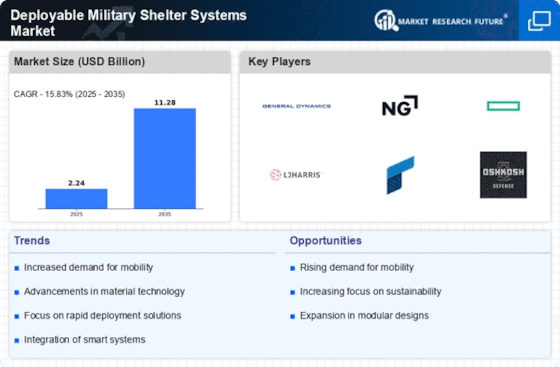
Deployable Military Shelter Systems Market Infographic
Purchase Options

Market Trends

Key Emerging Trends in the Deployable Military Shelter Systems Market

The deployable military shelter systems market is witnessing significant growth and evolution, driven by advancements in materials technology, changing military operational requirements, and the increasing demand for mobile and rapidly deployable shelter solutions. Deployable military shelters play a critical role in providing temporary housing, command and control centers, medical facilities, and storage units for military personnel and equipment in the field. One prominent trend in this market is the development of lightweight, durable, and modular shelter systems that offer improved mobility, versatility, and ease of deployment to meet the diverse needs of military forces worldwide.

One of the key drivers of growth in the deployable military shelter systems market is the increasing focus on expeditionary warfare and expeditionary logistics by military organizations around the world. With the rise of asymmetric threats, regional conflicts, and humanitarian crises, there is a growing need for military forces to rapidly deploy and establish operational bases, forward operating sites, and field hospitals in remote or austere environments. Deployable shelters provide soldiers with protection from the elements, security, and comfort while maintaining operational readiness and agility in dynamic and unpredictable situations.

Moreover, advancements in materials science, manufacturing processes, and shelter design are driving innovation and differentiation in the deployable military shelter systems market. Manufacturers are developing shelters made from lightweight and high-strength materials such as composite fabrics, synthetic textiles, and engineered polymers to reduce weight and volume while maintaining structural integrity and durability. Additionally, modular shelter systems enable rapid assembly, disassembly, and reconfiguration of shelter configurations to adapt to changing mission requirements and operational scenarios.

Another significant trend in the deployable military shelter systems market is the integration of advanced features and technologies into shelter designs to enhance functionality, comfort, and sustainability. Deployable shelters may include features such as integrated heating, ventilation, and air conditioning (HVAC) systems, lighting, insulation, and electrical outlets to provide soldiers with a safe and comfortable living and working environment in harsh and remote environments. Additionally, solar panels, energy storage systems, and water purification units enable shelters to operate independently off-grid, reducing reliance on external logistics support and enhancing sustainability during prolonged deployments.

Furthermore, the increasing adoption of expeditionary base camps and modular expeditionary base camps (MEBCs) by military forces is driving demand for deployable shelter systems that can be rapidly deployed and interconnected to create scalable and adaptable base camp configurations. MEBCs consist of interconnected shelters, tents, and support facilities such as kitchens, latrines, and workshops, providing soldiers with a self-contained and secure operating environment for extended deployments. Additionally, advancements in shelter logistics and supply chain management enable military forces to pre-position and pre-pack deployable shelter systems for rapid deployment and setup in response to emerging crises and contingencies.


Author
Author Profile
Abbas Raut
Research Analyst

Abbas Raut is a Senior Research Analyst with 5+ years of experience delivering data-driven insights and strategic recommendations across the Automotive and Aerospace & Defense sectors. He specializes in emerging technologies, industry value chains, and global market dynamics shaping the future of mobility and defense. In automotive, Abbas has led studies on EVs, charging stations, BMS, superchargers, and more, guiding stakeholders through electrification and regulatory shifts. In Aerospace & Defense, he has analyzed markets for military electronics, drones, radars, and electronic warfare solutions, supporting procurement and investment strategies. With expertise in market sizing, forecasting, benchmarking, and technology adoption, Abbas is known for transforming complex datasets into actionable insights that drive strategy, innovation, and growth.

Leave a Comment

FAQs

What is the projected market valuation for the Deployable Military Shelter Systems Market in 2035?

<p>The projected market valuation for the Deployable Military Shelter Systems Market in 2035 is expected to reach 11.28 USD Billion.</p>

What was the market valuation for Deployable Military Shelter Systems in 2024?

The market valuation for Deployable Military Shelter Systems in 2024 was 2.239 USD Billion.

What is the expected CAGR for the Deployable Military Shelter Systems Market from 2025 to 2035?

The expected CAGR for the Deployable Military Shelter Systems Market during the forecast period 2025 - 2035 is 15.83%.

Which companies are considered key players in the Deployable Military Shelter Systems Market?

Key players in the market include General Dynamics, Northrop Grumman, and L3Harris Technologies, among others.

What are the primary applications of Deployable Military Shelter Systems?

The primary applications include Military Operations, Humanitarian Assistance, Disaster Relief, and Training and Simulation.

What material types are predominantly used in Deployable Military Shelter Systems?

The predominant material types include Fabric, Aluminum, Steel, and Composite Materials.

What deployment types are available for Deployable Military Shelter Systems?

Deployment types include Rapid Deployment, Temporary Setup, and Mobile Deployment.

Who are the main end users of Deployable Military Shelter Systems?

Main end users include Defense Forces, Non-Governmental Organizations, and Civilian Agencies.

How does the market for Military Operations compare to other applications in 2025?

In 2025, the market for Military Operations is projected to be valued at 4.56 USD Billion, leading other applications.

What is the expected market size for Humanitarian Assistance by 2035?

The expected market size for Humanitarian Assistance by 2035 is projected to reach 2.28 USD Billion.

Market Summary

As per Market Research Future analysis, the Deployable Military Shelter Systems Market was estimated at 2.239 USD Billion in 2024. The Deployable Military Shelter Systems industry is projected to grow from 2.594 USD Billion in 2025 to 11.28 USD Billion by 2035, exhibiting a compound annual growth rate (CAGR) of 15.83% during the forecast period 2025 - 2035

Key Market Trends & Highlights

The Deployable Military Shelter Systems Market is experiencing robust growth driven by technological advancements and increasing demand for versatile solutions.

  • North America remains the largest market for deployable military shelter systems, driven by significant defense budgets and advanced military capabilities.
  • The Asia-Pacific region is emerging as the fastest-growing market, reflecting rising geopolitical tensions and increased military investments.
  • Military operations represent the largest segment, while humanitarian assistance is rapidly gaining traction due to heightened global response needs.
  • Technological advancements and a focus on sustainability are key drivers, as defense forces seek innovative and eco-friendly shelter solutions.

Market Size & Forecast

2024 Market Size 2.239 (USD Billion)
2035 Market Size 11.28 (USD Billion)
CAGR (2025 - 2035) 15.83%
Largest Regional Market Share in 2024 North America

Major Players

General Dynamics (US), Northrop Grumman (US), Hewlett Packard Enterprise (US), L3Harris Technologies (US), Rheinmetall (DE), Oshkosh Defense (US), BAE Systems (GB), Thales Group (FR), Textron (US)

Market Trends

The Deployable Military Shelter Systems Market is currently experiencing a notable evolution, driven by the increasing demand for rapid deployment capabilities in military operations. This market encompasses a variety of portable structures designed to provide essential shelter and support for personnel in diverse environments. As military forces around the globe prioritize operational readiness, the need for adaptable and efficient shelter solutions becomes increasingly apparent. The integration of advanced materials and technologies into these systems enhances their functionality, making them suitable for various applications, including command centers, medical facilities, and living quarters. Moreover, the emphasis on sustainability and environmental considerations is shaping the future of the Deployable Military Shelter Systems Market. Manufacturers are exploring eco-friendly materials and energy-efficient designs to align with modern military strategies that prioritize resource conservation. This shift not only addresses environmental concerns but also reflects a broader trend towards innovation in military logistics. As the landscape of military operations continues to evolve, the Deployable Military Shelter Systems Market is poised for growth, driven by the need for versatile, efficient, and sustainable shelter solutions that meet the demands of contemporary warfare and humanitarian missions.

Technological Advancements

The Deployable Military Shelter Systems Market is witnessing a surge in technological innovations. Enhanced materials, such as lightweight composites and modular designs, are being integrated into shelter systems, allowing for quicker assembly and disassembly. These advancements not only improve operational efficiency but also enhance the durability and functionality of shelters in various environments.

Focus on Sustainability

There is a growing emphasis on sustainability within the Deployable Military Shelter Systems Market. Manufacturers are increasingly adopting eco-friendly materials and energy-efficient technologies. This trend reflects a broader commitment to reducing the environmental impact of military operations while ensuring that shelter systems remain effective and reliable.

Increased Demand for Versatility

The need for versatile shelter solutions is becoming more pronounced in the Deployable Military Shelter Systems Market. Military forces are seeking adaptable systems that can serve multiple purposes, from command posts to medical facilities. This demand for multifunctionality drives innovation and encourages manufacturers to develop shelters that can be easily customized for various operational scenarios.

Deployable Military Shelter Systems Market Market Drivers

Geopolitical Tensions

Geopolitical tensions across various regions are driving the demand for deployable military shelter systems Market. As nations face increasing security challenges, military forces are compelled to enhance their readiness and response capabilities. This has led to a heightened focus on rapid deployment solutions, including advanced shelter systems that can be set up quickly in conflict zones. The market is expected to expand as countries invest in modernizing their military infrastructure, with projections indicating a potential increase in spending on deployable shelters by 20% over the next five years. Consequently, the Deployable Military Shelter Systems Market is likely to benefit from these heightened defense expenditures.

Focus on Sustainability

Sustainability is emerging as a pivotal driver within the Deployable Military Shelter Systems Market. Military organizations are increasingly prioritizing eco-friendly materials and energy-efficient designs in their shelter systems. This shift not only aligns with global sustainability goals but also reduces operational costs over time. The market is witnessing a growing trend towards the use of renewable energy sources, such as solar panels, integrated into shelter designs. Reports suggest that the adoption of sustainable practices could lead to a 15% reduction in lifecycle costs for military shelters. As environmental considerations become more critical, the Deployable Military Shelter Systems Market is likely to adapt, ensuring that sustainability remains at the forefront of development.

Emerging Defense Budgets

Emerging defense budgets in various nations are significantly influencing the Deployable Military Shelter Systems Market. Countries are increasingly recognizing the need to modernize their military capabilities, leading to increased allocations for defense spending. This trend is particularly evident in regions where military modernization is a priority, with some nations reporting budget increases of up to 10% annually. As defense budgets expand, the demand for advanced deployable shelter systems is expected to rise, as these shelters provide essential support for troops in the field. The Deployable Military Shelter Systems Market is poised to capitalize on this trend, as military forces seek to enhance their operational effectiveness through improved shelter solutions.

Technological Advancements

The Deployable Military Shelter Systems Market is experiencing a surge in technological advancements that enhance the functionality and efficiency of these systems. Innovations such as modular designs, lightweight materials, and integrated smart technologies are becoming increasingly prevalent. For instance, the incorporation of climate control systems and energy-efficient solutions is likely to improve the operational capabilities of shelters in diverse environments. Furthermore, the market is projected to grow at a compound annual growth rate of approximately 5.2% from 2025 to 2030, driven by these advancements. As military operations become more complex, the demand for shelters that can adapt to various scenarios is expected to rise, indicating a robust future for the Deployable Military Shelter Systems Market.

Increased Demand for Versatility

The need for versatile shelter solutions is a significant driver in the Deployable Military Shelter Systems Market. Military operations often require rapid deployment in various terrains and climates, necessitating shelters that can be easily adapted for different uses. This versatility includes configurations for command centers, medical facilities, and living quarters. The market is projected to see a notable increase in demand for multi-functional shelters, with estimates suggesting a growth rate of around 6% annually. As military forces seek to enhance operational readiness and adaptability, the Deployable Military Shelter Systems Market is likely to respond by offering more customizable and flexible solutions.

Market Segment Insights

By Application: Military Operations (Largest) vs. Humanitarian Assistance (Fastest-Growing)

<p>In the Deployable Military Shelter Systems Market, the application segment is characterized by a distribution where Military Operations takes the lead in market share, driven by ongoing military engagements and strategic deployment requirements. Humanitarian Assistance follows closely, with a significant share of applications stemming from global crises that necessitate rapid shelter solutions for displaced populations. Disaster Relief and Training & Simulation sectors contribute to market diversity but occupy a smaller portion of the segment, reflecting varying degrees of urgency and deployment frequency in both military and civilian contexts. Looking at growth trends, Military Operations remain a cornerstone of the market due to sustained defense spending and evolving military strategies. Meanwhile, the Humanitarian Assistance sector is emerging as the fastest-growing area, fuelled by increasing natural disasters and humanitarian crises worldwide, prompting urgent needs for deployable shelters. The Disaster Relief segment is also witnessing growth spurred by climate change's impact on disaster frequency, while the Training and Simulation sector is adapting to technological advancements that enhance training environments.</p>

<p>Military Operations (Dominant) vs. Disaster Relief (Emerging)</p>

<p>Military Operations represent the dominant force in the Deployable Military Shelter Systems Market, primarily due to the increasing demand for rapid, flexible, and secure deployment capabilities across various terrains and operational scenarios. These shelters are engineered for durability and quick setup, providing essential living spaces for personnel involved in active deployment. Conversely, the Emerging Disaster Relief segment has garnered attention recently as natural disasters escalate in frequency and severity, highlighting a growing need for immediate shelter solutions. Companies are innovating within this space to develop lightweight, easily transportable systems that can be rapidly deployed post-disaster. As aid organizations increasingly leverage technology for efficient distribution, the Disaster Relief segment is set to grow significantly, complementing the established Military Operations sector.</p>

By Material Type: Fabric (Largest) vs. Composite Materials (Fastest-Growing)

<p>In the Deployable Military Shelter Systems Market, the material type segment is primarily dominated by Fabric, which holds the largest share due to its lightweight nature, ease of deployment, and versatility in various terrains. Following closely are Aluminum and Steel, which are favored for their durability and strength. Composite Materials are gaining traction, characterized by their lightweight and high-performance features, presenting a competitive alternative. The growth trends in this segment are significantly influenced by advancements in material technology and the increasing need for rapid deployment solutions in military operations. The demand for more resilient and versatile shelter systems is driving interest in Composite Materials, which are rapidly becoming the fastest-growing segment due to their enhanced performance in various environmental conditions.</p>

<p>Fabric (Dominant) vs. Composite Materials (Emerging)</p>

<p>Fabric shelters are recognized for their dominance in the Deployable Military Shelter Systems Market, as they provide unmatched portability and quick deployment capabilities essential for military operations. These shelters are typically made from durable materials that can withstand adverse weather conditions, making them suitable for various operational theatres. Conversely, Composite Materials are emerging as a powerful alternative, leveraging innovative technologies to deliver superior strength-to-weight ratios and improved insulation properties. This positions them as favorable options for military planners looking to balance performance with rapid deployment needs. As both segments evolve, it will be essential for stakeholders to consider the specific operational requirements and constraints when choosing the appropriate material.</p>

By Deployment Type: Rapid Deployment (Largest) vs. Mobile Deployment (Fastest-Growing)

<p>In the Deployable Military Shelter Systems Market, the deployment type segment showcases significant diversity, with Rapid Deployment taking the lead due to its essential role in immediate military responses. This segment holds the largest market share, primarily driven by the increased demand for quick-response solutions in conflict zones and disaster relief efforts. Conversely, Mobile Deployment is emerging rapidly in this space, reflecting an increasing preference for flexibility and agility in military operations, spurred by advancements in technology and logistics. Growth trends within this segment are largely influenced by the evolving nature of military engagements, which require not just swift but also adaptable solutions. The rapid deployment of military shelters is increasingly focused on minimizing setup time, while Mobile Deployment is capitalizing on the need for deployable units that can be easily transported. The rise in defense budgets across various nations and the push for innovative solutions further fuel this growth, making deployment type a critical factor in the overall market trajectory.</p>

<p>Rapid Deployment (Dominant) vs. Mobile Deployment (Emerging)</p>

<p>The Rapid Deployment segment is characterized by its dominance in the Deployable Military Shelter Systems Market, largely driven by the military's need for immediate operational responses. These systems are designed for quick setup and teardown, often utilizing advanced materials that facilitate rapid assembly. This capability is particularly advantageous in crisis situations where time is of the essence. Meanwhile, Mobile Deployment is gaining traction as an emerging segment, responding to the military's need for adaptable and transportable shelter solutions. These systems are designed to be easily relocated, offering flexibility in various environments. The combination of advanced technology and intuitive designs in Mobile Deployment solutions makes them increasingly favorable for modern military operations, providing both comfort and security for personnel in dynamic situations.</p>

By End Use: Defense Forces (Largest) vs. Non-Governmental Organizations (Fastest-Growing)

<p>In the Deployable Military Shelter Systems Market, the predominant end use comes from Defense Forces, which hold a significant share of the overall market. This segment includes military personnel and infrastructure, which rely heavily on deployable shelters for strategic operations and logistics support. Non-Governmental Organizations, while smaller in share, are rapidly expanding due to increased humanitarian missions and disaster relief efforts necessitating temporary shelter solutions. The growth trends show a rising demand for deployable shelters from Non-Governmental Organizations as they adapt to various global crises, particularly in conflict zones and natural disasters. This segment is witnessing rapid adoption of advanced technologies and innovative designs to enhance functionality and comfort, indicating a shift towards more tailored solutions that meet specific operational needs and environments.</p>

<p>Defense Forces (Dominant) vs. Non-Governmental Organizations (Emerging)</p>

<p>The Defense Forces segment remains dominant within the Deployable Military Shelter Systems Market, driven by a consistent need for robust, reliable, and strategically deployable shelters. These facilities are engineered for various military applications, offering durability and adaptability in hostile environments. Features such as modular designs, rapid deployability, and advanced climate control enhance their utility, allowing for quick setup and effectiveness in diverse terrains. On the other hand, the Non-Governmental Organizations segment is emerging as a critical player, focusing on versatile and cost-effective shelter solutions to cater to humanitarian needs. These organizations often require shelters that are easy to transport and deploy swiftly, sometimes prioritizing lightweight structures that can accommodate diverse groups of people in disaster situations. Increasing collaborations between manufacturers and NGOs are also shaping this segment, ensuring that shelters meet both operational requirements and humanitarian standards.</p>

Get more detailed insights about Deployable Military Shelter Systems Market Research Report - Forecast till 2035

Regional Insights

North America : Defense Innovation Leader

North America is the largest market for deployable military shelter systems, accounting for approximately 45% of the global market share. The region's growth is driven by increasing defense budgets, technological advancements, and a focus on rapid deployment capabilities. Regulatory support from government agencies, including the Department of Defense, further catalyzes market expansion, emphasizing the need for modernized military infrastructure. The United States leads the market, with significant contributions from key players such as General Dynamics, Northrop Grumman, and L3Harris Technologies. The competitive landscape is characterized by innovation and collaboration among defense contractors, ensuring that the region remains at the forefront of military shelter technology. The presence of established firms fosters a robust ecosystem for research and development, enhancing the overall market dynamics.

Europe : Growing Defense Investments

Europe is witnessing a significant increase in demand for deployable military shelter systems, holding approximately 30% of the global market share. This growth is fueled by rising defense expenditures among NATO countries and a strategic focus on enhancing military readiness. Regulatory frameworks, such as the European Defence Fund, support collaborative defense projects, driving innovation and efficiency in military logistics and infrastructure. Leading countries in this region include Germany, France, and the United Kingdom, where companies like Rheinmetall and Thales Group are prominent players. The competitive landscape is evolving, with a mix of established defense contractors and emerging startups focusing on advanced shelter solutions. This dynamic environment fosters innovation and positions Europe as a key player in The Deployable Military Shelter Systems Market.

Asia-Pacific : Rapidly Expanding Defense Sector

Asia-Pacific is emerging as a significant market for deployable military shelter systems, accounting for approximately 20% of the global market share. The region's growth is driven by escalating defense budgets, geopolitical tensions, and a focus on enhancing military capabilities. Countries like India and Japan are investing heavily in modernizing their defense infrastructure, supported by government initiatives aimed at improving operational readiness and response times. Key players in this region include major defense contractors and local manufacturers, contributing to a competitive landscape that encourages innovation. The presence of companies like BAE Systems and Textron highlights the region's strategic importance in The Deployable Military Shelter Systems Market. As nations prioritize defense spending, the demand for advanced shelter systems is expected to rise significantly in the coming years.

Middle East and Africa : Strategic Defense Developments

The Middle East and Africa region is witnessing a growing demand for deployable military shelter systems, holding approximately 5% of the global market share. This growth is primarily driven by ongoing conflicts, regional instability, and the need for enhanced military logistics. Governments are increasingly recognizing the importance of modern military infrastructure, leading to investments in deployable solutions that can be rapidly deployed in crisis situations. Countries such as Saudi Arabia and the United Arab Emirates are at the forefront of this market, with significant investments in defense capabilities. The competitive landscape includes both international defense contractors and local firms, creating a diverse ecosystem for military shelter solutions. As regional tensions persist, the demand for effective and efficient military shelters is expected to grow, further shaping the market dynamics.

Key Players and Competitive Insights

The  Deployable Military Shelter Systems Market has been witnessing substantial growth due to increasing defense expenditures, a rising focus on advanced military infrastructure, and the strategic need for rapid deployment solutions. This market is characterized by a mix of established players and emerging companies, all vying for market share through innovation, enhanced product offerings, and strategic partnerships. Competitive insights reveal that players in this market are leveraging cutting-edge technologies and innovative materials to create versatile shelter systems that address a variety of military needs, such as mobile headquarters, medical facilities, and operational bases in remote or austere environments.
As tensions in various regions continue to escalate, the demand for these deployable systems is anticipated to grow, prompting companies to focus on agility and adaptability in their offerings, thereby enhancing their competitive positions. Textron stands out in the  Deployable Military Shelter Systems Market with its comprehensive portfolio of advanced shelter solutions designed for military and humanitarian applications. Known for its resilience in the face of market challenges, Textron leverages its engineering capabilities and extensive experience to deliver high-quality products that meet the rigorous demands of military operations.
The company's commitment to innovation is evident in its development of lightweight, easy-to-transport shelters that can be rapidly deployed in diverse environments. Furthermore, Textron's  presence ensures that it remains close to its customer base, which helps in understanding the unique requirements of different military organizations. Its established relationships with defense agencies and military contractors bolster its position in the market, making Textron a formidable competitor in the deployable shelter systems segment.
In the context of the  Deployable Military Shelter Systems Market, Palantir Technologies is recognized for its data analytics capabilities, enabling military organizations to effectively manage and utilize vast amounts of operational data. While primarily known for its software solutions, Palantir enhances the effectiveness of deployable shelter systems by integrating data-driven insights into their operations. The company's real-time analytics tools aid military personnel in decision-making processes during deployments, which is an important value-add for shelter systems. Palantir's strategic acquisitions bolster its technological capabilities and enhance its product offerings within the military logistics sector.
Its focus on developing partnerships with defense agencies and active involvement in  military training exercises positions Palantir as a significant player, providing tailored solutions that support military readiness and operational efficiency in various countries around the world.

Key Companies in the Deployable Military Shelter Systems Market include

Industry Developments

The  Deployable Military Shelter Systems Market is witnessing significant growth, fueled by increasing defense budgets in various countries and the rising demand for flexible military solutions. Companies such as Textron, BAE Systems, and Northrop Grumman are at the forefront of this development, focusing on advanced technologies and rapid deployment solutions. In October 2023, Textron announced a collaboration with L3Harris Technologies to enhance shelter capabilities through innovative modular designs. Concurrently, in September 2023, Rheinmetall secured a contract to supply deployable solutions to a major European military, reflecting increased investment in responsive technologies.

In terms of mergers and acquisitions, BAE Systems acquired a minority stake in Magellan Aerospace in February 2023 to strengthen its capabilities in systems integration and aerospace technologies. Moreover, the market has seen significant growth, with estimates suggesting a valuation surge of over 15% in the last two years. This expansion is underpinned by heightened military readiness and the necessity for rapid-setup capabilities worldwide, particularly in conflict zones and humanitarian missions. Overall, these developments illustrate a robust trajectory for the market, driven by innovation and strategic partnerships among key industry players.

Deployable Military Shelter Systems Market Application Outlook

    • Military Operations
    • Humanitarian Assistance
    • Disaster Relief
    • Training and Simulation

Deployable Military Shelter Systems Market Material Type Outlook

    • Fabric
    • Aluminum
    • Steel
    • Composite Materials

Deployable Military Shelter Systems Market Deployment Type Outlook

    • Rapid Deployment
    • Temporary Setup
    • Mobile Deployment

Deployable Military Shelter Systems Market End Use Outlook

    • Defense Forces
    • Non-Governmental Organizations
    • Civilian Agencies

Deployable Military Shelter Systems Market Regional Outlook

    • North America
    • Europe
    • South America
    • Asia Pacific
    • Middle East and Africa

Future Outlook

Deployable Military Shelter Systems Market Future Outlook

The Deployable Military Shelter Systems Market is projected to grow at a 15.83% CAGR from 2025 to 2035, driven by increasing military modernization and operational flexibility demands.

New opportunities lie in:

  • Integration of advanced modular designs for rapid deployment
  • Development of eco-friendly shelter materials for sustainability
  • Expansion into emerging markets with tailored solutions

By 2035, the market is expected to achieve robust growth, reflecting evolving military needs.

Market Segmentation

Deployable Military Shelter Systems Market End Use Outlook

  • Defense Forces
  • Non-Governmental Organizations
  • Civilian Agencies

Deployable Military Shelter Systems Market Application Outlook

  • Military Operations
  • Humanitarian Assistance
  • Disaster Relief
  • Training and Simulation

Deployable Military Shelter Systems Market Material Type Outlook

  • Fabric
  • Aluminum
  • Steel
  • Composite Materials

Deployable Military Shelter Systems Market Deployment Type Outlook

  • Rapid Deployment
  • Temporary Setup
  • Mobile Deployment

Report Scope

MARKET SIZE 2024 2.239(USD Billion)
MARKET SIZE 2025 2.594(USD Billion)
MARKET SIZE 2035 11.28(USD Billion)
COMPOUND ANNUAL GROWTH RATE (CAGR) 15.83% (2025 - 2035)
REPORT COVERAGE Revenue Forecast, Competitive Landscape, Growth Factors, and Trends
BASE YEAR 2024
Market Forecast Period 2025 - 2035
Historical Data 2019 - 2024
Market Forecast Units USD Billion
Key Companies Profiled General Dynamics (US), Northrop Grumman (US), Hewlett Packard Enterprise (US), L3Harris Technologies (US), Rheinmetall (DE), Oshkosh Defense (US), BAE Systems (GB), Thales Group (FR), Textron (US)
Segments Covered Application, Material Type, Deployment Type, End Use, Regional
Key Market Opportunities Integration of advanced materials and smart technologies enhances operational efficiency in the Deployable Military Shelter Systems Market.
Key Market Dynamics Rising demand for rapid deployment capabilities drives innovation in deployable military shelter systems and enhances competitive dynamics.
Countries Covered North America, Europe, APAC, South America, MEA

FAQs

What is the projected market valuation for the Deployable Military Shelter Systems Market in 2035?

<p>The projected market valuation for the Deployable Military Shelter Systems Market in 2035 is expected to reach 11.28 USD Billion.</p>

What was the market valuation for Deployable Military Shelter Systems in 2024?

The market valuation for Deployable Military Shelter Systems in 2024 was 2.239 USD Billion.

What is the expected CAGR for the Deployable Military Shelter Systems Market from 2025 to 2035?

The expected CAGR for the Deployable Military Shelter Systems Market during the forecast period 2025 - 2035 is 15.83%.

Which companies are considered key players in the Deployable Military Shelter Systems Market?

Key players in the market include General Dynamics, Northrop Grumman, and L3Harris Technologies, among others.

What are the primary applications of Deployable Military Shelter Systems?

The primary applications include Military Operations, Humanitarian Assistance, Disaster Relief, and Training and Simulation.

What material types are predominantly used in Deployable Military Shelter Systems?

The predominant material types include Fabric, Aluminum, Steel, and Composite Materials.

What deployment types are available for Deployable Military Shelter Systems?

Deployment types include Rapid Deployment, Temporary Setup, and Mobile Deployment.

Who are the main end users of Deployable Military Shelter Systems?

Main end users include Defense Forces, Non-Governmental Organizations, and Civilian Agencies.

How does the market for Military Operations compare to other applications in 2025?

In 2025, the market for Military Operations is projected to be valued at 4.56 USD Billion, leading other applications.

What is the expected market size for Humanitarian Assistance by 2035?

The expected market size for Humanitarian Assistance by 2035 is projected to reach 2.28 USD Billion.

  1. SECTION I: EXECUTIVE SUMMARY AND KEY HIGHLIGHTS
    1. | 1.1 EXECUTIVE SUMMARY
    2. | | 1.1.1 Market Overview
    3. | | 1.1.2 Key Findings
    4. | | 1.1.3 Market Segmentation
    5. | | 1.1.4 Competitive Landscape
    6. | | 1.1.5 Challenges and Opportunities
    7. | | 1.1.6 Future Outlook
  2. SECTION II: SCOPING, METHODOLOGY AND MARKET STRUCTURE
    1. | 2.1 MARKET INTRODUCTION
    2. | | 2.1.1 Definition
    3. | | 2.1.2 Scope of the study
    4. | | | 2.1.2.1 Research Objective
    5. | | | 2.1.2.2 Assumption
    6. | | | 2.1.2.3 Limitations
    7. | 2.2 RESEARCH METHODOLOGY
    8. | | 2.2.1 Overview
    9. | | 2.2.2 Data Mining
    10. | | 2.2.3 Secondary Research
    11. | | 2.2.4 Primary Research
    12. | | | 2.2.4.1 Primary Interviews and Information Gathering Process
    13. | | | 2.2.4.2 Breakdown of Primary Respondents
    14. | | 2.2.5 Forecasting Model
    15. | | 2.2.6 Market Size Estimation
    16. | | | 2.2.6.1 Bottom-Up Approach
    17. | | | 2.2.6.2 Top-Down Approach
    18. | | 2.2.7 Data Triangulation
    19. | | 2.2.8 Validation
  3. SECTION III: QUALITATIVE ANALYSIS
    1. | 3.1 MARKET DYNAMICS
    2. | | 3.1.1 Overview
    3. | | 3.1.2 Drivers
    4. | | 3.1.3 Restraints
    5. | | 3.1.4 Opportunities
    6. | 3.2 MARKET FACTOR ANALYSIS
    7. | | 3.2.1 Value chain Analysis
    8. | | 3.2.2 Porter's Five Forces Analysis
    9. | | | 3.2.2.1 Bargaining Power of Suppliers
    10. | | | 3.2.2.2 Bargaining Power of Buyers
    11. | | | 3.2.2.3 Threat of New Entrants
    12. | | | 3.2.2.4 Threat of Substitutes
    13. | | | 3.2.2.5 Intensity of Rivalry
    14. | | 3.2.3 COVID-19 Impact Analysis
    15. | | | 3.2.3.1 Market Impact Analysis
    16. | | | 3.2.3.2 Regional Impact
    17. | | | 3.2.3.3 Opportunity and Threat Analysis
  4. SECTION IV: QUANTITATIVE ANALYSIS
    1. | 4.1 Aerospace & Defense, BY Application (USD Billion)
    2. | | 4.1.1 Military Operations
    3. | | 4.1.2 Humanitarian Assistance
    4. | | 4.1.3 Disaster Relief
    5. | | 4.1.4 Training and Simulation
    6. | 4.2 Aerospace & Defense, BY Material Type (USD Billion)
    7. | | 4.2.1 Fabric
    8. | | 4.2.2 Aluminum
    9. | | 4.2.3 Steel
    10. | | 4.2.4 Composite Materials
    11. | 4.3 Aerospace & Defense, BY Deployment Type (USD Billion)
    12. | | 4.3.1 Rapid Deployment
    13. | | 4.3.2 Temporary Setup
    14. | | 4.3.3 Mobile Deployment
    15. | 4.4 Aerospace & Defense, BY End Use (USD Billion)
    16. | | 4.4.1 Defense Forces
    17. | | 4.4.2 Non-Governmental Organizations
    18. | | 4.4.3 Civilian Agencies
    19. | 4.5 Aerospace & Defense, BY Region (USD Billion)
    20. | | 4.5.1 North America
    21. | | | 4.5.1.1 US
    22. | | | 4.5.1.2 Canada
    23. | | 4.5.2 Europe
    24. | | | 4.5.2.1 Germany
    25. | | | 4.5.2.2 UK
    26. | | | 4.5.2.3 France
    27. | | | 4.5.2.4 Russia
    28. | | | 4.5.2.5 Italy
    29. | | | 4.5.2.6 Spain
    30. | | | 4.5.2.7 Rest of Europe
    31. | | 4.5.3 APAC
    32. | | | 4.5.3.1 China
    33. | | | 4.5.3.2 India
    34. | | | 4.5.3.3 Japan
    35. | | | 4.5.3.4 South Korea
    36. | | | 4.5.3.5 Malaysia
    37. | | | 4.5.3.6 Thailand
    38. | | | 4.5.3.7 Indonesia
    39. | | | 4.5.3.8 Rest of APAC
    40. | | 4.5.4 South America
    41. | | | 4.5.4.1 Brazil
    42. | | | 4.5.4.2 Mexico
    43. | | | 4.5.4.3 Argentina
    44. | | | 4.5.4.4 Rest of South America
    45. | | 4.5.5 MEA
    46. | | | 4.5.5.1 GCC Countries
    47. | | | 4.5.5.2 South Africa
    48. | | | 4.5.5.3 Rest of MEA
  5. SECTION V: COMPETITIVE ANALYSIS
    1. | 5.1 Competitive Landscape
    2. | | 5.1.1 Overview
    3. | | 5.1.2 Competitive Analysis
    4. | | 5.1.3 Market share Analysis
    5. | | 5.1.4 Major Growth Strategy in the Aerospace & Defense
    6. | | 5.1.5 Competitive Benchmarking
    7. | | 5.1.6 Leading Players in Terms of Number of Developments in the Aerospace & Defense
    8. | | 5.1.7 Key developments and growth strategies
    9. | | | 5.1.7.1 New Product Launch/Service Deployment
    10. | | | 5.1.7.2 Merger & Acquisitions
    11. | | | 5.1.7.3 Joint Ventures
    12. | | 5.1.8 Major Players Financial Matrix
    13. | | | 5.1.8.1 Sales and Operating Income
    14. | | | 5.1.8.2 Major Players R&D Expenditure. 2023
    15. | 5.2 Company Profiles
    16. | | 5.2.1 General Dynamics (US)
    17. | | | 5.2.1.1 Financial Overview
    18. | | | 5.2.1.2 Products Offered
    19. | | | 5.2.1.3 Key Developments
    20. | | | 5.2.1.4 SWOT Analysis
    21. | | | 5.2.1.5 Key Strategies
    22. | | 5.2.2 Northrop Grumman (US)
    23. | | | 5.2.2.1 Financial Overview
    24. | | | 5.2.2.2 Products Offered
    25. | | | 5.2.2.3 Key Developments
    26. | | | 5.2.2.4 SWOT Analysis
    27. | | | 5.2.2.5 Key Strategies
    28. | | 5.2.3 Hewlett Packard Enterprise (US)
    29. | | | 5.2.3.1 Financial Overview
    30. | | | 5.2.3.2 Products Offered
    31. | | | 5.2.3.3 Key Developments
    32. | | | 5.2.3.4 SWOT Analysis
    33. | | | 5.2.3.5 Key Strategies
    34. | | 5.2.4 L3Harris Technologies (US)
    35. | | | 5.2.4.1 Financial Overview
    36. | | | 5.2.4.2 Products Offered
    37. | | | 5.2.4.3 Key Developments
    38. | | | 5.2.4.4 SWOT Analysis
    39. | | | 5.2.4.5 Key Strategies
    40. | | 5.2.5 Rheinmetall (DE)
    41. | | | 5.2.5.1 Financial Overview
    42. | | | 5.2.5.2 Products Offered
    43. | | | 5.2.5.3 Key Developments
    44. | | | 5.2.5.4 SWOT Analysis
    45. | | | 5.2.5.5 Key Strategies
    46. | | 5.2.6 Oshkosh Defense (US)
    47. | | | 5.2.6.1 Financial Overview
    48. | | | 5.2.6.2 Products Offered
    49. | | | 5.2.6.3 Key Developments
    50. | | | 5.2.6.4 SWOT Analysis
    51. | | | 5.2.6.5 Key Strategies
    52. | | 5.2.7 BAE Systems (GB)
    53. | | | 5.2.7.1 Financial Overview
    54. | | | 5.2.7.2 Products Offered
    55. | | | 5.2.7.3 Key Developments
    56. | | | 5.2.7.4 SWOT Analysis
    57. | | | 5.2.7.5 Key Strategies
    58. | | 5.2.8 Thales Group (FR)
    59. | | | 5.2.8.1 Financial Overview
    60. | | | 5.2.8.2 Products Offered
    61. | | | 5.2.8.3 Key Developments
    62. | | | 5.2.8.4 SWOT Analysis
    63. | | | 5.2.8.5 Key Strategies
    64. | | 5.2.9 Textron (US)
    65. | | | 5.2.9.1 Financial Overview
    66. | | | 5.2.9.2 Products Offered
    67. | | | 5.2.9.3 Key Developments
    68. | | | 5.2.9.4 SWOT Analysis
    69. | | | 5.2.9.5 Key Strategies
    70. | 5.3 Appendix
    71. | | 5.3.1 References
    72. | | 5.3.2 Related Reports
  6. LIST OF FIGURES
    1. | 6.1 MARKET SYNOPSIS
    2. | 6.2 NORTH AMERICA MARKET ANALYSIS
    3. | 6.3 US MARKET ANALYSIS BY APPLICATION
    4. | 6.4 US MARKET ANALYSIS BY MATERIAL TYPE
    5. | 6.5 US MARKET ANALYSIS BY DEPLOYMENT TYPE
    6. | 6.6 US MARKET ANALYSIS BY END USE
    7. | 6.7 CANADA MARKET ANALYSIS BY APPLICATION
    8. | 6.8 CANADA MARKET ANALYSIS BY MATERIAL TYPE
    9. | 6.9 CANADA MARKET ANALYSIS BY DEPLOYMENT TYPE
    10. | 6.10 CANADA MARKET ANALYSIS BY END USE
    11. | 6.11 EUROPE MARKET ANALYSIS
    12. | 6.12 GERMANY MARKET ANALYSIS BY APPLICATION
    13. | 6.13 GERMANY MARKET ANALYSIS BY MATERIAL TYPE
    14. | 6.14 GERMANY MARKET ANALYSIS BY DEPLOYMENT TYPE
    15. | 6.15 GERMANY MARKET ANALYSIS BY END USE
    16. | 6.16 UK MARKET ANALYSIS BY APPLICATION
    17. | 6.17 UK MARKET ANALYSIS BY MATERIAL TYPE
    18. | 6.18 UK MARKET ANALYSIS BY DEPLOYMENT TYPE
    19. | 6.19 UK MARKET ANALYSIS BY END USE
    20. | 6.20 FRANCE MARKET ANALYSIS BY APPLICATION
    21. | 6.21 FRANCE MARKET ANALYSIS BY MATERIAL TYPE
    22. | 6.22 FRANCE MARKET ANALYSIS BY DEPLOYMENT TYPE
    23. | 6.23 FRANCE MARKET ANALYSIS BY END USE
    24. | 6.24 RUSSIA MARKET ANALYSIS BY APPLICATION
    25. | 6.25 RUSSIA MARKET ANALYSIS BY MATERIAL TYPE
    26. | 6.26 RUSSIA MARKET ANALYSIS BY DEPLOYMENT TYPE
    27. | 6.27 RUSSIA MARKET ANALYSIS BY END USE
    28. | 6.28 ITALY MARKET ANALYSIS BY APPLICATION
    29. | 6.29 ITALY MARKET ANALYSIS BY MATERIAL TYPE
    30. | 6.30 ITALY MARKET ANALYSIS BY DEPLOYMENT TYPE
    31. | 6.31 ITALY MARKET ANALYSIS BY END USE
    32. | 6.32 SPAIN MARKET ANALYSIS BY APPLICATION
    33. | 6.33 SPAIN MARKET ANALYSIS BY MATERIAL TYPE
    34. | 6.34 SPAIN MARKET ANALYSIS BY DEPLOYMENT TYPE
    35. | 6.35 SPAIN MARKET ANALYSIS BY END USE
    36. | 6.36 REST OF EUROPE MARKET ANALYSIS BY APPLICATION
    37. | 6.37 REST OF EUROPE MARKET ANALYSIS BY MATERIAL TYPE
    38. | 6.38 REST OF EUROPE MARKET ANALYSIS BY DEPLOYMENT TYPE
    39. | 6.39 REST OF EUROPE MARKET ANALYSIS BY END USE
    40. | 6.40 APAC MARKET ANALYSIS
    41. | 6.41 CHINA MARKET ANALYSIS BY APPLICATION
    42. | 6.42 CHINA MARKET ANALYSIS BY MATERIAL TYPE
    43. | 6.43 CHINA MARKET ANALYSIS BY DEPLOYMENT TYPE
    44. | 6.44 CHINA MARKET ANALYSIS BY END USE
    45. | 6.45 INDIA MARKET ANALYSIS BY APPLICATION
    46. | 6.46 INDIA MARKET ANALYSIS BY MATERIAL TYPE
    47. | 6.47 INDIA MARKET ANALYSIS BY DEPLOYMENT TYPE
    48. | 6.48 INDIA MARKET ANALYSIS BY END USE
    49. | 6.49 JAPAN MARKET ANALYSIS BY APPLICATION
    50. | 6.50 JAPAN MARKET ANALYSIS BY MATERIAL TYPE
    51. | 6.51 JAPAN MARKET ANALYSIS BY DEPLOYMENT TYPE
    52. | 6.52 JAPAN MARKET ANALYSIS BY END USE
    53. | 6.53 SOUTH KOREA MARKET ANALYSIS BY APPLICATION
    54. | 6.54 SOUTH KOREA MARKET ANALYSIS BY MATERIAL TYPE
    55. | 6.55 SOUTH KOREA MARKET ANALYSIS BY DEPLOYMENT TYPE
    56. | 6.56 SOUTH KOREA MARKET ANALYSIS BY END USE
    57. | 6.57 MALAYSIA MARKET ANALYSIS BY APPLICATION
    58. | 6.58 MALAYSIA MARKET ANALYSIS BY MATERIAL TYPE
    59. | 6.59 MALAYSIA MARKET ANALYSIS BY DEPLOYMENT TYPE
    60. | 6.60 MALAYSIA MARKET ANALYSIS BY END USE
    61. | 6.61 THAILAND MARKET ANALYSIS BY APPLICATION
    62. | 6.62 THAILAND MARKET ANALYSIS BY MATERIAL TYPE
    63. | 6.63 THAILAND MARKET ANALYSIS BY DEPLOYMENT TYPE
    64. | 6.64 THAILAND MARKET ANALYSIS BY END USE
    65. | 6.65 INDONESIA MARKET ANALYSIS BY APPLICATION
    66. | 6.66 INDONESIA MARKET ANALYSIS BY MATERIAL TYPE
    67. | 6.67 INDONESIA MARKET ANALYSIS BY DEPLOYMENT TYPE
    68. | 6.68 INDONESIA MARKET ANALYSIS BY END USE
    69. | 6.69 REST OF APAC MARKET ANALYSIS BY APPLICATION
    70. | 6.70 REST OF APAC MARKET ANALYSIS BY MATERIAL TYPE
    71. | 6.71 REST OF APAC MARKET ANALYSIS BY DEPLOYMENT TYPE
    72. | 6.72 REST OF APAC MARKET ANALYSIS BY END USE
    73. | 6.73 SOUTH AMERICA MARKET ANALYSIS
    74. | 6.74 BRAZIL MARKET ANALYSIS BY APPLICATION
    75. | 6.75 BRAZIL MARKET ANALYSIS BY MATERIAL TYPE
    76. | 6.76 BRAZIL MARKET ANALYSIS BY DEPLOYMENT TYPE
    77. | 6.77 BRAZIL MARKET ANALYSIS BY END USE
    78. | 6.78 MEXICO MARKET ANALYSIS BY APPLICATION
    79. | 6.79 MEXICO MARKET ANALYSIS BY MATERIAL TYPE
    80. | 6.80 MEXICO MARKET ANALYSIS BY DEPLOYMENT TYPE
    81. | 6.81 MEXICO MARKET ANALYSIS BY END USE
    82. | 6.82 ARGENTINA MARKET ANALYSIS BY APPLICATION
    83. | 6.83 ARGENTINA MARKET ANALYSIS BY MATERIAL TYPE
    84. | 6.84 ARGENTINA MARKET ANALYSIS BY DEPLOYMENT TYPE
    85. | 6.85 ARGENTINA MARKET ANALYSIS BY END USE
    86. | 6.86 REST OF SOUTH AMERICA MARKET ANALYSIS BY APPLICATION
    87. | 6.87 REST OF SOUTH AMERICA MARKET ANALYSIS BY MATERIAL TYPE
    88. | 6.88 REST OF SOUTH AMERICA MARKET ANALYSIS BY DEPLOYMENT TYPE
    89. | 6.89 REST OF SOUTH AMERICA MARKET ANALYSIS BY END USE
    90. | 6.90 MEA MARKET ANALYSIS
    91. | 6.91 GCC COUNTRIES MARKET ANALYSIS BY APPLICATION
    92. | 6.92 GCC COUNTRIES MARKET ANALYSIS BY MATERIAL TYPE
    93. | 6.93 GCC COUNTRIES MARKET ANALYSIS BY DEPLOYMENT TYPE
    94. | 6.94 GCC COUNTRIES MARKET ANALYSIS BY END USE
    95. | 6.95 SOUTH AFRICA MARKET ANALYSIS BY APPLICATION
    96. | 6.96 SOUTH AFRICA MARKET ANALYSIS BY MATERIAL TYPE
    97. | 6.97 SOUTH AFRICA MARKET ANALYSIS BY DEPLOYMENT TYPE
    98. | 6.98 SOUTH AFRICA MARKET ANALYSIS BY END USE
    99. | 6.99 REST OF MEA MARKET ANALYSIS BY APPLICATION
    100. | 6.100 REST OF MEA MARKET ANALYSIS BY MATERIAL TYPE
    101. | 6.101 REST OF MEA MARKET ANALYSIS BY DEPLOYMENT TYPE
    102. | 6.102 REST OF MEA MARKET ANALYSIS BY END USE
    103. | 6.103 KEY BUYING CRITERIA OF AEROSPACE & DEFENSE
    104. | 6.104 RESEARCH PROCESS OF MRFR
    105. | 6.105 DRO ANALYSIS OF AEROSPACE & DEFENSE
    106. | 6.106 DRIVERS IMPACT ANALYSIS: AEROSPACE & DEFENSE
    107. | 6.107 RESTRAINTS IMPACT ANALYSIS: AEROSPACE & DEFENSE
    108. | 6.108 SUPPLY / VALUE CHAIN: AEROSPACE & DEFENSE
    109. | 6.109 AEROSPACE & DEFENSE, BY APPLICATION, 2024 (% SHARE)
    110. | 6.110 AEROSPACE & DEFENSE, BY APPLICATION, 2024 TO 2035 (USD Billion)
    111. | 6.111 AEROSPACE & DEFENSE, BY MATERIAL TYPE, 2024 (% SHARE)
    112. | 6.112 AEROSPACE & DEFENSE, BY MATERIAL TYPE, 2024 TO 2035 (USD Billion)
    113. | 6.113 AEROSPACE & DEFENSE, BY DEPLOYMENT TYPE, 2024 (% SHARE)
    114. | 6.114 AEROSPACE & DEFENSE, BY DEPLOYMENT TYPE, 2024 TO 2035 (USD Billion)
    115. | 6.115 AEROSPACE & DEFENSE, BY END USE, 2024 (% SHARE)
    116. | 6.116 AEROSPACE & DEFENSE, BY END USE, 2024 TO 2035 (USD Billion)
    117. | 6.117 BENCHMARKING OF MAJOR COMPETITORS
  7. LIST OF TABLES
    1. | 7.1 LIST OF ASSUMPTIONS
    2. | | 7.1.1
    3. | 7.2 North America MARKET SIZE ESTIMATES; FORECAST
    4. | | 7.2.1 BY APPLICATION, 2025-2035 (USD Billion)
    5. | | 7.2.2 BY MATERIAL TYPE, 2025-2035 (USD Billion)
    6. | | 7.2.3 BY DEPLOYMENT TYPE, 2025-2035 (USD Billion)
    7. | | 7.2.4 BY END USE, 2025-2035 (USD Billion)
    8. | 7.3 US MARKET SIZE ESTIMATES; FORECAST
    9. | | 7.3.1 BY APPLICATION, 2025-2035 (USD Billion)
    10. | | 7.3.2 BY MATERIAL TYPE, 2025-2035 (USD Billion)
    11. | | 7.3.3 BY DEPLOYMENT TYPE, 2025-2035 (USD Billion)
    12. | | 7.3.4 BY END USE, 2025-2035 (USD Billion)
    13. | 7.4 Canada MARKET SIZE ESTIMATES; FORECAST
    14. | | 7.4.1 BY APPLICATION, 2025-2035 (USD Billion)
    15. | | 7.4.2 BY MATERIAL TYPE, 2025-2035 (USD Billion)
    16. | | 7.4.3 BY DEPLOYMENT TYPE, 2025-2035 (USD Billion)
    17. | | 7.4.4 BY END USE, 2025-2035 (USD Billion)
    18. | 7.5 Europe MARKET SIZE ESTIMATES; FORECAST
    19. | | 7.5.1 BY APPLICATION, 2025-2035 (USD Billion)
    20. | | 7.5.2 BY MATERIAL TYPE, 2025-2035 (USD Billion)
    21. | | 7.5.3 BY DEPLOYMENT TYPE, 2025-2035 (USD Billion)
    22. | | 7.5.4 BY END USE, 2025-2035 (USD Billion)
    23. | 7.6 Germany MARKET SIZE ESTIMATES; FORECAST
    24. | | 7.6.1 BY APPLICATION, 2025-2035 (USD Billion)
    25. | | 7.6.2 BY MATERIAL TYPE, 2025-2035 (USD Billion)
    26. | | 7.6.3 BY DEPLOYMENT TYPE, 2025-2035 (USD Billion)
    27. | | 7.6.4 BY END USE, 2025-2035 (USD Billion)
    28. | 7.7 UK MARKET SIZE ESTIMATES; FORECAST
    29. | | 7.7.1 BY APPLICATION, 2025-2035 (USD Billion)
    30. | | 7.7.2 BY MATERIAL TYPE, 2025-2035 (USD Billion)
    31. | | 7.7.3 BY DEPLOYMENT TYPE, 2025-2035 (USD Billion)
    32. | | 7.7.4 BY END USE, 2025-2035 (USD Billion)
    33. | 7.8 France MARKET SIZE ESTIMATES; FORECAST
    34. | | 7.8.1 BY APPLICATION, 2025-2035 (USD Billion)
    35. | | 7.8.2 BY MATERIAL TYPE, 2025-2035 (USD Billion)
    36. | | 7.8.3 BY DEPLOYMENT TYPE, 2025-2035 (USD Billion)
    37. | | 7.8.4 BY END USE, 2025-2035 (USD Billion)
    38. | 7.9 Russia MARKET SIZE ESTIMATES; FORECAST
    39. | | 7.9.1 BY APPLICATION, 2025-2035 (USD Billion)
    40. | | 7.9.2 BY MATERIAL TYPE, 2025-2035 (USD Billion)
    41. | | 7.9.3 BY DEPLOYMENT TYPE, 2025-2035 (USD Billion)
    42. | | 7.9.4 BY END USE, 2025-2035 (USD Billion)
    43. | 7.10 Italy MARKET SIZE ESTIMATES; FORECAST
    44. | | 7.10.1 BY APPLICATION, 2025-2035 (USD Billion)
    45. | | 7.10.2 BY MATERIAL TYPE, 2025-2035 (USD Billion)
    46. | | 7.10.3 BY DEPLOYMENT TYPE, 2025-2035 (USD Billion)
    47. | | 7.10.4 BY END USE, 2025-2035 (USD Billion)
    48. | 7.11 Spain MARKET SIZE ESTIMATES; FORECAST
    49. | | 7.11.1 BY APPLICATION, 2025-2035 (USD Billion)
    50. | | 7.11.2 BY MATERIAL TYPE, 2025-2035 (USD Billion)
    51. | | 7.11.3 BY DEPLOYMENT TYPE, 2025-2035 (USD Billion)
    52. | | 7.11.4 BY END USE, 2025-2035 (USD Billion)
    53. | 7.12 Rest of Europe MARKET SIZE ESTIMATES; FORECAST
    54. | | 7.12.1 BY APPLICATION, 2025-2035 (USD Billion)
    55. | | 7.12.2 BY MATERIAL TYPE, 2025-2035 (USD Billion)
    56. | | 7.12.3 BY DEPLOYMENT TYPE, 2025-2035 (USD Billion)
    57. | | 7.12.4 BY END USE, 2025-2035 (USD Billion)
    58. | 7.13 APAC MARKET SIZE ESTIMATES; FORECAST
    59. | | 7.13.1 BY APPLICATION, 2025-2035 (USD Billion)
    60. | | 7.13.2 BY MATERIAL TYPE, 2025-2035 (USD Billion)
    61. | | 7.13.3 BY DEPLOYMENT TYPE, 2025-2035 (USD Billion)
    62. | | 7.13.4 BY END USE, 2025-2035 (USD Billion)
    63. | 7.14 China MARKET SIZE ESTIMATES; FORECAST
    64. | | 7.14.1 BY APPLICATION, 2025-2035 (USD Billion)
    65. | | 7.14.2 BY MATERIAL TYPE, 2025-2035 (USD Billion)
    66. | | 7.14.3 BY DEPLOYMENT TYPE, 2025-2035 (USD Billion)
    67. | | 7.14.4 BY END USE, 2025-2035 (USD Billion)
    68. | 7.15 India MARKET SIZE ESTIMATES; FORECAST
    69. | | 7.15.1 BY APPLICATION, 2025-2035 (USD Billion)
    70. | | 7.15.2 BY MATERIAL TYPE, 2025-2035 (USD Billion)
    71. | | 7.15.3 BY DEPLOYMENT TYPE, 2025-2035 (USD Billion)
    72. | | 7.15.4 BY END USE, 2025-2035 (USD Billion)
    73. | 7.16 Japan MARKET SIZE ESTIMATES; FORECAST
    74. | | 7.16.1 BY APPLICATION, 2025-2035 (USD Billion)
    75. | | 7.16.2 BY MATERIAL TYPE, 2025-2035 (USD Billion)
    76. | | 7.16.3 BY DEPLOYMENT TYPE, 2025-2035 (USD Billion)
    77. | | 7.16.4 BY END USE, 2025-2035 (USD Billion)
    78. | 7.17 South Korea MARKET SIZE ESTIMATES; FORECAST
    79. | | 7.17.1 BY APPLICATION, 2025-2035 (USD Billion)
    80. | | 7.17.2 BY MATERIAL TYPE, 2025-2035 (USD Billion)
    81. | | 7.17.3 BY DEPLOYMENT TYPE, 2025-2035 (USD Billion)
    82. | | 7.17.4 BY END USE, 2025-2035 (USD Billion)
    83. | 7.18 Malaysia MARKET SIZE ESTIMATES; FORECAST
    84. | | 7.18.1 BY APPLICATION, 2025-2035 (USD Billion)
    85. | | 7.18.2 BY MATERIAL TYPE, 2025-2035 (USD Billion)
    86. | | 7.18.3 BY DEPLOYMENT TYPE, 2025-2035 (USD Billion)
    87. | | 7.18.4 BY END USE, 2025-2035 (USD Billion)
    88. | 7.19 Thailand MARKET SIZE ESTIMATES; FORECAST
    89. | | 7.19.1 BY APPLICATION, 2025-2035 (USD Billion)
    90. | | 7.19.2 BY MATERIAL TYPE, 2025-2035 (USD Billion)
    91. | | 7.19.3 BY DEPLOYMENT TYPE, 2025-2035 (USD Billion)
    92. | | 7.19.4 BY END USE, 2025-2035 (USD Billion)
    93. | 7.20 Indonesia MARKET SIZE ESTIMATES; FORECAST
    94. | | 7.20.1 BY APPLICATION, 2025-2035 (USD Billion)
    95. | | 7.20.2 BY MATERIAL TYPE, 2025-2035 (USD Billion)
    96. | | 7.20.3 BY DEPLOYMENT TYPE, 2025-2035 (USD Billion)
    97. | | 7.20.4 BY END USE, 2025-2035 (USD Billion)
    98. | 7.21 Rest of APAC MARKET SIZE ESTIMATES; FORECAST
    99. | | 7.21.1 BY APPLICATION, 2025-2035 (USD Billion)
    100. | | 7.21.2 BY MATERIAL TYPE, 2025-2035 (USD Billion)
    101. | | 7.21.3 BY DEPLOYMENT TYPE, 2025-2035 (USD Billion)
    102. | | 7.21.4 BY END USE, 2025-2035 (USD Billion)
    103. | 7.22 South America MARKET SIZE ESTIMATES; FORECAST
    104. | | 7.22.1 BY APPLICATION, 2025-2035 (USD Billion)
    105. | | 7.22.2 BY MATERIAL TYPE, 2025-2035 (USD Billion)
    106. | | 7.22.3 BY DEPLOYMENT TYPE, 2025-2035 (USD Billion)
    107. | | 7.22.4 BY END USE, 2025-2035 (USD Billion)
    108. | 7.23 Brazil MARKET SIZE ESTIMATES; FORECAST
    109. | | 7.23.1 BY APPLICATION, 2025-2035 (USD Billion)
    110. | | 7.23.2 BY MATERIAL TYPE, 2025-2035 (USD Billion)
    111. | | 7.23.3 BY DEPLOYMENT TYPE, 2025-2035 (USD Billion)
    112. | | 7.23.4 BY END USE, 2025-2035 (USD Billion)
    113. | 7.24 Mexico MARKET SIZE ESTIMATES; FORECAST
    114. | | 7.24.1 BY APPLICATION, 2025-2035 (USD Billion)
    115. | | 7.24.2 BY MATERIAL TYPE, 2025-2035 (USD Billion)
    116. | | 7.24.3 BY DEPLOYMENT TYPE, 2025-2035 (USD Billion)
    117. | | 7.24.4 BY END USE, 2025-2035 (USD Billion)
    118. | 7.25 Argentina MARKET SIZE ESTIMATES; FORECAST
    119. | | 7.25.1 BY APPLICATION, 2025-2035 (USD Billion)
    120. | | 7.25.2 BY MATERIAL TYPE, 2025-2035 (USD Billion)
    121. | | 7.25.3 BY DEPLOYMENT TYPE, 2025-2035 (USD Billion)
    122. | | 7.25.4 BY END USE, 2025-2035 (USD Billion)
    123. | 7.26 Rest of South America MARKET SIZE ESTIMATES; FORECAST
    124. | | 7.26.1 BY APPLICATION, 2025-2035 (USD Billion)
    125. | | 7.26.2 BY MATERIAL TYPE, 2025-2035 (USD Billion)
    126. | | 7.26.3 BY DEPLOYMENT TYPE, 2025-2035 (USD Billion)
    127. | | 7.26.4 BY END USE, 2025-2035 (USD Billion)
    128. | 7.27 MEA MARKET SIZE ESTIMATES; FORECAST
    129. | | 7.27.1 BY APPLICATION, 2025-2035 (USD Billion)
    130. | | 7.27.2 BY MATERIAL TYPE, 2025-2035 (USD Billion)
    131. | | 7.27.3 BY DEPLOYMENT TYPE, 2025-2035 (USD Billion)
    132. | | 7.27.4 BY END USE, 2025-2035 (USD Billion)
    133. | 7.28 GCC Countries MARKET SIZE ESTIMATES; FORECAST
    134. | | 7.28.1 BY APPLICATION, 2025-2035 (USD Billion)
    135. | | 7.28.2 BY MATERIAL TYPE, 2025-2035 (USD Billion)
    136. | | 7.28.3 BY DEPLOYMENT TYPE, 2025-2035 (USD Billion)
    137. | | 7.28.4 BY END USE, 2025-2035 (USD Billion)
    138. | 7.29 South Africa MARKET SIZE ESTIMATES; FORECAST
    139. | | 7.29.1 BY APPLICATION, 2025-2035 (USD Billion)
    140. | | 7.29.2 BY MATERIAL TYPE, 2025-2035 (USD Billion)
    141. | | 7.29.3 BY DEPLOYMENT TYPE, 2025-2035 (USD Billion)
    142. | | 7.29.4 BY END USE, 2025-2035 (USD Billion)
    143. | 7.30 Rest of MEA MARKET SIZE ESTIMATES; FORECAST
    144. | | 7.30.1 BY APPLICATION, 2025-2035 (USD Billion)
    145. | | 7.30.2 BY MATERIAL TYPE, 2025-2035 (USD Billion)
    146. | | 7.30.3 BY DEPLOYMENT TYPE, 2025-2035 (USD Billion)
    147. | | 7.30.4 BY END USE, 2025-2035 (USD Billion)
    148. | 7.31 PRODUCT LAUNCH/PRODUCT DEVELOPMENT/APPROVAL
    149. | | 7.31.1
    150. | 7.32 ACQUISITION/PARTNERSHIP
    151. | | 7.32.1

Aerospace & Defense Market Segmentation

Aerospace & Defense By Application (USD Billion, 2025-2035)

  • Military Operations
  • Humanitarian Assistance
  • Disaster Relief
  • Training and Simulation

Aerospace & Defense By Material Type (USD Billion, 2025-2035)

  • Fabric
  • Aluminum
  • Steel
  • Composite Materials

Aerospace & Defense By Deployment Type (USD Billion, 2025-2035)

  • Rapid Deployment
  • Temporary Setup
  • Mobile Deployment

Aerospace & Defense By End Use (USD Billion, 2025-2035)

  • Defense Forces
  • Non-Governmental Organizations
  • Civilian Agencies
Infographic

Free Sample Request

Kindly complete the form below to receive a free sample of this Report

Get Free Sample

Customer Strories

Compare Licence

×
Features License Type
Single User Multiuser License Enterprise User
Price $4,950 $5,950 $7,250
Maximum User Access Limit 1 User Upto 10 Users Unrestricted Access Throughout the Organization
Free Customization
Direct Access to Analyst
Deliverable Format
Platform Access
Discount on Next Purchase 10% 15% 15%
Printable Versions