×
Request Free Sample ×

Kindly complete the form below to receive a free sample of this Report

* Please use a valid business email

Leading companies partner with us for data-driven Insights

clients tt-cursor
Hero Background
English
Chinese
French
Japanese
Korean
German
Spanish

Decaf Coffee Market Size

ID: MRFR/FnB/7119-HCR
111 Pages
Snehal Singh
February 2026

Decaf Coffee Market Size, Share, Industry Trend & Analysis Research Report Information By Type (Arabica, Robusta, and Others), By Form (Ground and Whole), By Category (Organic and Conventional), By Distribution Channel (Store-Based, and Non-Store-Based), And By Region (North America, Europe, Asia-Pacific, And Rest Of The World) – Forecast Till 2035

Share:
Download PDF ×

We do not share your information with anyone. However, we may send you emails based on your report interest from time to time. You may contact us at any time to opt-out.

Decaf Coffee Market Infographic
Purchase Options

Decaf Coffee Size

Decaf Coffee Market Growth Projections and Opportunities

Several important variables that collectively contribute to the dynamics and evolution of the Decaf Coffee market. The increasing consciousness of health-conscious customers is one important aspect. There is an increasing demand for druthers that let consumers experience coffee's rich flavor without the stimulating effects of caffeine as people place a higher priority on their health. Decaf coffee meets this need by offering a good choice for those who choose to cut back on their caffeine intake or abstain from it completely. The demand for decaf coffee has increased as a result of this health-conscious trend. Additionally, the rise in markets is attributed to changes in consumer preferences and living circumstances. As the focus shifts to balanced lifestyles and conscious consumerism, people are assiduously searching for items that correspond with their health aspirations. In this industry, decaf coffee makes sense since it provides a beloved beverage without the concomitant negative effects of too much caffeine. Decaf coffee's adaptability—it comes in a variety of vibrant forms, including ground coffee, instant coffee, and even decaf coffee capsules—adds to its allure and promotes the diversity and growth of the demand. Technological developments have also had a significant impact on the demand for decaf coffee. The quality and flavor of decaffeinated coffee have improved due to advancements in decaffeination methods and preservation techniques. The goal of ultramodern designs is to minimize the loss of canvases and composites during the decaffeination process, while maintaining the flavor characteristic of ordinary coffee. The idea that decaf coffee preference worse has been subverted because to this improvement in the subtle aspects of the beverage, which has also contributed to the rise in demand. Profitable elements influence the availability of decaf coffee in a comparable way to disposable income and affordability. While speciality decaf coffee offerings and décor may appeal to a small market prepared to pay a premium for quality, price is still a crucial factor for a larger range of customers. Maintaining demand growth requires finding a balance between providing premium decaf coffee and making sure it's priced competitively. The market for decaf coffee is also impacted by regulatory reasons. Building customer confidence requires adherence to quality standards, labeling laws, and tools. The market for decaf coffee products gains credibility when clear and precise information about the decaffeination process, origin, and brewing instructions are provided. Consumers may pick decaf coffee with confidence as part of their daily routine since health and safety laws are followed. Marketing tactics have a significant influence on customer understanding and demand growth. Decaf coffee may become more widely known and more fashionable with the use of strong branding, advertising, and promotional marketing. By highlighting the superior flavor, high caliber, and health advantages of decaf coffee through eye-catching promotional materials, one may influence customer choices and encourage the growth of markets.
Decaf Coffee Market Size Graph
Author
Snehal Singh
Assistant Manager - Research

High acumen in analyzing complex macro & micro markets with more than 6 years of work experience in the field of market research. By implementing her analytical skills in forecasting and estimation into market research reports, she has expertise in Packaging, Construction, and Equipment domains. She handles a team size of 20-25 resources and ensures smooth running of the projects, associated marketing activities, and client servicing.

Leave a Comment

FAQs

What is the current valuation of The Global Decaf Coffee?

<p>The Global Decaf Coffee was valued at 20.37 USD Billion in 2024.</p>

What is the projected market size for The Global Decaf Coffee by 2035?

<p>The market is projected to reach 32.89 USD Billion by 2035.</p>

What is the expected CAGR for The Global Decaf Coffee during the forecast period?

<p>The expected CAGR for The Global Decaf Coffee from 2025 to 2035 is 4.45%.</p>

Which companies are considered key players in The Global Decaf Coffee?

<p>Key players include Starbucks, Nestle, Peet's Coffee, Kraft Heinz, Lavazza, Dunkin', Green Mountain Coffee Roasters, and Illycaffe.</p>

How does the market segment for Arabica and Robusta decaf coffee compare?

<p>In 2024, the market for Arabica decaf coffee was valued at 10.18 USD Billion, while Robusta was valued at 6.11 USD Billion.</p>

What are the projected values for organic and conventional decaf coffee categories by 2035?

<p>The organic decaf coffee category is projected to reach 12.5 USD Billion, while conventional is expected to reach 20.39 USD Billion by 2035.</p>

What is the market outlook for ground versus whole decaf coffee forms?

By 2035, the ground decaf coffee form is projected to reach 12.5 USD Billion, whereas whole decaf coffee is expected to reach 20.39 USD Billion.

How do store-based and non-store-based distribution channels compare in the decaf coffee market?

In 2024, store-based distribution was valued at 12.22 USD Billion, while non-store-based was valued at 8.15 USD Billion.

What trends are influencing the growth of The Global Decaf Coffee?

Trends such as increasing health consciousness and demand for organic products are likely to drive market growth.

What factors contribute to the competitive landscape of The Global Decaf Coffee?

The competitive landscape is shaped by product innovation, brand loyalty, and strategic partnerships among key players.

Market Summary

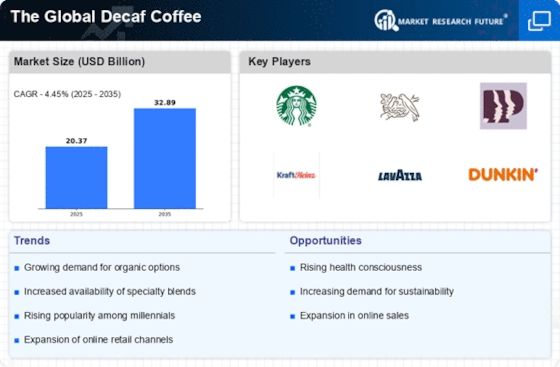
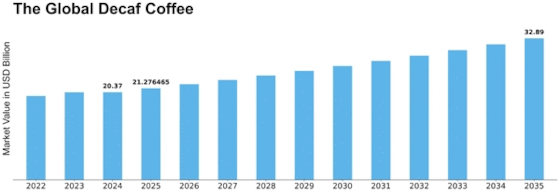
As per Market Research Future analysis, The Global Decaf Coffee Market Size was estimated at 20.37 USD Billion in 2024. The decaf coffee industry is projected to grow from 21.28 USD Billion in 2025 to 32.89 USD Billion by 2035, exhibiting a compound annual growth rate (CAGR) of 4.45% during the forecast period 2025 - 2035

Key Market Trends & Highlights

The Global Decaf Coffee Market is experiencing a notable shift towards health-conscious and specialty offerings.

  • North America remains the largest market for decaf coffee, driven by increasing health awareness among consumers. The Asia-Pacific region is emerging as the fastest-growing market, reflecting a rising demand for diverse coffee options. Arabica coffee continues to dominate the market, while Robusta is gaining traction due to its affordability and unique flavor profile. Health consciousness and sustainability trends are key drivers propelling the growth of organic decaf coffee offerings.

Market Size & Forecast

2024 Market Size 20.37 (USD Billion)
2035 Market Size 32.89 (USD Billion)
CAGR (2025 - 2035) 4.45%
Largest Regional Market Share in 2024 North America

Major Players

Starbucks (US), Nestle (CH), <a href="https://en.wikipedia.org/wiki/Peet%27s_Coffee">Peet's Coffee</a> (US), Kraft Heinz (US), Lavazza (IT), Dunkin' (US), Green Mountain Coffee Roasters (US), Illycaffe (IT)

Market Trends

The Global Decaf Coffee Market is currently experiencing a notable transformation, driven by evolving consumer preferences and a growing awareness of health benefits associated with decaffeinated beverages. As individuals increasingly seek alternatives to traditional caffeinated options, the demand for decaf coffee appears to be on the rise. This shift is likely influenced by a broader trend towards wellness and lifestyle choices that prioritize health-conscious consumption. Furthermore, the market seems to be benefiting from innovations in decaffeination processes, which enhance flavor profiles while maintaining the essential characteristics of coffee. In addition to health considerations, The Global Decaf Coffee Market is also witnessing a surge in specialty offerings. Consumers are becoming more discerning, seeking unique flavors and high-quality beans that cater to their refined tastes. This trend suggests that brands may need to adapt their strategies to meet the expectations of a more sophisticated audience. Moreover, the increasing availability of decaf options in cafes and retail outlets indicates a growing acceptance and integration of decaffeinated products into mainstream coffee culture. As the market continues to evolve, it is poised for further growth, driven by both consumer demand and industry innovation.

Health Consciousness

The rising awareness of health benefits associated with decaf coffee is influencing consumer choices. Individuals are increasingly opting for decaffeinated options to reduce caffeine intake while still enjoying the rich flavors of coffee.

Specialty Offerings

There is a noticeable trend towards specialty decaf coffee, with consumers seeking unique flavors and high-quality beans. This shift indicates a demand for premium products that cater to discerning palates.

Wider Availability

The expansion of decaf coffee options in cafes and retail stores reflects a growing acceptance of these products. This trend suggests that decaf coffee is becoming more integrated into mainstream coffee culture.

Decaf Coffee Market Market Drivers

Wider Availability

The expansion of distribution channels for decaf coffee products is a crucial factor propelling The Global Decaf Coffee Industry. Retailers, both online and brick-and-mortar, are increasingly stocking a diverse range of decaffeinated coffee options to meet growing consumer demand. This trend is evident in supermarkets, specialty stores, and e-commerce platforms, where decaf coffee is becoming more accessible. Market data suggests that the availability of decaf products has increased by over 30% in recent years, indicating a shift in retail strategies to cater to health-conscious consumers. As accessibility improves, The Global Decaf Coffee Industry is likely to benefit from heightened consumer interest and increased sales.

Specialty Offerings

The rise of specialty coffee shops and artisanal brands has significantly influenced The Global Decaf Coffee Industry. Consumers are increasingly drawn to unique and high-quality coffee experiences, which include a variety of decaffeinated options. Specialty roasters are now offering decaf blends that highlight distinct flavor profiles, appealing to discerning coffee drinkers. This trend is supported by market data indicating that specialty coffee sales, including decaf varieties, have been on the rise, reflecting a shift in consumer preferences. As more coffee enthusiasts seek out premium decaf options, The Global Decaf Coffee Industry is poised for expansion, driven by innovation and a focus on quality.

Health Consciousness

The increasing awareness of health and wellness among consumers appears to be a primary driver for The Global Decaf Coffee Industry. As individuals become more health-conscious, they seek alternatives to traditional caffeinated beverages. Decaf coffee, which retains the rich flavor of coffee without the stimulating effects of caffeine, is gaining traction. According to recent data, the demand for decaffeinated options has surged, with a notable increase in sales reported in various regions. This trend is particularly evident among demographics such as pregnant women and those with certain health conditions, who are advised to limit caffeine intake. Consequently, The Global Decaf Coffee Industry is likely to experience sustained growth as more consumers prioritize their health and opt for decaffeinated products.

Sustainability Trends

Sustainability has emerged as a significant driver in The Global Decaf Coffee Industry. Consumers are becoming more environmentally conscious, seeking products that align with their values. This trend has led to a growing demand for decaf coffee sourced from sustainable and ethical practices. Brands that emphasize organic and fair-trade certifications are particularly appealing to consumers who prioritize sustainability. Market data indicates that sales of sustainably sourced decaf coffee have increased, reflecting a broader shift towards eco-friendly consumption. As sustainability continues to shape consumer choices, The Global Decaf Coffee Industry is expected to adapt and thrive, offering products that resonate with environmentally aware consumers.

Innovative Brewing Methods

The advent of innovative brewing methods is reshaping The Global Decaf Coffee Industry. As consumers seek convenience and quality, new brewing technologies are emerging, allowing for enhanced flavor extraction in decaffeinated coffee. Methods such as cold brew and nitro coffee are gaining popularity, even among decaf options. This innovation is supported by market data showing a rise in sales of ready-to-drink decaf beverages, which cater to on-the-go consumers. As these brewing techniques become more mainstream, they are likely to attract a broader audience to the decaf segment. Consequently, The Global Decaf Coffee Industry may witness growth driven by the appeal of modern brewing solutions.

Market Segment Insights

By Type: Arabica (Largest) vs. Robusta (Fastest-Growing)

<p>In The Global Decaf Coffee, the segment distribution reveals that Arabica coffee holds the largest share, reflecting its popularity and preference among consumers worldwide. The smooth, balanced flavor profile of Arabica decaf makes it a top choice for many, contributing significantly to its dominance in the market. Conversely, Robusta, though currently smaller in market share, is emerging rapidly due to its stronger caffeine content and affordability, appealing to a different consumer base.</p>

<p>Arabica: Dominant vs. Robusta: Emerging</p>

<p>Arabica decaf coffee is recognized for its superior quality and taste, making it the dominant player in The Global Decaf Coffee. Its mild flavor and aromatic qualities attract a growing number of consumers who seek a premium coffee experience without the caffeine. In contrast, Robusta decaf is characterized by its robust flavor and higher caffeine levels, positioning it as the emerging choice among budget-conscious consumers or those preferring a more intense coffee. As consumer trends shift towards diverse offerings and sustainability, Robusta's cost-effectiveness and adaptability are driving its growth, setting the stage for increased competition within the market.</p>

By Category: Organic (Largest) vs. Conventional (Fastest-Growing)

<p>In The Global Decaf Coffee, the category segment is primarily dominated by organic decaf coffee, which caters to growing consumer preferences for sustainable and health-conscious products. Conventional decaf coffee, while traditional, still holds a significant market share, appealing to consumers seeking affordability and accessibility. The demand for organic decaf is driven by a shift in consumer behavior towards natural and environmentally-friendly products, thus shaping the market distribution dynamics favorably towards organic offerings. The growth trends in this segment indicate that organic decaf coffee is not only the largest segment but also shows substantial growth as consumers become more aware of the health benefits associated with organic products. Conversely, conventional decaf coffee ranks as the fastest-growing option due to its wide availability and the increasing interest in decaf options among regular coffee drinkers looking to reduce caffeine intake. Factors such as changing demographics and an increase in coffee consumption are pivotal in driving the growth of both categories, each addressing different consumer needs and market demands.</p>

<p>Organic (Dominant) vs. Conventional (Emerging)</p>

<p>Organic decaf coffee is recognized as the dominant category in the market, appealing to a niche of consumers who prioritize sustainability, quality, and specific health benefits associated with organic farming practices. It typically commands higher price points but offers unique flavor profiles and transparency in sourcing. In contrast, conventional decaf coffee is emerging strongly, attracting a growing segment of consumers prioritizing convenience and cost-effectiveness. This category often includes blends that are accessible and familiar to a wider audience. While organic options focus on niche marketing, conventional decaf is gradually evolving to offer vary local flavors and innovative products, thereby capturing the interest of diverse coffee drinkers seeking low-caffeine alternatives without compromising on taste.</p>

By Form: Ground (Largest) vs. Whole (Fastest-Growing)

<p>In The Global Decaf Coffee, the form segment is predominantly composed of Ground and Whole coffee products. Ground decaf coffee currently holds the largest market share, appealing to a broad customer base due to its convenience and ease of use. On the other hand, Whole decaf coffee, although smaller in comparison, is gaining traction among specialty coffee enthusiasts who favor freshness and flavor preservation that whole beans offer. This shift in preference underlines the diverse needs of consumers in the decaf coffee market.</p>

<p>Ground (Dominant) vs. Whole (Emerging)</p>

<p>Ground decaf coffee has established itself as the dominant form in the market, favored for its practicality and quick preparation. Consumers appreciate the ready-to-use nature of ground coffee, which fits seamlessly into a fast-paced lifestyle. In contrast, Whole decaf coffee is emerging as a trendy option among discerning coffee drinkers who prioritize quality and taste. This segment is driven by the growing demand for premium coffee experiences, with consumers increasingly opting for whole beans to grind at home, heightening flavor and aroma authenticity. The combination of these contrasting segments highlights the market's dynamic nature and the diverse preferences of consumers.</p>

By Distribution Channel: Store-Based (Largest) vs. Non-Store-Based (Fastest-Growing)

<p>The Global Decaf Coffee exhibits diverse distribution through various channels, with the store-based segment leading the market due to its established presence and consumer trust. In-store purchases allow customers to physically assess products, enhancing their purchasing confidence. On the other hand, the non-store-based segment, although smaller in market share, is rapidly gaining traction through online sales and direct-to-consumer models, responding to the changing shopping behavior in the digital era. Growth trends within the distribution channels are reflective of broader market dynamics. The increasing reliance on e-commerce and the convenience of home delivery are driving the non-store-based segment forward, making it the fastest-growing channel. Meanwhile, the store-based segment continues to benefit from brand loyalty and customer engagement strategies, ensuring a healthy competition between these two channels in the decaf coffee market.</p>

<p>Store-Based (Dominant) vs. Non-Store-Based (Emerging)</p>

<p>The store-based distribution channel remains the dominant force in The Global Decaf Coffee, characterized by its extensive reach and established consumer habits. This segment includes supermarkets, specialty coffee shops, and retail outlets that play a critical role in brand visibility and customer interaction. On the other hand, the non-store-based segment emerges as a dynamic player, leveraging e-commerce platforms and subscription services to cater to changing consumer preferences. This channel appeals particularly to younger consumers who prioritize convenience and digital engagement over traditional shopping experiences. As they both evolve, store-based channels invest in enhancing in-store experiences, while non-store-based firms capitalize on technology to enhance customer access and product availability.</p>

Get more detailed insights about Decaf Coffee Market Research Report - Global Forecast till 2035

Regional Insights

North America : Market Leader in Decaf Coffee Market

North America is the largest market for decaf coffee, holding approximately 45% of the global share. The region's growth is driven by increasing health consciousness among consumers, leading to a rising demand for decaffeinated options. Regulatory support for organic and sustainable coffee production further enhances market dynamics. The U.S. and Canada are the primary contributors, with a growing trend towards specialty decaf products. The competitive landscape in North America is robust, featuring key players such as Starbucks, Dunkin', and Peet's Coffee. These companies are innovating with new flavors and blends to attract health-conscious consumers. The presence of established brands and a strong retail network contribute to the region's dominance. Additionally, the trend towards online coffee sales is gaining traction, further expanding market reach.

Europe : Emerging Market for Decaf Coffee Market

Europe is witnessing a significant rise in decaf coffee consumption, accounting for approximately 30% of the global market share. The growth is fueled by increasing awareness of health benefits associated with decaffeinated coffee and a shift towards premium coffee experiences. Countries like Germany and the UK are leading this trend, supported by favorable regulations promoting sustainable coffee sourcing and production practices. The competitive landscape in Europe is characterized by a mix of local and international brands, including Lavazza and Illycaffe. The market is also seeing a surge in specialty coffee shops that offer a variety of decaf options. The presence of established players and a growing number of artisanal roasters are enhancing the market's appeal. As consumer preferences evolve, the demand for high-quality decaf products is expected to continue rising.

Asia-Pacific : Emerging Powerhouse in Coffee

The Asia-Pacific region is emerging as a significant player in The Global Decaf Coffee Market, holding about 15% of the market share. The growth is driven by rising disposable incomes, urbanization, and a growing coffee culture, particularly in countries like Japan and Australia. Regulatory initiatives promoting health and wellness are also contributing to the increasing demand for decaffeinated options. Leading countries in this region include Japan, Australia, and South Korea, where the coffee market is expanding rapidly. The competitive landscape features both local and international brands, with companies like Nestle and Green Mountain Coffee Roasters making significant inroads. The increasing popularity of specialty coffee shops and cafes is further driving the demand for decaf products, catering to a health-conscious consumer base.

Middle East and Africa : Untapped Potential in Coffee Market

The Middle East and Africa region is gradually recognizing the potential of the decaf coffee market, currently holding about 10% of the global share. The growth is primarily driven by changing consumer preferences and an increasing focus on health and wellness. Countries like South Africa and the UAE are leading this trend, supported by regulatory frameworks that encourage sustainable coffee sourcing and production practices. The competitive landscape is still developing, with a mix of local and international players entering the market. Key players are beginning to explore opportunities in decaf coffee, with a focus on premium and specialty products. As the coffee culture continues to evolve in this region, the demand for decaffeinated options is expected to grow, driven by a younger, health-conscious demographic.

Key Players and Competitive Insights

The Global Decaf Coffee is currently characterized by a dynamic competitive landscape, driven by evolving consumer preferences for healthier beverage options and the increasing demand for premium coffee products. Major players such as Starbucks (US), Nestle (CH), and Dunkin' (US) are strategically positioning themselves to capitalize on these trends through innovation and market expansion. Starbucks (US) has focused on enhancing its product offerings by introducing new decaf blends that cater to health-conscious consumers, while Nestle (CH) has been investing in sustainable sourcing practices to appeal to environmentally aware customers. Dunkin' (US), on the other hand, has been expanding its menu to include more decaf options, thereby broadening its appeal to a diverse customer base. Collectively, these strategies not only enhance brand loyalty but also intensify competition within the market.
In terms of business tactics, companies are increasingly localizing manufacturing and optimizing supply chains to reduce costs and improve efficiency. The competitive structure of the decaf coffee market appears moderately fragmented, with several key players vying for market share. This fragmentation allows for niche brands to emerge, yet the influence of major players remains substantial, as they set trends and standards that smaller companies often follow.
In August 2025, Starbucks (US) announced the launch of a new line of organic decaf coffee sourced from sustainable farms in South America. This initiative not only aligns with the growing consumer demand for organic products but also reinforces Starbucks' commitment to sustainability. By focusing on high-quality, ethically sourced ingredients, Starbucks aims to differentiate itself in a crowded market, potentially attracting a more discerning customer base.
In September 2025, Nestle (CH) unveiled a partnership with a leading technology firm to enhance its decaf coffee production through AI-driven quality control systems. This strategic move is indicative of Nestle's commitment to innovation and efficiency, as it seeks to streamline operations while ensuring product consistency. The integration of advanced technology into the production process may provide Nestle with a competitive edge, allowing for quicker responses to market demands and consumer preferences.
In October 2025, Dunkin' (US) launched a promotional campaign highlighting its new range of decaf beverages, which includes seasonal flavors aimed at attracting customers during the fall. This marketing strategy not only seeks to boost sales but also positions Dunkin' as a versatile player in the decaf segment. By leveraging seasonal trends, Dunkin' aims to enhance customer engagement and drive foot traffic to its stores.
As of October 2025, the competitive trends within The Global Decaf Coffee are increasingly defined by digitalization, sustainability, and the integration of advanced technologies. Strategic alliances are becoming more prevalent, as companies recognize the need to collaborate in order to enhance their market positions. Looking ahead, it is likely that competitive differentiation will evolve, shifting from traditional price-based competition to a focus on innovation, technological advancements, and supply chain reliability. This transition may ultimately reshape consumer expectations and redefine success within the market.

Key Companies in the Decaf Coffee Market include

Industry Developments

  • Q2 2024: Nestlé launches Nescafé Gold Decaf in recyclable packaging across Europe Nestlé announced the launch of its Nescafé Gold Decaf in new recyclable packaging, aiming to strengthen its sustainability credentials and expand its decaf coffee portfolio in major European markets.
  • Q1 2024: Starbucks introduces new Decaf Espresso Roast in U.S. stores Starbucks launched a new Decaf Espresso Roast, expanding its decaffeinated coffee offerings in U.S. retail locations to meet growing consumer demand for low-caffeine options.
  • Q2 2024: Peet’s Coffee debuts organic decaf blend nationwide Peet’s Coffee announced the nationwide release of its first certified organic decaf blend, targeting health-conscious consumers and expanding its specialty coffee portfolio.
  • Q3 2024: JDE Peet’s opens new decaf coffee production facility in Germany JDE Peet’s inaugurated a state-of-the-art decaffeinated coffee production facility in Bremen, Germany, increasing its capacity to meet rising European demand for decaf products.
  • Q2 2025: Lavazza acquires minority stake in Swiss Water Decaffeinated Coffee Inc. Lavazza announced the acquisition of a minority stake in Swiss Water Decaffeinated Coffee Inc., aiming to strengthen its position in the premium decaf coffee segment and access proprietary decaffeination technology.
  • Q1 2025: Illycaffè launches ready-to-drink decaf cold brew in European supermarkets Illycaffè introduced a new ready-to-drink decaf cold brew product in select European supermarkets, marking its entry into the growing decaf RTD coffee market.
  • Q4 2024: Keurig Dr Pepper partners with Rainforest Alliance for sustainable decaf sourcing Keurig Dr Pepper announced a partnership with the Rainforest Alliance to source sustainably grown decaf coffee beans for its Green Mountain Coffee brand, enhancing its ESG commitments.
  • Q2 2024: Costa Coffee expands decaf menu with new single-origin offering Costa Coffee launched a new single-origin decaf coffee sourced from Colombia, expanding its decaf menu and catering to specialty coffee enthusiasts.
  • Q3 2024: Swiss Water Decaffeinated Coffee Inc. announces $20M facility expansion Swiss Water Decaffeinated Coffee Inc. disclosed in an SEC filing the approval of a $20 million expansion of its decaffeination facility in British Columbia to meet growing global demand.
  • Q1 2025: Nestlé appoints new Head of Decaf Coffee Market Innovation Nestlé announced the appointment of Dr. Maria Rossi as Head of Decaf Coffee Market Innovation, signaling increased focus on product development and R&D in the decaf segment.
  • Q4 2024: Tchibo launches decaf coffee pods for European market Tchibo introduced a new line of decaf coffee pods compatible with major single-serve machines, expanding its product range in response to rising consumer demand for convenient decaf options.
  • Q2 2025: Blue Bottle Coffee secures $15M funding to expand decaf product line Blue Bottle Coffee raised $15 million in a funding round to support the development and marketing of new decaf coffee products, targeting health-conscious and specialty coffee consumers.

Future Outlook

Decaf Coffee Market Future Outlook

The Global Decaf Coffee Market is projected to grow at a 4.45% CAGR from 2025 to 2035, driven by increasing health consciousness and demand for premium products.

New opportunities lie in:

  • Expansion of online subscription services for decaf coffee delivery.
  • Development of innovative decaf coffee blends targeting niche markets.
  • Partnerships with health-focused cafes to promote decaf options.

By 2035, the market is expected to solidify its position as a key segment in the coffee industry.

Market Segmentation

Decaf Coffee Market Form Outlook

  • Ground
  • Whole

Decaf Coffee Market Type Outlook

  • Arabica
  • Robusta
  • Others

Decaf Coffee Market Category Outlook

  • Organic
  • Conventional

Decaf Coffee Market Distribution Channel Outlook

  • Store-Based
  • Non-Store-Based

Report Scope

MARKET SIZE 2024 20.37(USD Billion)
MARKET SIZE 2025 21.28(USD Billion)
MARKET SIZE 2035 32.89(USD Billion)
COMPOUND ANNUAL GROWTH RATE (CAGR) 4.45% (2025 - 2035)
REPORT COVERAGE Revenue Forecast, Competitive Landscape, Growth Factors, and Trends
BASE YEAR 2024
Market Forecast Period 2025 - 2035
Historical Data 2019 - 2024
Market Forecast Units USD Billion
Key Companies Profiled Starbucks (US), Nestle (CH), Peet's Coffee (US), Kraft Heinz (US), Lavazza (IT), Dunkin' (US), Green Mountain Coffee Roasters (US), Illycaffe (IT)
Segments Covered Type, Form, Category, Distribution Channel, Region
Key Market Opportunities Growing consumer preference for health-conscious beverages drives innovation in The Global Decaf Coffee.
Key Market Dynamics Rising consumer preference for healthier options drives demand for decaffeinated coffee across diverse markets.
Countries Covered North America, Europe, APAC, South America, MEA

FAQs

What is the current valuation of The Global Decaf Coffee?

<p>The Global Decaf Coffee was valued at 20.37 USD Billion in 2024.</p>

What is the projected market size for The Global Decaf Coffee by 2035?

<p>The market is projected to reach 32.89 USD Billion by 2035.</p>

What is the expected CAGR for The Global Decaf Coffee during the forecast period?

<p>The expected CAGR for The Global Decaf Coffee from 2025 to 2035 is 4.45%.</p>

Which companies are considered key players in The Global Decaf Coffee?

<p>Key players include Starbucks, Nestle, Peet's Coffee, Kraft Heinz, Lavazza, Dunkin', Green Mountain Coffee Roasters, and Illycaffe.</p>

How does the market segment for Arabica and Robusta decaf coffee compare?

<p>In 2024, the market for Arabica decaf coffee was valued at 10.18 USD Billion, while Robusta was valued at 6.11 USD Billion.</p>

What are the projected values for organic and conventional decaf coffee categories by 2035?

<p>The organic decaf coffee category is projected to reach 12.5 USD Billion, while conventional is expected to reach 20.39 USD Billion by 2035.</p>

What is the market outlook for ground versus whole decaf coffee forms?

By 2035, the ground decaf coffee form is projected to reach 12.5 USD Billion, whereas whole decaf coffee is expected to reach 20.39 USD Billion.

How do store-based and non-store-based distribution channels compare in the decaf coffee market?

In 2024, store-based distribution was valued at 12.22 USD Billion, while non-store-based was valued at 8.15 USD Billion.

What trends are influencing the growth of The Global Decaf Coffee?

Trends such as increasing health consciousness and demand for organic products are likely to drive market growth.

What factors contribute to the competitive landscape of The Global Decaf Coffee?

The competitive landscape is shaped by product innovation, brand loyalty, and strategic partnerships among key players.

  1. SECTION I: EXECUTIVE SUMMARY AND KEY HIGHLIGHTS
    1. | 1.1 EXECUTIVE SUMMARY
    2. | | 1.1.1 Market Overview
    3. | | 1.1.2 Key Findings
    4. | | 1.1.3 Market Segmentation
    5. | | 1.1.4 Competitive Landscape
    6. | | 1.1.5 Challenges and Opportunities
    7. | | 1.1.6 Future Outlook
  2. SECTION II: SCOPING, METHODOLOGY AND MARKET STRUCTURE
    1. | 2.1 MARKET INTRODUCTION
    2. | | 2.1.1 Definition
    3. | | 2.1.2 Scope of the study
    4. | | | 2.1.2.1 Research Objective
    5. | | | 2.1.2.2 Assumption
    6. | | | 2.1.2.3 Limitations
    7. | 2.2 RESEARCH METHODOLOGY
    8. | | 2.2.1 Overview
    9. | | 2.2.2 Data Mining
    10. | | 2.2.3 Secondary Research
    11. | | 2.2.4 Primary Research
    12. | | | 2.2.4.1 Primary Interviews and Information Gathering Process
    13. | | | 2.2.4.2 Breakdown of Primary Respondents
    14. | | 2.2.5 Forecasting Model
    15. | | 2.2.6 Market Size Estimation
    16. | | | 2.2.6.1 Bottom-Up Approach
    17. | | | 2.2.6.2 Top-Down Approach
    18. | | 2.2.7 Data Triangulation
    19. | | 2.2.8 Validation
  3. SECTION III: QUALITATIVE ANALYSIS
    1. | 3.1 MARKET DYNAMICS
    2. | | 3.1.1 Overview
    3. | | 3.1.2 Drivers
    4. | | 3.1.3 Restraints
    5. | | 3.1.4 Opportunities
    6. | 3.2 MARKET FACTOR ANALYSIS
    7. | | 3.2.1 Value chain Analysis
    8. | | 3.2.2 Porter's Five Forces Analysis
    9. | | | 3.2.2.1 Bargaining Power of Suppliers
    10. | | | 3.2.2.2 Bargaining Power of Buyers
    11. | | | 3.2.2.3 Threat of New Entrants
    12. | | | 3.2.2.4 Threat of Substitutes
    13. | | | 3.2.2.5 Intensity of Rivalry
    14. | | 3.2.3 COVID-19 Impact Analysis
    15. | | | 3.2.3.1 Market Impact Analysis
    16. | | | 3.2.3.2 Regional Impact
    17. | | | 3.2.3.3 Opportunity and Threat Analysis
  4. SECTION IV: QUANTITATIVE ANALYSIS
    1. | 4.1 Food, Beverages & Nutrition, BY Type (USD Billion)
    2. | | 4.1.1 Arabica
    3. | | 4.1.2 Robusta
    4. | | 4.1.3 Others
    5. | 4.2 Food, Beverages & Nutrition, BY Category (USD Billion)
    6. | | 4.2.1 Organic
    7. | | 4.2.2 Conventional
    8. | 4.3 Food, Beverages & Nutrition, BY Form (USD Billion)
    9. | | 4.3.1 Ground
    10. | | 4.3.2 Whole
    11. | 4.4 Food, Beverages & Nutrition, BY Distribution Channel (USD Billion)
    12. | | 4.4.1 Store-Based
    13. | | 4.4.2 Non-Store-Based
    14. | 4.5 Food, Beverages & Nutrition, BY Region (USD Billion)
    15. | | 4.5.1 North America
    16. | | | 4.5.1.1 US
    17. | | | 4.5.1.2 Canada
    18. | | 4.5.2 Europe
    19. | | | 4.5.2.1 Germany
    20. | | | 4.5.2.2 UK
    21. | | | 4.5.2.3 France
    22. | | | 4.5.2.4 Russia
    23. | | | 4.5.2.5 Italy
    24. | | | 4.5.2.6 Spain
    25. | | | 4.5.2.7 Rest of Europe
    26. | | 4.5.3 APAC
    27. | | | 4.5.3.1 China
    28. | | | 4.5.3.2 India
    29. | | | 4.5.3.3 Japan
    30. | | | 4.5.3.4 South Korea
    31. | | | 4.5.3.5 Malaysia
    32. | | | 4.5.3.6 Thailand
    33. | | | 4.5.3.7 Indonesia
    34. | | | 4.5.3.8 Rest of APAC
    35. | | 4.5.4 South America
    36. | | | 4.5.4.1 Brazil
    37. | | | 4.5.4.2 Mexico
    38. | | | 4.5.4.3 Argentina
    39. | | | 4.5.4.4 Rest of South America
    40. | | 4.5.5 MEA
    41. | | | 4.5.5.1 GCC Countries
    42. | | | 4.5.5.2 South Africa
    43. | | | 4.5.5.3 Rest of MEA
  5. SECTION V: COMPETITIVE ANALYSIS
    1. | 5.1 Competitive Landscape
    2. | | 5.1.1 Overview
    3. | | 5.1.2 Competitive Analysis
    4. | | 5.1.3 Market share Analysis
    5. | | 5.1.4 Major Growth Strategy in the Food, Beverages & Nutrition
    6. | | 5.1.5 Competitive Benchmarking
    7. | | 5.1.6 Leading Players in Terms of Number of Developments in the Food, Beverages & Nutrition
    8. | | 5.1.7 Key developments and growth strategies
    9. | | | 5.1.7.1 New Product Launch/Service Deployment
    10. | | | 5.1.7.2 Merger & Acquisitions
    11. | | | 5.1.7.3 Joint Ventures
    12. | | 5.1.8 Major Players Financial Matrix
    13. | | | 5.1.8.1 Sales and Operating Income
    14. | | | 5.1.8.2 Major Players R&D Expenditure. 2023
    15. | 5.2 Company Profiles
    16. | | 5.2.1 Starbucks (US)
    17. | | | 5.2.1.1 Financial Overview
    18. | | | 5.2.1.2 Products Offered
    19. | | | 5.2.1.3 Key Developments
    20. | | | 5.2.1.4 SWOT Analysis
    21. | | | 5.2.1.5 Key Strategies
    22. | | 5.2.2 Nestle (CH)
    23. | | | 5.2.2.1 Financial Overview
    24. | | | 5.2.2.2 Products Offered
    25. | | | 5.2.2.3 Key Developments
    26. | | | 5.2.2.4 SWOT Analysis
    27. | | | 5.2.2.5 Key Strategies
    28. | | 5.2.3 Peet's Coffee (US)
    29. | | | 5.2.3.1 Financial Overview
    30. | | | 5.2.3.2 Products Offered
    31. | | | 5.2.3.3 Key Developments
    32. | | | 5.2.3.4 SWOT Analysis
    33. | | | 5.2.3.5 Key Strategies
    34. | | 5.2.4 Kraft Heinz (US)
    35. | | | 5.2.4.1 Financial Overview
    36. | | | 5.2.4.2 Products Offered
    37. | | | 5.2.4.3 Key Developments
    38. | | | 5.2.4.4 SWOT Analysis
    39. | | | 5.2.4.5 Key Strategies
    40. | | 5.2.5 Lavazza (IT)
    41. | | | 5.2.5.1 Financial Overview
    42. | | | 5.2.5.2 Products Offered
    43. | | | 5.2.5.3 Key Developments
    44. | | | 5.2.5.4 SWOT Analysis
    45. | | | 5.2.5.5 Key Strategies
    46. | | 5.2.6 Dunkin' (US)
    47. | | | 5.2.6.1 Financial Overview
    48. | | | 5.2.6.2 Products Offered
    49. | | | 5.2.6.3 Key Developments
    50. | | | 5.2.6.4 SWOT Analysis
    51. | | | 5.2.6.5 Key Strategies
    52. | | 5.2.7 Green Mountain Coffee Roasters (US)
    53. | | | 5.2.7.1 Financial Overview
    54. | | | 5.2.7.2 Products Offered
    55. | | | 5.2.7.3 Key Developments
    56. | | | 5.2.7.4 SWOT Analysis
    57. | | | 5.2.7.5 Key Strategies
    58. | | 5.2.8 Illycaffe (IT)
    59. | | | 5.2.8.1 Financial Overview
    60. | | | 5.2.8.2 Products Offered
    61. | | | 5.2.8.3 Key Developments
    62. | | | 5.2.8.4 SWOT Analysis
    63. | | | 5.2.8.5 Key Strategies
    64. | 5.3 Appendix
    65. | | 5.3.1 References
    66. | | 5.3.2 Related Reports
  6. LIST OF FIGURES
    1. | 6.1 MARKET SYNOPSIS
    2. | 6.2 NORTH AMERICA MARKET ANALYSIS
    3. | 6.3 US MARKET ANALYSIS BY TYPE
    4. | 6.4 US MARKET ANALYSIS BY CATEGORY
    5. | 6.5 US MARKET ANALYSIS BY FORM
    6. | 6.6 US MARKET ANALYSIS BY DISTRIBUTION CHANNEL
    7. | 6.7 CANADA MARKET ANALYSIS BY TYPE
    8. | 6.8 CANADA MARKET ANALYSIS BY CATEGORY
    9. | 6.9 CANADA MARKET ANALYSIS BY FORM
    10. | 6.10 CANADA MARKET ANALYSIS BY DISTRIBUTION CHANNEL
    11. | 6.11 EUROPE MARKET ANALYSIS
    12. | 6.12 GERMANY MARKET ANALYSIS BY TYPE
    13. | 6.13 GERMANY MARKET ANALYSIS BY CATEGORY
    14. | 6.14 GERMANY MARKET ANALYSIS BY FORM
    15. | 6.15 GERMANY MARKET ANALYSIS BY DISTRIBUTION CHANNEL
    16. | 6.16 UK MARKET ANALYSIS BY TYPE
    17. | 6.17 UK MARKET ANALYSIS BY CATEGORY
    18. | 6.18 UK MARKET ANALYSIS BY FORM
    19. | 6.19 UK MARKET ANALYSIS BY DISTRIBUTION CHANNEL
    20. | 6.20 FRANCE MARKET ANALYSIS BY TYPE
    21. | 6.21 FRANCE MARKET ANALYSIS BY CATEGORY
    22. | 6.22 FRANCE MARKET ANALYSIS BY FORM
    23. | 6.23 FRANCE MARKET ANALYSIS BY DISTRIBUTION CHANNEL
    24. | 6.24 RUSSIA MARKET ANALYSIS BY TYPE
    25. | 6.25 RUSSIA MARKET ANALYSIS BY CATEGORY
    26. | 6.26 RUSSIA MARKET ANALYSIS BY FORM
    27. | 6.27 RUSSIA MARKET ANALYSIS BY DISTRIBUTION CHANNEL
    28. | 6.28 ITALY MARKET ANALYSIS BY TYPE
    29. | 6.29 ITALY MARKET ANALYSIS BY CATEGORY
    30. | 6.30 ITALY MARKET ANALYSIS BY FORM
    31. | 6.31 ITALY MARKET ANALYSIS BY DISTRIBUTION CHANNEL
    32. | 6.32 SPAIN MARKET ANALYSIS BY TYPE
    33. | 6.33 SPAIN MARKET ANALYSIS BY CATEGORY
    34. | 6.34 SPAIN MARKET ANALYSIS BY FORM
    35. | 6.35 SPAIN MARKET ANALYSIS BY DISTRIBUTION CHANNEL
    36. | 6.36 REST OF EUROPE MARKET ANALYSIS BY TYPE
    37. | 6.37 REST OF EUROPE MARKET ANALYSIS BY CATEGORY
    38. | 6.38 REST OF EUROPE MARKET ANALYSIS BY FORM
    39. | 6.39 REST OF EUROPE MARKET ANALYSIS BY DISTRIBUTION CHANNEL
    40. | 6.40 APAC MARKET ANALYSIS
    41. | 6.41 CHINA MARKET ANALYSIS BY TYPE
    42. | 6.42 CHINA MARKET ANALYSIS BY CATEGORY
    43. | 6.43 CHINA MARKET ANALYSIS BY FORM
    44. | 6.44 CHINA MARKET ANALYSIS BY DISTRIBUTION CHANNEL
    45. | 6.45 INDIA MARKET ANALYSIS BY TYPE
    46. | 6.46 INDIA MARKET ANALYSIS BY CATEGORY
    47. | 6.47 INDIA MARKET ANALYSIS BY FORM
    48. | 6.48 INDIA MARKET ANALYSIS BY DISTRIBUTION CHANNEL
    49. | 6.49 JAPAN MARKET ANALYSIS BY TYPE
    50. | 6.50 JAPAN MARKET ANALYSIS BY CATEGORY
    51. | 6.51 JAPAN MARKET ANALYSIS BY FORM
    52. | 6.52 JAPAN MARKET ANALYSIS BY DISTRIBUTION CHANNEL
    53. | 6.53 SOUTH KOREA MARKET ANALYSIS BY TYPE
    54. | 6.54 SOUTH KOREA MARKET ANALYSIS BY CATEGORY
    55. | 6.55 SOUTH KOREA MARKET ANALYSIS BY FORM
    56. | 6.56 SOUTH KOREA MARKET ANALYSIS BY DISTRIBUTION CHANNEL
    57. | 6.57 MALAYSIA MARKET ANALYSIS BY TYPE
    58. | 6.58 MALAYSIA MARKET ANALYSIS BY CATEGORY
    59. | 6.59 MALAYSIA MARKET ANALYSIS BY FORM
    60. | 6.60 MALAYSIA MARKET ANALYSIS BY DISTRIBUTION CHANNEL
    61. | 6.61 THAILAND MARKET ANALYSIS BY TYPE
    62. | 6.62 THAILAND MARKET ANALYSIS BY CATEGORY
    63. | 6.63 THAILAND MARKET ANALYSIS BY FORM
    64. | 6.64 THAILAND MARKET ANALYSIS BY DISTRIBUTION CHANNEL
    65. | 6.65 INDONESIA MARKET ANALYSIS BY TYPE
    66. | 6.66 INDONESIA MARKET ANALYSIS BY CATEGORY
    67. | 6.67 INDONESIA MARKET ANALYSIS BY FORM
    68. | 6.68 INDONESIA MARKET ANALYSIS BY DISTRIBUTION CHANNEL
    69. | 6.69 REST OF APAC MARKET ANALYSIS BY TYPE
    70. | 6.70 REST OF APAC MARKET ANALYSIS BY CATEGORY
    71. | 6.71 REST OF APAC MARKET ANALYSIS BY FORM
    72. | 6.72 REST OF APAC MARKET ANALYSIS BY DISTRIBUTION CHANNEL
    73. | 6.73 SOUTH AMERICA MARKET ANALYSIS
    74. | 6.74 BRAZIL MARKET ANALYSIS BY TYPE
    75. | 6.75 BRAZIL MARKET ANALYSIS BY CATEGORY
    76. | 6.76 BRAZIL MARKET ANALYSIS BY FORM
    77. | 6.77 BRAZIL MARKET ANALYSIS BY DISTRIBUTION CHANNEL
    78. | 6.78 MEXICO MARKET ANALYSIS BY TYPE
    79. | 6.79 MEXICO MARKET ANALYSIS BY CATEGORY
    80. | 6.80 MEXICO MARKET ANALYSIS BY FORM
    81. | 6.81 MEXICO MARKET ANALYSIS BY DISTRIBUTION CHANNEL
    82. | 6.82 ARGENTINA MARKET ANALYSIS BY TYPE
    83. | 6.83 ARGENTINA MARKET ANALYSIS BY CATEGORY
    84. | 6.84 ARGENTINA MARKET ANALYSIS BY FORM
    85. | 6.85 ARGENTINA MARKET ANALYSIS BY DISTRIBUTION CHANNEL
    86. | 6.86 REST OF SOUTH AMERICA MARKET ANALYSIS BY TYPE
    87. | 6.87 REST OF SOUTH AMERICA MARKET ANALYSIS BY CATEGORY
    88. | 6.88 REST OF SOUTH AMERICA MARKET ANALYSIS BY FORM
    89. | 6.89 REST OF SOUTH AMERICA MARKET ANALYSIS BY DISTRIBUTION CHANNEL
    90. | 6.90 MEA MARKET ANALYSIS
    91. | 6.91 GCC COUNTRIES MARKET ANALYSIS BY TYPE
    92. | 6.92 GCC COUNTRIES MARKET ANALYSIS BY CATEGORY
    93. | 6.93 GCC COUNTRIES MARKET ANALYSIS BY FORM
    94. | 6.94 GCC COUNTRIES MARKET ANALYSIS BY DISTRIBUTION CHANNEL
    95. | 6.95 SOUTH AFRICA MARKET ANALYSIS BY TYPE
    96. | 6.96 SOUTH AFRICA MARKET ANALYSIS BY CATEGORY
    97. | 6.97 SOUTH AFRICA MARKET ANALYSIS BY FORM
    98. | 6.98 SOUTH AFRICA MARKET ANALYSIS BY DISTRIBUTION CHANNEL
    99. | 6.99 REST OF MEA MARKET ANALYSIS BY TYPE
    100. | 6.100 REST OF MEA MARKET ANALYSIS BY CATEGORY
    101. | 6.101 REST OF MEA MARKET ANALYSIS BY FORM
    102. | 6.102 REST OF MEA MARKET ANALYSIS BY DISTRIBUTION CHANNEL
    103. | 6.103 KEY BUYING CRITERIA OF FOOD, BEVERAGES & NUTRITION
    104. | 6.104 RESEARCH PROCESS OF MRFR
    105. | 6.105 DRO ANALYSIS OF FOOD, BEVERAGES & NUTRITION
    106. | 6.106 DRIVERS IMPACT ANALYSIS: FOOD, BEVERAGES & NUTRITION
    107. | 6.107 RESTRAINTS IMPACT ANALYSIS: FOOD, BEVERAGES & NUTRITION
    108. | 6.108 SUPPLY / VALUE CHAIN: FOOD, BEVERAGES & NUTRITION
    109. | 6.109 FOOD, BEVERAGES & NUTRITION, BY TYPE, 2024 (% SHARE)
    110. | 6.110 FOOD, BEVERAGES & NUTRITION, BY TYPE, 2024 TO 2035 (USD Billion)
    111. | 6.111 FOOD, BEVERAGES & NUTRITION, BY CATEGORY, 2024 (% SHARE)
    112. | 6.112 FOOD, BEVERAGES & NUTRITION, BY CATEGORY, 2024 TO 2035 (USD Billion)
    113. | 6.113 FOOD, BEVERAGES & NUTRITION, BY FORM, 2024 (% SHARE)
    114. | 6.114 FOOD, BEVERAGES & NUTRITION, BY FORM, 2024 TO 2035 (USD Billion)
    115. | 6.115 FOOD, BEVERAGES & NUTRITION, BY DISTRIBUTION CHANNEL, 2024 (% SHARE)
    116. | 6.116 FOOD, BEVERAGES & NUTRITION, BY DISTRIBUTION CHANNEL, 2024 TO 2035 (USD Billion)
    117. | 6.117 BENCHMARKING OF MAJOR COMPETITORS
  7. LIST OF TABLES
    1. | 7.1 LIST OF ASSUMPTIONS
    2. | | 7.1.1
    3. | 7.2 North America MARKET SIZE ESTIMATES; FORECAST
    4. | | 7.2.1 BY TYPE, 2025-2035 (USD Billion)
    5. | | 7.2.2 BY CATEGORY, 2025-2035 (USD Billion)
    6. | | 7.2.3 BY FORM, 2025-2035 (USD Billion)
    7. | | 7.2.4 BY DISTRIBUTION CHANNEL, 2025-2035 (USD Billion)
    8. | 7.3 US MARKET SIZE ESTIMATES; FORECAST
    9. | | 7.3.1 BY TYPE, 2025-2035 (USD Billion)
    10. | | 7.3.2 BY CATEGORY, 2025-2035 (USD Billion)
    11. | | 7.3.3 BY FORM, 2025-2035 (USD Billion)
    12. | | 7.3.4 BY DISTRIBUTION CHANNEL, 2025-2035 (USD Billion)
    13. | 7.4 Canada MARKET SIZE ESTIMATES; FORECAST
    14. | | 7.4.1 BY TYPE, 2025-2035 (USD Billion)
    15. | | 7.4.2 BY CATEGORY, 2025-2035 (USD Billion)
    16. | | 7.4.3 BY FORM, 2025-2035 (USD Billion)
    17. | | 7.4.4 BY DISTRIBUTION CHANNEL, 2025-2035 (USD Billion)
    18. | 7.5 Europe MARKET SIZE ESTIMATES; FORECAST
    19. | | 7.5.1 BY TYPE, 2025-2035 (USD Billion)
    20. | | 7.5.2 BY CATEGORY, 2025-2035 (USD Billion)
    21. | | 7.5.3 BY FORM, 2025-2035 (USD Billion)
    22. | | 7.5.4 BY DISTRIBUTION CHANNEL, 2025-2035 (USD Billion)
    23. | 7.6 Germany MARKET SIZE ESTIMATES; FORECAST
    24. | | 7.6.1 BY TYPE, 2025-2035 (USD Billion)
    25. | | 7.6.2 BY CATEGORY, 2025-2035 (USD Billion)
    26. | | 7.6.3 BY FORM, 2025-2035 (USD Billion)
    27. | | 7.6.4 BY DISTRIBUTION CHANNEL, 2025-2035 (USD Billion)
    28. | 7.7 UK MARKET SIZE ESTIMATES; FORECAST
    29. | | 7.7.1 BY TYPE, 2025-2035 (USD Billion)
    30. | | 7.7.2 BY CATEGORY, 2025-2035 (USD Billion)
    31. | | 7.7.3 BY FORM, 2025-2035 (USD Billion)
    32. | | 7.7.4 BY DISTRIBUTION CHANNEL, 2025-2035 (USD Billion)
    33. | 7.8 France MARKET SIZE ESTIMATES; FORECAST
    34. | | 7.8.1 BY TYPE, 2025-2035 (USD Billion)
    35. | | 7.8.2 BY CATEGORY, 2025-2035 (USD Billion)
    36. | | 7.8.3 BY FORM, 2025-2035 (USD Billion)
    37. | | 7.8.4 BY DISTRIBUTION CHANNEL, 2025-2035 (USD Billion)
    38. | 7.9 Russia MARKET SIZE ESTIMATES; FORECAST
    39. | | 7.9.1 BY TYPE, 2025-2035 (USD Billion)
    40. | | 7.9.2 BY CATEGORY, 2025-2035 (USD Billion)
    41. | | 7.9.3 BY FORM, 2025-2035 (USD Billion)
    42. | | 7.9.4 BY DISTRIBUTION CHANNEL, 2025-2035 (USD Billion)
    43. | 7.10 Italy MARKET SIZE ESTIMATES; FORECAST
    44. | | 7.10.1 BY TYPE, 2025-2035 (USD Billion)
    45. | | 7.10.2 BY CATEGORY, 2025-2035 (USD Billion)
    46. | | 7.10.3 BY FORM, 2025-2035 (USD Billion)
    47. | | 7.10.4 BY DISTRIBUTION CHANNEL, 2025-2035 (USD Billion)
    48. | 7.11 Spain MARKET SIZE ESTIMATES; FORECAST
    49. | | 7.11.1 BY TYPE, 2025-2035 (USD Billion)
    50. | | 7.11.2 BY CATEGORY, 2025-2035 (USD Billion)
    51. | | 7.11.3 BY FORM, 2025-2035 (USD Billion)
    52. | | 7.11.4 BY DISTRIBUTION CHANNEL, 2025-2035 (USD Billion)
    53. | 7.12 Rest of Europe MARKET SIZE ESTIMATES; FORECAST
    54. | | 7.12.1 BY TYPE, 2025-2035 (USD Billion)
    55. | | 7.12.2 BY CATEGORY, 2025-2035 (USD Billion)
    56. | | 7.12.3 BY FORM, 2025-2035 (USD Billion)
    57. | | 7.12.4 BY DISTRIBUTION CHANNEL, 2025-2035 (USD Billion)
    58. | 7.13 APAC MARKET SIZE ESTIMATES; FORECAST
    59. | | 7.13.1 BY TYPE, 2025-2035 (USD Billion)
    60. | | 7.13.2 BY CATEGORY, 2025-2035 (USD Billion)
    61. | | 7.13.3 BY FORM, 2025-2035 (USD Billion)
    62. | | 7.13.4 BY DISTRIBUTION CHANNEL, 2025-2035 (USD Billion)
    63. | 7.14 China MARKET SIZE ESTIMATES; FORECAST
    64. | | 7.14.1 BY TYPE, 2025-2035 (USD Billion)
    65. | | 7.14.2 BY CATEGORY, 2025-2035 (USD Billion)
    66. | | 7.14.3 BY FORM, 2025-2035 (USD Billion)
    67. | | 7.14.4 BY DISTRIBUTION CHANNEL, 2025-2035 (USD Billion)
    68. | 7.15 India MARKET SIZE ESTIMATES; FORECAST
    69. | | 7.15.1 BY TYPE, 2025-2035 (USD Billion)
    70. | | 7.15.2 BY CATEGORY, 2025-2035 (USD Billion)
    71. | | 7.15.3 BY FORM, 2025-2035 (USD Billion)
    72. | | 7.15.4 BY DISTRIBUTION CHANNEL, 2025-2035 (USD Billion)
    73. | 7.16 Japan MARKET SIZE ESTIMATES; FORECAST
    74. | | 7.16.1 BY TYPE, 2025-2035 (USD Billion)
    75. | | 7.16.2 BY CATEGORY, 2025-2035 (USD Billion)
    76. | | 7.16.3 BY FORM, 2025-2035 (USD Billion)
    77. | | 7.16.4 BY DISTRIBUTION CHANNEL, 2025-2035 (USD Billion)
    78. | 7.17 South Korea MARKET SIZE ESTIMATES; FORECAST
    79. | | 7.17.1 BY TYPE, 2025-2035 (USD Billion)
    80. | | 7.17.2 BY CATEGORY, 2025-2035 (USD Billion)
    81. | | 7.17.3 BY FORM, 2025-2035 (USD Billion)
    82. | | 7.17.4 BY DISTRIBUTION CHANNEL, 2025-2035 (USD Billion)
    83. | 7.18 Malaysia MARKET SIZE ESTIMATES; FORECAST
    84. | | 7.18.1 BY TYPE, 2025-2035 (USD Billion)
    85. | | 7.18.2 BY CATEGORY, 2025-2035 (USD Billion)
    86. | | 7.18.3 BY FORM, 2025-2035 (USD Billion)
    87. | | 7.18.4 BY DISTRIBUTION CHANNEL, 2025-2035 (USD Billion)
    88. | 7.19 Thailand MARKET SIZE ESTIMATES; FORECAST
    89. | | 7.19.1 BY TYPE, 2025-2035 (USD Billion)
    90. | | 7.19.2 BY CATEGORY, 2025-2035 (USD Billion)
    91. | | 7.19.3 BY FORM, 2025-2035 (USD Billion)
    92. | | 7.19.4 BY DISTRIBUTION CHANNEL, 2025-2035 (USD Billion)
    93. | 7.20 Indonesia MARKET SIZE ESTIMATES; FORECAST
    94. | | 7.20.1 BY TYPE, 2025-2035 (USD Billion)
    95. | | 7.20.2 BY CATEGORY, 2025-2035 (USD Billion)
    96. | | 7.20.3 BY FORM, 2025-2035 (USD Billion)
    97. | | 7.20.4 BY DISTRIBUTION CHANNEL, 2025-2035 (USD Billion)
    98. | 7.21 Rest of APAC MARKET SIZE ESTIMATES; FORECAST
    99. | | 7.21.1 BY TYPE, 2025-2035 (USD Billion)
    100. | | 7.21.2 BY CATEGORY, 2025-2035 (USD Billion)
    101. | | 7.21.3 BY FORM, 2025-2035 (USD Billion)
    102. | | 7.21.4 BY DISTRIBUTION CHANNEL, 2025-2035 (USD Billion)
    103. | 7.22 South America MARKET SIZE ESTIMATES; FORECAST
    104. | | 7.22.1 BY TYPE, 2025-2035 (USD Billion)
    105. | | 7.22.2 BY CATEGORY, 2025-2035 (USD Billion)
    106. | | 7.22.3 BY FORM, 2025-2035 (USD Billion)
    107. | | 7.22.4 BY DISTRIBUTION CHANNEL, 2025-2035 (USD Billion)
    108. | 7.23 Brazil MARKET SIZE ESTIMATES; FORECAST
    109. | | 7.23.1 BY TYPE, 2025-2035 (USD Billion)
    110. | | 7.23.2 BY CATEGORY, 2025-2035 (USD Billion)
    111. | | 7.23.3 BY FORM, 2025-2035 (USD Billion)
    112. | | 7.23.4 BY DISTRIBUTION CHANNEL, 2025-2035 (USD Billion)
    113. | 7.24 Mexico MARKET SIZE ESTIMATES; FORECAST
    114. | | 7.24.1 BY TYPE, 2025-2035 (USD Billion)
    115. | | 7.24.2 BY CATEGORY, 2025-2035 (USD Billion)
    116. | | 7.24.3 BY FORM, 2025-2035 (USD Billion)
    117. | | 7.24.4 BY DISTRIBUTION CHANNEL, 2025-2035 (USD Billion)
    118. | 7.25 Argentina MARKET SIZE ESTIMATES; FORECAST
    119. | | 7.25.1 BY TYPE, 2025-2035 (USD Billion)
    120. | | 7.25.2 BY CATEGORY, 2025-2035 (USD Billion)
    121. | | 7.25.3 BY FORM, 2025-2035 (USD Billion)
    122. | | 7.25.4 BY DISTRIBUTION CHANNEL, 2025-2035 (USD Billion)
    123. | 7.26 Rest of South America MARKET SIZE ESTIMATES; FORECAST
    124. | | 7.26.1 BY TYPE, 2025-2035 (USD Billion)
    125. | | 7.26.2 BY CATEGORY, 2025-2035 (USD Billion)
    126. | | 7.26.3 BY FORM, 2025-2035 (USD Billion)
    127. | | 7.26.4 BY DISTRIBUTION CHANNEL, 2025-2035 (USD Billion)
    128. | 7.27 MEA MARKET SIZE ESTIMATES; FORECAST
    129. | | 7.27.1 BY TYPE, 2025-2035 (USD Billion)
    130. | | 7.27.2 BY CATEGORY, 2025-2035 (USD Billion)
    131. | | 7.27.3 BY FORM, 2025-2035 (USD Billion)
    132. | | 7.27.4 BY DISTRIBUTION CHANNEL, 2025-2035 (USD Billion)
    133. | 7.28 GCC Countries MARKET SIZE ESTIMATES; FORECAST
    134. | | 7.28.1 BY TYPE, 2025-2035 (USD Billion)
    135. | | 7.28.2 BY CATEGORY, 2025-2035 (USD Billion)
    136. | | 7.28.3 BY FORM, 2025-2035 (USD Billion)
    137. | | 7.28.4 BY DISTRIBUTION CHANNEL, 2025-2035 (USD Billion)
    138. | 7.29 South Africa MARKET SIZE ESTIMATES; FORECAST
    139. | | 7.29.1 BY TYPE, 2025-2035 (USD Billion)
    140. | | 7.29.2 BY CATEGORY, 2025-2035 (USD Billion)
    141. | | 7.29.3 BY FORM, 2025-2035 (USD Billion)
    142. | | 7.29.4 BY DISTRIBUTION CHANNEL, 2025-2035 (USD Billion)
    143. | 7.30 Rest of MEA MARKET SIZE ESTIMATES; FORECAST
    144. | | 7.30.1 BY TYPE, 2025-2035 (USD Billion)
    145. | | 7.30.2 BY CATEGORY, 2025-2035 (USD Billion)
    146. | | 7.30.3 BY FORM, 2025-2035 (USD Billion)
    147. | | 7.30.4 BY DISTRIBUTION CHANNEL, 2025-2035 (USD Billion)
    148. | 7.31 PRODUCT LAUNCH/PRODUCT DEVELOPMENT/APPROVAL
    149. | | 7.31.1
    150. | 7.32 ACQUISITION/PARTNERSHIP
    151. | | 7.32.1

Food, Beverages & Nutrition Market Segmentation

Food, Beverages & Nutrition By Type (USD Billion, 2025-2035)

  • Arabica
  • Robusta
  • Others

Food, Beverages & Nutrition By Category (USD Billion, 2025-2035)

  • Organic
  • Conventional

Food, Beverages & Nutrition By Form (USD Billion, 2025-2035)

  • Ground
  • Whole

Food, Beverages & Nutrition By Distribution Channel (USD Billion, 2025-2035)

  • Store-Based
  • Non-Store-Based
Infographic

Free Sample Request

Kindly complete the form below to receive a free sample of this Report

Get Free Sample

Customer Strories

Compare Licence

×
Features License Type
Single User Multiuser License Enterprise User
Price $4,950 $5,950 $7,250
Maximum User Access Limit 1 User Upto 10 Users Unrestricted Access Throughout the Organization
Free Customization
Direct Access to Analyst
Deliverable Format
Platform Access
Discount on Next Purchase 10% 15% 15%
Printable Versions