
Hero Background

Customer Analytics Market

Customer Analytics Market Size, Share and Research Report: By Solution (Web Analytical Tools, Social Analysis Tool, Reporting), Service (Professional Service And Support and Maintenance Service), Organization Size (Large Enterprises and SMEs), Deployment (Cloud And On-Premise), End-User (Healthcare, Hospitality and Travel, Media and Entertainment, Government and Defense, Telecommunication and IT, Manufacturing, BFSI, Transportation and Logistics, Retail), Region (North America, Europe, Asia-Pacific, Rest Of The World) –Market Forecast Till 2035
ID: MRFR/ICT/2504-HCR
100 Pages
Ankit Gupta
Last Updated: May 28, 2026
 

Customer Analytics Market Summary

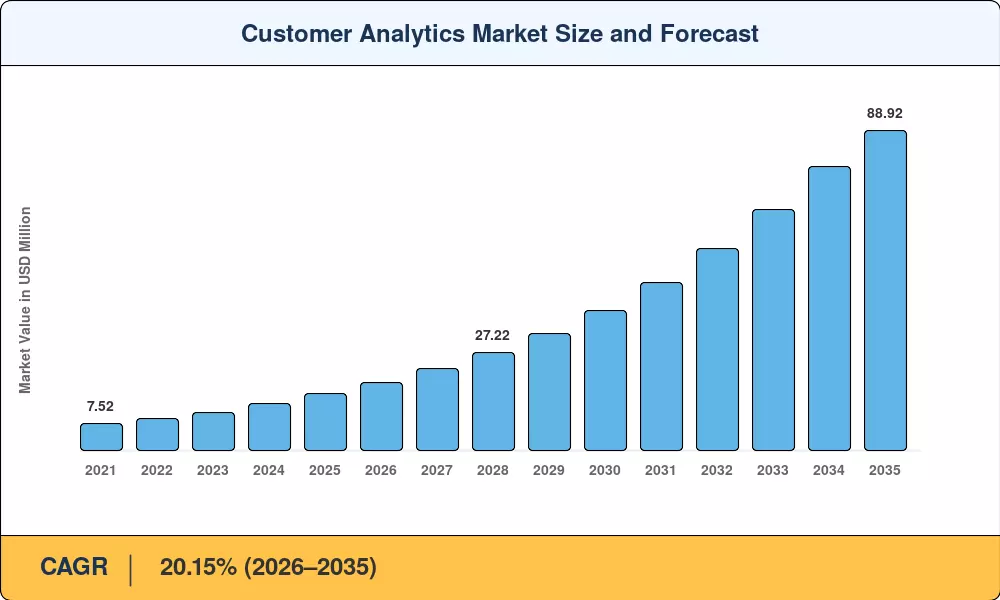
The Customer Analytics Market reached an estimated USD 15.86 billion in 2025, with the forecast period beginning at USD 18.85 billion in 2026 and projected to climb to USD 88.92 billion by 2035, reflecting a compound annual growth rate of 20.15% across the 2026–2035 window. Two catalysts are accelerating adoption: enterprises now allocate over 65% of their marketing technology budgets toward analytics-first platforms, and stricter data-governance mandates such as the EU Digital Markets Act are forcing brands to build first-party data capabilities rather than rely on third-party cookies [2]. Customer Analytics Market growth is anchored in a fundamental business shift — organizations that once measured campaign ROI quarterly now demand real-time customer behavior analysis delivered within minutes.

Legacy batch-processing data warehouses and static CRM dashboards are giving way to cloud-native analytics stacks powered by AI-driven customer segmentation tools and streaming-data architectures. According to IDC, global spending on customer-experience analytics platforms surpassed USD 9.4 billion in 2024, up 22% year over year. Predictive customer lifetime value modeling has moved from experimental pilot to production deployment inside Fortune 500 marketing operations, with Salesforce reporting that 58% of enterprise clients activated at least one predictive scoring module in 2024 [4].

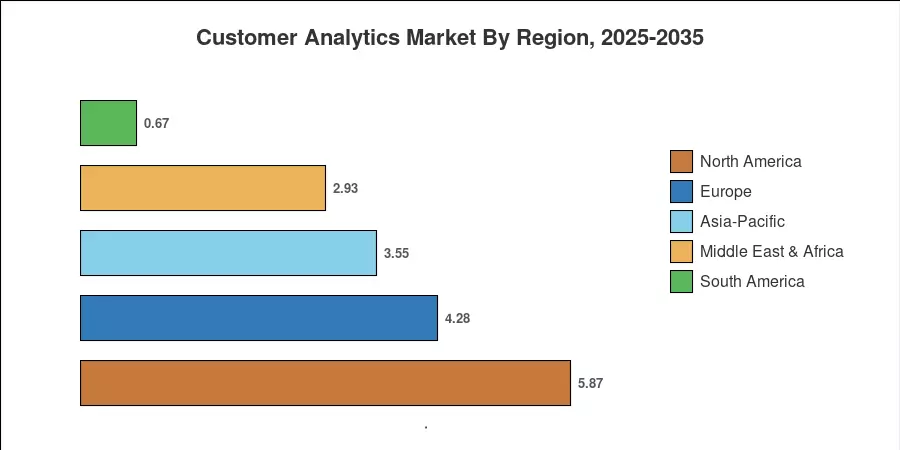
North America commands roughly 37% of the global Customer Analytics Market revenue, backed by Silicon Valley platform economics and early enterprise AI adoption Asia-Pacific is the fastest-growing region at a projected CAGR exceeding 22%, driven by India's digital-payments boom and China's super-app ecosystems. Europe holds the second-largest share, near 27%, underpinned by GDPR-driven demand for a compliant personalization engine for customer data solutions. As omnichannel commerce matures, the Customer Analytics Market is poised to become the backbone of every customer-facing function from acquisition through retention.

Key Report Takeaways

• By Deployment

  • Cloud-based deployments captured approximately 65% of Customer Analytics Market revenue in 2025, reflecting the dominance of scalable, pay-as-you-go architectures that minimize capital expenditure


• By Solution

  • Cloud-based deployments captured approximately 65% of Customer Analytics Market revenue in 2025, reflecting the dominance of scalable, pay-as-you-go architectures that minimize capital expenditure
  • AI-augmented analytics modules are forecast to grow at a CAGR of 25.6% through 2035, making them the fastest-expanding solution category as enterprises invest in customer churn prediction analytics
  • Dashboard and reporting tools accounted for USD 4.48 billion in 2025 revenue, serving as the entry point for organizations beginning their analytics journey

• By Organization Size

  • Large enterprises controlled roughly 67% of the Customer Analytics Market in 2025, leveraging dedicated data-science teams and multi-year platform contracts
  • Small and medium enterprises are growing at an annual rate near 20.8%, enabled by self-service AI-driven customer segmentation tools delivered through cloud marketplaces


• By Service

  • Large enterprises controlled roughly 67% of the Customer Analytics Market in 2025, leveraging dedicated data-science teams and multi-year platform contracts
  • Managed services represented approximately 58% of service revenue in 2025, as organizations outsource model maintenance and data-pipeline operations
  • Small and medium enterprises are growing at an annual rate near 20.8%, enabled by self-service AI-driven customer segmentation tools delivered through cloud marketplaces

• By Region

  • North America leads the Customer Analytics Market at roughly 37% global share, driven by mature digital advertising ecosystems and high per-capita martech spending
  • Asia-Pacific is projected to register the highest CAGR of approximately 22.4%, fueled by rapid mobile-commerce adoption in India and Southeast Asia
  • Europe contributed an estimated USD 4.28 billion in 2025, with GDPR compliance fueling demand for privacy-centric analytics platforms

Market Size and Forecast (2021–2035)

MRFR's market sizing integrates bottom-up revenue modeling from vendor disclosures, top-down cross-referencing against enterprise IT spending benchmarks from IDC and Gartner, and primary interviews with 120+ analytics decision-makers across verticals.
Market Size Chart
Our Impact
Enabled $4.3B Revenue Impact for Fortune 500 and Leading Multinationals
Partnering with 2000+ Global Organizations Each Year
30K+ Citations by Top-Tier Firms in the Industry
 

Driver Impact Analysis

Driver ~% Impact on CAGR Geographic Relevance Impact Timeline
AI/ML integration in analytics platforms ~3.8% Global Short-term (≤2 yr)
First-party data mandates (cookie deprecation) ~3.2% North America, Europe Short-term
Omnichannel commerce expansion ~2.9% Asia-Pacific, North America Medium-term (2–4 yr)
Real-time personalization demand ~2.5% Global Medium-term
Healthcare and BFSI vertical adoption ~2.1% North America, Europe Long-term (≥4 yr)
SME cloud migration ~1.8% Asia-Pacific, South America Medium-term
Data monetization via embedded analytics ~1.5% Global Long-term


AI and Machine Learning Integration

The infusion of machine learning into Customer Analytics Market platforms is the single largest growth accelerant. Google's 2024 announcement that its Customer Data Platform would embed predictive customer lifetime value modeling as a default feature signaled a tipping point — analytics moved from descriptive dashboards to prescriptive action engines. Gartner estimates that by 2027, 75% of B2C enterprises will deploy at least one AI-driven customer segmentation tool module in production, up from 38% in 2024. Real-time customer behavior analysis powered by transformer-based models now processes over 200 million events per second on hyperscaler infrastructure, enabling sub-second personalization at scale.

First-Party Data Mandates

Google’s progressive deprecation of third-party cookies in Chrome and Apple’s App Tracking Transparency framework have prompted advertisers to rebuild audience graphs around first-party signals [2]. In 2024, 72% of US marketers increased their Customer Analytics Market expenditure to compensate for signal loss, according to the Interactive Advertising Bureau [12]. Such regulatory-commercial pressure creates a demand for customer churn prediction analytics tools that extract predictive value from owned data assets.


Omnichannel Commerce Expansion

The convergence of in-store, mobile, social, and marketplace touchpoints creates a data-integration challenge that only unified analytics platforms can solve. Shopify's 2024 merchant survey found that brands using a personalization engine for customer data across three or more channels achieved 34% higher repeat-purchase rates than single-channel peers [6]. Asia-Pacific's social-commerce boom — projected at USD 1.3 trillion by 2028 — further amplifies the Customer Analytics Market growth trajectory as sellers demand cross-platform attribution.

Healthcare and Regulated-Vertical Adoption

Healthcare organizations spent an estimated USD 1.9 billion on patient-experience analytics in 2024 [8]. HIPAA-compliant analytics modules now support predictive patient engagement and readmission-risk scoring. The US Centers for Medicare & Medicaid Services tied 2025 reimbursement adjustments to patient-satisfaction metrics, creating a compliance-driven demand vector for Customer Analytics Market platforms in clinical and payer environments.


Restraints Impact Analysis

Restraint ~% Impact on CAGR Geographic Relevance Impact Timeline
Data privacy and sovereignty regulations ~−2.4% Europe, Asia-Pacific Short-term
Analytics talent shortage ~−1.8% Global Medium-term
Integration complexity with legacy systems ~−1.5% North America, Europe Medium-term
Data-quality and silo challenges ~−1.2% Global Long-term
Vendor lock-in concerns ~−0.9% Global Long-term


Data Privacy and Sovereignty Regulations

The EU's General Data Protection Regulation, India's Digital Personal Data Protection Act of 2023, and China's PIPL collectively govern data processing for over 4 billion people [2]. Compliance costs for multinational analytics deployments have risen 40% since 2022, according to the IAPP [13]. These mandates force Customer Analytics Market vendors to re-architect data pipelines for regional residency, fragmenting infrastructure and slowing time-to-value for cross-border programs.

Analytics Talent Shortage

LinkedIn's 2024 Workforce Report identified "customer data analyst" among the top-15 hardest-to-fill roles globally, with median vacancy durations exceeding 68 days [13]. The shortage constrains the adoption of advanced capabilities such as predictive customer lifetime value modeling and real-time customer behavior analysis, as organizations lack the internal expertise to configure and maintain complex models. Managed services partially mitigate this gap, but specialist talent remains a structural bottleneck for the Customer Analytics Market.

Integration Complexity with Legacy Systems

On-premises ERP and CRM stacks, still common in industrial and government, have 12-to-18-month integration cycles to adopt cloud-native analytics [14]. Middleware fees and API management overhead can add 25–35% to total project budgets, which will impact ROI estimates and delay purchasing decisions in the Customer Analytics Market.


Customer Analytics Market Opportunities

Edge Analytics for In-Store Personalization

Brick-and-mortar retailers deploying edge-compute nodes can deliver real-time customer behavior analysis at the shelf level, enabling dynamic pricing and targeted promotions without round-tripping data to the cloud The global edge-AI chipset market is projected to exceed USD 38 billion by 2030, creating a hardware foundation for on-premises Customer Analytics Market growth in physical retail.

Embedded Analytics and Data Monetization

SaaS platforms are embedding analytics directly into their applications — Shopify, HubSpot, and ServiceNow all launched native analytics modules in 2024 [10]. This "analytics-as-a-feature" model opens a data-monetization pathway where platform operators license AI-driven customer segmentation tools to their merchant or developer ecosystems, expanding the addressable Customer Analytics Market beyond traditional analytics buyers.

Emerging-Market Leapfrogging in Southeast Asia and Africa

Southeast Asian digital-economy GMV surpassed USD 218 billion in 2024, yet analytics penetration remains below 15% of eligible merchants [9]. Similarly, Africa's mobile-money ecosystem — over 850 million registered accounts — generates vast transactional datasets ripe for customer churn prediction analytics. These regions represent greenfield opportunities for the Customer Analytics Market

Privacy-Preserving Analytics and Clean Rooms

Data clean rooms and federated-learning frameworks allow brands to run a personalization engine for customer data workloads across partner datasets without exposing raw records Google and Meta both launched expanded clean-room services in 2024, and the segment is forecast to grow at 28% CAGR through 2030 [18]. This technology directly addresses the privacy-sovereignty restraint while sustaining Customer Analytics Market growth.

Generative AI for Insight Narration

Large language models are being incorporated into analytics dashboards to auto-generate executive summaries, campaign recommendations, and anomaly explanations in natural language. Early adopters have seen a 40% reduction in the time it takes to produce analyst reports, freeing up resources for higher-order strategic work and boosting Customer Analytics Market acceptance among non-technical business users.


Customer Analytics Market Future Outlook

Autonomous Analytics Agents

By 2030, Customer Analytics Market platforms will shift from insight delivery to autonomous action execution. AI agents will independently adjust campaign parameters, reallocate budgets, and trigger customer churn prediction analytics interventions without human approval loops. McKinsey estimates that agentic AI could automate 45% of marketing-operations tasks by 2028.

Composable Analytics Architectures

No more monolithic analytics suites. Enterprises will be able to compose best-of-breed modules for real-time customer behavior analysis, identity resolution, and attribution modeling from composable, API-first architectures. This evolution is a boon for specialist vendors and open source frameworks, which leads to fragmentation of the Customer Analytics Market and faster innovation velocity.


Privacy-First Personalization as Standard

Globally, regulators are moving towards consent-centric data regimes. By 2030, all major Customer Analytics Market platforms will have differential privacy, synthetic-data generation, and federated learning as default features (not premium add-ons) [18]. We shall see the customization engine for customer data running on privacy-preserving signals, which will significantly change the way AI-powered consumer segmentation tools work.


ESG and Ethical-AI Reporting

The EU AI Act's risk-classification framework requires analytics vendors to audit algorithmic bias in customer scoring models [24]. By 2028, Customer Analytics Market vendors will publish annual algorithmic-impact assessments alongside financial disclosures, and procurement teams will weigh ethical-AI certifications in vendor selection criteria.


Customer Analytics Market Segmentation

By Deployment Type

Segment Key Metric Primary Demand Driver
Cloud-Based ~65% share (2025) Scalable infrastructure, lower TCO
On-Premises CAGR ~8.5% (2026–2035) Data-sovereignty requirements


Cloud-based deployment dominates the Customer Analytics Market because enterprises prioritize operational agility and avoid capital expenditure on hardware. Hyperscaler partnerships — AWS, Azure, and GCP all offer managed analytics environments — further entrench the cloud's lead. On-premises solutions retain relevance in highly regulated verticals such as defense and healthcare, where data-residency mandates prevent cloud migration, but their growth trails significantly behind cloud alternatives.

By Solution

Segment Key Metric Primary Demand Driver
Dashboard & Reporting Tools USD 4.48 Billion (2025) Operational visibility, executive reporting
Social-Media Analytical Tools ~18% share (2025) Influencer ROI measurement
Web Analytical Tools CAGR ~17.5% (2026–2035) Conversion-rate optimization
AI-Augmented Analytics Modules CAGR ~25.6% (2026–2035) Predictive customer lifetime value modeling
Other Solutions ~12% share (2025) Voice-of-customer, survey analytics


AI-augmented analytics modules represent the highest-growth solution within the Customer Analytics Market, driven by enterprise demand for automated insight generation and customer churn prediction analytics. Dashboard and reporting tools remain the revenue anchor because every analytics deployment begins with visualization — even organizations deploying advanced AI-driven customer segmentation tools still rely on dashboards for stakeholder communication.

By Organization Size

Segment Key Metric Primary Demand Driver
Large Enterprises ~67% share (2025) Multi-brand analytics consolidation
Small & Medium Enterprises CAGR ~20.8% (2026–2035) Self-service cloud platforms


Large enterprises dominate the Customer Analytics Market spending because they operate complex, multi-channel customer ecosystems requiring integrated platforms. SMEs are closing the gap rapidly as vendors launch pre-configured analytics templates and AI-driven customer segmentation tools that eliminate the need for dedicated data-science headcount.

By Service

Segment Key Metric Primary Demand Driver
Managed Services ~58% share (2025) Outsourced data-pipeline management
Professional Services CAGR ~24.8% (2026–2035) Implementation and custom model development


By End-User Industry

Segment Key Metric Primary Demand Driver
Retail ~22% share (2025) Omnichannel personalization engine for customer data
BFSI USD 2.86 Billion (2025) Risk scoring, real-time customer behavior analysis
Telecommunications & IT CAGR ~19.4% (2026–2035) Subscriber churn reduction
Healthcare CAGR ~23.5% (2026–2035) Patient engagement, compliance analytics
Travel & Hospitality ~9% share (2025) Dynamic pricing, loyalty optimization
Other Verticals ~14% share (2025) Government, education, media


Retail remains the largest end-user vertical in the Customer Analytics Market because the sector pioneered digital personalization and maintains the most mature analytics tech stacks. Healthcare is emerging as the fastest-growing vertical — HIPAA-compliant customer churn prediction analytics modules now support patient-retention modeling, and CMS reimbursement incentives create a compliance-driven spending floor [8].


Regional Market Share Analysis

Region Key Metric Primary Investment Themes
North America ~37% global share Platform consolidation, AI-native analytics
Europe USD 4.28 Billion (2025) GDPR compliance, privacy-first personalization
Asia-Pacific ~22.4% CAGR (2026–2035) Mobile commerce, super-app ecosystems
South America ~4.2% global share Fintech-led adoption, SME digitization
Middle East & Africa ~18.5% CAGR (2026–2035) Government digital transformation, mobile money
Total USD 15.86 Billion (2025)

The Customer Analytics Market exhibits significant regional variation driven by digital maturity, regulatory environments, and vertical-industry composition. North America and Europe together account for over 62% of global revenue, while Asia-Pacific's rapid digitization is reshaping the competitive map.


North America

Country Key Metric Key Driver
US ~78% of regional share Enterprise martech spending, hyperscaler AI
Canada CAGR ~19.1% Banking-sector analytics mandates
Mexico USD 0.34 Billion (2025) E-commerce growth in consumer goods


The United States dominates the North American Customer Analytics Market because five of the ten largest analytics platform vendors — Salesforce, Adobe, Oracle, SAS, and Teradata — are headquartered there. Canada's financial regulator, OSFI, issued 2024 guidance encouraging data-driven risk profiling, accelerating customer churn prediction analytics adoption among the Big Five banks [19]. Mexico's e-commerce GMV exceeded USD 60 billion in 2024, stimulating demand for real-time customer behavior analysis among direct-to-consumer brands.

Europe

Country Key Metric Key Driver
Germany ~22% of regional share Manufacturing CX and Industry 4.0
UK CAGR ~19.6% Open Banking data-sharing frameworks
France USD 0.52 Billion (2025) Luxury-retail personalization
Italy CAGR ~17.8% SME digitization incentives
Spain ~6.5% of regional share Tourism-sector loyalty analytics
Nordic Countries CAGR ~18.9% Digital-first banking culture
Russia USD 0.18 Billion (2025) Domestic platform development
Rest of Europe ~11% of regional share Mixed vertical adoption


Europe's Customer Analytics Market is shaped by GDPR's dual role as both a restraint and a catalyst — the regulation raised compliance costs but also drove investment in privacy-preserving AI-driven customer segmentation tools that now represent exportable intellectual property [2]. The UK's Open Banking mandate — covering over 7 million active users — provides a structured data pipeline that analytics vendors exploit for predictive customer lifetime value modeling in financial services [20].

Asia-Pacific

Country Key Metric Key Driver
China ~35% of regional share Super-app ecosystems (WeChat, Alipay)
India CAGR ~24.1% UPI payments data, Jio digital ecosystem
Japan USD 0.62 Billion (2025) Enterprise CRM modernization
South Korea CAGR ~20.3% 5G-enabled real-time analytics
ASEAN ~14% of regional share Social-commerce analytics
Rest of Asia-Pacific CAGR ~19.5% Government digital-ID programs


Asia-Pacific represents the fastest-growing theater for the Customer Analytics Market, anchored by India's Unified Payments Interface, processing over 14 billion monthly transactions that generate rich behavioral datasets [7]. China's tech giants operate closed-loop analytics ecosystems — Alibaba's Customer Analytics platform processes a personalization engine for customer data workloads for over 900 million active consumers. Japan's legacy CRM installed base is transitioning to cloud-native stacks, with NTT Data and Fujitsu both launching Customer Analytics Market partnerships in 2024.

South America

Country Key Metric Key Driver
Brazil ~62% of regional share Pix payments ecosystem, fintech expansion
Argentina CAGR ~17.2% Digital banking growth
Rest of South America USD 0.11 Billion (2025) Retail digitization


Brazil's instant-payment system Pix — with over 160 million registered users — creates a transactional data layer that fintechs leverage for real-time customer behavior analysis [21]. The Customer Analytics Market in South America is still nascent, but declining cloud-infrastructure costs are lowering entry barriers for mid-market retailers.

Middle East & Africa

Country Key Metric Key Driver
Saudi Arabia ~28% of regional share Vision 2030 digital transformation
UAE CAGR ~19.8% Smart-city CX initiatives
South Africa USD 0.09 Billion (2025) Banking-sector analytics
Egypt CAGR ~21.3% Mobile-wallet adoption
Rest of MEA ~24% of regional share Telecom-led analytics bundling


Saudi Arabia's Vision 2030 program has allocated over USD 1.2 billion to digital-government initiatives that include citizen-experience analytics [22]. The UAE's Dubai Smart City program deploys predictive customer lifetime value modeling across government service touchpoints to optimize citizen satisfaction scores, creating a reference case for the Customer Analytics Market across the Gulf Cooperation Council.

Regional Market Share
 

Competitive Benchmarking

The Customer Analytics Market exhibits moderate concentration — the top five vendors capture an estimated 38–44% of global revenue, while a long tail of specialist and regional players competes for the remainder. The Herfindahl-Hirschman Index sits in the moderate range (~800–1,200), indicating a competitive but not fragmented market structure. Platform vendors with existing CRM or cloud ecosystems hold structural advantages because they bundle analytics into broader enterprise agreements.

Company Est. Revenue Share Range Key Offerings Strategic Positioning
Salesforce ~10–13% Customer 360, Marketing Cloud Intelligence CRM-embedded analytics, largest installed base
Microsoft ~8–11% Dynamics 365 Customer Insights, Power BI Azure-native stack, enterprise bundling
Oracle ~7–10% Unity CDP, CX Analytics Database-to-analytics vertical integration
IBM ~5–8% Watson Customer Experience Analytics AI-first positioning, hybrid-cloud
Adobe ~6–9% Experience Platform, Customer Journey Analytics Creative-to-analytics workflow integration
SAP ~4–7% Emarsys, SAP Customer Data Platform ERP-to-CX data unification
SAS Institute ~3–5% Customer Intelligence 360 Advanced statistical modeling heritage
Google (Alphabet) ~4–6% Google Analytics 4, BigQuery ML Advertising-data ecosystem lock-in
Teradata ~2–4% VantageCloud Customer Analytics Large-scale data-warehouse analytics
Zoho ~1–3% Zoho Analytics, Zoho CRM Plus SME-focused, cost-competitive


Recent News & Developments


  • Google (September 2024): Released Google Analytics 4 Audience Export API, allowing enterprises to activate predictive customer lifetime value modeling segments across third-party ad platforms [18].


  • SAP (April 2024): Partnered with Databricks to offer joint customer churn prediction analytics solutions on SAP Business Technology Platform, targeting enterprise data-lakehouse architectures [15].
  • IBM (February 2024): Integrated watsonx.ai foundation models into Watson CX Analytics, enabling natural-language querying of customer data and a personalization engine for customer data insights.


Customer Analytics Market Report Scope

Parameter Details
Market Scope Global Customer Analytics Market across all deployment types, solutions, organization sizes, services, and end-user industries
Study Period 2021–2035
CAGR (Forecast Window) 20.15% (2026–2035)
Market Size (2025, Base Year) USD 15.86 Billion
Market Size (2035, Forecast End) USD 88.92 Billion
Fastest Growing Segment AI-Augmented Analytics Modules (~25.6% CAGR); Healthcare vertical (~23.5% CAGR)
Companies Profiled Salesforce, Microsoft, Oracle, IBM, Adobe, SAP, SAS Institute, Google, Teradata, Zoho
Valuation Currency USD Billion


FAQs

How does real-time customer behavior analysis differ from traditional batch analytics in terms of infrastructure cost?

Real-time streaming architectures typically cost 2–3× more per compute-hour than batch pipelines but reduce decision latency from hours to milliseconds. Most enterprises adopt a hybrid approach, reserving streaming for high-value triggers like cart abandonment while processing bulk segmentation overnight.

Which pricing models do Customer Analytics Market vendors most commonly offer to mid-market buyers?

Most vendors offer tiered subscription pricing based on monthly tracked users or events processed. Mid-market buyers should negotiate annual contracts with usage caps to avoid overage charges that can inflate costs by 30–40%.

How do data clean rooms affect the accuracy of AI-driven customer segmentation tools?

Clean rooms introduce noise through differential privacy mechanisms, reducing segmentation precision by roughly 5–12% compared to direct data access. The trade-off is acceptable for compliance-sensitive verticals like BFSI and healthcare [18].

What role does predictive customer lifetime value modeling play in M&A due diligence for D2C brands?

Acquirers use CLV models to validate revenue-sustainability claims by stress-testing cohort decay curves against historical retention data. Brands with validated CLV models command 15–25% higher acquisition multiples.

How should enterprises evaluate customer churn prediction analytics accuracy before committing to a vendor?

Request a proof-of-concept on your own dataset and benchmark the model's AUC-ROC score against a simple logistic baseline. Vendors delivering less than 0.75 AUC-ROC on your data are unlikely to outperform basic rules engines.

What compliance considerations apply when deploying a personalization engine for customer data across the EU and US simultaneously?

GDPR requires explicit consent and data-minimization controls that the US generally does not mandate at the federal level. Enterprises must implement geo-fenced consent flows and maintain separate processing records for each jurisdiction [2].

How are Customer Analytics Market vendors integrating generative AI without increasing hallucination risk in customer-facing outputs?

Leading vendors constrain LLM outputs through retrieval-augmented generation tied to verified customer data stores and implement human-in-the-loop review for externally published insights. Grounding reduces hallucination rates below 3% in controlled benchmarks.

Author
Author
Author Profile
Ankit Gupta LinkedIn
Team Lead - Research
Ankit Gupta is a seasoned market intelligence and strategic research professional with over six plus years of experience in the ICT and Semiconductor industries. With academic roots in Telecom, Marketing, and Electronics, he blends technical insight with business strategy. Ankit has led 200+ projects, including work for Fortune 500 clients like Microsoft and Rio Tinto, covering market sizing, tech forecasting, and go-to-market strategies. Known for bridging engineering and enterprise decision-making, his insights support growth, innovation, and investment planning across diverse technology markets.
Download Free Sample

Kindly complete the form below to receive a free sample of this Report

Download PDF ×

We do not share your information with anyone. However, we may send you emails based on your report interest from time to time. You may contact us at any time to opt-out.














