


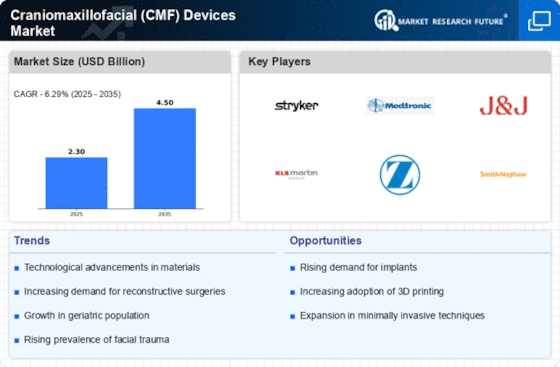
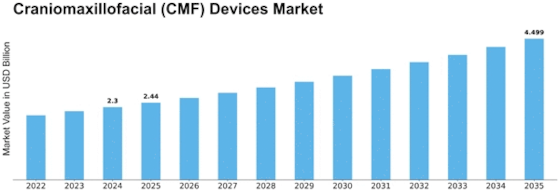
Craniomaxillofacial Devices Size
Craniomaxillofacial Devices Market Growth Projections and Opportunities
The global bone graft substitute market is experiencing significant growth, driven by various factors such as the increasing incidence of road injuries and joint disorders, the development of biocompatible synthetic bone grafts, and a growing demand for dental bone grafts. Additionally, technological advancements in bone graft substitutes are playing a crucial role in propelling market expansion. The rise in healthcare expenditure globally is another major contributor to the market's growth.
The market is categorized based on product types into allograft, bone graft substitute, and cell-based matrices. Within the allograft segment, further distinctions are made between machined allograft and demineralized bone matrix. The bone graft substitute category is subdivided into bone morphogenic proteins (BMP) and synthetic bone grafts. In 2020, the allograft segment emerged as the dominant force in the market and is anticipated to be the fastest-growing segment moving forward.
A bone graft substitute refers to a synthetic, inorganic, or biologically organic amalgamation used to treat bone defects, providing an alternative to autogenous or allogenous bone. Despite autografts being considered the 'gold standard' for bone grafting, bone graft substitutes have gained popularity among medical practitioners due to the avoidance of the double incision required in autografting procedures, as well as the associated pain during and after surgery at both sites.
The applications of bone graft substitutes are expanding rapidly due to the limitations associated with other bone graft types, including autografts and allografts, such as limited availability, site morbidity, pain, and susceptibility to infections. Notably, demineralized bone matrices (DBM) are employed in approximately 50% of allograft procedures conducted in the United States.
In terms of applications, the global bone graft substitute market is segmented into dental, foot & ankle, joint reconstruction, long bone, and spinal fusion. The spinal fusion segment took the lead in 2020 and is projected to be the fastest-growing segment throughout the study period.
In conclusion, the global bone graft substitute market is witnessing substantial growth propelled by factors like road injuries, joint disorders, advancements in synthetic grafts, and a rising demand for dental bone grafts. The market segmentation based on product types and applications highlights the versatility and expanding applications of bone graft substitutes, positioning it as a preferred option in various medical scenarios. The continuous evolution of technology in this field is expected to sustain the market's growth momentum.























Leave a Comment