Request Free Sample ×

Kindly complete the form below to receive a free sample of this Report

* Please use a valid business email

Leading companies partner with us for data-driven Insights

clients tt-cursor
Hero Background
English
Chinese
French
Japanese
Korean
German
Spanish

Craniomaxillofacial Devices Market Analysis

ID: MRFR/HC/6539-HCR
90 Pages
Vikita Thakur
April 2026

Craniomaxillofacial (CMF) Devices Market Research Report: Size, Share, Trend Analysis By Device Type (Fixation Devices, Bone Graft Substitute, CMF Plates and Screws, Distraction Systems, Temporomandibular Joint Implants), By Applications (Orthognathic Surgery, Craniofacial Reconstruction, Trauma Reconstruction, Oral Surgery, Dentoalveolar Surgery), By End Users (Hospitals, Ambulatory Surgical Centers, Specialty Clinics), By Material Type (Metal, Biomaterials, Polymers, Ceramics) and By Regional (North America, Europe, South America, Asia Pacific, Middle East and Africa) - Growth Outlook & Industry Forecast 2025 To 2035

Share:
Download PDF ×

We do not share your information with anyone. However, we may send you emails based on your report interest from time to time. You may contact us at any time to opt-out.

Craniomaxillofacial Devices Market Infographic
Purchase Options

Market Analysis

In-depth Analysis of Craniomaxillofacial Devices Market Industry Landscape

Investments in the orthopedic care sector have reached notable heights, fueled by increasing health spending globally. Accurate estimates of health expenditures are crucial for effective health policy and planning, playing a pivotal role in attaining national and international health objectives. A report from the World Health Organization (WHO) released on February 20, 2019, highlighted a 6% increase in global health spending in low- and middle-income countries and a 4% increase in high-income countries. However, governments contribute less than 40% to primary health care spending, creating opportunities for private sector involvement.

The allure of the orthopedic care sector is drawing numerous companies due to its high market potential. Existing players are actively investing in research and development to incorporate advanced technologies into their portfolios, ensuring they remain competitive and maintain their market share.

In the United States, healthcare spending in 2018 was estimated to exceed $10,000 per resident. A significant portion of this spending is directed toward planned knee and hip replacement procedures, a trend noted in a review of medical claims data from 2010 to 2017 by the Blue Cross Blue Shield Association. Knee replacements have seen a 17% increase, while hip replacements have surged by 33%. Orthopedic surgeries, particularly planned ones, accounted for over $25 billion in 2017, constituting 47% of total orthopedic spending—a substantial 44% rise since 2010.

In response to the growing demand, healthcare companies are establishing orthopedic care centers globally. For instance, Hartford HealthCare launched its $150 million, 130,000-square-foot Bone and Joint Institute in early 2017, while Bristol Hospital is opening a $25.3 million, 60,000-square-foot ambulatory care center in Bristol, focusing on orthopedic and other services. Projections from the American Academy of Orthopaedic Surgeons (AAOS) indicate a 189% increase in total knee replacements, reaching nearly 1.3 million by 2030 and surging to approximately 2.6 million by 2060. This anticipated growth presents significant opportunities for the bone graft substitute market in the forecast years.

In conclusion, the orthopedic care sector is experiencing substantial investments and growth, driven by increased health spending globally. Private sector participation is rising, and companies are channeling resources into research and development to stay ahead in this competitive landscape. The surge in planned orthopedic surgeries, especially knee and hip replacements, is contributing to a burgeoning market with the establishment of orthopedic care centers to meet the growing demand. Projections for the future underscore the continued expansion of the orthopedic care sector, presenting considerable opportunities for the bone graft substitute market.


Author
Author Profile
Vikita Thakur
Senior Research Analyst

She holds an experience of about 5+ years in market research and business consulting projects for sectors such as life sciences, medical devices, and healthcare IT. She possesses a robust background in data analysis, market estimation, competitive intelligence, pipeline analysis market trend identification, and consumer behavior insights. Her expertise lies in technical Sales support, client interaction and project management, designing and implementing market research studies, conducting competitive analysis, and synthesizing complex data into actionable recommendations that drive business growth.

Leave a Comment

FAQs

What is the projected market valuation of the Craniomaxillofacial (CMF) Devices Market by 2035?

The projected market valuation for the market is expected to reach 4.499 USD Billion by 2035.

What was the market valuation of the market in 2024?

The overall market valuation of the market was 2.3 USD Billion in 2024.

What is the expected CAGR for the Craniomaxillofacial (CMF) Devices Market during the forecast period 2025 - 2035?

The expected CAGR for the market during the forecast period 2025 - 2035 is 6.29%.

Which companies are considered key players in the market?

Key players in the market include Stryker, Medtronic, DePuy Synthes, KLS Martin, Zimmer Biomet, Smith & Nephew, B. Braun Melsungen AG, MediCAD Hectec GmbH, and Aesculap.

What are the main segments of the Craniomaxillofacial (CMF) Devices Market?

The main segments of the market include Fixation Devices, Bone Graft Substitute, CMF Plates and Screws, Distraction Systems, and Temporomandibular Joint Implants.

How much is the Fixation Devices segment projected to grow by 2035?

<p>The Fixation Devices segment is projected to grow from 0.8 USD Billion in 2024 to 1.5 USD Billion by 2035.</p>

What is the expected growth of the Craniofacial Reconstruction application segment by 2035?

<p>The Craniofacial Reconstruction application segment is expected to increase from 0.69 USD Billion in 2024 to 1.15 USD Billion by 2035.</p>

Which end-user segment is anticipated to have the highest valuation by 2035?

<p>The Hospitals end-user segment is anticipated to have the highest valuation, projected to grow from 0.92 USD Billion in 2024 to 1.83 USD Billion by 2035.</p>

What materials are primarily used in the Craniomaxillofacial (CMF) Devices Market?

The primary materials used in the market include Metal, Biomaterials, Polymers, and Ceramics.

What is the projected growth for the Distraction Systems segment by 2035?

<p>The Distraction Systems segment is projected to grow from 0.3 USD Billion in 2024 to 0.7 USD Billion by 2035.</p>

Market Summary

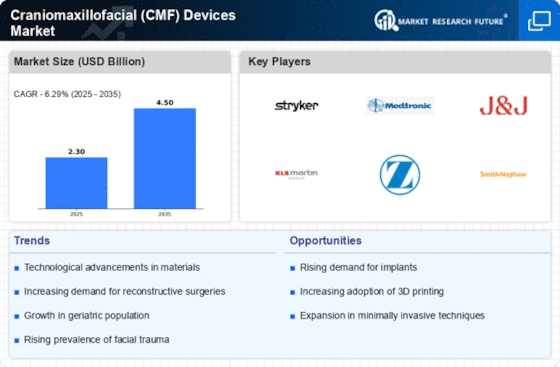
According to Market Research Future Reports analysis, the Craniomaxillofacial (CMF) Devices Market Size was valued at USD 2.3 Billion in 2024. The market is projected to grow from USD 2.445 Billion in 2025 to USD 4.499 Billion by 2035, registering a CAGR of 6.2% during the forecast 2025–2035. North America led the market with over 43% share, generating around USD 1 billion in revenue.
 
The market is driven by rising incidence of craniofacial injuries, increasing demand for reconstructive and aesthetic surgeries, and advancements in biomaterials and digital surgical technologies that enhance precision, outcomes, and patient-specific treatment approaches globally.
 
The Centers for Disease Control and Prevention reports over 2.8 million traumatic brain injury-related emergency visits annually, many involving craniofacial damage, supporting demand for CMF procedures; additionally, injury-related cases continue rising globally, strengthening surgical device adoption

Key Market Trends & Highlights

The Craniomaxillofacial (CMF) Devices Market is poised for substantial growth driven by technological advancements and increasing demand for aesthetic procedures.

  • North America leads with over 43% revenue share in 2024, driven by advanced surgical infrastructure and high procedure volume. Fixation devices dominate with 64% share, while bone graft substitutes grow rapidly at 36% due to innovation. Craniofacial reconstruction leads with 57%, while trauma reconstruction expands quickly at 43% driven by rising injuries. Hospitals hold 68% share, while ambulatory surgical centers grow steadily at 32% with increasing outpatient surgical demand.

Market Size & Forecast

2024 Market Size 2.3 (USD Billion)
2035 Market Size 4.499 (USD Billion)
CAGR (2025 - 2035) 6.29%
Largest Regional Market Share in 2024 North America

Major Players

Companies such as <a href="https://www.stryker.com/us/en/portfolios/orthopaedics/craniomaxillofacial.html">Stryker</a> (US), Medtronic (US), DePuy Synthes (US), KLS Martin (DE), <a href="https://www.zimmerbiomet.com/en/products-and-solutions/specialties/cmf.html">Zimmer Biomet </a>(US), Smith &amp; Nephew (GB), B. Braun Melsungen AG (DE), MediCAD Hectec GmbH (DE), Aesculap (DE) are some of the major participants in the global market.

Market Trends

The Craniomaxillofacial (CMF) Devices Market is currently experiencing notable growth, driven by advancements in surgical techniques and an increasing prevalence of craniofacial disorders strengthening the overall craniomaxillofacial devices market outlook.. Innovations in materials and technology related to CMF medical device development are enhancing the effectiveness and safety of surgical procedures, which appears to be attracting more healthcare professionals to adopt these devices.

Furthermore, the rising awareness regarding the importance of aesthetic and functional rehabilitation is likely to propel demand across the global CMF market. As a result, manufacturers are focusing on developing products that not only meet clinical needs but also cater to patient preferences, thereby expanding their footprint in the craniomaxillofacial devices market.. In addition, the integration of digital technologies, such as three-dimensional imaging and computer-aided design, is transforming the landscape of the market.

These technologies facilitate personalized treatment plans, which may lead to improved surgical outcomes and patient satisfaction. Moreover, the growing geriatric population, coupled with an increase in road accidents and sports injuries, is expected to further drive the market. Overall, the market appears poised for continued expansion, with ongoing research and development efforts likely to yield innovative solutions in the near future.

Technological Advancements

The Craniomaxillofacial (CMF) Devices Market is witnessing a surge in technological innovations. Enhanced imaging techniques and computer-assisted surgical tools are becoming more prevalent, allowing for greater precision in procedures. This trend suggests that the integration of advanced technologies may lead to improved patient outcomes and increased adoption of CMF market

Advanced imaging and computer-assisted surgery are improving precision and outcomes. The World Health Organization highlights that road traffic injuries cause approximately 1.19 million deaths annually, with millions sustaining facial injuries, reinforcing demand for technologically advanced CMF surgical solutions and precision-based interventions.

Rising Demand for Aesthetic Procedures

There is a growing inclination towards aesthetic enhancements among patients, which is influencing the Craniomaxillofacial (CMF) Devices Market. As individuals seek to improve their facial appearance, the demand for devices that facilitate cosmetic surgeries is likely to rise. This trend indicates a shift in focus towards not only functional but also aesthetic applications of CMF devices.

Growing aesthetic awareness is increasing demand for CMF interventions. The International Society of Aesthetic Plastic Surgery aligned with global health insights shows over 14.9 million surgical cosmetic procedures performed annually, reflecting strong growth in facial enhancement demand, indirectly boosting adoption of CMF devices worldwide.

Increased Focus on Patient-Centric Solutions

The Craniomaxillofacial (CMF) Devices Market is increasingly prioritizing patient-centric approaches. Manufacturers are developing devices that cater to individual needs, emphasizing comfort and usability. This trend suggests a broader recognition of the importance of patient experience in the design and implementation of CMF solutions.

Patient-focused innovations are improving treatment outcomes and satisfaction. The Pan American Health Organization emphasizes that patient-centered care models can improve treatment adherence rates by up to 30%, supporting the adoption of customized CMF devices designed for enhanced comfort, safety, and recovery outcomes.

Craniomaxillofacial Devices Market Market Drivers

Rising Aesthetic Surgery Demand

The growing demand for aesthetic procedures is significantly influencing the Craniomaxillofacial (CMF) Devices Market. As societal perceptions of beauty evolve, more individuals are seeking surgical interventions to enhance facial features. This trend is particularly evident in regions where cosmetic surgery is becoming more socially accepted.
 
Data indicates that the aesthetic segment of the CMF market is projected to witness substantial growth, driven by procedures such as rhinoplasty, chin augmentation, and facial implants. The increasing availability of minimally invasive techniques is likely to further propel this demand, as patients seek quicker recovery times and less invasive options. Consequently, manufacturers are focusing on developing innovative devices that cater to this burgeoning market.

Growing Incidence of Facial Trauma

The rising incidence of facial trauma, driven by factors such as road accidents, sports injuries, and interpersonal violence, is a critical driver for the Craniomaxillofacial (CMF) Devices Market. Statistics indicate that facial injuries account for a substantial percentage of trauma cases, necessitating effective surgical interventions.
 
As the demand for reconstructive surgeries increases, the market for CMF devices is expected to expand correspondingly. The need for advanced fixation devices and implants to address complex fractures and deformities is becoming more pronounced. This trend suggests that healthcare providers are increasingly investing in innovative CMF solutions to improve patient outcomes and reduce the long-term impact of facial injuries.

Technological Innovations in CMF Devices

The Craniomaxillofacial (CMF) Devices Market is experiencing a surge in technological innovations that enhance surgical outcomes. Advanced materials, such as bioresorbable polymers and titanium alloys, are increasingly utilized in device manufacturing, improving biocompatibility and reducing the risk of complications.
 
Furthermore, the integration of 3D printing technology allows for the customization of implants tailored to individual patient anatomies, which is likely to enhance surgical precision. According to recent data, the market for 3D-printed CMF devices is projected to grow significantly, reflecting a broader trend towards personalized medicine. These innovations not only improve patient satisfaction but also streamline surgical procedures, potentially reducing recovery times and hospital stays.

Aging Population and Associated Health Issues

The aging population presents a significant driver for the Craniomaxillofacial (CMF) Devices Market. As individuals age, they often experience a range of health issues, including bone density loss and facial deformities, which may necessitate surgical intervention. The demographic shift towards an older population is likely to increase the prevalence of conditions requiring CMF devices, such as osteoporotic fractures and tumors.
 
Data suggests that the demand for reconstructive and corrective surgeries is expected to rise in tandem with this demographic trend. Consequently, manufacturers are focusing on developing devices that cater specifically to the needs of older patients, thereby enhancing their market presence and addressing the unique challenges posed by this demographic.

Increased Investment in Healthcare Infrastructure

The Craniomaxillofacial (CMF) Devices Market is benefiting from increased investment in healthcare infrastructure across various regions. Governments and private entities are recognizing the importance of advanced medical technologies in improving patient care. This investment is leading to the establishment of specialized surgical centers equipped with state-of-the-art CMF devices. Enhanced healthcare facilities are likely to facilitate more complex surgical procedures, thereby driving demand for CMF devices. Furthermore, as healthcare systems evolve, there is a growing emphasis on training healthcare professionals in the latest surgical techniques, which may further stimulate market growth. The overall improvement in healthcare infrastructure is expected to create a conducive environment for the expansion of the CMF devices market.

Market Segment Insights

By Type: Fixation Devices (Largest) vs. Bone Graft Substitute (Fastest-Growing)

In the Craniomaxillofacial (CMF) Devices Market, fixation devices lead the segment, accounting for a significant 64% share of the market. These devices, which include various surgical plates and screws, are critical for stabilization in craniofacial surgeries. Bone graft substitutes are also a notable segment, increasingly utilized to promote healing and support in areas where bone restoration is required. As surgical techniques advance, the adoption of these devices is becoming more prevalent among clinicians. Growth trends within the CMF devices segment indicate a rising preference for innovative fixation techniques, reflecting in the increasing sales of fixation devices. Simultaneously, the demand for bone graft substitutes is on the rise, driven by enhancements in biocompatibility and patient outcomes. The aging population and an increase in accidents further contribute to growth in both segments, paving the way for evolving treatments in craniofacial reconstructive procedures.

Fixation Devices (Dominant) vs. Bone Graft Substitute (Emerging)

Fixation devices continue to be a dominant force in the market share. These devices are intricately designed to secure bone fragments during healing, and their effectiveness and reliability make them a staple in surgical practices. On the other hand,<a href="https://www.marketresearchfuture.com/reports/bone-graft-substitutes-market-1195"> bone graft substitutes </a>are emerging rapidly, recognized for their ability to facilitate and enhance bone regeneration. This segment is characterized by a variety of materials, including synthetic and natural options, that cater to specific clinical needs. As the demand for minimally invasive procedures grows, both segments are evolving, with fixation devices becoming increasingly sophisticated while bone graft substitutes are expanding in their applications and peer-reviewed successes, showcasing their potential in reconstructive surgery.

By Application: Craniofacial Reconstruction (Largest) vs. Trauma Reconstruction (Fastest-Growing)

The Craniomaxillofacial (CMF) Devices Market features a diverse range of applications, with craniofacial reconstruction leading the segment at a 57% share.  This dominance is attributed to the growing number of congenital and acquired facial deformities, necessitating advanced surgical interventions. Orthognathic Surgery and Oral Surgery are also significant contributors, though they capture comparatively smaller shares. Overall, the segment distribution reflects a robust demand for innovative surgical solutions that improve patient outcomes in craniofacial procedures. Looking at growth trends, Trauma Reconstruction is recognized as the fastest-growing segment within the CMF Devices Market. The rise in sports-related injuries, road accidents, and an increasing geriatric population are primary drivers behind this trend. Hospitals are increasingly investing in advanced technologies to enhance surgical effectiveness, thus fostering growth in this area. The overall market dynamics point towards an upward trajectory, with all segments expected to expand as clinical needs evolve and technology advances.

Craniofacial Reconstruction (Dominant) vs. Trauma Reconstruction (Emerging)

Craniofacial Reconstruction remains a dominant force in the market share, characterized by its extensive range of surgical techniques and devices aimed at correcting deformities of the face and skull. This segment is primarily driven by evolving surgical technologies and the rising incidence of conditions requiring reconstruction. In contrast, Trauma Reconstruction has emerged as a vital segment, fueled by a surge in traumatic injuries. It focuses on repairing complex fractures and soft tissue damage, leveraging modern surgical innovations. As healthcare systems prioritize trauma care enhancements, the Trauma Reconstruction segment is gaining traction and witnessing rapid advancements, carving a distinct niche within the CMF landscape.

By End User: Hospitals (Largest) vs. Ambulatory Surgical Centers (Fastest-Growing)

In the Craniomaxillofacial (CMF) Devices Market, hospitals dominate the end-user segment, accounting for the largest 68% share. Their extensive resources, specialized departments, and comprehensive patient care make them the preferred choice for advanced surgical procedures. Ambulatory surgical centers are gaining traction, largely due to their ability to provide cost-effective and efficient outpatient services, appealing to a growing number of patients seeking quicker recovery times and reduced hospitalization.

Hospitals (Dominant) vs. Ambulatory Surgical Centers (Emerging)

Hospitals play a dominant role in the market share, benefitting from established infrastructures and a wide array of services that cater to complex craniomaxillofacial procedures. These facilities often have access to advanced technology and skilled professionals, enhancing their capacity to handle diverse cases and emergencies. On the other hand, ambulatory surgical centers are emerging as a vital option for patients and practitioners due to their focus on outpatient care. These centers provide convenience and efficiency, allowing patients to undergo procedures without the lengthy recovery times associated with hospital stays, thus attracting a growing patient demographic.

By Material Type: Metals (Largest) vs. Biomaterials (Fastest-Growing)

In the Craniomaxillofacial (CMF) Devices Market, the material type segment includes metals, biomaterials, polymers, and ceramics, with metals leading the segment by holding a 62% share. Metals currently dominate the market due to their strength, durability, and historical precedence in surgical applications. However, Biomaterials are gaining traction, driven by their biocompatibility and ability to promote healing, making them increasingly preferred for cranial and facial reconstruction procedures. Growth in this segment is primarily influenced by the rising demand for minimally invasive surgeries and advancements in material technologies. The shift towards Biomaterials is propelled by increasing awareness regarding patient safety and improved clinical outcomes. Meanwhile, Polymeric and Ceramic materials are also growing but at a slower pace, often being utilized in specific applications where customizability and aesthetic properties are essential.

Metals (Dominant) vs. Biomaterials (Emerging)

Metals, particularly titanium and stainless steel, remain the dominant material in the CMF devices sector due to their proven reliability, mechanical strength, and compatibility with imaging techniques. They are extensively used for plates, screws, and other fixation devices. In contrast, Biomaterials, such as absorbable plates and scaffolds, are emerging as a vital component in the market. Their ability to integrate with human tissue, coupled with advancements in synthetic and natural polymers, is enabling more innovative applications in grafting and defect reconstruction. While Metals are essential for structural stability, Biomaterials offer additional benefits like promoting healing and reducing infection risks, positioning them as a complementary option in surgical interventions.

Get more detailed insights about Craniomaxillofacial (CMF) Devices Market Research Report - Forecast till 2035

Regional Insights

The Craniomaxillofacial (CMF) Devices Market showcases significant regional dynamics, with North America leads in the market, accounting for over 43% of the global revenue in 2024, growing to 1.478 USD Billion in 2035. This region is characterized by advanced healthcare infrastructure and high demand for innovative medical devices. Europe follows closely, with values of 0.616 USD billion in 2024, increasing to 1.197 USD billion by 2035, driven by rising surgical procedures and technological advancements.

South America, although smaller, is on the rise, expected to grow from 0.189 USD Billion in 2024 to 0.372 USD billion in 2035, as healthcare access improves.The Asia Pacific region is gaining traction, projected to elevate from 0.485 USD Billion in 2024 to 0.974 USD billion in 2035, boosted by expanding population and increasing awareness of craniomaxillofacial procedures. Meanwhile, the Middle East and Africa showcase a modest growth from 0.246 USD Billion in 2024 to 0.479 USD billion in 2035, influenced by gradual improvements in healthcare systems.

The increasing incidence of facial trauma, congenital abnormalities, and rising aesthetic surgical preferences across these regions largely spurs the demand for Craniomaxillofacial (CMF) Devices.As the market evolves, maintaining technological advancements will be pivotal for meeting diverse regional needs and enhancing patient outcomes in the Craniomaxillofacial (CMF) Devices Market.

Key Players and Competitive Insights

The Craniomaxillofacial (CMF) Devices Market is witnessing significant competitive dynamics, fueled by advancements in surgical technology, rising awareness of facial reconstruction procedures, and increasing incidences of traumatic injuries and craniofacial deformities. This market segment comprises a variety of devices including plates, screws, distraction systems, and grafts specifically designed for reconstructive surgery.
 
As demand grows for minimally invasive procedures and enhanced aesthetic outcomes, companies in the global CMF devices market are striving to innovate and expand their product portfolios. A diverse set of industry players characterizes the competitive landscape, each focusing on differentiating their offerings through technological advancements, strategic collaborations, and expanded geographical reach. Manufacturers are not only innovating within their product lines but are also actively engaging in strategic partnerships to enhance their market presence and leverage regional strengths.
 
KLS Martin is recognized for its robust integration of innovative technologies within the Global Craniomaxillofacial Devices Market. The company's commitment to quality and precision in surgical instruments has positioned it as a reliable choice for surgeons involved in craniomaxillofacial procedures. KLS Martin's strengths lie in its extensive product range that includes surgical plates, titanium fixation devices, and various tools designed specifically for craniofacial surgery.
 
The company's focus on continuous research and development ensures its offerings meet the evolving needs of healthcare professionals. Moreover, KLS Martin boasts strong distribution networks and partnerships that enhance their market visibility and accessibility on a global scale, allowing healthcare providers to adopt their products efficiently for different surgical requirements.DePuy Synthes, part of the Johnson & Johnson family, holds a significant position in the Global Craniomaxillofacial Devices Market with a strong focus on innovation and comprehensive solutions for craniofacial surgery.
 
 The company offers a wide array of products, including fixation systems, bio-resorbable and traditional plates, and a range of instruments that cater to both surgical procedures and post-operative care. DePuy Synthes is known for its commitment to developing technologies that improve surgical outcomes, emphasizing patient well-being. The company has strategically engaged in mergers and acquisitions, enhancing its capabilities and expanding its product offerings.
 
Its presence in the global market is further strengthened by substantial investment in research, clinical studies, and collaborations aimed at advancing CMF surgery. The combination of DePuy Synthes' established reputation, innovative products, and effective distribution channels positions it as a formidable contender in the competitive landscape of the CMF devices market.

Key Companies in the Craniomaxillofacial Devices Market include

Industry Developments

The Craniomaxillofacial (CMF) Devices Market continues to evolve with significant recent developments. Companies like KLS Martin, DePuy Synthes, and Stryker have introduced innovative technological advancements aimed at enhancing patient outcomes following cranial and facial surgeries.

Medtronic introduced a new range of bioactive CMF implants in February 2023 with the goal of speeding up recovery and improving bone regeneration.

In order to increase the accuracy of CMF treatments, Stryker purchased a manufacturer of robotically assisted surgical devices in April 2023.

The regulatory body approved KLS Martin's software-enhanced surgical planning tools for CMF procedures in June 2023.

Future Outlook

Craniomaxillofacial Devices Market Future Outlook

The Craniomaxillofacial (CMF) Devices Market size is projected to reach USD 4.499 Billion by 2035, growing at a CAGR of 6.2%, driven by technological advancements, increasing surgical procedures, and rising demand for reconstructive surgeries.

New opportunities lie in:

  • <p>Development of biodegradable implants for enhanced patient recovery. Integration of AI-driven surgical planning tools to improve outcomes. Expansion into emerging markets with tailored product offerings.</p>

By 2035, the CMF Devices Market is expected to achieve substantial growth, reflecting evolving healthcare needs.

Market Segmentation

Craniomaxillofacial Devices Market Type Outlook

  • Fixation Devices
  • Bone Graft Substitute
  • CMF Plates and Screws
  • Distraction Systems
  • Temporomandibular Joint Implants

Craniomaxillofacial Devices Market End User Outlook

  • Hospitals
  • Ambulatory Surgical Centers
  • Specialty Clinics

Craniomaxillofacial Devices Market Application Outlook

  • Orthognathic Surgery
  • Craniofacial Reconstruction
  • Trauma Reconstruction
  • Oral Surgery
  • Dentoalveolar Surgery

Craniomaxillofacial Devices Market Material Type Outlook

  • Metal
  • Biomaterials
  • Polymers
  • Ceramics

Report Scope

MARKET SIZE 2024 2.3(USD Billion)
MARKET SIZE 2025 2.445(USD Billion)
MARKET SIZE 2035 4.499(USD Billion)
COMPOUND ANNUAL GROWTH RATE (CAGR) 6.29% (2025 - 2035)
REPORT COVERAGE Revenue Forecast, Competitive Landscape, Growth Factors, and Trends
BASE YEAR 2024
Market Forecast Period 2025 - 2035
Historical Data 2019 - 2024
Market Forecast Units USD Billion
Key Companies Profiled Stryker (US), Medtronic (US), DePuy Synthes (US), KLS Martin (DE), Zimmer Biomet (US), Smith & Nephew (GB), B. Braun Melsungen AG (DE), MediCAD Hectec GmbH (DE), Aesculap (DE)
Segments Covered Device Type, Applications, End Users, Material Type, Regional
Key Market Opportunities Advancements in 3D printing technology enhance customization in the market.
Key Market Dynamics Technological advancements and regulatory changes drive innovation and competition in the Craniomaxillofacial Devices Market.
Countries Covered North America, Europe, APAC, South America, MEA

FAQs

What is the projected market valuation of the Craniomaxillofacial (CMF) Devices Market by 2035?

The projected market valuation for the market is expected to reach 4.499 USD Billion by 2035.

What was the market valuation of the market in 2024?

The overall market valuation of the market was 2.3 USD Billion in 2024.

What is the expected CAGR for the Craniomaxillofacial (CMF) Devices Market during the forecast period 2025 - 2035?

The expected CAGR for the market during the forecast period 2025 - 2035 is 6.29%.

Which companies are considered key players in the market?

Key players in the market include Stryker, Medtronic, DePuy Synthes, KLS Martin, Zimmer Biomet, Smith &amp; Nephew, B. Braun Melsungen AG, MediCAD Hectec GmbH, and Aesculap.

What are the main segments of the Craniomaxillofacial (CMF) Devices Market?

The main segments of the market include Fixation Devices, Bone Graft Substitute, CMF Plates and Screws, Distraction Systems, and Temporomandibular Joint Implants.

How much is the Fixation Devices segment projected to grow by 2035?

<p>The Fixation Devices segment is projected to grow from 0.8 USD Billion in 2024 to 1.5 USD Billion by 2035.</p>

What is the expected growth of the Craniofacial Reconstruction application segment by 2035?

<p>The Craniofacial Reconstruction application segment is expected to increase from 0.69 USD Billion in 2024 to 1.15 USD Billion by 2035.</p>

Which end-user segment is anticipated to have the highest valuation by 2035?

<p>The Hospitals end-user segment is anticipated to have the highest valuation, projected to grow from 0.92 USD Billion in 2024 to 1.83 USD Billion by 2035.</p>

What materials are primarily used in the Craniomaxillofacial (CMF) Devices Market?

The primary materials used in the market include Metal, Biomaterials, Polymers, and Ceramics.

What is the projected growth for the Distraction Systems segment by 2035?

<p>The Distraction Systems segment is projected to grow from 0.3 USD Billion in 2024 to 0.7 USD Billion by 2035.</p>

  1. SECTION I: EXECUTIVE SUMMARY AND KEY HIGHLIGHTS |
    1. EXECUTIVE SUMMARY | |
      1. Market Overview | |
      2. Key Findings | |
      3. Market Segmentation | |
      4. Competitive Landscape | |
      5. Challenges and Opportunities | |
      6. Future Outlook 2
  2. SECTION II: SCOPING, METHODOLOGY AND MARKET STRUCTURE |
    1. MARKET INTRODUCTION | |
      1. Definition | |
      2. Scope of the study | | |
    2. RESEARCH METHODOLOGY | |
      1. Overview | |
      2. Data Mining | |
      3. Secondary Research | |
      4. Primary Research | | |
      5. Forecasting Model | |
      6. Market Size Estimation | | |
      7. Data Triangulation | |
      8. Validation 3
  3. SECTION III: QUALITATIVE ANALYSIS |
    1. MARKET DYNAMICS | |
      1. Overview | |
      2. Drivers | |
      3. Restraints | |
      4. Opportunities |
    2. MARKET FACTOR ANALYSIS | |
      1. Value chain Analysis | |
      2. Porter's Five Forces Analysis | | |
      3. COVID-19 Impact Analysis | | |
  4. SECTION IV: QUANTITATIVE ANALYSIS |
    1. Healthcare, BY Type (USD Billion) | |
      1. Fixation Devices | |
      2. Bone Graft Substitute | |
      3. CMF Plates and Screws | |
      4. Distraction Systems | |
      5. Temporomandibular Joint Implants |
    2. Healthcare, BY Application (USD Billion) | |
      1. Orthognathic Surgery | |
      2. Craniofacial Reconstruction | |
      3. Trauma Reconstruction | |
      4. Oral Surgery | |
      5. Dentoalveolar Surgery |
    3. Healthcare, BY End User (USD Billion) | |
      1. Hospitals | |
      2. Ambulatory Surgical Centers | |
      3. Specialty Clinics |
    4. Healthcare, BY Material Type (USD Billion) | |
      1. Metal | |
      2. Biomaterials | |
      3. Polymers | |
      4. Ceramics |
    5. Healthcare, BY Region (USD Billion) | |
      1. North America | | |
      2. Europe | | |
      3. APAC | | |
      4. South America | | |
      5. MEA | | |
  5. SECTION V: COMPETITIVE ANALYSIS |
    1. Competitive Landscape | |
      1. Overview | |
      2. Competitive Analysis | |
      3. Market share Analysis | |
      4. Major Growth Strategy in the Healthcare | |
      5. Competitive Benchmarking | |
      6. Leading Players in Terms of Number of Developments in the Healthcare | |
      7. Key developments and growth strategies | | |
      8. Major Players Financial Matrix | | |
    2. Company Profiles | |
      1. Stryker (US) | | |
      2. Medtronic (US) | | |
      3. DePuy Synthes (US) | | |
      4. KLS Martin (DE) | | |
      5. Zimmer Biomet (US) | | |
      6. Smith & Nephew (GB) | | |
      7. B. Braun Melsungen AG (DE) | | |
      8. MediCAD Hectec GmbH (DE) | | |
      9. Aesculap (DE) | | |
    3. Appendix | |
      1. References | |
      2. Related Reports 6 LIST OF FIGURES |
    4. MARKET SYNOPSIS |
    5. NORTH AMERICA MARKET ANALYSIS |
    6. US MARKET ANALYSIS BY TYPE |
    7. US MARKET ANALYSIS BY APPLICATION |
    8. US MARKET ANALYSIS BY END USER |
    9. US MARKET ANALYSIS BY MATERIAL TYPE |
    10. CANADA MARKET ANALYSIS BY TYPE |
    11. CANADA MARKET ANALYSIS BY APPLICATION |
    12. CANADA MARKET ANALYSIS BY END USER |
    13. CANADA MARKET ANALYSIS BY MATERIAL TYPE |
    14. EUROPE MARKET ANALYSIS |
    15. GERMANY MARKET ANALYSIS BY TYPE |
    16. GERMANY MARKET ANALYSIS BY APPLICATION |
    17. GERMANY MARKET ANALYSIS BY END USER |
    18. GERMANY MARKET ANALYSIS BY MATERIAL TYPE |
    19. UK MARKET ANALYSIS BY TYPE |
    20. UK MARKET ANALYSIS BY APPLICATION |
    21. UK MARKET ANALYSIS BY END USER |
    22. UK MARKET ANALYSIS BY MATERIAL TYPE |
    23. FRANCE MARKET ANALYSIS BY TYPE |
    24. FRANCE MARKET ANALYSIS BY APPLICATION |
    25. FRANCE MARKET ANALYSIS BY END USER |
    26. FRANCE MARKET ANALYSIS BY MATERIAL TYPE |
    27. RUSSIA MARKET ANALYSIS BY TYPE |
    28. RUSSIA MARKET ANALYSIS BY APPLICATION |
    29. RUSSIA MARKET ANALYSIS BY END USER |
    30. RUSSIA MARKET ANALYSIS BY MATERIAL TYPE |
    31. ITALY MARKET ANALYSIS BY TYPE |
    32. ITALY MARKET ANALYSIS BY APPLICATION |
    33. ITALY MARKET ANALYSIS BY END USER |
    34. ITALY MARKET ANALYSIS BY MATERIAL TYPE |
    35. SPAIN MARKET ANALYSIS BY TYPE |
    36. SPAIN MARKET ANALYSIS BY APPLICATION |
    37. SPAIN MARKET ANALYSIS BY END USER |
    38. SPAIN MARKET ANALYSIS BY MATERIAL TYPE |
    39. REST OF EUROPE MARKET ANALYSIS BY TYPE |
    40. REST OF EUROPE MARKET ANALYSIS BY APPLICATION |
    41. REST OF EUROPE MARKET ANALYSIS BY END USER |
    42. REST OF EUROPE MARKET ANALYSIS BY MATERIAL TYPE |
    43. APAC MARKET ANALYSIS |
    44. CHINA MARKET ANALYSIS BY TYPE |
    45. CHINA MARKET ANALYSIS BY APPLICATION |
    46. CHINA MARKET ANALYSIS BY END USER |
    47. CHINA MARKET ANALYSIS BY MATERIAL TYPE |
    48. INDIA MARKET ANALYSIS BY TYPE |
    49. INDIA MARKET ANALYSIS BY APPLICATION |
    50. INDIA MARKET ANALYSIS BY END USER |
    51. INDIA MARKET ANALYSIS BY MATERIAL TYPE |
    52. JAPAN MARKET ANALYSIS BY TYPE |
    53. JAPAN MARKET ANALYSIS BY APPLICATION |
    54. JAPAN MARKET ANALYSIS BY END USER |
    55. JAPAN MARKET ANALYSIS BY MATERIAL TYPE |
    56. SOUTH KOREA MARKET ANALYSIS BY TYPE |
    57. SOUTH KOREA MARKET ANALYSIS BY APPLICATION |
    58. SOUTH KOREA MARKET ANALYSIS BY END USER |
    59. SOUTH KOREA MARKET ANALYSIS BY MATERIAL TYPE |
    60. MALAYSIA MARKET ANALYSIS BY TYPE |
    61. MALAYSIA MARKET ANALYSIS BY APPLICATION |
    62. MALAYSIA MARKET ANALYSIS BY END USER |
    63. MALAYSIA MARKET ANALYSIS BY MATERIAL TYPE |
    64. THAILAND MARKET ANALYSIS BY TYPE |
    65. THAILAND MARKET ANALYSIS BY APPLICATION |
    66. THAILAND MARKET ANALYSIS BY END USER |
    67. THAILAND MARKET ANALYSIS BY MATERIAL TYPE |
    68. INDONESIA MARKET ANALYSIS BY TYPE |
    69. INDONESIA MARKET ANALYSIS BY APPLICATION |
    70. INDONESIA MARKET ANALYSIS BY END USER |
    71. INDONESIA MARKET ANALYSIS BY MATERIAL TYPE |
    72. REST OF APAC MARKET ANALYSIS BY TYPE |
    73. REST OF APAC MARKET ANALYSIS BY APPLICATION |
    74. REST OF APAC MARKET ANALYSIS BY END USER |
    75. REST OF APAC MARKET ANALYSIS BY MATERIAL TYPE |
    76. SOUTH AMERICA MARKET ANALYSIS |
    77. BRAZIL MARKET ANALYSIS BY TYPE |
    78. BRAZIL MARKET ANALYSIS BY APPLICATION |
    79. BRAZIL MARKET ANALYSIS BY END USER |
    80. BRAZIL MARKET ANALYSIS BY MATERIAL TYPE |
    81. MEXICO MARKET ANALYSIS BY TYPE |
    82. MEXICO MARKET ANALYSIS BY APPLICATION |
    83. MEXICO MARKET ANALYSIS BY END USER |
    84. MEXICO MARKET ANALYSIS BY MATERIAL TYPE |
    85. ARGENTINA MARKET ANALYSIS BY TYPE |
    86. ARGENTINA MARKET ANALYSIS BY APPLICATION |
    87. ARGENTINA MARKET ANALYSIS BY END USER |
    88. ARGENTINA MARKET ANALYSIS BY MATERIAL TYPE |
    89. REST OF SOUTH AMERICA MARKET ANALYSIS BY TYPE |
    90. REST OF SOUTH AMERICA MARKET ANALYSIS BY APPLICATION |
    91. REST OF SOUTH AMERICA MARKET ANALYSIS BY END USER |
    92. REST OF SOUTH AMERICA MARKET ANALYSIS BY MATERIAL TYPE |
    93. MEA MARKET ANALYSIS |
    94. GCC COUNTRIES MARKET ANALYSIS BY TYPE |
    95. GCC COUNTRIES MARKET ANALYSIS BY APPLICATION |
    96. GCC COUNTRIES MARKET ANALYSIS BY END USER |
    97. GCC COUNTRIES MARKET ANALYSIS BY MATERIAL TYPE |
    98. SOUTH AFRICA MARKET ANALYSIS BY TYPE |
    99. SOUTH AFRICA MARKET ANALYSIS BY APPLICATION |
    100. SOUTH AFRICA MARKET ANALYSIS BY END USER |
    101. SOUTH AFRICA MARKET ANALYSIS BY MATERIAL TYPE |
    102. REST OF MEA MARKET ANALYSIS BY TYPE |
    103. REST OF MEA MARKET ANALYSIS BY APPLICATION |
    104. REST OF MEA MARKET ANALYSIS BY END USER |
    105. REST OF MEA MARKET ANALYSIS BY MATERIAL TYPE |
    106. KEY BUYING CRITERIA OF HEALTHCARE |
    107. RESEARCH PROCESS OF MRFR |
    108. DRO ANALYSIS OF HEALTHCARE |
    109. DRIVERS IMPACT ANALYSIS: HEALTHCARE |
    110. RESTRAINTS IMPACT ANALYSIS: HEALTHCARE |
    111. SUPPLY / VALUE CHAIN: HEALTHCARE |
    112. HEALTHCARE, BY TYPE, 2024 (% SHARE) |
    113. HEALTHCARE, BY TYPE, 2024 TO 2035 (USD Billion) |
    114. HEALTHCARE, BY APPLICATION, 2024 (% SHARE) |
    115. HEALTHCARE, BY APPLICATION, 2024 TO 2035 (USD Billion) |
    116. HEALTHCARE, BY END USER, 2024 (% SHARE) |
    117. HEALTHCARE, BY END USER, 2024 TO 2035 (USD Billion) |
    118. HEALTHCARE, BY MATERIAL TYPE, 2024 (% SHARE) |
    119. HEALTHCARE, BY MATERIAL TYPE, 2024 TO 2035 (USD Billion) |
    120. BENCHMARKING OF MAJOR COMPETITORS 7 LIST OF TABLES |
    121. LIST OF ASSUMPTIONS | |
      1. |
    122. North America MARKET SIZE ESTIMATES; FORECAST | |
      1. BY TYPE, 2025-2035 (USD Billion) | |
      2. BY APPLICATION, 2025-2035 (USD Billion) | |
      3. BY END USER, 2025-2035 (USD Billion) | |
      4. BY MATERIAL TYPE, 2025-2035 (USD Billion) |
    123. US MARKET SIZE ESTIMATES; FORECAST | |
      1. BY TYPE, 2025-2035 (USD Billion) | |
      2. BY APPLICATION, 2025-2035 (USD Billion) | |
      3. BY END USER, 2025-2035 (USD Billion) | |
      4. BY MATERIAL TYPE, 2025-2035 (USD Billion) |
    124. Canada MARKET SIZE ESTIMATES; FORECAST | |
      1. BY TYPE, 2025-2035 (USD Billion) | |
      2. BY APPLICATION, 2025-2035 (USD Billion) | |
      3. BY END USER, 2025-2035 (USD Billion) | |
      4. BY MATERIAL TYPE, 2025-2035 (USD Billion) |
    125. Europe MARKET SIZE ESTIMATES; FORECAST | |
      1. BY TYPE, 2025-2035 (USD Billion) | |
      2. BY APPLICATION, 2025-2035 (USD Billion) | |
      3. BY END USER, 2025-2035 (USD Billion) | |
      4. BY MATERIAL TYPE, 2025-2035 (USD Billion) |
    126. Germany MARKET SIZE ESTIMATES; FORECAST | |
      1. BY TYPE, 2025-2035 (USD Billion) | |
      2. BY APPLICATION, 2025-2035 (USD Billion) | |
      3. BY END USER, 2025-2035 (USD Billion) | |
      4. BY MATERIAL TYPE, 2025-2035 (USD Billion) |
    127. UK MARKET SIZE ESTIMATES; FORECAST | |
      1. BY TYPE, 2025-2035 (USD Billion) | |
      2. BY APPLICATION, 2025-2035 (USD Billion) | |
      3. BY END USER, 2025-2035 (USD Billion) | |
      4. BY MATERIAL TYPE, 2025-2035 (USD Billion) |
    128. France MARKET SIZE ESTIMATES; FORECAST | |
      1. BY TYPE, 2025-2035 (USD Billion) | |
      2. BY APPLICATION, 2025-2035 (USD Billion) | |
      3. BY END USER, 2025-2035 (USD Billion) | |
      4. BY MATERIAL TYPE, 2025-2035 (USD Billion) |
    129. Russia MARKET SIZE ESTIMATES; FORECAST | |
      1. BY TYPE, 2025-2035 (USD Billion) | |
      2. BY APPLICATION, 2025-2035 (USD Billion) | |
      3. BY END USER, 2025-2035 (USD Billion) | |
      4. BY MATERIAL TYPE, 2025-2035 (USD Billion) |
    130. Italy MARKET SIZE ESTIMATES; FORECAST | |
      1. BY TYPE, 2025-2035 (USD Billion) | |
      2. BY APPLICATION, 2025-2035 (USD Billion) | |
      3. BY END USER, 2025-2035 (USD Billion) | |
      4. BY MATERIAL TYPE, 2025-2035 (USD Billion) |
    131. Spain MARKET SIZE ESTIMATES; FORECAST | |
      1. BY TYPE, 2025-2035 (USD Billion) | |
      2. BY APPLICATION, 2025-2035 (USD Billion) | |
      3. BY END USER, 2025-2035 (USD Billion) | |
      4. BY MATERIAL TYPE, 2025-2035 (USD Billion) |
    132. Rest of Europe MARKET SIZE ESTIMATES; FORECAST | |
      1. BY TYPE, 2025-2035 (USD Billion) | |
      2. BY APPLICATION, 2025-2035 (USD Billion) | |
      3. BY END USER, 2025-2035 (USD Billion) | |
      4. BY MATERIAL TYPE, 2025-2035 (USD Billion) |
    133. APAC MARKET SIZE ESTIMATES; FORECAST | |
      1. BY TYPE, 2025-2035 (USD Billion) | |
      2. BY APPLICATION, 2025-2035 (USD Billion) | |
      3. BY END USER, 2025-2035 (USD Billion) | |
      4. BY MATERIAL TYPE, 2025-2035 (USD Billion) |
    134. China MARKET SIZE ESTIMATES; FORECAST | |
      1. BY TYPE, 2025-2035 (USD Billion) | |
      2. BY APPLICATION, 2025-2035 (USD Billion) | |
      3. BY END USER, 2025-2035 (USD Billion) | |
      4. BY MATERIAL TYPE, 2025-2035 (USD Billion) |
    135. India MARKET SIZE ESTIMATES; FORECAST | |
      1. BY TYPE, 2025-2035 (USD Billion) | |
      2. BY APPLICATION, 2025-2035 (USD Billion) | |
      3. BY END USER, 2025-2035 (USD Billion) | |
      4. BY MATERIAL TYPE, 2025-2035 (USD Billion) |
    136. Japan MARKET SIZE ESTIMATES; FORECAST | |
      1. BY TYPE, 2025-2035 (USD Billion) | |
      2. BY APPLICATION, 2025-2035 (USD Billion) | |
      3. BY END USER, 2025-2035 (USD Billion) | |
      4. BY MATERIAL TYPE, 2025-2035 (USD Billion) |
    137. South Korea MARKET SIZE ESTIMATES; FORECAST | |
      1. BY TYPE, 2025-2035 (USD Billion) | |
      2. BY APPLICATION, 2025-2035 (USD Billion) | |
      3. BY END USER, 2025-2035 (USD Billion) | |
      4. BY MATERIAL TYPE, 2025-2035 (USD Billion) |
    138. Malaysia MARKET SIZE ESTIMATES; FORECAST | |
      1. BY TYPE, 2025-2035 (USD Billion) | |
      2. BY APPLICATION, 2025-2035 (USD Billion) | |
      3. BY END USER, 2025-2035 (USD Billion) | |
      4. BY MATERIAL TYPE, 2025-2035 (USD Billion) |
    139. Thailand MARKET SIZE ESTIMATES; FORECAST | |
      1. BY TYPE, 2025-2035 (USD Billion) | |
      2. BY APPLICATION, 2025-2035 (USD Billion) | |
      3. BY END USER, 2025-2035 (USD Billion) | |
      4. BY MATERIAL TYPE, 2025-2035 (USD Billion) |
    140. Indonesia MARKET SIZE ESTIMATES; FORECAST | |
      1. BY TYPE, 2025-2035 (USD Billion) | |
      2. BY APPLICATION, 2025-2035 (USD Billion) | |
      3. BY END USER, 2025-2035 (USD Billion) | |
      4. BY MATERIAL TYPE, 2025-2035 (USD Billion) |
    141. Rest of APAC MARKET SIZE ESTIMATES; FORECAST | |
      1. BY TYPE, 2025-2035 (USD Billion) | |
      2. BY APPLICATION, 2025-2035 (USD Billion) | |
      3. BY END USER, 2025-2035 (USD Billion) | |
      4. BY MATERIAL TYPE, 2025-2035 (USD Billion) |
    142. South America MARKET SIZE ESTIMATES; FORECAST | |
      1. BY TYPE, 2025-2035 (USD Billion) | |
      2. BY APPLICATION, 2025-2035 (USD Billion) | |
      3. BY END USER, 2025-2035 (USD Billion) | |
      4. BY MATERIAL TYPE, 2025-2035 (USD Billion) |
    143. Brazil MARKET SIZE ESTIMATES; FORECAST | |
      1. BY TYPE, 2025-2035 (USD Billion) | |
      2. BY APPLICATION, 2025-2035 (USD Billion) | |
      3. BY END USER, 2025-2035 (USD Billion) | |
      4. BY MATERIAL TYPE, 2025-2035 (USD Billion) |
    144. Mexico MARKET SIZE ESTIMATES; FORECAST | |
      1. BY TYPE, 2025-2035 (USD Billion) | |
      2. BY APPLICATION, 2025-2035 (USD Billion) | |
      3. BY END USER, 2025-2035 (USD Billion) | |
      4. BY MATERIAL TYPE, 2025-2035 (USD Billion) |
    145. Argentina MARKET SIZE ESTIMATES; FORECAST | |
      1. BY TYPE, 2025-2035 (USD Billion) | |
      2. BY APPLICATION, 2025-2035 (USD Billion) | |
      3. BY END USER, 2025-2035 (USD Billion) | |
      4. BY MATERIAL TYPE, 2025-2035 (USD Billion) |
    146. Rest of South America MARKET SIZE ESTIMATES; FORECAST | |
      1. BY TYPE, 2025-2035 (USD Billion) | |
      2. BY APPLICATION, 2025-2035 (USD Billion) | |
      3. BY END USER, 2025-2035 (USD Billion) | |
      4. BY MATERIAL TYPE, 2025-2035 (USD Billion) |
    147. MEA MARKET SIZE ESTIMATES; FORECAST | |
      1. BY TYPE, 2025-2035 (USD Billion) | |
      2. BY APPLICATION, 2025-2035 (USD Billion) | |
      3. BY END USER, 2025-2035 (USD Billion) | |
      4. BY MATERIAL TYPE, 2025-2035 (USD Billion) |
    148. GCC Countries MARKET SIZE ESTIMATES; FORECAST | |
      1. BY TYPE, 2025-2035 (USD Billion) | |
      2. BY APPLICATION, 2025-2035 (USD Billion) | |
      3. BY END USER, 2025-2035 (USD Billion) | |
      4. BY MATERIAL TYPE, 2025-2035 (USD Billion) |
    149. South Africa MARKET SIZE ESTIMATES; FORECAST | |
      1. BY TYPE, 2025-2035 (USD Billion) | |
      2. BY APPLICATION, 2025-2035 (USD Billion) | |
      3. BY END USER, 2025-2035 (USD Billion) | |
      4. BY MATERIAL TYPE, 2025-2035 (USD Billion) |
    150. Rest of MEA MARKET SIZE ESTIMATES; FORECAST | |
      1. BY TYPE, 2025-2035 (USD Billion) | |
      2. BY APPLICATION, 2025-2035 (USD Billion) | |
      3. BY END USER, 2025-2035 (USD Billion) | |
      4. BY MATERIAL TYPE, 2025-2035 (USD Billion) |
    151. PRODUCT LAUNCH/PRODUCT DEVELOPMENT/APPROVAL | |
      1. |
    152. ACQUISITION/PARTNERSHIP | |

Healthcare Market Segmentation

Healthcare By Type (USD Billion, 2025-2035)

  • Fixation Devices
  • Bone Graft Substitute
  • CMF Plates and Screws
  • Distraction Systems
  • Temporomandibular Joint Implants

Healthcare By Application (USD Billion, 2025-2035)

  • Orthognathic Surgery
  • Craniofacial Reconstruction
  • Trauma Reconstruction
  • Oral Surgery
  • Dentoalveolar Surgery

Healthcare By End User (USD Billion, 2025-2035)

  • Hospitals
  • Ambulatory Surgical Centers
  • Specialty Clinics

Healthcare By Material Type (USD Billion, 2025-2035)

  • Metal
  • Biomaterials
  • Polymers
  • Ceramics
Infographic

Free Sample Request

Kindly complete the form below to receive a free sample of this Report

Get Free Sample

Customer Strories

Compare Licence

×
Features License Type
Single User Multiuser License Enterprise User
Price $4,950 $5,950 $7,250
Maximum User Access Limit 1 User Upto 10 Users Unrestricted Access Throughout the Organization
Free Customization
Direct Access to Analyst
Deliverable Format
Platform Access
Discount on Next Purchase 10% 15% 15%
Printable Versions
%>