×
Hero Background
English
Chinese
French
Japanese
Korean
German
Spanish

Continuous Positive Airway Pressure Devices Market Size

ID: MRFR/MED/0433-HCR
80 Pages
Kinjoll Dey
October 2025

Continuous Positive Airway Pressure (CPAP) Devices Market Research Report Information: By Product Type (CPAP Motors, CPAP Hoses, CPAP Mask, others), Features (Humidifier, Portability, Heated Tubing), Automation (Manual, Automatic) & End User (Hospitals, Private Clinics, Home Care) - Forecast till 2035

Share:
Download PDF ×

We do not share your information with anyone. However, we may send you emails based on your report interest from time to time. You may contact us at any time to opt-out.

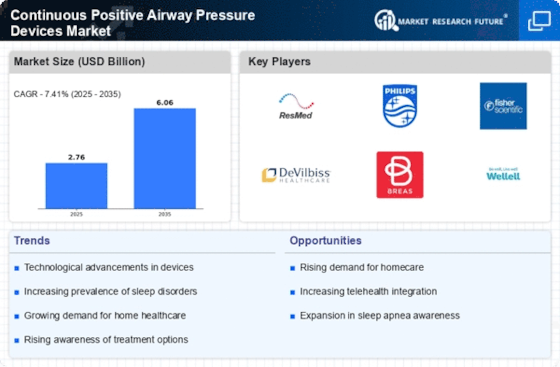
Continuous Positive Airway Pressure Devices Market Infographic
Purchase Options

Continuous Positive Airway Pressure Devices Size

Continuous Positive Airway Pressure Devices Market Growth Projections and Opportunities

The Continuous Positive Airway Pressure (CPAP) devices market is influenced by various market factors that play a crucial role in shaping its dynamics. One of the primary drivers of this market is the rising prevalence of sleep apnea and other respiratory disorders. As awareness about these conditions grows, there is an increased demand for effective treatment options, with CPAP devices emerging as a preferred choice. The aging population is another significant factor contributing to the market's expansion, as elderly individuals are more susceptible to respiratory issues, thus driving the need for CPAP therapy.

Technological advancements represent a pivotal market factor, continually enhancing the functionality and comfort of CPAP devices. Innovations such as quieter motors, compact designs, and smart features are gaining traction, improving patient compliance and overall satisfaction. Additionally, the integration of connectivity options, allowing remote monitoring by healthcare providers, has further augmented the market's appeal.

Government initiatives and healthcare policies also significantly impact the CPAP devices market. Supportive regulations, reimbursement programs, and awareness campaigns contribute to increased adoption of these devices. The recognition of sleep apnea as a serious health concern by healthcare authorities globally has led to the inclusion of CPAP therapy in various treatment guidelines, positively influencing market growth.

Economic factors, including disposable income and healthcare expenditure, play a role in shaping the CPAP devices market. As economies develop, individuals are more willing to invest in their health, leading to increased sales of CPAP devices. However, cost remains a significant concern, especially in developing regions, where affordability can hinder widespread adoption. Manufacturers are increasingly focusing on developing cost-effective solutions to address this challenge and tap into emerging markets.

Market competition and the presence of a diverse range of CPAP devices contribute to market dynamics. The existence of various players, each offering unique features and pricing strategies, fosters competition and innovation. This competitive landscape not only benefits consumers by providing them with choices but also drives manufacturers to improve their products continually.

The COVID-19 pandemic has had a dual impact on the CPAP devices market. On one hand, the increased awareness of respiratory health and the potential complications associated with infections has highlighted the importance of CPAP therapy. On the other hand, disruptions in the supply chain and healthcare priorities shifting towards pandemic management have posed challenges for market growth.

Consumer preferences and lifestyle changes also influence the CPAP devices market. As individuals become more health-conscious and seek non-invasive treatment options, the demand for CPAP devices is likely to witness an upward trajectory. Moreover, the convenience of home-based therapy compared to hospital stays has driven the preference for CPAP devices, contributing to market growth.
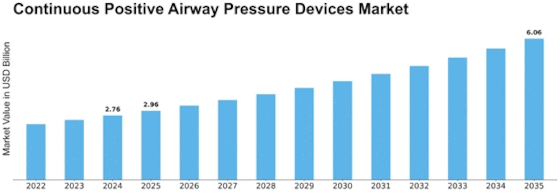

Continuous Positive Airway Pressure Devices Market Size Graph
Author
Kinjoll Dey
Research Analyst Level I

He is an extremely curious individual currently working in Healthcare and Medical Devices Domain. Kinjoll is comfortably versed in data centric research backed by healthcare educational background. He leverages extensive data mining and analytics tools such as Primary and Secondary Research, Statistical Analysis, Machine Learning, Data Modelling. His key role also involves Technical Sales Support, Client Interaction and Project management within the Healthcare team. Lastly, he showcases extensive affinity towards learning new skills and remain fascinated in implementing them.

Leave a Comment

FAQs

What is the projected market valuation for Continuous Positive Airway Pressure Devices by 2035?

The market is projected to reach a valuation of 6.06 USD Billion by 2035.

What was the market valuation for Continuous Positive Airway Pressure Devices in 2024?

The market valuation was 2.76 USD Billion in 2024.

What is the expected CAGR for the Continuous Positive Airway Pressure Devices Market during the forecast period 2025 - 2035?

The expected CAGR for the market during this period is 7.41%.

Which product type segment is anticipated to have the highest growth in the Continuous Positive Airway Pressure Devices Market?

The CPAP mask segment is expected to grow from 1.1 USD Billion in 2024 to 2.4 USD Billion by 2035.

How do automation types compare in terms of market valuation for Continuous Positive Airway Pressure Devices?

The automatic devices segment is projected to grow from 1.66 USD Billion in 2024 to 3.66 USD Billion by 2035.

Market Summary

As per Market Research Future analysis, the Continuous Positive Airway Pressure Devices Market was estimated at 2.76 USD Billion in 2024. The Continuous Positive Airway Pressure Devices industry is projected to grow from 2.965 USD Billion in 2025 to 6.06 USD Billion by 2035, exhibiting a compound annual growth rate (CAGR) of 7.41% during the forecast period 2025 - 2035

Key Market Trends & Highlights

The Continuous Positive Airway Pressure Devices Market is experiencing robust growth driven by technological advancements and increasing awareness of sleep disorders.

  • Technological advancements in CPAP devices are enhancing patient comfort and compliance, thereby driving market growth. North America remains the largest market for CPAP devices, while Asia-Pacific is emerging as the fastest-growing region. CPAP masks dominate the market, whereas CPAP motors are witnessing the fastest growth due to innovations in design and functionality. The rising prevalence of sleep apnea and increasing healthcare expenditure are key drivers propelling the market forward.

Market Size & Forecast

2024 Market Size 2.76 (USD Billion)
2035 Market Size 6.06 (USD Billion)
CAGR (2025 - 2035) 7.41%
Largest Regional Market Share in 2024 North America

Major Players

<p><a href="https://newsroom.resmed.com/news-releases/news-details/2018/ResMeds-New-QuietAir-Diffuser-Vent-for-CPAP-Masks-Reduces-Noise-by-89-Percent/default.aspx">ResMed</a> (AU), Philips (NL), Fisher &amp; Paykel Healthcare (NZ), DeVilbiss Healthcare (US), Breas Medical (SE), Apex Medical (TW), Medtronic (US), Sleepnet Corporation (US)</p>

Market Trends

The Continuous Positive Airway Pressure Devices Market is currently experiencing a notable transformation, driven by advancements in technology and an increasing awareness of sleep-related disorders. The integration of smart technology into these devices appears to enhance patient compliance and comfort, which may lead to improved health outcomes. Furthermore, the growing prevalence of conditions such as obstructive sleep apnea is likely to propel demand for these devices, as healthcare providers seek effective solutions to manage these disorders. As a result, manufacturers are focusing on innovation, developing devices that are not only more efficient but also user-friendly, which could potentially reshape the competitive landscape of the market. In addition to technological advancements, the Continuous Positive Airway Pressure Devices Market is influenced by regulatory changes and evolving healthcare policies. Governments and health organizations seem to be placing greater emphasis on the importance of sleep health, which may lead to increased funding and support for research and development in this field. Moreover, the rise of telemedicine and remote monitoring solutions could facilitate better access to these devices, particularly in underserved regions. This evolving landscape suggests that the market is poised for growth, with opportunities for both established players and new entrants to capitalize on emerging trends and consumer needs.

Technological Advancements

The Continuous Positive Airway Pressure Devices Market is witnessing a surge in technological innovations. Manufacturers are increasingly incorporating smart features, such as connectivity and data tracking, into their devices. This trend appears to enhance user experience and adherence to therapy, as patients can monitor their progress and receive real-time feedback.

Increased Awareness of Sleep Disorders

There is a growing recognition of the impact of sleep disorders on overall health. This heightened awareness seems to drive demand for Continuous Positive Airway Pressure devices, as more individuals seek effective treatments for conditions like obstructive sleep apnea. Healthcare providers are likely to respond by recommending these devices more frequently.

Regulatory Support and Policy Changes

The regulatory environment surrounding sleep health is evolving, with governments and health organizations advocating for better sleep management solutions. This trend may lead to increased funding for research and development in the Continuous Positive Airway Pressure Devices Market, potentially fostering innovation and improving access to these essential devices.

Continuous Positive Airway Pressure Devices Market Market Drivers

Rising Healthcare Expenditure

Rising healthcare expenditure is another critical driver influencing the Continuous Positive Airway Pressure Devices Market. As countries allocate more resources to healthcare, there is a corresponding increase in spending on medical devices, including CPAP machines. This trend is particularly evident in regions where healthcare reforms are underway, leading to improved access to treatment for sleep disorders. Increased funding for sleep studies and awareness campaigns further supports the growth of the market. Data indicates that healthcare spending is expected to rise significantly in the coming years, which may enhance the affordability and availability of CPAP devices. Consequently, this financial commitment to healthcare is likely to bolster the Continuous Positive Airway Pressure Devices Market.

Increasing Geriatric Population

The increasing geriatric population is a significant driver for the Continuous Positive Airway Pressure Devices Market. As individuals age, the likelihood of developing sleep apnea and other respiratory disorders escalates. According to demographic data, the global population aged 65 and older is projected to reach 1.5 billion by 2050, creating a substantial market for CPAP devices. Older adults often experience comorbidities that exacerbate sleep-related issues, necessitating effective management solutions. Healthcare systems are increasingly focusing on providing adequate care for this demographic, which includes the prescription of CPAP devices. This trend indicates a growing recognition of the importance of sleep health in the elderly, thereby driving demand within the Continuous Positive Airway Pressure Devices Market.

Rising Prevalence of Sleep Apnea

The rising prevalence of sleep apnea is a primary driver for the Continuous Positive Airway Pressure Devices Market. Studies indicate that approximately 22 million individuals in the United States suffer from sleep apnea, with a significant portion remaining undiagnosed. This condition, characterized by repeated interruptions in breathing during sleep, necessitates effective treatment options. As awareness of sleep disorders increases, more patients seek diagnosis and treatment, thereby propelling demand for CPAP devices. The market is projected to grow as healthcare providers emphasize the importance of managing sleep apnea to prevent associated health risks, such as cardiovascular diseases and diabetes. Consequently, the growing patient population is likely to stimulate innovation and expansion within the Continuous Positive Airway Pressure Devices Market.

Growing Focus on Preventive Healthcare

The growing focus on preventive healthcare is emerging as a vital driver for the Continuous Positive Airway Pressure Devices Market. As healthcare systems shift towards preventive measures, there is an increasing emphasis on early diagnosis and management of sleep disorders. This proactive approach encourages individuals to seek treatment before complications arise, thereby increasing the demand for CPAP devices. Public health initiatives aimed at educating the population about the risks associated with untreated sleep apnea are gaining traction. Market data suggests that this shift towards preventive healthcare is likely to result in higher adoption rates of CPAP devices, as patients become more aware of the importance of managing their sleep health. This trend is expected to significantly impact the Continuous Positive Airway Pressure Devices Market.

Technological Innovations in CPAP Devices

Technological innovations play a crucial role in shaping the Continuous Positive Airway Pressure Devices Market. Recent advancements have led to the development of more compact, user-friendly, and efficient CPAP devices. Features such as automatic pressure adjustments, integrated humidifiers, and connectivity with mobile applications enhance user experience and compliance. The introduction of smart CPAP devices, which monitor sleep patterns and provide real-time feedback, is particularly noteworthy. These innovations not only improve patient outcomes but also attract a broader consumer base. Market data suggests that the demand for technologically advanced CPAP devices is on the rise, with a notable increase in sales attributed to enhanced functionalities. As manufacturers continue to invest in research and development, the Continuous Positive Airway Pressure Devices Market is expected to witness sustained growth.

Market Segment Insights

By Product Type: CPAP Masks (Largest) vs. CPAP Motors (Fastest-Growing)

<p>In the Continuous Positive Airway Pressure Devices Market, the product type segment shows a diverse distribution with CPAP masks dominating the landscape. They account for the largest share due to their fundamental role in delivering therapy to patients suffering from obstructive sleep apnea. Following them, CPAP motors and hoses, although smaller in comparison, play crucial roles in the functionality and efficiency of CPAP systems. The 'Others' category includes ancillary devices that, while not central, contribute to the overall market dynamics.</p>

<p>CPAP Masks (Dominant) vs. CPAP Motors (Emerging)</p>

<p>CPAP masks remain the dominant product type in the Continuous Positive Airway Pressure Devices Market, primarily because of their essential function in ensuring effective therapy delivery. They come in various styles, including nasal, full-face, and nasal pillow masks, addressing diverse patient needs and preferences. On the other hand, CPAP motors are emerging as a significant segment due to technological advancements that enhance operational efficiency and patient comfort. These motors are essential for the device's performance, and their growth is driven by increasing demand for quieter, compact, and energy-efficient solutions, allowing them to carve a niche in the market.</p>

By Automation: Automatic (Largest) vs. Manual (Fastest-Growing)

<p>In the Continuous Positive Airway Pressure (CPAP) Devices Market, the automation segment is led by Automatic devices, which account for the majority of the market share due to their advanced features and user-friendly designs. Automatic CPAPs adjust pressure levels automatically in response to the patient's breathing patterns, ensuring optimal therapy. In contrast, Manual CPAP devices hold a smaller share but are gaining traction among specific patient demographics seeking cost-effective solutions. This shift in preference is also indicative of broader trends in personal healthcare management, where patients increasingly desire control over their therapeutic options.</p>

<p>Automation: Automatic (Dominant) vs. Manual (Emerging)</p>

<p>Automatic CPAP devices dominate the market because they provide customizable pressure adjustments throughout the night, accommodating for varying respiratory needs. These devices are often equipped with advanced algorithms and data connectivity, enhancing patient adherence and comfort. In contrast, Manual CPAP devices, while offering cost advantages and simplicity, serve as an ideal choice for specific patient segments including those with stable conditions who prefer traditional settings. The emerging trends in manual devices are driven by increasing cost sensitivity among patients and efforts to expand access to therapy, showcasing a versatile landscape within the CPAP market.</p>

By Features: Heated Tubing (Largest) vs. Humidifier (Fastest-Growing)

<p>In the Continuous Positive Airway Pressure (CPAP) Devices Market, the features segment is diverse, with heated tubing holding a significant market share. This segment benefits from technological advancements that enhance patient comfort and compliance. Following this, humidifiers have emerged as a crucial feature, appealing to users who prioritize respiratory comfort. As patients increasingly seek therapeutic benefits, these features have become more integral to device offerings, thereby shaping market dynamics.</p>

<p>Heated Tubing (Dominant) vs. Humidifier (Emerging)</p>

<p>Heated tubing is recognized as the dominant feature within the CPAP devices market, providing essential benefits such as consistent temperature control and reduced condensation, which ultimately enhances user experience. By contrast, humidifiers are emerging as a vital complement to CPAP devices, rapidly gaining traction due to their ability to alleviate dryness and irritation during therapy. The growing preference for personalized patient care is shifting market demand towards features like humidifiers, which cater specifically to comfort and usability. Both features underline a trend towards improving user experience and adherence to therapy, highlighting their unique positions in the market.</p>

By End-user: Home Care (Largest) vs. Hospitals (Fastest-Growing)

<p>In the Continuous Positive Airway Pressure (CPAP) Devices Market, the distribution of market share among end-users shows that the home care segment is the largest contributor, significantly due to the increasing preference for at-home treatment solutions. Hospitals and private clinics follow, with a considerable share that reflects the reliance on these facilities for acute patient care. Moreover, the segment labeled 'Others' also plays a role, providing niche applications that cater to varied patient needs across different environments.</p>

<p>Home Care (Dominant) vs. Hospitals (Emerging)</p>

<p>The home care segment is dominant within the CPAP devices market, characterized by its strong customer base of patients requiring long-term management of sleep apnea and other respiratory conditions in familiar settings. The rise in home healthcare services, coupled with patients' preference for convenience, has propelled this segment. Conversely, hospitals represent an emerging segment, witnessing rapid growth due to advancements in technology and increasing patient admissions requiring immediate respiratory support. Hospitals often leverage cutting-edge CPAP devices to enhance patient outcomes, making this sector potentially the fastest-growing within the overall market.</p>

Get more detailed insights about Continuous Positive Airway Pressure (CPAP) Devices Market Research Report - Forecast till 2035

Regional Insights

Key Companies in the Continuous Positive Airway Pressure Devices Market market include

Industry Developments

March 2024: ResMed (US) launched AirFit F40 ultra-compact, CPAP mask. This product will help with sleep apnea therapy compliance for users of high-pressure continuous positive airway pressure (CPAP) treatment. February 2024: ResMed (US) launched a new bi-level sleep apnea device AirCurve 11 as a CPAP alternative. The AirCurve 11 device, which is compatible with all ResMed’s masks, is currently available in the US with an international rollout on deck.

Continuous Positive Airway Pressure (CPAP) Devices Market Trends

CPAP industry Drivers

A few factors may drive the continuous positive airway pressure devices market growth. The rising cases of obesity, sleep apnea, and Covid-19 around the world have led to a demand for breathing aid devices. However, this may also lead to high healthcare expenditure. Hence, CPAP devices serve as the ideal alternative to conventional breathing aids. These factors are expected to fuel the global market growth.

CPAP industry Opportunities

The major companies that account for the largest CPAP devices market share adopt various market trends such as new product launches in the field. The advancements in technology and research are adding to its growth. Moreover, most companies are also adopting R&D market trends. Hence, these factors serve as opportunities for global CPAP devices market growth.

CPAP industry Restraints

There are a few factors that may inhibit the growth of the continuous positive airway pressure devices industry. One of the most important of them is the high cost of the CPAP devices. They are often not affordable for everyone. Moreover, the use of these devices also has adverse effects on the patients. Hence, these factors may hinder the CPAP devices market growth in the long run.

CPAP industry Challenges

Most patients who use the CPAP devices have reported that devices feel uncomfortable and do not seem fit for everyday use. They also seem to have adverse side effects on the patients who use the device. Hence, the CPAP devices manufacturer companies often find it challenging to cater to the expectations of the consumers. This may slow down the continuous positive airway pressure devices market growth in the forecast period.

CPAP industry Value Chain Analysis

The continuous positive airway pressure devices market outlook is expected to be prosperous. This is because of the growing number of sleep apnea cases among the global population. The CPAP devices help increase the air pressure in the throat to prevent the airway from collapsing when breathing. These devices are suitable for everyday use at home while asleep.

The CPAP devices are also available in two types of automation technology – manual and automatic. The automatic devices are run by automatically controlling the air pressure in the airway. The automatic CPAP device market is witnessed the fastest growth rate over the forecast years. Post the pandemic, people affected with Covid-19 often suffer from breathing issues. Hence, continuous positive airway pressure devices can be used to aid patients in breathing.

Future Outlook

Continuous Positive Airway Pressure Devices Market Future Outlook

<p>The Continuous Positive Airway Pressure Devices Market is projected to grow at a 7.41% CAGR from 2024 to 2035, driven by increasing prevalence of sleep apnea and technological advancements.</p>

New opportunities lie in:

  • <p>Expansion into <a href="https://www.marketresearchfuture.com/reports/telehealth-service-market-43509">telehealth services</a> for remote patient monitoring.</p>
  • <p>Development of portable CPAP devices for travel convenience.</p>
  • <p>Partnerships with sleep clinics for integrated care solutions.</p>

<p>By 2035, the market is expected to be robust, reflecting substantial growth and innovation.</p>

Market Segmentation

Continuous Positive Airway Pressure Devices Market End-user Outlook

  • Home care
  • Hospitals
  • Private clinics
  • Others

Continuous Positive Airway Pressure Devices Market Features Outlook

  • Heated tubing
  • Humidifier
  • Portability
  • Others

Continuous Positive Airway Pressure Devices Market Automation Outlook

  • Automatic
  • Manual

Continuous Positive Airway Pressure Devices Market Product Type Outlook

  • CPAP mask
  • CPAP motors
  • CPAP hoses
  • Others

Report Scope

MARKET SIZE 2024 2.76(USD Billion)
MARKET SIZE 2025 2.965(USD Billion)
MARKET SIZE 2035 6.06(USD Billion)
COMPOUND ANNUAL GROWTH RATE (CAGR) 7.41% (2024 - 2035)
REPORT COVERAGE Revenue Forecast, Competitive Landscape, Growth Factors, and Trends
BASE YEAR 2024
Market Forecast Period 2025 - 2035
Historical Data 2019 - 2024
Market Forecast Units USD Billion
Key Companies Profiled ResMed (AU), Philips (NL), Fisher & Paykel Healthcare (NZ), DeVilbiss Healthcare (US), Breas Medical (SE), Apex Medical (TW), Medtronic (US), Sleepnet Corporation (US)
Segments Covered Product Type
Key Market Opportunities Integration of telehealth solutions enhances patient monitoring in the Continuous Positive Airway Pressure Devices Market.
Key Market Dynamics Technological advancements and regulatory changes drive innovation and competition in the Continuous Positive Airway Pressure Devices market.
Countries Covered North America, Europe, APAC, South America, MEA

FAQs

What is the projected market valuation for Continuous Positive Airway Pressure Devices by 2035?

The market is projected to reach a valuation of 6.06 USD Billion by 2035.

What was the market valuation for Continuous Positive Airway Pressure Devices in 2024?

The market valuation was 2.76 USD Billion in 2024.

What is the expected CAGR for the Continuous Positive Airway Pressure Devices Market during the forecast period 2025 - 2035?

The expected CAGR for the market during this period is 7.41%.

Which product type segment is anticipated to have the highest growth in the Continuous Positive Airway Pressure Devices Market?

The CPAP mask segment is expected to grow from 1.1 USD Billion in 2024 to 2.4 USD Billion by 2035.

How do automation types compare in terms of market valuation for Continuous Positive Airway Pressure Devices?

The automatic devices segment is projected to grow from 1.66 USD Billion in 2024 to 3.66 USD Billion by 2035.

  1. SECTION I: EXECUTIVE SUMMARY AND KEY HIGHLIGHTS
    1. EXECUTIVE SUMMARY
      1. Market Overview
      2. Key Findings
      3. Market Segmentation
      4. Competitive Landscape
      5. Challenges and Opportunities
      6. Future Outlook 2
  2. SECTION II: SCOPING, METHODOLOGY AND MARKET STRUCTURE
    1. MARKET INTRODUCTION
      1. Definition
      2. Scope of the study
    2. RESEARCH METHODOLOGY
      1. Overview
      2. Data Mining
      3. Secondary Research
      4. Primary Research
      5. Forecasting Model
      6. Market Size Estimation
      7. Data Triangulation
      8. Validation 3
  3. SECTION III: QUALITATIVE ANALYSIS
    1. MARKET DYNAMICS
      1. Overview
      2. Drivers
      3. Restraints
      4. Opportunities
    2. MARKET FACTOR ANALYSIS
      1. Value chain Analysis
      2. Porter's Five Forces Analysis
      3. COVID-19 Impact Analysis
  4. SECTION IV: QUANTITATIVE ANALYSIS
    1. Healthcare, BY Product Type (USD Billion)
      1. CPAP mask
      2. CPAP motors
      3. CPAP hoses
      4. Others
    2. Healthcare, BY Automation (USD Billion)
      1. Automatic
      2. Manual
    3. Healthcare, BY Features (USD Billion)
      1. Heated tubing
      2. Humidifier
      3. Portability
      4. Others
    4. Healthcare, BY End-user (USD Billion)
      1. Home care
      2. Hospitals
      3. Private clinics
      4. Others
    5. Healthcare, BY Region (USD Billion)
      1. North America
      2. Europe
      3. APAC
      4. South America
      5. MEA
  5. SECTION V: COMPETITIVE ANALYSIS
    1. Competitive Landscape
      1. Overview
      2. Competitive Analysis
      3. Market share Analysis
      4. Major Growth Strategy in the Healthcare
      5. Competitive Benchmarking
      6. Leading Players in Terms of Number of Developments in the Healthcare
      7. Key developments and growth strategies
      8. Major Players Financial Matrix
    2. Company Profiles
      1. ResMed (AU)
      2. Philips (NL)
      3. Fisher & Paykel Healthcare (NZ)
      4. DeVilbiss Healthcare (US)
      5. Breas Medical (SE)
      6. Apex Medical (TW)
      7. Medtronic (US)
      8. Sleepnet Corporation (US)
    3. Appendix
      1. References
      2. Related Reports 6 LIST OF FIGURES
    4. MARKET SYNOPSIS
    5. NORTH AMERICA MARKET ANALYSIS
    6. US MARKET ANALYSIS BY PRODUCT TYPE
    7. US MARKET ANALYSIS BY AUTOMATION
    8. US MARKET ANALYSIS BY FEATURES
    9. US MARKET ANALYSIS BY END-USER
    10. CANADA MARKET ANALYSIS BY PRODUCT TYPE
    11. CANADA MARKET ANALYSIS BY AUTOMATION
    12. CANADA MARKET ANALYSIS BY FEATURES
    13. CANADA MARKET ANALYSIS BY END-USER
    14. EUROPE MARKET ANALYSIS
    15. GERMANY MARKET ANALYSIS BY PRODUCT TYPE
    16. GERMANY MARKET ANALYSIS BY AUTOMATION
    17. GERMANY MARKET ANALYSIS BY FEATURES
    18. GERMANY MARKET ANALYSIS BY END-USER
    19. UK MARKET ANALYSIS BY PRODUCT TYPE
    20. UK MARKET ANALYSIS BY AUTOMATION
    21. UK MARKET ANALYSIS BY FEATURES
    22. UK MARKET ANALYSIS BY END-USER
    23. FRANCE MARKET ANALYSIS BY PRODUCT TYPE
    24. FRANCE MARKET ANALYSIS BY AUTOMATION
    25. FRANCE MARKET ANALYSIS BY FEATURES
    26. FRANCE MARKET ANALYSIS BY END-USER
    27. RUSSIA MARKET ANALYSIS BY PRODUCT TYPE
    28. RUSSIA MARKET ANALYSIS BY AUTOMATION
    29. RUSSIA MARKET ANALYSIS BY FEATURES
    30. RUSSIA MARKET ANALYSIS BY END-USER
    31. ITALY MARKET ANALYSIS BY PRODUCT TYPE
    32. ITALY MARKET ANALYSIS BY AUTOMATION
    33. ITALY MARKET ANALYSIS BY FEATURES
    34. ITALY MARKET ANALYSIS BY END-USER
    35. SPAIN MARKET ANALYSIS BY PRODUCT TYPE
    36. SPAIN MARKET ANALYSIS BY AUTOMATION
    37. SPAIN MARKET ANALYSIS BY FEATURES
    38. SPAIN MARKET ANALYSIS BY END-USER
    39. REST OF EUROPE MARKET ANALYSIS BY PRODUCT TYPE
    40. REST OF EUROPE MARKET ANALYSIS BY AUTOMATION
    41. REST OF EUROPE MARKET ANALYSIS BY FEATURES
    42. REST OF EUROPE MARKET ANALYSIS BY END-USER
    43. APAC MARKET ANALYSIS
    44. CHINA MARKET ANALYSIS BY PRODUCT TYPE
    45. CHINA MARKET ANALYSIS BY AUTOMATION
    46. CHINA MARKET ANALYSIS BY FEATURES
    47. CHINA MARKET ANALYSIS BY END-USER
    48. INDIA MARKET ANALYSIS BY PRODUCT TYPE
    49. INDIA MARKET ANALYSIS BY AUTOMATION
    50. INDIA MARKET ANALYSIS BY FEATURES
    51. INDIA MARKET ANALYSIS BY END-USER
    52. JAPAN MARKET ANALYSIS BY PRODUCT TYPE
    53. JAPAN MARKET ANALYSIS BY AUTOMATION
    54. JAPAN MARKET ANALYSIS BY FEATURES
    55. JAPAN MARKET ANALYSIS BY END-USER
    56. SOUTH KOREA MARKET ANALYSIS BY PRODUCT TYPE
    57. SOUTH KOREA MARKET ANALYSIS BY AUTOMATION
    58. SOUTH KOREA MARKET ANALYSIS BY FEATURES
    59. SOUTH KOREA MARKET ANALYSIS BY END-USER
    60. MALAYSIA MARKET ANALYSIS BY PRODUCT TYPE
    61. MALAYSIA MARKET ANALYSIS BY AUTOMATION
    62. MALAYSIA MARKET ANALYSIS BY FEATURES
    63. MALAYSIA MARKET ANALYSIS BY END-USER
    64. THAILAND MARKET ANALYSIS BY PRODUCT TYPE
    65. THAILAND MARKET ANALYSIS BY AUTOMATION
    66. THAILAND MARKET ANALYSIS BY FEATURES
    67. THAILAND MARKET ANALYSIS BY END-USER
    68. INDONESIA MARKET ANALYSIS BY PRODUCT TYPE
    69. INDONESIA MARKET ANALYSIS BY AUTOMATION
    70. INDONESIA MARKET ANALYSIS BY FEATURES
    71. INDONESIA MARKET ANALYSIS BY END-USER
    72. REST OF APAC MARKET ANALYSIS BY PRODUCT TYPE
    73. REST OF APAC MARKET ANALYSIS BY AUTOMATION
    74. REST OF APAC MARKET ANALYSIS BY FEATURES
    75. REST OF APAC MARKET ANALYSIS BY END-USER
    76. SOUTH AMERICA MARKET ANALYSIS
    77. BRAZIL MARKET ANALYSIS BY PRODUCT TYPE
    78. BRAZIL MARKET ANALYSIS BY AUTOMATION
    79. BRAZIL MARKET ANALYSIS BY FEATURES
    80. BRAZIL MARKET ANALYSIS BY END-USER
    81. MEXICO MARKET ANALYSIS BY PRODUCT TYPE
    82. MEXICO MARKET ANALYSIS BY AUTOMATION
    83. MEXICO MARKET ANALYSIS BY FEATURES
    84. MEXICO MARKET ANALYSIS BY END-USER
    85. ARGENTINA MARKET ANALYSIS BY PRODUCT TYPE
    86. ARGENTINA MARKET ANALYSIS BY AUTOMATION
    87. ARGENTINA MARKET ANALYSIS BY FEATURES
    88. ARGENTINA MARKET ANALYSIS BY END-USER
    89. REST OF SOUTH AMERICA MARKET ANALYSIS BY PRODUCT TYPE
    90. REST OF SOUTH AMERICA MARKET ANALYSIS BY AUTOMATION
    91. REST OF SOUTH AMERICA MARKET ANALYSIS BY FEATURES
    92. REST OF SOUTH AMERICA MARKET ANALYSIS BY END-USER
    93. MEA MARKET ANALYSIS
    94. GCC COUNTRIES MARKET ANALYSIS BY PRODUCT TYPE
    95. GCC COUNTRIES MARKET ANALYSIS BY AUTOMATION
    96. GCC COUNTRIES MARKET ANALYSIS BY FEATURES
    97. GCC COUNTRIES MARKET ANALYSIS BY END-USER
    98. SOUTH AFRICA MARKET ANALYSIS BY PRODUCT TYPE
    99. SOUTH AFRICA MARKET ANALYSIS BY AUTOMATION
    100. SOUTH AFRICA MARKET ANALYSIS BY FEATURES
    101. SOUTH AFRICA MARKET ANALYSIS BY END-USER
    102. REST OF MEA MARKET ANALYSIS BY PRODUCT TYPE
    103. REST OF MEA MARKET ANALYSIS BY AUTOMATION
    104. REST OF MEA MARKET ANALYSIS BY FEATURES
    105. REST OF MEA MARKET ANALYSIS BY END-USER
    106. KEY BUYING CRITERIA OF HEALTHCARE
    107. RESEARCH PROCESS OF MRFR
    108. DRO ANALYSIS OF HEALTHCARE
    109. DRIVERS IMPACT ANALYSIS: HEALTHCARE
    110. RESTRAINTS IMPACT ANALYSIS: HEALTHCARE
    111. SUPPLY / VALUE CHAIN: HEALTHCARE
    112. HEALTHCARE, BY PRODUCT TYPE, 2024 (% SHARE)
    113. HEALTHCARE, BY PRODUCT TYPE, 2024 TO 2035 (USD Billion)
    114. HEALTHCARE, BY AUTOMATION, 2024 (% SHARE)
    115. HEALTHCARE, BY AUTOMATION, 2024 TO 2035 (USD Billion)
    116. HEALTHCARE, BY FEATURES, 2024 (% SHARE)
    117. HEALTHCARE, BY FEATURES, 2024 TO 2035 (USD Billion)
    118. HEALTHCARE, BY END-USER, 2024 (% SHARE)
    119. HEALTHCARE, BY END-USER, 2024 TO 2035 (USD Billion)
    120. BENCHMARKING OF MAJOR COMPETITORS 7 LIST OF TABLES
    121. LIST OF ASSUMPTIONS
    122. North America MARKET SIZE ESTIMATES; FORECAST
      1. BY PRODUCT TYPE, 2025-2035 (USD Billion)
      2. BY AUTOMATION, 2025-2035 (USD Billion)
      3. BY FEATURES, 2025-2035 (USD Billion)
      4. BY END-USER, 2025-2035 (USD Billion)
    123. US MARKET SIZE ESTIMATES; FORECAST
      1. BY PRODUCT TYPE, 2025-2035 (USD Billion)
      2. BY AUTOMATION, 2025-2035 (USD Billion)
      3. BY FEATURES, 2025-2035 (USD Billion)
      4. BY END-USER, 2025-2035 (USD Billion)
    124. Canada MARKET SIZE ESTIMATES; FORECAST
      1. BY PRODUCT TYPE, 2025-2035 (USD Billion)
      2. BY AUTOMATION, 2025-2035 (USD Billion)
      3. BY FEATURES, 2025-2035 (USD Billion)
      4. BY END-USER, 2025-2035 (USD Billion)
    125. Europe MARKET SIZE ESTIMATES; FORECAST
      1. BY PRODUCT TYPE, 2025-2035 (USD Billion)
      2. BY AUTOMATION, 2025-2035 (USD Billion)
      3. BY FEATURES, 2025-2035 (USD Billion)
      4. BY END-USER, 2025-2035 (USD Billion)
    126. Germany MARKET SIZE ESTIMATES; FORECAST
      1. BY PRODUCT TYPE, 2025-2035 (USD Billion)
      2. BY AUTOMATION, 2025-2035 (USD Billion)
      3. BY FEATURES, 2025-2035 (USD Billion)
      4. BY END-USER, 2025-2035 (USD Billion)
    127. UK MARKET SIZE ESTIMATES; FORECAST
      1. BY PRODUCT TYPE, 2025-2035 (USD Billion)
      2. BY AUTOMATION, 2025-2035 (USD Billion)
      3. BY FEATURES, 2025-2035 (USD Billion)
      4. BY END-USER, 2025-2035 (USD Billion)
    128. France MARKET SIZE ESTIMATES; FORECAST
      1. BY PRODUCT TYPE, 2025-2035 (USD Billion)
      2. BY AUTOMATION, 2025-2035 (USD Billion)
      3. BY FEATURES, 2025-2035 (USD Billion)
      4. BY END-USER, 2025-2035 (USD Billion)
    129. Russia MARKET SIZE ESTIMATES; FORECAST
      1. BY PRODUCT TYPE, 2025-2035 (USD Billion)
      2. BY AUTOMATION, 2025-2035 (USD Billion)
      3. BY FEATURES, 2025-2035 (USD Billion)
      4. BY END-USER, 2025-2035 (USD Billion)
    130. Italy MARKET SIZE ESTIMATES; FORECAST
      1. BY PRODUCT TYPE, 2025-2035 (USD Billion)
      2. BY AUTOMATION, 2025-2035 (USD Billion)
      3. BY FEATURES, 2025-2035 (USD Billion)
      4. BY END-USER, 2025-2035 (USD Billion)
    131. Spain MARKET SIZE ESTIMATES; FORECAST
      1. BY PRODUCT TYPE, 2025-2035 (USD Billion)
      2. BY AUTOMATION, 2025-2035 (USD Billion)
      3. BY FEATURES, 2025-2035 (USD Billion)
      4. BY END-USER, 2025-2035 (USD Billion)
    132. Rest of Europe MARKET SIZE ESTIMATES; FORECAST
      1. BY PRODUCT TYPE, 2025-2035 (USD Billion)
      2. BY AUTOMATION, 2025-2035 (USD Billion)
      3. BY FEATURES, 2025-2035 (USD Billion)
      4. BY END-USER, 2025-2035 (USD Billion)
    133. APAC MARKET SIZE ESTIMATES; FORECAST
      1. BY PRODUCT TYPE, 2025-2035 (USD Billion)
      2. BY AUTOMATION, 2025-2035 (USD Billion)
      3. BY FEATURES, 2025-2035 (USD Billion)
      4. BY END-USER, 2025-2035 (USD Billion)
    134. China MARKET SIZE ESTIMATES; FORECAST
      1. BY PRODUCT TYPE, 2025-2035 (USD Billion)
      2. BY AUTOMATION, 2025-2035 (USD Billion)
      3. BY FEATURES, 2025-2035 (USD Billion)
      4. BY END-USER, 2025-2035 (USD Billion)
    135. India MARKET SIZE ESTIMATES; FORECAST
      1. BY PRODUCT TYPE, 2025-2035 (USD Billion)
      2. BY AUTOMATION, 2025-2035 (USD Billion)
      3. BY FEATURES, 2025-2035 (USD Billion)
      4. BY END-USER, 2025-2035 (USD Billion)
    136. Japan MARKET SIZE ESTIMATES; FORECAST
      1. BY PRODUCT TYPE, 2025-2035 (USD Billion)
      2. BY AUTOMATION, 2025-2035 (USD Billion)
      3. BY FEATURES, 2025-2035 (USD Billion)
      4. BY END-USER, 2025-2035 (USD Billion)
    137. South Korea MARKET SIZE ESTIMATES; FORECAST
      1. BY PRODUCT TYPE, 2025-2035 (USD Billion)
      2. BY AUTOMATION, 2025-2035 (USD Billion)
      3. BY FEATURES, 2025-2035 (USD Billion)
      4. BY END-USER, 2025-2035 (USD Billion)
    138. Malaysia MARKET SIZE ESTIMATES; FORECAST
      1. BY PRODUCT TYPE, 2025-2035 (USD Billion)
      2. BY AUTOMATION, 2025-2035 (USD Billion)
      3. BY FEATURES, 2025-2035 (USD Billion)
      4. BY END-USER, 2025-2035 (USD Billion)
    139. Thailand MARKET SIZE ESTIMATES; FORECAST
      1. BY PRODUCT TYPE, 2025-2035 (USD Billion)
      2. BY AUTOMATION, 2025-2035 (USD Billion)
      3. BY FEATURES, 2025-2035 (USD Billion)
      4. BY END-USER, 2025-2035 (USD Billion)
    140. Indonesia MARKET SIZE ESTIMATES; FORECAST
      1. BY PRODUCT TYPE, 2025-2035 (USD Billion)
      2. BY AUTOMATION, 2025-2035 (USD Billion)
      3. BY FEATURES, 2025-2035 (USD Billion)
      4. BY END-USER, 2025-2035 (USD Billion)
    141. Rest of APAC MARKET SIZE ESTIMATES; FORECAST
      1. BY PRODUCT TYPE, 2025-2035 (USD Billion)
      2. BY AUTOMATION, 2025-2035 (USD Billion)
      3. BY FEATURES, 2025-2035 (USD Billion)
      4. BY END-USER, 2025-2035 (USD Billion)
    142. South America MARKET SIZE ESTIMATES; FORECAST
      1. BY PRODUCT TYPE, 2025-2035 (USD Billion)
      2. BY AUTOMATION, 2025-2035 (USD Billion)
      3. BY FEATURES, 2025-2035 (USD Billion)
      4. BY END-USER, 2025-2035 (USD Billion)
    143. Brazil MARKET SIZE ESTIMATES; FORECAST
      1. BY PRODUCT TYPE, 2025-2035 (USD Billion)
      2. BY AUTOMATION, 2025-2035 (USD Billion)
      3. BY FEATURES, 2025-2035 (USD Billion)
      4. BY END-USER, 2025-2035 (USD Billion)
    144. Mexico MARKET SIZE ESTIMATES; FORECAST
      1. BY PRODUCT TYPE, 2025-2035 (USD Billion)
      2. BY AUTOMATION, 2025-2035 (USD Billion)
      3. BY FEATURES, 2025-2035 (USD Billion)
      4. BY END-USER, 2025-2035 (USD Billion)
    145. Argentina MARKET SIZE ESTIMATES; FORECAST
      1. BY PRODUCT TYPE, 2025-2035 (USD Billion)
      2. BY AUTOMATION, 2025-2035 (USD Billion)
      3. BY FEATURES, 2025-2035 (USD Billion)
      4. BY END-USER, 2025-2035 (USD Billion)
    146. Rest of South America MARKET SIZE ESTIMATES; FORECAST
      1. BY PRODUCT TYPE, 2025-2035 (USD Billion)
      2. BY AUTOMATION, 2025-2035 (USD Billion)
      3. BY FEATURES, 2025-2035 (USD Billion)
      4. BY END-USER, 2025-2035 (USD Billion)
    147. MEA MARKET SIZE ESTIMATES; FORECAST
      1. BY PRODUCT TYPE, 2025-2035 (USD Billion)
      2. BY AUTOMATION, 2025-2035 (USD Billion)
      3. BY FEATURES, 2025-2035 (USD Billion)
      4. BY END-USER, 2025-2035 (USD Billion)
    148. GCC Countries MARKET SIZE ESTIMATES; FORECAST
      1. BY PRODUCT TYPE, 2025-2035 (USD Billion)
      2. BY AUTOMATION, 2025-2035 (USD Billion)
      3. BY FEATURES, 2025-2035 (USD Billion)
      4. BY END-USER, 2025-2035 (USD Billion)
    149. South Africa MARKET SIZE ESTIMATES; FORECAST
      1. BY PRODUCT TYPE, 2025-2035 (USD Billion)
      2. BY AUTOMATION, 2025-2035 (USD Billion)
      3. BY FEATURES, 2025-2035 (USD Billion)
      4. BY END-USER, 2025-2035 (USD Billion)
    150. Rest of MEA MARKET SIZE ESTIMATES; FORECAST
      1. BY PRODUCT TYPE, 2025-2035 (USD Billion)
      2. BY AUTOMATION, 2025-2035 (USD Billion)
      3. BY FEATURES, 2025-2035 (USD Billion)
      4. BY END-USER, 2025-2035 (USD Billion)
    151. PRODUCT LAUNCH/PRODUCT DEVELOPMENT/APPROVAL
    152. ACQUISITION/PARTNERSHIP

Continuous Positive Airway Pressure (CPAP) Devices Market Segmentation

Market Segmentation Overview

  • Detailed segmentation data will be available in the full report
  • Comprehensive analysis by multiple parameters
  • Regional and country-level breakdowns
  • Market size forecasts by segment
Infographic

Free Sample Request

Kindly complete the form below to receive a free sample of this Report

Get Free Sample

Customer Strories

Compare Licence

×
Features License Type
Single User Multiuser License Enterprise User
Price $4,950 $5,950 $7,250
Maximum User Access Limit 1 User Upto 10 Users Unrestricted Access Throughout the Organization
Free Customization
Direct Access to Analyst
Deliverable Format
Platform Access
Discount on Next Purchase 10% 15% 15%
Printable Versions