
×
Hero Background
English
Chinese
French
Japanese
Korean
German
Spanish

Construction 4.0 Market Size

ID: MRFR/ICT/11072-HCR
128 Pages
Pradeep Nandi
October 2025

Construction 4.0 Market Research Report Information By Solution (Hardware, Software, Services), By Technology (IoT, Artificial Intelligence, Industrial Robots, Others), By Application (Predictive Maintenance, Fleet Management, Asset Monitoring, Wearables, Others), By End User (Residential, Non-residential), And By Region (North America, Europe, Asia-Pacific, And Rest Of The World) –Market Forecast Till 2035

Share:
Download PDF ×

We do not share your information with anyone. However, we may send you emails based on your report interest from time to time. You may contact us at any time to opt-out.

Construction 4.0 Market Infographic
Purchase Options

Construction 4 0 Size

Construction 4.0 Market Growth Projections and Opportunities

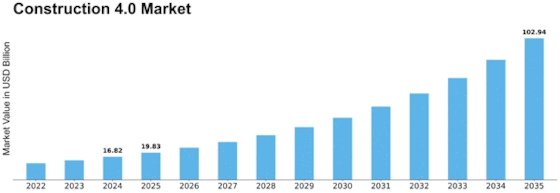
The size of the Construction 4.0 Market reached in 2022 was approximately USD 12.1 Billion. Based on the estimation, the construction 4.0 industry is expected to grow from USD 14.27 Billion in 2023 to USD 53.26 Billion by 2032 with a CAGR of 17.90% (Compound Annual Growth Rate).

At present moment, the Construction 4.0 market undergoes enormous changes driven mostly by different market factors, which determine its dynamics. Among the main factors, which includes technological progress. The engineering of novel techniques including BIM, IoT, and AI has brought a renaissance to the construction sector. The application of these technologies result in several improvements such as speeding up the project, reducing mistakes, and providing a platform for communication among all the stakeholders of the Construction 4.0 industry.

Sustainability is another important factor which impacts the market. As a result of increasing environmental activism and efficiency, constructions 4.0 are converting to eco-friendly methods. Sustainable construction has emerged as a trend, incorporating the use of sustainable materials, energy-efficient designs, and green construction techniques. This showing that there are and moreover, consumers are opting to use environmentally friendly constructions.

Along with global economic issues, the Construction 4.0 market also greatly suffers the impact of these global economic conditions. Economic stability, government policies and financial investments will significantly impact the volume of construction work that can be accomplished. With regard to the economy's upswing, there appears to be increased infrastructure development and construction projects thus Construction 4.0 market expands. However, economic depressions may cause project delays, investment level decrease and the market growth slowdown.

The government is a critical player in the elements of the market that affect construction 4.0 through laws and policies. Governments all over the globe are paying attention very much to safety norms, energy efficiency, and quality care in construction projects. Adherence to the regulations set up in this case not only assures project integrity but also generates confidence among stakeholders. The integration of all Construction 4.0 methods in terms of laws and regulations is key to continuous market growth.

Moreover, population trends and urbanization further determine the dimension of development of Construction 4.0 market. With an expansion of population and a trend of moving to urban areas this increases the infrastructure requirements as well as those solutions requiring smartness. Technologies of construction 4.0 have the potential to introduce new innovations that help solving the problems of urbanization, like fast transportation systems, intelligent buildings and integrated infrastructure. For businesses working in the Construction 4.0 market, the ability to understand demographical shifts and make necessary adjustments is paramount.

Construction 4.0 Market Size Graph
Author
Pradeep Nandi
Senior Research Analyst

I have a bachelor's degree in mechanical engineering and an MBA. I have more than two years of expertise in the retail, food, and beverage, chemical, and material industries, and hence have developed a sound cross-domain expertise. A firm believer in lifelong learning and sharing of knowledge. Having a proclivity for hatching ideas and trying to absorb as much information as possible in a short amount of time. Introducing corporates to the data and insight, which enables them to move from probability to possibility, has been my key areas of interest. 

Leave a Comment

FAQs

What is the projected market valuation of the Construction 4.0 Market by 2035?

The Construction 4.0 Market is projected to reach a valuation of 102.94 USD Billion by 2035.

What was the market valuation of the Construction 4.0 Market in 2024?

In 2024, the Construction 4.0 Market was valued at 16.82 USD Billion.

What is the expected CAGR for the Construction 4.0 Market during the forecast period 2025 - 2035?

The expected CAGR for the Construction 4.0 Market during the forecast period 2025 - 2035 is 17.9%.

Which segment of the Construction 4.0 Market had the highest valuation in 2024?

In 2024, the Software segment had the highest valuation at 6.5 USD Billion.

What are the projected valuations for the Hardware segment by 2035?

The Hardware segment is projected to reach a valuation of 27.5 USD Billion by 2035.

Which technology is expected to show significant growth in the Construction 4.0 Market?

Artificial Intelligence is expected to show significant growth, with a projected valuation of 25.56 USD Billion by 2035.

Market Summary

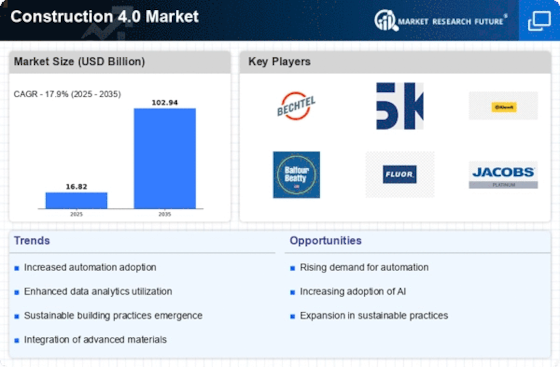
As per MRFR analysis, the Construction 4.0 Market Size was estimated at 16.82 USD Billion in 2024. The Construction 4.0 industry is projected to grow from 19.84 USD Billion in 2025 to 102.94 USD Billion by 2035, exhibiting a compound annual growth rate (CAGR) of 17.9 during the forecast period 2025 - 2035.

Key Market Trends & Highlights

The Construction 4.0 Market is poised for transformative growth driven by advanced technologies and sustainability initiatives.

  • The integration of advanced technologies is reshaping construction processes, enhancing efficiency and productivity.
  • Sustainability remains a focal point, with an increasing emphasis on green building practices across projects.
  • Enhanced collaboration and communication tools are becoming essential for successful project delivery in the industry.
  • Key market drivers include the integration of IoT and AI technologies, alongside increased investment in construction technology.

Market Size & Forecast

2024 Market Size 16.82 (USD Billion)
2035 Market Size 102.94 (USD Billion)
CAGR (2025 - 2035) 17.9%
Largest Regional Market Share in 2024 North America

Major Players

<p>Bechtel (US), Skanska (SE), Kiewit Corporation (US), Balfour Beatty (GB), Fluor Corporation (US), Jacobs Engineering Group (US), Turner Construction Company (US), Lendlease (AU), VINCI (FR)</p>

Market Trends

The Construction 4.0 Market is currently experiencing a transformative phase characterized by the integration of advanced technologies and innovative practices. This evolution is driven by the need for enhanced efficiency, sustainability, and safety within the construction sector. As digital tools and automation become more prevalent, stakeholders are increasingly adopting solutions such as Building Information Modeling (BIM), Internet of Things (IoT), and artificial intelligence. These technologies not only streamline processes but also facilitate better collaboration among project teams, ultimately leading to improved project outcomes. Moreover, the emphasis on sustainability is reshaping the Construction 4.0 Market. Companies are now prioritizing eco-friendly materials and practices, aligning with global efforts to reduce carbon footprints. This shift is likely to influence procurement strategies and project designs, as stakeholders seek to meet regulatory requirements and consumer expectations. The convergence of technology and sustainability appears to be a defining characteristic of the current landscape, suggesting that the Construction 4.0 Market is poised for continued growth and innovation in the coming years.

Integration of Advanced Technologies

The Construction 4.0 Market is witnessing a notable trend towards the adoption of advanced technologies. Tools such as Building Information Modeling (BIM) and artificial intelligence are becoming integral to project management, enhancing efficiency and accuracy. This integration facilitates real-time data sharing and decision-making, which can lead to reduced project timelines and costs.

Focus on Sustainability

Sustainability is emerging as a critical focus within the Construction 4.0 Market. Companies are increasingly adopting eco-friendly materials and practices to minimize environmental impact. This trend reflects a broader societal shift towards responsible construction, where stakeholders prioritize sustainable solutions to meet regulatory standards and consumer demands.

Enhanced Collaboration and Communication

The Construction 4.0 Market is also characterized by improved collaboration and communication among project stakeholders. Digital platforms and tools are enabling seamless interaction between architects, engineers, and contractors. This enhanced connectivity is likely to lead to more cohesive project execution and better alignment of objectives.

Construction 4.0 Market Market Drivers

Integration of IoT and AI Technologies

The integration of Internet of Things (IoT) and Artificial Intelligence (AI) technologies is a pivotal driver in the Construction 4.0 Market. These technologies facilitate real-time data collection and analysis, enhancing decision-making processes. For instance, IoT devices can monitor equipment performance and environmental conditions, leading to improved operational efficiency. According to recent estimates, the adoption of IoT in construction could lead to a 10-15% reduction in project costs. AI algorithms can optimize project scheduling and resource allocation, further streamlining operations. As construction firms increasingly embrace these technologies, the Construction 4.0 Market is likely to witness accelerated growth, driven by the demand for smarter, more efficient construction practices.

Regulatory Compliance and Safety Standards

Regulatory compliance and safety standards are increasingly influencing the Construction 4.0 Market. Governments and regulatory bodies are implementing stringent safety regulations to mitigate risks associated with construction activities. This has led to a heightened focus on adopting technologies that enhance safety and compliance, such as wearable devices and automated monitoring systems. The market for safety technology in construction is expected to grow, driven by the need for companies to adhere to these regulations. As firms invest in compliance-related technologies, the Construction 4.0 Market is likely to evolve, fostering a culture of safety and accountability that aligns with modern construction practices.

Sustainability and Green Building Practices

Sustainability has emerged as a crucial driver in the Construction 4.0 Market, as stakeholders increasingly prioritize eco-friendly practices. The shift towards green building is not merely a trend; it reflects a broader commitment to reducing carbon footprints and enhancing energy efficiency. The market for sustainable construction materials is projected to grow significantly, with estimates suggesting a compound annual growth rate of over 10% in the coming years. This focus on sustainability is not only driven by regulatory requirements but also by consumer preferences for environmentally responsible buildings. As a result, the Construction 4.0 Market is adapting to incorporate sustainable practices, which may lead to innovative solutions and materials that align with these environmental goals.

Collaboration and Integrated Project Delivery

Collaboration and integrated project delivery (IPD) are essential drivers in the Construction 4.0 Market. The traditional siloed approach to construction projects often leads to inefficiencies and miscommunication. However, the adoption of collaborative frameworks and IPD models is transforming how projects are executed. These approaches encourage stakeholders to work together from the project's inception, fostering transparency and shared responsibility. As a result, projects are completed more efficiently, with reduced costs and improved outcomes. The Construction 4.0 Market is witnessing a shift towards these collaborative practices, which may enhance overall project performance and stakeholder satisfaction.

Increased Investment in Construction Technology

Investment in construction technology is a prominent driver of the Construction 4.0 Market. As companies recognize the potential for technology to enhance productivity and reduce costs, funding for innovative solutions has surged. Reports indicate that investment in construction technology reached approximately $10 billion in recent years, reflecting a growing confidence in the sector's digital transformation. This influx of capital is facilitating the development of advanced tools such as Building Information Modeling (BIM), drones, and robotics, which are revolutionizing traditional construction methods. Consequently, the Construction 4.0 Market is poised for substantial growth as these technologies become more widely adopted, leading to improved project outcomes and efficiency.

Market Segment Insights

By Solution: Software (Largest) vs. Hardware (Fastest-Growing)

<p>In the Construction 4.0 Market, the segment distribution showcases Software as the largest contributor, reflecting its extensive adoption across various construction processes. Software solutions streamline planning, design, and project management, making them indispensable in modern construction. Meanwhile, Hardware is emerging as the fastest-growing segment, driven by advancements in technology such as IoT devices and robotics that enhance efficiency and safety on job sites. This dynamic shift signifies a notable trend where companies increasingly rely on hardware innovations to complement their software systems. Growth trends in this segment are primarily supported by the integration of digital technologies into the construction processes. Companies are investing in software that leverages big data and AI to optimize workflows. In contrast, the rapid evolution of hardware technology, including drones, Autonomous Mobile Robots (AMRs), and innovative machinery, is reshaping traditional construction paradigms. This dual influence of software and hardware is pivotal, as it fosters a comprehensive ecosystem where enhanced collaboration and productivity become the norm.</p>

<p>Software (Dominant) vs. Hardware (Emerging)</p>

<p>In the Construction 4.0 Market, Software stands out as the dominant segment, pivotal in transforming traditional construction methodologies. It encompasses a wide array of applications ranging from project management and scheduling to design and visualization tools. Software solutions are crucial for data management, enabling real-time collaboration among stakeholders. On the other hand, Hardware is gaining traction as an emerging segment, fueled by a surge in technological advancements like augmented reality and 3D printing. These hardware innovations not only improve operational efficiency but also introduce new methods of construction. With Hardware complementing Software, the convergence aims at elevating overall project outcomes and driving sustainability in construction practices.</p>

By Technology: IoT (Largest) vs. Artificial Intelligence (Fastest-Growing)

<p>The Construction 4.0 Market showcases a diverse distribution of technological advancements, with IoT leading as the largest segment among its contemporaries. This dominance is driven by the widespread adoption of smart sensors, interconnected devices, and real-time data analytics, making IoT a cornerstone in modern construction practices. Following closely, Artificial Intelligence is rapidly gaining traction, enhancing workflows, predictive analytics, and automation across projects, from design to execution. In addition to market share, growth trends indicate that segments like Artificial Intelligence are outpacing traditional technologies, fueled by advancements in machine learning, computer vision, and predictive maintenance. The increasing complexity of construction projects and the demand for efficiency, sustainability, and safety are major drivers behind these trends. As stakeholders recognize the potential of these technologies, investment in AI solutions is set to rise significantly, indicating a shift towards smarter, more efficient construction methodologies.</p>

<p>Technology: IoT (Dominant) vs. Artificial Intelligence (Emerging)</p>

<p>In the evolving landscape of Construction 4.0 Market, IoT stands out as the dominant technology, providing unparalleled connectivity and data-driven insights. IoT applications enable real-time monitoring of construction sites, enhancing operational efficiency and safety. By integrating sensors and devices, stakeholders can anticipate issues before they escalate, reducing downtime and costs. Conversely, Artificial Intelligence represents the emerging force within this segment. Its capabilities in automating processes, improving decision-making, and optimizing resource allocation are transformative. AI's potential to analyze vast datasets and providing actionable insights is propelling its growth. Together, these technologies not only enhance productivity but also redefine how construction projects are managed, paving the way for a more innovative and efficient future in the industry.</p>

By Application: Predictive Maintenance (Largest) vs. Wearables (Fastest-Growing)

<p>The Construction 4.0 Market exhibits a diverse application landscape with predictive maintenance leading the charge due to its critical role in operational efficiency. Fleet management and asset monitoring follow, representing significant shares as the industry increasingly relies on advanced analytics and IoT integration. Meanwhile, wearables, although currently smaller in market share, show rapid adoption driven by the need for enhanced worker safety and productivity. As technology penetrates traditional construction practices, these applications are poised for transformative impacts in project outcomes.</p>

<p>Application Segment: Predictive Maintenance (Dominant) vs. Wearables (Emerging)</p>

<p>Predictive maintenance stands out as the dominant force within the Construction 4.0 Market applications due to its ability to preemptively address equipment failures and extend machinery life, thereby enhancing overall productivity. It leverages data analytics to forecast maintenance needs, significantly reducing downtime and operational costs. Conversely, wearables are an emerging application, rapidly gaining traction as construction companies prioritize safety innovations. With features like real-time health monitoring and augmented reality capabilities, wearables enhance worker safety and operational efficiency. This duality reflects the evolving landscape, where proven practices meet innovative technologies, addressing both current needs and future challenges in the construction sector.</p>

By End User: Residential (Largest) vs. Non-residential (Fastest-Growing)

<p>The Construction 4.0 Market exhibits a distinct separation in market share between residential and non-residential segments. Residential construction dominates, fueled by increased consumer demand for smart, efficient homes that integrate advanced technologies. As urbanization continues to surge, the demand for housing and residential projects remains robust, positioning this segment as the largest in the market. Conversely, the non-residential sector, which includes commercial and industrial construction, is witnessing a rapid rise due to significant investments in infrastructure and green buildings, aiming for sustainability and efficiency. This growth reflects the evolving needs of businesses and the modernization of urban spaces, setting the stage for a competitive landscape.</p>

<p>Construction Type: Residential (Dominant) vs. Non-residential (Emerging)</p>

<p>The residential segment, characterized by single-family homes, multifamily units, and innovative design approaches, leads the Construction 4.0 Market. This sector is driven by technological advancements such as Modular Construction and home automation, appealing to environmentally-conscious consumers looking for energy-efficient solutions. Meanwhile, the non-residential sector is increasingly emerging as a critical component, focusing on commercial spaces, offices, and public infrastructure that leverage IoT, AI, and robotics for enhanced productivity. This segment is evolving rapidly, supported by the need for flexible work environments and sustainable practices, indicating a shift towards smarter, more adaptive building solutions.</p>

Get more detailed insights about Construction 4.0 Market Research Report—Global Forecast till 2035

Regional Insights

North America : Innovation and Technology Leader

North America is poised to dominate the Construction 4.0 Market, driven by technological advancements and a strong regulatory framework. The region holds approximately 45% of the global market share, with the United States being the largest contributor, followed by Canada at around 15%. Key drivers include increased investment in smart construction technologies and sustainability initiatives, supported by government policies promoting innovation. The competitive landscape is robust, featuring major players like Bechtel, Kiewit Corporation, and Turner Construction Company. These companies are leveraging advanced technologies such as AI, IoT, and robotics to enhance efficiency and reduce costs. The presence of strong infrastructure projects and a skilled workforce further solidifies North America's position as a leader in the Construction 4.0 Market.

Europe : Sustainable Growth and Innovation

Europe is rapidly evolving in the Construction 4.0 Market, driven by sustainability goals and digital transformation. The region accounts for approximately 30% of the global market share, with Germany and the UK leading the charge. Regulatory frameworks, such as the EU's Green Deal, are catalyzing investments in eco-friendly construction practices and smart technologies, fostering a competitive environment for innovation. Leading countries like Germany, France, and the UK are home to key players such as Skanska and VINCI, who are at the forefront of adopting advanced construction methodologies. The competitive landscape is characterized by a focus on collaboration and partnerships, enabling companies to leverage new technologies and improve project delivery. This collaborative approach is essential for meeting the increasing demand for sustainable construction solutions.

Asia-Pacific : Emerging Markets and Growth Potential

The Asia-Pacific region is witnessing significant growth in the Construction 4.0 Market, fueled by rapid urbanization and infrastructure development. This region holds about 20% of the global market share, with China and India being the largest contributors. Government initiatives aimed at enhancing infrastructure and smart city projects are key drivers of this growth, creating a favorable environment for technological adoption in construction. Countries like China, Japan, and Australia are leading the charge, with major players such as Lendlease and Jacobs Engineering Group actively participating in the market. The competitive landscape is marked by a mix of local and international firms, all vying to capitalize on the burgeoning demand for innovative construction solutions. The focus on digital technologies and sustainable practices is reshaping the industry, positioning Asia-Pacific as a vital player in the global Construction 4.0 Market.

Middle East and Africa : Resource-Rich and Developing Markets

The Middle East and Africa region is emerging as a significant player in the Construction 4.0 Market, driven by resource wealth and infrastructural investments. This region holds approximately 5% of the global market share, with the UAE and South Africa leading the way. Government initiatives aimed at diversifying economies and enhancing infrastructure are key growth drivers, fostering a conducive environment for technological advancements in construction. Countries like the UAE and Saudi Arabia are investing heavily in smart construction technologies, with key players such as Balfour Beatty and Fluor Corporation actively involved. The competitive landscape is characterized by a mix of local and international firms, all focused on leveraging new technologies to meet the growing demand for efficient and sustainable construction solutions. This focus on innovation is essential for the region's long-term growth in the Construction 4.0 Market.

Key Players and Competitive Insights

Leading market players are investing heavily in research and development in order to expand their product lines, which will help the construction 4.0 market, grow even more. Market participants are also undertaking a variety of strategic activities to expand their global footprint, with important market developments including new product launches, contractual agreements, mergers and acquisitions, higher investments, and collaboration with other organizations. To expand and survive in a more competitive and rising market climate, construction 4.0industry must offer cost-effective items.

Manufacturing locally to minimize operational costs is one of the key business tactics used by manufacturers in the global construction 4.0 industry to benefit clients and increase the market sector. In recent years, the construction 4.0 industry has offered some of the most significant advantages to medicine. Major players in the construction 4.0 market, including Advanced Opto-Mechanical Systems and Technologies Inc., Trimble, Inc., Hexagon AB, CalAmp Corporation, Hilti Corporation, Autodesk Inc., ABB Ltd., and others, are attempting to increase market demand by investing in research and development operations.

American software, hardware, and services technology business Trimble Inc. Building and construction, agriculture, GIS, utilities, natural resources, governments, and transportation are just a few of the international industries Trimble serves. In addition, Trimble develops hardware for unmanned aerial vehicles (UAVs), inertial navigation systems, scanners, laser rangefinders, and global navigation satellite system (GNSS) receivers. It also produces software processing tools. In May 2020, To make it easier to locate and fill truckload capacity, Trimble and Kuebix introduced next-generation Community Load Match features.

Oracle Corporation has its main office in Austin, Texas. In terms of both revenue and market capitalization, Oracle ranked as the third-biggest software firm globally in 2020. The company offers enterprise software products, including supply chain management (SCM), customer relationship management (CRM), enterprise performance management (EPM), enterprise resource planning (ERP), human capital management (HCM), and cloud-engineered systems. It also sells database software and technology, especially under its own brands. In December 2020, Oracle declared its intention to relocate its global headquarters from Redwood Shores, California, to Austin, Texas.

Key Companies in the Construction 4.0 Market market include

Industry Developments

January 2022: Hexagon has initiated a novel open innovation start-up platform with the aim of expediting technology commercialization within the worldwide manufacturing sector.

January 2023: Topcon has expanded its product line throughout North America and added the 2D-MC automatic grade control solution for compact track loaders to its portfolio of compact solutions.

January 2021: Autodesk Inc. introduced innovative cloud-based technology. Toledo, Ohio now has a robust water system because to Arcadis's use of 3D modeling and cloud collaboration.

Future Outlook

Construction 4.0 Market Future Outlook

<p>The Construction 4.0 Market is projected to grow at a 17.9% CAGR from 2024 to 2035, driven by technological advancements, increased automation, and sustainability initiatives.</p>

New opportunities lie in:

  • <p>Integration of AI-driven project management tools</p>
  • <p>Development of modular construction solutions</p>
  • <p>Implementation of IoT-enabled smart building technologies</p>

<p>By 2035, the Construction 4.0 Market is poised for substantial growth and innovation.</p>

Market Segmentation

Construction 4.0 Market End User Outlook

  • Residential
  • Non-residential

Construction 4.0 Market Solution Outlook

  • Hardware
  • Software
  • Services

Construction 4.0 Market Technology Outlook

  • IoT
  • Artificial Intelligence
  • Industrial Robots
  • Others

Construction 4.0 Market Application Outlook

  • Predictive Maintenance
  • Fleet Management
  • Asset Monitoring
  • Wearables
  • Others

Report Scope

MARKET SIZE 202416.82(USD Billion)
MARKET SIZE 202519.84(USD Billion)
MARKET SIZE 2035102.94(USD Billion)
COMPOUND ANNUAL GROWTH RATE (CAGR)17.9% (2024 - 2035)
REPORT COVERAGERevenue Forecast, Competitive Landscape, Growth Factors, and Trends
BASE YEAR2024
Market Forecast Period2025 - 2035
Historical Data2019 - 2024
Market Forecast UnitsUSD Billion
Key Companies ProfiledMarket analysis in progress
Segments CoveredMarket segmentation analysis in progress
Key Market OpportunitiesIntegration of advanced digital technologies enhances efficiency and sustainability in the Construction 4.0 Market.
Key Market DynamicsTechnological advancements drive automation and efficiency, reshaping competitive dynamics in the Construction 4.0 Market.
Countries CoveredNorth America, Europe, APAC, South America, MEA

FAQs

What is the projected market valuation of the Construction 4.0 Market by 2035?

The Construction 4.0 Market is projected to reach a valuation of 102.94 USD Billion by 2035.

What was the market valuation of the Construction 4.0 Market in 2024?

In 2024, the Construction 4.0 Market was valued at 16.82 USD Billion.

What is the expected CAGR for the Construction 4.0 Market during the forecast period 2025 - 2035?

The expected CAGR for the Construction 4.0 Market during the forecast period 2025 - 2035 is 17.9%.

Which segment of the Construction 4.0 Market had the highest valuation in 2024?

In 2024, the Software segment had the highest valuation at 6.5 USD Billion.

What are the projected valuations for the Hardware segment by 2035?

The Hardware segment is projected to reach a valuation of 27.5 USD Billion by 2035.

Which technology is expected to show significant growth in the Construction 4.0 Market?

Artificial Intelligence is expected to show significant growth, with a projected valuation of 25.56 USD Billion by 2035.

  1. SECTION I: EXECUTIVE SUMMARY AND KEY HIGHLIGHTS
    1. EXECUTIVE SUMMARY
      1. Market Overview
      2. Key Findings
      3. Market Segmentation
      4. Competitive Landscape
      5. Challenges and Opportunities
      6. Future Outlook
  2. SECTION II: SCOPING, METHODOLOGY AND MARKET STRUCTURE
    1. MARKET INTRODUCTION
      1. Definition
      2. Scope of the study
    2. RESEARCH METHODOLOGY
      1. Overview
      2. Data Mining
      3. Secondary Research
      4. Primary Research
      5. Forecasting Model
      6. Market Size Estimation
      7. Data Triangulation
      8. Validation
  3. SECTION III: QUALITATIVE ANALYSIS
    1. MARKET DYNAMICS
      1. Overview
      2. Drivers
      3. Restraints
      4. Opportunities
    2. MARKET FACTOR ANALYSIS
      1. Value chain Analysis
      2. Porter's Five Forces Analysis
      3. COVID-19 Impact Analysis
  4. SECTION IV: QUANTITATIVE ANALYSIS
    1. Information and Communications Technology, BY Solution (USD Billion)
      1. Hardware
      2. Software
      3. Services
    2. Information and Communications Technology, BY Technology (USD Billion)
      1. IoT
      2. Artificial Intelligence
      3. Industrial Robots
      4. Others
    3. Information and Communications Technology, BY Application (USD Billion)
      1. Predictive Maintenance
      2. Fleet Management
      3. Asset Monitoring
      4. Wearables
      5. Others
    4. Information and Communications Technology, BY End User (USD Billion)
      1. Residential
      2. Non-residential
    5. Information and Communications Technology, BY Region (USD Billion)
      1. North America
      2. Europe
      3. APAC
      4. South America
      5. MEA
  5. SECTION V: COMPETITIVE ANALYSIS
    1. Competitive Landscape
      1. Overview
      2. Competitive Analysis
      3. Market share Analysis
      4. Major Growth Strategy in the Information and Communications Technology
      5. Competitive Benchmarking
      6. Leading Players in Terms of Number of Developments in the Information and Communications Technology
      7. Key developments and growth strategies
      8. Major Players Financial Matrix
    2. Company Profiles
      1. Bechtel (US)
      2. Skanska (SE)
      3. Kiewit Corporation (US)
      4. Balfour Beatty (GB)
      5. Fluor Corporation (US)
      6. Jacobs Engineering Group (US)
      7. Turner Construction Company (US)
      8. Lendlease (AU)
      9. VINCI (FR)
    3. Appendix
      1. References
      2. Related Reports
  6. LIST OF FIGURES
    1. MARKET SYNOPSIS
    2. NORTH AMERICA MARKET ANALYSIS
    3. US MARKET ANALYSIS BY SOLUTION
    4. US MARKET ANALYSIS BY TECHNOLOGY
    5. US MARKET ANALYSIS BY APPLICATION
    6. US MARKET ANALYSIS BY END USER
    7. CANADA MARKET ANALYSIS BY SOLUTION
    8. CANADA MARKET ANALYSIS BY TECHNOLOGY
    9. CANADA MARKET ANALYSIS BY APPLICATION
    10. CANADA MARKET ANALYSIS BY END USER
    11. EUROPE MARKET ANALYSIS
    12. GERMANY MARKET ANALYSIS BY SOLUTION
    13. GERMANY MARKET ANALYSIS BY TECHNOLOGY
    14. GERMANY MARKET ANALYSIS BY APPLICATION
    15. GERMANY MARKET ANALYSIS BY END USER
    16. UK MARKET ANALYSIS BY SOLUTION
    17. UK MARKET ANALYSIS BY TECHNOLOGY
    18. UK MARKET ANALYSIS BY APPLICATION
    19. UK MARKET ANALYSIS BY END USER
    20. FRANCE MARKET ANALYSIS BY SOLUTION
    21. FRANCE MARKET ANALYSIS BY TECHNOLOGY
    22. FRANCE MARKET ANALYSIS BY APPLICATION
    23. FRANCE MARKET ANALYSIS BY END USER
    24. RUSSIA MARKET ANALYSIS BY SOLUTION
    25. RUSSIA MARKET ANALYSIS BY TECHNOLOGY
    26. RUSSIA MARKET ANALYSIS BY APPLICATION
    27. RUSSIA MARKET ANALYSIS BY END USER
    28. ITALY MARKET ANALYSIS BY SOLUTION
    29. ITALY MARKET ANALYSIS BY TECHNOLOGY
    30. ITALY MARKET ANALYSIS BY APPLICATION
    31. ITALY MARKET ANALYSIS BY END USER
    32. SPAIN MARKET ANALYSIS BY SOLUTION
    33. SPAIN MARKET ANALYSIS BY TECHNOLOGY
    34. SPAIN MARKET ANALYSIS BY APPLICATION
    35. SPAIN MARKET ANALYSIS BY END USER
    36. REST OF EUROPE MARKET ANALYSIS BY SOLUTION
    37. REST OF EUROPE MARKET ANALYSIS BY TECHNOLOGY
    38. REST OF EUROPE MARKET ANALYSIS BY APPLICATION
    39. REST OF EUROPE MARKET ANALYSIS BY END USER
    40. APAC MARKET ANALYSIS
    41. CHINA MARKET ANALYSIS BY SOLUTION
    42. CHINA MARKET ANALYSIS BY TECHNOLOGY
    43. CHINA MARKET ANALYSIS BY APPLICATION
    44. CHINA MARKET ANALYSIS BY END USER
    45. INDIA MARKET ANALYSIS BY SOLUTION
    46. INDIA MARKET ANALYSIS BY TECHNOLOGY
    47. INDIA MARKET ANALYSIS BY APPLICATION
    48. INDIA MARKET ANALYSIS BY END USER
    49. JAPAN MARKET ANALYSIS BY SOLUTION
    50. JAPAN MARKET ANALYSIS BY TECHNOLOGY
    51. JAPAN MARKET ANALYSIS BY APPLICATION
    52. JAPAN MARKET ANALYSIS BY END USER
    53. SOUTH KOREA MARKET ANALYSIS BY SOLUTION
    54. SOUTH KOREA MARKET ANALYSIS BY TECHNOLOGY
    55. SOUTH KOREA MARKET ANALYSIS BY APPLICATION
    56. SOUTH KOREA MARKET ANALYSIS BY END USER
    57. MALAYSIA MARKET ANALYSIS BY SOLUTION
    58. MALAYSIA MARKET ANALYSIS BY TECHNOLOGY
    59. MALAYSIA MARKET ANALYSIS BY APPLICATION
    60. MALAYSIA MARKET ANALYSIS BY END USER
    61. THAILAND MARKET ANALYSIS BY SOLUTION
    62. THAILAND MARKET ANALYSIS BY TECHNOLOGY
    63. THAILAND MARKET ANALYSIS BY APPLICATION
    64. THAILAND MARKET ANALYSIS BY END USER
    65. INDONESIA MARKET ANALYSIS BY SOLUTION
    66. INDONESIA MARKET ANALYSIS BY TECHNOLOGY
    67. INDONESIA MARKET ANALYSIS BY APPLICATION
    68. INDONESIA MARKET ANALYSIS BY END USER
    69. REST OF APAC MARKET ANALYSIS BY SOLUTION
    70. REST OF APAC MARKET ANALYSIS BY TECHNOLOGY
    71. REST OF APAC MARKET ANALYSIS BY APPLICATION
    72. REST OF APAC MARKET ANALYSIS BY END USER
    73. SOUTH AMERICA MARKET ANALYSIS
    74. BRAZIL MARKET ANALYSIS BY SOLUTION
    75. BRAZIL MARKET ANALYSIS BY TECHNOLOGY
    76. BRAZIL MARKET ANALYSIS BY APPLICATION
    77. BRAZIL MARKET ANALYSIS BY END USER
    78. MEXICO MARKET ANALYSIS BY SOLUTION
    79. MEXICO MARKET ANALYSIS BY TECHNOLOGY
    80. MEXICO MARKET ANALYSIS BY APPLICATION
    81. MEXICO MARKET ANALYSIS BY END USER
    82. ARGENTINA MARKET ANALYSIS BY SOLUTION
    83. ARGENTINA MARKET ANALYSIS BY TECHNOLOGY
    84. ARGENTINA MARKET ANALYSIS BY APPLICATION
    85. ARGENTINA MARKET ANALYSIS BY END USER
    86. REST OF SOUTH AMERICA MARKET ANALYSIS BY SOLUTION
    87. REST OF SOUTH AMERICA MARKET ANALYSIS BY TECHNOLOGY
    88. REST OF SOUTH AMERICA MARKET ANALYSIS BY APPLICATION
    89. REST OF SOUTH AMERICA MARKET ANALYSIS BY END USER
    90. MEA MARKET ANALYSIS
    91. GCC COUNTRIES MARKET ANALYSIS BY SOLUTION
    92. GCC COUNTRIES MARKET ANALYSIS BY TECHNOLOGY
    93. GCC COUNTRIES MARKET ANALYSIS BY APPLICATION
    94. GCC COUNTRIES MARKET ANALYSIS BY END USER
    95. SOUTH AFRICA MARKET ANALYSIS BY SOLUTION
    96. SOUTH AFRICA MARKET ANALYSIS BY TECHNOLOGY
    97. SOUTH AFRICA MARKET ANALYSIS BY APPLICATION
    98. SOUTH AFRICA MARKET ANALYSIS BY END USER
    99. REST OF MEA MARKET ANALYSIS BY SOLUTION
    100. REST OF MEA MARKET ANALYSIS BY TECHNOLOGY
    101. REST OF MEA MARKET ANALYSIS BY APPLICATION
    102. REST OF MEA MARKET ANALYSIS BY END USER
    103. KEY BUYING CRITERIA OF INFORMATION AND COMMUNICATIONS TECHNOLOGY
    104. RESEARCH PROCESS OF MRFR
    105. DRO ANALYSIS OF INFORMATION AND COMMUNICATIONS TECHNOLOGY
    106. DRIVERS IMPACT ANALYSIS: INFORMATION AND COMMUNICATIONS TECHNOLOGY
    107. RESTRAINTS IMPACT ANALYSIS: INFORMATION AND COMMUNICATIONS TECHNOLOGY
    108. SUPPLY / VALUE CHAIN: INFORMATION AND COMMUNICATIONS TECHNOLOGY
    109. INFORMATION AND COMMUNICATIONS TECHNOLOGY, BY SOLUTION, 2024 (% SHARE)
    110. INFORMATION AND COMMUNICATIONS TECHNOLOGY, BY SOLUTION, 2024 TO 2035 (USD Billion)
    111. INFORMATION AND COMMUNICATIONS TECHNOLOGY, BY TECHNOLOGY, 2024 (% SHARE)
    112. INFORMATION AND COMMUNICATIONS TECHNOLOGY, BY TECHNOLOGY, 2024 TO 2035 (USD Billion)
    113. INFORMATION AND COMMUNICATIONS TECHNOLOGY, BY APPLICATION, 2024 (% SHARE)
    114. INFORMATION AND COMMUNICATIONS TECHNOLOGY, BY APPLICATION, 2024 TO 2035 (USD Billion)
    115. INFORMATION AND COMMUNICATIONS TECHNOLOGY, BY END USER, 2024 (% SHARE)
    116. INFORMATION AND COMMUNICATIONS TECHNOLOGY, BY END USER, 2024 TO 2035 (USD Billion)
    117. BENCHMARKING OF MAJOR COMPETITORS
  7. LIST OF TABLES
    1. LIST OF ASSUMPTIONS
    2. North America MARKET SIZE ESTIMATES; FORECAST
      1. BY SOLUTION, 2025-2035 (USD Billion)
      2. BY TECHNOLOGY, 2025-2035 (USD Billion)
      3. BY APPLICATION, 2025-2035 (USD Billion)
      4. BY END USER, 2025-2035 (USD Billion)
    3. US MARKET SIZE ESTIMATES; FORECAST
      1. BY SOLUTION, 2025-2035 (USD Billion)
      2. BY TECHNOLOGY, 2025-2035 (USD Billion)
      3. BY APPLICATION, 2025-2035 (USD Billion)
      4. BY END USER, 2025-2035 (USD Billion)
    4. Canada MARKET SIZE ESTIMATES; FORECAST
      1. BY SOLUTION, 2025-2035 (USD Billion)
      2. BY TECHNOLOGY, 2025-2035 (USD Billion)
      3. BY APPLICATION, 2025-2035 (USD Billion)
      4. BY END USER, 2025-2035 (USD Billion)
    5. Europe MARKET SIZE ESTIMATES; FORECAST
      1. BY SOLUTION, 2025-2035 (USD Billion)
      2. BY TECHNOLOGY, 2025-2035 (USD Billion)
      3. BY APPLICATION, 2025-2035 (USD Billion)
      4. BY END USER, 2025-2035 (USD Billion)
    6. Germany MARKET SIZE ESTIMATES; FORECAST
      1. BY SOLUTION, 2025-2035 (USD Billion)
      2. BY TECHNOLOGY, 2025-2035 (USD Billion)
      3. BY APPLICATION, 2025-2035 (USD Billion)
      4. BY END USER, 2025-2035 (USD Billion)
    7. UK MARKET SIZE ESTIMATES; FORECAST
      1. BY SOLUTION, 2025-2035 (USD Billion)
      2. BY TECHNOLOGY, 2025-2035 (USD Billion)
      3. BY APPLICATION, 2025-2035 (USD Billion)
      4. BY END USER, 2025-2035 (USD Billion)
    8. France MARKET SIZE ESTIMATES; FORECAST
      1. BY SOLUTION, 2025-2035 (USD Billion)
      2. BY TECHNOLOGY, 2025-2035 (USD Billion)
      3. BY APPLICATION, 2025-2035 (USD Billion)
      4. BY END USER, 2025-2035 (USD Billion)
    9. Russia MARKET SIZE ESTIMATES; FORECAST
      1. BY SOLUTION, 2025-2035 (USD Billion)
      2. BY TECHNOLOGY, 2025-2035 (USD Billion)
      3. BY APPLICATION, 2025-2035 (USD Billion)
      4. BY END USER, 2025-2035 (USD Billion)
    10. Italy MARKET SIZE ESTIMATES; FORECAST
      1. BY SOLUTION, 2025-2035 (USD Billion)
      2. BY TECHNOLOGY, 2025-2035 (USD Billion)
      3. BY APPLICATION, 2025-2035 (USD Billion)
      4. BY END USER, 2025-2035 (USD Billion)
    11. Spain MARKET SIZE ESTIMATES; FORECAST
      1. BY SOLUTION, 2025-2035 (USD Billion)
      2. BY TECHNOLOGY, 2025-2035 (USD Billion)
      3. BY APPLICATION, 2025-2035 (USD Billion)
      4. BY END USER, 2025-2035 (USD Billion)
    12. Rest of Europe MARKET SIZE ESTIMATES; FORECAST
      1. BY SOLUTION, 2025-2035 (USD Billion)
      2. BY TECHNOLOGY, 2025-2035 (USD Billion)
      3. BY APPLICATION, 2025-2035 (USD Billion)
      4. BY END USER, 2025-2035 (USD Billion)
    13. APAC MARKET SIZE ESTIMATES; FORECAST
      1. BY SOLUTION, 2025-2035 (USD Billion)
      2. BY TECHNOLOGY, 2025-2035 (USD Billion)
      3. BY APPLICATION, 2025-2035 (USD Billion)
      4. BY END USER, 2025-2035 (USD Billion)
    14. China MARKET SIZE ESTIMATES; FORECAST
      1. BY SOLUTION, 2025-2035 (USD Billion)
      2. BY TECHNOLOGY, 2025-2035 (USD Billion)
      3. BY APPLICATION, 2025-2035 (USD Billion)
      4. BY END USER, 2025-2035 (USD Billion)
    15. India MARKET SIZE ESTIMATES; FORECAST
      1. BY SOLUTION, 2025-2035 (USD Billion)
      2. BY TECHNOLOGY, 2025-2035 (USD Billion)
      3. BY APPLICATION, 2025-2035 (USD Billion)
      4. BY END USER, 2025-2035 (USD Billion)
    16. Japan MARKET SIZE ESTIMATES; FORECAST
      1. BY SOLUTION, 2025-2035 (USD Billion)
      2. BY TECHNOLOGY, 2025-2035 (USD Billion)
      3. BY APPLICATION, 2025-2035 (USD Billion)
      4. BY END USER, 2025-2035 (USD Billion)
    17. South Korea MARKET SIZE ESTIMATES; FORECAST
      1. BY SOLUTION, 2025-2035 (USD Billion)
      2. BY TECHNOLOGY, 2025-2035 (USD Billion)
      3. BY APPLICATION, 2025-2035 (USD Billion)
      4. BY END USER, 2025-2035 (USD Billion)
    18. Malaysia MARKET SIZE ESTIMATES; FORECAST
      1. BY SOLUTION, 2025-2035 (USD Billion)
      2. BY TECHNOLOGY, 2025-2035 (USD Billion)
      3. BY APPLICATION, 2025-2035 (USD Billion)
      4. BY END USER, 2025-2035 (USD Billion)
    19. Thailand MARKET SIZE ESTIMATES; FORECAST
      1. BY SOLUTION, 2025-2035 (USD Billion)
      2. BY TECHNOLOGY, 2025-2035 (USD Billion)
      3. BY APPLICATION, 2025-2035 (USD Billion)
      4. BY END USER, 2025-2035 (USD Billion)
    20. Indonesia MARKET SIZE ESTIMATES; FORECAST
      1. BY SOLUTION, 2025-2035 (USD Billion)
      2. BY TECHNOLOGY, 2025-2035 (USD Billion)
      3. BY APPLICATION, 2025-2035 (USD Billion)
      4. BY END USER, 2025-2035 (USD Billion)
    21. Rest of APAC MARKET SIZE ESTIMATES; FORECAST
      1. BY SOLUTION, 2025-2035 (USD Billion)
      2. BY TECHNOLOGY, 2025-2035 (USD Billion)
      3. BY APPLICATION, 2025-2035 (USD Billion)
      4. BY END USER, 2025-2035 (USD Billion)
    22. South America MARKET SIZE ESTIMATES; FORECAST
      1. BY SOLUTION, 2025-2035 (USD Billion)
      2. BY TECHNOLOGY, 2025-2035 (USD Billion)
      3. BY APPLICATION, 2025-2035 (USD Billion)
      4. BY END USER, 2025-2035 (USD Billion)
    23. Brazil MARKET SIZE ESTIMATES; FORECAST
      1. BY SOLUTION, 2025-2035 (USD Billion)
      2. BY TECHNOLOGY, 2025-2035 (USD Billion)
      3. BY APPLICATION, 2025-2035 (USD Billion)
      4. BY END USER, 2025-2035 (USD Billion)
    24. Mexico MARKET SIZE ESTIMATES; FORECAST
      1. BY SOLUTION, 2025-2035 (USD Billion)
      2. BY TECHNOLOGY, 2025-2035 (USD Billion)
      3. BY APPLICATION, 2025-2035 (USD Billion)
      4. BY END USER, 2025-2035 (USD Billion)
    25. Argentina MARKET SIZE ESTIMATES; FORECAST
      1. BY SOLUTION, 2025-2035 (USD Billion)
      2. BY TECHNOLOGY, 2025-2035 (USD Billion)
      3. BY APPLICATION, 2025-2035 (USD Billion)
      4. BY END USER, 2025-2035 (USD Billion)
    26. Rest of South America MARKET SIZE ESTIMATES; FORECAST
      1. BY SOLUTION, 2025-2035 (USD Billion)
      2. BY TECHNOLOGY, 2025-2035 (USD Billion)
      3. BY APPLICATION, 2025-2035 (USD Billion)
      4. BY END USER, 2025-2035 (USD Billion)
    27. MEA MARKET SIZE ESTIMATES; FORECAST
      1. BY SOLUTION, 2025-2035 (USD Billion)
      2. BY TECHNOLOGY, 2025-2035 (USD Billion)
      3. BY APPLICATION, 2025-2035 (USD Billion)
      4. BY END USER, 2025-2035 (USD Billion)
    28. GCC Countries MARKET SIZE ESTIMATES; FORECAST
      1. BY SOLUTION, 2025-2035 (USD Billion)
      2. BY TECHNOLOGY, 2025-2035 (USD Billion)
      3. BY APPLICATION, 2025-2035 (USD Billion)
      4. BY END USER, 2025-2035 (USD Billion)
    29. South Africa MARKET SIZE ESTIMATES; FORECAST
      1. BY SOLUTION, 2025-2035 (USD Billion)
      2. BY TECHNOLOGY, 2025-2035 (USD Billion)
      3. BY APPLICATION, 2025-2035 (USD Billion)
      4. BY END USER, 2025-2035 (USD Billion)
    30. Rest of MEA MARKET SIZE ESTIMATES; FORECAST
      1. BY SOLUTION, 2025-2035 (USD Billion)
      2. BY TECHNOLOGY, 2025-2035 (USD Billion)
      3. BY APPLICATION, 2025-2035 (USD Billion)
      4. BY END USER, 2025-2035 (USD Billion)
    31. PRODUCT LAUNCH/PRODUCT DEVELOPMENT/APPROVAL
    32. ACQUISITION/PARTNERSHIP

Construction 4.0 Market Segmentation

Construction 4.0 Solution Outlook (USD Billion, 2018-2032)

  • Hardware
  • Software
  • Services

Construction 4.0 Technology Outlook (USD Billion, 2018-2032)

  • IoT
  • Artificial Intelligence
  • Industrial Robots
  • Others

Construction 4.0 Application Outlook (USD Billion, 2018-2032)

  • Predictive Maintenance
  • Fleet Management
  • Asset Monitoring
  • Wearables
  • Others

Construction 4.0 End User Outlook (USD Billion, 2018-2032)

  • Residential
  • Non-residential

Construction 4.0 Regional Outlook (USD Billion, 2018-2032)

  • North AmericaOutlook (USD Billion, 2018-2032)
    • North America Construction 4.0 by Solution
      • Hardware
      • Software
      • Services
    • North America Construction 4.0 by Technology
      • IoT
      • Artificial Intelligence
      • Industrial Robots
      • Others
    • North America Construction 4.0 by Application
      • Predictive Maintenance
      • Fleet Management
      • Asset Monitoring
      • Wearables
      • Others
    • North America Construction 4.0 by End User
      • Residential
      • Non-residential
    • US Outlook (USD Billion, 2018-2032)
    • US Construction 4.0 by Solution
      • Hardware
      • Software
      • Services
    • US Construction 4.0 by Technology
      • IoT
      • Artificial Intelligence
      • Industrial Robots
      • Others
    • US Construction 4.0 by Application
      • Predictive Maintenance
      • Fleet Management
      • Asset Monitoring
      • Wearables
      • Others
    • US Construction 4.0 by End User
      • Residential
      • Non-residential
    • CANADA Outlook (USD Billion, 2018-2032)
    • CANADA Construction 4.0 by Solution
      • Hardware
      • Software
      • Services
    • CANADA Construction 4.0 by Technology
      • IoT
      • Artificial Intelligence
      • Industrial Robots
      • Others
    • CANADA Construction 4.0 by Application
      • Predictive Maintenance
      • Fleet Management
      • Asset Monitoring
      • Wearables
      • Others
    • CANADA Construction 4.0 by End User
      • Residential
      • Non-residential
    • Europe Outlook (USD Billion, 2018-2032)
      • Europe Construction 4.0 by Solution
        • Hardware
        • Software
        • Services
      • Europe Construction 4.0 by Technology
        • IoT
        • Artificial Intelligence
        • Industrial Robots
        • Others
      • Europe Construction 4.0 by Application
        • Predictive Maintenance
        • Fleet Management
        • Asset Monitoring
        • Wearables
        • Others
      • Europe Construction 4.0 by End User
        • Residential
        • Non-residential
      • Germany Outlook (USD Billion, 2018-2032)
      • Germany Construction 4.0 by Solution
        • Hardware
        • Software
        • Services
      • Germany Construction 4.0 by Technology
        • IoT
        • Artificial Intelligence
        • Industrial Robots
        • Others
      • Germany Construction 4.0 by Application
        • Predictive Maintenance
        • Fleet Management
        • Asset Monitoring
        • Wearables
        • Others
      • Germany Construction 4.0 by End User
        • Residential
        • Non-residential
      • France Outlook (USD Billion, 2018-2032)
      • France Construction 4.0 by Solution
        • Hardware
        • Software
        • Services
      • France Construction 4.0 by Technology
        • IoT
        • Artificial Intelligence
        • Industrial Robots
        • Others
      • France Construction 4.0 by Application
        • Predictive Maintenance
        • Fleet Management
        • Asset Monitoring
        • Wearables
        • Others
      • France Construction 4.0 by End User
        • Residential
        • Non-residential
      • UK Outlook (USD Billion, 2018-2032)
      • UK Construction 4.0 by Solution
        • Hardware
        • Software
        • Services
      • UK Construction 4.0 by Technology
        • IoT
        • Artificial Intelligence
        • Industrial Robots
        • Others
      • UK Construction 4.0 by Application
        • Predictive Maintenance
        • Fleet Management
        • Asset Monitoring
        • Wearables
        • Others
      • UK Construction 4.0 by End User
        • Residential
        • Non-residential
      • ITALY Outlook (USD Billion, 2018-2032)
      • ITALY Construction 4.0 by Solution
        • Hardware
        • Software
        • Services
      • ITALY Construction 4.0 by Technology
        • IoT
        • Artificial Intelligence
        • Industrial Robots
        • Others
      • ITALY Construction 4.0 by Application
        • Predictive Maintenance
        • Fleet Management
        • Asset Monitoring
        • Wearables
        • Others
      • ITALY Construction 4.0 by End User
        • Residential
        • Non-residential
      • SPAIN Outlook (USD Billion, 2018-2032)
      • Spain Construction 4.0 by Solution
        • Hardware
        • Software
        • Services
      • Spain Construction 4.0 by Technology
        • IoT
        • Artificial Intelligence
        • Industrial Robots
        • Others
      • Spain Construction 4.0 by Application
        • Predictive Maintenance
        • Fleet Management
        • Asset Monitoring
        • Wearables
        • Others
      • Spain Construction 4.0 by End User
        • Residential
        • Non-residential
      • Rest Of Europe Outlook (USD Billion, 2018-2032)
      • Rest Of Europe Construction 4.0 by Solution
        • Hardware
        • Software
        • Services
      • REST OF EUROPE Construction 4.0 by Technology
        • IoT
        • Artificial Intelligence
        • Industrial Robots
        • Others
      • REST OF EUROPE Construction 4.0 by Application
        • Predictive Maintenance
        • Fleet Management
        • Asset Monitoring
        • Wearables
        • Others
      • REST OF EUROPE Construction 4.0 by End User
        • Residential
        • Non-residential
      • Asia-Pacific Outlook (USD Billion, 2018-2032)
        • Asia-Pacific Construction 4.0 by Solution
          • Hardware
          • Software
          • Services
        • Asia-Pacific Construction 4.0 by Technology
          • IoT
          • Artificial Intelligence
          • Industrial Robots
          • Others
        • Asia-Pacific Construction 4.0 by Application
          • Predictive Maintenance
          • Fleet Management
          • Asset Monitoring
          • Wearables
          • Others
        • Asia-Pacific Construction 4.0 by End User
          • Residential
          • Non-residential
        • China Outlook (USD Billion, 2018-2032)
        • China Construction 4.0 by Solution
          • Hardware
          • Software
          • Services
        • China Construction 4.0 by Technology
          • IoT
          • Artificial Intelligence
          • Industrial Robots
          • Others
        • China Construction 4.0 by Application
          • Predictive Maintenance
          • Fleet Management
          • Asset Monitoring
          • Wearables
          • Others
        • China Construction 4.0 by End User
          • Residential
          • Non-residential
        • Japan Outlook (USD Billion, 2018-2032)
        • Japan Construction 4.0 by Solution
          • Hardware
          • Software
          • Services
        • Japan Construction 4.0 by Technology
          • IoT
          • Artificial Intelligence
          • Industrial Robots
          • Others
        • Japan Construction 4.0 by Application
          • Predictive Maintenance
          • Fleet Management
          • Asset Monitoring
          • Wearables
          • Others
        • Japan Construction 4.0 by End User
          • Residential
          • Non-residential
        • India Outlook (USD Billion, 2018-2032)
        • India Construction 4.0 by Solution
          • Hardware
          • Software
          • Services
        • India Construction 4.0 by Technology
          • IoT
          • Artificial Intelligence
          • Industrial Robots
          • Others
        • India Construction 4.0 by Application
          • Predictive Maintenance
          • Fleet Management
          • Asset Monitoring
          • Wearables
          • Others
        • India Construction 4.0 by End User
          • Residential
          • Non-residential
        • Australia Outlook (USD Billion, 2018-2032)
        • Australia Construction 4.0 by Solution
          • Hardware
          • Software
          • Services
        • Australia Construction 4.0 by Technology
          • IoT
          • Artificial Intelligence
          • Industrial Robots
          • Others
        • Australia Construction 4.0 by Application
          • Predictive Maintenance
          • Fleet Management
          • Asset Monitoring
          • Wearables
          • Others
        • Australia Construction 4.0 by End User
          • Residential
          • Non-residential
        • Rest of Asia-Pacific Outlook (USD Billion, 2018-2032)
        • Rest of Asia-Pacific Construction 4.0 by Solution
          • Hardware
          • Software
          • Services
        • Rest of Asia-Pacific Construction 4.0 by Technology
          • IoT
          • Artificial Intelligence
          • Industrial Robots
          • Others
        • Rest of Asia-Pacific Construction 4.0 by Application
          • Predictive Maintenance
          • Fleet Management
          • Asset Monitoring
          • Wearables
          • Others
        • Rest of Asia-Pacific Construction 4.0 by End User
          • Residential
          • Non-residential
        • Rest of the World Outlook (USD Billion, 2018-2032)
          • Rest of the World Construction 4.0 by Solution
            • Hardware
            • Software
            • Services
          • Rest of the World Construction 4.0 by Technology
            • IoT
            • Artificial Intelligence
            • Industrial Robots
            • Others
          • Rest of the World Construction 4.0 by Application
            • Predictive Maintenance
            • Fleet Management
            • Asset Monitoring
            • Wearables
            • Others
          • Rest of the World Construction 4.0 by End User
            • Residential
            • Non-residential
          • Middle East Outlook (USD Billion, 2018-2032)
          • Middle East Construction 4.0 by Solution
            • Hardware
            • Software
            • Services
          • Middle East Construction 4.0 by Technology
            • IoT
            • Artificial Intelligence
            • Industrial Robots
            • Others
          • Middle East Construction 4.0 by Application
            • Predictive Maintenance
            • Fleet Management
            • Asset Monitoring
            • Wearables
            • Others
          • Middle East Construction 4.0 by End User
            • Residential
            • Non-residential
          • Africa Outlook (USD Billion, 2018-2032)
          • Africa Construction 4.0 by Solution
            • Hardware
            • Software
            • Services
          • Africa Construction 4.0 by Technology
            • IoT
            • Artificial Intelligence
            • Industrial Robots
            • Others
          • Africa Construction 4.0 by Application
            • Predictive Maintenance
            • Fleet Management
            • Asset Monitoring
            • Wearables
            • Others
          • Africa Construction 4.0 by End User
            • Residential
            • Non-residential
          • Latin America Outlook (USD Billion, 2018-2032)
          • Latin America Construction 4.0 by Solution
            • Hardware
            • Software
            • Services
          • Latin America Construction 4.0 by Technology
            • IoT
            • Artificial Intelligence
            • Industrial Robots
            • Others
          • Latin America Construction 4.0 by Application
            • Predictive Maintenance
            • Fleet Management
            • Asset Monitoring
            • Wearables
            • Others
          • Latin America Construction 4.0 by End User
            • Residential
            • Non-residential
Infographic

Free Sample Request

Kindly complete the form below to receive a free sample of this Report

Get Free Sample

Customer Strories

Compare Licence

×
Features License Type
Single User Multiuser License Enterprise User
Price $4,950 $5,950 $7,250
Maximum User Access Limit 1 User Upto 10 Users Unrestricted Access Throughout the Organization
Free Customization
Direct Access to Analyst
Deliverable Format
Platform Access
Discount on Next Purchase 10% 15% 15%
Printable Versions