Request Free Sample ×

Kindly complete the form below to receive a free sample of this Report

* Please use a valid business email

Leading companies partner with us for data-driven Insights

clients tt-cursor
Hero Background
English
Chinese
French
Japanese
Korean
German
Spanish

Conductive Inks Market Trends

ID: MRFR/CnM/1371-HCR
111 Pages
Chitranshi Jaiswal
March 2026

Conductive Inks Market Research Report By Application (Printed Electronics, Solar Cells, Flexible Displays, Smart Textiles), By Composition (Carbon-Based Inks, Metal-Based Inks, Polymer-Based Inks), By Technique (Screen Printing, Inkjet Printing, Flexographic Printing, Gravure Printing), By End Use (Consumer Electronics, Automotive, Healthcare, Aerospace) and By Regional (North America, Europe, South America, Asia Pacific, Middle East and Africa)-Forecast to 2035

Share:
Download PDF ×

We do not share your information with anyone. However, we may send you emails based on your report interest from time to time. You may contact us at any time to opt-out.

Conductive Inks Market Infographic
Purchase Options

Market Trends

Key Emerging Trends in the Conductive Inks Market

The market trends of conductive inks depict a dynamic landscape influenced by various factors shaping its growth trajectory. Conductive inks, composed of conductive materials such as silver, copper, carbon, or graphene, find extensive applications in industries such as electronics, automotive, healthcare, aerospace, and energy. One significant trend driving the conductive inks market is the increasing demand for printed electronics solutions. As electronic devices become smaller, lighter, and more integrated into everyday objects, there is a growing need for flexible, lightweight, and cost-effective printing technologies that can create electronic circuits and components directly onto substrates such as paper, plastics, textiles, and even curved surfaces. Conductive inks enable the fabrication of printed sensors, antennas, touchscreens, RFID tags, and other electronic components, offering advantages in terms of design flexibility, scalability, and customization compared to traditional manufacturing methods.

Moreover, the automotive industry represents a major market for conductive inks, driven by the growing adoption of electronic systems, sensors, and smart surfaces in vehicles for safety, connectivity, and autonomous driving functionalities. Conductive inks are used for printing flexible circuitry, heating elements, capacitive touch controls, and antenna systems onto automotive interiors, exteriors, and glass surfaces, enabling advanced features such as in-car displays, touch panels, keyless entry systems, and wireless communication networks. Additionally, the healthcare industry utilizes conductive inks for applications such as wearable sensors, medical electrodes, diagnostic devices, and drug delivery systems, where the material's biocompatibility, flexibility, and conductivity properties are critical for patient comfort, accuracy, and reliability.

Furthermore, the energy sector presents significant opportunities for the conductive inks market, particularly in the field of printed electronics for energy harvesting, storage, and conversion applications. Conductive inks are used for printing photovoltaic cells, flexible batteries, supercapacitors, and energy storage devices onto various substrates, enabling the development of lightweight, portable, and flexible power solutions for remote monitoring systems, IoT devices, wearables, and consumer electronics. Moreover, advancements in materials science and inkjet printing technologies enable the fabrication of high-efficiency, low-cost printed solar cells and energy storage devices, offering alternatives to traditional silicon-based photovoltaic technologies.

Additionally, the packaging industry is emerging as a key market for conductive inks, driven by the growing demand for smart packaging solutions that can provide real-time information, authentication, and anti-counterfeiting features. Conductive inks are used for printing RFID tags, NFC labels, temperature sensors, and interactive graphics onto packaging materials, enabling functionalities such as product tracking, tamper detection, freshness monitoring, and consumer engagement. Moreover, the adoption of conductive inks in packaging applications supports sustainability goals by enabling the development of recyclable, compostable, and intelligent packaging solutions that enhance product safety, traceability, and brand value.

However, the conductive inks market faces challenges such as material compatibility, printability, and performance optimization. Conductive inks must be formulated to adhere to a wide range of substrates, including flexible films, rigid plastics, ceramics, and textiles, while maintaining their conductivity, adhesion, and mechanical properties. Moreover, the performance of conductive inks in terms of conductivity, stability, and durability must be optimized for specific application requirements such as temperature extremes, humidity, mechanical stress, and chemical exposure. Additionally, the competitive landscape of the conductive inks market is characterized by the presence of numerous global and regional players offering a wide range of formulations, technologies, and application expertise, posing challenges for market differentiation and customer adoption.

Author
Author Profile
Chitranshi Jaiswal
Team Lead - Research

Chitranshi is a Team Leader in the Chemicals & Materials (CnM) and Energy & Power (EnP) domains, with 6+ years of experience in market research. She leads and mentors teams to deliver cross-domain projects that equip clients with actionable insights and growth strategies. She is skilled in market estimation, forecasting, competitive benchmarking, and both primary & secondary research, enabling her to turn complex data into decision-ready insights. An engineer and MBA professional, she combines technical expertise with strategic acumen to solve dynamic market challenges. Chitranshi has successfully managed projects that support market entry, investment planning, and competitive positioning, while building strong client relationships. Certified in Advanced Excel & Power BI she leverages data-driven approaches to ensure accuracy, clarity, and impactful outcomes.

Leave a Comment

FAQs

What is the projected market valuation of the Conductive Inks Market by 2035?

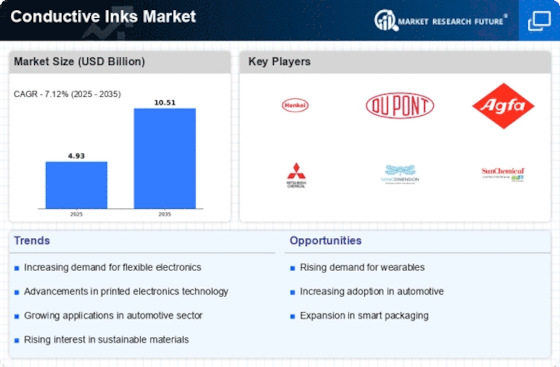
<p>The Conductive Inks Market is projected to reach a valuation of 10.51 USD Billion by 2035.</p>

What was the market valuation of the Conductive Inks Market in 2024?

<p>In 2024, the overall market valuation of the Conductive Inks Market was 4.93 USD Billion.</p>

What is the expected CAGR for the Conductive Inks Market during the forecast period 2025 - 2035?

<p>The expected CAGR for the Conductive Inks Market during the forecast period 2025 - 2035 is 7.12%.</p>

Which application segment is projected to have the highest growth in the Conductive Inks Market?

<p>The Printed Electronics application segment is projected to grow from 1.5 USD Billion in 2024 to 3.2 USD Billion by 2035.</p>

What are the key players in the Conductive Inks Market?

<p>Key players in the Conductive Inks Market include Henkel, DuPont, Agfa-Gevaert, and Mitsubishi Chemical.</p>

How does the market for Metal-Based Inks compare to Carbon-Based Inks in 2035?

<p>By 2035, the market for Metal-Based Inks is expected to reach 4.2 USD Billion, surpassing the 3.2 USD Billion projected for Carbon-Based Inks.</p>

What end-use segment is anticipated to show significant growth in the Conductive Inks Market?

<p>The Aerospace end-use segment is anticipated to grow from 1.23 USD Billion in 2024 to 2.71 USD Billion by 2035.</p>

Which printing technique is expected to dominate the Conductive Inks Market by 2035?

<p>Screen Printing is expected to dominate the Conductive Inks Market, growing from 1.5 USD Billion in 2024 to 3.2 USD Billion by 2035.</p>

What is the projected growth for the Flexible Displays segment in the Conductive Inks Market?

<p>The Flexible Displays segment is projected to grow from 1.0 USD Billion in 2024 to 2.1 USD Billion by 2035.</p>

How does the market for Polymer-Based Inks compare to other compositions by 2035?

<p>By 2035, the market for Polymer-Based Inks is expected to reach 3.11 USD Billion, indicating robust growth compared to other compositions.</p>

Market Summary

As per Market Research Future analysis, the Conductive Inks Market Size was estimated at 3.6 USD Billion in 2024. The Conductive Inks industry is projected to grow from 3.8 USD Billion in 2025 to 5.7 USD Billion by 2035, exhibiting a compound annual growth rate (CAGR) of 4.30% during the forecast period 2025 - 2035

Key Market Trends & Highlights

The Conductive Inks Market is poised for substantial growth driven by technological advancements and increasing applications across various sectors.

  • North America remains the largest market for conductive inks, driven by robust demand in printed electronics. Asia-Pacific is emerging as the fastest-growing region, fueled by rapid advancements in smart textiles. Printed electronics dominate the market, while smart textiles are gaining traction as a rapidly expanding segment. Rising demand for flexible electronics and advancements in material science are key drivers propelling market growth.

Market Size & Forecast

2024 Market Size 3.6 (USD Billion)
2035 Market Size 5.7 (USD Billion)
CAGR (2025 - 2035) 4.30%
Largest Regional Market Share in 2024 Asia Pacific

Major Players

NovaCentrix, Henkel AG, Heraeus Holding, DuPont, Sun Chemical, Johnson Matthey, Poly-Ink, Creative Materials Inc, Parker Hannifin Corporation

Market Trends

The Conductive Inks Market is currently experiencing a notable transformation, driven by advancements in technology and increasing demand across various sectors. The integration of conductive inks into consumer electronics, automotive applications, and wearable devices appears to be a key factor propelling market growth. As industries seek innovative solutions for flexible and printed electronics, the versatility of conductive inks is becoming increasingly apparent. Furthermore, the rise of smart packaging and Internet of Things (IoT) devices suggests a burgeoning opportunity for conductive inks, as they enable enhanced functionality and connectivity in everyday products. In addition to technological advancements, environmental considerations are influencing the Conductive Inks Market. Manufacturers are increasingly focusing on developing eco-friendly inks that meet sustainability standards. This shift not only aligns with global efforts to reduce environmental impact but also caters to the growing consumer preference for sustainable products. As the market evolves, it is likely that the emphasis on performance, sustainability, and adaptability will shape the future landscape of conductive inks, presenting both challenges and opportunities for stakeholders in this dynamic field.

Technological Advancements

The ongoing evolution of technology is significantly impacting the Conductive Inks Market. Innovations in materials and processes are enhancing the performance and applicability of conductive inks, making them suitable for a wider range of applications. This trend indicates a shift towards more efficient and effective solutions in electronics manufacturing.

Sustainability Focus

There is a growing emphasis on sustainability within the Conductive Inks Market. Manufacturers are increasingly developing eco-friendly inks that comply with environmental regulations. This trend reflects a broader societal shift towards sustainable practices, which may influence consumer choices and industry standards.

Integration with Smart Technologies

The integration of conductive inks with smart technologies is becoming more prevalent. As industries adopt IoT and smart devices, the demand for conductive inks that facilitate connectivity and functionality is likely to rise. This trend suggests a promising future for conductive inks in enhancing the capabilities of modern products.

Conductive Inks Market Market Drivers

Increased Investment in R&D

Increased investment in research and development is a significant driver for the Conductive Inks Market. Companies are recognizing the potential of conductive inks in various applications and are allocating substantial resources to innovate and improve their products. This trend is evident in the rising number of patents filed related to conductive ink technologies, which indicates a growing interest in this field. Furthermore, government initiatives aimed at promoting advanced manufacturing technologies are likely to bolster R&D efforts. As a result, the Conductive Inks Market is expected to benefit from enhanced product offerings and improved performance characteristics, which could lead to broader adoption across multiple sectors.

Growth in Printed Electronics

The expansion of printed electronics is significantly influencing the Conductive Inks Market. Printed electronics, which utilize printing techniques to create electronic devices, are gaining traction due to their cost-effectiveness and scalability. The market for printed electronics is expected to surpass 30 billion USD by 2025, driven by applications in packaging, sensors, and displays. Conductive inks play a crucial role in this sector, as they are integral to the printing process, enabling the creation of circuits and components on various substrates. This growth in printed electronics not only enhances the demand for conductive inks but also fosters innovation in the Conductive Inks Market, as manufacturers strive to develop inks with improved performance characteristics.

Advancements in Material Science

Advancements in material science are propelling the Conductive Inks Market forward. Researchers are continuously exploring new formulations and compositions that enhance the performance of conductive inks. Innovations such as silver nanowires and carbon nanotubes are being integrated into ink formulations, resulting in inks that offer superior conductivity and flexibility. The market for advanced conductive inks is anticipated to grow at a compound annual growth rate of over 10% through the next few years. These advancements not only improve the functionality of conductive inks but also expand their applicability across various industries, including automotive, healthcare, and consumer electronics, thereby driving the overall growth of the Conductive Inks Market.

Emerging Applications in Healthcare

Emerging applications in healthcare are creating new opportunities for the Conductive Inks Market. The integration of conductive inks in medical devices, such as biosensors and diagnostic tools, is becoming increasingly prevalent. These inks enable the development of devices that are not only efficient but also cost-effective. The healthcare sector is projected to invest heavily in innovative technologies, with the market for medical sensors expected to reach 20 billion USD by 2027. Conductive inks are essential in this context, as they facilitate the creation of sensitive and accurate diagnostic devices. This growing intersection of healthcare and conductive inks is likely to drive demand and innovation within the Conductive Inks Market.

Rising Demand for Flexible Electronics

The increasing demand for flexible electronics is a pivotal driver for the Conductive Inks Market. As consumer electronics evolve, manufacturers are seeking materials that can be integrated into flexible substrates. This trend is particularly evident in sectors such as wearables and smart textiles, where traditional wiring is impractical. The market for flexible electronics is projected to reach approximately 50 billion USD by 2026, indicating a robust growth trajectory. Conductive inks, with their ability to maintain conductivity while being applied to flexible surfaces, are becoming essential. This shift towards flexibility not only enhances product design but also opens new avenues for innovation in the Conductive Inks Market.

Market Segment Insights

By Application: Printed Electronics (Largest) vs. Smart Textiles (Fastest-Growing)

The Conductive Inks Market is broadly segmented into Printed Electronics, Solar Cells, Flexible Displays, and <a href="https://www.marketresearchfuture.com/reports/smart-textile-market-5477">Smart Textiles</a>, with Printed Electronics holding the largest share. This segment benefits significantly from the rising demand for advanced packaging and product configurations that require conductive properties. Solar Cells and Flexible Displays also contribute notably to the market but are smaller in share relative to Printed Electronics. Smart Textiles, while currently representing the smallest share, are quickly gaining traction due to innovations in personal electronics and wearables.

Printed Electronics: Dominant vs. Smart Textiles: Emerging

Printed Electronics as a dominant segment leverages printing technologies to create diverse electronic components like sensors and circuit boards, making it essential in consumer electronics and automotive applications. The segment is characterized by highly efficient manufacturing processes and significant integration with other technologies. Smart <a href="https://www.marketresearchfuture.com/reports/textile-market-25424">Textiles</a>, on the other hand, represent an emerging sector driven by the demand for garments with integrated electronic capabilities for applications in healthcare, fitness, and entertainment. This segment is characterized by rapid innovation and development, focusing on enhancing user experience and functionality in daily wear, positioning itself as a promising area of growth.

By Composition: Carbon-Based Inks (Largest) vs. Metal-Based Inks (Fastest-Growing)

In the Conductive Inks Market, the composition segment is dominated by carbon-based inks, which hold the largest share due to their cost-effectiveness and versatility in various applications such as printed electronics and sensors. Metal-based inks, while smaller in share, are gaining traction rapidly thanks to their superior conductivity properties, making them increasingly preferred for high-performance applications like RFIDs and flexible displays. Polymer-based inks, although present, occupy a niche market position, primarily driven by innovations in organic electronics.

Carbon-Based Inks (Dominant) vs. Metal-Based Inks (Emerging)

Carbon-based inks are recognized for their affordability and adaptability, making them a staple in the conductive ink industry. They provide good conductivity while being environmentally friendly, thus appealing to a broader market segment. Conversely, metal-based inks are emerging as a strong alternative due to their enhanced conductivity and performance in various high-tech applications. This segment is characterized by the use of silver and copper particles for increased efficiency, particularly in printed circuits and flexible electronics, indicating a shift towards metal formulations as technology demands evolve.

By Technique: Screen Printing (Largest) vs. Inkjet Printing (Fastest-Growing)

The Conductive Inks Market showcases a varied distribution among its primary techniques, with Screen Printing leading as the largest segment. Its robust market share can be attributed to its widespread application in numerous industries, such as electronics and packaging, where high-quality prints are essential. Inkjet Printing, while currently smaller in market share, is rapidly gaining traction due to advancements in technology that enhance performance and efficiency, facilitating its adoption in diverse applications.

Technique: Screen Printing (Dominant) vs. Inkjet Printing (Emerging)

Screen Printing is a dominant force in the Conductive Inks Market, known for its ability to produce thick, durable layers of ink, making it ideal for high-resolution and large-scale prints. It sees considerable usage in sectors that require reliability and longevity in conductive applications. Conversely, Inkjet Printing, which is emerging in this space, offers flexibility and cost-effectiveness for short runs and customization. Its rapid advancements in speed and resolution cater to the evolving demands of the market, positioning it as a potential leader in the future of conductive ink technology.

By End Use: Consumer Electronics (Largest) vs. Automotive (Fastest-Growing)

The Conductive Inks Market is significantly influenced by the end-use segments, with Consumer Electronics taking the largest share. This sector encompasses various applications such as flexible electronics and printed circuit boards, which are essential for modern devices. Following behind, the Automotive segment is rapidly expanding, driven by the increasing adoption of electric vehicles and advanced driver-assistance systems. The growth within this segment showcases a shift towards integrating conductive inks in smart automotive technologies. In terms of growth trends, the Healthcare sector shows an emerging demand for conductive inks in medical devices and diagnostics, supporting patient monitoring and wearable health applications. The Aerospace segment, while smaller, is also noted for its unique applications in <a href="https://www.marketresearchfuture.com/reports/lightweight-materials-market-8528">lightweight materials</a> and printed electronics, contributing to overall advancements in aeronautical technologies. As technological innovations continue, these sectors are expected to evolve, demanding higher performance from conductive inks.

Consumer Electronics (Dominant) vs. Automotive (Emerging)

The Consumer Electronics segment holds a dominant position in the Conductive Inks Market, characterized by its application in devices like smartphones, tablets, and wearable technologies. This segment thrives on innovations including flexible displays and touch-sensitive interfaces, where conductive inks play a vital role in enhancing performance and design flexibility. In contrast, the Automotive sector is emerging aggressively, driven by the need for functionalities such as in-vehicle connectivity and advanced sensor technology. Conductive inks are integral in this segment for enabling smart automotive solutions. As manufacturers seek to integrate more electronics into vehicles, the automotive applications of conductive inks are rapidly expanding, showcasing their potential to significantly transform driving experiences through smart technology.

Get more detailed insights about Conductive Inks Market Research Report - Global Forecast to 2035

Regional Insights

The Conductive Inks Market demonstrates significant regional dynamics, with an overall valuation expected to reach 4.93 USD billion by 2024. North America is a major contributor, valued at 1.5 USD Billion in 2024 and projected to grow to 3.2 USD billion by 2035. This region’s focus on advanced technology applications drives its leading position.

Europe follows closely, with a market value of 1.3 USD Billion in 2024, rising to 2.8 USD billion by 2035, reflecting strong demand in sectors like automotive and electronics.

Asia Pacific holds a substantial share, valued at 1.7 USD Billion in 2024 and anticipated to grow to 3.4 USD billion by 2035, fueled by rapid industrialization and a booming electronics market.

In contrast, South America’s market value sits at 0.3 USD Billion in 2024, with growth reaching 0.7 USD billion by 2035, indicating potential for future expansion.

The Middle East and Africa, with a value of 0.13 USD billion in 2024, is projected to reach 0.2 USD billion by 2035, signaling a nascent market that may see further developments in the coming years.

Each region presents unique opportunities and growth drivers within the Conductive Inks Market, dictated by technological advancements and consumption trends.

Key Players and Competitive Insights

The Conductive Inks Market has experienced substantial growth driven by increasing demand for printed electronics and advancements in various applications such as flexible electronics, photovoltaics, and consumer devices. As the market expands, competitive insights reveal a dynamic landscape where companies are striving to distinguish their products through innovation, strategic partnerships, and improved functionalities. Understanding the competition involves analyzing market positioning, product development strategies, and the technological capabilities that set leading firms apart. These competitive insights provide valuable intelligence for stakeholders seeking to navigate the complexities of this evolving market, as they garner insights into how companies are adapting to emerging trends and consumer needs.

Conductive Composites stands out in the Conductive Inks Market with its strong emphasis on innovative materials and formulations that enhance the performance of conductive inks. With a robust focus on research and development, Conductive Composites has established a competitive edge through the creation of advanced products that cater to a wide array of applications, ranging from automotive to consumer electronics. The company's strength lies not only in its high-quality conductive inks but also in its ability to adapt to changing market demands by offering customized solutions to its clients. The strong presence of Conductive Composites in key markets enables the firm to leverage its expertise in material science to remain at the forefront of the industry, exceeding customer expectations with reliable, high-performance products.

Epoxyset has carved a niche within the Conductive Inks Market by providing a diverse range of specialty conductive inks tailored to meet the specific requirements of different applications, including electronic assemblies and printed circuit boards. The company’s strengths lie in its innovative formulations that facilitate superior conductivity and adhesion characteristics, ensuring excellent performance in various operating conditions. With a focus on customer-centric solutions, Epoxyset has established strong relationships within the industry, enhancing its market presence globally. The company continually invests in research and development, which has spurred new product introductions and technological advancements, consolidating its position in an increasingly competitive landscape. Furthermore, strategic mergers and acquisitions have enabled Epoxyset to expand its product line and enhance its operational capabilities, solidifying its role as a key player in the Conductive Inks Market.

Key Companies in the Conductive Inks Market include

Industry Developments

  • Q2 2024: DuPont Launches New Silver/Silver Chloride Inks for Medical Wearables DuPont announced the launch of its new silver/silver chloride conductive inks designed for next-generation medical wearable devices, expanding its portfolio for the healthcare electronics sector.
  • Q1 2024: Heraeus Opens New Conductive Ink Manufacturing Facility in Singapore Heraeus inaugurated a new manufacturing facility in Singapore dedicated to the production of advanced conductive inks, aiming to meet growing demand in the Asia-Pacific region.
  • Q2 2024: Sun Chemical Introduces New Line of Conductive Inks Market for Flexible Electronics Sun Chemical launched a new series of conductive inks tailored for flexible and printed electronics applications, targeting the rapidly expanding market for wearable and IoT devices.
  • Q3 2024: Henkel Partners with Asian Electronics Manufacturer to Develop Next-Gen Conductive Inks Market Henkel announced a strategic partnership with a leading Asian electronics manufacturer to co-develop next-generation conductive inks for use in advanced printed circuit applications.
  • Q2 2024: NovaCentrix Expands Production Capacity for Photonic Curing and Conductive Inks Market NovaCentrix completed an expansion of its production facilities to increase output of photonic curing systems and conductive inks, supporting growth in printed electronics manufacturing.
  • Q1 2024: Creative Materials Launches New Conductive Ink for Automotive Touch Sensors Creative Materials introduced a new conductive ink formulation specifically designed for automotive touch sensor applications, enhancing durability and conductivity for in-vehicle electronics.
  • Q2 2024: Poly-Ink Announces Partnership with European Display Manufacturer Poly-Ink entered into a partnership with a major European display manufacturer to supply conductive inks for use in next-generation flexible display panels.
  • Q3 2024: Applied Ink Solutions Unveils New Carbon-Based Conductive Ink for Biosensors Applied Ink Solutions launched a new carbon-based conductive ink aimed at biosensor applications, offering improved biocompatibility and printability for medical diagnostics.
  • Q2 2024: Electroninks Raises $15 Million in Series B Funding to Scale Conductive Ink Production Electroninks secured $15 million in Series B funding to expand its manufacturing capabilities for conductive inks used in printed electronics and semiconductor packaging.
  • Q1 2024: Sun Chemical and Agfa Collaborate on Conductive Ink Solutions for Printed Electronics Sun Chemical and Agfa announced a collaboration to jointly develop and commercialize conductive ink solutions for the printed electronics industry.
  • Q2 2024: DuPont Expands R&D Center for Conductive Inks Market in Japan DuPont expanded its research and development center in Japan to accelerate innovation in conductive ink formulations for emerging electronics applications.
  • Q3 2024: Heraeus Signs Supply Agreement with Major Solar Panel Manufacturer for Conductive Silver Inks Heraeus entered into a long-term supply agreement with a leading solar panel manufacturer to provide conductive silver inks for high-efficiency photovoltaic cell production.


Future Outlook

Conductive Inks Market Future Outlook

The Conductive Inks Market is projected to grow at a 4.30% CAGR from 2025 to 2035, driven by advancements in electronics, renewable energy applications, and increased demand for flexible displays.

New opportunities lie in:

  • <p>Development of eco-friendly conductive ink formulations Integration of conductive inks in <a href="https://www.marketresearchfuture.com/reports/smart-packaging-market-1981">smart packaging</a> solutions Expansion into emerging markets with tailored product offerings</p>

By 2035, the market is expected to achieve robust growth, positioning itself as a leader in innovative applications.

Market Segmentation

Conductive Inks Market End Use Outlook

  • Consumer Electronics
  • Automotive
  • Healthcare
  • Aerospace

Conductive Inks Market Technique Outlook

  • Screen Printing
  • Inkjet Printing
  • Flexographic Printing
  • Gravure Printing

Conductive Inks Market Application Outlook

  • Printed Electronics
  • Solar Cells
  • Flexible Displays
  • Smart Textiles

Conductive Inks Market Composition Outlook

  • Carbon-Based Inks
  • Metal-Based Inks
  • Polymer-Based Inks

Report Scope

MARKET SIZE 2024 3.6(USD Billion)
MARKET SIZE 2025 3.8 (USD Billion)
MARKET SIZE 2035 5.7(USD Billion)
COMPOUND ANNUAL GROWTH RATE (CAGR) 4.30% (2025 - 2035)
REPORT COVERAGE Revenue Forecast, Competitive Landscape, Growth Factors, and Trends
BASE YEAR 2024
Market Forecast Period 2025 - 2035
Historical Data 2019 - 2024
Market Forecast Units USD Billion
Key Companies Profiled NovaCentrix, Henkel AG, Heraeus Holding, DuPont, Sun Chemical, Johnson Matthey, Poly-Ink, Creative Materials Inc, Parker Hannifin Corporation
Segments Covered Application, Composition, Technique, End Use, Regional
Key Market Opportunities Integration of conductive inks in flexible electronics and wearable technology presents substantial growth potential.
Key Market Dynamics Rising demand for flexible electronics drives innovation and competition in the conductive inks market.
Countries Covered North America, Europe, APAC, South America, MEA

FAQs

What is the projected market valuation of the Conductive Inks Market by 2035?

<p>The Conductive Inks Market is projected to reach a valuation of 10.51 USD Billion by 2035.</p>

What was the market valuation of the Conductive Inks Market in 2024?

<p>In 2024, the overall market valuation of the Conductive Inks Market was 4.93 USD Billion.</p>

What is the expected CAGR for the Conductive Inks Market during the forecast period 2025 - 2035?

<p>The expected CAGR for the Conductive Inks Market during the forecast period 2025 - 2035 is 7.12%.</p>

Which application segment is projected to have the highest growth in the Conductive Inks Market?

<p>The Printed Electronics application segment is projected to grow from 1.5 USD Billion in 2024 to 3.2 USD Billion by 2035.</p>

What are the key players in the Conductive Inks Market?

<p>Key players in the Conductive Inks Market include Henkel, DuPont, Agfa-Gevaert, and Mitsubishi Chemical.</p>

How does the market for Metal-Based Inks compare to Carbon-Based Inks in 2035?

<p>By 2035, the market for Metal-Based Inks is expected to reach 4.2 USD Billion, surpassing the 3.2 USD Billion projected for Carbon-Based Inks.</p>

What end-use segment is anticipated to show significant growth in the Conductive Inks Market?

<p>The Aerospace end-use segment is anticipated to grow from 1.23 USD Billion in 2024 to 2.71 USD Billion by 2035.</p>

Which printing technique is expected to dominate the Conductive Inks Market by 2035?

<p>Screen Printing is expected to dominate the Conductive Inks Market, growing from 1.5 USD Billion in 2024 to 3.2 USD Billion by 2035.</p>

What is the projected growth for the Flexible Displays segment in the Conductive Inks Market?

<p>The Flexible Displays segment is projected to grow from 1.0 USD Billion in 2024 to 2.1 USD Billion by 2035.</p>

How does the market for Polymer-Based Inks compare to other compositions by 2035?

<p>By 2035, the market for Polymer-Based Inks is expected to reach 3.11 USD Billion, indicating robust growth compared to other compositions.</p>

  1. SECTION I: EXECUTIVE SUMMARY AND KEY HIGHLIGHTS
    1. | 1.1 EXECUTIVE SUMMARY
    2. | | 1.1.1 Market Overview
    3. | | 1.1.2 Key Findings
    4. | | 1.1.3 Market Segmentation
    5. | | 1.1.4 Competitive Landscape
    6. | | 1.1.5 Challenges and Opportunities
    7. | | 1.1.6 Future Outlook
  2. SECTION II: SCOPING, METHODOLOGY AND MARKET STRUCTURE
    1. | 2.1 MARKET INTRODUCTION
    2. | | 2.1.1 Definition
    3. | | 2.1.2 Scope of the study
    4. | | | 2.1.2.1 Research Objective
    5. | | | 2.1.2.2 Assumption
    6. | | | 2.1.2.3 Limitations
    7. | 2.2 RESEARCH METHODOLOGY
    8. | | 2.2.1 Overview
    9. | | 2.2.2 Data Mining
    10. | | 2.2.3 Secondary Research
    11. | | 2.2.4 Primary Research
    12. | | | 2.2.4.1 Primary Interviews and Information Gathering Process
    13. | | | 2.2.4.2 Breakdown of Primary Respondents
    14. | | 2.2.5 Forecasting Model
    15. | | 2.2.6 Market Size Estimation
    16. | | | 2.2.6.1 Bottom-Up Approach
    17. | | | 2.2.6.2 Top-Down Approach
    18. | | 2.2.7 Data Triangulation
    19. | | 2.2.8 Validation
  3. SECTION III: QUALITATIVE ANALYSIS
    1. | 3.1 MARKET DYNAMICS
    2. | | 3.1.1 Overview
    3. | | 3.1.2 Drivers
    4. | | 3.1.3 Restraints
    5. | | 3.1.4 Opportunities
    6. | 3.2 MARKET FACTOR ANALYSIS
    7. | | 3.2.1 Value chain Analysis
    8. | | 3.2.2 Porter's Five Forces Analysis
    9. | | | 3.2.2.1 Bargaining Power of Suppliers
    10. | | | 3.2.2.2 Bargaining Power of Buyers
    11. | | | 3.2.2.3 Threat of New Entrants
    12. | | | 3.2.2.4 Threat of Substitutes
    13. | | | 3.2.2.5 Intensity of Rivalry
    14. | | 3.2.3 COVID-19 Impact Analysis
    15. | | | 3.2.3.1 Market Impact Analysis
    16. | | | 3.2.3.2 Regional Impact
    17. | | | 3.2.3.3 Opportunity and Threat Analysis
  4. SECTION IV: QUANTITATIVE ANALYSIS
    1. | 4.1 Chemicals and Materials, BY Application (USD Billion)
    2. | | 4.1.1 Printed Electronics
    3. | | 4.1.2 Solar Cells
    4. | | 4.1.3 Flexible Displays
    5. | | 4.1.4 Smart Textiles
    6. | 4.2 Chemicals and Materials, BY Composition (USD Billion)
    7. | | 4.2.1 Carbon-Based Inks
    8. | | 4.2.2 Metal-Based Inks
    9. | | 4.2.3 Polymer-Based Inks
    10. | 4.3 Chemicals and Materials, BY Technique (USD Billion)
    11. | | 4.3.1 Screen Printing
    12. | | 4.3.2 Inkjet Printing
    13. | | 4.3.3 Flexographic Printing
    14. | | 4.3.4 Gravure Printing
    15. | 4.4 Chemicals and Materials, BY End Use (USD Billion)
    16. | | 4.4.1 Consumer Electronics
    17. | | 4.4.2 Automotive
    18. | | 4.4.3 Healthcare
    19. | | 4.4.4 Aerospace
    20. | 4.5 Chemicals and Materials, BY Region (USD Billion)
    21. | | 4.5.1 North America
    22. | | | 4.5.1.1 US
    23. | | | 4.5.1.2 Canada
    24. | | 4.5.2 Europe
    25. | | | 4.5.2.1 Germany
    26. | | | 4.5.2.2 UK
    27. | | | 4.5.2.3 France
    28. | | | 4.5.2.4 Russia
    29. | | | 4.5.2.5 Italy
    30. | | | 4.5.2.6 Spain
    31. | | | 4.5.2.7 Rest of Europe
    32. | | 4.5.3 APAC
    33. | | | 4.5.3.1 China
    34. | | | 4.5.3.2 India
    35. | | | 4.5.3.3 Japan
    36. | | | 4.5.3.4 South Korea
    37. | | | 4.5.3.5 Malaysia
    38. | | | 4.5.3.6 Thailand
    39. | | | 4.5.3.7 Indonesia
    40. | | | 4.5.3.8 Rest of APAC
    41. | | 4.5.4 South America
    42. | | | 4.5.4.1 Brazil
    43. | | | 4.5.4.2 Mexico
    44. | | | 4.5.4.3 Argentina
    45. | | | 4.5.4.4 Rest of South America
    46. | | 4.5.5 MEA
    47. | | | 4.5.5.1 GCC Countries
    48. | | | 4.5.5.2 South Africa
    49. | | | 4.5.5.3 Rest of MEA
  5. SECTION V: COMPETITIVE ANALYSIS
    1. | 5.1 Competitive Landscape
    2. | | 5.1.1 Overview
    3. | | 5.1.2 Competitive Analysis
    4. | | 5.1.3 Market share Analysis
    5. | | 5.1.4 Major Growth Strategy in the Chemicals and Materials
    6. | | 5.1.5 Competitive Benchmarking
    7. | | 5.1.6 Leading Players in Terms of Number of Developments in the Chemicals and Materials
    8. | | 5.1.7 Key developments and growth strategies
    9. | | | 5.1.7.1 New Product Launch/Service Deployment
    10. | | | 5.1.7.2 Merger & Acquisitions
    11. | | | 5.1.7.3 Joint Ventures
    12. | | 5.1.8 Major Players Financial Matrix
    13. | | | 5.1.8.1 Sales and Operating Income
    14. | | | 5.1.8.2 Major Players R&D Expenditure. 2023
    15. | 5.2 Company Profiles
    16. | | 5.2.1 Henkel (DE)
    17. | | | 5.2.1.1 Financial Overview
    18. | | | 5.2.1.2 Products Offered
    19. | | | 5.2.1.3 Key Developments
    20. | | | 5.2.1.4 SWOT Analysis
    21. | | | 5.2.1.5 Key Strategies
    22. | | 5.2.2 DuPont (US)
    23. | | | 5.2.2.1 Financial Overview
    24. | | | 5.2.2.2 Products Offered
    25. | | | 5.2.2.3 Key Developments
    26. | | | 5.2.2.4 SWOT Analysis
    27. | | | 5.2.2.5 Key Strategies
    28. | | 5.2.3 Agfa-Gevaert (BE)
    29. | | | 5.2.3.1 Financial Overview
    30. | | | 5.2.3.2 Products Offered
    31. | | | 5.2.3.3 Key Developments
    32. | | | 5.2.3.4 SWOT Analysis
    33. | | | 5.2.3.5 Key Strategies
    34. | | 5.2.4 Mitsubishi Chemical (JP)
    35. | | | 5.2.4.1 Financial Overview
    36. | | | 5.2.4.2 Products Offered
    37. | | | 5.2.4.3 Key Developments
    38. | | | 5.2.4.4 SWOT Analysis
    39. | | | 5.2.4.5 Key Strategies
    40. | | 5.2.5 Nano Dimension (IL)
    41. | | | 5.2.5.1 Financial Overview
    42. | | | 5.2.5.2 Products Offered
    43. | | | 5.2.5.3 Key Developments
    44. | | | 5.2.5.4 SWOT Analysis
    45. | | | 5.2.5.5 Key Strategies
    46. | | 5.2.6 Sun Chemical (JP)
    47. | | | 5.2.6.1 Financial Overview
    48. | | | 5.2.6.2 Products Offered
    49. | | | 5.2.6.3 Key Developments
    50. | | | 5.2.6.4 SWOT Analysis
    51. | | | 5.2.6.5 Key Strategies
    52. | | 5.2.7 Creative Materials (US)
    53. | | | 5.2.7.1 Financial Overview
    54. | | | 5.2.7.2 Products Offered
    55. | | | 5.2.7.3 Key Developments
    56. | | | 5.2.7.4 SWOT Analysis
    57. | | | 5.2.7.5 Key Strategies
    58. | | 5.2.8 Parker Hannifin (US)
    59. | | | 5.2.8.1 Financial Overview
    60. | | | 5.2.8.2 Products Offered
    61. | | | 5.2.8.3 Key Developments
    62. | | | 5.2.8.4 SWOT Analysis
    63. | | | 5.2.8.5 Key Strategies
    64. | | 5.2.9 Avery Dennison (US)
    65. | | | 5.2.9.1 Financial Overview
    66. | | | 5.2.9.2 Products Offered
    67. | | | 5.2.9.3 Key Developments
    68. | | | 5.2.9.4 SWOT Analysis
    69. | | | 5.2.9.5 Key Strategies
    70. | 5.3 Appendix
    71. | | 5.3.1 References
    72. | | 5.3.2 Related Reports
  6. LIST OF FIGURES
    1. | 6.1 MARKET SYNOPSIS
    2. | 6.2 NORTH AMERICA MARKET ANALYSIS
    3. | 6.3 US MARKET ANALYSIS BY APPLICATION
    4. | 6.4 US MARKET ANALYSIS BY COMPOSITION
    5. | 6.5 US MARKET ANALYSIS BY TECHNIQUE
    6. | 6.6 US MARKET ANALYSIS BY END USE
    7. | 6.7 CANADA MARKET ANALYSIS BY APPLICATION
    8. | 6.8 CANADA MARKET ANALYSIS BY COMPOSITION
    9. | 6.9 CANADA MARKET ANALYSIS BY TECHNIQUE
    10. | 6.10 CANADA MARKET ANALYSIS BY END USE
    11. | 6.11 EUROPE MARKET ANALYSIS
    12. | 6.12 GERMANY MARKET ANALYSIS BY APPLICATION
    13. | 6.13 GERMANY MARKET ANALYSIS BY COMPOSITION
    14. | 6.14 GERMANY MARKET ANALYSIS BY TECHNIQUE
    15. | 6.15 GERMANY MARKET ANALYSIS BY END USE
    16. | 6.16 UK MARKET ANALYSIS BY APPLICATION
    17. | 6.17 UK MARKET ANALYSIS BY COMPOSITION
    18. | 6.18 UK MARKET ANALYSIS BY TECHNIQUE
    19. | 6.19 UK MARKET ANALYSIS BY END USE
    20. | 6.20 FRANCE MARKET ANALYSIS BY APPLICATION
    21. | 6.21 FRANCE MARKET ANALYSIS BY COMPOSITION
    22. | 6.22 FRANCE MARKET ANALYSIS BY TECHNIQUE
    23. | 6.23 FRANCE MARKET ANALYSIS BY END USE
    24. | 6.24 RUSSIA MARKET ANALYSIS BY APPLICATION
    25. | 6.25 RUSSIA MARKET ANALYSIS BY COMPOSITION
    26. | 6.26 RUSSIA MARKET ANALYSIS BY TECHNIQUE
    27. | 6.27 RUSSIA MARKET ANALYSIS BY END USE
    28. | 6.28 ITALY MARKET ANALYSIS BY APPLICATION
    29. | 6.29 ITALY MARKET ANALYSIS BY COMPOSITION
    30. | 6.30 ITALY MARKET ANALYSIS BY TECHNIQUE
    31. | 6.31 ITALY MARKET ANALYSIS BY END USE
    32. | 6.32 SPAIN MARKET ANALYSIS BY APPLICATION
    33. | 6.33 SPAIN MARKET ANALYSIS BY COMPOSITION
    34. | 6.34 SPAIN MARKET ANALYSIS BY TECHNIQUE
    35. | 6.35 SPAIN MARKET ANALYSIS BY END USE
    36. | 6.36 REST OF EUROPE MARKET ANALYSIS BY APPLICATION
    37. | 6.37 REST OF EUROPE MARKET ANALYSIS BY COMPOSITION
    38. | 6.38 REST OF EUROPE MARKET ANALYSIS BY TECHNIQUE
    39. | 6.39 REST OF EUROPE MARKET ANALYSIS BY END USE
    40. | 6.40 APAC MARKET ANALYSIS
    41. | 6.41 CHINA MARKET ANALYSIS BY APPLICATION
    42. | 6.42 CHINA MARKET ANALYSIS BY COMPOSITION
    43. | 6.43 CHINA MARKET ANALYSIS BY TECHNIQUE
    44. | 6.44 CHINA MARKET ANALYSIS BY END USE
    45. | 6.45 INDIA MARKET ANALYSIS BY APPLICATION
    46. | 6.46 INDIA MARKET ANALYSIS BY COMPOSITION
    47. | 6.47 INDIA MARKET ANALYSIS BY TECHNIQUE
    48. | 6.48 INDIA MARKET ANALYSIS BY END USE
    49. | 6.49 JAPAN MARKET ANALYSIS BY APPLICATION
    50. | 6.50 JAPAN MARKET ANALYSIS BY COMPOSITION
    51. | 6.51 JAPAN MARKET ANALYSIS BY TECHNIQUE
    52. | 6.52 JAPAN MARKET ANALYSIS BY END USE
    53. | 6.53 SOUTH KOREA MARKET ANALYSIS BY APPLICATION
    54. | 6.54 SOUTH KOREA MARKET ANALYSIS BY COMPOSITION
    55. | 6.55 SOUTH KOREA MARKET ANALYSIS BY TECHNIQUE
    56. | 6.56 SOUTH KOREA MARKET ANALYSIS BY END USE
    57. | 6.57 MALAYSIA MARKET ANALYSIS BY APPLICATION
    58. | 6.58 MALAYSIA MARKET ANALYSIS BY COMPOSITION
    59. | 6.59 MALAYSIA MARKET ANALYSIS BY TECHNIQUE
    60. | 6.60 MALAYSIA MARKET ANALYSIS BY END USE
    61. | 6.61 THAILAND MARKET ANALYSIS BY APPLICATION
    62. | 6.62 THAILAND MARKET ANALYSIS BY COMPOSITION
    63. | 6.63 THAILAND MARKET ANALYSIS BY TECHNIQUE
    64. | 6.64 THAILAND MARKET ANALYSIS BY END USE
    65. | 6.65 INDONESIA MARKET ANALYSIS BY APPLICATION
    66. | 6.66 INDONESIA MARKET ANALYSIS BY COMPOSITION
    67. | 6.67 INDONESIA MARKET ANALYSIS BY TECHNIQUE
    68. | 6.68 INDONESIA MARKET ANALYSIS BY END USE
    69. | 6.69 REST OF APAC MARKET ANALYSIS BY APPLICATION
    70. | 6.70 REST OF APAC MARKET ANALYSIS BY COMPOSITION
    71. | 6.71 REST OF APAC MARKET ANALYSIS BY TECHNIQUE
    72. | 6.72 REST OF APAC MARKET ANALYSIS BY END USE
    73. | 6.73 SOUTH AMERICA MARKET ANALYSIS
    74. | 6.74 BRAZIL MARKET ANALYSIS BY APPLICATION
    75. | 6.75 BRAZIL MARKET ANALYSIS BY COMPOSITION
    76. | 6.76 BRAZIL MARKET ANALYSIS BY TECHNIQUE
    77. | 6.77 BRAZIL MARKET ANALYSIS BY END USE
    78. | 6.78 MEXICO MARKET ANALYSIS BY APPLICATION
    79. | 6.79 MEXICO MARKET ANALYSIS BY COMPOSITION
    80. | 6.80 MEXICO MARKET ANALYSIS BY TECHNIQUE
    81. | 6.81 MEXICO MARKET ANALYSIS BY END USE
    82. | 6.82 ARGENTINA MARKET ANALYSIS BY APPLICATION
    83. | 6.83 ARGENTINA MARKET ANALYSIS BY COMPOSITION
    84. | 6.84 ARGENTINA MARKET ANALYSIS BY TECHNIQUE
    85. | 6.85 ARGENTINA MARKET ANALYSIS BY END USE
    86. | 6.86 REST OF SOUTH AMERICA MARKET ANALYSIS BY APPLICATION
    87. | 6.87 REST OF SOUTH AMERICA MARKET ANALYSIS BY COMPOSITION
    88. | 6.88 REST OF SOUTH AMERICA MARKET ANALYSIS BY TECHNIQUE
    89. | 6.89 REST OF SOUTH AMERICA MARKET ANALYSIS BY END USE
    90. | 6.90 MEA MARKET ANALYSIS
    91. | 6.91 GCC COUNTRIES MARKET ANALYSIS BY APPLICATION
    92. | 6.92 GCC COUNTRIES MARKET ANALYSIS BY COMPOSITION
    93. | 6.93 GCC COUNTRIES MARKET ANALYSIS BY TECHNIQUE
    94. | 6.94 GCC COUNTRIES MARKET ANALYSIS BY END USE
    95. | 6.95 SOUTH AFRICA MARKET ANALYSIS BY APPLICATION
    96. | 6.96 SOUTH AFRICA MARKET ANALYSIS BY COMPOSITION
    97. | 6.97 SOUTH AFRICA MARKET ANALYSIS BY TECHNIQUE
    98. | 6.98 SOUTH AFRICA MARKET ANALYSIS BY END USE
    99. | 6.99 REST OF MEA MARKET ANALYSIS BY APPLICATION
    100. | 6.100 REST OF MEA MARKET ANALYSIS BY COMPOSITION
    101. | 6.101 REST OF MEA MARKET ANALYSIS BY TECHNIQUE
    102. | 6.102 REST OF MEA MARKET ANALYSIS BY END USE
    103. | 6.103 KEY BUYING CRITERIA OF CHEMICALS AND MATERIALS
    104. | 6.104 RESEARCH PROCESS OF MRFR
    105. | 6.105 DRO ANALYSIS OF CHEMICALS AND MATERIALS
    106. | 6.106 DRIVERS IMPACT ANALYSIS: CHEMICALS AND MATERIALS
    107. | 6.107 RESTRAINTS IMPACT ANALYSIS: CHEMICALS AND MATERIALS
    108. | 6.108 SUPPLY / VALUE CHAIN: CHEMICALS AND MATERIALS
    109. | 6.109 CHEMICALS AND MATERIALS, BY APPLICATION, 2024 (% SHARE)
    110. | 6.110 CHEMICALS AND MATERIALS, BY APPLICATION, 2024 TO 2035 (USD Billion)
    111. | 6.111 CHEMICALS AND MATERIALS, BY COMPOSITION, 2024 (% SHARE)
    112. | 6.112 CHEMICALS AND MATERIALS, BY COMPOSITION, 2024 TO 2035 (USD Billion)
    113. | 6.113 CHEMICALS AND MATERIALS, BY TECHNIQUE, 2024 (% SHARE)
    114. | 6.114 CHEMICALS AND MATERIALS, BY TECHNIQUE, 2024 TO 2035 (USD Billion)
    115. | 6.115 CHEMICALS AND MATERIALS, BY END USE, 2024 (% SHARE)
    116. | 6.116 CHEMICALS AND MATERIALS, BY END USE, 2024 TO 2035 (USD Billion)
    117. | 6.117 BENCHMARKING OF MAJOR COMPETITORS
  7. LIST OF TABLES
    1. | 7.1 LIST OF ASSUMPTIONS
    2. | | 7.1.1
    3. | 7.2 North America MARKET SIZE ESTIMATES; FORECAST
    4. | | 7.2.1 BY APPLICATION, 2025-2035 (USD Billion)
    5. | | 7.2.2 BY COMPOSITION, 2025-2035 (USD Billion)
    6. | | 7.2.3 BY TECHNIQUE, 2025-2035 (USD Billion)
    7. | | 7.2.4 BY END USE, 2025-2035 (USD Billion)
    8. | 7.3 US MARKET SIZE ESTIMATES; FORECAST
    9. | | 7.3.1 BY APPLICATION, 2025-2035 (USD Billion)
    10. | | 7.3.2 BY COMPOSITION, 2025-2035 (USD Billion)
    11. | | 7.3.3 BY TECHNIQUE, 2025-2035 (USD Billion)
    12. | | 7.3.4 BY END USE, 2025-2035 (USD Billion)
    13. | 7.4 Canada MARKET SIZE ESTIMATES; FORECAST
    14. | | 7.4.1 BY APPLICATION, 2025-2035 (USD Billion)
    15. | | 7.4.2 BY COMPOSITION, 2025-2035 (USD Billion)
    16. | | 7.4.3 BY TECHNIQUE, 2025-2035 (USD Billion)
    17. | | 7.4.4 BY END USE, 2025-2035 (USD Billion)
    18. | 7.5 Europe MARKET SIZE ESTIMATES; FORECAST
    19. | | 7.5.1 BY APPLICATION, 2025-2035 (USD Billion)
    20. | | 7.5.2 BY COMPOSITION, 2025-2035 (USD Billion)
    21. | | 7.5.3 BY TECHNIQUE, 2025-2035 (USD Billion)
    22. | | 7.5.4 BY END USE, 2025-2035 (USD Billion)
    23. | 7.6 Germany MARKET SIZE ESTIMATES; FORECAST
    24. | | 7.6.1 BY APPLICATION, 2025-2035 (USD Billion)
    25. | | 7.6.2 BY COMPOSITION, 2025-2035 (USD Billion)
    26. | | 7.6.3 BY TECHNIQUE, 2025-2035 (USD Billion)
    27. | | 7.6.4 BY END USE, 2025-2035 (USD Billion)
    28. | 7.7 UK MARKET SIZE ESTIMATES; FORECAST
    29. | | 7.7.1 BY APPLICATION, 2025-2035 (USD Billion)
    30. | | 7.7.2 BY COMPOSITION, 2025-2035 (USD Billion)
    31. | | 7.7.3 BY TECHNIQUE, 2025-2035 (USD Billion)
    32. | | 7.7.4 BY END USE, 2025-2035 (USD Billion)
    33. | 7.8 France MARKET SIZE ESTIMATES; FORECAST
    34. | | 7.8.1 BY APPLICATION, 2025-2035 (USD Billion)
    35. | | 7.8.2 BY COMPOSITION, 2025-2035 (USD Billion)
    36. | | 7.8.3 BY TECHNIQUE, 2025-2035 (USD Billion)
    37. | | 7.8.4 BY END USE, 2025-2035 (USD Billion)
    38. | 7.9 Russia MARKET SIZE ESTIMATES; FORECAST
    39. | | 7.9.1 BY APPLICATION, 2025-2035 (USD Billion)
    40. | | 7.9.2 BY COMPOSITION, 2025-2035 (USD Billion)
    41. | | 7.9.3 BY TECHNIQUE, 2025-2035 (USD Billion)
    42. | | 7.9.4 BY END USE, 2025-2035 (USD Billion)
    43. | 7.10 Italy MARKET SIZE ESTIMATES; FORECAST
    44. | | 7.10.1 BY APPLICATION, 2025-2035 (USD Billion)
    45. | | 7.10.2 BY COMPOSITION, 2025-2035 (USD Billion)
    46. | | 7.10.3 BY TECHNIQUE, 2025-2035 (USD Billion)
    47. | | 7.10.4 BY END USE, 2025-2035 (USD Billion)
    48. | 7.11 Spain MARKET SIZE ESTIMATES; FORECAST
    49. | | 7.11.1 BY APPLICATION, 2025-2035 (USD Billion)
    50. | | 7.11.2 BY COMPOSITION, 2025-2035 (USD Billion)
    51. | | 7.11.3 BY TECHNIQUE, 2025-2035 (USD Billion)
    52. | | 7.11.4 BY END USE, 2025-2035 (USD Billion)
    53. | 7.12 Rest of Europe MARKET SIZE ESTIMATES; FORECAST
    54. | | 7.12.1 BY APPLICATION, 2025-2035 (USD Billion)
    55. | | 7.12.2 BY COMPOSITION, 2025-2035 (USD Billion)
    56. | | 7.12.3 BY TECHNIQUE, 2025-2035 (USD Billion)
    57. | | 7.12.4 BY END USE, 2025-2035 (USD Billion)
    58. | 7.13 APAC MARKET SIZE ESTIMATES; FORECAST
    59. | | 7.13.1 BY APPLICATION, 2025-2035 (USD Billion)
    60. | | 7.13.2 BY COMPOSITION, 2025-2035 (USD Billion)
    61. | | 7.13.3 BY TECHNIQUE, 2025-2035 (USD Billion)
    62. | | 7.13.4 BY END USE, 2025-2035 (USD Billion)
    63. | 7.14 China MARKET SIZE ESTIMATES; FORECAST
    64. | | 7.14.1 BY APPLICATION, 2025-2035 (USD Billion)
    65. | | 7.14.2 BY COMPOSITION, 2025-2035 (USD Billion)
    66. | | 7.14.3 BY TECHNIQUE, 2025-2035 (USD Billion)
    67. | | 7.14.4 BY END USE, 2025-2035 (USD Billion)
    68. | 7.15 India MARKET SIZE ESTIMATES; FORECAST
    69. | | 7.15.1 BY APPLICATION, 2025-2035 (USD Billion)
    70. | | 7.15.2 BY COMPOSITION, 2025-2035 (USD Billion)
    71. | | 7.15.3 BY TECHNIQUE, 2025-2035 (USD Billion)
    72. | | 7.15.4 BY END USE, 2025-2035 (USD Billion)
    73. | 7.16 Japan MARKET SIZE ESTIMATES; FORECAST
    74. | | 7.16.1 BY APPLICATION, 2025-2035 (USD Billion)
    75. | | 7.16.2 BY COMPOSITION, 2025-2035 (USD Billion)
    76. | | 7.16.3 BY TECHNIQUE, 2025-2035 (USD Billion)
    77. | | 7.16.4 BY END USE, 2025-2035 (USD Billion)
    78. | 7.17 South Korea MARKET SIZE ESTIMATES; FORECAST
    79. | | 7.17.1 BY APPLICATION, 2025-2035 (USD Billion)
    80. | | 7.17.2 BY COMPOSITION, 2025-2035 (USD Billion)
    81. | | 7.17.3 BY TECHNIQUE, 2025-2035 (USD Billion)
    82. | | 7.17.4 BY END USE, 2025-2035 (USD Billion)
    83. | 7.18 Malaysia MARKET SIZE ESTIMATES; FORECAST
    84. | | 7.18.1 BY APPLICATION, 2025-2035 (USD Billion)
    85. | | 7.18.2 BY COMPOSITION, 2025-2035 (USD Billion)
    86. | | 7.18.3 BY TECHNIQUE, 2025-2035 (USD Billion)
    87. | | 7.18.4 BY END USE, 2025-2035 (USD Billion)
    88. | 7.19 Thailand MARKET SIZE ESTIMATES; FORECAST
    89. | | 7.19.1 BY APPLICATION, 2025-2035 (USD Billion)
    90. | | 7.19.2 BY COMPOSITION, 2025-2035 (USD Billion)
    91. | | 7.19.3 BY TECHNIQUE, 2025-2035 (USD Billion)
    92. | | 7.19.4 BY END USE, 2025-2035 (USD Billion)
    93. | 7.20 Indonesia MARKET SIZE ESTIMATES; FORECAST
    94. | | 7.20.1 BY APPLICATION, 2025-2035 (USD Billion)
    95. | | 7.20.2 BY COMPOSITION, 2025-2035 (USD Billion)
    96. | | 7.20.3 BY TECHNIQUE, 2025-2035 (USD Billion)
    97. | | 7.20.4 BY END USE, 2025-2035 (USD Billion)
    98. | 7.21 Rest of APAC MARKET SIZE ESTIMATES; FORECAST
    99. | | 7.21.1 BY APPLICATION, 2025-2035 (USD Billion)
    100. | | 7.21.2 BY COMPOSITION, 2025-2035 (USD Billion)
    101. | | 7.21.3 BY TECHNIQUE, 2025-2035 (USD Billion)
    102. | | 7.21.4 BY END USE, 2025-2035 (USD Billion)
    103. | 7.22 South America MARKET SIZE ESTIMATES; FORECAST
    104. | | 7.22.1 BY APPLICATION, 2025-2035 (USD Billion)
    105. | | 7.22.2 BY COMPOSITION, 2025-2035 (USD Billion)
    106. | | 7.22.3 BY TECHNIQUE, 2025-2035 (USD Billion)
    107. | | 7.22.4 BY END USE, 2025-2035 (USD Billion)
    108. | 7.23 Brazil MARKET SIZE ESTIMATES; FORECAST
    109. | | 7.23.1 BY APPLICATION, 2025-2035 (USD Billion)
    110. | | 7.23.2 BY COMPOSITION, 2025-2035 (USD Billion)
    111. | | 7.23.3 BY TECHNIQUE, 2025-2035 (USD Billion)
    112. | | 7.23.4 BY END USE, 2025-2035 (USD Billion)
    113. | 7.24 Mexico MARKET SIZE ESTIMATES; FORECAST
    114. | | 7.24.1 BY APPLICATION, 2025-2035 (USD Billion)
    115. | | 7.24.2 BY COMPOSITION, 2025-2035 (USD Billion)
    116. | | 7.24.3 BY TECHNIQUE, 2025-2035 (USD Billion)
    117. | | 7.24.4 BY END USE, 2025-2035 (USD Billion)
    118. | 7.25 Argentina MARKET SIZE ESTIMATES; FORECAST
    119. | | 7.25.1 BY APPLICATION, 2025-2035 (USD Billion)
    120. | | 7.25.2 BY COMPOSITION, 2025-2035 (USD Billion)
    121. | | 7.25.3 BY TECHNIQUE, 2025-2035 (USD Billion)
    122. | | 7.25.4 BY END USE, 2025-2035 (USD Billion)
    123. | 7.26 Rest of South America MARKET SIZE ESTIMATES; FORECAST
    124. | | 7.26.1 BY APPLICATION, 2025-2035 (USD Billion)
    125. | | 7.26.2 BY COMPOSITION, 2025-2035 (USD Billion)
    126. | | 7.26.3 BY TECHNIQUE, 2025-2035 (USD Billion)
    127. | | 7.26.4 BY END USE, 2025-2035 (USD Billion)
    128. | 7.27 MEA MARKET SIZE ESTIMATES; FORECAST
    129. | | 7.27.1 BY APPLICATION, 2025-2035 (USD Billion)
    130. | | 7.27.2 BY COMPOSITION, 2025-2035 (USD Billion)
    131. | | 7.27.3 BY TECHNIQUE, 2025-2035 (USD Billion)
    132. | | 7.27.4 BY END USE, 2025-2035 (USD Billion)
    133. | 7.28 GCC Countries MARKET SIZE ESTIMATES; FORECAST
    134. | | 7.28.1 BY APPLICATION, 2025-2035 (USD Billion)
    135. | | 7.28.2 BY COMPOSITION, 2025-2035 (USD Billion)
    136. | | 7.28.3 BY TECHNIQUE, 2025-2035 (USD Billion)
    137. | | 7.28.4 BY END USE, 2025-2035 (USD Billion)
    138. | 7.29 South Africa MARKET SIZE ESTIMATES; FORECAST
    139. | | 7.29.1 BY APPLICATION, 2025-2035 (USD Billion)
    140. | | 7.29.2 BY COMPOSITION, 2025-2035 (USD Billion)
    141. | | 7.29.3 BY TECHNIQUE, 2025-2035 (USD Billion)
    142. | | 7.29.4 BY END USE, 2025-2035 (USD Billion)
    143. | 7.30 Rest of MEA MARKET SIZE ESTIMATES; FORECAST
    144. | | 7.30.1 BY APPLICATION, 2025-2035 (USD Billion)
    145. | | 7.30.2 BY COMPOSITION, 2025-2035 (USD Billion)
    146. | | 7.30.3 BY TECHNIQUE, 2025-2035 (USD Billion)
    147. | | 7.30.4 BY END USE, 2025-2035 (USD Billion)
    148. | 7.31 PRODUCT LAUNCH/PRODUCT DEVELOPMENT/APPROVAL
    149. | | 7.31.1
    150. | 7.32 ACQUISITION/PARTNERSHIP
    151. | | 7.32.1

Chemicals and Materials Market Segmentation

Chemicals and Materials By Application (USD Billion, 2025-2035)

  • Printed Electronics
  • Solar Cells
  • Flexible Displays
  • Smart Textiles

Chemicals and Materials By Composition (USD Billion, 2025-2035)

  • Carbon-Based Inks
  • Metal-Based Inks
  • Polymer-Based Inks

Chemicals and Materials By Technique (USD Billion, 2025-2035)

  • Screen Printing
  • Inkjet Printing
  • Flexographic Printing
  • Gravure Printing

Chemicals and Materials By End Use (USD Billion, 2025-2035)

  • Consumer Electronics
  • Automotive
  • Healthcare
  • Aerospace
Infographic

Free Sample Request

Kindly complete the form below to receive a free sample of this Report

Get Free Sample

Customer Strories

Compare Licence

×
Features License Type
Single User Multiuser License Enterprise User
Price $4,950 $5,950 $7,250
Maximum User Access Limit 1 User Upto 10 Users Unrestricted Access Throughout the Organization
Free Customization
Direct Access to Analyst
Deliverable Format
Platform Access
Discount on Next Purchase 10% 15% 15%
Printable Versions