Request Free Sample ×

Kindly complete the form below to receive a free sample of this Report

* Please use a valid business email

Leading companies partner with us for data-driven Insights

clients tt-cursor
Hero Background
English
Chinese
French
Japanese
Korean
German
Spanish

Competent Cells Market Analysis

ID: MRFR/LS/10091-HCR
128 Pages
Rahul Gotadki
April 2026

Competent Cells Market Research Report By Application (Molecular Cloning, Protein Expression, Gene Expression), By Product Type (Chemically Competent Cells, Electrocompetent Cells, Commercial Competent Cells), By End User (Academic Institutes, Biotechnology Companies, Pharmaceutical Companies), By Technique (Transformation, Transfection, Gene Editing) and By Regional (North America, Europe, South America, Asia Pacific, Middle East and Africa) - Growth & Industry Forecast 2025 To 2035

Share:
Download PDF ×

We do not share your information with anyone. However, we may send you emails based on your report interest from time to time. You may contact us at any time to opt-out.

Competent Cells Market Infographic
Purchase Options

Market Analysis

In-depth Analysis of Competent Cells Market Industry Landscape

There are various factors affecting the Competent Cells Market, which shape its dynamics and growth collectively. Increasing demand for genetic engineering and molecular biology applications is a major driving force behind this market. Advancements made in scientific research and technology significantly influence the overall competent cells market. Currently, researchers concentrate on developing new strains of competent cells with higher transformation efficiencies tailored toward diverse applications. The emergence of sophisticated genome editing techniques such as CRISPR-Cas9 has further fueled the demand for specialized competence cells, hence expanding the market. Regulatory considerations play a significant role in the development and commercialization of competent cells. Stringent regulatory standards ensure the safety and reliability of these cell lines, instilling confidence in researchers and biotechnologists. Economic factors have a great impact on this market. Economic growth and stability increase funding for research, leading to improved accessibility of academic institutions, research organizations, and biotechnology companies to competent cells. On the other hand, during economic downturns, there might be changes in spending priorities within R&D budgets, thereby altering competitiveness. Cost-effectiveness and wide availability become important decision-making criteria, particularly where financial determinants tend to outweigh scientific reasons behind conducting research. A key market factor is the competitive landscape between biotechnology companies and makers of competent cells. Companies compete intensely to develop more advanced and specialized competent cell products that can give them an edge, which encourages innovation. Consumer preferences influence the choice of researchers and scientists regarding competent cells. High transformation efficiency, specific application compatibility, and ease of use are important factors to consider by researchers when selecting effective, competent cells for their experiments. Additionally, competitive cell markets are constrained by the total structure of scientific community research and funding policies. Research funds accessibility, biotechnology research support policies by governments, and institutional priorities impact adoption decisions on certain competent cell technologies, thereby impacting market dynamics.


Author
Author Profile
Rahul Gotadki
Research Manager

He holds an experience of about 9+ years in Market Research and Business Consulting, working under the spectrum of Life Sciences and Healthcare domains. Rahul conceptualizes and implements a scalable business strategy and provides strategic leadership to the clients. His expertise lies in market estimation, competitive intelligence, pipeline analysis, customer assessment, etc.

Leave a Comment

FAQs

What is the projected market valuation of the Competent Cells Market by 2035?

<p>The Competent Cells Market is projected to reach a valuation of 7.269 USD Billion by 2035.</p>

What was the market valuation of the Competent Cells Market in 2024?

<p>In 2024, the overall market valuation of the Competent Cells Market was 2.329 USD Billion.</p>

What is the expected CAGR for the Competent Cells Market during the forecast period 2025 - 2035?

<p>The expected CAGR for the Competent Cells Market during the forecast period 2025 - 2035 is 10.9%.</p>

Which application segment is expected to dominate the Competent Cells Market?

<p>The Molecular Cloning application segment is anticipated to dominate, with a projected valuation of 2.883 USD Billion by 2035.</p>

What are the key product types in the Competent Cells Market?

<p>The key product types include Chemically Competent Cells, Electrocompetent Cells, and Commercial Competent Cells.</p>

Which end user segment is projected to have the highest market share in 2035?

<p>Pharmaceutical Companies are projected to have the highest market share, with an expected valuation of 2.921 USD Billion by 2035.</p>

Who are the leading players in the Competent Cells Market?

<p>Key players in the Competent Cells Market include Thermo Fisher Scientific, New England Biolabs, and Takara Bio.</p>

What is the projected valuation for the Protein Expression application segment by 2035?

<p>The Protein Expression application segment is projected to reach a valuation of 2.154 USD Billion by 2035.</p>

How does the market for Electrocompetent Cells compare to Chemically Competent Cells?

<p>Electrocompetent Cells are projected to reach 2.154 USD Billion, while Chemically Competent Cells are expected to reach 2.883 USD Billion by 2035.</p>

What techniques are driving growth in the Competent Cells Market?

<p>Techniques such as Transformation, Transfection, and Gene Editing are driving growth, with Transformation expected to reach 2.883 USD Billion by 2035.</p>

Market Summary

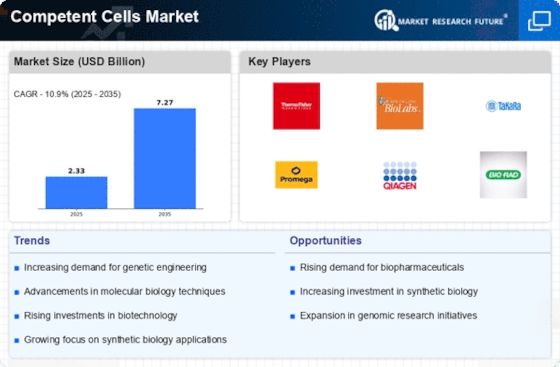
As per Market Research Future analysis, the Competent Cells Market Size was estimated at 2.329 USD Billion in 2024. The Competent Cells industry is projected to grow from 2.583 USD Billion in 2025 to 7.269 USD Billion by 2035, exhibiting a compound annual growth rate (CAGR) of 10% during the forecast period 2025 - 2035

Key Market Trends & Highlights

The Competent Cells Market is experiencing robust growth driven by advancements in biotechnology and increasing applications in synthetic biology.

  • The market is witnessing a rising demand for synthetic biology, particularly in North America, which remains the largest market. Advancements in genetic engineering techniques are propelling growth, especially in the Asia-Pacific region, recognized as the fastest-growing area. Molecular cloning continues to dominate as the largest segment, while protein expression is emerging as the fastest-growing segment in the market. Key drivers include rising applications in biotechnology and growing investment in genomic research, which are significantly influencing market dynamics.

Market Size & Forecast

2024 Market Size 2.329 (USD Billion)
2035 Market Size 7.269 (USD Billion)
CAGR (2025 - 2035) 10.9%
Largest Regional Market Share in 2024 North America

Major Players

<a href="https://www.thermofisher.com/in/en/home/life-science/cloning.html?gclid=CjwKCAiAxc_JBhA2EiwAFVs7XFJvr3IRa-WmWvDyzTUZ7gZWkM6arCL5CdsZ0IBDIfk2C8TsBVNI1RoCN4IQAvD_BwE&amp;ef_id=CjwKCAiAxc_JBhA2EiwAFVs7XFJvr3IRa-WmWvDyzTUZ7gZWkM6arCL5CdsZ0IBDIfk2C8TsBVNI1RoCN4IQAvD_BwE:G:s&amp;s_kwcid=AL!3652!3!772311048650!p!!g!!thermo%20fisher%20cloning!10552817726!185542036795&amp;cid=bid_mol_clo_r01_co_cp1358_pjt0000_bid00000_0se_gaw_bt_pur_con&amp;gad_source=1&amp;gad_campaignid=10552817726&amp;gbraid=0AAAAADxi_GS-vz9bRlB7pKbezjGhNcRWS">Thermo Fisher Scientific</a> (US), New England Biolabs (US), Takara Bio (JP), Promega Corporation (US), Qiagen (DE), Bio-Rad Laboratories (US), Agilent Technologies (US), SABiosciences (US)

Market Trends

The Competent Cells Market is currently experiencing a dynamic evolution, driven by advancements in biotechnology and molecular biology. As researchers increasingly seek efficient methods for gene cloning, protein expression, and other genetic manipulations, the demand for competent cells is on the rise. These cells, which are capable of taking up foreign DNA, play a crucial role in various applications, including synthetic biology, genetic engineering, and pharmaceutical development. The Competent Cells Market appears to be influenced by the growing emphasis on personalized medicine and the need for innovative therapeutic solutions, suggesting a robust future for this sector.

Moreover, the expansion of research activities in academic and industrial laboratories is likely to further propel the Competent Cells Market. The increasing focus on genetic research and the development of novel biopharmaceuticals may lead to heightened investments in competent cell technologies. Additionally, collaborations between academic institutions and biotechnology companies could foster innovation, enhancing the capabilities and applications of these cells. As the landscape of genetic research continues to evolve, the Competent Cells Market seems poised for significant growth, driven by both technological advancements and the expanding scope of applications in life sciences.

Rising Demand for Synthetic Biology

The Competent Cells Market is witnessing a surge in demand due to the increasing interest in synthetic biology. Researchers are exploring new ways to design and construct biological systems, which necessitates the use of competent cells for efficient DNA uptake and manipulation. This trend indicates a shift towards more complex genetic engineering projects, potentially expanding the market's scope.

Advancements in Genetic Engineering Techniques

Innovations in genetic engineering techniques are shaping the Competent Cells Market. As methods such as CRISPR and gene editing become more prevalent, the need for high-quality competent cells that can facilitate these processes is likely to grow. This trend suggests that the market may evolve to accommodate more specialized products tailored to specific applications.

Increased Focus on Personalized Medicine

The Competent Cells Market is also influenced by the rising emphasis on personalized medicine. As healthcare shifts towards more individualized treatment approaches, the demand for competent cells that can support the development of tailored therapies is expected to increase. This trend highlights the potential for growth in the market as it aligns with broader healthcare objectives.

Competent Cells Market Market Drivers

Rising Applications in Biotechnology

The Competent Cells Market is experiencing a surge in applications across various biotechnology sectors. This growth is primarily driven by the increasing need for genetic modifications and recombinant DNA technology. As biopharmaceutical companies expand their research and development efforts, the demand for competent cells, which facilitate the transformation of plasmids into host cells, is likely to rise. In 2023, the biotechnology sector accounted for a substantial portion of the overall market, with projections indicating a continued upward trajectory. The versatility of competent cells in producing proteins, enzymes, and vaccines further enhances their relevance in the industry. Consequently, the expansion of biotechnology applications is a pivotal driver for the Competent Cells Market.

Growing Investment in Genomic Research

Investment in genomic research is a critical driver for the Competent Cells Market. As governments and private entities allocate substantial funding towards genomics, the demand for competent cells is likely to escalate. In 2023, global investments in genomic research reached unprecedented levels, with a focus on understanding genetic diseases and developing targeted therapies. Competent cells play a vital role in these research endeavors, serving as essential tools for gene cloning and manipulation. The increasing emphasis on genomics is expected to create a robust market for competent cells, as researchers require high-quality products to facilitate their studies. This trend highlights the interconnectedness of genomic research and the Competent Cells Market.

Expansion of Synthetic Biology Initiatives

The expansion of synthetic biology initiatives is significantly impacting the Competent Cells Market. As organizations and academic institutions increasingly adopt synthetic biology approaches, the need for competent cells to support these initiatives is growing. Synthetic biology relies heavily on the manipulation of genetic material, and competent cells are crucial for the successful implementation of these techniques. In recent years, numerous synthetic biology projects have emerged, focusing on applications such as biofuel production and environmental remediation. This burgeoning field is expected to drive demand for competent cells, as researchers seek efficient methods for constructing and testing synthetic organisms. The rise of synthetic biology initiatives thus represents a key driver for the Competent Cells Market.

Increased Focus on Research and Development

The heightened focus on research and development (R&D) across various sectors is a significant driver for the Competent Cells Market. Organizations are increasingly investing in R&D to foster innovation and develop new products, particularly in the fields of biotechnology and pharmaceuticals. This trend is evident in the substantial growth of R&D expenditures, which have seen a steady increase in recent years. Competent cells are integral to R&D processes, enabling scientists to conduct experiments related to gene expression and protein production. As the demand for novel therapies and biotechnological solutions rises, the reliance on competent cells is expected to grow. This emphasis on R&D thus serves as a crucial catalyst for the Competent Cells Market.

Technological Innovations in Cell Transformation

Technological advancements in cell transformation techniques are significantly influencing the Competent Cells Market. Innovations such as electroporation and heat shock methods have improved the efficiency of competent cell preparation, leading to higher transformation rates. These advancements not only enhance the performance of competent cells but also reduce the time and resources required for genetic engineering projects. In recent years, the introduction of new competent cell strains with optimized properties has further propelled market growth. As researchers seek more efficient and reliable methods for gene cloning and expression, the demand for technologically advanced competent cells is expected to increase. This trend underscores the importance of innovation in driving the Competent Cells Market.

Market Segment Insights

By Application: Molecular Cloning (Largest) vs. Protein Expression (Fastest-Growing)

In the Competent Cells Market, the application segment is primarily dominated by <a href="https://www.marketresearchfuture.com/reports/molecular-cloning-market-38767" target="_blank" title="molecular cloning">Molecular Cloning</a>, which holds the largest share due to its extensive use in genetic engineering and synthetic biology. The demand for molecular cloning applications continues to grow as researchers aim to develop new genetic constructs for a wide range of applications, from academic research to industrial biotechnology. Following closely is Protein Expression, which has emerged as a burgeoning segment, driven by the increasing need for recombinant proteins in therapeutics and diagnostics.

Molecular Cloning (Dominant) vs. Protein Expression (Emerging)

Molecular Cloning is recognized as the dominant segment within the Competent Cells Market, mainly due to its foundational role in genetic manipulation and research. This application involves the precise insertion of DNA fragments into vectors, facilitating the production of genetically modified organisms. In contrast, Protein Expression is labeled as the emerging segment, witnessing rapid growth fueled by advancements in biopharmaceuticals that require high-quality protein production. The robust demand for therapeutic proteins is driving innovation in competent cell technologies, allowing efficient and scalable protein expression for various applications.

By Product Type: Chemically Competent Cells (Largest) vs. Electrocompetent Cells (Fastest-Growing)

<p>In the Competent Cells Market, Chemically Competent Cells dominate the landscape, capturing the attention of researchers and biotechnologists. These cells are preferred due to their simplicity in preparation and ability to offer high transformation efficiencies. Meanwhile, Electrocompetent Cells, although they hold a smaller share, are rapidly growing in popularity within specialized applications. Their ability to facilitate the transformation of plasmid DNA through electroporation makes them invaluable in advanced research settings. The market for Competent Cells is being driven by increasing investments in biotechnology and genetic research. The demand for Chemically Competent Cells continues to be stable as they represent the standard option for most laboratory experiments. However, the surge in research requiring higher precision and efficiency has led to the rapid adoption of Electrocompetent Cells, which are becoming the preferred choice for complex molecular biology applications, pushing them into the spotlight as the fastest-growing segment in the market.</p>

<p>Chemically Competent Cells (Dominant) vs. Electrocompetent Cells (Emerging)</p>

<p>Chemically Competent Cells have established themselves as the dominant product type in the Competent Cells Market due to their user-friendly nature and high transformation efficiency. These cells are typically treated with calcium chloride or other agents that make their cell membranes permeable to DNA. They are widely used across various applications in cloning, gene expression, and synthetic biology. On the other hand, Electrocompetent Cells are emerging as a significant force in the market. These cells, subjected to an electric field, allow for more efficient DNA uptake compared to traditional methods, making them ideal for advanced applications that require higher transformation rates. As laboratories seek enhanced performance and reliability in genetic manipulations, Electrocompetent Cells are experiencing a remarkable rise in adoption.</p>

By End User: Pharmaceutical Companies (Largest) vs. Biotechnology Companies (Fastest-Growing)

In the Competent Cells Market, the distribution of market share among end users shows that Pharmaceutical Companies hold the largest share, primarily due to their extensive R&amp;D activities and demand for innovative drug development processes. Academic Institutes follow, leveraging competent cells for educational purposes and research projects, while Biotechnology Companies represent a growing segment fueled by advancements in genetic engineering and synthetic biology initiatives.

End Users: Pharmaceutical Companies (Dominant) vs. Biotechnology Companies (Emerging)

Pharmaceutical Companies dominate the Competent Cells Market, utilizing competent cells in the production of biologics and monoclonal antibodies, which are crucial for therapies targeting various diseases. Their robust pipeline and substantial investment in research contribute to their leading position. In contrast, Biotechnology Companies, although currently smaller in market share, are rapidly emerging as key players. Their focus on innovative biotechnological solutions and collaborative research with academic institutions drives their growth, reflecting the industry's shift towards personalized medicine and biologic therapies.

By Technique: Transformation (Largest) vs. Transfection (Fastest-Growing)

In the Competent Cells Market, the technique segment reveals significant insights into how various methods are utilized in genetic modifications. Transformation represents the largest share, capitalizing on its established methodology in molecular biology. It is widely adopted for introducing plasmid DNA into bacteria, making it the go-to choice for researchers and developers. On the other hand, transfection is rapidly gaining momentum, driven by its effectiveness in delivering DNA or RNA into various cell types, thus expanding its applications in therapeutic development.

Technique: Transformation (Dominant) vs. Transfection (Emerging)

The Transformation technique stands out as the dominant method in the competent cells market due to its long-standing presence and reliability in genetic engineering. It allows for efficient plasmid uptake in bacterial cells, making it essential for applications in cloning and expression studies. In contrast, transfection is emerging as a pivotal technique, especially in the realm of eukaryotic cells, overcoming some previous limitations associated with transformation. This method is increasingly employed in research and therapeutic applications, particularly in gene therapy and vaccine development, highlighting its growing importance in the biotechnology landscape.

Get more detailed insights about Competent Cells Market Research Report—Global Forecast till 2035

Regional Insights

North America : Innovation and Research Hub

North America dominates the competent cells market, accounting for approximately 45% of the global share. The region benefits from robust research and development activities, significant funding for biotechnology, and a strong presence of academic institutions. Regulatory support from agencies like the FDA further drives market growth, as they facilitate the approval of new biotechnological products and innovations. The United States is the largest market, followed by Canada, both showcasing a high demand for competent cells in various applications, including genetic engineering and synthetic biology. Key players such as Thermo Fisher Scientific and New England Biolabs are headquartered here, contributing to a competitive landscape that fosters innovation and collaboration among industry stakeholders.

Europe : Emerging Biotech Powerhouse

Europe is witnessing significant growth in the competent cells market, holding approximately 30% of the global share. The region's growth is driven by increasing investments in biotechnology and a strong regulatory framework that encourages innovation. The European Medicines Agency (EMA) plays a crucial role in ensuring that new biotechnological products meet safety and efficacy standards, thus boosting market confidence. Leading countries in this region include Germany, the UK, and France, which are home to numerous biotech firms and research institutions. The competitive landscape is characterized by the presence of key players like Qiagen and Bio-Rad Laboratories, which are actively involved in developing advanced competent cell technologies. This dynamic environment fosters collaboration and accelerates the pace of innovation in the Competent Cells Market.

Asia-Pacific : Rapidly Expanding Market

Asia-Pacific is rapidly emerging as a significant player in the competent cells market, accounting for approximately 20% of the global share. The region's growth is fueled by increasing investments in biotechnology research, rising healthcare needs, and a growing number of academic institutions focusing on genetic research. Countries like China and India are at the forefront, supported by favorable government policies that promote biotechnological advancements. China is the largest market in the region, followed by Japan and India, which are witnessing a surge in demand for competent cells for various applications, including drug development and genetic engineering. The competitive landscape is evolving, with both local and international players, such as Takara Bio and Promega Corporation, actively participating in the Competent Cells Market, enhancing innovation and accessibility.

Middle East and Africa : Emerging Research Landscape

The Middle East and Africa region is gradually developing its competent cells market, currently holding about 5% of the global share. Growth is driven by increasing investments in biotechnology and healthcare, alongside a rising number of research initiatives supported by governments and international organizations. Countries like South Africa and the UAE are leading the way, with initiatives aimed at enhancing research capabilities and fostering innovation in biotechnology. The competitive landscape is still in its nascent stages, but there is a growing presence of both local and international players. Key players are beginning to establish a foothold in the region, focusing on collaborations with academic institutions and research organizations to drive advancements in competent cell technologies. This collaborative approach is expected to accelerate market growth in the coming years.

Key Players and Competitive Insights

The Competent Cells Market is characterized by a dynamic competitive landscape, driven by innovation, strategic partnerships, and a growing demand for advanced molecular biology tools. Key players such as Thermo Fisher Scientific (US), New England Biolabs (US), and Takara Bio (JP) are at the forefront, each adopting distinct strategies to enhance their market positioning. Thermo Fisher Scientific (US) emphasizes innovation through continuous product development, while New England Biolabs (US) focuses on expanding its product portfolio to cater to diverse research needs. Takara Bio (JP) appears to be leveraging strategic partnerships to enhance its technological capabilities, thereby shaping a competitive environment that is increasingly reliant on collaboration and innovation. The business tactics employed by these companies reflect a concerted effort to optimize supply chains and localize manufacturing. The market structure is moderately fragmented, with several players vying for market share, yet the influence of major companies remains pronounced. This competitive structure allows for a variety of offerings, catering to different segments of the market, while also fostering an environment where innovation can thrive. In August 2025, Thermo Fisher Scientific (US) announced the launch of a new line of competent cells designed for high-efficiency cloning applications. This strategic move is significant as it not only enhances their product offerings but also positions them to capture a larger share of the growing synthetic biology market. The introduction of these advanced competent cells is likely to attract researchers seeking reliable and efficient solutions, thereby reinforcing Thermo Fisher's competitive edge. In July 2025, New England Biolabs (US) expanded its global distribution network by partnering with regional distributors in Asia and Europe. This action is indicative of their strategy to enhance accessibility to their products, which may lead to increased market penetration. By localizing distribution, New England Biolabs (US) can respond more swiftly to customer needs, thereby strengthening its market presence and fostering customer loyalty. In September 2025, Takara Bio (JP) entered into a collaboration with a leading biotechnology firm to develop next-generation competent cells tailored for CRISPR applications. This partnership underscores the importance of innovation in the current market landscape, as it aligns with the growing trend towards gene editing technologies. Such collaborations are likely to enhance Takara Bio's technological capabilities and expand its product offerings, positioning it favorably in a competitive market. As of October 2025, the Competent Cells Market is witnessing trends such as digitalization, sustainability, and the integration of artificial intelligence in product development. Strategic alliances are increasingly shaping the competitive landscape, allowing companies to pool resources and expertise. Looking ahead, it appears that competitive differentiation will evolve from traditional price-based competition to a focus on innovation, technological advancements, and supply chain reliability, suggesting a transformative shift in how companies approach market challenges.

Key Companies in the Competent Cells Market include

Industry Developments

  • Q3 2025: Bio-Rad Laboratories Launches Innovative ddPCR Kits For Cell And Gene Therapy Production Bio-Rad Laboratories announced the launch of new droplet digital PCR (ddPCR) kits designed for cell and gene therapy production, expanding their product portfolio in the competent cells sector.

Future Outlook

Competent Cells Market Future Outlook

The Competent Cells Market is projected to grow at a 10.9% CAGR from 2025 to 2035, driven by advancements in genetic engineering and increasing demand for biopharmaceuticals.

New opportunities lie in:

  • <p>Development of high-efficiency transformation protocols for diverse cell types. Expansion into emerging markets with tailored product offerings. Partnerships with biotech firms for co-development of innovative applications.</p>

By 2035, the Competent Cells Market is expected to achieve substantial growth and innovation.

Market Segmentation

Competent Cells Market End User Outlook

  • Academic Institutes
  • Biotechnology Companies
  • Pharmaceutical Companies

Competent Cells Market Technique Outlook

  • Transformation
  • Transfection
  • Gene Editing

Competent Cells Market Application Outlook

  • Molecular Cloning
  • Protein Expression
  • Gene Expression

Competent Cells Market Product Type Outlook

  • Chemically Competent Cells
  • Electrocompetent Cells
  • Commercial Competent Cells

Report Scope

MARKET SIZE 2024 2.329(USD Billion)
MARKET SIZE 2025 2.583(USD Billion)
MARKET SIZE 2035 7.269(USD Billion)
COMPOUND ANNUAL GROWTH RATE (CAGR) 10.9% (2025 - 2035)
REPORT COVERAGE Revenue Forecast, Competitive Landscape, Growth Factors, and Trends
BASE YEAR 2024
Market Forecast Period 2025 - 2035
Historical Data 2019 - 2024
Market Forecast Units USD Billion
Key Companies Profiled Thermo Fisher Scientific (US), New England Biolabs (US), Takara Bio (JP), Promega Corporation (US), Qiagen (DE), Bio-Rad Laboratories (US), Agilent Technologies (US), SABiosciences (US)
Segments Covered Application, Product Type, End User, Technique, Regional
Key Market Opportunities Advancements in genetic engineering techniques drive demand in the Competent Cells Market.
Key Market Dynamics Rising demand for genetic engineering drives innovation and competition in the competent cells market.
Countries Covered North America, Europe, APAC, South America, MEA

FAQs

What is the projected market valuation of the Competent Cells Market by 2035?

<p>The Competent Cells Market is projected to reach a valuation of 7.269 USD Billion by 2035.</p>

What was the market valuation of the Competent Cells Market in 2024?

<p>In 2024, the overall market valuation of the Competent Cells Market was 2.329 USD Billion.</p>

What is the expected CAGR for the Competent Cells Market during the forecast period 2025 - 2035?

<p>The expected CAGR for the Competent Cells Market during the forecast period 2025 - 2035 is 10.9%.</p>

Which application segment is expected to dominate the Competent Cells Market?

<p>The Molecular Cloning application segment is anticipated to dominate, with a projected valuation of 2.883 USD Billion by 2035.</p>

What are the key product types in the Competent Cells Market?

<p>The key product types include Chemically Competent Cells, Electrocompetent Cells, and Commercial Competent Cells.</p>

Which end user segment is projected to have the highest market share in 2035?

<p>Pharmaceutical Companies are projected to have the highest market share, with an expected valuation of 2.921 USD Billion by 2035.</p>

Who are the leading players in the Competent Cells Market?

<p>Key players in the Competent Cells Market include Thermo Fisher Scientific, New England Biolabs, and Takara Bio.</p>

What is the projected valuation for the Protein Expression application segment by 2035?

<p>The Protein Expression application segment is projected to reach a valuation of 2.154 USD Billion by 2035.</p>

How does the market for Electrocompetent Cells compare to Chemically Competent Cells?

<p>Electrocompetent Cells are projected to reach 2.154 USD Billion, while Chemically Competent Cells are expected to reach 2.883 USD Billion by 2035.</p>

What techniques are driving growth in the Competent Cells Market?

<p>Techniques such as Transformation, Transfection, and Gene Editing are driving growth, with Transformation expected to reach 2.883 USD Billion by 2035.</p>

  1. SECTION I: EXECUTIVE SUMMARY AND KEY HIGHLIGHTS
    1. | 1.1 EXECUTIVE SUMMARY
    2. | | 1.1.1 Market Overview
    3. | | 1.1.2 Key Findings
    4. | | 1.1.3 Market Segmentation
    5. | | 1.1.4 Competitive Landscape
    6. | | 1.1.5 Challenges and Opportunities
    7. | | 1.1.6 Future Outlook
  2. SECTION II: SCOPING, METHODOLOGY AND MARKET STRUCTURE
    1. | 2.1 MARKET INTRODUCTION
    2. | | 2.1.1 Definition
    3. | | 2.1.2 Scope of the study
    4. | | | 2.1.2.1 Research Objective
    5. | | | 2.1.2.2 Assumption
    6. | | | 2.1.2.3 Limitations
    7. | 2.2 RESEARCH METHODOLOGY
    8. | | 2.2.1 Overview
    9. | | 2.2.2 Data Mining
    10. | | 2.2.3 Secondary Research
    11. | | 2.2.4 Primary Research
    12. | | | 2.2.4.1 Primary Interviews and Information Gathering Process
    13. | | | 2.2.4.2 Breakdown of Primary Respondents
    14. | | 2.2.5 Forecasting Model
    15. | | 2.2.6 Market Size Estimation
    16. | | | 2.2.6.1 Bottom-Up Approach
    17. | | | 2.2.6.2 Top-Down Approach
    18. | | 2.2.7 Data Triangulation
    19. | | 2.2.8 Validation
  3. SECTION III: QUALITATIVE ANALYSIS
    1. | 3.1 MARKET DYNAMICS
    2. | | 3.1.1 Overview
    3. | | 3.1.2 Drivers
    4. | | 3.1.3 Restraints
    5. | | 3.1.4 Opportunities
    6. | 3.2 MARKET FACTOR ANALYSIS
    7. | | 3.2.1 Value chain Analysis
    8. | | 3.2.2 Porter's Five Forces Analysis
    9. | | | 3.2.2.1 Bargaining Power of Suppliers
    10. | | | 3.2.2.2 Bargaining Power of Buyers
    11. | | | 3.2.2.3 Threat of New Entrants
    12. | | | 3.2.2.4 Threat of Substitutes
    13. | | | 3.2.2.5 Intensity of Rivalry
    14. | | 3.2.3 COVID-19 Impact Analysis
    15. | | | 3.2.3.1 Market Impact Analysis
    16. | | | 3.2.3.2 Regional Impact
    17. | | | 3.2.3.3 Opportunity and Threat Analysis
  4. SECTION IV: QUANTITATIVE ANALYSIS
    1. | 4.1 Healthcare, BY Application (USD Billion)
    2. | | 4.1.1 Molecular Cloning
    3. | | 4.1.2 Protein Expression
    4. | | 4.1.3 Gene Expression
    5. | 4.2 Healthcare, BY Product Type (USD Billion)
    6. | | 4.2.1 Chemically Competent Cells
    7. | | 4.2.2 Electrocompetent Cells
    8. | | 4.2.3 Commercial Competent Cells
    9. | 4.3 Healthcare, BY End User (USD Billion)
    10. | | 4.3.1 Academic Institutes
    11. | | 4.3.2 Biotechnology Companies
    12. | | 4.3.3 Pharmaceutical Companies
    13. | 4.4 Healthcare, BY Technique (USD Billion)
    14. | | 4.4.1 Transformation
    15. | | 4.4.2 Transfection
    16. | | 4.4.3 Gene Editing
    17. | 4.5 Healthcare, BY Region (USD Billion)
    18. | | 4.5.1 North America
    19. | | | 4.5.1.1 US
    20. | | | 4.5.1.2 Canada
    21. | | 4.5.2 Europe
    22. | | | 4.5.2.1 Germany
    23. | | | 4.5.2.2 UK
    24. | | | 4.5.2.3 France
    25. | | | 4.5.2.4 Russia
    26. | | | 4.5.2.5 Italy
    27. | | | 4.5.2.6 Spain
    28. | | | 4.5.2.7 Rest of Europe
    29. | | 4.5.3 APAC
    30. | | | 4.5.3.1 China
    31. | | | 4.5.3.2 India
    32. | | | 4.5.3.3 Japan
    33. | | | 4.5.3.4 South Korea
    34. | | | 4.5.3.5 Malaysia
    35. | | | 4.5.3.6 Thailand
    36. | | | 4.5.3.7 Indonesia
    37. | | | 4.5.3.8 Rest of APAC
    38. | | 4.5.4 South America
    39. | | | 4.5.4.1 Brazil
    40. | | | 4.5.4.2 Mexico
    41. | | | 4.5.4.3 Argentina
    42. | | | 4.5.4.4 Rest of South America
    43. | | 4.5.5 MEA
    44. | | | 4.5.5.1 GCC Countries
    45. | | | 4.5.5.2 South Africa
    46. | | | 4.5.5.3 Rest of MEA
  5. SECTION V: COMPETITIVE ANALYSIS
    1. | 5.1 Competitive Landscape
    2. | | 5.1.1 Overview
    3. | | 5.1.2 Competitive Analysis
    4. | | 5.1.3 Market share Analysis
    5. | | 5.1.4 Major Growth Strategy in the Healthcare
    6. | | 5.1.5 Competitive Benchmarking
    7. | | 5.1.6 Leading Players in Terms of Number of Developments in the Healthcare
    8. | | 5.1.7 Key developments and growth strategies
    9. | | | 5.1.7.1 New Product Launch/Service Deployment
    10. | | | 5.1.7.2 Merger & Acquisitions
    11. | | | 5.1.7.3 Joint Ventures
    12. | | 5.1.8 Major Players Financial Matrix
    13. | | | 5.1.8.1 Sales and Operating Income
    14. | | | 5.1.8.2 Major Players R&D Expenditure. 2023
    15. | 5.2 Company Profiles
    16. | | 5.2.1 Thermo Fisher Scientific (US)
    17. | | | 5.2.1.1 Financial Overview
    18. | | | 5.2.1.2 Products Offered
    19. | | | 5.2.1.3 Key Developments
    20. | | | 5.2.1.4 SWOT Analysis
    21. | | | 5.2.1.5 Key Strategies
    22. | | 5.2.2 New England Biolabs (US)
    23. | | | 5.2.2.1 Financial Overview
    24. | | | 5.2.2.2 Products Offered
    25. | | | 5.2.2.3 Key Developments
    26. | | | 5.2.2.4 SWOT Analysis
    27. | | | 5.2.2.5 Key Strategies
    28. | | 5.2.3 Takara Bio (JP)
    29. | | | 5.2.3.1 Financial Overview
    30. | | | 5.2.3.2 Products Offered
    31. | | | 5.2.3.3 Key Developments
    32. | | | 5.2.3.4 SWOT Analysis
    33. | | | 5.2.3.5 Key Strategies
    34. | | 5.2.4 Promega Corporation (US)
    35. | | | 5.2.4.1 Financial Overview
    36. | | | 5.2.4.2 Products Offered
    37. | | | 5.2.4.3 Key Developments
    38. | | | 5.2.4.4 SWOT Analysis
    39. | | | 5.2.4.5 Key Strategies
    40. | | 5.2.5 Qiagen (DE)
    41. | | | 5.2.5.1 Financial Overview
    42. | | | 5.2.5.2 Products Offered
    43. | | | 5.2.5.3 Key Developments
    44. | | | 5.2.5.4 SWOT Analysis
    45. | | | 5.2.5.5 Key Strategies
    46. | | 5.2.6 Bio-Rad Laboratories (US)
    47. | | | 5.2.6.1 Financial Overview
    48. | | | 5.2.6.2 Products Offered
    49. | | | 5.2.6.3 Key Developments
    50. | | | 5.2.6.4 SWOT Analysis
    51. | | | 5.2.6.5 Key Strategies
    52. | | 5.2.7 Agilent Technologies (US)
    53. | | | 5.2.7.1 Financial Overview
    54. | | | 5.2.7.2 Products Offered
    55. | | | 5.2.7.3 Key Developments
    56. | | | 5.2.7.4 SWOT Analysis
    57. | | | 5.2.7.5 Key Strategies
    58. | | 5.2.8 SABiosciences (US)
    59. | | | 5.2.8.1 Financial Overview
    60. | | | 5.2.8.2 Products Offered
    61. | | | 5.2.8.3 Key Developments
    62. | | | 5.2.8.4 SWOT Analysis
    63. | | | 5.2.8.5 Key Strategies
    64. | 5.3 Appendix
    65. | | 5.3.1 References
    66. | | 5.3.2 Related Reports
  6. LIST OF FIGURES
    1. | 6.1 MARKET SYNOPSIS
    2. | 6.2 NORTH AMERICA MARKET ANALYSIS
    3. | 6.3 US MARKET ANALYSIS BY APPLICATION
    4. | 6.4 US MARKET ANALYSIS BY PRODUCT TYPE
    5. | 6.5 US MARKET ANALYSIS BY END USER
    6. | 6.6 US MARKET ANALYSIS BY TECHNIQUE
    7. | 6.7 CANADA MARKET ANALYSIS BY APPLICATION
    8. | 6.8 CANADA MARKET ANALYSIS BY PRODUCT TYPE
    9. | 6.9 CANADA MARKET ANALYSIS BY END USER
    10. | 6.10 CANADA MARKET ANALYSIS BY TECHNIQUE
    11. | 6.11 EUROPE MARKET ANALYSIS
    12. | 6.12 GERMANY MARKET ANALYSIS BY APPLICATION
    13. | 6.13 GERMANY MARKET ANALYSIS BY PRODUCT TYPE
    14. | 6.14 GERMANY MARKET ANALYSIS BY END USER
    15. | 6.15 GERMANY MARKET ANALYSIS BY TECHNIQUE
    16. | 6.16 UK MARKET ANALYSIS BY APPLICATION
    17. | 6.17 UK MARKET ANALYSIS BY PRODUCT TYPE
    18. | 6.18 UK MARKET ANALYSIS BY END USER
    19. | 6.19 UK MARKET ANALYSIS BY TECHNIQUE
    20. | 6.20 FRANCE MARKET ANALYSIS BY APPLICATION
    21. | 6.21 FRANCE MARKET ANALYSIS BY PRODUCT TYPE
    22. | 6.22 FRANCE MARKET ANALYSIS BY END USER
    23. | 6.23 FRANCE MARKET ANALYSIS BY TECHNIQUE
    24. | 6.24 RUSSIA MARKET ANALYSIS BY APPLICATION
    25. | 6.25 RUSSIA MARKET ANALYSIS BY PRODUCT TYPE
    26. | 6.26 RUSSIA MARKET ANALYSIS BY END USER
    27. | 6.27 RUSSIA MARKET ANALYSIS BY TECHNIQUE
    28. | 6.28 ITALY MARKET ANALYSIS BY APPLICATION
    29. | 6.29 ITALY MARKET ANALYSIS BY PRODUCT TYPE
    30. | 6.30 ITALY MARKET ANALYSIS BY END USER
    31. | 6.31 ITALY MARKET ANALYSIS BY TECHNIQUE
    32. | 6.32 SPAIN MARKET ANALYSIS BY APPLICATION
    33. | 6.33 SPAIN MARKET ANALYSIS BY PRODUCT TYPE
    34. | 6.34 SPAIN MARKET ANALYSIS BY END USER
    35. | 6.35 SPAIN MARKET ANALYSIS BY TECHNIQUE
    36. | 6.36 REST OF EUROPE MARKET ANALYSIS BY APPLICATION
    37. | 6.37 REST OF EUROPE MARKET ANALYSIS BY PRODUCT TYPE
    38. | 6.38 REST OF EUROPE MARKET ANALYSIS BY END USER
    39. | 6.39 REST OF EUROPE MARKET ANALYSIS BY TECHNIQUE
    40. | 6.40 APAC MARKET ANALYSIS
    41. | 6.41 CHINA MARKET ANALYSIS BY APPLICATION
    42. | 6.42 CHINA MARKET ANALYSIS BY PRODUCT TYPE
    43. | 6.43 CHINA MARKET ANALYSIS BY END USER
    44. | 6.44 CHINA MARKET ANALYSIS BY TECHNIQUE
    45. | 6.45 INDIA MARKET ANALYSIS BY APPLICATION
    46. | 6.46 INDIA MARKET ANALYSIS BY PRODUCT TYPE
    47. | 6.47 INDIA MARKET ANALYSIS BY END USER
    48. | 6.48 INDIA MARKET ANALYSIS BY TECHNIQUE
    49. | 6.49 JAPAN MARKET ANALYSIS BY APPLICATION
    50. | 6.50 JAPAN MARKET ANALYSIS BY PRODUCT TYPE
    51. | 6.51 JAPAN MARKET ANALYSIS BY END USER
    52. | 6.52 JAPAN MARKET ANALYSIS BY TECHNIQUE
    53. | 6.53 SOUTH KOREA MARKET ANALYSIS BY APPLICATION
    54. | 6.54 SOUTH KOREA MARKET ANALYSIS BY PRODUCT TYPE
    55. | 6.55 SOUTH KOREA MARKET ANALYSIS BY END USER
    56. | 6.56 SOUTH KOREA MARKET ANALYSIS BY TECHNIQUE
    57. | 6.57 MALAYSIA MARKET ANALYSIS BY APPLICATION
    58. | 6.58 MALAYSIA MARKET ANALYSIS BY PRODUCT TYPE
    59. | 6.59 MALAYSIA MARKET ANALYSIS BY END USER
    60. | 6.60 MALAYSIA MARKET ANALYSIS BY TECHNIQUE
    61. | 6.61 THAILAND MARKET ANALYSIS BY APPLICATION
    62. | 6.62 THAILAND MARKET ANALYSIS BY PRODUCT TYPE
    63. | 6.63 THAILAND MARKET ANALYSIS BY END USER
    64. | 6.64 THAILAND MARKET ANALYSIS BY TECHNIQUE
    65. | 6.65 INDONESIA MARKET ANALYSIS BY APPLICATION
    66. | 6.66 INDONESIA MARKET ANALYSIS BY PRODUCT TYPE
    67. | 6.67 INDONESIA MARKET ANALYSIS BY END USER
    68. | 6.68 INDONESIA MARKET ANALYSIS BY TECHNIQUE
    69. | 6.69 REST OF APAC MARKET ANALYSIS BY APPLICATION
    70. | 6.70 REST OF APAC MARKET ANALYSIS BY PRODUCT TYPE
    71. | 6.71 REST OF APAC MARKET ANALYSIS BY END USER
    72. | 6.72 REST OF APAC MARKET ANALYSIS BY TECHNIQUE
    73. | 6.73 SOUTH AMERICA MARKET ANALYSIS
    74. | 6.74 BRAZIL MARKET ANALYSIS BY APPLICATION
    75. | 6.75 BRAZIL MARKET ANALYSIS BY PRODUCT TYPE
    76. | 6.76 BRAZIL MARKET ANALYSIS BY END USER
    77. | 6.77 BRAZIL MARKET ANALYSIS BY TECHNIQUE
    78. | 6.78 MEXICO MARKET ANALYSIS BY APPLICATION
    79. | 6.79 MEXICO MARKET ANALYSIS BY PRODUCT TYPE
    80. | 6.80 MEXICO MARKET ANALYSIS BY END USER
    81. | 6.81 MEXICO MARKET ANALYSIS BY TECHNIQUE
    82. | 6.82 ARGENTINA MARKET ANALYSIS BY APPLICATION
    83. | 6.83 ARGENTINA MARKET ANALYSIS BY PRODUCT TYPE
    84. | 6.84 ARGENTINA MARKET ANALYSIS BY END USER
    85. | 6.85 ARGENTINA MARKET ANALYSIS BY TECHNIQUE
    86. | 6.86 REST OF SOUTH AMERICA MARKET ANALYSIS BY APPLICATION
    87. | 6.87 REST OF SOUTH AMERICA MARKET ANALYSIS BY PRODUCT TYPE
    88. | 6.88 REST OF SOUTH AMERICA MARKET ANALYSIS BY END USER
    89. | 6.89 REST OF SOUTH AMERICA MARKET ANALYSIS BY TECHNIQUE
    90. | 6.90 MEA MARKET ANALYSIS
    91. | 6.91 GCC COUNTRIES MARKET ANALYSIS BY APPLICATION
    92. | 6.92 GCC COUNTRIES MARKET ANALYSIS BY PRODUCT TYPE
    93. | 6.93 GCC COUNTRIES MARKET ANALYSIS BY END USER
    94. | 6.94 GCC COUNTRIES MARKET ANALYSIS BY TECHNIQUE
    95. | 6.95 SOUTH AFRICA MARKET ANALYSIS BY APPLICATION
    96. | 6.96 SOUTH AFRICA MARKET ANALYSIS BY PRODUCT TYPE
    97. | 6.97 SOUTH AFRICA MARKET ANALYSIS BY END USER
    98. | 6.98 SOUTH AFRICA MARKET ANALYSIS BY TECHNIQUE
    99. | 6.99 REST OF MEA MARKET ANALYSIS BY APPLICATION
    100. | 6.100 REST OF MEA MARKET ANALYSIS BY PRODUCT TYPE
    101. | 6.101 REST OF MEA MARKET ANALYSIS BY END USER
    102. | 6.102 REST OF MEA MARKET ANALYSIS BY TECHNIQUE
    103. | 6.103 KEY BUYING CRITERIA OF HEALTHCARE
    104. | 6.104 RESEARCH PROCESS OF MRFR
    105. | 6.105 DRO ANALYSIS OF HEALTHCARE
    106. | 6.106 DRIVERS IMPACT ANALYSIS: HEALTHCARE
    107. | 6.107 RESTRAINTS IMPACT ANALYSIS: HEALTHCARE
    108. | 6.108 SUPPLY / VALUE CHAIN: HEALTHCARE
    109. | 6.109 HEALTHCARE, BY APPLICATION, 2024 (% SHARE)
    110. | 6.110 HEALTHCARE, BY APPLICATION, 2024 TO 2035 (USD Billion)
    111. | 6.111 HEALTHCARE, BY PRODUCT TYPE, 2024 (% SHARE)
    112. | 6.112 HEALTHCARE, BY PRODUCT TYPE, 2024 TO 2035 (USD Billion)
    113. | 6.113 HEALTHCARE, BY END USER, 2024 (% SHARE)
    114. | 6.114 HEALTHCARE, BY END USER, 2024 TO 2035 (USD Billion)
    115. | 6.115 HEALTHCARE, BY TECHNIQUE, 2024 (% SHARE)
    116. | 6.116 HEALTHCARE, BY TECHNIQUE, 2024 TO 2035 (USD Billion)
    117. | 6.117 BENCHMARKING OF MAJOR COMPETITORS
  7. LIST OF TABLES
    1. | 7.1 LIST OF ASSUMPTIONS
    2. | | 7.1.1
    3. | 7.2 North America MARKET SIZE ESTIMATES; FORECAST
    4. | | 7.2.1 BY APPLICATION, 2025-2035 (USD Billion)
    5. | | 7.2.2 BY PRODUCT TYPE, 2025-2035 (USD Billion)
    6. | | 7.2.3 BY END USER, 2025-2035 (USD Billion)
    7. | | 7.2.4 BY TECHNIQUE, 2025-2035 (USD Billion)
    8. | 7.3 US MARKET SIZE ESTIMATES; FORECAST
    9. | | 7.3.1 BY APPLICATION, 2025-2035 (USD Billion)
    10. | | 7.3.2 BY PRODUCT TYPE, 2025-2035 (USD Billion)
    11. | | 7.3.3 BY END USER, 2025-2035 (USD Billion)
    12. | | 7.3.4 BY TECHNIQUE, 2025-2035 (USD Billion)
    13. | 7.4 Canada MARKET SIZE ESTIMATES; FORECAST
    14. | | 7.4.1 BY APPLICATION, 2025-2035 (USD Billion)
    15. | | 7.4.2 BY PRODUCT TYPE, 2025-2035 (USD Billion)
    16. | | 7.4.3 BY END USER, 2025-2035 (USD Billion)
    17. | | 7.4.4 BY TECHNIQUE, 2025-2035 (USD Billion)
    18. | 7.5 Europe MARKET SIZE ESTIMATES; FORECAST
    19. | | 7.5.1 BY APPLICATION, 2025-2035 (USD Billion)
    20. | | 7.5.2 BY PRODUCT TYPE, 2025-2035 (USD Billion)
    21. | | 7.5.3 BY END USER, 2025-2035 (USD Billion)
    22. | | 7.5.4 BY TECHNIQUE, 2025-2035 (USD Billion)
    23. | 7.6 Germany MARKET SIZE ESTIMATES; FORECAST
    24. | | 7.6.1 BY APPLICATION, 2025-2035 (USD Billion)
    25. | | 7.6.2 BY PRODUCT TYPE, 2025-2035 (USD Billion)
    26. | | 7.6.3 BY END USER, 2025-2035 (USD Billion)
    27. | | 7.6.4 BY TECHNIQUE, 2025-2035 (USD Billion)
    28. | 7.7 UK MARKET SIZE ESTIMATES; FORECAST
    29. | | 7.7.1 BY APPLICATION, 2025-2035 (USD Billion)
    30. | | 7.7.2 BY PRODUCT TYPE, 2025-2035 (USD Billion)
    31. | | 7.7.3 BY END USER, 2025-2035 (USD Billion)
    32. | | 7.7.4 BY TECHNIQUE, 2025-2035 (USD Billion)
    33. | 7.8 France MARKET SIZE ESTIMATES; FORECAST
    34. | | 7.8.1 BY APPLICATION, 2025-2035 (USD Billion)
    35. | | 7.8.2 BY PRODUCT TYPE, 2025-2035 (USD Billion)
    36. | | 7.8.3 BY END USER, 2025-2035 (USD Billion)
    37. | | 7.8.4 BY TECHNIQUE, 2025-2035 (USD Billion)
    38. | 7.9 Russia MARKET SIZE ESTIMATES; FORECAST
    39. | | 7.9.1 BY APPLICATION, 2025-2035 (USD Billion)
    40. | | 7.9.2 BY PRODUCT TYPE, 2025-2035 (USD Billion)
    41. | | 7.9.3 BY END USER, 2025-2035 (USD Billion)
    42. | | 7.9.4 BY TECHNIQUE, 2025-2035 (USD Billion)
    43. | 7.10 Italy MARKET SIZE ESTIMATES; FORECAST
    44. | | 7.10.1 BY APPLICATION, 2025-2035 (USD Billion)
    45. | | 7.10.2 BY PRODUCT TYPE, 2025-2035 (USD Billion)
    46. | | 7.10.3 BY END USER, 2025-2035 (USD Billion)
    47. | | 7.10.4 BY TECHNIQUE, 2025-2035 (USD Billion)
    48. | 7.11 Spain MARKET SIZE ESTIMATES; FORECAST
    49. | | 7.11.1 BY APPLICATION, 2025-2035 (USD Billion)
    50. | | 7.11.2 BY PRODUCT TYPE, 2025-2035 (USD Billion)
    51. | | 7.11.3 BY END USER, 2025-2035 (USD Billion)
    52. | | 7.11.4 BY TECHNIQUE, 2025-2035 (USD Billion)
    53. | 7.12 Rest of Europe MARKET SIZE ESTIMATES; FORECAST
    54. | | 7.12.1 BY APPLICATION, 2025-2035 (USD Billion)
    55. | | 7.12.2 BY PRODUCT TYPE, 2025-2035 (USD Billion)
    56. | | 7.12.3 BY END USER, 2025-2035 (USD Billion)
    57. | | 7.12.4 BY TECHNIQUE, 2025-2035 (USD Billion)
    58. | 7.13 APAC MARKET SIZE ESTIMATES; FORECAST
    59. | | 7.13.1 BY APPLICATION, 2025-2035 (USD Billion)
    60. | | 7.13.2 BY PRODUCT TYPE, 2025-2035 (USD Billion)
    61. | | 7.13.3 BY END USER, 2025-2035 (USD Billion)
    62. | | 7.13.4 BY TECHNIQUE, 2025-2035 (USD Billion)
    63. | 7.14 China MARKET SIZE ESTIMATES; FORECAST
    64. | | 7.14.1 BY APPLICATION, 2025-2035 (USD Billion)
    65. | | 7.14.2 BY PRODUCT TYPE, 2025-2035 (USD Billion)
    66. | | 7.14.3 BY END USER, 2025-2035 (USD Billion)
    67. | | 7.14.4 BY TECHNIQUE, 2025-2035 (USD Billion)
    68. | 7.15 India MARKET SIZE ESTIMATES; FORECAST
    69. | | 7.15.1 BY APPLICATION, 2025-2035 (USD Billion)
    70. | | 7.15.2 BY PRODUCT TYPE, 2025-2035 (USD Billion)
    71. | | 7.15.3 BY END USER, 2025-2035 (USD Billion)
    72. | | 7.15.4 BY TECHNIQUE, 2025-2035 (USD Billion)
    73. | 7.16 Japan MARKET SIZE ESTIMATES; FORECAST
    74. | | 7.16.1 BY APPLICATION, 2025-2035 (USD Billion)
    75. | | 7.16.2 BY PRODUCT TYPE, 2025-2035 (USD Billion)
    76. | | 7.16.3 BY END USER, 2025-2035 (USD Billion)
    77. | | 7.16.4 BY TECHNIQUE, 2025-2035 (USD Billion)
    78. | 7.17 South Korea MARKET SIZE ESTIMATES; FORECAST
    79. | | 7.17.1 BY APPLICATION, 2025-2035 (USD Billion)
    80. | | 7.17.2 BY PRODUCT TYPE, 2025-2035 (USD Billion)
    81. | | 7.17.3 BY END USER, 2025-2035 (USD Billion)
    82. | | 7.17.4 BY TECHNIQUE, 2025-2035 (USD Billion)
    83. | 7.18 Malaysia MARKET SIZE ESTIMATES; FORECAST
    84. | | 7.18.1 BY APPLICATION, 2025-2035 (USD Billion)
    85. | | 7.18.2 BY PRODUCT TYPE, 2025-2035 (USD Billion)
    86. | | 7.18.3 BY END USER, 2025-2035 (USD Billion)
    87. | | 7.18.4 BY TECHNIQUE, 2025-2035 (USD Billion)
    88. | 7.19 Thailand MARKET SIZE ESTIMATES; FORECAST
    89. | | 7.19.1 BY APPLICATION, 2025-2035 (USD Billion)
    90. | | 7.19.2 BY PRODUCT TYPE, 2025-2035 (USD Billion)
    91. | | 7.19.3 BY END USER, 2025-2035 (USD Billion)
    92. | | 7.19.4 BY TECHNIQUE, 2025-2035 (USD Billion)
    93. | 7.20 Indonesia MARKET SIZE ESTIMATES; FORECAST
    94. | | 7.20.1 BY APPLICATION, 2025-2035 (USD Billion)
    95. | | 7.20.2 BY PRODUCT TYPE, 2025-2035 (USD Billion)
    96. | | 7.20.3 BY END USER, 2025-2035 (USD Billion)
    97. | | 7.20.4 BY TECHNIQUE, 2025-2035 (USD Billion)
    98. | 7.21 Rest of APAC MARKET SIZE ESTIMATES; FORECAST
    99. | | 7.21.1 BY APPLICATION, 2025-2035 (USD Billion)
    100. | | 7.21.2 BY PRODUCT TYPE, 2025-2035 (USD Billion)
    101. | | 7.21.3 BY END USER, 2025-2035 (USD Billion)
    102. | | 7.21.4 BY TECHNIQUE, 2025-2035 (USD Billion)
    103. | 7.22 South America MARKET SIZE ESTIMATES; FORECAST
    104. | | 7.22.1 BY APPLICATION, 2025-2035 (USD Billion)
    105. | | 7.22.2 BY PRODUCT TYPE, 2025-2035 (USD Billion)
    106. | | 7.22.3 BY END USER, 2025-2035 (USD Billion)
    107. | | 7.22.4 BY TECHNIQUE, 2025-2035 (USD Billion)
    108. | 7.23 Brazil MARKET SIZE ESTIMATES; FORECAST
    109. | | 7.23.1 BY APPLICATION, 2025-2035 (USD Billion)
    110. | | 7.23.2 BY PRODUCT TYPE, 2025-2035 (USD Billion)
    111. | | 7.23.3 BY END USER, 2025-2035 (USD Billion)
    112. | | 7.23.4 BY TECHNIQUE, 2025-2035 (USD Billion)
    113. | 7.24 Mexico MARKET SIZE ESTIMATES; FORECAST
    114. | | 7.24.1 BY APPLICATION, 2025-2035 (USD Billion)
    115. | | 7.24.2 BY PRODUCT TYPE, 2025-2035 (USD Billion)
    116. | | 7.24.3 BY END USER, 2025-2035 (USD Billion)
    117. | | 7.24.4 BY TECHNIQUE, 2025-2035 (USD Billion)
    118. | 7.25 Argentina MARKET SIZE ESTIMATES; FORECAST
    119. | | 7.25.1 BY APPLICATION, 2025-2035 (USD Billion)
    120. | | 7.25.2 BY PRODUCT TYPE, 2025-2035 (USD Billion)
    121. | | 7.25.3 BY END USER, 2025-2035 (USD Billion)
    122. | | 7.25.4 BY TECHNIQUE, 2025-2035 (USD Billion)
    123. | 7.26 Rest of South America MARKET SIZE ESTIMATES; FORECAST
    124. | | 7.26.1 BY APPLICATION, 2025-2035 (USD Billion)
    125. | | 7.26.2 BY PRODUCT TYPE, 2025-2035 (USD Billion)
    126. | | 7.26.3 BY END USER, 2025-2035 (USD Billion)
    127. | | 7.26.4 BY TECHNIQUE, 2025-2035 (USD Billion)
    128. | 7.27 MEA MARKET SIZE ESTIMATES; FORECAST
    129. | | 7.27.1 BY APPLICATION, 2025-2035 (USD Billion)
    130. | | 7.27.2 BY PRODUCT TYPE, 2025-2035 (USD Billion)
    131. | | 7.27.3 BY END USER, 2025-2035 (USD Billion)
    132. | | 7.27.4 BY TECHNIQUE, 2025-2035 (USD Billion)
    133. | 7.28 GCC Countries MARKET SIZE ESTIMATES; FORECAST
    134. | | 7.28.1 BY APPLICATION, 2025-2035 (USD Billion)
    135. | | 7.28.2 BY PRODUCT TYPE, 2025-2035 (USD Billion)
    136. | | 7.28.3 BY END USER, 2025-2035 (USD Billion)
    137. | | 7.28.4 BY TECHNIQUE, 2025-2035 (USD Billion)
    138. | 7.29 South Africa MARKET SIZE ESTIMATES; FORECAST
    139. | | 7.29.1 BY APPLICATION, 2025-2035 (USD Billion)
    140. | | 7.29.2 BY PRODUCT TYPE, 2025-2035 (USD Billion)
    141. | | 7.29.3 BY END USER, 2025-2035 (USD Billion)
    142. | | 7.29.4 BY TECHNIQUE, 2025-2035 (USD Billion)
    143. | 7.30 Rest of MEA MARKET SIZE ESTIMATES; FORECAST
    144. | | 7.30.1 BY APPLICATION, 2025-2035 (USD Billion)
    145. | | 7.30.2 BY PRODUCT TYPE, 2025-2035 (USD Billion)
    146. | | 7.30.3 BY END USER, 2025-2035 (USD Billion)
    147. | | 7.30.4 BY TECHNIQUE, 2025-2035 (USD Billion)
    148. | 7.31 PRODUCT LAUNCH/PRODUCT DEVELOPMENT/APPROVAL
    149. | | 7.31.1
    150. | 7.32 ACQUISITION/PARTNERSHIP
    151. | | 7.32.1

Healthcare Market Segmentation

Healthcare By Application (USD Billion, 2025-2035)

  • Molecular Cloning
  • Protein Expression
  • Gene Expression

Healthcare By Product Type (USD Billion, 2025-2035)

  • Chemically Competent Cells
  • Electrocompetent Cells
  • Commercial Competent Cells

Healthcare By End User (USD Billion, 2025-2035)

  • Academic Institutes
  • Biotechnology Companies
  • Pharmaceutical Companies

Healthcare By Technique (USD Billion, 2025-2035)

  • Transformation
  • Transfection
  • Gene Editing
Infographic

Free Sample Request

Kindly complete the form below to receive a free sample of this Report

Get Free Sample

Customer Strories

Compare Licence

×
Features License Type
Single User Multiuser License Enterprise User
Price $4,950 $5,950 $7,250
Maximum User Access Limit 1 User Upto 10 Users Unrestricted Access Throughout the Organization
Free Customization
Direct Access to Analyst
Deliverable Format
Platform Access
Discount on Next Purchase 10% 15% 15%
Printable Versions
%>