×
Request Free Sample ×

Kindly complete the form below to receive a free sample of this Report

* Please use a valid business email

Leading companies partner with us for data-driven Insights

clients tt-cursor
Hero Background
English
Chinese
French
Japanese
Korean
German
Spanish

Commodity Plastic Market Share

ID: MRFR/CnM/2054-CR
190 Pages
Anshula Mandaokar
April 2017

Commodity Plastic Market Research Report Information By Type (Polyethylene, Polypropylene, Polyethylene Terephthalate, Polystyrene, and Others), By Application (Packaging, Consumer Goods, Electronics, Automotive, Textile, Pharmaceuticals, and Others) And By Region (North America, Europe, Asia-Pacific, And Rest Of The World) –Market Forecast Till 2035.

Share:
Download PDF ×

We do not share your information with anyone. However, we may send you emails based on your report interest from time to time. You may contact us at any time to opt-out.

Commodity Plastic Market Infographic
×
Commodity Plastic Market Infographic Full View
Purchase Options

Market Share

Commodity Plastic Market Share Analysis

In the highly competitive commodity plastic market, companies utilize a variety of strategies to establish and enhance their market share. These strategies encompass technological innovation, strategic partnerships, geographical expansion, pricing tactics, sustainability initiatives, and robust marketing endeavors. Each of these elements plays a crucial role in enabling companies to differentiate themselves, attract customers, and gain a competitive edge in the commodity plastic segment.

Technological innovation stands as a cornerstone strategy in the commodity plastic market. Companies invest in research and development to develop new plastic formulations, manufacturing processes, and applications. Innovations may involve the creation of plastics with improved strength, flexibility, recyclability, or biodegradability, as well as the development of novel additives and compounds to enhance performance. By offering innovative solutions that meet evolving customer needs and regulatory requirements, companies can differentiate their products, attract new customers, and gain market share.

Strategic partnerships and collaborations are essential for companies seeking to strengthen their market position in the commodity plastic industry. Companies form alliances with raw material suppliers, manufacturers, recyclers, and end-users to create value chains and supply networks. Collaborative efforts enable companies to access new markets, leverage complementary expertise and resources, and drive product development and innovation. Moreover, partnerships with key players across the value chain enhance brand visibility, credibility, and market reach, driving growth and market share expansion.

Geographical expansion serves as a strategic imperative for companies aiming to capitalize on growth opportunities in the global commodity plastic market. Establishing a presence in key regions, particularly emerging markets with growing industrialization and urbanization, enables companies to access new customers and distribution channels. Localized production facilities and distribution networks enhance supply chain efficiency, reduce transportation costs, and improve responsiveness to local market demands. By strategically expanding their footprint, companies can strengthen their market position, increase brand awareness, and capture market share in diverse geographic regions.

Pricing strategies play a critical role in shaping market share dynamics within the commodity plastic industry. Companies adopt competitive pricing tactics to attract price-sensitive customers and gain a foothold in the market. This may involve offering discounts, bulk pricing, or value-added services to incentivize purchase and foster brand loyalty. However, pricing strategies must be balanced with considerations of production costs, market demand, and competitive dynamics to ensure sustainable profitability. Companies often employ dynamic pricing models and strategic pricing adjustments to optimize revenue and market share performance.

Sustainability initiatives are gaining prominence as a strategic imperative for companies operating in the commodity plastic market. With increasing consumer awareness of environmental issues and regulatory pressure to reduce plastic waste, there is growing demand for sustainable plastic alternatives and recycling solutions. Companies invest in sustainable sourcing, production, and recycling technologies to minimize environmental impact and meet consumer expectations. By aligning with sustainability goals and addressing consumer preferences for eco-friendly products, companies can enhance brand reputation, attract environmentally conscious consumers, and gain a competitive advantage in the market.

Effective marketing and brand positioning are crucial for companies seeking to differentiate themselves and gain market share in the commodity plastic industry. Companies leverage targeted marketing campaigns, digital channels, and product labeling to communicate the quality, performance, and sustainability attributes of their plastic products. Building a strong brand identity based on reliability, innovation, and environmental responsibility helps companies stand out in a crowded market and resonate with consumers. Moreover, strategic branding initiatives enable companies to command premium pricing, strengthen customer loyalty, and reinforce market leadership position.

Customer service excellence is paramount in driving market share growth and sustaining long-term success in the commodity plastic market. Companies prioritize customer-centric practices, including responsive communication, product quality assurance, and prompt resolution of inquiries or complaints. By consistently exceeding customer expectations and delivering superior value, companies can foster brand loyalty, generate positive word-of-mouth referrals, and gain market share traction. Furthermore, proactive engagement with customers enables companies to gather valuable feedback, identify emerging trends, and adapt their strategies to evolving consumer preferences and market dynamics.

Author
Anshula Mandaokar
Team Lead - Research

Anshula Mandaokar holds an academic degree in Chemical Engineering and has been contributing to the field for more than 5 years. She has expertise in Market Research and Business Consulting and serves as a Team Lead for a reputed Market Research firm under the Chemicals and Materials domain spectrum. She has worked on multiple projects, generating explicit results in a quick turnaround time. Her understanding of data interpretation justifies her role as a leader.

Leave a Comment

FAQs

How much is the Commodity Plastic market?

Commodity Plastic Market was valued at USD 565.99 Billion in 2024

What is the growth rate of the Commodity Plastic market?

Commodity Plastic Market is projected to grow at a CAGR of 5.49% during the forecast period, 2025-2035

Which Region holds the largest market share in the Commodity Plastic market?

North America holds the largest share of the Commodity Plastic market.

Who are the key players in the Commodity Plastic market?

The key players in the Commodity Plastic market are Westlake Chemical, Exxon Mobil, Qatar Petroleum, LG Chem, Qenos Pty, The Dow Chemical Company, Nova Chemicals, SABIC, Hanwha Chemical, LyondellBasell, Reliance Industries, Sinopec, and Chevron Phillips Chemical.

Which Type led the Commodity Plastic market?

Polyethylene Terephthalate dominated the Commodity Plastic market in 2024.

Which Application holds the largest market share in the Commodity Plastic market?

Packaging had the largest share of the Commodity Plastic market.

Market Summary

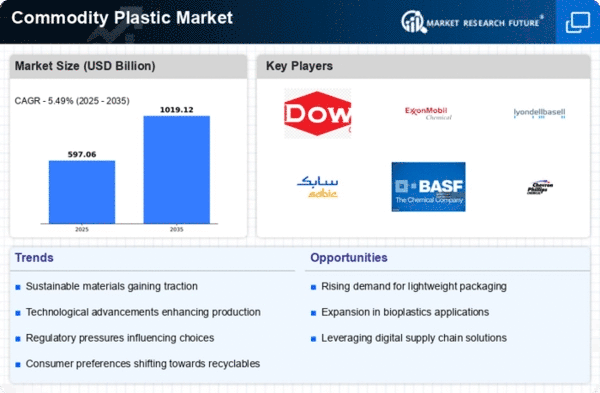
As per MRFR analysis, the Commodity Plastic Market Size was estimated at 565.99 USD Billion in 2024. The Commodity Plastic industry is projected to grow from 597.07 USD Billion in 2025 to 1019.12 USD Billion by 2035, exhibiting a compound annual growth rate (CAGR) of 5.49 during the forecast period 2025 - 2035.

Key Market Trends & Highlights

The Commodity Plastic Market is currently experiencing a dynamic shift towards sustainability and innovation.

  • North America remains the largest market for commodity plastics, driven by robust demand across various sectors.
  • Asia-Pacific is emerging as the fastest-growing region, fueled by rapid industrialization and urbanization.
  • The packaging segment continues to dominate the market, while the automotive segment is witnessing the fastest growth due to technological advancements.
  • Rising demand for packaging solutions and evolving consumer preferences towards sustainable products are key drivers shaping the market.

Market Size & Forecast

2024 Market Size 565.99 (USD Billion)
2035 Market Size 1019.12 (USD Billion)
CAGR (2025 - 2035) 5.49%
Largest Regional Market Share in 2024 Asia-Pacific

Major Players

<p>Dow Chemical Company (US), ExxonMobil Chemical Company (US), LyondellBasell Industries N.V. (NL), SABIC (SA), BASF SE (DE), Chevron Phillips Chemical Company (US), Ineos Group Limited (GB), Mitsubishi Chemical Corporation (JP), Formosa Plastics Corporation (TW)</p>

Market Trends

The Commodity Plastic Market is currently experiencing a dynamic phase characterized by evolving consumer preferences and increasing regulatory pressures. As sustainability becomes a focal point for industries worldwide, there is a noticeable shift towards eco-friendly alternatives and recycling initiatives. This transition appears to be driven by heightened awareness of environmental issues, prompting manufacturers to innovate and adapt their product lines. Consequently, the demand for biodegradable and recyclable plastics is on the rise, suggesting a potential transformation in production methodologies and supply chain practices. Moreover, the Commodity Plastic Market is witnessing advancements in technology that enhance production efficiency and reduce waste. Innovations in polymer science and processing techniques may lead to the development of new materials that offer improved performance while minimizing environmental impact. This trend indicates a growing emphasis on circular economy principles, where the lifecycle of plastic products is extended through reuse and recycling. As the market evolves, stakeholders must navigate these changes to remain competitive and responsive to consumer demands, which could redefine the landscape of the Commodity Plastic Market in the coming years.

Sustainability Initiatives

The Commodity Plastic Market is increasingly influenced by sustainability initiatives, as companies strive to reduce their environmental footprint. This trend encompasses the development of biodegradable plastics and the implementation of recycling programs, reflecting a broader commitment to eco-friendly practices.

Technological Advancements

Technological advancements are reshaping the Commodity Plastic Market, with innovations in polymer processing and material science. These developments may lead to enhanced production efficiency and the creation of high-performance materials that align with sustainability goals.

Regulatory Changes

Regulatory changes are playing a crucial role in the Commodity Plastic Market, as governments worldwide impose stricter guidelines on plastic usage and waste management. This trend compels manufacturers to adapt their practices, potentially accelerating the shift towards sustainable alternatives.

Commodity Plastic Market Market Drivers

Rising Demand for Sustainable Packaging

The Global Commodity Plastic Market Industry experiences a notable surge in demand for sustainable packaging solutions. As consumers increasingly prioritize eco-friendly products, companies are adapting their packaging strategies to incorporate biodegradable and recyclable materials. This shift not only aligns with environmental goals but also meets regulatory pressures for reduced plastic waste. For instance, major brands are committing to using recycled plastics, which could potentially drive the market's value to 566.0 USD Billion in 2024. This trend reflects a broader movement towards sustainability, indicating that the industry is evolving to meet both consumer preferences and legislative requirements.

Market Segment Insights

By Application: Packaging (Largest) vs. Automotive (Fastest-Growing)

<p>The Commodity Plastic Market is significantly influenced by the application segments, with packaging being the largest, dominating market share due to its extensive use in food and beverage industries. Automotive follows, benefitting from increased lightweight materials adoption and design innovation. Consumer goods, construction, and electronics also hold notable shares, catering to products across various sectors but lagging behind packaging in overall demand.</p>

<p>Consumer Goods (Dominant) vs. Construction (Emerging)</p>

<p>In the Commodity Plastic Market, the consumer goods sector stands out as a dominant force, leveraging innovation in product design and marketing to meet modern consumer needs. It encompasses various items from kitchenware to personal care products, driving consistent demand for versatile plastics. In contrast, the construction sector is emerging with an increasing adoption of plastics in building materials for energy efficiency and sustainability. This growth is supported by technological advancements that enhance the durability and functionality of construction materials, positioning it as a key area for future development.</p>

By End Use: Food and Beverage (Largest) vs. Healthcare (Fastest-Growing)

<p>The Commodity Plastic Market exhibits a diverse distribution of market share across different end-use segments. The Food and Beverage sector holds the largest share, driven by the high demand for food packaging and containers that offer durability and convenience. Following closely is the Healthcare segment, which, although smaller, significantly contributes to the overall market with its specific requirements for medical applications. Other segments such as Household Products, Industrial, and Agriculture also play essential roles in the market but do not match the dominance of the top two sectors.</p>

<p>Food and Beverage (Dominant) vs. Healthcare (Emerging)</p>

<p>The Food and Beverage segment remains the dominant force within the Commodity Plastic Market, primarily due to the persistent demand for efficient and safe packaging solutions. This segment benefits from innovations in sustainable materials and the rising trend of ready-to-eat food products. In contrast, the Healthcare segment, although emerging, is rapidly gaining traction driven by the growth in biopharmaceuticals and medical devices that utilize advanced plastic materials for safety and hygiene. Both sectors illustrate the versatility of commodity plastics; however, as healthcare regulations tighten, the demand for specialty plastic applications in healthcare is poised for significant growth, offering opportunities for specialization within the industry.</p>

By Material Type: Polyethylene (Largest) vs. Polypropylene (Fastest-Growing)

<p>In the Commodity Plastic Market, Polyethylene dominates, holding the largest market share among material types. Its versatility and widespread usage in packaging, containers, and consumer goods contribute significantly to its leading position. Following closely, Polypropylene is making notable strides, capitalizing on its superior thermal resistance and flexibility, which makes it increasingly popular in automotive and textile applications.</p>

<p>Polyethylene (Dominant) vs. Polypropylene (Emerging)</p>

<p>Polyethylene is characterized by its unmatched versatility and robust application spectrum, including films, bags, and containers. It serves an essential role in the packaging industry due to its durability and moisture barrier properties. Conversely, Polypropylene, often regarded as the emerging force in the Commodity Plastic Market, offers excellent chemical resistance and heat tolerance, making it a preferred choice in industries such as automotive, healthcare, and consumer goods. Given its expanding usage in sustainable products, Polypropylene continues to carve out a significant niche, positioning itself as a formidable competitor.</p>

By Processing Technique: Injection Molding (Largest) vs. Blow Molding (Fastest-Growing)

<p>In the Commodity Plastic Market, Injection Molding stands as the dominant processing technique, commanding a significant share of the market. This technique is widely favored for its efficiency and versatility in producing complex shapes and high-volume production runs. On the other hand, Blow Molding is emerging rapidly, particularly driven by the demand for lightweight, durable plastic containers. Its ability to create hollow parts at high production rates has made it a go-to choice for various applications, including packaging industries.</p>

<p>Injection Molding (Dominant) vs. Extrusion (Emerging)</p>

<p>Injection Molding is recognized as the dominant force in the Commodity Plastic Market, offering unparalleled precision and adaptability in manufacturing processes. Its capability to handle complex geometries and varying material types makes it ideal for automotive, consumer goods, and electronic components. In contrast, Extrusion is an emerging technique characterized by its capacity to produce continuous shapes and profiles. This method is particularly advantageous for creating products in large volumes, such as pipes and sheets, and is seeing increased adoption due to innovations in material quality and processing speeds that cater to diverse market needs.</p>

Get more detailed insights about Commodity Plastic Market Research Report - Global Forecast till 2035

Regional Insights

North America : Innovation and Sustainability Focus

The North American commodity plastic market, valued at $120.0 billion, is driven by innovation and sustainability initiatives. Regulatory frameworks are increasingly favoring eco-friendly materials, pushing manufacturers to adopt greener practices. The demand for lightweight and durable plastics in automotive and packaging sectors is also on the rise, contributing to market growth. As companies pivot towards sustainable solutions, the market is expected to see significant advancements in recycling technologies and bioplastics. Leading the market are the US and Canada, with major players like Dow Chemical Company and ExxonMobil Chemical Company dominating the landscape. The competitive environment is characterized by strategic partnerships and investments in R&D to enhance product offerings. The presence of established firms ensures a robust supply chain, while emerging startups are introducing innovative solutions, further enriching the market dynamics.

Europe : Regulatory Compliance and Innovation

Europe's commodity plastic market, valued at €150.0 billion, is significantly influenced by stringent regulations aimed at reducing plastic waste. The European Union's directives on single-use plastics and recycling targets are driving innovation in sustainable materials. This regulatory landscape is fostering a shift towards biodegradable and recyclable plastics, aligning with consumer demand for environmentally friendly products. The market is expected to grow as companies adapt to these regulations and invest in sustainable practices. Germany, France, and the UK are leading the market, with key players like BASF SE and LyondellBasell Industries N.V. at the forefront. The competitive landscape is marked by collaborations between industry leaders and research institutions to develop advanced materials. The presence of a well-established manufacturing base and a strong focus on sustainability positions Europe as a leader in The Commodity Plastic.

Asia-Pacific : Emerging Powerhouse in Plastics

The Asia-Pacific region, with a market size of $250.0 billion, is the largest player in the commodity plastic market, driven by rapid industrialization and urbanization. Countries like China and India are experiencing significant demand for plastics in packaging, automotive, and construction sectors. The region's growth is further supported by favorable government policies and investments in infrastructure, which are enhancing production capabilities and supply chain efficiencies. China stands out as a dominant force, hosting major players like Sinopec and Formosa Plastics Corporation. The competitive landscape is characterized by a mix of local and international companies, all vying for market share. As the region continues to expand, innovations in production processes and materials are expected to play a crucial role in meeting the growing demand for commodity plastics.

Middle East and Africa : Resource-Rich Frontier

The Middle East and Africa (MEA) commodity plastic market, valued at $45.99 billion, is poised for growth, driven by abundant natural resources and increasing industrial activities. The region is witnessing a surge in demand for plastics in construction, packaging, and consumer goods, fueled by population growth and urbanization. Governments are also investing in petrochemical industries, which is expected to enhance production capacities and attract foreign investments. Leading countries in the MEA region include Saudi Arabia and South Africa, where companies like SABIC and Ineos Group Limited are key players. The competitive landscape is evolving, with local firms expanding their operations and international companies entering the market. As the region capitalizes on its resource wealth, the commodity plastic market is set to experience significant growth in the coming years.

Key Players and Competitive Insights

The Commodity Plastic Market is currently characterized by a dynamic competitive landscape, driven by factors such as increasing demand for sustainable materials, technological advancements, and the ongoing shift towards circular economy practices. Major players like Dow Chemical Company (US), ExxonMobil Chemical Company (US), and SABIC (SA) are strategically positioning themselves through innovation and partnerships, which collectively shape the competitive environment. These companies are not only focusing on enhancing their product portfolios but are also investing in sustainable practices to meet evolving consumer preferences and regulatory requirements.

Key business tactics employed by these companies include localizing manufacturing and optimizing supply chains to enhance efficiency and reduce costs. The market appears moderately fragmented, with a mix of large multinational corporations and smaller regional players. The collective influence of key players is significant, as they leverage their scale and resources to drive innovation and maintain competitive advantages.

In November 2025, Dow Chemical Company (US) announced a partnership with a leading technology firm to develop advanced recycling technologies aimed at increasing the recyclability of its plastic products. This strategic move is likely to enhance Dow's sustainability credentials and align with global efforts to reduce plastic waste, thereby positioning the company favorably in a market increasingly focused on environmental responsibility.

In October 2025, ExxonMobil Chemical Company (US) unveiled a new line of bio-based plastics derived from renewable feedstocks. This initiative not only diversifies ExxonMobil's product offerings but also reflects a growing trend towards sustainable materials in the industry. The introduction of bio-based options may attract environmentally conscious consumers and businesses, potentially increasing market share in a competitive landscape.

In September 2025, SABIC (SA) launched a new initiative aimed at enhancing the circularity of its plastic products through innovative design and material recovery processes. This initiative underscores SABIC's commitment to sustainability and positions the company as a leader in the transition towards a circular economy. By focusing on product lifecycle management, SABIC is likely to strengthen its competitive edge in a market that increasingly values sustainability.

As of December 2025, current competitive trends in the Commodity Plastic Market are heavily influenced by digitalization, sustainability, and the integration of AI technologies. Strategic alliances are becoming more prevalent, as companies seek to enhance their capabilities and market reach. The competitive differentiation is expected to evolve from traditional price-based competition towards a focus on innovation, technology, and supply chain reliability, reflecting a broader industry shift towards sustainable practices and advanced manufacturing techniques.

Key Companies in the Commodity Plastic Market include

Industry Developments

  • Q2 2024: LyondellBasell and Genox Recycling Announce Joint Venture to Build Mechanical Plastics Recycling Facility in China LyondellBasell announced a joint venture with Genox Recycling to establish a new mechanical plastics recycling facility in Zhaoqing, Guangdong Province, China, aiming to expand circular economy capabilities in Asia.[4]

Future Outlook

Commodity Plastic Market Future Outlook

<p>The Commodity Plastic Market is projected to grow at a 5.49% CAGR from 2024 to 2035, driven by increasing demand for sustainable materials and technological advancements.</p>

New opportunities lie in:

  • <p>Expansion into biodegradable plastic production lines</p>
  • <p>Investment in recycling technology for post-consumer plastics</p>
  • <p>Development of smart packaging solutions integrating IoT capabilities</p>

<p>By 2035, the Commodity Plastic Market is expected to achieve robust growth, driven by innovation and sustainability initiatives.</p>

Market Segmentation

Commodity Plastic Market End Use Outlook

  • Food and Beverage
  • Healthcare
  • Household Products
  • Industrial
  • Agriculture

Commodity Plastic Market Application Outlook

  • Packaging
  • Automotive
  • Consumer Goods
  • Construction
  • Electronics

Commodity Plastic Market Material Type Outlook

  • Polyethylene
  • Polypropylene
  • Polyvinyl Chloride
  • Polystyrene
  • Polyethylene Terephthalate

Commodity Plastic Market Processing Technique Outlook

  • Injection Molding
  • Blow Molding
  • Extrusion
  • Thermoforming
  • Rotational Molding

Report Scope

MARKET SIZE 2024565.99(USD Billion)
MARKET SIZE 2025597.07(USD Billion)
MARKET SIZE 20351019.12(USD Billion)
COMPOUND ANNUAL GROWTH RATE (CAGR)5.49% (2024 - 2035)
REPORT COVERAGERevenue Forecast, Competitive Landscape, Growth Factors, and Trends
BASE YEAR2024
Market Forecast Period2025 - 2035
Historical Data2019 - 2024
Market Forecast UnitsUSD Billion
Key Companies ProfiledDow Chemical Company (US), ExxonMobil Chemical Company (US), LyondellBasell Industries N.V. (NL), SABIC (SA), BASF SE (DE), Chevron Phillips Chemical Company (US), Ineos Group Limited (GB), Mitsubishi Chemical Corporation (JP), Formosa Plastics Corporation (TW)
Segments CoveredApplication, End Use, Material Type, Processing Technique
Key Market OpportunitiesAdoption of biodegradable alternatives drives innovation in the Commodity Plastic Market.
Key Market DynamicsRising demand for sustainable alternatives drives innovation and competition in the Commodity Plastic Market.
Countries CoveredNorth America, Europe, APAC, South America, MEA

FAQs

How much is the Commodity Plastic market?

Commodity Plastic Market was valued at USD 565.99 Billion in 2024

What is the growth rate of the Commodity Plastic market?

Commodity Plastic Market is projected to grow at a CAGR of 5.49% during the forecast period, 2025-2035

Which Region holds the largest market share in the Commodity Plastic market?

North America holds the largest share of the Commodity Plastic market.

Who are the key players in the Commodity Plastic market?

The key players in the Commodity Plastic market are Westlake Chemical, Exxon Mobil, Qatar Petroleum, LG Chem, Qenos Pty, The Dow Chemical Company, Nova Chemicals, SABIC, Hanwha Chemical, LyondellBasell, Reliance Industries, Sinopec, and Chevron Phillips Chemical.

Which Type led the Commodity Plastic market?

Polyethylene Terephthalate dominated the Commodity Plastic market in 2024.

Which Application holds the largest market share in the Commodity Plastic market?

Packaging had the largest share of the Commodity Plastic market.

  1. SECTION I: EXECUTIVE SUMMARY AND KEY HIGHLIGHTS
    1. | 1.1 EXECUTIVE SUMMARY
  2. SECTION II: SCOPING, METHODOLOGY AND MARKET STRUCTURE
    1. | 2.1 MARKET INTRODUCTION
    2. | 2.2 RESEARCH METHODOLOGY
  3. SECTION III: QUALITATIVE ANALYSIS
    1. | 3.1 MARKET DYNAMICS
    2. | 3.2 MARKET FACTOR ANALYSIS
  4. SECTION IV: QUANTITATIVE ANALYSIS
    1. | 4.1 Chemicals and Materials, BY Application (USD Billion)
    2. | 4.2 Chemicals and Materials, BY End Use (USD Billion)
    3. | 4.3 Chemicals and Materials, BY Material Type (USD Billion)
    4. | 4.4 Chemicals and Materials, BY Processing Technique (USD Billion)
    5. | 4.5 Chemicals and Materials, BY Region (USD Billion)
  5. SECTION V: COMPETITIVE ANALYSIS
    1. | 5.1 Competitive Landscape
    2. | 5.2 Company Profiles
    3. | 5.3 Appendix

Commodity Plastic Market Segmentation

Market Segmentation Overview

  • Detailed segmentation data will be available in the full report
  • Comprehensive analysis by multiple parameters
  • Regional and country-level breakdowns
  • Market size forecasts by segment
Infographic

Free Sample Request

Kindly complete the form below to receive a free sample of this Report

Get Free Sample

Customer Strories

Compare Licence

×
Features License Type
Single User Multiuser License Enterprise User
Price $4,950 $5,950 $7,250
Maximum User Access Limit 1 User Upto 10 Users Unrestricted Access Throughout the Organization
Free Customization
Direct Access to Analyst
Deliverable Format
Platform Access
Discount on Next Purchase 10% 15% 15%
Printable Versions