×
Request Free Sample ×

Kindly complete the form below to receive a free sample of this Report

* Please use a valid business email

Leading companies partner with us for data-driven Insights

clients tt-cursor
Hero Background
English
Chinese
French
Japanese
Korean
German
Spanish

Ceramic Ball Market Trends

ID: MRFR/CnM/6997-HCR
111 Pages
Anshula Mandaokar
October 2025

Ceramic Ball Market Research Report Information: By Material Type (Alumina Oxide, Zirconia, Ruby Sapphire, Silicon Nitride, Others), By Application (Bearings, Valves, Ball Screws, Grinding, Chemical Pumps, Flowmeter, Others) and By End-Use (Aerospace, Automotive, Chemical, Others) - Forecast to 2035

Share:
Download PDF ×

We do not share your information with anyone. However, we may send you emails based on your report interest from time to time. You may contact us at any time to opt-out.

Ceramic Ball Market Infographic
×
Ceramic Ball Market Infographic Full View
Purchase Options

Market Trends

Key Emerging Trends in the Ceramic Ball Market

The ceramic ball market is undergoing significant trends that shape its dynamics in various industries. Ceramic balls, known for their high resistance to wear and corrosion, find applications in diverse fields, including bearings, valves, and grinding media. One prominent trend is the increasing demand for ceramic balls in the automotive and aerospace industries. As these sectors emphasize efficiency, reduced friction, and extended component lifespan, the superior properties of ceramic balls make them an attractive choice for use in bearings and other critical components, contributing to enhanced performance and reliability.

Moreover, the market is experiencing a surge in demand for ceramic balls in the medical and healthcare sector. The inert and biocompatible nature of ceramic materials makes them suitable for medical applications, including prosthetics, joint replacements, and dental implants. As the aging population grows and the demand for advanced medical devices increases, ceramic balls play a crucial role in providing durable and biocompatible solutions. This trend is likely to continue as medical technology advances and the need for long-lasting and reliable implants rises.

Additionally, there is a growing emphasis on sustainability and environmental responsibility in the ceramic ball market. Manufacturers are exploring eco-friendly production processes and materials to minimize the environmental impact of ceramic ball production. This trend aligns with the global push towards sustainable practices and the reduction of carbon footprints. Companies are investing in research and development to discover innovative methods that reduce energy consumption, waste generation, and the use of hazardous substances in the manufacturing of ceramic balls.

Furthermore, the market is witnessing a shift towards the use of ceramic balls in chemical processing and grinding applications. The chemical resistance and hardness of ceramic balls make them ideal for use in grinding and milling processes, where they can withstand harsh chemicals and high temperatures. The expanding chemical industry, driven by increased manufacturing activities, contributes to the growing demand for ceramic balls in processes such as catalysis and material dispersion.

The advent of advanced technologies is also influencing the ceramic ball market. The incorporation of precision engineering and ceramic nanotechnology in the manufacturing process results in ceramic balls with enhanced properties, such as increased hardness, improved surface finish, and better dimensional accuracy. These advancements contribute to the overall performance of ceramic balls in critical applications, making them more attractive to industries seeking high-performance materials.

Despite these positive trends, challenges exist within the ceramic ball market. The high cost of ceramic balls compared to conventional steel balls can be a limiting factor, especially in cost-sensitive industries. Additionally, issues related to the brittleness of ceramics may arise in certain applications, requiring careful consideration and engineering solutions to prevent breakage and ensure optimal performance.
Author
Anshula Mandaokar
Team Lead - Research

Anshula Mandaokar holds an academic degree in Chemical Engineering and has been contributing to the field for more than 5 years. She has expertise in Market Research and Business Consulting and serves as a Team Lead for a reputed Market Research firm under the Chemicals and Materials domain spectrum. She has worked on multiple projects, generating explicit results in a quick turnaround time. Her understanding of data interpretation justifies her role as a leader.

Leave a Comment

FAQs

What is the valuation of the market?

The global ceramic ball market is expected to reach USD 786.3 million by 2025.

What is the CAGR of the market?

The market is expected to exhibit a strong 9.32% CAGR over the forecast period from 2019 to 2025.

What is the major driver for the market?

Growing adoption of ceramic balls in automotive and aircraft manufacturing is the major driver for the ceramic ball market.

Which is the leading regional market?

Asia Pacific holds the largest share in the global ceramic ball market.

What are the leading market players?

Leading players in the ceramic ball market include Industrial Tectonics, Axens, and Honeywell International, among others.

Market Summary

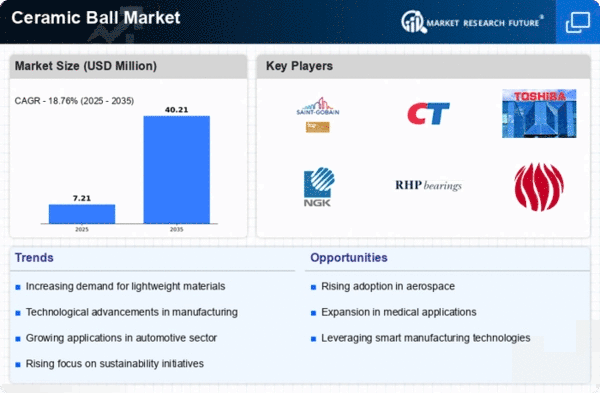
As per MRFR analysis, the Ceramic Ball Market Size was estimated at 6.07 USD Million in 2024. The Ceramic Ball industry is projected to grow from 7.21 in 2025 to 40.21 by 2035, exhibiting a compound annual growth rate (CAGR) of 18.76 during the forecast period 2025 - 2035.

Key Market Trends & Highlights

The Ceramic Ball Market is poised for growth driven by technological advancements and increasing demand across various sectors.

  • North America remains the largest market for ceramic balls, driven by robust industrial applications. Asia-Pacific is emerging as the fastest-growing region, fueled by rapid industrialization and technological adoption. The aerospace segment dominates the market, while the electronics segment is witnessing the fastest growth due to innovation. Key market drivers include rising demand in the automotive sector and a growing focus on energy efficiency.

Market Size & Forecast

2024 Market Size 6.07 (USD Million)
2035 Market Size 40.21 (USD Million)
CAGR (2025 - 2035) 18.76%
Largest Regional Market Share in 2024 Asia-Pacific

Major Players

<p>Saint-Gobain (FR), CeramTec (DE), Toshiba Materials (JP), NGK Insulators (JP), RHP Bearings (GB), Zircar Ceramics (US), Spheric Trafalgar (CA), Lily Ceramics (CN), Honsin Ceramics (CN)</p>

Market Trends

The Ceramic Ball Market is currently experiencing a notable transformation, driven by advancements in technology and increasing demand across various industries. The versatility of ceramic balls, which are utilized in applications ranging from aerospace to automotive, suggests a broadening scope of usage. As industries seek materials that offer durability and resistance to wear, the appeal of ceramic balls appears to be on the rise. Furthermore, the growing emphasis on sustainability and eco-friendly materials may also influence the market dynamics, as manufacturers explore innovative solutions to meet environmental standards. In addition, the Ceramic Ball Market seems to be benefiting from the expansion of manufacturing capabilities and the globalization of supply chains. This interconnectedness allows for enhanced distribution and accessibility of ceramic balls, potentially leading to increased competition among suppliers. As companies strive to differentiate their products, there is a likelihood of innovation in design and functionality. Overall, the current landscape of the Ceramic Ball Market indicates a period of growth and adaptation, with various factors contributing to its evolution.

Technological Advancements

Recent innovations in production techniques are enhancing the performance characteristics of ceramic balls. These advancements may lead to improved durability and efficiency, making ceramic balls more appealing to manufacturers.

Sustainability Focus

The increasing emphasis on environmentally friendly materials is prompting manufacturers to explore sustainable alternatives in the Ceramic Ball Market. This trend could reshape product offerings and influence consumer preferences.

Global Supply Chain Integration

The integration of global supply chains is facilitating the distribution of ceramic balls across diverse markets. This interconnectedness may enhance competition and drive innovation among suppliers.

Ceramic Ball Market Market Drivers

Market Growth Projections

The Global Ceramic Ball Market Industry is poised for substantial growth, with projections indicating a market value of 2500 USD Million in 2024 and an anticipated increase to 4500 USD Million by 2035. This growth trajectory suggests a compound annual growth rate of 5.49% from 2025 to 2035, driven by rising demand across various sectors, including aerospace, automotive, and industrial applications. The increasing adoption of advanced materials and technologies is likely to further enhance the market's potential, positioning ceramic balls as a critical component in modern manufacturing and engineering.

Rising Demand in Aerospace Sector

The Global Ceramic Ball Market Industry is experiencing heightened demand from the aerospace sector, where ceramic balls are utilized for their lightweight and high-strength properties. The aerospace industry is increasingly adopting advanced materials to enhance fuel efficiency and performance. For instance, ceramic balls are employed in bearings and other critical components, contributing to reduced weight and improved durability. This trend is expected to drive the market's growth, with projections indicating a market value of 2500 USD Million in 2024, potentially reaching 4500 USD Million by 2035.

Expansion of Industrial Applications

The expansion of industrial applications is a notable driver for the Global Ceramic Ball Market Industry. Industries such as oil and gas, mining, and manufacturing are increasingly utilizing ceramic balls for their durability and performance under extreme conditions. For instance, ceramic balls are employed in pumps and valves, where their resistance to wear and chemical corrosion is critical. This diversification of applications is likely to contribute to the market's growth, with expectations of a compound annual growth rate of 5.49% from 2025 to 2035, reflecting the increasing reliance on ceramic materials in various industrial sectors.

Increasing Focus on Energy Efficiency

There is a growing emphasis on energy efficiency across multiple sectors, which is positively influencing the Global Ceramic Ball Market Industry. Ceramic balls, known for their low friction properties, are increasingly being used in applications that require energy-efficient solutions. For example, in industrial machinery and equipment, the use of ceramic balls can lead to significant energy savings and reduced operational costs. This trend aligns with global sustainability goals, potentially propelling the market towards a valuation of 4500 USD Million by 2035, as industries seek to adopt more sustainable practices.

Growing Applications in Automotive Industry

The automotive industry is a major driver of the Global Ceramic Ball Market Industry, as manufacturers increasingly incorporate ceramic balls into various components to enhance performance and longevity. Ceramic balls are utilized in applications such as bearings, valve seats, and fuel injectors, where their resistance to wear and corrosion is advantageous. The shift towards electric vehicles is also contributing to this trend, as these vehicles require high-performance materials to optimize efficiency. This growing demand is expected to support the market's expansion, with a projected value of 2500 USD Million in 2024.

Technological Advancements in Manufacturing

Technological innovations in the manufacturing processes of ceramic balls are significantly impacting the Global Ceramic Ball Market Industry. Advanced techniques such as additive manufacturing and precision machining are enhancing the quality and performance of ceramic balls. These advancements allow for the production of more complex geometries and improved surface finishes, which are crucial for applications in various industries, including automotive and electronics. As a result, the market is likely to witness a compound annual growth rate of 5.49% from 2025 to 2035, reflecting the increasing adoption of high-performance ceramic balls.

Market Segment Insights

By Application: Aerospace (Largest) vs. Electronics (Fastest-Growing)

<p>In the Ceramic Ball Market, the application segment is characterized by diverse values including Aerospace, Automotive, Industrial, Medical, and Electronics. The Aerospace sector holds the largest market share, driven by the increasing demand for lightweight and durable materials in aircraft component manufacturing. In contrast, the Electronics sector, while currently smaller, is witnessing rapid growth due to the proliferation of electronic devices and the need for advanced ceramic balls in semiconductor applications. Growth trends within the Ceramic Ball Market are significantly influenced by technological advancements and evolving industry requirements. The Aerospace industry remains on a steady trajectory, bolstered by new aircraft designs and higher efficiency standards. Meanwhile, the Electronics segment is projected to grow the fastest, spurred by innovations in consumer electronics and the rise of IoT devices, prompting manufacturers to invest in higher-quality ceramic components for improved performance and reliability.</p>

<p>Aerospace: Dominant vs. Electronics: Emerging</p>

<p>Aerospace is a dominant player in the Ceramic Ball Market, benefiting from stringent performance and safety standards that necessitate the use of high-quality ceramic materials. This sector is characterized by a mature supply chain and established relationships between manufacturers and aerospace companies, enabling consistent demand for ceramic balls in essential applications like turbines and structural components. On the other hand, the Electronics segment is emerging rapidly, spurred by the increasing integration of ceramic balls in advanced electronic devices such as smartphones, computers, and automotive electronics. This segment is characterized by a fast-paced innovation cycle, with manufacturers constantly exploring new ceramics and designs to enhance energy efficiency and miniaturization, marking it as a focal point for future market growth.</p>

By End Use: Ball Bearings (Largest) vs. Valves (Fastest-Growing)

<p>The ceramic ball market has seen a diverse distribution among its end-use segments, with ball bearings commanding the largest share. This predominance can be attributed to their extensive application in various industries, including automotive and aerospace, where durability and performance are paramount. Valves, while currently a smaller segment, are poised for rapid growth as industries invest more in energy-efficient and sustainable technologies that require innovative valve solutions. The growth trends within the ceramic ball market show a clear trajectory towards advancements in material technology, propelling both ball bearings and valves. Demand for lightweight and high-strength components is a key driver in the automotive and industrial sectors, enhancing the adoption of ceramic balls. Additionally, as industries pursue more robust and longer-lasting materials, the valves segment is likely to accelerate due to increasing investments in infrastructure and upgrading existing systems to improve efficiency and reduce maintenance costs.</p>

<p>Ball Bearings (Dominant) vs. Valves (Emerging)</p>

<p>Ball bearings are the dominant force within the ceramic ball market, utilized extensively across various sectors for their superior load-bearing capabilities and resistance to wear. Their ability to enhance performance and reduce friction in mechanical applications positions them as a preferred choice in industries such as automotive and aerospace. Conversely, valves represent an emerging segment, driven by innovations in design that cater to the growing demand for efficient fluid control systems. This market dynamic allows ceramic valves to outperform traditional materials, particularly in applications requiring corrosion resistance and longevity. As technological advancements continue, we can expect ceramic valves to gain traction, particularly in environmentally conscious operations that prioritize sustainability and performance.</p>

By Material Type: Alumina (Largest) vs. Zirconia (Fastest-Growing)

<p>In the Ceramic Ball Market, the segmentation by material type reveals that Alumina holds the largest share, driven by its widespread applications in various industries such as aerospace, automotive, and manufacturing. Zirconia follows closely behind as the fastest-growing material, appealing primarily due to its exceptional strength and thermal stability, making it highly sought after in high-performance applications.</p>

<p>Alumina (Dominant) vs. Zirconia (Emerging)</p>

<p>Alumina ceramic balls are the dominant material in the market due to their excellent wear resistance and high mechanical strength, making them suitable for applications in grinding, milling, and other demanding environments. Although Alumina remains a favorite, Zirconia is emerging rapidly, known for its superior toughness and ability to withstand high temperatures. This combination of properties allows Zirconia to be increasingly used in high-stress applications, thus carving out a significant niche in the market. As industries look towards more robust and durable materials, Zirconia's growth trajectory is supported by ongoing advancements in production processes and material science.</p>

By Size: Medium (Largest) vs. Custom (Fastest-Growing)

<p>In the Ceramic Ball Market, the size segment shows a diverse distribution among its categories, namely small, medium, large, and custom. The medium size ceramic balls hold the largest market share, favored by manufacturers for a range of applications, including industrial and commercial purposes. In contrast, the small and large sizes cater to specific niche markets, with small ceramic balls preferred for precision tasks and large ones used in heavy-duty applications. Custom size balls are increasingly finding their way into the market, tailored to meet specific demands of clients, thereby expanding their influence in the segment.</p>

<p>Medium (Dominant) vs. Custom (Emerging)</p>

<p>The medium size ceramic balls are recognized as the dominant choice in the market due to their optimal dimensions that cater to a wide variety of applications. They strike a balance between performance and versatility, making them ideal for industries such as automotive and electronics. On the other hand, custom-sized ceramic balls have emerged as a significant trend, addressing specialized applications that standard sizes cannot fulfill. This customization allows manufacturers to provide tailored solutions that meet unique operational requirements, thereby positioning them as an increasingly important player in the ceramic ball market.</p>

By Coating Type: Coated (Largest) vs. Thermal Barrier Coating (Fastest-Growing)

<p>The Ceramic Ball Market showcases a marked divide among its coating types, with the Coated ceramic balls holding the largest share. This segment's popularity is largely fueled by their enhanced properties, making them ideal for various applications. In contrast, <a href="https://www.marketresearchfuture.com/reports/thermal-barrier-coatings-market-4980">Thermal Barrier Coating</a> is rapidly gaining traction, recognized for its ability to extend the lifespan and improve the performance of ceramic balls under extreme conditions. As industries innovate, the demand for these specialized coatings is projected to rise, shaping the market dynamics significantly. Growth within the Ceramic Ball Market is currently being driven by technological advancements and an increasing need for higher performance materials. The Coated segment remains favored for its established robustness, while the Thermal Barrier Coating segment is projected to experience the fastest growth due to escalating demand in high-temperature applications. Trends indicate that manufacturers are increasingly investing in these coatings to meet diverse industry requirements, particularly in aerospace and automotive sectors.</p>

<p>Coated (Dominant) vs. Thermal Barrier Coating (Emerging)</p>

<p>In the Ceramic Ball Market, Coated ceramic balls stand as the dominant player due to their extensive application range and superior attributes. These coatings provide enhanced wear resistance and improved thermal stability, making them crucial in industrial settings. Conversely, the Thermal Barrier Coating segment is emerging as a vital solution, particularly in high-heat applications. This coating type is characterized by its ability to safeguard the underlying structure from heat damage, thus extending functional longevity. As industries increasingly pursue efficiency and durability in their processes, the demand for both Coated and Thermal Barrier Coating ceramic balls is set to expand, though the latter is likely to define future market trends.</p>

Get more detailed insights about Ceramic Ball Market Research Report - Global Forecast till 2035

Regional Insights

North America : Stable Growth Environment

The North American ceramic ball market is projected to reach $1.52 billion by 2025, driven by increasing demand in aerospace, automotive, and industrial applications. Regulatory support for advanced materials and sustainability initiatives is fostering innovation in the sector. The region's focus on high-performance materials is expected to enhance market growth, with a notable shift towards lightweight and durable ceramic solutions. Leading countries such as the US and Canada are home to key players like Zircar Ceramics and Spheric Trafalgar. The competitive landscape is characterized by a mix of established firms and emerging players, all vying for market share. The presence of advanced manufacturing capabilities and R&D facilities further strengthens the region's position in The Ceramic Ball. Companies are investing in technology to enhance product performance and meet evolving customer needs.

Europe : Innovation and Sustainability Focus

Europe's ceramic ball market is valued at $1.21 billion, with growth driven by stringent regulations on material performance and environmental sustainability. The region is witnessing a shift towards advanced ceramic materials, particularly in the automotive and energy sectors. Regulatory frameworks are encouraging the adoption of innovative solutions, enhancing the market's appeal to manufacturers and end-users alike. Germany, France, and the UK are leading countries in this market, with key players like CeramTec and RHP Bearings. The competitive landscape is robust, with a mix of local and international firms. Companies are focusing on R&D to develop high-performance ceramic balls that meet regulatory standards and customer expectations. The emphasis on sustainability is also shaping product development, making Europe a leader in eco-friendly ceramic solutions.

Asia-Pacific : Dominant Market Leader

The Asia-Pacific region dominates the ceramic ball market with a substantial share of $3.0 billion, driven by rapid industrialization and increasing demand from sectors like electronics and automotive. Countries such as China and Japan are leading this growth, supported by favorable government policies and investments in manufacturing capabilities. The region's focus on technological advancements is also propelling market expansion, with a growing emphasis on high-performance materials. China is a key player, with companies like Lily Ceramics and Honsin Ceramics leading the charge. The competitive landscape is marked by a mix of domestic and international firms, all striving to capture market share. The presence of a robust supply chain and skilled workforce further enhances the region's competitive edge. As demand continues to rise, the Asia-Pacific market is expected to maintain its leadership position in the global ceramic ball industry.

Middle East and Africa : Emerging Market Potential

The Middle East and Africa ceramic ball market is valued at $0.34 billion, with growth potential driven by increasing industrial activities and infrastructure development. The region is witnessing a gradual shift towards advanced materials, supported by government initiatives aimed at diversifying economies. The demand for ceramic balls in sectors like oil and gas, as well as construction, is expected to rise, providing new opportunities for market players. Countries such as South Africa and the UAE are emerging as key markets, with a growing presence of local and international manufacturers. The competitive landscape is evolving, with companies focusing on establishing production facilities to cater to regional demand. As the market matures, the emphasis on quality and performance will become crucial for success in this developing region.

Key Players and Competitive Insights

The Ceramic Ball Market is currently characterized by a dynamic competitive landscape, driven by technological advancements and increasing demand across various industries, including automotive, aerospace, and electronics. Key players such as Saint-Gobain (FR), CeramTec (DE), and Toshiba Materials (JP) are strategically positioning themselves through innovation and regional expansion. For instance, Saint-Gobain (FR) has focused on enhancing its product portfolio by investing in R&D to develop high-performance ceramic balls that cater to specific industrial applications. This emphasis on innovation not only strengthens their market presence but also fosters competitive differentiation in a moderately fragmented market.In terms of business tactics, companies are increasingly localizing manufacturing to reduce lead times and optimize supply chains. The market structure appears to be moderately fragmented, with several players vying for market share. However, the collective influence of major companies like NGK Insulators (JP) and RHP Bearings (GB) is notable, as they leverage their established networks and operational efficiencies to maintain a competitive edge.


In November CeramTec (DE) announced a strategic partnership with a leading automotive manufacturer to supply advanced ceramic balls for electric vehicle applications. This collaboration is significant as it aligns with the growing trend towards electrification in the automotive sector, positioning CeramTec (DE) as a key player in a rapidly evolving market. The partnership not only enhances their product offerings but also opens new avenues for growth in the electric vehicle segment.


In October Toshiba Materials (JP) launched a new line of high-strength ceramic balls designed for use in high-temperature environments. This product introduction is crucial as it addresses the increasing demand for materials that can withstand extreme conditions, particularly in aerospace and industrial applications. By expanding their product range, Toshiba Materials (JP) is likely to capture a larger share of the market, reinforcing its competitive stance.Furthermore, in September 2025, NGK Insulators (JP) completed the acquisition of a smaller ceramic ball manufacturer, which is expected to enhance their production capabilities and broaden their market reach. This acquisition reflects a strategic move to consolidate their position in the market and leverage synergies for improved operational efficiency. Such mergers and acquisitions are indicative of the competitive strategies employed by key players to navigate the complexities of the market.


As of December current trends in the Ceramic Ball Market are increasingly defined by digitalization, sustainability, and the integration of AI technologies. Companies are forming strategic alliances to enhance their capabilities and drive innovation. The competitive landscape is shifting from traditional price-based competition to a focus on technological advancements and supply chain reliability. This evolution suggests that future differentiation will hinge on the ability to innovate and adapt to changing market demands, positioning companies for sustained success in a competitive environment.

Key Companies in the Ceramic Ball Market include

Industry Developments

Future Outlook

Ceramic Ball Market Future Outlook

<p>The Ceramic Ball Market is projected to grow at an 18.76% CAGR from 2025 to 2035, driven by advancements in manufacturing technologies and increasing demand across various industries.</p>

New opportunities lie in:

  • <p>Expansion into emerging markets with tailored ceramic ball solutions. Development of high-performance ceramic balls for aerospace applications. Strategic partnerships with automotive manufacturers for innovative ceramic components.</p>

<p>By 2035, the Ceramic Ball Market is expected to achieve substantial growth and diversification.</p>

Market Segmentation

Ceramic Ball Market Size Outlook

  • Small
  • Medium
  • Large
  • Custom

Ceramic Ball Market End Use Outlook

  • Ball Bearings
  • Valves
  • Pumps
  • Seals
  • Gears

Ceramic Ball Market Application Outlook

  • Aerospace
  • Automotive
  • Industrial
  • Medical
  • Electronics

Ceramic Ball Market Coating Type Outlook

  • Uncoated
  • Coated
  • Thermal Barrier Coating
  • Wear Resistant Coating

Ceramic Ball Market Material Type Outlook

  • Alumina
  • Zirconia
  • Silicon Nitride
  • Titanium Dioxide
  • Ceramic Composites

Report Scope

MARKET SIZE 2024 6.07(USD Million)
MARKET SIZE 2025 7.21(USD Million)
MARKET SIZE 2035 40.21(USD Million)
COMPOUND ANNUAL GROWTH RATE (CAGR) 18.76% (2025 - 2035)
REPORT COVERAGE Revenue Forecast, Competitive Landscape, Growth Factors, and Trends
BASE YEAR 2024
Market Forecast Period 2025 - 2035
Historical Data 2019 - 2024
Market Forecast Units USD Million
Key Companies Profiled Saint-Gobain (FR), CeramTec (DE), Toshiba Materials (JP), NGK Insulators (JP), RHP Bearings (GB), Zircar Ceramics (US), Spheric Trafalgar (CA), Lily Ceramics (CN), Honsin Ceramics (CN)
Segments Covered Application, End Use, Material Type, Size, Coating Type
Key Market Opportunities Growing demand for high-performance materials in automotive and aerospace sectors drives Ceramic Ball Market expansion.
Key Market Dynamics Rising demand for high-performance materials drives innovation and competition in the ceramic ball market.
Countries Covered North America, Europe, APAC, South America, MEA

FAQs

What is the valuation of the market?

The global ceramic ball market is expected to reach USD 786.3 million by 2025.

What is the CAGR of the market?

The market is expected to exhibit a strong 9.32% CAGR over the forecast period from 2019 to 2025.

What is the major driver for the market?

Growing adoption of ceramic balls in automotive and aircraft manufacturing is the major driver for the ceramic ball market.

Which is the leading regional market?

Asia Pacific holds the largest share in the global ceramic ball market.

What are the leading market players?

Leading players in the ceramic ball market include Industrial Tectonics, Axens, and Honeywell International, among others.

  1. SECTION I: EXECUTIVE SUMMARY AND KEY HIGHLIGHTS
    1. | 1.1 EXECUTIVE SUMMARY
    2. | 1.1.1 Market Overview
    3. | 1.1.2 Key Findings
    4. | 1.1.3 Market Segmentation
    5. | 1.1.4 Competitive Landscape
    6. | 1.1.5 Challenges and Opportunities
    7. | 1.1.6 Future Outlook
  2. SECTION II: SCOPING, METHODOLOGY AND MARKET STRUCTURE
    1. | 2.1 MARKET INTRODUCTION
    2. | 2.1.1 Definition
    3. | 2.1.2 Scope of the study
    4. |-- 2.1.2.1 Research Objective
    5. |-- 2.1.2.2 Assumption
    6. |-- 2.1.2.3 Limitations
    7. | 2.2 RESEARCH METHODOLOGY
    8. | 2.2.1 Overview
    9. | 2.2.2 Data Mining
    10. | 2.2.3 Secondary Research
    11. | 2.2.4 Primary Research
    12. |-- 2.2.4.1 Primary Interviews and Information Gathering Process
    13. |-- 2.2.4.2 Breakdown of Primary Respondents
    14. | 2.2.5 Forecasting Model
    15. | 2.2.6 Market Size Estimation
    16. |-- 2.2.6.1 Bottom-Up Approach
    17. |-- 2.2.6.2 Top-Down Approach
    18. | 2.2.7 Data Triangulation
    19. | 2.2.8 Validation
  3. SECTION III: QUALITATIVE ANALYSIS
    1. | 3.1 MARKET DYNAMICS
    2. | 3.1.1 Overview
    3. | 3.1.2 Drivers
    4. | 3.1.3 Restraints
    5. | 3.1.4 Opportunities
    6. | 3.2 MARKET FACTOR ANALYSIS
    7. | 3.2.1 Value chain Analysis
    8. | 3.2.2 Porter's Five Forces Analysis
    9. |-- 3.2.2.1 Bargaining Power of Suppliers
    10. |-- 3.2.2.2 Bargaining Power of Buyers
    11. |-- 3.2.2.3 Threat of New Entrants
    12. |-- 3.2.2.4 Threat of Substitutes
    13. |-- 3.2.2.5 Intensity of Rivalry
    14. | 3.2.3 COVID-19 Impact Analysis
    15. |-- 3.2.3.1 Market Impact Analysis
    16. |-- 3.2.3.2 Regional Impact
    17. |-- 3.2.3.3 Opportunity and Threat Analysis
  4. SECTION IV: QUANTITATIVE ANALYSIS
    1. | 4.1 Chemicals and Materials, BY Application (USD Million)
    2. | 4.1.1 Aerospace
    3. | 4.1.2 Automotive
    4. | 4.1.3 Industrial
    5. | 4.1.4 Medical
    6. | 4.1.5 Electronics
    7. | 4.2 Chemicals and Materials, BY End Use (USD Million)
    8. | 4.2.1 Ball Bearings
    9. | 4.2.2 Valves
    10. | 4.2.3 Pumps
    11. | 4.2.4 Seals
    12. | 4.2.5 Gears
    13. | 4.3 Chemicals and Materials, BY Material Type (USD Million)
    14. | 4.3.1 Alumina
    15. | 4.3.2 Zirconia
    16. | 4.3.3 Silicon Nitride
    17. | 4.3.4 Titanium Dioxide
    18. | 4.3.5 Ceramic Composites
    19. | 4.4 Chemicals and Materials, BY Size (USD Million)
    20. | 4.4.1 Small
    21. | 4.4.2 Medium
    22. | 4.4.3 Large
    23. | 4.4.4 Custom
    24. | 4.5 Chemicals and Materials, BY Coating Type (USD Million)
    25. | 4.5.1 Uncoated
    26. | 4.5.2 Coated
    27. | 4.5.3 Thermal Barrier Coating
    28. | 4.5.4 Wear Resistant Coating
    29. | 4.6 Chemicals and Materials, BY Region (USD Million)
    30. | 4.6.1 North America
    31. |-- 4.6.1.1 US
    32. |-- 4.6.1.2 Canada
    33. | 4.6.2 Europe
    34. |-- 4.6.2.1 Germany
    35. |-- 4.6.2.2 UK
    36. |-- 4.6.2.3 France
    37. |-- 4.6.2.4 Russia
    38. |-- 4.6.2.5 Italy
    39. |-- 4.6.2.6 Spain
    40. |-- 4.6.2.7 Rest of Europe
    41. | 4.6.3 APAC
    42. |-- 4.6.3.1 China
    43. |-- 4.6.3.2 India
    44. |-- 4.6.3.3 Japan
    45. |-- 4.6.3.4 South Korea
    46. |-- 4.6.3.5 Malaysia
    47. |-- 4.6.3.6 Thailand
    48. |-- 4.6.3.7 Indonesia
    49. |-- 4.6.3.8 Rest of APAC
    50. | 4.6.4 South America
    51. |-- 4.6.4.1 Brazil
    52. |-- 4.6.4.2 Mexico
    53. |-- 4.6.4.3 Argentina
    54. |-- 4.6.4.4 Rest of South America
    55. | 4.6.5 MEA
    56. |-- 4.6.5.1 GCC Countries
    57. |-- 4.6.5.2 South Africa
    58. |-- 4.6.5.3 Rest of MEA
  5. SECTION V: COMPETITIVE ANALYSIS
    1. | 5.1 Competitive Landscape
    2. | 5.1.1 Overview
    3. | 5.1.2 Competitive Analysis
    4. | 5.1.3 Market share Analysis
    5. | 5.1.4 Major Growth Strategy in the Chemicals and Materials
    6. | 5.1.5 Competitive Benchmarking
    7. | 5.1.6 Leading Players in Terms of Number of Developments in the Chemicals and Materials
    8. | 5.1.7 Key developments and growth strategies
    9. |-- 5.1.7.1 New Product Launch/Service Deployment
    10. |-- 5.1.7.2 Merger & Acquisitions
    11. |-- 5.1.7.3 Joint Ventures
    12. | 5.1.8 Major Players Financial Matrix
    13. |-- 5.1.8.1 Sales and Operating Income
    14. |-- 5.1.8.2 Major Players R&D Expenditure. 2023
    15. | 5.2 Company Profiles
    16. | 5.2.1 Saint-Gobain (FR)
    17. |-- 5.2.1.1 Financial Overview
    18. |-- 5.2.1.2 Products Offered
    19. |-- 5.2.1.3 Key Developments
    20. |-- 5.2.1.4 SWOT Analysis
    21. |-- 5.2.1.5 Key Strategies
    22. | 5.2.2 CeramTec (DE)
    23. |-- 5.2.2.1 Financial Overview
    24. |-- 5.2.2.2 Products Offered
    25. |-- 5.2.2.3 Key Developments
    26. |-- 5.2.2.4 SWOT Analysis
    27. |-- 5.2.2.5 Key Strategies
    28. | 5.2.3 Toshiba Materials (JP)
    29. |-- 5.2.3.1 Financial Overview
    30. |-- 5.2.3.2 Products Offered
    31. |-- 5.2.3.3 Key Developments
    32. |-- 5.2.3.4 SWOT Analysis
    33. |-- 5.2.3.5 Key Strategies
    34. | 5.2.4 NGK Insulators (JP)
    35. |-- 5.2.4.1 Financial Overview
    36. |-- 5.2.4.2 Products Offered
    37. |-- 5.2.4.3 Key Developments
    38. |-- 5.2.4.4 SWOT Analysis
    39. |-- 5.2.4.5 Key Strategies
    40. | 5.2.5 RHP Bearings (GB)
    41. |-- 5.2.5.1 Financial Overview
    42. |-- 5.2.5.2 Products Offered
    43. |-- 5.2.5.3 Key Developments
    44. |-- 5.2.5.4 SWOT Analysis
    45. |-- 5.2.5.5 Key Strategies
    46. | 5.2.6 Zircar Ceramics (US)
    47. |-- 5.2.6.1 Financial Overview
    48. |-- 5.2.6.2 Products Offered
    49. |-- 5.2.6.3 Key Developments
    50. |-- 5.2.6.4 SWOT Analysis
    51. |-- 5.2.6.5 Key Strategies
    52. | 5.2.7 Spheric Trafalgar (CA)
    53. |-- 5.2.7.1 Financial Overview
    54. |-- 5.2.7.2 Products Offered
    55. |-- 5.2.7.3 Key Developments
    56. |-- 5.2.7.4 SWOT Analysis
    57. |-- 5.2.7.5 Key Strategies
    58. | 5.2.8 Lily Ceramics (CN)
    59. |-- 5.2.8.1 Financial Overview
    60. |-- 5.2.8.2 Products Offered
    61. |-- 5.2.8.3 Key Developments
    62. |-- 5.2.8.4 SWOT Analysis
    63. |-- 5.2.8.5 Key Strategies
    64. | 5.2.9 Honsin Ceramics (CN)
    65. |-- 5.2.9.1 Financial Overview
    66. |-- 5.2.9.2 Products Offered
    67. |-- 5.2.9.3 Key Developments
    68. |-- 5.2.9.4 SWOT Analysis
    69. |-- 5.2.9.5 Key Strategies
    70. | 5.3 Appendix
    71. | 5.3.1 References
    72. | 5.3.2 Related Reports

Chemicals and Materials Market Segmentation

Chemicals and Materials By Application (USD Million, 2025-2035)

  • Aerospace
  • Automotive
  • Industrial
  • Medical
  • Electronics

Chemicals and Materials By End Use (USD Million, 2025-2035)

  • Ball Bearings
  • Valves
  • Pumps
  • Seals
  • Gears

Chemicals and Materials By Material Type (USD Million, 2025-2035)

  • Alumina
  • Zirconia
  • Silicon Nitride
  • Titanium Dioxide
  • Ceramic Composites

Chemicals and Materials By Size (USD Million, 2025-2035)

  • Small
  • Medium
  • Large
  • Custom

Chemicals and Materials By Coating Type (USD Million, 2025-2035)

  • Uncoated
  • Coated
  • Thermal Barrier Coating
  • Wear Resistant Coating
Infographic

Free Sample Request

Kindly complete the form below to receive a free sample of this Report

Get Free Sample

Customer Strories

Compare Licence

×
Features License Type
Single User Multiuser License Enterprise User
Price $4,950 $5,950 $7,250
Maximum User Access Limit 1 User Upto 10 Users Unrestricted Access Throughout the Organization
Free Customization
Direct Access to Analyst
Deliverable Format
Platform Access
Discount on Next Purchase 10% 15% 15%
Printable Versions