×
Hero Background
English
Chinese
French
Japanese
Korean
German
Spanish

Ceramic Ball Market Analysis

ID: MRFR/CnM/6997-HCR
111 Pages
Anshula Mandaokar
October 2025

Ceramic Ball Market Research Report Information: By Material Type (Alumina Oxide, Zirconia, Ruby Sapphire, Silicon Nitride, Others), By Application (Bearings, Valves, Ball Screws, Grinding, Chemical Pumps, Flowmeter, Others) and By End-Use (Aerospace, Automotive, Chemical, Others) - Forecast to 2035

Share:
Download PDF ×

We do not share your information with anyone. However, we may send you emails based on your report interest from time to time. You may contact us at any time to opt-out.

Ceramic Ball Market Infographic
Purchase Options

Market Analysis

In-depth Analysis of Ceramic Ball Market Industry Landscape

The Ceramic Ball market is shaped by dynamic factors that influence the production, demand, and applications of these specialized balls made from ceramic materials. Ceramic balls find applications in various industries, including bearings, valves, and grinding media. The market dynamics are intricately linked to factors such as technological advancements, industrial growth, and the increasing demand for high-performance materials.

One of the key drivers of the Ceramic Ball market is the growing demand for advanced materials in the manufacturing sector. Ceramic balls are known for their superior properties such as high hardness, wear resistance, and corrosion resistance, making them ideal for critical applications in machinery components. As industries seek materials that can withstand harsh operating conditions and provide extended durability, the demand for ceramic balls in bearings, valves, and other applications increases.

The bearing industry represents a significant contributor to the market dynamics of ceramic balls. Ceramic balls are used in precision bearings, offering advantages such as reduced friction, increased speed, and longer lifespan compared to traditional steel balls. As industries like automotive, aerospace, and machinery manufacturing demand high-performance bearings, the use of ceramic balls becomes more prevalent.

Technological advancements in ceramic manufacturing processes contribute to the market dynamics of ceramic balls. Innovations in shaping methods, sintering techniques, and material compositions enhance the quality and performance of ceramic balls. Manufacturers are continually exploring ways to improve the mechanical properties of ceramic materials, expanding their applications in diverse industries.

The semiconductor and electronics industry is another major influencer of the Ceramic Ball market. Ceramic balls are utilized in check valves, flow meters, and precision measurement instruments within semiconductor manufacturing equipment. As the demand for smaller, more efficient electronic components grows, the need for high-precision ceramic balls in critical applications rises.

Supply dynamics in the Ceramic Ball market are influenced by the availability and cost of raw materials such as alumina, zirconia, and silicon nitride. The ceramic manufacturing industry, responsible for producing these raw materials, is subject to market fluctuations and global trade dynamics. Additionally, advancements in raw material processing and sourcing impact the overall supply chain of ceramic balls.

Global trade dynamics are significant in the Ceramic Ball market, with many countries involved in both the production and consumption of ceramic ball products. Trade policies, tariffs, and regional economic conditions can impact the flow of ceramic balls across borders. The market is also influenced by competition among manufacturers to develop innovative ceramic ball products with enhanced properties.

Environmental considerations and sustainability initiatives are increasingly influencing the market dynamics of ceramic balls. Companies are investing in research and development to create environmentally friendly ceramic materials, including recyclable and energy-efficient options. As industries prioritize sustainable practices, the demand for eco-friendly ceramic ball solutions is expected to increase.

Price volatility is a common factor in the Ceramic Ball market, driven by fluctuations in raw material prices, manufacturing costs, and market demand. Companies in this dynamic market must adopt effective pricing strategies and risk management practices to navigate the uncertainties associated with price variations.


Author
Anshula Mandaokar
Team Lead - Research

Anshula Mandaokar holds an academic degree in Chemical Engineering and has been contributing to the field for more than 5 years. She has expertise in Market Research and Business Consulting and serves as a Team Lead for a reputed Market Research firm under the Chemicals and Materials domain spectrum. She has worked on multiple projects, generating explicit results in a quick turnaround time. Her understanding of data interpretation justifies her role as a leader.

Leave a Comment

FAQs

What is the valuation of the market?

The global ceramic ball market is expected to reach USD 786.3 million by 2025.

What is the CAGR of the market?

The market is expected to exhibit a strong 9.32% CAGR over the forecast period from 2019 to 2025.

What is the major driver for the market?

Growing adoption of ceramic balls in automotive and aircraft manufacturing is the major driver for the ceramic ball market.

Which is the leading regional market?

Asia Pacific holds the largest share in the global ceramic ball market.

What are the leading market players?

Leading players in the ceramic ball market include Industrial Tectonics, Axens, and Honeywell International, among others.

Market Summary

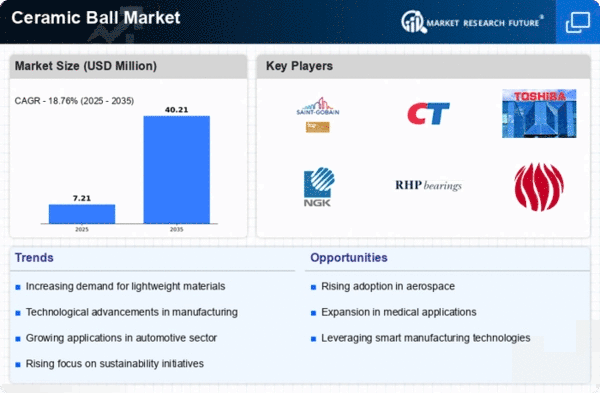
As per MRFR analysis, the Ceramic Ball Market Size was estimated at 6.07 USD Million in 2024. The Ceramic Ball industry is projected to grow from 7.21 in 2025 to 40.21 by 2035, exhibiting a compound annual growth rate (CAGR) of 18.76 during the forecast period 2025 - 2035.

Key Market Trends & Highlights

The Ceramic Ball Market is poised for robust growth driven by technological advancements and diverse applications.

  • North America remains the largest market for ceramic balls, driven by its established aerospace and automotive sectors.
  • Asia-Pacific is recognized as the fastest-growing region, reflecting increasing industrialization and demand for advanced materials.
  • The aerospace segment leads in market size, while the medical devices segment is experiencing rapid growth due to innovation and healthcare advancements.
  • Technological advancements in manufacturing and rising demand in automotive applications are key drivers propelling market expansion.

Market Size & Forecast

2024 Market Size 6.07 (USD Million)
2035 Market Size 40.21 (USD Million)
CAGR (2025 - 2035) 18.76%
Largest Regional Market Share in 2024 Asia-Pacific

Major Players

<p>Saint-Gobain (FR), CeramTec (DE), Toshiba Materials (JP), NGK Insulators (JP), RHP Bearings (GB), Zircar Ceramics (US), CoorsTek (US), Syalon (GB), Aremco Products (US)</p>

Market Trends

The Ceramic Ball Market is currently experiencing a dynamic evolution, driven by various factors that influence its growth trajectory. The increasing demand for high-performance materials across diverse industries, such as automotive, aerospace, and manufacturing, appears to be a primary catalyst. As organizations seek to enhance efficiency and reduce friction in machinery, the adoption of ceramic balls is likely to rise. Furthermore, advancements in manufacturing technologies may facilitate the production of more durable and precise ceramic balls, thereby expanding their applications. This trend suggests a shift towards more specialized uses, potentially enhancing the market's overall value. In addition, environmental considerations are becoming increasingly relevant in the Ceramic Ball Market. The push for sustainable practices and materials is prompting manufacturers to explore eco-friendly alternatives. This inclination towards sustainability may lead to innovations in the production processes of ceramic balls, aligning with global efforts to minimize environmental impact. As a result, the market could witness a transformation in product offerings, catering to a more environmentally conscious consumer base. Overall, the Ceramic Ball Market seems poised for growth, driven by technological advancements and a heightened focus on sustainability.

Technological Advancements

Recent innovations in manufacturing processes are enhancing the quality and performance of ceramic balls. These advancements may lead to the development of products that offer superior durability and precision, thereby expanding their applicability across various sectors.

Sustainability Trends

The increasing emphasis on environmentally friendly practices is influencing the Ceramic Ball Market. Manufacturers are likely to explore sustainable materials and production methods, aligning with global initiatives aimed at reducing ecological footprints.

Diverse Applications

The versatility of ceramic balls is becoming more apparent as they find uses in a wide range of industries. From automotive to aerospace, the demand for high-performance materials is driving the exploration of new applications, potentially broadening market reach.

Ceramic Ball Market Market Drivers

Market Growth Projections

The Global Ceramic Ball Market Industry is poised for substantial growth, with projections indicating a market value of 2500 USD Million in 2024 and an anticipated increase to 4500 USD Million by 2035. This growth trajectory suggests a compound annual growth rate of 5.49% from 2025 to 2035, driven by rising demand across various sectors, including aerospace, automotive, and industrial applications. The increasing adoption of advanced materials and technologies is likely to further enhance the market's potential, positioning ceramic balls as a critical component in modern manufacturing and engineering.

Rising Demand in Aerospace Sector

The Global Ceramic Ball Market Industry is experiencing heightened demand from the aerospace sector, where ceramic balls are utilized for their lightweight and high-strength properties. The aerospace industry is increasingly adopting advanced materials to enhance fuel efficiency and performance. For instance, ceramic balls are employed in bearings and other critical components, contributing to reduced weight and improved durability. This trend is expected to drive the market's growth, with projections indicating a market value of 2500 USD Million in 2024, potentially reaching 4500 USD Million by 2035.

Expansion of Industrial Applications

The expansion of industrial applications is a notable driver for the Global Ceramic Ball Market Industry. Industries such as oil and gas, mining, and manufacturing are increasingly utilizing ceramic balls for their durability and performance under extreme conditions. For instance, ceramic balls are employed in pumps and valves, where their resistance to wear and chemical corrosion is critical. This diversification of applications is likely to contribute to the market's growth, with expectations of a compound annual growth rate of 5.49% from 2025 to 2035, reflecting the increasing reliance on ceramic materials in various industrial sectors.

Increasing Focus on Energy Efficiency

There is a growing emphasis on energy efficiency across multiple sectors, which is positively influencing the Global Ceramic Ball Market Industry. Ceramic balls, known for their low friction properties, are increasingly being used in applications that require energy-efficient solutions. For example, in industrial machinery and equipment, the use of ceramic balls can lead to significant energy savings and reduced operational costs. This trend aligns with global sustainability goals, potentially propelling the market towards a valuation of 4500 USD Million by 2035, as industries seek to adopt more sustainable practices.

Growing Applications in Automotive Industry

The automotive industry is a major driver of the Global Ceramic Ball Market Industry, as manufacturers increasingly incorporate ceramic balls into various components to enhance performance and longevity. Ceramic balls are utilized in applications such as bearings, valve seats, and fuel injectors, where their resistance to wear and corrosion is advantageous. The shift towards electric vehicles is also contributing to this trend, as these vehicles require high-performance materials to optimize efficiency. This growing demand is expected to support the market's expansion, with a projected value of 2500 USD Million in 2024.

Technological Advancements in Manufacturing

Technological innovations in the manufacturing processes of ceramic balls are significantly impacting the Global Ceramic Ball Market Industry. Advanced techniques such as additive manufacturing and precision machining are enhancing the quality and performance of ceramic balls. These advancements allow for the production of more complex geometries and improved surface finishes, which are crucial for applications in various industries, including automotive and electronics. As a result, the market is likely to witness a compound annual growth rate of 5.49% from 2025 to 2035, reflecting the increasing adoption of high-performance ceramic balls.

Market Segment Insights

By Application: Aerospace (Largest) vs. Medical Devices (Fastest-Growing)

<p>In the Ceramic Ball Market, the application segment showcases a diverse range of industries such as aerospace, automotive, industrial equipment, medical devices, and electronics. The aerospace sector remains a dominant player, utilizing ceramic balls for their lightweight and high strength properties. Meanwhile, medical devices are emerging rapidly, driven by the increasing demand for innovative healthcare solutions that leverage advanced materials. The shift towards precision and quality in these applications exemplifies the changing dynamics of the market.</p>

<p>Aerospace: Dominant vs. Medical Devices: Emerging</p>

<p>The aerospace application of ceramic balls is characterized by stringent safety and performance requirements, making it the dominant segment in the market. Their lightweight nature, coupled with exceptional strength and resistance to thermal shock, enhances fuel efficiency in aviation systems. In contrast, the medical devices segment is emerging rapidly, spurred by technological advancements in healthcare. The need for biocompatible and high-quality materials for surgical instruments and implants drives this growth, ensuring that mechanical properties align with medical standards. Both segments showcase significant R&D efforts aimed at enhancing product performance and expanding application scopes.</p>

By End Use: Ball Bearings (Largest) vs. Valves (Fastest-Growing)

<p>In the Ceramic Ball Market, the end-use segment showcases a diverse distribution among its values. Ball Bearings hold the largest share due to their critical role in various applications, providing efficiency and durability. Valves, while currently a smaller segment, are gaining traction and exhibit rapid growth in response to increased demand for reliable pressure control and fluid management in multiple industries.</p>

<p>Ball Bearings (Dominant) vs. Valves (Emerging)</p>

<p>Ball Bearings stand as the dominant force in the Ceramic Ball Market, known for their ability to reduce friction in machinery and increase longevity. Their application spans automotive, aerospace, and industrial machinery, making them a vital component in enhancing productivity. Conversely, Valves represent an emerging segment, driven by the need for precise control in processes involving fluids or gases. As industries focus on improving efficiency and sustainability, the demand for high-performance ceramic ball valves is on the rise, leading to innovative designs and increased adoption in various sectors.</p>

By Material Type: Alumina (Largest) vs. Zirconia (Fastest-Growing)

<p>In the Ceramic Ball Market, Alumina remains the largest material type, commanding a significant share due to its superior properties such as high wear resistance and thermal stability. Zirconia, while smaller in share, is emerging as a strong contender in specific applications, driven by its exceptional toughness and resistance to crack propagation. The collective market distribution showcases the robustness of these materials, with others like Silicon Nitride, Titanium Dioxide, and Ceramic Composites contributing to a diversified landscape.</p>

<p>Alumina: (Dominant) vs. Zirconia (Emerging)</p>

<p>Alumina ceramic balls are recognized for their predominant role in various industrial applications due to their excellent hardness, thermal resistance, and low wear rates, making them ideal for bearings and abrasives. In contrast, zirconia ceramic balls are rapidly gaining attention for their applications in biotechnology and aerospace industries, where properties like high toughness and thermal stability are crucial. Both materials exhibit contrasting yet complementary features, with alumina's reliability making it the dominant player, while the emerging corners of the market are being claimed by zirconia, which is benefiting from increasing demand for advanced performance in critical applications.</p>

By Size: Standard (Largest) vs. Miniature (Fastest-Growing)

<p>In the Ceramic Ball Market, the 'Size' segment reveals a diverse range of options achieving various levels of market share. Standard ceramic balls dominate significantly, appealing to a wide audience with their practicality and versatility in numerous applications. Miniature ceramic balls, although smaller in market share, are gaining traction owing to specialized industries that require precision and compactness, highlighting a shift in consumer preferences towards more tailored products.</p>

<p>Standard (Dominant) vs. Miniature (Emerging)</p>

<p>Standard ceramic balls are characterized by their broad usage across multiple sectors such as manufacturing and automotive due to their reliability and cost-effectiveness. They are preferred for applications where size is less critical but performance is paramount. In contrast, miniature ceramic balls exemplify the shift towards precision engineering. As industries become more advanced, the need for smaller, lightweight components without compromising functionality is paramount. Miniature options cater to highly specialized applications, including medical devices and electronic components. This growth reflects an increasing demand for advanced tech solutions, positioning the miniature segment as an emerging leader in innovation.</p>

By Production Method: Isostatic Pressing (Largest) vs. Injection Molding (Fastest-Growing)

<p>The Ceramic Ball Market exhibits a diverse distribution among various production methods. Isostatic Pressing holds the largest market share, primarily due to its efficiency in producing high-density and high-strength ceramic balls. Following closely are Dry Pressing and Slip Casting, which cater to different applications in the industry. Injection Molding is emerging rapidly in this market, showing significant growth due to advancements in manufacturing technology that allow for more complex shapes and reduced production costs. Growth trends in the Ceramic Ball Market are largely driven by the increasing demand for high-performance materials in various sectors such as automotive, aerospace, and industrial applications. Factors such as technological advancements leading to improved production capabilities in Injection Molding and the need for lightweight and durable materials are propelling this segment. Isostatic Pressing continues to dominate due to its established presence and superior product output, while Injection Molding is quickly gaining traction as manufacturers seek to optimize production efficiency and costs.</p>

<p>Production Method: Isostatic Pressing (Dominant) vs. Injection Molding (Emerging)</p>

<p>Isostatic Pressing is recognized as the dominant production method in the Ceramic Ball Market, particularly due to its ability to produce high-density products with excellent mechanical properties. This method is widely adopted in applications requiring high precision and reliability. Its capability to consistently yield high-quality ceramic balls makes it a preferred choice among manufacturers. In contrast, Injection Molding is an emerging method that is making waves in the industry. This approach offers flexibility in design and can produce complex geometries, making it ideal for innovative applications. As the demand for customized ceramic balls grows, Injection Molding’s advantages in scalability and production speed position it as a key player in the future of the Ceramic Ball Market.</p>

Get more detailed insights about Ceramic Ball Market Research Report - Global Forecast till 2035

Regional Insights

North America : Stable Growth Environment

The North American ceramic ball market is projected to reach $1.52 billion by December 2025, driven by increasing demand in aerospace and automotive sectors. Regulatory support for advanced materials and sustainability initiatives is fostering innovation. The region's focus on high-performance applications is expected to enhance market growth, with a notable shift towards lightweight and durable materials. Leading countries like the US and Canada are home to key players such as Zircar Ceramics and CoorsTek, which are investing in R&D to enhance product offerings. The competitive landscape is characterized by a mix of established firms and emerging players, all vying for market share. The presence of stringent quality standards ensures that only the best products are available, further driving market dynamics.

Europe : Innovation and Sustainability Focus

Europe's ceramic ball market is valued at $1.21 billion as of December 2025, with a strong emphasis on innovation and sustainability. The region is witnessing a surge in demand for advanced ceramic materials in industries such as healthcare and energy. Regulatory frameworks promoting eco-friendly practices are catalyzing market expansion, aligning with the EU's Green Deal objectives. Germany and France are leading the charge, with companies like CeramTec and Saint-Gobain at the forefront of technological advancements. The competitive landscape is robust, with a mix of local and international players. The focus on high-quality standards and compliance with EU regulations ensures a thriving market environment, fostering growth and investment in new technologies.

Asia-Pacific : Dominant Market Leader

The Asia-Pacific ceramic ball market is the largest globally, with a market size of $3.0 billion as of December 2025. This growth is fueled by rapid industrialization, particularly in countries like China and Japan, where demand for high-performance materials is surging. The region's regulatory environment is increasingly supportive of advanced manufacturing technologies, driving innovation and efficiency. China and Japan are the leading countries in this market, hosting major players such as Toshiba Materials and NGK Insulators. The competitive landscape is marked by aggressive pricing strategies and a focus on product differentiation. As the region continues to invest in infrastructure and technology, the ceramic ball market is expected to expand significantly, catering to diverse industrial applications.

Middle East and Africa : Emerging Market Potential

The Middle East and Africa ceramic ball market is valued at $0.34 billion as of December 2025, showing potential for growth driven by increasing industrial activities and investments in manufacturing. The region is gradually adopting advanced materials, with regulatory bodies encouraging the use of ceramics in various applications. This shift is expected to enhance market dynamics and attract foreign investments. Countries like South Africa and the UAE are emerging as key players in this market, with local manufacturers beginning to establish a foothold. The competitive landscape is still developing, with opportunities for both local and international companies to expand their presence. As infrastructure projects ramp up, the demand for ceramic balls is anticipated to rise, paving the way for future growth.

Key Players and Competitive Insights

The Ceramic Ball Market is currently characterized by a dynamic competitive landscape, driven by technological advancements and increasing demand across various sectors, including automotive, aerospace, and electronics. Key players such as Saint-Gobain (FR), CeramTec (DE), and Toshiba Materials (JP) are strategically positioning themselves through innovation and regional expansion. For instance, Saint-Gobain (FR) has focused on enhancing its product portfolio with advanced ceramic materials, which appears to be a response to the growing need for high-performance components in demanding applications. Similarly, CeramTec (DE) emphasizes its commitment to sustainability, integrating eco-friendly practices into its manufacturing processes, which may resonate well with environmentally conscious consumers and industries.

The business tactics employed by these companies often include localizing manufacturing to reduce lead times and optimize supply chains. The market structure is moderately fragmented, with several players vying for market share, yet the influence of major companies remains substantial. This competitive environment fosters innovation and encourages smaller firms to adopt advanced technologies to remain relevant.

In November 2025, Toshiba Materials (JP) announced a strategic partnership with a leading automotive manufacturer to develop next-generation ceramic bearings. This collaboration is likely to enhance Toshiba's market presence and leverage its technological expertise in producing high-performance ceramic components. Such partnerships may also facilitate the sharing of resources and knowledge, ultimately leading to improved product offerings.

In October 2025, NGK Insulators (JP) launched a new line of ceramic balls designed specifically for high-temperature applications in the aerospace sector. This product introduction not only showcases NGK's commitment to innovation but also positions the company to capture a growing segment of the market that demands specialized materials capable of withstanding extreme conditions. The strategic importance of this launch lies in its potential to differentiate NGK from competitors by addressing niche market needs.

In September 2025, CoorsTek (US) expanded its manufacturing capabilities by investing in a new facility in the Midwest, aimed at increasing production capacity for ceramic components. This expansion is indicative of CoorsTek's proactive approach to meet rising demand and enhance supply chain reliability. By bolstering its manufacturing footprint, the company may improve its responsiveness to market fluctuations and customer requirements.

As of December 2025, the Ceramic Ball Market is witnessing trends such as digitalization and sustainability, which are reshaping competitive dynamics. Companies are increasingly forming strategic alliances to enhance their technological capabilities and market reach. The shift from price-based competition to a focus on innovation, technology, and supply chain reliability is becoming evident. Moving forward, competitive differentiation will likely hinge on the ability to integrate advanced technologies and sustainable practices into product development, thereby meeting the evolving demands of the market.

Key Companies in the Ceramic Ball Market market include

Industry Developments

Future Outlook

Ceramic Ball Market Future Outlook

<p>The Ceramic Ball Market is projected to grow at an 18.76% CAGR from 2024 to 2035, driven by advancements in manufacturing technologies and increasing demand across various industries.</p>

New opportunities lie in:

  • <p>Expansion into emerging markets with tailored ceramic ball solutions.</p>
  • <p>Development of high-performance ceramic balls for aerospace applications.</p>
  • <p>Strategic partnerships with automotive manufacturers for innovative ceramic components.</p>

<p>By 2035, the Ceramic Ball Market is expected to achieve substantial growth, solidifying its position as a key industry player.</p>

Market Segmentation

Ceramic Ball Market Size Outlook

  • Micro
  • Miniature
  • Standard
  • Large
  • Custom

Ceramic Ball Market End Use Outlook

  • Ball Bearings
  • Valves
  • Pumps
  • Seals
  • Gears

Ceramic Ball Market Application Outlook

  • Aerospace
  • Automotive
  • Industrial Equipment
  • Medical Devices
  • Electronics

Ceramic Ball Market Material Type Outlook

  • Alumina
  • Zirconia
  • Silicon Nitride
  • Titanium Dioxide
  • Ceramic Composites

Ceramic Ball Market Production Method Outlook

  • Isostatic Pressing
  • Slip Casting
  • Injection Molding
  • Dry Pressing
  • Hot Pressing

Report Scope

MARKET SIZE 20246.07(USD Million)
MARKET SIZE 20257.21(USD Million)
MARKET SIZE 203540.21(USD Million)
COMPOUND ANNUAL GROWTH RATE (CAGR)18.76% (2024 - 2035)
REPORT COVERAGERevenue Forecast, Competitive Landscape, Growth Factors, and Trends
BASE YEAR2024
Market Forecast Period2025 - 2035
Historical Data2019 - 2024
Market Forecast UnitsUSD Million
Key Companies ProfiledSaint-Gobain (FR), CeramTec (DE), Toshiba Materials (JP), NGK Insulators (JP), RHP Bearings (GB), Zircar Ceramics (US), CoorsTek (US), Syalon (GB), Aremco Products (US)
Segments CoveredApplication, End Use, Material Type, Size, Production Method
Key Market OpportunitiesGrowing demand for lightweight, high-performance materials in automotive and aerospace sectors drives Ceramic Ball Market expansion.
Key Market DynamicsRising demand for high-performance materials drives innovation and competition in the ceramic ball market.
Countries CoveredNorth America, Europe, APAC, South America, MEA

FAQs

What is the valuation of the market?

The global ceramic ball market is expected to reach USD 786.3 million by 2025.

What is the CAGR of the market?

The market is expected to exhibit a strong 9.32% CAGR over the forecast period from 2019 to 2025.

What is the major driver for the market?

Growing adoption of ceramic balls in automotive and aircraft manufacturing is the major driver for the ceramic ball market.

Which is the leading regional market?

Asia Pacific holds the largest share in the global ceramic ball market.

What are the leading market players?

Leading players in the ceramic ball market include Industrial Tectonics, Axens, and Honeywell International, among others.

  1. Executive Summary
  2. Market Introduction
    1. Market
    2. Definition
    3. Scope of the Study
    4. List of Assumptions
    5. Markets Structure
  3. Market Research Methodology
    1. Research Process
    2. Primary Research
    3. Secondary Research
    4. Market Size Estimation
    5. Forecast Model
  4. Market Dynamics of Global Ceramic Ball Market
    1. Introduction
    2. Drivers
    3. Restraints
    4. Opportunities
    5. Challenges
    6. Trends/Technology
  5. Market Factor Analysis of Global Ceramic Ball Market
    1. Supply
      1. Raw Material Type Suppliers
      2. Manufacturers/Producers
      3. Distributors/Retailers/Wholesalers/E-Commerce
      4. End Users
    2. Chain Analysis
    3. Porter’s
      1. Threat of New Entrants
      2. Bargaining Power of Buyers
      3. Bargaining Power of Suppliers
      4. Threat of Substitutes
    4. Five Forces Analysis
    5. Intensity of Competitive Rivalry
    6. Pricing Analysis
  6. Global Ceramic Ball Market,
    1. by Material Type
    2. Introduction
    3. Alumina Oxide
      1. Market Estimates & Forecast,
      2. Market Estimates & Forecast, by Region, 2019−2027
      3. Market Estimates & Forecast, 2019−2027
      4. Market
    4. Zirconia
    5. Estimates & Forecast, by Region, 2019−2027
    6. Ruby Sapphire
      1. Market
      2. Market Estimates & Forecast,
    7. Estimates & Forecast, 2019−2027
    8. by Region, 2019−2027
    9. Silicon Nitride
      1. Market Estimates & Forecast,
      2. Market Estimates & Forecast, by Region, 2019−2027
      3. Market Estimates & Forecast, 2019−2027
      4. Market
    10. Others
    11. Estimates & Forecast, by Region, 2019−2027
  7. Global Ceramic Ball Market,
    1. by Application
    2. Introduction
    3. Bearings
      1. Market Estimates & Forecast,
      2. Market Estimates & Forecast, by Region, 2019−2027
      3. Market Estimates & Forecast, 2019−2027
      4. Market
    4. Valves
    5. Estimates & Forecast, by Region, 2019−2027
    6. Ball Screws
      1. Market
      2. Market Estimates & Forecast,
    7. Estimates & Forecast, 2019−2027
    8. by Region, 2019−2027
    9. Grinding
      1. Market Estimates & Forecast,
      2. Market Estimates & Forecast, by Region, 2019−2027
      3. Market Estimates & Forecast, 2019−2027
    10. Chemical Pumps
  8. Market Estimates & Forecast, by Region, 2019−2027
    1. Flowmeter
      1. Market
      2. Market Estimates & Forecast,
    2. Estimates & Forecast, 2019−2027
    3. by Region, 2019−2027
    4. Others
      1. Market Estimates & Forecast,
      2. Market Estimates & Forecast, by Region, 2019−2027
  9. Global Ceramic Ball Market, by End-Use Industry
    1. Introduction
    2. Aerospace
      1. Market Estimates & Forecast, 2019−2027
      2. Market
    3. Estimates & Forecast, by Region, 2019−2027
    4. Automotive
      1. Market
      2. Market Estimates & Forecast,
    5. Estimates & Forecast, 2019−2027
    6. by Region, 2019−2027
    7. Chemical
      1. Market Estimates & Forecast,
      2. Market Estimates & Forecast, by Region, 2019−2027
      3. Market Estimates & Forecast, 2019−2027
      4. Market
    8. Others
    9. Estimates & Forecast, by Region, 2019−2027
  10. Global Ceramic Ball Market,
    1. by Region
    2. Introduction
    3. North America
      1. Market Estimates & Forecast,
      2. Market Estimates & Forecast, by Material Type, 2019−2027
  11. Market Estimates & Forecast, by Application, 2019−2027
    1. Estimates & Forecast, by End-Use Industry, 2019−2027
    2. Market Estimates & Forecast, 2019−2027
    3. Forecast, by Material Type, 2019−2027
    4. Forecast, by Application, 2019−2027
    5. Forecast, by End-Use Industry, 2019−2027
    6. Estimates & Forecast, 2019−2027
    7. Forecast, by Material Type, 2019−2027
    8. Forecast, by Application, 2019−2027
    9. Forecast, by End-Use Industry, 2019−2027
  12. Market
  13. US
  14. Market Estimates &
  15. Market Estimates &
  16. Market Estimates &
  17. Canada
  18. Market
  19. Market Estimates &
  20. Market Estimates &
  21. Market Estimates &
    1. Europe
      1. Market Estimates & Forecast,
      2. Market Estimates & Forecast, by Material Type, 2019−2027
  22. Market Estimates & Forecast, by Application, 2019−2027
    1. Estimates & Forecast, by End-Use Industry, 2019−2027
    2. Market Estimates & Forecast, 2019−2027
    3. Forecast, by Material Type, 2019−2027
    4. Forecast, by Application, 2019−2027
    5. Forecast, by End-Use Industry, 2019−2027
    6. Estimates & Forecast, 2019−2027
    7. Forecast, by Material Type, 2019−2027
    8. Forecast, by Application, 2019−2027
    9. Forecast, by End-Use Industry, 2019−2027
    10. Estimates & Forecast, 2019−2027
    11. Forecast, by Material Type, 2019−2027
    12. Forecast, by Application, 2019−2027
    13. Forecast, by End-Use Industry, 2019−2027
    14. Estimates & Forecast, 2019−2027
    15. Forecast, by Material Type, 2019−2027
    16. Forecast, by Application, 2019−2027
    17. Forecast, by End-Use Industry, 2019−2027
    18. Forecast, 2019−2027
    19. Type, 2019−2027
  23. Market
  24. Germany
  25. Market Estimates &
  26. Market Estimates &
  27. Market Estimates &
  28. France
  29. Market
  30. Market Estimates &
  31. Market Estimates &
  32. Market Estimates &
  33. Italy
  34. Market
  35. Market Estimates &
  36. Market Estimates &
  37. Market Estimates &
  38. Spain
  39. Market
  40. Market Estimates &
  41. Market Estimates &
  42. Market Estimates &
  43. UK
  44. Market Estimates &
  45. Market Estimates & Forecast, by Material
  46. Market Estimates & Forecast, by Application, 2019−2027
  47. Market Estimates & Forecast, by End-Use Industry, 2019−2027
    1. Russia
    2. Estimates & Forecast, by Material Type, 2019−2027
    3. Forecast, by Application, 2019−2027
    4. Forecast, by End-Use Industry, 2019−2027
    5. Estimates & Forecast, 2019−2027
    6. Forecast, by Material Type, 2019−2027
    7. Forecast, by Application, 2019−2027
    8. Forecast, by End-Use Industry, 2019−2027
    9. Market Estimates & Forecast, 2019−2027
    10. Forecast, by Material Type, 2019−2027
    11. Forecast, by Application, 2019−2027
    12. Forecast, by End-Use Industry, 2019−2027
    13. Estimates & Forecast, 2019−2027
    14. by Material Type, 2019−2027
  48. Market Estimates & Forecast, 2019−2027
  49. Market
  50. Market Estimates &
  51. Market Estimates &
  52. Poland
  53. Market
  54. Market Estimates &
  55. Market Estimates &
  56. Market Estimates &
  57. Rest of Europe
  58. Market Estimates &
  59. Market Estimates &
  60. Market Estimates &
    1. Asia-Pacific
      1. Market
      2. Market Estimates & Forecast,
      3. Market Estimates & Forecast, by Application,
      4. Market Estimates & Forecast, by End-Use Industry,
      5. China
  61. Market Estimates & Forecast, by Material Type, 2019−2027
    1. Estimates & Forecast, by Application, 2019−2027
    2. Forecast, by End-Use Industry, 2019−2027
    3. Estimates & Forecast, 2019−2027
    4. Forecast, by Material Type, 2019−2027
    5. Forecast, by Application, 2019−2027
    6. Forecast, by End-Use Industry, 2019−2027
    7. Estimates & Forecast, 2019−2027
    8. Forecast, by Material Type, 2019−2027
    9. Forecast, by Application, 2019−2027
    10. Forecast, by End-Use Industry, 2019−2027
    11. Market Estimates & Forecast, 2019−2027
    12. Forecast, by Material Type, 2019−2027
    13. Forecast, by Application, 2019−2027
    14. Forecast, by End-Use Industry, 2019−2027
    15. Market Estimates & Forecast, 2019−2027
    16. Forecast, by Material Type, 2019−2027
    17. Forecast, by Application, 2019−2027
    18. Forecast, by End-Use Industry, 2019−2027
    19. Market Estimates & Forecast, 2019−2027
    20. by Material Type, 2019−2027
  62. Market
  63. Market Estimates &
  64. India
  65. Market
  66. Market Estimates &
  67. Market Estimates &
  68. Market Estimates &
  69. Japan
  70. Market
  71. Market Estimates &
  72. Market Estimates &
  73. Market Estimates &
  74. Australia & New Zealand
  75. Market Estimates &
  76. Market Estimates &
  77. Market Estimates &
  78. Rest of Asia Pacific
  79. Market Estimates &
  80. Market Estimates &
  81. Market Estimates &
    1. Middle East & Africa
      1. Market Estimates & Forecast,
      2. Market Estimates & Forecast, by Application,
      3. Market Estimates & Forecast, by End-Use Industry,
      4. GCC
  82. Market Estimates & Forecast, by Material Type, 2019−2027
    1. Estimates & Forecast, by Application, 2019−2027
    2. Forecast, by End-Use Industry, 2019−2027
    3. Estimates & Forecast, 2019−2027
    4. Forecast, by Material Type, 2019−2027
    5. Forecast, by Application, 2019−2027
    6. Forecast, by End-Use Industry, 2019−2027
    7. Market Estimates & Forecast, 2019−2027
    8. Forecast, by Material Type, 2019−2027
    9. Forecast, by Application, 2019−2027
    10. Forecast, by End-Use Industry, 2019−2027
    11. Estimates & Forecast, 2019−2027
    12. Forecast, by Material Type, 2019−2027
    13. Forecast, by Application, 2019−2027
    14. Forecast, by End-Use Industry, 2019−2027
    15. Africa
    16. Estimates & Forecast, by Material Type, 2019−2027
    17. Forecast, by Application, 2019−2027
    18. Forecast, by End-Use Industry, 2019−2027
    19. Estimates & Forecast, 2019−2027
    20. by Material Type, 2019−2027
  83. Market
  84. Market Estimates &
  85. Israel
  86. Market
  87. Market Estimates &
  88. Market Estimates &
  89. Market Estimates &
  90. North Africa
  91. Market Estimates &
  92. Market Estimates &
  93. Market Estimates &
  94. Turkey
  95. Market
  96. Market Estimates &
  97. Market Estimates &
  98. Market Estimates &
  99. Rest of Middle East &
  100. Market Estimates & Forecast, 2019−2027
  101. Market
  102. Market Estimates &
  103. Market Estimates &
    1. Latin America
      1. Market
      2. Market Estimates & Forecast,
      3. Market Estimates & Forecast, by Application,
      4. Market Estimates & Forecast, by End-Use Industry,
      5. Brazil
  104. Market Estimates & Forecast, by Material Type, 2019−2027
    1. Estimates & Forecast, by Application, 2019−2027
    2. Forecast, by End-Use Industry, 2019−2027
    3. Estimates & Forecast, 2019−2027
    4. Forecast, by Material Type, 2019−2027
    5. Forecast, by Application, 2019−2027
    6. Forecast, by End-Use Industry, 2019−2027
    7. Estimates & Forecast, 2019−2027
    8. Forecast, by Material Type, 2019−2027
    9. Forecast, by Application, 2019−2027
    10. Forecast, by End-Use Industry, 2019−2027
    11. Market Estimates & Forecast, 2019−2027
    12. Forecast, by Material Type, 2019−2027
    13. Forecast, by Application, 2019−2027
    14. Forecast, by End-Use Industry, 2019−2027
  105. Market
  106. Market Estimates &
  107. Mexico
  108. Market
  109. Market Estimates &
  110. Market Estimates &
  111. Market Estimates &
  112. Argentina
  113. Market
  114. Market Estimates &
  115. Market Estimates &
  116. Market Estimates &
  117. Rest of Latin America
  118. Market Estimates &
  119. Market Estimates &
  120. Market Estimates &
  121. Company Landscape
    1. Introduction
    2. Market Strategy
    3. Key Development Analysis (Expansion/Merger
    4. & Acquisition/Joint Venture/New Product Development/Agreement/Investment)
    5. Company Profiles
    6. Industrial Tectonics Inc
      1. Company Overview
      2. Product Segment Overview
      3. Strategy
      4. Key
      5. SWOT Analysis
    7. Financial Updates
    8. Developments
    9. Axens
      1. Company Overview
      2. Product Segment Overview
      3. Strategy
      4. Key
      5. SWOT Analysis
    10. Financial Updates
    11. Developments
    12. Honeywell International Inc.
      1. Financial Updates
      2. Product Segment Overview
      3. Strategy
      4. Key Developments
      5. SWOT Analysis
      6. Company Overview
      7. Financial Updates
      8. Strategy
      9. Key Developments
    13. Company Overview
    14. Saint-Gobain
    15. Product Segment Overview
    16. SWOT Analysis
    17. TOSHIBA MATERIALS CO., LTD
      1. Company Overview
      2. Product Segment Overview
      3. Strategy
      4. Key
      5. SWOT Analysis
    18. Financial Updates
    19. Developments
    20. GLOBAL PRECISION BALL AND ROLLER
      1. Company Overview
      2. Financial Updates
      3. Product Segment Overview
      4. Strategy
      5. Key Developments
      6. SWOT Analysis
      7. Company Overview
      8. Financial Updates
      9. Strategy
      10. Key Developments
    21. FineWay Inc
    22. Product Segment Overview
    23. SWOT Analysis
    24. CoorsTek Inc
      1. Company Overview
      2. Financial
      3. Product Segment Overview
      4. Strategy
      5. Key
      6. SWOT Analysis
    25. Updates
    26. Developments
    27. Devson Catalyst
      1. Company
      2. Financial Updates
      3. Product Segment Overview
      4. Key Developments
      5. SWOT Analysis
    28. Overview
    29. Strategy
    30. MetalBall
      1. Company
      2. Financial Updates
      3. Product Segment Overview
      4. Key Developments
      5. SWOT Analysis
    31. Overview
    32. Strategy
    33. Others
  122. Appendix
    1. LIST
  123. OF TABLES
  124. Global Ceramic Ball Market, by Region, 2019−2027
    1. Table
  125. North America: Ceramic Ball Market, by Country, 2019−2027
  126. Europe:
  127. Ceramic Ball Market, by Country, 2019−2027
  128. Asia-Pacific: Ceramic
  129. Ball Market, by Country, 2019−2027
  130. Middle East & Africa:
  131. Ceramic Ball Market, by Country, 2019−2027
  132. Latin America: Ceramic
  133. Ball Market, by Country, 2019−2027
  134. Global Ceramic Ball Material
  135. Type Market, by Regions, 2019−2027
  136. North America: Ceramic
  137. Ball Material Type Market, by Country, 2019−2027
  138. Europe: Ceramic Ball Material
  139. Type Market, by Country, 2019−2027
    1. Table10 Asia-Pacific: Ceramic
  140. Ball Material Type Market, by Country, 2019−2027
    1. Table11 Middle East & Africa:
  141. Ceramic Ball Material Type Market, by Country, 2019−2027
    1. Table12 Latin
  142. America: Ceramic Ball Material Type Market, by Country, 2019−2027
    1. Table13
  143. Global Ceramic Ball Application Market, by Regions, 2019−2027
    1. Table14 North
  144. America: Ceramic Ball by Application Market, by Country, 2019−2027
    1. Table15
  145. Europe: Ceramic Ball Application Market, by Country, 2019−2027
    1. Table16
  146. Asia-Pacific: Ceramic Ball Application Market, by Country, 2019−2027
    1. Table17
  147. Middle East & Africa: Ceramic Ball Application Market, by Country, 2019−2027
  148. Table18 Latin America: Ceramic Ball Application Market, by Country, 2019−2027
  149. Table19 Global Ceramic Ball End-Use Industry Market, by Regions, 2019−2027
    1. Table20
  150. North America: Ceramic Ball End-Use Industry Market, by Country, 2019−2027
  151. Table21 Europe: Ceramic Ball End-Use Industry Market, by Country, 2019−2027
  152. Table22 Asia-Pacific: Ceramic Ball End-Use Industry Market, by Country,
    1. Table23 Middle East & Africa: Ceramic Ball End-Use Industry
  153. Market, by Country, 2019−2027
    1. Table24 Latin America: Ceramic Ball End-Use
  154. Industry Market, by Country, 2019−2027
    1. Table25 Global Material Type Market,
    2. by Region, 2019−2027
  155. Table26 Global Application Market, by Region, 2019−2027
  156. Table27 Global End-Use Industry Market, by Region, 2019−2027
    1. Table28
  157. North America: Ceramic Ball Market, by Country
    1. Table29 North America: Ceramic
  158. Ball Market, by Material Type
  159. Table30 North America: Ceramic Ball Market, by Application
  160. Table31 North America: Ceramic Ball Market, by End-Use Industry
    1. Table32
  161. Europe: Ceramic Ball Market, by Country
    1. Table33 Europe: Ceramic Ball Market,
    2. by Material Type
  162. Table34 Europe: Ceramic Ball Market, by Application
    1. Table35
  163. Europe: Ceramic Ball Market, by End-Use Industry
    1. Table36 Asia-Pacific: Ceramic
  164. Ball Market, by Country
  165. Table37 Asia-Pacific: Ceramic Ball Market, by Material
    1. Type
  166. Table38 Asia-Pacific: Ceramic Ball Market, by Application
    1. Table39 Asia-Pacific:
  167. Ceramic Ball Market, by End-Use Industry
    1. Table40 Middle East & Africa: Ceramic
  168. Ball Market, by Country
    1. Table41 Middle East & Africa: Ceramic Ball Market,
    2. by Material Type
  169. Table42 Middle East & Africa: Ceramic Ball Market, by Application
  170. Table43 Middle East & Africa: Ceramic Ball Market, by End-Use Industry
  171. Table44 Latin America: Ceramic Ball Market, by Country
    1. Table45 Latin
  172. America: Ceramic Ball Market, by Material Type
    1. Table46 Latin America: Ceramic
  173. Ball Market, by Application
  174. Table47 Latin America: Ceramic Ball Market, by End-Use
    1. Industry
  175. LIST OF FIGURES
  176. Global Ceramic Ball Market Segmentation
    1. FIGURE
  177. Forecast Research Methodology
  178. Five Forces Analysis of Global Ceramic
    1. Ball Market
  179. Value Chain of Global Ceramic Ball Market
    1. FIGURE
  180. Share of Global Ceramic Ball Market in 2019, by Country (%)
  181. Global
    1. Ceramic Ball Market, 2019−2027
  182. Global Ceramic Ball Market Size,
    1. by Material Type, 2019
  183. Share of Global Ceramic Ball Market, by Material Type,
  184. Global Ceramic Ball Market Size, by Application, 2019
    1. FIGURE
  185. Share of Global Ceramic Ball Market, by Application, 2019−2027
    1. FIGURE
  186. Global Ceramic Ball Market Size, by End-Use Industry, 2019
    1. FIGURE 12
  187. Share of Global Ceramic Ball Market, by End-Use Industry, 2019−2027

Ceramic Ball Market Segmentation

Market Segmentation Overview

  • Detailed segmentation data will be available in the full report
  • Comprehensive analysis by multiple parameters
  • Regional and country-level breakdowns
  • Market size forecasts by segment
Infographic

Free Sample Request

Kindly complete the form below to receive a free sample of this Report

Get Free Sample

Customer Strories

Compare Licence

×
Features License Type
Single User Multiuser License Enterprise User
Price $4,950 $5,950 $7,250
Maximum User Access Limit 1 User Upto 10 Users Unrestricted Access Throughout the Organization
Free Customization
Direct Access to Analyst
Deliverable Format
Platform Access
Discount on Next Purchase 10% 15% 15%
Printable Versions