Request Free Sample ×

Kindly complete the form below to receive a free sample of this Report

* Please use a valid business email

Leading companies partner with us for data-driven Insights

clients tt-cursor
Hero Background
English
Chinese
French
Japanese
Korean
German
Spanish

Cardless ATM Market Size

ID: MRFR/ICT/10068-HCR
128 Pages
Ankit Gupta
April 2026

Cardless ATM Market Research Report Information By Type (On-site ATM, Off-site ATM, and Others), By Technology (Near-field Communication (NFC), Quick Response (QR) Codes, and Biometric Verification), By End User (Bank and Financial Institutions and Independent ATM Deployer), And By Region (North America, Europe, Asia-Pacific, And Rest Of The World) –Market Forecast Till 2035

Share:
Download PDF ×

We do not share your information with anyone. However, we may send you emails based on your report interest from time to time. You may contact us at any time to opt-out.

Cardless ATM Market Infographic
Purchase Options

Cardless Atm Size

Cardless ATM Market Growth Projections and Opportunities

The Cardless ATM market is motivated by a myriad of things that collectively form its panorama and power its boom. One of the pivotal marketplace elements is the increasing adoption of digital charge methods globally. As societies transition toward a cashless economy, clients are searching for convenient and stable options for traditional ATM transactions. Cardless ATMs offer an answer by permitting customers to withdraw coins through the usage of cell apps, QR codes, or biometric authentication, aligning with the evolving preferences of tech-savvy individuals. Moreover, the growing emphasis on more advantageous security measures is another critical element shaping the Cardless ATM marketplace. Traditional card-based total transactions are prone to fraud and browsing sports, prompting financial institutions to discover more steady options. Cardless ATM transactions, frequently requiring biometric authentication or particular cell codes, offer an extra layer of security, decreasing the hazard of unauthorized get entry to and fraudulent activities. This increased protection function is especially attractive to both economic establishments and customers, contributing to the market's expansion. The surge in smartphone penetration and the massive availability of cell banking apps additionally play a pivotal function in driving the Cardless ATM marketplace. With a full-size portion of the global population owning smartphones, the accessibility and convenience of using cell gadgets for economic transactions have soared. Cardless ATMs leverage this trend by integrating seamlessly with cell banking apps, empowering users to initiate transaction results easily without the want for bodily playing cards. This symbiotic relationship between cellular generation and Cardless ATMs fosters a market boom as monetary establishments adapt to the evolving wishes of their digitally connected patron base. Furthermore, the COVID-19 pandemic has improved the adoption of contactless answers throughout numerous industries, including banking. Cardless ATMs, requiring minimum physical interaction, flawlessly align with this converting consumer behavior. Financial establishments are recognizing this shift and are investing in the deployment of Cardless ATM solutions to offer customers a more secure and extra-hygienic option for coin withdrawals.
Cardless ATM Market Size Graph
Author
Author Profile
Ankit Gupta
Team Lead - Research

Ankit Gupta is a seasoned market intelligence and strategic research professional with over six plus years of experience in the ICT and Semiconductor industries. With academic roots in Telecom, Marketing, and Electronics, he blends technical insight with business strategy. Ankit has led 200+ projects, including work for Fortune 500 clients like Microsoft and Rio Tinto, covering market sizing, tech forecasting, and go-to-market strategies. Known for bridging engineering and enterprise decision-making, his insights support growth, innovation, and investment planning across diverse technology markets.

Leave a Comment

FAQs

What is the projected market valuation of the Cardless ATM Market by 2035?

<p>The Cardless ATM Market is projected to reach a valuation of 9.217 USD Billion by 2035.</p>

What was the market valuation of the Cardless ATM Market in 2024?

<p>In 2024, the Cardless ATM Market had a valuation of 2.838 USD Billion.</p>

What is the expected CAGR for the Cardless ATM Market during the forecast period 2025 - 2035?

<p>The expected CAGR for the Cardless ATM Market during the forecast period 2025 - 2035 is 11.3%.</p>

Which companies are considered key players in the Cardless ATM Market?

<p>Key players in the Cardless ATM Market include NCR Corporation, Diebold Nixdorf, FIS, and Cardtronics, among others.</p>

What are the main segments of the Cardless ATM Market?

<p>The main segments of the Cardless ATM Market include Type, Technology, and End User.</p>

How did the On-site segment perform in terms of valuation in 2024?

<p>The On-site segment was valued at 0.851 USD Billion in 2024.</p>

What is the projected valuation for the Off-site segment by 2035?

The Off-site segment is projected to reach a valuation of 4.607 USD Billion by 2035.

What technologies are driving the Cardless ATM Market?

Technologies driving the Cardless ATM Market include Near-field Communication (NFC), Quick Response (QR) Codes, and Biometric Verification.

What was the valuation of the Biometric Verification technology in 2024?

The Biometric Verification technology was valued at 1.135 USD Billion in 2024.

Which end users are primarily involved in the Cardless ATM Market?

The primary end users in the Cardless ATM Market are Bank and Financial Institutions and Independent ATM Deployers.

Market Summary

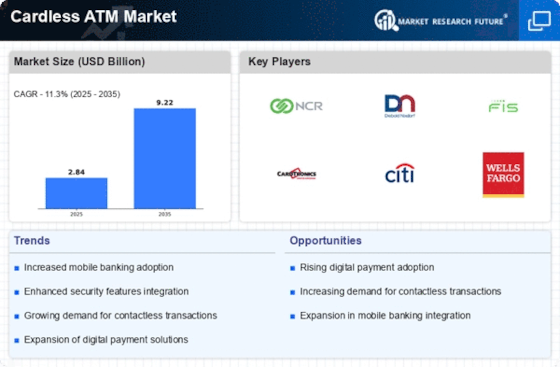
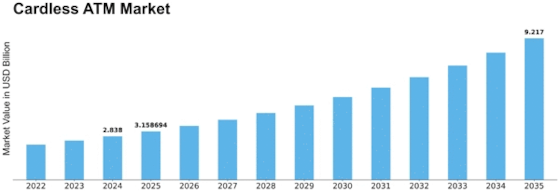
As per Market Research Future analysis, the Cardless ATM Market Size was estimated at 2.838 USD Billion in 2024. The Cardless ATM industry is projected to grow from 3.159 USD Billion in 2025 to 9.217 USD Billion by 2035, exhibiting a compound annual growth rate (CAGR) of 11.3% during the forecast period 2025 - 2035

Key Market Trends & Highlights

The Cardless ATM Market is experiencing robust growth driven by technological advancements and evolving consumer preferences.

  • North America remains the largest market for cardless ATMs, reflecting a strong adoption of digital banking solutions. Asia-Pacific is emerging as the fastest-growing region, propelled by increasing smartphone penetration and demand for contactless transactions. The on-site segment dominates the market, while the off-site segment is rapidly gaining traction due to its convenience and accessibility. Technological advancements in banking and rising demand for contactless transactions are key drivers fueling market expansion.

Market Size & Forecast

2024 Market Size 2.838 (USD Billion)
2035 Market Size 9.217 (USD Billion)
CAGR (2025 - 2035) 11.3%
Largest Regional Market Share in 2024 North America

Major Players

<a href="https://cloud.google.com/blog/topics/partners/how-ncr-and-opus-migrated-ncr-authentic-cards-to-google-cloud">NCR Corporation</a> (US), Diebold Nixdorf (US), FIS (US), Cardtronics (US), Citi (US), Wells Fargo (US), Bank of America (US), <a href="https://www.onesafe.io/blog/jpmorgan-freezes-accounts-venezuelan-fintech">JPMorgan Chase </a>(US), Visa (US), Mastercard (US)

Market Trends

The Cardless ATM Market is currently experiencing a notable transformation, driven by advancements in technology and changing consumer preferences. As financial institutions increasingly adopt digital solutions, the demand for cardless transactions is on the rise. This shift appears to be influenced by the growing emphasis on convenience and security, as users seek seamless access to their funds without the need for physical cards. Moreover, the integration of mobile banking applications with ATM networks is enhancing user experience, allowing for quicker and more efficient transactions. This trend suggests a potential for further innovation in the sector, as banks and fintech companies explore new ways to streamline services. In addition, the Cardless ATM Market is likely to benefit from the increasing penetration of smartphones and mobile wallets. As more individuals embrace digital payment methods, the reliance on traditional banking practices diminishes. This evolution may lead to a broader acceptance of cardless solutions, as consumers become more comfortable with technology-driven financial services. Furthermore, regulatory support for digital banking initiatives could further bolster market growth, creating an environment conducive to the expansion of cardless ATM services. Overall, the landscape of the Cardless ATM Market appears poised for significant evolution in the coming years, reflecting broader trends in the financial services industry.

The expanding cardless ATM market size reflects strong adoption of digital banking infrastructure, driven by increasing consumer demand for secure and convenient cash access solutions. Current cardless ATM market analysis indicates sustained momentum supported by mobile banking integration, regulatory encouragement, and continuous technology innovation. Emerging cardless ATM market trends highlight rapid adoption of biometric authentication, QR-enabled transactions, and seamless mobile wallet integration. Regional competition continues to shape cardless ATM market share distribution, with North America leading while Europe and Asia-Pacific demonstrate accelerating adoption.

Technological Integration

The integration of advanced technologies into the Cardless ATM Market is reshaping how consumers interact with banking services. Innovations such as biometric authentication and QR code scanning are enhancing security and user convenience. This trend indicates a shift towards more sophisticated and user-friendly interfaces, which may attract a broader customer base.

Consumer Preference for Convenience

There is a growing consumer preference for convenience in financial transactions, which is driving the adoption of cardless ATMs. Users increasingly favor quick and easy access to their funds without the need for physical cards. This trend suggests that financial institutions must adapt to meet evolving customer expectations.

Regulatory Support for Digital Banking

Regulatory frameworks are evolving to support the growth of digital banking solutions, including cardless ATMs. This trend indicates a favorable environment for innovation and expansion within the Cardless ATM Market, as policymakers recognize the importance of facilitating secure and efficient financial transactions.

Cardless ATM Market Market Drivers

Enhanced Security Features

The Cardless ATM Market is also being propelled by enhanced security features that accompany cardless transactions. Financial institutions are increasingly implementing advanced security measures such as encryption and two-factor authentication to protect user data. This focus on security is crucial, as it addresses consumer concerns regarding fraud and identity theft. Recent surveys indicate that 70% of consumers are more likely to use cardless ATMs if they feel confident in the security of the transaction process. As security continues to be a priority for banks, the Cardless ATM Market is likely to thrive, attracting more users who prioritize safe banking practices.

Increased Smartphone Penetration

The Cardless ATM Market is benefiting from the increased penetration of smartphones across various demographics. With over 80% of the population in developed regions owning smartphones, the accessibility of banking applications has never been higher. This trend facilitates the use of cardless ATMs, as users can easily initiate transactions through their mobile devices. Furthermore, the proliferation of mobile wallets and payment apps is likely to drive the adoption of cardless ATM services. As more consumers embrace digital banking solutions, the Cardless ATM Market is expected to witness substantial growth, reflecting the changing landscape of financial services.

Technological Advancements in Banking

The Cardless ATM Market is experiencing a surge due to rapid technological advancements in banking. Innovations such as mobile banking applications and biometric authentication are enhancing user experience and security. According to recent data, the integration of these technologies has led to a 30% increase in cardless transactions over the past year. This trend indicates a growing acceptance of digital solutions among consumers, who are increasingly seeking convenience and efficiency in their banking activities. As financial institutions invest in modernizing their infrastructure, the Cardless ATM Market is likely to expand further, driven by the demand for seamless and secure access to funds without the need for physical cards.

Rising Demand for Contactless Transactions

The Cardless ATM Market is significantly influenced by the rising demand for contactless transactions. As consumers become more health-conscious and prefer touchless interactions, the adoption of cardless ATMs is on the rise. Recent statistics suggest that contactless payment methods have seen a 40% increase in usage, which directly correlates with the growth of cardless ATM services. This shift in consumer behavior is prompting banks and financial institutions to adapt their services accordingly. Consequently, the Cardless ATM Market is poised for growth as it aligns with the broader trend of enhancing customer safety and convenience in financial transactions.

Regulatory Support for Digital Banking Solutions

The Cardless ATM Market is positively impacted by regulatory support for digital banking solutions. Governments and financial authorities are increasingly recognizing the importance of promoting digital financial services to enhance financial inclusion. Recent policy initiatives have encouraged banks to adopt innovative technologies, including cardless ATM systems. This regulatory backing not only fosters a conducive environment for growth but also instills consumer confidence in using digital banking services. As regulations evolve to support technological advancements, the Cardless ATM Market is expected to expand, driven by a favorable policy landscape that encourages the adoption of modern banking solutions.

Market Segment Insights

By Type: On-site (Largest) vs. Off-site (Fastest-Growing)

In the Cardless ATM Market, the distribution of market share among different types is revealing a significant trend. The on-site segment currently commands the largest share, providing consumers easy access to banking services directly within retail and banking locations. In contrast, off-site ATMs are gaining traction with their convenience and accessibility in various public places, catering to the growing demand for cashless transactions and increased mobility. This shift demonstrates a diversification of services catering to varied consumer needs as technology continues to evolve. The growth trends within this segment highlight the changing landscape of consumer behavior and preferences. Off-site ATMs are fast becoming the preferred choice for users seeking convenience, fueled by technological advances and the widespread adoption of mobile banking. As financial institutions increasingly explore innovative ways to enhance user experience, both on-site and off-site ATM solutions are poised for continuous development, paving the way for a more integrated and efficient banking system in the Cardless ATM Market.

Usage: On-site (Dominant) vs. Off-site (Emerging)

The on-site ATM segment stands out as a dominant force in the Cardless ATM Market, characterized by its strategic placement within banks and retail outlets. These locations provide a straightforward approach for customers aiming for direct transactions, ensuring reliability and trust. Equally important is the off-site segment, which is rapidly emerging and gaining recognition among consumers for its accessibility in public spaces such as shopping centers, airports, and university campuses. This shift in consumer preference reflects a desire for more flexible banking solutions outside traditional settings. Off-site ATMs cater to a tech-savvy demographic that seeks efficiency, drawing in foot traffic and adapting to evolving financial habits. The continuity in investment and innovation in both on-site and off-site segments portrays a dynamic market responding to user needs.

By Technology: Near-field Communication (NFC) (Largest) vs. Biometric Verification (Fastest-Growing)

In the Cardless ATM Market, various technologies are employed, with Near-field Communication (NFC) holding the largest market share. This technology allows users to access ATMs conveniently through mobile devices, leading to its widespread adoption in many regions. Following NFC, Biometric Verification is emerging as a significant player, leveraging advanced authentication techniques to enhance security and user confidence. Quick Response (QR) Codes, while popular, currently hold a smaller share as compared to these two technologies.

Technology: NFC (Dominant) vs. Biometric Verification (Emerging)

Near-field Communication (NFC) technology is dominating the Cardless ATM Market, providing a seamless, contactless experience that resonates with the growing consumer preference for mobile banking solutions. NFC allows users to perform transactions simply by tapping their smartphones, making it highly convenient. In contrast, Biometric Verification is an emerging technology, rapidly gaining traction due to its potential to significantly enhance security through unique user identification methods such as fingerprints and facial recognition. This technology is particularly appealing for its ability to reduce fraud and increase transaction safety, positioning it as a vital player for future growth in the cardless ATM landscape.

By End User: Bank and Financial Institutions (Largest) vs. Independent ATM Deployers (Fastest-Growing)

In the Cardless ATM Market, 'Bank and Financial Institutions' represent the largest segment, capturing a significant portion of market share due to their extensive networks and established customer bases. These institutions leverage cardless technology to enhance user convenience and improve service efficiency while ensuring security. In contrast, 'Independent ATM Deployers' have shown increasing traction in recent years, targeting underserved markets and harnessing advanced technologies to provide flexible and accessible solutions. This shift highlights the changing landscape of the ATM ecosystem, prompting traditional banks to adapt accordingly. Growth trends in the cardless ATM segment reveal an increasing preference for seamless and contactless banking solutions, driven by the rise of mobile banking apps and fintech innovations. As digital financial services gain traction, both banks and independent deployers are integrating cardless options to cater to consumer demands for convenience and accessibility. Factors such as heightened security concerns and the need for cost efficiencies further fuel this growth, making the cardless ATM market a dynamic space for competition and investment in the coming years.

Bank and Financial Institutions: Dominant vs. Independent ATM Deployers: Emerging

'Bank and Financial Institutions' hold a dominant position in the Cardless ATM Market, characterized by robust infrastructures and strong brand recognition. These banks invest heavily in technology to remain competitive and offer enhanced security for their users. On the other hand, 'Independent ATM Deployers' are emerging players that identify niche markets, aiming to offer customized solutions beyond traditional banking hours or locations. These deployers often capitalize on advanced technologies such as biometric authentication and mobile integrations to stand out in the market. While banks focus on expanding their service capacities, independent deployers challenge the status quo by introducing innovative offerings that cater to the evolving needs of consumers, thus promoting healthy competition.

Get more detailed insights about Cardless ATM Market Research Report - Global Forecast till 2035

Regional Insights

North America : Technological Innovation Leader

North America is the largest market for cardless ATMs, holding approximately 45% of the global market share. The region's growth is driven by increasing consumer demand for convenient banking solutions, coupled with advancements in mobile payment technologies. Regulatory support for digital banking initiatives further catalyzes market expansion, as financial institutions seek to enhance customer experience and reduce operational costs. The United States is the leading country in this market, with major players like NCR Corporation, Diebold Nixdorf, and FIS dominating the landscape. The competitive environment is characterized by continuous innovation and partnerships among banks and technology providers. Key financial institutions such as Wells Fargo and JPMorgan Chase are actively investing in cardless ATM solutions to meet evolving consumer preferences, ensuring a robust market presence. The Canada cardless ATM market is witnessing steady expansion as banks modernize ATM networks to align with mobile-first banking preferences.

Europe : Emerging Market Dynamics

Europe is witnessing significant growth in the cardless ATM market, accounting for approximately 30% of the global share. The rise in contactless payment methods and the increasing adoption of mobile banking applications are key drivers of this trend. Regulatory frameworks across the EU are evolving to support digital banking, enhancing security measures and promoting innovation in financial services, which further fuels market growth. Leading countries in this region include the United Kingdom, Germany, and France, where major banks are investing in cardless ATM technology. Companies like Diebold Nixdorf and Cardtronics are expanding their operations to meet the growing demand. The competitive landscape is marked by collaborations between banks and fintech companies, aiming to enhance customer convenience and streamline banking operations. The Europe cardless ATM market is expanding steadily as financial institutions accelerate investments in contactless banking infrastructure and mobile-first service models. Growth in the germany cardless ATM market is driven by advanced banking digitization initiatives, while the uk cardless ATM market benefits from widespread mobile payment adoption. Similarly, the france cardless ATM market is expanding through fintech collaboration, and the italy cardless ATM market reflects rising consumer demand for secure cardless transactions. Meanwhile, the spain cardless ATM market continues to grow alongside increasing digital banking penetration.

Asia-Pacific : Rapid Adoption of Technology

Asia-Pacific is rapidly emerging as a significant player in the cardless ATM market, holding around 20% of the global market share. The region's growth is propelled by the increasing smartphone penetration and the rising trend of digital banking among consumers. Governments are also promoting cashless transactions, which is further driving the demand for cardless ATM solutions across various countries in the region. Countries like China, India, and Japan are at the forefront of this transformation, with local banks and financial institutions investing heavily in technology. Key players such as FIS and Visa are actively participating in this market, enhancing their offerings to cater to the growing consumer base. The competitive landscape is characterized by rapid technological advancements and a focus on improving user experience in banking services. The China cardless ATM market is advancing rapidly due to strong digital payment ecosystems, while the south korea cardless ATM market reflects high consumer adoption of biometric-enabled banking technologies.

Middle East and Africa : Untapped Market Potential

The Middle East and Africa region is gradually emerging in the cardless ATM market, currently holding about 5% of the global share. The growth is driven by increasing financial inclusion initiatives and the rising adoption of mobile banking solutions. Governments are focusing on enhancing digital infrastructure, which is expected to catalyze the demand for cardless ATMs in the coming years, as more consumers seek convenient banking options. Leading countries in this region include South Africa and the UAE, where banks are beginning to implement cardless ATM technology. The competitive landscape is still developing, with local and international players exploring opportunities to expand their services. Companies like Mastercard are investing in partnerships to enhance their presence in this market, aiming to meet the evolving needs of consumers in the region. The GCC cardless ATM market is emerging as governments promote digital financial infrastructure and smart banking initiatives.

Key Players and Competitive Insights

Leading market players are conducting research and development to expand their offering, which will help the Cardless ATM Market grow even further. Companies are also undertaking strategic initiatives to expand their global market share, with important market developments including introducing new products, collaborations, joint ventures, expansion, and agreements. In recent years, the Cardless ATM industry has been through several new advancements, such as the launch of modernized and easy-to-use ATMs. Major Cardless ATM Market players include Citigroup Inc., JPMorgan Chase & Co., Fujitsu, Santander Group, GRG Banking, NCR Corporation, HSBC Bank A.S., Wells Fargo, Barclays Bank PLC, and ICICI Bank Ltd. Citigroup Inc offers a variety of financial services. It offers retail, commercial, and investment banking, securities brokerage, trade and securities services, and wealth management solutions. The group offers a variety of accounts and deposit services, debit and credit cards, banking solutions for small businesses, loans and mortgages, treasury and trade services, and corporate and institutional lending. In addition to asset management, capital market, and securities services, Citigroup provides asset management, capital market, and securities services. The group is in the Americas, Asia-Pacific Europe, the Middle East, and Africa and serves individuals, corporations, small enterprises, institutions, and government entities. Citigroup's headquarters are in New York, United States. JPMorgan Chase & Co is a financial holding corporation whose subsidiaries provide solutions for consumer and commercial banking, financial transaction processing, investment banking, and asset management. The consumer enterprises include, among others, credit cards, small businesses, auto financing, education financing, and merchant services. Commercial banking services include, among others, middle market banking, corporate credit, equipment financing, and commercial term lending. The company provides commercial banking services such as corporate client banking and banking for government, non-profit organizations, and the healthcare industry. Under the J.P. Morgan and Chase brands, the corporation offers asset management, investment banking, treasury services, private banking, wealth management, US consumer and commercial banking operations, and brokerage services. Europe, Asia-Pacific, the Middle East and Africa, and the Americas are among the regions where the company operates. JPM is based in New York City, New York, United States.

Key Companies in the Cardless ATM Market include

Industry Developments

August 2021: National Australia Bank Limited (NAB) and Microsoft collaborated to develop a proof-of-concept ATM using cloud and artificial intelligence (AI) technology. The Azure Cognitive Services-built cloud application is intended to enhance the customer experience by eliminating the need for physical cards or devices to access currency from ATMs. A client who opts into the service would instead be able to withdraw cash via an ATM using facial recognition technology and a personal identification number, or PIN.

April 2021: NCR Corporation introduced the first interoperable cardless cash withdrawal (ICCW) solution based on the UPI platform. This feature lets consumers withdraw cash via their mobile device and any UPI-enabled application, including BHIM, Paytm, GPay, etc. There is no requirement to swipe or possess a card when using UPI-enabled ATMs. A user must scan the QR code on the screen and authorize cash withdrawals using their mobile device.

January 2022: ICICI Bank announced the launch of a 'Cardless Cash Withdrawal' service at its ATMs. This service enables clients to withdraw cash from the bank's more than 15,000 ATMs by submitting a request through its mobile banking application, iMobile. It is a simple and convenient alternative to using a debit card to withdraw cash. Customers not wanting to carry their debit card may use the 'Cardless Cash Withdrawal' service for self-withdrawal. Both the daily and per-transaction limits have been set at Rs. 20,000.

Future Outlook

Cardless ATM Market Future Outlook

The Cardless ATM Market is projected to grow at 11.3% CAGR from 2025 to 2035, driven by technological advancements, increased smartphone penetration, and consumer demand for convenience.

New opportunities lie in:

  • <p>Integration of biometric authentication for enhanced security Partnerships with fintech firms for innovative payment solutions Expansion into underserved markets with mobile banking initiatives</p>

By 2035, the Cardless ATM Market is expected to be robust, reflecting substantial growth and innovation.

Market Segmentation

Cardless ATM Market Type Outlook

  • On-site
  • Off-site
  • Others

Cardless ATM Market End User Outlook

  • Bank and Financial Institutions
  • Independent ATM Deployers

Cardless ATM Market Technology Outlook

  • Near-field Communication (NFC)
  • Quick Response (QR) Codes
  • Biometric Verification

Report Scope

MARKET SIZE 2024 2.838(USD Billion)
MARKET SIZE 2025 3.159(USD Billion)
MARKET SIZE 2035 9.217(USD Billion)
COMPOUND ANNUAL GROWTH RATE (CAGR) 11.3% (2025 - 2035)
REPORT COVERAGE Revenue Forecast, Competitive Landscape, Growth Factors, and Trends
BASE YEAR 2024
Market Forecast Period 2025 - 2035
Historical Data 2019 - 2024
Market Forecast Units USD Billion
Key Companies Profiled NCR Corporation (US), Diebold Nixdorf (US), FIS (US), Cardtronics (US), Citi (US), Wells Fargo (US), Bank of America (US), JPMorgan Chase (US), Visa (US), Mastercard (US)
Segments Covered Type, Technology, End User, Region
Key Market Opportunities Integration of biometric authentication enhances security and user experience in the Cardless ATM Market.
Key Market Dynamics Rising consumer preference for contactless transactions drives innovation in cardless ATM technology and service offerings.
Countries Covered North America, Europe, APAC, South America, MEA

FAQs

What is the projected market valuation of the Cardless ATM Market by 2035?

<p>The Cardless ATM Market is projected to reach a valuation of 9.217 USD Billion by 2035.</p>

What was the market valuation of the Cardless ATM Market in 2024?

<p>In 2024, the Cardless ATM Market had a valuation of 2.838 USD Billion.</p>

What is the expected CAGR for the Cardless ATM Market during the forecast period 2025 - 2035?

<p>The expected CAGR for the Cardless ATM Market during the forecast period 2025 - 2035 is 11.3%.</p>

Which companies are considered key players in the Cardless ATM Market?

<p>Key players in the Cardless ATM Market include NCR Corporation, Diebold Nixdorf, FIS, and Cardtronics, among others.</p>

What are the main segments of the Cardless ATM Market?

<p>The main segments of the Cardless ATM Market include Type, Technology, and End User.</p>

How did the On-site segment perform in terms of valuation in 2024?

<p>The On-site segment was valued at 0.851 USD Billion in 2024.</p>

What is the projected valuation for the Off-site segment by 2035?

The Off-site segment is projected to reach a valuation of 4.607 USD Billion by 2035.

What technologies are driving the Cardless ATM Market?

Technologies driving the Cardless ATM Market include Near-field Communication (NFC), Quick Response (QR) Codes, and Biometric Verification.

What was the valuation of the Biometric Verification technology in 2024?

The Biometric Verification technology was valued at 1.135 USD Billion in 2024.

Which end users are primarily involved in the Cardless ATM Market?

The primary end users in the Cardless ATM Market are Bank and Financial Institutions and Independent ATM Deployers.

  1. SECTION I: EXECUTIVE SUMMARY AND KEY HIGHLIGHTS
    1. | 1.1 EXECUTIVE SUMMARY
    2. | | 1.1.1 Market Overview
    3. | | 1.1.2 Key Findings
    4. | | 1.1.3 Market Segmentation
    5. | | 1.1.4 Competitive Landscape
    6. | | 1.1.5 Challenges and Opportunities
    7. | | 1.1.6 Future Outlook
  2. SECTION II: SCOPING, METHODOLOGY AND MARKET STRUCTURE
    1. | 2.1 MARKET INTRODUCTION
    2. | | 2.1.1 Definition
    3. | | 2.1.2 Scope of the study
    4. | | | 2.1.2.1 Research Objective
    5. | | | 2.1.2.2 Assumption
    6. | | | 2.1.2.3 Limitations
    7. | 2.2 RESEARCH METHODOLOGY
    8. | | 2.2.1 Overview
    9. | | 2.2.2 Data Mining
    10. | | 2.2.3 Secondary Research
    11. | | 2.2.4 Primary Research
    12. | | | 2.2.4.1 Primary Interviews and Information Gathering Process
    13. | | | 2.2.4.2 Breakdown of Primary Respondents
    14. | | 2.2.5 Forecasting Model
    15. | | 2.2.6 Market Size Estimation
    16. | | | 2.2.6.1 Bottom-Up Approach
    17. | | | 2.2.6.2 Top-Down Approach
    18. | | 2.2.7 Data Triangulation
    19. | | 2.2.8 Validation
  3. SECTION III: QUALITATIVE ANALYSIS
    1. | 3.1 MARKET DYNAMICS
    2. | | 3.1.1 Overview
    3. | | 3.1.2 Drivers
    4. | | 3.1.3 Restraints
    5. | | 3.1.4 Opportunities
    6. | 3.2 MARKET FACTOR ANALYSIS
    7. | | 3.2.1 Value chain Analysis
    8. | | 3.2.2 Porter's Five Forces Analysis
    9. | | | 3.2.2.1 Bargaining Power of Suppliers
    10. | | | 3.2.2.2 Bargaining Power of Buyers
    11. | | | 3.2.2.3 Threat of New Entrants
    12. | | | 3.2.2.4 Threat of Substitutes
    13. | | | 3.2.2.5 Intensity of Rivalry
    14. | | 3.2.3 COVID-19 Impact Analysis
    15. | | | 3.2.3.1 Market Impact Analysis
    16. | | | 3.2.3.2 Regional Impact
    17. | | | 3.2.3.3 Opportunity and Threat Analysis
  4. SECTION IV: QUANTITATIVE ANALYSIS
    1. | 4.1 Information and Communications Technology, BY Type (USD Billion)
    2. | | 4.1.1 On-site
    3. | | 4.1.2 Off-site
    4. | | 4.1.3 Others
    5. | 4.2 Information and Communications Technology, BY Technology (USD Billion)
    6. | | 4.2.1 Near-field Communication (NFC)
    7. | | 4.2.2 Quick Response (QR) Codes
    8. | | 4.2.3 Biometric Verification
    9. | 4.3 Information and Communications Technology, BY End User (USD Billion)
    10. | | 4.3.1 Bank and Financial Institutions
    11. | | 4.3.2 Independent ATM Deployers
    12. | 4.4 Information and Communications Technology, BY Region (USD Billion)
    13. | | 4.4.1 North America
    14. | | | 4.4.1.1 US
    15. | | | 4.4.1.2 Canada
    16. | | 4.4.2 Europe
    17. | | | 4.4.2.1 Germany
    18. | | | 4.4.2.2 UK
    19. | | | 4.4.2.3 France
    20. | | | 4.4.2.4 Russia
    21. | | | 4.4.2.5 Italy
    22. | | | 4.4.2.6 Spain
    23. | | | 4.4.2.7 Rest of Europe
    24. | | 4.4.3 APAC
    25. | | | 4.4.3.1 China
    26. | | | 4.4.3.2 India
    27. | | | 4.4.3.3 Japan
    28. | | | 4.4.3.4 South Korea
    29. | | | 4.4.3.5 Malaysia
    30. | | | 4.4.3.6 Thailand
    31. | | | 4.4.3.7 Indonesia
    32. | | | 4.4.3.8 Rest of APAC
    33. | | 4.4.4 South America
    34. | | | 4.4.4.1 Brazil
    35. | | | 4.4.4.2 Mexico
    36. | | | 4.4.4.3 Argentina
    37. | | | 4.4.4.4 Rest of South America
    38. | | 4.4.5 MEA
    39. | | | 4.4.5.1 GCC Countries
    40. | | | 4.4.5.2 South Africa
    41. | | | 4.4.5.3 Rest of MEA
  5. SECTION V: COMPETITIVE ANALYSIS
    1. | 5.1 Competitive Landscape
    2. | | 5.1.1 Overview
    3. | | 5.1.2 Competitive Analysis
    4. | | 5.1.3 Market share Analysis
    5. | | 5.1.4 Major Growth Strategy in the Information and Communications Technology
    6. | | 5.1.5 Competitive Benchmarking
    7. | | 5.1.6 Leading Players in Terms of Number of Developments in the Information and Communications Technology
    8. | | 5.1.7 Key developments and growth strategies
    9. | | | 5.1.7.1 New Product Launch/Service Deployment
    10. | | | 5.1.7.2 Merger & Acquisitions
    11. | | | 5.1.7.3 Joint Ventures
    12. | | 5.1.8 Major Players Financial Matrix
    13. | | | 5.1.8.1 Sales and Operating Income
    14. | | | 5.1.8.2 Major Players R&D Expenditure. 2023
    15. | 5.2 Company Profiles
    16. | | 5.2.1 NCR Corporation (US)
    17. | | | 5.2.1.1 Financial Overview
    18. | | | 5.2.1.2 Products Offered
    19. | | | 5.2.1.3 Key Developments
    20. | | | 5.2.1.4 SWOT Analysis
    21. | | | 5.2.1.5 Key Strategies
    22. | | 5.2.2 Diebold Nixdorf (US)
    23. | | | 5.2.2.1 Financial Overview
    24. | | | 5.2.2.2 Products Offered
    25. | | | 5.2.2.3 Key Developments
    26. | | | 5.2.2.4 SWOT Analysis
    27. | | | 5.2.2.5 Key Strategies
    28. | | 5.2.3 FIS (US)
    29. | | | 5.2.3.1 Financial Overview
    30. | | | 5.2.3.2 Products Offered
    31. | | | 5.2.3.3 Key Developments
    32. | | | 5.2.3.4 SWOT Analysis
    33. | | | 5.2.3.5 Key Strategies
    34. | | 5.2.4 Cardtronics (US)
    35. | | | 5.2.4.1 Financial Overview
    36. | | | 5.2.4.2 Products Offered
    37. | | | 5.2.4.3 Key Developments
    38. | | | 5.2.4.4 SWOT Analysis
    39. | | | 5.2.4.5 Key Strategies
    40. | | 5.2.5 Citi (US)
    41. | | | 5.2.5.1 Financial Overview
    42. | | | 5.2.5.2 Products Offered
    43. | | | 5.2.5.3 Key Developments
    44. | | | 5.2.5.4 SWOT Analysis
    45. | | | 5.2.5.5 Key Strategies
    46. | | 5.2.6 Wells Fargo (US)
    47. | | | 5.2.6.1 Financial Overview
    48. | | | 5.2.6.2 Products Offered
    49. | | | 5.2.6.3 Key Developments
    50. | | | 5.2.6.4 SWOT Analysis
    51. | | | 5.2.6.5 Key Strategies
    52. | | 5.2.7 Bank of America (US)
    53. | | | 5.2.7.1 Financial Overview
    54. | | | 5.2.7.2 Products Offered
    55. | | | 5.2.7.3 Key Developments
    56. | | | 5.2.7.4 SWOT Analysis
    57. | | | 5.2.7.5 Key Strategies
    58. | | 5.2.8 JPMorgan Chase (US)
    59. | | | 5.2.8.1 Financial Overview
    60. | | | 5.2.8.2 Products Offered
    61. | | | 5.2.8.3 Key Developments
    62. | | | 5.2.8.4 SWOT Analysis
    63. | | | 5.2.8.5 Key Strategies
    64. | | 5.2.9 Visa (US)
    65. | | | 5.2.9.1 Financial Overview
    66. | | | 5.2.9.2 Products Offered
    67. | | | 5.2.9.3 Key Developments
    68. | | | 5.2.9.4 SWOT Analysis
    69. | | | 5.2.9.5 Key Strategies
    70. | | 5.2.10 Mastercard (US)
    71. | | | 5.2.10.1 Financial Overview
    72. | | | 5.2.10.2 Products Offered
    73. | | | 5.2.10.3 Key Developments
    74. | | | 5.2.10.4 SWOT Analysis
    75. | | | 5.2.10.5 Key Strategies
    76. | 5.3 Appendix
    77. | | 5.3.1 References
    78. | | 5.3.2 Related Reports
  6. LIST OF FIGURES
    1. | 6.1 MARKET SYNOPSIS
    2. | 6.2 NORTH AMERICA MARKET ANALYSIS
    3. | 6.3 US MARKET ANALYSIS BY TYPE
    4. | 6.4 US MARKET ANALYSIS BY TECHNOLOGY
    5. | 6.5 US MARKET ANALYSIS BY END USER
    6. | 6.6 CANADA MARKET ANALYSIS BY TYPE
    7. | 6.7 CANADA MARKET ANALYSIS BY TECHNOLOGY
    8. | 6.8 CANADA MARKET ANALYSIS BY END USER
    9. | 6.9 EUROPE MARKET ANALYSIS
    10. | 6.10 GERMANY MARKET ANALYSIS BY TYPE
    11. | 6.11 GERMANY MARKET ANALYSIS BY TECHNOLOGY
    12. | 6.12 GERMANY MARKET ANALYSIS BY END USER
    13. | 6.13 UK MARKET ANALYSIS BY TYPE
    14. | 6.14 UK MARKET ANALYSIS BY TECHNOLOGY
    15. | 6.15 UK MARKET ANALYSIS BY END USER
    16. | 6.16 FRANCE MARKET ANALYSIS BY TYPE
    17. | 6.17 FRANCE MARKET ANALYSIS BY TECHNOLOGY
    18. | 6.18 FRANCE MARKET ANALYSIS BY END USER
    19. | 6.19 RUSSIA MARKET ANALYSIS BY TYPE
    20. | 6.20 RUSSIA MARKET ANALYSIS BY TECHNOLOGY
    21. | 6.21 RUSSIA MARKET ANALYSIS BY END USER
    22. | 6.22 ITALY MARKET ANALYSIS BY TYPE
    23. | 6.23 ITALY MARKET ANALYSIS BY TECHNOLOGY
    24. | 6.24 ITALY MARKET ANALYSIS BY END USER
    25. | 6.25 SPAIN MARKET ANALYSIS BY TYPE
    26. | 6.26 SPAIN MARKET ANALYSIS BY TECHNOLOGY
    27. | 6.27 SPAIN MARKET ANALYSIS BY END USER
    28. | 6.28 REST OF EUROPE MARKET ANALYSIS BY TYPE
    29. | 6.29 REST OF EUROPE MARKET ANALYSIS BY TECHNOLOGY
    30. | 6.30 REST OF EUROPE MARKET ANALYSIS BY END USER
    31. | 6.31 APAC MARKET ANALYSIS
    32. | 6.32 CHINA MARKET ANALYSIS BY TYPE
    33. | 6.33 CHINA MARKET ANALYSIS BY TECHNOLOGY
    34. | 6.34 CHINA MARKET ANALYSIS BY END USER
    35. | 6.35 INDIA MARKET ANALYSIS BY TYPE
    36. | 6.36 INDIA MARKET ANALYSIS BY TECHNOLOGY
    37. | 6.37 INDIA MARKET ANALYSIS BY END USER
    38. | 6.38 JAPAN MARKET ANALYSIS BY TYPE
    39. | 6.39 JAPAN MARKET ANALYSIS BY TECHNOLOGY
    40. | 6.40 JAPAN MARKET ANALYSIS BY END USER
    41. | 6.41 SOUTH KOREA MARKET ANALYSIS BY TYPE
    42. | 6.42 SOUTH KOREA MARKET ANALYSIS BY TECHNOLOGY
    43. | 6.43 SOUTH KOREA MARKET ANALYSIS BY END USER
    44. | 6.44 MALAYSIA MARKET ANALYSIS BY TYPE
    45. | 6.45 MALAYSIA MARKET ANALYSIS BY TECHNOLOGY
    46. | 6.46 MALAYSIA MARKET ANALYSIS BY END USER
    47. | 6.47 THAILAND MARKET ANALYSIS BY TYPE
    48. | 6.48 THAILAND MARKET ANALYSIS BY TECHNOLOGY
    49. | 6.49 THAILAND MARKET ANALYSIS BY END USER
    50. | 6.50 INDONESIA MARKET ANALYSIS BY TYPE
    51. | 6.51 INDONESIA MARKET ANALYSIS BY TECHNOLOGY
    52. | 6.52 INDONESIA MARKET ANALYSIS BY END USER
    53. | 6.53 REST OF APAC MARKET ANALYSIS BY TYPE
    54. | 6.54 REST OF APAC MARKET ANALYSIS BY TECHNOLOGY
    55. | 6.55 REST OF APAC MARKET ANALYSIS BY END USER
    56. | 6.56 SOUTH AMERICA MARKET ANALYSIS
    57. | 6.57 BRAZIL MARKET ANALYSIS BY TYPE
    58. | 6.58 BRAZIL MARKET ANALYSIS BY TECHNOLOGY
    59. | 6.59 BRAZIL MARKET ANALYSIS BY END USER
    60. | 6.60 MEXICO MARKET ANALYSIS BY TYPE
    61. | 6.61 MEXICO MARKET ANALYSIS BY TECHNOLOGY
    62. | 6.62 MEXICO MARKET ANALYSIS BY END USER
    63. | 6.63 ARGENTINA MARKET ANALYSIS BY TYPE
    64. | 6.64 ARGENTINA MARKET ANALYSIS BY TECHNOLOGY
    65. | 6.65 ARGENTINA MARKET ANALYSIS BY END USER
    66. | 6.66 REST OF SOUTH AMERICA MARKET ANALYSIS BY TYPE
    67. | 6.67 REST OF SOUTH AMERICA MARKET ANALYSIS BY TECHNOLOGY
    68. | 6.68 REST OF SOUTH AMERICA MARKET ANALYSIS BY END USER
    69. | 6.69 MEA MARKET ANALYSIS
    70. | 6.70 GCC COUNTRIES MARKET ANALYSIS BY TYPE
    71. | 6.71 GCC COUNTRIES MARKET ANALYSIS BY TECHNOLOGY
    72. | 6.72 GCC COUNTRIES MARKET ANALYSIS BY END USER
    73. | 6.73 SOUTH AFRICA MARKET ANALYSIS BY TYPE
    74. | 6.74 SOUTH AFRICA MARKET ANALYSIS BY TECHNOLOGY
    75. | 6.75 SOUTH AFRICA MARKET ANALYSIS BY END USER
    76. | 6.76 REST OF MEA MARKET ANALYSIS BY TYPE
    77. | 6.77 REST OF MEA MARKET ANALYSIS BY TECHNOLOGY
    78. | 6.78 REST OF MEA MARKET ANALYSIS BY END USER
    79. | 6.79 KEY BUYING CRITERIA OF INFORMATION AND COMMUNICATIONS TECHNOLOGY
    80. | 6.80 RESEARCH PROCESS OF MRFR
    81. | 6.81 DRO ANALYSIS OF INFORMATION AND COMMUNICATIONS TECHNOLOGY
    82. | 6.82 DRIVERS IMPACT ANALYSIS: INFORMATION AND COMMUNICATIONS TECHNOLOGY
    83. | 6.83 RESTRAINTS IMPACT ANALYSIS: INFORMATION AND COMMUNICATIONS TECHNOLOGY
    84. | 6.84 SUPPLY / VALUE CHAIN: INFORMATION AND COMMUNICATIONS TECHNOLOGY
    85. | 6.85 INFORMATION AND COMMUNICATIONS TECHNOLOGY, BY TYPE, 2024 (% SHARE)
    86. | 6.86 INFORMATION AND COMMUNICATIONS TECHNOLOGY, BY TYPE, 2024 TO 2035 (USD Billion)
    87. | 6.87 INFORMATION AND COMMUNICATIONS TECHNOLOGY, BY TECHNOLOGY, 2024 (% SHARE)
    88. | 6.88 INFORMATION AND COMMUNICATIONS TECHNOLOGY, BY TECHNOLOGY, 2024 TO 2035 (USD Billion)
    89. | 6.89 INFORMATION AND COMMUNICATIONS TECHNOLOGY, BY END USER, 2024 (% SHARE)
    90. | 6.90 INFORMATION AND COMMUNICATIONS TECHNOLOGY, BY END USER, 2024 TO 2035 (USD Billion)
    91. | 6.91 BENCHMARKING OF MAJOR COMPETITORS
  7. LIST OF TABLES
    1. | 7.1 LIST OF ASSUMPTIONS
    2. | | 7.1.1
    3. | 7.2 North America MARKET SIZE ESTIMATES; FORECAST
    4. | | 7.2.1 BY TYPE, 2025-2035 (USD Billion)
    5. | | 7.2.2 BY TECHNOLOGY, 2025-2035 (USD Billion)
    6. | | 7.2.3 BY END USER, 2025-2035 (USD Billion)
    7. | 7.3 US MARKET SIZE ESTIMATES; FORECAST
    8. | | 7.3.1 BY TYPE, 2025-2035 (USD Billion)
    9. | | 7.3.2 BY TECHNOLOGY, 2025-2035 (USD Billion)
    10. | | 7.3.3 BY END USER, 2025-2035 (USD Billion)
    11. | 7.4 Canada MARKET SIZE ESTIMATES; FORECAST
    12. | | 7.4.1 BY TYPE, 2025-2035 (USD Billion)
    13. | | 7.4.2 BY TECHNOLOGY, 2025-2035 (USD Billion)
    14. | | 7.4.3 BY END USER, 2025-2035 (USD Billion)
    15. | 7.5 Europe MARKET SIZE ESTIMATES; FORECAST
    16. | | 7.5.1 BY TYPE, 2025-2035 (USD Billion)
    17. | | 7.5.2 BY TECHNOLOGY, 2025-2035 (USD Billion)
    18. | | 7.5.3 BY END USER, 2025-2035 (USD Billion)
    19. | 7.6 Germany MARKET SIZE ESTIMATES; FORECAST
    20. | | 7.6.1 BY TYPE, 2025-2035 (USD Billion)
    21. | | 7.6.2 BY TECHNOLOGY, 2025-2035 (USD Billion)
    22. | | 7.6.3 BY END USER, 2025-2035 (USD Billion)
    23. | 7.7 UK MARKET SIZE ESTIMATES; FORECAST
    24. | | 7.7.1 BY TYPE, 2025-2035 (USD Billion)
    25. | | 7.7.2 BY TECHNOLOGY, 2025-2035 (USD Billion)
    26. | | 7.7.3 BY END USER, 2025-2035 (USD Billion)
    27. | 7.8 France MARKET SIZE ESTIMATES; FORECAST
    28. | | 7.8.1 BY TYPE, 2025-2035 (USD Billion)
    29. | | 7.8.2 BY TECHNOLOGY, 2025-2035 (USD Billion)
    30. | | 7.8.3 BY END USER, 2025-2035 (USD Billion)
    31. | 7.9 Russia MARKET SIZE ESTIMATES; FORECAST
    32. | | 7.9.1 BY TYPE, 2025-2035 (USD Billion)
    33. | | 7.9.2 BY TECHNOLOGY, 2025-2035 (USD Billion)
    34. | | 7.9.3 BY END USER, 2025-2035 (USD Billion)
    35. | 7.10 Italy MARKET SIZE ESTIMATES; FORECAST
    36. | | 7.10.1 BY TYPE, 2025-2035 (USD Billion)
    37. | | 7.10.2 BY TECHNOLOGY, 2025-2035 (USD Billion)
    38. | | 7.10.3 BY END USER, 2025-2035 (USD Billion)
    39. | 7.11 Spain MARKET SIZE ESTIMATES; FORECAST
    40. | | 7.11.1 BY TYPE, 2025-2035 (USD Billion)
    41. | | 7.11.2 BY TECHNOLOGY, 2025-2035 (USD Billion)
    42. | | 7.11.3 BY END USER, 2025-2035 (USD Billion)
    43. | 7.12 Rest of Europe MARKET SIZE ESTIMATES; FORECAST
    44. | | 7.12.1 BY TYPE, 2025-2035 (USD Billion)
    45. | | 7.12.2 BY TECHNOLOGY, 2025-2035 (USD Billion)
    46. | | 7.12.3 BY END USER, 2025-2035 (USD Billion)
    47. | 7.13 APAC MARKET SIZE ESTIMATES; FORECAST
    48. | | 7.13.1 BY TYPE, 2025-2035 (USD Billion)
    49. | | 7.13.2 BY TECHNOLOGY, 2025-2035 (USD Billion)
    50. | | 7.13.3 BY END USER, 2025-2035 (USD Billion)
    51. | 7.14 China MARKET SIZE ESTIMATES; FORECAST
    52. | | 7.14.1 BY TYPE, 2025-2035 (USD Billion)
    53. | | 7.14.2 BY TECHNOLOGY, 2025-2035 (USD Billion)
    54. | | 7.14.3 BY END USER, 2025-2035 (USD Billion)
    55. | 7.15 India MARKET SIZE ESTIMATES; FORECAST
    56. | | 7.15.1 BY TYPE, 2025-2035 (USD Billion)
    57. | | 7.15.2 BY TECHNOLOGY, 2025-2035 (USD Billion)
    58. | | 7.15.3 BY END USER, 2025-2035 (USD Billion)
    59. | 7.16 Japan MARKET SIZE ESTIMATES; FORECAST
    60. | | 7.16.1 BY TYPE, 2025-2035 (USD Billion)
    61. | | 7.16.2 BY TECHNOLOGY, 2025-2035 (USD Billion)
    62. | | 7.16.3 BY END USER, 2025-2035 (USD Billion)
    63. | 7.17 South Korea MARKET SIZE ESTIMATES; FORECAST
    64. | | 7.17.1 BY TYPE, 2025-2035 (USD Billion)
    65. | | 7.17.2 BY TECHNOLOGY, 2025-2035 (USD Billion)
    66. | | 7.17.3 BY END USER, 2025-2035 (USD Billion)
    67. | 7.18 Malaysia MARKET SIZE ESTIMATES; FORECAST
    68. | | 7.18.1 BY TYPE, 2025-2035 (USD Billion)
    69. | | 7.18.2 BY TECHNOLOGY, 2025-2035 (USD Billion)
    70. | | 7.18.3 BY END USER, 2025-2035 (USD Billion)
    71. | 7.19 Thailand MARKET SIZE ESTIMATES; FORECAST
    72. | | 7.19.1 BY TYPE, 2025-2035 (USD Billion)
    73. | | 7.19.2 BY TECHNOLOGY, 2025-2035 (USD Billion)
    74. | | 7.19.3 BY END USER, 2025-2035 (USD Billion)
    75. | 7.20 Indonesia MARKET SIZE ESTIMATES; FORECAST
    76. | | 7.20.1 BY TYPE, 2025-2035 (USD Billion)
    77. | | 7.20.2 BY TECHNOLOGY, 2025-2035 (USD Billion)
    78. | | 7.20.3 BY END USER, 2025-2035 (USD Billion)
    79. | 7.21 Rest of APAC MARKET SIZE ESTIMATES; FORECAST
    80. | | 7.21.1 BY TYPE, 2025-2035 (USD Billion)
    81. | | 7.21.2 BY TECHNOLOGY, 2025-2035 (USD Billion)
    82. | | 7.21.3 BY END USER, 2025-2035 (USD Billion)
    83. | 7.22 South America MARKET SIZE ESTIMATES; FORECAST
    84. | | 7.22.1 BY TYPE, 2025-2035 (USD Billion)
    85. | | 7.22.2 BY TECHNOLOGY, 2025-2035 (USD Billion)
    86. | | 7.22.3 BY END USER, 2025-2035 (USD Billion)
    87. | 7.23 Brazil MARKET SIZE ESTIMATES; FORECAST
    88. | | 7.23.1 BY TYPE, 2025-2035 (USD Billion)
    89. | | 7.23.2 BY TECHNOLOGY, 2025-2035 (USD Billion)
    90. | | 7.23.3 BY END USER, 2025-2035 (USD Billion)
    91. | 7.24 Mexico MARKET SIZE ESTIMATES; FORECAST
    92. | | 7.24.1 BY TYPE, 2025-2035 (USD Billion)
    93. | | 7.24.2 BY TECHNOLOGY, 2025-2035 (USD Billion)
    94. | | 7.24.3 BY END USER, 2025-2035 (USD Billion)
    95. | 7.25 Argentina MARKET SIZE ESTIMATES; FORECAST
    96. | | 7.25.1 BY TYPE, 2025-2035 (USD Billion)
    97. | | 7.25.2 BY TECHNOLOGY, 2025-2035 (USD Billion)
    98. | | 7.25.3 BY END USER, 2025-2035 (USD Billion)
    99. | 7.26 Rest of South America MARKET SIZE ESTIMATES; FORECAST
    100. | | 7.26.1 BY TYPE, 2025-2035 (USD Billion)
    101. | | 7.26.2 BY TECHNOLOGY, 2025-2035 (USD Billion)
    102. | | 7.26.3 BY END USER, 2025-2035 (USD Billion)
    103. | 7.27 MEA MARKET SIZE ESTIMATES; FORECAST
    104. | | 7.27.1 BY TYPE, 2025-2035 (USD Billion)
    105. | | 7.27.2 BY TECHNOLOGY, 2025-2035 (USD Billion)
    106. | | 7.27.3 BY END USER, 2025-2035 (USD Billion)
    107. | 7.28 GCC Countries MARKET SIZE ESTIMATES; FORECAST
    108. | | 7.28.1 BY TYPE, 2025-2035 (USD Billion)
    109. | | 7.28.2 BY TECHNOLOGY, 2025-2035 (USD Billion)
    110. | | 7.28.3 BY END USER, 2025-2035 (USD Billion)
    111. | 7.29 South Africa MARKET SIZE ESTIMATES; FORECAST
    112. | | 7.29.1 BY TYPE, 2025-2035 (USD Billion)
    113. | | 7.29.2 BY TECHNOLOGY, 2025-2035 (USD Billion)
    114. | | 7.29.3 BY END USER, 2025-2035 (USD Billion)
    115. | 7.30 Rest of MEA MARKET SIZE ESTIMATES; FORECAST
    116. | | 7.30.1 BY TYPE, 2025-2035 (USD Billion)
    117. | | 7.30.2 BY TECHNOLOGY, 2025-2035 (USD Billion)
    118. | | 7.30.3 BY END USER, 2025-2035 (USD Billion)
    119. | 7.31 PRODUCT LAUNCH/PRODUCT DEVELOPMENT/APPROVAL
    120. | | 7.31.1
    121. | 7.32 ACQUISITION/PARTNERSHIP
    122. | | 7.32.1

Information and Communications Technology Market Segmentation

Information and Communications Technology By Type (USD Billion, 2025-2035)

  • On-site
  • Off-site
  • Others

Information and Communications Technology By Technology (USD Billion, 2025-2035)

  • Near-field Communication (NFC)
  • Quick Response (QR) Codes
  • Biometric Verification

Information and Communications Technology By End User (USD Billion, 2025-2035)

  • Bank and Financial Institutions
  • Independent ATM Deployers
Infographic

Free Sample Request

Kindly complete the form below to receive a free sample of this Report

Get Free Sample

Customer Strories

Compare Licence

×
Features License Type
Single User Multiuser License Enterprise User
Price $4,950 $5,950 $7,250
Maximum User Access Limit 1 User Upto 10 Users Unrestricted Access Throughout the Organization
Free Customization
Direct Access to Analyst
Deliverable Format
Platform Access
Discount on Next Purchase 10% 15% 15%
Printable Versions