Request Free Sample ×

Kindly complete the form below to receive a free sample of this Report

* Please use a valid business email

Leading companies partner with us for data-driven Insights

clients tt-cursor
Hero Background
English
Chinese
French
Japanese
Korean
German
Spanish

Car Charger Market Trends

ID: MRFR/AT/12518-HCR
128 Pages
Shubham Munde
April 2026

Car Charger Market Research Report Information By Charging Type (Manual Charging, and Automatic Charging), By Charger Type (Smart/Intelligent Charger, Float Charger, and Trickle Charger), By Portability (Plug-In Charger, and Portable Charger), By Battery Capacity (Up to 12V, 12V-48V, and Above 48V), By Product Type (Car Battery Charger, and Electric Car Battery Charger), By Application (Garage, and Personal Use), And By Region (North America, Europe, Asia-Pacific, And Rest Of The World) –Market Forecast Till 2035

Share:
Download PDF ×

We do not share your information with anyone. However, we may send you emails based on your report interest from time to time. You may contact us at any time to opt-out.

Car Charger Market Infographic
Purchase Options

Market Trends

Key Emerging Trends in the Car Charger Market

The car charger market has seen some key trends emerging over the last few years, such as changes that occurred within the automotive sector and consumer demands for user-friendly charging. A significant one is the growing demand for fast-charging technologies. As the use of EVs has increased together with demand for portable higher charging power, more powerful car chargers have become greatly popular. This demand is for much quicker and more accurate charging options to reduce the downtime and make the whole electric car ownership much more easier. Secondly, the incorporation of smart and connected capabilities into the car chargers is one notable trend. Today, cutting-edge car chargers have gained many smart characteristics that enable users to control the charging progress; monitor energy consumption or even plan a session of loading remotely through an app on their phone. This integration not only increases the customer's experience but also helps in overall utilisation of energy, as a part from smart technology adoption shown by automotive industry. The car charger market has also been greatly affected by the environmental sustainability movement. However, with the increasing number of the consumers adopting eco-friendly forms of transportation, there is an increased demand for chargers that are either powered by sustainable sources or incorporate energy saving features. Manufacturers are answering this development with many techniques. Apart from these many innovations, the market has seen a very significant growth of wireless charging technologies for electric vehicles. Wireless car charging requires no physical cables, offering a very convenient and hassle-free way of accessing the electricity. This innovation is gaining lot of momentum as the automakers and charger producers are becoming more conscious of what is being provided by them in the form of an all-inclusive user experience thereby making e vehicle ownership very easy to operate. Additionally, the market is also witnessing a boom in the generating of universal chargers that can also support various charging protocols. With the increase of electric vehicle models and charging standards, there is an increasing demand for chargers that can serve numerous types of vehicles. Universal Chargers seek to ensure compatibility across the different EV models, providing variety and ease of use for the consumer while attempting to foster interoperability within the electric vehicle domain. The car charger market has also gained a lot of impetus due to the government initiatives and incentives. Many countries adopt electric vehicles policies that increase the demand for the charging infrastructure.


Author
Author Profile
Shubham Munde
Team Lead - Research

Shubham brings over 7 years of expertise in Market Intelligence and Strategic Consulting, with a strong focus on the Automotive, Aerospace, and Defense sectors. Backed by a solid foundation in semiconductors, electronics, and software, he has successfully delivered high-impact syndicated and custom research on a global scale. His core strengths include market sizing, forecasting, competitive intelligence, consumer insights, and supply chain mapping. Widely recognized for developing scalable growth strategies, Shubham empowers clients to navigate complex markets and achieve a lasting competitive edge. Trusted by start-ups and Fortune 500 companies alike, he consistently converts challenges into strategic opportunities that drive sustainable growth.

Leave a Comment

FAQs

What is the projected market valuation of The Global Car Charger by 2035?

<p>The projected market valuation of The Global Car Charger is expected to reach 56.5 USD Billion by 2035.</p>

What was the market valuation of The Global Car Charger in 2024?

<p>The overall market valuation of The Global Car Charger was 25.24 USD Billion in 2024.</p>

What is the expected CAGR for The Global Car Charger during the forecast period 2025 - 2035?

<p>The expected CAGR for The Global Car Charger during the forecast period 2025 - 2035 is 7.6%.</p>

Which companies are considered key players in The Global Car Charger?

<p>Key players in The Global Car Charger include Tesla, Bosch, Schneider Electric, Siemens, ABB, Leviton, Eaton, Censtar, and Webasto.</p>

What are the projected values for Manual and Automatic Charging segments by 2035?

<p>The projected values for Manual Charging and Automatic Charging segments are expected to reach 23.0 USD Billion and 33.5 USD Billion, respectively, by 2035.</p>

How do Smart/Intelligent Chargers compare to Float and Trickle Chargers in terms of market value?

<p>By 2035, Smart/Intelligent Chargers are projected to reach 23.0 USD Billion, whereas Float Chargers and Trickle Chargers are expected to reach 16.0 USD Billion and 17.5 USD Billion, respectively.</p>

What is the anticipated market size for Plug-In and Portable Chargers by 2035?

<p>The anticipated market size for Plug-In Chargers is expected to reach 35.0 USD Billion, while Portable Chargers may reach 21.5 USD Billion by 2035.</p>

What are the projected values for different battery capacity segments by 2035?

<p>By 2035, the projected values for battery capacity segments are expected to be 11.5 USD Billion for Up to 12V, 35.5 USD Billion for 12V-48V, and 9.5 USD Billion for Above 48V.</p>

What is the expected market value for Electric Car Battery Chargers by 2035?

<p>The expected market value for Electric Car Battery Chargers is projected to reach 34.5 USD Billion by 2035.</p>

What applications are driving growth in The Global Car Charger?

<p>The applications driving growth include Garage and Personal Use, with projected values of 23.0 USD Billion and 33.5 USD Billion, respectively, by 2035.</p>

Market Summary

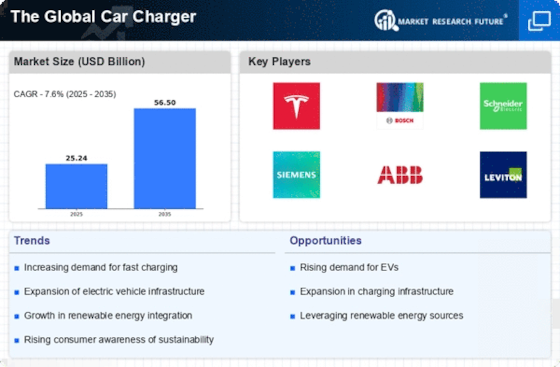
As per Market Research Future analysis, The Global Car Charger Market Size was estimated at 25.24 USD Billion in 2024. The car charger industry is projected to grow from 27.16 USD Billion in 2025 to 56.5 USD Billion by 2035, exhibiting a compound annual growth rate (CAGR) of 7.6% during the forecast period 2025 - 2035

Key Market Trends & Highlights

The Global Car Charger Market is experiencing robust growth driven by technological advancements and increasing electric vehicle adoption.

  • The rise of fast charging solutions is reshaping consumer expectations and enhancing convenience. Integration of smart technologies is becoming prevalent, allowing for more efficient charging processes. North America remains the largest market, while Asia-Pacific is emerging as the fastest-growing region in car charger adoption. The increase in electric vehicle adoption and government initiatives are key drivers propelling market expansion.

Market Size & Forecast

2024 Market Size 25.24 (USD Billion)
2035 Market Size 56.5 (USD Billion)
CAGR (2025 - 2035) 7.6%
Largest Regional Market Share in 2024 North America

Major Players

Tesla (US), Bosch (DE), Schneider Electric (FR), Siemens (DE), ABB (CH), Leviton (US), Eaton (US), Censtar (CN), Webasto (DE)

Market Trends

The Global Car Charger Market is currently experiencing a transformative phase, driven by the increasing adoption of electric vehicles and the growing emphasis on sustainable transportation solutions. As consumers become more environmentally conscious, the demand for efficient and reliable car charging solutions is on the rise.

This shift is further supported by advancements in technology, which enhance the performance and accessibility of charging stations. Additionally, the expansion of charging infrastructure is likely to play a crucial role in shaping market dynamics, as it addresses the concerns of range anxiety among potential electric vehicle owners.

Moreover, the competitive landscape of the car charger industry is evolving, with numerous players striving to innovate and differentiate their offerings. Partnerships between automotive manufacturers and charging solution providers appear to be a common strategy, aimed at creating seamless user experiences. Furthermore, government initiatives promoting electric mobility and renewable energy sources may bolster market growth. As the industry progresses, it seems that the focus will increasingly shift towards developing fast-charging technologies and integrating smart features into charging systems, potentially enhancing user convenience and satisfaction.

Rise of Fast Charging Solutions

The demand for fast charging solutions is gaining momentum as consumers seek quicker and more efficient ways to recharge their electric vehicles. This trend is likely to drive innovation in charging technology, leading to the development of high-capacity chargers that can significantly reduce downtime.

Integration of Smart Technologies

The incorporation of smart technologies into car charging systems is becoming more prevalent. Features such as mobile app connectivity, real-time monitoring, and automated payment systems may enhance user experience and streamline the charging process.

Expansion of Charging Infrastructure

The expansion of charging infrastructure is crucial for the growth of the Car Charging Solutions Market. Increased investment in public and private charging stations is expected to alleviate range anxiety, making electric vehicles more appealing to a broader audience.

Car Charger Market Market Drivers

Expansion of Charging Infrastructure

The expansion of charging infrastructure is a critical driver for the Vehicle Charging Equipment Market. As the number of electric vehicles on the road increases, the need for accessible and reliable charging stations becomes paramount. Investments in charging networks are being made by both public and private sectors, aiming to alleviate range anxiety among potential electric vehicle buyers. Reports suggest that the number of public charging stations is expected to double by 2026, significantly enhancing the accessibility of charging solutions. This expansion not only supports the growth of The Global Car Charger Industry but also encourages more consumers to consider electric vehicles as a viable option.

Increase in Electric Vehicle Adoption

The rise in electric vehicle adoption is a primary driver for the Car Charger Industry. As consumers increasingly opt for electric vehicles, the demand for compatible charging solutions surges. In 2025, it is estimated that electric vehicles will account for approximately 30% of total vehicle sales, indicating a substantial market shift. This trend is further supported by government incentives and policies aimed at reducing carbon emissions, which encourage consumers to transition to electric vehicles. Consequently, The Global Car Charger Industry is likely to experience significant growth as manufacturers respond to the increasing need for efficient and accessible charging solutions.

Government Initiatives and Regulations

Government initiatives and regulations are pivotal in driving the Car Charging Solutions Market. Many countries are implementing stringent regulations aimed at reducing greenhouse gas emissions, which in turn promotes the adoption of electric vehicles and the necessary charging infrastructure. For example, various governments are investing in the expansion of public charging networks and providing financial incentives for consumers to purchase electric vehicles. This regulatory support is expected to bolster The Global Car Charger Industry, as it creates a favorable environment for both manufacturers and consumers. The alignment of government policies with market needs is likely to accelerate the growth of charging solutions.

Growing Consumer Awareness of Sustainability

The increasing consumer awareness of sustainability is influencing the Car Charging Solutions Market. As environmental concerns become more prominent, consumers are actively seeking eco-friendly transportation options, including electric vehicles. This shift in consumer behavior is driving the demand for efficient charging solutions that align with sustainable practices. Market Research Future indicates that a significant portion of consumers is willing to invest in electric vehicles if adequate charging infrastructure is available. Consequently, The Global Car Charger Industry is poised for growth as manufacturers develop innovative charging solutions that cater to the environmentally conscious consumer.

Technological Advancements in Charging Solutions

Technological advancements play a crucial role in shaping the EV Charger Market. Innovations such as ultra-fast charging technology and wireless charging systems are enhancing the efficiency and convenience of charging electric vehicles. For instance, the development of chargers that can deliver up to 350 kW of power is expected to reduce charging times significantly, making electric vehicles more appealing to consumers. Furthermore, the integration of smart technologies, such as mobile applications for locating charging stations, is likely to enhance user experience. These advancements not only improve the functionality of chargers but also contribute to the overall growth of The Global Car Charger Industry.

Market Segment Insights

By Charging Type: Automatic Charging (Largest) vs. Manual Charging (Fastest-Growing)

In The Car Chargers Market, the segment of Automatic Charging holds the largest market share, predominating due to its convenience and enhanced user experience. This charging type is increasingly preferred as electric vehicle adoption rises, as it allows for seamless charging without user intervention. In contrast, Manual Charging, while still substantial, is experiencing rapid growth as more consumers seek flexibility and control during the charging process.

Automatic Charging (Dominant) vs. Manual Charging (Emerging)

Automatic Charging stands out as the dominant force in The Car Chargers Market, favored for its fully integrated systems that eliminate user error and make charging effortless. This technology is typically employed in advanced <a href="https://www.marketresearchfuture.com/reports/electric-vehicles-market-1793">electric vehicle</a> models featuring smart connectivity. On the other hand, Manual Charging is emerging, appealing to users who desire greater control over their charging experience, often preferred for home-based setups or where users are cautious about energy consumption. As infrastructure develops, both charging types are expected to co-exist, catering to varied consumer preferences.

By Charger Type: Smart/Intelligent Charger (Largest) vs. Trickle Charger (Fastest-Growing)

In The Car Charger Market, Smart/Intelligent Chargers hold the largest market share, driven by their advanced features and increasing consumer preference for efficiency and modern technology. The Float Charger and Trickle Charger segments also contribute to the market, but their shares are modest compared to the prominent presence of Smart/Intelligent Chargers. This differential illustrates how consumers prioritize smarter charging solutions that offer enhanced functionality. As the automotive industry shifts towards electrification, both Float and Trickle Chargers are gaining traction, particularly among consumers who prefer cost-effective solutions. The growth in electric vehicles (EVs) and <a href="https://www.marketresearchfuture.com/reports/hybrid-vehicle-market-6025">hybrid vehicles</a> is propelling the demand for these chargers and contributing to the overall evolution of charging technology. Furthermore, environmental awareness plays a significant role in shaping consumer preferences, with sustainable solutions driving interest in these emerging charger types.

Smart/Intelligent Charger (Dominant) vs. Trickle Charger (Emerging)

Smart/Intelligent Chargers are characterized by their ability to communicate with vehicles, facilitating optimal charging based on the vehicle's charge state. This segment enjoys strong market dominance due to its appeal among tech-savvy consumers and the integration of smart home technologies. Meanwhile, Trickle Chargers are gaining recognition as an emerging alternative, particularly for users seeking affordable and simple charging solutions. While Trickle Chargers are favored for their ability to maintain battery health over extended periods, the increasing adoption of Smart/Intelligent Chargers reflects a significant shift towards smarter and more efficient charging practices in the automotive landscape.

By Portability: Plug-In Charger (Largest) vs. Portable Charger (Fastest-Growing)

In The Car Charger Market, the Plug-In Charger holds a significant portion of the total market share, owing to its established presence within the automotive industry. On the other hand, the Portable Charger segment, although relatively smaller, has been gaining traction rapidly among consumers who prioritize convenience and flexibility, particularly those with electric vehicles that require on-the-go charging capabilities. This distribution signifies a clear preference for traditional charging solutions, while also highlighting a shift towards innovative alternatives driven by consumer demand for portability.

Car Charger Market: Plug-In Charger (Dominant) vs. Portable Charger (Emerging)

The Plug-In Charger segment remains dominant in the market due to its widespread adoption and compatibility with a vast range of vehicles, making it the go-to choice for most consumers. Its adoption is fueled by reliable performance and ease of use. In contrast, the Portable Charger segment is emerging as a significant player, appealing to tech-savvy consumers and those looking for mobility in charging solutions. These devices provide an essential service, especially in urban areas, where charging infrastructure might be limited. The convenience of charging at various locations without being tethered to a specific charger is fostering growth in this segment.

By Battery Capacity: 12V-48V (Largest) vs. Above 48V (Fastest-Growing)

The Car Charger Market reveals a notable distribution across the battery capacity segments, with the 12V-48V segment currently holding the largest market share. This broad range appeals to a wide array of electric vehicles (EVs) and hybrid vehicles, making it a key target for manufacturers. The 'Up to 12V' segment, while significant, is overshadowed by the growing adoption of higher voltage systems as automotive technology evolves, leading to a gradual decline in its overall share.

Battery Capacity: Up to 12V (Dominant) vs. Above 48V (Emerging)

The Up to 12V segment, characterized by its use in traditional and entry-level electric vehicles, remains a dominant force in the EV Charger Market. This capacity is often favored for its compatibility with older vehicle models and simpler electrical systems. Meanwhile, the Above 48V segment is emergent, driven by advancements in battery technology and increasing consumer demand for high-performance EVs. This higher voltage range supports faster charging capabilities and better power management, making it an attractive option for manufacturers looking to future-proof their products. As technology progresses, the dynamic between these segments is expected to evolve significantly.

By Product Type: Car Battery Charger (Largest) vs. Electric Car Battery Charger (Fastest-Growing)

In The Global Car Charger Industry, the distribution of market share reflects the dominance of the Car Battery Charger segment, which caters to traditional vehicles. In contrast, the Electric Car Battery Charger segment is rapidly gaining ground in response to the increasing adoption of electric vehicles (EVs). This shift highlights a transformative phase in the market as more consumers gravitate towards electric options, resulting in a notable enhancement in the market presence of electric chargers.

Car Battery Charger (Dominant) vs. Electric Car Battery Charger (Emerging)

The Car Battery Charger segment remains dominant due to its established presence and extensive usage in traditional combustion engine vehicles. This segment benefits from a loyal customer base and widespread availability. Conversely, the <a href="https://www.marketresearchfuture.com/reports/electric-vehicle-battery-charger-market-7937">Electric Car Battery Charger</a> segment is emerging as a vital player in the market, driven by the global transition towards sustainable energy and government initiatives favoring electric mobility. As EVs become increasingly mainstream, the demand for electric chargers is surging, characterized by innovative technology, faster charging capabilities, and a focus on renewable energy sources, positioning it as a pivotal element of the automotive industry's future.

By Application: Garage (Largest) vs. Personal Use (Fastest-Growing)

In The Car Charging Solutions Market, the application segment is primarily dominated by the 'Garage' category, which accounts for a significant share of the overall market. This segment appeals to homeowners with electric vehicles who prefer charging their cars at home, providing convenience and efficiency. Meanwhile, 'Personal Use' is emerging rapidly, captivating a younger demographic that prioritizes technology and convenience, thus driving a shift in consumer preferences.

Application: Garage (Dominant) vs. Personal Use (Emerging)

The 'Garage' application segment is characterized by residential installations, where consumers are increasingly investing in home charging stations to facilitate electric vehicle usage. This segment benefits from the growing trend of home ownership and the demand for eco-friendly transportation solutions. In contrast, the 'Personal Use' segment is witnessing an upsurge, driven primarily by urbanization and a tech-savvy population that seeks portable and easily accessible charging options. This segment caters to consumers who travel frequently and rely on charging solutions that fit their dynamic lifestyles. As such, the dual dynamics of a stable garage market and the rapidly evolving personal market are reshaping the landscape of electric vehicle charging solutions.

Get more detailed insights about Car Charger Market Research Report — Global Forecast till 2035

Regional Insights

By region, the study provides the market insights into North America, Europe, Asia-Pacific and Rest of the World. The North American Car Charger Market area will dominate this market. The increasing incentives for setting up charging stations in homes and workplaces, as well as the expanding government push to lower consumer barriers to EVs and charging station installations are what are propelling the growth of this region. However, the market's expansion is constrained by the grid's inability to handle EV charging stations.

Further, the major countries studied in the market report are The US, German, France, the UK, Canada, Italy, Spain, India, Australia, South Korea, China, Japan, and Brazil.

Figure2: CAR CHARGER MARKET SHARE BY REGION 2022 (USD Billion)

Europe Car Charger Market has the second-largest portion of the market due to the growing government initiatives to construct infrastructure for electric vehicle charging. Further, the German Car Charger Market had the biggest market share, and the UK Car Charger Market was the European market with the quickest rate of growth.

The Asia-Pacific Car Charger Market is anticipated to expand between 2023 and 2032 at the quickest CAGR. This is due to government programs to encourage EV adoption and the construction of related infrastructure. Moreover, China’s Car Charger Market had the biggest market share, and the Indian Car Charger Market was the Asia-Pacific region's fastest-growing market.

Key Players and Competitive Insights

Leading market players are making significant investments in R&D to improve their product portfolios, which will fuel further growth in the car charger market. Additionally, market players are engaging in a range of calculated initiatives to increase their worldwide presence, with important market developments involving the introduction of new products, contracts, M&A transactions, increased investment, and cooperation with other enterprises. To grow and endure in an increasingly cutthroat and dynamic market, Car Charger industry must provide reasonably priced goods.
One of the main business strategies employed by manufacturers is to manufacture locally in order to reduce operating expenses in the global Electrical Car Charging industry to help customers and expand the market segment. In recent years, the Electrical Car Charging industry has provided the automotive sector with some of the biggest benefits. Major players in the Car Chargers Market, including CTEK Holding AB, Delphi Automotive, Schumacher Electric Corporation, Clore Automotive LLC, Baccus Global LLC, Robert Bosch GmbH, Current Ways Inc., and others, are engaging in research and development activities in an effort to boost market demand.
Robert Bosch LLC is a well-known international engineering and technology corporation. With a rich history spanning more than a century, it was founded in 1886. Automotive, industrial, consumer goods, energy and building technologies are just a few of the industries in which Bosch is a global leader in supplying cutting-edge solutions. Power tools, smart home solutions, industrial automation technology, and automotive components are all part of its vast offering. Focusing on cutting-edge innovation, Bosch is a major global force behind technological breakthroughs.
In 2019, Bosch revealed intentions to invest billions on electric vehicle (EV) and battery technologies, among other major expenditures in electric transportation. Although the announcement's precise date is unknown, this action demonstrated their dedication to environmentally friendly transportation.
AeroVironment, Inc. is a defense contractor based in the United States that creates and produces unmanned aerial vehicles (UAVs). The company was started in 1971 by human-powered aircraft designer Paul B. MacCready Jr. The company's lightweight human- and solar-powered vehicles are its most well-known products. Leading provider of tiny drones to the US military, the business is known for its Raven, Switchblade, Wasp, and Puma variants. For US$405 million in January 2021, the business purchased Arcturus UAV, the company that makes the Arcturus T-20 UAV.
In November 2025, UK charging operators warned they could face a £100 million industry-wide bill due to new business rate changes. The added financial burden may slow EV charging infrastructure rollout. Industry groups urge the government to reconsider to avoid hindering EV adoption.
In March 2025, BYD unveiled a next-generation fast-charging EV platform, capable of significantly reducing charging times for future models. The company also announced plans to deploy thousands of new charging stations to expand its national charging infrastructure.

Key Companies in the Car Charger Market include

Industry Developments

Current Ways Inc

January 15, 2025: Announced a partnership with local governments to expand charging station networks in urban areas.

February 10, 2025: Launched a new line of fast chargers that reduce charging time by 30%.

AeroVironment, Inc.

January 20, 2025: AeroVironment unveiled its new wireless charging technology at the Consumer Electronics Show (CES) 2025. 

March 5, 2025: Signed a contract with a major automaker to provide charging solutions for their upcoming electric vehicle models.

April 2023: Bosch Research and the Chair of High-Performance Converter Systems (HLU) at the Technical University of Munich, under the direction of Prof. Heldwein, are developing cutting-edge "Charger-Converter" systems for electric cars. By concentrating on innovative modulation methods and alternate converter topologies, their collaboration seeks to increase power density and efficiency.

February 2020: Kirana Charzer invented an electric car charger that can be deployed in small stores and commercial spaces in order to expedite the establishment of the area's network for charging electric vehicles.

June 2022: Schneider Electric, a digital automation and energy management firm with headquarters in France, purchased EV Connect, Inc. Through the acquisition of EV Connect by Schneider Electric, the business will be able to grow more quickly with the current management group.

Future Outlook

Car Charger Market Future Outlook

The Car Charger Market is projected to grow at a 7.6% CAGR from 2025 to 2035, driven by increasing electric vehicle adoption, technological advancements, and expanding charging infrastructure.

New opportunities lie in:

  • Development of ultra-fast charging stations in urban areas.
  • Integration of renewable energy sources for charging solutions.
  • Partnerships with automotive manufacturers for bundled charging services.

By 2035, the market is expected to be robust, reflecting substantial growth and innovation.

Market Segmentation

Car Charger Market Application Outlook

  • Garage
  • Personal Use

Car Charger Market Portability Outlook

  • Plug-In Charger
  • Portable Charger

Car Charger Market Charger Type Outlook

  • Smart/Intelligent Charger
  • Float Charger
  • Trickle Charger

Car Charger Market Product Type Outlook

  • Car Battery Charger
  • Electric Car Battery Charger

Car Charger Market Charging Type Outlook

  • Manual Charging
  • Automatic Charging

Car Charger Market Battery Capacity Outlook

  • Up to 12V
  • 12V-48V
  • Above 48V

Report Scope

MARKET SIZE 2024 25.24(USD Billion)
MARKET SIZE 2025 27.16(USD Billion)
MARKET SIZE 2035 56.5(USD Billion)
COMPOUND ANNUAL GROWTH RATE (CAGR) 7.6% (2025 - 2035)
REPORT COVERAGE Revenue Forecast, Competitive Landscape, Growth Factors, and Trends
BASE YEAR 2024
Market Forecast Period 2025 - 2035
Historical Data 2019 - 2024
Market Forecast Units USD Billion
Key Companies Profiled Tesla (US), Bosch (DE), Schneider Electric (FR), Siemens (DE), ABB (CH), Leviton (US), Eaton (US), Censtar (CN), Webasto (DE)
Segments Covered Charging Type, Charger Type, Portability, Battery Capacity, Product Type, Application, Region
Key Market Opportunities Integration of fast-charging technology and renewable energy sources in The Global Car Charger.
Key Market Dynamics Rising demand for electric vehicles drives innovation and competition in the car charger market.
Countries Covered North America, Europe, APAC, South America, MEA

FAQs

What is the projected market valuation of The Global Car Charger by 2035?

<p>The projected market valuation of The Global Car Charger is expected to reach 56.5 USD Billion by 2035.</p>

What was the market valuation of The Global Car Charger in 2024?

<p>The overall market valuation of The Global Car Charger was 25.24 USD Billion in 2024.</p>

What is the expected CAGR for The Global Car Charger during the forecast period 2025 - 2035?

<p>The expected CAGR for The Global Car Charger during the forecast period 2025 - 2035 is 7.6%.</p>

Which companies are considered key players in The Global Car Charger?

<p>Key players in The Global Car Charger include Tesla, Bosch, Schneider Electric, Siemens, ABB, Leviton, Eaton, Censtar, and Webasto.</p>

What are the projected values for Manual and Automatic Charging segments by 2035?

<p>The projected values for Manual Charging and Automatic Charging segments are expected to reach 23.0 USD Billion and 33.5 USD Billion, respectively, by 2035.</p>

How do Smart/Intelligent Chargers compare to Float and Trickle Chargers in terms of market value?

<p>By 2035, Smart/Intelligent Chargers are projected to reach 23.0 USD Billion, whereas Float Chargers and Trickle Chargers are expected to reach 16.0 USD Billion and 17.5 USD Billion, respectively.</p>

What is the anticipated market size for Plug-In and Portable Chargers by 2035?

<p>The anticipated market size for Plug-In Chargers is expected to reach 35.0 USD Billion, while Portable Chargers may reach 21.5 USD Billion by 2035.</p>

What are the projected values for different battery capacity segments by 2035?

<p>By 2035, the projected values for battery capacity segments are expected to be 11.5 USD Billion for Up to 12V, 35.5 USD Billion for 12V-48V, and 9.5 USD Billion for Above 48V.</p>

What is the expected market value for Electric Car Battery Chargers by 2035?

<p>The expected market value for Electric Car Battery Chargers is projected to reach 34.5 USD Billion by 2035.</p>

What applications are driving growth in The Global Car Charger?

<p>The applications driving growth include Garage and Personal Use, with projected values of 23.0 USD Billion and 33.5 USD Billion, respectively, by 2035.</p>

  1. SECTION I: EXECUTIVE SUMMARY AND KEY HIGHLIGHTS
    1. | 1.1 EXECUTIVE SUMMARY
    2. | | 1.1.1 Market Overview
    3. | | 1.1.2 Key Findings
    4. | | 1.1.3 Market Segmentation
    5. | | 1.1.4 Competitive Landscape
    6. | | 1.1.5 Challenges and Opportunities
    7. | | 1.1.6 Future Outlook
  2. SECTION II: SCOPING, METHODOLOGY AND MARKET STRUCTURE
    1. | 2.1 MARKET INTRODUCTION
    2. | | 2.1.1 Definition
    3. | | 2.1.2 Scope of the study
    4. | | | 2.1.2.1 Research Objective
    5. | | | 2.1.2.2 Assumption
    6. | | | 2.1.2.3 Limitations
    7. | 2.2 RESEARCH METHODOLOGY
    8. | | 2.2.1 Overview
    9. | | 2.2.2 Data Mining
    10. | | 2.2.3 Secondary Research
    11. | | 2.2.4 Primary Research
    12. | | | 2.2.4.1 Primary Interviews and Information Gathering Process
    13. | | | 2.2.4.2 Breakdown of Primary Respondents
    14. | | 2.2.5 Forecasting Model
    15. | | 2.2.6 Market Size Estimation
    16. | | | 2.2.6.1 Bottom-Up Approach
    17. | | | 2.2.6.2 Top-Down Approach
    18. | | 2.2.7 Data Triangulation
    19. | | 2.2.8 Validation
  3. SECTION III: QUALITATIVE ANALYSIS
    1. | 3.1 MARKET DYNAMICS
    2. | | 3.1.1 Overview
    3. | | 3.1.2 Drivers
    4. | | 3.1.3 Restraints
    5. | | 3.1.4 Opportunities
    6. | 3.2 MARKET FACTOR ANALYSIS
    7. | | 3.2.1 Value chain Analysis
    8. | | 3.2.2 Porter's Five Forces Analysis
    9. | | | 3.2.2.1 Bargaining Power of Suppliers
    10. | | | 3.2.2.2 Bargaining Power of Buyers
    11. | | | 3.2.2.3 Threat of New Entrants
    12. | | | 3.2.2.4 Threat of Substitutes
    13. | | | 3.2.2.5 Intensity of Rivalry
    14. | | 3.2.3 COVID-19 Impact Analysis
    15. | | | 3.2.3.1 Market Impact Analysis
    16. | | | 3.2.3.2 Regional Impact
    17. | | | 3.2.3.3 Opportunity and Threat Analysis
  4. SECTION IV: QUANTITATIVE ANALYSIS
    1. | 4.1 Automobile, BY Charging Type (USD Billion)
    2. | | 4.1.1 Manual Charging
    3. | | 4.1.2 Automatic Charging
    4. | 4.2 Automobile, BY Charger Type (USD Billion)
    5. | | 4.2.1 Smart/Intelligent Charger
    6. | | 4.2.2 Float Charger
    7. | | 4.2.3 Trickle Charger
    8. | 4.3 Automobile, BY Portability (USD Billion)
    9. | | 4.3.1 Plug-In Charger
    10. | | 4.3.2 Portable Charger
    11. | 4.4 Automobile, BY Battery Capacity (USD Billion)
    12. | | 4.4.1 Up to 12V
    13. | | 4.4.2 12V-48V
    14. | | 4.4.3 Above 48V
    15. | 4.5 Automobile, BY Product Type (USD Billion)
    16. | | 4.5.1 Car Battery Charger
    17. | | 4.5.2 Electric Car Battery Charger
    18. | 4.6 Automobile, BY Application (USD Billion)
    19. | | 4.6.1 Garage
    20. | | 4.6.2 Personal Use
    21. | 4.7 Automobile, BY Region (USD Billion)
    22. | | 4.7.1 North America
    23. | | | 4.7.1.1 US
    24. | | | 4.7.1.2 Canada
    25. | | 4.7.2 Europe
    26. | | | 4.7.2.1 Germany
    27. | | | 4.7.2.2 UK
    28. | | | 4.7.2.3 France
    29. | | | 4.7.2.4 Russia
    30. | | | 4.7.2.5 Italy
    31. | | | 4.7.2.6 Spain
    32. | | | 4.7.2.7 Rest of Europe
    33. | | 4.7.3 APAC
    34. | | | 4.7.3.1 China
    35. | | | 4.7.3.2 India
    36. | | | 4.7.3.3 Japan
    37. | | | 4.7.3.4 South Korea
    38. | | | 4.7.3.5 Malaysia
    39. | | | 4.7.3.6 Thailand
    40. | | | 4.7.3.7 Indonesia
    41. | | | 4.7.3.8 Rest of APAC
    42. | | 4.7.4 South America
    43. | | | 4.7.4.1 Brazil
    44. | | | 4.7.4.2 Mexico
    45. | | | 4.7.4.3 Argentina
    46. | | | 4.7.4.4 Rest of South America
    47. | | 4.7.5 MEA
    48. | | | 4.7.5.1 GCC Countries
    49. | | | 4.7.5.2 South Africa
    50. | | | 4.7.5.3 Rest of MEA
  5. SECTION V: COMPETITIVE ANALYSIS
    1. | 5.1 Competitive Landscape
    2. | | 5.1.1 Overview
    3. | | 5.1.2 Competitive Analysis
    4. | | 5.1.3 Market share Analysis
    5. | | 5.1.4 Major Growth Strategy in the Automobile
    6. | | 5.1.5 Competitive Benchmarking
    7. | | 5.1.6 Leading Players in Terms of Number of Developments in the Automobile
    8. | | 5.1.7 Key developments and growth strategies
    9. | | | 5.1.7.1 New Product Launch/Service Deployment
    10. | | | 5.1.7.2 Merger & Acquisitions
    11. | | | 5.1.7.3 Joint Ventures
    12. | | 5.1.8 Major Players Financial Matrix
    13. | | | 5.1.8.1 Sales and Operating Income
    14. | | | 5.1.8.2 Major Players R&D Expenditure. 2023
    15. | 5.2 Company Profiles
    16. | | 5.2.1 Tesla (US)
    17. | | | 5.2.1.1 Financial Overview
    18. | | | 5.2.1.2 Products Offered
    19. | | | 5.2.1.3 Key Developments
    20. | | | 5.2.1.4 SWOT Analysis
    21. | | | 5.2.1.5 Key Strategies
    22. | | 5.2.2 Bosch (DE)
    23. | | | 5.2.2.1 Financial Overview
    24. | | | 5.2.2.2 Products Offered
    25. | | | 5.2.2.3 Key Developments
    26. | | | 5.2.2.4 SWOT Analysis
    27. | | | 5.2.2.5 Key Strategies
    28. | | 5.2.3 Schneider Electric (FR)
    29. | | | 5.2.3.1 Financial Overview
    30. | | | 5.2.3.2 Products Offered
    31. | | | 5.2.3.3 Key Developments
    32. | | | 5.2.3.4 SWOT Analysis
    33. | | | 5.2.3.5 Key Strategies
    34. | | 5.2.4 Siemens (DE)
    35. | | | 5.2.4.1 Financial Overview
    36. | | | 5.2.4.2 Products Offered
    37. | | | 5.2.4.3 Key Developments
    38. | | | 5.2.4.4 SWOT Analysis
    39. | | | 5.2.4.5 Key Strategies
    40. | | 5.2.5 ABB (CH)
    41. | | | 5.2.5.1 Financial Overview
    42. | | | 5.2.5.2 Products Offered
    43. | | | 5.2.5.3 Key Developments
    44. | | | 5.2.5.4 SWOT Analysis
    45. | | | 5.2.5.5 Key Strategies
    46. | | 5.2.6 Leviton (US)
    47. | | | 5.2.6.1 Financial Overview
    48. | | | 5.2.6.2 Products Offered
    49. | | | 5.2.6.3 Key Developments
    50. | | | 5.2.6.4 SWOT Analysis
    51. | | | 5.2.6.5 Key Strategies
    52. | | 5.2.7 Eaton (US)
    53. | | | 5.2.7.1 Financial Overview
    54. | | | 5.2.7.2 Products Offered
    55. | | | 5.2.7.3 Key Developments
    56. | | | 5.2.7.4 SWOT Analysis
    57. | | | 5.2.7.5 Key Strategies
    58. | | 5.2.8 Censtar (CN)
    59. | | | 5.2.8.1 Financial Overview
    60. | | | 5.2.8.2 Products Offered
    61. | | | 5.2.8.3 Key Developments
    62. | | | 5.2.8.4 SWOT Analysis
    63. | | | 5.2.8.5 Key Strategies
    64. | | 5.2.9 Webasto (DE)
    65. | | | 5.2.9.1 Financial Overview
    66. | | | 5.2.9.2 Products Offered
    67. | | | 5.2.9.3 Key Developments
    68. | | | 5.2.9.4 SWOT Analysis
    69. | | | 5.2.9.5 Key Strategies
    70. | 5.3 Appendix
    71. | | 5.3.1 References
    72. | | 5.3.2 Related Reports
  6. LIST OF FIGURES
    1. | 6.1 MARKET SYNOPSIS
    2. | 6.2 NORTH AMERICA MARKET ANALYSIS
    3. | 6.3 US MARKET ANALYSIS BY CHARGING TYPE
    4. | 6.4 US MARKET ANALYSIS BY CHARGER TYPE
    5. | 6.5 US MARKET ANALYSIS BY PORTABILITY
    6. | 6.6 US MARKET ANALYSIS BY BATTERY CAPACITY
    7. | 6.7 US MARKET ANALYSIS BY PRODUCT TYPE
    8. | 6.8 US MARKET ANALYSIS BY APPLICATION
    9. | 6.9 CANADA MARKET ANALYSIS BY CHARGING TYPE
    10. | 6.10 CANADA MARKET ANALYSIS BY CHARGER TYPE
    11. | 6.11 CANADA MARKET ANALYSIS BY PORTABILITY
    12. | 6.12 CANADA MARKET ANALYSIS BY BATTERY CAPACITY
    13. | 6.13 CANADA MARKET ANALYSIS BY PRODUCT TYPE
    14. | 6.14 CANADA MARKET ANALYSIS BY APPLICATION
    15. | 6.15 EUROPE MARKET ANALYSIS
    16. | 6.16 GERMANY MARKET ANALYSIS BY CHARGING TYPE
    17. | 6.17 GERMANY MARKET ANALYSIS BY CHARGER TYPE
    18. | 6.18 GERMANY MARKET ANALYSIS BY PORTABILITY
    19. | 6.19 GERMANY MARKET ANALYSIS BY BATTERY CAPACITY
    20. | 6.20 GERMANY MARKET ANALYSIS BY PRODUCT TYPE
    21. | 6.21 GERMANY MARKET ANALYSIS BY APPLICATION
    22. | 6.22 UK MARKET ANALYSIS BY CHARGING TYPE
    23. | 6.23 UK MARKET ANALYSIS BY CHARGER TYPE
    24. | 6.24 UK MARKET ANALYSIS BY PORTABILITY
    25. | 6.25 UK MARKET ANALYSIS BY BATTERY CAPACITY
    26. | 6.26 UK MARKET ANALYSIS BY PRODUCT TYPE
    27. | 6.27 UK MARKET ANALYSIS BY APPLICATION
    28. | 6.28 FRANCE MARKET ANALYSIS BY CHARGING TYPE
    29. | 6.29 FRANCE MARKET ANALYSIS BY CHARGER TYPE
    30. | 6.30 FRANCE MARKET ANALYSIS BY PORTABILITY
    31. | 6.31 FRANCE MARKET ANALYSIS BY BATTERY CAPACITY
    32. | 6.32 FRANCE MARKET ANALYSIS BY PRODUCT TYPE
    33. | 6.33 FRANCE MARKET ANALYSIS BY APPLICATION
    34. | 6.34 RUSSIA MARKET ANALYSIS BY CHARGING TYPE
    35. | 6.35 RUSSIA MARKET ANALYSIS BY CHARGER TYPE
    36. | 6.36 RUSSIA MARKET ANALYSIS BY PORTABILITY
    37. | 6.37 RUSSIA MARKET ANALYSIS BY BATTERY CAPACITY
    38. | 6.38 RUSSIA MARKET ANALYSIS BY PRODUCT TYPE
    39. | 6.39 RUSSIA MARKET ANALYSIS BY APPLICATION
    40. | 6.40 ITALY MARKET ANALYSIS BY CHARGING TYPE
    41. | 6.41 ITALY MARKET ANALYSIS BY CHARGER TYPE
    42. | 6.42 ITALY MARKET ANALYSIS BY PORTABILITY
    43. | 6.43 ITALY MARKET ANALYSIS BY BATTERY CAPACITY
    44. | 6.44 ITALY MARKET ANALYSIS BY PRODUCT TYPE
    45. | 6.45 ITALY MARKET ANALYSIS BY APPLICATION
    46. | 6.46 SPAIN MARKET ANALYSIS BY CHARGING TYPE
    47. | 6.47 SPAIN MARKET ANALYSIS BY CHARGER TYPE
    48. | 6.48 SPAIN MARKET ANALYSIS BY PORTABILITY
    49. | 6.49 SPAIN MARKET ANALYSIS BY BATTERY CAPACITY
    50. | 6.50 SPAIN MARKET ANALYSIS BY PRODUCT TYPE
    51. | 6.51 SPAIN MARKET ANALYSIS BY APPLICATION
    52. | 6.52 REST OF EUROPE MARKET ANALYSIS BY CHARGING TYPE
    53. | 6.53 REST OF EUROPE MARKET ANALYSIS BY CHARGER TYPE
    54. | 6.54 REST OF EUROPE MARKET ANALYSIS BY PORTABILITY
    55. | 6.55 REST OF EUROPE MARKET ANALYSIS BY BATTERY CAPACITY
    56. | 6.56 REST OF EUROPE MARKET ANALYSIS BY PRODUCT TYPE
    57. | 6.57 REST OF EUROPE MARKET ANALYSIS BY APPLICATION
    58. | 6.58 APAC MARKET ANALYSIS
    59. | 6.59 CHINA MARKET ANALYSIS BY CHARGING TYPE
    60. | 6.60 CHINA MARKET ANALYSIS BY CHARGER TYPE
    61. | 6.61 CHINA MARKET ANALYSIS BY PORTABILITY
    62. | 6.62 CHINA MARKET ANALYSIS BY BATTERY CAPACITY
    63. | 6.63 CHINA MARKET ANALYSIS BY PRODUCT TYPE
    64. | 6.64 CHINA MARKET ANALYSIS BY APPLICATION
    65. | 6.65 INDIA MARKET ANALYSIS BY CHARGING TYPE
    66. | 6.66 INDIA MARKET ANALYSIS BY CHARGER TYPE
    67. | 6.67 INDIA MARKET ANALYSIS BY PORTABILITY
    68. | 6.68 INDIA MARKET ANALYSIS BY BATTERY CAPACITY
    69. | 6.69 INDIA MARKET ANALYSIS BY PRODUCT TYPE
    70. | 6.70 INDIA MARKET ANALYSIS BY APPLICATION
    71. | 6.71 JAPAN MARKET ANALYSIS BY CHARGING TYPE
    72. | 6.72 JAPAN MARKET ANALYSIS BY CHARGER TYPE
    73. | 6.73 JAPAN MARKET ANALYSIS BY PORTABILITY
    74. | 6.74 JAPAN MARKET ANALYSIS BY BATTERY CAPACITY
    75. | 6.75 JAPAN MARKET ANALYSIS BY PRODUCT TYPE
    76. | 6.76 JAPAN MARKET ANALYSIS BY APPLICATION
    77. | 6.77 SOUTH KOREA MARKET ANALYSIS BY CHARGING TYPE
    78. | 6.78 SOUTH KOREA MARKET ANALYSIS BY CHARGER TYPE
    79. | 6.79 SOUTH KOREA MARKET ANALYSIS BY PORTABILITY
    80. | 6.80 SOUTH KOREA MARKET ANALYSIS BY BATTERY CAPACITY
    81. | 6.81 SOUTH KOREA MARKET ANALYSIS BY PRODUCT TYPE
    82. | 6.82 SOUTH KOREA MARKET ANALYSIS BY APPLICATION
    83. | 6.83 MALAYSIA MARKET ANALYSIS BY CHARGING TYPE
    84. | 6.84 MALAYSIA MARKET ANALYSIS BY CHARGER TYPE
    85. | 6.85 MALAYSIA MARKET ANALYSIS BY PORTABILITY
    86. | 6.86 MALAYSIA MARKET ANALYSIS BY BATTERY CAPACITY
    87. | 6.87 MALAYSIA MARKET ANALYSIS BY PRODUCT TYPE
    88. | 6.88 MALAYSIA MARKET ANALYSIS BY APPLICATION
    89. | 6.89 THAILAND MARKET ANALYSIS BY CHARGING TYPE
    90. | 6.90 THAILAND MARKET ANALYSIS BY CHARGER TYPE
    91. | 6.91 THAILAND MARKET ANALYSIS BY PORTABILITY
    92. | 6.92 THAILAND MARKET ANALYSIS BY BATTERY CAPACITY
    93. | 6.93 THAILAND MARKET ANALYSIS BY PRODUCT TYPE
    94. | 6.94 THAILAND MARKET ANALYSIS BY APPLICATION
    95. | 6.95 INDONESIA MARKET ANALYSIS BY CHARGING TYPE
    96. | 6.96 INDONESIA MARKET ANALYSIS BY CHARGER TYPE
    97. | 6.97 INDONESIA MARKET ANALYSIS BY PORTABILITY
    98. | 6.98 INDONESIA MARKET ANALYSIS BY BATTERY CAPACITY
    99. | 6.99 INDONESIA MARKET ANALYSIS BY PRODUCT TYPE
    100. | 6.100 INDONESIA MARKET ANALYSIS BY APPLICATION
    101. | 6.101 REST OF APAC MARKET ANALYSIS BY CHARGING TYPE
    102. | 6.102 REST OF APAC MARKET ANALYSIS BY CHARGER TYPE
    103. | 6.103 REST OF APAC MARKET ANALYSIS BY PORTABILITY
    104. | 6.104 REST OF APAC MARKET ANALYSIS BY BATTERY CAPACITY
    105. | 6.105 REST OF APAC MARKET ANALYSIS BY PRODUCT TYPE
    106. | 6.106 REST OF APAC MARKET ANALYSIS BY APPLICATION
    107. | 6.107 SOUTH AMERICA MARKET ANALYSIS
    108. | 6.108 BRAZIL MARKET ANALYSIS BY CHARGING TYPE
    109. | 6.109 BRAZIL MARKET ANALYSIS BY CHARGER TYPE
    110. | 6.110 BRAZIL MARKET ANALYSIS BY PORTABILITY
    111. | 6.111 BRAZIL MARKET ANALYSIS BY BATTERY CAPACITY
    112. | 6.112 BRAZIL MARKET ANALYSIS BY PRODUCT TYPE
    113. | 6.113 BRAZIL MARKET ANALYSIS BY APPLICATION
    114. | 6.114 MEXICO MARKET ANALYSIS BY CHARGING TYPE
    115. | 6.115 MEXICO MARKET ANALYSIS BY CHARGER TYPE
    116. | 6.116 MEXICO MARKET ANALYSIS BY PORTABILITY
    117. | 6.117 MEXICO MARKET ANALYSIS BY BATTERY CAPACITY
    118. | 6.118 MEXICO MARKET ANALYSIS BY PRODUCT TYPE
    119. | 6.119 MEXICO MARKET ANALYSIS BY APPLICATION
    120. | 6.120 ARGENTINA MARKET ANALYSIS BY CHARGING TYPE
    121. | 6.121 ARGENTINA MARKET ANALYSIS BY CHARGER TYPE
    122. | 6.122 ARGENTINA MARKET ANALYSIS BY PORTABILITY
    123. | 6.123 ARGENTINA MARKET ANALYSIS BY BATTERY CAPACITY
    124. | 6.124 ARGENTINA MARKET ANALYSIS BY PRODUCT TYPE
    125. | 6.125 ARGENTINA MARKET ANALYSIS BY APPLICATION
    126. | 6.126 REST OF SOUTH AMERICA MARKET ANALYSIS BY CHARGING TYPE
    127. | 6.127 REST OF SOUTH AMERICA MARKET ANALYSIS BY CHARGER TYPE
    128. | 6.128 REST OF SOUTH AMERICA MARKET ANALYSIS BY PORTABILITY
    129. | 6.129 REST OF SOUTH AMERICA MARKET ANALYSIS BY BATTERY CAPACITY
    130. | 6.130 REST OF SOUTH AMERICA MARKET ANALYSIS BY PRODUCT TYPE
    131. | 6.131 REST OF SOUTH AMERICA MARKET ANALYSIS BY APPLICATION
    132. | 6.132 MEA MARKET ANALYSIS
    133. | 6.133 GCC COUNTRIES MARKET ANALYSIS BY CHARGING TYPE
    134. | 6.134 GCC COUNTRIES MARKET ANALYSIS BY CHARGER TYPE
    135. | 6.135 GCC COUNTRIES MARKET ANALYSIS BY PORTABILITY
    136. | 6.136 GCC COUNTRIES MARKET ANALYSIS BY BATTERY CAPACITY
    137. | 6.137 GCC COUNTRIES MARKET ANALYSIS BY PRODUCT TYPE
    138. | 6.138 GCC COUNTRIES MARKET ANALYSIS BY APPLICATION
    139. | 6.139 SOUTH AFRICA MARKET ANALYSIS BY CHARGING TYPE
    140. | 6.140 SOUTH AFRICA MARKET ANALYSIS BY CHARGER TYPE
    141. | 6.141 SOUTH AFRICA MARKET ANALYSIS BY PORTABILITY
    142. | 6.142 SOUTH AFRICA MARKET ANALYSIS BY BATTERY CAPACITY
    143. | 6.143 SOUTH AFRICA MARKET ANALYSIS BY PRODUCT TYPE
    144. | 6.144 SOUTH AFRICA MARKET ANALYSIS BY APPLICATION
    145. | 6.145 REST OF MEA MARKET ANALYSIS BY CHARGING TYPE
    146. | 6.146 REST OF MEA MARKET ANALYSIS BY CHARGER TYPE
    147. | 6.147 REST OF MEA MARKET ANALYSIS BY PORTABILITY
    148. | 6.148 REST OF MEA MARKET ANALYSIS BY BATTERY CAPACITY
    149. | 6.149 REST OF MEA MARKET ANALYSIS BY PRODUCT TYPE
    150. | 6.150 REST OF MEA MARKET ANALYSIS BY APPLICATION
    151. | 6.151 KEY BUYING CRITERIA OF AUTOMOBILE
    152. | 6.152 RESEARCH PROCESS OF MRFR
    153. | 6.153 DRO ANALYSIS OF AUTOMOBILE
    154. | 6.154 DRIVERS IMPACT ANALYSIS: AUTOMOBILE
    155. | 6.155 RESTRAINTS IMPACT ANALYSIS: AUTOMOBILE
    156. | 6.156 SUPPLY / VALUE CHAIN: AUTOMOBILE
    157. | 6.157 AUTOMOBILE, BY CHARGING TYPE, 2024 (% SHARE)
    158. | 6.158 AUTOMOBILE, BY CHARGING TYPE, 2024 TO 2035 (USD Billion)
    159. | 6.159 AUTOMOBILE, BY CHARGER TYPE, 2024 (% SHARE)
    160. | 6.160 AUTOMOBILE, BY CHARGER TYPE, 2024 TO 2035 (USD Billion)
    161. | 6.161 AUTOMOBILE, BY PORTABILITY, 2024 (% SHARE)
    162. | 6.162 AUTOMOBILE, BY PORTABILITY, 2024 TO 2035 (USD Billion)
    163. | 6.163 AUTOMOBILE, BY BATTERY CAPACITY, 2024 (% SHARE)
    164. | 6.164 AUTOMOBILE, BY BATTERY CAPACITY, 2024 TO 2035 (USD Billion)
    165. | 6.165 AUTOMOBILE, BY PRODUCT TYPE, 2024 (% SHARE)
    166. | 6.166 AUTOMOBILE, BY PRODUCT TYPE, 2024 TO 2035 (USD Billion)
    167. | 6.167 AUTOMOBILE, BY APPLICATION, 2024 (% SHARE)
    168. | 6.168 AUTOMOBILE, BY APPLICATION, 2024 TO 2035 (USD Billion)
    169. | 6.169 BENCHMARKING OF MAJOR COMPETITORS
  7. LIST OF TABLES
    1. | 7.1 LIST OF ASSUMPTIONS
    2. | | 7.1.1
    3. | 7.2 North America MARKET SIZE ESTIMATES; FORECAST
    4. | | 7.2.1 BY CHARGING TYPE, 2025-2035 (USD Billion)
    5. | | 7.2.2 BY CHARGER TYPE, 2025-2035 (USD Billion)
    6. | | 7.2.3 BY PORTABILITY, 2025-2035 (USD Billion)
    7. | | 7.2.4 BY BATTERY CAPACITY, 2025-2035 (USD Billion)
    8. | | 7.2.5 BY PRODUCT TYPE, 2025-2035 (USD Billion)
    9. | | 7.2.6 BY APPLICATION, 2025-2035 (USD Billion)
    10. | 7.3 US MARKET SIZE ESTIMATES; FORECAST
    11. | | 7.3.1 BY CHARGING TYPE, 2025-2035 (USD Billion)
    12. | | 7.3.2 BY CHARGER TYPE, 2025-2035 (USD Billion)
    13. | | 7.3.3 BY PORTABILITY, 2025-2035 (USD Billion)
    14. | | 7.3.4 BY BATTERY CAPACITY, 2025-2035 (USD Billion)
    15. | | 7.3.5 BY PRODUCT TYPE, 2025-2035 (USD Billion)
    16. | | 7.3.6 BY APPLICATION, 2025-2035 (USD Billion)
    17. | 7.4 Canada MARKET SIZE ESTIMATES; FORECAST
    18. | | 7.4.1 BY CHARGING TYPE, 2025-2035 (USD Billion)
    19. | | 7.4.2 BY CHARGER TYPE, 2025-2035 (USD Billion)
    20. | | 7.4.3 BY PORTABILITY, 2025-2035 (USD Billion)
    21. | | 7.4.4 BY BATTERY CAPACITY, 2025-2035 (USD Billion)
    22. | | 7.4.5 BY PRODUCT TYPE, 2025-2035 (USD Billion)
    23. | | 7.4.6 BY APPLICATION, 2025-2035 (USD Billion)
    24. | 7.5 Europe MARKET SIZE ESTIMATES; FORECAST
    25. | | 7.5.1 BY CHARGING TYPE, 2025-2035 (USD Billion)
    26. | | 7.5.2 BY CHARGER TYPE, 2025-2035 (USD Billion)
    27. | | 7.5.3 BY PORTABILITY, 2025-2035 (USD Billion)
    28. | | 7.5.4 BY BATTERY CAPACITY, 2025-2035 (USD Billion)
    29. | | 7.5.5 BY PRODUCT TYPE, 2025-2035 (USD Billion)
    30. | | 7.5.6 BY APPLICATION, 2025-2035 (USD Billion)
    31. | 7.6 Germany MARKET SIZE ESTIMATES; FORECAST
    32. | | 7.6.1 BY CHARGING TYPE, 2025-2035 (USD Billion)
    33. | | 7.6.2 BY CHARGER TYPE, 2025-2035 (USD Billion)
    34. | | 7.6.3 BY PORTABILITY, 2025-2035 (USD Billion)
    35. | | 7.6.4 BY BATTERY CAPACITY, 2025-2035 (USD Billion)
    36. | | 7.6.5 BY PRODUCT TYPE, 2025-2035 (USD Billion)
    37. | | 7.6.6 BY APPLICATION, 2025-2035 (USD Billion)
    38. | 7.7 UK MARKET SIZE ESTIMATES; FORECAST
    39. | | 7.7.1 BY CHARGING TYPE, 2025-2035 (USD Billion)
    40. | | 7.7.2 BY CHARGER TYPE, 2025-2035 (USD Billion)
    41. | | 7.7.3 BY PORTABILITY, 2025-2035 (USD Billion)
    42. | | 7.7.4 BY BATTERY CAPACITY, 2025-2035 (USD Billion)
    43. | | 7.7.5 BY PRODUCT TYPE, 2025-2035 (USD Billion)
    44. | | 7.7.6 BY APPLICATION, 2025-2035 (USD Billion)
    45. | 7.8 France MARKET SIZE ESTIMATES; FORECAST
    46. | | 7.8.1 BY CHARGING TYPE, 2025-2035 (USD Billion)
    47. | | 7.8.2 BY CHARGER TYPE, 2025-2035 (USD Billion)
    48. | | 7.8.3 BY PORTABILITY, 2025-2035 (USD Billion)
    49. | | 7.8.4 BY BATTERY CAPACITY, 2025-2035 (USD Billion)
    50. | | 7.8.5 BY PRODUCT TYPE, 2025-2035 (USD Billion)
    51. | | 7.8.6 BY APPLICATION, 2025-2035 (USD Billion)
    52. | 7.9 Russia MARKET SIZE ESTIMATES; FORECAST
    53. | | 7.9.1 BY CHARGING TYPE, 2025-2035 (USD Billion)
    54. | | 7.9.2 BY CHARGER TYPE, 2025-2035 (USD Billion)
    55. | | 7.9.3 BY PORTABILITY, 2025-2035 (USD Billion)
    56. | | 7.9.4 BY BATTERY CAPACITY, 2025-2035 (USD Billion)
    57. | | 7.9.5 BY PRODUCT TYPE, 2025-2035 (USD Billion)
    58. | | 7.9.6 BY APPLICATION, 2025-2035 (USD Billion)
    59. | 7.10 Italy MARKET SIZE ESTIMATES; FORECAST
    60. | | 7.10.1 BY CHARGING TYPE, 2025-2035 (USD Billion)
    61. | | 7.10.2 BY CHARGER TYPE, 2025-2035 (USD Billion)
    62. | | 7.10.3 BY PORTABILITY, 2025-2035 (USD Billion)
    63. | | 7.10.4 BY BATTERY CAPACITY, 2025-2035 (USD Billion)
    64. | | 7.10.5 BY PRODUCT TYPE, 2025-2035 (USD Billion)
    65. | | 7.10.6 BY APPLICATION, 2025-2035 (USD Billion)
    66. | 7.11 Spain MARKET SIZE ESTIMATES; FORECAST
    67. | | 7.11.1 BY CHARGING TYPE, 2025-2035 (USD Billion)
    68. | | 7.11.2 BY CHARGER TYPE, 2025-2035 (USD Billion)
    69. | | 7.11.3 BY PORTABILITY, 2025-2035 (USD Billion)
    70. | | 7.11.4 BY BATTERY CAPACITY, 2025-2035 (USD Billion)
    71. | | 7.11.5 BY PRODUCT TYPE, 2025-2035 (USD Billion)
    72. | | 7.11.6 BY APPLICATION, 2025-2035 (USD Billion)
    73. | 7.12 Rest of Europe MARKET SIZE ESTIMATES; FORECAST
    74. | | 7.12.1 BY CHARGING TYPE, 2025-2035 (USD Billion)
    75. | | 7.12.2 BY CHARGER TYPE, 2025-2035 (USD Billion)
    76. | | 7.12.3 BY PORTABILITY, 2025-2035 (USD Billion)
    77. | | 7.12.4 BY BATTERY CAPACITY, 2025-2035 (USD Billion)
    78. | | 7.12.5 BY PRODUCT TYPE, 2025-2035 (USD Billion)
    79. | | 7.12.6 BY APPLICATION, 2025-2035 (USD Billion)
    80. | 7.13 APAC MARKET SIZE ESTIMATES; FORECAST
    81. | | 7.13.1 BY CHARGING TYPE, 2025-2035 (USD Billion)
    82. | | 7.13.2 BY CHARGER TYPE, 2025-2035 (USD Billion)
    83. | | 7.13.3 BY PORTABILITY, 2025-2035 (USD Billion)
    84. | | 7.13.4 BY BATTERY CAPACITY, 2025-2035 (USD Billion)
    85. | | 7.13.5 BY PRODUCT TYPE, 2025-2035 (USD Billion)
    86. | | 7.13.6 BY APPLICATION, 2025-2035 (USD Billion)
    87. | 7.14 China MARKET SIZE ESTIMATES; FORECAST
    88. | | 7.14.1 BY CHARGING TYPE, 2025-2035 (USD Billion)
    89. | | 7.14.2 BY CHARGER TYPE, 2025-2035 (USD Billion)
    90. | | 7.14.3 BY PORTABILITY, 2025-2035 (USD Billion)
    91. | | 7.14.4 BY BATTERY CAPACITY, 2025-2035 (USD Billion)
    92. | | 7.14.5 BY PRODUCT TYPE, 2025-2035 (USD Billion)
    93. | | 7.14.6 BY APPLICATION, 2025-2035 (USD Billion)
    94. | 7.15 India MARKET SIZE ESTIMATES; FORECAST
    95. | | 7.15.1 BY CHARGING TYPE, 2025-2035 (USD Billion)
    96. | | 7.15.2 BY CHARGER TYPE, 2025-2035 (USD Billion)
    97. | | 7.15.3 BY PORTABILITY, 2025-2035 (USD Billion)
    98. | | 7.15.4 BY BATTERY CAPACITY, 2025-2035 (USD Billion)
    99. | | 7.15.5 BY PRODUCT TYPE, 2025-2035 (USD Billion)
    100. | | 7.15.6 BY APPLICATION, 2025-2035 (USD Billion)
    101. | 7.16 Japan MARKET SIZE ESTIMATES; FORECAST
    102. | | 7.16.1 BY CHARGING TYPE, 2025-2035 (USD Billion)
    103. | | 7.16.2 BY CHARGER TYPE, 2025-2035 (USD Billion)
    104. | | 7.16.3 BY PORTABILITY, 2025-2035 (USD Billion)
    105. | | 7.16.4 BY BATTERY CAPACITY, 2025-2035 (USD Billion)
    106. | | 7.16.5 BY PRODUCT TYPE, 2025-2035 (USD Billion)
    107. | | 7.16.6 BY APPLICATION, 2025-2035 (USD Billion)
    108. | 7.17 South Korea MARKET SIZE ESTIMATES; FORECAST
    109. | | 7.17.1 BY CHARGING TYPE, 2025-2035 (USD Billion)
    110. | | 7.17.2 BY CHARGER TYPE, 2025-2035 (USD Billion)
    111. | | 7.17.3 BY PORTABILITY, 2025-2035 (USD Billion)
    112. | | 7.17.4 BY BATTERY CAPACITY, 2025-2035 (USD Billion)
    113. | | 7.17.5 BY PRODUCT TYPE, 2025-2035 (USD Billion)
    114. | | 7.17.6 BY APPLICATION, 2025-2035 (USD Billion)
    115. | 7.18 Malaysia MARKET SIZE ESTIMATES; FORECAST
    116. | | 7.18.1 BY CHARGING TYPE, 2025-2035 (USD Billion)
    117. | | 7.18.2 BY CHARGER TYPE, 2025-2035 (USD Billion)
    118. | | 7.18.3 BY PORTABILITY, 2025-2035 (USD Billion)
    119. | | 7.18.4 BY BATTERY CAPACITY, 2025-2035 (USD Billion)
    120. | | 7.18.5 BY PRODUCT TYPE, 2025-2035 (USD Billion)
    121. | | 7.18.6 BY APPLICATION, 2025-2035 (USD Billion)
    122. | 7.19 Thailand MARKET SIZE ESTIMATES; FORECAST
    123. | | 7.19.1 BY CHARGING TYPE, 2025-2035 (USD Billion)
    124. | | 7.19.2 BY CHARGER TYPE, 2025-2035 (USD Billion)
    125. | | 7.19.3 BY PORTABILITY, 2025-2035 (USD Billion)
    126. | | 7.19.4 BY BATTERY CAPACITY, 2025-2035 (USD Billion)
    127. | | 7.19.5 BY PRODUCT TYPE, 2025-2035 (USD Billion)
    128. | | 7.19.6 BY APPLICATION, 2025-2035 (USD Billion)
    129. | 7.20 Indonesia MARKET SIZE ESTIMATES; FORECAST
    130. | | 7.20.1 BY CHARGING TYPE, 2025-2035 (USD Billion)
    131. | | 7.20.2 BY CHARGER TYPE, 2025-2035 (USD Billion)
    132. | | 7.20.3 BY PORTABILITY, 2025-2035 (USD Billion)
    133. | | 7.20.4 BY BATTERY CAPACITY, 2025-2035 (USD Billion)
    134. | | 7.20.5 BY PRODUCT TYPE, 2025-2035 (USD Billion)
    135. | | 7.20.6 BY APPLICATION, 2025-2035 (USD Billion)
    136. | 7.21 Rest of APAC MARKET SIZE ESTIMATES; FORECAST
    137. | | 7.21.1 BY CHARGING TYPE, 2025-2035 (USD Billion)
    138. | | 7.21.2 BY CHARGER TYPE, 2025-2035 (USD Billion)
    139. | | 7.21.3 BY PORTABILITY, 2025-2035 (USD Billion)
    140. | | 7.21.4 BY BATTERY CAPACITY, 2025-2035 (USD Billion)
    141. | | 7.21.5 BY PRODUCT TYPE, 2025-2035 (USD Billion)
    142. | | 7.21.6 BY APPLICATION, 2025-2035 (USD Billion)
    143. | 7.22 South America MARKET SIZE ESTIMATES; FORECAST
    144. | | 7.22.1 BY CHARGING TYPE, 2025-2035 (USD Billion)
    145. | | 7.22.2 BY CHARGER TYPE, 2025-2035 (USD Billion)
    146. | | 7.22.3 BY PORTABILITY, 2025-2035 (USD Billion)
    147. | | 7.22.4 BY BATTERY CAPACITY, 2025-2035 (USD Billion)
    148. | | 7.22.5 BY PRODUCT TYPE, 2025-2035 (USD Billion)
    149. | | 7.22.6 BY APPLICATION, 2025-2035 (USD Billion)
    150. | 7.23 Brazil MARKET SIZE ESTIMATES; FORECAST
    151. | | 7.23.1 BY CHARGING TYPE, 2025-2035 (USD Billion)
    152. | | 7.23.2 BY CHARGER TYPE, 2025-2035 (USD Billion)
    153. | | 7.23.3 BY PORTABILITY, 2025-2035 (USD Billion)
    154. | | 7.23.4 BY BATTERY CAPACITY, 2025-2035 (USD Billion)
    155. | | 7.23.5 BY PRODUCT TYPE, 2025-2035 (USD Billion)
    156. | | 7.23.6 BY APPLICATION, 2025-2035 (USD Billion)
    157. | 7.24 Mexico MARKET SIZE ESTIMATES; FORECAST
    158. | | 7.24.1 BY CHARGING TYPE, 2025-2035 (USD Billion)
    159. | | 7.24.2 BY CHARGER TYPE, 2025-2035 (USD Billion)
    160. | | 7.24.3 BY PORTABILITY, 2025-2035 (USD Billion)
    161. | | 7.24.4 BY BATTERY CAPACITY, 2025-2035 (USD Billion)
    162. | | 7.24.5 BY PRODUCT TYPE, 2025-2035 (USD Billion)
    163. | | 7.24.6 BY APPLICATION, 2025-2035 (USD Billion)
    164. | 7.25 Argentina MARKET SIZE ESTIMATES; FORECAST
    165. | | 7.25.1 BY CHARGING TYPE, 2025-2035 (USD Billion)
    166. | | 7.25.2 BY CHARGER TYPE, 2025-2035 (USD Billion)
    167. | | 7.25.3 BY PORTABILITY, 2025-2035 (USD Billion)
    168. | | 7.25.4 BY BATTERY CAPACITY, 2025-2035 (USD Billion)
    169. | | 7.25.5 BY PRODUCT TYPE, 2025-2035 (USD Billion)
    170. | | 7.25.6 BY APPLICATION, 2025-2035 (USD Billion)
    171. | 7.26 Rest of South America MARKET SIZE ESTIMATES; FORECAST
    172. | | 7.26.1 BY CHARGING TYPE, 2025-2035 (USD Billion)
    173. | | 7.26.2 BY CHARGER TYPE, 2025-2035 (USD Billion)
    174. | | 7.26.3 BY PORTABILITY, 2025-2035 (USD Billion)
    175. | | 7.26.4 BY BATTERY CAPACITY, 2025-2035 (USD Billion)
    176. | | 7.26.5 BY PRODUCT TYPE, 2025-2035 (USD Billion)
    177. | | 7.26.6 BY APPLICATION, 2025-2035 (USD Billion)
    178. | 7.27 MEA MARKET SIZE ESTIMATES; FORECAST
    179. | | 7.27.1 BY CHARGING TYPE, 2025-2035 (USD Billion)
    180. | | 7.27.2 BY CHARGER TYPE, 2025-2035 (USD Billion)
    181. | | 7.27.3 BY PORTABILITY, 2025-2035 (USD Billion)
    182. | | 7.27.4 BY BATTERY CAPACITY, 2025-2035 (USD Billion)
    183. | | 7.27.5 BY PRODUCT TYPE, 2025-2035 (USD Billion)
    184. | | 7.27.6 BY APPLICATION, 2025-2035 (USD Billion)
    185. | 7.28 GCC Countries MARKET SIZE ESTIMATES; FORECAST
    186. | | 7.28.1 BY CHARGING TYPE, 2025-2035 (USD Billion)
    187. | | 7.28.2 BY CHARGER TYPE, 2025-2035 (USD Billion)
    188. | | 7.28.3 BY PORTABILITY, 2025-2035 (USD Billion)
    189. | | 7.28.4 BY BATTERY CAPACITY, 2025-2035 (USD Billion)
    190. | | 7.28.5 BY PRODUCT TYPE, 2025-2035 (USD Billion)
    191. | | 7.28.6 BY APPLICATION, 2025-2035 (USD Billion)
    192. | 7.29 South Africa MARKET SIZE ESTIMATES; FORECAST
    193. | | 7.29.1 BY CHARGING TYPE, 2025-2035 (USD Billion)
    194. | | 7.29.2 BY CHARGER TYPE, 2025-2035 (USD Billion)
    195. | | 7.29.3 BY PORTABILITY, 2025-2035 (USD Billion)
    196. | | 7.29.4 BY BATTERY CAPACITY, 2025-2035 (USD Billion)
    197. | | 7.29.5 BY PRODUCT TYPE, 2025-2035 (USD Billion)
    198. | | 7.29.6 BY APPLICATION, 2025-2035 (USD Billion)
    199. | 7.30 Rest of MEA MARKET SIZE ESTIMATES; FORECAST
    200. | | 7.30.1 BY CHARGING TYPE, 2025-2035 (USD Billion)
    201. | | 7.30.2 BY CHARGER TYPE, 2025-2035 (USD Billion)
    202. | | 7.30.3 BY PORTABILITY, 2025-2035 (USD Billion)
    203. | | 7.30.4 BY BATTERY CAPACITY, 2025-2035 (USD Billion)
    204. | | 7.30.5 BY PRODUCT TYPE, 2025-2035 (USD Billion)
    205. | | 7.30.6 BY APPLICATION, 2025-2035 (USD Billion)
    206. | 7.31 PRODUCT LAUNCH/PRODUCT DEVELOPMENT/APPROVAL
    207. | | 7.31.1
    208. | 7.32 ACQUISITION/PARTNERSHIP
    209. | | 7.32.1

Automobile Market Segmentation

Automobile By Charging Type (USD Billion, 2025-2035)

  • Manual Charging
  • Automatic Charging

Automobile By Charger Type (USD Billion, 2025-2035)

  • Smart/Intelligent Charger
  • Float Charger
  • Trickle Charger

Automobile By Portability (USD Billion, 2025-2035)

  • Plug-In Charger
  • Portable Charger

Automobile By Battery Capacity (USD Billion, 2025-2035)

  • Up to 12V
  • 12V-48V
  • Above 48V

Automobile By Product Type (USD Billion, 2025-2035)

  • Car Battery Charger
  • Electric Car Battery Charger

Automobile By Application (USD Billion, 2025-2035)

  • Garage
  • Personal Use
Infographic

Free Sample Request

Kindly complete the form below to receive a free sample of this Report

Get Free Sample

Customer Strories

Compare Licence

×
Features License Type
Single User Multiuser License Enterprise User
Price $4,950 $5,950 $7,250
Maximum User Access Limit 1 User Upto 10 Users Unrestricted Access Throughout the Organization
Free Customization
Direct Access to Analyst
Deliverable Format
Platform Access
Discount on Next Purchase 10% 15% 15%
Printable Versions