Request Free Sample ×

Kindly complete the form below to receive a free sample of this Report

* Please use a valid business email

Leading companies partner with us for data-driven Insights

clients tt-cursor
Hero Background
English
Chinese
French
Japanese
Korean
German
Spanish

Bluetooth in Automotive Market Trends

ID: MRFR/AT/0754-CR
123 Pages
Triveni Bhoyar
July 2019

Bluetooth in Automotive Market Research Report Information By Application (Communication, Infotainment, and Telematics), By Vehicle Type (Passenger Car, Light Commercial Vehicle, and Heavy Commercial Vehicle), and By Region (North America, Europe, Asia-Pacific, and Rest of The World) – Market Forecast Till 2035

Share:
Download PDF ×

We do not share your information with anyone. However, we may send you emails based on your report interest from time to time. You may contact us at any time to opt-out.

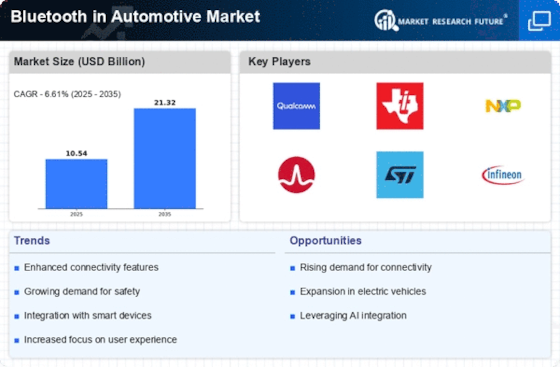
Bluetooth in Automotive Market Infographic
Purchase Options

Market Trends

Key Emerging Trends in the Bluetooth in Automotive Market

The Bluetooth in the automotive market is undergoing dynamic shifts, with emerging trends reshaping the landscape of in-car connectivity. One prominent trend is the increasing integration of advanced driver-assistance systems (ADAS) and infotainment systems with Bluetooth technology. As vehicles become more technologically sophisticated, the demand for seamless connectivity between smartphones and in-car systems has risen. Bluetooth facilitates hands-free calling, music streaming, and navigation, contributing to a safer and more convenient driving experience.

Moreover, the rise of electric and hybrid vehicles has spurred the demand for energy-efficient connectivity solutions. Bluetooth Low Energy (BLE) technology is gaining traction in the automotive sector, offering a power-efficient option for various applications, including keyless entry systems and tire pressure monitoring. This trend aligns with the industry's push toward sustainability and energy conservation.

Another notable trend is the integration of Bluetooth with vehicle-to-everything (V2X) communication systems. V2X technology enables vehicles to communicate with each other and with infrastructure, enhancing safety and traffic efficiency. Bluetooth's role in this ecosystem supports cooperative driving initiatives, contributing to the realization of connected and autonomous vehicles.

The automotive industry is witnessing an upsurge in the adoption of connected car platforms, and Bluetooth plays a pivotal role in this evolution. From over-the-air updates to vehicle diagnostics, Bluetooth connectivity is essential for seamless communication between the vehicle and external platforms. This trend is not only enhancing user experience but also enabling automakers to offer advanced features and services remotely.

Furthermore, the demand for in-car personalization is driving Bluetooth-enabled solutions. From personalized driver profiles to tailored infotainment settings, Bluetooth technology allows for a more customized driving experience. This trend aligns with the broader consumer preference for technology that adapts to individual preferences and enhances overall comfort.


Author
Author Profile
Triveni Bhoyar
Senior Research Analyst

Triveni Bhoyar has over 5 years of experience in the market research industry, specializing in the Automotive and Aerospace & Defense sectors. She has contributed to 200+ reports, including numerous custom projects for leading global companies, delivering solutions to complex business challenges. Renowned for her ability to generate valuable insights, Triveni excels in addressing unique market dynamics with precision and depth. Her expertise spans market sizing, competitive intelligence, and trend analysis, enabling clients to craft data-driven growth strategies. With strong analytical rigor and a client-centric approach, she plays a pivotal role in driving impactful, strategic decision-making.

Leave a Comment

FAQs

What is the projected market valuation for Bluetooth in the automotive sector by 2035?

<p>The projected market valuation for Bluetooth in the automotive sector is 21.32 USD Billion by 2035.</p>

What was the market valuation for Bluetooth in automotive in 2024?

<p>The market valuation for Bluetooth in automotive was 10.54 USD Billion in 2024.</p>

What is the expected CAGR for the Bluetooth in automotive market from 2025 to 2035?

<p>The expected CAGR for the Bluetooth in automotive market during the forecast period 2025 - 2035 is 6.61%.</p>

Which application segments are driving growth in the Bluetooth automotive market?

<p>The application segments driving growth include Communication, Infotainment, and Telematics, with valuations projected to reach 6.0, 8.0, and 7.32 USD Billion respectively by 2035.</p>

How do passenger cars compare to other vehicle types in the Bluetooth automotive market?

<p>Passenger cars are projected to reach 10.64 USD Billion by 2035, outpacing Light Commercial Vehicles and Heavy Commercial Vehicles, which are expected to reach 6.36 and 4.32 USD Billion respectively.</p>

Who are the key players in the Bluetooth automotive market?

<p>Key players in the Bluetooth automotive market include Qualcomm, Texas Instruments, NXP Semiconductors, Broadcom, and STMicroelectronics.</p>

What role does infotainment play in the Bluetooth automotive market?

Infotainment is a crucial segment, with its valuation expected to grow from 4.0 USD Billion in 2024 to 8.0 USD Billion by 2035.

What is the significance of telematics in the Bluetooth automotive market?

Telematics is projected to grow from 3.54 USD Billion in 2024 to 7.32 USD Billion by 2035, indicating its increasing importance in automotive connectivity.

How does the growth of Bluetooth technology impact vehicle safety?

The growth of Bluetooth technology is likely to enhance vehicle safety by enabling hands-free communication and advanced driver-assistance systems.

What trends are influencing the Bluetooth automotive market in 2025?

In 2025, trends such as increased demand for connected vehicles and advancements in infotainment systems appear to be influencing the Bluetooth automotive market.

Market Summary

As per Market Research Future analysis, the Bluetooth in Automotive Market Size was estimated at 10.54 USD Billion in 2024. The Bluetooth in Automotive industry is projected to grow from 11.24 USD Billion in 2025 to 21.32 USD Billion by 2035, exhibiting a compound annual growth rate (CAGR) of 6.61% during the forecast period 2025 - 2035

Key Market Trends & Highlights

The Bluetooth in Automotive Market is experiencing robust growth driven by enhanced connectivity and safety features.

  • The market is witnessing enhanced connectivity features that cater to consumer demands for seamless in-car experiences. There is a growing focus on safety and compliance, aligning with advancements in automotive safety standards. Integration with emerging technologies is becoming increasingly prevalent, particularly in infotainment systems. Rising demand for in-car connectivity and consumer preference for wireless solutions are key drivers propelling growth in both North America and Asia-Pacific.

Market Size & Forecast

2024 Market Size 10.54 (USD Billion)
2035 Market Size 21.32 (USD Billion)
CAGR (2025 - 2035) 6.61%
Largest Regional Market Share in 2024 Asia Pacific

Major Players

Qualcomm (US), Texas Instruments (US), NXP Semiconductors (NL), Broadcom (US), STMicroelectronics (FR), Infineon Technologies (DE), Renesas Electronics (JP), Cypress Semiconductor (US), MediaTek (TW)

Market Trends

The Bluetooth in Automotive Market is currently experiencing a transformative phase, driven by the increasing demand for connectivity and enhanced user experiences in vehicles. As consumers seek seamless integration of their mobile devices with automotive systems, manufacturers are prioritizing the development of advanced Bluetooth technologies reinforcing growth across the bluetooth in automotive market. This shift not only enhances convenience but also promotes safety by enabling hands-free communication and access to navigation systems. Furthermore, the rise of electric and autonomous vehicles is likely to further propel the adoption of Bluetooth technology particularly solutions aligned with the bluetooth low energy in automotive market, as these vehicles often require sophisticated communication systems to operate efficiently. In addition to consumer preferences, regulatory frameworks are evolving to support the integration of Bluetooth in vehicles. Governments are emphasizing the importance of safety features, which Bluetooth technology can facilitate. The ongoing advancements in wireless communication standards, such as Bluetooth Low Energy in automotive market trends, are also contributing to the growth of this market. As the automotive industry continues to innovate, the Bluetooth in Automotive Market appears poised for sustained expansion, with potential applications extending beyond traditional uses to include smart city integrations and vehicle-to-everything (V2X) communications.

Enhanced Connectivity Features

The demand for enhanced connectivity features in vehicles is driving the Bluetooth in Automotive Market. Consumers increasingly expect their vehicles to seamlessly connect with smartphones and other devices, allowing for hands-free communication and access to various applications. This trend indicates a shift towards more integrated automotive systems that prioritize user experience.

Focus on Safety and Compliance

Safety remains a paramount concern in the automotive sector, leading to a heightened focus on compliance with regulations. Bluetooth technology facilitates hands-free operations, reducing distractions for drivers. This trend suggests that manufacturers are likely to invest in Bluetooth solutions that not only enhance connectivity but also adhere to safety standards.

Integration with Emerging Technologies

The integration of Bluetooth technology with emerging automotive technologies, such as electric and autonomous vehicles, is becoming increasingly prevalent. This trend indicates that Bluetooth may play a crucial role in enabling communication between vehicles and infrastructure, enhancing overall efficiency and safety in transportation systems.

Bluetooth in Automotive Market Market Drivers

Rising Demand for In-Car Connectivity

The increasing consumer demand for seamless in-car connectivity is a primary driver in the Bluetooth in Automotive Market. As vehicles become more integrated with smartphones and other devices, the need for reliable wireless communication technologies has surged. According to recent data, the automotive sector is projected to witness a compound annual growth rate of approximately 15% in the adoption of Bluetooth technology by 2026. This trend indicates that consumers are prioritizing features such as hands-free calling, music streaming, and navigation assistance, all of which rely heavily on Bluetooth connectivity. Consequently, automotive manufacturers are compelled to enhance their offerings to meet these expectations, thereby propelling the growth of the Bluetooth in Automotive Market.

Integration with Smart Devices and IoT

The proliferation of smart devices and the Internet of Things (IoT) is a crucial driver for the Bluetooth in Automotive Market. As vehicles increasingly connect with various smart devices, the demand for Bluetooth technology has escalated. This integration allows for enhanced functionalities such as remote vehicle access, diagnostics, and personalized user experiences. Market data suggests that the number of connected devices is expected to reach over 75 billion by 2025, creating a substantial opportunity for Bluetooth technology in vehicles. Automotive manufacturers are thus focusing on developing systems that can seamlessly interact with these devices, which is likely to further stimulate the growth of the Bluetooth in Automotive Market.

Consumer Preference for Wireless Solutions

The shift in consumer preference towards wireless solutions is a notable driver in the Bluetooth in Automotive Market. As consumers become more accustomed to wireless technologies in their daily lives, they expect similar conveniences in their vehicles. Bluetooth technology offers a wireless alternative to traditional wired connections, providing users with greater flexibility and ease of use. Recent surveys indicate that over 70% of consumers prefer vehicles equipped with Bluetooth capabilities for their convenience and functionality. This growing preference is prompting automotive manufacturers to prioritize Bluetooth integration in their designs, thereby fostering the expansion of the Bluetooth in Automotive Market.

Cost-Effectiveness of Bluetooth Technology

The cost-effectiveness of Bluetooth technology serves as a significant driver in the Bluetooth in Automotive Market. As the technology matures, the costs associated with Bluetooth components have decreased, making it more accessible for automotive manufacturers. This reduction in cost allows for the integration of Bluetooth systems in a wider range of vehicle models, including entry-level cars. Market analysis indicates that the average cost of Bluetooth modules has dropped by nearly 30% over the past five years, encouraging manufacturers to adopt this technology to enhance their vehicle offerings. Consequently, the affordability of Bluetooth technology is likely to contribute to the sustained growth of the Bluetooth in Automotive Market.

Advancements in Automotive Safety Standards

The Bluetooth in Automotive Market is significantly influenced by advancements in automotive safety standards. Regulatory bodies are increasingly mandating the integration of advanced safety features in vehicles, which often include Bluetooth technology for hands-free communication. This integration not only enhances driver safety but also aligns with the growing emphasis on reducing distractions while driving. For instance, the National Highway Traffic Safety Administration has reported that hands-free devices can potentially reduce the risk of accidents caused by mobile phone use. As a result, automotive manufacturers are investing in Bluetooth-enabled systems to comply with these regulations, thereby driving the growth of the Bluetooth in Automotive Market.

Market Segment Insights

By Application: Infotainment (Largest) vs. Communication (Fastest-Growing)

The Bluetooth in Automotive Market showcases a diverse application landscape, with the Infotainment segment holding the largest market share. This segment encompasses a range of activities, including streaming music, navigation, and hands-free communication, which are increasingly essential in modern vehicles. Following closely, the Communication segment is experiencing substantial growth, driven by the rising demand for seamless connectivity and advanced driver-assistance systems that enhance safety and convenience. Growth trends in the Bluetooth in Automotive Market are primarily influenced by technological advancements and shifts in consumer behavior. Infotainment systems are evolving, incorporating artificial intelligence and offering improved user interfaces, ensuring they remain the focal point of in-car technology. Meanwhile, the Communication segment is gaining traction as consumers expect integrated solutions that connect vehicles with their personal devices, highlighting the importance of robust Bluetooth capabilities for real-time communication and data exchange.

Infotainment (Dominant) vs. Telematics (Emerging)

The Infotainment segment remains the dominant force within the Bluetooth in Automotive Market, characterized by its wide acceptance and essential role in user experience. It integrates entertainment features with essential functionalities such as navigation, enhancing the overall driving experience. Manufacturers are investing heavily in this segment, focusing on better sound quality, intuitive interfaces, and compatibility with multiple platforms. On the other hand, the Telematics segment is emerging rapidly, driven by increasing regulatory demands for safety and efficiency. With advancements in connectivity, telematics systems are providing real-time vehicle diagnostics, GPS tracking, and data analytics, which are essential for modern fleet management and consumer applications. The convergence of these two segments indicates a trend towards smarter, connected vehicles with enhanced functionality.

By Vehicle Type: Passenger Car (Largest) vs. Light Commercial Vehicle (Fastest-Growing)

In the Bluetooth in Automotive Market, the Passenger Car segment commands the largest share, driven by the growing consumer preference for enhanced connectivity features within vehicles. This segment benefits significantly from the rising integration of Bluetooth technology in modern vehicles, providing drivers and passengers with seamless hands-free communication and entertainment options. Meanwhile, the Light Commercial Vehicle segment follows closely, summarizing a substantial portion of the overall market, bolstered by the increasing demand for connected solutions in logistics and delivery services. Examining growth trends, the Light Commercial Vehicle segment is recognized as the fastest-growing segment, attributed to the rapid expansion of e-commerce and delivery services. Fleet operators increasingly seek connected vehicle technologies to optimize logistics, enhance safety, and improve driver experience. Additionally, advancements in Bluetooth technology are paving the way for enhanced features in both Passenger Cars and Light Commercial Vehicles, encouraging OEMs to incorporate these systems into their new models to cater to consumer demand for smart vehicle connectivity.

Passenger Car (Dominant) vs. Heavy Commercial Vehicle (Emerging)

The Passenger Car segment is the dominant force in the Bluetooth in Automotive Market due to its strong consumer base and widespread integration of Bluetooth-enabled features. These vehicles typically offer extensive connectivity solutions, from hands-free calling to advanced infotainment systems, which are increasingly sought after by buyers. In contrast, the Heavy Commercial Vehicle segment, while emerging, is progressively adapting to technological advancements as fleet operators look to leverage Bluetooth technology for enhanced communication and operational efficiency. The integration of Bluetooth in heavy vehicles focuses on improving safety through better communication between vehicles and their environments, while also being utilized for fleet management solutions. Despite its smaller current market share, the growing emphasis on technological upgrades in Heavy Commercial Vehicles presents significant opportunities for future growth.

Get more detailed insights about Bluetooth in Automotive Market Research Report - Global Forecast till 2035

Regional Insights

North America : Tech Innovation Leader

North America is the largest market for Bluetooth in the automotive sector, holding approximately 40% of the global share. The region's growth is driven by increasing consumer demand for connected vehicles, stringent safety regulations, and advancements in automotive technology. The U.S. government has been proactive in promoting smart vehicle technologies, which further fuels market expansion. The competitive landscape is robust, with key players like Qualcomm, Texas Instruments, and Broadcom leading the charge. The U.S. is the primary contributor, followed by Canada, which is also witnessing a surge in automotive Bluetooth adoption. The presence of major automotive manufacturers and tech companies enhances the region's market dynamics, making it a focal point for innovation in automotive connectivity.

Europe : Regulatory Framework Support

Europe is the second-largest market for Bluetooth in automotive, accounting for around 30% of the global market share. The region's growth is significantly influenced by stringent regulations aimed at enhancing vehicle safety and connectivity. The European Union's initiatives to promote smart mobility and reduce emissions are key drivers for the adoption of Bluetooth technology in vehicles. Leading countries include Germany, France, and the UK, where major automotive manufacturers are increasingly integrating Bluetooth technology into their vehicles. The competitive landscape features prominent players like NXP Semiconductors and STMicroelectronics, which are at the forefront of innovation. The presence of a well-established automotive industry and supportive regulatory frameworks further solidifies Europe's position in the market.

Asia-Pacific : Emerging Market Potential

Asia-Pacific is witnessing rapid growth in the Bluetooth automotive market, holding approximately 25% of the global share. The region's expansion is driven by increasing vehicle production, rising disposable incomes, and a growing demand for advanced connectivity features. Countries like China and Japan are leading the charge, supported by government initiatives to promote smart transportation solutions. China is the largest market in the region, with significant investments in automotive technology and infrastructure. The competitive landscape includes key players like Renesas Electronics and MediaTek, which are focusing on innovative solutions to meet the rising demand. The region's dynamic automotive sector and technological advancements position it as a critical player in The Bluetooth in Automotive Market.

Middle East and Africa : Untapped Market Opportunities

The Middle East and Africa region is gradually emerging in the Bluetooth automotive market, currently holding about 5% of the global share. The growth is primarily driven by increasing vehicle ownership, urbanization, and a rising interest in smart technologies. Governments in the region are beginning to recognize the importance of connectivity in vehicles, which is expected to catalyze market growth in the coming years. Leading countries such as South Africa and the UAE are at the forefront of this trend, with local automotive manufacturers exploring Bluetooth integration. The competitive landscape is still developing, with opportunities for both local and international players to establish a foothold. As the region invests in infrastructure and technology, the potential for Bluetooth adoption in automotive applications is significant.

Key Players and Competitive Insights

Leading market players are investing heavily in research and development in order to expand their product lines, which will help the Bluetooth in Automotive Market, grow even more. Market participants are also undertaking a variety of strategic activities to expand their global footprint, with important market developments including new product launches, contractual agreements, mergers and acquisitions, higher investments, and collaboration with other organizations. To expand and survive in a more competitive and rising market climate, Bluetooth in Automotive industry must offer cost-effective items.
Manufacturing locally to minimize operational costs is one of the key business tactics used by manufacturers in the Bluetooth in Automotive Market industry to benefit clients and increase the market sector. In recent years, the Bluetooth in Automotive industry has offered some of the most significant advantages to medicine. Major players in the Bluetooth in Automotive Market, including Texas Instruments Incorporated, QUALCOMM Incorporated, Cypress Semiconductor Corporation, Marvell Technology Group Ltd, Toshiba Corporation, Samsung Corporation, Semiconductor Corporation, Broadcom Corporation, Pioneer Corporation, and Silicon Laboratories, are attempting to increase market demand by investing in research and development operations.
Panasonic Holdings Corp. (Panasonic), formerly known as Panasonic Corp., is a global manufacturer, retailer, and service provider of a wide range of electric and electronic products. Individual room air conditioners, TVs, landlines, digital cameras, home audio and video equipment, rice cookers, lamps, wiring devices, air conditioners, air purifiers, and bicycles are just a few of the things Panasonic offers. In addition, it sells PCs, tablets, batteries, electric motors, mounting machines, semiconductors, LCD panels, electronic materials, electronic components, and electronic materials. The company manages and operates facilities and R&D locations in Europe, Asia, the Americas, and Japan.
Panasonic's corporate headquarters are in Kadoma-shi in the Japanese city of Osaka.
In May Panasonic Corporation revealed the new frictionless connectivity solution, which is a safer way to wirelessly link mobile devices with automobiles.
Qualcomm Inc. creates and creates digital wireless telecommunications products and services. System software and integrated circuits for wireless mobile devices are sold by the company. Among its product lines are radio frequency transceivers, modems, processors, consumer wireless goods, integrated chipsets for wireless communication, and power management. The company's products are used in a variety of products, including mobile phones, laptops, handheld wireless computers, data modules, routers, access points, gateway equipment, desktop computers, gaming devices, infrastructure equipment, and Internet of Things (IoT) devices.
The corporation has operations in a number of nations, including Brazil, China, France, Germany, India, Mexico, South Korea, Indonesia, Japan, the UK, and the United States. Qualcomm's global headquarters are in San Diego, California.
In May Qualcomm revealed a new infotainment control platform. 

Key Companies in the Bluetooth in Automotive Market include

Industry Developments

January 2021: Alps Alpine Co., Ltd. worked with Broadcom Inc. to introduce a Bluetooth Low Energy (BLE)-based, secure, and extremely accurate distance measurement system for the automotive market.

Future Outlook

Bluetooth in Automotive Market Future Outlook

The Bluetooth in Automotive Market is projected to grow at a 6.61% CAGR from 2025 to 2035, driven by advancements in connectivity, safety features, and consumer demand for smart technology.

New opportunities lie in:

  • <p>Integration of advanced driver-assistance systems with Bluetooth technology. Development of proprietary Bluetooth applications for vehicle diagnostics. Expansion of Bluetooth-enabled infotainment systems in electric vehicles.</p>

By 2035, the market is expected to be robust, reflecting substantial growth and innovation.

Market Segmentation

Bluetooth in Automotive Market Application Outlook

  • Communication
  • Infotainment
  • Telematics

Bluetooth in Automotive Market Vehicle Type Outlook

  • Passenger Car
  • Light Commercial Vehicle
  • Heavy Commercial Vehicle

Report Scope

MARKET SIZE 2024 10.54(USD Billion)
MARKET SIZE 2025 11.24(USD Billion)
MARKET SIZE 2035 21.32(USD Billion)
COMPOUND ANNUAL GROWTH RATE (CAGR) 6.61% (2025 - 2035)
REPORT COVERAGE Revenue Forecast, Competitive Landscape, Growth Factors, and Trends
BASE YEAR 2024
Market Forecast Period 2025 - 2035
Historical Data 2019 - 2024
Market Forecast Units USD Billion
Key Companies Profiled Qualcomm (US), Texas Instruments (US), NXP Semiconductors (NL), Broadcom (US), STMicroelectronics (FR), Infineon Technologies (DE), Renesas Electronics (JP), Cypress Semiconductor (US), MediaTek (TW)
Segments Covered Application, Vehicle Type, Region
Key Market Opportunities Integration of advanced driver-assistance systems enhances Bluetooth in Automotive Market connectivity and user experience.
Key Market Dynamics Rising consumer demand for seamless connectivity drives innovation in Bluetooth technology for automotive applications.
Countries Covered North America, Europe, APAC, South America, MEA

FAQs

What is the projected market valuation for Bluetooth in the automotive sector by 2035?

<p>The projected market valuation for Bluetooth in the automotive sector is 21.32 USD Billion by 2035.</p>

What was the market valuation for Bluetooth in automotive in 2024?

<p>The market valuation for Bluetooth in automotive was 10.54 USD Billion in 2024.</p>

What is the expected CAGR for the Bluetooth in automotive market from 2025 to 2035?

<p>The expected CAGR for the Bluetooth in automotive market during the forecast period 2025 - 2035 is 6.61%.</p>

Which application segments are driving growth in the Bluetooth automotive market?

<p>The application segments driving growth include Communication, Infotainment, and Telematics, with valuations projected to reach 6.0, 8.0, and 7.32 USD Billion respectively by 2035.</p>

How do passenger cars compare to other vehicle types in the Bluetooth automotive market?

<p>Passenger cars are projected to reach 10.64 USD Billion by 2035, outpacing Light Commercial Vehicles and Heavy Commercial Vehicles, which are expected to reach 6.36 and 4.32 USD Billion respectively.</p>

Who are the key players in the Bluetooth automotive market?

<p>Key players in the Bluetooth automotive market include Qualcomm, Texas Instruments, NXP Semiconductors, Broadcom, and STMicroelectronics.</p>

What role does infotainment play in the Bluetooth automotive market?

Infotainment is a crucial segment, with its valuation expected to grow from 4.0 USD Billion in 2024 to 8.0 USD Billion by 2035.

What is the significance of telematics in the Bluetooth automotive market?

Telematics is projected to grow from 3.54 USD Billion in 2024 to 7.32 USD Billion by 2035, indicating its increasing importance in automotive connectivity.

How does the growth of Bluetooth technology impact vehicle safety?

The growth of Bluetooth technology is likely to enhance vehicle safety by enabling hands-free communication and advanced driver-assistance systems.

What trends are influencing the Bluetooth automotive market in 2025?

In 2025, trends such as increased demand for connected vehicles and advancements in infotainment systems appear to be influencing the Bluetooth automotive market.

  1. SECTION I: EXECUTIVE SUMMARY AND KEY HIGHLIGHTS
    1. | 1.1 EXECUTIVE SUMMARY
    2. | | 1.1.1 Market Overview
    3. | | 1.1.2 Key Findings
    4. | | 1.1.3 Market Segmentation
    5. | | 1.1.4 Competitive Landscape
    6. | | 1.1.5 Challenges and Opportunities
    7. | | 1.1.6 Future Outlook
  2. SECTION II: SCOPING, METHODOLOGY AND MARKET STRUCTURE
    1. | 2.1 MARKET INTRODUCTION
    2. | | 2.1.1 Definition
    3. | | 2.1.2 Scope of the study
    4. | | | 2.1.2.1 Research Objective
    5. | | | 2.1.2.2 Assumption
    6. | | | 2.1.2.3 Limitations
    7. | 2.2 RESEARCH METHODOLOGY
    8. | | 2.2.1 Overview
    9. | | 2.2.2 Data Mining
    10. | | 2.2.3 Secondary Research
    11. | | 2.2.4 Primary Research
    12. | | | 2.2.4.1 Primary Interviews and Information Gathering Process
    13. | | | 2.2.4.2 Breakdown of Primary Respondents
    14. | | 2.2.5 Forecasting Model
    15. | | 2.2.6 Market Size Estimation
    16. | | | 2.2.6.1 Bottom-Up Approach
    17. | | | 2.2.6.2 Top-Down Approach
    18. | | 2.2.7 Data Triangulation
    19. | | 2.2.8 Validation
  3. SECTION III: QUALITATIVE ANALYSIS
    1. | 3.1 MARKET DYNAMICS
    2. | | 3.1.1 Overview
    3. | | 3.1.2 Drivers
    4. | | 3.1.3 Restraints
    5. | | 3.1.4 Opportunities
    6. | 3.2 MARKET FACTOR ANALYSIS
    7. | | 3.2.1 Value chain Analysis
    8. | | 3.2.2 Porter's Five Forces Analysis
    9. | | | 3.2.2.1 Bargaining Power of Suppliers
    10. | | | 3.2.2.2 Bargaining Power of Buyers
    11. | | | 3.2.2.3 Threat of New Entrants
    12. | | | 3.2.2.4 Threat of Substitutes
    13. | | | 3.2.2.5 Intensity of Rivalry
    14. | | 3.2.3 COVID-19 Impact Analysis
    15. | | | 3.2.3.1 Market Impact Analysis
    16. | | | 3.2.3.2 Regional Impact
    17. | | | 3.2.3.3 Opportunity and Threat Analysis
  4. SECTION IV: QUANTITATIVE ANALYSIS
    1. | 4.1 Automobile, BY Application (USD Billion)
    2. | | 4.1.1 Communication
    3. | | 4.1.2 Infotainment
    4. | | 4.1.3 Telematics
    5. | 4.2 Automobile, BY Vehicle Type (USD Billion)
    6. | | 4.2.1 Passenger Car
    7. | | 4.2.2 Light Commercial Vehicle
    8. | | 4.2.3 Heavy Commercial Vehicle
    9. | 4.3 Automobile, BY Region (USD Billion)
    10. | | 4.3.1 North America
    11. | | | 4.3.1.1 US
    12. | | | 4.3.1.2 Canada
    13. | | 4.3.2 Europe
    14. | | | 4.3.2.1 Germany
    15. | | | 4.3.2.2 UK
    16. | | | 4.3.2.3 France
    17. | | | 4.3.2.4 Russia
    18. | | | 4.3.2.5 Italy
    19. | | | 4.3.2.6 Spain
    20. | | | 4.3.2.7 Rest of Europe
    21. | | 4.3.3 APAC
    22. | | | 4.3.3.1 China
    23. | | | 4.3.3.2 India
    24. | | | 4.3.3.3 Japan
    25. | | | 4.3.3.4 South Korea
    26. | | | 4.3.3.5 Malaysia
    27. | | | 4.3.3.6 Thailand
    28. | | | 4.3.3.7 Indonesia
    29. | | | 4.3.3.8 Rest of APAC
    30. | | 4.3.4 South America
    31. | | | 4.3.4.1 Brazil
    32. | | | 4.3.4.2 Mexico
    33. | | | 4.3.4.3 Argentina
    34. | | | 4.3.4.4 Rest of South America
    35. | | 4.3.5 MEA
    36. | | | 4.3.5.1 GCC Countries
    37. | | | 4.3.5.2 South Africa
    38. | | | 4.3.5.3 Rest of MEA
  5. SECTION V: COMPETITIVE ANALYSIS
    1. | 5.1 Competitive Landscape
    2. | | 5.1.1 Overview
    3. | | 5.1.2 Competitive Analysis
    4. | | 5.1.3 Market share Analysis
    5. | | 5.1.4 Major Growth Strategy in the Automobile
    6. | | 5.1.5 Competitive Benchmarking
    7. | | 5.1.6 Leading Players in Terms of Number of Developments in the Automobile
    8. | | 5.1.7 Key developments and growth strategies
    9. | | | 5.1.7.1 New Product Launch/Service Deployment
    10. | | | 5.1.7.2 Merger & Acquisitions
    11. | | | 5.1.7.3 Joint Ventures
    12. | | 5.1.8 Major Players Financial Matrix
    13. | | | 5.1.8.1 Sales and Operating Income
    14. | | | 5.1.8.2 Major Players R&D Expenditure. 2023
    15. | 5.2 Company Profiles
    16. | | 5.2.1 Qualcomm (US)
    17. | | | 5.2.1.1 Financial Overview
    18. | | | 5.2.1.2 Products Offered
    19. | | | 5.2.1.3 Key Developments
    20. | | | 5.2.1.4 SWOT Analysis
    21. | | | 5.2.1.5 Key Strategies
    22. | | 5.2.2 Texas Instruments (US)
    23. | | | 5.2.2.1 Financial Overview
    24. | | | 5.2.2.2 Products Offered
    25. | | | 5.2.2.3 Key Developments
    26. | | | 5.2.2.4 SWOT Analysis
    27. | | | 5.2.2.5 Key Strategies
    28. | | 5.2.3 NXP Semiconductors (NL)
    29. | | | 5.2.3.1 Financial Overview
    30. | | | 5.2.3.2 Products Offered
    31. | | | 5.2.3.3 Key Developments
    32. | | | 5.2.3.4 SWOT Analysis
    33. | | | 5.2.3.5 Key Strategies
    34. | | 5.2.4 Broadcom (US)
    35. | | | 5.2.4.1 Financial Overview
    36. | | | 5.2.4.2 Products Offered
    37. | | | 5.2.4.3 Key Developments
    38. | | | 5.2.4.4 SWOT Analysis
    39. | | | 5.2.4.5 Key Strategies
    40. | | 5.2.5 STMicroelectronics (FR)
    41. | | | 5.2.5.1 Financial Overview
    42. | | | 5.2.5.2 Products Offered
    43. | | | 5.2.5.3 Key Developments
    44. | | | 5.2.5.4 SWOT Analysis
    45. | | | 5.2.5.5 Key Strategies
    46. | | 5.2.6 Infineon Technologies (DE)
    47. | | | 5.2.6.1 Financial Overview
    48. | | | 5.2.6.2 Products Offered
    49. | | | 5.2.6.3 Key Developments
    50. | | | 5.2.6.4 SWOT Analysis
    51. | | | 5.2.6.5 Key Strategies
    52. | | 5.2.7 Renesas Electronics (JP)
    53. | | | 5.2.7.1 Financial Overview
    54. | | | 5.2.7.2 Products Offered
    55. | | | 5.2.7.3 Key Developments
    56. | | | 5.2.7.4 SWOT Analysis
    57. | | | 5.2.7.5 Key Strategies
    58. | | 5.2.8 Cypress Semiconductor (US)
    59. | | | 5.2.8.1 Financial Overview
    60. | | | 5.2.8.2 Products Offered
    61. | | | 5.2.8.3 Key Developments
    62. | | | 5.2.8.4 SWOT Analysis
    63. | | | 5.2.8.5 Key Strategies
    64. | | 5.2.9 MediaTek (TW)
    65. | | | 5.2.9.1 Financial Overview
    66. | | | 5.2.9.2 Products Offered
    67. | | | 5.2.9.3 Key Developments
    68. | | | 5.2.9.4 SWOT Analysis
    69. | | | 5.2.9.5 Key Strategies
    70. | 5.3 Appendix
    71. | | 5.3.1 References
    72. | | 5.3.2 Related Reports
  6. LIST OF FIGURES
    1. | 6.1 MARKET SYNOPSIS
    2. | 6.2 NORTH AMERICA MARKET ANALYSIS
    3. | 6.3 US MARKET ANALYSIS BY APPLICATION
    4. | 6.4 US MARKET ANALYSIS BY VEHICLE TYPE
    5. | 6.5 CANADA MARKET ANALYSIS BY APPLICATION
    6. | 6.6 CANADA MARKET ANALYSIS BY VEHICLE TYPE
    7. | 6.7 EUROPE MARKET ANALYSIS
    8. | 6.8 GERMANY MARKET ANALYSIS BY APPLICATION
    9. | 6.9 GERMANY MARKET ANALYSIS BY VEHICLE TYPE
    10. | 6.10 UK MARKET ANALYSIS BY APPLICATION
    11. | 6.11 UK MARKET ANALYSIS BY VEHICLE TYPE
    12. | 6.12 FRANCE MARKET ANALYSIS BY APPLICATION
    13. | 6.13 FRANCE MARKET ANALYSIS BY VEHICLE TYPE
    14. | 6.14 RUSSIA MARKET ANALYSIS BY APPLICATION
    15. | 6.15 RUSSIA MARKET ANALYSIS BY VEHICLE TYPE
    16. | 6.16 ITALY MARKET ANALYSIS BY APPLICATION
    17. | 6.17 ITALY MARKET ANALYSIS BY VEHICLE TYPE
    18. | 6.18 SPAIN MARKET ANALYSIS BY APPLICATION
    19. | 6.19 SPAIN MARKET ANALYSIS BY VEHICLE TYPE
    20. | 6.20 REST OF EUROPE MARKET ANALYSIS BY APPLICATION
    21. | 6.21 REST OF EUROPE MARKET ANALYSIS BY VEHICLE TYPE
    22. | 6.22 APAC MARKET ANALYSIS
    23. | 6.23 CHINA MARKET ANALYSIS BY APPLICATION
    24. | 6.24 CHINA MARKET ANALYSIS BY VEHICLE TYPE
    25. | 6.25 INDIA MARKET ANALYSIS BY APPLICATION
    26. | 6.26 INDIA MARKET ANALYSIS BY VEHICLE TYPE
    27. | 6.27 JAPAN MARKET ANALYSIS BY APPLICATION
    28. | 6.28 JAPAN MARKET ANALYSIS BY VEHICLE TYPE
    29. | 6.29 SOUTH KOREA MARKET ANALYSIS BY APPLICATION
    30. | 6.30 SOUTH KOREA MARKET ANALYSIS BY VEHICLE TYPE
    31. | 6.31 MALAYSIA MARKET ANALYSIS BY APPLICATION
    32. | 6.32 MALAYSIA MARKET ANALYSIS BY VEHICLE TYPE
    33. | 6.33 THAILAND MARKET ANALYSIS BY APPLICATION
    34. | 6.34 THAILAND MARKET ANALYSIS BY VEHICLE TYPE
    35. | 6.35 INDONESIA MARKET ANALYSIS BY APPLICATION
    36. | 6.36 INDONESIA MARKET ANALYSIS BY VEHICLE TYPE
    37. | 6.37 REST OF APAC MARKET ANALYSIS BY APPLICATION
    38. | 6.38 REST OF APAC MARKET ANALYSIS BY VEHICLE TYPE
    39. | 6.39 SOUTH AMERICA MARKET ANALYSIS
    40. | 6.40 BRAZIL MARKET ANALYSIS BY APPLICATION
    41. | 6.41 BRAZIL MARKET ANALYSIS BY VEHICLE TYPE
    42. | 6.42 MEXICO MARKET ANALYSIS BY APPLICATION
    43. | 6.43 MEXICO MARKET ANALYSIS BY VEHICLE TYPE
    44. | 6.44 ARGENTINA MARKET ANALYSIS BY APPLICATION
    45. | 6.45 ARGENTINA MARKET ANALYSIS BY VEHICLE TYPE
    46. | 6.46 REST OF SOUTH AMERICA MARKET ANALYSIS BY APPLICATION
    47. | 6.47 REST OF SOUTH AMERICA MARKET ANALYSIS BY VEHICLE TYPE
    48. | 6.48 MEA MARKET ANALYSIS
    49. | 6.49 GCC COUNTRIES MARKET ANALYSIS BY APPLICATION
    50. | 6.50 GCC COUNTRIES MARKET ANALYSIS BY VEHICLE TYPE
    51. | 6.51 SOUTH AFRICA MARKET ANALYSIS BY APPLICATION
    52. | 6.52 SOUTH AFRICA MARKET ANALYSIS BY VEHICLE TYPE
    53. | 6.53 REST OF MEA MARKET ANALYSIS BY APPLICATION
    54. | 6.54 REST OF MEA MARKET ANALYSIS BY VEHICLE TYPE
    55. | 6.55 KEY BUYING CRITERIA OF AUTOMOBILE
    56. | 6.56 RESEARCH PROCESS OF MRFR
    57. | 6.57 DRO ANALYSIS OF AUTOMOBILE
    58. | 6.58 DRIVERS IMPACT ANALYSIS: AUTOMOBILE
    59. | 6.59 RESTRAINTS IMPACT ANALYSIS: AUTOMOBILE
    60. | 6.60 SUPPLY / VALUE CHAIN: AUTOMOBILE
    61. | 6.61 AUTOMOBILE, BY APPLICATION, 2024 (% SHARE)
    62. | 6.62 AUTOMOBILE, BY APPLICATION, 2024 TO 2035 (USD Billion)
    63. | 6.63 AUTOMOBILE, BY VEHICLE TYPE, 2024 (% SHARE)
    64. | 6.64 AUTOMOBILE, BY VEHICLE TYPE, 2024 TO 2035 (USD Billion)
    65. | 6.65 BENCHMARKING OF MAJOR COMPETITORS
  7. LIST OF TABLES
    1. | 7.1 LIST OF ASSUMPTIONS
    2. | | 7.1.1
    3. | 7.2 North America MARKET SIZE ESTIMATES; FORECAST
    4. | | 7.2.1 BY APPLICATION, 2025-2035 (USD Billion)
    5. | | 7.2.2 BY VEHICLE TYPE, 2025-2035 (USD Billion)
    6. | 7.3 US MARKET SIZE ESTIMATES; FORECAST
    7. | | 7.3.1 BY APPLICATION, 2025-2035 (USD Billion)
    8. | | 7.3.2 BY VEHICLE TYPE, 2025-2035 (USD Billion)
    9. | 7.4 Canada MARKET SIZE ESTIMATES; FORECAST
    10. | | 7.4.1 BY APPLICATION, 2025-2035 (USD Billion)
    11. | | 7.4.2 BY VEHICLE TYPE, 2025-2035 (USD Billion)
    12. | 7.5 Europe MARKET SIZE ESTIMATES; FORECAST
    13. | | 7.5.1 BY APPLICATION, 2025-2035 (USD Billion)
    14. | | 7.5.2 BY VEHICLE TYPE, 2025-2035 (USD Billion)
    15. | 7.6 Germany MARKET SIZE ESTIMATES; FORECAST
    16. | | 7.6.1 BY APPLICATION, 2025-2035 (USD Billion)
    17. | | 7.6.2 BY VEHICLE TYPE, 2025-2035 (USD Billion)
    18. | 7.7 UK MARKET SIZE ESTIMATES; FORECAST
    19. | | 7.7.1 BY APPLICATION, 2025-2035 (USD Billion)
    20. | | 7.7.2 BY VEHICLE TYPE, 2025-2035 (USD Billion)
    21. | 7.8 France MARKET SIZE ESTIMATES; FORECAST
    22. | | 7.8.1 BY APPLICATION, 2025-2035 (USD Billion)
    23. | | 7.8.2 BY VEHICLE TYPE, 2025-2035 (USD Billion)
    24. | 7.9 Russia MARKET SIZE ESTIMATES; FORECAST
    25. | | 7.9.1 BY APPLICATION, 2025-2035 (USD Billion)
    26. | | 7.9.2 BY VEHICLE TYPE, 2025-2035 (USD Billion)
    27. | 7.10 Italy MARKET SIZE ESTIMATES; FORECAST
    28. | | 7.10.1 BY APPLICATION, 2025-2035 (USD Billion)
    29. | | 7.10.2 BY VEHICLE TYPE, 2025-2035 (USD Billion)
    30. | 7.11 Spain MARKET SIZE ESTIMATES; FORECAST
    31. | | 7.11.1 BY APPLICATION, 2025-2035 (USD Billion)
    32. | | 7.11.2 BY VEHICLE TYPE, 2025-2035 (USD Billion)
    33. | 7.12 Rest of Europe MARKET SIZE ESTIMATES; FORECAST
    34. | | 7.12.1 BY APPLICATION, 2025-2035 (USD Billion)
    35. | | 7.12.2 BY VEHICLE TYPE, 2025-2035 (USD Billion)
    36. | 7.13 APAC MARKET SIZE ESTIMATES; FORECAST
    37. | | 7.13.1 BY APPLICATION, 2025-2035 (USD Billion)
    38. | | 7.13.2 BY VEHICLE TYPE, 2025-2035 (USD Billion)
    39. | 7.14 China MARKET SIZE ESTIMATES; FORECAST
    40. | | 7.14.1 BY APPLICATION, 2025-2035 (USD Billion)
    41. | | 7.14.2 BY VEHICLE TYPE, 2025-2035 (USD Billion)
    42. | 7.15 India MARKET SIZE ESTIMATES; FORECAST
    43. | | 7.15.1 BY APPLICATION, 2025-2035 (USD Billion)
    44. | | 7.15.2 BY VEHICLE TYPE, 2025-2035 (USD Billion)
    45. | 7.16 Japan MARKET SIZE ESTIMATES; FORECAST
    46. | | 7.16.1 BY APPLICATION, 2025-2035 (USD Billion)
    47. | | 7.16.2 BY VEHICLE TYPE, 2025-2035 (USD Billion)
    48. | 7.17 South Korea MARKET SIZE ESTIMATES; FORECAST
    49. | | 7.17.1 BY APPLICATION, 2025-2035 (USD Billion)
    50. | | 7.17.2 BY VEHICLE TYPE, 2025-2035 (USD Billion)
    51. | 7.18 Malaysia MARKET SIZE ESTIMATES; FORECAST
    52. | | 7.18.1 BY APPLICATION, 2025-2035 (USD Billion)
    53. | | 7.18.2 BY VEHICLE TYPE, 2025-2035 (USD Billion)
    54. | 7.19 Thailand MARKET SIZE ESTIMATES; FORECAST
    55. | | 7.19.1 BY APPLICATION, 2025-2035 (USD Billion)
    56. | | 7.19.2 BY VEHICLE TYPE, 2025-2035 (USD Billion)
    57. | 7.20 Indonesia MARKET SIZE ESTIMATES; FORECAST
    58. | | 7.20.1 BY APPLICATION, 2025-2035 (USD Billion)
    59. | | 7.20.2 BY VEHICLE TYPE, 2025-2035 (USD Billion)
    60. | 7.21 Rest of APAC MARKET SIZE ESTIMATES; FORECAST
    61. | | 7.21.1 BY APPLICATION, 2025-2035 (USD Billion)
    62. | | 7.21.2 BY VEHICLE TYPE, 2025-2035 (USD Billion)
    63. | 7.22 South America MARKET SIZE ESTIMATES; FORECAST
    64. | | 7.22.1 BY APPLICATION, 2025-2035 (USD Billion)
    65. | | 7.22.2 BY VEHICLE TYPE, 2025-2035 (USD Billion)
    66. | 7.23 Brazil MARKET SIZE ESTIMATES; FORECAST
    67. | | 7.23.1 BY APPLICATION, 2025-2035 (USD Billion)
    68. | | 7.23.2 BY VEHICLE TYPE, 2025-2035 (USD Billion)
    69. | 7.24 Mexico MARKET SIZE ESTIMATES; FORECAST
    70. | | 7.24.1 BY APPLICATION, 2025-2035 (USD Billion)
    71. | | 7.24.2 BY VEHICLE TYPE, 2025-2035 (USD Billion)
    72. | 7.25 Argentina MARKET SIZE ESTIMATES; FORECAST
    73. | | 7.25.1 BY APPLICATION, 2025-2035 (USD Billion)
    74. | | 7.25.2 BY VEHICLE TYPE, 2025-2035 (USD Billion)
    75. | 7.26 Rest of South America MARKET SIZE ESTIMATES; FORECAST
    76. | | 7.26.1 BY APPLICATION, 2025-2035 (USD Billion)
    77. | | 7.26.2 BY VEHICLE TYPE, 2025-2035 (USD Billion)
    78. | 7.27 MEA MARKET SIZE ESTIMATES; FORECAST
    79. | | 7.27.1 BY APPLICATION, 2025-2035 (USD Billion)
    80. | | 7.27.2 BY VEHICLE TYPE, 2025-2035 (USD Billion)
    81. | 7.28 GCC Countries MARKET SIZE ESTIMATES; FORECAST
    82. | | 7.28.1 BY APPLICATION, 2025-2035 (USD Billion)
    83. | | 7.28.2 BY VEHICLE TYPE, 2025-2035 (USD Billion)
    84. | 7.29 South Africa MARKET SIZE ESTIMATES; FORECAST
    85. | | 7.29.1 BY APPLICATION, 2025-2035 (USD Billion)
    86. | | 7.29.2 BY VEHICLE TYPE, 2025-2035 (USD Billion)
    87. | 7.30 Rest of MEA MARKET SIZE ESTIMATES; FORECAST
    88. | | 7.30.1 BY APPLICATION, 2025-2035 (USD Billion)
    89. | | 7.30.2 BY VEHICLE TYPE, 2025-2035 (USD Billion)
    90. | 7.31 PRODUCT LAUNCH/PRODUCT DEVELOPMENT/APPROVAL
    91. | | 7.31.1
    92. | 7.32 ACQUISITION/PARTNERSHIP
    93. | | 7.32.1

Automobile Market Segmentation

Automobile By Application (USD Billion, 2025-2035)

  • Communication
  • Infotainment
  • Telematics

Automobile By Vehicle Type (USD Billion, 2025-2035)

  • Passenger Car
  • Light Commercial Vehicle
  • Heavy Commercial Vehicle
Infographic

Free Sample Request

Kindly complete the form below to receive a free sample of this Report

Get Free Sample

Customer Strories

Compare Licence

×
Features License Type
Single User Multiuser License Enterprise User
Price $4,950 $5,950 $7,250
Maximum User Access Limit 1 User Upto 10 Users Unrestricted Access Throughout the Organization
Free Customization
Direct Access to Analyst
Deliverable Format
Platform Access
Discount on Next Purchase 10% 15% 15%
Printable Versions
%>