Request Free Sample ×

Kindly complete the form below to receive a free sample of this Report

* Please use a valid business email

Leading companies partner with us for data-driven Insights

clients tt-cursor
Hero Background
English
Chinese
French
Japanese
Korean
German
Spanish

Blind Spot Object Detection System Market Trends

ID: MRFR/AT/3450-CR
100 Pages
Triveni Bhoyar
August 2022

Blind Spot Detection System Market Research Report Information By Technology (Radar Sensor and Camera), By Vehicle Type (Passenger Vehicle and Commercial Vehicle), By Sales Channel (OEM and Aftermarket) And By Region (North America, Europe, Asia-Pacific, And Rest Of The World) –Market Forecast Till 2035

Share:
Download PDF ×

We do not share your information with anyone. However, we may send you emails based on your report interest from time to time. You may contact us at any time to opt-out.

Blind Spot Object Detection System Market Infographic
Purchase Options

Market Trends

Key Emerging Trends in the Blind Spot Object Detection System Market

The latest trend in developed countries across the globe is the increasing preference for premium cars equipped with advanced blind spot object detection systems. These systems, utilizing technologies like cameras, radar sensors, light detection, or ultrasonic systems, play a crucial role in alerting drivers when another object enters the blind spot of the car. The luxury car market has experienced significant growth due to a notable increase in luxury features in vehicles, a shift in consumer preferences from sedans to SUVs, and the rise in disposable incomes.

As automobile technologies evolve to enhance efficiency and sustainability, there is a sustained demand for blind spot object detection systems in both personal and commercial vehicles. Furthermore, emerging markets such as China, France, Germany, Italy, and Spain are witnessing a surge in consumer purchasing power, leading to an increased adoption of advanced blind spot object detection systems in newer vehicle models. This growing demand for high-end passenger cars and commercial vehicles contributes to the overall expansion of the global blind spot object detection system market.

In addition to these factors, the increasing emphasis on road safety and the incorporation of stringent regulations by various countries further drive the integration of advanced safety features in vehicles. Blind spot detection systems, being a crucial component in enhancing driver and passenger safety, are anticipated to experience a continuous rise in demand. The market's growth is further supported by ongoing technological advancements in the automotive industry, ensuring that these systems become more precise, efficient, and faster in detecting potential hazards.

Moreover, the global automotive industry is witnessing a shift towards the production of electric vehicles (EVs) and autonomous vehicles, contributing to the rising demand for advanced safety features, including blind spot object detection systems. The integration of these systems aligns with the industry's commitment to creating safer and technologically advanced vehicles for consumers worldwide. As a result, the global blind spot object detection system market is expected to witness sustained growth in the foreseeable future.


Author
Author Profile
Triveni Bhoyar
Senior Research Analyst

Triveni Bhoyar has over 5 years of experience in the market research industry, specializing in the Automotive and Aerospace & Defense sectors. She has contributed to 200+ reports, including numerous custom projects for leading global companies, delivering solutions to complex business challenges. Renowned for her ability to generate valuable insights, Triveni excels in addressing unique market dynamics with precision and depth. Her expertise spans market sizing, competitive intelligence, and trend analysis, enabling clients to craft data-driven growth strategies. With strong analytical rigor and a client-centric approach, she plays a pivotal role in driving impactful, strategic decision-making.

Leave a Comment

FAQs

What is the projected market valuation for the Blind Spot Detection System by 2035?

<p>The projected market valuation for the Blind Spot Detection System is expected to reach 16.93 USD Billion by 2035.</p>

What was the market valuation for the Blind Spot Detection System in 2024?

<p>The market valuation for the Blind Spot Detection System was 5.23 USD Billion in 2024.</p>

What is the expected CAGR for the Blind Spot Detection System Market during the forecast period 2025 - 2035?

<p>The expected CAGR for the Blind Spot Detection System Market during the forecast period 2025 - 2035 is 11.27%.</p>

Which technology segments are included in the Blind Spot Detection System Market?

<p>The Blind Spot Detection System Market includes technology segments such as Radar Sensors and Cameras.</p>

What are the projected valuations for Radar Sensors and Cameras by 2035?

<p>By 2035, Radar Sensors are projected to reach 6.83 USD Billion, while Cameras are expected to reach 10.1 USD Billion.</p>

What vehicle types are considered in the Blind Spot Detection System Market?

<p>The Blind Spot Detection System Market considers Passenger Vehicles and Commercial Vehicles as key segments.</p>

What are the projected market valuations for Passenger and Commercial Vehicles by 2035?

By 2035, Passenger Vehicles are projected to reach 8.45 USD Billion, and Commercial Vehicles are expected to reach 8.48 USD Billion.

What sales channels are analyzed in the Blind Spot Detection System Market?

The Blind Spot Detection System Market analyzes sales channels including OEM and Aftermarket.

What are the projected valuations for OEM and Aftermarket by 2035?

By 2035, the OEM segment is projected to reach 8.45 USD Billion, while the Aftermarket segment is expected to reach 8.48 USD Billion.

Who are the key players in the Blind Spot Detection System Market?

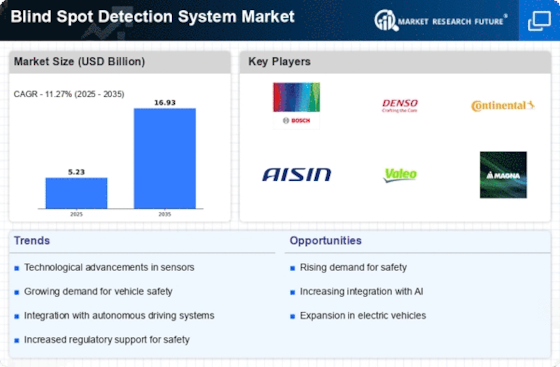
Key players in the Blind Spot Detection System Market include Bosch, Denso, Continental, Aisin Seiki, Valeo, Magna International, Autoliv, Nissan, and Ford Motor Company.

Market Summary

As per Market Research Future analysis, the Blind Spot Detection System Market Size was estimated at 5.23 USD Billion in 2024. The Blind Spot Detection System industry is projected to grow from 5.82 USD Billion in 2025 to 16.93 USD Billion by 2035, exhibiting a compound annual growth rate (CAGR) of 11.27% during the forecast period 2025 - 2035

Key Market Trends & Highlights

The Blind Spot Detection System Market is poised for substantial growth driven by technological advancements and increasing safety awareness.

  • North America remains the largest market for blind spot detection systems, reflecting a strong demand for advanced safety features. The Asia-Pacific region is emerging as the fastest-growing market, fueled by rapid urbanization and rising vehicle production. Radar sensors dominate the market, while camera-based systems are experiencing the fastest growth due to technological innovations. Key market drivers include the rising vehicle production and the growing demand for safety features, which are shaping market dynamics.

Market Size & Forecast

2024 Market Size 5.23 (USD Billion)
2035 Market Size 16.93 (USD Billion)
CAGR (2025 - 2035) 11.27%
Largest Regional Market Share in 2024 North America

Major Players

Bosch (DE), Denso (JP), Continental (DE), Aisin Seiki (JP), Valeo (FR), Magna International (CA), Autoliv (SE), Nissan (JP), Ford Motor Company (US)

Market Trends

The Blind Spot Detection System Market is currently experiencing a notable transformation, driven by advancements in automotive technology and increasing consumer awareness regarding vehicle safety. As vehicles become more sophisticated, the integration of innovative safety features, such as blind spot detection systems, is becoming a standard expectation among consumers.

This shift is further fueled by regulatory bodies advocating for enhanced safety measures in vehicles, which appears to be influencing manufacturers to prioritize the development and implementation of these systems. Consequently, the market is witnessing a surge in demand, as consumers seek vehicles equipped with advanced safety technologies that can mitigate the risks associated with blind spots. Moreover, the Blind Spot Detection System Market is likely to benefit from the growing trend of electrification in the automotive sector. Electric vehicles, which are gaining traction, often come equipped with cutting-edge safety features, including blind spot detection systems.

This trend suggests that as the adoption of electric vehicles continues to rise, the demand for blind spot detection systems will also increase. Additionally, the ongoing development of autonomous driving technologies may further propel the market, as these systems are integral to ensuring safe navigation in complex driving environments. Overall, the blind spot object detection system market  appears poised for substantial growth in the coming years, driven by technological advancements and evolving consumer preferences.

Technological Advancements

The Blind Spot Detection System Market is witnessing rapid technological advancements, particularly in sensor and camera technologies. These innovations enhance the accuracy and reliability of detection systems, making them more appealing to consumers. As manufacturers invest in research and development, the integration of artificial intelligence and machine learning into these systems is becoming more prevalent, potentially improving their functionality.

Increased Consumer Awareness

There is a growing awareness among consumers regarding vehicle safety features, which is influencing purchasing decisions. As individuals become more informed about the risks associated with blind spots, they are more likely to seek vehicles equipped with advanced detection systems. This trend indicates a shift in consumer priorities towards safety, thereby driving demand in the blind spot object detection system market .

Regulatory Influence

Regulatory bodies are increasingly advocating for enhanced safety measures in vehicles, which is impacting the Blind Spot Detection System Market. As governments implement stricter safety standards, manufacturers are compelled to incorporate advanced safety features, including blind spot detection systems, into their vehicle designs. This regulatory influence is likely to accelerate market growth as compliance becomes essential.

Blind Spot Object Detection System Market Market Drivers

Regulatory Mandates

Regulatory influences are increasingly shaping the Blind Spot Detection System Market. Governments and regulatory bodies are implementing stringent safety standards that require the inclusion of advanced safety features in vehicles. These mandates often include the necessity for blind spot detection systems, particularly in commercial vehicles and larger passenger cars. As compliance with these regulations becomes mandatory, manufacturers are compelled to integrate such systems into their vehicle designs. This regulatory push is expected to drive growth in the Blind Spot Detection System Market, as automakers adapt to meet these evolving safety requirements.

Increased Urbanization

The trend of urbanization is contributing to the growth of the Blind Spot Detection System Market. As urban areas become more congested, the risk of accidents increases, particularly in environments with high traffic density. Blind spot detection systems are increasingly recognized as vital tools for enhancing safety in urban driving conditions. The rising number of vehicles on the road, coupled with the complexities of urban driving, creates a favorable environment for the adoption of these systems. Consequently, the Blind Spot Detection System Market is likely to experience growth as urbanization continues to influence vehicle safety technology.

Rising Vehicle Production

The increasing production of vehicles is a primary driver for the Blind Spot Detection System Market. As manufacturers strive to enhance vehicle safety features, the integration of advanced driver assistance systems, including blind spot detection, becomes essential. In recent years, the automotive sector has witnessed a surge in production rates, with millions of vehicles being manufactured annually. This trend is expected to continue, as consumer demand for safer vehicles grows. Consequently, the Blind Spot Detection System Market is likely to expand in tandem with vehicle production, as automakers incorporate these systems to meet safety standards and consumer expectations.

Technological Innovations

Technological advancements play a crucial role in shaping the Blind Spot Detection System Market. Innovations in sensor technology, radar systems, and camera capabilities have significantly improved the effectiveness and reliability of blind spot detection systems. These advancements not only enhance the performance of existing systems but also pave the way for the development of new features, such as integration with other driver assistance technologies. As manufacturers continue to innovate, the Blind Spot Detection System Market is likely to benefit from the introduction of more sophisticated and efficient systems, appealing to both consumers and automotive manufacturers.

Growing Demand for Safety Features

Consumer demand for enhanced safety features in vehicles is a significant driver for the Blind Spot Detection System Market. As awareness of road safety increases, consumers are actively seeking vehicles equipped with advanced safety technologies. Reports indicate that a substantial percentage of consumers prioritize safety features when purchasing a vehicle. This trend has prompted manufacturers to invest in the development and integration of blind spot detection systems, which are increasingly viewed as essential components of modern vehicles. The Blind Spot Detection System Market is thus positioned for growth, driven by the need to meet consumer expectations for safety.

Market Segment Insights

By Technology: Radar Sensor (Largest) vs. Camera (Fastest-Growing)

In the Blind Spot Detection System Market, radar sensors currently hold the largest share, benefitting from their reliability and performance in detecting objects in various weather conditions and distances. They dominate the market primarily due to their long-range capabilities and robustness, which is crucial for vehicle safety and efficient blind spot monitoring.

Technology: Radar Sensor (Dominant) vs. Camera (Emerging)

Radar sensors are widely recognized as the dominant technology in blind spot detection systems due to their superior ability to operate under various environmental conditions, such as rain, fog, and darkness. Their long-range detection capabilities allow them to identify objects from a significant distance, enhancing overall vehicle safety. In contrast, <a href="https://www.marketresearchfuture.com/reports/digital-camera-market-2316">camera </a>systems are emerging rapidly, especially with advancements in image processing and machine learning technologies. Although they currently represent the fastest-growing segment, their effectiveness can be limited by changing light conditions and inclement weather, making them a complementary technology to radar sensors.

By Vehicle Type: Passenger Vehicle (Largest) vs. Commercial Vehicle (Fastest-Growing)

In the Blind Spot Detection System Market, the segment distribution is heavily tilted towards passenger vehicles, which hold the largest market share. This is largely due to the high consumer demand for safety features in personal vehicles and the increasing incorporation of advanced safety systems by manufacturers. The dominance of passenger vehicles is evident as they account for a significant portion of blind spot detection system installations, reflecting consumer awareness and regulatory pressures for enhanced safety standards.

Passenger Vehicle (Dominant) vs. Commercial Vehicle (Emerging)

The passenger vehicle segment in the Blind Spot Detection System Market is recognized as the dominant force, driven by consumer preference for enhanced safety features and manufacturers' commitment to integrating advanced technology. This segment benefits from the growing awareness around road safety and strict regulations for vehicular safety globally. In contrast, the <a href="https://www.marketresearchfuture.com/reports/commercial-vehicle-accessories-market-28935">commercial vehicle segment</a> is emerging rapidly, fueled by the increasing adoption of safety technologies to minimize accidents and enhance fleet management. Commercial vehicles are often required to meet specific safety standards, making blind spot detection systems increasingly important as fleet operators prioritize safety and efficiency. Both segments play crucial roles, with passenger vehicles leading the market while commercial vehicles are positioned for rapid growth.

By Sales Channel: OEM (Largest) vs. Aftermarket (Fastest-Growing)

In the Blind Spot Detection System market, the sales distribution is primarily dominated by the OEM segment, which accounts for a significant portion of the market share. This segment benefits from established relationships between manufacturers and automakers, ensuring consistent demand for integrated safety features. On the other hand, the aftermarket segment, while smaller in market share, exhibits substantial growth due to increasing consumer awareness and demand for vehicle safety upgrades. This growth is fueled by technological advancements and regulatory pressures prompting vehicle manufacturers to enhance safety features in existing models.

Sales Channels: OEM (Dominant) vs. Aftermarket (Emerging)

The OEM segment stands as the dominant player in the Blind Spot Detection System market, characterized by strong partnerships with automotive manufacturers and a focus on innovation in integrated systems. OEM solutions are typically preferred for new vehicle models, providing advanced functionalities and reliability. In contrast, the aftermarket segment is rapidly emerging, driven by rising consumer interest in enhancing vehicle safety features post-purchase. This segment is characterized by a diverse range of products, often offering competitive pricing and easy installation options, appealing to both individual car owners and repair shops looking to add value to their service offerings.

Get more detailed insights about Blind Spot Object Detection System Market Research Report—Global Forecast till 2035

Regional Insights

By region, the study provides market insights into North America, Europe, Asia-Pacific and Rest of the World. The North American blind spot object detection system market area will dominate this market, Government-imposed strict safety regulations are assisting North America in retaining its second-largest ranking. The region's ruling bodies have raised the vehicle rating scale, which has compelled manufacturers to build cars that adhere to the government's safety regulations.

Further, the major countries studied in the market report are The US, Canada, German, France, the UK, Italy, Spain, China, Japan, India, Australia, South Korea, and Brazil.

Figure 2: Global Blind Spot Object Detection System Market Share By Region 2024 (USD Billion)

Europe’s blind spot object detection system market accounts for the second-largest market share. The presence of significant key players in this region and rising consumer awareness of vehicle safety are expected to drive positive market growth. Europe's market for blind spot detection systems is expected to grow during the forecast period due to the region's rising demand for vehicles with driver assistance systems. Further, the German blind spot object detection system market held the largest market share, and the UK blind spot object detection system market was the fastest-growing market in the European region.

The Asia-Pacific Blind Spot Detection System Market is expected to grow at the fastest CAGR from 2024 to 2032. The presence of significant key players in this region and rising consumer awareness of vehicle safety are expected to drive positive market growth. Europe's market for blind spot detection systems is expected to grow during the forecast period due to the region's rising demand for vehicles with driver assistance systems. Moreover, China’s blind spot object detection system market held the largest market share, and the Indian blind spot object detection system market was the fastest-growing market in the Asia-Pacific region.

Key Players and Competitive Insights

Leading market players are investing heavily in research and development in order to expand their product lines, which will help the blind spot object detection system market grow even more. Market participants are also undertaking various strategic activities to expand their global footprint, with important market developments including new product launches, contractual agreements, mergers and acquisitions, higher investments, and collaboration with other organizations. To expand and survive in a more competitive and rising market climate, the blind spot object detection system industry must offer cost-effective items. Manufacturing locally to minimize operational costs is one of the key business tactics manufacturers use in the global blind spot object detection system industry to benefit clients and increase the market sector. In recent years, the blind spot object detection system industry has offered some of the most significant advantages. Major players in the blind spot object detection system market, including Continental AG (Germany), Robert Bosch Gmbh (Germany), Daimler AG (Germany), Autoliv (Stheyden), Gentex Corporation (US), Mobileye (Israel), Friedrichshafen AG (Germany), Ficosa (Spain), Delphi Technologies (UK), Nissan Motor Co Ltd (Japan), Denso Corporation (Japan), Magna International Inc (Canada), Valeo (France), Hitachi Aamito Americas, Inc (Japan) and others, are attempting to increase market demand by investing in research and development operations. Continental AG (Germany), creates cutting-edge services and technologies for connected, sustainable transportation of people and their goods. Established in 1871, the technology business provides safe, effective, intelligent, and reasonably priced solutions for machines, traffic, and transportation. Continental generated €39.4 billion in sales in 2022 and currently employs about 200,000 people across 57 markets and countries. At Continental, they have relentlessly pursued ground-breaking concepts to make the future better for everyone. They are among the pioneers of the global mobility transformation and constantly push the boundaries of what is possible. A safer, cleaner, and more effective mobility experience will undoubtedly be made possible by their display solutions and the collaboration with Ambarella for future autonomous mobility. They are they-positioned to shape the future of mobility thanks to 20,000 software experts and 150 years of engineering excellence. Valeo (France), the first friction materials made in France, was created by SAFF, which started in a small workshop near Paris under the direction of automotive pioneer Eugène Buisson. SAFF played a significant role in the automotive revolution at the turn of the 20th century. On the eve of World War II, it dominated the brake linings and clutches manufacturing market. It had grown to have 2,500 workers by the beginning of the 1950s.

Key Companies in the Blind Spot Object Detection System Market include

Industry Developments

June 2022: Continental introduced cutting-edge driver assistance safety equipment to eliminate the blind spot at the A-pillar of the vehicle. The virtual A-pillar facilitates the driver's ability to see through the pillar, thus avoiding collisions. On an internal OLED display, the virtual A-Pillar shows the vehicle’s exterior in accordance with how the car is moving and how the steering wheel is turned.

January 2022: Magna and Renesas announced in May 2018 that they’re creating an affordable 3D surround view system for mid- and entry-level vehicles. The cost-effective technology available for entry-level and mid-level vehicles enhances the safety of these models.

Future Outlook

Blind Spot Object Detection System Market Future Outlook

The Blind Spot Detection System Market is projected to grow at 11.27% CAGR from 2025 to 2035, driven by increasing safety regulations, technological advancements, and rising consumer awareness.

New opportunities lie in:

  • <p>Integration of AI-driven analytics for predictive maintenance solutions. Development of aftermarket blind spot detection kits for older vehicle models. Partnerships with automotive manufacturers for OEM integration of advanced systems.</p>

By 2035, the market is expected to be robust, reflecting substantial growth and innovation.

Market Segmentation

Blind Spot Object Detection System Market Technology Outlook

  • Radar Sensor
  • Camera

Blind Spot Object Detection System Market Vehicle Type Outlook

  • Passenger Vehicle
  • Commercial Vehicle

Blind Spot Object Detection System Market Sales Channel Outlook

  • OEM
  • Aftermarket

Report Scope

MARKET SIZE 2024 5.23(USD Billion)
MARKET SIZE 2025 5.82(USD Billion)
MARKET SIZE 2035 16.93(USD Billion)
COMPOUND ANNUAL GROWTH RATE (CAGR) 11.27% (2025 - 2035)
REPORT COVERAGE Revenue Forecast, Competitive Landscape, Growth Factors, and Trends
BASE YEAR 2024
Market Forecast Period 2025 - 2035
Historical Data 2019 - 2024
Market Forecast Units USD Billion
Key Companies Profiled Bosch (DE), Denso (JP), Continental (DE), Aisin Seiki (JP), Valeo (FR), Magna International (CA), Autoliv (SE), Nissan (JP), Ford Motor Company (US)
Segments Covered Technology, Vehicle Type, Sales Channel, Region
Key Market Opportunities Integration of advanced sensors and artificial intelligence enhances safety in the Blind Spot Detection System Market.
Key Market Dynamics Rising demand for advanced safety features drives innovation in Blind Spot Detection System technology and competitive market dynamics.
Countries Covered North America, Europe, APAC, South America, MEA

FAQs

What is the projected market valuation for the Blind Spot Detection System by 2035?

<p>The projected market valuation for the Blind Spot Detection System is expected to reach 16.93 USD Billion by 2035.</p>

What was the market valuation for the Blind Spot Detection System in 2024?

<p>The market valuation for the Blind Spot Detection System was 5.23 USD Billion in 2024.</p>

What is the expected CAGR for the Blind Spot Detection System Market during the forecast period 2025 - 2035?

<p>The expected CAGR for the Blind Spot Detection System Market during the forecast period 2025 - 2035 is 11.27%.</p>

Which technology segments are included in the Blind Spot Detection System Market?

<p>The Blind Spot Detection System Market includes technology segments such as Radar Sensors and Cameras.</p>

What are the projected valuations for Radar Sensors and Cameras by 2035?

<p>By 2035, Radar Sensors are projected to reach 6.83 USD Billion, while Cameras are expected to reach 10.1 USD Billion.</p>

What vehicle types are considered in the Blind Spot Detection System Market?

<p>The Blind Spot Detection System Market considers Passenger Vehicles and Commercial Vehicles as key segments.</p>

What are the projected market valuations for Passenger and Commercial Vehicles by 2035?

By 2035, Passenger Vehicles are projected to reach 8.45 USD Billion, and Commercial Vehicles are expected to reach 8.48 USD Billion.

What sales channels are analyzed in the Blind Spot Detection System Market?

The Blind Spot Detection System Market analyzes sales channels including OEM and Aftermarket.

What are the projected valuations for OEM and Aftermarket by 2035?

By 2035, the OEM segment is projected to reach 8.45 USD Billion, while the Aftermarket segment is expected to reach 8.48 USD Billion.

Who are the key players in the Blind Spot Detection System Market?

Key players in the Blind Spot Detection System Market include Bosch, Denso, Continental, Aisin Seiki, Valeo, Magna International, Autoliv, Nissan, and Ford Motor Company.

  1. SECTION I: EXECUTIVE SUMMARY AND KEY HIGHLIGHTS
    1. | 1.1 EXECUTIVE SUMMARY
    2. | | 1.1.1 Market Overview
    3. | | 1.1.2 Key Findings
    4. | | 1.1.3 Market Segmentation
    5. | | 1.1.4 Competitive Landscape
    6. | | 1.1.5 Challenges and Opportunities
    7. | | 1.1.6 Future Outlook
  2. SECTION II: SCOPING, METHODOLOGY AND MARKET STRUCTURE
    1. | 2.1 MARKET INTRODUCTION
    2. | | 2.1.1 Definition
    3. | | 2.1.2 Scope of the study
    4. | | | 2.1.2.1 Research Objective
    5. | | | 2.1.2.2 Assumption
    6. | | | 2.1.2.3 Limitations
    7. | 2.2 RESEARCH METHODOLOGY
    8. | | 2.2.1 Overview
    9. | | 2.2.2 Data Mining
    10. | | 2.2.3 Secondary Research
    11. | | 2.2.4 Primary Research
    12. | | | 2.2.4.1 Primary Interviews and Information Gathering Process
    13. | | | 2.2.4.2 Breakdown of Primary Respondents
    14. | | 2.2.5 Forecasting Model
    15. | | 2.2.6 Market Size Estimation
    16. | | | 2.2.6.1 Bottom-Up Approach
    17. | | | 2.2.6.2 Top-Down Approach
    18. | | 2.2.7 Data Triangulation
    19. | | 2.2.8 Validation
  3. SECTION III: QUALITATIVE ANALYSIS
    1. | 3.1 MARKET DYNAMICS
    2. | | 3.1.1 Overview
    3. | | 3.1.2 Drivers
    4. | | 3.1.3 Restraints
    5. | | 3.1.4 Opportunities
    6. | 3.2 MARKET FACTOR ANALYSIS
    7. | | 3.2.1 Value chain Analysis
    8. | | 3.2.2 Porter's Five Forces Analysis
    9. | | | 3.2.2.1 Bargaining Power of Suppliers
    10. | | | 3.2.2.2 Bargaining Power of Buyers
    11. | | | 3.2.2.3 Threat of New Entrants
    12. | | | 3.2.2.4 Threat of Substitutes
    13. | | | 3.2.2.5 Intensity of Rivalry
    14. | | 3.2.3 COVID-19 Impact Analysis
    15. | | | 3.2.3.1 Market Impact Analysis
    16. | | | 3.2.3.2 Regional Impact
    17. | | | 3.2.3.3 Opportunity and Threat Analysis
  4. SECTION IV: QUANTITATIVE ANALYSIS
    1. | 4.1 Automobile, BY Technology (USD Billion)
    2. | | 4.1.1 Radar Sensor
    3. | | 4.1.2 Camera
    4. | 4.2 Automobile, BY Vehicle Type (USD Billion)
    5. | | 4.2.1 Passenger Vehicle
    6. | | 4.2.2 Commercial Vehicle
    7. | 4.3 Automobile, BY Sales Channel (USD Billion)
    8. | | 4.3.1 OEM
    9. | | 4.3.2 Aftermarket
    10. | 4.4 Automobile, BY Region (USD Billion)
    11. | | 4.4.1 North America
    12. | | | 4.4.1.1 US
    13. | | | 4.4.1.2 Canada
    14. | | 4.4.2 Europe
    15. | | | 4.4.2.1 Germany
    16. | | | 4.4.2.2 UK
    17. | | | 4.4.2.3 France
    18. | | | 4.4.2.4 Russia
    19. | | | 4.4.2.5 Italy
    20. | | | 4.4.2.6 Spain
    21. | | | 4.4.2.7 Rest of Europe
    22. | | 4.4.3 APAC
    23. | | | 4.4.3.1 China
    24. | | | 4.4.3.2 India
    25. | | | 4.4.3.3 Japan
    26. | | | 4.4.3.4 South Korea
    27. | | | 4.4.3.5 Malaysia
    28. | | | 4.4.3.6 Thailand
    29. | | | 4.4.3.7 Indonesia
    30. | | | 4.4.3.8 Rest of APAC
    31. | | 4.4.4 South America
    32. | | | 4.4.4.1 Brazil
    33. | | | 4.4.4.2 Mexico
    34. | | | 4.4.4.3 Argentina
    35. | | | 4.4.4.4 Rest of South America
    36. | | 4.4.5 MEA
    37. | | | 4.4.5.1 GCC Countries
    38. | | | 4.4.5.2 South Africa
    39. | | | 4.4.5.3 Rest of MEA
  5. SECTION V: COMPETITIVE ANALYSIS
    1. | 5.1 Competitive Landscape
    2. | | 5.1.1 Overview
    3. | | 5.1.2 Competitive Analysis
    4. | | 5.1.3 Market share Analysis
    5. | | 5.1.4 Major Growth Strategy in the Automobile
    6. | | 5.1.5 Competitive Benchmarking
    7. | | 5.1.6 Leading Players in Terms of Number of Developments in the Automobile
    8. | | 5.1.7 Key developments and growth strategies
    9. | | | 5.1.7.1 New Product Launch/Service Deployment
    10. | | | 5.1.7.2 Merger & Acquisitions
    11. | | | 5.1.7.3 Joint Ventures
    12. | | 5.1.8 Major Players Financial Matrix
    13. | | | 5.1.8.1 Sales and Operating Income
    14. | | | 5.1.8.2 Major Players R&D Expenditure. 2023
    15. | 5.2 Company Profiles
    16. | | 5.2.1 Bosch (DE)
    17. | | | 5.2.1.1 Financial Overview
    18. | | | 5.2.1.2 Products Offered
    19. | | | 5.2.1.3 Key Developments
    20. | | | 5.2.1.4 SWOT Analysis
    21. | | | 5.2.1.5 Key Strategies
    22. | | 5.2.2 Denso (JP)
    23. | | | 5.2.2.1 Financial Overview
    24. | | | 5.2.2.2 Products Offered
    25. | | | 5.2.2.3 Key Developments
    26. | | | 5.2.2.4 SWOT Analysis
    27. | | | 5.2.2.5 Key Strategies
    28. | | 5.2.3 Continental (DE)
    29. | | | 5.2.3.1 Financial Overview
    30. | | | 5.2.3.2 Products Offered
    31. | | | 5.2.3.3 Key Developments
    32. | | | 5.2.3.4 SWOT Analysis
    33. | | | 5.2.3.5 Key Strategies
    34. | | 5.2.4 Aisin Seiki (JP)
    35. | | | 5.2.4.1 Financial Overview
    36. | | | 5.2.4.2 Products Offered
    37. | | | 5.2.4.3 Key Developments
    38. | | | 5.2.4.4 SWOT Analysis
    39. | | | 5.2.4.5 Key Strategies
    40. | | 5.2.5 Valeo (FR)
    41. | | | 5.2.5.1 Financial Overview
    42. | | | 5.2.5.2 Products Offered
    43. | | | 5.2.5.3 Key Developments
    44. | | | 5.2.5.4 SWOT Analysis
    45. | | | 5.2.5.5 Key Strategies
    46. | | 5.2.6 Magna International (CA)
    47. | | | 5.2.6.1 Financial Overview
    48. | | | 5.2.6.2 Products Offered
    49. | | | 5.2.6.3 Key Developments
    50. | | | 5.2.6.4 SWOT Analysis
    51. | | | 5.2.6.5 Key Strategies
    52. | | 5.2.7 Autoliv (SE)
    53. | | | 5.2.7.1 Financial Overview
    54. | | | 5.2.7.2 Products Offered
    55. | | | 5.2.7.3 Key Developments
    56. | | | 5.2.7.4 SWOT Analysis
    57. | | | 5.2.7.5 Key Strategies
    58. | | 5.2.8 Nissan (JP)
    59. | | | 5.2.8.1 Financial Overview
    60. | | | 5.2.8.2 Products Offered
    61. | | | 5.2.8.3 Key Developments
    62. | | | 5.2.8.4 SWOT Analysis
    63. | | | 5.2.8.5 Key Strategies
    64. | | 5.2.9 Ford Motor Company (US)
    65. | | | 5.2.9.1 Financial Overview
    66. | | | 5.2.9.2 Products Offered
    67. | | | 5.2.9.3 Key Developments
    68. | | | 5.2.9.4 SWOT Analysis
    69. | | | 5.2.9.5 Key Strategies
    70. | 5.3 Appendix
    71. | | 5.3.1 References
    72. | | 5.3.2 Related Reports
  6. LIST OF FIGURES
    1. | 6.1 MARKET SYNOPSIS
    2. | 6.2 NORTH AMERICA MARKET ANALYSIS
    3. | 6.3 US MARKET ANALYSIS BY TECHNOLOGY
    4. | 6.4 US MARKET ANALYSIS BY VEHICLE TYPE
    5. | 6.5 US MARKET ANALYSIS BY SALES CHANNEL
    6. | 6.6 CANADA MARKET ANALYSIS BY TECHNOLOGY
    7. | 6.7 CANADA MARKET ANALYSIS BY VEHICLE TYPE
    8. | 6.8 CANADA MARKET ANALYSIS BY SALES CHANNEL
    9. | 6.9 EUROPE MARKET ANALYSIS
    10. | 6.10 GERMANY MARKET ANALYSIS BY TECHNOLOGY
    11. | 6.11 GERMANY MARKET ANALYSIS BY VEHICLE TYPE
    12. | 6.12 GERMANY MARKET ANALYSIS BY SALES CHANNEL
    13. | 6.13 UK MARKET ANALYSIS BY TECHNOLOGY
    14. | 6.14 UK MARKET ANALYSIS BY VEHICLE TYPE
    15. | 6.15 UK MARKET ANALYSIS BY SALES CHANNEL
    16. | 6.16 FRANCE MARKET ANALYSIS BY TECHNOLOGY
    17. | 6.17 FRANCE MARKET ANALYSIS BY VEHICLE TYPE
    18. | 6.18 FRANCE MARKET ANALYSIS BY SALES CHANNEL
    19. | 6.19 RUSSIA MARKET ANALYSIS BY TECHNOLOGY
    20. | 6.20 RUSSIA MARKET ANALYSIS BY VEHICLE TYPE
    21. | 6.21 RUSSIA MARKET ANALYSIS BY SALES CHANNEL
    22. | 6.22 ITALY MARKET ANALYSIS BY TECHNOLOGY
    23. | 6.23 ITALY MARKET ANALYSIS BY VEHICLE TYPE
    24. | 6.24 ITALY MARKET ANALYSIS BY SALES CHANNEL
    25. | 6.25 SPAIN MARKET ANALYSIS BY TECHNOLOGY
    26. | 6.26 SPAIN MARKET ANALYSIS BY VEHICLE TYPE
    27. | 6.27 SPAIN MARKET ANALYSIS BY SALES CHANNEL
    28. | 6.28 REST OF EUROPE MARKET ANALYSIS BY TECHNOLOGY
    29. | 6.29 REST OF EUROPE MARKET ANALYSIS BY VEHICLE TYPE
    30. | 6.30 REST OF EUROPE MARKET ANALYSIS BY SALES CHANNEL
    31. | 6.31 APAC MARKET ANALYSIS
    32. | 6.32 CHINA MARKET ANALYSIS BY TECHNOLOGY
    33. | 6.33 CHINA MARKET ANALYSIS BY VEHICLE TYPE
    34. | 6.34 CHINA MARKET ANALYSIS BY SALES CHANNEL
    35. | 6.35 INDIA MARKET ANALYSIS BY TECHNOLOGY
    36. | 6.36 INDIA MARKET ANALYSIS BY VEHICLE TYPE
    37. | 6.37 INDIA MARKET ANALYSIS BY SALES CHANNEL
    38. | 6.38 JAPAN MARKET ANALYSIS BY TECHNOLOGY
    39. | 6.39 JAPAN MARKET ANALYSIS BY VEHICLE TYPE
    40. | 6.40 JAPAN MARKET ANALYSIS BY SALES CHANNEL
    41. | 6.41 SOUTH KOREA MARKET ANALYSIS BY TECHNOLOGY
    42. | 6.42 SOUTH KOREA MARKET ANALYSIS BY VEHICLE TYPE
    43. | 6.43 SOUTH KOREA MARKET ANALYSIS BY SALES CHANNEL
    44. | 6.44 MALAYSIA MARKET ANALYSIS BY TECHNOLOGY
    45. | 6.45 MALAYSIA MARKET ANALYSIS BY VEHICLE TYPE
    46. | 6.46 MALAYSIA MARKET ANALYSIS BY SALES CHANNEL
    47. | 6.47 THAILAND MARKET ANALYSIS BY TECHNOLOGY
    48. | 6.48 THAILAND MARKET ANALYSIS BY VEHICLE TYPE
    49. | 6.49 THAILAND MARKET ANALYSIS BY SALES CHANNEL
    50. | 6.50 INDONESIA MARKET ANALYSIS BY TECHNOLOGY
    51. | 6.51 INDONESIA MARKET ANALYSIS BY VEHICLE TYPE
    52. | 6.52 INDONESIA MARKET ANALYSIS BY SALES CHANNEL
    53. | 6.53 REST OF APAC MARKET ANALYSIS BY TECHNOLOGY
    54. | 6.54 REST OF APAC MARKET ANALYSIS BY VEHICLE TYPE
    55. | 6.55 REST OF APAC MARKET ANALYSIS BY SALES CHANNEL
    56. | 6.56 SOUTH AMERICA MARKET ANALYSIS
    57. | 6.57 BRAZIL MARKET ANALYSIS BY TECHNOLOGY
    58. | 6.58 BRAZIL MARKET ANALYSIS BY VEHICLE TYPE
    59. | 6.59 BRAZIL MARKET ANALYSIS BY SALES CHANNEL
    60. | 6.60 MEXICO MARKET ANALYSIS BY TECHNOLOGY
    61. | 6.61 MEXICO MARKET ANALYSIS BY VEHICLE TYPE
    62. | 6.62 MEXICO MARKET ANALYSIS BY SALES CHANNEL
    63. | 6.63 ARGENTINA MARKET ANALYSIS BY TECHNOLOGY
    64. | 6.64 ARGENTINA MARKET ANALYSIS BY VEHICLE TYPE
    65. | 6.65 ARGENTINA MARKET ANALYSIS BY SALES CHANNEL
    66. | 6.66 REST OF SOUTH AMERICA MARKET ANALYSIS BY TECHNOLOGY
    67. | 6.67 REST OF SOUTH AMERICA MARKET ANALYSIS BY VEHICLE TYPE
    68. | 6.68 REST OF SOUTH AMERICA MARKET ANALYSIS BY SALES CHANNEL
    69. | 6.69 MEA MARKET ANALYSIS
    70. | 6.70 GCC COUNTRIES MARKET ANALYSIS BY TECHNOLOGY
    71. | 6.71 GCC COUNTRIES MARKET ANALYSIS BY VEHICLE TYPE
    72. | 6.72 GCC COUNTRIES MARKET ANALYSIS BY SALES CHANNEL
    73. | 6.73 SOUTH AFRICA MARKET ANALYSIS BY TECHNOLOGY
    74. | 6.74 SOUTH AFRICA MARKET ANALYSIS BY VEHICLE TYPE
    75. | 6.75 SOUTH AFRICA MARKET ANALYSIS BY SALES CHANNEL
    76. | 6.76 REST OF MEA MARKET ANALYSIS BY TECHNOLOGY
    77. | 6.77 REST OF MEA MARKET ANALYSIS BY VEHICLE TYPE
    78. | 6.78 REST OF MEA MARKET ANALYSIS BY SALES CHANNEL
    79. | 6.79 KEY BUYING CRITERIA OF AUTOMOBILE
    80. | 6.80 RESEARCH PROCESS OF MRFR
    81. | 6.81 DRO ANALYSIS OF AUTOMOBILE
    82. | 6.82 DRIVERS IMPACT ANALYSIS: AUTOMOBILE
    83. | 6.83 RESTRAINTS IMPACT ANALYSIS: AUTOMOBILE
    84. | 6.84 SUPPLY / VALUE CHAIN: AUTOMOBILE
    85. | 6.85 AUTOMOBILE, BY TECHNOLOGY, 2024 (% SHARE)
    86. | 6.86 AUTOMOBILE, BY TECHNOLOGY, 2024 TO 2035 (USD Billion)
    87. | 6.87 AUTOMOBILE, BY VEHICLE TYPE, 2024 (% SHARE)
    88. | 6.88 AUTOMOBILE, BY VEHICLE TYPE, 2024 TO 2035 (USD Billion)
    89. | 6.89 AUTOMOBILE, BY SALES CHANNEL, 2024 (% SHARE)
    90. | 6.90 AUTOMOBILE, BY SALES CHANNEL, 2024 TO 2035 (USD Billion)
    91. | 6.91 BENCHMARKING OF MAJOR COMPETITORS
  7. LIST OF TABLES
    1. | 7.1 LIST OF ASSUMPTIONS
    2. | | 7.1.1
    3. | 7.2 North America MARKET SIZE ESTIMATES; FORECAST
    4. | | 7.2.1 BY TECHNOLOGY, 2025-2035 (USD Billion)
    5. | | 7.2.2 BY VEHICLE TYPE, 2025-2035 (USD Billion)
    6. | | 7.2.3 BY SALES CHANNEL, 2025-2035 (USD Billion)
    7. | 7.3 US MARKET SIZE ESTIMATES; FORECAST
    8. | | 7.3.1 BY TECHNOLOGY, 2025-2035 (USD Billion)
    9. | | 7.3.2 BY VEHICLE TYPE, 2025-2035 (USD Billion)
    10. | | 7.3.3 BY SALES CHANNEL, 2025-2035 (USD Billion)
    11. | 7.4 Canada MARKET SIZE ESTIMATES; FORECAST
    12. | | 7.4.1 BY TECHNOLOGY, 2025-2035 (USD Billion)
    13. | | 7.4.2 BY VEHICLE TYPE, 2025-2035 (USD Billion)
    14. | | 7.4.3 BY SALES CHANNEL, 2025-2035 (USD Billion)
    15. | 7.5 Europe MARKET SIZE ESTIMATES; FORECAST
    16. | | 7.5.1 BY TECHNOLOGY, 2025-2035 (USD Billion)
    17. | | 7.5.2 BY VEHICLE TYPE, 2025-2035 (USD Billion)
    18. | | 7.5.3 BY SALES CHANNEL, 2025-2035 (USD Billion)
    19. | 7.6 Germany MARKET SIZE ESTIMATES; FORECAST
    20. | | 7.6.1 BY TECHNOLOGY, 2025-2035 (USD Billion)
    21. | | 7.6.2 BY VEHICLE TYPE, 2025-2035 (USD Billion)
    22. | | 7.6.3 BY SALES CHANNEL, 2025-2035 (USD Billion)
    23. | 7.7 UK MARKET SIZE ESTIMATES; FORECAST
    24. | | 7.7.1 BY TECHNOLOGY, 2025-2035 (USD Billion)
    25. | | 7.7.2 BY VEHICLE TYPE, 2025-2035 (USD Billion)
    26. | | 7.7.3 BY SALES CHANNEL, 2025-2035 (USD Billion)
    27. | 7.8 France MARKET SIZE ESTIMATES; FORECAST
    28. | | 7.8.1 BY TECHNOLOGY, 2025-2035 (USD Billion)
    29. | | 7.8.2 BY VEHICLE TYPE, 2025-2035 (USD Billion)
    30. | | 7.8.3 BY SALES CHANNEL, 2025-2035 (USD Billion)
    31. | 7.9 Russia MARKET SIZE ESTIMATES; FORECAST
    32. | | 7.9.1 BY TECHNOLOGY, 2025-2035 (USD Billion)
    33. | | 7.9.2 BY VEHICLE TYPE, 2025-2035 (USD Billion)
    34. | | 7.9.3 BY SALES CHANNEL, 2025-2035 (USD Billion)
    35. | 7.10 Italy MARKET SIZE ESTIMATES; FORECAST
    36. | | 7.10.1 BY TECHNOLOGY, 2025-2035 (USD Billion)
    37. | | 7.10.2 BY VEHICLE TYPE, 2025-2035 (USD Billion)
    38. | | 7.10.3 BY SALES CHANNEL, 2025-2035 (USD Billion)
    39. | 7.11 Spain MARKET SIZE ESTIMATES; FORECAST
    40. | | 7.11.1 BY TECHNOLOGY, 2025-2035 (USD Billion)
    41. | | 7.11.2 BY VEHICLE TYPE, 2025-2035 (USD Billion)
    42. | | 7.11.3 BY SALES CHANNEL, 2025-2035 (USD Billion)
    43. | 7.12 Rest of Europe MARKET SIZE ESTIMATES; FORECAST
    44. | | 7.12.1 BY TECHNOLOGY, 2025-2035 (USD Billion)
    45. | | 7.12.2 BY VEHICLE TYPE, 2025-2035 (USD Billion)
    46. | | 7.12.3 BY SALES CHANNEL, 2025-2035 (USD Billion)
    47. | 7.13 APAC MARKET SIZE ESTIMATES; FORECAST
    48. | | 7.13.1 BY TECHNOLOGY, 2025-2035 (USD Billion)
    49. | | 7.13.2 BY VEHICLE TYPE, 2025-2035 (USD Billion)
    50. | | 7.13.3 BY SALES CHANNEL, 2025-2035 (USD Billion)
    51. | 7.14 China MARKET SIZE ESTIMATES; FORECAST
    52. | | 7.14.1 BY TECHNOLOGY, 2025-2035 (USD Billion)
    53. | | 7.14.2 BY VEHICLE TYPE, 2025-2035 (USD Billion)
    54. | | 7.14.3 BY SALES CHANNEL, 2025-2035 (USD Billion)
    55. | 7.15 India MARKET SIZE ESTIMATES; FORECAST
    56. | | 7.15.1 BY TECHNOLOGY, 2025-2035 (USD Billion)
    57. | | 7.15.2 BY VEHICLE TYPE, 2025-2035 (USD Billion)
    58. | | 7.15.3 BY SALES CHANNEL, 2025-2035 (USD Billion)
    59. | 7.16 Japan MARKET SIZE ESTIMATES; FORECAST
    60. | | 7.16.1 BY TECHNOLOGY, 2025-2035 (USD Billion)
    61. | | 7.16.2 BY VEHICLE TYPE, 2025-2035 (USD Billion)
    62. | | 7.16.3 BY SALES CHANNEL, 2025-2035 (USD Billion)
    63. | 7.17 South Korea MARKET SIZE ESTIMATES; FORECAST
    64. | | 7.17.1 BY TECHNOLOGY, 2025-2035 (USD Billion)
    65. | | 7.17.2 BY VEHICLE TYPE, 2025-2035 (USD Billion)
    66. | | 7.17.3 BY SALES CHANNEL, 2025-2035 (USD Billion)
    67. | 7.18 Malaysia MARKET SIZE ESTIMATES; FORECAST
    68. | | 7.18.1 BY TECHNOLOGY, 2025-2035 (USD Billion)
    69. | | 7.18.2 BY VEHICLE TYPE, 2025-2035 (USD Billion)
    70. | | 7.18.3 BY SALES CHANNEL, 2025-2035 (USD Billion)
    71. | 7.19 Thailand MARKET SIZE ESTIMATES; FORECAST
    72. | | 7.19.1 BY TECHNOLOGY, 2025-2035 (USD Billion)
    73. | | 7.19.2 BY VEHICLE TYPE, 2025-2035 (USD Billion)
    74. | | 7.19.3 BY SALES CHANNEL, 2025-2035 (USD Billion)
    75. | 7.20 Indonesia MARKET SIZE ESTIMATES; FORECAST
    76. | | 7.20.1 BY TECHNOLOGY, 2025-2035 (USD Billion)
    77. | | 7.20.2 BY VEHICLE TYPE, 2025-2035 (USD Billion)
    78. | | 7.20.3 BY SALES CHANNEL, 2025-2035 (USD Billion)
    79. | 7.21 Rest of APAC MARKET SIZE ESTIMATES; FORECAST
    80. | | 7.21.1 BY TECHNOLOGY, 2025-2035 (USD Billion)
    81. | | 7.21.2 BY VEHICLE TYPE, 2025-2035 (USD Billion)
    82. | | 7.21.3 BY SALES CHANNEL, 2025-2035 (USD Billion)
    83. | 7.22 South America MARKET SIZE ESTIMATES; FORECAST
    84. | | 7.22.1 BY TECHNOLOGY, 2025-2035 (USD Billion)
    85. | | 7.22.2 BY VEHICLE TYPE, 2025-2035 (USD Billion)
    86. | | 7.22.3 BY SALES CHANNEL, 2025-2035 (USD Billion)
    87. | 7.23 Brazil MARKET SIZE ESTIMATES; FORECAST
    88. | | 7.23.1 BY TECHNOLOGY, 2025-2035 (USD Billion)
    89. | | 7.23.2 BY VEHICLE TYPE, 2025-2035 (USD Billion)
    90. | | 7.23.3 BY SALES CHANNEL, 2025-2035 (USD Billion)
    91. | 7.24 Mexico MARKET SIZE ESTIMATES; FORECAST
    92. | | 7.24.1 BY TECHNOLOGY, 2025-2035 (USD Billion)
    93. | | 7.24.2 BY VEHICLE TYPE, 2025-2035 (USD Billion)
    94. | | 7.24.3 BY SALES CHANNEL, 2025-2035 (USD Billion)
    95. | 7.25 Argentina MARKET SIZE ESTIMATES; FORECAST
    96. | | 7.25.1 BY TECHNOLOGY, 2025-2035 (USD Billion)
    97. | | 7.25.2 BY VEHICLE TYPE, 2025-2035 (USD Billion)
    98. | | 7.25.3 BY SALES CHANNEL, 2025-2035 (USD Billion)
    99. | 7.26 Rest of South America MARKET SIZE ESTIMATES; FORECAST
    100. | | 7.26.1 BY TECHNOLOGY, 2025-2035 (USD Billion)
    101. | | 7.26.2 BY VEHICLE TYPE, 2025-2035 (USD Billion)
    102. | | 7.26.3 BY SALES CHANNEL, 2025-2035 (USD Billion)
    103. | 7.27 MEA MARKET SIZE ESTIMATES; FORECAST
    104. | | 7.27.1 BY TECHNOLOGY, 2025-2035 (USD Billion)
    105. | | 7.27.2 BY VEHICLE TYPE, 2025-2035 (USD Billion)
    106. | | 7.27.3 BY SALES CHANNEL, 2025-2035 (USD Billion)
    107. | 7.28 GCC Countries MARKET SIZE ESTIMATES; FORECAST
    108. | | 7.28.1 BY TECHNOLOGY, 2025-2035 (USD Billion)
    109. | | 7.28.2 BY VEHICLE TYPE, 2025-2035 (USD Billion)
    110. | | 7.28.3 BY SALES CHANNEL, 2025-2035 (USD Billion)
    111. | 7.29 South Africa MARKET SIZE ESTIMATES; FORECAST
    112. | | 7.29.1 BY TECHNOLOGY, 2025-2035 (USD Billion)
    113. | | 7.29.2 BY VEHICLE TYPE, 2025-2035 (USD Billion)
    114. | | 7.29.3 BY SALES CHANNEL, 2025-2035 (USD Billion)
    115. | 7.30 Rest of MEA MARKET SIZE ESTIMATES; FORECAST
    116. | | 7.30.1 BY TECHNOLOGY, 2025-2035 (USD Billion)
    117. | | 7.30.2 BY VEHICLE TYPE, 2025-2035 (USD Billion)
    118. | | 7.30.3 BY SALES CHANNEL, 2025-2035 (USD Billion)
    119. | 7.31 PRODUCT LAUNCH/PRODUCT DEVELOPMENT/APPROVAL
    120. | | 7.31.1
    121. | 7.32 ACQUISITION/PARTNERSHIP
    122. | | 7.32.1

Automobile Market Segmentation

Automobile By Technology (USD Billion, 2025-2035)

  • Radar Sensor
  • Camera

Automobile By Vehicle Type (USD Billion, 2025-2035)

  • Passenger Vehicle
  • Commercial Vehicle

Automobile By Sales Channel (USD Billion, 2025-2035)

  • OEM
  • Aftermarket
Infographic

Free Sample Request

Kindly complete the form below to receive a free sample of this Report

Get Free Sample

Customer Strories

Compare Licence

×
Features License Type
Single User Multiuser License Enterprise User
Price $4,950 $5,950 $7,250
Maximum User Access Limit 1 User Upto 10 Users Unrestricted Access Throughout the Organization
Free Customization
Direct Access to Analyst
Deliverable Format
Platform Access
Discount on Next Purchase 10% 15% 15%
Printable Versions