Request Free Sample ×

Kindly complete the form below to receive a free sample of this Report

* Please use a valid business email

Leading companies partner with us for data-driven Insights

clients tt-cursor
Hero Background
English
Chinese
French
Japanese
Korean
German
Spanish

Biosimilars Market Analysis

ID: MRFR/LS/0821-CR
209 Pages
Nidhi Mandole
July 2025

Biosimilars Market Research Report: Size, Share, Trend Analysis By Drug Class (Monoclonal Antibodies (Adalimumab, Infliximab, Rituximab, Bevacizumab, Trastuzumab, Ustekinumab, Tocilizumab, Aflibercept, Dupilumab, Denosumab, Others), Insulin, Granulocyte Colony- stimulating Factor, Erythropoietin, Recombinant Human Growth Hormone, Etanercept, Follitropin, Teriparatide, Anticoagulants, Others), By Applications (Oncology (Breast Cancer, Lung Cancer, Prostate Cancer, Leukemia, Bladder Cancer, Colorectal Cancer, Others), Autoimmune Diseases, Infectious Diseases, Blood Disorders, Others), by Route of Administration (Subcutaneous and Intravenous), by Distribution Channel (Hospital Pharmacies, Retail Pharmacies, Online Pharmacies, Specialty Pharmacies) and Region (North America, Europe, Asia-Pacific, South America, Middle East & Africa)) - Growth Outlook & Industry Forecast 2025 To 2035

Share:
Download PDF ×

We do not share your information with anyone. However, we may send you emails based on your report interest from time to time. You may contact us at any time to opt-out.

Biosimilars Market Infographic
Purchase Options

Market Analysis

In-depth Analysis of Biosimilars Market Industry Landscape

Biosimilars, which comprise of biologic drugs that don't show clinically huge varieties, are dependent upon the impact of monetary variables, administrative systems, and medical services requests. The biosimilars market is encountering development as the need might arise for practical biologic treatments; thusly, they have turned into a fundamental component of medical services availability.

Open doors for Market Passage and Patent Termination: The lapse of originator biologic licenses gives biosimilar makers possibilities to infiltrate the market. Biosimilars can possibly present contest as selectiveness periods close, consequently introducing more reasonable other options and cultivating a more serious climate. The administrative system and endorsement processes are critical variables that impact the elements of the biosimilars market. The timing and progress of the market section are influenced by thorough administrative prerequisites and endorsement processes, which ensure that biosimilars stick to raised measures for wellbeing, viability, and quality. The biosimilars market displays an extensive variety of treatment choices because of the speculation of organizations in innovative work for various restorative spaces. As an outcome, the market is dynamic and continually developing. The reception of biosimilars by doctors and patients significantly affects market elements. Mindfulness and schooling efforts add to the advancement of confidence in the wellbeing and adequacy of these items. Biosimilar makers experience imposing contests as they endeavor to get a piece of the market. To accomplish this, they utilize creative promoting strategies, cutthroat evaluating structures, and the foundation of notorieties for quality and trustworthiness. The biosimilars market is encountering development in arising economies as a way to determine unfulfilled clinical prerequisites and improve openness and moderateness to overcome monetary impediments. Biosimilar Lifecycle The board: Market elements are affected by lifecycle the executives’ techniques, which incorporate the improvement of biosimilar mixes and the presentation of biosimilars of the future. Makers try to grow their scope of items and support an upper hand throughout the span of the item's life cycle. Market elements are fundamentally impacted by essential coordinated efforts and associations that happen among drug organizations, biosimilar producers, and administrative bodies. The essential target of these unions is to advance improvement processes, smooth out specific information, and more prominent proficiently explore mind boggling administrative conditions. The use of biosimilars in the administration of persistent illnesses and oncology addresses a huge improvement that is influencing the elements of the market. Biosimilars give monetarily reasonable substitutes to fundamental medicines, in this manner working with an essential change in the way to deal with overseeing such circumstances. Evaluating Tensions and Worldwide Financial Elements: Valuing pressures and monetary variables impact the elements of the biosimilars market. The fragile harmony among moderateness and innovative work costs presents obstructions, convincing makers to change their evaluating techniques as per the financial matters of medical care.

Author
Author Profile
Nidhi Mandole
Senior Research Analyst

She is an extremely curious individual currently working in Healthcare and Medical Devices Domain. Nidhi is comfortably versed in data centric research backed by healthcare educational background. She leverages extensive data mining and analytics tools such as Primary and Secondary Research, Statistical Analysis, Machine Learning, Data Modelling. Her key role also involves Technical Sales Support, Client Interaction and Project management within the Healthcare team. Lastly, she showcases extensive affinity towards learning new skills and remain fascinated in implementing them.

Leave a Comment

FAQs

What is the current valuation of the Biosimilar Market as of 2024?

<p>The Biosimilar Market was valued at 36.79 USD Billion in 2024.</p>

What is the projected market size for the Biosimilar Market by 2035?

<p>The market is projected to reach 282.3 USD Billion by 2035.</p>

What is the expected CAGR for the Biosimilar Market during the forecast period 2025 - 2035?

<p>The expected CAGR for the Biosimilar Market during 2025 - 2035 is 20.35%.</p>

Which drug class segment holds the largest market share in the Biosimilar Market?

<p>The Monoclonal Antibodies segment is projected to dominate with a valuation of 80.0 USD Billion by 2035.</p>

What are the key applications driving growth in the Biosimilar Market?

<p>Oncology and Autoimmune Diseases are key applications, with projected valuations of 60.0 USD Billion and 50.0 USD Billion, respectively, by 2035.</p>

How does the route of administration impact the Biosimilar Market?

The Intravenous route is expected to lead with a projected valuation of 202.3 USD Billion by 2035.

What distribution channels are most significant in the Biosimilar Market?

Specialty Pharmacies are anticipated to be the largest distribution channel, reaching 107.3 USD Billion by 2035.

Who are the leading companies in the Biosimilar Market?

Key players include Amgen, Roche, Sandoz, and Pfizer, among others.

What is the projected growth for the Insulin segment in the Biosimilar Market?

The Insulin segment is expected to grow to 40.0 USD Billion by 2035.

What trends are influencing the future of the Biosimilar Market?

The increasing demand for cost-effective therapies and advancements in biotechnology are likely to drive market growth.

Market Summary

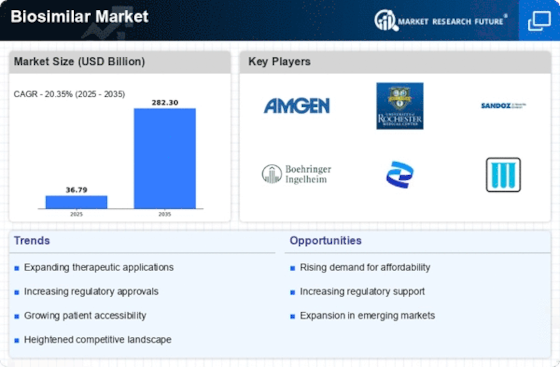
As per Market Research Future analysis, the Biosimilars Market Size was estimated at 36.79 USD Billion in 2024. The Biosimilar industry is projected to grow from 44.28 USD Billion in 2025 to 282.3 USD Billion by 2035, exhibiting a compound annual growth rate (CAGR) of 20.35% during the forecast period 2025 - 2035

Key Market Trends & Highlights

The Biosimilars Market is poised for substantial growth driven by increasing demand for cost-effective treatments and supportive regulatory frameworks.

  • North America remains the largest market for biosimilars, driven by rising healthcare costs and increasing patient access. The Asia-Pacific region is emerging as the fastest-growing market, fueled by advancements in biotechnology and a growing patient population. Monoclonal antibodies dominate the Biosimilars segment, while granulocyte colony-stimulating factors are experiencing the fastest growth. Key market drivers include the increasing prevalence of chronic diseases and patent expirations of biologics, which are propelling the demand for biosimilars.

Market Size & Forecast

2024 Market Size 36.79 (USD Billion)
2035 Market Size 282.3 (USD Billion)
CAGR (2025 - 2035) 20.35%
Largest Regional Market Share in 2024 Europe

Major Players

Amgen (US), Roche (CH), <a href="https://www.sandoz.com/business/biosimilars/our-biosimilars/">Sandoz </a>(CH), Boehringer Ingelheim (DE), Pfizer (US), Mylan (US), Samsung Bioepis (KR), Teva (IL), Celltrion (KR)

Market Trends

The Biosimilar Market is currently experiencing a transformative phase characterized by increasing acceptance and integration into healthcare systems worldwide. This shift is largely driven by the rising demand for cost-effective alternatives to expensive biologic therapies. As healthcare providers and patients alike seek more affordable treatment options, biosimilar market is emerging as viable substitutes, potentially enhancing patient access to essential medications. 

Furthermore, regulatory frameworks are evolving to support the development and approval of these products, fostering innovation and competition within the pharmaceutical landscape. In addition to economic factors, the Biosimilar Market is influenced by growing awareness among healthcare professionals and patients regarding the benefits of biosimilars. Educational initiatives and outreach programs are playing a crucial role in dispelling misconceptions and promoting understanding of these therapies regarding biosimilar market.

As the market continues to mature, it appears poised for further expansion, with ongoing research and development efforts likely to yield new biosimilar products across various therapeutic areas. The future of the Biosimilar Market seems promising, as it aligns with the broader goals of improving healthcare accessibility and affordability.

Rising Demand for Cost-Effective Treatments

The Biosimilar Market is witnessing a notable increase in demand for affordable alternatives to traditional biologics. This trend is driven by the need to reduce healthcare costs while maintaining treatment efficacy. As more patients and providers recognize the financial benefits of biosimilars, their adoption is likely to accelerate.

Regulatory Support and Evolving Frameworks

Regulatory bodies are enhancing their support for biosimilar development, streamlining approval processes to encourage innovation. This evolving regulatory landscape is expected to facilitate the entry of new biosimilars into the market, thereby increasing competition and potentially lowering prices.

Growing Awareness and Education Initiatives

Growing Awareness and Education Initiatives are key factors in development of biosimilar market. There is a concerted effort to improve understanding of biosimilars among healthcare professionals and patients. Educational campaigns are helping to clarify the safety and efficacy of these products, which may lead to greater acceptance and utilization in clinical practice.

Biosimilars Market Market Drivers

Rising Healthcare Costs

The escalating costs of healthcare are driving the demand for more affordable treatment options, thereby influencing the Biosimilar Market. As healthcare expenditures continue to rise, stakeholders are increasingly seeking cost-effective alternatives to expensive biologic therapies. Biosimilars Market, which can be priced significantly lower than their reference products, present a viable solution to this challenge.
 
Recent studies indicate that the introduction of biosimilars could save healthcare systems billions of dollars annually. This financial incentive is prompting healthcare providers to consider biosimilars as a first-line treatment option, further propelling the growth of the Biosimilar Market. The ongoing pressure to contain healthcare costs is likely to sustain this trend in the foreseeable future.

Advancements in Biotechnology

Technological advancements in biotechnology are playing a crucial role in shaping the Biosimilar Market. Innovations in manufacturing processes, analytical techniques, and quality control measures have enhanced the ability to produce biosimilars that closely mimic their reference products. These advancements not only improve the safety and efficacy of biosimilars but also streamline production, potentially reducing costs.
 
 As a result, the market is witnessing an increase in the number of biosimilars entering the pipeline, with projections indicating that the number of approved biosimilars could double in the next five years. This surge in innovation is likely to bolster the Biosimilar Market, as healthcare providers and patients gain access to a wider array of treatment options.

Patent Expirations of Biologics

The expiration of patents for several high-revenue biologic drugs is poised to significantly impact the Biosimilar Market. As patents expire, biosimilar manufacturers can enter the market with their products, often at a lower price point than the original biologics. This transition is expected to create a competitive landscape that benefits patients and healthcare providers alike. For instance, the patent for a leading monoclonal antibody has recently expired, opening the door for biosimilar alternatives. Market analysts suggest that this could lead to a reduction in treatment costs by up to 30%, making therapies more accessible. Consequently, the influx of biosimilars resulting from patent expirations is likely to drive the growth of the Biosimilar Market in the coming years.

Government Initiatives and Policies

Government initiatives and supportive policies are emerging as significant drivers for the Biosimilar Market. Many countries are implementing regulatory frameworks that encourage the development and approval of biosimilars, recognizing their potential to reduce healthcare costs and improve patient access to essential medications. For example, streamlined approval processes and incentives for biosimilar manufacturers are being introduced to foster competition in the market. These initiatives are expected to enhance the overall landscape for biosimilars, making it easier for new entrants to navigate regulatory hurdles. As a result, the Biosimilar Market is likely to experience accelerated growth, driven by favorable government policies that promote the adoption of biosimilars.

Increasing Prevalence of Chronic Diseases

The rising incidence of chronic diseases such as diabetes, cancer, and autoimmune disorders appears to be a primary driver for the Biosimilar Market. As these conditions become more prevalent, the demand for effective and affordable treatment options intensifies. According to recent data, chronic diseases account for approximately 70% of all deaths worldwide, underscoring the urgent need for innovative therapies. Biosimilars Market, which offer similar efficacy and safety profiles to their reference biologics, provide a cost-effective alternative that can alleviate the financial burden on healthcare systems. This trend is likely to continue, as healthcare providers and patients increasingly seek out biosimilars to manage chronic conditions, thereby propelling the growth of the Biosimilar Market.

Market Segment Insights

By Drug Class: Monoclonal Antibodies (Largest) vs. Granulocyte Colony-stimulating Factor (Fastest-Growing)

The Biosimilar Market is currently dominated by Monoclonal Antibodies, which represent the largest segment within the industry. This drug class is widely adopted due to its established track record in treating a variety of diseases, including cancer and autoimmune disorders. Other notable segments include Insulin and Erythropoietin, contributing significantly to the market share. However, Granulocyte Colony-stimulating Factor is gaining traction as the fastest-growing segment within the Biosimilar Market as it addresses critical needs in cancer treatment and recovery.

Monoclonal Antibodies (Dominant) vs. Granulocyte Colony-stimulating Factor (Emerging)

Monoclonal Antibodies remain the cornerstone of the Biosimilar Market due to their extensive applications and successful integration into treatment protocols. This category includes key players actively supported by both clinical data and patient demand. In contrast, Granulocyte Colony-stimulating Factor is emerging rapidly, driven by the increasing prevalence of hematological conditions, particularly in oncology. 

By Application: Oncology (Largest) vs. Autoimmune Diseases (Fastest-Growing)

The biosimilar market is significantly influenced by various applications, with Oncology commanding the largest share due to an increasing prevalence of cancer worldwide. This segment has seen substantial investment and development, catering to a growing need for effective and cost-efficient treatment options. Autoimmune Diseases, on the other hand, has emerged as a vital segment, driven by the rising incidence of conditions like rheumatoid arthritis and multiple sclerosis, which is paving the way for enhanced research and development efforts in biosimilars. Growth trends indicate that while Oncology remains the dominant application segment, Autoimmune Diseases is on the fast track, with growing public awareness and demand for accessible biosimilar therapeutics. This shift is attributed to an aging population and advancements in biotechnology, which continue to fuel innovation and improve treatment outcomes in these therapeutic areas.

Oncology (Dominant) vs. Autoimmune Diseases (Emerging)

The Oncology segment stands as the dominant player in the biosimilar market, attributed to its extensive pipeline and ongoing clinical trials aimed at addressing various types of cancers. This segment benefits from a robust framework of regulatory support, pushing for biosimilar approvals to ensure availability and affordability of cancer treatments. Throughout recent years, key players have focused on developing monoclonal antibodies and biologics within biosimilar market category, maintaining its lead in market share. Conversely, the Autoimmune Diseases segment is rapidly emerging, fueled by a dramatic increase in the prevalence of autoimmune disorders and the pressing need for biopharmaceutical interventions. This segment is characterized by innovative therapies that promise enhanced patient outcomes and align with healthcare providers' goals of personalized medicine. The dynamism surrounding this application is indicative of the growing market's adaptability in addressing both chronic and acute conditions.

By Route of Administration: Subcutaneous (Largest) vs. Intravenous (Fastest-Growing)

In the Biosimilar Market, the Route of Administration segment is primarily dominated by the Subcutaneous method, which commands a significant portion of the market share. This approach has become increasingly favored due to its convenience for patients and ease of self-administration, leading to broader adoption among healthcare providers. Intravenous administration, while less common, still maintains a prominent position and caters to specific therapeutic needs, particularly in settings requiring immediate therapeutic effects or where subcutaneous administration is not feasible.

Route of Administration: Subcutaneous (Dominant) vs. Intravenous (Emerging)

The Subcutaneous route of administration stands out as the dominant method within the Biosimilar Market, largely attributed to its patient-friendly nature that encourages self-administration, reducing the need for clinical interventions. This method has witnessed significant investment in product development, leading to an expanding range of biosimilars being offered for various indications. Conversely, Intravenous administration is emerging rapidly, spurred by advancements in formulation and targeted therapies. While it traditionally serves a niche market, the growing prevalence of complex therapies necessitating immediate action and the highest bioavailability is expected to drive its growth significantly, capturing patient attention and healthcare investment.

By Distribution Channel: Hospital Pharmacies (Largest) vs. Online Pharmacies (Fastest-Growing)

In the Biosimilar Market, Hospital Pharmacies hold the largest share due to their critical role in managing complex therapies and providing direct patient care. They serve as a key distribution point for prescribers and patients, ensuring that biosimilars are readily available in health facilities. Conversely, Online Pharmacies, while currently smaller in share, are rapidly gaining traction as more patients opt for convenience and direct-to-consumer options. This shift is indicative of changing consumer preferences towards <a href="https://www.marketresearchfuture.com/reports/digital-healthcare-market-7636">digital healthcare </a>solutions. Growth trends in the Biosimilar Market highlight a significant shift towards Online Pharmacies, which are expected to emerge as a vital channel for distribution. Factors such as increased internet penetration, the rise of <a href="https://www.marketresearchfuture.com/reports/telemedicine-market-2216">telemedicine</a>, and consumer demand for convenience are driving this growth. Meanwhile, Hospital Pharmacies continue to adapt, offering specialized services and competitive pricing to maintain their market position amidst the evolving landscape.

Hospital Pharmacies (Dominant) vs. Online Pharmacies (Emerging)

Hospital Pharmacies play a dominant role in the Biosimilar Market by providing an essential link between drug manufacturers and patients. They focus on personalized patient care and managing complex therapeutic regimens, enabling healthcare professionals to provide timely access to biosimilars. On the other hand, Online Pharmacies represent an emerging channel increasingly favored by tech-savvy patients seeking greater convenience and accessibility. As these platforms offer streamlined ordering and home delivery services, they are reshaping consumer behavior. With their rise in popularity, Online Pharmacies are challenging traditional distribution channels, compelling other market players to innovate and adapt to retain competitiveness in a digitized healthcare ecosystem.

Get more detailed insights about Biosimilars Market Research Report – Forecast Till 2035

Regional Insights

Based on the Region, the global Biosimilar are segmented into North America, Europe, Asia-Pacific, Rest of the World. The Europe dominated the global market in 2024, while the Asia-Pacific is projected to be the fastest–growing segment during the forecast period. Companies are competing for biosimilar market share by proving interchangeability through rigorous bioanalytical assays that confirm identical clinical efficacy.

Major demand factors driving the Europe market are the growing incidences of cancer and rare disorders and increasing launch of biosimilar and rising healthcare costs. The European Medicines Agency (EMA) has been at the forefront of biosimilar approvals, encouraging market penetration and physician confidence.

Additionally, the rising healthcare costs across the region have pushed governments and healthcare systems to adopt cost-effective alternatives to branded biologics, further fueling biosimilar uptake.

The presence of leading pharmaceutical companies and active initiatives to educate healthcare providers and patients have also supported market growth. Emerging markets in APAC are significantly contributing to the increasing biosimilar market size due to local manufacturing incentives and rising healthcare access. Supportive regulatory reforms and growing awareness of affordable treatment options are expected to accelerate biosimilar adoption across emerging markets like India, China, and South Korea and it has made APAC the fastest growing region.

Further, the countries considered in the scope of the Application Tracking System Market are the US, Canada, Mexico, Germany, France, UK, Italy, Spain, China, India, Japan, Australia, South Korea, Middle East and Africa, South America and others.

Additionally, the rising healthcare costs across the region have pushed governments and healthcare systems to adopt cost-effective alternatives to branded biologics, further fueling biosimilar uptake. 

The presence of leading pharmaceutical companies and active initiatives to educate healthcare providers and patients have also supported market growth. However, the Asia-Pacific region is projected to be the fastest-growing during the forecast period due to expanding healthcare infrastructure, a large patient population, and increasing investments by domestic and international biopharma companies. Supportive regulatory reforms and growing awareness of affordable treatment options are expected to accelerate biosimilar adoption across emerging markets like India, China, and South Korea.

Further, the countries considered in the scope of the Application Tracking System Market are the US, Canada, Mexico, Germany, France, UK, Italy, Spain, China, India, Japan, Australia, South Korea, Middle East and Africa, South America and others.

Key Players and Competitive Insights

Many global, regional, and local vendors characterize the Biosimilar Market. The market is highly competitive, with all the players competing to gain market share. Intense competition, rapid advances in technology, frequent changes in government policies, and environmental regulations are key factors that confront market growth. The vendors compete based on cost, product quality, reliability, and government regulations. Vendors must provide cost-efficient, high-quality products to survive and succeed in an intensely competitive market. The major competitors in the market are Eli Lilly and Company, Teva Pharmaceutical Industries Ltd., Samsung Bioepis, Amgen Inc., Pfizer Inc., Novartis AG, Biogen, Biocon, Dr. Reddy's Laboratories Ltd., Fresenius Kabi USA, LLC are among others. The Biosimilar Market is a consolidated market due to increasing competition, acquisitions, mergers and other strategic market developments and decisions to improve operational effectiveness.

Key Companies in the Biosimilars Market include

Industry Developments

Recent consolidations within the biosimilar industry have created integrated giants capable of managing both development and large-scale global distribution. Strong biosimilar market growth is being fueled by government mandates that prioritize cost-effective alternatives in public health systems.  In-depth biosimilars market research is focusing on the "biosimilar gap" where certain complex biologics still lack viable competitive alternatives. The highlights below elaborate the market development.

February 2025: Dr. Reddy’s Laboratories Ltd. has signed a license agreement with Shanghai Henlius Biotech, Inc. for the development and commercialization of HLX15, Henlius’s investigational daratumumab biosimilar candidate to Darzalex & Darzalex Faspro.

January 2024: Sandoz, a division of Novartis AG, has announced that its citrate-free high-concentration formulation (HCF) of Hyrimoz (adalimumab-adaz) injection will be available in the United States starting July 1. Hyrimoz HCF (100 mg/mL) is approved to treat all indications for which the regulatory exclusivity of the reference medicine, Humira (adalimumab), has expired as of July 1, 2023. These include rheumatoid arthritis, juvenile idiopathic arthritis, psoriatic arthritis, and more.

May 2024: U.S. Food and Drug Administration (FDA) approved Amgen’s Bkemv, the first biosimilar to AstraZeneca’s rare blood disorder treatment, Soliris. Bkemv will be marketed under Amgen’s brand name as a close copy of the complex biological drug. The approval includes a black-box warning highlighting the risk of serious infections caused by the bacteria Neisseria meningitidis.

December 2023: Coya Therapeutics, Inc. and Dr. Reddy’s Laboratories have established an exclusive collaboration to develop and commercialize COYA 302, a combination therapy being investigated for the treatment of amyotrophic lateral sclerosis (ALS).

Future Outlook

Biosimilars Market Future Outlook

The Biosimilars Market size is projected to grow at a 20.35% CAGR from 2025 to 2035, driven by increasing healthcare costs, patent expirations, and rising demand for affordable biologics.

New opportunities lie in:

  • <p> The biosimilars market is entering a transformative era, driven by a massive "patent cliff" affecting a wide array of blockbuster biologics. As healthcare systems demand cost-effective alternatives, the biosimilars market is being reshaped by innovations like AI-driven protein modeling and continuous manufacturing, which streamline development and ensure molecular precision. </p>
  • <p>These technological leaps, combined with enhanced regulatory clarity and increasing physician confidence, will further solidify the biosimilars market as a cornerstone of sustainable, high-quality global healthcare.</p>

By 2035, the Biosimilar Market size is expected to achieve substantial growth, solidifying its role in global healthcare.

Market Segmentation

Biosimilars Market Drug Class Outlook

  • Monoclonal Antibodies
  • Insulin
  • Granulocyte Colony-stimulating Factor
  • Erythropoietin
  • Recombinant Human Growth Hormone
  • Etanercept
  • Follitropin
  • Teriparatide
  • Anticoagulants
  • Others

Biosimilars Market Application Outlook

  • Oncology
  • Autoimmune Diseases
  • Infectious Diseases
  • Blood Disorders
  • Others

Biosimilars Market Distribution Channel Outlook

  • Hospital Pharmacies
  • Retail Pharmacies
  • Online Pharmacies
  • Specialty Pharmacies

Biosimilars Market Route of Administration Outlook

  • Subcutaneous
  • Intravenous

Report Scope

MARKET SIZE 2024 36.79(USD Billion)
MARKET SIZE 2025 44.28(USD Billion)
MARKET SIZE 2035 282.3(USD Billion)
COMPOUND ANNUAL GROWTH RATE (CAGR) 20.35% (2025 - 2035)
REPORT COVERAGE Revenue Forecast, Competitive Landscape, Growth Factors, and Trends
BASE YEAR 2024
Market Forecast Period 2025 - 2035
Historical Data 2019 - 2024
Market Forecast Units USD Billion
Key Companies Profiled Amgen (US), Roche (CH), Sandoz (CH), Boehringer Ingelheim (DE), Pfizer (US), Mylan (US), Samsung Bioepis (KR), Teva (IL), Celltrion (KR)
Segments Covered Drug Class, Applications, Route of Administration, Distribution Channel
Key Market Opportunities Emerging regulatory frameworks enhance access and adoption of Biosimilar Market products globally.
Key Market Dynamics Rising regulatory support and technological advancements drive competitive dynamics in the biosimilar market.
Countries Covered North America, Europe, APAC, South America, MEA

FAQs

What is the current valuation of the Biosimilar Market as of 2024?

<p>The Biosimilar Market was valued at 36.79 USD Billion in 2024.</p>

What is the projected market size for the Biosimilar Market by 2035?

<p>The market is projected to reach 282.3 USD Billion by 2035.</p>

What is the expected CAGR for the Biosimilar Market during the forecast period 2025 - 2035?

<p>The expected CAGR for the Biosimilar Market during 2025 - 2035 is 20.35%.</p>

Which drug class segment holds the largest market share in the Biosimilar Market?

<p>The Monoclonal Antibodies segment is projected to dominate with a valuation of 80.0 USD Billion by 2035.</p>

What are the key applications driving growth in the Biosimilar Market?

<p>Oncology and Autoimmune Diseases are key applications, with projected valuations of 60.0 USD Billion and 50.0 USD Billion, respectively, by 2035.</p>

How does the route of administration impact the Biosimilar Market?

The Intravenous route is expected to lead with a projected valuation of 202.3 USD Billion by 2035.

What distribution channels are most significant in the Biosimilar Market?

Specialty Pharmacies are anticipated to be the largest distribution channel, reaching 107.3 USD Billion by 2035.

Who are the leading companies in the Biosimilar Market?

Key players include Amgen, Roche, Sandoz, and Pfizer, among others.

What is the projected growth for the Insulin segment in the Biosimilar Market?

The Insulin segment is expected to grow to 40.0 USD Billion by 2035.

What trends are influencing the future of the Biosimilar Market?

The increasing demand for cost-effective therapies and advancements in biotechnology are likely to drive market growth.

  1. SECTION I: EXECUTIVE SUMMARY AND KEY HIGHLIGHTS
    1. | 1.1 EXECUTIVE SUMMARY
    2. | | 1.1.1 Market Overview
    3. | | 1.1.2 Key Findings
    4. | | 1.1.3 Market Segmentation
    5. | | 1.1.4 Competitive Landscape
    6. | | 1.1.5 Challenges and Opportunities
    7. | | 1.1.6 Future Outlook
  2. SECTION II: SCOPING, METHODOLOGY AND MARKET STRUCTURE
    1. | 2.1 MARKET INTRODUCTION
    2. | | 2.1.1 Definition
    3. | | 2.1.2 Scope of the study
    4. | | | 2.1.2.1 Research Objective
    5. | | | 2.1.2.2 Assumption
    6. | | | 2.1.2.3 Limitations
    7. | 2.2 RESEARCH METHODOLOGY
    8. | | 2.2.1 Overview
    9. | | 2.2.2 Data Mining
    10. | | 2.2.3 Secondary Research
    11. | | 2.2.4 Primary Research
    12. | | | 2.2.4.1 Primary Interviews and Information Gathering Process
    13. | | | 2.2.4.2 Breakdown of Primary Respondents
    14. | | 2.2.5 Forecasting Model
    15. | | 2.2.6 Market Size Estimation
    16. | | | 2.2.6.1 Bottom-Up Approach
    17. | | | 2.2.6.2 Top-Down Approach
    18. | | 2.2.7 Data Triangulation
    19. | | 2.2.8 Validation
  3. SECTION III: QUALITATIVE ANALYSIS
    1. | 3.1 MARKET DYNAMICS
    2. | | 3.1.1 Overview
    3. | | 3.1.2 Drivers
    4. | | 3.1.3 Restraints
    5. | | 3.1.4 Opportunities
    6. | 3.2 MARKET FACTOR ANALYSIS
    7. | | 3.2.1 Value chain Analysis
    8. | | 3.2.2 Porter's Five Forces Analysis
    9. | | | 3.2.2.1 Bargaining Power of Suppliers
    10. | | | 3.2.2.2 Bargaining Power of Buyers
    11. | | | 3.2.2.3 Threat of New Entrants
    12. | | | 3.2.2.4 Threat of Substitutes
    13. | | | 3.2.2.5 Intensity of Rivalry
    14. | | 3.2.3 COVID-19 Impact Analysis
    15. | | | 3.2.3.1 Market Impact Analysis
    16. | | | 3.2.3.2 Regional Impact
    17. | | | 3.2.3.3 Opportunity and Threat Analysis
  4. SECTION IV: QUANTITATIVE ANALYSIS
    1. | 4.1 Healthcare, BY Drug Class (USD Billion)
    2. | | 4.1.1 Monoclonal Antibodies
    3. | | 4.1.2 Insulin
    4. | | 4.1.3 Granulocyte Colony-stimulating Factor
    5. | | 4.1.4 Erythropoietin
    6. | | 4.1.5 Recombinant Human Growth Hormone
    7. | | 4.1.6 Etanercept
    8. | | 4.1.7 Follitropin
    9. | | 4.1.8 Teriparatide
    10. | | 4.1.9 Anticoagulants
    11. | | 4.1.10 Others
    12. | 4.2 Healthcare, BY Application (USD Billion)
    13. | | 4.2.1 Oncology
    14. | | 4.2.2 Autoimmune Diseases
    15. | | 4.2.3 Infectious Diseases
    16. | | 4.2.4 Blood Disorders
    17. | | 4.2.5 Others
    18. | 4.3 Healthcare, BY Route of Administration (USD Billion)
    19. | | 4.3.1 Subcutaneous
    20. | | 4.3.2 Intravenous
    21. | 4.4 Healthcare, BY Distribution Channel (USD Billion)
    22. | | 4.4.1 Hospital Pharmacies
    23. | | 4.4.2 Retail Pharmacies
    24. | | 4.4.3 Online Pharmacies
    25. | | 4.4.4 Specialty Pharmacies
    26. | 4.5 Healthcare, BY Region (USD Billion)
    27. | | 4.5.1 North America
    28. | | | 4.5.1.1 US
    29. | | | 4.5.1.2 Canada
    30. | | 4.5.2 Europe
    31. | | | 4.5.2.1 Germany
    32. | | | 4.5.2.2 UK
    33. | | | 4.5.2.3 France
    34. | | | 4.5.2.4 Russia
    35. | | | 4.5.2.5 Italy
    36. | | | 4.5.2.6 Spain
    37. | | | 4.5.2.7 Rest of Europe
    38. | | 4.5.3 APAC
    39. | | | 4.5.3.1 China
    40. | | | 4.5.3.2 India
    41. | | | 4.5.3.3 Japan
    42. | | | 4.5.3.4 South Korea
    43. | | | 4.5.3.5 Malaysia
    44. | | | 4.5.3.6 Thailand
    45. | | | 4.5.3.7 Indonesia
    46. | | | 4.5.3.8 Rest of APAC
    47. | | 4.5.4 South America
    48. | | | 4.5.4.1 Brazil
    49. | | | 4.5.4.2 Mexico
    50. | | | 4.5.4.3 Argentina
    51. | | | 4.5.4.4 Rest of South America
    52. | | 4.5.5 MEA
    53. | | | 4.5.5.1 GCC Countries
    54. | | | 4.5.5.2 South Africa
    55. | | | 4.5.5.3 Rest of MEA
  5. SECTION V: COMPETITIVE ANALYSIS
    1. | 5.1 Competitive Landscape
    2. | | 5.1.1 Overview
    3. | | 5.1.2 Competitive Analysis
    4. | | 5.1.3 Market share Analysis
    5. | | 5.1.4 Major Growth Strategy in the Healthcare
    6. | | 5.1.5 Competitive Benchmarking
    7. | | 5.1.6 Leading Players in Terms of Number of Developments in the Healthcare
    8. | | 5.1.7 Key developments and growth strategies
    9. | | | 5.1.7.1 New Product Launch/Service Deployment
    10. | | | 5.1.7.2 Merger & Acquisitions
    11. | | | 5.1.7.3 Joint Ventures
    12. | | 5.1.8 Major Players Financial Matrix
    13. | | | 5.1.8.1 Sales and Operating Income
    14. | | | 5.1.8.2 Major Players R&D Expenditure. 2023
    15. | 5.2 Company Profiles
    16. | | 5.2.1 Amgen (US)
    17. | | | 5.2.1.1 Financial Overview
    18. | | | 5.2.1.2 Products Offered
    19. | | | 5.2.1.3 Key Developments
    20. | | | 5.2.1.4 SWOT Analysis
    21. | | | 5.2.1.5 Key Strategies
    22. | | 5.2.2 Roche (CH)
    23. | | | 5.2.2.1 Financial Overview
    24. | | | 5.2.2.2 Products Offered
    25. | | | 5.2.2.3 Key Developments
    26. | | | 5.2.2.4 SWOT Analysis
    27. | | | 5.2.2.5 Key Strategies
    28. | | 5.2.3 Sandoz (CH)
    29. | | | 5.2.3.1 Financial Overview
    30. | | | 5.2.3.2 Products Offered
    31. | | | 5.2.3.3 Key Developments
    32. | | | 5.2.3.4 SWOT Analysis
    33. | | | 5.2.3.5 Key Strategies
    34. | | 5.2.4 Boehringer Ingelheim (DE)
    35. | | | 5.2.4.1 Financial Overview
    36. | | | 5.2.4.2 Products Offered
    37. | | | 5.2.4.3 Key Developments
    38. | | | 5.2.4.4 SWOT Analysis
    39. | | | 5.2.4.5 Key Strategies
    40. | | 5.2.5 Pfizer (US)
    41. | | | 5.2.5.1 Financial Overview
    42. | | | 5.2.5.2 Products Offered
    43. | | | 5.2.5.3 Key Developments
    44. | | | 5.2.5.4 SWOT Analysis
    45. | | | 5.2.5.5 Key Strategies
    46. | | 5.2.6 Mylan (US)
    47. | | | 5.2.6.1 Financial Overview
    48. | | | 5.2.6.2 Products Offered
    49. | | | 5.2.6.3 Key Developments
    50. | | | 5.2.6.4 SWOT Analysis
    51. | | | 5.2.6.5 Key Strategies
    52. | | 5.2.7 Samsung Bioepis (KR)
    53. | | | 5.2.7.1 Financial Overview
    54. | | | 5.2.7.2 Products Offered
    55. | | | 5.2.7.3 Key Developments
    56. | | | 5.2.7.4 SWOT Analysis
    57. | | | 5.2.7.5 Key Strategies
    58. | | 5.2.8 Teva (IL)
    59. | | | 5.2.8.1 Financial Overview
    60. | | | 5.2.8.2 Products Offered
    61. | | | 5.2.8.3 Key Developments
    62. | | | 5.2.8.4 SWOT Analysis
    63. | | | 5.2.8.5 Key Strategies
    64. | | 5.2.9 Celltrion (KR)
    65. | | | 5.2.9.1 Financial Overview
    66. | | | 5.2.9.2 Products Offered
    67. | | | 5.2.9.3 Key Developments
    68. | | | 5.2.9.4 SWOT Analysis
    69. | | | 5.2.9.5 Key Strategies
    70. | 5.3 Appendix
    71. | | 5.3.1 References
    72. | | 5.3.2 Related Reports
  6. LIST OF FIGURES
    1. | 6.1 MARKET SYNOPSIS
    2. | 6.2 NORTH AMERICA MARKET ANALYSIS
    3. | 6.3 US MARKET ANALYSIS BY DRUG CLASS
    4. | 6.4 US MARKET ANALYSIS BY APPLICATION
    5. | 6.5 US MARKET ANALYSIS BY ROUTE OF ADMINISTRATION
    6. | 6.6 US MARKET ANALYSIS BY DISTRIBUTION CHANNEL
    7. | 6.7 CANADA MARKET ANALYSIS BY DRUG CLASS
    8. | 6.8 CANADA MARKET ANALYSIS BY APPLICATION
    9. | 6.9 CANADA MARKET ANALYSIS BY ROUTE OF ADMINISTRATION
    10. | 6.10 CANADA MARKET ANALYSIS BY DISTRIBUTION CHANNEL
    11. | 6.11 EUROPE MARKET ANALYSIS
    12. | 6.12 GERMANY MARKET ANALYSIS BY DRUG CLASS
    13. | 6.13 GERMANY MARKET ANALYSIS BY APPLICATION
    14. | 6.14 GERMANY MARKET ANALYSIS BY ROUTE OF ADMINISTRATION
    15. | 6.15 GERMANY MARKET ANALYSIS BY DISTRIBUTION CHANNEL
    16. | 6.16 UK MARKET ANALYSIS BY DRUG CLASS
    17. | 6.17 UK MARKET ANALYSIS BY APPLICATION
    18. | 6.18 UK MARKET ANALYSIS BY ROUTE OF ADMINISTRATION
    19. | 6.19 UK MARKET ANALYSIS BY DISTRIBUTION CHANNEL
    20. | 6.20 FRANCE MARKET ANALYSIS BY DRUG CLASS
    21. | 6.21 FRANCE MARKET ANALYSIS BY APPLICATION
    22. | 6.22 FRANCE MARKET ANALYSIS BY ROUTE OF ADMINISTRATION
    23. | 6.23 FRANCE MARKET ANALYSIS BY DISTRIBUTION CHANNEL
    24. | 6.24 RUSSIA MARKET ANALYSIS BY DRUG CLASS
    25. | 6.25 RUSSIA MARKET ANALYSIS BY APPLICATION
    26. | 6.26 RUSSIA MARKET ANALYSIS BY ROUTE OF ADMINISTRATION
    27. | 6.27 RUSSIA MARKET ANALYSIS BY DISTRIBUTION CHANNEL
    28. | 6.28 ITALY MARKET ANALYSIS BY DRUG CLASS
    29. | 6.29 ITALY MARKET ANALYSIS BY APPLICATION
    30. | 6.30 ITALY MARKET ANALYSIS BY ROUTE OF ADMINISTRATION
    31. | 6.31 ITALY MARKET ANALYSIS BY DISTRIBUTION CHANNEL
    32. | 6.32 SPAIN MARKET ANALYSIS BY DRUG CLASS
    33. | 6.33 SPAIN MARKET ANALYSIS BY APPLICATION
    34. | 6.34 SPAIN MARKET ANALYSIS BY ROUTE OF ADMINISTRATION
    35. | 6.35 SPAIN MARKET ANALYSIS BY DISTRIBUTION CHANNEL
    36. | 6.36 REST OF EUROPE MARKET ANALYSIS BY DRUG CLASS
    37. | 6.37 REST OF EUROPE MARKET ANALYSIS BY APPLICATION
    38. | 6.38 REST OF EUROPE MARKET ANALYSIS BY ROUTE OF ADMINISTRATION
    39. | 6.39 REST OF EUROPE MARKET ANALYSIS BY DISTRIBUTION CHANNEL
    40. | 6.40 APAC MARKET ANALYSIS
    41. | 6.41 CHINA MARKET ANALYSIS BY DRUG CLASS
    42. | 6.42 CHINA MARKET ANALYSIS BY APPLICATION
    43. | 6.43 CHINA MARKET ANALYSIS BY ROUTE OF ADMINISTRATION
    44. | 6.44 CHINA MARKET ANALYSIS BY DISTRIBUTION CHANNEL
    45. | 6.45 INDIA MARKET ANALYSIS BY DRUG CLASS
    46. | 6.46 INDIA MARKET ANALYSIS BY APPLICATION
    47. | 6.47 INDIA MARKET ANALYSIS BY ROUTE OF ADMINISTRATION
    48. | 6.48 INDIA MARKET ANALYSIS BY DISTRIBUTION CHANNEL
    49. | 6.49 JAPAN MARKET ANALYSIS BY DRUG CLASS
    50. | 6.50 JAPAN MARKET ANALYSIS BY APPLICATION
    51. | 6.51 JAPAN MARKET ANALYSIS BY ROUTE OF ADMINISTRATION
    52. | 6.52 JAPAN MARKET ANALYSIS BY DISTRIBUTION CHANNEL
    53. | 6.53 SOUTH KOREA MARKET ANALYSIS BY DRUG CLASS
    54. | 6.54 SOUTH KOREA MARKET ANALYSIS BY APPLICATION
    55. | 6.55 SOUTH KOREA MARKET ANALYSIS BY ROUTE OF ADMINISTRATION
    56. | 6.56 SOUTH KOREA MARKET ANALYSIS BY DISTRIBUTION CHANNEL
    57. | 6.57 MALAYSIA MARKET ANALYSIS BY DRUG CLASS
    58. | 6.58 MALAYSIA MARKET ANALYSIS BY APPLICATION
    59. | 6.59 MALAYSIA MARKET ANALYSIS BY ROUTE OF ADMINISTRATION
    60. | 6.60 MALAYSIA MARKET ANALYSIS BY DISTRIBUTION CHANNEL
    61. | 6.61 THAILAND MARKET ANALYSIS BY DRUG CLASS
    62. | 6.62 THAILAND MARKET ANALYSIS BY APPLICATION
    63. | 6.63 THAILAND MARKET ANALYSIS BY ROUTE OF ADMINISTRATION
    64. | 6.64 THAILAND MARKET ANALYSIS BY DISTRIBUTION CHANNEL
    65. | 6.65 INDONESIA MARKET ANALYSIS BY DRUG CLASS
    66. | 6.66 INDONESIA MARKET ANALYSIS BY APPLICATION
    67. | 6.67 INDONESIA MARKET ANALYSIS BY ROUTE OF ADMINISTRATION
    68. | 6.68 INDONESIA MARKET ANALYSIS BY DISTRIBUTION CHANNEL
    69. | 6.69 REST OF APAC MARKET ANALYSIS BY DRUG CLASS
    70. | 6.70 REST OF APAC MARKET ANALYSIS BY APPLICATION
    71. | 6.71 REST OF APAC MARKET ANALYSIS BY ROUTE OF ADMINISTRATION
    72. | 6.72 REST OF APAC MARKET ANALYSIS BY DISTRIBUTION CHANNEL
    73. | 6.73 SOUTH AMERICA MARKET ANALYSIS
    74. | 6.74 BRAZIL MARKET ANALYSIS BY DRUG CLASS
    75. | 6.75 BRAZIL MARKET ANALYSIS BY APPLICATION
    76. | 6.76 BRAZIL MARKET ANALYSIS BY ROUTE OF ADMINISTRATION
    77. | 6.77 BRAZIL MARKET ANALYSIS BY DISTRIBUTION CHANNEL
    78. | 6.78 MEXICO MARKET ANALYSIS BY DRUG CLASS
    79. | 6.79 MEXICO MARKET ANALYSIS BY APPLICATION
    80. | 6.80 MEXICO MARKET ANALYSIS BY ROUTE OF ADMINISTRATION
    81. | 6.81 MEXICO MARKET ANALYSIS BY DISTRIBUTION CHANNEL
    82. | 6.82 ARGENTINA MARKET ANALYSIS BY DRUG CLASS
    83. | 6.83 ARGENTINA MARKET ANALYSIS BY APPLICATION
    84. | 6.84 ARGENTINA MARKET ANALYSIS BY ROUTE OF ADMINISTRATION
    85. | 6.85 ARGENTINA MARKET ANALYSIS BY DISTRIBUTION CHANNEL
    86. | 6.86 REST OF SOUTH AMERICA MARKET ANALYSIS BY DRUG CLASS
    87. | 6.87 REST OF SOUTH AMERICA MARKET ANALYSIS BY APPLICATION
    88. | 6.88 REST OF SOUTH AMERICA MARKET ANALYSIS BY ROUTE OF ADMINISTRATION
    89. | 6.89 REST OF SOUTH AMERICA MARKET ANALYSIS BY DISTRIBUTION CHANNEL
    90. | 6.90 MEA MARKET ANALYSIS
    91. | 6.91 GCC COUNTRIES MARKET ANALYSIS BY DRUG CLASS
    92. | 6.92 GCC COUNTRIES MARKET ANALYSIS BY APPLICATION
    93. | 6.93 GCC COUNTRIES MARKET ANALYSIS BY ROUTE OF ADMINISTRATION
    94. | 6.94 GCC COUNTRIES MARKET ANALYSIS BY DISTRIBUTION CHANNEL
    95. | 6.95 SOUTH AFRICA MARKET ANALYSIS BY DRUG CLASS
    96. | 6.96 SOUTH AFRICA MARKET ANALYSIS BY APPLICATION
    97. | 6.97 SOUTH AFRICA MARKET ANALYSIS BY ROUTE OF ADMINISTRATION
    98. | 6.98 SOUTH AFRICA MARKET ANALYSIS BY DISTRIBUTION CHANNEL
    99. | 6.99 REST OF MEA MARKET ANALYSIS BY DRUG CLASS
    100. | 6.100 REST OF MEA MARKET ANALYSIS BY APPLICATION
    101. | 6.101 REST OF MEA MARKET ANALYSIS BY ROUTE OF ADMINISTRATION
    102. | 6.102 REST OF MEA MARKET ANALYSIS BY DISTRIBUTION CHANNEL
    103. | 6.103 KEY BUYING CRITERIA OF HEALTHCARE
    104. | 6.104 RESEARCH PROCESS OF MRFR
    105. | 6.105 DRO ANALYSIS OF HEALTHCARE
    106. | 6.106 DRIVERS IMPACT ANALYSIS: HEALTHCARE
    107. | 6.107 RESTRAINTS IMPACT ANALYSIS: HEALTHCARE
    108. | 6.108 SUPPLY / VALUE CHAIN: HEALTHCARE
    109. | 6.109 HEALTHCARE, BY DRUG CLASS, 2024 (% SHARE)
    110. | 6.110 HEALTHCARE, BY DRUG CLASS, 2024 TO 2035 (USD Billion)
    111. | 6.111 HEALTHCARE, BY APPLICATION, 2024 (% SHARE)
    112. | 6.112 HEALTHCARE, BY APPLICATION, 2024 TO 2035 (USD Billion)
    113. | 6.113 HEALTHCARE, BY ROUTE OF ADMINISTRATION, 2024 (% SHARE)
    114. | 6.114 HEALTHCARE, BY ROUTE OF ADMINISTRATION, 2024 TO 2035 (USD Billion)
    115. | 6.115 HEALTHCARE, BY DISTRIBUTION CHANNEL, 2024 (% SHARE)
    116. | 6.116 HEALTHCARE, BY DISTRIBUTION CHANNEL, 2024 TO 2035 (USD Billion)
    117. | 6.117 BENCHMARKING OF MAJOR COMPETITORS
  7. LIST OF TABLES
    1. | 7.1 LIST OF ASSUMPTIONS
    2. | | 7.1.1
    3. | 7.2 North America MARKET SIZE ESTIMATES; FORECAST
    4. | | 7.2.1 BY DRUG CLASS, 2025-2035 (USD Billion)
    5. | | 7.2.2 BY APPLICATION, 2025-2035 (USD Billion)
    6. | | 7.2.3 BY ROUTE OF ADMINISTRATION, 2025-2035 (USD Billion)
    7. | | 7.2.4 BY DISTRIBUTION CHANNEL, 2025-2035 (USD Billion)
    8. | 7.3 US MARKET SIZE ESTIMATES; FORECAST
    9. | | 7.3.1 BY DRUG CLASS, 2025-2035 (USD Billion)
    10. | | 7.3.2 BY APPLICATION, 2025-2035 (USD Billion)
    11. | | 7.3.3 BY ROUTE OF ADMINISTRATION, 2025-2035 (USD Billion)
    12. | | 7.3.4 BY DISTRIBUTION CHANNEL, 2025-2035 (USD Billion)
    13. | 7.4 Canada MARKET SIZE ESTIMATES; FORECAST
    14. | | 7.4.1 BY DRUG CLASS, 2025-2035 (USD Billion)
    15. | | 7.4.2 BY APPLICATION, 2025-2035 (USD Billion)
    16. | | 7.4.3 BY ROUTE OF ADMINISTRATION, 2025-2035 (USD Billion)
    17. | | 7.4.4 BY DISTRIBUTION CHANNEL, 2025-2035 (USD Billion)
    18. | 7.5 Europe MARKET SIZE ESTIMATES; FORECAST
    19. | | 7.5.1 BY DRUG CLASS, 2025-2035 (USD Billion)
    20. | | 7.5.2 BY APPLICATION, 2025-2035 (USD Billion)
    21. | | 7.5.3 BY ROUTE OF ADMINISTRATION, 2025-2035 (USD Billion)
    22. | | 7.5.4 BY DISTRIBUTION CHANNEL, 2025-2035 (USD Billion)
    23. | 7.6 Germany MARKET SIZE ESTIMATES; FORECAST
    24. | | 7.6.1 BY DRUG CLASS, 2025-2035 (USD Billion)
    25. | | 7.6.2 BY APPLICATION, 2025-2035 (USD Billion)
    26. | | 7.6.3 BY ROUTE OF ADMINISTRATION, 2025-2035 (USD Billion)
    27. | | 7.6.4 BY DISTRIBUTION CHANNEL, 2025-2035 (USD Billion)
    28. | 7.7 UK MARKET SIZE ESTIMATES; FORECAST
    29. | | 7.7.1 BY DRUG CLASS, 2025-2035 (USD Billion)
    30. | | 7.7.2 BY APPLICATION, 2025-2035 (USD Billion)
    31. | | 7.7.3 BY ROUTE OF ADMINISTRATION, 2025-2035 (USD Billion)
    32. | | 7.7.4 BY DISTRIBUTION CHANNEL, 2025-2035 (USD Billion)
    33. | 7.8 France MARKET SIZE ESTIMATES; FORECAST
    34. | | 7.8.1 BY DRUG CLASS, 2025-2035 (USD Billion)
    35. | | 7.8.2 BY APPLICATION, 2025-2035 (USD Billion)
    36. | | 7.8.3 BY ROUTE OF ADMINISTRATION, 2025-2035 (USD Billion)
    37. | | 7.8.4 BY DISTRIBUTION CHANNEL, 2025-2035 (USD Billion)
    38. | 7.9 Russia MARKET SIZE ESTIMATES; FORECAST
    39. | | 7.9.1 BY DRUG CLASS, 2025-2035 (USD Billion)
    40. | | 7.9.2 BY APPLICATION, 2025-2035 (USD Billion)
    41. | | 7.9.3 BY ROUTE OF ADMINISTRATION, 2025-2035 (USD Billion)
    42. | | 7.9.4 BY DISTRIBUTION CHANNEL, 2025-2035 (USD Billion)
    43. | 7.10 Italy MARKET SIZE ESTIMATES; FORECAST
    44. | | 7.10.1 BY DRUG CLASS, 2025-2035 (USD Billion)
    45. | | 7.10.2 BY APPLICATION, 2025-2035 (USD Billion)
    46. | | 7.10.3 BY ROUTE OF ADMINISTRATION, 2025-2035 (USD Billion)
    47. | | 7.10.4 BY DISTRIBUTION CHANNEL, 2025-2035 (USD Billion)
    48. | 7.11 Spain MARKET SIZE ESTIMATES; FORECAST
    49. | | 7.11.1 BY DRUG CLASS, 2025-2035 (USD Billion)
    50. | | 7.11.2 BY APPLICATION, 2025-2035 (USD Billion)
    51. | | 7.11.3 BY ROUTE OF ADMINISTRATION, 2025-2035 (USD Billion)
    52. | | 7.11.4 BY DISTRIBUTION CHANNEL, 2025-2035 (USD Billion)
    53. | 7.12 Rest of Europe MARKET SIZE ESTIMATES; FORECAST
    54. | | 7.12.1 BY DRUG CLASS, 2025-2035 (USD Billion)
    55. | | 7.12.2 BY APPLICATION, 2025-2035 (USD Billion)
    56. | | 7.12.3 BY ROUTE OF ADMINISTRATION, 2025-2035 (USD Billion)
    57. | | 7.12.4 BY DISTRIBUTION CHANNEL, 2025-2035 (USD Billion)
    58. | 7.13 APAC MARKET SIZE ESTIMATES; FORECAST
    59. | | 7.13.1 BY DRUG CLASS, 2025-2035 (USD Billion)
    60. | | 7.13.2 BY APPLICATION, 2025-2035 (USD Billion)
    61. | | 7.13.3 BY ROUTE OF ADMINISTRATION, 2025-2035 (USD Billion)
    62. | | 7.13.4 BY DISTRIBUTION CHANNEL, 2025-2035 (USD Billion)
    63. | 7.14 China MARKET SIZE ESTIMATES; FORECAST
    64. | | 7.14.1 BY DRUG CLASS, 2025-2035 (USD Billion)
    65. | | 7.14.2 BY APPLICATION, 2025-2035 (USD Billion)
    66. | | 7.14.3 BY ROUTE OF ADMINISTRATION, 2025-2035 (USD Billion)
    67. | | 7.14.4 BY DISTRIBUTION CHANNEL, 2025-2035 (USD Billion)
    68. | 7.15 India MARKET SIZE ESTIMATES; FORECAST
    69. | | 7.15.1 BY DRUG CLASS, 2025-2035 (USD Billion)
    70. | | 7.15.2 BY APPLICATION, 2025-2035 (USD Billion)
    71. | | 7.15.3 BY ROUTE OF ADMINISTRATION, 2025-2035 (USD Billion)
    72. | | 7.15.4 BY DISTRIBUTION CHANNEL, 2025-2035 (USD Billion)
    73. | 7.16 Japan MARKET SIZE ESTIMATES; FORECAST
    74. | | 7.16.1 BY DRUG CLASS, 2025-2035 (USD Billion)
    75. | | 7.16.2 BY APPLICATION, 2025-2035 (USD Billion)
    76. | | 7.16.3 BY ROUTE OF ADMINISTRATION, 2025-2035 (USD Billion)
    77. | | 7.16.4 BY DISTRIBUTION CHANNEL, 2025-2035 (USD Billion)
    78. | 7.17 South Korea MARKET SIZE ESTIMATES; FORECAST
    79. | | 7.17.1 BY DRUG CLASS, 2025-2035 (USD Billion)
    80. | | 7.17.2 BY APPLICATION, 2025-2035 (USD Billion)
    81. | | 7.17.3 BY ROUTE OF ADMINISTRATION, 2025-2035 (USD Billion)
    82. | | 7.17.4 BY DISTRIBUTION CHANNEL, 2025-2035 (USD Billion)
    83. | 7.18 Malaysia MARKET SIZE ESTIMATES; FORECAST
    84. | | 7.18.1 BY DRUG CLASS, 2025-2035 (USD Billion)
    85. | | 7.18.2 BY APPLICATION, 2025-2035 (USD Billion)
    86. | | 7.18.3 BY ROUTE OF ADMINISTRATION, 2025-2035 (USD Billion)
    87. | | 7.18.4 BY DISTRIBUTION CHANNEL, 2025-2035 (USD Billion)
    88. | 7.19 Thailand MARKET SIZE ESTIMATES; FORECAST
    89. | | 7.19.1 BY DRUG CLASS, 2025-2035 (USD Billion)
    90. | | 7.19.2 BY APPLICATION, 2025-2035 (USD Billion)
    91. | | 7.19.3 BY ROUTE OF ADMINISTRATION, 2025-2035 (USD Billion)
    92. | | 7.19.4 BY DISTRIBUTION CHANNEL, 2025-2035 (USD Billion)
    93. | 7.20 Indonesia MARKET SIZE ESTIMATES; FORECAST
    94. | | 7.20.1 BY DRUG CLASS, 2025-2035 (USD Billion)
    95. | | 7.20.2 BY APPLICATION, 2025-2035 (USD Billion)
    96. | | 7.20.3 BY ROUTE OF ADMINISTRATION, 2025-2035 (USD Billion)
    97. | | 7.20.4 BY DISTRIBUTION CHANNEL, 2025-2035 (USD Billion)
    98. | 7.21 Rest of APAC MARKET SIZE ESTIMATES; FORECAST
    99. | | 7.21.1 BY DRUG CLASS, 2025-2035 (USD Billion)
    100. | | 7.21.2 BY APPLICATION, 2025-2035 (USD Billion)
    101. | | 7.21.3 BY ROUTE OF ADMINISTRATION, 2025-2035 (USD Billion)
    102. | | 7.21.4 BY DISTRIBUTION CHANNEL, 2025-2035 (USD Billion)
    103. | 7.22 South America MARKET SIZE ESTIMATES; FORECAST
    104. | | 7.22.1 BY DRUG CLASS, 2025-2035 (USD Billion)
    105. | | 7.22.2 BY APPLICATION, 2025-2035 (USD Billion)
    106. | | 7.22.3 BY ROUTE OF ADMINISTRATION, 2025-2035 (USD Billion)
    107. | | 7.22.4 BY DISTRIBUTION CHANNEL, 2025-2035 (USD Billion)
    108. | 7.23 Brazil MARKET SIZE ESTIMATES; FORECAST
    109. | | 7.23.1 BY DRUG CLASS, 2025-2035 (USD Billion)
    110. | | 7.23.2 BY APPLICATION, 2025-2035 (USD Billion)
    111. | | 7.23.3 BY ROUTE OF ADMINISTRATION, 2025-2035 (USD Billion)
    112. | | 7.23.4 BY DISTRIBUTION CHANNEL, 2025-2035 (USD Billion)
    113. | 7.24 Mexico MARKET SIZE ESTIMATES; FORECAST
    114. | | 7.24.1 BY DRUG CLASS, 2025-2035 (USD Billion)
    115. | | 7.24.2 BY APPLICATION, 2025-2035 (USD Billion)
    116. | | 7.24.3 BY ROUTE OF ADMINISTRATION, 2025-2035 (USD Billion)
    117. | | 7.24.4 BY DISTRIBUTION CHANNEL, 2025-2035 (USD Billion)
    118. | 7.25 Argentina MARKET SIZE ESTIMATES; FORECAST
    119. | | 7.25.1 BY DRUG CLASS, 2025-2035 (USD Billion)
    120. | | 7.25.2 BY APPLICATION, 2025-2035 (USD Billion)
    121. | | 7.25.3 BY ROUTE OF ADMINISTRATION, 2025-2035 (USD Billion)
    122. | | 7.25.4 BY DISTRIBUTION CHANNEL, 2025-2035 (USD Billion)
    123. | 7.26 Rest of South America MARKET SIZE ESTIMATES; FORECAST
    124. | | 7.26.1 BY DRUG CLASS, 2025-2035 (USD Billion)
    125. | | 7.26.2 BY APPLICATION, 2025-2035 (USD Billion)
    126. | | 7.26.3 BY ROUTE OF ADMINISTRATION, 2025-2035 (USD Billion)
    127. | | 7.26.4 BY DISTRIBUTION CHANNEL, 2025-2035 (USD Billion)
    128. | 7.27 MEA MARKET SIZE ESTIMATES; FORECAST
    129. | | 7.27.1 BY DRUG CLASS, 2025-2035 (USD Billion)
    130. | | 7.27.2 BY APPLICATION, 2025-2035 (USD Billion)
    131. | | 7.27.3 BY ROUTE OF ADMINISTRATION, 2025-2035 (USD Billion)
    132. | | 7.27.4 BY DISTRIBUTION CHANNEL, 2025-2035 (USD Billion)
    133. | 7.28 GCC Countries MARKET SIZE ESTIMATES; FORECAST
    134. | | 7.28.1 BY DRUG CLASS, 2025-2035 (USD Billion)
    135. | | 7.28.2 BY APPLICATION, 2025-2035 (USD Billion)
    136. | | 7.28.3 BY ROUTE OF ADMINISTRATION, 2025-2035 (USD Billion)
    137. | | 7.28.4 BY DISTRIBUTION CHANNEL, 2025-2035 (USD Billion)
    138. | 7.29 South Africa MARKET SIZE ESTIMATES; FORECAST
    139. | | 7.29.1 BY DRUG CLASS, 2025-2035 (USD Billion)
    140. | | 7.29.2 BY APPLICATION, 2025-2035 (USD Billion)
    141. | | 7.29.3 BY ROUTE OF ADMINISTRATION, 2025-2035 (USD Billion)
    142. | | 7.29.4 BY DISTRIBUTION CHANNEL, 2025-2035 (USD Billion)
    143. | 7.30 Rest of MEA MARKET SIZE ESTIMATES; FORECAST
    144. | | 7.30.1 BY DRUG CLASS, 2025-2035 (USD Billion)
    145. | | 7.30.2 BY APPLICATION, 2025-2035 (USD Billion)
    146. | | 7.30.3 BY ROUTE OF ADMINISTRATION, 2025-2035 (USD Billion)
    147. | | 7.30.4 BY DISTRIBUTION CHANNEL, 2025-2035 (USD Billion)
    148. | 7.31 PRODUCT LAUNCH/PRODUCT DEVELOPMENT/APPROVAL
    149. | | 7.31.1
    150. | 7.32 ACQUISITION/PARTNERSHIP
    151. | | 7.32.1

Healthcare Market Segmentation

Healthcare By Drug Class (USD Billion, 2025-2035)

  • Monoclonal Antibodies
  • Insulin
  • Granulocyte Colony-stimulating Factor
  • Erythropoietin
  • Recombinant Human Growth Hormone
  • Etanercept
  • Follitropin
  • Teriparatide
  • Anticoagulants
  • Others

Healthcare By Application (USD Billion, 2025-2035)

  • Oncology
  • Autoimmune Diseases
  • Infectious Diseases
  • Blood Disorders
  • Others

Healthcare By Route of Administration (USD Billion, 2025-2035)

  • Subcutaneous
  • Intravenous

Healthcare By Distribution Channel (USD Billion, 2025-2035)

  • Hospital Pharmacies
  • Retail Pharmacies
  • Online Pharmacies
  • Specialty Pharmacies
Infographic

Free Sample Request

Kindly complete the form below to receive a free sample of this Report

Get Free Sample

Customer Strories

Compare Licence

×
Features License Type
Single User Multiuser License Enterprise User
Price $4,950 $5,950 $7,250
Maximum User Access Limit 1 User Upto 10 Users Unrestricted Access Throughout the Organization
Free Customization
Direct Access to Analyst
Deliverable Format
Platform Access
Discount on Next Purchase 10% 15% 15%
Printable Versions
%>