×
Hero Background
English
Chinese
French
Japanese
Korean
German
Spanish

Biofuel Additives Market Analysis

ID: MRFR/CnM/9145-CR
180 Pages
Priya Nagrale
April 2023

Biofuel Additives Market Research Report Information By Product Type (Antioxidants, Corrosion Inhibitors, Cold Flow Improvers, Detergents, Octane and Cetane Improvers, Dyes and Markers, and Others), By Application (Diesel Fuel Additives, Heavy Fuel Oil Additives, Aviation Fuel Additives, Gasoline Fuel Additives, and Others) and By Region (North America, Europe, Asia-Pacific, and Rest of The World) - Forecast Till 2035

Share:
Download PDF ×

We do not share your information with anyone. However, we may send you emails based on your report interest from time to time. You may contact us at any time to opt-out.

Biofuel Additives Market Infographic
Purchase Options

Market Analysis

In-depth Analysis of Biofuel Additives Market Industry Landscape

The Biofuel Additives Market operates within a dynamic framework, influenced by various factors that shape its growth and trends. Understanding these market dynamics is crucial for businesses and stakeholders navigating the complexities of the biofuel additives sector. Market dynamics are closely tied to governmental policies promoting renewable energy sources and biofuel usage. Incentives, subsidies, and mandates for biofuel blending influence the demand for additives that enhance biofuel performance. The overall expansion of biofuel production, including biodiesel and ethanol, drives the demand for additives that improve fuel stability, efficiency, and combustion characteristics. Increasing biofuel consumption in the transportation sector contributes to market growth. Stringent environmental regulations on emissions and fuel quality impact the biofuel additives market. Additives that help biofuels meet regulatory standards for emissions and performance gain prominence. The availability and pricing of biofuel feedstocks, such as vegetable oils, animal fats, and crops like corn and sugarcane, influence production costs and, consequently, market dynamics. Fluctuations in feedstock supply can affect the overall biofuel additives market. Ongoing research and technological advancements lead to innovations in biofuel production processes and additive formulations. The biofuel additives market is closely linked to trends in the automotive industry, particularly the development of flex-fuel vehicles and engines designed for biofuel use. Consumer preferences for eco-friendly fuel options influence the demand for biofuel additives. Economic conditions impact the affordability and willingness of consumers and businesses to invest in biofuel technologies and additives. Market dynamics are influenced by economic cycles, affecting both biofuel production and consumption. Companies investing in research and development to create innovative biofuel additive formulations gain a competitive edge. Partnerships with research institutions and collaborations within the industry contribute to advancements in biofuel additive technology. Increasing awareness among consumers about the environmental benefits of biofuels and the role of additives in enhancing their performance influences market dynamics. Consumer acceptance and demand for cleaner and sustainable fuel options contribute to market growth. Adherence to industry certifications and standards for biofuels and additives is essential for market players. Compliance with recognized standards ensures product quality and market acceptance, shaping the overall dynamics of the biofuel additives sector.

Author
Priya Nagrale
Senior Research Analyst

With an experience of over five years in market research industry (Chemicals & Materials domain), I gather and analyze market data from diverse sources to produce results, which are then presented back to a client. Also, provide recommendations based on the findings. As a Senior Research Analyst, I perform quality checks (QC) for market estimations, QC for reports, and handle queries and work extensively on client customizations. Also, handle the responsibilities of client proposals, report planning, report finalization, and execution

Leave a Comment

FAQs

How much is the Biofuel Additives market?

13.2 Billion (2021)

What is the growth rate of the Biofuel Additives market?

8.90%

Which region held the largest share in the Biofuel Additives market?

North America

Who are the key players in the Biofuel Additives market?

LUBRIZOL, BASF SE, Quality Services, Chemiphase Ltd., Clariant, Afton Chemical, E-ZOIL, Eastman, Evonik, TotalEnergies, Chevron, Biofuel Systems, NALCO

Which product type led the Biofuel Additives market?

Antioxidants

Which application had the largest share in the Biofuel Additives market?

Diesel Fuel Additives

Market Summary

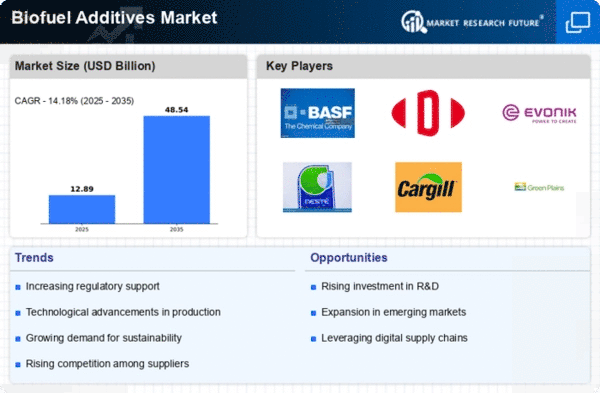
As per MRFR analysis, the Biofuel Additives Market Size was estimated at 11.29 USD Billion in 2024. The Biofuel Additives industry is projected to grow from 12.89 USD Billion in 2025 to 48.54 USD Billion by 2035, exhibiting a compound annual growth rate (CAGR) of 14.18 during the forecast period 2025 - 2035.

Key Market Trends & Highlights

The Biofuel Additives Market is poised for substantial growth driven by sustainability initiatives and technological advancements.

  • North America remains the largest market for biofuel additives, driven by increasing regulatory support and sustainability initiatives.
  • The Asia-Pacific region is emerging as the fastest-growing market, reflecting a rising demand for renewable energy solutions.
  • In the transportation segment, ester-based additives dominate, while alcohol-based additives are gaining traction in power generation applications.
  • Key market drivers include the rising demand for renewable energy and advancements in biofuel technology, which are shaping the industry's future.

Market Size & Forecast

2024 Market Size 11.29 (USD Billion)
2035 Market Size 48.54 (USD Billion)
CAGR (2025 - 2035) 14.18%
Largest Regional Market Share in 2024 North America

Major Players

<p>BASF SE (DE), DuPont de Nemours Inc (US), Evonik Industries AG (DE), Neste Corporation (FI), Cargill Inc (US), Green Plains Inc (US), ADM (US), Valero Energy Corporation (US), Renewable Energy Group Inc (US)</p>

Market Trends

The Biofuel Additives Market is currently experiencing a notable transformation, driven by a growing emphasis on sustainability and environmental responsibility. As nations strive to reduce greenhouse gas emissions and reliance on fossil fuels, biofuel additives are emerging as a viable solution to enhance the performance and efficiency of biofuels. This shift is not merely a trend but appears to be a fundamental change in how energy is produced and consumed. The increasing adoption of renewable energy sources, coupled with advancements in technology, suggests that the market is poised for substantial growth in the coming years. Moreover, regulatory frameworks are evolving to support the integration of biofuels into the energy mix. Governments worldwide are implementing policies that encourage the use of biofuel additives, which may further stimulate market expansion. The focus on improving fuel quality and engine performance is likely to drive innovation in additive formulations, leading to a more competitive landscape. As the Biofuel Additives Market continues to develop, it is essential to monitor these dynamics closely, as they will shape the future of energy production and consumption.

Sustainability Initiatives

The Biofuel Additives Market is increasingly influenced by sustainability initiatives. As environmental concerns gain prominence, stakeholders are prioritizing eco-friendly solutions. This trend indicates a shift towards biofuel additives that not only enhance performance but also minimize ecological impact.

Technological Advancements

Technological advancements are playing a crucial role in the evolution of the Biofuel Additives Market. Innovations in additive formulations and production processes are likely to improve fuel efficiency and reduce emissions. This trend suggests a continuous push for research and development in the sector.

Regulatory Support

Regulatory support is becoming a significant driver for the Biofuel Additives Market. Governments are implementing policies that promote the use of biofuels and their additives. This trend indicates a favorable environment for market growth, as compliance with regulations becomes increasingly important.

Biofuel Additives Market Market Drivers

Market Growth Projections

The Global Biofuel Additives Market Industry is poised for substantial growth, with projections indicating a market value of 16.7 USD Billion in 2024 and an anticipated increase to 41.7 USD Billion by 2035. This growth trajectory suggests a compound annual growth rate of 8.68% from 2025 to 2035, reflecting the increasing adoption of biofuels across various sectors. The expansion is driven by factors such as rising demand for renewable energy, technological advancements, and supportive government policies. These projections highlight the potential for biofuel additives to play a critical role in the transition towards sustainable energy solutions.

Growing Environmental Awareness

The rising awareness of environmental issues among consumers is a significant driver for the Global Biofuel Additives Market Industry. As individuals and organizations increasingly prioritize sustainability, the demand for eco-friendly fuel alternatives is surging. This shift in consumer behavior is prompting manufacturers to invest in biofuel additives that reduce emissions and enhance fuel performance. The growing preference for sustainable products is likely to influence market dynamics, encouraging companies to innovate and adapt their offerings. Consequently, this trend may lead to a more robust market presence for biofuel additives, aligning with global sustainability goals.

Rising Demand for Renewable Energy

The increasing global emphasis on renewable energy sources drives the Global Biofuel Additives Market Industry. Governments worldwide are implementing policies to reduce greenhouse gas emissions, thereby promoting biofuels as a cleaner alternative to fossil fuels. For instance, the European Union has set ambitious targets for renewable energy usage, which includes biofuels. This trend is expected to contribute to the market's growth, with projections indicating a market value of 16.7 USD Billion in 2024 and a potential increase to 41.7 USD Billion by 2035. The compound annual growth rate of 8.68% from 2025 to 2035 further underscores the urgency for sustainable energy solutions.

Expansion of Biofuel Infrastructure

The expansion of biofuel infrastructure is a pivotal factor influencing the Global Biofuel Additives Market Industry. As more biofuel production facilities and distribution networks are established, the accessibility and availability of biofuels are expected to improve. This infrastructure development is crucial for meeting the increasing demand for biofuels, particularly in regions with ambitious renewable energy targets. Enhanced logistics and supply chain capabilities can facilitate the integration of biofuels into existing fuel markets, thereby driving growth. The establishment of such infrastructure is likely to support the projected market growth, contributing to the anticipated increase in market value.

Government Incentives and Regulations

Government incentives and regulations play a crucial role in shaping the Global Biofuel Additives Market Industry. Many countries are implementing tax credits, subsidies, and mandates to encourage the use of biofuels. For instance, the Renewable Fuel Standard in the United States mandates a certain volume of renewable fuel to be blended into transportation fuels. Such regulatory frameworks not only stimulate demand for biofuel additives but also create a favorable environment for market players. As these policies become more stringent, they are expected to propel the market forward, fostering innovation and investment in biofuel technologies.

Technological Advancements in Biofuel Production

Innovations in biofuel production technologies are significantly influencing the Global Biofuel Additives Market Industry. Advances such as enzyme technology and improved fermentation processes enhance the efficiency and yield of biofuel production. For example, the development of second and third-generation biofuels, derived from non-food biomass, is gaining traction. These technologies not only optimize resource utilization but also reduce production costs, making biofuels more competitive against traditional fossil fuels. As these advancements continue to evolve, they are likely to attract investments and drive market growth, aligning with the increasing demand for sustainable energy solutions.

Market Segment Insights

By Application: Transportation (Largest) vs. Power Generation (Fastest-Growing)

<p>In the Biofuel Additives Market, the application segment is dominated by the transportation sector, which captures a significant share due to the rising demand for clean and sustainable fuels. Transportation covers various vehicles ranging from cars to heavy-duty trucks, making it a critical area for implementing biofuel additives to reduce emissions and enhance fuel performance. Meanwhile, power generation is emerging rapidly, driven by the increasing need for renewable energy sources and government incentives promoting cleaner energy solutions.</p>

<p>Transportation (Dominant) vs. Agriculture (Emerging)</p>

<p>The transportation sector stands as the dominant force within the Biofuel Additives Market. It benefits from stringent environmental regulations and a global push towards sustainable practices, leading to a consistent demand for biofuels such as ethanol and biodiesel. Additionally, the increasing adoption of flexible fuel vehicles enhances the accessibility of biofuel additives in this sector. Conversely, agriculture is an emerging segment that leverages biofuel additives for various farming applications, including equipment fueling and soil enhancement. As agricultural practices evolve towards sustainability, the demand for biofuels in this sector is set to grow, supported by a shift in farming policies and a focus on reducing carbon footprints.</p>

By Type: Ester-based Additives (Largest) vs. Alcohol-based Additives (Fastest-Growing)

<p>In the Biofuel Additives Market, ester-based additives have established a significant share due to their compatibility with various feedstocks and their ability to enhance fuel properties. This segment has gained traction among biofuel producers aiming to improve efficiency and reduce emissions. Conversely, alcohol-based additives, while smaller in market share, are witnessing rapid adoption driven by increasing demand for renewable and sustainable fuel options. This dynamic landscape illustrates a shifting preference as stakeholders seek innovative solutions to address environmental concerns.</p>

<p>Additives: Ester-based (Dominant) vs. Alcohol-based (Emerging)</p>

<p>Ester-based additives are the dominant force in the Biofuel Additives Market, characterized by their effectiveness in improving cold flow and reducing engine deposits. Often derived from fats and oils, these additives enhance the combustion properties of biofuels. In contrast, alcohol-based additives are emerging as an attractive alternative, offering benefits such as improved solubility and reduced emissions during combustion. The growing focus on renewable energy sources is propelling the development of alcohol-based options, which are easily integrated into existing fuel formulations. As regulations tighten around emissions, both segment values are key contributors to advancing cleaner fuel technologies.</p>

By End Use: Automotive (Largest) vs. Aviation (Fastest-Growing)

<p>In the Biofuel Additives Market, the 'Automotive' end use segment holds the largest market share, driven by a significant increase in the adoption of biofuels in vehicles globally. This segment benefits from a growing awareness of environmental issues, with biofuels positioned as a cleaner alternative to traditional fuels. On the other hand, the 'Aviation' segment is marked by rapid growth, spurred by regulatory initiatives and a push for sustainable aviation fuels. As governments enforce stricter emissions standards, the demand for biofuel additives in aviation is accelerating. The growth trends within the 'End Use' segment of biofuel additives are shaped by innovations in fuel technologies and a shift in consumer preferences toward greener solutions. The automotive sector continues to expand its use of biofuels as key players invest in production technologies. Meanwhile, the aviation industry is adapting quickly, with new developments in biofuel offerings meeting both environmental and operational performance standards. These dynamics highlight a promising future for biofuel additives across these critical end-use applications.</p>

<p>Automotive: Biofuels (Dominant) vs. Aviation: Sustainable Fuels (Emerging)</p>

<p>The automotive sector is recognized as the dominant force in the Biofuel Additives Market, primarily due to its extensive integration of biofuels and growing mandates for cleaner combustion technology. With diverse applications ranging from passenger vehicles to heavy-duty transport, the automotive segment emphasizes efficiency and sustainability. Conversely, the aviation sector is emerging rapidly with sustainable aviation fuels (SAFs) gaining traction among major airlines. These biofuels are designed to significantly reduce carbon emissions during flight, aligning with evolving regulatory frameworks and increasing consumer expectations for sustainable travel options. This contrast in dynamics showcases how each segment responds to market forces while influencing the broader adoption of biofuel technologies.</p>

Get more detailed insights about Biofuel Additives Market Research Report - Forecast till 2035

Regional Insights

North America : Leading Market Innovators

North America is poised to maintain its leadership in the biofuel additives market, holding a significant share of 5.65 in 2024. The region's growth is driven by increasing regulatory support for renewable energy and a shift towards sustainable fuel alternatives. Demand for biofuel additives is further fueled by rising environmental concerns and the need for energy independence, making it a focal point for innovation and investment in clean technologies. The United States stands out as a key player, with major companies like BASF SE, DuPont, and ADM leading the charge. The competitive landscape is characterized by a mix of established firms and emerging startups, all vying for market share. The presence of robust infrastructure and favorable policies enhances the region's attractiveness for biofuel production, ensuring a dynamic market environment.

Europe : Sustainable Energy Transition

Europe is rapidly evolving as a significant player in the biofuel additives market, with a market size of 3.5. The region's growth is propelled by stringent environmental regulations and ambitious climate goals set by the European Union. The demand for biofuel additives is expected to rise as countries strive to meet renewable energy targets and reduce greenhouse gas emissions, making it a critical area for investment and development. Leading countries such as Germany, France, and the UK are at the forefront of this transition, supported by key players like Neste Corporation and Evonik Industries. The competitive landscape is marked by innovation in biofuel technologies and a strong emphasis on sustainability. The European market is characterized by collaboration between governments and private sectors to enhance biofuel production and usage, ensuring a robust future for biofuel additives.

Asia-Pacific : Emerging Market Potential

Asia-Pacific is emerging as a promising market for biofuel additives, with a market size of 2.8. The region's growth is driven by increasing energy demands and a shift towards cleaner fuel alternatives. Governments are implementing policies to promote renewable energy sources, which is expected to boost the adoption of biofuel additives. The rising awareness of environmental issues is also contributing to this trend, making it a key area for future growth. Countries like China and India are leading the charge, with significant investments in biofuel technologies. The competitive landscape features both local and international players, including Cargill Inc and Green Plains Inc. As the region continues to develop its biofuel infrastructure, the market for biofuel additives is set to expand, supported by favorable regulations and growing consumer demand for sustainable energy solutions.

Middle East and Africa : Untapped Resource Potential

The Middle East and Africa region presents a unique opportunity in the biofuel additives market, with a market size of 0.34. The growth in this region is primarily driven by the need for energy diversification and the exploration of renewable energy sources. Governments are increasingly recognizing the importance of biofuels in achieving energy security and sustainability, leading to a gradual increase in market interest and investment. Countries like South Africa and the UAE are beginning to explore biofuel production, supported by local initiatives and international partnerships. The competitive landscape is still developing, with a focus on establishing a robust supply chain for biofuel additives. As awareness of renewable energy benefits grows, the region is likely to see increased activity from both local and global players, paving the way for future market expansion.

Key Players and Competitive Insights

The Biofuel Additives Market is currently characterized by a dynamic competitive landscape, driven by increasing demand for sustainable energy solutions and regulatory support for biofuels. Key players such as BASF SE (DE), DuPont de Nemours Inc (US), and Neste Corporation (FI) are strategically positioned to leverage innovation and sustainability in their operations. BASF SE (DE) focuses on developing advanced biofuel additives that enhance fuel efficiency and reduce emissions, while DuPont de Nemours Inc (US) emphasizes partnerships with agricultural producers to ensure a steady supply of raw materials. Neste Corporation (FI) is actively expanding its production capacity to meet the growing global demand for renewable diesel, indicating a collective shift towards sustainable practices among these companies.

The market structure appears moderately fragmented, with several players vying for market share through localized manufacturing and optimized supply chains. Companies are increasingly localizing their production facilities to reduce transportation costs and enhance responsiveness to regional market demands. This strategy not only improves operational efficiency but also aligns with the growing consumer preference for locally sourced products. The collective influence of these key players shapes a competitive environment where innovation and sustainability are paramount.

In November 2025, Neste Corporation (FI) announced the opening of a new biofuel production facility in the United States, aimed at increasing its renewable diesel output by 30%. This strategic move is significant as it positions Neste to capitalize on the burgeoning demand for low-carbon fuels in North America, thereby enhancing its competitive edge in the market. The facility is expected to create numerous jobs and contribute to local economies, further solidifying Neste's commitment to sustainability and community engagement.

In October 2025, DuPont de Nemours Inc (US) launched a new line of biofuel additives designed to improve engine performance and reduce emissions. This product introduction reflects DuPont's ongoing commitment to innovation and its strategic focus on developing solutions that meet stringent environmental regulations. By enhancing the performance characteristics of biofuels, DuPont aims to attract a broader customer base, including fleet operators and transportation companies seeking to comply with increasingly stringent emissions standards.

In September 2025, BASF SE (DE) entered into a strategic partnership with a leading agricultural firm to develop biofuel additives derived from sustainable feedstocks. This collaboration is indicative of BASF's strategy to integrate sustainability into its product offerings while ensuring a reliable supply of raw materials. The partnership not only enhances BASF's product portfolio but also aligns with global trends towards circular economy practices, positioning the company favorably in a competitive market.

As of December 2025, the Biofuel Additives Market is witnessing trends such as digitalization, sustainability, and the integration of AI technologies. These trends are reshaping competitive dynamics, with companies increasingly forming strategic alliances to enhance their innovation capabilities and market reach. The shift from price-based competition to a focus on technological advancement and supply chain reliability is evident, suggesting that future competitive differentiation will hinge on the ability to innovate and adapt to evolving market demands.

Key Companies in the Biofuel Additives Market market include

Industry Developments

In January 2022 BASF and Innospec collaborated to bring increased value to ethanol producers. As a result of this collaboration, BASF supplies concentrated corrosion inhibitor DCI-11 Plus ClearTrak to ethanol plants in the United States.

Future Outlook

Biofuel Additives Market Future Outlook

<p>The Biofuel Additives Market is projected to grow at a 14.18% CAGR from 2024 to 2035, driven by increasing environmental regulations, demand for cleaner fuels, and technological advancements.</p>

New opportunities lie in:

  • <p>Development of biofuel additive formulations for marine applications.</p>
  • <p>Expansion into emerging markets with tailored biofuel solutions.</p>
  • <p>Partnerships with automotive manufacturers for integrated biofuel systems.</p>

<p>By 2035, the Biofuel Additives Market is expected to be robust, reflecting substantial growth and innovation.</p>

Market Segmentation

Biofuel Additives Market Type Outlook

  • Ester-based Additives
  • Alcohol-based Additives
  • Emulsifiers
  • Detergents

Biofuel Additives Market End Use Outlook

  • Automotive
  • Aviation
  • Marine
  • Railway

Biofuel Additives Market Application Outlook

  • Transportation
  • Power Generation
  • Industrial
  • Agriculture

Report Scope

MARKET SIZE 202411.29(USD Billion)
MARKET SIZE 202512.89(USD Billion)
MARKET SIZE 203548.54(USD Billion)
COMPOUND ANNUAL GROWTH RATE (CAGR)14.18% (2024 - 2035)
REPORT COVERAGERevenue Forecast, Competitive Landscape, Growth Factors, and Trends
BASE YEAR2024
Market Forecast Period2025 - 2035
Historical Data2019 - 2024
Market Forecast UnitsUSD Billion
Key Companies ProfiledBASF SE (DE), DuPont de Nemours Inc (US), Evonik Industries AG (DE), Neste Corporation (FI), Cargill Inc (US), Green Plains Inc (US), ADM (US), Valero Energy Corporation (US), Renewable Energy Group Inc (US)
Segments CoveredApplication, Type, End Use
Key Market OpportunitiesGrowing demand for sustainable energy solutions drives innovation in the Biofuel Additives Market.
Key Market DynamicsRising regulatory pressures drive innovation in biofuel additives, enhancing performance and sustainability across various applications.
Countries CoveredNorth America, Europe, APAC, South America, MEA

FAQs

How much is the Biofuel Additives market?

13.2 Billion (2021)

What is the growth rate of the Biofuel Additives market?

8.90%

Which region held the largest share in the Biofuel Additives market?

North America

Who are the key players in the Biofuel Additives market?

LUBRIZOL, BASF SE, Quality Services, Chemiphase Ltd., Clariant, Afton Chemical, E-ZOIL, Eastman, Evonik, TotalEnergies, Chevron, Biofuel Systems, NALCO

Which product type led the Biofuel Additives market?

Antioxidants

Which application had the largest share in the Biofuel Additives market?

Diesel Fuel Additives

  1. Executive Summary
  2. Scope of the Report
    1. Market Definition
    2. Scope of the Study
    3. List of Assumptions
    4. Markets Structure
  3. Market Research Methodology
    1. Research Process
    2. Primary Research
    3. Secondary Research
    4. Market Size Estimation
    5. Forecast Model
  4. Market Factor Analysis
    1. Supply Chain Analysis
      1. Raw Material Suppliers
      2. Manufacturers/Service Providers of
      3. Distributors/Retailers/Wholesalers/E-Commerce Merchants
      4. End Users
    2. Biofuel Additives
    3. Porter’s Five Forces Model
      1. Threat of
      2. Intensity of Rivalry
      3. Threat of Substitutes
      4. Bargaining Power of Suppliers
      5. Bargaining Power of Buyers
    4. New Entrants
    5. Pricing Analysis
    6. Impact of Covid-19 on the market
  5. Market
    1. Dynamics of the Global Biofuel Additives Market
    2. Introduction
    3. Drivers
    4. Restraints
    5. Opportunities
    6. Challenges
  6. Global Biofuel Additives Market, by Product Type
    1. Introduction
      1. Market Estimates & Forecast, 2019–2030
    2. Antioxidants
  7. Market Estimates & Forecast, by Region, 2019–2030
    1. Corrosion Inhibitors
      1. Market Estimates & Forecast, 2019–2030
      2. Market Estimates
    2. & Forecast, by Region, 2019–2030
    3. Cold Flow Improvers
      1. Market Estimates &
    4. Market Estimates & Forecast, 2019–2030
    5. Forecast, by Region, 2019–2030
    6. Detergents
      1. Market Estimates
      2. Market Estimates & Forecast, by Region,
    7. & Forecast, 2019–2030
    8. Octane and Cetane Improvers
      1. Market Estimates
      2. Market Estimates & Forecast, by Region,
    9. & Forecast, 2019–2030
    10. Dyes and Markers
      1. Market Estimates & Forecast,
      2. Market Estimates & Forecast, by Region, 2019–2030
    11. Others
      1. Market Estimates & Forecast, 2019–2030
  8. Market Estimates & Forecast, by Region, 2019–2030
  9. Global Biofuel
  10. Additives Market, by Application
    1. Introduction
    2. Diesel Fuel Additives
      1. Market Estimates & Forecast, 2019–2030
      2. Market Estimates
    3. & Forecast, by Region, 2019–2030
    4. Heavy Fuel Oil Additives
      1. Market Estimates & Forecast, 2019–2030
      2. Market Estimates
    5. & Forecast, by Region, 2019–2030
    6. Aviation Fuel Additives
      1. Market Estimates &
    7. Market Estimates & Forecast, 2019–2030
    8. Forecast, by Region, 2019–2030
    9. Gasoline Fuel Additives
      1. Market Estimates &
    10. Market Estimates & Forecast, 2019–2030
    11. Forecast, by Region, 2019–2030
    12. Others
      1. Market Estimates
      2. Market Estimates & Forecast, by Region,
    13. & Forecast, 2019–2030
  11. Global Biofuel Additives Market, by Region
    1. Introduction
    2. North America
      1. Market Estimates & Forecast, 2019–2030
      2. Market Estimates & Forecast, by Product Type, 2019–2030
  12. Market Estimates & Forecast, by Application, 2019–2030
    1. & Forecast, by Product Type, 2019–2030
    2. Forecast, by Application, 2019–2030
    3. Estimates & Forecast, 2019–2030
    4. by Product Type, 2019–2030
    5. Application, 2019–2030
    6. Germany
  13. US
  14. Market Estimates & Forecast, 2019–2030
  15. Market Estimates
  16. Market Estimates &
  17. Canada
  18. Market
  19. Market Estimates & Forecast,
  20. Market Estimates & Forecast, by
    1. Europe
      1. Market Estimates & Forecast,
      2. Market Estimates & Forecast, by Product Type, 2019–2030
      3. Market Estimates & Forecast, by Application, 2019–2030
  21. Market Estimates & Forecast, by Product Type, 2019–2030
    1. Estimates & Forecast, by Application, 2019–2030
    2. Market Estimates & Forecast, 2019–2030
    3. Forecast, by Product Type, 2019–2030
    4. by Application, 2019–2030
    5. Forecast, 2019–2030
    6. Type, 2019–2030
  22. Market
  23. France
  24. Market Estimates &
  25. Market Estimates & Forecast,
  26. Italy
  27. Market Estimates &
  28. Market Estimates & Forecast, by Product
  29. Market Estimates & Forecast, by Application,
  30. Spain
  31. Market Estimates & Forecast, 2019–2030
  32. Market Estimates & Forecast, by Product Type, 2019–2030
  33. Market Estimates & Forecast, by Application, 2019–2030
    1. & Forecast, by Product Type, 2019–2030
    2. Forecast, by Application, 2019–2030
    3. Estimates & Forecast, 2019–2030
    4. by Product Type, 2019–2030
    5. Application, 2019–2030
    6. & Forecast, 2019–2030
    7. Product Type, 2019–2030
    8. Application, 2019–2030
    9. & Forecast, 2019–2030
    10. Product Type, 2019–2030
  34. UK
  35. Market Estimates & Forecast, 2019–2030
  36. Market Estimates
  37. Market Estimates &
  38. Russia
  39. Market
  40. Market Estimates & Forecast,
  41. Market Estimates & Forecast, by
  42. Rest of Europe
  43. Market Estimates
  44. Market Estimates & Forecast, by
  45. Market Estimates & Forecast, by
    1. Asia-Pacific
  46. Market Estimates
  47. Market Estimates & Forecast, by
  48. Market Estimates & Forecast, by Application,
  49. China
  50. Market Estimates & Forecast, 2019–2030
  51. Market Estimates & Forecast, by Product Type, 2019–2030
  52. Market Estimates & Forecast, by Application, 2019–2030
    1. & Forecast, by Product Type, 2019–2030
    2. Forecast, by Application, 2019–2030
    3. Estimates & Forecast, 2019–2030
    4. by Product Type, 2019–2030
    5. Application, 2019–2030
    6. & Forecast, 2019–2030
    7. Product Type, 2019–2030
    8. & Forecast, 2019–2030
    9. Product Type, 2019–2030
    10. Forecast, 2019–2030
    11. Type, 2019–2030
    12. Latin America
  53. India
  54. Market Estimates & Forecast, 2019–2030
  55. Market Estimates
  56. Market Estimates &
  57. South Korea
  58. Market
  59. Market Estimates & Forecast,
  60. Market Estimates & Forecast, by
  61. Indonesia
  62. Market Estimates
  63. Market Estimates & Forecast, by
  64. Market Estimates & Forecast, by Application,
  65. Australia & New Zealand
  66. Market Estimates
  67. Market Estimates & Forecast, by
  68. Market Estimates & Forecast, by Application,
  69. Rest of Asia-Pacific
  70. Market Estimates &
  71. Market Estimates & Forecast, by Product
  72. Market Estimates & Forecast, by Application,
    1. Rest of the World
  73. Market Estimates & Forecast,
  74. Market Estimates & Forecast, by Product Type, 2019–2030
  75. Market Estimates & Forecast, by Application, 2019–2030
  76. Market Estimates & Forecast, 2019–2030
  77. Market Estimates & Forecast, by Product Type, 2019–2030
    1. Estimates & Forecast, by Application, 2019–2030
    2. & Africa
  78. Market
  79. Middle East
  80. Market Estimates & Forecast, 2019–2030
  81. Market Estimates & Forecast, by Product Type, 2019–2030
    1. Estimates & Forecast, by Application, 2019–2030
  82. Market
  83. Competitive Landscape
    1. Introduction
    2. Market Key Strategies
    3. Competitive Benchmarking
    4. Key Development Analysis (Expansions/Mergers & Acquisitions/Joint Ventures/New
    5. Biofuel Additives Developments/Agreements/Investments)
  84. Company Profiles
    1. LUBRIZOL
      1. Company Overview
      2. Financial Overview
      3. Products Offered
      4. Key Developments
      5. SWOT Analysis
      6. Key Strategies
    2. BASF SE
    3. Fuel Quality Services
    4. Chemiphase Ltd.
    5. Clariant
    6. Afton Chemical
    7. E-ZOIL
    8. Eastman
    9. Evonik
    10. TotalEnergies
    11. Chevron
    12. Biofuel Systems
    13. NALCO.
  85. Appendix
  86. LIST OF TABLES
  87. Table 1: Global Biofuel Additives Market, by region, 2019–2030
  88. Table 2: North America: Biofuel Additives Market, by Country, 2019–2030
  89. Table 3: Europe: Biofuel Additives Market, by Country, 2019–2030
    1. Table
  90. 4: Asia-Pacific: Biofuel Additives Market, by Country, 2019–2030
    1. Table
  91. 5: Middle East & Africa: Biofuel Additives Market, by Country, 2019–2030
  92. Table 6: Latin America: Biofuel Additives Market, by Country, 2019–2030
  93. Table 13: Global Biofuel Additives Product Type Market, by Region, 2019–2030
  94. Table 14: North America: Biofuel Additives Product Type Market, by Country, 2019–2030
  95. Table 15: Europe: Biofuel Additives Product Type Market, by Country, 2019–2030
  96. Table 16: Asia-Pacific: Biofuel Additives Product Type Market, by Country, 2019–2030
    1. Table 17: Middle East & Africa: Biofuel Additives Product Type Market, by
    2. Country, 2019–2030
    3. Table 18: Latin America: Biofuel Additives Product
  97. Type Market, by Country, 2019–2030
    1. Table 19: Global Biofuel Additives
  98. Product Type Market, by Region, 2019–2030
    1. Table 20: North America: Biofuel
  99. Additives Product Type Market, by Country, 2019–2030
    1. Table 21: Europe:
  100. Biofuel Additives Product Type Market, by Country, 2019–2030
    1. Table 22:
  101. Asia-Pacific: Biofuel Additives Product Type Market, by Country, 2019–2030
    1. Table 23: Middle East & Africa: Biofuel Additives Product Type Market, by
    2. Country, 2019–2030
    3. Table 24: Latin America: Biofuel Additives Product
  102. Type Market, by Country, 2019–2030
    1. Table 25: Global Biofuel Additives
  103. Product Type Market, by Region, 2019–2030
    1. Table 26: Global Biofuel Additives
  104. Product Type Market, by Region, 2019–2030
    1. Table 27: North America: Biofuel
  105. Additives Market, by Country, 2019–2030
    1. Table 29: North America: Biofuel
  106. Additives Market, by Product Type, 2019–2030
    1. Table 30: North America:
  107. Biofuel Additives Market, by Application, 2019–2030
    1. Table 31: Europe:
  108. Biofuel Additives Market, by Country, 2019–2030
    1. Table 32: Europe: Biofuel
  109. Additives Market, by Product Type, 2019–2030
    1. Table 33: Europe: Biofuel
  110. Additives Market, by Application, 2019–2030
    1. Table 34: Asia-Pacific: Biofuel
  111. Additives Market, by Country, 2019–2030
    1. Table 35: Asia-Pacific: Biofuel
  112. Additives Market, by Product Type, 2019–2030
    1. Table 36: Asia-Pacific:
  113. Biofuel Additives Market, by Application, 2019–2030
    1. Table 37: Middle
  114. East & Africa: Biofuel Additives Market, by Country, 2019–2030
    1. Table
  115. 38: Middle East & Africa: Biofuel Additives Market, by Product Type, 2019–2030
  116. Table 39: Middle East & Africa: Biofuel Additives Market, by Application,
  117. Table 40: Latin America: Biofuel Additives Market, by Country,
  118. Table 41: Latin America: Biofuel Additives Market, by Product
    1. Type, 2019–2030
    2. Table 42: Latin America: Biofuel Additives Market, by
    3. Application, 2019–2030
  119. LIST OF FIGURES
    1. FIGURE 1-- Global
    2. Biofuel Additives Market Segmentation
    3. FIGURE 2-- Forecast Research Methodology
  120. -- Porter’s Five Forces Analysis of the Global Biofuel Additives
    1. Market
    2. FIGURE 4-- Value Chain/Supply Chain of Global Biofuel Additives Market
  121. FIGURE 5-- Share of Global Biofuel Additives Market, by Country, 2021 (%)
    1. FIGURE
    2. 6-- Global Biofuel Additives Market, 2019–2030
    3. FIGURE 7-- Global Biofuel
  122. Additives Market Size, by Product Type, 2019–2030
    1. FIGURE 8-- Share of
  123. Global Biofuel Additives Market, by Product Type, 2020 (%)
    1. FIGURE 11-- Global
  124. Biofuel Additives Market Size, by Application, 2019–2030
    1. FIGURE 12--
  125. Share of Global Biofuel Additives Market, by Application, 2021 (%)

Biofuel Additives Market Segmentation

Market Segmentation Overview

  • Detailed segmentation data will be available in the full report
  • Comprehensive analysis by multiple parameters
  • Regional and country-level breakdowns
  • Market size forecasts by segment
Infographic

Free Sample Request

Kindly complete the form below to receive a free sample of this Report

Get Free Sample

Customer Strories

Compare Licence

×
Features License Type
Single User Multiuser License Enterprise User
Price $4,950 $5,950 $7,250
Maximum User Access Limit 1 User Upto 10 Users Unrestricted Access Throughout the Organization
Free Customization
Direct Access to Analyst
Deliverable Format
Platform Access
Discount on Next Purchase 10% 15% 15%
Printable Versions