×
Request Free Sample ×

Kindly complete the form below to receive a free sample of this Report

* Please use a valid business email

Leading companies partner with us for data-driven Insights

clients tt-cursor
Hero Background
English
Chinese
French
Japanese
Korean
German
Spanish

Biofuel Additives Market Trends

ID: MRFR/CnM/9145-CR
180 Pages
Priya Nagrale
April 2023

Biofuel Additives Market Research Report Information By Product Type (Antioxidants, Corrosion Inhibitors, Cold Flow Improvers, Detergents, Octane and Cetane Improvers, Dyes and Markers, and Others), By Application (Diesel Fuel Additives, Heavy Fuel Oil Additives, Aviation Fuel Additives, Gasoline Fuel Additives, and Others) and By Region (North America, Europe, Asia-Pacific, and Rest of The World) - Forecast Till 2035

Share:
Download PDF ×

We do not share your information with anyone. However, we may send you emails based on your report interest from time to time. You may contact us at any time to opt-out.

Biofuel Additives Market Infographic
Purchase Options

Market Trends

Key Emerging Trends in the Biofuel Additives Market

Currently, the Biofuel Additives Market is undergoing major changes as global attention toward sustainable energy solutions grows stronger. A number of major trends are influencing market dynamics and impacting the adoption rates for additives in biofuels production. In recent years the concept of environmental sustainability has become more popular, as well as concerns over reducing greenhouse gas emissions. As a result there is greater interest in biofuels to replace traditional fossil fuels Additives for biofuels help to improve their performance in terms of efficiency and environmental impact, all part of the world's efforts against climate change. Additives for Biofuel The surge in stringent environmental regulations and government policies encouraging the use of renewable energy sources are pushing demand. Generous incentives as well as mandatory blending ratios for biofuels, along with regulatory backing provide a setting that is favorable to the development and application of biofuel additives. Such developments in the production of biofuels have diversified feedstocks, spanning traditional crops to waste and algae. Biofuel additives are customized to enhance the use of different biofuels feedstocks, overcoming problems caused by differences in characteristics among various kinds of materials. Additives for biofuel aim to enhancing engine adaptability and performance. They overcome problems such as corrosion, deposits, cold-start failure of the device due to poor mixing properties or rapid coalescence Additives designed to improve biofuel combustion characteristics aid overall biodiesel use, benefiting all sectors of the transportation and industrial economy. help ensure the sustainability of biofuel and avoid competition with food crops, the industry is diversifying their feedstock sources. Additives are being developed to fine-tune biofuel production from various feedstocks, such as cellulosic materials and agricultural residues or non-food crops. Collaboration among biofuel producers, additive makers, and research institutions is increasing. Partnerships mean that additives for innovative biofuels may be formulated under the skills of all parties quickly overcoming challenges to achieve better efficiency in applications. Many people in the aviation industry are turning to biojet fuel as a way of cutting carbon emissions. Additives for biofuel are of great importance in the production of viable, sustainable substitutes for jet fuels; and must meet stringent aviation fuel specifications. Biofuel additive formulations are being constantly improved through research and development. These additives are being developed with a view to performance conducive, stability desirable and compatibility convenient--influences further broadening the use of biofuels. Scientists and market players are seeking to move into new regions step by step in order to make full use of the growing awareness that biofuels represent an environmentally friendly way forward. Consumer awareness of environmental issues and corporate sustainability efforts are beginning to impact buying habits.

Author
Priya Nagrale
Senior Research Analyst

With an experience of over five years in market research industry (Chemicals & Materials domain), I gather and analyze market data from diverse sources to produce results, which are then presented back to a client. Also, provide recommendations based on the findings. As a Senior Research Analyst, I perform quality checks (QC) for market estimations, QC for reports, and handle queries and work extensively on client customizations. Also, handle the responsibilities of client proposals, report planning, report finalization, and execution

Leave a Comment

FAQs

How much is the Biofuel Additives market?

13.2 Billion (2021)

What is the growth rate of the Biofuel Additives market?

8.90%

Which region held the largest share in the Biofuel Additives market?

North America

Who are the key players in the Biofuel Additives market?

LUBRIZOL, BASF SE, Quality Services, Chemiphase Ltd., Clariant, Afton Chemical, E-ZOIL, Eastman, Evonik, TotalEnergies, Chevron, Biofuel Systems, NALCO

Which product type led the Biofuel Additives market?

Antioxidants

Which application had the largest share in the Biofuel Additives market?

Diesel Fuel Additives

Market Summary

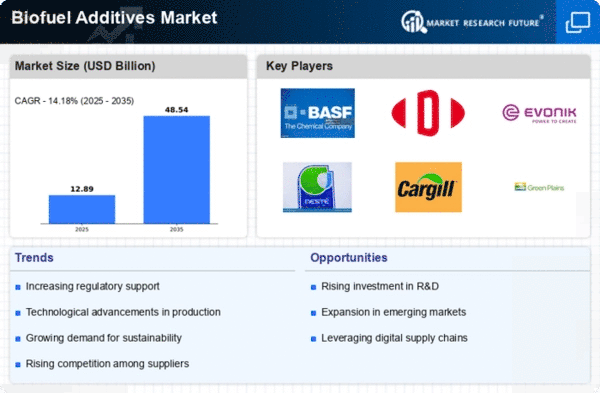
As per MRFR analysis, the Biofuel Additives Market Size was estimated at 11.29 USD Billion in 2024. The Biofuel Additives industry is projected to grow from 12.89 USD Billion in 2025 to 48.54 USD Billion by 2035, exhibiting a compound annual growth rate (CAGR) of 14.18 during the forecast period 2025 - 2035.

Key Market Trends & Highlights

The Biofuel Additives Market is poised for substantial growth driven by sustainability initiatives and technological advancements.

  • North America remains the largest market for biofuel additives, reflecting a strong commitment to renewable energy.
  • The Asia-Pacific region is emerging as the fastest-growing market, propelled by increasing energy demands and environmental awareness.
  • The transportation segment dominates the market, while the power generation segment is witnessing rapid growth due to evolving energy needs.
  • Rising demand for renewable energy and supportive regulatory frameworks are key drivers fueling market expansion.

Market Size & Forecast

2024 Market Size 11.29 (USD Billion)
2035 Market Size 48.54 (USD Billion)
CAGR (2025 - 2035) 14.18%
Largest Regional Market Share in 2024 North America

Major Players

BASF SE (DE), DuPont de Nemours Inc (US), Evonik Industries AG (DE), Neste Corporation (FI), Cargill Inc (US), Green Plains Inc (US), Renewable Energy Group Inc (US), ADM (US)

Market Trends

The Biofuel Additives Market is currently experiencing a notable transformation, driven by a growing emphasis on sustainability and environmental responsibility. As nations strive to reduce greenhouse gas emissions and reliance on fossil fuels, biofuel additives are emerging as a viable solution to enhance the performance and efficiency of biofuels. This shift is not merely a trend but appears to be a fundamental change in how energy is produced and consumed. The increasing adoption of renewable energy sources, coupled with advancements in technology, suggests that the market is poised for substantial growth in the coming years. Moreover, regulatory frameworks are evolving to support the integration of biofuels into the energy mix. Governments worldwide are implementing policies that encourage the use of biofuel additives, which may further stimulate market expansion. The focus on reducing carbon footprints and promoting cleaner alternatives is likely to drive innovation within the sector. As a result, stakeholders in the Biofuel Additives Market are exploring new formulations and applications to meet the diverse needs of consumers and industries alike. This dynamic landscape indicates a promising future for biofuel additives as they play a crucial role in the transition towards a more sustainable energy paradigm.

Sustainability Initiatives

The Biofuel Additives Market is increasingly influenced by sustainability initiatives. Companies are prioritizing eco-friendly practices, which may lead to the development of innovative additives that enhance biofuel performance while minimizing environmental impact. This trend reflects a broader commitment to reducing carbon emissions and promoting renewable energy sources.

Technological Advancements

Technological advancements are reshaping the Biofuel Additives Market. Innovations in production processes and formulation techniques are enabling the creation of more efficient and effective additives. These developments could enhance the overall performance of biofuels, making them more competitive with traditional fossil fuels.

Regulatory Support

Regulatory support is playing a pivotal role in the Biofuel Additives Market. Governments are implementing policies that encourage the use of biofuels and their additives, which may create a favorable environment for market growth. This support could lead to increased investment and research in the sector, further driving innovation.

Biofuel Additives Market Market Drivers

Market Growth Projections

The Global Biofuel Additives Market Industry is poised for substantial growth, with projections indicating a market value of 16.7 USD Billion in 2024 and an anticipated increase to 41.7 USD Billion by 2035. This growth trajectory suggests a compound annual growth rate of 8.68% from 2025 to 2035, reflecting the increasing adoption of biofuels across various sectors. The expansion is driven by factors such as rising demand for renewable energy, technological advancements, and supportive government policies. These projections highlight the potential for biofuel additives to play a critical role in the transition towards sustainable energy solutions.

Growing Environmental Awareness

The rising awareness of environmental issues among consumers is a significant driver for the Global Biofuel Additives Market Industry. As individuals and organizations increasingly prioritize sustainability, the demand for eco-friendly fuel alternatives is surging. This shift in consumer behavior is prompting manufacturers to invest in biofuel additives that reduce emissions and enhance fuel performance. The growing preference for sustainable products is likely to influence market dynamics, encouraging companies to innovate and adapt their offerings. Consequently, this trend may lead to a more robust market presence for biofuel additives, aligning with global sustainability goals.

Rising Demand for Renewable Energy

The increasing global emphasis on renewable energy sources drives the Global Biofuel Additives Market Industry. Governments worldwide are implementing policies to reduce greenhouse gas emissions, thereby promoting biofuels as a cleaner alternative to fossil fuels. For instance, the European Union has set ambitious targets for renewable energy usage, which includes biofuels. This trend is expected to contribute to the market's growth, with projections indicating a market value of 16.7 USD Billion in 2024 and a potential increase to 41.7 USD Billion by 2035. The compound annual growth rate of 8.68% from 2025 to 2035 further underscores the urgency for sustainable energy solutions.

Expansion of Biofuel Infrastructure

The expansion of biofuel infrastructure is a pivotal factor influencing the Global Biofuel Additives Market Industry. As more biofuel production facilities and distribution networks are established, the accessibility and availability of biofuels are expected to improve. This infrastructure development is crucial for meeting the increasing demand for biofuels, particularly in regions with ambitious renewable energy targets. Enhanced logistics and supply chain capabilities can facilitate the integration of biofuels into existing fuel markets, thereby driving growth. The establishment of such infrastructure is likely to support the projected market growth, contributing to the anticipated increase in market value.

Government Incentives and Regulations

Government incentives and regulations play a crucial role in shaping the Global Biofuel Additives Market Industry. Many countries are implementing tax credits, subsidies, and mandates to encourage the use of biofuels. For instance, the Renewable Fuel Standard in the United States mandates a certain volume of renewable fuel to be blended into transportation fuels. Such regulatory frameworks not only stimulate demand for biofuel additives but also create a favorable environment for market players. As these policies become more stringent, they are expected to propel the market forward, fostering innovation and investment in biofuel technologies.

Technological Advancements in Biofuel Production

Innovations in biofuel production technologies are significantly influencing the Global Biofuel Additives Market Industry. Advances such as enzyme technology and improved fermentation processes enhance the efficiency and yield of biofuel production. For example, the development of second and third-generation biofuels, derived from non-food biomass, is gaining traction. These technologies not only optimize resource utilization but also reduce production costs, making biofuels more competitive against traditional fossil fuels. As these advancements continue to evolve, they are likely to attract investments and drive market growth, aligning with the increasing demand for sustainable energy solutions.

Market Segment Insights

By Application: Transportation (Largest) vs. Power Generation (Fastest-Growing)

In the Biofuel Additives Market, the application segment is primarily dominated by the transportation sector, which accounts for a significant portion of the overall market share due to the increasing demand for cleaner and renewable fuels in vehicles. This demand is driven by regulatory mandates and a shift in consumer preferences toward eco-friendly alternatives. Following closely, power generation is emerging as a vital sector, showing remarkable growth rates due to investments in renewable energy sources and increasing awareness regarding carbon emissions. The growth trends in the application segment are being propelled by innovations in biofuel technologies and the rising pressure to reduce carbon footprints across various sectors. Transportation remains the backbone of this market segment, but the rapid adoption of biofuels in power generation is witnessing accelerated growth as governments and industries aim for sustainable energy transitions. Such dynamics indicate a robust future for both sectors, fueled by environmental policies and technological advancements.

Transportation (Dominant) vs. Agriculture (Emerging)

The Transportation application segment in the Biofuel Additives Market stands as the dominant player, accounting for the largest share due to its critical role in reducing greenhouse gas emissions from vehicles. Various biofuels, including biodiesel and ethanol, have been effectively integrated into transportation systems, supported by robust governmental regulations promoting cleaner fuel alternatives. In contrast, the Agriculture sector is emerging as a pivotal market player, tapping into the need for sustainable practices in farming. Agricultural biofuels, derived from various crops and residues, offer farmers an opportunity to enhance energy production while decreasing dependency on fossil fuels. The shift towards integrating biofuels within agricultural processes indicates a burgeoning market characterized by innovation and sustainability, which promises to reshape the dynamics of the biofuel value chain.

By End Use: Automotive (Largest) vs. Aviation (Fastest-Growing)

In the Biofuel Additives Market, the end use segments exhibit diverse market share distributions. The automotive sector takes precedence, holding the largest share as it benefits from the extensive adoption of biofuels to reduce carbon emissions and enhance fuel efficiency. Conversely, aviation is emerging as a promising segment, attracting interest due to stricter regulatory frameworks and the aviation industry's commitment to sustainability, leading to an increased integration of biofuel additives.

Automotive (Dominant) vs. Aviation (Emerging)

The automotive sector is characterized by its robust infrastructure and a wide-ranging consumer base relying on conventional and biofuel blends. The shift towards environmentally friendly alternatives is driving the automotive segment's dominance, supported by government incentives and a growing number of manufacturers adopting biofuel solutions. Meanwhile, the aviation sector represents an emerging opportunity, influenced by heightened demand for greener fuels and efforts to mitigate air travel's environmental impact. Innovations in biokerosene and increased partnerships among airlines and biofuel producers demonstrate aviation's potential for rapid growth, positioning it as a critical player in the Biofuel Additives Market.

By Type: Ester-based Additives (Largest) vs. Alcohol-based Additives (Fastest-Growing)

In the biofuel additives market, ester-based additives are leading with the largest market share, primarily due to their stability and compatibility with various biofuels. They enhance fuel performance and provide better efficiency in combustion processes. On the other hand, alcohol-based additives are witnessing rapid uptake, capturing a significant share of the market as they cater to the growing demand for lower emission and renewable fuel solutions.

Ester-based Additives (Dominant) vs. Alcohol-based Additives (Emerging)

Ester-based additives exhibit dominant characteristics in the biofuel additives market, as they are derived from sustainably sourced feedstocks and provide excellent lubricity and cleansing properties to biofuels. This has made them essential for improving fuel performance. In contrast, alcohol-based additives are emerging as an alternative solution, primarily driven by their feedstock flexibility and ability to enhance octane ratings in gasoline blends. This versatility allows for better integration into existing fuel infrastructure, making them appealing to manufacturers seeking eco-friendly options. Their increasing adoption is propelled by strict environmental regulations and the need for cleaner combustion strategies.

Get more detailed insights about Biofuel Additives Market Research Report - Forecast till 2035

Regional Insights

North America : Leading Market Innovator

North America is poised to maintain its leadership in the biofuel additives market, holding a significant share of 5.65 in 2024. The region's growth is driven by increasing regulatory support for renewable energy and a shift towards sustainable fuel alternatives. Demand for biofuels is further fueled by rising environmental concerns and government incentives aimed at reducing carbon emissions. The United States stands out as a key player, with major companies like BASF SE, DuPont, and Cargill leading the charge. The competitive landscape is characterized by innovation and strategic partnerships, enhancing product offerings and market reach. As the region continues to invest in biofuel technology, it is expected to solidify its position as a global leader in this sector.

Europe : Sustainable Energy Transition

Europe is rapidly advancing in the biofuel additives market, with a market size of 3.5. The region's growth is propelled by stringent environmental regulations and a strong commitment to reducing greenhouse gas emissions. Initiatives like the European Green Deal are driving demand for sustainable fuel alternatives, making biofuels a focal point in energy policies. Leading countries such as Germany and France are at the forefront, supported by key players like Neste Corporation and Evonik Industries. The competitive landscape is marked by innovation and collaboration among industry stakeholders, enhancing the development of advanced biofuel technologies. As Europe aims for carbon neutrality, the biofuel additives market is expected to flourish, supported by robust regulatory frameworks.

Asia-Pacific : Emerging Market Potential

Asia-Pacific is emerging as a significant player in the biofuel additives market, with a market size of 2.8. The region's growth is driven by increasing energy demands and a shift towards renewable energy sources. Governments are implementing policies to promote biofuels, addressing both energy security and environmental concerns. Countries like China and India are leading the charge, with a growing presence of key players such as Green Plains Inc and Renewable Energy Group. The competitive landscape is evolving, with local companies entering the market and forming strategic alliances to enhance their offerings. As the region continues to invest in biofuel technologies, the market is expected to expand significantly in the coming years.

Middle East and Africa : Untapped Resource Potential

The Middle East and Africa region is gradually recognizing the potential of biofuel additives, with a market size of 0.34. The growth is driven by increasing energy needs and a focus on sustainable energy solutions. Governments are beginning to explore biofuels as a viable alternative to traditional fossil fuels, spurred by environmental concerns and energy diversification strategies. Countries like South Africa and the UAE are taking initial steps towards biofuel adoption, with local companies exploring opportunities in this emerging market. The competitive landscape is still developing, but there is a growing interest from international players looking to invest in the region. As awareness and infrastructure improve, the biofuel additives market is expected to gain traction in the coming years.

Key Players and Competitive Insights

The Biofuel Additives Market is currently characterized by a dynamic competitive landscape, driven by increasing demand for sustainable energy solutions and regulatory support for biofuels. Key players such as BASF SE (DE), DuPont de Nemours Inc (US), and Neste Corporation (FI) are strategically positioned to leverage innovation and sustainability in their operations. BASF SE (DE) focuses on developing advanced biofuel additives that enhance fuel efficiency and reduce emissions, while DuPont de Nemours Inc (US) emphasizes partnerships with agricultural firms to secure a steady supply of bio-based feedstocks. Neste Corporation (FI) is actively expanding its production capacity for renewable diesel, indicating a strong commitment to meeting the growing market demand. Collectively, these strategies contribute to a competitive environment that prioritizes technological advancement and sustainability.In terms of business tactics, companies are increasingly localizing manufacturing to reduce transportation costs and enhance supply chain resilience. The market structure appears moderately fragmented, with several players vying for market share, yet the influence of major companies remains substantial. This competitive structure allows for a diverse range of products and innovations, fostering a healthy environment for growth and development.

In November Neste Corporation (FI) announced the opening of a new production facility in Singapore, aimed at increasing its capacity for renewable fuel production. This strategic move is likely to enhance its market presence in Asia, where demand for biofuels is rapidly increasing. The facility is expected to utilize advanced technologies to produce high-quality biofuel additives, thereby reinforcing Neste's commitment to sustainability and innovation in the biofuel sector.

In October DuPont de Nemours Inc (US) launched a new line of biofuel additives designed to improve engine performance and reduce emissions. This product introduction reflects DuPont's ongoing investment in research and development, positioning the company as a leader in the biofuel additives market. The emphasis on performance enhancement aligns with the growing consumer demand for cleaner and more efficient fuel options, potentially increasing DuPont's market share.

In September BASF SE (DE) entered into a strategic partnership with a leading agricultural firm to develop bio-based additives derived from renewable resources. This collaboration is indicative of BASF's strategy to integrate sustainability into its product offerings, which may enhance its competitive edge. By securing a reliable source of bio-based feedstocks, BASF is likely to strengthen its supply chain and improve its product portfolio.

As of December the Biofuel Additives Market is witnessing trends such as digitalization, sustainability, and the integration of AI technologies. These trends are reshaping the competitive landscape, with strategic alliances becoming increasingly important for innovation and market penetration. The shift from price-based competition to a focus on technological advancement and supply chain reliability is evident, suggesting that companies that prioritize innovation and sustainability will likely emerge as leaders in the evolving market.

Key Companies in the Biofuel Additives Market include

Industry Developments

In January 2022 BASF and Innospec collaborated to bring increased value to ethanol producers. As a result of this collaboration, BASF supplies concentrated corrosion inhibitor DCI-11 Plus ClearTrak to ethanol plants in the United States.

Future Outlook

Biofuel Additives Market Future Outlook

The Biofuel Additives Market is projected to grow at a 14.18% CAGR from 2025 to 2035, driven by increasing environmental regulations, demand for cleaner fuels, and technological advancements.

New opportunities lie in:

  • Development of advanced biofuel formulations for aviation fuels.
  • Expansion into emerging markets with tailored biofuel solutions.
  • Investment in R&D for innovative biofuel additive technologies.

By 2035, the Biofuel Additives Market is expected to be robust, reflecting substantial growth and innovation.

Market Segmentation

Biofuel Additives Market Type Outlook

  • Ester-based Additives
  • Alcohol-based Additives
  • Emulsifiers
  • Detergents

Biofuel Additives Market End Use Outlook

  • Automotive
  • Aviation
  • Marine
  • Railway

Biofuel Additives Market Application Outlook

  • Transportation
  • Power Generation
  • Industrial
  • Agriculture

Report Scope

MARKET SIZE 202411.29(USD Billion)
MARKET SIZE 202512.89(USD Billion)
MARKET SIZE 203548.54(USD Billion)
COMPOUND ANNUAL GROWTH RATE (CAGR)14.18% (2025 - 2035)
REPORT COVERAGERevenue Forecast, Competitive Landscape, Growth Factors, and Trends
BASE YEAR2024
Market Forecast Period2025 - 2035
Historical Data2019 - 2024
Market Forecast UnitsUSD Billion
Key Companies ProfiledBASF SE (DE), DuPont de Nemours Inc (US), Evonik Industries AG (DE), Neste Corporation (FI), Cargill Inc (US), Green Plains Inc (US), Renewable Energy Group Inc (US), ADM (US)
Segments CoveredApplication, End Use, Type
Key Market OpportunitiesGrowing demand for sustainable energy solutions drives innovation in the Biofuel Additives Market.
Key Market DynamicsRising regulatory pressures drive innovation in biofuel additives, enhancing performance and sustainability across various applications.
Countries CoveredNorth America, Europe, APAC, South America, MEA

FAQs

How much is the Biofuel Additives market?

13.2 Billion (2021)

What is the growth rate of the Biofuel Additives market?

8.90%

Which region held the largest share in the Biofuel Additives market?

North America

Who are the key players in the Biofuel Additives market?

LUBRIZOL, BASF SE, Quality Services, Chemiphase Ltd., Clariant, Afton Chemical, E-ZOIL, Eastman, Evonik, TotalEnergies, Chevron, Biofuel Systems, NALCO

Which product type led the Biofuel Additives market?

Antioxidants

Which application had the largest share in the Biofuel Additives market?

Diesel Fuel Additives

  1. SECTION I: EXECUTIVE SUMMARY AND KEY HIGHLIGHTS
    1. | 1.1 EXECUTIVE SUMMARY
    2. | 1.1.1 Market Overview
    3. | 1.1.2 Key Findings
    4. | 1.1.3 Market Segmentation
    5. | 1.1.4 Competitive Landscape
    6. | 1.1.5 Challenges and Opportunities
    7. | 1.1.6 Future Outlook
  2. SECTION II: SCOPING, METHODOLOGY AND MARKET STRUCTURE
    1. | 2.1 MARKET INTRODUCTION
    2. | 2.1.1 Definition
    3. | 2.1.2 Scope of the study
    4. |-- 2.1.2.1 Research Objective
    5. |-- 2.1.2.2 Assumption
    6. |-- 2.1.2.3 Limitations
    7. | 2.2 RESEARCH METHODOLOGY
    8. | 2.2.1 Overview
    9. | 2.2.2 Data Mining
    10. | 2.2.3 Secondary Research
    11. | 2.2.4 Primary Research
    12. |-- 2.2.4.1 Primary Interviews and Information Gathering Process
    13. |-- 2.2.4.2 Breakdown of Primary Respondents
    14. | 2.2.5 Forecasting Model
    15. | 2.2.6 Market Size Estimation
    16. |-- 2.2.6.1 Bottom-Up Approach
    17. |-- 2.2.6.2 Top-Down Approach
    18. | 2.2.7 Data Triangulation
    19. | 2.2.8 Validation
  3. SECTION III: QUALITATIVE ANALYSIS
    1. | 3.1 MARKET DYNAMICS
    2. | 3.1.1 Overview
    3. | 3.1.2 Drivers
    4. | 3.1.3 Restraints
    5. | 3.1.4 Opportunities
    6. | 3.2 MARKET FACTOR ANALYSIS
    7. | 3.2.1 Value chain Analysis
    8. | 3.2.2 Porter's Five Forces Analysis
    9. |-- 3.2.2.1 Bargaining Power of Suppliers
    10. |-- 3.2.2.2 Bargaining Power of Buyers
    11. |-- 3.2.2.3 Threat of New Entrants
    12. |-- 3.2.2.4 Threat of Substitutes
    13. |-- 3.2.2.5 Intensity of Rivalry
    14. | 3.2.3 COVID-19 Impact Analysis
    15. |-- 3.2.3.1 Market Impact Analysis
    16. |-- 3.2.3.2 Regional Impact
    17. |-- 3.2.3.3 Opportunity and Threat Analysis
  4. SECTION IV: QUANTITATIVE ANALYSIS
    1. | 4.1 Chemicals and Materials, BY Application (USD Billion)
    2. | 4.1.1 Transportation
    3. | 4.1.2 Power Generation
    4. | 4.1.3 Industrial
    5. | 4.1.4 Agriculture
    6. | 4.2 Chemicals and Materials, BY End Use (USD Billion)
    7. | 4.2.1 Automotive
    8. | 4.2.2 Aviation
    9. | 4.2.3 Marine
    10. | 4.2.4 Railway
    11. | 4.3 Chemicals and Materials, BY Type (USD Billion)
    12. | 4.3.1 Ester-based Additives
    13. | 4.3.2 Alcohol-based Additives
    14. | 4.3.3 Emulsifiers
    15. | 4.3.4 Detergents
    16. | 4.4 Chemicals and Materials, BY Region (USD Billion)
    17. | 4.4.1 North America
    18. |-- 4.4.1.1 US
    19. |-- 4.4.1.2 Canada
    20. | 4.4.2 Europe
    21. |-- 4.4.2.1 Germany
    22. |-- 4.4.2.2 UK
    23. |-- 4.4.2.3 France
    24. |-- 4.4.2.4 Russia
    25. |-- 4.4.2.5 Italy
    26. |-- 4.4.2.6 Spain
    27. |-- 4.4.2.7 Rest of Europe
    28. | 4.4.3 APAC
    29. |-- 4.4.3.1 China
    30. |-- 4.4.3.2 India
    31. |-- 4.4.3.3 Japan
    32. |-- 4.4.3.4 South Korea
    33. |-- 4.4.3.5 Malaysia
    34. |-- 4.4.3.6 Thailand
    35. |-- 4.4.3.7 Indonesia
    36. |-- 4.4.3.8 Rest of APAC
    37. | 4.4.4 South America
    38. |-- 4.4.4.1 Brazil
    39. |-- 4.4.4.2 Mexico
    40. |-- 4.4.4.3 Argentina
    41. |-- 4.4.4.4 Rest of South America
    42. | 4.4.5 MEA
    43. |-- 4.4.5.1 GCC Countries
    44. |-- 4.4.5.2 South Africa
    45. |-- 4.4.5.3 Rest of MEA
  5. SECTION V: COMPETITIVE ANALYSIS
    1. | 5.1 Competitive Landscape
    2. | 5.1.1 Overview
    3. | 5.1.2 Competitive Analysis
    4. | 5.1.3 Market share Analysis
    5. | 5.1.4 Major Growth Strategy in the Chemicals and Materials
    6. | 5.1.5 Competitive Benchmarking
    7. | 5.1.6 Leading Players in Terms of Number of Developments in the Chemicals and Materials
    8. | 5.1.7 Key developments and growth strategies
    9. |-- 5.1.7.1 New Product Launch/Service Deployment
    10. |-- 5.1.7.2 Merger & Acquisitions
    11. |-- 5.1.7.3 Joint Ventures
    12. | 5.1.8 Major Players Financial Matrix
    13. |-- 5.1.8.1 Sales and Operating Income
    14. |-- 5.1.8.2 Major Players R&D Expenditure. 2023
    15. | 5.2 Company Profiles
    16. | 5.2.1 BASF SE (DE)
    17. |-- 5.2.1.1 Financial Overview
    18. |-- 5.2.1.2 Products Offered
    19. |-- 5.2.1.3 Key Developments
    20. |-- 5.2.1.4 SWOT Analysis
    21. |-- 5.2.1.5 Key Strategies
    22. | 5.2.2 DuPont de Nemours Inc (US)
    23. |-- 5.2.2.1 Financial Overview
    24. |-- 5.2.2.2 Products Offered
    25. |-- 5.2.2.3 Key Developments
    26. |-- 5.2.2.4 SWOT Analysis
    27. |-- 5.2.2.5 Key Strategies
    28. | 5.2.3 Evonik Industries AG (DE)
    29. |-- 5.2.3.1 Financial Overview
    30. |-- 5.2.3.2 Products Offered
    31. |-- 5.2.3.3 Key Developments
    32. |-- 5.2.3.4 SWOT Analysis
    33. |-- 5.2.3.5 Key Strategies
    34. | 5.2.4 Neste Corporation (FI)
    35. |-- 5.2.4.1 Financial Overview
    36. |-- 5.2.4.2 Products Offered
    37. |-- 5.2.4.3 Key Developments
    38. |-- 5.2.4.4 SWOT Analysis
    39. |-- 5.2.4.5 Key Strategies
    40. | 5.2.5 Cargill Inc (US)
    41. |-- 5.2.5.1 Financial Overview
    42. |-- 5.2.5.2 Products Offered
    43. |-- 5.2.5.3 Key Developments
    44. |-- 5.2.5.4 SWOT Analysis
    45. |-- 5.2.5.5 Key Strategies
    46. | 5.2.6 Green Plains Inc (US)
    47. |-- 5.2.6.1 Financial Overview
    48. |-- 5.2.6.2 Products Offered
    49. |-- 5.2.6.3 Key Developments
    50. |-- 5.2.6.4 SWOT Analysis
    51. |-- 5.2.6.5 Key Strategies
    52. | 5.2.7 Renewable Energy Group Inc (US)
    53. |-- 5.2.7.1 Financial Overview
    54. |-- 5.2.7.2 Products Offered
    55. |-- 5.2.7.3 Key Developments
    56. |-- 5.2.7.4 SWOT Analysis
    57. |-- 5.2.7.5 Key Strategies
    58. | 5.2.8 ADM (US)
    59. |-- 5.2.8.1 Financial Overview
    60. |-- 5.2.8.2 Products Offered
    61. |-- 5.2.8.3 Key Developments
    62. |-- 5.2.8.4 SWOT Analysis
    63. |-- 5.2.8.5 Key Strategies
    64. | 5.3 Appendix
    65. | 5.3.1 References
    66. | 5.3.2 Related Reports

Chemicals and Materials Market Segmentation

Chemicals and Materials By Application (USD Billion, 2025-2035)

  • Transportation
  • Power Generation
  • Industrial
  • Agriculture

Chemicals and Materials By End Use (USD Billion, 2025-2035)

  • Automotive
  • Aviation
  • Marine
  • Railway

Chemicals and Materials By Type (USD Billion, 2025-2035)

  • Ester-based Additives
  • Alcohol-based Additives
  • Emulsifiers
  • Detergents
Infographic

Free Sample Request

Kindly complete the form below to receive a free sample of this Report

Get Free Sample

Customer Strories

Compare Licence

×
Features License Type
Single User Multiuser License Enterprise User
Price $4,950 $5,950 $7,250
Maximum User Access Limit 1 User Upto 10 Users Unrestricted Access Throughout the Organization
Free Customization
Direct Access to Analyst
Deliverable Format
Platform Access
Discount on Next Purchase 10% 15% 15%
Printable Versions