×
Hero Background
English
Chinese
French
Japanese
Korean
German
Spanish

Battery Recycling Market Trends

ID: MRFR/EnP/8542-HCR
188 Pages
Chitranshi Jaiswal
October 2025

Battery Recycling Market Research Report Information by Chemistry (Lead-Acid, Nickel-Based, Lithium-Based and others), Application (Transportation, Consumer Electronics, Industrial and Others), By Processing State (Extraction of material, (Reuse, repackaging and second life), Disposal), By Recycling Process (Hydrometallurgy, Pyrometallurgy, lead acid battery recycling process, lithium-ion battery recycling process) By Material (Metals, electrolytes, plastics, others) Source (Automotive Batteries, Industrial Batteries and Consumer & E... read more

Share:
Download PDF ×

We do not share your information with anyone. However, we may send you emails based on your report interest from time to time. You may contact us at any time to opt-out.

Battery Recycling Market Infographic
Purchase Options

Market Trends

Key Emerging Trends in the Battery Recycling Market

This market is characterized by several remarkable trends representing the combination of environmental awareness, technological innovations and rising demand for electric vehicles along with renewable energy alternatives. One of the most noticeable trends is circular economy development whereby, as much waste as possible should be avoided and resources reuse. Battery recycling is essential to this trend, allowing valuable materials like lithium cobalt and nickel back into the supply chain. E-waste issues have been giving rise to more awareness on the part of battery recycling industry that requires an environmentally conscious and responsible disposal options. Factors that are impacting the market drivers in battery recycling include rapid growth of electric vehicles. The development of electric vehicles leads to the growing production and use volumes along with higher generated waste amount. Rapid growth of the electric vehicle market has stimulated battery technology and recycling processes for effective management from increasing end-of life batteries. With governments across the world striving to achieve high targets of electric vehicle adoption, battery recycling market is expected to play a vital role in guaranteeing sustainable wastes management and resource recovery. Technological developments are changing the landscape of battery recycling. There are emerging innovative processes, such as hydrometallurgical and pyrometallurgy. Similarly, advanced sorting and separation technologies emerge to cater for more effective recovery of valuable materials facilitating higher recycling rates. Not only do these technological trends make it cheaper to recycle batteries, but they also reduce the environmental footprint of recycling compared to previous processes. Besides making contributions to the dynamics of battery recycling market, consumer electronics industry The continuing progress of smartphones, laptops and other electronic gizmos triggers the rise in battery disposal from those devices. This trend creates demand for an effective and scalable battery recycling plan. Manufacturers and retailers are also more active in promoting responsible disposal practices, which guide consumer behavior and lead to recycling culture within the electronics supply chain. Another significant trend impacting the battery recycling market is with increasing implementation of energy storage systems. The market for batteries used in grid-scale energy storage applications is growing with increased demand. This results in new challenges and opportunities for the recycling technologies to deal with various battery chemistries and designs.

Author
Chitranshi Jaiswal
Research Analyst Level I

In her 3 years of experience in the market research field, she has handled critical cross-domain projects. She has an in-depth knowledge of market estimation & analysis, problem-solving, primary as well as secondary research, and team management.She holds an engineering degree and is an MBA professional from a well-known university, capable of evaluating the market and competitive conditions. An exceptional strategist with excellent communication skills and a passion for delivering cutting-edge & practical insights for the market. Proficient in multi-tasking, and can successfully deal with competing demands, while maintaining complete confidentiality. Generated business through active client and project development, networking, and high-quality responses. Her knowledge and skills have helped in making solid business decisions, securing funding from investors, and avoiding business failures.

Leave a Comment

FAQs

What is the current valuation of the Battery Recycling Market as of 2024?

The Battery Recycling Market was valued at 26.93 USD Billion in 2024.

What is the projected market valuation for the Battery Recycling Market in 2035?

The market is projected to reach a valuation of 70.49 USD Billion by 2035.

What is the expected CAGR for the Battery Recycling Market during the forecast period 2025 - 2035?

The expected CAGR for the Battery Recycling Market during the forecast period 2025 - 2035 is 9.14%.

Which companies are considered key players in the Battery Recycling Market?

Key players in the market include Umicore, Li-Cycle, Redwood Materials, and American Battery Technology Company.

What are the main segments of the Battery Recycling Market based on chemistry?

The main segments based on chemistry include Lead-acid, Lithium-based, Nickel-based, and Alkaline batteries.

Market Summary

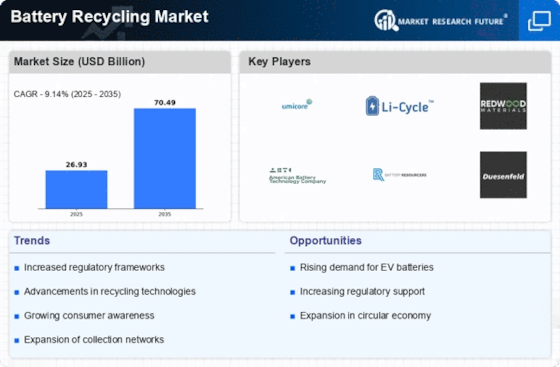
As per MRFR analysis, the Battery Recycling Market Size was estimated at 26.93 USD Billion in 2024. The Battery Recycling industry is projected to grow from 29.39 USD Billion in 2025 to 70.49 USD Billion by 2035, exhibiting a compound annual growth rate (CAGR) of 9.14 during the forecast period 2025 - 2035.

Key Market Trends & Highlights

The Battery Recycling Market is poised for substantial growth driven by technological advancements and increasing consumer demand for sustainable solutions.

  • Technological advancements in recycling processes are enhancing efficiency and recovery rates in the Battery Recycling Market. North America remains the largest market, while the Asia-Pacific region is emerging as the fastest-growing area for battery recycling initiatives. Lithium-based batteries dominate the market, whereas lead-acid batteries are experiencing the fastest growth in recycling activities. The increasing demand for electric vehicles and stringent environmental regulations are key drivers propelling the market forward.

Market Size & Forecast

2024 Market Size 26.93 (USD Billion)
2035 Market Size 70.49 (USD Billion)
CAGR (2025 - 2035) 9.14%
Largest Regional Market Share in 2024 Asia Pacific

Major Players

<p><a href="https://brs.umicore.com/en/recycling/">Umicore</a> (BE), Li-Cycle (CA), Redwood Materials (US), American Battery Technology Company (US), Battery Resourcers (US), <a href="https://www.duesenfeld.com/">Duesenfeld</a> (DE), Recupyl (FR), Aqua Metals (US), SungEel HiTech (KR)</p>

Market Trends

The Battery Recycling Market is currently experiencing a notable transformation driven by increasing environmental awareness and regulatory pressures. As the demand for electric vehicles and portable electronic devices continues to rise, the need for sustainable disposal and recycling of batteries has become paramount. This market appears to be evolving, with stakeholders recognizing the potential for recovering valuable materials such as lithium, cobalt, and nickel from spent batteries. The shift towards a circular economy is influencing various sectors, prompting manufacturers to invest in advanced recycling technologies and processes. Furthermore, collaboration among industry players, governments, and research institutions is likely to enhance the efficiency and effectiveness of recycling operations. In addition, the Battery Recycling Market is witnessing a surge in innovation, with new methods being developed to improve recovery rates and reduce environmental impact. Emerging technologies, such as hydrometallurgical and pyrometallurgical processes, are gaining traction, suggesting a potential shift in how batteries are processed. The market landscape is also characterized by increasing consumer awareness regarding the importance of responsible battery disposal, which may drive demand for recycling services. Overall, the Battery Recycling Market is poised for growth, as it adapts to the evolving needs of society and the environment, while addressing the challenges associated with battery waste management.

Technological Advancements in Recycling Processes

The Battery Recycling Market is witnessing a wave of technological innovations aimed at enhancing the efficiency of recycling processes. New methods, such as direct recycling and advanced hydrometallurgical techniques, are being developed to improve material recovery rates. These advancements not only optimize resource extraction but also minimize environmental impact, indicating a shift towards more sustainable practices.

Regulatory Frameworks and Policies

The influence of regulatory frameworks on the Battery Recycling Market is becoming increasingly pronounced. Governments worldwide are implementing stricter regulations regarding battery disposal and recycling, which may compel manufacturers to adopt more sustainable practices. This trend suggests a growing recognition of the environmental implications of battery waste and the need for responsible management.

Consumer Awareness and Demand for Sustainable Solutions

There is a noticeable increase in consumer awareness regarding the importance of battery recycling. As individuals become more informed about the environmental consequences of improper disposal, the demand for sustainable recycling solutions is likely to rise. This trend indicates a shift in consumer behavior, with a preference for products and services that prioritize environmental responsibility.

Battery Recycling Market Market Drivers

Stringent Environmental Regulations

The implementation of stringent environmental regulations is significantly influencing the Battery Recycling Market. Governments are increasingly recognizing the environmental hazards posed by improper battery disposal, leading to the establishment of regulations that mandate recycling. For instance, regulations in various regions require that a certain percentage of battery materials be recycled, which could reach up to 90% in some jurisdictions. This regulatory pressure compels manufacturers to adopt recycling practices, thereby expanding the market for battery recycling services. The Battery Recycling Market is likely to see growth as compliance with these regulations becomes essential for manufacturers and businesses involved in battery production and disposal.

Increasing Demand for Electric Vehicles

The rising demand for electric vehicles (EVs) is a pivotal driver for the Battery Recycling Market. As more consumers opt for EVs, the need for lithium-ion batteries surges, leading to an increase in battery production. This trend is expected to continue, with projections indicating that the number of electric vehicles on the road could reach 145 million by 2030. Consequently, the volume of used batteries requiring recycling will also rise, creating a robust market for battery recycling services. The Battery Recycling Market is thus positioned to benefit from this growing demand, as manufacturers and consumers alike seek sustainable solutions for battery disposal and recycling.

Economic Incentives for Recycling Programs

Economic incentives for recycling programs are playing a vital role in the growth of the Battery Recycling Market. Governments and organizations are increasingly offering financial incentives to encourage battery recycling, such as subsidies, tax breaks, and grants. These incentives not only lower the cost of recycling for businesses but also promote public participation in recycling initiatives. As a result, the volume of batteries being recycled is expected to increase, which could lead to a more circular economy. The Battery Recycling Market is likely to expand as these economic incentives create a favorable environment for both consumers and businesses to engage in battery recycling.

Growing Consumer Awareness of Sustainability

Growing consumer awareness of sustainability is a crucial driver for the Battery Recycling Market. As individuals become more conscious of their environmental footprint, there is a rising demand for sustainable practices, including battery recycling. Surveys indicate that a significant percentage of consumers are willing to pay a premium for products that are environmentally friendly. This shift in consumer behavior is prompting manufacturers to adopt sustainable practices, including the recycling of batteries. The Battery Recycling Market stands to benefit from this trend, as companies seek to align their operations with consumer expectations and regulatory requirements, ultimately fostering a more sustainable future.

Technological Innovations in Recycling Techniques

Technological innovations in recycling techniques are transforming the Battery Recycling Market. Advanced methods such as hydrometallurgical and pyrometallurgical processes are being developed to enhance the efficiency of battery recycling. These innovations not only improve recovery rates of valuable materials like lithium, cobalt, and nickel but also reduce the environmental impact of recycling operations. As technology continues to evolve, the market is expected to witness increased investment in research and development, leading to more efficient recycling processes. This could potentially lower costs and increase the profitability of battery recycling, thereby driving growth in the Battery Recycling Market.

Market Segment Insights

By Chemistry: Lithium-based (Largest) vs. Lead-acid (Fastest-Growing)

<p>The battery recycling market is notably influenced by various chemistry segments. Lithium-based batteries currently hold the largest share in the market, primarily due to their extensive applications in electric vehicles and portable electronic devices. Following them are <a href="https://www.marketresearchfuture.com/reports/lead-acid-battery-market-5055">lead-acid batteries</a>, which account for a significant portion of the recycling landscape, particularly due to their use in automotive batteries. Nickel-based and other chemistries, such as alkaline and mercury, contribute to the market but to a lesser extent, highlighting the dominance of lithium and lead-acid chemistries. In terms of growth trends, the lithium-based segment is spurred on by the increasing demand for electric vehicle infrastructure and sustainable disposal options. Conversely, lead-acid batteries are experiencing the fastest growth, driven by their importance in renewable energy storage systems as well as new recycling technologies that enhance recovery rates. A heightened consumer focus on environmental sustainability further propels the expansion of both segments as regulations tighten around battery disposal and recycling practices.</p>

<p>Lead-acid (Dominant) vs. Lithium-based (Emerging)</p>

<p>Lead-acid batteries are characterized by their cost-effectiveness and extensive use in automotive applications. They have a well-established recycling process with a high recovery rate, making them a dominant player in the battery recycling market. The familiarity of recycling technologies associated with lead-acid contributes to its resilience in the market. In contrast, lithium-based batteries are emerging due to their rapid adoption in electric vehicle technology. The challenges associated with lithium recycling, such as the technical complexities and the need for specialized infrastructure, are countered by increasing investments in recycling facilities. As both segments progress, lead-acid is poised to remain a staple, while lithium-based batteries are set to capture attention with innovative recycling solutions.</p>

By Processing State: Extraction of Material (Largest) vs. Repackaging (Fastest-Growing)

<p>In the Battery Recycling Market, the processing state segment showcases diverse values, with the extraction of material commanding the largest market share. This process includes the recovery of valuable components such as lithium, cobalt, and nickel, which are critical for manufacturing new batteries. On the other hand, repackaging is emerging rapidly as a significant player, as companies focus on refurbishing and repackaging used batteries to extend their life cycle and meet demand in secondary markets. The growth trends in this segment are significantly driven by increasing environmental regulations and rising awareness about sustainability. As battery consumption continues to swell globally, there is a pressing need to enhance recycling methods, thereby fostering growth in both extraction of material and repackaging. Moreover, technological advancements and innovative approaches in processing are paving the way for more efficient and effective recycling solutions, bolstering market growth across this segment.</p>

<p>Extraction of Material (Dominant) vs. Repackaging (Emerging)</p>

<p>The extraction of material stands as the dominant force within the processing state segment of the Battery Recycling Market. This process primarily focuses on recovering essential metals from spent batteries, which cater to the booming demand in the electronics and electric vehicle sectors. The extracted materials not only contribute to sustainability but also significantly reduce the need for virgin resources, establishing a competitive edge in today's eco-conscious market. In contrast, repackaging serves as an emerging trend focused on refurbishing and preparing batteries for second-life applications. It offers a sustainable solution by extending the functionality of batteries, ensuring that they serve various applications without contributing to waste. This growth is fueled by collaborative efforts between manufacturers and recyclers to optimize battery lifespan, indicating a strong trend toward circular economy practices.</p>

By Recycling Process: Hydrometallurgy (Largest) vs. Pyrometallurgy (Fastest-Growing)

<p>In the Battery Recycling Market, the recycling processes are crucial for determining the sustainability and efficiency of battery waste management. Hydrometallurgy dominates this segment, leveraging aqueous solutions to extract valuable metals from spent batteries, which is preferred by many recyclers due to its lower environmental impact. On the other hand, Pyrometallurgy, which involves high-temperature processes, is witnessing rapid adoption and growth, particularly for lithium-ion batteries, due to its ability to handle diverse battery chemistries effectively. This segment showcases an evolving landscape wherein traditional methods face competition from innovative approaches.</p>

<p>Hydrometallurgy (Dominant) vs. Pyrometallurgy (Emerging)</p>

<p>Hydrometallurgy stands as the dominant recycling method in the Battery Recycling Market due to its ecological benefits and efficiency in recovering metals like lithium and cobalt from lithium-ion batteries. It focuses on processes that minimize heat and utilizes solvents for extraction, making it more sustainable. Conversely, Pyrometallurgy is emerging as a vital process, especially for handling complex battery types. This high-temperature method, although energy-intensive, is gaining traction due to its effectiveness in recycling lead-acid batteries. The growing emphasis on reducing carbon footprints and enhancing metal recovery rates supports the positioning of both recycling methods as crucial players in the evolving market.</p>

By Material: Metals (Largest) vs. Electrolytes (Fastest-Growing)

<p>In the Battery Recycling Market, the 'Material' segment is primarily composed of Metals, Electrolytes, Plastics, and Others. Metals hold the largest market share, reflecting the high demand for recycled materials like lithium, cobalt, and nickel from spent batteries. These materials are crucial for new battery production, driving the recycling processes and ensuring sustainable practices. On the other hand, Electrolytes, while smaller in share, are gaining traction due to increasing innovations in battery technology that prioritize efficient recycling methods.</p>

<p>Metals (Dominant) vs. Electrolytes (Emerging)</p>

<p>Metals have established themselves as the dominant force within the Battery Recycling Market due to their critical importance and high recovery value. The metals extracted from batteries—particularly lithium, cobalt, and nickel—are fundamental in the production of new <a href="https://www.marketresearchfuture.com/reports/batteries-market-1895">batteries</a>, fulfilling the high demand driven by the electric vehicle market transition. On the other hand, Electrolytes, as an emerging component, are becoming increasingly significant as advances in recycling technologies allow for better recovery and reusability. The recycling of electrolytes can lead to cost savings and reduced environmental impact, supporting the industry's evolution towards a more sustainable future.</p>

By Source: Automotive Batteries (Largest) vs. Industrial Batteries (Fastest-Growing)

<p>In the Battery Recycling Market, the distribution of market share is significantly driven by the presence of automotive batteries, which currently dominate the segment. These batteries are widely utilized in vehicles, leading to a higher turnover and subsequent recycling rates due to regulatory mandates and environmental considerations. Additionally, the rise in electric vehicle production is amplifying the contribution of automotive batteries to the recycling market. In contrast, industrial batteries represent a segment that is swiftly escalating, fueled by the growing reliance on renewable energy storage solutions and backup power systems for various industries. This trend illustrates a shifting focus towards sustainability within industrial sectors, further supporting the recycling initiatives.</p>

<p>Automotive Batteries (Dominant) vs. Industrial Batteries (Emerging)</p>

<p>Automotive batteries hold a dominant position in the Battery Recycling Market due to their widespread use in both traditional and electric vehicles. As the automotive industry transitions towards electrification, the demand for recycling automotive batteries is increasing, leading to innovations in recovery processes and sustainable practices. On the other hand, industrial batteries are emerging rapidly as a key segment, largely due to their critical role in energy storage for renewable sources and supply backup solutions. The market for industrial batteries is characterized by extensive use in sectors like manufacturing, telecommunications, and utilities, which are noticing improved recycling technologies to enhance recovery rates and decrease environmental impacts. This presents ample opportunities for growth as industrial operations seek greener alternatives.</p>

Get more detailed insights about Battery Recycling Market Research Report - Global Forecast till 2035

Regional Insights

North America : Innovation and Sustainability Leader

North America is the largest market for battery recycling, holding approximately 45% of the global share. The region's growth is driven by stringent regulations on waste management and increasing demand for sustainable practices. Government initiatives, such as tax incentives for recycling facilities, are catalyzing investments in this sector. The push for electric vehicles (EVs) further fuels demand for battery recycling, as manufacturers seek to recover valuable materials. The United States is the leading country in this market, with key players like Redwood Materials and Li-Cycle leading the charge. Canada is also emerging as a significant player, focusing on innovative recycling technologies. The competitive landscape is characterized by collaborations between companies and government bodies to enhance recycling processes and efficiency, ensuring a sustainable future for battery materials.

Europe : Regulatory Framework and Innovation

Europe is the second-largest market for battery recycling, accounting for about 30% of the global market share. The region's growth is propelled by the European Union's stringent regulations aimed at promoting circular economy practices. The Battery Directive mandates recycling targets, pushing manufacturers to adopt sustainable practices. Additionally, the increasing adoption of electric vehicles is driving demand for efficient recycling solutions, ensuring resource recovery and environmental protection. Leading countries in this market include Germany, France, and the Netherlands, with companies like Umicore and Duesenfeld at the forefront. The competitive landscape is marked by innovation in recycling technologies and partnerships between industry players and governmental organizations. These collaborations aim to enhance recycling rates and develop new methods for recovering valuable materials from spent batteries, aligning with the EU's sustainability goals.

Asia-Pacific : Emerging Market with High Potential

Asia-Pacific is rapidly emerging as a significant player in the battery recycling market, holding approximately 20% of the global share. The region's growth is driven by increasing industrialization, urbanization, and a rising demand for electric vehicles. Countries like China and South Korea are implementing policies to enhance recycling capabilities, focusing on reducing environmental impact and promoting sustainable practices. The region's regulatory landscape is evolving, with governments encouraging investments in recycling technologies. China is the largest market in the region, with companies like SungEel HiTech leading the way. South Korea is also making strides in battery recycling, supported by government initiatives aimed at fostering innovation. The competitive landscape is characterized by a mix of established players and new entrants, all vying to capture market share in this burgeoning sector, which is expected to grow significantly in the coming years.

Middle East and Africa : Resource-Rich with Emerging Opportunities

The Middle East and Africa region is in the nascent stages of developing its battery recycling market, currently holding about 5% of the global share. The growth is primarily driven by increasing awareness of environmental issues and the need for sustainable waste management solutions. Countries in this region are beginning to recognize the economic potential of recycling, leading to the establishment of regulatory frameworks aimed at promoting recycling initiatives and reducing waste. South Africa is the leading country in this market, with initiatives focused on improving recycling rates and developing local capabilities. The competitive landscape is still developing, with a few key players beginning to emerge. As the region invests in infrastructure and technology, the potential for growth in battery recycling is significant, aligning with global sustainability trends and the increasing demand for electric vehicles.

Key Players and Competitive Insights

The Battery Recycling Market is currently characterized by a dynamic competitive landscape, driven by increasing regulatory pressures and a growing emphasis on sustainability. Key players are actively engaging in innovative strategies to enhance their operational capabilities and market presence. Companies such as Umicore (BE), Li-Cycle (CA), and Redwood Materials (US) are at the forefront, focusing on technological advancements and strategic partnerships to optimize their recycling processes and expand their geographical reach. This collective emphasis on innovation and sustainability is reshaping the competitive environment, as these firms strive to meet the rising demand for recycled materials in the battery supply chain.

In terms of business tactics, companies are increasingly localizing manufacturing and optimizing their supply chains to enhance efficiency and reduce costs. The market appears moderately fragmented, with several players vying for market share. However, the influence of major companies is significant, as they set benchmarks for operational excellence and sustainability practices. This competitive structure encourages smaller firms to innovate and adapt, thereby fostering a more robust market ecosystem.

In August 2025, Li-Cycle (CA) announced the opening of a new recycling facility in the United States, which is expected to significantly increase its processing capacity. This strategic move not only enhances Li-Cycle's operational footprint but also positions the company to better serve the growing North American market. The facility is anticipated to utilize advanced hydrometallurgical processes, which could improve recovery rates of critical battery materials, thereby reinforcing Li-Cycle's competitive edge in the industry.

Similarly, in September 2025, Redwood Materials (US) secured a partnership with a major automotive manufacturer to supply recycled battery materials for electric vehicle production. This collaboration underscores Redwood's commitment to integrating sustainability into the automotive supply chain. By aligning with a prominent player in the automotive sector, Redwood is likely to enhance its market visibility and establish itself as a key supplier of recycled materials, which could lead to increased demand for its services.

Moreover, in July 2025, American Battery Technology Company (US) announced a significant investment in research and development aimed at improving battery recycling technologies. This initiative reflects a broader trend within the industry, where companies are prioritizing technological innovation to enhance efficiency and reduce environmental impact. By focusing on R&D, American Battery Technology Company is positioning itself to capitalize on future market opportunities and address the evolving needs of the battery recycling sector.

As of October 2025, the Battery Recycling Market is witnessing trends that emphasize digitalization, sustainability, and the integration of artificial intelligence in recycling processes. Strategic alliances are becoming increasingly pivotal, as companies collaborate to enhance their technological capabilities and market reach. Looking ahead, competitive differentiation is likely to evolve from traditional price-based competition to a focus on innovation, technology, and supply chain reliability. This shift suggests that companies that prioritize sustainable practices and technological advancements will be better positioned to thrive in the future.

Key Companies in the Battery Recycling Market market include

Industry Developments

July 2023

EVE Energy Co. Ltd. and Li-Cycle Holdings Corp., two of the world's top lithium-ion battery resource recovery firms, are happy to announce that they have signed a memorandum of understanding ("MOU") to work together and investigate lithium-ion battery recycling options for EVE battery materials.

The MOU contains a framework for investigating environmentally sound recycling options for EVE lithium-ion battery components sold in the North American market as well as battery manufacturing waste produced at EVE's upcoming lithium-ion battery cell manufacturing facilities in Malaysia and Hungary. The partnership is anticipated to continue to assist the worldwide electrification revolution as well as EVE's environmental goals through a closed-loop supply solution. 

In addition to having a sizable manufacturing footprint for lithium-ion batteries in Asia, EVE has also declared plans to construct its first European battery manufacturing plant in Hungary. This facility will likely supply a significant global automaker with batteries for the creation of electric vehicles. A manufacturing plant for lithium-ion battery cells has also been announced by EVE for Malaysia.

Li-Cycle's advanced Spoke & Hub Technologies make it possible to recycle lithium-ion batteries, battery production waste, and important battery-grade elements like lithium, nickel, and cobalt in a secure and ecologically friendly manner. Li-Cycle's new technologies are positioned as a good recycling option for EVE's capacity to produce battery cells thanks to the total process's small environmental footprint, low direct greenhouse gas emissions, and low wastewater discharge.

July 2023

The recycling start-up Nth Cycle is establishing its first large-scale facility in Fairfield, Ohio, to manufacture a mixture of nickel and cobalt, which are essential components of lithium-ion batteries used to power electric vehicles and smart phones. The method used by Nth Cycle entails soaking the crushed residues of dead batteries in a water-based solution before extracting certain metals using a succession of electrified filters. It also functions with metal scrap, mine debris, and electronic trash.

This report provides and in-depth analysis of battery recycling global market value and provides insights regarding the various factors expected to be prevalent and affect the global battery recycling industry throughout the forecast period taken various market dynamics into consideration.

In order to promote CATL's localization in Europe and develop a sustainable battery value chain in order to help reach global carbon neutrality goals, CATL is pursuing strategic cooperation with local partners in Europe in the areas of cathode active materials and battery recycling.

As a global leader in stored energy solutions for industrial applications, EnerSys (NYSE: ENS) has announced a non-binding Memorandum of Understanding with Verkor SAS, a leading European battery technology company, to explore the development of a gigafactory for lithium batteries in the U.S.

Future Outlook

Battery Recycling Market Future Outlook

<p>The Battery Recycling Market is projected to grow at a 9.14% CAGR from 2024 to 2035, driven by increasing demand for sustainable practices and regulatory support.</p>

New opportunities lie in:

  • <p>Development of advanced hydrometallurgical processes for efficient metal recovery.</p><p>Partnerships with electric vehicle manufacturers for closed-loop recycling systems.</p><p>Expansion of consumer awareness campaigns to boost battery collection rates.</p>

<p>By 2035, the Battery Recycling Market is expected to be robust, driven by innovation and strategic partnerships.</p>

Market Segmentation

Battery Recycling Market Source Outlook

  • Automotive Batteries
  • Industrial Batteries
  • Consumer & Electronic Appliance Batteries

Battery Recycling Market Material Outlook

  • Metals
  • Electrolytes
  • Plastics
  • Others

Battery Recycling Market Chemistry Outlook

  • Lead-acid
  • Lithium-based
  • Nickel-based
  • Others
  • Alkaline
  • Mercury
  • Zinc-carbon
  • Zinc-air

Battery Recycling Market Processing State Outlook

  • Extraction of material
  • Reuse
  • Repackaging
  • Second life
  • Disposal

Battery Recycling Market Recycling Process Outlook

  • Hydrometallurgy
  • Pyrometallurgy
  • Lead acid battery recycling process
  • Lithium-ion battery recycling process

Report Scope

MARKET SIZE 202426.93(USD Billion)
MARKET SIZE 202529.39(USD Billion)
MARKET SIZE 203570.49(USD Billion)
COMPOUND ANNUAL GROWTH RATE (CAGR)9.14% (2024 - 2035)
REPORT COVERAGERevenue Forecast, Competitive Landscape, Growth Factors, and Trends
BASE YEAR2024
Market Forecast Period2025 - 2035
Historical Data2019 - 2024
Market Forecast UnitsUSD Billion
Key Companies ProfiledMarket analysis in progress
Segments CoveredMarket segmentation analysis in progress
Key Market OpportunitiesAdvancements in sustainable technologies enhance efficiency in the Battery Recycling Market.
Key Market DynamicsRising regulatory pressures and technological advancements drive innovation and competition in the battery recycling sector.
Countries CoveredNorth America, Europe, APAC, South America, MEA

FAQs

What is the current valuation of the Battery Recycling Market as of 2024?

The Battery Recycling Market was valued at 26.93 USD Billion in 2024.

What is the projected market valuation for the Battery Recycling Market in 2035?

The market is projected to reach a valuation of 70.49 USD Billion by 2035.

What is the expected CAGR for the Battery Recycling Market during the forecast period 2025 - 2035?

The expected CAGR for the Battery Recycling Market during the forecast period 2025 - 2035 is 9.14%.

Which companies are considered key players in the Battery Recycling Market?

Key players in the market include Umicore, Li-Cycle, Redwood Materials, and American Battery Technology Company.

What are the main segments of the Battery Recycling Market based on chemistry?

The main segments based on chemistry include Lead-acid, Lithium-based, Nickel-based, and Alkaline batteries.

  1. SECTION I: EXECUTIVE SUMMARY AND KEY HIGHLIGHTS
    1. EXECUTIVE SUMMARY
      1. Market Overview
      2. Key Findings
      3. Market Segmentation
      4. Competitive Landscape
      5. Challenges and Opportunities
      6. Future Outlook 2
  2. SECTION II: SCOPING, METHODOLOGY AND MARKET STRUCTURE
    1. MARKET INTRODUCTION
      1. Definition
      2. Scope of the study
    2. RESEARCH METHODOLOGY
      1. Overview
      2. Data Mining
      3. Secondary Research
      4. Primary Research
      5. Forecasting Model
      6. Market Size Estimation
      7. Data Triangulation
      8. Validation 3
  3. SECTION III: QUALITATIVE ANALYSIS
    1. MARKET DYNAMICS
      1. Overview
      2. Drivers
      3. Restraints
      4. Opportunities
    2. MARKET FACTOR ANALYSIS
      1. Value chain Analysis
      2. Porter's Five Forces Analysis
      3. COVID-19 Impact Analysis
  4. SECTION IV: QUANTITATIVE ANALYSIS
    1. Energy & Power, BY Chemistry (USD Billion)
      1. Lead-acid
      2. Lithium-based
      3. Nickel-based
      4. Others
      5. Alkaline
      6. Mercury
      7. Zinc-carbon
      8. Zinc-air
    2. Energy & Power, BY Processing State (USD Billion)
      1. Extraction of material
      2. Reuse
      3. Repackaging
      4. Second life
      5. Disposal
    3. Energy & Power, BY Recycling Process (USD Billion)
      1. Hydrometallurgy
      2. Pyrometallurgy
      3. Lead acid battery recycling process
      4. Lithium-ion battery recycling process
    4. Energy & Power, BY Material (USD Billion)
      1. Metals
      2. Electrolytes
      3. Plastics
      4. Others
    5. Energy & Power, BY Source (USD Billion)
      1. Automotive Batteries
      2. Industrial Batteries
      3. Consumer & Electronic Appliance Batteries
    6. Energy & Power, BY Region (USD Billion)
      1. North America
      2. Europe
      3. APAC
      4. South America
      5. MEA
  5. SECTION V: COMPETITIVE ANALYSIS
    1. Competitive Landscape
      1. Overview
      2. Competitive Analysis
      3. Market share Analysis
      4. Major Growth Strategy in the Energy & Power
      5. Competitive Benchmarking
      6. Leading Players in Terms of Number of Developments in the Energy & Power
      7. Key developments and growth strategies
      8. Major Players Financial Matrix
    2. Company Profiles
      1. Umicore (BE)
      2. Li-Cycle (CA)
      3. Redwood Materials (US)
      4. American Battery Technology Company (US)
      5. Battery Resourcers (US)
      6. Duesenfeld (DE)
      7. Recupyl (FR)
      8. Aqua Metals (US)
      9. SungEel HiTech (KR)
    3. Appendix
      1. References
      2. Related Reports 6 LIST OF FIGURES
    4. MARKET SYNOPSIS
    5. NORTH AMERICA MARKET ANALYSIS
    6. US MARKET ANALYSIS BY CHEMISTRY
    7. US MARKET ANALYSIS BY PROCESSING STATE
    8. US MARKET ANALYSIS BY RECYCLING PROCESS
    9. US MARKET ANALYSIS BY MATERIAL
    10. US MARKET ANALYSIS BY SOURCE
    11. CANADA MARKET ANALYSIS BY CHEMISTRY
    12. CANADA MARKET ANALYSIS BY PROCESSING STATE
    13. CANADA MARKET ANALYSIS BY RECYCLING PROCESS
    14. CANADA MARKET ANALYSIS BY MATERIAL
    15. CANADA MARKET ANALYSIS BY SOURCE
    16. EUROPE MARKET ANALYSIS
    17. GERMANY MARKET ANALYSIS BY CHEMISTRY
    18. GERMANY MARKET ANALYSIS BY PROCESSING STATE
    19. GERMANY MARKET ANALYSIS BY RECYCLING PROCESS
    20. GERMANY MARKET ANALYSIS BY MATERIAL
    21. GERMANY MARKET ANALYSIS BY SOURCE
    22. UK MARKET ANALYSIS BY CHEMISTRY
    23. UK MARKET ANALYSIS BY PROCESSING STATE
    24. UK MARKET ANALYSIS BY RECYCLING PROCESS
    25. UK MARKET ANALYSIS BY MATERIAL
    26. UK MARKET ANALYSIS BY SOURCE
    27. FRANCE MARKET ANALYSIS BY CHEMISTRY
    28. FRANCE MARKET ANALYSIS BY PROCESSING STATE
    29. FRANCE MARKET ANALYSIS BY RECYCLING PROCESS
    30. FRANCE MARKET ANALYSIS BY MATERIAL
    31. FRANCE MARKET ANALYSIS BY SOURCE
    32. RUSSIA MARKET ANALYSIS BY CHEMISTRY
    33. RUSSIA MARKET ANALYSIS BY PROCESSING STATE
    34. RUSSIA MARKET ANALYSIS BY RECYCLING PROCESS
    35. RUSSIA MARKET ANALYSIS BY MATERIAL
    36. RUSSIA MARKET ANALYSIS BY SOURCE
    37. ITALY MARKET ANALYSIS BY CHEMISTRY
    38. ITALY MARKET ANALYSIS BY PROCESSING STATE
    39. ITALY MARKET ANALYSIS BY RECYCLING PROCESS
    40. ITALY MARKET ANALYSIS BY MATERIAL
    41. ITALY MARKET ANALYSIS BY SOURCE
    42. SPAIN MARKET ANALYSIS BY CHEMISTRY
    43. SPAIN MARKET ANALYSIS BY PROCESSING STATE
    44. SPAIN MARKET ANALYSIS BY RECYCLING PROCESS
    45. SPAIN MARKET ANALYSIS BY MATERIAL
    46. SPAIN MARKET ANALYSIS BY SOURCE
    47. REST OF EUROPE MARKET ANALYSIS BY CHEMISTRY
    48. REST OF EUROPE MARKET ANALYSIS BY PROCESSING STATE
    49. REST OF EUROPE MARKET ANALYSIS BY RECYCLING PROCESS
    50. REST OF EUROPE MARKET ANALYSIS BY MATERIAL
    51. REST OF EUROPE MARKET ANALYSIS BY SOURCE
    52. APAC MARKET ANALYSIS
    53. CHINA MARKET ANALYSIS BY CHEMISTRY
    54. CHINA MARKET ANALYSIS BY PROCESSING STATE
    55. CHINA MARKET ANALYSIS BY RECYCLING PROCESS
    56. CHINA MARKET ANALYSIS BY MATERIAL
    57. CHINA MARKET ANALYSIS BY SOURCE
    58. INDIA MARKET ANALYSIS BY CHEMISTRY
    59. INDIA MARKET ANALYSIS BY PROCESSING STATE
    60. INDIA MARKET ANALYSIS BY RECYCLING PROCESS
    61. INDIA MARKET ANALYSIS BY MATERIAL
    62. INDIA MARKET ANALYSIS BY SOURCE
    63. JAPAN MARKET ANALYSIS BY CHEMISTRY
    64. JAPAN MARKET ANALYSIS BY PROCESSING STATE
    65. JAPAN MARKET ANALYSIS BY RECYCLING PROCESS
    66. JAPAN MARKET ANALYSIS BY MATERIAL
    67. JAPAN MARKET ANALYSIS BY SOURCE
    68. SOUTH KOREA MARKET ANALYSIS BY CHEMISTRY
    69. SOUTH KOREA MARKET ANALYSIS BY PROCESSING STATE
    70. SOUTH KOREA MARKET ANALYSIS BY RECYCLING PROCESS
    71. SOUTH KOREA MARKET ANALYSIS BY MATERIAL
    72. SOUTH KOREA MARKET ANALYSIS BY SOURCE
    73. MALAYSIA MARKET ANALYSIS BY CHEMISTRY
    74. MALAYSIA MARKET ANALYSIS BY PROCESSING STATE
    75. MALAYSIA MARKET ANALYSIS BY RECYCLING PROCESS
    76. MALAYSIA MARKET ANALYSIS BY MATERIAL
    77. MALAYSIA MARKET ANALYSIS BY SOURCE
    78. THAILAND MARKET ANALYSIS BY CHEMISTRY
    79. THAILAND MARKET ANALYSIS BY PROCESSING STATE
    80. THAILAND MARKET ANALYSIS BY RECYCLING PROCESS
    81. THAILAND MARKET ANALYSIS BY MATERIAL
    82. THAILAND MARKET ANALYSIS BY SOURCE
    83. INDONESIA MARKET ANALYSIS BY CHEMISTRY
    84. INDONESIA MARKET ANALYSIS BY PROCESSING STATE
    85. INDONESIA MARKET ANALYSIS BY RECYCLING PROCESS
    86. INDONESIA MARKET ANALYSIS BY MATERIAL
    87. INDONESIA MARKET ANALYSIS BY SOURCE
    88. REST OF APAC MARKET ANALYSIS BY CHEMISTRY
    89. REST OF APAC MARKET ANALYSIS BY PROCESSING STATE
    90. REST OF APAC MARKET ANALYSIS BY RECYCLING PROCESS
    91. REST OF APAC MARKET ANALYSIS BY MATERIAL
    92. REST OF APAC MARKET ANALYSIS BY SOURCE
    93. SOUTH AMERICA MARKET ANALYSIS
    94. BRAZIL MARKET ANALYSIS BY CHEMISTRY
    95. BRAZIL MARKET ANALYSIS BY PROCESSING STATE
    96. BRAZIL MARKET ANALYSIS BY RECYCLING PROCESS
    97. BRAZIL MARKET ANALYSIS BY MATERIAL
    98. BRAZIL MARKET ANALYSIS BY SOURCE
    99. MEXICO MARKET ANALYSIS BY CHEMISTRY
    100. MEXICO MARKET ANALYSIS BY PROCESSING STATE
    101. MEXICO MARKET ANALYSIS BY RECYCLING PROCESS
    102. MEXICO MARKET ANALYSIS BY MATERIAL
    103. MEXICO MARKET ANALYSIS BY SOURCE
    104. ARGENTINA MARKET ANALYSIS BY CHEMISTRY
    105. ARGENTINA MARKET ANALYSIS BY PROCESSING STATE
    106. ARGENTINA MARKET ANALYSIS BY RECYCLING PROCESS
    107. ARGENTINA MARKET ANALYSIS BY MATERIAL
    108. ARGENTINA MARKET ANALYSIS BY SOURCE
    109. REST OF SOUTH AMERICA MARKET ANALYSIS BY CHEMISTRY
    110. REST OF SOUTH AMERICA MARKET ANALYSIS BY PROCESSING STATE
    111. REST OF SOUTH AMERICA MARKET ANALYSIS BY RECYCLING PROCESS
    112. REST OF SOUTH AMERICA MARKET ANALYSIS BY MATERIAL
    113. REST OF SOUTH AMERICA MARKET ANALYSIS BY SOURCE
    114. MEA MARKET ANALYSIS
    115. GCC COUNTRIES MARKET ANALYSIS BY CHEMISTRY
    116. GCC COUNTRIES MARKET ANALYSIS BY PROCESSING STATE
    117. GCC COUNTRIES MARKET ANALYSIS BY RECYCLING PROCESS
    118. GCC COUNTRIES MARKET ANALYSIS BY MATERIAL
    119. GCC COUNTRIES MARKET ANALYSIS BY SOURCE
    120. SOUTH AFRICA MARKET ANALYSIS BY CHEMISTRY
    121. SOUTH AFRICA MARKET ANALYSIS BY PROCESSING STATE
    122. SOUTH AFRICA MARKET ANALYSIS BY RECYCLING PROCESS
    123. SOUTH AFRICA MARKET ANALYSIS BY MATERIAL
    124. SOUTH AFRICA MARKET ANALYSIS BY SOURCE
    125. REST OF MEA MARKET ANALYSIS BY CHEMISTRY
    126. REST OF MEA MARKET ANALYSIS BY PROCESSING STATE
    127. REST OF MEA MARKET ANALYSIS BY RECYCLING PROCESS
    128. REST OF MEA MARKET ANALYSIS BY MATERIAL
    129. REST OF MEA MARKET ANALYSIS BY SOURCE
    130. KEY BUYING CRITERIA OF ENERGY & POWER
    131. RESEARCH PROCESS OF MRFR
    132. DRO ANALYSIS OF ENERGY & POWER
    133. DRIVERS IMPACT ANALYSIS: ENERGY & POWER
    134. RESTRAINTS IMPACT ANALYSIS: ENERGY & POWER
    135. SUPPLY / VALUE CHAIN: ENERGY & POWER
    136. ENERGY & POWER, BY CHEMISTRY, 2024 (% SHARE)
    137. ENERGY & POWER, BY CHEMISTRY, 2024 TO 2035 (USD Billion)
    138. ENERGY & POWER, BY PROCESSING STATE, 2024 (% SHARE)
    139. ENERGY & POWER, BY PROCESSING STATE, 2024 TO 2035 (USD Billion)
    140. ENERGY & POWER, BY RECYCLING PROCESS, 2024 (% SHARE)
    141. ENERGY & POWER, BY RECYCLING PROCESS, 2024 TO 2035 (USD Billion)
    142. ENERGY & POWER, BY MATERIAL, 2024 (% SHARE)
    143. ENERGY & POWER, BY MATERIAL, 2024 TO 2035 (USD Billion)
    144. ENERGY & POWER, BY SOURCE, 2024 (% SHARE)
    145. ENERGY & POWER, BY SOURCE, 2024 TO 2035 (USD Billion)
    146. BENCHMARKING OF MAJOR COMPETITORS 7 LIST OF TABLES
    147. LIST OF ASSUMPTIONS
    148. North America MARKET SIZE ESTIMATES; FORECAST
      1. BY CHEMISTRY, 2025-2035 (USD Billion)
      2. BY PROCESSING STATE, 2025-2035 (USD Billion)
      3. BY RECYCLING PROCESS, 2025-2035 (USD Billion)
      4. BY MATERIAL, 2025-2035 (USD Billion)
      5. BY SOURCE, 2025-2035 (USD Billion)
    149. US MARKET SIZE ESTIMATES; FORECAST
      1. BY CHEMISTRY, 2025-2035 (USD Billion)
      2. BY PROCESSING STATE, 2025-2035 (USD Billion)
      3. BY RECYCLING PROCESS, 2025-2035 (USD Billion)
      4. BY MATERIAL, 2025-2035 (USD Billion)
      5. BY SOURCE, 2025-2035 (USD Billion)
    150. Canada MARKET SIZE ESTIMATES; FORECAST
      1. BY CHEMISTRY, 2025-2035 (USD Billion)
      2. BY PROCESSING STATE, 2025-2035 (USD Billion)
      3. BY RECYCLING PROCESS, 2025-2035 (USD Billion)
      4. BY MATERIAL, 2025-2035 (USD Billion)
      5. BY SOURCE, 2025-2035 (USD Billion)
    151. Europe MARKET SIZE ESTIMATES; FORECAST
      1. BY CHEMISTRY, 2025-2035 (USD Billion)
      2. BY PROCESSING STATE, 2025-2035 (USD Billion)
      3. BY RECYCLING PROCESS, 2025-2035 (USD Billion)
      4. BY MATERIAL, 2025-2035 (USD Billion)
      5. BY SOURCE, 2025-2035 (USD Billion)
    152. Germany MARKET SIZE ESTIMATES; FORECAST
      1. BY CHEMISTRY, 2025-2035 (USD Billion)
      2. BY PROCESSING STATE, 2025-2035 (USD Billion)
      3. BY RECYCLING PROCESS, 2025-2035 (USD Billion)
      4. BY MATERIAL, 2025-2035 (USD Billion)
      5. BY SOURCE, 2025-2035 (USD Billion)
    153. UK MARKET SIZE ESTIMATES; FORECAST
      1. BY CHEMISTRY, 2025-2035 (USD Billion)
      2. BY PROCESSING STATE, 2025-2035 (USD Billion)
      3. BY RECYCLING PROCESS, 2025-2035 (USD Billion)
      4. BY MATERIAL, 2025-2035 (USD Billion)
      5. BY SOURCE, 2025-2035 (USD Billion)
    154. France MARKET SIZE ESTIMATES; FORECAST
      1. BY CHEMISTRY, 2025-2035 (USD Billion)
      2. BY PROCESSING STATE, 2025-2035 (USD Billion)
      3. BY RECYCLING PROCESS, 2025-2035 (USD Billion)
      4. BY MATERIAL, 2025-2035 (USD Billion)
      5. BY SOURCE, 2025-2035 (USD Billion)
    155. Russia MARKET SIZE ESTIMATES; FORECAST
      1. BY CHEMISTRY, 2025-2035 (USD Billion)
      2. BY PROCESSING STATE, 2025-2035 (USD Billion)
      3. BY RECYCLING PROCESS, 2025-2035 (USD Billion)
      4. BY MATERIAL, 2025-2035 (USD Billion)
      5. BY SOURCE, 2025-2035 (USD Billion)
    156. Italy MARKET SIZE ESTIMATES; FORECAST
      1. BY CHEMISTRY, 2025-2035 (USD Billion)
      2. BY PROCESSING STATE, 2025-2035 (USD Billion)
      3. BY RECYCLING PROCESS, 2025-2035 (USD Billion)
      4. BY MATERIAL, 2025-2035 (USD Billion)
      5. BY SOURCE, 2025-2035 (USD Billion)
    157. Spain MARKET SIZE ESTIMATES; FORECAST
      1. BY CHEMISTRY, 2025-2035 (USD Billion)
      2. BY PROCESSING STATE, 2025-2035 (USD Billion)
      3. BY RECYCLING PROCESS, 2025-2035 (USD Billion)
      4. BY MATERIAL, 2025-2035 (USD Billion)
      5. BY SOURCE, 2025-2035 (USD Billion)
    158. Rest of Europe MARKET SIZE ESTIMATES; FORECAST
      1. BY CHEMISTRY, 2025-2035 (USD Billion)
      2. BY PROCESSING STATE, 2025-2035 (USD Billion)
      3. BY RECYCLING PROCESS, 2025-2035 (USD Billion)
      4. BY MATERIAL, 2025-2035 (USD Billion)
      5. BY SOURCE, 2025-2035 (USD Billion)
    159. APAC MARKET SIZE ESTIMATES; FORECAST
      1. BY CHEMISTRY, 2025-2035 (USD Billion)
      2. BY PROCESSING STATE, 2025-2035 (USD Billion)
      3. BY RECYCLING PROCESS, 2025-2035 (USD Billion)
      4. BY MATERIAL, 2025-2035 (USD Billion)
      5. BY SOURCE, 2025-2035 (USD Billion)
    160. China MARKET SIZE ESTIMATES; FORECAST
      1. BY CHEMISTRY, 2025-2035 (USD Billion)
      2. BY PROCESSING STATE, 2025-2035 (USD Billion)
      3. BY RECYCLING PROCESS, 2025-2035 (USD Billion)
      4. BY MATERIAL, 2025-2035 (USD Billion)
      5. BY SOURCE, 2025-2035 (USD Billion)
    161. India MARKET SIZE ESTIMATES; FORECAST
      1. BY CHEMISTRY, 2025-2035 (USD Billion)
      2. BY PROCESSING STATE, 2025-2035 (USD Billion)
      3. BY RECYCLING PROCESS, 2025-2035 (USD Billion)
      4. BY MATERIAL, 2025-2035 (USD Billion)
      5. BY SOURCE, 2025-2035 (USD Billion)
    162. Japan MARKET SIZE ESTIMATES; FORECAST
      1. BY CHEMISTRY, 2025-2035 (USD Billion)
      2. BY PROCESSING STATE, 2025-2035 (USD Billion)
      3. BY RECYCLING PROCESS, 2025-2035 (USD Billion)
      4. BY MATERIAL, 2025-2035 (USD Billion)
      5. BY SOURCE, 2025-2035 (USD Billion)
    163. South Korea MARKET SIZE ESTIMATES; FORECAST
      1. BY CHEMISTRY, 2025-2035 (USD Billion)
      2. BY PROCESSING STATE, 2025-2035 (USD Billion)
      3. BY RECYCLING PROCESS, 2025-2035 (USD Billion)
      4. BY MATERIAL, 2025-2035 (USD Billion)
      5. BY SOURCE, 2025-2035 (USD Billion)
    164. Malaysia MARKET SIZE ESTIMATES; FORECAST
      1. BY CHEMISTRY, 2025-2035 (USD Billion)
      2. BY PROCESSING STATE, 2025-2035 (USD Billion)
      3. BY RECYCLING PROCESS, 2025-2035 (USD Billion)
      4. BY MATERIAL, 2025-2035 (USD Billion)
      5. BY SOURCE, 2025-2035 (USD Billion)
    165. Thailand MARKET SIZE ESTIMATES; FORECAST
      1. BY CHEMISTRY, 2025-2035 (USD Billion)
      2. BY PROCESSING STATE, 2025-2035 (USD Billion)
      3. BY RECYCLING PROCESS, 2025-2035 (USD Billion)
      4. BY MATERIAL, 2025-2035 (USD Billion)
      5. BY SOURCE, 2025-2035 (USD Billion)
    166. Indonesia MARKET SIZE ESTIMATES; FORECAST
      1. BY CHEMISTRY, 2025-2035 (USD Billion)
      2. BY PROCESSING STATE, 2025-2035 (USD Billion)
      3. BY RECYCLING PROCESS, 2025-2035 (USD Billion)
      4. BY MATERIAL, 2025-2035 (USD Billion)
      5. BY SOURCE, 2025-2035 (USD Billion)
    167. Rest of APAC MARKET SIZE ESTIMATES; FORECAST
      1. BY CHEMISTRY, 2025-2035 (USD Billion)
      2. BY PROCESSING STATE, 2025-2035 (USD Billion)
      3. BY RECYCLING PROCESS, 2025-2035 (USD Billion)
      4. BY MATERIAL, 2025-2035 (USD Billion)
      5. BY SOURCE, 2025-2035 (USD Billion)
    168. South America MARKET SIZE ESTIMATES; FORECAST
      1. BY CHEMISTRY, 2025-2035 (USD Billion)
      2. BY PROCESSING STATE, 2025-2035 (USD Billion)
      3. BY RECYCLING PROCESS, 2025-2035 (USD Billion)
      4. BY MATERIAL, 2025-2035 (USD Billion)
      5. BY SOURCE, 2025-2035 (USD Billion)
    169. Brazil MARKET SIZE ESTIMATES; FORECAST
      1. BY CHEMISTRY, 2025-2035 (USD Billion)
      2. BY PROCESSING STATE, 2025-2035 (USD Billion)
      3. BY RECYCLING PROCESS, 2025-2035 (USD Billion)
      4. BY MATERIAL, 2025-2035 (USD Billion)
      5. BY SOURCE, 2025-2035 (USD Billion)
    170. Mexico MARKET SIZE ESTIMATES; FORECAST
      1. BY CHEMISTRY, 2025-2035 (USD Billion)
      2. BY PROCESSING STATE, 2025-2035 (USD Billion)
      3. BY RECYCLING PROCESS, 2025-2035 (USD Billion)
      4. BY MATERIAL, 2025-2035 (USD Billion)
      5. BY SOURCE, 2025-2035 (USD Billion)
    171. Argentina MARKET SIZE ESTIMATES; FORECAST
      1. BY CHEMISTRY, 2025-2035 (USD Billion)
      2. BY PROCESSING STATE, 2025-2035 (USD Billion)
      3. BY RECYCLING PROCESS, 2025-2035 (USD Billion)
      4. BY MATERIAL, 2025-2035 (USD Billion)
      5. BY SOURCE, 2025-2035 (USD Billion)
    172. Rest of South America MARKET SIZE ESTIMATES; FORECAST
      1. BY CHEMISTRY, 2025-2035 (USD Billion)
      2. BY PROCESSING STATE, 2025-2035 (USD Billion)
      3. BY RECYCLING PROCESS, 2025-2035 (USD Billion)
      4. BY MATERIAL, 2025-2035 (USD Billion)
      5. BY SOURCE, 2025-2035 (USD Billion)
    173. MEA MARKET SIZE ESTIMATES; FORECAST
      1. BY CHEMISTRY, 2025-2035 (USD Billion)
      2. BY PROCESSING STATE, 2025-2035 (USD Billion)
      3. BY RECYCLING PROCESS, 2025-2035 (USD Billion)
      4. BY MATERIAL, 2025-2035 (USD Billion)
      5. BY SOURCE, 2025-2035 (USD Billion)
    174. GCC Countries MARKET SIZE ESTIMATES; FORECAST
      1. BY CHEMISTRY, 2025-2035 (USD Billion)
      2. BY PROCESSING STATE, 2025-2035 (USD Billion)
      3. BY RECYCLING PROCESS, 2025-2035 (USD Billion)
      4. BY MATERIAL, 2025-2035 (USD Billion)
      5. BY SOURCE, 2025-2035 (USD Billion)
    175. South Africa MARKET SIZE ESTIMATES; FORECAST
      1. BY CHEMISTRY, 2025-2035 (USD Billion)
      2. BY PROCESSING STATE, 2025-2035 (USD Billion)
      3. BY RECYCLING PROCESS, 2025-2035 (USD Billion)
      4. BY MATERIAL, 2025-2035 (USD Billion)
      5. BY SOURCE, 2025-2035 (USD Billion)
    176. Rest of MEA MARKET SIZE ESTIMATES; FORECAST
      1. BY CHEMISTRY, 2025-2035 (USD Billion)
      2. BY PROCESSING STATE, 2025-2035 (USD Billion)
      3. BY RECYCLING PROCESS, 2025-2035 (USD Billion)
      4. BY MATERIAL, 2025-2035 (USD Billion)
      5. BY SOURCE, 2025-2035 (USD Billion)
    177. PRODUCT LAUNCH/PRODUCT DEVELOPMENT/APPROVAL
    178. ACQUISITION/PARTNERSHIP

Battery Recycling Market Segmentation

Market Segmentation Overview

  • Detailed segmentation data will be available in the full report
  • Comprehensive analysis by multiple parameters
  • Regional and country-level breakdowns
  • Market size forecasts by segment
Infographic

Free Sample Request

Kindly complete the form below to receive a free sample of this Report

Get Free Sample

Customer Strories

Compare Licence

×
Features License Type
Single User Multiuser License Enterprise User
Price $4,950 $5,950 $7,250
Maximum User Access Limit 1 User Upto 10 Users Unrestricted Access Throughout the Organization
Free Customization
Direct Access to Analyst
Deliverable Format
Platform Access
Discount on Next Purchase 10% 15% 15%
Printable Versions